


Tank landing ship

Encyclopedia
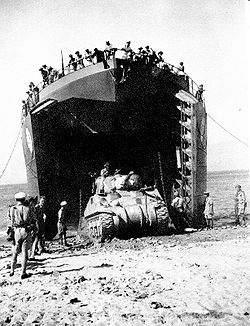
Landing Ship, Tank was the military designation for naval vessels created during World War II
World War II
World War II, or the Second World War , was a global conflict lasting from 1939 to 1945, involving most of the world's nations—including all of the great powers—eventually forming two opposing military alliances: the Allies and the Axis...
to support amphibious operations by carrying significant quantities of vehicles, cargo, and landing troops directly onto an unimproved shore.
The majority, a thousand, were laid down in the United States
United States
The United States of America is a federal constitutional republic comprising fifty states and a federal district...
during World War II for use by the Allies. Eighty more were built in the United Kingdom
United Kingdom
The United Kingdom of Great Britain and Northern IrelandIn the United Kingdom and Dependencies, other languages have been officially recognised as legitimate autochthonous languages under the European Charter for Regional or Minority Languages...
and Canada
Canada
Canada is a North American country consisting of ten provinces and three territories. Located in the northern part of the continent, it extends from the Atlantic Ocean in the east to the Pacific Ocean in the west, and northward into the Arctic Ocean...
.
LST Mk.1
The British evacuation from Dunkirk
Operation Dynamo
The Dunkirk evacuation, commonly known as the Miracle of Dunkirk, code-named Operation Dynamo by the British, was the evacuation of Allied soldiers from the beaches and harbour of Dunkirk, France, between 26 May and the early hours of 3 June 1940, because the British, French and Belgian troops were...
in 1940 demonstrated to the Admiralty
Admiralty
The Admiralty was formerly the authority in the Kingdom of England, and later in the United Kingdom, responsible for the command of the Royal Navy...
that the Allies needed relatively large, ocean-going ships capable of shore-to-shore delivery of tank
Tank
A tank is a tracked, armoured fighting vehicle designed for front-line combat which combines operational mobility, tactical offensive, and defensive capabilities...
s and other vehicles in amphibious assaults upon the continent of Europe. As an interim measure, three 4000 to 4800 GRT tankers, built to pass over the restrictive bars of Lake Maracaibo
Lake Maracaibo
Lake Maracaibo is a large brackish bay in Venezuela at . It is connected to the Gulf of Venezuela by Tablazo Strait at the northern end, and fed by numerous rivers, the largest being the Catatumbo. It is commonly considered a lake rather than a bay or lagoon, and at 13,210 km² it would be the...
, Venezuela
Venezuela
Venezuela , officially called the Bolivarian Republic of Venezuela , is a tropical country on the northern coast of South America. It borders Colombia to the west, Guyana to the east, and Brazil to the south...
, were selected for conversion because of their shallow draft. Bow doors and ramps were added to these ships which became the first tank landing ships, "LST (1)": , and . They later proved their worth during the invasion of Algeria
Operation Torch
Operation Torch was the British-American invasion of French North Africa in World War II during the North African Campaign, started on 8 November 1942....
in 1942, but their bluff bows made for inadequate speed and pointed up the need for an all-new design incorporating a sleeker hull.
The first purpose-built LST design was HMS Boxer
HMS Boxer (1941)
HMS Boxer, pennant F121, was built as a Landing Ship, Tank at Harland and Wolff. Launched in December 1942 and commissioned the following April, she saw service as part of the Allied invasion of Italy.-Design and devleopment:...
. It was a scaled down design from ideas penned by Churchill. In order to carry 13 Churchill
Churchill tank
The Tank, Infantry, Mk IV was a heavy British infantry tank used in the Second World War, best known for its heavy armour, large longitudinal chassis with all-around tracks with multiple bogies, and its use as the basis of many specialist vehicles. It was one of the heaviest Allied tanks of the war...
infantry tank
Infantry tank
The infantry tank was a concept developed by the British and French in the years leading up to World War II. Infantry tanks were tanks designed to support the infantry in the attack. To achieve this they were generally heavily armoured compared to the cruiser tanks, to allow them to operate in...
s, 27 vehicles and nearly 200 men (in addition to the crew) at a speed of 18 knots, it could not have the shallow draught that would make for easy unloading. As a result, each of the three (Boxer, Bruiser, and Thruster) ordered in March 1941 had a very long ramp stowed behind the bow doors.
The three ships were converted to "Fighter Direction Ships" for the invasion of Normandy.
Development
At their first meeting at the Atlantic conference in Argentia, Newfoundland in August 1941, President Franklin D. RooseveltFranklin D. Roosevelt
Franklin Delano Roosevelt , also known by his initials, FDR, was the 32nd President of the United States and a central figure in world events during the mid-20th century, leading the United States during a time of worldwide economic crisis and world war...
and Prime Minister Winston Churchill
Winston Churchill
Sir Winston Leonard Spencer-Churchill, was a predominantly Conservative British politician and statesman known for his leadership of the United Kingdom during the Second World War. He is widely regarded as one of the greatest wartime leaders of the century and served as Prime Minister twice...
confirmed the Admiralty's views. In November 1941, a small delegation from the Admiralty arrived in the United States to pool ideas with the United States Navy
United States Navy
The United States Navy is the naval warfare service branch of the United States Armed Forces and one of the seven uniformed services of the United States. The U.S. Navy is the largest in the world; its battle fleet tonnage is greater than that of the next 13 largest navies combined. The U.S...
's Bureau of Ships
Bureau of Ships
The United States Navy's Bureau of Ships was established by Congress on June 20, 1940, by a law which consolidated the functions of the Bureau of Construction and Repair and the Bureau of Engineering. The new Bureau was to be headed by a Chief and Deputy-Chief, one selected from the engineering...
with regard to development of ships and also including the possibility of building further Boxers in the US. During this meeting, it was decided that the Bureau of Ships would design these vessels. As with the standing agreement these would be built by the US so British shipyards could concentrate on building vessels for the Royal Navy. The specification called for vessels capable of crossing the Atlantic and the original title given to them was "Atlantic Tank Landing Craft" (Atlantic (T.L.C.)). Calling a vessel 300 ft (91.4 m) long a "craft" was considered a misnomer and the type was re-christened "Landing Ship, Tank (2)", or "LST (2)".
The LST(2) design incorporated elements of the first British LCTs from their designer, Sir Rowland Baker, who was part of the British delegation. This included sufficient buoyancy in the ships' sidewalls that they would float even with the tank deck flooded. The LST(2) gave up the speed of HMS Boxer at only 10 knots but had a similar load while drawing a draught of only 3 feet forward when beaching.
Design
Within a few days, John C. Niedermair of the Bureau of Ships sketched out an awkward looking ship that proved to be the basic design for the more than 1,000 "LST (2)" which would be built during World War II. To meet the conflicting requirements of deep draft for ocean travel and shallow draft for beaching the ship was designed with a large ballast system that could be filled for ocean passage and pumped out for beaching operations. An anchor and mechanical winch system also aided in the ship's ability to pull itself off the beach. The rough sketch was sent to Britain on 5 November 1941 and accepted immediately. The Admiralty then requested the United States to build 200 "LST (2)" for the Royal NavyRoyal Navy
The Royal Navy is the naval warfare service branch of the British Armed Forces. Founded in the 16th century, it is the oldest service branch and is known as the Senior Service...
under the terms of lend-lease
Lend-Lease
Lend-Lease was the program under which the United States of America supplied the United Kingdom, the Soviet Union, China, Free France, and other Allied nations with materiel between 1941 and 1945. It was signed into law on March 11, 1941, a year and a half after the outbreak of war in Europe in...
.
The preliminary plans initially called for an LST 280 feet (85 m) in length; but, in January 1942, the Bureau of Ships discarded these drawings in favor of specifications for a ship 290 feet (88.4 m) long. Within a month final working plans were developed which further stretched the overall length to 328 feet (100 m) and called for a 50-foot (15 m) beam and minimum draft of 3.8 feet (1.2 m). This scheme distributed the ship's weight over a greater area enabling her to ride higher in the water when in landing trim. The LST could carry a 2,100-ton (1,900 t) load of tanks and vehicles. The larger dimensions also permitted the designers to increase the width of the bow door opening and ramp from 12 to 14 feet (3.7 to 4.3 m) and thus accommodate most Allied vehicles. As the dimensions and weight of the LST increased, steel plating thickness increased from 0.25 inches (6.4 mm) to 0.375 inches (9.5 mm) on the deck and sides with 1-inch-thick plating under the bow. By January 1942, the first scale model of the LST had been built and was undergoing tests at the David Taylor Model Basin
David Taylor Model Basin
The David Taylor Model Basin is one of the largest ship model basins — test facilities for the development of ship design — in the world...
in Washington, D.C.
Washington, D.C.
Washington, D.C., formally the District of Columbia and commonly referred to as Washington, "the District", or simply D.C., is the capital of the United States. On July 16, 1790, the United States Congress approved the creation of a permanent national capital as permitted by the U.S. Constitution....
Provisions were made for the satisfactory ventilation of the tank space while the tank motors were running, and an elevator was provided to lower vehicles from the main deck to the tank deck for disembarking. In April 1942 a mock-up of the well deck of an LST was constructed at Fort Knox
Fort Knox
Fort Knox is a United States Army post in Kentucky south of Louisville and north of Elizabethtown. The base covers parts of Bullitt, Hardin, and Meade counties. It currently holds the Army Human Resources Center of Excellence to include the Army Human Resources Command, United States Army Cadet...
, Kentucky
Kentucky
The Commonwealth of Kentucky is a state located in the East Central United States of America. As classified by the United States Census Bureau, Kentucky is a Southern state, more specifically in the East South Central region. Kentucky is one of four U.S. states constituted as a commonwealth...
to resolve the problem of ventilation within the LST well-deck. The interior of the building was constructed to duplicate all the features found within an actual LST. Being the home to the Armored Force Board, Fort Knox supplied tanks to run on the inside while Naval architects developed a ventilation system capable of evacuating the well-deck of harmful gases. Testing was completed in three months. This historic building remains at Fort Knox today.
Early LST operations required overcoming the 18th century language of the Articles for the Government of the United States Navy: "He who doth suffer his ships to founder on rocks and shoals shall be punished..." There were some tense moments of concept testing at Quonset, Rhode Island in early 1943 when designer Niedermair encouraged the commanding officer of the first U.S. LST to drive his ship onto the beach at full speed of 10 knots (19.6 km/h).
Production
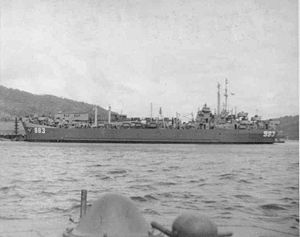
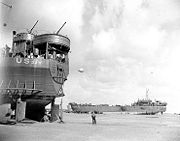
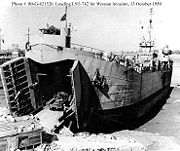
Destroyer escort
A destroyer escort is the classification for a smaller, lightly armed warship designed to be used to escort convoys of merchant marine ships, primarily of the United States Merchant Marine in World War II. It is employed primarily for anti-submarine warfare, but also provides some protection...
s, and assorted landing craft
Landing craft
Landing craft are boats and seagoing vessels used to convey a landing force from the sea to the shore during an amphibious assault. Most renowned are those used to storm the beaches of Normandy, the Mediterranean, and many Pacific islands during WWII...
. The enormous building program quickly gathered momentum. Such a high priority was assigned to the construction of LSTs that the previously laid keel of an aircraft carrier
Aircraft carrier
An aircraft carrier is a warship designed with a primary mission of deploying and recovering aircraft, acting as a seagoing airbase. Aircraft carriers thus allow a naval force to project air power worldwide without having to depend on local bases for staging aircraft operations...
was hastily removed to make room for several LSTs to be built in her place. The keel of the first LST was laid down on 10 June 1942 at Newport News
Newport News, Virginia
Newport News is an independent city located in the Hampton Roads metropolitan area of Virginia. It is at the southeastern end of the Virginia Peninsula, on the north shore of the James River extending southeast from Skiffe's Creek along many miles of waterfront to the river's mouth at Newport News...
, Va., and the first standardized LSTs were floated out of their building dock in October. Twenty-three were in commission by the end of 1942.
The LST building program was unique in several respects. As soon as the basic design had been developed, contracts were let and construction was commenced in quantity before the completion of a test vessel. Preliminary orders were rushed out verbally or by telegrams, telephone, and air mail letters. The ordering of certain materials actually preceded the completion of design work. While many heavy equipment items such as main propulsion machinery were furnished directly by the Navy, the balance of the procurement was handled centrally by the Material Coordinating Agency — an adjunct of the Bureau of Ships — so that the numerous builders in the program would not have to bid against one another. Through vigorous follow-up action on materials ordered, the agency made possible the completion of construction schedules in record time.
The need for LSTs was urgent, and the program enjoyed a high priority throughout the war. Since most shipbuilding activities were located in coastal yards and were largely used for construction of large, deep-draft ships, new construction facilities were established along inland waterways. In some instances, heavy-industry plants such as steel fabrication yards were converted for LST construction. This posed the problem of getting the completed ships from the inland building yards to deep water. The chief obstacles were bridges. The Navy successfully undertook the modification of bridges and, through a "Ferry Command" of Navy crews, transported the newly constructed ships to coastal ports for fitting out. The success of these "cornfield" shipyards of the Middle West was a revelation to the long-established shipbuilders on the coasts. Their contribution to the LST building program was enormous. Of the 1,051 LSTs built during World War II, 670 were constructed by five major inland builders. Chicago Bridge and Iron shipyard in Seneca, Illinois
Seneca, Illinois
Seneca is a village in LaSalle and Grundy counties in the U.S. state of Illinois. The population was 2,371 at the 2010 census.The LaSalle County portion of Seneca is part of the Ottawa–Streator Micropolitan Statistical Area, while the small portion that lies in Grundy County is part of the...
launched 156 ships and was specifically chosen because of their reputation and skills, particularly in welding. The most LSTs constructed during World War II were built in Evansville, Indiana
Evansville, Indiana
Evansville is the third-largest city in the U.S. state of Indiana and the largest city in Southern Indiana. As of the 2010 census, the city had a total population of 117,429. It is the county seat of Vanderburgh County and the regional hub for both Southwestern Indiana and the...
, by Missouri Valley Bridge and Iron, & International Steel Co.
Modifications
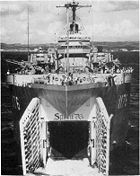
By 1943, the construction time for an LST had been reduced to four months. By the end of the war, this had been cut to two months. Considerable effort was expended to hold the ship's design constant, but, by mid-1943, operating experience led to the incorporation of certain changes in the new ships.The LST-491 class replaced the elevator installed in the original LST-1 class, to transfer equipment between the tank deck and the main deck, with a ramp that was hinged at the main deck. This allowed vehicles to be driven directly from the main deck into the tank deck, and then across the bow ramp to the beach or causeway, speeding the process of disembarkation.
Changes in the later LST-542 class included the addition of a navigation bridge, the installation of a water distillation plant with a capacity of 4,000 gallons per day, the removal of the tank deck ventilator tubes from the center section of the main deck, the strengthening the main deck to carry an LCT
Landing craft tank
The Landing Craft, Tank was an amphibious assault ship for landing tanks on beachheads. They were initially developed by the British Royal Navy and later by the United States Navy during World War II in a series of versions. Initially known as the "Tank Landing Craft" by the British, they later...
, and an upgrade in armor and armament, with the addition of a 3"/50 caliber gun.
Design
The LST (2) design was successful and production extensive but there was still a need for more LST's for British operations. As such it was decided to build a further 80 of them in UK and Canada to be available in the spring of 1945.The British Staff drew up their own specification:
- To embark and disembark tanks, motor transport etc. on beaches of varying slopes, and amphibians and DD Shermans into deep water.
- To carry five Landing Craft AssaultLanding Craft AssaultThe Landing Craft Assault was a British landing craft used extensively in World War II. Its primary purpose was to ferry troops from transport ships to attack enemy-held shores. The craft derived from a prototype designed by John I. Thornycroft Ltd. During the war it was manufactured throughout...
(LCA) or similar craft and one LCT (5) or LCT (6) on the upper deck in place of transport and as an alternative to LCT (5) two NL causeway to be carried; the LCT (5) and NL causeways to be capable of launching direct from the upper deck. - To carry 500 tons of military load and to beach with that and sufficient fuel and stores for 1000 miles (1,609.3 km) return journey at 10 knots (19.6 km/h), on draughts 4 in 6 in (1.37 m) forward and 11 in 6 in (3.51 m) aft.
- To be capable of carrying a load of sixty tons over the main ramp and ten tons over the vehicle ramp (i.e. the 50 ft (15.2 m) ramp from the upper deck to the bow door. After trials, this was removed from some vessels)
- To be fitted for operations in the tropics and in cold climates.
Two major problems made a redesign necessary. The locomotive
Locomotive
A locomotive is a railway vehicle that provides the motive power for a train. The word originates from the Latin loco – "from a place", ablative of locus, "place" + Medieval Latin motivus, "causing motion", and is a shortened form of the term locomotive engine, first used in the early 19th...
type diesel engines were not available. Staff wanted more power and higher speeds if possible. The only engines available were very heavy steam reciprocating engines from frigates that had been cancelled. These delivered two and a half times the power of the diesels. So large were they that significant changes had to be made to accommodate them. Lack of welded construction facilities meant that the hull had to be riveted. This combination of heavy hull and heavy engines meant that speed was only 3 knots faster than the LCT(2)
At the same time some other improvements were made as well as simplifications needed to allow for rivet
Rivet
A rivet is a permanent mechanical fastener. Before being installed a rivet consists of a smooth cylindrical shaft with a head on one end. The end opposite the head is called the buck-tail. On installation the rivet is placed in a punched or pre-drilled hole, and the tail is upset, or bucked A rivet...
ting most of the structure. The cutaway hard chine
Chine (boating)
A chine in boating refers to a sharp angle in the hull, as compared to the rounded bottoms of most traditional boat hulls. The term hard chine indicates an angle with little rounding, where a soft chine would be more rounded, but still involve the meeting of distinct planes. Chine log...
which had been dropped in the American version of the design of the Mark 2 vessels was restored. The tank deck, which was above the waterline, was made parallel to the keel
Keel
In boats and ships, keel can refer to either of two parts: a structural element, or a hydrodynamic element. These parts overlap. As the laying down of the keel is the initial step in construction of a ship, in British and American shipbuilding traditions the construction is dated from this event...
, there was to be no round down to the upper deck, and the ship was enlarged to accommodate the more bulky machinery.
Provision was made for carrying the British Landing Craft Assault
Landing Craft Assault
The Landing Craft Assault was a British landing craft used extensively in World War II. Its primary purpose was to ferry troops from transport ships to attack enemy-held shores. The craft derived from a prototype designed by John I. Thornycroft Ltd. During the war it was manufactured throughout...
(LCA) in gravity davit
Davit
A davit is a structure, usually made of steel, which is used to lower things over an edge of a long drop off such as lowering a maintenance trapeze down a building or launching a lifeboat over the side of a ship....
s, instead of American assault craft. Provision was also made for carrying Landing Craft Tank
Landing craft tank
The Landing Craft, Tank was an amphibious assault ship for landing tanks on beachheads. They were initially developed by the British Royal Navy and later by the United States Navy during World War II in a series of versions. Initially known as the "Tank Landing Craft" by the British, they later...
(LCT) and Landing Craft Mechanized
Landing Craft Mechanized
The Landing Craft Mechanized or Landing Craft Mechanical was a landing craft designed for carrying vehicles. They came to prominence during the Second World War when they were used to land troops or tanks during Allied amphibious assaults....
(LCM), and NL pontoon
Pontoon bridge
A pontoon bridge or floating bridge is a bridge that floats on water and in which barge- or boat-like pontoons support the bridge deck and its dynamic loads. While pontoon bridges are usually temporary structures, some are used for long periods of time...
causeway
Causeway
In modern usage, a causeway is a road or railway elevated, usually across a broad body of water or wetland.- Etymology :When first used, the word appeared in a form such as “causey way” making clear its derivation from the earlier form “causey”. This word seems to have come from the same source by...
s.
When the design was commenced, it was known that the beaches on which the ships were expected to be used would be very flat, but it was not possible to produce a satisfactory vessel with a 3 ft (0.9144 m) draught forward, and very little keel slope, so the 1 in 50 keel slope was maintained. It was known that the 1:50 slope would often result in the LST grounding aft on a shallow beach, resulting in the vehicles being discharged into comparatively deep water.
Various methods had been investigated to overcome the problem, but heavy grounding skegs and the N.L. pontoon causeways were finally accepted as standard; the pontoon causeways were formed of pontoons 7 ft (2.1 m) × 5 ft × 5 ft (1.5 m), made up into strings and rafts. When offloading, the rafts were secured to the fore end of the ship, and the load discharged directly onto the shore, or towed on the raft to the shore.
The ships were fitted out for service in both very cold and tropical conditions. The accommodation provided for both crew and army personnel was greatly improved compared with "LST (2)". The main hazard, apart from enemy action, was fire on the tank deck. Fire sprinkler
Fire sprinkler
A fire sprinkler system is an active fire protection measure, consisting of a water supply system, providing adequate pressure and flowrate to a water distribution piping system, onto which fire sprinklers are connected...
s were provided, but the water drenching system installed in later American vessels could not be provided.
The bow door arrangements were similar to the "LST (2)", but the bow ramp was arranged in two parts in an attempt to increase the number of beaches onto which direct discharge would be possible. The machinery for operating the bow doors and ramp were electrical, but otherwise steam auxiliaries were fitted instead of the electrical gear on the "LST (2)".
The general arrangements of the tank deck were similar, but head room was increased, and a ramp fitted to reach the top deck, as in later "LST (2)"s. Provision was made for carrying LCA on gravity davits instead of the American built assault boats.
The arrangements were generally an improvement on the "LST (2)"s, but they suffered from their deeper draught, and to some extent from the haste in which they were built.
First orders were placed in December 1943, 45 with British builders, and 35 with Canadian builders. The first of these ships was delivered by Swan Hunter
Swan Hunter
Swan Hunter, formerly known as "Swan Hunter & Wigham Richardson", was one of the best known shipbuilding companies in the world. Based in Wallsend, Tyne and Wear, the company was responsible for some of the greatest ships of the early 20th century — most famously, the RMS Mauretania which...
in December 1944. During 1944, follow up orders were placed in Canada for a further 36. These programmes were in full swing when the war ended, not all vessels were completed.
The ships were numbered numbers LST - 3001 to LST 3045 and LST -3501 to 3534. LST -3535 and later were cancelled.
Propulsion
Steam was supplied by a pair of AdmiraltyAdmiralty
The Admiralty was formerly the authority in the Kingdom of England, and later in the United Kingdom, responsible for the command of the Royal Navy...
3-drum water-tube type boilers, working at 225 pounds per square inch. The main engines were of the 4-cylinder triple expansion 4-crank type, balanced on the Yarrow
Yarrow
Achillea millefolium or yarrow is a flowering plant in the family Asteraceae, native to the Northern Hemisphere. In New Mexico and southern Colorado, it is called plumajillo, or "little feather", for the shape of the leaves. In antiquity, yarrow was known as herbal militaris, for its use in...
-Tweedy-Slick system, the cylinders being as follows;
| High pressure | 18.5 in diameter |
| Medium pressure | 31.0 in diameter |
| Forward low pressure | 38.5 in diameter |
| Aft low pressure | 38.5 in diameter |
The common stroke was 30 inches (762 mm). The piston and slide valve rods were all fitted with metallic packing to the stuffing boxes, and all pistons fitted with packing rings and springs. The high-pressure valve was of the piston type, whilst the remaining ones were of the balanced type.
The main engines were designed to develop 2750 hp at 185 rpm continuously.
With the ships being twin screw, the engines were fitted with a shaft coupling to the crank shaft at the forward end, allowing the engine to be turned end to end to suit either port or starboard side fitting.
Modifications for landing craft
When the "LST (3)"s were being ordered the "LST (2)" programme was in full swing, and similar arrangements were made to enable the LSTs to carry the 112 feet (34.1 m) long LCT5Landing craft tank
The Landing Craft, Tank was an amphibious assault ship for landing tanks on beachheads. They were initially developed by the British Royal Navy and later by the United States Navy during World War II in a series of versions. Initially known as the "Tank Landing Craft" by the British, they later...
or LCT6 which were being built in America for the Royal Navy.
The LCT needed lifting onto the deck of the ship, being carried on wedge-shaped support blocks; at the time of launching she was set down on the "launch ways" by simply slacking off bolts in the wedge blocks, allowing the launch way to take the weight. To carry out a launch, the LST was simply heeled over about 11 degrees by careful flooding of tanks in the hull. The height of the drop was about 10 ft (3 m), and immediately after the launch the craft's engines were started and they were ready for operation.
This method was used for moving LCT5s from Britain to the far east, although there seems to be no reference to LST (3)'s being used, most being completed late in or after the war.
Even at the end of the war there was a need for more ships able to carry minor landing craft, and two of the LST (3)'s then completing were specially fitted to carry LCM (7). These craft, which were 58 ft (17.7 m) long and weighed about 28 tons, were carried transversely on the upper deck of the ship.
They were hoisted on by means of a specially fitted 30-ton derrick; This 30 ton derrick replaced a 15-ton derrick, two of which were the standard fit of the LST (3). The 30-ton derrick was taller and generally more substantial than the 15 ton one.
The LCM (7)s were landed on trolleys fitted with hydraulic jacks. These ran on rails down each side of the deck, and were hauled to and fro by means of winches. The stowage was filled from fore to aft as each craft was jacked down onto fixed cradles between the rails. The ships completed to this standard were LST-3043/HMS Messina, and LST-3044/HMS Narvik. While these ships were able to carry LCMs, they were only able to carry out loading and unloading operations under nearly ideal weather conditions, and as such were not able to be used as such for assault operations; they also lacked the facilities to maintain the landing craft (which the Dock Landing Ships provided).
The LCAs, or Landing Craft Assault
Landing Craft Assault
The Landing Craft Assault was a British landing craft used extensively in World War II. Its primary purpose was to ferry troops from transport ships to attack enemy-held shores. The craft derived from a prototype designed by John I. Thornycroft Ltd. During the war it was manufactured throughout...
, were wartime developments. Wooden hulled, with a length of 41 in 6 in (12.65 m) overall including propeller guards. Beam was 10 ft (3 m), and had a displacement of 10 tons, rising to 13 tons fully loaded. Draught was 2 in 3 in (0.6858 m), and normal load was 35 troops with 800 lb (362.9 kg) of equipment. A pair of Scripps marine conversions of Ford V8 marine engines, producing 130 bhp at 2,800 rpm, provided propulsion producing 11 knots (21.6 km/h) unloaded, 8 knots (15.7 km/h) service speed, 3 knots (5.9 km/h) on one engine. Range was 50–80 miles on 64 gallons. Armament was typically a Bren Gun aft; with two Lewis Gun
Lewis Gun
The Lewis Gun is a World War I–era light machine gun of American design that was perfected and widely used by the British Empire. It was first used in combat in World War I, and continued in service with a number of armed forces through to the end of the Korean War...
s in a port forward position.
The LCM (7)'s that were carried on the LST (2) were considerably larger, 60 in 3 in (18.36 m) in length, 16 ft (4.9 m) beam, with a hoisting weight of 28 tons, full load displacement of 63 tons. Beaching draught was 3 in 8 in (1.12 m), and propulsion was provided by a pair of Hudson Invader petrol engines, later replaced with Grays diesels, both sets providing 290 bhp, giving a speed of 9.8 knots (19.2 km/h).
The main requirement of the design was to carry a 40-ton Churchill tank
Churchill tank
The Tank, Infantry, Mk IV was a heavy British infantry tank used in the Second World War, best known for its heavy armour, large longitudinal chassis with all-around tracks with multiple bogies, and its use as the basis of many specialist vehicles. It was one of the heaviest Allied tanks of the war...
or bulldozer at 10 knots (19.6 km/h). 140 had been completed when the war ended, and some saw service through to the 1970s.
Variants
Some LST(3) were converted to LST(A) (A for "assault") by adding stiffening so they could carry the heaviest British tanks.Two LST(3) were converted to command vessels, LST(C): LST 3043 and LST 3044. Post war they became HMS Messina (L112) and HMS Narvik (L114). They were better armed with ten 20 mm Oerlikons and four 40 mm Bofors.
Two LST(3) were converted during building into Headquarters command ships LST(Q) these were L3012 which became L3101 (and later HMS Ben Nevis) and LST 3013 which became LST 3102, and then HMS Ben Lomond. They acted as LST "mother ships", similar in most aspects to American ships based on the LST (2) hull. They had two Quonset hut
Quonset hut
A Quonset hut is a lightweight prefabricated structure of corrugated galvanized steel having a semicircular cross section. The design was based on the Nissen hut developed by the British during World War I...
s erected on the main deck to accommodate 40 officers. Berths on the tank deck berthed an extra 196 men. A bake shop and 16 refrigeration boxes for fresh provisions augmented the facilities normally provided for the crew. Four extra distilling units were added, and the ballast tanks were converted for the storage of fresh water.
Service in World War II
At the Armor Training School in Ft. Knox, KY, buildings were erected as exact mock-ups of an LST. Tank crews in training learned how to maneuver their vehicles onto, in and from an LST with these facilities. One of these buildings has been preserved at Ft. Knox for historic reasons and can still be seen there.From their combat debut in the Solomon Islands
Solomon Islands
Solomon Islands is a sovereign state in Oceania, east of Papua New Guinea, consisting of nearly one thousand islands. It covers a land mass of . The capital, Honiara, is located on the island of Guadalcanal...
in June 1943 until the end of the hostilities in August 1945, the LSTs performed a vital service in World War II. They participated in the invasions of Sicily
Sicily
Sicily is a region of Italy, and is the largest island in the Mediterranean Sea. Along with the surrounding minor islands, it constitutes an autonomous region of Italy, the Regione Autonoma Siciliana Sicily has a rich and unique culture, especially with regard to the arts, music, literature,...
(Operation Husky), Italy
Allied invasion of Italy
The Allied invasion of Italy was the Allied landing on mainland Italy on September 3, 1943, by General Harold Alexander's 15th Army Group during the Second World War. The operation followed the successful invasion of Sicily during the Italian Campaign...
, Normandy
Operation Overlord
Operation Overlord was the code name for the Battle of Normandy, the operation that launched the invasion of German-occupied western Europe during World War II by Allied forces. The operation commenced on 6 June 1944 with the Normandy landings...
, and southern France
Operation Dragoon
Operation Dragoon was the Allied invasion of southern France on August 15, 1944, during World War II. The invasion was initiated via a parachute drop by the 1st Airborne Task Force, followed by an amphibious assault by elements of the U.S. Seventh Army, followed a day later by a force made up...
in the European Theater
European Theatre of World War II
The European Theatre of World War II was a huge area of heavy fighting across Europe from Germany's invasion of Poland on September 1, 1939 until the end of the war with the German unconditional surrender on May 8, 1945...
and were an essential element in the island-hopping campaigns in the Pacific which culminated in the liberation of the Philippines
Battle of Leyte
The Battle of Leyte in the Pacific campaign of World War II was the invasion and conquest of the island of Leyte in the Philippines by American and Filipino guerrilla forces under the command of General Douglas MacArthur, who fought against the Imperial Japanese Army in the Philippines led by...
and the capture of Iwo Jima
Battle of Iwo Jima
The Battle of Iwo Jima , or Operation Detachment, was a major battle in which the United States fought for and captured the island of Iwo Jima from the Empire of Japan. The U.S...
and Okinawa
Battle of Okinawa
The Battle of Okinawa, codenamed Operation Iceberg, was fought on the Ryukyu Islands of Okinawa and was the largest amphibious assault in the Pacific War of World War II. The 82-day-long battle lasted from early April until mid-June 1945...
.
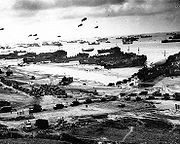
The LST proved to be a remarkably versatile ship. A number of them were converted to become landing craft repair ships
Achelous class repair ship
The Achelous class repair ship was a class of ship built by the US Navy during World War II.As the US gained experience in amphibious operations, it was realized that some sort of mobile repair facility would be useful for repairing the damage that frequently occurred to smaller vessels such as...
(ARL). In this design, the bow ramp and doors were removed, and the bow was sealed. Derricks, booms, and winches were added to haul damaged landing craft on board for repairs, and blacksmith, machine, and electrical workshops were provided on the main deck and tank deck. Another successful conversion was the LST "Mother Ship". This version of the standard LST hull had two Quonset huts erected on the main deck to accommodate 40 officers. Bunks on the tank deck berthed an additional 196 men. A bake shop and 16 refrigeration boxes for fresh provisions augmented the facilities normally provided the crew. Four extra distilling units were added, and the ballast tanks were converted for storage of fresh water.
Hospital ship
A hospital ship is a ship designated for primary function as a floating medical treatment facility or hospital; most are operated by the military forces of various countries, as they are intended to be used in or near war zones....
s and designated LSTH
LSTH
An LSTH was designed to act as a hospital ship, but because they retained armament were not officially designated as such. The Tank Landing Ship was a vessel designed to beach itself and unload equipment, vehicles, tanks, and troops onto an enemy beach...
. They supplemented the many standard LSTs which removed casualties from the beach following the landing of their cargo of tanks and vehicles. LSTs had brought 41,035 wounded men back across the English Channel
English Channel
The English Channel , often referred to simply as the Channel, is an arm of the Atlantic Ocean that separates southern England from northern France, and joins the North Sea to the Atlantic. It is about long and varies in width from at its widest to in the Strait of Dover...
from Normandy
Normandy
Normandy is a geographical region corresponding to the former Duchy of Normandy. It is in France.The continental territory covers 30,627 km² and forms the preponderant part of Normandy and roughly 5% of the territory of France. It is divided for administrative purposes into two régions:...
by D-Day+114 (28 September 1944). Other LSTs, provided with extra cranes and handling gear, were used exclusively for replenishing ammunition. They possessed a special advantage in this role, as their size permitted two or three LSTs to go simultaneously alongside an anchored battleship
Battleship
A battleship is a large armored warship with a main battery consisting of heavy caliber guns. Battleships were larger, better armed and armored than cruisers and destroyers. As the largest armed ships in a fleet, battleships were used to attain command of the sea and represented the apex of a...
or cruiser
Cruiser
A cruiser is a type of warship. The term has been in use for several hundreds of years, and has had different meanings throughout this period...
to accomplish replenishment more rapidly than standard ammunition ships.
Three LST (2) were converted into British "Fighter Direction Tenders" swapping their landing craft for Motor Launch
Motor Launch
A Motor Launch is a small military vessel in British navy service. It was designed for harbour defence and submarine chasing or for armed high speed air-sea rescue....
es.
In the latter stages of World War II, some LSTs such as were fitted with flight decks from which small observation planes were sent up during amphibious operations. It has been estimated that, in the combined fleets assembled for the war on Japan
Empire of Japan
The Empire of Japan is the name of the state of Japan that existed from the Meiji Restoration on 3 January 1868 to the enactment of the post-World War II Constitution of...
, the tonnage of landing ships, excluding landing craft, would have exceeded five million tons and nearly all built within four years.
Throughout the war, LSTs demonstrated a remarkable capacity to absorb punishment and survive. Despite the sobriquets "Large Slow Target" and "Large Stationary Target" which were applied to them by irreverent crew members, the LSTs suffered few losses in proportion to their number and the scope of their operations. Their brilliantly conceived structural arrangement provided unusual strength and buoyancy; was struck and holed in a post-war collision with a Victory ship
Victory ship
The Victory ship was a type of cargo ship produced in large numbers by North American shipyards during World War II to replace shipping losses caused by German submarines...
and survived. Although the LST was considered a valuable target by the enemy, only 26 were lost due to enemy action, and a mere 13 were the victims of weather, reef, or accident. A total of 1,152 LSTs were contracted for in the great naval building program of World War II, but 101 were cancelled in the fall of 1942 because of shifting construction priorities. Of 1,051 actually constructed, 113 LSTs were transferred to Britain under the terms of Lend-Lease, and four more were turned over to the Greek Navy. Conversions to other ship types with different hull designations accounted for 116.
United States

Ferry
A ferry is a form of transportation, usually a boat, but sometimes a ship, used to carry primarily passengers, and sometimes vehicles and cargo as well, across a body of water. Most ferries operate on regular, frequent, return services...
, and dredge
Dredge
Dredging is an excavation activity or operation usually carried out at least partly underwater, in shallow seas or fresh water areas with the purpose of gathering up bottom sediments and disposing of them at a different location...
s. Consequently, construction of LSTs in the immediate post-war years was modest. LST-1153
USS Talbot County (LST-1153)
USS Talbot County was a tank landing ship built for the United States Navy just after World War II. The lead ship of her class of only two vessels, she was named after counties in Maryland and Georgia, and was the only U.S...
and LST-1154
USS Tallahatchie County (LST-1154)
USS Tallahatchie County was the second of only two Talbot County-class tank landing ships built for the United States Navy just after World War II. Named after Tallahatchie County, Mississippi, she was the only U.S...
, commissioned respectively in 1947 and 1949, were the only steam-driven LSTs ever built by the Navy. They provided improved berthing arrangements and a greater cargo capacity than their predecessors.
The success of the amphibious assault at Inchon
Battle of Inchon
The Battle of Inchon was an amphibious invasion and battle of the Korean War that resulted in a decisive victory and strategic reversal in favor of the United Nations . The operation involved some 75,000 troops and 261 naval vessels, and led to the recapture of the South Korean capital Seoul two...
during the Korean War
Korean War
The Korean War was a conventional war between South Korea, supported by the United Nations, and North Korea, supported by the People's Republic of China , with military material aid from the Soviet Union...
pointed out the utility of LSTs once again. This was in contrast with the earlier opinion expressed by many military authorities that the advent of the atomic bomb had relegated amphibious landings to a thing of the past. As a consequence, fifteen LSTs of what were later to be known as the Terrebonne Parish-class were constructed in the early 1950s. These new LSTs were 56 feet (17.1 m) longer and were equipped with four, rather than two, diesel engines, which increased their speed to 15 knots (29.4 km/h). Three-inch 50-caliber twin mounts replaced the old twin 40-millimeter guns, and controllable pitch propellers improved the ship's backing power. On 1 July 1955, county or parish
Parish
A parish is a territorial unit historically under the pastoral care and clerical jurisdiction of one parish priest, who might be assisted in his pastoral duties by a curate or curates - also priests but not the parish priest - from a more or less central parish church with its associated organization...
names (Louisiana
Louisiana
Louisiana is a state located in the southern region of the United States of America. Its capital is Baton Rouge and largest city is New Orleans. Louisiana is the only state in the U.S. with political subdivisions termed parishes, which are local governments equivalent to counties...
counties are called "parishes") were assigned to many LSTs, which up to then had borne only a letter-number hull designation.
In the late 1950s, seven LSTs of the De Soto County-class
USS De Soto County (LST-1171)
USS De Soto County was a built for the United States Navy during the late 1950s. The lead ship of her class of seven, she was named after counties in Florida, Louisiana, and Mississippi, the only U.S...
were constructed. These were an improved version over earlier LSTs, with a high degree of habitability for the crew and embarked troops. Considered the "ultimate" design attainable with the traditional LST bow door configuration, they were capable of 17.5 knots (34.3 km/h).
The LST (3) as commercial ferry
In 1946 a brand new concept of transport was developed in the UK. It was during World War II that a few experienced men recognised the great potential of landing ships and craft. The idea was simple; if you could drive tanks, guns and lorries directly onto a ship and then drive them off at the other end directly onto a beach, then theoretically you could use the same landing craft to carry out the same operation in the civilian commercial market, providing there were reasonable port facilities. From this idea grew the worldwide roll-on/roll-off ferryFerry
A ferry is a form of transportation, usually a boat, but sometimes a ship, used to carry primarily passengers, and sometimes vehicles and cargo as well, across a body of water. Most ferries operate on regular, frequent, return services...
industry of today. In the period between the wars Michael Bustard formed the Atlantic Steam Navigation Company, with a view to cheap transatlantic travel, this never materialised, but during the war he observed trials on Brighton Sands of an LST in 1943 when its peacetime capabilities were obvious.
In the spring of 1946 Michael Bustard approached the Admiralty with a request to purchase three of these vessels. The Admiralty were unwilling to sell, but after negotiations agreed to let the ASN have the use of three vessels on bareboat charter
Bareboat charter
A bareboat charter is an arrangement for the chartering or hiring of a ship or boat, whereby no crew or provisions are included as part of the agreement; instead, the people who rent the vessel from the owner are responsible for taking care of such things....
at a rate of £13 6s 8d per day. These vessels were LSTs 3519, 3534, and 3512. They were renamed Empire Baltic
HMS LST 3519
HMS LST 3519 was a Landing Ship, Tank of the Royal Navy, entering service during the last months of the Second World War. She was chartered for civilian service as the Empire Baltic from 1946, serving as an early RO-RO ferry until the navy suspended the charter and requisitioned the ship during...
, , and , perpetuating the name of White Star Line
White Star Line
The Oceanic Steam Navigation Company or White Star Line of Boston Packets, more commonly known as the White Star Line, was a prominent British shipping company, today most famous for its ill-fated vessel, the RMS Titanic, and the World War I loss of Titanics sister ship Britannic...
ships.
The chartered vessels had to be adapted for their new role. First the accommodation on board had to be improved, and alterations in the engine and boiler rooms had also to be made. Modified funnels and navigational aids had also to be provided before they could enter service. On the morning of 11 September 1946 the first voyage of the Atlantic Steam Navigation Company took place when the Empire Baltic sailed from Tilbury
Port of Tilbury
The Port of Tilbury is located on the River Thames at Tilbury in Essex, England. It is the principal port for London; as well as being the main United Kingdom port for handling the importation of paper. There are extensive facilities for containers, grain, and other bulk cargoes. There are also...
to Rotterdam
Rotterdam
Rotterdam is the second-largest city in the Netherlands and one of the largest ports in the world. Starting as a dam on the Rotte river, Rotterdam has grown into a major international commercial centre...
with a full load of 64 vehicles for the Dutch Government. On arrival at Waalhaven the vessel beached using the method employed during wartime landings, being held by a stern anchor. The vessel stayed on the beach overnight, returning at 08:00 the next morning. This leisurely pace of work was followed for the first few voyages, the beach being employed possibly due to normal port facilities being unavailable due to wartime damage. Following the Rotterdam maiden voyage, ASN used their new vessels to transfer thousands of vehicles for the Army from Tilbury to Hamburg, later moved to Antwerp in 1955.
The original three LSTs were joined in 1948 by another vessel, LST 3041
LST 3041
LST 3041 was a Landing Ship, Tank that served in the Royal Navy at the end of World War II, before being converted to a commercial ferry. She was later requisitioned by the Navy during the Suez Crisis, and was scrapped in 1960.-Description:...
, renamed Empire Doric, after the ASN were able to convince commercial operators to support the new route between Preston and the Antrim port of Larne
Larne
Larne is a substantial seaport and industrial market town on the east coast of County Antrim, Northern Ireland with a population of 18,228 people in the 2001 Census. As of 2011, there are about 31,000 residents in the greater Larne area. It has been used as a seaport for over 1,000 years, and is...
. Originally Liverpool
Liverpool
Liverpool is a city and metropolitan borough of Merseyside, England, along the eastern side of the Mersey Estuary. It was founded as a borough in 1207 and was granted city status in 1880...
was chosen, but opposition from other operators led to a move to Preston in Lancashire. However, special port facilities were constructed at both Preston and Larne before the new route could be opened – a wartime-built end loading ramp built by engineers during World War II at Preston, and a floating pontoon from a Mulberry harbour
Mulberry harbour
A Mulberry harbour was a British type of temporary harbour developed in World War II to offload cargo on the beaches during the Allied invasion of Normandy....
connected via a bridge to the Quay at Larne.
The first sailing of this new route was on 21 May 1948 by Empire Cedric. After the inaugural sailing Empire Cedric continued on the Northern Ireland service, offering initially a twice-weekly service. Empire Cedric was the first vessel of the ASN fleet to hold a Passenger Certificate, and was allowed to carry fifty passengers. Thus Empire Cedric became the first vessel in the world to operate as a commercial/passenger Roll-on/roll-off ferry, and the ASN became the first commercial company to offer this type of service.
Some of the first cargo on this service were two lorry-loads of 65 gas cookers each on behalf of Messrs Moffats of Blackburn, believed to be the first commercial vehicles carried in this way as freight. The Preston—Larne service continued to expand, so much so that in 1950 the service was expanded to include a service to Belfast. This service opened in 1950 and sailings out of Preston were soon increased to six or seven a week to either Belfast or Larne.
In 1954, the British Transport Commission
British Transport Commission
The British Transport Commission was created by Clement Attlee's post-war Labour government as a part of its nationalisation programme, to oversee railways, canals and road freight transport in Great Britain...
(BTC) took over the ASN under the Labour Governments nationalization
Nationalization
Nationalisation, also spelled nationalization, is the process of taking an industry or assets into government ownership by a national government or state. Nationalization usually refers to private assets, but may also mean assets owned by lower levels of government, such as municipalities, being...
policy. In 1955 another two LSTs where chartered into the existing fleet, Empire Cymric and Empire Nordic, bringing the fleet strength to seven. The Hamburg service was terminated in 1955, and a new service was opened between Antwerp and Tilbury. The fleet of seven ships was to be split up with the usual three ships based at Tilbury and the others maintaining the Preston to Northern Ireland service.
During late 1956, the entire fleet of ASN were taken over for use in the Mediterranean during the Suez Crisis
Suez Crisis
The Suez Crisis, also referred to as the Tripartite Aggression, Suez War was an offensive war fought by France, the United Kingdom, and Israel against Egypt beginning on 29 October 1956. Less than a day after Israel invaded Egypt, Britain and France issued a joint ultimatum to Egypt and Israel,...
, and the Drive on/Drive off services were not re-established until January 1957. At this point ASN were made responsible for the management of twelve Admiralty LST (3)'s brought out of reserve as a result of the Suez Crisis too late to see service.
The LST (3) in Army service
A major task at the end of World War II was the redistribution of stores and equipment worldwide. Due to the scarcity and expense of merchant shipping it was decided in 1946 that the Royal Army Service CorpsRoyal Army Service Corps
The Royal Army Service Corps was a corps of the British Army. It was responsible for land, coastal and lake transport; air despatch; supply of food, water, fuel, and general domestic stores such as clothing, furniture and stationery ; administration of...
civilian fleet should take over seven LSTs from the Royal Navy, These were named after distinguished corps officers; Evan Gibb, Charles Macleod, Maxwell Brander, Snowden Smith, Humphrey Gale, Reginald Kerr, Fredrick Glover.
The LSTs needed to comply with Board of Trade
Board of Trade
The Board of Trade is a committee of the Privy Council of the United Kingdom, originating as a committee of inquiry in the 17th century and evolving gradually into a government department with a diverse range of functions...
regulations, and to be brought up to merchant navy standards, which involved lengthy alterations including extra accommodation. On completion, five vessels sailed for the Middle East, and two for the Far East.
During the evacuation of Palestine, Humphrey Gale and Evan Gibb made fifteen voyages each between Haifa
Haifa
Haifa is the largest city in northern Israel, and the third-largest city in the country, with a population of over 268,000. Another 300,000 people live in towns directly adjacent to the city including the cities of the Krayot, as well as, Tirat Carmel, Daliyat al-Karmel and Nesher...
and Port Said
Port Said
Port Said is a city that lies in north east Egypt extending about 30 km along the coast of the Mediterranean Sea, north of the Suez Canal, with an approximate population of 603,787...
lifting between them 26,000 tons of vehicles and stores.
Similar work was done worldwide until 1952 when the ships were handed over to the Atlantic Steam Navigation Company, and subsequently in 1961 to the British-India Steam Navigation Company
British-India Steam Navigation Company
British India Steam Navigation Company was formed in 1856 as the Calcutta and Burmah Steam Navigation Company. The company had been formed out of Mackinnon, Mackenzie & Co, a trading partnership of the Scots William Mackinnon and Robert Mackenzie, to carry mail between Calcutta and Rangoon. It...
, tasked by the War Office directly, RASC having no further concern with their administration.
The LST (3) as aviation training ship
The rapid increase in the use of helicopters in the Royal Navy in the late 1950s and 1960s required an increase in the training and support facilities ashore and afloat. Operational training for aircrew was carried out by naval air stations at Portland and Culdrose. The scrapping of some carriers, and conversion of other to commando carriers in the mid-1950s left a shortage of suitable decks. This led to the ordering of the RFA EngadineRFA Engadine (K08)
RFA Engadine was a helicopter support ship of the Royal Fleet Auxiliary. The need for Engadine was seen in the mid-1960s as more and more helicopters were deployed from Royal Navy aircraft carriers and surface combatants. The ship was ordered in August 1964, from Henry Robb of Leith , and...
in 1964; however she would not be available till 1967, in the meantime it was decided to convert LST 3027 to serve as an interim training ship.
This work was carried out at Devonport Dockyard in 1964. The deck forward of the cargo hatch was cleared of all obstructions, and strengthened for helicopter use. A small deckhouse used to support the gun emplacements was retained, although no guns were fitted, and it was used by the Flight Deck Officer as a helicopter control position. Below deck, two 10,000 gallon aviation fuel tanks were installed at the fore end of the tank deck, and refuelling positions provided at the fore end of the flight deck. The tanks were sealed off by a bulkhead and the rest of the space used for stores, workshops and accommodation. Finally the bow doors were sealed, as they would no longer be needed. The flight deck was large enough for two Westland Wessex
Westland Wessex
The Westland Wessex is a British turbine-powered version of the Sikorsky S-58 "Choctaw", developed under license by Westland Aircraft , initially for the Royal Navy, and later for the Royal Air Force...
helicopters with rotors turning, or six could be parked with rotors folded. Renamed she proved extremely useful in service, and many lessons were learned that would be incorporated into Engadine.
Last WWII survivors
, previously LST-3515 survived until 2010 at what was formerly Pounds scrapyard at the northern end of Portsea IslandPortsea Island
Portsea Island is a small, flat and low lying island just off the south coast of England. The island is totally within, and contains a large proportion of, the city of Portsmouth. It has the third-largest population of any island in the British Isles, after the mainlands of Great Britain and...
.
, previously LST-120 and Hellenic Navy
Hellenic Navy
The Hellenic Navy is the naval force of Greece, part of the Greek Armed Forces. The modern Greek navy has its roots in the naval forces of various Aegean Islands, which fought in the Greek War of Independence...
RHS Syros (L-144) is one of the last operating survivors of World War II. It is currently home ported at Evansville, Indiana at the USS LST Memorial museum. The ship is kept in navigable shape and participated in a cruise from Evansville, Indiana
Evansville, Indiana
Evansville is the third-largest city in the U.S. state of Indiana and the largest city in Southern Indiana. As of the 2010 census, the city had a total population of 117,429. It is the county seat of Vanderburgh County and the regional hub for both Southwestern Indiana and the...
to Pittsburgh, Pennsylvania
Pittsburgh, Pennsylvania
Pittsburgh is the second-largest city in the US Commonwealth of Pennsylvania and the county seat of Allegheny County. Regionally, it anchors the largest urban area of Appalachia and the Ohio River Valley, and nationally, it is the 22nd-largest urban area in the United States...
for the Amphibious Reunion in Pittsburgh from September 1–7, 2010. Upon completion of the reunion, the ship sailed from Pittsburgh to Marietta, Ohio
Marietta, Ohio
Marietta is a city in and the county seat of Washington County, Ohio, United States. During 1788, pioneers to the Ohio Country established Marietta as the first permanent American settlement of the new United States in the Northwest Territory. Marietta is located in southeastern Ohio at the mouth...
, to take part in the Sternwheel Festival.
participated in the Invasion of Normandy and has operated as a ferry in New England for almost 30 years. She currently operates between New London, Connecticut
New London, Connecticut
New London is a seaport city and a port of entry on the northeast coast of the United States.It is located at the mouth of the Thames River in New London County, southeastern Connecticut....
and Long Island, New York.
which participated in the landings on Sicily; at Salerno, and the Invasion of Normandy is now located in Muskegon, Michigan as a museum and undergoing restoration.
USS Maricopa County
USS Maricopa County (LST-938)
USS Maricopa County was an built for the United States Navy during World War II. Named after Maricopa County, Arizona, she was the only U.S. Naval vessel to bear the name....
, previously , had been transferred to the Republic of Vietnam Navy
Republic of Vietnam Navy
The Republic of Vietnam Navy was the naval force of the former Republic of Vietnam from 1955 to 1975. The early fleet consisted of boats from France. After 1955 and the transfer of the armed forces to Vietnamese control, the fleet was supplied from the United States...
, and after the Fall of Saigon
Fall of Saigon
The Fall of Saigon was the capture of Saigon, the capital of South Vietnam, by the People's Army of Vietnam and the National Liberation Front on April 30, 1975...
was captured by North Vietnamese forces. , she is active and in commission with the Vietnamese People's Navy as the Tran Khanh Du.
The Philippine Navy
Philippine Navy
The Philippine Navy is the naval arm of the Armed Forces of the Philippines . Its official name in Filipino is Hukbong Dagat ng Pilipinas, literally, "Sea Force of the Philippines"....
received 20+ units of the LST Mk.2 since 1969, and still have 7 units on their active list as of 2010. This includes BRP Laguna (LT-501) (ex-USS LST-230)
USS LST-230
USS LST-230 was an built for the United States Navy during World War II.LST-230 was laid down on 10 June 1943 at Seneca, III., by the Chicago Bridge & Iron Co.; launched on 12 October 1943; sponsored by Mrs...
, BRP Zamboanga del Sur (LT-86) (ex-USS Marion County (LST-975)
USS Marion County (LST-975)
USS Marion County was an built for the United States Navy during World War II. Named after counties in seventeen U.S. states, she was the only U.S. Naval vessel to bear the name....
, BRP Kalinga Apayao (LT-516) (ex-USS Garrett County (LST-786)
USS Garrett County (LST-786)
USS Garrett County was an built for the United States Navy during World War II. Named after Garrett County, Maryland, she was the only U.S. Naval vessel to bear the name....
and BRP Benguet (LT-507) (ex-USS Daviess County (LST-692)
USS Daviess County (LST-692)
USS Daviess County was an built for the United States Navy during World War II. Named after counties in Indiana, Kentucky, and Missouri, she was the only U.S. Naval vessel to bear the name....
.
Modern developments
Newport class tank landing ship
Newport-class tank-landing ships are an improved class of American tank-landing ship , intended to provide substantial advantages over their World War II-era predecessors...
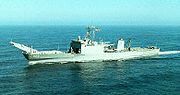
in 1969 marked the introduction of an entirely new concept in the design of LSTs. She was the first of a new class of 20 LSTs capable of steaming at a sustained speed of 20 knots (39.2 km/h). To obtain that speed, the traditional blunt bow doors of the LST were replaced by a pointed ship bow. Unloading is accomplished through the use of a 112-foot (34 m) ramp
Drawbridge
A drawbridge is a type of movable bridge typically associated with the entrance of a castle surrounded by a moat. The term is often used to describe all different types of movable bridges, like bascule bridges and lift bridges.-Castle drawbridges:...
operated over the bow and supported by twin derrick arms. A stern gate to the tank deck permits unloading of LVTs
Landing Vehicle Tracked
The Landing Vehicle Tracked was a class of amphibious vehicles introduced by the United States Navy, Marine Corps and Army during World War II. Originally intended solely as cargo carriers for ship to shore operations, they rapidly evolved into assault troop and fire support vehicles as well...
into the water or the unloading of other vehicles into a landing craft utility
Landing Craft Utility
The Landing Craft Utility is a type of boat used by amphibious forces to transport equipment and troops to the shore. They are capable of transporting tracked or wheeled vehicles and troops from amphibious assault ships to beachheads or piers....
(LCU), onto a pier, or directly into the water. Capable of operating with high-speed amphibious squadrons consisting of LHA
LHA (hull classification symbol)
thumb|right|300px|USS Tarawa LHA, for Landing Helicopter Assault, is the US Navy hull classification symbol for the general purpose helicopter-carrying amphibious assault ships of the Tarawa and the future America classes. They are used to transport Fleet Marine Force personnel and equipment while...
s, LPD
Amphibious transport dock
An amphibious transport dock, also called a landing platform/dock , is an amphibious warfare ship, a warship that embarks, transports, and lands elements of a landing force for expeditionary warfare missions. Several navies currently operate this kind of ship...
s, and LSD
Dock landing ship
A Dock landing ship or Landing ship is a form of amphibious warship designed to support amphibious operations. These amphibious assault ships transport and launch amphibious craft and vehicles with their crews and embarked personnel...
s, the Newport-class LST can transport tanks, other heavy vehicles, and engineer equipment which cannot readily be landed by helicopter
Helicopter
A helicopter is a type of rotorcraft in which lift and thrust are supplied by one or more engine-driven rotors. This allows the helicopter to take off and land vertically, to hover, and to fly forwards, backwards, and laterally...
s or landing craft. The Newport type has been removed from the U.S. Navy, but serves on in the navies of Brazil
Brazil
Brazil , officially the Federative Republic of Brazil , is the largest country in South America. It is the world's fifth largest country, both by geographical area and by population with over 192 million people...
, Chile
Chile
Chile ,officially the Republic of Chile , is a country in South America occupying a long, narrow coastal strip between the Andes mountains to the east and the Pacific Ocean to the west. It borders Peru to the north, Bolivia to the northeast, Argentina to the east, and the Drake Passage in the far...
, Malaysia, Mexico
Mexico
The United Mexican States , commonly known as Mexico , is a federal constitutional republic in North America. It is bordered on the north by the United States; on the south and west by the Pacific Ocean; on the southeast by Guatemala, Belize, and the Caribbean Sea; and on the east by the Gulf of...
, Morocco
Morocco
Morocco , officially the Kingdom of Morocco , is a country located in North Africa. It has a population of more than 32 million and an area of 710,850 km², and also primarily administers the disputed region of the Western Sahara...
, Taiwan
Taiwan
Taiwan , also known, especially in the past, as Formosa , is the largest island of the same-named island group of East Asia in the western Pacific Ocean and located off the southeastern coast of mainland China. The island forms over 99% of the current territory of the Republic of China following...
, Spain
Spain
Spain , officially the Kingdom of Spain languages]] under the European Charter for Regional or Minority Languages. In each of these, Spain's official name is as follows:;;;;;;), is a country and member state of the European Union located in southwestern Europe on the Iberian Peninsula...
, in a modified form, Australia
Australia
Australia , officially the Commonwealth of Australia, is a country in the Southern Hemisphere comprising the mainland of the Australian continent, the island of Tasmania, and numerous smaller islands in the Indian and Pacific Oceans. It is the world's sixth-largest country by total area...
and soon with Peru
Peru
Peru , officially the Republic of Peru , is a country in western South America. It is bordered on the north by Ecuador and Colombia, on the east by Brazil, on the southeast by Bolivia, on the south by Chile, and on the west by the Pacific Ocean....
. Indian Navy
Indian Navy
The Indian Navy is the naval branch of the armed forces of India. The President of India serves as the Commander-in-Chief of the Navy. The Chief of Naval Staff , usually a four-star officer in the rank of Admiral, commands the Navy...
also maintains a fleet of LSTs.
Literature
The Ninety and Nine by William BrinkleyWilliam Brinkley
William Clark "Bill" Brinkley was an American writer and journalist.Brinkley is perhaps best known for his 1988 novel, The Last Ship, and his 1956 novel, Don't Go Near the Water, which was later adapted to film in 1957 by Metro-Goldwyn-Mayer as Don't Go Near the Water.-Early life and...
, author of Don't Go Near the Water
Don't Go Near the Water (novel)
-Background:Dont Go Near the Water is a lighthearted, comedic war novel, dealing with public relations officers in the United States Navy during World War II...
, portrays an LST running supplies to Anzio
Anzio
Anzio is a city and comune on the coast of the Lazio region of Italy, about south of Rome.Well known for its seaside harbour setting, it is a fishing port and a departure point for ferries and hydroplanes to the Pontine Islands of Ponza, Palmarola and Ventotene...
during World War II
World War II
World War II, or the Second World War , was a global conflict lasting from 1939 to 1945, involving most of the world's nations—including all of the great powers—eventually forming two opposing military alliances: the Allies and the Axis...
. The title refers to the ship's company of ninety enlisted men and nine officers. The book opens with a quotation attributed to Winston Churchill
Winston Churchill
Sir Winston Leonard Spencer-Churchill, was a predominantly Conservative British politician and statesman known for his leadership of the United Kingdom during the Second World War. He is widely regarded as one of the greatest wartime leaders of the century and served as Prime Minister twice...
- "The destinies of two great empires ... seemed to be tied by some god-damned things called LST's."
In the biography MAN IN MOTION: Michigan's Legendary Senate Majority Leader, Emil Lockwood by Stanley C. Fedewa and Marilyn H. Fedewa, Lockwood colorfully describes his World War II service aboard LST-478. "We were always in the thick of it," Emil
Emil Lockwood
Emil Lockwood represented Gratiot County in the Michigan Senate from 1963 to 1970, serving as Republican Party Senate Minority Leader from 1965 to 1966 and Senate Majority Leader from 1967 to 1970. With F.J. Coomes in 1971, he co-founded Public Affairs Associates , the state's first multi-client...
said, "because it was our job on the LSTs to carry personnel-operated tanks, artillery, supplies—anything, you name it—into the heart of a war zone."
See also
- List of amphibious warfare ships
- List of LSTs
- LSTHLSTHAn LSTH was designed to act as a hospital ship, but because they retained armament were not officially designated as such. The Tank Landing Ship was a vessel designed to beach itself and unload equipment, vehicles, tanks, and troops onto an enemy beach...
- West Loch DisasterWest Loch DisasterThe West Loch Disaster was a previously secret American World War II maritime accident which led to the deaths of 163 men at the U.S. naval base of Pearl Harbor in Hawaii on 21 May 1944...
External links
- HMS MISOA - LANDING SHIP TANK (LST)
- Ship Tour LST325 in Evansville, Indiana
- DANFS: TANK LANDING SHIPS (LST)
- NavSource Online: Tank Landing Ship (LST) Index
- InsideLST.com - a selection of information on the construction, complement, &c of LSTs, mostly taken from LST-325
- United States LST Association website
- The American Amphibious Forces Association - information about later classes of LSTs
- History of LSTs including description of LSTs in use as aircraft carriers etc..
- The US LST Ship Memorial - A preserved and operational LST from World War II - LST 325
- LST Story Film: the building and launch of Tank Landing Ship Coconino County (LST-603) during World War II.