

Locomotive

Encyclopedia
Rail transport
Rail transport is a means of conveyance of passengers and goods by way of wheeled vehicles running on rail tracks. In contrast to road transport, where vehicles merely run on a prepared surface, rail vehicles are also directionally guided by the tracks they run on...
vehicle
Vehicle
A vehicle is a device that is designed or used to transport people or cargo. Most often vehicles are manufactured, such as bicycles, cars, motorcycles, trains, ships, boats, and aircraft....
that provides the motive power for a train
Train
A train is a connected series of vehicles for rail transport that move along a track to transport cargo or passengers from one place to another place. The track usually consists of two rails, but might also be a monorail or maglev guideway.Propulsion for the train is provided by a separate...
. The word originates from the Latin loco – "from a place", ablative
Ablative case
In linguistics, ablative case is a name given to cases in various languages whose common characteristic is that they mark motion away from something, though the details in each language may differ...
of locus, "place" + Medieval Latin motivus, "causing motion", and is a shortened form of the term locomotive engine, first used in the early 19th century to distinguish between mobile and stationary
Stationary steam engine
Stationary steam engines are fixed steam engines used for pumping or driving mills and factories, and for power generation. They are distinct from locomotive engines used on railways, traction engines for heavy steam haulage on roads, steam cars , agricultural engines used for ploughing or...
steam engines.
A locomotive has no payload capacity of its own, and its sole purpose is to move the train along the tracks. In contrast, some trains have self-propelled payload-carrying vehicles. These are not normally considered locomotives, and may be referred to as multiple unit
Multiple unit
The term multiple unit or MU is used to describe a self-propelled carriages capable of coupling with other units of the same or similar type and still being controlled from one driving cab. The term is commonly used to denote passenger trainsets consisting of more than one carriage...
s, motor coaches
Rail motor coach
A motor coach or motorcar is a powered rail vehicle able to pull several trailers and at the same time transport passengers or luggage. With multiple unit train control, one operator can control several “motor coaches” efficiently in the same train, making longer trains possible, it can be part of...
or railcar
Railcar
A railcar, in British English and Australian English, is a self-propelled railway vehicle designed to transport passengers. The term "railcar" is usually used in reference to a train consisting of a single coach , with a driver's cab at one or both ends. Some railways, e.g., the Great Western...
s. The use of these self-propelled vehicles is increasingly common for passenger trains, but rare for freight (see CargoSprinter
CargoSprinter
The CargoSprinter is a multiple unit freight car;it could also be thought of as a container truck that runs on rails.Built by the German company Windhoff, it is in effect a self-propelled flatcar for containers...
). Vehicles which provide motive power to haul an unpowered train, but are not generally considered locomotives because they have payload space or are rarely detached from their trains, are known as power car
Power car
A power car is a railroad vehicle that is closely related to the locomotive. What differentiates the two is their construction or their use. A true locomotive can be physically separated from its train and does nothing but provide propulsion . A power car, on the other hand, is frequently an...
s.
Traditionally, locomotives pull trains from the front. Increasingly common is push-pull
Push-pull train
Push–pull is a mode of operation for locomotive-hauled trains allowing them to be driven from either end.A push–pull train has a locomotive at one end of the train, connected via some form of remote control, such as multiple-unit train control, to a vehicle equipped with a control cab at the other...
operation, where a locomotive pulls the train in one direction and pushes it in the other, and can be controlled from a control cab at the other end of the train.
Origins
Prior to locomotives, the motive force for railroads had been generated by various lower-technology methods such as human power, horse power, gravityGravity railroad
A gravity railroad or Gravity railway is a railroad on a slope that allow cars carrying minerals or passengers to coast down the slope by the force of gravity alone. The cars are then hauled back up the slope using animal power or a stationary engine and a cable, chain or one or more wide, flat...
or stationary engines that drove cable systems.
The first successful locomotives were built by Cornish
Cornwall
Cornwall is a unitary authority and ceremonial county of England, within the United Kingdom. It is bordered to the north and west by the Celtic Sea, to the south by the English Channel, and to the east by the county of Devon, over the River Tamar. Cornwall has a population of , and covers an area of...
inventor Richard Trevithick
Richard Trevithick
Richard Trevithick was a British inventor and mining engineer from Cornwall. His most significant success was the high pressure steam engine and he also built the first full-scale working railway steam locomotive...
. In 1804 his unnamed steam locomotive
Steam locomotive
A steam locomotive is a railway locomotive that produces its power through a steam engine. These locomotives are fueled by burning some combustible material, usually coal, wood or oil, to produce steam in a boiler, which drives the steam engine...
hauled a train along the tramway
Rail transport
Rail transport is a means of conveyance of passengers and goods by way of wheeled vehicles running on rail tracks. In contrast to road transport, where vehicles merely run on a prepared surface, rail vehicles are also directionally guided by the tracks they run on...
of the Penydarren
Penydarren
Penydarren Ironworks was the fourth of the great ironworks established at Merthyr Tydfil in South Wales.Built in 1784 by the brothers Samuel Homfray, Jeremiah Homfray, and Thomas Homfray, all sons of Francis Homfray of Stourbridge. Their father, Francis, for a time managed a nail warehouse there...
ironworks, near Merthyr Tydfil
Merthyr Tydfil
Merthyr Tydfil is a town in Wales, with a population of about 30,000. Although once the largest town in Wales, it is now ranked as the 15th largest urban area in Wales. It also gives its name to a county borough, which has a population of around 55,000. It is located in the historic county of...
in Wales
Wales
Wales is a country that is part of the United Kingdom and the island of Great Britain, bordered by England to its east and the Atlantic Ocean and Irish Sea to its west. It has a population of three million, and a total area of 20,779 km²...
. Although the locomotive hauled a train of 10 tons of iron and 70 passengers in five wagons over nine miles (14 km), it was too heavy for the cast iron
Cast iron
Cast iron is derived from pig iron, and while it usually refers to gray iron, it also identifies a large group of ferrous alloys which solidify with a eutectic. The color of a fractured surface can be used to identify an alloy. White cast iron is named after its white surface when fractured, due...
rails used at the time. The locomotive only ran three trips before it was abandoned. Trevithick built a series of locomotives after the Penydarren experiment, including one which ran at a colliery in Tyneside in northern England, where it was seen by the young George Stephenson
George Stephenson
George Stephenson was an English civil engineer and mechanical engineer who built the first public railway line in the world to use steam locomotives...
.
The first commercially successful steam locomotive was Matthew Murray
Matthew Murray
Matthew Murray was an English steam engine and machine tool manufacturer, who designed and built the first commercially viable steam locomotive, the twin cylinder Salamanca in 1812...
's rack
Rack railway
A rack-and-pinion railway is a railway with a toothed rack rail, usually between the running rails. The trains are fitted with one or more cog wheels or pinions that mesh with this rack rail...
locomotive, Salamanca
The Salamanca
Salamanca was the first commercially successful steam locomotive, built in 1812 by Matthew Murray of Holbeck, for the edge railed Middleton Railway between Middleton and Leeds. It was the first to have two cylinders...
, built for the narrow gauge Middleton Railway
Middleton Railway
The Middleton Railway is the world's oldest continuously working railway. It was founded in 1758 and is now a heritage railway run by volunteers from The Middleton Railway Trust Ltd...
in 1812. This was followed in 1813 by the Puffing Billy
Puffing Billy (locomotive)
Puffing Billy is an early railway steam locomotive, constructed in 1813-1814 by engineer William Hedley, enginewright Jonathan Forster and blacksmith Timothy Hackworth for Christopher Blackett, the owner of Wylam Colliery near Newcastle upon Tyne, in the United Kingdom. It is the world's oldest...
built by Christopher Blackett and William Hedley
William Hedley
William Hedley was one of the leading industrial engineers of the early 19th century, and was very instrumental in several major innovations in early railway development...
for the Wylam Colliery Railway, the first successful locomotive running by adhesion
Rail adhesion
The term adhesion railway or adhesion traction describes the most common type of railway, where power is applied by driving some or all of the wheels of the locomotive. Thus, it relies on the friction between a steel wheel and a steel rail. Note that steam locomotives of old were driven only by...
only. Puffing Billy is now on display in the Science Museum
Science Museum (London)
The Science Museum is one of the three major museums on Exhibition Road, South Kensington, London in the Royal Borough of Kensington and Chelsea. It is part of the National Museum of Science and Industry. The museum is a major London tourist attraction....
in London
London
London is the capital city of :England and the :United Kingdom, the largest metropolitan area in the United Kingdom, and the largest urban zone in the European Union by most measures. Located on the River Thames, London has been a major settlement for two millennia, its history going back to its...
, the oldest locomotive in existence.
In 1814 George Stephenson
George Stephenson
George Stephenson was an English civil engineer and mechanical engineer who built the first public railway line in the world to use steam locomotives...
, inspired by the early locomotives of Trevithick and Hedley persuaded the manager of the Killingworth
Killingworth
Killingworth, formerly Killingworth Township, is a town north of Newcastle Upon Tyne, in North Tyneside, United Kingdom.Built as a planned town in the 1960s, most of Killingworth's residents commute to Newcastle, or the city's surrounding area. However, Killingworth itself has a sizeable...
colliery
Coal mining
The goal of coal mining is to obtain coal from the ground. Coal is valued for its energy content, and since the 1880s has been widely used to generate electricity. Steel and cement industries use coal as a fuel for extraction of iron from iron ore and for cement production. In the United States,...
where he worked to allow him to build a steam-powered
Steam engine
A steam engine is a heat engine that performs mechanical work using steam as its working fluid.Steam engines are external combustion engines, where the working fluid is separate from the combustion products. Non-combustion heat sources such as solar power, nuclear power or geothermal energy may be...
machine. He built the Blücher
Blücher (locomotive)
Blücher was an early railway locomotive built in 1814 by George Stephenson for Killingworth Colliery. It was the first of a series of locomotives that he designed in the period 1814-16 which established his reputation as an engine designer and laid the foundations for his subsequent pivotal role in...
, one of the first successful flange
Flange
A flange is an external or internal ridge, or rim , for strength, as the flange of an iron beam such as an I-beam or a T-beam; or for attachment to another object, as the flange on the end of a pipe, steam cylinder, etc., or on the lens mount of a camera; or for a flange of a rail car or tram wheel...
d-wheel adhesion locomotives. Stephenson played a pivotal role in the development and widespread adoption of steam locomotives. His designs improved on the work of the pioneers. In 1825 he built the Locomotion
Locomotion No 1
Locomotion No. 1 is an early British steam locomotive. Built by George and Robert Stephenson's company Robert Stephenson and Company in 1825, it hauled the first train on the Stockton and Darlington Railway on 27 September 1825....
for the Stockton and Darlington Railway
Stockton and Darlington Railway
The Stockton and Darlington Railway , which opened in 1825, was the world's first publicly subscribed passenger railway. It was 26 miles long, and was built in north-eastern England between Witton Park and Stockton-on-Tees via Darlington, and connected to several collieries near Shildon...
, north east England, which became the first public steam railway. In 1829 he built The Rocket
Stephenson's Rocket
Stephenson's Rocket was an early steam locomotive of 0-2-2 wheel arrangement, built in Newcastle Upon Tyne at the Forth Street Works of Robert Stephenson and Company in 1829.- Design innovations :...
which was entered in and won the Rainhill Trials
Rainhill Trials
The Rainhill Trials were an important competition in the early days of steam locomotive railways, run in October 1829 in Rainhill, Lancashire for the nearly completed Liverpool and Manchester Railway....
. This success led to Stephenson establishing his company as the pre-eminent builder of steam locomotives used on railways in the United Kingdom, the United States and much of Europe. The first inter city passenger railway, Liverpool and Manchester Railway
Liverpool and Manchester Railway
The Liverpool and Manchester Railway was the world's first inter-city passenger railway in which all the trains were timetabled and were hauled for most of the distance solely by steam locomotives. The line opened on 15 September 1830 and ran between the cities of Liverpool and Manchester in North...
, opened in 1830, making exclusive use of steam power for both passenger and freight trains.
Advantages of locomotives
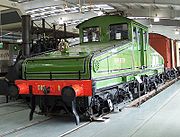
Multiple unit
The term multiple unit or MU is used to describe a self-propelled carriages capable of coupling with other units of the same or similar type and still being controlled from one driving cab. The term is commonly used to denote passenger trainsets consisting of more than one carriage...
.
Ease : Should the locomotive fail, it is easy to replace it with another. Failure or maintenance of the motive power unit does not require taking the entire train out of service.
Maximum utilization of power cars : Idle trains waste costly motive power resources. Separate locomotives enable costly motive power assets to be moved around as needed.
Flexibility : Large locomotives can be substituted for small locomotives where the grades are steeper and more power is needed. A 'passenger' locomotive can also be used for freight duties if needed, and vice versa.
Obsolescence cycles : Separating the motive power from payload-hauling cars enables one to be replaced without affecting the other. At times locomotives have become obsolete when their cars were not, and vice versa.
Safety : In case of an accident, the locomotive may act as buffer zone for the rest of the train. If an obstacle is encountered on the line, the heavier mass of a locomotive is less likely to be deviated from its normal course. Also it may be safer in the event of fire especially with diesel locomotives.
Noise : A single source of tractive power, which means only motors in one place, means that the train will be quieter than with multiple unit operation, where one or more motors are located under every carriage. The noise problem is particularly present in diesel multiple units.
Advantages of multiple units
There are several advantages of multiple unitMultiple unit
The term multiple unit or MU is used to describe a self-propelled carriages capable of coupling with other units of the same or similar type and still being controlled from one driving cab. The term is commonly used to denote passenger trainsets consisting of more than one carriage...
(MU) trains compared to locomotives.
Energy efficiency : Multiple unit
Multiple unit
The term multiple unit or MU is used to describe a self-propelled carriages capable of coupling with other units of the same or similar type and still being controlled from one driving cab. The term is commonly used to denote passenger trainsets consisting of more than one carriage...
s are more energy efficient than locomotive-hauled trains and more nimble, especially on grades, as much more of the train's weight (sometimes all of it) is placed on driven wheels, rather than suffer the dead weight of unpowered coaches.
No need to turn locomotive : Many multiple units have cabs at both ends, the train may be reversed without uncoupling/re-coupling the locomotive, giving quicker turnaround times, reducing crew costs, and enhancing safety. In practice, the development of driving van trailers
Driving Van Trailer
A Driving Van Trailer is a purpose-built railway vehicle that allows the driver to operate a locomotive at the opposite end of a train. Trains operating with a DVT therefore do not require the locomotive to be moved around to the other end of the train at terminal stations...
and cab cars
Control car (rail)
A control car is a generic term for a non-powered railroad vehicle that can control operation of a train from the end opposite to the position of the locomotive...
has removed the need for locomotives to run-around, giving easy bi-directional working and removing this MU advantage.
Reliability : As multiple unit trains have multiple engines, the failure of one engine does not prevent the train from continuing its journey. A locomotive drawn passenger train
Train
A train is a connected series of vehicles for rail transport that move along a track to transport cargo or passengers from one place to another place. The track usually consists of two rails, but might also be a monorail or maglev guideway.Propulsion for the train is provided by a separate...
typically only has one power unit, meaning the failure of this causes the train to be disabled. However, some locomotive hauled passenger trains may utilize more than one locomotive, as do many locomotive hauled freight trains, and so are able to continue at reduced speed after the failure of one locomotive.
Motive power
Locomotives may generate their power from fuel (wood, coal, petroleum or natural gas), or they may take powerPower (physics)
In physics, power is the rate at which energy is transferred, used, or transformed. For example, the rate at which a light bulb transforms electrical energy into heat and light is measured in watts—the more wattage, the more power, or equivalently the more electrical energy is used per unit...
from an outside source of electricity. It is common to classify locomotives by their source of energy. The common ones include:
Steam

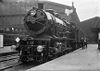
Steam engine
A steam engine is a heat engine that performs mechanical work using steam as its working fluid.Steam engines are external combustion engines, where the working fluid is separate from the combustion products. Non-combustion heat sources such as solar power, nuclear power or geothermal energy may be...
, usually generated by burning coal
Coal
Coal is a combustible black or brownish-black sedimentary rock usually occurring in rock strata in layers or veins called coal beds or coal seams. The harder forms, such as anthracite coal, can be regarded as metamorphic rock because of later exposure to elevated temperature and pressure...
. Because steam locomotives included one or more steam engines, they are sometimes referred to as "steam engines". The steam locomotive remained by far the most common type of locomotive until after World War II
World War II
World War II, or the Second World War , was a global conflict lasting from 1939 to 1945, involving most of the world's nations—including all of the great powers—eventually forming two opposing military alliances: the Allies and the Axis...
.
The first steam locomotive was built by Richard Trevithick
Richard Trevithick
Richard Trevithick was a British inventor and mining engineer from Cornwall. His most significant success was the high pressure steam engine and he also built the first full-scale working railway steam locomotive...
; it first ran on 21 February 1804, although it was some years before steam locomotive design became economically practical. The first commercial use of a steam locomotive was Salamanca on the narrow gauge Middleton Railway
Middleton Railway
The Middleton Railway is the world's oldest continuously working railway. It was founded in 1758 and is now a heritage railway run by volunteers from The Middleton Railway Trust Ltd...
in Leeds
Leeds
Leeds is a city and metropolitan borough in West Yorkshire, England. In 2001 Leeds' main urban subdivision had a population of 443,247, while the entire city has a population of 798,800 , making it the 30th-most populous city in the European Union.Leeds is the cultural, financial and commercial...
in 1812. The locomotive Fairy Queen
Fairy Queen (locomotive)
The Fairy Queen, built in 1855, is the world's oldest steam locomotive in regular operation today, plying between New Delhi to Alwar in India. The locomotive was certified by the Guinness Book of Records to be the oldest operational locomotive after the Rajasthan government invoked it in 2004 to...
, built in 1855 runs between Delhi
Delhi
Delhi , officially National Capital Territory of Delhi , is the largest metropolis by area and the second-largest by population in India, next to Mumbai. It is the eighth largest metropolis in the world by population with 16,753,265 inhabitants in the Territory at the 2011 Census...
and Alwar in India
India
India , officially the Republic of India , is a country in South Asia. It is the seventh-largest country by geographical area, the second-most populous country with over 1.2 billion people, and the most populous democracy in the world...
and is the oldest steam locomotive in regular (albeit tourist-only) service in the world, and the oldest steam locomotive operating on a mainline.
The all-time speed record for steam trains is held by an LNER Class A4
LNER Class A4
The Class A4 is a class of streamlined 4-6-2 steam locomotive, designed by Nigel Gresley for the London and North Eastern Railway in 1935. Their streamlined design gave them high-speed capability as well as making them instantly recognizable, and one of the class, 4468 Mallard, still claims the...
4-6-2
Whyte notation
The Whyte notation for classifying steam locomotives by wheel arrangement was devised by Frederick Methvan Whyte and came into use in the early twentieth century encouraged by an editorial in American Engineer and Railroad Journal...
Pacific
4-6-2
4-6-2, in the Whyte notation for the classification of steam locomotives, represents the wheel arrangement of four leading wheels on two axles , six powered and coupled driving wheels on three axles, and two trailing wheels on one axle .These locomotives are also known as Pacifics...
locomotive of the LNER in the United Kingdom, number 4468 Mallard, which pulling six carriages (plus a dynamometer car) reached 126 mph (203 km/h) on a slight downhill gradient down Stoke Bank on 3 July 1938. Aerodynamic passenger locomotives in Germany attained speeds very close to this and due to the difficulties of adequately balancing and lubricating the running gear, this is generally thought to be close to the practicable limit for a direct-coupled steam locomotive.
Before the middle of the 20th century, electric and diesel-electric locomotives began replacing steam locomotives. Steam locomotives are less efficient than their more modern diesel and electric counterparts and require much greater manpower to operate and service. British Rail
British Rail
British Railways , which from 1965 traded as British Rail, was the operator of most of the rail transport in Great Britain between 1948 and 1997. It was formed from the nationalisation of the "Big Four" British railway companies and lasted until the gradual privatisation of British Rail, in stages...
figures showed the cost of crewing and fuelling a steam locomotive was some two and a half times that of diesel power, and the daily mileage achievable was far lower. As labour costs rose, particularly after the second world war, non-steam technologies became much more cost-efficient. By the end of the 1960s-1970s, most western countries had completely replaced steam locomotives in passenger service. Freight locomotives generally were replaced later. Other designs, such as locomotives powered by gas turbines, have been experimented with, but have seen little use, mainly due to high fuel costs.
By the end of the 20th century, almost the only steam power still in regular use in North America
North America
North America is a continent wholly within the Northern Hemisphere and almost wholly within the Western Hemisphere. It is also considered a northern subcontinent of the Americas...
and Western Europe
Europe
Europe is, by convention, one of the world's seven continents. Comprising the westernmost peninsula of Eurasia, Europe is generally 'divided' from Asia to its east by the watershed divides of the Ural and Caucasus Mountains, the Ural River, the Caspian and Black Seas, and the waterways connecting...
an countries was on heritage railways largely aimed at tourists and/or railroad hobbyists, known as 'railfan
Railfan
A railfan or rail buff , railway enthusiast or railway buff , or trainspotter , is a person interested in a recreational capacity in rail transport...
s' or 'railway enthusiasts', although some narrow gauge lines in Germany which form part of the public transport system, running to all-year-round timetables retain steam for all or part of their motive power. Steam locomotives remained in commercial use in parts of Mexico
Mexico
The United Mexican States , commonly known as Mexico , is a federal constitutional republic in North America. It is bordered on the north by the United States; on the south and west by the Pacific Ocean; on the southeast by Guatemala, Belize, and the Caribbean Sea; and on the east by the Gulf of...
into the late 1970s. Steam locomotives were in regular use until 2004 in the People's Republic of China
People's Republic of China
China , officially the People's Republic of China , is the most populous country in the world, with over 1.3 billion citizens. Located in East Asia, the country covers approximately 9.6 million square kilometres...
, where coal
Coal
Coal is a combustible black or brownish-black sedimentary rock usually occurring in rock strata in layers or veins called coal beds or coal seams. The harder forms, such as anthracite coal, can be regarded as metamorphic rock because of later exposure to elevated temperature and pressure...
is a much more abundant resource than petroleum
Petroleum
Petroleum or crude oil is a naturally occurring, flammable liquid consisting of a complex mixture of hydrocarbons of various molecular weights and other liquid organic compounds, that are found in geologic formations beneath the Earth's surface. Petroleum is recovered mostly through oil drilling...
for diesel fuel. India
India
India , officially the Republic of India , is a country in South Asia. It is the seventh-largest country by geographical area, the second-most populous country with over 1.2 billion people, and the most populous democracy in the world...
switched over from steam-powered trains to electric and diesel-powered trains in the 1980s, except heritage trains. In some mountainous and high altitude rail lines, steam engines remain in use because they are less affected by reduced air pressure than diesel engines. Steam locomotives remained in routine passenger use in South Africa
South Africa
The Republic of South Africa is a country in southern Africa. Located at the southern tip of Africa, it is divided into nine provinces, with of coastline on the Atlantic and Indian oceans...
until the late 1990s, but are now reserved to tourist trains. In Zimbabwe
Zimbabwe
Zimbabwe is a landlocked country located in the southern part of the African continent, between the Zambezi and Limpopo rivers. It is bordered by South Africa to the south, Botswana to the southwest, Zambia and a tip of Namibia to the northwest and Mozambique to the east. Zimbabwe has three...
steam locomotives are still used on shunting duties around Bulawayo
Bulawayo
Bulawayo is the second largest city in Zimbabwe after the capital Harare, with an estimated population in 2010 of 2,000,000. It is located in Matabeleland, 439 km southwest of Harare, and is now treated as a separate provincial area from Matabeleland...
and on some regular freight services.
As of 2006 DLM AG (Switzerland) continues to manufacture new steam locomotives.
Gasoline
Gasoline locomotives have been produced since the early 1900s.Diesel
Experimental dieselDiesel engine
A diesel engine is an internal combustion engine that uses the heat of compression to initiate ignition to burn the fuel, which is injected into the combustion chamber...
-powered locomotives were first built just after World War I
World War I
World War I , which was predominantly called the World War or the Great War from its occurrence until 1939, and the First World War or World War I thereafter, was a major war centred in Europe that began on 28 July 1914 and lasted until 11 November 1918...
. In the 1940s, they began to displace steam
Steam
Steam is the technical term for water vapor, the gaseous phase of water, which is formed when water boils. In common language it is often used to refer to the visible mist of water droplets formed as this water vapor condenses in the presence of cooler air...
power on American railroads. Following the end of World War II
World War II
World War II, or the Second World War , was a global conflict lasting from 1939 to 1945, involving most of the world's nations—including all of the great powers—eventually forming two opposing military alliances: the Allies and the Axis...
, diesel power began to appear on railroads in many countries. In many countries the significantly better economics of diesel operation triggered a dash to diesel power, a process known as Dieselization. By the late 1960s, few major railroads in North America, Europe and Oceania continued to operate steam locomotives, although significant numbers still existed outside these areas.
As is the case with any vehicle powered by an internal combustion engine
Internal combustion engine
The internal combustion engine is an engine in which the combustion of a fuel occurs with an oxidizer in a combustion chamber. In an internal combustion engine, the expansion of the high-temperature and high -pressure gases produced by combustion apply direct force to some component of the engine...
, diesel locomotives require some type of power transmission
Power transmission
Power transmission is the movement of energy from its place of generation to a location where it is applied to performing useful work.Power is defined formally as units of energy per unit time...
system to couple the output of the prime mover
Prime mover (locomotive)
In engineering, a prime mover is an engine that converts fuel to useful work. In locomotives, the prime mover is thus the source of power for its propulsion. The term is generally used when discussing any locomotive powered by an internal combustion engine...
to the driving wheels. In the early days of diesel railroad propulsion development, electric, hydraulic
Hydraulic drive system
A hydraulic drive system is a drive or transmission system that uses pressurized hydraulic fluid to drive hydraulic machinery. The term hydrostatic refers to the transfer of energy from flow and pressure, not from the kinetic energy of the flow....
and mechanical power transmission
Transmission (mechanics)
A machine consists of a power source and a power transmission system, which provides controlled application of the power. Merriam-Webster defines transmission as: an assembly of parts including the speed-changing gears and the propeller shaft by which the power is transmitted from an engine to a...
systems were all employed with varying degrees of success. Of the three, electric transmission has proved to be most popular, and although diesel-hydraulic locomotives have certain advantages and are continuously used in some European countries, most modern Diesel-powered locomotives are diesel-electric.
Diesel locomotives require considerably less maintenance than steam, with a corresponding reduction in the number of personnel needed to keep the fleet in service. The best steam locomotives spent an average of three to five days per month in the shop for routine maintenance and running repairs. Heavy overhauls were frequent, often involving removal of the boiler
Boiler
A boiler is a closed vessel in which water or other fluid is heated. The heated or vaporized fluid exits the boiler for use in various processes or heating applications.-Materials:...
from the frame for major repairs. In contrast, a typical diesel locomotive requires no more than eight to ten hours of maintenance per month. and may run for many years between heavy overhauls.
Diesel units do not pollute as much as steam trains; modern units produce low levels of exhaust emissions. Diesel-electric locomotives are often fitted with "dynamic brakes" that use the traction motors as electrical generator
Electrical generator
In electricity generation, an electric generator is a device that converts mechanical energy to electrical energy. A generator forces electric charge to flow through an external electrical circuit. It is analogous to a water pump, which causes water to flow...
s during braking to assist in controlling the speed of a train on a descending grade. This technology is similar to regenerative braking used in hybrid cars, the key difference being that dynamic braking does not store the generated power, instead routing it to resistors where it is converted into waste heat.
Electric
In 1893 in Paris Charles BrownCharles Eugene Lancelot Brown
thumb|200pxCharles Eugene Lancelot Brown founded BBC Brown Boveri with Walter Boveri.He was born in Winterthur and was one of 6 children. His mother was Swiss and his father, a British engineer, was the founder of SLM - Schweizerische Lokomotiv- und Maschinenfabrik...
assisted Jean Heilmann in evaluating AC
Alternating current
In alternating current the movement of electric charge periodically reverses direction. In direct current , the flow of electric charge is only in one direction....
and DC
Direct current
Direct current is the unidirectional flow of electric charge. Direct current is produced by such sources as batteries, thermocouples, solar cells, and commutator-type electric machines of the dynamo type. Direct current may flow in a conductor such as a wire, but can also flow through...
transmission systems for Fusée Electrique
Heilmann locomotive
The Heilmann locomotives were a series of three experimental steam-electric locomotives produced in the 1890s for the French Chemins de Fer de l'Ouest . A prototype was built in 1894 and two larger locomotives were built in 1897...
, a steam locomotive with electric transmission, and using this knowledge he designed a three-phase AC
Three-phase electric power
Three-phase electric power is a common method of alternating-current electric power generation, transmission, and distribution. It is a type of polyphase system and is the most common method used by grids worldwide to transfer power. It is also used to power large motors and other heavy loads...
electric locomotive for Oerlikon, Zurich. Brown (by then in partnership with Walter Boveri
Brown, Boveri & Cie
Brown, Boveri & Cie was a Swiss group of electrical engineering companies.It was founded in Baden, Switzerland, in 1891 by Charles Eugene Lancelot Brown and Walter Boveri who worked at the Maschinenfabrik Oerlikon. In 1970 BBC took over the Maschinenfabrik Oerlikon...
) put these into service on the first electrified main line, the Burgdorf—Thun line, Switzerland, in 1899. Each thirty-tonne locomotive had two 150 hp motors.
In 1894, a Hungarian engineer Kálmán Kandó
Kálmán Kandó
Kálmán Kandó de Egerfarmos et Sztregova was a Hungarian engineer, and a pioneer in the development of electric railway traction.-Education:...
developed high-voltage three phase alternating current motors and generators for electric locomotives. His work on railway electrification was done at the Ganz electric works in Budapest. The first installation was on the Valtellina
Valtellina
Valtellina or the Valtelline valley ; is a valley in the Lombardy region of northern Italy, bordering Switzerland. Today it is known for its skiing, its hot spring spas, its cheeses and its wines...
line, Italy, in 1902. Kandó was the first who recognised that an electric train system can only be successful if it can use the electricity from public networks. After realising that, he also provided the means to build such a rail network by inventing a rotary phase converter
Rotary phase converter
A rotary phase converter, abbreviated RPC, is an electrical machine that produces three-phase electric power from single-phase electric power. This allows three phase loads to run using generator or utility-supplied single-phase electric power....
suitable for locomotive usage.
The electric locomotive
Electric locomotive
An electric locomotive is a locomotive powered by electricity from overhead lines, a third rail or an on-board energy storage device...
is supplied externally with electric power, either through an overhead pickup
Overhead lines
Overhead lines or overhead wires are used to transmit electrical energy to trams, trolleybuses or trains at a distance from the energy supply point...
or through a third rail
Third rail
A third rail is a method of providing electric power to a railway train, through a semi-continuous rigid conductor placed alongside or between the rails of a railway track. It is used typically in a mass transit or rapid transit system, which has alignments in its own corridors, fully or almost...
. While the capital cost of electrifying track is high, electric trains and locomotives are capable of higher performance and lower operational costs than steam or diesel power. Electric locomotives, because they tend to be less technically complex than diesel-electric locomotives, are both easier and cheaper to maintain and have extremely long working lives, usually 40 to 50 years: the last unit of the Italian E626 class
FS Class E626
The FS E.625 and E.626 are two classes of Italian electric locomotives produced for the Ferrovie dello Stato. They were introduced in the course of the 1920s and remained in service until the 1990s...
, introduced in 1928, was retired 71 years later, in 1999. There are many other examples of electric locomotives operating for more than half a century with minimal overhaul, and it is not unusual for electric locomotives to be operating close to their centenary. The Finnish State Railroad
VR Group
VR or VR Group is a state-owned railway company in Finland. Formerly known as Suomen Valtion Rautatiet until 1922 and Valtionrautatiet / Statsjärnvägarna until 1995...
is planning to phase out the Soviet-manufactured VR Class Sr1
VR Class Sr1
The Sr1 is a class of electric locomotives built for VR . These 25kV locomotives were built in the Soviet Union at the Novocherkassk Electric Locomotive Factory between 1973 and 1985...
engines, operative since 1973, in 2024, at which time they will have been over fifty years in line service.
A French TGV
TGV
The TGV is France's high-speed rail service, currently operated by SNCF Voyages, the long-distance rail branch of SNCF, the French national rail operator....
holds the world speed record
Land speed record for railed vehicles
Determination of the fastest rail vehicle in the world varies depending on the definition of "rail".Official absolute world record for conventional train is held by the French TGV...
for the fastest wheeled train, having reached 574.8 km/h (357.2 mph) on 3 April 2007.
Some electric locomotives can also operate off battery
Battery (electricity)
An electrical battery is one or more electrochemical cells that convert stored chemical energy into electrical energy. Since the invention of the first battery in 1800 by Alessandro Volta and especially since the technically improved Daniell cell in 1836, batteries have become a common power...
power to enable short journeys or shunting on non-electrified lines or yards. Battery-powered locomotives are used in mines and other underground locations where diesel fumes or smoke would endanger crews, and where external electricity supplies cannot be used due to the danger of sparks igniting flammable gas. Battery locomotives are also used on many underground railways for maintenance operations, as they are required when operating in areas where the electricity supply has been temporarily disconnected.
Hybrid locomotives
Besides locomotives which use only a fuelled power source (e.g. an internal combustion engineInternal combustion engine
The internal combustion engine is an engine in which the combustion of a fuel occurs with an oxidizer in a combustion chamber. In an internal combustion engine, the expansion of the high-temperature and high -pressure gases produced by combustion apply direct force to some component of the engine...
), and a electrical engine, there are also hybrids that additionally use a battery. Here, the battery acts as a temporary energy store
Rechargeable energy storage system
A rechargeable energy storage system or RESS is a system that stores energy for delivery of power and which is rechargeable.Production storage systems use electric rechargeable traction batteries, electric double-layer capacitors or flywheel energy storage.This term of art is used in US legislation...
, allowing e.g. the implementation of regenerative braking and switching off the hydrocarbon engine when idling or stationary (as used in automobiles such as the Toyota Prius).
Steam-diesel hybrid locomotives
Steam-diesel hybrid locomotives have been tried in Britain, Russia and Italy but with only limited success.Gas turbine-electric
A gas turbine-electric locomotive, or GTEL, is a locomotive that uses a gas turbineGas turbine
A gas turbine, also called a combustion turbine, is a type of internal combustion engine. It has an upstream rotating compressor coupled to a downstream turbine, and a combustion chamber in-between....
to drive an electrical generator
Electrical generator
In electricity generation, an electric generator is a device that converts mechanical energy to electrical energy. A generator forces electric charge to flow through an external electrical circuit. It is analogous to a water pump, which causes water to flow...
or alternator
Alternator
An alternator is an electromechanical device that converts mechanical energy to electrical energy in the form of alternating current.Most alternators use a rotating magnetic field but linear alternators are occasionally used...
. The electric current thus produced is used to power traction motor
Traction motor
Traction motor refers to an electric motor providing the primary rotational torque of a machine, usually for conversion into linear motion ....
s. This type of locomotive was first experimented with in 1920 but reached its peak in the 1950s to 1960s. The turbine (similar to a turboshaft
Turboshaft
A turboshaft engine is a form of gas turbine which is optimized to produce free turbine shaft power, rather than jet thrust...
engine) drives an output shaft, which drives the alternator via a system of gear
Gear
A gear is a rotating machine part having cut teeth, or cogs, which mesh with another toothed part in order to transmit torque. Two or more gears working in tandem are called a transmission and can produce a mechanical advantage through a gear ratio and thus may be considered a simple machine....
s.
A turbine offers some advantages over a piston engine. The number of moving parts is much smaller, and the power-to-weight ratio
Power-to-weight ratio
Power-to-weight ratio is a calculation commonly applied to engines and mobile power sources to enable the comparison of one unit or design to another. Power-to-weight ratio is a measurement of actual performance of any engine or power sources...
is much higher. A turbine of a given power output is also physically smaller than an equally powerful piston engine, allowing a locomotive to be very powerful without being inordinately large. However, a turbine's power output and efficiency both drop dramatically with rotational speed
Rotational speed
Rotational speed tells how many complete rotations there are per time unit. It is therefore a cyclic frequency, measured in hertz in the SI System...
, unlike a piston engine, which has a comparatively flat power curve.
Gas turbine locomotives are very powerful, but also tend to be very loud. Union Pacific Railroad
Union Pacific Railroad
The Union Pacific Railroad , headquartered in Omaha, Nebraska, is the largest railroad network in the United States. James R. Young is president, CEO and Chairman....
operated the largest fleet of gas turbine-electric locomotives in the world, and was the only railroad to use them for hauling freight in regular service. Most other GTELs have been built for small passenger trains, and only a few have seen any real success in that role.
After the 1973 oil crisis
1973 oil crisis
The 1973 oil crisis started in October 1973, when the members of Organization of Arab Petroleum Exporting Countries or the OAPEC proclaimed an oil embargo. This was "in response to the U.S. decision to re-supply the Israeli military" during the Yom Kippur war. It lasted until March 1974. With the...
and the subsequent rise in fuel costs, gas turbine locomotives became uneconomical to operate, and many were taken out of service. This type of locomotive is now rare.
Fuel cell-electric
In 2002 the first 3.6 tonne, 17 kW hydrogenHydrogen
Hydrogen is the chemical element with atomic number 1. It is represented by the symbol H. With an average atomic weight of , hydrogen is the lightest and most abundant chemical element, constituting roughly 75% of the Universe's chemical elemental mass. Stars in the main sequence are mainly...
(fuel cell)-powered mining locomotive was demonstrated in Val-d'Or, Quebec
Val-d'Or, Quebec
-External links:* ***...
. In 2007 the educational mini-hydrail in Kaohsiung
Kaohsiung
Kaohsiung is a city located in southwestern Taiwan, facing the Taiwan Strait on the west. Kaohsiung, officially named Kaohsiung City, is divided into thirty-eight districts. The city is one of five special municipalities of the Republic of China...
, Taiwan
Taiwan
Taiwan , also known, especially in the past, as Formosa , is the largest island of the same-named island group of East Asia in the western Pacific Ocean and located off the southeastern coast of mainland China. The island forms over 99% of the current territory of the Republic of China following...
went into service. The Railpower GG20B
Railpower GG20B
The Railpower GG20B Green Goat is a low-emissions diesel hybrid switcher locomotive built by Railpower Technologies Corp. It is powered by a single Caterpillar C9 I6 engine developing , which is also connected to a large battery bank where both sources combine for a total power output of...
finally is another example of a fuel cell-electric locomotive.
Slug or Drone
A slugSlug (railroad)
A railroad slug is an accessory to a diesel-electric locomotive. It has trucks with traction motors but is unable to move about under its own power, as it does not contain a prime mover to produce electricity...
or drone locomotive is a non-powered unit attached to a diesel-electric locomotive to provide additional traction and braking capability. The slug has traction motor
Traction motor
Traction motor refers to an electric motor providing the primary rotational torque of a machine, usually for conversion into linear motion ....
s but no engine, power being supplied by the attached locomotive (known as a 'mother'). At slow speeds, a diesel-electric prime mover can potentially produce more power than can be usefully used by its own traction motors; a slug increases the number of traction motors available to use the power more effectively.
Slugs are mainly used in rail yards for switching duties, in which case they are normally built without a cab. Other slugs, designed for use on service trains, may be fitted with a cab, which can control the whole consist, and may also provide additional fuel storage for the mother locomotive. In recent years, conventional locomotives have been used in place of slugs on service trains, remotely controlled from the lead locomotive configuration.
CP Rail used a prototype drone locomotive system called LOCOTROL
Locotrol
Locotrol is a product of GE Transportation Systems that permits railway locomotives to be distributed throughout the length of a train...
which evolved into today's systems.
Use
Rail transport operations
A railway has two major components: the rolling stock and the infrastructure .-Operation:...
. There are passenger
Passenger
A passenger is a term broadly used to describe any person who travels in a vehicle, but bears little or no responsibility for the tasks required for that vehicle to arrive at its destination....
locomotives, freight locomotives and switcher
Switcher
A switcher or shunter is a small railroad locomotive intended not for moving trains over long distances but rather for assembling trains ready for a road locomotive to take over, disassembling a train that has been...
(or shunting) locomotives. These categories determine the locomotive's combination of physical size, starting tractive effort
Tractive effort
As used in mechanical engineering, the term tractive force is the pulling or pushing force exerted by a vehicle on another vehicle or object. The term tractive effort is synonymous with tractive force, and is often used in railway engineering to describe the pulling or pushing capability of a...
and maximum permitted speed. Freight locomotives are normally designed to deliver high starting tractive effort
Tractive effort
As used in mechanical engineering, the term tractive force is the pulling or pushing force exerted by a vehicle on another vehicle or object. The term tractive effort is synonymous with tractive force, and is often used in railway engineering to describe the pulling or pushing capability of a...
—needed to start trains that may weigh as much as 15,000 ton
Ton
The ton is a unit of measure. It has a long history and has acquired a number of meanings and uses over the years. It is used principally as a unit of weight, and as a unit of volume. It can also be used as a measure of energy, for truck classification, or as a colloquial term.It is derived from...
s—and deliver sustained high power, at the sacrifice of maximum speed. Passenger locomotives develop less starting tractive effort but are able to operate at the high speeds demanded by passenger schedules. Mixed traffic locomotives
Mixed-traffic locomotive
A mixed-traffic locomotive is one designed to be capable of hauling both passenger trains and freight trains. The term is mostly used in the United Kingdom and those nations following British practice...
(US English: general purpose or road switcher locomotives) are built to provide elements of both requirements. They do not develop as much starting tractive effort as a freight unit but are able to haul heavier trains than a passenger engine.
Most steam locomotives are reciprocating units, in which the pistons are coupled to the drivers (driving wheels) by means of connecting rods. Therefore, the combination of starting tractive effort and maximum speed is greatly influenced by the diameter of the drivers. Steam locomotives intended for freight service generally have relatively small diameter drivers, whereas passenger models have large diameter drivers (as large as 84 inches in some cases).
With diesel-electric and electric locomotives, the gear ratio between the traction motor
Traction motor
Traction motor refers to an electric motor providing the primary rotational torque of a machine, usually for conversion into linear motion ....
s and axle
Axle
An axle is a central shaft for a rotating wheel or gear. On wheeled vehicles, the axle may be fixed to the wheels, rotating with them, or fixed to its surroundings, with the wheels rotating around the axle. In the former case, bearings or bushings are provided at the mounting points where the axle...
s is what adapts the unit to freight or passenger service, although a passenger unit may include other features, such as head end power
Head end power
Head end power or electric train supply is a rail transport term for the electrical power distribution system on a passenger train. The power source, usually a locomotive at the front or “head” of a train or a generator car, generates all the electricity used for lighting, electrical and other...
(also referred to as hotel power or electric train supply) or a steam generator
Steam generator (railroad)
Steam generator is the term used to describe a type of boiler used to produce steam for climate control and potable water heating in railroad passenger cars...
.
Some locomotives are designed specifically to work mountain railways, and feature extensive additional braking mechanisms and sometimes rack and pinion. Steam locomotives built for steep rack and pinion railways frequently have the boiler tilted relative to the wheels, so that the boiler remains roughly level on steep grades.
Operational role
Sometimes a locomotive will work in a specific role, such as:- Train engine is the technical name for the locomotive which is attached to the front of a railway trainTrainA train is a connected series of vehicles for rail transport that move along a track to transport cargo or passengers from one place to another place. The track usually consists of two rails, but might also be a monorail or maglev guideway.Propulsion for the train is provided by a separate...
for the purpose of hauling that train. Exceptionally, where operating facilities exist for push-pullPush-pull trainPush–pull is a mode of operation for locomotive-hauled trains allowing them to be driven from either end.A push–pull train has a locomotive at one end of the train, connected via some form of remote control, such as multiple-unit train control, to a vehicle equipped with a control cab at the other...
operation, the train engine may be attached to the rear of the train; - Pilot engine – a locomotive attached in front of the train engine, to enable Double-headingDouble-headingIn railroad terminology, double-heading or double heading indicates the use of two locomotives at the front of a train, each operated individually by its own crew. The practice of triple-heading involves the use of three locomotives....
; - Banking engine – a locomotive temporarily assisting a train from the rear, due to a difficult start or a sharp incline gradient;
- Light engine – a locomotive which is operating without a train behind it, usually because it needs to be relocated for operational reasons.
- Station pilot – a locomotive used for shunting passenger trains at a railway station.
Wheel arrangement
Wheel arrangement is one type of classification. Common methods include the AAR wheel arrangementAAR wheel arrangement
The AAR wheel arrangement system is a method of classifying locomotive wheel arrangements that was developed by the Association of American Railroads. It is essentially a simplification of the European UIC classification, and it is widely used in North America to describe diesel and electric...
, UIC classification
UIC classification
The UIC classification of locomotive axle arrangements describes the wheel arrangement of locomotives, multiple units and trams. It is set out in the International Union of Railways "Leaflet 650 - Standard designation of axle arrangement on locomotives and multiple-unit sets". It is used in much...
, and Whyte notation
Whyte notation
The Whyte notation for classifying steam locomotives by wheel arrangement was devised by Frederick Methvan Whyte and came into use in the early twentieth century encouraged by an editorial in American Engineer and Railroad Journal...
systems.
Remote control locomotives
In the second half of the twentieth century remote control locomotives started to enter service in switching operations, being remotely controlledRemote control
A remote control is a component of an electronics device, most commonly a television set, used for operating the television device wirelessly from a short line-of-sight distance.The remote control is usually contracted to remote...
by an operator outside of the locomotive cab.
The main benefit is one operator can control the loading of grain, coal, gravel, etc. into the cars. In addition, the same operator can move the train as needed. Thus, the locomotive is loaded or unloaded in about a third of the time.
Locomotives in numismatics
Locomotives have been a subject for collectors' coins and medals. One of the most famous and recent ones is the 25 euro 150 Years Semmering Alpine Railway commemorative coin. The obverse shows two locomotives: a historical and a modern one. This represents the technical development in locomotive construction between the years 1854 and 2004. The upper half depicts the “Taurus”, a high performance locomotive. Below is shown the first functional Alpine locomotive, the EngerthEngerth locomotive
The Engerth locomotive was a type of early articulated steam locomotive designed by Wilhelm Freiherr von Engerth for use on the Semmering Railway in Austria.- Designer :...
; constructed by Wilhelm Freiherr von Engerth.
Gallery
See also
- Air brakeAir brake (rail)An air brake is a conveyance braking system actuated by compressed air. Modern trains rely upon a fail-safe air brake system that is based upon a design patented by George Westinghouse on March 5, 1872. The Westinghouse Air Brake Company was subsequently organized to manufacture and sell...
- Articulated locomotiveArticulated locomotiveArticulated locomotive usually means a steam locomotive with one or more engine units which can move independent of the main frame. This is done to allow a longer locomotive to negotiate tighter curves...
- AutorailAutorailThe French word Autorail describes a single powered vehicle capable of carrying passengers. French designed vehicles are some of the most interesting made...
- Bank engineBank engineA bank engine or helper engine or pusher engine is a railway locomotive that temporarily assists a train that requires additional power or traction to climb a grade...
- Duplex locomotiveDuplex locomotiveA duplex locomotive is a steam locomotive that divides the driving force on its wheels by using two pairs of cylinders rigidly mounted to a single locomotive frame; it is not an articulated locomotive...
- Electric multiple unitElectric multiple unitAn electric multiple unit or EMU is a multiple unit train consisting of self-propelled carriages, using electricity as the motive power. An EMU requires no separate locomotive, as electric traction motors are incorporated within one or a number of the carriages...
- Headboard (train)Headboard (train)A Train headboard is a board hung on the front of a locomotive. Generally it can depict a named train, although other purposes also exist. Headboards are distinct from locomotive nameplates....
- Kryšpín's systemKryšpín's systemKryšpín's system refers to the locomotive class nomenclature used in Czechoslovakia from September 1923 to the late 1980s. It is named after Ing. Vojtěch Kryšpín, director of one of the Czechoslovak locomotive manufacturers, who invented the system...
- List of locomotive builders
- List of locomotives
- Locomotives in artTrains in artA locomotive or train can play many roles in art, for example:* As a work of art in itself in addition to most functional considerations, especially in streamlined steam locomotives and luxury passenger accommodations of the early 20th century, known also as the Machine Age* As a subject for a...
- Railway brakesBrake (railway)Brakes are used on the cars of railway trains to enable deceleration, control acceleration or to keep them standing when parked. While the basic principle is familiar from road vehicle usage, operational features are more complex because of the need to control multiple linked carriages and to be...
- Regenerative (dynamic) brakesRegenerative brakeA regenerative brake is an energy recovery mechanism which slows a vehicle or object down by converting its kinetic energy into another form, which can be either used immediately or stored until needed...
- Train hornTrain hornTrain horns are audible warning devices found on most diesel and electric locomotives. Their primary purpose is to alert persons and animals to the presence of a train, especially when approaching a grade crossing. They are also used for acknowledging signals given by railroad employees Train horns...
- Vacuum brakeVacuum brakeThe vacuum brake is a braking system employed on trains and introduced in the mid-1860s. A variant, the automatic vacuum brake system, became almost universal in British train equipment and in those countries influenced by British practice. Vacuum brakes also enjoyed a brief period of adoption in...
- World's largest locomotiveWorld's largest locomotiveAs railroads around the world needed to haul larger quantities of freight efficiently, the title of world's largest locomotive has often been passed to new generations of rolling stock.-Standard:...
External links
- An engineer's guide from 1891
- Animated engines, Steam Locomotive
- International Steam Locomotives
- Turning a Locomotive into a Stationary Engine, Popular SciencePopular SciencePopular Science is an American monthly magazine founded in 1872 carrying articles for the general reader on science and technology subjects. Popular Science has won over 58 awards, including the ASME awards for its journalistic excellence in both 2003 and 2004...
monthly, February 1919, page 72, Scanned by Google Books: http://books.google.com/books?id=7igDAAAAMBAJ&pg=PA72