
All Topics  
Battle of Leyte

 
Battle of Leyte

   Email Print
   Bookmark   Link


Battle of Leyte


The Battle of Leyte in the Pacific campaign
Pacific War

The Pacific War was the part of World War II?and preceding conflicts?that took place in the Pacific Ocean, its islands, and in East Asia, between July 7, 1937 and August 14, 1945....
 of World War II
World War II

World War II, or the Second World War , was a global military conflict which involved a Participants in World War II, including all of the great powers, organised into two opposing military alliances: the Allies of World War II and the Axis powers....
 was the invasion and conquest of Leyte in the Philippines
Philippines

The Philippines, officially known as the Republic of the Philippines, is a country in Southeast Asia with Manila as its capital city. It comprises 7,107 islands in the western Pacific Ocean....
 by American
Military history of the United States during World War II

The Military history of the United States during World War II covers the involvement of the United States during World War II. The Empire of Japan declaration of war on the United States and the British Empire on 7 December 1941, immediately after the attack on Pearl Harbor on the same day....
 and Filipino
Military history of the Philippines during World War II

In September 1940, Germany, Italy, and Japan had allied under the Tripartite Pact. In July 1940 the United States banned the shipment of aviation gasoline to Japan, and by 1941 shipments of scrap iron, steel, gasoline, and other materials had practically ceased....
 guerrilla
Guerrilla warfare

Guerrilla warfare is the Irregular warfare warfare and combat with which a small group of combatants use mobile Military tactics to combat a larger and less mobile formal army....
 forces under the command of General Douglas MacArthur
Douglas MacArthur

General of the Army Douglas MacArthur, Order of the Bath was an United States General officer, United Nations general and Field Marshal of the Philippine Army....
, who fought against the Imperial Japanese Army
Imperial Japanese Army

The Imperial Japanese Army , or literally Army of Empire of Greater Japan was the official ground based armed force of Imperial Japan from 1867 to 1945....
 in the Philippines led by General Tomoyuki Yamashita
Tomoyuki Yamashita

General was a general of the Japanese Imperial Army during World War II. He was most famous for conquering the British colonies of Battle of Malaya and Battle of Singapore, earning the nickname "The Tiger of Malaya"....
 from 17 October to 31 December 1944. The battle launched the Philippines campaign of 1944-45 for the recapture and liberation of the entire Philippine Archipelago and to end almost three years of Japanese occupation
Second Philippine Republic

The Second Philippine Republic, officially known as the Republic of the Philippines , was a state in the Philippines established in October 14, 1943 under Japanese occupation of the Philippines....
.

Philippines were an important source of supplies, especially rubber
Rubber

Natural rubber is an elastomer?an Elasticity_ hydrocarbon polymer?that was originally derived from a milky colloidal suspension, or latex , found in the sap of some plants....
, to Japan and also commanded the sea routes to Borneo
Borneo

Borneo is the List of islands by area and is located at the centre of Maritime Southeast Asia. Administratively, this island is divided between Indonesia, Malaysia and Brunei....
 and Sumatra
Sumatra

Sumatra is an island in western Indonesia, westernmost of the Sunda Islands. It is the largest island entirely in Indonesia , and the list of islands by area in the world ....
 by which petroleum
Petroleum

Petroleum or crude oil is a naturally occurring, flammable liquid found in rock formations in the Earth consisting of a complex mixture of hydrocarbons of various molecular weights, plus other organic compounds....
 was brought to Japan: holding on to the Philippines was vital.


Discussion
Ask a question about 'Battle of Leyte'
Start a new discussion about 'Battle of Leyte'
Answer questions from other users
Full Discussion Forum


Encyclopedia


The Battle of Leyte in the Pacific campaign
Pacific War

The Pacific War was the part of World War II?and preceding conflicts?that took place in the Pacific Ocean, its islands, and in East Asia, between July 7, 1937 and August 14, 1945....
 of World War II
World War II

World War II, or the Second World War , was a global military conflict which involved a Participants in World War II, including all of the great powers, organised into two opposing military alliances: the Allies of World War II and the Axis powers....
 was the invasion and conquest of Leyte in the Philippines
Philippines

The Philippines, officially known as the Republic of the Philippines, is a country in Southeast Asia with Manila as its capital city. It comprises 7,107 islands in the western Pacific Ocean....
 by American
Military history of the United States during World War II

The Military history of the United States during World War II covers the involvement of the United States during World War II. The Empire of Japan declaration of war on the United States and the British Empire on 7 December 1941, immediately after the attack on Pearl Harbor on the same day....
 and Filipino
Military history of the Philippines during World War II

In September 1940, Germany, Italy, and Japan had allied under the Tripartite Pact. In July 1940 the United States banned the shipment of aviation gasoline to Japan, and by 1941 shipments of scrap iron, steel, gasoline, and other materials had practically ceased....
 guerrilla
Guerrilla warfare

Guerrilla warfare is the Irregular warfare warfare and combat with which a small group of combatants use mobile Military tactics to combat a larger and less mobile formal army....
 forces under the command of General Douglas MacArthur
Douglas MacArthur

General of the Army Douglas MacArthur, Order of the Bath was an United States General officer, United Nations general and Field Marshal of the Philippine Army....
, who fought against the Imperial Japanese Army
Imperial Japanese Army

The Imperial Japanese Army , or literally Army of Empire of Greater Japan was the official ground based armed force of Imperial Japan from 1867 to 1945....
 in the Philippines led by General Tomoyuki Yamashita
Tomoyuki Yamashita

General was a general of the Japanese Imperial Army during World War II. He was most famous for conquering the British colonies of Battle of Malaya and Battle of Singapore, earning the nickname "The Tiger of Malaya"....
 from 17 October to 31 December 1944. The battle launched the Philippines campaign of 1944-45 for the recapture and liberation of the entire Philippine Archipelago and to end almost three years of Japanese occupation
Second Philippine Republic

The Second Philippine Republic, officially known as the Republic of the Philippines , was a state in the Philippines established in October 14, 1943 under Japanese occupation of the Philippines....
.

Background

The Philippines were an important source of supplies, especially rubber
Rubber

Natural rubber is an elastomer?an Elasticity_ hydrocarbon polymer?that was originally derived from a milky colloidal suspension, or latex , found in the sap of some plants....
, to Japan and also commanded the sea routes to Borneo
Borneo

Borneo is the List of islands by area and is located at the centre of Maritime Southeast Asia. Administratively, this island is divided between Indonesia, Malaysia and Brunei....
 and Sumatra
Sumatra

Sumatra is an island in western Indonesia, westernmost of the Sunda Islands. It is the largest island entirely in Indonesia , and the list of islands by area in the world ....
 by which petroleum
Petroleum

Petroleum or crude oil is a naturally occurring, flammable liquid found in rock formations in the Earth consisting of a complex mixture of hydrocarbons of various molecular weights, plus other organic compounds....
 was brought to Japan: holding on to the Philippines was vital. For the US, capturing the Philippines was a key strategic step in isolating Imperial Japan's military holdings in China and the Pacific theater. It was also a personal matter for MacArthur: two years previously he had left the Philippines vowing to return, and he insisted that it was a moral obligation of the U.S. to liberate it as soon as possible.

From September to early October 1944, the aircraft carrier
Aircraft carrier

An aircraft carrier is a warship designed with a primary mission of deploying and recovering aircraft, acting as a seagoing airbase. Aircraft carriers thus allow a navy force to project air power great distances without having to depend on local bases for staging aircraft operations....
s of the U.S. Third Fleet under Admiral William F. Halsey carried out successful missions. During the Palau
Mariana and Palau Islands campaign

The Mariana and Palau Islands campaign was an offensive launched by United States forces against Empire of Japan forces in the Mariana Islands and Palau in the Pacific Ocean between June and November, 1944 during the Pacific War....
 and Morotai
Battle of Morotai

The Battle of Morotai was a battle of World War II which took place between 15 September 1944 and the end of the war. United States and Australian forces landed on the south west corner of Morotai, a small island in the Dutch East Indies , in mid-September as it was needed as a base to support the Philippines campaign later that year....
 campaigns, they destroyed some 500 enemy aircraft and 180 seagoing merchant ships. These successful actions in the Philippines, Okinawa, and Formosa
Taiwan

Taiwan is an island in East Asia. "Taiwan" is also commonly used to refer to the country governed by the Republic of China and to the ROC itself, which governs the island of Taiwan, Orchid Island and Green Island, Taiwan in the Pacific Ocean off the Taiwan coast, the Penghu islands in the Taiwan Strait, and Kinmen and the Matsu Islands...
 indicated that an invasion of the Philippines itself was now feasible.

Leyte, one of the larger Philippine islands, has numerous deep-water approaches and sandy beaches which offered opportunities for amphibious assaults and fast resupply. The roads and lowlands extending inland from Highway 1, that ran for forty miles (65 km) along the east coast between the Abuyog town up north to San Juanico Strait
San Juanico Strait

San Juanico Strait is a narrow strait in the Philippines. It separates the islands of Samar and Leyte . At its narrowest point, the strait is only 2 km wide....
 between Leyte and Samar
Samar

Samar, formerly Western Samar, is a Provinces of the Philippines in the Philippines located in the Eastern Visayas Regions of the Philippines....
 Islands, provided avenues for tank-infantry operations, as well as a basis for airfield construction. American air forces based on Leyte could strike on enemy bases and airfields anywhere in the archipelago
Archipelago

An archipelago is a chain or cluster of islands that are formed tectonically. The word archipelago literally means "chief sea", from Italian language arcipelago , derived ultimately from Greek language arkhon and pelagos ....
.
Battle of Leyte Map 1
A heavily-forested north-south mountain range dominates the interior and separates two sizable valleys, or coastal plains. The larger Leyte Valley extends from the northern coast to the long eastern shore and contains most of the towns and roadways on the island. The other, Ormoc Valley, situated on the west side, was connected to Leyte Valley by a roundabout and winding road, Highway 2, which ran from Palo
Palo, Leyte

Palo is a 3rd class Philippine municipality in the Philippine province of Leyte province, Philippines. According to the 2000 census, it has a population of 47,982 people in 9,272 households....
 town on the east coast, then west and northwest through Leyte Valley to the north coast, then turned south and wound through a mountainous neck to enter northern Ormoc Valley. This continued south to the port of Ormoc City
Ormoc City

The City of Ormoc is a 1st class Philippine city in the Philippine province of Leyte province, Philippines. The city's name is derived from ogmok, an old Visayan languages term for lowland or depressed plain....
, then along the western shore to Baybay
Baybay, Leyte

Baybay is a Philippine municipality in the Philippine province of Leyte province, Philippines. Covering an area of 46,050 hectares, Baybay is composed of 92 barangays, 23 of which are in the poblacion....
 town. The road then turned east to cross the mountainous waist of the island and connected with Highway 1 on the east coast at Abuyog. Below these towns, the mountainous southern third of Leyte was mostly undeveloped. High mountain peaks over 4,400 feet (1,340 m), as well as the jagged outcroppings, ravines, and caves typical of volcanic islands offered formidable defensive opportunities. The timing late in the year of the assault would force combat troops and supporting pilots, as well as logistical units, to contend with monsoon
Monsoon

A monsoon is a seasonal prevailing wind that lasts for several months. The term was first used in English in India, Bangladesh, Pakistan, and neighboring countries to refer to the big seasonal winds blowing from the Indian Ocean and Arabian Sea in the southwest bringing heavy rainfall to the region....
 rains.
Convoy Off Leyte
Leyte's population of over 900,000 people, mostly farmers and fishermen, could be expected to assist an American invasion, since many residents already supported the guerrilla struggle against the Japanese in the face of harsh repression. Japanese troop strength on Leyte was estimated by U.S. intelligence at 20,000, mostly of the 16th Division
16th Division (Imperial Japanese Army)

was an infantry division in the Imperial Japanese Army. Its call sign was the ....
 under Lt. Gen. Shiro Makino.

Landing forces

The Leyte invasion was the largest amphibious operation mounted by American and Allied forces to date in the Pacific theater. Gen. MacArthur was designated as supreme commander of sea, air, and land forces drawn from both the Southwest and Central Pacific theaters of operation. Allied naval and air support forces consisted primarily of the U.S. Seventh Fleet under Vice Adm. Thomas C. Kinkaid
Thomas C. Kinkaid

Thomas Cassin Kinkaid was an admiral of the United States Navy during World War II. He was Commander Allied Naval Forces in the South West Pacific Area during 1943 ? 45 and concurrently commanded the US 7th Fleet....
. With 701 ships, including 157 warships, Kinkaid's fleet would transport and put ashore the landing force. The Royal Australian Navy
Royal Australian Navy

The Royal Australian Navy is the navy of the Australian Defence Force. Established in 1901, the RAN was formed out of the Commonwealth Naval Forces to become the small navy of Australia after federation, consisting of the former colonial navies of the new Australian states....
 forces seconded to the Seventh Fleet included five warships, three landing ships and five auxiliary vessels.
Battle of Leyte Map 2
The U.S. Sixth Army under Lt. Gen. Walter Krueger
Walter Krueger

Walter Krueger was a Germany-United States soldier and General officer in the first half of the 20th century. He is best known for his command of the Sixth United States Army in the South West Pacific Area during World War II....
 was the main combat force, which consisted of two corps
Corps

A Corps is either a large formation , or an administrative grouping of troops within an armed force with a common function such as Artillery or Signals representing an arm of service....
 of two divisions
Division (military)

A division is a large military unit or Formation usually consisting of between ten to thirty thousand soldiers. In most armies, a division is composed of several regiments or brigades, and in turn several divisions make up a corps....
 each. Maj. Gen. Franklin C. Sibert
Franklin C. Sibert

Franklin C. Sibert was a United States army general. During World War II, Sibert was originally the commander of the 6th Infantry Division but was promoted to command the X Corps of General Walter Krueger's US Sixth Army....
's X Corps included the 1st Cavalry Division and the 24th Infantry Division, minus the 21st RCT. Maj. Gen. John R. Hodge
John R. Hodge

John Reed Hodge was a military officer of the United States Army, not to be confused with U.S. Army General Courtney Hodges, who also served in World War II....
's XXIV Corps included the 7th Infantry Division and the untested 96th Infantry Division. The 32nd and 77th Infantry Divisions and the 381st RCT (of the 96th) were the reserve forces. Supplementary units included the 6th Ranger Battalion, tasked to secure outlying islands and guide naval forces to the landing beaches. The new 6th Army Service Command under Maj. Gen. Hugh J. Casey was responsible for organizing the beachhead
Beachhead

Beachhead is a military term used to describe the line created when a unit reaches a beach, and begins to defend that area of beach, while other reinforcements help out, until a unit large enough to begin advancing has arrived....
, supplying units ashore, and constructing or improving roads and airfields. In all, Gen. Krueger had under his command 202,500 ground troops. On Leyte, some 3,000 Filipino guerrillas under Lt. Col. Ruperto Kangleon awaited the landing forces.

The Sixth Army mission of securing Leyte was to be accomplished in three phases. The first would begin on 17 October, three days before and some fifty miles (80 km) east of the landing beaches, with the seizure of three islands commanding the eastern approaches to Leyte Gulf. On A-Day, 20 October, the X and XXIV Corps would land at separate beaches on the east coast of Leyte, the former on the right (north), the latter fifteen miles (24 km) south. The X Corps would take Tacloban City
Tacloban City

The City of Tacloban is a port city approximately 360 miles southeast of Manila. It is the first in Eastern Visayas to be classified as a Highly Urbanized City....
 and its airfield north of the corps beachhead, secure the strait between Leyte and Samar Islands, then push through Leyte Valley to the north coast. The XXIV Corps was to secure southern Leyte Valley for airfield and logistical development. Meanwhile, the 21st RCT would come ashore to secure the strait between Leyte and Panaon Islands. In the third phase, the two corps would take separate routes through the mountains to clear the enemy from Ormoc Valley and the west coast of the island, at the same time placing an outpost on the island of Samar some thirty-five miles (56 km) north of Tacloban.

Battle


Landings

Preliminary operations for the Leyte invasion began at dawn on 17 October with minesweeping operations and the movement of the 6th Rangers toward three small islands in Leyte Gulf. Although delayed by a storm, the Rangers were on Suluan and Dinagat islands by 12:30. On Suluan, they dispersed a small group of Japanese defenders and destroyed a radio station, while they found Dinagat unoccupied. On both, the Rangers proceeded to erect navigation lights for the amphibious transports to follow three days later. The next day, the third island Homonhon, was taken without opposition. Meanwhile reconnaissance by underwater demolition teams revealed clear landing beaches for assault troops on Leyte.
1st Cav Troops At Leyte
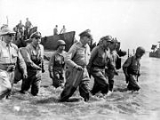
Following four hours of heavy naval gunfire on A-day, 20 October, Sixth Army forces landed on assigned beaches at 10:00. The X Corps pushed across a four-mile (6.5 km) stretch of beach between Tacloban airfield and the Palo River. Fifteen miles (24 km) to the south, XXIV Corps units came ashore across a three-mile (5 km) strand between San José and the Daguitan River. Troops found as much resistance from swampy terrain as from Japanese fire. Within an hour of landing, units in most sectors had secured beachheads deep enough to receive heavy vehicles and large amounts of supplies. Only in the 24th Division sector did enemy fire force a diversion of follow-up landing craft. But even that sector was secure enough by 13:30 to allow Gen. MacArthur to make a dramatic entrance through the surf and announce to the populace the beginning of their liberation: "People of the Philippines, I have returned! By the grace of Almighty God, our forces stand again on Philippine soil."

By the end of A-day, the Sixth Army had moved two miles (3 km) inland and controlled Panaon Strait at the southern end of Leyte. In the X Corps sector, the 1st Cavalry Division held Tacloban airfield, and the 24th Infantry Division had taken the high ground commanding its beachheads Hill 522. In the XXIV Corps sector, the 96th Infantry Division held the approaches to Catmon Hill. The 7th Infantry Division took the town of Dulag, which forced Gen. Makino to move his command post ten miles (16 km) inland to the town of Dagami. The initial fighting was won at a cost of 49 killed, 192 wounded, and 6 missing.

Campaign in Southern Leyte Valley

The Sixth Army made steady progress inland against sporadic and uncoordinated enemy resistance on Leyte in the next few days. The 1st Cavalry Division of Maj. Gen. Verne D. Mudge secured the provincial capital, Tacloban, on 21 October. On 23 October Gen. MacArthur presided over a ceremony to restore civil government to Leyte. 1st and 2nd Cavalry Brigades initiated a holding action to prevent a Japanese counterattack from the mountainous interior, after which the 1st Cavalry was allowed to move out.
U
On the X Corps left, the 24th Infantry Division under Maj. Gen. Frederick A. Irving, drove inland into heavy enemy resistance. After days and nights of hard fighting and killing some 800 Japanese the 19th and 34th Infantry Regiments expanded their beachhead and took control of high ground commanding the entrance to the northern Leyte Valley. By 1 November, after a seven-day tank-infantry advance supported by artillery fire, both regiments had pushed through Leyte Valley and were within sight of the north coast and the port of Carigara
Carigara, Leyte

Carigara is a 3rd class Philippine municipality in the Philippine province of Leyte province, Philippines. According to the 2000 census, it has a population of 43,455 people in 8,571 households....
. The next day, the 2nd Cavalry Brigade captured Carigara. In its drive through Leyte Valley the 24th Division inflicted nearly 3,000 enemy casualties
Casualty (person)

A casualty is a person who is the victim of an accident, injury, or Physical trauma. The word casualties is most often used by the news media to describe deaths and injuries resulting from wars or disasters....
. These advances left only one major port on Leyte—Ormoc City on the west coast—under Japanese control.
U
From the XXIV Corps beachhead Gen. Hodge had sent his two divisions into the southern Leyte Valley, which already contained four airfields and a large supply center. Maj. Gen. James L. Bradley's 96th Infantry Division was to clear Catmon Hill, a 1,400-foot (420 m) promontory, the highest point in both corps beachheads, and used by the Japanese as an observation and firing post to fire on landing craft approaching the beach on A-day. Under cover of incessant artillery and naval gunfire Bradley's troops made their way through the swamps south and west of the high ground at Labiranan Head. After a three-day fight the 382nd Infantry took a key Japanese supply base at Tabontabon, five miles (8 km) inland, and killed some 350 Japanese on 28 October. Simultaneously two battalions each from the 381st and 383d Infantry Regiments slowly advanced up opposite sides of Catmon Hill and battled the fierce Japanese resistance. When the mop-up of Catmon Hill was completed on 31 October the Americans had cleared fifty-three pillboxes, seventeen caves, and several heavy artillery positions.
U
On the left of XXIV Corps the 7th Infantry Division under Maj. Gen. Archibald V. Arnold
Archibald V. Arnold

Archibald V. Arnold was an American major general during World War II.He was the second in command of the 7th Infantry Division during the Battle of the Aleutian Islands....
 moved inland against four Japanese airfields between the small towns of Dulag and Burauen. On 21 October the 184th Infantry took Dulag airfield, while the 32nd Infantry cleared both sides of the Calbasag River. The bloody fight for the airfields and village was decided by flying wedges of American tanks which cleared the way for the infantrymen. At Burauen
Burauen, Leyte

Burauen is a 2nd class Philippine municipality in the Philippine province of Leyte province, Philippines. According to the 2007 census, it has a population of 48,606 people in 9,213 households....
, the 17th Infantry overcame fanatical but futile resistance from enemy spider holes and suicidal attacks to stop the American tanks by holding explosives against their armored hulls. A mile north 32nd Infantry soldiers killed more than 400 Japanese at Buri airfield. While two battalions of the 184th Infantry patrolled the corps left flank, the 17th Infantry, with the 184th's 2nd Battalion attached, turned north toward Dagami
Dagami, Leyte

Dagami is a Philippine municipality in the Philippine Province of Leyte province, Philippines. According to the 2000 census, the town has a population of 29,240 people with 25,644 rural population and 3,596 urban population in 5,776 households....
, six miles (10 km) above Burauen. Using flamethrower
Flamethrower

A flamethrower is a mechanical device designed to project a long controllable stream of fire.Some flamethrowers project a stream of ignited liquid fuel; some project a long Liquefied petroleum gas flame....
s to root their enemy out of pillboxes and a cemetery, U.S. troops captured Dagami on 30 October, which forced Gen. Makino to evacuate his command post further westward. Meanwhile on 29 October the 32nd Infantry's 2nd Battalion, preceded by the 7th Cavalry Reconnaissance Troop, moved fifteen miles (24 km) south along the east coast to Abuyog for a probe of the area, and then over the next four days patrolled west through the mountains to bring Ormoc Bay under observation, all without opposition.

Japanese counterattacks

As the Sixth Army pushed deeper into Leyte, the Japanese struck back in the air and at sea. On 24 October, some 150 to 200 enemy aircraft approached American beachheads and shipping from the north. Fifty American land-based aircraft rose to intercept, and claimed to have shot down between sixty-six and eighty-four of the attackers. Day and night air raids continued over the next four days, damaging supply dumps ashore and threatening American shipping. But by 28 October counterattacks by U.S. aircraft on Japanese airfields and shipping on other islands so reduced enemy air strength that conventional air raids ceased to be a major threat. As their air strength diminished, the Japanese resorted to the deadly kamikaze
Kamikaze

The were suicide attacks by military aviation from the Empire of Japan against Allies Of World War II shipping, in the closing stages of the Pacific War of World War II, to destroy as many warships as possible....
s
, a corps of suicide pilots who crashed their bomb-laden planes directly into U.S. ships. They chose the large American transport and escort fleet that had gathered in Leyte Gulf on A-day as their first target and sank one escort carrier and heavily damaged many other vessels.
U
A more serious danger to the U.S. forces developed at sea: to destroy U.S. Navy forces supporting the Sixth Army, the Imperial Japanese Navy decided to commit nearly its entire surface fleet to the Leyte Campaign in three major task groups. One, which included four aircraft carrier
Aircraft carrier

An aircraft carrier is a warship designed with a primary mission of deploying and recovering aircraft, acting as a seagoing airbase. Aircraft carriers thus allow a navy force to project air power great distances without having to depend on local bases for staging aircraft operations....
s with no aircraft aboard, was to act as a decoy, luring the U.S. Third Fleet north away from Leyte Gulf. If the decoy was successful, the other two groups, consisting primarily of heavy surface combatants, would enter the gulf from the west and attack the American transports. On 23 October the approach of the enemy surface vessels was detected. U.S. naval units moved out to intercept and the air and naval Battle of Leyte Gulf
Battle of Leyte Gulf

The Battle of Leyte Gulf, also called the "Battles for Leyte Gulf", and formerly as the "Second Battle of the Philippine Sea", is generally considered to be the largest naval battle of World War II and also, by some criteria, the largest naval battle in history....
, the largest naval battle in the Pacific, was fought from 23 October to 26 October: the Japanese suffered a decisive defeat. Nonetheless by 11 December the Japanese had succeeded in moving to Leyte more than 34,000 troops and over 10,000 tons of materiel, most through the port of Ormoc on the west coast, despite heavy losses to reinforcement convoys, including engagements at Ormoc Bay
Battle of Ormoc Bay

The Battle of Ormoc Bay was a series of air-sea battles between Imperial Japan and the United States in the Camotes Sea in the Philippines between 11 November 1944 and 21 December 1944, part of the Battle of Leyte in the Pacific War of World War II....
, because of relentless air interdiction missions by U.S. aircraft.

Advance into northern Leyte Valley

The Japanese reinforcement presented severe problems for both Krueger and MacArthur. Instead of projected mopping up operations after clearing the east side of Leyte, the Sixth Army had to prepare for extended combat in the mountains on its western side, which included landing three reserve divisions on Leyte, which pushed back Gen. MacArthur's operations schedule for the Philippine campaign and the War Department's deployment plans in the Pacific.

The 1st Cavalry and 24th Infantry Divisions linked up at Carigara on 2 November highlighted the successful opening drive of the campaign. After seventeen days of combat operations, the Sixth Army had all of its first and second phase objectives under control, as well as one third-phase objective, Abuyog. In addition, elements of the 7th Division had pushed across the island from the southern end of the XXIV Corps sector and controlled approaches to the town of Baybay on the west coast. Only one key area, Ormoc Valley on the west side of the island, remained to be taken.

To clear Ormoc Valley, Gen. Krueger planned a giant pincer operation
Pincer movement

The pincer movement or double envelopment is a basic element of military strategy which has been used, to some extent, in many wars, and is considered to be the consummate Maneuver, executed by Hannibal at the Battle of Cannae in 216 BC, over 2,200 years ago....
, with X Corps forces moving south through the mountains and XXIV Corps units pushing north along the western shore. To overcome the expected increased resistance, especially in the mountain barrier to the north, Krueger mobilized his reserve forces, the 32nd and 77th Infantry Divisions, while MacArthur activated the 11th Airborne Division
U.S. 11th Airborne Division

The 11th Airborne Division was a United States Army Airborne forces, first activated on 25 February 1943, during World War II. The division took part in several training exercises in 1943, including the Knollwood Maneuver....
. The 21st RCT pulled out from the Panaon area to rejoin the 24th Division and replaced by a battalion of the 32nd Infantry. On 3 November, the 34th Infantry moved out from west of Carigara to sweep the rest of the northern coast before turning south into the mountains. The 1st Battalion soon came under attack from a ridge along the highway. Supported by the 63rd Field Artillery Battalion, the unit cleared the ridge, and the 34th Infantry continued unopposed that night through the town of Pinamopoan, recovered numerous heavy weapons abandoned by the enemy, then halted at the point where Highway 2 turns south into the mountains.

Battles of Breakneck and Kilay Ridges

On 7 November the 21st Infantry went into its first sustained combat on Leyte when it moved into the mountains along Highway 2, near Carigara Bay. The fresh regiment, with the 19th Infantry's 3rd Battalion attached, immediately ran into strong defenses of the newly arrived Japanese 1st Division, aligned from east to west across the road and anchored on a network of fighting positions built of heavy logs and interconnecting trench lines and countless spider holes, which became known as "Breakneck Ridge".

A typhoon began on 8 November, and heavy rains that followed for several days further impeded American progress. Despite the storm and high winds, which added falling trees and mud slides to enemy defenses and delayed supply trains, the 21st Infantry continued its slow and halting attack, with companies often having to withdraw and recapture hills that had been taken earlier. The Americans seized the approaches to Hill 1525 two miles (3 km) to the east, enabling Gen. Irving to stretch out the enemy defenses further across a four-mile (6.5 km) front along Highway 2.

Five days of battling against seemingly impregnable hill positions and two nights of repulsing enemy counterattacks proved fruitless, so Gen. Irving decided on a double envelopment of the enemy defenders. The 19th Infantry's 2nd Battalion swung east around Hill 1525 behind the enemy right flank, cutting back to Highway 2, three miles (5 km) south of Breakneck Ridge. To take the left flank to the west, Irving sent the 34th Infantry's 1st Battalion under Lt. Col. Thomas E. Clifford, over water from the Carigara area to a point two miles (3 km) west of the southward turn of Highway 2 and moved it inland. After crossing a ridge line and the Leyte River, they approached the enemy left flank at 900-foot (270 m) Kilay Ridge, the highest terrain behind the main battle area. Both battalions reached positions only about apart on opposite sides of the highway by 13 November despite strong opposition and heavy rains. Clifford's battalion promptly attacked Kilay Ridge on the west, while the 2nd Battalion assaulted a hill on the east side. Neither unit achieved their objectives.
Battle of Leyte Filipino Volunteers
It took Clifford's men two weeks of struggle through mud and rain—often dangerously close to friendly mortar and artillery fire—to root the enemy out of fighting positions on the way up Kilay Ridge. On 2 December Clifford's battalion finally cleared the heights overlooking the road, and 32nd Division units quickly took over. Clifford's outfit suffered 26 killed, 101 wounded and 2 missing, in contrast to 900 enemy dead. For their arduous efforts against Kilay Ridge and adjacent areas, both flanking battalions received Presidential Unit Citations. Clifford received the Distinguished Service Cross for the action. It was not until 14 December that the 1st Cavalry Division and the 32nd Division finally cleared the Breakneck-Kilay Ridge area, placing the most heavily defended portions of Highway 2 between Carigara Bay and the Ormoc Valley under X Corps control.

Throughout this phase, American efforts had become increasingly hampered by logistical problems. Mountainous terrain and impassable roads forced Sixth Army transportation units to improvise resupply trains of Navy landing craft, tracked landing vehicles, airdrops, artillery tractors, trucks, even carabaos and hundreds of barefoot Filipino bearers. Not surprisingly, the complex scheduling slowed resupply as well as the pace of assaults, particularly in the mountains north and east of Ormoc Valley and subsequently in the ridgelines along Ormoc Bay.

Drive through Ormoc Valley

With the X Corps making headway through the northern mountains, the XXIV Corps struggled to muster forces around Baybay for the northern drive up the western Ormoc Valley coast. By mid-November the XXIV Corps still had only the 32nd Infantry in western Leyte, with 7th Division remnants still securing Burauen. Only the arrival of the 11th Airborne Division in strength around 22 November finally made Gen. Hodge allow the entire 7th Division to the west. On the night of 23 November, the 32nd Division suddenly came under attack by the Japanese 26th Division with its 2nd Battalion was pushed back, but they regained lost ground the next day. Gen. Arnold ordered his units to dig in and attached the 1st Battalion, 184th Infantry, to the 32nd Infantry, including reinforcements from the 767th Tank Battalion, the 49th Field Artillery Battalion, and a Marine Corps 155 mm battery from the cancelled Yap operation. Pummeled by heavy fire from these artillery units, the Japanese concentrated on them on the night of 24 November, and put four 105 mm pieces out of action. The 57th Field Artillery Battalion reinforced them the next day, giving the 7th Division five additional batteries to support what had become a major defensive effort. The battle for Shoestring Ridge continued, as the Japanese mounted two more attacks on consecutive nights despite heavy casualties. Not until 27 November were U.S. troops able to take the offensive, with some 500 enemy dead and 29 abandoned machine guns outside and within the defensive perimeter discovered during their northern advance.

Gen. Arnold finally began his advance toward Ormoc with a novel tactic. On the night of 4 December vehicles of the 776th Amphibian Tank Battalion put to sea and leapfrogged north along the coast ahead of the ground units. The next morning, the tanks moved to within of the shore and fired into the hills in front of the advancing 17th and 184th regiments. This tactic proved effective, greatly disorganizing the defenders, except where ground troops encountered enemy pockets on reverse slopes inland, shielded from the offshore tank fire. The 7th Division pushed north with two regiments which encountered heavy enemy fire coming from Hill 918, from which the entire coast to Ormoc City could be observed. Two days of intense fighting against enemy units enabled the 17th and 184th regiments to clear the strongpoint, after which the advance accelerated. By 12 December, Gen. Arnold's lead battalion was less than ten miles (16 km) south of Ormoc City.

Fall of Ormoc

While Gen. Arnold moved closer to Ormoc, the Japanese made a surprise attack on the Burauen airfields with the 16th and 26th Divisions in the central mountains, combined with the 3rd and 4th Airborne Raiding Regiments from Luzon. Some 350 Japanese paratroopers dropped at dusk on 6 December, mostly near the San Pablo airstrip. Although poorly coordinated, the enemy attack yielded the seizure of some abandoned weapons which they managed to use against the Americans over the next four days. Hastily mustered groups of support and service troops of the 7th Division held off the Japanese until reinforcements from the 11th Airborne and 38th Infantry Division, concentrated enough strength to contain and defeat the enemy paratroopers by nightfall of 11 December. With a few American supply dumps and aircraft on the ground destroyed and construction projects delayed, the enemy attacks on the airfields failed to have any effect on the overall Leyte Campaign.
Battle of Leyte Map 3
Meanwhile, on the west side of Leyte, the XXIV Corps received reinforcements on 7 December with the landing of the 77th Infantry Division under Maj. Gen. Andrew D. Bruce south of Ormoc City. The 77th Division's 305th, 306th, and 307th Infantry Regiments came ashore unopposed although naval shipping was subjected to kamikaze air attacks. The arrival of the 77th Division proved decisive. This enabled the 7th Division to resume its march north, and the enemy defenders were quickly squeezed between the two forces. Gen. Suzuki ordered the Burauen task force to disengage and cross the mountains to help hold Ormoc Valley. Only small groups of these exhausted and malnourished troops reached the west coast in time to be of any great use.

The 77th Division faced strong opposition at Camp Downes, a prewar Philippine constabulary post. Supported by the 305th and 902d Field Artillery Battalions, Gen. Bruce's troops pushed through and beyond Camp Downes to enter Ormoc City
Ormoc City

The City of Ormoc is a 1st class Philippine city in the Philippine province of Leyte province, Philippines. The city's name is derived from ogmok, an old Visayan languages term for lowland or depressed plain....
 on 10 December, and in its final drive, U.S. troops killed some 1,506 enemy and took 7 prisoners while losing 123 killed or wounded and 13 missing. With Ormoc City captured, the XXIV Corps and X Corps were only sixteen miles (26 km) apart. In between, the last enemy salient with its defenses anchored on a blockhouse, north of Ormoc, and held by the 12th Independent Infantry Regiment, resisted the Americans for two days. On 14 December, the 305th Infantry closed on the stronghold, aided by heavy artillery barrages and employing flamethrowers and armored bulldozers. Hand-to-hand combat and the inspiring leadership of Medal of Honor awardee Capt. Robert B. Nett cleared the enemy from the blockhouse area, while leading Company E, 2nd Battalion, 305th Infantry forward through intense fire and killing several Japanese soldiers.

Westward march to the coast

After breaking out of Ormoc, the 77th Division took Valencia airfield, seven miles (11 km) north, on 18 December, and continued north to establish contact with X Corps units. That same day, Gen. Sibert ordered the 1st Cavalry Division to complete the drive south. The 12th Cavalry Regiment pushed out of the mountains on a southwest track to Highway 2, then followed fire from the 271st Field Artillery Battalion to clear a three-mile (5 km) stretch of the road. North of Ormoc Valley, the 32nd Division had met continued determined opposition from the defending Japanese 1st Division along Highway 2, after moving south past Kilay Ridge and entering a heavy rain forest, which limited visibility and concealed the enemy. Using flamethrowers, hand grenades, rifles, and bayonets, troops valiantly scratched out daily advances measured in yards, and in five days of hard fighting, the 126th and 127th Infantry advanced less than a mile (1,600 m). Contact between patrols of the 12th Cavalry and the 77th Division's 306th Infantry on 21 December marked the juncture of the U.S. X and XXIV Corps and the closing of the Sixth Army's pincer maneuver against Ormoc Valley.

While the 77th and 32nd Divisions converged on the valley, Maj. Gen. Joseph M. Swing
Joseph M. Swing

Joseph May Swing was a Lieutenant General in the United States Army, who commanded the 11th Airborne Division during the Philippines campaign in World War II....
's 11th Airborne Division had moved into the central mountain passes from the east. With blocking positions established south of Leyte Valley on 22 November-24 November, the 511th Parachute Infantry Regiment pushed farther west into the mountains on the 25 November. After an arduous advance, the 511th reached Mahonag, ten miles (16 km) west of Burauen, on 6 December, the same day Japanese paratroops landed at the Buri and San Pablo airfields. On 16 December, the 2nd Battalion, 32nd Infantry, made slow but steady progress into the mountains from the Ormoc Bay area to meet the airborne regiment and assist its passage westward. On 23 December after battling scattered Japanese defenders on ridges and in caves, the 7th Division infantrymen met troops from the 2nd Battalion, 187th Glider Infantry Regiment, which had passed through the 511th, to complete the cross-island move.

Gen. Bruce opened the drive on Palompon
Palompon, Leyte

Palompon is a 2nd class Philippine municipality in the Philippine province of Leyte province, Philippines. According to the 2000 census, it has a population of 50,754 people in 10,790 households....
 by sending the 2nd and 3rd Battalions, 305th Infantry, with armor support, west along the road on the morning of 22 December. The 302d Engineer Battalion followed repairing and strengthening bridges for armor, artillery, and supply vehicles. Assault units progressed rapidly through sporadic enemy fire until they hit strong positions about eight miles (13 km) short of Palompon. To restore momentum, Gen. Bruce put the 1st Battalion, 305th Infantry, on Navy landing craft and dispatched it from the port of Ormoc to Palompon. Supported by fire from mortar boats of the 2nd Engineer Special Brigade and from the 155 mm guns of the 531st Field Artillery Battalion, the infantrymen landed at 07:20 on 25 December and secured the small coastal town within four hours.

Learning of the seizure of the last port open to the Japanese, Gen. MacArthur announced the end of organized resistance on Leyte. As these sweeps continued, Gen. MacArthur transferred control of operations on Leyte and Samar to the Eighth Army on 26 December 1944. Farther north, other U.S. forces made faster progress against more disorganized and dispirited enemy troops. 1st Cavalry Division troops reached the coast on 28 December as 24th Division units cleared the last enemy positions from the northwest corner of Leyte on the same day and two days later met patrols of the 32nd Division. But Japanese defenders continued to fight as units until 31 December, and the ensuing mop-up of stragglers continued until 8 May 1945.

Aftermath

The campaign for Leyte proved the first and most decisive operation in the American reconquest of the Philippines, and it cost American forces a total of 15,584 casualties, of which 3,504 were killed in action. Australian casualties include 30 dead and 64 wounded when a Japanese kamikaze plane crashed into the heavy cruiser HMAS Australia
HMAS Australia (1927)

HMAS Australia , launched in 1927, was a County class cruiser heavy cruiser built for the Royal Australian Navy . The ship is believed to have been the first ship damaged by a kamikaze attack, and to be the ship hit the most times by kamikazes....
 during the gulf battle
Battle of Leyte Gulf

The Battle of Leyte Gulf, also called the "Battles for Leyte Gulf", and formerly as the "Second Battle of the Philippine Sea", is generally considered to be the largest naval battle of World War II and also, by some criteria, the largest naval battle in history....
.

The Japanese lost an estimated 49,000 combat troops in their failed defense of Leyte. Their losses at Leyte were heavy, with the army losing four divisions and several separate combat units, while the navy lost 26 major warships and 46 large transports and merchantmen in the campaign. The struggle also reduced Japanese land-based air capability in the Philippines by more than fifty percent, forcing them to depend on suicidal kamikaze pilots. Some 250,000 troops still remained on Luzon
Luzon

Luzon is the largest and most economically and politically important island in the Philippines and one of the three island groups in the country, with Visayas and Mindanao being the other two....
, but the loss of air and naval support at Leyte so narrowed Gen. Yamashita's options that he now had to fight a defensive, almost passive, battle of attrition on Luzon, the largest and most important island in the Philippines. In effect, once the decisive battle of Leyte was lost, the Japanese gave up hope of retaining the Philippines, conceding to the Allies in the process a critical bastion from which Japan could be easily cut off from outside resources, and from which the final assaults on the Japanese home islands could be launched.

External links