
All Topics  
Battle of Inchon


   Email Print
   Bookmark   Link


Battle of Inchon


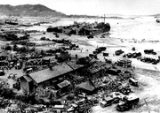
The Battle of Incheon ( Incheon Sangryuk Jakjeon; code nameCode name

A code name or cryptonym is a word or name used clandestinely to refer to another name or word....
: Operation Chromite) was a decisive invasion and battleBattle

Generally, a battle is an instance of combat in warfare between two or more parties wherein each group will seek to defeat t...
 during the Korean WarKorean War

The Korean War began on June 25, 1950 and ended with a truce on July 27, 1953 ....
.

The battle began on September 15, 1950, and ended around September 28. During the amphibious operationAmphibious warfare

This article is about a military strategy involving land troops dispatched from naval ships....
, United NationsUnited Nations

name = United NationsNations Unies...
 (UN) forces secured Inchon and broke out of the BusanBusan

Busan Metropolitan City, also known as Pusan, is the largest harbor city in South Korea....
 region through a series of landings in enemy territory. The majority of UN ground forces participating in this assault were U.S. MarinesUnited States Marine Corps

The United States Marine Corps is a branch of the U.S....
, commanded by General of the ArmyGeneral of the Army (United States)

General of the Army is historically the second most senior rank in the United States Army, equivalent to a Field Marshal in ...
 Douglas MacArthurDouglas MacArthur

Douglas MacArthur was an American general and Medal of Honor recipient, who was Supreme Commander of Allied forces in the S...
.

The Battle of Inchon ended a string of victories by the invading North Korean People's ArmyKorean People's Army

Korean People's Army refers to the armed personnel of the military of North Korea....
 (NKPA) and began a counterattackCounterattack

A counterattack is a military tactic used by defending forces when under attack by an enemy force....
 by United Nations forces that led to the recapture of SeoulSeoul

Seoul listen) is the capital and largest city of South Korea ....
. The advance north ended near the Yalu RiverYalu River

The Yalu River or the Amrok River , is a river on the border between China and North Korea....
, when ChinaPeople's Republic of China

The People's Republic of China , is a country in East Asia....
's People's Volunteer ArmyPeople's Volunteer Army

People's Volunteer Armywas a Volunteer army used by the Chinese government during the Korean War ....
, feeling strategically threatened by what would be the complete loss of Korea, entered the conflict by deploying what would amount to approximately one hundred and fifty thousand of Chinese troops in support of North Korea, overrunning UN forces along the Ch'ongch'on River and forcing a withdrawal after the Battle of Chosin ReservoirBattle of Chosin Reservoir

The Battle of Chosin Reservoir was a battle in the Korean War, in which 30,000 United Nations troops under the command of A...
 to South KoreaSouth Korea

South Korea, officially the Republic of Korea, is an East Asian state on the southern half of the Korean Peninsula....
.
BackgroundPlanningThe idea to land UN forces at Inchon was suggested by MacArthur after he visited the Korean battlefield on June 29 1950, four days after the war began.


Discussion
Ask a question about 'Battle of Inchon'
Start a new discussion about 'Battle of Inchon'
Answer questions from other users
Full Discussion Forum


Timeline

1950   Allied troops land in Inchon, occupied by North Korea, to begin the Battle of Inchon.


Encyclopedia


The Battle of Incheon ( Incheon Sangryuk Jakjeon; code nameCode name

A code name or cryptonym is a word or name used clandestinely to refer to another name or word....
: Operation Chromite) was a decisive invasion and battleBattle

Generally, a battle is an instance of combat in warfare between two or more parties wherein each group will seek to defeat t...
 during the Korean WarKorean War

The Korean War began on June 25, 1950 and ended with a truce on July 27, 1953 ....
.

The battle began on September 15, 1950, and ended around September 28. During the amphibious operationAmphibious warfare

This article is about a military strategy involving land troops dispatched from naval ships....
, United NationsUnited Nations

name = United NationsNations Unies...
 (UN) forces secured Inchon and broke out of the BusanBusan

Busan Metropolitan City, also known as Pusan, is the largest harbor city in South Korea....
 region through a series of landings in enemy territory. The majority of UN ground forces participating in this assault were U.S. MarinesUnited States Marine Corps

The United States Marine Corps is a branch of the U.S....
, commanded by General of the ArmyGeneral of the Army (United States)

General of the Army is historically the second most senior rank in the United States Army, equivalent to a Field Marshal in ...
 Douglas MacArthurDouglas MacArthur

Douglas MacArthur was an American general and Medal of Honor recipient, who was Supreme Commander of Allied forces in the S...
.

The Battle of Inchon ended a string of victories by the invading North Korean People's ArmyKorean People's Army

Korean People's Army refers to the armed personnel of the military of North Korea....
 (NKPA) and began a counterattackCounterattack

A counterattack is a military tactic used by defending forces when under attack by an enemy force....
 by United Nations forces that led to the recapture of SeoulSeoul

Seoul listen) is the capital and largest city of South Korea ....
. The advance north ended near the Yalu RiverYalu River

The Yalu River or the Amrok River , is a river on the border between China and North Korea....
, when ChinaPeople's Republic of China

The People's Republic of China , is a country in East Asia....
's People's Volunteer ArmyPeople's Volunteer Army

People's Volunteer Armywas a Volunteer army used by the Chinese government during the Korean War ....
, feeling strategically threatened by what would be the complete loss of Korea, entered the conflict by deploying what would amount to approximately one hundred and fifty thousand of Chinese troops in support of North Korea, overrunning UN forces along the Ch'ongch'on River and forcing a withdrawal after the Battle of Chosin ReservoirBattle of Chosin Reservoir

The Battle of Chosin Reservoir was a battle in the Korean War, in which 30,000 United Nations troops under the command of A...
 to South KoreaSouth Korea

South Korea, officially the Republic of Korea, is an East Asian state on the southern half of the Korean Peninsula....
.

Background

Planning

The idea to land UN forces at Inchon was suggested by MacArthur after he visited the Korean battlefield on June 29 1950, four days after the war began. MacArthur thought that the North Korean army would push the South Korean armyRepublic of Korea Army

The Republic of Korea Army is by far the largest of the military branches, with over 560,000 effectives as of 2004....
 back far past Seoul. He decided that the battered, demoralized, and under-equipped South Koreans could not hold off the NKPA's advances even with American reinforcements. MacArthur felt that he could turn the tide if he made a decisive troop movement behind enemy lines. He hoped that a landing near Inchon would allow him to cut off the NKPA and destroy that army as a useful fighting force, thus winning the war.

In order to accomplish such a large amphibious operation, MacArthur requested the use of United States Marine Corps expeditionary forces, having become familiar with their ability to integrate amphibious operations in the PacificPacific War

The Pacific War was the part of World War II — and preceding conflicts — that occurred in the Pacific Ocean, its...
 during World War IIWorld War II

World War II, or the Second World War, was a worldwide conflict fought between the Allied Powers and the Axis Powers ,...
. However, the Marines at that point were still recovering from a series of severe program cutbacks instituted by the Truman administrationHarry S. Truman

Harry S. Truman was the thirty-third President of the United States; as Vice President, he succeeded to the office upon the ...
 and Secretary of DefenseUnited States Secretary of Defense Summary

The United States Secretary of Defense is the head of the United States Department of Defense, concerned with the armed se...
 Louis A. JohnsonLouis A. Johnson

Louis Arthur Johnson was the second United States Secretary of Defense, serving in the cabinet of President Harry S....
. Indeed, Johnson had tried to eliminate the Marines entirely and slashed Marine expeditionary forces from a World War II peak of 300,000 men to just over 27,000. Much of the Marines' landing craft and amphibious carriers had been sold off, scrapped, or transferred to the exclusive use of the U.S. Army. After hastily re-equipping Marine forces with aging World War II landing craft, withdrawing Marine units from the Pusan perimeter, and stripping recruitment depots bare of men, Marine commanders were just able to mount a force capable of undertaking offensive operations.

MacArthur decided to use the Joint Strategic and Operations GroupJoint Strategic and Operations Group

The Joint Strategic and Operations Group, also know as the Joint Strategic Plans and Operations Group, was a committee that ...
 (JSPOG) of his Far East CommandFar East Command

The Far East Command was a military regional division of the British military....
 (FECOM). The initial plan was met with skepticism by the other generals because Inchon's natural and artificial defenses were formidable. The approaches to Inchon were two restricted passages, Flying Fish and Eastern channels, which could be easily blocked by minesNaval mine

A naval mine is a self-contained explosive device placed in water to destroy ships or submarines....
. The current of the channels was also dangerously quick—three to eight knotKnot (speed)

A knot is a unit of speed, abbreviated kt or kn....
s. Finally, the anchorage was small and the harbor surrounded by tall seawallSeawall

A seawall is a form of hard coastal defense constructed on the inland part of a coast to reduce the effects of strong waves ...
s. Commander Arlie G. Capps noted "We drew up a list of every natural and geographic handicap—and Inchon had 'em all."

These problems, along with the advancing North Korean army, forced MacArthur to abandon his first plan, Operation Bluehearts, which called for an Inchon landing in July 1950.

Despite these obstacles, in September MacArthur issued a revised plan of assault on Inchon: Plan 100-B, codenamed Operation Chromite. A briefing led by AdmiralAdmiral

Admiral is the rank, or part of the name of the ranks, of the highest naval officers. ...
 James Doyle concluded "the best that I can say is that Inchon is not impossible." Officers at the briefing spent much of their time asking about alternative landing sites such as Kunsan. MacArthur spent 45 minutes after the briefing explaining his reasons for choosing Inchon. He said that because it was so heavily defended, the enemy would not expect an attack there, that victory at Inchon would avoid a brutal winter campaign, and that, by invading a northern strong point, the UN forces could cut off North Korean lines of communication. Inchon was also chosen because of its proximity to Seoul. Admiral Forrest P. Sherman and General J. Lawton CollinsJ. Lawton Collins

Joseph "Lightning Joe" Lawton Collins was a general of the United States Army....
 returned to Washington, D.C.Washington, D.C.

Washington, D.C. is the capital city of the United States of America....
, and had the invasion approved.

The landing at Inchon was not the first large-scale amphibious operation since World War II. That distinction belonged to the July 18, 1950 landing at PohangPohang

Pohang is a city in North Gyeongsang Province, South Korea....
. However, that operation was not made in enemy held territory and was unopposed.

Before the landing

Seven days before the main attack on Inchon, a joint Central Intelligence AgencyCentral Intelligence Agency

The Central Intelligence Agency is an intelligence agency of the United States Government....
military intelligenceMilitary intelligence

Military intelligence, is a military discipline that focuses on the gathering, analysis, protection, and dissemination of in...
 reconnaissance, codenamed Trudy Jackson, placed a team of guerrillasGuerrilla warfare

Guerrilla is a term borrowed from the Spanish guerrilla meaning small war, and used to describe small combat groups...
 in Inchon. The group, led by Navy Lieutenant Eugene Clark, landed at Yonghung-do, an islandIsland

An island or isle is any piece of land that is completely surrounded by water....
 in the mouth of the harbor. From there, they relayed intelligence back to U.S. forces.

With the help of locals, the guerrillas gathered information about tideFacts About Tide

The tide is the cyclic rising and falling of Earth's ocean surface caused by the tidal forces of the Moon and the Sun acting...
s, mudflatMudflat

Mudflats are coastal wetlands that form when mud is deposited by the tides or rivers, they are found in sheltered areas such...
s, seawalls and enemy fortificationFortification

Fortifications are military constructions and buildings designed for defense in warfare....
s. The mission's most important contribution was the restarting of a lighthouseLighthouse

An aid for navigation and pilotage at sea, a lighthouse is a tower building or framework sending out light from a system of ...
 on Palmi-do. When the North Koreans discovered that the allied agents had entered the peninsula, they sent an attack craft with 16 infantrymen. Eugene Clark mounted a machine gun on a sampan and sank the attack boat. In response, the North Koreans killed up to 50 civilians for helping Clark.

A series of drills and tests were conducted elsewhere on the coast of Korea, where conditions were similar to Inchon, before the actual invasion. These drills were used to perfect the timing and performance of the landing craft.

As the landing groups neared, cruiserCruiser

A cruiser is a large warship capable of engaging multiple targets simultaneously....
s and destroyerDestroyer

In naval terminology, a destroyer is a fast and maneuverable yet long-endurance warship intended to escort larger vessels in...
s from several UN navies shelled Wolmi-do and checked for mines in Flying Fish Channel. The first Canadian forces entered the Korean War when HMCS CayugaHMCS Cayuga (R04)

HMCS Cayuga R04/218 was a Destroyer of the Tribal class built in the United Kingdom and served in the Royal Canadian Navy....
, HMCS AthabaskanHMCS Athabaskan (R79)

olspan="2"|...
 and HMCS SiouxHMCS Sioux (R64)

HMCS Sioux is a V-Class Canadian WWII destroyer, formerly of the Royal Navy HMS Vixen....
 bombarded the coast. The Fast Carrier Force flew fighter cover, interdictionAir interdiction

Air interdiction is the use of aircraft to attack tactical ground targets that are not in close proximity to friendly ground...
, and ground attack missions. Destroyer Squadron Nine, headed by the USS MansfieldUSS Mansfield (DD-728)

USS Mansfield, an Allen M. Sumner-class destroyer, is the only ship of the United States Navy to be named for Sergea...
, sailed up Eastern Channel and into Inchon Harbor, where it fired upon enemy gun emplacements. The attacks tipped off the North Koreans that a landing might be imminent. The North Korean officer at Wolmi-do assured his superiors that he would throw the enemy back into the sea.

Battle


The flotilla of ships that landed during the battle was commanded by Arthur Dewey StrubleArthur Dewey Struble

Arthur Dewey Struble was a U.S. admiral who served in World War II....
, an expert in amphibious warfare. Struble had participated in amphibious operations in World War II, including the Battle of LeyteBattle of Leyte

The Battle of Leyte in the Pacific campaign of World War II was the invasion and conquest of Leyte in the Philippines by the...
 and the Battle of NormandyBattle of Normandy

The Battle of Normandy was fought in 1944 between Nazi Germany in Western Europe and the invading Allied forces as part of ...
.

Green Beach

At 06:30 on September 15, 1950, the lead elements of U.S. X Corps hit "Green Beach" on the northern side of Wolmi-Do Island. The landing force consisted of the 3rd Battalion 5th Marines3rd Battalion 5th Marines Summary

3rd Battalion 5th Marines is an infantry battalion in the United States Marine Corps based out of Camp Pendleton, California...
 and nine M26 PershingM26 Pershing

The Heavy Tank M26 Pershing was an American tank used during World War II and the Korean War....
 tanks from the 1st Tank Battalion1st Tank Battalion

The 1st Tank Battalion is an armored battalion of the United States Marine Corps which is based out of the Marine Corps Air ...
. One tank was equipped with a flamethrowerFlamethrower

A flamethrower is a mechanical device designed to project a long, controllable stream of fire, hence the metaphor "to throw ...
 and two others had bulldozerBulldozer

A bulldozer is a very powerful crawler equipped with a blade....
 blades. The battle group landed in LSTs designed and built during World War II. The entire island was captured by noon at the cost of just 14 casualties. North Korean casualties included over 200 killed and 136 captured, primarily from the 918th Artillery Regiment918th Artillery Regiment (North Korea)

Sorry, no overview for this topic
 and the 226th Independent Marine Regiment226th Independent Marine Regiment (North Korea)

Sorry, no overview for this topic
. The forces on Green Beach had to wait until 19:50 for the tide to rise, allowing another group to land. During this time, extensive shelling and bombing, along with anti-tank mines placed on the only bridge, kept the North Koreans from launching a significant counterattack. The second wave came ashore at "Red Beach" and "Blue Beach".

The North Korean army had not been expecting an invasion at Inchon. After the storming of Green Beach, the NKPA assumed (probably because of deliberate misinformation by American counter-intelligence) that the main invasion would happen at Kunsan. As a result, only a small force was diverted to Inchon. Even those forces were too late, and they arrived after the UN forces had taken Blue and Red Beaches. The troops already stationed at Inchon had been weakened by Clark's guerrillas, and napalmNapalm

Napalm is any of a number of flammable liquids used in warfare, often jellied gasoline....
 bombing runs had destroyed key ammunition dumps. In total, 261 ships took part.

Red Beach


The Red Beach forces, made up of the Regimental Combat Team 5, used ladders to scale the sea walls. After neutralizing North Korean defenses, they opened the causeway to Wolmi-Do, allowing the tanks from Green Beach to enter the battle. Red Beach forces suffered eight dead and 28 wounded.

Blue Beach

Under the command of Colonel Lewis "Chesty" PullerChesty Puller

Lieutenant General Lewis Burwell "Chesty" Puller was a United States Marine mustang officer, notable as the most decorated M...
, the 1st Marine Regiment landing at Blue Beach was significantly south of the other two beaches and reached shore last. As they approached the coast, the combined fire from several NKPA gun emplacements sank one LST. Destroyer fire and bombing runs silenced the North Korean defenses. When they finally arrived, the North Korean forces at Inchon had already surrendered, so the Blue Beach forces suffered few casualties and met little opposition. The 1st Marine Regiment spent much of its time strengthening the beachheadBeachhead Overview

Beachhead is a military term used to describe the line created when a unit reaches a beach, and begins to defend that area o...
 and preparing for the inland invasion.

Aftermath

Beachhead


Immediately after North Korean resistance was extinguished in Inchon, the supply and reinforcement process began. SeabeeSeabee

The Seabees are the Construction Battalions of the United States Navy....
s and Underwater Demolition TeamUnderwater Demolition Team

Underwater Demolition Teams were a precursor to the current United States Navy SEALs....
s (UDTs) that had arrived with the U.S. Marines constructed a pontoon dock on Green Beach and cleared debris from the water. The dock was then used to unload the remainder of the LSTs.

Documents written by Kim Il Sung and recovered by UN troops soon after the landing said, "The original plan was to end the war in a month, we could not stamp out four American divisions...We were taken by surprise when United Nations troops and the American Air Force and Navy moved in."

On September 16, the North Koreans, realizing their blunder, sent six columns of T-34 tanks to the beachhead. In response, two flights from F4U CorsairF4U Corsair

The Chance Vought F4U Corsair was a fighter aircraft that saw service in World War II and the Korean War....
 squadron VMF-214 bombed the attackers. The air strike damaged or destroyed half of the tank column and lost one plane. A quick counter-attack by M26 PershingM26 Pershing

The Heavy Tank M26 Pershing was an American tank used during World War II and the Korean War....
 tanks destroyed the remainder of the North Korean armored division and cleared the way for the capture of Inchon.

On September 19, the U.S. Army Corps of EngineersUnited States Army Corps of Engineers

The United States Army Corps of Engineers, or USACE, is made up of some 34,600 civilian and 650 military men and women...
 repaired the local railroad up to eight miles (13 km) inland. The Kimpo airstrip was captured, and transport planes began flying in gasoline and ordnance for the aircraft stationed at Inchon. The Marines continued unloading supplies and reinforcements. By September 22, they had unloaded 6,629 vehicles and 53,882 troops, along with 25,512 tonShort ton

The short ton is a unit of mass equal to 2000 lb....
s (23,000 tonneTonne Summary

A tonne , sometimes referred to as a metric tonne, is a measurement of mass equal to 1,000 kilograms....
s) of supplies.

Battle of Seoul


In contrast to the quick victory at Inchon, the advance on Seoul was slow and bloody. The NKPA launched another T-34 attack, which was trapped and destroyed, and a Yak bombing run in Inchon harbor, which did little damage. The NKPA attempted to stall the UN offensive to allow time to reinforce Seoul and withdraw troops from the south. Though warned that the process of taking Seoul would allow remaining NKPA forces in the south to escape, MacArthur felt that he was bound to honor promises given to the South Korean government to retake the capital as soon as possible.

On the second day, vessels carrying the U.S. Army's 7th Infantry Division arrived in Inchon Harbor. General Almond was eager to get the division into position to block a possible enemy movement from the south of Seoul. On the morning of September 18, the division's 2nd Battalion of the 32nd Infantry Regiment32d Infantry Regiment (United States)

The 32nd Infantry Regiment is a formation of the United States Army....
 landed at Inchon and the remainder of the regiment went ashore later in the day. The next morning, the 2nd Battalion moved up to relieve an U.S. Marine battalion occupying positions on the right flank south of Seoul. Meanwhile, the 7th Division's 31st Regiment came ashore at Inchon. Responsibility for the zone south of Seoul highway passed to 7th Division at 18:00 on September 19. The 7th Infantry Division then engaged in heavy fighting on the outskirts of Seoul.

Before the battle, North Korea had just one understrength division in the city, with the majority of its forces south of the capital. MacArthur personally oversaw the 1st Marine Regiment as it fought through North Korean positions on the road to Seoul. Control of Operation Chromite was then given to Major General Edward AlmondEdward Almond

Edward Mallory Almond was an American military officer best known as the commander of the United States Army X Corps during ...
, the X Corps commander. It was Almond's goal to take Seoul on September 25, exactly three months after the beginning of the war. On September 22, the Marines entered Seoul to find it heavily fortified. Casualties mounted as the forces engaged in desperate house-to-house fighting. Anxious to pronounce the conquest of Seoul, Almond declared the city liberated on September 25 despite the fact that Marines were still engaged in house-to-house combat (gunfire and artillery could still be heard in the northern suburbs).

Breakout of Pusan

The last North Korean troops in South Korea still fighting were defeated when Walker's 8th ArmyU.S. Eighth Army

The Eighth US Army—often abbreviated EUSA— is the commanding formation of all US Army troops in South Kore...
 broke out of the Pusan perimeter, joining the Army's X Corps in a coordinated attack on NKPA forces. Of the 70,000 NKPA troops around Pusan, more than half were killed or captured. However, because UN forces had concentrated on taking Seoul rather than cutting off the NKPA's withdrawal north, the remaining 30,000 North Korean soldiers escaped to the north across the Yalu River, where they were soon reconstituted as a cadre for the formation of new NKPA divisions hastily re-equipped by the Soviet UnionSoviet Union

The Union of Soviet Socialist Republics , more commonly known as the Soviet Union, was a Communist state that existed...
. The allied assault continued north to the Yalu River until the intervention of the People's Republic of ChinaPeople's Republic of China

The People's Republic of China , is a country in East Asia....
 in the war.

External links

  • French and English supported operations. Allies provide a unique perspective of naval operation in the Korean War.