
Home      Discussion      Topics      Dictionary      Almanac
Signup       Login
Fire sprinkler

Fire sprinkler

Overview

Discussion
Ask a question about 'Fire sprinkler'
Start a new discussion about 'Fire sprinkler'
Answer questions from other users
Full Discussion Forum
 
Unanswered Questions
Encyclopedia

A fire sprinkler system is an active fire protection
Active fire protection
Active fire protection is an integral part of fire protection. AFP is characterised by items and/or systems, which require a certain amount of motion and response in order to work, contrary to passive fire protection.-Fire suppression:...

 measure, consisting of a water supply system, providing adequate pressure and flowrate to a water distribution piping system, onto which fire sprinkler
Fire sprinkler
A fire sprinkler system is an active fire protection measure, consisting of a water supply system, providing adequate pressure and flowrate to a water distribution piping system, onto which fire sprinklers are connected...

s are connected. Although historically only used in factories and large commercial buildings, home and small building systems are now available at a cost-effective price.

History


The world’s first recognizable sprinkler system was installed in the Theatre Royal, Drury Lane
Theatre Royal, Drury Lane
The Theatre Royal, Drury Lane is a West End theatre in Covent Garden, in the City of Westminster, a borough of London. The building faces Catherine Street and backs onto Drury Lane. The building standing today is the most recent in a line of four theatres at the same location dating back to 1663,...

 in the United Kingdom in 1812 by its architect . The system was designed by Sir William Congreve, 2nd Baronet was covered by a patent No 3606 dated the same year. The apparatus consisted of a cylindrical airtight reservoir of 400 hogsheads (~95,000 litres) fed by a 10 inches (254 mm) water main which branched to all parts of the theatre. A series of smaller pipes feed from the distribution pipe were pierced with a series of 1/2 in holes which pour water in the event of a fire.

From 1852 to 1885, perforated pipe systems were used in textile mills throughout New England as a means of fire protection. However, they were not automatic systems; they did not turn on by themselves. Inventors first began experimenting with automatic sprinklers around 1860. The first automatic sprinkler system was patented by Philip W. Pratt of Abington, MA, in 1872.

Henry S. Parmalee of New Haven, Connecticut is considered the inventor of the first automatic sprinkler head. Parmalee improved upon the Pratt patent and created a better sprinkler system. In 1874, he installed his fire sprinkler system into the piano factory that he owned.
Frederick Grinnell
Frederick Grinnell
Frederick Grinnell was a pioneer in fire safety.-Improved fire sprinkler:He was born in New Bedford, Massachusetts. In 1855, he graduated from Rensselaer Polytechnic Institute. Inventor, engineer, and industrialist, Grinnell was the creator of the first practical automatic fire sprinkler, which...

 improved Parmalee's design and in 1881 patented the automatic sprinkler that bears his name. He continued to improve the device and in 1890 invented the glass disc sprinkler, essentially the same as that in use today.

Until the 1940s, sprinklers were installed almost exclusively for the protection of commercial buildings, whose owners were generally able to recoup their expenses with savings in insurance costs. Over the years, fire sprinklers have become mandatory safety equipment in some parts of North America, in certain occupancies
Occupancy
Occupancy in building construction and building codes is the use or intended use of a building or part thereof for the shelter or support of persons, animals or property. A closely related meaning is the number of units in such a building that are rented or leased, or otherwise in-use...

, including, but not limited to newly constructed hospitals, schools, hotels and other public buildings, subject to the local building codes and enforcement.

However, outside of the US and Canada, sprinklers are rarely mandated by building codes for normal hazard occupancies which do not have large numbers of occupants (e.g. factories, process lines, retail outlets, petrol stations etc.)

Usage


Sprinklers have been in use in the United States
United States
The United States of America is a federal constitutional republic comprising fifty states and a federal district...

 since 1874, and were used in factory applications where fires at the turn of the century were often catastrophic in terms of both human and property losses. In the US, sprinklers are today required in all new high rise and underground buildings generally 75 feet (22.9 m) above or below fire department access, where the ability of firefighter
Firefighter
Firefighters are rescuers extensively trained primarily to put out hazardous fires that threaten civilian populations and property, to rescue people from car incidents, collapsed and burning buildings and other such situations...

s to provide adequate hose streams to fires is limited.

Sprinklers may be required to be installed by building code
Building code
A building code, or building control, is a set of rules that specify the minimum acceptable level of safety for constructed objects such as buildings and nonbuilding structures. The main purpose of building codes are to protect public health, safety and general welfare as they relate to the...

s, or may be recommended by insurance companies to reduce potential property losses or business interruption. Building code
Building code
A building code, or building control, is a set of rules that specify the minimum acceptable level of safety for constructed objects such as buildings and nonbuilding structures. The main purpose of building codes are to protect public health, safety and general welfare as they relate to the...

s in the United States for places of assembly, generally over 100 persons, and places with overnight sleeping accommodation such as hotel
Hotel
A hotel is an establishment that provides paid lodging on a short-term basis. The provision of basic accommodation, in times past, consisting only of a room with a bed, a cupboard, a small table and a washstand has largely been replaced by rooms with modern facilities, including en-suite bathrooms...

s, nursing home
Nursing home
A nursing home, convalescent home, skilled nursing unit , care home, rest home, or old people's home provides a type of care of residents: it is a place of residence for people who require constant nursing care and have significant deficiencies with activities of daily living...

s, dormitories
Dormitory
A dormitory, often shortened to dorm, in the United States is a residence hall consisting of sleeping quarters or entire buildings primarily providing sleeping and residential quarters for large numbers of people, often boarding school, college or university students...

, and hospital
Hospital
A hospital is a health care institution providing patient treatment by specialized staff and equipment. Hospitals often, but not always, provide for inpatient care or longer-term patient stays....

s usually require sprinklers either under local building codes, as a condition of receiving State and Federal funding or as a requirement to obtain certification (essential for institutions who wish to train medical staff)..

Since 2011, Pennsylvania and California require sprinkler systems in all new residential construction - the first US states to do so.

Federal Law (US)


While there is very little specific Federal legislation regarding building codes, which are generally left to local jurisdictions, the Federal government has used its funding and monetary clout to strongly encourage fire safety standards. construction. Since 2011, two states, California and Pennsylvania have required sprinklers in at least some new residential construction.

In 1990 the US Congress passed PL-101-391, better known as "The Hotel and Motel Safety Act (of 1990)". This law requires that any hotel, meeting hall, or similar institution that receives federal funds (i.e. for a government traveller's overnight stay, or a conference, etc.), must meet fire and other safety requirements. The most visible of these conditions are the implementation of sprinklers.

As more and more hotels, etc., upgraded their facilities to enable acceptance of government visitors, this type of construction became the de facto industry norm - even when not directly mandated by any local building codes.

If building codes do not explicitly mandate the use of fire sprinklers, the code often makes it highly advantageous to install them as an optional system. Most US building codes allow for less expensive construction materials, larger floor area limitations, longer egress paths, and fewer requirements for fire rated construction in structures protected by fire sprinklers. Consequently, the total building cost is often less by installing a sprinkler system and savings money in the other aspects of the project, as compared to building a non-sprinklered structure. In the UK, since the 1990s sprinklers have gained recognition within the Building Regulations (England and Wales) and Scottish Building Standards and under certain circumstances, the presence of sprinkler systems is deemed to provide a form of alternative compliance to some parts of the codes. For example, the presence of a sprinkler system will usually permit doubling of compartment sizes and increases in travel distances (to fire exits) as well as allowing a reduction in the fire rating of internal compartment walls.

Europe


Renewed interest in and support for sprinkler systems in the UK, largely as a result of effective lobbying by the National Fire Sprinkler Network, the European Fire Sprinkler Network and the British Automatic Fire Sprinkler Association, has resulted in sprinkler systems being more widely installed. In schools, for example, the government has issued recommendations through Building Bulletin 100 that most new schools should be constructed with sprinkler protection. In 2011 Wales became the first country in the world where sprinklers are compulsory in all new homes. The law will apply to newly built houses and blocks of flats, as well as care homes and university halls of residence. In Scotland, all new schools are sprinklered, as are new care homes, sheltered housing and high rise flats. In Norway as of July 2010, all new housing of more than two storeys, all new hotels, care homes and hospitals must be sprinklered. Other Nordic countries require or soon will require sprinklers in new care homes, and in Finland as of 2010 a third of care homes were retrofitted with sprinklers. A fire in an illegal immigrant detention centre at Schiphol airport in The Netherlands on 27 October 2005 killed 11 detainees and led to the retrofitting of sprinklers in all similarly designed prisons in The Netherlands. A fire at Düsseldorf airport on 11 April 1996 which killed 17 people led to sprinklers being retrofitted in all major German airports. Most European countries also require sprinklers in shopping centres, in large warehouses and in high-rise buildings.

Operation


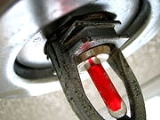
Each closed-head sprinkler is held closed by either a heat-sensitive glass bulb or a two-part metal link held together with fusible alloy
Fusible alloy
A fusible alloy is a metal alloy capable of being easily fused, i.e. easily meltable, at relatively low temperatures. Fusible alloys are commonly, but not necessarily, eutectic alloys....

. The glass bulb or link applies pressure to a pip cap which acts as a plug which prevents water from flowing until the ambient temperature around the sprinkler reaches the design activation temperature of the individual sprinkler head. In a standard wet-pipe sprinkler system, each sprinkler activates independently when the predetermined heat level is reached. Because of this, the number of sprinklers that operate is limited to only those near the fire, thereby maximizing the available water pressure over the point of fire origin.

A sprinkler activation will do less damage than a fire department hose stream, which provide approximately 900 liters/min (250 US gallons/min). A typical sprinkler used for industrial manufacturing occupancies discharge about 75-150 litres/min (20-40 US gallons/min). However, a typical Early Suppression Fast Response (ESFR) sprinkler at a pressure of 50 psi (344.7 kPa) will discharge approximately 100 USgal/min. In addition, a sprinkler will usually activate between one and four minutes, whereas the fire department typically takes at least five minutes to arrive at the fire site after receiving an alarm, and an additional ten minutes to set up equipment and apply hose streams to the fire. This additional time can result in a much larger fire, requiring much more water to extinguish.

Wet pipe systems


By a wide margin, wet pipe sprinkler systems are installed more often than all other types of fire sprinkler systems. They also are the most reliable, because they are simple, with the only operating components being the automatic sprinklers and (commonly, but not always) the automatic alarm check valve. An automatic water supply provides water under pressure to the system piping.

Dry pipe systems


Dry pipe systems are installed in spaces in which the ambient temperature may be cold enough to freeze the water in a wet pipe system, rendering the system inoperable. Dry pipe systems are most often used in unheated buildings, in parking garages, in outside canopies attached to heated buildings (in which a wet pipe system would be provided), or in refrigerated cooler
Refrigerator
A refrigerator is a common household appliance that consists of a thermally insulated compartment and a heat pump that transfers heat from the inside of the fridge to its external environment so that the inside of the fridge is cooled to a temperature below the ambient temperature of the room...

s. Dry pipe systems are the second most common sprinkler system type. In regions using NFPA regulations, dry pipe systems cannot be installed unless the range of ambient temperatures reaches below 40F.

Operation - Water is not present in the piping until the system operates. The piping is filled with air below the water supply pressure. To prevent the larger water supply pressure from forcing water into the piping, the design of the dry pipe valve (a specialized type of check valve
Check valve
A check valve, clack valve, non-return valve or one-way valve is a mechanical device, a valve, which normally allows fluid to flow through it in only one direction....

) results in a greater force on top of the check valve clapper by the use of a larger valve clapper area exposed to the piping air pressure, as compared to the higher water pressure but smaller clapper surface area.

When one or more of the automatic sprinklers is exposed, for a sufficient time, to a temperature at or above the temperature rating, it opens, allowing the air in the piping to vent from that sprinkler. Each sprinkler operates individually. As the air pressure in the piping drops, the pressure differential across the dry pipe valve changes, allowing water to enter the piping system. Water flow from sprinklers, needed to control the fire, is delayed until the air is vented from the sprinklers. For this reason, dry pipe systems are usually not as effective as wet pipe systems in fire control during the initial stages of the fire.

Some view dry pipe sprinklers as advantageous for protection of collections and other water sensitive areas. This perceived benefit is due to a fear that wet system piping may leak, while dry pipe systems will not. However, the same potential for accidental water damage exists, as dry pipe systems will only provide a slight delay prior to water discharge while the air in the piping is released from the pipe.

Disadvantages of using dry pipe fire sprinkler systems include:
  • Increased complexity - Dry pipe systems require additional control equipment and air pressure supply components which increases system complexity. This puts a premium on proper maintenance, as this increase in system complexity results in an inherently less reliable overall system (i.e., more single failure points) as compared to a wet pipe system.
  • Higher installation and maintenance costs - The added complexity impacts the overall dry-pipe installation cost, and increases maintenance expenditure primarily due to added service labor costs.
  • Lower design flexibility - Regulatory requirements limit the maximum permitted size (i.e., 750 gallons) of individual dry-pipe systems, unless additional components and design efforts are provided to limit the time from sprinkler activation to water discharge to under one minute. These limitations may increase the number of individual sprinkler systems (i.e., served from a single riser) that must be provided in the building, and impact the ability of an owner to make system additions.
  • Increased fire response time - Because the piping is empty at the time the sprinkler operates, there is an inherent time delay in delivering water to the sprinklers which have operated while the water travels from the riser to the sprinkler, partially filling the piping in the process. A maximum of 60 seconds is normally allowed by regulatory requirements from the time a single sprinkler opens until water is discharged onto the fire. This delay in fire suppression results in a larger fire prior to control, increasing property damage.
  • Increased corrosion
    Corrosion
    Corrosion is the disintegration of an engineered material into its constituent atoms due to chemical reactions with its surroundings. In the most common use of the word, this means electrochemical oxidation of metals in reaction with an oxidant such as oxygen...

     potential - Following operation or testing, dry-pipe sprinkler system piping is drained, but residual water collects in piping low spots, and moisture is also retained in the atmosphere within the piping. This moisture, coupled with the oxygen available in the compressed air in the piping, increases pipe internal wall corrosion rates, possibly eventually leading to leaks. The internal pipe wall corrosion rate in wet pipe systems (in which the piping is constantly full of water) is much lower, as the amount of oxygen available for the corrosion process is lower.

Deluge systems


"Deluge" systems are systems in which all sprinklers connected to the water piping system are open, in that the heat sensing operating element is removed, or specifically designed as such. These systems are used for special hazards where rapid fire spread is a concern, as they provide a simultaneous application of water over the entire hazard. They are sometimes installed in personnel egress paths or building openings to slow travel of fire (e.g., openings in a fire-rated wall).

Water is not present in the piping until the system operates. Because the sprinkler orifices are open, the piping is at atmospheric pressure. To prevent the water supply pressure from forcing water into the piping, a deluge valve is used in the water supply connection, which is a mechanically latched valve. It is a non-resetting valve, and stays open once tripped.

Because the heat sensing elements present in the automatic sprinklers have been removed (resulting in open sprinklers), the deluge valve must be opened as signaled by a fire alarm system. The type of fire alarm initiating device is selected mainly based on the hazard (e.g., smoke detector
Smoke detector
A smoke detector is a device that detects smoke, typically as an indicator of fire. Commercial, industrial, and mass residential devices issue a signal to a fire alarm system, while household detectors, known as smoke alarms, generally issue a local audible and/or visual alarm from the detector...

s, heat detector
Heat detector
A heat detector is a fire alarm device designed to respond when the convected thermal energy of a fire increases the temperature of a heat sensitive element....

s, or optical flame detector
Flame detector
There are several types of flame detector. The optical flame detector is a detector that uses optical sensors to detect flames. There are also ionisation flame detectors, which use current flow in the flame to detect flame presence, and thermocouple flame detectors.-Ultraviolet:Ultraviolet ...

s). The initiation device signals the fire alarm panel, which in turn signals the deluge valve to open. Activation can also be manual, depending on the system goals. Manual activation is usually via an electric or pneumatic fire alarm pull station, which signals the fire alarm panel, which in turn signals the deluge valve to open.

Operation - Activation of a fire alarm initiating device, or a manual pull station, signals the fire alarm panel, which in turn signals the deluge valve to open, allowing water to enter the piping system. Water flows from all sprinklers simultaneously.

Pre-Action Systems


Pre-action sprinkler systems are specialized for use in locations where accidental activation is undesired, such as in museum
Museum
A museum is an institution that cares for a collection of artifacts and other objects of scientific, artistic, cultural, or historical importance and makes them available for public viewing through exhibits that may be permanent or temporary. Most large museums are located in major cities...

s with rare art works, manuscripts, or books; and Data Centers, for protection of computer equipment from accidental water discharge.

Pre-action systems are hybrids of wet, dry, and deluge systems, depending on the exact system goal. There are two main sub-types of pre-action systems: single interlock, and double interlock.

The operation of single interlock systems are similar to dry systems except that these systems require that a “preceding” fire detection event, typically the activation of a heat or smoke detector, takes place prior to the “action” of water introduction into the system’s piping by opening the pre-action valve, which is a mechanically latched valve (i.e., similar to a deluge valve). In this way, the system is essentially converted from a dry system into a wet system. The intent is to reduce the undesirable time delay of water delivery to sprinklers that is inherent in dry systems. Prior to fire detection, if the sprinkler operates, or the piping system develops a leak, loss of air pressure in the piping will activate a trouble alarm. In this case, the pre-action valve will not open due to loss of supervisory pressure, and water will not enter the piping.

The operation of double interlock systems are similar to deluge systems except that automatic sprinklers are used. These systems require that both a “preceding” fire detection event, typically the activation of a heat or smoke detector, and an automatic sprinkler operation take place prior to the “action” of water introduction into the system’s piping. Activation of either the fire detectors alone, or sprinklers alone, without the concurrent operation of the other, will not allow water to enter the piping. Because water does not enter the piping until a sprinkler operates, double interlock systems are considered as dry systems in terms of water delivery times, and similarly require a larger design area.

Foam water sprinkler systems


A foam water fire sprinkler system is a special application system, discharging a mixture of water and low expansion foam
Foam
-Definition:A foam is a substance that is formed by trapping gas in a liquid or solid in a divided form, i.e. by forming gas regions inside liquid regions, leading to different kinds of dispersed media...

 concentrate, resulting in a foam spray from the sprinkler. These systems are usually used with special hazards occupancies associated with high challenge fires, such as flammable liquid
Flammable liquid
Generally, a flammable liquid is a liquid that can catch fire.In the USA, there is a precise definition of flammable liquid as one with a flash point below 100 degrees Fahrenheit. Less-flammable liquids are defined as combustible liquids...

s, and airport hangar
Hangar
A hangar is a closed structure to hold aircraft or spacecraft in protective storage. Most hangars are built of metal, but other materials such as wood and concrete are also sometimes used...

s. Operation is as described above, depending on the system type into which the foam is injected.

Water spray


"Water spray" systems are operationally identical to a deluge system, but the piping and discharge nozzle spray patterns are designed to protect a uniquely configured hazard, usually being three dimensional components or equipment (i.e., as opposed to a deluge system, which is designed to cover the horizontal floor area of a room). The nozzles used may not be listed fire sprinklers, and are usually selected for a specific spray pattern to conform to the three dimensional nature of the hazard (e.g., typical spray patterns being oval, fan, full circle, narrow jet). Examples of hazards protected by water spray systems are electrical transformers containing oil for cooling or turbgenerator bearings. Water spray systems can also be used externally on the surfaces of tanks containing flammable liquids or gases (such as hydrogen). Here the water spray is intended to cool the tank and its contents to prevent tank rupture/explosion (BLEVE
BLEVE
A boiling liquid expanding vapor explosion occurs when a vessel containing a pressurized liquid above its boiling point ruptures.-Mechanism:...

) and fire spread.

Design


Sprinkler systems are intended to either control the fire or to suppress the fire. Control mode sprinklers are intended to control the heat release rate of the fire to prevent building structure collapse, and pre-wet the surrounding combustibles to prevent fire spread. The fire is not extinguished until the burning combustibles are exhausted or manual extinguishment is effected by firefighter
Firefighter
Firefighters are rescuers extensively trained primarily to put out hazardous fires that threaten civilian populations and property, to rescue people from car incidents, collapsed and burning buildings and other such situations...

s. Suppression mode sprinklers (formerly known as Early Suppression Fast Response (ESFR) sprinklers) are intended to result in a severe sudden reduction of the heat release rate of the fire, followed quickly by complete extinguishment, prior to manual intervention.

Most sprinkler systems installed today are designed using an area and density approach. First the building use and building contents are analyzed to determine the level of fire hazard. Usually buildings are classified as light hazard, ordinary hazard group 1, ordinary hazard group 2, extra hazard group 1, or extra hazard group 2. After determining the hazard classification, a design area and density can be determined by referencing tables in the National Fire Protection Association
National Fire Protection Association
The National Fire Protection Association is a United States trade association that creates and maintains private, copywrited, standards and codes for usage and adoption by local governments...

 (NFPA) standards. The design area is a theoretical area of the building representing the worst case area where a fire could burn. The design density is a measurement of how much water per square foot of floor area should be applied to the design area. For example, in an office building classified as light hazard, a typical design area would be 1500 square feet (139.4 m²) and the design density would be 0.1 USgal/min per 1 square foot (0.09290304 m²) or a minimum of 150 USgal/min applied over the 1500 square feet (139.4 m²) design area. Another example would be a manufacturing facility classified as ordinary hazard group 2 where a typical design area would be 1500 square feet (139.4 m²) and the design density would be 0.2 USgal/min per 1 square foot (0.09290304 m²) or a minimum of 300 USgal/min applied over the 1500 square feet (139.4 m²) design area.

After the design area and density have been determined, calculations are performed to prove that the system can deliver the required amount of water over the required design area. These calculations account for all of the pressure that is lost or gained between the water supply source and the sprinklers that would operate in the design area. This includes pressure losses due to friction inside the piping and losses or gains due to elevational differences between the source and the discharging sprinklers. Sometimes momentum pressure from water velocity inside the piping is also calculated. Typically these calculations are performed using computer software but before the advent of computer systems these sometimes complicated calculations were performed by hand. This skill of calculating sprinkler systems by hand is still required training for a sprinkler system design technologist
Engineering technologist
An engineering technologist, is a specialist devoted to the implementation of existing technology within a field of engineering. Technologists often work with engineers in a wide variety of projects by applying basic engineering principles and technical skills...

 who seeks senior level certification from engineering certification organizations such as the National Institute for Certification in Engineering Technologies
National Institute for Certification in Engineering Technologies
The National Institute for Certification in Engineering Technologies is an organization that was established in 1961 to create a recognized certification for engineering technicians and technologist within the United States....

 (NICET).
Sprinkler systems in residential structures are becoming more common as the cost of such systems becomes more practical and the benefits become more obvious. Residential sprinkler systems usually fall under a residential classification separate from the commercial classifications mentioned above. A commercial sprinkler system is designed to protect the structure and the occupants from a fire. Most residential sprinkler systems are primarily designed to suppress a fire in such a way to allow for the safe escape of the building occupants. While these systems will often also protect the structure from major fire damage, this is a secondary consideration. In residential structures sprinklers are often omitted from closets, bathrooms, balconies, garages and attics because a fire in these areas would not usually impact the occupant's escape route.

If water damage or water volume is of particular concern, a technique called Water Mist Fire Suppression may be an alternative. This technology has been under development for over 50 years. It hasn't entered general use, but is gaining some acceptance on ships and in a few residential applications. Mist suppression systems work by using the heat of the fire to 'flash' the water mist cloud to steam. This then smothers the fire. As such, mist systems tend to be highly effective where there is likely to be a free-burning hot fire. Where there is insufficient heat (as in a deep seated fire such as will be found in stored paper, no steam will be generated and the mist system will not extinguish the fire. Some tests have shown that the volume of water needed to extinguish a fire with such a system installed can be dramatically less than with a conventional sprinkler system.

Costs


In 2006, the hardware costs of sprinkler systems run from US$2 – $5 per square foot ($50/m²), depending on type and location. However, specialty systems may cost as much as $10/square foot ($100/m²). Systems can be installed during construction or retrofitted. Some communities have laws requiring residential sprinkler systems, where large municipal hydrant
Hydrant
A hydrant is an outlet from a fluid main often consisting of an upright pipe with a valve attached from which fluid can be tapped. Depending on the fluid involved, the term may refer to:*Fire hydrant*Oil depot*Yard hydrant...

 water supplies ("fire flows") are not available. Nationwide in the United States, one and two-family homes generally do not require fire sprinkler systems, although the overwhelming loss of life due to fires occurs in these spaces. Residential sprinkler systems are inexpensive (about the same per square foot as carpeting or floor tiling), but require larger water supply piping than is normally installed in homes, so retrofitting is usually cost prohibitive.

According to the National Fire Protection Association (NFPA), fires in hotels with sprinklers averaged 78% less damage than fires in hotels without them (1983–1987). The NFPA says the average loss per fire in buildings with sprinklers was $2,300, compared to an average loss of $10,300 in unsprinklered buildings. The NFPA adds that there is no record of a fatality in a fully sprinklered building outside the point of fire origin. However, in a purely economic comparison, this is not a complete picture; the total costs of fitting, and the costs arising from non-fire triggered release must be factored.

The NFPA states that it "has no record of a fire killing more than two people in a completely sprinklered building where a sprinkler system was properly operating, except in an explosion
Explosion
An explosion is a rapid increase in volume and release of energy in an extreme manner, usually with the generation of high temperatures and the release of gases. An explosion creates a shock wave. If the shock wave is a supersonic detonation, then the source of the blast is called a "high explosive"...

 or flash fire
Flash fire
A flash fire is a sudden, intense fire caused by ignition of a mixture of air and a dispersed flammable substance such as a solid , flammable or combustible liquid , or a flammable gas...

 or where industrial fire brigade members or employees were killed during fire suppression operations."

The world's largest fire sprinkler manufacturer is the SimplexGrinnell division of Tyco International
Tyco International
Tyco International Ltd. is a highly diversified global manufacturing company incorporated in Switzerland, with United States operational headquarters in Princeton, New Jersey...

 , other manufacturers / suppliers include The Viking Corporation, Victaulic, NNI Inc, P.u.P. Feuerschutz und Anlagenbau GmbH and Reliable Sprinkler Company.

See also

  • Active fire protection
    Active fire protection
    Active fire protection is an integral part of fire protection. AFP is characterised by items and/or systems, which require a certain amount of motion and response in order to work, contrary to passive fire protection.-Fire suppression:...

  • Passive fire protection
    Passive fire protection
    Passive fire protection is an integral component of the three components of structural fire protection and fire safety in a building. PFP attempts to contain fires or slow the spread, through use of fire-resistant walls, floors, and doors...

  • Listing and approval use and compliance
  • Fire protection
    Fire protection
    Fire protection is the study and practice of mitigating the unwanted effects of fires. It involves the study of the behaviour, compartmentalisation, suppression and investigation of fire and its related emergencies, as well as the research and development, production, testing and application of...

  • Fire protection engineering
    Fire protection engineering
    Fire Protection Engineering is the application of science and engineering principles to protect people and their environments from the destructive effects of fire and smoke....

  • Architectural engineering
    Architectural engineering
    Architectural engineering, also known as building engineering, is the application of engineering principles and technology to building design and construction...

  • Sprinkler fitting
    Sprinkler fitting
    Sprinkler fitting is an occupation consisting of the installing, testing, inspecting, and certifying of automatic fire suppression systems in all types of structures. Sprinkler systems installed by sprinkler fitters can include the underground supply as well as integrated overhead piping systems...