
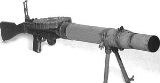
The
Lewis Gun is a
World War IWorld War I , which was predominantly called the World War or the Great War from its occurrence until 1939, and the First World War or World War I thereafter, was a major war centred in Europe that began on 28 July 1914 and lasted until 11 November 1918...
–era
light machine gunA light machine gun is a machine gun designed to be employed by an individual soldier, with or without an assistant, as an infantry support weapon. Light machine guns are often used as squad automatic weapons.-Characteristics:...
of American design that was perfected and widely used by the
British EmpireThe British Empire comprised the dominions, colonies, protectorates, mandates and other territories ruled or administered by the United Kingdom. It originated with the overseas colonies and trading posts established by England in the late 16th and early 17th centuries. At its height, it was the...
. It was first used in combat in World War I, and continued in service with a number of armed forces through to the end of the
Korean WarThe Korean War was a conventional war between South Korea, supported by the United Nations, and North Korea, supported by the People's Republic of China , with military material aid from the Soviet Union...
. It is visually distinctive because of a wide tubular cooling shroud around the barrel and a top-mounted
drum-pan magazineA magazine is an ammunition storage and feeding device within or attached to a repeating firearm. Magazines may be integral to the firearm or removable . The magazine functions by moving the cartridges stored in the magazine into a position where they may be loaded into the chamber by the action...
. It was commonly used as an aircraft machine gun, almost always with the cooling shroud removed, during both World Wars.
History
The Lewis Gun was invented by
US ArmyThe United States Army is the main branch of the United States Armed Forces responsible for land-based military operations. It is the largest and oldest established branch of the U.S. military, and is one of seven U.S. uniformed services...
Colonel
Isaac Newton LewisIsaac Newton Lewis was an American soldier and inventor. He was graduated from the United States Military Academy in 1884 and was commissioned second lieutenant in the Second Artillery...
in 1911, based on initial work by Samuel Maclean. Despite its origins, the Lewis Gun was not initially adopted by the American military—most likely because of political differences between Lewis and
General William CrozierWilliam Crozier was an American artillerist and inventor,-Biography:Born at Carrollton, Ohio on February 19, 1855, was the son of Robert Crozier , Chief Justice of Kansas in 1863-1866, and a United States senator from that State from December 1873 to February 1874...
, the Chief of the Ordnance Department. Lewis became frustrated with trying to persuade the US Army to adopt his design and so ("slapped by rejections from ignorant hacks", as he said), retired from the army. He left the United States in 1913 and headed to Belgium (and shortly afterwards, the UK). He established the
Armes Automatique Lewis company in Liege to facilitate commercial production of the gun. Lewis had been working closely with British arms manufacturer the Birmingham Small Arms company
(BSA)This article is not about Gamo subsidiary BSA Guns Limited of Armoury Road, Small Heath, Birmingham B11 2PP or BSA Company or its successors....
in an effort to overcome some of the production difficulties of the weapon. The Belgians quickly adopted the design in 1913, using the
.303 British.303 British, or 7.7x56mmR, is a .311 inch calibre rifle and machine gun cartridge first developed in Britain as a blackpowder round put into service in December 1888 for the Lee-Metford rifle, later adapted to use smokeless powders...
round, and in 1914, BSA purchased a licence to manufacture the Lewis Machine Gun in the UK, which resulted in Col. Lewis receiving significant
royalty paymentsRoyalties are usage-based payments made by one party to another for the right to ongoing use of an asset, sometimes an intellectual property...
and becoming very wealthy.
The onset of World War I increased demand for the Lewis Gun, and BSA began production (under the designation
Model 1914). The design was officially approved for service on 15 October 1915 under the designation "Gun, Lewis, .303-cal." No Lewis Guns were produced in Belgium during World War I; all manufacture was carried out by BSA in the UK and the Savage Arms Company in the US.
Production
The Lewis was only produced by BSA and Savage Arms during World War I, and although the two guns were largely similar, there were enough differences to stop them being completely interchangeable. BSA-produced weapons were not completely interchangeable with other BSA-produced Lewis guns, although this was rectified during World War II.
The major difference between the two designs was that the BSA weapons were chambered for British .303British ammunition, and the Savage guns were chambered for .30-06 cartridges, which necessitated some difference in the magazine along with the feed mechanism, bolt, barrel, extractors, and gas operation system. Savage did make Lewis Guns in .303 British calibre; the Model 1916 and Model 1917 were exported to Canada and the United Kingdom and a few were also supplied to the US military, particularly the navy. The Savage Model 1917 was generally produced in .30-06 caliber, a number of these guns were supplied to the UK under
lend-leaseLend-Lease was the program under which the United States of America supplied the United Kingdom, the Soviet Union, China, Free France, and other Allied nations with materiel between 1941 and 1945. It was signed into law on March 11, 1941, a year and a half after the outbreak of war in Europe in...
during World War II.
Design details
The Lewis Gun was
gas operatedGas-operation is a system of operation used to provide energy to operate autoloading firearms. In gas-operation, a portion of high pressure gas from the cartridge being fired is used to power a mechanism to extract the spent case and chamber a new cartridge. Energy from the gas is harnessed...
. A portion of the expanding propellant gas was tapped off from the barrel, driving a piston to the rear against a spring. The piston was fitted with a vertical post at its rear which rode in a helical
camA cam is a rotating or sliding piece in a mechanical linkage used especially in transforming rotary motion into linear motion or vice-versa. It is often a part of a rotating wheel or shaft that strikes a lever at one or more points on its circular path...
track in the bolt, rotating it at the end of its travel nearest the breech. This allowed the three locking lugs at the rear of the bolt to engage in recesses in the gun's body to lock it into place. The post also carried a fixed
firing pinA firing pin or striker is part of the firing mechanism used in a firearm or explosive device e.g. an M14 landmine or bomb fuze. Firing pins may take many forms, though the types used in landmines, bombs, grenade fuzes or other single-use devices generally have a sharpened point...
, which protruded through an aperture in the front of the bolt, firing the next round at the foremost part of the piston's travel.
The gun was designed with an aluminium barrel-casing which used the muzzle blast to draw air into the gun and cool down the internal mechanism. There is some discussion over whether the cooling tube was effective or even necessary—in the
Second World WarWorld War II, or the Second World War , was a global conflict lasting from 1939 to 1945, involving most of the world's nations—including all of the great powers—eventually forming two opposing military alliances: the Allies and the Axis...
many old aircraft guns which did not have the tubing, were issued to
anti-aircraftNATO defines air defence as "all measures designed to nullify or reduce the effectiveness of hostile air action." They include ground and air based weapon systems, associated sensor systems, command and control arrangements and passive measures. It may be to protect naval, ground and air forces...
units of the
British Home GuardThe Home Guard was a defence organisation of the British Army during the Second World War...
and to British airfields. Other weapons were used on vehicle mounts in the Western Desert and did not suffer without the tube. They were found to function properly without it, leading to the suggestion that Lewis had insisted on the cooling arrangement largely to show that his design was different from Maclean's earlier prototypes. Only the
Royal NavyThe Royal Navy is the naval warfare service branch of the British Armed Forces. Founded in the 16th century, it is the oldest service branch and is known as the Senior Service...
retained the tube on their deck-mounted AA-configuration Lewis Guns.
The Lewis Gun utilised two different drum
magazineA magazine is an ammunition storage and feeding device within or attached to a repeating firearm. Magazines may be integral to the firearm or removable . The magazine functions by moving the cartridges stored in the magazine into a position where they may be loaded into the chamber by the action...
s, one holding 47 rounds, the other 97. Unlike other designs, the Lewis's drum was not wound against a spring but was mechanically driven by a cam on top of the bolt which operated a
pawl mechanismA ratchet is a device that allows continuous linear or rotary motion in only one direction while preventing motion in the opposite direction. Because most socket wrenches today use ratcheting handles, the term "ratchet" alone is often used to refer to a ratcheting wrench, and the terms "ratchet"...
via a lever.
An interesting point of the design was that it did not use a traditional helical coiled spring, but used a spiral spring, much like a large clock spring, in a semicircular housing just in front of the trigger. The operating rod had a toothed underside, which engaged with a cog which wound the spring. When the gun fired, the bolt recoiled and the cog was turned, tightening the spring until the resistance of the spring had reached the recoil force of the bolt assembly. At that moment, as the gas pressure in the breech fell, the spring unwound, turning the cog, which, in turn, wound the operating rod forward for the next round. As with a clock spring, the Lewis Gun's recoil spring had an adjustment device to adjust the recoil resistance for variations in temperature and wear. Unusual as it seems, the Lewis design proved enduringly reliable, and was even copied by the Japanese and used extensively by them during World War II.
The gun's cyclic rate of fire was approximately 500–600 rounds per minute. It weighed 28 lb (12.7 kg), only about half as much as a typical medium machine gun of the era, such as the
VickersNot to be confused with the Vickers light machine gunThe Vickers machine gun or Vickers gun is a name primarily used to refer to the water-cooled .303 inch machine gun produced by Vickers Limited, originally for the British Army...
, and was chosen in part because, being more portable than a heavy machine gun, it could be carried and used by a single soldier. BSA even produced at least one model (the "B.S.A. Light Infantry Pattern Lewis Gun", which lacked the aluminium barrel shroud and had a wooden foregrip) designed as a form of assault weapon.
Service
World War I
The Belgian Army was the first military force to adopt the Lewis Gun; when the Germans first encountered it in 1914 (whilst in combat against the Belgians), they nicknamed it "The Belgian Rattlesnake".
The British officially adopted the Lewis Gun in .303 calibre for Land and Aircraft use in October 1915, with the US Navy and
Marine CorpsA marine is a member of a force that specializes in expeditionary operations such as amphibious assault and occupation. The marines traditionally have strong links with the country's navy...
following in early 1917, adopting the M1917 Lewis Gun (produced by the Savage Arms Co.), in .30-06 caliber.
The US Army never officially adopted the weapon for infantry use and even went so far as to take Lewis Guns away from US Marines arriving in France and replacing them with the cheap, shoddy, and extremely unsatisfactory
ChauchatThe Chauchat , was the standard light machine gun of the French Army during World War I. Under the leadership of General Joseph Joffre, it was commissioned into the French Army in 1916. It was also widely used by the US Army in 1917-1918 and by six other nations: Belgium, Greece, Poland, Russia,...
LMG—a practice believed to be related to
General Crozier'sWilliam Crozier was an American artillerist and inventor,-Biography:Born at Carrollton, Ohio on February 19, 1855, was the son of Robert Crozier , Chief Justice of Kansas in 1863-1866, and a United States senator from that State from December 1873 to February 1874...
dislike of Lewis and his gun. The US Army eventually adopted the
Browning Automatic RifleThe Browning Automatic Rifle was a family of United States automatic rifles and light machine guns used by the United States and numerous other countries during the 20th century. The primary variant of the BAR series was the M1918, chambered for the .30-06 Springfield rifle cartridge and designed...
in 1917 (although it was September 1918 before any of the new guns reached the front). The US Navy and
Marine CorpsA marine is a member of a force that specializes in expeditionary operations such as amphibious assault and occupation. The marines traditionally have strong links with the country's navy...
continued to use the .30-06 caliber Lewis until the early part of World War II.
The
Russian EmpireRussia or , officially known as both Russia and the Russian Federation , is a country in northern Eurasia. It is a federal semi-presidential republic, comprising 83 federal subjects...
purchased 10,000 Lewis Guns in 1917 from the British Government, and ordered another 10,000 weapons from Savage Arms in the US. The US Government was unwilling to supply the Tsarist Russian Government with the guns and there is some doubt as to whether they were actually delivered, although records indicate that 5,982 Savage weapons were delivered to Russia by 31 March 1917. The Lewis Guns supplied by Britain were dispatched to Russia in May 1917, but there is some confusion as to whether these were the Savage-made weapons being trans-shipped through the UK, or a separate batch of UK-produced units.
British Mark IV tanks used the Lewis, replacing the Vickers and Hotchkiss used in earlier tanks. The Lewis was chosen for its relatively compact magazines, but as soon as an improved magazine belt for the Hotchkiss was developed, the Lewis was replaced by them in later Marks of tank.
The Germans also used captured Lewis guns in both World Wars, and included instruction in its operation and care as part of their machine-gun crew training.
Despite costing more than a Vickers gun to manufacture, (the cost of a Lewis Gun in 1915 was £165, the Vickers cost about £100), Lewis machine guns were in high demand with the British military during World War I. The Lewis also had the advantage of being about 80% faster (in both time and component parts) to build than the Vickers (and was a lot more portable), thus orders were placed by the British Government between August 1914 and June 1915 for 3,052 guns. By the end of World War I over 50,000 Lewis guns had been produced in the US and UK and they were nearly ubiquitous on the Western Front, outnumbering the Vickers by a ratio of about 3:1.
Aircraft use
The Lewis Gun has the distinction of being the first machine gun fired from an aeroplane; on 7 June 1912 Captain
Charles ChandlerColonel Charles deForest Chandler was an American military aviator, and the first head of the Aeronautical Division, U.S. Signal Corps that later became the United States Air Force.-External links:**...
of the US Army fired a prototype Lewis Gun from the foot-bar of a
Wright Model B Flyer|-See also:-References:* * * * * * -External links:* *...
.
The Lewis Gun was extensively used on British and French aircraft during World War I, either as an observer's or gunner's weapon or as an additional weapon to the more common Vickers. The Lewis' popularity as an aircraft machine gun was partly due to its low weight, the fact that it was air-cooled and that it used self-contained 97-round drum magazines. Because of this, the Lewis was first fitted on two early production examples of the
Bristol ScoutThe Bristol Scout was a simple, single seat, rotary-engined biplane originally intended as a civilian racing aircraft. Like other similar fast, light aircraft of the period - it was acquired by the RNAS and the RFC as a "scout", or fast reconnaissance type...
C aircraft by
Lanoe HawkerLanoe George Hawker VC, DSO was a British flying ace, with seven credited victories, during the First World War. He was the first British flying ace, and the third pilot to receive the Victoria Cross, the highest and most prestigious award for gallantry in the face of the enemy that can be awarded...
in the summer of 1915, mounted on the port side and firing forwards and outwards at a 30º angle to avoid the propeller arc.
The
open boltA semi or full automatic firearm is said to fire from an open bolt if, when ready to fire, the bolt and working parts are held to the rear. When the trigger is pulled the bolt goes forward, feeding a round from the magazine into the chamber and firing it...
firing cycle of the Lewis prevented it from being synchronized to fire directly forward through the propeller arc of a single engined-fighter, only the British Airco D.H.2 and
Royal Aircraft Factory F.E.8|-See also:-References:NotesBibliography* Bruce, J.M. The Aeroplanes of the Royal Flying Corps . London: Putnam, 1982. ISBN 0-370-30084-X.* Bruce, J.M. British Aeroplanes 1914–18. London: Putnam, 1957....
pusherIn a craft with a pusher configuration the propeller are mounted behind their respective engine. According to Bill Gunston, a "pusher propeller" is one mounted behind engine so that drive shaft is in compression...
fighters could readily use the Lewis as direct forward-firing armament early in World War I. For the use of observers or rear gunners, the Lewis was mounted on a
Scarff ringThe Scarff ring was a type of machine gun mounting developed during the First World War by Warrant Officer F. W. Scarff of the Admiralty Air Department for use on two-seater aircraft...
, which allowed the gun to be rotated and elevated whilst supporting the gun's weight. Lewis Guns were often employed in a balloon-busting role, loaded with incendiary ammunition designed to ignite the hydrogen inside the gasbags of German Zeppelins and dirigibles.
Later, on the French
Nieuport 11|-See also:-References:NotesBibliography* Angelucci, Enzio, ed. The Rand McNally Encyclopedia of Military Aircraft. New York: The Military Press, 1983. ISBN 0-517-41021-4....
and Nieuport 17 and the British
S.E.5aThe Royal Aircraft Factory S.E.5 was a British biplane fighter aircraft of the First World War. Although the first examples reached the Western Front before the Sopwith Camel and it had a much better overall performance, problems with its Hispano-Suiza engine, particularly the geared-output H-S...
and some versions of the Sopwith Camel and Bristol F2b fighter aircraft, the Lewis was fitted above the top wing on a
Foster mountIn early 1916 Sergeant Foster of No. 11 Squadron RFC devised a sliding rail mounting for the upper wing Lewis Gun on a Nieuport 11. It enabled the gun to be pulled down so that its breech was conveniently in front of the pilot, making it much easier to change ammunition drums or to clear stoppages...
, which allowed firing directly forward outside the
propellerAircraft propellers or airscrews convert rotary motion from piston engines or turboprops to provide propulsive force. They may be fixed or variable pitch. Early aircraft propellers were carved by hand from solid or laminated wood with later propellers being constructed from metal...
's arc. The gun could be swung back into the cockpit on a rail to allow the ammunition drum to be changed in flight but fighter ace Albert Ball V.C. also discovered that the weapon retained its original trigger and could thus be fired upwards. He used the upward firing Lewis to attack solitary German two-seater aircraft from below and behind where the rear observer could not see him or fire back. It was his use of the weapon in this way, in a Nieuport, that led to its later introduction on the S.E.5/S.E.5a. Ball had acted in a consultant capacity on the development of this aeroplane.
Lewis guns were also carried as defensive guns on British airships. The
SS class blimpSS class blimps were simple, cheap and easily assembled small non-rigid airships that were developed as a matter of some urgency to counter the German U-boat threat to British shipping during World War I...
s carried one gun. The larger
NS class blimpThe British NS class blimps were the largest and last in a succession of non-rigid airship designs that served with the Royal Naval Air Service during World War I; developed from experiences gained with earlier classes to operate off the east coast of Britain on long-range patrols...
s carried two or three guns in the control car, and some were fitted with an additional gun and a gunner's position at the top of the gasbag.
World War II
By World War II, the British Army had replaced the Lewis Gun with the Bren gun for most infantry use. As an airborne weapon the Lewis was largely supplanted by the
Vickers KNot to be confused with the Vickers light machine gunThe Vickers K machine gun, known as the Vickers Gas Operated in British service, was a rapid-firing machine gun developed and manufactured for use in aircraft by Vickers-Armstrongs...
, a weapon that could achieve over twice the rate of fire of the Lewis.
In the crisis following the Fall of France, where a large part of the British Army's equipment had been lost, stocks of Lewis guns in both .303 and .30-06 were hurriedly pressed into service, primarily for arming Home Guard units and purposes such as defending airfields and anti-aircraft use. 58,983 Lewis Guns were taken from stores, repaired, refitted and issued by the British during the course of World War II. In addition to their reserve weapon role in the UK, they also saw front-line use with British, Australian, and New Zealand forces in the early years of the
Pacific campaignThe Pacific War, also sometimes called the Asia-Pacific War refers broadly to the parts of World War II that took place in the Pacific Ocean, its islands, and in East Asia, then called the Far East...
against the Japanese. The Lewis gun saw continued service as an anti-aircraft weapon during World War II; in this role it was credited by the British for bringing down more low-flying enemy aircraft than any other AA weapon.
American forces used the Lewis gun (in .30-06 caliber) throughout World War II. The
US NavyThe United States Navy is the naval warfare service branch of the United States Armed Forces and one of the seven uniformed services of the United States. The U.S. Navy is the largest in the world; its battle fleet tonnage is greater than that of the next 13 largest navies combined. The U.S...
used the weapon on armed merchant cruisers, small auxiliary ships, landing craft and submarines. The US Coast Guard also used the Lewis on their vessels. It was never officially adopted by the US Army for anything other than aircraft use.
The Germans used captured British Lewis Guns during World War II under the designation
MG 137(e), whilst the Japanese copied the Lewis design and employed it extensively during World War II; it was designated the
Type 92The was developed for aerial use for the Imperial Japanese Navy before World War II. It was the standard hand-held machine gun in multi-place IJN aircraft during the most part of the Pacific War. It proved to be seriously inadequate...
and chambered for a 7.7mm rimmed cartridge that was interchangeable with the .303 British round.
The Lewis was officially withdrawn from British service in 1946, but continued to be used by forces operating against the United Nations in the
Korean WarThe Korean War was a conventional war between South Korea, supported by the United Nations, and North Korea, supported by the People's Republic of China , with military material aid from the Soviet Union...
. It was also used against the French and the USA in the
First Indochina WarThe First Indochina War was fought in French Indochina from December 19, 1946, until August 1, 1954, between the French Union's French Far East...
and the subsequent
Vietnam WarThe Vietnam War was a Cold War-era military conflict that occurred in Vietnam, Laos, and Cambodia from 1 November 1955 to the fall of Saigon on 30 April 1975. This war followed the First Indochina War and was fought between North Vietnam, supported by its communist allies, and the government of...
.
Total production of the Lewis Gun by BSA was over 145,000 units, a total of 3,550 guns were produced by the Savage Arms Co. for US service—2,500 in .30-06 and 1,050 in .303 British calibre.
Influence on later designs
The German FG42 rifle used the Lewis Gun's clock-mainspring design, the
M60 machine gunThe M60 is a family of American general-purpose machine guns firing 7.62×51mm NATO cartridges from a disintegrating belt of M13 links...
also has some design similarities in relation to the bolt and groups of the gas piston and firing pin. The new Russian PKP "Pecheneg" borrows the forced cooling principle.
See also
External links