


Yarrow

Encyclopedia
Flowering plant
The flowering plants , also known as Angiospermae or Magnoliophyta, are the most diverse group of land plants. Angiosperms are seed-producing plants like the gymnosperms and can be distinguished from the gymnosperms by a series of synapomorphies...
in the family Asteraceae
Asteraceae
The Asteraceae or Compositae , is an exceedingly large and widespread family of vascular plants. The group has more than 22,750 currently accepted species, spread across 1620 genera and 12 subfamilies...
, native to the Northern Hemisphere
Northern Hemisphere
The Northern Hemisphere is the half of a planet that is north of its equator—the word hemisphere literally means “half sphere”. It is also that half of the celestial sphere north of the celestial equator...
. In New Mexico and southern Colorado, it is called plumajillo, or "little feather", for the shape of the leaves. In antiquity, yarrow was known as herbal militaris, for its use in staunching the flow of blood from wounds. Other common names for this species include common yarrow, gordaldo, nosebleed plant, old man's pepper, devil's nettle, sanguinary, milfoil, soldier's woundwort, thousand-leaf (as its binomial name affirms), and thousand-seal.
Description
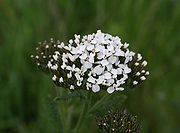
Common yarrow is an erect herbaceousHerbaceous
A herbaceous plant is a plant that has leaves and stems that die down at the end of the growing season to the soil level. They have no persistent woody stem above ground...
perennial plant
Perennial plant
A perennial plant or simply perennial is a plant that lives for more than two years. The term is often used to differentiate a plant from shorter lived annuals and biennials. The term is sometimes misused by commercial gardeners or horticulturalists to describe only herbaceous perennials...
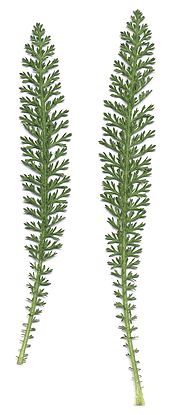
that produces one to several stems (0.2 to 1m tall) and has a rhizomatous growth form. Leaves are evenly distributed along the stem, with the leaves near the middle and bottom of the stem being the largest. The leaves have varying degrees of hairiness (pubescence). The leaves
Leaf
A leaf is an organ of a vascular plant, as defined in botanical terms, and in particular in plant morphology. Foliage is a mass noun that refers to leaves as a feature of plants....
are 5–20 cm long, bipinnate or tripinnate
Pinnate
Pinnate is a term used to describe feather-like or multi-divided features arising from both sides of a common axis in plant or animal structures, and comes from the Latin word pinna meaning "feather", "wing", or "fin". A similar term is pectinate, which refers to a comb-like arrangement of parts...
, almost feathery, and arranged spirally on the stems. The leaves are cauline and more or less clasping. The inflorescence has 4 to 9 phyllaries
Bract
In botany, a bract is a modified or specialized leaf, especially one associated with a reproductive structure such as a flower, inflorescence axis, or cone scale. Bracts are often different from foliage leaves. They may be smaller, larger, or of a different color, shape, or texture...
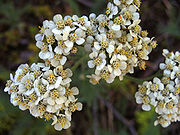
and contains ray and disk flowers which are white to pink. There are generally 3 to 8 ray flowers that are ovate to round. Disk flowers range from 15 to 40. The inflorescence is produced in a flat-topped cluster. The fruits are small achene
Achene
An achene is a type of simple dry fruit produced by many species of flowering plants. Achenes are monocarpellate and indehiscent...
s. Yarrow grows at low or high altitudes, up to 3500m above sea level. The plant commonly flowers from May through June, and is a frequent component in butterfly garden
Butterfly Garden
Butterfly Garden is a life simulation game by independent developer Autonomous Productions, revolving around the raising and collecting of butterflies. Initially for the Xbox 360 via Xbox Live Arcade, the developers have promised there will be a PC version and WiiWare version...
s. Common yarrow is frequently found in the mildly disturbed soil of grasslands and open forests. Active growth occurs in the spring.
In North America, there are both native and introduced genotypes, and both diploid and polyploid plants.
The plant has a strong, sweet scent, similar to chrysanthemum
Chrysanthemum
Chrysanthemums, often called mums or chrysanths, are of the genus constituting approximately 30 species of perennial flowering plants in the family Asteraceae which is native to Asia and northeastern Europe.-Etymology:...
s.
Establishment
Common yarrow is a drought tolerant species of which there are several different ornamental cultivars. Seeds require light for germination, so optimal germination occurs when planted no deeper than ¼ inch (~6 mm). Seeds also require a germination temperature of 18–24 °C (64.4–75.2 F). Common yarrow responds best to soil that is poorly developed and well drained. The plant has a relatively short life, but may be prolonged by dividing the plant every other year, and planting 12 to 18 in (30.5 to 45.7 cm) apart. Common yarrow is a weedy species and can become invasive. It may suffer from mildew or root rot if not planted in well-drained soil.There are several varieties
Variety (biology)
In botanical nomenclature, variety is a taxonomic rank below that of species: as such, it gets a three-part infraspecific name....
and subspecies
Subspecies
Subspecies in biological classification, is either a taxonomic rank subordinate to species, ora taxonomic unit in that rank . A subspecies cannot be recognized in isolation: a species will either be recognized as having no subspecies at all or two or more, never just one...
:
- Achillea millefolium subsp. millefolium
- Achillea millefolium subsp. millefolium var. millefolium - EuropeEuropeEurope is, by convention, one of the world's seven continents. Comprising the westernmost peninsula of Eurasia, Europe is generally 'divided' from Asia to its east by the watershed divides of the Ural and Caucasus Mountains, the Ural River, the Caspian and Black Seas, and the waterways connecting...
, AsiaAsiaAsia is the world's largest and most populous continent, located primarily in the eastern and northern hemispheres. It covers 8.7% of the Earth's total surface area and with approximately 3.879 billion people, it hosts 60% of the world's current human population... - Achillea millefolium subsp. millefolium var. alpicola - Rocky MountainsRocky MountainsThe Rocky Mountains are a major mountain range in western North America. The Rocky Mountains stretch more than from the northernmost part of British Columbia, in western Canada, to New Mexico, in the southwestern United States...
- Achillea millefolium subsp. millefolium var. borealis - ArcticArcticThe Arctic is a region located at the northern-most part of the Earth. The Arctic consists of the Arctic Ocean and parts of Canada, Russia, Greenland, the United States, Norway, Sweden, Finland, and Iceland. The Arctic region consists of a vast, ice-covered ocean, surrounded by treeless permafrost...
regions - Achillea millefolium subsp. millefolium var. californica - CaliforniaCaliforniaCalifornia is a state located on the West Coast of the United States. It is by far the most populous U.S. state, and the third-largest by land area...
- Achillea millefolium subsp. millefolium var. occidentalis - North AmericaNorth AmericaNorth America is a continent wholly within the Northern Hemisphere and almost wholly within the Western Hemisphere. It is also considered a northern subcontinent of the Americas...
- Achillea millefolium subsp. millefolium var. pacifica - west coast of North AmericaNorth AmericaNorth America is a continent wholly within the Northern Hemisphere and almost wholly within the Western Hemisphere. It is also considered a northern subcontinent of the Americas...
- Achillea millefolium subsp. millefolium var. puberula - California
- Achillea millefolium subsp. millefolium var. rubra - Southern Appalachians
- Achillea millefolium subsp. millefolium var. millefolium - Europe
- Achillea millefolium subsp. chitralensis - western Himalaya
- Achillea millefolium subsp. sudetica - Alps, Carpathians
Cultivation and uses
The herb is purported to be a diaphoretic, astringent
Astringent
An astringent substance is a chemical compound that tends to shrink or constrict body tissues, usually locally after topical medicinal application. The word "astringent" derives from Latin adstringere, meaning "to bind fast"...
, tonic
Herbal tonic
An herbal tonic is used to help restore, tone and invigorate systems in the body or to promote general health and well-being....
, stimulant
Stimulant
Stimulants are psychoactive drugs which induce temporary improvements in either mental or physical function or both. Examples of these kinds of effects may include enhanced alertness, wakefulness, and locomotion, among others...
and mild aromatic
Aroma compound
An aroma compound, also known as odorant, aroma, fragrance or flavor, is a chemical compound that has a smell or odor...
. It contains isovaleric acid, salicylic acid
Salicylic acid
Salicylic acid is a monohydroxybenzoic acid, a type of phenolic acid and a beta hydroxy acid. This colorless crystalline organic acid is widely used in organic synthesis and functions as a plant hormone. It is derived from the metabolism of salicin...
, asparagin, sterols, flavonoids, bitters
Bitters
A bitters is an alcoholic beverage that is flavored with herbal essences and has a bitter or bittersweet flavor. There are numerous brands of bitters that were formerly marketed as patent medicines but are now considered to be digestifs, rather than medicines...
, tannin
Tannin
A tannin is an astringent, bitter plant polyphenolic compound that binds to and precipitates proteins and various other organic compounds including amino acids and alkaloids.The term tannin refers to the use of...
s, and coumarin
Coumarin
Coumarin is a fragrant chemical compound in the benzopyrone chemical class, found in many plants, notably in high concentration in the tonka bean , vanilla grass , sweet woodruff , mullein , sweet grass , cassia cinnamon and sweet clover...
s. The plant also has a long history as a powerful 'healing herb' used topically for wounds, cuts and abrasions. The genus name Achillea
Achillea
Achillea is a genus of about 85 flowering plants, in the family Asteraceae, commonly referred to as yarrow. They occur in Europe and temperate areas of Asia. A few grow in North America. These plants typically have frilly, hairy, aromatic leaves....
is derived from mythical Greek character, Achilles
Achilles
In Greek mythology, Achilles was a Greek hero of the Trojan War, the central character and the greatest warrior of Homer's Iliad.Plato named Achilles the handsomest of the heroes assembled against Troy....
, who reportedly carried it with his army to treat battle wounds. This medicinal action is also reflected in some of the common names mentioned below, such as Staunchweed and Soldier's Woundwort.
The stalks of yarrow are dried and used as a randomising agent in I Ching divination
I Ching divination
Among the many forms of divination is a bibliomancy method using the I Ching or Book of Changes. The book is structured as 32 pairs of hexagrams, divided in half after the first 30. The text was a subject for civil service exams in Imperial China...
.
In the Middle Ages
Middle Ages
The Middle Ages is a periodization of European history from the 5th century to the 15th century. The Middle Ages follows the fall of the Western Roman Empire in 476 and precedes the Early Modern Era. It is the middle period of a three-period division of Western history: Classic, Medieval and Modern...
, yarrow was part of a herbal mixture known as gruit
Gruit
Gruit is an old-fashioned herb mixture used for bittering and flavoring beer, popular before the extensive use of hops. Gruit or grut ale may also refer to the beverage produced using gruit....
used in the flavouring of beer prior to the use of hops
Hops
Hops are the female flower clusters , of a hop species, Humulus lupulus. They are used primarily as a flavoring and stability agent in beer, to which they impart a bitter, tangy flavor, though hops are also used for various purposes in other beverages and herbal medicine...
. The flowers and leaves are used in making some liquors and bitters
Bitters
A bitters is an alcoholic beverage that is flavored with herbal essences and has a bitter or bittersweet flavor. There are numerous brands of bitters that were formerly marketed as patent medicines but are now considered to be digestifs, rather than medicines...
.
Old folk names for yarrow include arrowroot, bad man's plaything, carpenter's weed, death flower, devil's nettle, eerie, field hops, gearwe, hundred leaved grass, knight's milefoil, knyghten, milefolium, milfoil, millefoil, noble yarrow, nosebleed, old man's mustard, old man's pepper, sanguinary, seven year's love, snake's grass, soldier, soldier's woundwort, stanch weed, thousand seal, woundwort, yarroway, yerw.
The English name yarrow comes from the Saxon (Old English) word gearwe, which is related to both the Dutch word gerw and the Old High German word garawa.
Yarrow has also been used as a food, and was very popular as a vegetable in the seventeenth century. The younger leaves are said to be a pleasant leaf vegetable
Leaf vegetable
Leaf vegetables, also called potherbs, green vegetables, greens, leafy greens or salad greens, are plant leaves eaten as a vegetable, sometimes accompanied by tender petioles and shoots...
when cooked as spinach, or in a soup. Yarrow is sweet with a slight bitter taste. The leaves can also be dried and used as a herb in cooking.
Cultivars
The species is generally too weedy for gardens but cultivars include 'Paprika', 'Cerise Queen' and 'Red Beauty'; and the many hybrids of this species designated Achillea x taygetea including 'Appleblossom', 'Fanal' and 'Hoffnung' are useful garden subjects.Agricultural Use: before the arrival of monocultures of Ryegrass, both grass leys and permanent pasture always contained Yarrow (Achillea millefolium) at a rate of ca. 0.3 kg/ha. At least one of the reasons for Yarrow's inclusion in grass mixtures was that it is a deep rooted herb, whose leaves are rich in minerals. Thus its inclusion helped to prevent mineral deficiencies in the ruminants to whom it was fed.
Herbal medicine
Yarrow has seen historical use as a medicine, often because of its astringent effects. Decoctions have been used to treat inflammations, such as hemorrhoidHemorrhoid
Hemorrhoids or haemorrhoids , are vascular structures in the anal canal which help with stool control. They become pathological or piles when swollen or inflamed. In their physiological state they act as a cushion composed of arterio-venous channels and connective tissue that aid the passage of...
s, and headaches. Confusingly, it has been said to both stop bleeding and promote it. (Depending on the form it is administered it can do both, which is why when dabbling in using herbs for medicine it is proper to contact a herbalist or other expert. Achillea Millefolium has been used with great success in promoting blood flow, as well as staunching blood flow when properly used.) Infusions of yarrow, taken either internally or externally, are said to speed recovery from severe bruising. The most medicinally active part of the plant is the flowering tops. They also have a mild stimulant effect, and have been used as a snuff. Today, yarrow is valued mainly for its action in colds and influenza
Influenza
Influenza, commonly referred to as the flu, is an infectious disease caused by RNA viruses of the family Orthomyxoviridae , that affects birds and mammals...
, and also for its effect on the circulatory, digestive, excretory, and urinary systems. In the nineteenth century, yarrow was said to have a greater number of indications than any other herb.
It is believed that anti-allergenic compounds can be extracted from the flowers by steam distillation. The flowers are used to treat various allergic mucus problems, including hay fever
Hay Fever
Hay Fever is a comic play written by Noël Coward in 1924 and first produced in 1925 with Marie Tempest as the first Judith Bliss. Laura Hope Crews played the role in New York...
. Flowers used in this way are harvested in summer or autumn, and an infusion drunk for upper respiratory phlegm or used externally as a wash for eczema
Eczema
Eczema is a form of dermatitis, or inflammation of the epidermis . In England, an estimated 5.7 million or about one in every nine people have been diagnosed with the disease by a clinician at some point in their lives.The term eczema is broadly applied to a range of persistent skin conditions...
.
The dark blue essential oil
Essential oil
An essential oil is a concentrated hydrophobic liquid containing volatile aroma compounds from plants. Essential oils are also known as volatile oils, ethereal oils or aetherolea, or simply as the "oil of" the plant from which they were extracted, such as oil of clove...
, extracted by steam distillation
Distillation
Distillation is a method of separating mixtures based on differences in volatilities of components in a boiling liquid mixture. Distillation is a unit operation, or a physical separation process, and not a chemical reaction....
of the flowers, is generally used as an anti-inflammatory or in chest rubs for colds and influenza. For a massage oil for inflamed joints, dilute 5-10 drops yarrow oil in 25 ml infused St. John's wort oil. A chest rub can be made for chesty colds and influenza. Combine yarrow with eucalyptus
Eucalyptus
Eucalyptus is a diverse genus of flowering trees in the myrtle family, Myrtaceae. Members of the genus dominate the tree flora of Australia...
, peppermint
Peppermint
Peppermint is a hybrid mint, a cross between the watermint and spearmint . The plant, indigenous to Europe, is now widespread in cultivation throughout all regions of the world...
, hyssop
Hyssop
Hyssop is a genus of about 10-12 species of herbaceous or semi-woody plants in the family Lamiaceae, native from the east Mediterranean to central Asia. They are aromatic, with erect branched stems up to 60 cm long covered with fine hairs at the tips. The leaves are narrow oblong, 2–5 cm...
, or thyme
Thyme
Thyme is a culinary and medicinal herb of the genus Thymus.-History:Ancient Egyptians used thyme for embalming. The ancient Greeks used it in their baths and burnt it as incense in their temples, believing it was a source of courage...
oil, diluting a total of 20 drops of oil in 25 ml almond
Almond
The almond , is a species of tree native to the Middle East and South Asia. Almond is also the name of the edible and widely cultivated seed of this tree...
or sunflower
Sunflower
Sunflower is an annual plant native to the Americas. It possesses a large inflorescence . The sunflower got its name from its huge, fiery blooms, whose shape and image is often used to depict the sun. The sunflower has a rough, hairy stem, broad, coarsely toothed, rough leaves and circular heads...
oil.
The leaves encourage clotting, so it can be used fresh for nosebleeds. The aerial parts of the plant are used for phlegm conditions, as a bitter digestive tonic to encourage bile flow, and as a diuretic
Diuretic
A diuretic provides a means of forced diuresis which elevates the rate of urination. There are several categories of diuretics. All diuretics increase the excretion of water from bodies, although each class does so in a distinct way.- Medical uses :...
. The aerial parts act as a tonic for the blood, stimulate the circulation, and can be used for high blood pressure. Also useful in menstrual disorders, and as an effective sweating remedy to bring down fevers.
Yarrow intensifies the medicinal action of other herbs taken with it, and helps eliminate toxins from the body. It is reported to be associated with the treatment of the following ailments:
Analgesic Amenorrhea, antiphlogistic, anti-inflammatory
Anti-inflammatory
Anti-inflammatory refers to the property of a substance or treatment that reduces inflammation. Anti-inflammatory drugs make up about half of analgesics, remedying pain by reducing inflammation as opposed to opioids, which affect the central nervous system....
, bowels, bleeding
Bleeding
Bleeding, technically known as hemorrhaging or haemorrhaging is the loss of blood or blood escape from the circulatory system...
, blood clots, blood pressure (lowers), blood purifier, blood vessels (tones), catarrh (acute, repertory), colds, chicken pox, circulation, contraceptive (unproven), cystitis, diabetes treatment, digestion (stimulates)gastro-intestinal disorders, choleretic dyspepsia, eczema, fevers, flu, gastritis, glandular system, gum ailments, heartbeat (slow), influenza, insect repellant, inflammation, emmenagogue, internal bleeding, liver (stimulates and regulates), lungs (hemorrhage), measles, menses (suppressed), menorrhagia, menstruation (regulates, relieves pain), nipples (soreness), nosebleeds, piles (bleeding), smallpox, stomach sickness, toothache, thrombosis, ulcers, urinary antiseptic, uterus (tighten and contract),gastroprotective varicose veins, vision, may reduce autoimmune responses.
The salicylic acid
Salicylic acid
Salicylic acid is a monohydroxybenzoic acid, a type of phenolic acid and a beta hydroxy acid. This colorless crystalline organic acid is widely used in organic synthesis and functions as a plant hormone. It is derived from the metabolism of salicin...
derivatives are a component of aspirin, which may account for its use in treating fevers and reducing pain.
Yarrow was also used in traditional Native American herbal medicine. Navajo Indians considered it to be a "life medicine", chewed it for toothaches, and poured an infusion into ears for earaches. Several tribes of the Plains region of the United States used common yarrow. The Pawnee used the stalk for pain relief. The Chippewa used the leaves for headaches by inhaling it in a steam. They also chewed the roots and applied the saliva to their appendages as a stimulant. The Cherokee
Cherokee
The Cherokee are a Native American people historically settled in the Southeastern United States . Linguistically, they are part of the Iroquoian language family...
drank a tea of common yarrow to reduce fever and aid in restful sleep.
Companion planting
Yarrow is considered an especially useful companion plant, not only repelling some bad insects while attracting good, predatory ones, but also improving soil quality. It attracts predatory wasps, which drink the nectar and then use insect pests as food for their larvae. Similarly, it attracts ladybugs and hoverfliesHoverfly
Hoverflies, sometimes called flower flies or syrphid flies, make up the insect family Syrphidae. As their common name suggests, they are often seen hovering or nectaring at flowers; the adults of many species feed mainly on nectar and pollen, while the larvae eat a wide range of foods...
. Its leaves are thought to be good fertilizer, and a beneficial additive for compost.
It is also considered directly beneficial to other plants, improving the health of sick plants when grown near them.
Use by birds
Several cavity-nesting birds, including the common starling, use yarrow to line their nests. Experiments conducted on the tree swallowTree Swallow
The Tree Swallow, Tachycineta bicolor, is a migratory passerine bird that breeds in North America and winters in Mexico, Central America and the Caribbean. It is a very rare vagrant to western Europe....
, which does not use yarrow, suggest that adding yarrow to nests inhibits the growth of parasites
Parasitism
Parasitism is a type of symbiotic relationship between organisms of different species where one organism, the parasite, benefits at the expense of the other, the host. Traditionally parasite referred to organisms with lifestages that needed more than one host . These are now called macroparasites...
.
Insecticidal (EO on larvae of the Culicidae mosquito Aedes albopictus)
Dangers
In rare cases, yarrow can cause severe allergic skin rashes; prolonged use can increase the skin's photosensitivity. This can be triggered initially when wet skin comes into contact with cut grass and yarrow together.In one study aqueous extracts of yarrow impaired the sperm production of laboratory rats.
History
Yarrow was one herb identified at Shanidar IV, a Neanderthal flower burial of northern Iraq, dated c.60,000BCE along with a number of other medicinal herbs.In popular culture
Stories about yarrow feature in traditional Chinese culture. For example, it is said that it grows around the grave of ConfuciusConfucius
Confucius , literally "Master Kong", was a Chinese thinker and social philosopher of the Spring and Autumn Period....
. Also the most authentic way to cast the Yi Jing
Yi Jing
I Ching is one of Chinese classic texts.I Ching may also refer to:* I Ching , a Tang Dynasty Buddhist monk* I Ching , fictional, blind martial artist published by DC Comics...
is to use dried yarrow stalks. The stems are said to be good for divining the future. Chinese proverbs claim that yarrow brightens the eyes and promotes intelligence. Yarrow and tortoiseshell
Tortoiseshell material
Tortoiseshell or tortoise shell is a material produced mainly from the shell of the hawksbill turtle, an endangered species. It was widely used in the 1960s and 1970s in the manufacture of items such as combs, sunglasses, guitar picks and knitting needles...
are considered to be lucky in Chinese tradition. Oriental tradition also assured mountain wanderers that where the yarrow grew neither tigers nor wolves nor poisonous plants would be found.
In Classical tradition, Homer
Homer
In the Western classical tradition Homer , is the author of the Iliad and the Odyssey, and is revered as the greatest ancient Greek epic poet. These epics lie at the beginning of the Western canon of literature, and have had an enormous influence on the history of literature.When he lived is...
tells us that the centaur Chiron
Chiron
In Greek mythology, Chiron was held to be the superlative centaur among his brethren.-History:Like the satyrs, centaurs were notorious for being wild and lusty, overly indulgent drinkers and carousers, given to violence when intoxicated, and generally uncultured delinquents...
, who conveyed herbal secrets to his human pupils, taught Achilles to use yarrow on the battle grounds of Troy. Achilles is said to have used it to stop the bleeding wounds of his soldiers. For centuries it has been carried in battle because of its magical as well as medicinal properties. Western European tradition also connects yarrow with a goddess and a demon. Yarrow was a witching herb, used to summon the devil or drive him away. But it was also a loving herb in the domain of Aphrodite
Aphrodite
Aphrodite is the Greek goddess of love, beauty, pleasure, and procreation.Her Roman equivalent is the goddess .Historically, her cult in Greece was imported from, or influenced by, the cult of Astarte in Phoenicia....
.
Yarrow also featured in British folk customs and beliefs. Yarrow was one of the herbs put in Saxon amulets. These amulets were for protection from everything from blindness to barking dogs. In the Middle Ages
Middle Ages
The Middle Ages is a periodization of European history from the 5th century to the 15th century. The Middle Ages follows the fall of the Western Roman Empire in 476 and precedes the Early Modern Era. It is the middle period of a three-period division of Western history: Classic, Medieval and Modern...
, witches were said to use yarrow to make incantations. This may be the source for the common names devil's nettle, devil's plaything, and bad man's plaything. Some people believed that you could determine the devotion of a lover by poking a yarrow leaf up your nostril and twitching the leaf while saying, "Yarroway, yarroway, bear a white blow: if my love loves me, my nose will bleed now". (Yarrow is a nasal irritant, and generally causes the nose to bleed if inserted.) Nursery rhymes say if you put a yarrow sachet under your pillow, you will dream of your own true love. If you dream of cabbages (the leaves do have a similar scent), then death or other serious misfortune will strike. A folk belief states that if you hang a bunch of dried yarrow or yarrow that had been used in wedding decorations over the bed, you can thus ensure a lasting love for at least seven years.
In literature, in the book The Glass Bead Game
The Glass Bead Game
The Glass Bead Game is the last full-length novel and magnum opus of the German author Hermann Hesse. Begun in 1931 and published in Switzerland in 1943, after being rejected for publication in Germany, the book was mentioned in Hesse's citation for the 1946 Nobel Prize for Literature."Glass Bead...
by Hermann Hesse, Elder Brother uses yarrow stalks to divine the will of the Oracle.
In the science-fiction/fantasy novel Crystal Singer
Crystal Singer
The Crystal Singer , or Crystal Singer is a science fiction, young-adult novel by Anne McCaffrey. It is a fix-up of four stories published 1974 and 1975 and is the first book set in her "Crystal universe"...
by Anne McCaffrey
Anne McCaffrey
Anne Inez McCaffrey was an American-born Irish writer, best known for her Dragonriders of Pern series. Over the course of her 46 year career she won a Hugo Award and a Nebula Award...
, Yarrow (or Yarra) is mentioned as the name of a planet where 'the best beer in the galaxy' is brewed.
In the manga and anime series Bleach
Bleach (manga)
is a Japanese shōnen manga series written and illustrated by Noriaki "Tite" Kubo. Bleach follows the adventures of Ichigo Kurosaki after he obtains the powers of a —a death personification similar to the Grim Reaper—from another Soul Reaper, Rukia Kuchiki...
, the insignia for the Eleventh Division is the Yarrow; the meaning behind it is Fight.
Similar species
Other plants with white flowers in large compound umbels that may be confused with Achillea millefolium include: water parsnip, (swamp parsnip, sium suaveSium suave
Sium suave , the Water Parsnip, is a herb belonging to the parsnip family and comes from Africa and some parts of the Northern Hemisphere.- Appearance :...
) and western water hemlock, (Cicuta douglasii, poison hemlock) and spotted water hemlock
Cicuta maculata
Cicuta maculata is a species of flowering plant in the carrot family known by several common names, including spotted water hemlock, spotted parsley, spotted cowbane, and the suicide root by the Iroquois. It is native to nearly all of North America, from northern Canada to southern Mexico...
(Cicuta maculata, spotted water hemlock, spotted parsley, spotted cowbane). Water parsnip and water hemlock have clusters of small white flowers that are shaped like umbrellas, both grow in moist soils. Water parsnip leaves are once compound, and water hemlock leaves are three times compound. Water hemlock has a large swelling at the stem base. All parts of water hemlock are highly poisonous. Other yarrow species have similar foliage and flowers, including: Achillea ageratifolia
Achillea ageratifolia
Achillea ageratifolia, commonly called yarrow or greek yarrow, is a herbaceous perennial flowering plant native to Greece and Bulgaria. It is a highly variable species, with three recognized subspecies that have white flowers. They have erect, simple, some-what woody based stems....
and Achillea nobilis
Achillea nobilis
Achillea nobilis is a flowering plant in the Asteraceae family.The species has creamy-whitish yellow colored flowers, and resemble 'Common Yarrow' except with more flowers that are smaller and foliage which is much finer with thin lacy compound leaves...
.