
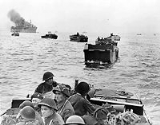
The
Landing Craft Assault (LCA) was a
landing craftLanding craft are boats and seagoing vehicles used to convey a landing force from the sea to the shore during an amphibious assault. Most renowned are those used to storm the beaches of Normandy, the Mediterranean, and many Pacific islands during WWII...
used extensively in the Second World War. Its primary purpose was to ferry troops from transport ships to attack enemy-held shores. The craft derived from a prototype designed by
John I. Thornycroft Ltd.John I. Thornycroft & Company Limited, usually known simply as Thornycroft was a British shipbuilding firm started by John Isaac Thornycroft in the 19th century.-History:...
During the war it was manufactured throughout the United Kingdom in places as various as small boatyards and furniture manufacturers. The design was also produced in Commonwealth boatyards in the Far East.
Typically constructed of
hardwoodThe term 'hardwood' is used to describe wood from angiosperm trees . It may also be used for those trees themselves: these are usually broad-leaved; in temperate and boreal latitudes they are mostly deciduous, but in tropics and subtropics mostly evergreen.Hardwood contrasts with softwood which...
planking and selectively clad with armour plate, this shallow-draft,
bargeA barge is a flat-bottomed boat, built mainly for river and canal transport of heavy goods. Some barges are not self-propelled and need to be towed by tugboats or pushed by towboats...
-like boat with a crew of 4, could ferry an infantry
platoonA platoon is a military unit typically composed of two to four sections or squads and containing about 30 to 50 soldiers. Platoons are organised into a company, which typically consists of three, four or five platoons. A platoon is typically the smallest military unit led by a commissioned officer...
of 31, with space to spare for 5 additional specialist troops, to shore at 7
knotsThe knot is a unit of speed equal to one nautical mile per hour, which is equal to exactly 1.852 km/h and approximately 1.151 mph. The abbreviation kn is preferred by American and Canadian maritime authorities, and by the Institute of Electrical and Electronics Engineers; however, the...
(13 km/h). Men generally entered the boat by walking over a gangplank from the boat deck of their troop transport as the LCA hung from its davits. When loaded, the LCA was lowered into the water. Soldiers exited by the boat's
bowThe bow is a nautical term that refers to the forward part of the hull of a ship or boat, the point that is most forward when the vessel is underway. Both of the adjectives fore and forward mean towards the bow...
ramp.
Overview
The LCA was the most common British and Commonwealth
landing craftLanding craft are boats and seagoing vehicles used to convey a landing force from the sea to the shore during an amphibious assault. Most renowned are those used to storm the beaches of Normandy, the Mediterranean, and many Pacific islands during WWII...
of the Second World War, and the smallest
landing craftLanding craft are boats and seagoing vehicles used to convey a landing force from the sea to the shore during an amphibious assault. Most renowned are those used to storm the beaches of Normandy, the Mediterranean, and many Pacific islands during WWII...
employed by the
Royal NavyThe Royal Navy of the United Kingdom is the oldest of HM Armed Forces . From the beginning of the 18th century until well into the 20th century, it was the most powerful navy in the world, playing a key part in establishing the British Empire as the dominant world power from 1815 until the early...
on
D-DayD-Day is a term often used in military parlance to denote the day on which a combat attack or operation is to be initiated. "D-Day" often represents a variable, designating the day upon which some significant event will occur or has occurred; see Military designation of days and hours for similar...
.
Landing craftLanding craft are boats and seagoing vehicles used to convey a landing force from the sea to the shore during an amphibious assault. Most renowned are those used to storm the beaches of Normandy, the Mediterranean, and many Pacific islands during WWII...
could hardly be adored by soldiers required to endure rides in them through any sea conditions. Still, the design’s sturdy hull, load capacity, low silhouette, shallow draft, little bow wave, and silenced engines were all assets that benefited the occupants. The extent of its light armour, proof against rifle bullets and shell splinters with similar ballistic power recommended the LCA. Also, many a
TommyTommy Atkins is a term for a common soldier in the British Army that was already well established in the nineteenth century, but is particularly associated with World War I. It can be used as a term of reference, or as a form of address. German soldiers would call out to "Tommy" across no man's...
and GI looked favourably upon the luxury of seating in the well for the soldier passengers. Throughout the war in the Atlantic, the Mediterranean, and the Indian Ocean, the LCA was the most likely sea assault transport of Allied
CommandosCommandos is a successful stealth-oriented real-time tactics game series, available for Microsoft Windows and Mac OS X. The game is set in the Second World War and follows the escapades of a fictional British Commando section. It leans heavily on historical events during WWII to carry the plot...
,
RangersThe United States Army Rangers are an elite American Special Operations Force capable of conducting direct action operations.United States Army Rangers draw very strongly on the heritage, traditions and ethos of Rogers' Rangers but have no lineage back to that unit. The current U.S. Army Rangers,...
, and other
Special ForcesSpecial forces and special operations forces are generic terms for elite highly-trained military teams/units that conduct specialized operations such as reconnaissance, unconventional warfare, direct action and counter-terrorism actions.In the United States, the term special operations forces is...
.
Origins
The history of amphibious operations in the
British IslesThe British Isles are a group of islands off the northwest coast of continental Europe that include Great Britain, Ireland and numerous smaller islands. There are two sovereign states located on the islands: the United Kingdom of Great Britain and Northern Ireland, and Ireland...
reaches back at least as far as
Julius CaesarGaius Julius Caesar , , was a Roman military and political leader. He played a critical role in the transformation of the Roman Republic into the Roman Empire....
’s legions crossing the
ChannelThe English Channel is an arm of the Atlantic Ocean that separates England from northern France, and joins the North Sea to the Atlantic. It is about long and varies in width from at its widest, to only in the Strait of Dover...
to invade from
GaulGaul is a historical name used in the context of the Roman Empire in references to the region of Western Europe approximating present day France and Belgium, but also sometimes including the Po Valley, western Switzerland, and the parts of the Netherlands and Germany on the west bank of the River...
. For centuries the Royal Navy had been landing soldiers on hostile shores. During the inter-war period a combination of recent experience and economic stringency contributed to the delay in producing a modern infantry landing craft.
In military and government circles the costly failure of the Gallipoli campaign during the First World War coupled with the emerging potential of airpower satisfied many that the age of amphibious operations had come to a close. Still, throughout the 1920s and 1930s, animated discussion in
Staff CollegeStaff colleges train military officers in the administrative, staff and policy aspects of their profession. It is usual for such training to occur at several levels in a career...
s in Britain and the
Indian ArmyThe Indian Army is the land based branch and the largest component of the Indian Armed Forces. Its primary mission is to ensure the national security and defense of the Republic of India from external aggression and threats, and maintaining peace and security within its borders...
Staff College at
Quetta) is the largest city and the provincial capital of the Balochistan Province of Pakistan. It is known as the "Fruit Garden of Pakistan", due to its diversity in plant and animals wildlife. The city has been a major stronghold along the western frontier of the country. It is situated at an average...
surrounded the potential of the Dardanelles campaign compared with the
attritionAttrition may refer to:*Physical wear*Loss of personnel by Withdrawal *Attrition , the loss of participants during an experiment*Attrition , the loss of tooth structure by mechanical forces from opposing teeth...
of the
Western FrontWestern Front was a term used during the First and Second World Wars to describe the "contested armed frontier" between lands controlled by Germany to the East and the Allies to the West...
. The economic austerity of the worldwide economic depression and the
Ten Year RuleThe Ten Year Rule was a British government guideline, first adopted in August 1919, that the armed forces should draft their estimates "on the assumption that the British Empire would not be engaged in any great war during the next ten years"....
assured that such theoretical talk would not result in the procurement of any equipment. for a successful landing, troops had to be put ashore safely and quickly in large numbers. The design and production, and use of landing craft was the responsibility of the
Royal NavyThe Royal Navy of the United Kingdom is the oldest of HM Armed Forces . From the beginning of the 18th century until well into the 20th century, it was the most powerful navy in the world, playing a key part in establishing the British Empire as the dominant world power from 1815 until the early...
The
Munich AgreementThe Munich Agreement was an agreement permitting German annexation of Czechoslovakia's Sudetenland. The Sudetenland were areas along borders of Czechoslovakia, mainly inhabited by Czech Germans. The agreement was negotiated at a conference held in Munich, Germany, among the major powers of Europe...
of 1938 delayed the inevitable war between Britain and Germany. Munich also led to many changes in Imperial General Staff policies, among which was the acceptance of a proposal in November from the Inter-Service Training Development Centre based at
Fort CumberlandFort Cumberland is a pentagonal artillery fortification erected to guard the entrance to Langstone Harbour, east of the naval port of Portsmouth on the south coast of England. It was sited to protect the Royal Navy Dockyard, by preventing enemy forces from landing in Langstone Harbour and attacking...
for amphibious assault procedures and for a new type of
landing craftLanding craft are boats and seagoing vehicles used to convey a landing force from the sea to the shore during an amphibious assault. Most renowned are those used to storm the beaches of Normandy, the Mediterranean, and many Pacific islands during WWII...
. Up to this time the Landing Craft Committee had produced some Motor Landing Craft but had not formed procedures for the assault role of these boats, but now there were specifications for what the new boat must be able to do. They must be under ten
long tonLong ton is the name for the unit called the "ton" in the avoirdupois or Imperial system of measurements, as used in the United Kingdom and several other Commonwealth countries. It has been mostly replaced by the tonne, and in the USA by the short ton. It is equal to or of salt water with a...
s, enabling lifting by passenger liner davits. The new craft also had to be built around the load - apart from crew they should carry the thirty-one men of a British Army
platoonA platoon is a military unit typically composed of two to four sections or squads and containing about 30 to 50 soldiers. Platoons are organised into a company, which typically consists of three, four or five platoons. A platoon is typically the smallest military unit led by a commissioned officer...
and five
assault engineerThe Corps of Royal Engineers, usually just called the Royal Engineers , and commonly known as the Sappers, is one of the corps of the British Army. It provides combat engineering and other technical support to the British Armed Forces...
s or signallers – and be so shallow drafted as to be able to land them in eighteen inches of water. The troops had to unload quickly, so the seats had to be fore and aft and the exit had to be a ramp in the bows. The protection they needed was against rifle and machine-gun fire. the Inter-Service Training Development Centre carried out experiments at the
Musketry SchoolThe Small Arms School Corps is a small corps of the British Army responsible for maintaining the proficiency of the army in the use of small arms, support weapons and range management.-History:...
at
HythePlacenames in Canada*Hythe, Alberta Placenames in England*Hythe, Essex *Hythe, Hampshire *Hythe, Kent **Hythe...
to determine the thickness and type of plate to be ‘used, and the behaviour of a bullet when striking the water, making allowance for the fact that German bullets had 200
fpsFPS has several meanings:In units of measurement:* Foot-pound-second, the imperial units system of measurement* Feet per second, an Imperial unit for speed* Frames per second, used for measuring the frame speed in a moving imageIn media:...
greater velocity than the
Lee-EnfieldThe Lee-Enfield bolt-action, magazine-fed, repeating rifle was the main firearm used by the military forces of the British Empire/Commonwealth during the first half of the 20th century. It was the British Army's standard rifle from its official adoption in 1895 until 1957...
’s.
All of these specifications made the LCA personnel carriers; a separate set of requirements were laid down for vehicle carriers, although previously the two roles were combined in the Motor Landing Craft.
Admiralty designers, swamped with the accelerating demands of rearmament, were unable to produce a design on short notice. So Mr. Fleming of Liverpool, who had produced the Fleming lifeboat, came to Fort Cumberland and the design of the first LCA began.
Design
All landing craft designs (and landing ship designs for ships intended to beach) must find a compromise between two divergent priorities; the qualities that make a good sea boat are opposite those that make a craft suitable for beaching. By this challenging criteria, the LCA was a reasonable compromise. The LCA had a hull built of double-diagonal
mahoganyThe name mahogany is used when referring to numerous varieties of dark-coloured hardwood, it is an American Indian word originally used for the wood of the species Swietenia mahagoni, known as West Indian or Cuban mahogany. Mahogany it was next equally applied to the wood of Swietenia macrophylla,...
planking. The sides were plated with "10lb. D
IHT" armour, a heat treated steel based on D1 steel, in this case
HadfieldMangalloy, or Hadfield steel, is a steel alloy containing an average of around 13% manganese. Mangalloy is known for its high impact strength and resistance to abrasion.-Material properties:...
’s Resista ¼”. Steps were taken to ensure that the boat would not sink when swamped. In the bow section between the armoured doors and the ramp, each bulkhead was packed with 30 cubic feet of Onozote buoyant material. The same Onozote packing was placed along both hull sides for the length of the well, and 42.5 cubic feet filled the aft compartment.
The LCA had a long central well section fitted with three benches, one centre, one each port and starboard, for seating troops. The side benches were covered by the top deck. The well was divided from the bow by a bulkhead fitted with two vertically hinged doors. This pair of forward-opening armour-plate doors lead to the ramp, which was lowered and raised by a simple arrangement of pulleys and wire. Two rollers on the leading outboard edge providing some freedom of movement for the ramp when it was grounded. Over this ramp troops could come ashore in two to three minutes, or less if the soldiers and crews were well trained. Immediately behind the bulkhead were the steering shelter on the starboard, and the
Lewis gunThe Lewis Gun is a World War I era light machine gun of American design that was perfected and most widely used by the forces of the British Empire. It was first used in combat in World War I, and continued in service with a number of armed forces all the way through to the end of the Korean War...
shelter on the port. The steering shelter was fitted with a
telegraphAn engine order telegraph or E.O.T., often also chadburn, is a communications device used on a ship for the pilot on the bridge to order engineers in the engine room to power the vessel at a certain desired speed...
and voice pipe for communication with the stoker, a featherspray control lever, and a fold-up seat. The shelter was protected on all four sides by non-magnetic bulletproof plate surmounted by a hinged double-door roof. Most LCA were fitted with a compass.
Drive was by two shafts from the pair of low-powered Ford V8 engines to two 19”x14” 2-bladed propellers. Fuel capacity was . The craft were steered by twin rudders with steering wires that ran from the coxswain’s shelter aft through the well and engine compartment, and the last three foot (unarmoured) buoyancy section in the stern. The LCA propulsion system was designed to be quiet. At low speeds the engines could not be heard at 25 yards. The LCA handled well enough in moderate seas when waves were 3 to 5 ft but could make no speed against rough weather, demonstrated in the number of LCA-hulled support craft that foundered in 6 ft waves while on tow to Normandy (specifically LCA(HR)). The power-plant, while quiet, has been criticized for being underpowered. Nevertheless the bow lines and small ramp made the LCA a reasonably good sea boat.
Variants
From the start, the Inter-Service Training and Development Centre intended to use armed versions of the LCA to provide close support to the troop-carrying types. These variants were armed with heavy machine guns and smoke-firing mortars. The two prototype LCA from 1938 were converted for this purpose, and other, similar, conversions became the Mkl LCS(M). The Mk1 had a centrally located armoured steering shelter just fore of the engine compartment, and was armed with two .50 calibre machine guns, two .303 Lewis guns, and one 4' mortar or a 20mm gun. The crew of 11 included 1 officer, 3 ratings to sail, and 7 gun crew. The Mk2 was similarly armed on a standard LCA hull, except the two machine guns were in a twin turret rather than single mounts. These craft were not expected to beach and later in production boats were given a proper bow, making them more seaworthy. Thus the LCS(M)(3) was produced and stayed in production for the rest of the war. The LCS(M)(3) used Scripps marine conversions of the Ford V8 engine and had 98 gal. fuel tanks. The turret was armed with twin .50 cal. Vickers power-operated machine-guns.
The LCA was used as the basis for another support weapon variant; the LCA(HR). The capacity to carry troops was replaced by
Hedgehog spigot mortar weaponThe Hedgehog was an anti-submarine weapon developed by the Royal Navy during World War II, that was deployed on convoy escort warships such as destroyers to supplement the depth charge. The weapon worked by firing a number of small spigot mortar bombs from spiked fittings...
. The additional weight of this weapon and the force it placed on the craft when fired required strengthening of the well floor. As employed for anti-submarine use, it fired 24 bombs arranged in four rows of six in what had been the troop well space, each bomb containing about 30 lb of HE into a 100 circle about 250 yards forward. It was expected that the bombs would clear paths through mines and wire on the beach and for this it was known as "Hedgerow" and the vessels were known as LCA(HR). Using this principle of ‘counter-mining’ - the explosions from mortar rounds setting off the mines both above and below the water’s edge, proved very successful. They were used at Salerno and Normandy. The US had a similar craft the "Woofus" based on the LCM.
While not, perhaps, a variant, a field modification was developed by US Rangers, with assistance from LCA crews and Commandos, for the famous
Pointe du HocPointe du Hoc is a clifftop location on the coast of Normandy in northern France. It lies 4 miles west of Omaha Beach, and stands on 100 ft tall cliffs overlooking the sea...
assault of 6 June 1944. Each of the 10 LCA of Flotillas 510 and 522 which carried the US
2nd Ranger Battalion2nd Ranger Battalion is the name of two distinct units of United States Army Rangers. The first was part of the six Ranger battalions of the Second World War...
to Pointe du Hoc, was fitted with 3 pairs of rocket tubes, firing six-tine grapnels. These pulled up (by pairs) ¾” plain ropes, toggle ropes, and rope ladders. The ropes and ladders were stowed in three large tackle boxes mounted down either side of the LCA decks and the rocket tubes were positioned down either side behind the corresponding boxes. In addition, each craft carried a pair of small hand-projector-type rockets, which could be easily carried ashore and fired small 100’ ropes. These could carry to full extension provided the line was dry and used in moderate weather conditions. Each craft also carried tubular-steel extension ladders made up of light, four-foot sections suitable for quick assembly. These modified craft had the central bench in the well removed. At least some of the LCAs also had smoke floats on the stern and the armament in the gunner’s shelter was a Lewis gun, but a variety of Brens and other light weapons were also carried.
Additional support craft variants included the LCA (OC), which was fitted to clear foreshore obstructions. Neither the LCA (FT) fitted with a flamethrower, nor the LCA (
CDLCDL may refer to:* Candlestick chart * Canal Defence Light* California Digital Library* Carbondale , Illinois, United States; Amtrak station code CDL* Career development loan...
) appears to have been used in action. The latter was a conversion by the parent firm of
ThornycroftThornycroft was a United Kingdom-based vehicle manufacturer which built coaches, buses, and trucks from 1896 until 1977.-History:Thornycroft started out with steam vans and lorries. John Isaac Thornycroft, the naval engineer, built his first steam lorry in 1896...
to carry an armoured searchlight (‘canal defence light’) originally developed for use in tanks and intended to blind the enemy in a night attack. Though plans exist of a prototype conversion it is not clear whether it was ever completed. There was an LCA (Bakery) variant to provide fresh bread.
Production and development history
With few exceptions, the hull, ramp, and power plant of the LCA remained the same throughout the war. Early on the coxswain’s position was moved from aft to forward on the starboard side. Other particulars could vary greatly; some LCA having
Direction FinderDirection finding refers to the establishment of the direction from which a received signal was transmitted. This can refer to radio or other forms of wireless communication...
antenna loops, others Danforth anchors on vertical racks forward. The hatch layout on the stern deck varies, as do the placement and type of mooring bits, chocks,
cleatCleat may refer to:* Cleat , a fitting on ships, boats, and docks to which ropes are tied* Cleat , a type or part of a shoe* Cleats , a comic strip by Bill Hinds...
s,
fairleadA fairlead is a device to guide a line, rope or cable around an object or out of the way, or to stop it from moving laterally. Typically a fairlead will be a ring or hook. The fairlead may be a separate piece of hardware, or it could be a hole in the structure.A fairlead can also be used to stop...
s, and fuel caps. Photographic evidence shows all these variations and also differences in the placement of the lifelines that were looped along either hullside for men in the water.
The Admiralty ordered 18 LCA from Messrs. Thornycroft in April 1939. These early boats weighed more than 9 tons and had flush-decked hulls, an armoured bulkhead forward that wrapped around the steering compartment on the starboard side. The steering compartment’s armour plates stood about two feet proud of the deck line. In September, 8 more were ordered. Ford V8 marine conversions by Thornycroft powered the early groups of LCA, these water-cooled petrol engines developing 65 hp each when driving the 19”x14” 2-bladed propellers through a 41:20 gear reduction. The twin propulsion units gave a speed of 10½ knots at 2,800 revolutions per minute with a load of 8,300 lb in the boat.
The Admiralty placed orders for 30 LCA in March 1940. By this time, Thornycroft were subcontracting with South Coast yacht-builders to fill the
AdmiraltyThe Admiralty was formerly the authority in the United Kingdom responsible for the command of the Royal Navy. Originally exercised by a single person, the office of Lord High Admiral was from the 18th century onward almost invariably put "in commission", and was exercised by a Board of Admiralty.In...
’s many small boat orders as Thornycroft yards were overtaxed building
war-emergency convoy escorts and the likeThe War Emergency Programme destroyers were 112 destroyers built for the British Royal Navy during World War II. They were based on the hull and machinery of the earlier J, K and N class destroyer. Due to supply problems and the persistent failure by the Royal Navy to develop a suitable...
. Some LCA - Numbers 24-29 and 51 - were fitted with
ParsonsParsons Marine Steam Turbine Company was a British engineering company based in Wallsend, North England, on the River Tyne.-History:The Company was founded by Charles Algernon Parsons in 1897 with £500,000 of capital, and specialised in building the steam turbine engines that Parsons had invented...
conversions of the Ford V8, driving propellers similar to the standard type but on a 2:1 gear reduction; these LCA did 12 knots at 3,300 revolutions. The standard engine fitted in almost all other craft was the
ScrippsA colorful member of Cranbrook's Founding family, James Scripps Booth combined his love of art and automotive engineering to create some of America's most unusual and innovative automobiles...
conversion of the Ford V8. Official trial results for craft built in 1940-1 with this engine show a consistent performance with an unladen speed of 11 knots at 2,800 revolutions. June saw 64 more LCA orders, and then between late September and March1941 another 104. These early craft did not yet have the later standard portside armoured Lewis gun position, but nevertheless, had framed canvas hold covers, scaling ladders mounted on the decks amidships, and various other refinements dropped when mass production got into full swing. The finish and performance of these early LCA were quite fine, which might be expected as these boats were built in established Thornycroft selected yards, but in circumstances of nightly blackouts, air raids, wartime restrictions, and shortages the LCA building programme was a remarkable achievement.
About April 1941 the Admiralty decided not to place orders exclusively through Thornycroft and leaving them to sub-contract, rather, the Admiralty placed orders directly with cabinet makers, carpenters, and yacht-builders in all parts of Britain. In this way, Britain was able to produce an additional 1,694 LCA before the end of 1944.
Certain details were modified as production ran, but the basic LCA design remained unchanged for the length of the war. By the time production was in full tilt in preparation for Overlord production rose to sixty LCA a month.
Sources differ regarding the speed and endurance of the LCA. By 1945 the all-up loaded weight of a LCA had risen to 13½ tons, due to the addition of further armour and the weight of weaponry an infantry platoon expected to carry into battle. As with all wooden vessels after prolonged immersion, weight increased in the LCA and performance consequently fell. The equipment had evolved and so had the personnel. The time of needing a few craft for raiding was past and the time for invasion, for scores of flotillas dawned. Another obstacle to getting the best performance out of the LCA was the early war tendency to return ratings to their various barracks who had landing craft and small marine engine training. Unfortunately, the Navy appointed these ratings to duties without regard to the importance of their amphibious skills. In June 1941 this pattern was changed with the establishment of the Combined Operations naval base HMS
Quebec at
InverarayInveraray is a town and former Royal Burgh in Argyll and Bute, Scotland, located on the western shore of Loch Fyne near its head, and on the A83 road...
. Combined Operations was then able to keep trained landing craft crew until boats became available.
Service history
Throughout the Second World War, LCA were used for landing Allied forces in almost every combined operation, major and minor, in the European theatre.
1940
The first four LCA used in an opposed landing disembarked 120
French Foreign LegionThe French Foreign Legion is a unique unit in the French Army, established in 1831. The legion was specifically created for foreign nationals wishing to serve in the French Armed Forces, but commanded by French officers. However, it is also open to French citizens, who amount to 24% of recruits...
naires near Narvik in the May 1940
Norwegian campaignThe Norwegian Campaign was the name used by the Allies United Kingdom and France for their first direct land confrontation with the military forces of Nazi Germany in World War II. The conflict occurred in Norway between 9 April and 10 June 1940, making Norway the nation - aside from the Soviet...
. All four were lost in an unsuccessful attempt to tow them home at the end of the campaign. Nine LCA played a part in evacuating the BEF from
DunkirkDunkirk is a commune in the Nord department in northern France.It lies 10 kilometres from the Belgian border. The population of the city at the 1999 census was 70,850 inhabitants...
(
Operation DynamoThe Dunkirk evacuation, codenamed Operation Dynamo by the British, was the evacuation of Allied soldiers from the beaches and harbour of Dunkirk, France, between 26 May and 4 June 1940, when British, French, and Canadian troops were cut off by the German army during the Battle of Dunkirk in the...
). The LCA were sent to
DunkirkDunkirk is a commune in the Nord department in northern France.It lies 10 kilometres from the Belgian border. The population of the city at the 1999 census was 70,850 inhabitants...
on merchant ships. Designed to be hoisted on the standard
davitFor the name of a person, see David.A davit, , is a structure, usually made of steel, which is used to lower things over an edge of a long drop off such as lowering a maintenance trapeze down a building or launching a lifeboat over the side of a ship.The development of the davit from its original...
s used for the 99 man lifeboats in use on all passenger liners, the LCA could be carried and launched from a large number of
Merchant NavyThe British Merchant Navy, known simply as the Merchant Navy, is the maritime register of the United Kingdom, and describes the seagoing commercial interests of UK-registered ships and their crews...
vessels. Five LCA were lost when the merchant ship carrying them was sunk and the remaining four returned to England “in a bad way” after taking some 2,000 soldiers directly off the beaches.
1941
In the Mediterranean, LCA from
HMS GlengyleHMS Glengyle was an infantry landing ship of the Royal Navy. She saw service in the Second World War, formally known as a "Landing Ship Infantry Large" .-Design and conversion:...
carried No. 4 Commando in their raid on
BardiaBardia is a geographic region in the Kingdom of Nepal.Bardia comprises a portion of the Terai, or lowland hills and valleys of southern Nepal. The Terai is over 1,000 feet in elevation, and extends all along the Indian border...
in April. The objective was to silence a coastal defence battery atop 300 ft high cliffs on a rocky coast. Here the sturdy hull of the LCA, coupled with the skill of the crews allowed many of the Commandos to land almost dry-shod. Later that month LCA were involved in the
evacuation of GreeceThe Battle of Greece was a World War II battle that occurred on the Greek mainland and in southern Albania. The battle was fought between the Allied and Axis forces...
, where some 50,000 troops were embarked in hastily organized operations from Raphto,
ArgosArgos is a city in Greece in the Peloponnese near Nafplion, which was its historic harbour .-Name:The region of Argos is known as the Argolis, Argolid, or Argeia...
and
KalamataKalamata is the second-largest city of the Peloponnese in southern Greece. The capital and chief port of the Messenia prefecture, it lies along the Nedon River at the head of the Messenian Gulf...
. In May LCA ferried many of these troops to
CreteCrete is the largest of the Greek islands and the fifth largest island in the Mediterranean Sea at 8,336 km²...
, and days later, LCA from
HMS GlengyleHMS Glengyle was an infantry landing ship of the Royal Navy. She saw service in the Second World War, formally known as a "Landing Ship Infantry Large" .-Design and conversion:...
and the SS
Cameronia evacuated 6,000
Argyll and Sutherland HighlandersThe Argyll and Sutherland Highlanders was an infantry regiment of the British Army, part of the Scottish Division. In 2004, as part of the restructuring of the infantry, it was announced that the Argyll and Sutherland Highlanders would be amalgamated with the other Scottish infantry regiments into...
during the
evacuation of CreteThe Battle of Crete was a battle during World War II on the Greek island of Crete. The battle began on the morning of 20 May 1941, when Nazi Germany launched an airborne invasion of Crete under the code-name Unternehmen Merkur Greek and Allied forces along with Cretan civilians defended the...
.
1942
In April two troops of No.4 Commando and eight officers and 43 other ranks of the Carleton and York Regiment (Canadian 1st Infantry Division) took part in
AbercrombieDuring World War II, Operation Abercrombie was a raid on the French coastal village of Hardelot scheduled for the night of 18/19 April,1942, but delayed by bad weather until 21/22 April....
, a raid on
Hardelot, FranceNeufchâtel-Hardelot is a commune in the Pas-de-Calais department in the Nord-Pas-de-Calais region of France.-Geography:Neufchâtel-Hardelot is a farming and tourist town of forests, golf courses and beaches, situated some south of Boulogne, at the junction of the D940, D308 and D215 roads...
, near Boulogne. The LCA of
HMS Prince AlbertThree ships of the Royal Navy have borne the name HMS Prince Albert or HMS Prins Albert, after Prince Albert, husband of Queen Victoria:...
transported the party. This raid also marked the first operational use of the new LCS. The raid set out on the night of 19 April with the LCA being towed by
Motor Gun BoatMotor Gun Boat was a Royal Navy term for a small military vessel of the Second World War. They were physically similar to the Motor Torpedo Boats but equipped with a mix of guns instead of torpedoes. Their small size and high speed made them difficult targets for E-boats or torpedo bombers, but...
s (MGBs). The procedure was for the party to travel to within two miles of the French coast on the MGBs and then to transfer to the LCA for the landing. Due to high seas and strong winds, which swamped and sank LCA 211, the raid was stopped with the loss of two naval ratings. The raid was remounted two nights later in calmer seas, but the period of optimum tide, moon, and darkness had past. The raid became uncoordinated, and whilst the Commandos got ashore and began their mission, the boats with the regular infantry became lost. Soon a German
E-BoatGenerally Schnellboot or S-boot , is the designation for Motor Torpedo Boats of the German Navy since 1932. In particular it applies to that type of Boat that saw service during World War II...
was engaged by the MGBs. The army officers in the LCA conferred and decided not to disembark. Aboard the LCS, the senior naval officer’s compass failed, and the flotilla only returned to England steered by Lt. Groom’s army compass.
Beginning in May, LCA were used in
Operation IroncladThe Battle of Madagascar was the Allied campaign to capture Vichy French-controlled Madagascar during World War II. It began on 5 May, 1942. Fighting did not cease until 6 November.-Background:...
, where British and Commonwealth forces landed in Madagascar to deny its harbours to the Japanese. Because the entrance to Diego Suarez harbour and its approaches were heavily mined the ships of the invasion fleet were unable to anchor close and LCA were required to make long and frequent journeys from ship to shore to satisfy requirements for supplies and reinforcements in worsening sea conditions. Here it became obvious that the assault design was not ideal for utility and supply purposes and future expeditions were allotted more
LCMThe Landing Craft Mechanized or Landing Craft Mechanical was a landing craft designed for carrying vehicles. They came to prominence during the Second World War when they were used to land troops or tanks during Allied amphibious assaults....
and
LCVLCV can stand for:* Landing Craft, Vehicle* League of Conservation Voters* Customer lifetime value* Light commercial vehicle* Lincolnville, Maine * Light Combat Vehicle* Long Combination Vehicle, see road train* Leuco Crystal Violet...
. LCA were used in three additional landings during the campaign before Madagascar surrendered in September. They carried the assault infantry of the Canadian 2nd Division
to Dieppe in AugustThe Dieppe Raid, also known as The Battle of Dieppe, Operation Rutter or later on Operation Jubilee, during the Second World War, was an Allied attack on the German-occupied port of Dieppe on the northern coast of France on 19 August 1942. The assault began at 5:00 AM in the morning and by 9:00 AM...
, and later that year US and British infantry divisions of the Centre and the Eastern Task Forces in the
Operation TorchOperation Torch was the British-American invasion of French North Africa in World War II during the North African Campaign, started 8 November 1942....
landings in French held North Africa.
1944
On D-Day LCA put troops ashore on
JunoJuno Beach was one of the five main landing sites of the Allied invasion of the coast of Normandy on D-Day during World War II. It was situated between Sword Beach and Gold Beach. It is also known as the Canadian beach, as it was assigned to the 3rd Canadian Infantry Division. Juno Beach stretched...
,
GoldGold Beach was the code name for one of the central D-Day landing beaches that Allied forces used to invade German-occupied France on June 6, 1944, during World War II....
and
Sword BeachSword Beach was the codename of one of the five main landing beaches in Operation Neptune, which was the initial assault phase of Operation Overlord . Stretching 8 km from Ouistreham to Saint-Aubin-sur-Mer it was the farthest east of the landing points and around 15 km from Caen...
es. The LCA also landed the US infantry formations on either flank of
OmahaOmaha Beach is the code name for one of the main landing points of the Allied invasion of German-occupied France in the Normandy landings on June 6 1944, during World War II....
and the Rangers who assaulted
Pointe du HocPointe du Hoc is a clifftop location on the coast of Normandy in northern France. It lies 4 miles west of Omaha Beach, and stands on 100 ft tall cliffs overlooking the sea...
.
In addition to the gently sloping sand beaches that amphibious planners favour, sometimes it is necessary to make landings on turbulent waters on rock-infested shores. The sturdiness and quietness of the LCA proved invaluable during
Operation DragoonOperation Dragoon was the Allied invasion of southern France, on August 15, 1944, as part of World War II. The invasion took place between Toulon and Cannes.- Background :...
, the invasion of Southern France in July 1944.
Operation RomeoOperation Romeo was a French commando operation to disable German artillery atop the cliffs of Cap Nègre. The operation happened the evening before Operation Dragoon, the main invasion of Southern France...
had Landing Craft Assault of the Royal Canadian Navy disembark the 1er Commando Français de l'Afrique du Nord to disable German artillery atop the cliffs of Cap Nègre. Canadian LCAs also landed the U.S.-Canadian 1st Special Service Force on the difficult, sharp-rocked shores of Isle de Levant in a pre-dawn operation to silence batteries there that threatened the main force. The LCA was a strong little craft, in this instance standing up better to the pounding in rough landings than other LC types, especially on these rocky offshore islands in the Dragoon landings when many
LCVPThe Landing Craft, Vehicle, Personnel or Higgins boat was a landing craft used extensively in World War II. The craft was designed by Andrew Higgins of Louisiana, United States based on boats made for operating in swamps and marshes...
s were lost. Following the landings in Southern France the Royal Navy’s LSI units remained in the Mediterranean or began moving to the Indian Ocean in anticipation of joining the war against Japan. There was one more notable use of LCA in the war against Germany; the fierce fighting around
FlushingFlushing may refer to:* Flushing , the warm, red condition of human skin* Flush toilet* Flushing , related to skirmishing* Cache flush, when a CPU cache is emptied* Flushing hydrant, a device to flush water mains...
, the
MaasMaas is a Dutch and North German surname allegedly from a short form of Thomas. The Dutch spelling of the French name Maes...
, and
Western Scheldtthumb|right|Satellite image of the Scheldt delta showing the Western Scheldt The Western Scheldt in the province Zeeland in the southwestern Netherlands, is the estuary of the Scheldt river. This river once had several estuaries, but the others are disconnected from the Scheldt, leaving the...
in the operations designed to open
Antwerp||-||-||-||}Antwerp is a city and municipality in Belgium and the capital of the Antwerp province in Flanders, one of Belgium's three regions. Antwerp's total population is 472,071 and its total area is , giving a population density of 2,308 inhabitants per km²...
(
Battle of the ScheldtThe Battle of the Scheldt was a series of military operations of the First Canadian Army, led by Lieutenant General Guy Simonds. The battle took place in northern Belgium and southwestern Netherlands during World War II from October 2, 1944 to November 8, 1944By September, 1944, it had become...
). LCA were used to ferry troops through the river network and the extensive flooded areas.
Crew and Flotilla structure
In
Royal NavyThe Royal Navy of the United Kingdom is the oldest of HM Armed Forces . From the beginning of the 18th century until well into the 20th century, it was the most powerful navy in the world, playing a key part in establishing the British Empire as the dominant world power from 1815 until the early...
service LCA were normally crewed by hostilities-only ratings, personnel of the
Royal Naval Patrol ServiceThe Royal Naval Patrol Service was a branch of the Royal Navy active during the Second World War. The RNPS operated many small auxiliary vessels such as naval trawlers for anti-submarine and minesweeping operations to protect coastal Britain and convoys during WWII.-History:The Royal Naval Patrol...
, and officers and ratings of the Royal Navy Volunteer Reserve (RNVR). Approximately 43,500 hostilities-only and 5,500 RNVR officers and ratings crewed the various landing craft types in 1944. Of these, the
Royal Canadian NavyThe Royal Canadian Navy was the navy of Canada from 1911 until 1968 when the three Canadian services were unified to form the Canadian Forces....
provided 60 officers and 300 ratings, provided they be formed into specifically Canadian companies. In July 1943
Royal MarinesThe Royal Marines are the marine corps and amphibious infantry of the United Kingdom and, along with the Royal Navy and Royal Fleet Auxiliary, form the Naval Service. They are also the United Kingdom's specialists in amphibious warfare, including the operation of landing craft; mountain warfare;...
from the Mobile Naval Bases Defence Organization and other shore units were drafted into the pool to crew the expanding numbers of landing craft being gathered in England for the Normandy invasion. By 1944, 500 Royal Marine officers and 12,500 Marines had become landing craft crew.
A junior naval or Royal Marine officer commanded 3 LCA and was carried aboard one of the craft. The officer relayed signals and orders to the other two craft in the group by signal flags in the earlier part of the war, but by 1944 many of the boats had been fitted with two-way radios. On the wave leader’s boat the Sternsheetsman was normally employed as the
SignalmanA Signalman is a person who historically gave signals using flags and light. In modern times the role of Signalmen has evolved and now usually uses electronic communication equipment. Signalmen usually work in rail transport networks or armed forces...
but flags, aldis lamps, and loudhailers were sometimes more reliable than 1940s radio equipment. The communications equipment of the troops being ferried could sometimes prove helpful.
The LCA’s crew of four ratings included a Sternsheetsman, whose action station was at the
sternThe stern is the rear or aft part of a ship or boat, technically defined as the area built up over the sternpost, extending upwards from the counter to the taffrail...
to assist in lowering and raising the boat at the davits of the
LSILSI may mean* Lake Superior and Ishpeming Railroad, a U.S. railroad offering service from Marquette, Michigan, to nearby locations in Michigan's Upper Peninsula...
, a Bowman-gunner, whose action station was at the front of the boat to open and close the armoured doors, raise and lower the ramp, and operate the one or two
Lewis gunThe Lewis Gun is a World War I era light machine gun of American design that was perfected and most widely used by the forces of the British Empire. It was first used in combat in World War I, and continued in service with a number of armed forces all the way through to the end of the Korean War...
s in the armoured gun cockpit opposite the steering position, a
stokerA stoker is "one who stokes".Stoker may also refer to:*Mechanical stoker - a coal-feeding device on a steam locomotive*Stoker - an Australian colloquial term for any slender cylindrical instrument used to clear debris from a cone.*Stoker - a job on a coal-powered steam ship to stoke the...
-mechanic responsible for the engine compartment, and a
CoxswainThe coxswain is the person in charge of a boat, particularly its navigation and steering. The etymology of the word gives us a literal meaning of "boat servant" since it comes from cox, a coxboat or other small vessel kept aboard a ship, and swain, which can be rendered as boy, in authority.-...
who sat in the armoured steering cockpit forward on the starboard side. Though in control of the steering, the coxswain did not have direct control of the engines and gave instructions to the stoker through voicepipe and telegraph. The craft relayed signals and orders to the other two craft in the group by signal flags in the earlier part of the war, but by 1944 many of the boats had been fitted with two-way radios.
It appears that the number of boats in a Landing Craft Assault Flotilla could vary, perhaps depending on the number of davits available on a given
LSILSI may mean* Lake Superior and Ishpeming Railroad, a U.S. railroad offering service from Marquette, Michigan, to nearby locations in Michigan's Upper Peninsula...
. Generally, a Flotilla comprised 12 boats at full complement. Normally, an infantry company would be carried in six LCA. Flotillas were normally assigned to one of the
Landing Ship, InfantryLanding Ship, Infantry was a British term for a type of ship used to transport infantry in amphibious warfare during the Second World War...
. These varied in capacity with smaller ones, such as the 3,975+ ton HMCS
Prince David able to hoist 6 LCA, and larger ones, such as the nearly 16,000 ton
HMS GlengyleHMS Glengyle was an infantry landing ship of the Royal Navy. She saw service in the Second World War, formally known as a "Landing Ship Infantry Large" .-Design and conversion:...
Landing Ship, Infantry (Large)Landing Ship, Infantry was a British term for a type of ship used to transport infantry in amphibious warfare during the Second World War...
(LSI(L)) with room for 13 LCA.
LCA post war
Perhaps 1,500 LCA survived the war in serviceable condition. Flotillas were retained in
Royal NavyThe Royal Navy of the United Kingdom is the oldest of HM Armed Forces . From the beginning of the 18th century until well into the 20th century, it was the most powerful navy in the world, playing a key part in establishing the British Empire as the dominant world power from 1815 until the early...
service through the 1960s, landing Nos.
40The term commando, in English, means a specific kind of individual soldier or military unit. In contemporary usage, commando usually means élite light infantry and/or special forces units, specialised in amphibious landings, parachuting, rappelling and similar techniques, to conduct and effect...
and
42 Commando42 Commando Royal Marines is a battalion sized formation of the British Royal Marines and a subordinate unit within 3 Commando Brigade, the principal Commando formation, under the Operational Command of Commander in Chief Fleet.Roled as a Commando light infantry unit, 42 Cdo RM is capable of a...
at
Port SaidPort Said is a northeastern Egyptian city near the Suez Canal, with an approximate population of 515,007 ....
in the 1956
Suez CrisisThe Suez Crisis, also referred to as the Tripartite Aggression, was a military attack on Egypt by Britain, France, and Israel beginning on 29 October 1956....
. Perhaps the last operational use of LCA by the Royal Navy was in 1967 when boats from
HMS AlbionHMS Albion was a 22,000 ton Centaur-class light fleet carrier of the Royal Navy.-Construction and modifications:She was built by Swan Hunter & Wigham Richardson Ltd. Her keel was laid down in March 1944 and she was launched in May 1947...
supported operations in
AdenAden is a city in Yemen, 170 kilometres east of Bab-el-Mandeb.Aden's ancient, natural harbour lies in the crater of an extinct volcano which now forms a peninsula, joined to the mainland by a low isthmus. This harbour, Front Bay, was first used by the ancient Kingdom of Awsan between the 5th and...
; a LCA being the last craft to carry British personnel away from Aden. Nevertheless, the end of the Second World War meant the merchant ships and passenger liners requisitioned by the
AdmiraltyThe Admiralty was formerly the authority in the United Kingdom responsible for the command of the Royal Navy. Originally exercised by a single person, the office of Lord High Admiral was from the 18th century onward almost invariably put "in commission", and was exercised by a Board of Admiralty.In...
to serve as
Landing Ship, Infantry (Large)Landing Ship, Infantry was a British term for a type of ship used to transport infantry in amphibious warfare during the Second World War...
were returned to their owners and refitted to civilian trim. This left a LCA surfeit that was sold off for civilian uses. They were popular acquisitions among riparian holiday-makers and canal enthusiasts in Britain. Their holds covered and ramps sealed LCA became charming little houseboats.
As France began repossession of its Southeast Asian colonies after the Japanese surrender, the need for amphibious craft became apparent. France procured a number of LCA and other landing craft from Britain. The French Army and Navy created a number of river flotillas and in 1947 these were designated Divisions Navales d'Assaut. These
French Indochina||-|French Indochina was part of the French colonial empire in southeast Asia. A federation of the three Vietnamese regions, Tonkin , Annam , and Cochinchina , as well as Cambodia, was formed in 1887. Laos was added in 1893 and Kouang-Tchéou-Wan in 1900...
boats were the last LCA to be recorded in combat service.
The first amphibious craft of the Navy of the Federal Republic of Germany were 10 LCA obtained from Britain in October 1958. These boats were regarded as well built by the
German NavyThe German Navy The German Navy The German Navy (Deutsche Marine is the navy of Germany and part of the Bundeswehr (German Armed Forces).The German Navy traces its roots back to the Imperial Fleet (Reichsflotte) of the revolutionary era of 1848–1852 and more directly to the Prussian Navy, which...
, having good timber, and were fitted with a machine-gun and carried 25 soldiers. Though well regarded, they were small for the tactical plans of the time and sometime about 1967 they were mustered out.