
|
|
|
|
Grenadier Guards
|
| |
|
| |
The Grenadier Guards (GREN GDS) is the most senior regiment of the Guards Division of the British Army, and, as such, is the most senior regiment of infantry. It is not, however, the most senior regiment of the Army, this position being attributed to the Life Guards. The Coldstream Guards was formed before the Grenadier Guards, but that regiment is ranked after the Grenadiers in seniority as it was a regiment of the New Model Army.
The grouping of buttons on the tunic is a common way to distinguish between the regiments of Foot Guards.

Discussion
Ask a question about 'Grenadier Guards'
Start a new discussion about 'Grenadier Guards'
Answer questions from other users
|
Encyclopedia
The Grenadier Guards (GREN GDS) is the most senior regiment of the Guards Division of the British Army, and, as such, is the most senior regiment of infantry. It is not, however, the most senior regiment of the Army, this position being attributed to the Life Guards. The Coldstream Guards was formed before the Grenadier Guards, but that regiment is ranked after the Grenadiers in seniority as it was a regiment of the New Model Army.
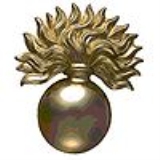
The grouping of buttons on the tunic is a common way to distinguish between the regiments of Foot Guards. Grenadier Guards' buttons are equally spaced and embossed with the Royal Cypher reversed and interlaced surrounded by the Royal Garter bearing Honi soit qui mal y pense (Evil be to him who evil thinks ). Their “Buff Belt” brass clasped also carry the Royal Cypher, Modern Grenadier Guardsmen wear a cap badge of a "grenade fired proper" with seventeen flames. This cap badge is to be cleaned twice a day once in the morning and once in the afternoon, as it is made from brass and a tarnished grenade is frowned upon by all in the regiment.
History
The Grenadier Guards celebrated its 350th anniversary in 2006.
In 1656, Lord Wentworth's Regiment was formed in Bruges, in the Spanish Netherlands, currently Belgium, forming a portion of exiled King Charles II's bodyguard. A few years later, a similar regiment known as John Russell's Regiment of Guards was formed. In 1665, these two regiments were combined to form the 1st Regiment of Foot Guards. As a result of their heroic actions in defeating the French Imperial Grenadiers at Waterloo, the 1st Guards were renamed by Royal Proclamation as the 1st or Grenadier Regiment of Foot Guards, thus becoming the only regiment in the British Army to win its name in battle. The 1st British Foot Guards never faced the French Grenadiers of the Imperial Guard. They in fact with the help of the adjacent British brigade of General Adam, beat and routed roughly three battalions of French Chausseurs of the Imperial (Middle) Guard; . One can even research the uniforms of the Imperial Guard and see that the British Grenadier adoption of the bearskin bonnet uses the Chasseur Imperial guards type that has no brassplate on the front. The Grenadiers of the Imperial Guard had this distinct brass plate on their bonnets. The nickname for the 2nd Battalion is the 'Models' and for the third battalion the 'Ribbs'.
The Grenadier Guards have served ten Kings and three Queens, including currently Queen Elizabeth II.
Role
The Grenadier Guards serves as a light infantry battalion - following the reforms of 2004, this will be fixed. The regiment will alternate with the Welsh Guards in the public duties role. In recent years the 1st Battalion has deployed as part of Operation TELIC in Iraq, and Op Herrick in Afghanistan.
Battle honours
The 1st Foot Guards have received 79 battle honours, including:
In 1994, under the Options for Change reforms, the Grenadier Guards was reduced to a single battalion. The 2nd Battalion was put into 'suspended animation', and its colours passed for safekeeping to a newly formed independent Company, which was named "The Nijmegen Company". The Inkerman Company, one of the three rifle companies that form the 1st Battalion, maintains the customs and traditions of the 3rd Battalion that went into 'suspended animation' back in 1962.
Training
Recruits to the Grenadier Guards go through a twenty-eight week training course at the Infantry Training Centre. This is two weeks more than the training for regular line regiments of the British Army; the extra training, carried out throughout the course, is devoted to drill and ceremonies.
Following graduation from the ITC, guardsmen are assigned to Nijmegen Company for additional training and orientation before being posted to the 1st Battalion.
Colonels-in-Chief
The Grenadier Guards' various colonels-in-chief have generally been the British monarchs, including Edward VII, George V, Edward VIII, George VI, and currently Elizabeth II. The Colonel-in-Chief is always the reigning Sovereign. This applies to all regiments of the Household Division. Other Sovereigns have served in the regiment.
Colonels
- 1656: Thomas Wentworth, 5th Baron Wentworth (colonel of Lord Wentworth's Regiment)
- November 23, 1660: Hon. John Russell (colonel of John Russell's Regiment of Guards until united with Wentworth's Regiment in 1665)
- December 14, 1681: Henry Fitzroy, 1st Duke of Grafton
- November 30, 1688: Edward Lee, 1st Earl of Lichfield
- December 31, 1688: Henry Fitzroy, 1st Duke of Grafton
- March 16, 1689: Henry Sydney, 1st Earl of Romney
- December 27, 1690: Charles Schomberg, 2nd Duke of Schomberg
- November 27, 1693: Henry Sydney, 1st Earl of Romney
- April 25, 1704: John Churchill, 1st Duke of Marlborough
- January 1, 1712: James Butler, 2nd Duke of Ormonde
- September 26, 1714: John Churchill, 1st Duke of Marlborough
- June 18, 1722: William Cadogan, 1st Earl Cadogan
- September 26, 1726: Sir Charles Wills
- February 18, 1742: Prince William, Duke of Cumberland
- November 30, 1757: John Ligonier, 1st Earl Ligonier
- April 30, 1770: Prince William Henry, Duke of Gloucester and Edinburgh
- September 5, 1805: Prince Frederick, Duke of York and Albany
- January 22, 1827: Arthur Wellesley, 1st Duke of Wellington
- September 23, 1852: Albert, Prince Consort
- December 15, 1861: Prince George, Duke of Cambridge
- May 1, 1904: Prince Arthur, Duke of Connaught and Strathearn
- February 24, 1942: Princess Elizabeth
- April 8, 1952: George Jeffreys, 1st Baron Jeffreys
- December 19, 1960: Sir Allan Henry Shafto Adair
- March 1, 1975: Prince Philip, Duke of Edinburgh
Marches
The Regimental Slow March is the march Scipio, from the opera of the same name by George Frideric Handel, inspired by the exploits of the Roman General Scipio Africanus. The first performance of Scipio was in 1726. Handel actually composed the eponymous slow march for the First Guards, presenting it to the regiment before he added it to the score of the opera. The Quick March is The British Grenadiers.
Football
Both the 2nd Grenadier Guards F.C. and the 3rd Grenadier Guards F.C. enjoyed considerable success in the London League, playing against the likes of West Ham United.
Order of Precedence
Cadet Force The 78th Unit Grenadier Guards Cadet Force meets every Monday and Thursday at the Lorship Lane Cadet Centre near the Horniman Museum.
Alliances
Footnotes
See also
External links
- Containing the history of the five regiments of Foot Guards, Wellington Barracks, London.
-
|
| |
|
|