
Home      Discussion      Topics      Dictionary      Almanac
Signup       Login
The Prince

The Prince

Overview
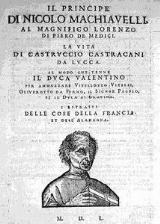
The Prince is a political
Politics
Politics is a process by which groups of people make collective decisions. The term is generally applied to the art or science of running governmental or state affairs, including behavior within civil governments, but also applies to institutions, fields, and special interest groups such as the...

 treatise
Treatise
A treatise is a formal and systematic written discourse on some subject, generally longer and treating it in greater depth than an essay, and more concerned with investigating or exposing the principles of the subject.-Noteworthy treatises:...

 by the Italian diplomat
Diplomacy
Diplomacy is the art and practice of conducting negotiations between representatives of groups or states...

, historian
History
History is the discovery, collection, organization, and presentation of information about past events. History can also mean the period of time after writing was invented. Scholars who write about history are called historians...

 and political theorist
Political philosophy
Political philosophy is the study of such topics as liberty, justice, property, rights, law, and the enforcement of a legal code by authority: what they are, why they are needed, what, if anything, makes a government legitimate, what rights and freedoms it should protect and why, what form it...

 Niccolò Machiavelli
Niccolò Machiavelli
Niccolò di Bernardo dei Machiavelli was an Italian historian, philosopher, humanist, and writer based in Florence during the Renaissance. He is one of the main founders of modern political science. He was a diplomat, political philosopher, playwright, and a civil servant of the Florentine Republic...

. From correspondence a version appears to have been distributed in 1513, using a Latin title, De Principatibus (About Principalities). But the printed version was not published until 1532, five years after Machiavelli's death. This was done with the permission of the Medici
Medici
The House of Medici or Famiglia de' Medici was a political dynasty, banking family and later royal house that first began to gather prominence under Cosimo de' Medici in the Republic of Florence during the late 14th century. The family originated in the Mugello region of the Tuscan countryside,...

 pope
Pope
The Pope is the Bishop of Rome, a position that makes him the leader of the worldwide Catholic Church . In the Catholic Church, the Pope is regarded as the successor of Saint Peter, the Apostle...

 Clement VII, but "long before then, in fact since the first appearance of the Prince in manuscript, controversy had swirled about his writings".
Discussion
Ask a question about 'The Prince'
Start a new discussion about 'The Prince'
Answer questions from other users
Full Discussion Forum
 
Quotations

And so it is with State affairs. For the distempers of a State being discovered while yet inchoate, which can only be done by a sagacious ruler, may easily be dealt with; but when, from not being observed, they are suffered to grow until they are obvious to every one, there is no longer any remedy.

Chapter III: Of Mixed Princedoms

[…]you ought never to suffer your designs to be crossed in order to avoid war, since war is not so to be avoided, but is only deferred to your disadvantage.

Chapter III: Of Mixed Princedoms

For, besides what has been said, it should be borne in mind that the temper of the multitude is fickle, and that while it is easy to persuade them of a thing, it is hard to fix them in that persuasion. Wherefore, matters should be so ordered that when men no longer believe of their own accord, they may be compelled to believe by force.

Chapter VI: Of New Princedoms Which a Prince Acquires With His Own Arms and by Merit

And here comes in the question whether it is better to be loved rather than feared, or feared rather than loved. It might perhaps be answered that we should wish to be both; but since love and fear can hardly exist together, if we must choose between them, it is far safer to be feared than loved.

Chapter XVII: Of Cruelty and Clemency, and Whether It Is Better To Be Loved or Feared

A Prince, therefore, if he is enabled thereby to forbear from plundering his subjects, to defend himself, to escape poverty and contempt, and the necessity of becoming rapacious, ought to care little though he incur the reproach of miserliness, for this is one of those vices which enable him to reign.

Chapter XVII: Of Cruelty and Clemency, and Whether It Is Better To Be Loved or Feared

A controversy has arisen about this: whether it is better to be loved than feared, or vise versa. My view is that it is deserable to be both loved and feared; but it is difficult to achieve both and, if one of them has to be lacking, it is much safer to be feared than loved.

Chapter XVI: Of Liberality and Miserliness

For of men it may generally be affirmed, that they are thankless, fickle, false studious to avoid danger, greedy of gain, devoted to you while you are able to confer benefits upon them, and ready, as I said before, while danger is distant, to shed their blood, and sacrifice their property, their lives, and their children for you; but in the hour of need they turn against you.

Chapter XVII: Of Cruelty and Clemency, and Whether It Is Better To Be Loved or Feared
Encyclopedia
The Prince is a political
Politics
Politics is a process by which groups of people make collective decisions. The term is generally applied to the art or science of running governmental or state affairs, including behavior within civil governments, but also applies to institutions, fields, and special interest groups such as the...

 treatise
Treatise
A treatise is a formal and systematic written discourse on some subject, generally longer and treating it in greater depth than an essay, and more concerned with investigating or exposing the principles of the subject.-Noteworthy treatises:...

 by the Italian diplomat
Diplomacy
Diplomacy is the art and practice of conducting negotiations between representatives of groups or states...

, historian
History
History is the discovery, collection, organization, and presentation of information about past events. History can also mean the period of time after writing was invented. Scholars who write about history are called historians...

 and political theorist
Political philosophy
Political philosophy is the study of such topics as liberty, justice, property, rights, law, and the enforcement of a legal code by authority: what they are, why they are needed, what, if anything, makes a government legitimate, what rights and freedoms it should protect and why, what form it...

 Niccolò Machiavelli
Niccolò Machiavelli
Niccolò di Bernardo dei Machiavelli was an Italian historian, philosopher, humanist, and writer based in Florence during the Renaissance. He is one of the main founders of modern political science. He was a diplomat, political philosopher, playwright, and a civil servant of the Florentine Republic...

. From correspondence a version appears to have been distributed in 1513, using a Latin title, De Principatibus (About Principalities). But the printed version was not published until 1532, five years after Machiavelli's death. This was done with the permission of the Medici
Medici
The House of Medici or Famiglia de' Medici was a political dynasty, banking family and later royal house that first began to gather prominence under Cosimo de' Medici in the Republic of Florence during the late 14th century. The family originated in the Mugello region of the Tuscan countryside,...

 pope
Pope
The Pope is the Bishop of Rome, a position that makes him the leader of the worldwide Catholic Church . In the Catholic Church, the Pope is regarded as the successor of Saint Peter, the Apostle...

 Clement VII, but "long before then, in fact since the first appearance of the Prince in manuscript, controversy had swirled about his writings".

Although it was written as if it were a traditional work in the Mirror of Princes style, it is generally agreed that it was especially innovative. This is only partly because it was written in the Vernacular
Vernacular
A vernacular is the native language or native dialect of a specific population, as opposed to a language of wider communication that is not native to the population, such as a national language or lingua franca.- Etymology :The term is not a recent one...

 (Italian
Italian language
Italian is a Romance language spoken mainly in Europe: Italy, Switzerland, San Marino, Vatican City, by minorities in Malta, Monaco, Croatia, Slovenia, France, Libya, Eritrea, and Somalia, and by immigrant communities in the Americas and Australia...

) rather than Latin
Latin
Latin is an Italic language originally spoken in Latium and Ancient Rome. It, along with most European languages, is a descendant of the ancient Proto-Indo-European language. Although it is considered a dead language, a number of scholars and members of the Christian clergy speak it fluently, and...

, a practice which had become increasingly popular since the publication of Dante's Divine Comedy and other works of Renaissance literature.

The Prince is sometimes claimed to be one of the first works of modern philosophy
Modern philosophy
Modern philosophy is a type of philosophy that originated in Western Europe in the 17th century, and is now common worldwide. It is not a specific doctrine or school , although there are certain assumptions common to much of it, which helps to distinguish it from earlier philosophy.The 17th and...

, especially modern political philosophy
Political philosophy
Political philosophy is the study of such topics as liberty, justice, property, rights, law, and the enforcement of a legal code by authority: what they are, why they are needed, what, if anything, makes a government legitimate, what rights and freedoms it should protect and why, what form it...

, in which the effective truth is taken to be more important than any abstract ideal. It was also in direct conflict with the dominant Catholic and scholastic
Scholasticism
Scholasticism is a method of critical thought which dominated teaching by the academics of medieval universities in Europe from about 1100–1500, and a program of employing that method in articulating and defending orthodoxy in an increasingly pluralistic context...

 doctrines of the time concerning how to consider politics and ethics.

Although it is relatively short, the treatise is the most remembered of his works and the one most responsible for bringing the word "Machiavellian
Machiavellianism
Machiavellianism is, according to the Oxford English Dictionary, "the employment of cunning and duplicity in statecraft or in general conduct", deriving from the Italian Renaissance diplomat and writer Niccolò Machiavelli, who wrote Il Principe and other works...

" into wide usage as a pejorative term. It also helped make "Old Nick" an English term for the devil, and even contributed to the modern negative connotations of the words "politics" and "politician" in western countries. In terms of subject matter it overlaps with the much longer Discourses on Livy
Discourses on Livy
The Discourses on Livy is a work of political history and philosophy written in the early 16th century by the Italian writer and political theorist Niccolò Machiavelli, best known as the author of The Prince...

, which was written a few years later. In its use of near contemporary Italians as examples of people who perpetrated criminal deeds for politics, another lesser-known work by Machiavelli which The Prince has been compared to is the Life of Castruccio Castracani
Life of Castruccio Castracani
The Life of Castruccio Castracani is a short work by Niccolò Machiavelli. It is made in the form of a short biographical account of the like of the medieval Tuscan condottiere, Castruccio Castracani, who lived in and ruled Lucca.The book is thought to have been written during a visit to Lucca in...

.

The descriptions within The Prince have the general theme of accepting that the aims of princes, such as glory, and indeed survival, can justify the use of immoral means to achieve those ends.

Analysis


As shown by his letter of dedication, Machiavelli's work eventually came to be dedicated to Lorenzo di Piero de' Medici, grandson of "Lorenzo the Magnificent", and a member of the ruling Florentine Medici family, whose uncle Giovanni became pope Leo X in 1513. It is known from his personal correspondence that it was written during 1513, the year after the Medici took control of Florence, and a few months after Machiavelli's arrest, torture, and banishment by the in-coming Medici regime. It was discussed for a long time with Francesco Vettori
Francesco Vettori
Francesco Vettori was an Italian diplomat, politician and writer from Florence, who served his city during both the republican and de Medici regimes...

, a friend of Machiavelli who he wanted to pass it and commend it to the Medici. The book had originally been intended for Giuliano di Lorenzo de' Medici
Giuliano di Lorenzo de' Medici
Giuliano di Lorenzo de' Medici was an Italian nobleman, one of three sons of Lorenzo the Magnificent.-Biography:He was born in Florence, Italy. His brothers were Piero and Giovanni de' Medici....

, young Lorenzo's uncle, who however died in 1516. It is not certain that the work was ever read by any of the Medici before it was printed. Machiavelli describes the contents as being an un-embellished summary of his knowledge about the nature of princes and "the actions of great men", based not only on reading but also, unusually, on real experience.

The types of political behavior which are discussed with apparent approval by Machiavelli in The Prince were perceived as shocking by contemporaries, and its immorality is still a subject of serious discussion. Although the work advises princes how to tyrannize, Machiavelli is generally thought to have preferred some form of free republic. Some commentators justify his acceptance of immoral and criminal actions by leaders by arguing that he lived during a time of continuous political conflict and instability in Italy, and that his influence has increased the "pleasures, equality and freedom" of many people, loosening the grip of medieval Catholicism's "classical teleology
Teleology
A teleology is any philosophical account which holds that final causes exist in nature, meaning that design and purpose analogous to that found in human actions are inherent also in the rest of nature. The word comes from the Greek τέλος, telos; root: τελε-, "end, purpose...

", which "disregarded not only the needs of individuals and the wants of the common man, but stifled innovation, enterprise, and enquiry into cause and effect relationships that now allow us to control nature
Nature (philosophy)
Nature is a concept with two major sets of inter-related meanings, referring on the one hand to the things which are natural, or subject to the normal working of "laws of nature", or on the other hand to the essential properties and causes of those things to be what they naturally are, or in other...

".

On the other hand, notes that "even if we were forced to grant that Machiavelli was essentially a patriot or a scientist, we would not be forced to deny that he was a teacher of evil". Furthermore, Machiavelli "was too thoughtful not to know what he was doing and too generous not to admit it to his reasonable friends".

Machiavelli emphasized the need for realism, as opposed to idealism
Idealism
In philosophy, idealism is the family of views which assert that reality, or reality as we can know it, is fundamentally mental, mentally constructed, or otherwise immaterial. Epistemologically, idealism manifests as a skepticism about the possibility of knowing any mind-independent thing...

. In The Prince he does not explain what he thinks the best ethical or political goals are, except the control of one's own fortune, as opposed to waiting to see what chance brings. Machiavelli took it for granted that would-be leaders naturally aim at glory or honor. He associated these goals with a need for "virtue
Virtue
Virtue is moral excellence. A virtue is a positive trait or quality subjectively deemed to be morally excellent and thus is valued as a foundation of principle and good moral being....

" and "prudence
Prudence
Prudence is the ability to govern and discipline oneself by the use of reason. It is classically considered to be a virtue, and in particular one of the four Cardinal virtues .The word comes from Old French prudence , from Latin...

" in a leader, and saw such virtues as essential to good politics and indeed the common good. That great men should develop and use their virtue and prudence was a traditional theme of advice to Christian princes. And that more virtue meant less reliance on chance was a classically influenced "humanist
Humanism
Humanism is an approach in study, philosophy, world view or practice that focuses on human values and concerns. In philosophy and social science, humanism is a perspective which affirms some notion of human nature, and is contrasted with anti-humanism....

 commonplace" in Machiavelli's time, as says, even if it was somewhat controversial. However Machiavelli went far beyond other authors in his time, who in his opinion left things to fortune, and therefore to bad rulers, because of their Christian beliefs. He used the words "virtue" and "prudence" to refer to glory-seeking and spirited excellence of character, in strong contrast to the traditional Christian uses of those terms, but more keeping with the original pre-Christian Greek and Roman concepts from which they derived. He encouraged ambition and risk taking. So in another break with tradition, he treated not only stability, but also radical innovation
Innovation
Innovation is the creation of better or more effective products, processes, technologies, or ideas that are accepted by markets, governments, and society...

, as possible aims of a prince in a political community. Managing major reforms can show off a Prince's virtue and give him glory. He clearly felt Italy needed major reform in his time, and this opinion of his time is widely shared.

Machiavelli's descriptions encourage leaders to attempt to control their fortune gloriously, to the extreme extent that some situations may call for a fresh "founding" (or re-founding) of the "modes and orders" that define a community, despite the danger and necessary evil and lawlessness of such a project. Founding a wholly new state, or even a new religion, using injustice and immorality has even been called the chief theme of the Prince. For a political theorist to do this in public was one of Machiavelli's clearest breaks not just with medieval scholasticism, but with the classical tradition of political philosophy
Political philosophy
Political philosophy is the study of such topics as liberty, justice, property, rights, law, and the enforcement of a legal code by authority: what they are, why they are needed, what, if anything, makes a government legitimate, what rights and freedoms it should protect and why, what form it...

, especially the favorite philosopher of catholicism
Catholicism
Catholicism is a broad term for the body of the Catholic faith, its theologies and doctrines, its liturgical, ethical, spiritual, and behavioral characteristics, as well as a religious people as a whole....

 at the time, Aristotle
Aristotle
Aristotle was a Greek philosopher and polymath, a student of Plato and teacher of Alexander the Great. His writings cover many subjects, including physics, metaphysics, poetry, theater, music, logic, rhetoric, linguistics, politics, government, ethics, biology, and zoology...

. This is one of Machiavelli's most lasting influences upon modernity
Modernity
Modernity typically refers to a post-traditional, post-medieval historical period, one marked by the move from feudalism toward capitalism, industrialization, secularization, rationalization, the nation-state and its constituent institutions and forms of surveillance...

.

Nevertheless Machiavelli was heavily influenced by classical pre-Christian political philosophy
Political philosophy
Political philosophy is the study of such topics as liberty, justice, property, rights, law, and the enforcement of a legal code by authority: what they are, why they are needed, what, if anything, makes a government legitimate, what rights and freedoms it should protect and why, what form it...

. According to Machiavelli refers to Xenophon
Xenophon
Xenophon , son of Gryllus, of the deme Erchia of Athens, also known as Xenophon of Athens, was a Greek historian, soldier, mercenary, philosopher and a contemporary and admirer of Socrates...

 more than Plato, Aristotle, and Cicero
Cicero
Marcus Tullius Cicero , was a Roman philosopher, statesman, lawyer, political theorist, and Roman constitutionalist. He came from a wealthy municipal family of the equestrian order, and is widely considered one of Rome's greatest orators and prose stylists.He introduced the Romans to the chief...

 put together. Xenophon wrote one of the classic mirrors of princes, the Education of Cyrus. wrote: "The Cyrus of Xenophon was a hero to many a literary man of the sixteenth century, but for Machiavelli he lived". Xenophon also, as Strauss pointed out, wrote a dialogue, Hiero
Hiero (Xenophon)
Hiero is a minor work by Xenophon, set as a dialogue between Hiero, tyrant of Syracuse, and the lyric poet Simonides about 474 BCE. In it Xenophon argues that a tyrant does not have any more access to happiness than a private person.The dialogue—like many of Xenophon's works—does not...

which showed a wise man dealing sympathetically with a tyrant, coming close to what Machiavelli would do in questioning the ideal of "the imagined prince". Xenophon however, like Plato and Aristotle, was a follower of Socrates
Socrates
Socrates was a classical Greek Athenian philosopher. Credited as one of the founders of Western philosophy, he is an enigmatic figure known chiefly through the accounts of later classical writers, especially the writings of his students Plato and Xenophon, and the plays of his contemporary ...

, and his works show approval of a "teleological argument
Teleological argument
A teleological or design argument is an a posteriori argument for the existence of God based on apparent design and purpose in the universe. The argument is based on an interpretation of teleology wherein purpose and intelligent design appear to exist in nature beyond the scope of any such human...

", while Machiavelli rejected such arguments. On this matter, gives evidence that Machiavelli may have seen himself as having learned something from Democritus
Democritus
Democritus was an Ancient Greek philosopher born in Abdera, Thrace, Greece. He was an influential pre-Socratic philosopher and pupil of Leucippus, who formulated an atomic theory for the cosmos....

, Epicurus
Epicurus
Epicurus was an ancient Greek philosopher and the founder of the school of philosophy called Epicureanism.Only a few fragments and letters remain of Epicurus's 300 written works...

 and classical materialism
Atomism
Atomism is a natural philosophy that developed in several ancient traditions. The atomists theorized that the natural world consists of two fundamental parts: indivisible atoms and empty void.According to Aristotle, atoms are indestructible and immutable and there are an infinite variety of shapes...

, which was however not associated with political realism, or even any interest in politics.

On the topic of rhetoric
Rhetoric
Rhetoric is the art of discourse, an art that aims to improve the facility of speakers or writers who attempt to inform, persuade, or motivate particular audiences in specific situations. As a subject of formal study and a productive civic practice, rhetoric has played a central role in the Western...

 Machiavelli, in his introduction, stated that “I have not embellished or crammed this book with rounded periods or big, impressive words, or with any blandishment or superfluous decoration of the kind which many are in the habit of using to describe or adorn what they have produced”. This has been interpreted as showing a distancing from traditional rhetoric styles, but there are echoes of classical rhetoric in several areas. In Chapter 18, for example, he uses a metaphor of a lion and a fox, examples of cunning and force; according to , “the Roman author from whom Machiavelli in all likelihood drew the simile of the lion and the fox” was Cicero. The Rhetorica ad Herennium
Rhetorica ad Herennium
The Rhetorica ad Herennium, formerly attributed to Cicero but of unknown authorship, is the oldest surviving Latin book on rhetoric, dating from the 90s BC, and is still used today as a textbook on the structure and uses of rhetoric and persuasion....

, a work which was believed to be written by Cicero during Machiavelli’s time, was used widely to teach rhetoric, and it is likely that Machiavelli was familiar with it. Unlike Cicero's more widely accepted works however, according to , “Ad Herennium … offers a model of an ethical system that not only condones the practice of force and deception but appears to regard them as habitual and indeed germane to political activity”. This makes it an ideal text for Machiavelli to have used.

Summary


The work has a recognizable structure, for the most part indicated by the author himself, which can be summarized as follows.

The subject matter: new princedoms (chapters 1 and 2)


The Prince starts by describing the subject matter it will handle. In the first sentence Machiavelli uses the word "state
State (polity)
A state is an organized political community, living under a government. States may be sovereign and may enjoy a monopoly on the legal initiation of force and are not dependent on, or subject to any other power or state. Many states are federated states which participate in a federal union...

" (Italian stato which could also mean "status
Status
Status , is a state, condition, or situation.Status may also refer to:* Social status, in sociology** Achieved status** Ascribed status** Master status** Political status** Socioeconomic status** Sociometric status...

") in order to neutrally cover "all forms of organization of supreme political power, whether republican or princely". The way in which the word state came to acquire this modern type of meaning during the Renaissance
Renaissance
The Renaissance was a cultural movement that spanned roughly the 14th to the 17th century, beginning in Italy in the Late Middle Ages and later spreading to the rest of Europe. The term is also used more loosely to refer to the historical era, but since the changes of the Renaissance were not...

 has been the subject of many academic discussions, with this sentence and similar ones in the works of Machiavelli being considered particularly important.

Machiavelli said that the Prince would be about princedoms, mentioning that he has written about republics elsewhere (possibly referring to the Discourses on Livy
Discourses on Livy
The Discourses on Livy is a work of political history and philosophy written in the early 16th century by the Italian writer and political theorist Niccolò Machiavelli, best known as the author of The Prince...

although this is debated), but in fact he mixes discussion of republics into this in many places, effectively treating republics as a type of princedom also, and one with many strengths. More importantly, and less traditionally, he distinguishes new princedoms from hereditary established princedoms. He deals with hereditary princedoms quickly in Chapter 2, saying that they are much easier to rule. For such a prince, "unless extraordinary vices cause him to be hated, it is reasonable to expect that his subjects will be naturally well disposed towards him". , comparing to traditional presentations of advice for princes, stated that the novelty in chapters 1 and 2 is the "deliberate purpose of dealing with a new ruler who will need to establish himself in defiance of custom". Normally, these types of works were addressed only to hereditary princes. He thinks Machiavelli may have been influenced by Tacitus
Tacitus
Publius Cornelius Tacitus was a senator and a historian of the Roman Empire. The surviving portions of his two major works—the Annals and the Histories—examine the reigns of the Roman Emperors Tiberius, Claudius, Nero and those who reigned in the Year of the Four Emperors...

 as well his own experience, but finds no clear predecessor for this.

This categorization of regime types is also "un-Aristotelian" and apparently simpler than the traditional one found for example in Aristotle
Aristotle
Aristotle was a Greek philosopher and polymath, a student of Plato and teacher of Alexander the Great. His writings cover many subjects, including physics, metaphysics, poetry, theater, music, logic, rhetoric, linguistics, politics, government, ethics, biology, and zoology...

's Politics, which divides regime
Regime
The word regime refers to a set of conditions, most often of a political nature.-Politics:...

s into those ruled by a single monarch
Monarch
A monarch is the person who heads a monarchy. This is a form of government in which a state or polity is ruled or controlled by an individual who typically inherits the throne by birth and occasionally rules for life or until abdication...

, an oligarchy
Oligarchy
Oligarchy is a form of power structure in which power effectively rests with an elite class distinguished by royalty, wealth, family ties, commercial, and/or military legitimacy...

, or by the people
The People
The People, previously known as the Sunday People, is a British tabloid Sunday-only newspaper. The paper was founded on 16 October 1881.It is published by the Trinity Mirror Group.In July 2011 it had an average daily circulation of 806,544....

, in a democracy
Democracy
Democracy is generally defined as a form of government in which all adult citizens have an equal say in the decisions that affect their lives. Ideally, this includes equal participation in the proposal, development and passage of legislation into law...

. He also ignores the classical distinctions between the good and corrupt forms, for example between monarchy and tyranny. points out that Machiavelli frequently uses the words "prince" and "tyrant" as synonyms, "regardless of whether he speaks of criminal or non-criminal tyrants".

Xenophon
Xenophon
Xenophon , son of Gryllus, of the deme Erchia of Athens, also known as Xenophon of Athens, was a Greek historian, soldier, mercenary, philosopher and a contemporary and admirer of Socrates...

, on the other hand, made exactly the same distinction between types of rulers in the opening of his Education of Cyrus where he says that, concerning the knowledge of how to rule human beings, Cyrus the Great
Cyrus the Great
Cyrus II of Persia , commonly known as Cyrus the Great, also known as Cyrus the Elder, was the founder of the Achaemenid Empire. Under his rule, the empire embraced all the previous civilized states of the ancient Near East, expanded vastly and eventually conquered most of Southwest Asia and much...

, his exemplary prince, was very different "from all other kings, both those who have inherited their thrones from their fathers and those who have gained their crowns by their own efforts".

Machiavelli divides the subject of new states into two types, "mixed" cases and purely new states.

"Mixed" princedoms (chapters 3 to 5)


New princedoms are either totally new, or they are “mixed” meaning that they are new parts of an older state, already belonging to that prince.

New conquests added to older states (chapter 3)


Machiavelli generalizes that there were several virtuous Roman ways to hold a newly acquired province, using a republic as an example of how new princes can act:
  • to install one's princedom in the new acquisition, or to install colonies of one's people there, which is better.
  • to indulge the lesser powers of the area without increasing their power.
  • to put down the powerful people.
  • to not allow a foreign power to gain reputation.


More generally, Machiavelli emphasizes that one should have regard not only for present problems but also for the future ones. One should not “enjoy the benefit of time” but rather the benefit of one's virtue and prudence, because time can bring evil as well as good.

Conquered kingdoms (chapter 4)


In some cases the old king of the conquered kingdom depended on his lords. 16th century France, or in other words France as it was at the time of writing of the Prince, is given by Machiavelli as an example of such a kingdom. These are easy to enter but difficult to hold.

When the kingdom revolves around the king, then it is difficult to enter but easy to hold. The solution is to eliminate the old bloodline of the prince. Machiavelli used the Persian empire of Darius III, conquered by Alexander the Great, to illustrate this point and then noted that the Medici, if they think about it, will find this historical example similar to the "kingdom of the Turk" (Ottoman Empire
Ottoman Empire
The Ottoman EmpireIt was usually referred to as the "Ottoman Empire", the "Turkish Empire", the "Ottoman Caliphate" or more commonly "Turkey" by its contemporaries...

) in their time - making this a potentially easier conquest to hold than France would be.

Conquered Free States, with their own laws and orders (Chapter 5)


notes that this chapter is quite atypical of any previous books for princes. Gilbert supposed the need to discuss conquering free republics is linked to Machiavelli's project to unite Italy, which contained some free republics. As he also notes, the chapter in any case makes it clear that holding such a state is highly difficult for a prince. Machiavelli gives three options:-
  • Ruin them, like Rome
    Rome
    Rome is the capital of Italy and the country's largest and most populated city and comune, with over 2.7 million residents in . The city is located in the central-western portion of the Italian Peninsula, on the Tiber River within the Lazio region of Italy.Rome's history spans two and a half...

     destroyed Carthage
    Carthage
    Carthage , implying it was a 'new Tyre') is a major urban centre that has existed for nearly 3,000 years on the Gulf of Tunis, developing from a Phoenician colony of the 1st millennium BC...

    , and also like Machiavelli says the Romans eventually had to do in Greece, even though they had wanted to avoid it.
  • Go to live there (or install colonies, if you are a prince of a republic).
  • Let them keep their own orders but install a puppet regime. But Machiavelli says this way is useless.

Conquests by virtue (Chapter 6)


Princes who rise to power through their own skill and resources (their "virtue") rather than luck tend to have a hard time rising to the top, but once they reach the top they are very secure in their position. This is because they effectively crush their opponents and earn great respect from everyone else. Because they are strong and more self-sufficient, they have to make fewer compromises with their allies.

Machiavelli writes that reforming an existing order is one of the most dangerous and difficult things a prince can do. Part of the reason is that people are naturally resistant to change and reform. Those who benefited from the old order will resist change very fiercely. By contrast, those who stand to benefit from the new order will be less fierce in their support, because the new order is unfamiliar and they are not certain it will live up to its promises. Moreover, it is impossible for the prince to satisfy everybody's expectations. Inevitably, he will disappoint some of his followers. Therefore, a prince must have the means to force his supporters to keep supporting him even when they start having second thoughts, otherwise he will lose his power. Only armed prophets, like Moses, succeed in bringing lasting change. Machiavelli claims that Moses killed uncountable numbers of his own people in order to enforce his will.

Machiavelli was not the first thinker to notice this pattern. Allan Gilbert wrote: "In wishing new laws and yet seeing danger in them Machiavelli was not himself an innovator," because this idea was traditional and could be found in Aristotle
Aristotle
Aristotle was a Greek philosopher and polymath, a student of Plato and teacher of Alexander the Great. His writings cover many subjects, including physics, metaphysics, poetry, theater, music, logic, rhetoric, linguistics, politics, government, ethics, biology, and zoology...

's writings. But Machiavelli went much further than any other author in his emphasis on this aim, and Gilbert associates Machiavelli's emphasis upon such drastic aims with the level of corruption to be found in Italy.

Conquest by fortune, meaning by someone else’s virtue (Chapter 7)


According to Machiavelli, when a prince comes to power through luck or the blessings of powerful figures within the regime, he typically has an easy time gaining power but a hard time keeping it thereafter, because his power is dependent on his benefactors' goodwill. He does not command the loyalty of the armies and officials that maintain his authority, and these can be withdrawn from him at a whim. Having risen the easy way, it is not even certain such a prince has the skill and strength to stand on his own feet.

This is not necessarily true in every case. Machiavelli cites Cesare Borgia
Cesare Borgia
Cesare Borgia , Duke of Valentinois, was an Italian condottiero, nobleman, politician, and cardinal. He was the son of Pope Alexander VI and his long-term mistress Vannozza dei Cattanei. He was the brother of Lucrezia Borgia; Giovanni Borgia , Duke of Gandia; and Gioffre Borgia , Prince of Squillace...

 as an example of a lucky prince who escaped this pattern. Through cunning political maneuvers, he managed to secure his power base. Cesare was made commander of the papal armies by his father, Pope Alexander VI
Pope Alexander VI
Pope Alexander VI , born Roderic Llançol i Borja was Pope from 1492 until his death on 18 August 1503. He is one of the most controversial of the Renaissance popes, and his Italianized surname—Borgia—became a byword for the debased standards of the Papacy of that era, most notoriously the Banquet...

, but was also heavily dependent on mercenary armies loyal to the Orsini brothers and the support of the French king. Borgia won over the allegiance of the Orsini's followers with better pay and prestigious government posts. When some of his mercenary captains started to plot against him, he had them imprisoned and executed. When it looked like the king of France would to abandon him, Borgia sought new alliances.

Finally, Machiavelli makes a point that bringing new benefits to a conquered people will not be enough to cancel the memory of old injuries, an idea Allan Gilbert said can be found in Tacitus
Tacitus
Publius Cornelius Tacitus was a senator and a historian of the Roman Empire. The surviving portions of his two major works—the Annals and the Histories—examine the reigns of the Roman Emperors Tiberius, Claudius, Nero and those who reigned in the Year of the Four Emperors...

 and Seneca the Younger
Seneca the Younger
Lucius Annaeus Seneca was a Roman Stoic philosopher, statesman, dramatist, and in one work humorist, of the Silver Age of Latin literature. He was tutor and later advisor to emperor Nero...

.

Conquests by “criminal virtue” (Chapter 8)


Conquests by "criminal virtue" are ones in which the new prince secures his power through cruel, immoral deeds, such as the execution of political rivals. Machiavelli advises that a prince should carefully calculate all the wicked deeds he needs to do to secure his power, and then execute them all in one stroke, such that he need not commit any more wickedness for the rest of his reign. In this way, his subjects will slowly forget his cruel deeds and his reputation can recover. Princes who fail to do this, who hesitate in their ruthlessness, find that their problems mushroom over time and they are forced to commit wicked deeds throughout their reign. Thus they continuously mar their reputations and alienate their people.

Machiavelli's case study is Agathocles of Syracuse. After Agathocles became Praetor of Syracuse, he called a meeting of the city's elite. At his signal, his soldiers killed all the senators and the wealthiest citizens, completely destroying the old oligarchy. He declared himself ruler with no opposition. So secure was his power that he could afford to absent himself to go off on military campaigns in Africa.

remarks that this chapter is even less traditional than those it follows, not only in its treatment of criminal behavior, but also in the advice to take power from people at a stroke, noting that precisely the opposite had been advised by Aristotle in his Politics
Politics (Aristotle)
Aristotle's Politics is a work of political philosophy. The end of the Nicomachean Ethics declared that the inquiry into ethics necessarily follows into politics, and the two works are frequently considered to be parts of a larger treatise, or perhaps connected lectures, dealing with the...

(5.11.1315a13). On the other hand Gilbert shows that another piece of advice in this chapter, to give benefits when it will not appear forced, was traditional.

Becoming a prince by the selection of one's fellow citizens (Chapter 9)


These "civic principalities" do not require real virtue, only “fortunate astuteness”. Machiavelli breaks this case into two basic types, depending upon which section of the populace supports the new prince.
Supported by the great (those who wish to command the people)

This, according to Machiavelli, is an unstable situation, which must be avoided after the initial coming to power. The great should be made and unmade everyday at your convenience. There are two types of great people that might be encountered:-
  1. Those who are bound to the prince. Concerning these it is important to distinguish between two types of obligated great people, those who are rapacious and those who are not. It is the latter who can and should be honoured.
  2. Those who are not bound to the new prince. Once again these need to be divided into two types:- Those with a weak spirit. A prince can make use of them if they are of good counsel; Those who shun being bound because of their own ambition. These should be watched and feared as enemies.

Supported by the people (those who wish not to be commanded by the great)

How to win over people depends on circumstances. Machiavelli advises:-
  • Do not get frightened in adversity.
  • One should avoid ruling via magistrates, if one wishes to be able to “ascend” to absolute rule quickly and safely.
  • One should make sure that the people need the prince, especially if a time of need should come.

How to judge the strength of principates (Chapter 10)


The way to judge the strength of a princedom is to see whether it can defend itself, or whether it needs to depend on allies. This does not just mean that the cities should be prepared and the people trained. A prince who is hated is also exposed.

Ecclesiastical principates (Chapter 11)


This type of "princedom" refers for example explicitly to the Catholic church, which is of course not traditionally thought of as a princedom. According to Machiavelli, these are relatively easy to maintain, once founded. They do not need to defend themselves militarily, nor to govern their subjects.

Machiavelli discusses the recent history of the Church as if it were a princedom that was in competition to conquer Italy against other princes. He points to factionalism as a historical weak point in the Church, and points to the recent example of the Borgia family as a better strategy which almost worked. He then explicitly proposes that the Medici are now in a position to try the same thing.

Defense and military (Chapter 12-14)


Having discussed the various types of principalities, Machiavelli turns to the ways a state can attack other territories or defend itself. The two most essential foundations for any state, whether old or new, are sound laws and strong military forces.
A self-sufficient prince is one who can meet any enemy on the battlefield. He should be "armed" with his own arms. However, a prince that relies solely on fortifications or on the help of others and stands on the defensive is not self-sufficient. If he cannot raise a formidable army, but must rely on defense, he must fortify his city. A well-fortified city is unlikely to be attacked, and if it is, most armies cannot endure an extended siege. However, during a siege a virtuous prince will keep the morale of his subjects high while removing all dissenters. Thus, as long as the city is properly defended and has enough supplies, a wise prince can withstand any siege.

Machiavelli stands strongly against the use of mercenaries
Mercenary
A mercenary, is a person who takes part in an armed conflict based on the promise of material compensation rather than having a direct interest in, or a legal obligation to, the conflict itself. A non-conscript professional member of a regular army is not considered to be a mercenary although he...

, and in this he was innovative, and he also had personal experience in Florence. He believes them useless to a ruler because they are undisciplined, cowardly, and without any loyalty, being motivated only by money. Machiavelli attributes the Italian city states’ weakness to their reliance on mercenary armies.

Machiavelli also warns against using auxiliary forces, troops borrowed from an ally, because if they win, the employer is under their favor and if they lose, he is ruined. Auxiliary forces are more dangerous than mercenary forces because they are united and controlled by capable leaders who may turn against the employer.

The main concern for a prince should be war, or the preparation thereof, not books. Through war a hereditary prince maintains his power or a private citizen rises to power. Machiavelli advises that a prince must frequently hunt in order to keep his body fit and learn the landscape surrounding his kingdom. Through this, he can best learn how to protect his territory and advance upon others. For intellectual strength, he is advised to study great military men so he may imitate their successes and avoid their mistakes. A prince who is diligent in times of peace will be ready in times of adversity. Machiavelli writes, “thus, when fortune turns against him he will be prepared to resist it.”

The Qualities of a Prince (Chapters 14-19)


Each of the following chapters presents a discussion about a particular virtue or vice that a prince might have, and is therefore structured in a way which appears like traditional advice for a prince. However the advice is far from traditional.

A Prince's Duty Concerning Military Matters (Chapter 14)


Machiavelli believe's that a prince's main focus should be on perfecting the art of war. He believes that by taking this profession a ruler will be able to protect his kingdom. He claims that "being disarmed makes you despised." He believes that the only way to ensure loyalty from one's soldiers is to understand military matters.
The two activities Machiavelli recommends practicing to prepare for war are physical and mental. Physically, he believes rulers should learn the landscape of their territories. Mentally, he encouraged the study of past military events. He also warns against idleness.

Reputation of a prince (Chapter 15)


Because, says Machiavelli, he wants to write something useful to those who understand, he thought it more fitting "to go directly to the effectual truth ("verità effettuale") of the thing than to the imagination of it". This section is one where Machiavelli’s pragmatic ideal can be seen most clearly. The prince should, ideally, be virtuous, but he should be willing and able to abandon those virtues if it becomes necessary. Concerning the behavior of a prince toward his subjects, Machiavelli announces that he will depart from what other writers say, and writes:
Since there are many possible qualities that a prince can be said to possess, he must not be overly concerned about having all the good ones. Also, a prince may be perceived to be merciful, faithful, humane, frank, and religious, but most important is only to seem to have these qualities. A prince cannot truly have these qualities because at times it is necessary to act against them. In fact, he must sometimes deliberately choose evil. Although a bad reputation should be avoided, it is sometimes necessary to have one.

Generosity vs. parsimony (Chapter 16)


If a prince is overly generous to his subjects, Machiavelli asserts he will not be appreciated, and will only cause greed for more. Additionally, being overly generous is not economical, because eventually all resources will be exhausted. This results in higher taxes, and will bring grief upon the prince. Then, if he decides to discontinue or limit his generosity, he will be labeled as a miser. Thus, Machiavelli summarizes that guarding against the people’s hatred is more important than building up a reputation for generosity. A wise prince should be willing to be more reputed a miser than be hated for trying to be too generous.

On the other hand: "of what is not yours or your subjects' one can be a bigger giver, as were Cyrus
Cyrus the Great
Cyrus II of Persia , commonly known as Cyrus the Great, also known as Cyrus the Elder, was the founder of the Achaemenid Empire. Under his rule, the empire embraced all the previous civilized states of the ancient Near East, expanded vastly and eventually conquered most of Southwest Asia and much...

, Caesar
Julius Caesar
Gaius Julius Caesar was a Roman general and statesman and a distinguished writer of Latin prose. He played a critical role in the gradual transformation of the Roman Republic into the Roman Empire....

, and Alexander, because spending what is someone else's does not take reputation from you but adds it to you; only spending your own hurts you".

Cruelty vs. mercy (Chapter 17)


In addressing the question of whether it is better to be loved or feared, Machiavelli writes, “The answer is that one would like to be both the one and the other; but because it is difficult to combine them, it is far safer to be feared than loved if you cannot be both.” As Machiavelli asserts, commitments made in peace are not always kept in adversity; however, commitments made in fear are kept out of fear. Yet, a prince must ensure that he is not feared to the point of hatred, which is very possible.

This chapter is possibly the most well-known of the work, and it is important because of the reasoning behind Machiavelli’s famous idea that it is better to be feared than loved – his justification is purely pragmatic; as he notes, “Men worry less about doing an injury to one who makes himself loved than to one who makes himself feared.” Fear is simply a means to an end, and that end is security for the prince. The fear instilled should never be excessive, for that could be dangerous to the prince. Above all, Machiavelli argues, do not interfere with the property of their subjects, their women, or the life of somebody without proper justification.

Regarding the troops of the prince, fear is absolutely necessary to keep a large garrison united and a prince should not mind the thought of cruelty in that regard. For a prince who leads his own army, it is imperative for him to observe cruelty because that is the only way he can command his soldiers' absolute respect. Machiavelli compares two great military leaders: Hannibal and Scipio Africanus
Scipio Africanus
Publius Cornelius Scipio Africanus , also known as Scipio Africanus and Scipio the Elder, was a general in the Second Punic War and statesman of the Roman Republic...

. Although Hannibal's army consisted of men of various races, they were never rebellious because they feared their leader. Machiavelli says this required "inhuman cruelty" which he refers to as a virtue. Scipio's men, on the other hand, were known for their mutiny and dissension, due to Scipio's "excessive mercy" - which was however a source of glory because he lived in a republic.

In what way princes should keep their word (Chapter 18)


Machiavelli notes that a prince is praised for keeping his word. However, he also notes that a prince is also praised for the illusion of being reliable in keeping his word. A prince, therefore, should only keep his word when it suits his purposes, but do his utmost to maintain the illusion that he does keep his word and that he is reliable in that regard. Therefore, a prince should not break his word unnecessarily.

As Machiavelli notes, “He should appear to be compassionate, faithful to his word, guileless, and devout. And indeed he should be so. But his disposition should be such that, if he needs to be the opposite, he knows how.” As noted in chapter 15, the prince must appear to be virtuous, and should be virtuous, but he should be able to be otherwise when the time calls for it; that includes being able to lie, though however much he lies he should always keep the appearance of being truthful.

Avoiding contempt and hatred (Chapter 19)


Machiavelli observes that most men are content as long as they are not deprived of their property and women. A prince should command respect through his conduct, because a prince that is highly respected by his people is unlikely to face internal struggles. Additionally, a prince who does not raise the contempt of the nobles and keeps the people satisfied, Machiavelli assures, should have no fear of conspirators. Machiavelli advises monarchs to have both internal and external fears. Internal fears exist inside his kingdom and focus on his subjects, Machiavelli warns to be suspicious of everyone when hostile attitudes emerge. External fears are of foreign powers.

Whether ruling conquests with fortresses works (Chapter 20)


Machiavelli mentions that placing fortresses in conquered territories, although it sometimes works, often fails. Using fortresses can be a good plan, but Machiavelli says he shall "blame anyone who, trusting in fortresses, thinks little of being hated by the people".

Gaining honors (Chapter 21)


A prince truly earns honor by completing great feats. King Ferdinand of Spain
Ferdinand II of Aragon
Ferdinand the Catholic was King of Aragon , Sicily , Naples , Valencia, Sardinia, and Navarre, Count of Barcelona, jure uxoris King of Castile and then regent of that country also from 1508 to his death, in the name of...

 is cited by Machiavelli as an example of a monarch
Monarch
A monarch is the person who heads a monarchy. This is a form of government in which a state or polity is ruled or controlled by an individual who typically inherits the throne by birth and occasionally rules for life or until abdication...

 who gained esteem by showing his ability through great feats and who, in the name of religion, conquered many territories and kept his subjects occupied so that they had no chance to rebel.
Regarding two warring states, Machiavelli asserts it is always wiser to choose a side, rather than to be neutral. Machiavelli then provides the following reasons why:
  • If your allies win, you benefit whether or not you have more power than they have.
  • If you are more powerful, then your allies are under your command; if your allies are stronger, they will always feel a certain obligation to you for your help.
  • If your side loses, you still have an ally in the loser.

Machiavelli also notes that it is wise for a prince not to ally with a stronger force unless compelled to do so. In conclusion, the most important virtue is having the wisdom to discern what ventures will come with the most reward and then pursuing them courageously.

Nobles and staff (Chapter 22)


The selection of quality servants is reflected directly upon the prince’s intelligence, so if they are loyal, the prince is considered wise; however, when they are otherwise, the prince is open to adverse criticism. Machiavelli asserts that there are three types of intelligence:
  • The kind that understands things for itself—which is excellent to have.
  • The kind that understands what others can understand—which is good to have.
  • The kind that does not understand for itself, nor through others—which is useless to have.


If the prince does not have the first type of intelligence, he should at the very least have the second type. For, as Machiavelli states, “A prince needs to have the discernment to recognize the good or bad in what another says or does even though he has no acumen himself".

Avoiding flatterers (Chapter 23)


This chapter shows a low opinion of flatterers; Machiavelli notes that “Men are so happily absorbed in their own affairs and indulge in such self-deception that it is difficult for them not to fall victim to this plague; and some efforts to protect oneself from flatterers involve the risk of becoming despised.” Flatterers were seen as a great danger to a prince, because their flattery could cause him to avoid wise counsel in favor of rash action, but avoiding all advice, flattery or otherwise, was equally bad; a middle road had to be taken. A prudent prince should have a select group of wise counselors to advise him truthfully on matters all the time. All their opinions should be taken into account. Ultimately, the decision should be made by the counselors and carried out absolutely. If a prince is given to changing his mind, his reputation will suffer. A prince must have the wisdom to recognize good advice from bad. Machiavelli gives a negative example in Emperor Maximilian I
Maximilian I, Holy Roman Emperor
Maximilian I , the son of Frederick III, Holy Roman Emperor and Eleanor of Portugal, was King of the Romans from 1486 and Holy Roman Emperor from 1493 until his death, though he was never in fact crowned by the Pope, the journey to Rome always being too risky...

; Maximilian, who was secretive, never consulted others, but once he ordered his plans and met dissent, he immediately changed them.

Why the princes of Italy lost their states (Chapter 24)


After first mentioning that a new prince can quickly become as respected as a hereditary one, Machiavelli says princes in Italy who had long standing power and lost it can not blame bad luck, but should blame their own indolence. One "should never fall in the belief that you can find someone to pick you up". They all showed:
  • A defect of arms, already discussed.
  • Either had a hostile populace or else they did not know to secure themselves with the great.

Fortune (Chapter 25)


As pointed out by it was traditional in the genre of Mirrors of Princes to mention fortune, but "Fortune pervades The Prince as she does no other similar work". Machiavelli argues that fortune is only the judge of half of our actions and that we have control over the other half with "sweat", prudence and virtue. Even more unusual, rather than simply suggesting caution as a prudent way to try to avoid the worst of bad luck, Machiavelli holds that the greatest princes in history tend to be ones who take more risks, and rise to power through their own labour, virtue, prudence, and particularly by their ability to adapt to changing circumstances.

Machiavelli even encourages risk taking as a reaction to risk. In a well-known metaphor, Machiavelli writes that "it is better to be impetuous than cautious, because fortune is a woman; and it is necessary, if one wants to hold her down, to beat her and strike her down." Gilbert (p. 217) points out that Machiavelli's friend the historian and diplomat Francesco Guicciardini
Francesco Guicciardini
Francesco Guicciardini was an Italian historian and statesman. A friend and critic of Niccolò Machiavelli, he is considered one of the major political writers of the Italian Renaissance...

 expressed similar ideas about fortune.

Machiavelli compares fortune to a torrential river that cannot be easily controlled during flooding season. In periods of calm, however, people can erect dams and levees in order to minimize its impact. Fortune, Machiavelli argues, seems to strike at the places where no resistance is offered, as had recently been the case in Italy. As points out that what Machiavelli actually says is that Italians in his time leave things not just to fortune, but to "fortune and God". Machiavelli is indicating in this passage, as in some others in his works, that Christianity itself was making Italians helpless and lazy concerning their own politics, as if they would leave dangerous rivers un-controlled.

Exhortation to Seize Italy and to Free Her from the Barbarians (Chapter 26)


Pope Leo X was pope at the time the book was written and a member of the de Medici family. This chapter directly appeals to the Medici to use what has been summarized in order to conquer Italy using Italian armies, following the advice in the book. showed that including such exhortation was not unusual in the genre of books full of advice for princes. But it is unusual that the Medici family's position of Papal power is openly named as something which should used as a personal power base, as a tool of secular politics. Indeed takes the Borgia family's recent and very controversial attempts to use church power in secular politics, often very brutally executed, as a positive example. This continues a controversial theme throughout the book.

Influence


To quote :-


Machiavelli's ideas on how to accrue honor and power as a leader had a profound impact on political leaders throughout the modern west, helped by the new technology of the printing press. Pole reported that it was spoken of highly by Thomas Cromwell in England and had influenced Henry VIII in his turn towards Protestantism
Protestantism
Protestantism is one of the three major groupings within Christianity. It is a movement that began in Germany in the early 16th century as a reaction against medieval Roman Catholic doctrines and practices, especially in regards to salvation, justification, and ecclesiology.The doctrines of the...

, and in his tactics, for example during the Pilgrimage of Grace
Pilgrimage of Grace
The Pilgrimage of Grace was a popular rising in York, Yorkshire during 1536, in protest against Henry VIII's break with the Roman Catholic Church and the Dissolution of the Monasteries, as well as other specific political, social and economic grievances. It was done in action against Thomas Cromwell...

. A copy was also possessed by the Catholic
Catholic
The word catholic comes from the Greek phrase , meaning "on the whole," "according to the whole" or "in general", and is a combination of the Greek words meaning "about" and meaning "whole"...

 king and emperor Charles V
Charles V, Holy Roman Emperor
Charles V was ruler of the Holy Roman Empire from 1519 and, as Charles I, of the Spanish Empire from 1516 until his voluntary retirement and abdication in favor of his younger brother Ferdinand I and his son Philip II in 1556.As...

. In France, after an initially mixed reaction, Machiavelli came to be associated with Catherine de Medici and the St Bartholomew's Day Massacre. As reports, in the 16th century, Catholic writers "associated Machiavelli with the Protestants, whereas Protestant authors saw him as Italian and Catholic". In fact, he was apparently influencing both Catholic and Protestant kings.

One of the most important early works dedicated to criticism of Machiavelli, especially The Prince, was that of the Huguenot
Huguenot
The Huguenots were members of the Protestant Reformed Church of France during the 16th and 17th centuries. Since the 17th century, people who formerly would have been called Huguenots have instead simply been called French Protestants, a title suggested by their German co-religionists, the...

, Innocent Gentillet, Discourse against Machiavelli, commonly also referred to as Anti Machiavel, published in Geneva
Geneva
Geneva In the national languages of Switzerland the city is known as Genf , Ginevra and Genevra is the second-most-populous city in Switzerland and is the most populous city of Romandie, the French-speaking part of Switzerland...

 in 1576. He accused Machiavelli of being an atheist and accused politicians of his time by saying that they treated his works as the "Koran of the courtiers". Another theme of Gentillet was more in the spirit of Machiavelli himself: he questioned the effectiveness of immoral strategies (just as Machiavelli had himself done, despite also explaining how they could sometimes work). This became the theme of much future political discourse in Europe during the 17th century. This includes the Catholic Counter Reformation writers summarised by Bireley: Giovanni Botero
Giovanni Botero
Giovanni Botero was an Italian thinker, priest, poet, and diplomat, best known for his work Della ragion di Stato . In this work, he argued against the amoral political philosophy associated with Niccolò Machiavelli's The Prince, not only because it lacked a Christian foundation but also because...

, Justus Lipsius
Justus Lipsius
Justus Lipsius was a Southern-Netherlandish philologist and humanist. Lipsius wrote a series of works designed to revive ancient Stoicism in a form that would be compatible with Christianity. The most famous of these is De Constantia...

, Carlo Scribani, Adam Contzen
Adam Contzen
Adam Contzen was a German Jesuit economist and exegete.Contzen was born in 1573, or, according to Carlos Sommervogel, in 1575. Friedrich Wilhelm Bautz gives the 1571 date listed above. Contzen entered the Society of Jesus at Trier in 1595...

, Pedro de Ribadeneira
Pedro de Ribadeneira
Pedro de Ribadeneira was a Spanish hagiologist.He was born at Toledo, Spain. His father, Alvaro Ortiz de Cisneros, was the son of Pedro Gonzales Cedillo and grandson of Hernando Ortiz de Cisneros, whom Ferdinand IV had honoured with the governorship of Toledo and important missions.As a lad, Pedro...

, and Diego Saavedra Fajardo. These authors criticized Machiavelli, but also followed him in many ways. They accepted the need for a prince to be concerned with reputation, and even a need for cunning and deceit, but compared to Machiavelli, and like later modernist writers, they emphasized economic progress
Economic growth
In economics, economic growth is defined as the increasing capacity of the economy to satisfy the wants of goods and services of the members of society. Economic growth is enabled by increases in productivity, which lowers the inputs for a given amount of output. Lowered costs increase demand...

 much more than the riskier ventures of war. These authors tended to cite Tacitus
Tacitus
Publius Cornelius Tacitus was a senator and a historian of the Roman Empire. The surviving portions of his two major works—the Annals and the Histories—examine the reigns of the Roman Emperors Tiberius, Claudius, Nero and those who reigned in the Year of the Four Emperors...

 as their source for realist political advice, rather than Machiavelli, and this pretense came to be known as "Tacitism
Tacitean studies
Tacitean studies, centred on the work of Tacitus the Ancient Roman historian, constitute an area of scholarship extending beyond the field of history. The work has traditionally been read for its moral instruction, its narrative, and its inimitable prose style; Tacitus has been most influential...

".

Modern materialist
Materialism
In philosophy, the theory of materialism holds that the only thing that exists is matter; that all things are composed of material and all phenomena are the result of material interactions. In other words, matter is the only substance...

 philosophy developed in the 16th, 17th and 18th century, starting in the generations after Machiavelli. The importance of Machiavelli's realism was noted by many important figures in this endeavor, for example Bodin
Bodin
Bodin is a parish and former municipality in Nordland county, Norway.-History:Bodin was established as a municipality January 1, 1838 . Some smaller parts of the municipality were transferred to the town of Bodø January 1, 1901 and July 1, 1938...

, Francis Bacon
Francis Bacon
Francis Bacon, 1st Viscount St Albans, KC was an English philosopher, statesman, scientist, lawyer, jurist, author and pioneer of the scientific method. He served both as Attorney General and Lord Chancellor of England...

, Descartes, Harrington, Rousseau, Hume
David Hume
David Hume was a Scottish philosopher, historian, economist, and essayist, known especially for his philosophical empiricism and skepticism. He was one of the most important figures in the history of Western philosophy and the Scottish Enlightenment...

 and Adam Smith
Adam Smith
Adam Smith was a Scottish social philosopher and a pioneer of political economy. One of the key figures of the Scottish Enlightenment, Smith is the author of The Theory of Moral Sentiments and An Inquiry into the Nature and Causes of the Wealth of Nations...

. Although he was not always mentioned by name as an inspiration, due to his controversy, he is also thought to have been a major influence on other major influence for example upon Hobbes, Spinoza, and Montesquieu.

In literature:-
  • Machiavelli is featured as a character in the prologue
    Prologue
    A prologue is an opening to a story that establishes the setting and gives background details, often some earlier story that ties into the main one, and other miscellaneous information. The Greek prologos included the modern meaning of prologue, but was of wider significance...

     of Christopher Marlowe
    Christopher Marlowe
    Christopher Marlowe was an English dramatist, poet and translator of the Elizabethan era. As the foremost Elizabethan tragedian, next to William Shakespeare, he is known for his blank verse, his overreaching protagonists, and his mysterious death.A warrant was issued for Marlowe's arrest on 18 May...

    's The Jew of Malta
    The Jew of Malta
    The Jew of Malta is a play by Christopher Marlowe, probably written in 1589 or 1590. Its plot is an original story of religious conflict, intrigue, and revenge, set against a backdrop of the struggle for supremacy between Spain and the Ottoman Empire in the Mediterranean that takes place on the...

    .
  • In William Shakespeare's tragedy, Othello
    Othello
    The Tragedy of Othello, the Moor of Venice is a tragedy by William Shakespeare, believed to have been written in approximately 1603, and based on the Italian short story "Un Capitano Moro" by Cinthio, a disciple of Boccaccio, first published in 1565...

    , the antagonist Iago
    Iago
    Iago is a fictional character in Shakespeare's Othello . The character's source is traced to Giovanni Battista Giraldi Cinthio's tale "Un Capitano Moro" in Gli Hecatommithi . There, the character is simply "the ensign". Iago is a soldier and Othello's ancient . He is the husband of Emilia,...

     has been noted by some literary critics as being archetypal in adhering to Machiavelli's ideals by advancing himself through machination and duplicity with the consequence of causing the demise of both Othello
    Othello
    The Tragedy of Othello, the Moor of Venice is a tragedy by William Shakespeare, believed to have been written in approximately 1603, and based on the Italian short story "Un Capitano Moro" by Cinthio, a disciple of Boccaccio, first published in 1565...

     and Desdemona
    Desdemona
    Desdemona is a character in William Shakespeare's play Othello.Desdemona may also refer to:People* Desdemona , a soprano role in the 1816 opera Otello by Gioachino Rossini...

    .


Amongst later political leaders:-
  • Under the guidance of Voltaire
    Voltaire
    François-Marie Arouet , better known by the pen name Voltaire , was a French Enlightenment writer, historian and philosopher famous for his wit and for his advocacy of civil liberties, including freedom of religion, free trade and separation of church and state...

    , Frederick the Great of Prussia
    Prussia
    Prussia was a German kingdom and historic state originating out of the Duchy of Prussia and the Margraviate of Brandenburg. For centuries, the House of Hohenzollern ruled Prussia, successfully expanding its size by way of an unusually well-organized and effective army. Prussia shaped the history...

     criticised Machiavelli's conclusions in his "Anti-Machiavel
    Anti-Machiavel
    Anti-Machiavel is an 18th century essay by Frederick the Great, King of Prussia and patron of Voltaire, consisting of a chapter-by-chapter rebuttal of The Prince, the 16th century book by Niccolò Machiavelli, and Machiavellianism in general...

    ", published in 1740.
  • At different stages in his life, Napoleon I of France
    Napoleon I of France
    Napoleon Bonaparte was a French military and political leader during the latter stages of the French Revolution.As Napoleon I, he was Emperor of the French from 1804 to 1815...

     wrote extensive comments to The Prince. After his defeat at Waterloo
    Waterloo, Belgium
    Waterloo is a Walloon municipality located in the province of Walloon Brabant, Belgium. On December 31, 2009, Waterloo had a total population of 29,573. The total area is 21.03 km² which gives a population density of 1,407 inhabitants per km²...

    , these comments were found in the emperor's coach and taken by Prussian military.
  • Italian dictator Benito Mussolini
    Benito Mussolini
    Benito Amilcare Andrea Mussolini was an Italian politician who led the National Fascist Party and is credited with being one of the key figures in the creation of Fascism....

     wrote a discourse on The Prince.


20th century Italian-American mobsters were influenced by The Prince. John Gotti
John Gotti
John Joseph Gotti, Jr was an American mobster who became the Boss of the Gambino crime family in New York City. Gotti grew up in poverty. He and his brothers turned to a life of crime at an early age...

 and Roy DeMeo
Roy DeMeo
Roy Albert DeMeo was a soldier in the Gambino crime family. He is infamous for heading the DeMeo crew, a gang suspected by the FBI of murdering at least 70 people between 1973 and 1983. The vast majority were disposed of so thoroughly that they were never found...

 would regularly quote The Prince and consider it to be the
"Mafia
American Mafia
The American Mafia , is an Italian-American criminal society. Much like the Sicilian Mafia, the American Mafia has no formal name and is a secret criminal society. Its members usually refer to it as Cosa Nostra or by its English translation "our thing"...

 Bible".

Interpretation of The Prince as political satire


As discussed by many authors have historically argued that "the book is, first and foremost, a satire
Satire
Satire is primarily a literary genre or form, although in practice it can also be found in the graphic and performing arts. In satire, vices, follies, abuses, and shortcomings are held up to ridicule, ideally with the intent of shaming individuals, and society itself, into improvement...

, so that many of the things we find in it which are morally absurd, specious, and contradictory, are there quite deliberately in order to ridicule ... the very notion of tyrannical rule". Hence, Johnston says, "the satire has a firm moral purpose - to expose tyranny and promote republican government".

This position was the standard one in Europe during the 18th century, amongst the Enlightenment
Age of Enlightenment
The Age of Enlightenment was an elite cultural movement of intellectuals in 18th century Europe that sought to mobilize the power of reason in order to reform society and advance knowledge. It promoted intellectual interchange and opposed intolerance and abuses in church and state...

 philosophes. Diderot thought it was a satire. And in his The Social Contract
Social Contract (Rousseau)
Of The Social Contract, Or Principles of Political Right by Jean-Jacques Rousseau, is the book in which Rousseau theorized about the best way in which to set up a political community in the face of the problems of commercial society which he had already identified in his Discourse on Inequality...

, the French philosopher Jean-Jacques Rousseau
Jean-Jacques Rousseau
Jean-Jacques Rousseau was a Genevan philosopher, writer, and composer of 18th-century Romanticism. His political philosophy influenced the French Revolution as well as the overall development of modern political, sociological and educational thought.His novel Émile: or, On Education is a treatise...

 said:

Whether or not the word "satire" is the best choice, there is more general agreement that despite seeming to be written for someone wanting to be a monarch, and not the leader of a republic, the Prince can be read as deliberately emphasizing the benefits of free republics as opposed to monarchies
Monarchy
A monarchy is a form of government in which the office of head of state is usually held until death or abdication and is often hereditary and includes a royal house. In some cases, the monarch is elected...

.

Differences of opinion amongst commentators revolve around whether this sub-text was intended to be understood, let alone understood as deliberately satirical or comic. One such commentator, Mary , writes that Machiavelli's agenda was "offering carefully crafted advice (such as arming the people) designed to undo the ruler if taken seriously and followed." Antonio Gramsci
Antonio Gramsci
Antonio Gramsci was an Italian writer, politician, political philosopher, and linguist. He was a founding member and onetime leader of the Communist Party of Italy and was imprisoned by Benito Mussolini's Fascist regime...

 argued that Machiavelli's audience for this work was not even the ruling class but the common people because the rulers already knew these methods through their education.

Hans is one of the few major commentators who argue that Machiavelli must have changed his mind dramatically in favour of free republics, after having written the Prince.

See also

  • Mirrors for princes, the genre
  • Arthashastra
    Arthashastra
    The Arthashastra is an ancient Indian treatise on statecraft, economic policy and military strategy which identifies its author by the names Kautilya and , who are traditionally identified with The Arthashastra (IAST: Arthaśāstra) is an ancient Indian treatise on statecraft, economic policy and...

    , an ancient Indian text with many similarities.

Other works by Machiavelli

  • Discourses on Livy
    Discourses on Livy
    The Discourses on Livy is a work of political history and philosophy written in the early 16th century by the Italian writer and political theorist Niccolò Machiavelli, best known as the author of The Prince...

  • The Art of War
    The Art of War (Machiavelli)
    Art of War is a treatise by the Italian Renaissance political philosopher and historian Niccolò Machiavelli.The format of Art of War is a socratic dialogue...

  • The Mandrake
    The Mandrake
    The Mandrake is a satirical play by Italian Renaissance writer Niccolò Machiavelli. Its tale of the corruption of Italian society was written while Machiavelli was in exile, allegedly having plotted against the Medici...


External links