

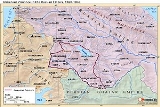
Russian Armenia

Encyclopedia
Russian Armenia is the period of Armenia's
history under Russian rule beginning from 1829, when Eastern Armenia
became part of the Russian Empire
to the declaration of the Democratic Republic of Armenia
in 1918. The term can also refer to the period during which Armenia was the Armenian SSR
under Russian domination.
, while the Ottomans and Persians were both Muslims
.
In 1678, the Armenian leadership secretly conducted a congress in Echmiadzin
, and decided that Armenia had to be liberated from foreign domination. At this stage, the Armenians were unable to fight against two empires at once, so they searched for help from abroad. Israel Ori
, an Armenian native of Karabagh, son of an Armenian melik
or prince, searched for help in many of the European capitals. Israel Ori died in 1711, without seeing the Armenian Dream realized.
In 1722, the Tsar of Russia
, Peter the Great, declared war against the Safavid Persians
. Georgians
and Karabagh's Armenians helped the Russians by rebelling against Safavid rule. David Bek
commanded the rebellion for six years, until David Bek died in the battlefield.
Kingdom of Kartli-Kakheti, giving them a foothold in Transcaucasia. Over the next three decades, Russia sought to expand its territory south of the Caucasus at the expense of the Ottomans and the Persians. The Russian campaigns found enthusiastic support amongst the Armenians, led by the Bishop of Tbilisi
, Nerses Ashtaraketsi, who took part in the fighting in person. The Russo-Persian War
of 1804 to 1813 saw the Russians conquer territory in eastern Armenia only to renounce most of it at the Treaty of Gulistan.
In 1827-1828, Tsar Nicholas I again declared war
against the Qajarid Persians, and sought help from Armenians, promising that after the war, their lives would improve. In 1828, with the Treaty of Turkmenchay
, Russia annexed Yerevan
, Nakhichevan
, and the surrounding countryside. Armenians still living under Persian rule were encouraged to emigrate to Russian Armenia and 30,000 followed the call. In 1828, the Russians declared war against the Ottoman Empire
. They quickly conquered Kars
, Akhalkalak
, Akhaltsikhe
, Bayazid
, Alashkert
, Erzerum, and reached Trabzon
. However, in the peace treaty of 1829
, Russians gave all of the newly captured Armenian territories back to the Ottoman Empire, keeping only Akhalkalak and Akhaltsikhe. There was another wave of immigration as 25,000 Ottoman Armenians moved to Russian Armenia. Tens of thousands of Muslims
also left for Persia
or the Ottoman Empire
, enabling Christians
to become the majority in eastern Armenia, where they made up only a small percentage of the population until then.
, had other plans. They wanted the Russian Empire to be a centralised, bureaucratic state and when Nerses complained he was soon sent to Bessarabia
, far away from the Caucasus region.
In 1836 a regulation, the Polozhenie (Statute) was enacted by the Russian government that greatly reduced the political powers of the Armenian religious leadership, including that of the Catholicos
, while preserving the autonomy of the Armenian Church. After 1836, in accordance with the new regulation, the Catholicos
of Echmiadzin
was to be elected in congresses in Echmiadzin, in which religious and non-religious dignitaries would participate. The Tsar
would have a last word in the choice of the Catholicos. Armenians greatly profited from the fact that the Catholicosate retained the authority to open schools. Notable ones are Moscow
's Lazarian Tiflis' Nersessian school
s. Moreover, the Catholicosate opened printing houses and encouraged the publication of Armenian newspapers.
. Armenian merchants conducted their trade across the world and many had set up base within Russia. In 1778, Catherine the Great invited Armenian merchants from the Crimea
to Russia and they established a settlement at Nor Nakhichevan
near Rostov-on-Don
. The Russian ruling classes welcomed the Armenians' entrepreneurial skills as a boost to the economy, but they also regarded them with some suspicion. The image of the Armenian as a "wily merchant" was already widespread. Russian nobles derived their income from their estates worked by serfs and, with their aristocratic distaste for engaging in business, they had little understanding or sympathy for the way of life of mercantile Armenians.
Nevertheless, middle-class Armenians prospered under Russian rule and they were the first to seize the new opportunities and transform themselves into a prosperous bourgeoisie
when capitalism
and industrialisation
came to Transcaucasia in the later half of the 19th century. The Armenians were much more skilled at adapting to the new economic circumstances than their neighbours in Transcaucasia, the Georgians and the Azeris
. They became the most powerful element in the municipal life of Tbilisi, the city regarded by Georgians as their capital, and in the late 19th century they began to buy up the lands of the Georgian nobility, who had gone into decline after the emancipation of their serfs. Armenian entrepreneurs were quick to exploit the oil boom which began in Transcaucasia in the 1870s, having large investments in the oil-fields in Baku
in Azerbaijan and the refineries of Batumi
on the Black Sea
coast. All this meant that the tensions between Armenians, Georgians and Azeris in Russian Transcaucasia were not simply ethnic or religious in nature but were due to social and economic factors too. Nevertheless, in spite of the popular image of the typical Armenian as a successful businessman, at the end of the 19th century 80 per cent of Russian Armenians were still peasants working the land.
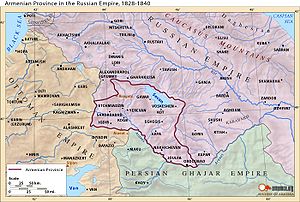 Relations between the Russian authorities and their new Armenian subjects did not begin smoothly. Since Armenia was on Russia's frontline against the rival empires of the Ottomans and Persians, it was initially treated as a military zone. Until 1840, Russian Armenia was a separate administrative unit, the Armenian Oblast
, but it was then merged into other Transcaucasian provinces with no regard to its national identity. Things improved when Nerses Ashtaraketsi was recalled from Bessarabia and made Catholicos of the Armenian Church in 1843. Moreover, Mikhail Vorontsov
, who ruled Russian Armenia as Viceroy of the Caucasus
between 1845 and 1854, was highly sympathetic to the Armenians.
As a consequence, by the mid-19th century, most of the Armenian intelligentsia
had become highly Russophile. Armenian culture flourished in these years as the new unified province under Russian rule gave Armenians a sense of their shared identity once more. Being part of the Russian Empire also turned Armenia away from the Middle East and towards Europe and modern intellectual currents such as the Enlightenment
and Romanticism
. A wide array of Armenian newspapers were published and there was a literary revival headed by Mikael Nalbandian
, who wanted to modernise the Armenian language
, and the poet and novelist Raffi
. The pro-Russian outlook of the Armenian intelligentsia continued under Tsar Alexander II, who was widely praised for his reforms.
under the Ottoman Empire
had grown increasingly discontented and looked towards Russia to free them from Turkish rule. In 1877, war broke out between the Russia and the Ottomans over the treatment of Christians in the Balkans
. The Russians were keen to mobilise Armenian patriotism when they advanced on a second front against the Turks in the Caucasus, and many of the commanders they employed were of Armenian descent. The Russians made large territorial gains in western Armenia before an armistice was called in January, 1878.
The Treaty of San Stefano
, signed in March, 1878, did not grant Russia the whole of western Armenia but it contained a special clause, Article 16, by which Russia guaranteed the rights of Armenians still under Ottoman rule against oppression. However, Russia's Great Power rivals, Great Britain
and Austria
, had been disturbed at the gains Russia had made at the expense of the Ottomans and pressed for a revision of the treaty. At the Congress of Berlin
, amongst other territories, Russia was forced to give up all its Armenian gains except the regions of Kars
and Ardahan
and Article 16 was replaced by the "meaningless" Article 61, which stated that reforms need only be carried out in the Ottoman Armenian provinces after the Russian army had withdrawn.
. The first sign of this was the new regime's dismissal of Alexander II's leading minister, the Armenian Count Loris-Melikov
. Loris-Melikov was viewed as too liberal but he was also labeled a "frenzied Asiatic" and "not a true Russian patriot". The Russian authorities also began to be suspicious of Armenian economic dominance in Transcaucasia. Ironically, such suspicions of the Armenians - who were among the most Russophile of the tsar's subjects - as an untrustworthy people prone to revolutionary conspiracy led the Russians to introduce policies which produced the very thing they were aimed at preventing, as Armenians turned more and more towards new nationalist movements.
Russification began in earnest in 1885, when the Viceroy of the Caucasus, Dondukov-Korsakov, ordered the closure of all Armenian parish schools and their replacement by Russian ones. Though the Armenian schools were reopened the following year, they were now subject to strict tsarist control and the use of the Armenian language was discouraged in favour of Russian. The Russians also began to persecute the Armenian Church, which had been separate from the Orthodox Church
since the year 451. The Russian attitude to the Ottoman Empire also changed and by the 1890s, Russia and Britain had exchanged roles. Now it was Russia who supported the status quo in western Armenia, with the British urging improvement in conditions for Christians in the region. The Russian authorities were disturbed by revolutionary Armenian nationalist movements within the Ottoman Empire and feared their links with eastern Armenians would increase subversion within Russian Transcaucasia too. The tsarist regime cracked down on any attempt by Russian Armenians to engage in action across the border, a leading example being the Gugunian Expedition
of 1890.
and Smyrna
. Tbilisi and Yerevan were much more obvious choices for a base for promoting revolutionary activity among Armenians in the eastern Ottoman Empire. The importance of the unity of the Armenia, divided between three empires, ensured that Armenian political movements would have little in common with other political movements in the Russian Empire.
The growth of Armenian nationalism
was given impetus by the Russian authorities' anti-Armenian measures of the 1880s. In 1889, Christapor Mikaelian
founded the "Young Armenia" movement in Tbilisi. Its aims were carrying out reprisals against Kurds believed to be guilty of persecuting Armenians in the Ottoman Empire, as well as smuggling arms and encouraging guerrilla action. They also established links with a new Ottoman Armenian nationalist party, the Hunchaks. In 1890, Mikaelian and his colleague Simon Zavarian
replaced Young Armenia with a new party: the Armenian Revolutionary Federation
, usually known as the "Dashnaks". The Dashnaks tried to get the Hunchaks to join them but the two split in 1891 and rivalry between the parties would be a major feature of subsequent Armenian nationalism. Both parties were socialist
in their economic programmes. The primary focus of the Dashnaks was nationalism, however, and their chief concern was the fate of the Ottoman Armenians. They soon had branches in Russia, Persia and Turkey and after the fragmentation of the Hunchaks in the mid-1890s, they became the dominant nationalist force in Russian Armenia.
's policy of Russification. Anti-Armenian feeling among the Georgians and Azeris of Transcaucasia was also on the rise, inflamed by the editor of the official newspaper Kavkaz ("Caucasus"), V.L. Velichko, who was an ardent Russian chauvinist.
as governor of Transcaucasia, and Armenian schools, cultural associations, newspapers and libraries were closed. Armenian nationalism as practised by the Dashnaks, with their penchant for revolutionary violence and socialist economic policies, had at first had little appeal for the Armenian bourgeoisie, but Russian cultural repression gained them more sympathy. Russified middle-class Armenians began changing their names back to their Armenian form (e.g. Mirzoev became Mirzoian) and engaged private tutors to teach their children the Armenian language.
The tsar's Russification programme reached its peak with the decree of June 12, 1903 ordering the confiscation of the properties of the Armenian Church. The Catholicos of Armenia begged the Russians to overturn the decree but when they refused he turned to the Dashnaks. The Armenian clergy had previously been very wary of the Dashnaks, condemning their socialism as anti-clerical
, but now they saw them as their protectors. The Dashnaks formed a Central Committee for Self-Defence in the Caucasus and organised a series of protests among Armenians. At Gandzak
the Russian army responded by firing into the crowd, killing ten, and further demonstrations were met with more bloodshed. The Dashnaks and Hunchaks began a campaign of assassinations against tsarist officials in Transcaucasia and they even succeeded in wounding Prince Golitsin. In 1904, the Dashnak congress specifically extended their programme to look after the rights of Armenians within the Russian Empire as well as Ottoman Turkey.
put into trial. The entire Armenian intelligentsia, including writers, physicians, lawyers, bankers, and even merchants" on trial. When the tribune finished its work, 64 charges were dropped and the rest were either imprisoned or exiled for varying periods.
 The years between the 1905 Revolution and World War I
saw a rapprochement between most Armenians and the Russian authorities. Russia became concerned when her enemy Germany
began drawing closer to the Ottoman Empire
, which led the Russians to take a renewed interest in the welfare of the Ottoman Armenians.
When World War I
broke out in August 1914, the Russians sought to mobilise Armenian patriotic sentiment. Most Armenian troops were transferred to the European theatre of World War I
(known as the Eastern Front
). The Ottoman Empire did not join the world war until several months had passed and, as the possibility of a Caucasus Campaign
come closer, in the summer of 1914, Count Illarion Ivanovich Vorontsov-Dashkov consulted with the Mayor of Tbilisi Alexandre Khatsian, the primate of Tbilisi, Bishop Mesrop, and the prominent civic leader Dr. Hakob Zavriev
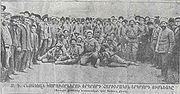
about the creation of Armenian volunteer detachments
. The volunteer units would be made up from Armenians who were not subjects of the empire or not obliged to serve in the army. These units would be employed on the Caucasus Campaign. Many of them were living in the Caucasus and many were impatient to take up arms to liberate their homeland. During the course of the war 150,000 Armenians fought in the Russian Army.
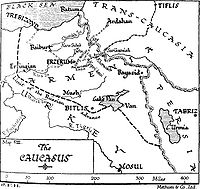 But the rapid Russian advance on the Caucasus Campaign, as early as April 1915 after the Siege of Van
, prompted the Ottoman authorities to embark on the genocide of their Armenian subjects
. An Armenia
n provisional government
within the autonomous region was initially set up around Lake Van
. The Armenian government in the war zone was briefly referred to as "Free Vaspurakan", and after an Ottoman advance in June 1915 it was reestablished as "Administration for Western Armenia
". With the Ottoman advance in June 1915 250,000 Armenians from Van and the neighbouring region of Alashkerd
retreated to the Russian frontier. Russian Transcaucasia was flooded with refugees from the massacres.
While it scored military successes against the Turks, the Russian war machine began to disintegrate on its front against Germany and in February 1917
the tsarist regime was overthrown by a revolution in Saint Petersburg.
Russian Armenians greeted the new government with enthusiasm, hoping it would secure Ottoman Armenia for them. The issue of the continuation of the war was a highly contentious one amongst the political parties of the new Russia, with most favouring a "democratic peace"; but since the provinces of Ottoman Armenia were under Russian military occupation at the time of the revolution, the Armenians believed that the government would agree to defend them. To help out, the Provisional Government began replacing Russian troops, whose commitment to continued fighting was in doubt, with Armenian ones on the Caucasian front. But as 1917 went on the Provisional Government lost support among Russian soldiers and workers and much of the army melted away from Transcaucasia.
of October, 1917 forced the issue of independence for the peoples of Transcaucasia, since the Bolsheviks enjoyed little support in the region. In February, 1918, the Armenians, Georgians and Azeris formed their own Transcaucasian parliament. Armenians united under Armenian Congress of Eastern Armenians
. On April 22, 1918 it voted for independence, declaring itself to be the Democratic Federative Republic of Transcaucasia
. The federation dissolved when Georgia declared its independence on May 26. Armenian Congress of Eastern Armenians followed on May 28.
The Armenian Congress of Eastern Armenians
devised policies to direct the war efforts and the relief and repatriation of refugees. The council passed a law to organise the defense of the Caucasus against the Ottoman Empire using the vast quantity of supplies and ammunition left over from the departure of the Russian army. The congress specifically devised a local control and administrative structure for Transcaucasia. Even if the Congress did not devise specific solutions for the soldiers left in Baku, Tbilisi, Kars, and other militias under the Administration for Western Armenia
under the civil governor Hakob Zavriev
, they did not resist the ongoing reality of these soldiers serving for the other forces. The Congress also selected a fifteen member permanent executive committee, known as the "Armenian National Council", whose leader was Avetis Aharonyan. This committee’s first task was to set the stage for the declaration of the "Democratic Republic of Armenia
".
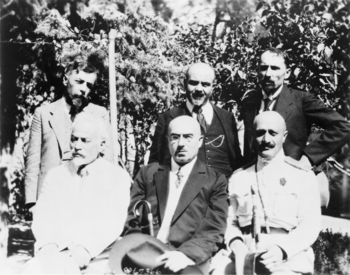 The major problem confronting the new state was the advancing Ottoman army, which by now had recaptured much of western Armenia, but the interests of the three peoples were very different. For obvious reasons, defence against the invading army was of paramount importance to the Armenians, while the Muslim Azeris were sympathetic to the Turks. The Georgians felt that their interests could best be guaranteed by coming to a deal with the Germans rather than the Turks and on May 26, 1918, at German prompting, Georgia declared its independence from the Transcaucasian Republic. This move was followed two days later by Azerbaijan. Reluctantly, the Dashnak leaders, who were the most powerful Armenian politicians in the region, declared the formation of a new independent state, the Democratic Republic of Armenia
on May 28, 1918.
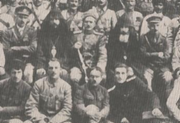
The Treaty of Batum
was signed between the Democratic Republic of Armenia
and the Ottoman Empire
after the last battles of the Caucasus Campaign
. The Ottoman Empire
initially gained a considerable portion of the South Caucasus with the Treaty of Brest-Litovsk
signed with the Russian SFSR and then following Treaty of Batum
with Armenia. Andranik Toros Ozanian
rejected these new borders and proclaimed the new state, where his activities were concentrated at the link between the Ottoman Empire to the Azerbaijan Democratic Republic
at Karabakh
, Zanghezur
and Nakhichevan
. In January 1919, with Armenian troops advancing, the British forces (Lionel Dunsterville
) ordered Andranik back to Zangezur, and gave him assurances that this conflict could be solved with the Paris Peace Conference of 1919
. The Paris Peace Conference proclaimed the Democratic Republic of Armenia
an internationally recognized state and Republic of Mountainous Armenia dissolved.
was a British-backed anti-Soviet government founded in Baku on August 1, 1918. The government was composed by the Socialist-Revolutionary Party and the Armenian national movement
which majority was from Armenian Revolutionary Federation
(Dashnaks). British force the Dunsterforce
occupied the city and helped the mainly Dashnak-Armenian forces to defend the capital during the Battle of Baku
. However, Baku fell on September 15, 1918 and an Azeri-Ottoman army entered the capital, causing British forces and much of the Armenian population to flee. The Ottoman Empire signed the Armistice of Mudros
on November 30, 1918 and the British occupational force re-entered Baku.
Armenia
Armenia , officially the Republic of Armenia , is a landlocked mountainous country in the Caucasus region of Eurasia...
history under Russian rule beginning from 1829, when Eastern Armenia
Eastern Armenia
Eastern Armenia or Caucasian Armenia was the portion of Ottoman Armenia and Persian Armenia that was ceded to the Russian Empire following the Russo-Turkish War, 1828-1829...
became part of the Russian Empire
Russia
Russia or , officially known as both Russia and the Russian Federation , is a country in northern Eurasia. It is a federal semi-presidential republic, comprising 83 federal subjects...
to the declaration of the Democratic Republic of Armenia
Democratic Republic of Armenia
The Democratic Republic of Armenia was the first modern establishment of an Armenian state...
in 1918. The term can also refer to the period during which Armenia was the Armenian SSR
Armenian SSR
The Armenian Soviet Socialist Republic The Armenian Soviet Socialist Republic The Armenian Soviet Socialist Republic The Armenian Soviet Socialist Republic The Armenian Soviet Socialist Republic The Armenian Soviet Socialist Republic The Armenian Soviet Socialist Republic The Armenian Soviet...
under Russian domination.
Background
For hundreds of years, the inhabitants of Eastern Armenia lived under Ottoman or Safavid rule. Subsequent wars between the Ottoman and Safavid empires led to the destruction of many of the Armenian towns, and made Armenian life difficult. Added to this, the Armenians were ChristianChristianity
Christianity is a monotheistic religion based on the life and teachings of Jesus as presented in canonical gospels and other New Testament writings...
, while the Ottomans and Persians were both Muslims
Islam
Islam . The most common are and . : Arabic pronunciation varies regionally. The first vowel ranges from ~~. The second vowel ranges from ~~~...
.
In 1678, the Armenian leadership secretly conducted a congress in Echmiadzin
Echmiadzin
Mother Cathedral of Holy Etchmiadzin is a 4th century Armenian church in the town of Ejmiatsin, Armenia. It is also the central cathedral of the Mother See of Holy Etchmiadzin of the Armenian Apostolic Church....
, and decided that Armenia had to be liberated from foreign domination. At this stage, the Armenians were unable to fight against two empires at once, so they searched for help from abroad. Israel Ori
Israel Ori
Israel Ori was a prominent figure of the Armenian national liberation movement and a diplomat that sought the liberation of Armenia from Persia and the Ottoman Empire.-Early life:...
, an Armenian native of Karabagh, son of an Armenian melik
Melik
Мelik , from malik ) was a hereditary Armenian noble title, in various Eastern Armenian principalities known as melikdoms encompassing modern Yerevan, Kars, Nakhchivan, Sevan, Lori, Artsakh, Tabriz and Syunik starting from the Late Middle Ages until the end of the nineteenth century...
or prince, searched for help in many of the European capitals. Israel Ori died in 1711, without seeing the Armenian Dream realized.
In 1722, the Tsar of Russia
Russia
Russia or , officially known as both Russia and the Russian Federation , is a country in northern Eurasia. It is a federal semi-presidential republic, comprising 83 federal subjects...
, Peter the Great, declared war against the Safavid Persians
Russo-Persian War, 1722-1723
Russo-Persian War, 1722-1723, known in Russian historiography as the Persian campaign of Peter the Great, was a war between Russia and Persia , triggered by the tsar's attempt to expand Russian influence in the Caspian and South Caucasus regions and to prevent its rival, Ottoman Turkey, from...
. Georgians
Georgians
The Georgians are an ethnic group that have originated in Georgia, where they constitute a majority of the population. Large Georgian communities are also present throughout Russia, European Union, United States, and South America....
and Karabagh's Armenians helped the Russians by rebelling against Safavid rule. David Bek
David Bek
David Bek was an Armenian military commander and one of the most prominent military figures of the Armenian liberation movement of the 18th century against the forces of Safavid Iran and the Ottoman Empire...
commanded the rebellion for six years, until David Bek died in the battlefield.
The Russian annexations
A turning-point came in 1801 when the Russians annexed the GeorgianGeorgia (country)
Georgia is a sovereign state in the Caucasus region of Eurasia. Located at the crossroads of Western Asia and Eastern Europe, it is bounded to the west by the Black Sea, to the north by Russia, to the southwest by Turkey, to the south by Armenia, and to the southeast by Azerbaijan. The capital of...
Kingdom of Kartli-Kakheti, giving them a foothold in Transcaucasia. Over the next three decades, Russia sought to expand its territory south of the Caucasus at the expense of the Ottomans and the Persians. The Russian campaigns found enthusiastic support amongst the Armenians, led by the Bishop of Tbilisi
Tbilisi
Tbilisi is the capital and the largest city of Georgia, lying on the banks of the Mt'k'vari River. The name is derived from an early Georgian form T'pilisi and it was officially known as Tiflis until 1936...
, Nerses Ashtaraketsi, who took part in the fighting in person. The Russo-Persian War
Russo-Persian War (1804-1813)
The 1804-1813 Russo-Persian War, one of the many wars between the Persian Empire and Imperial Russia, began like many wars as a territorial dispute. The Persian king, Fath Ali Shah Qajar, wanted to consolidate the northernmost reaches of his Qajar dynasty by securing land near the Caspian Sea's...
of 1804 to 1813 saw the Russians conquer territory in eastern Armenia only to renounce most of it at the Treaty of Gulistan.
In 1827-1828, Tsar Nicholas I again declared war
Russo-Persian War, 1826-1828
The Russo-Persian War of 1826-1828 was the last major military conflict between the Russian Empire and the Persian Empire.After the Treaty of Gulistan concluded the previous Russo-Persian War in 1813, peace reigned in the Caucasus for thirteen years...
against the Qajarid Persians, and sought help from Armenians, promising that after the war, their lives would improve. In 1828, with the Treaty of Turkmenchay
Treaty of Turkmenchay
The Treaty of Turkmenchay was a treaty negotiated in Turkmenchay by which the Qajar Empire recognized Russian suzerainty over the Erivan khanate, the Nakhchivan khanate, and the remainder of the Talysh khanate, establishing the Aras River as the common boundary between the empires, after its...
, Russia annexed Yerevan
Yerevan
Yerevan is the capital and largest city of Armenia and one of the world's oldest continuously-inhabited cities. Situated along the Hrazdan River, Yerevan is the administrative, cultural, and industrial center of the country...
, Nakhichevan
Nakhichevan
The Nakhchivan Autonomous Republic is a landlocked exclave of Azerbaijan. The region covers 5,363 km² and borders Armenia to the east and north, Iran to the south and west, and Turkey to the northwest...
, and the surrounding countryside. Armenians still living under Persian rule were encouraged to emigrate to Russian Armenia and 30,000 followed the call. In 1828, the Russians declared war against the Ottoman Empire
Russo-Turkish War, 1828-1829
The Russo–Turkish War of 1828–1829 was sparked by the Greek War of Independence. The war broke out after the Sultan, incensed by the Russian participation in the Battle of Navarino, closed the Dardanelles for Russian ships and revoked the Akkerman Convention....
. They quickly conquered Kars
Kars
Kars is a city in northeast Turkey and the capital of Kars Province. The population of the city is 73,826 as of 2010.-Etymology:As Chorzene, the town appears in Roman historiography as part of ancient Armenia...
, Akhalkalak
Akhalkalaki
Akhalkalaki is a small city in Georgia's southern region of Samtskhe-Javakheti with a population of 60,975. Akhalkalaki lies on the edge of the Javakheti Volcanic Plateau. The city is located about 30 km from the border with Turkey. 90 percent of the city's population are ethnic Armenians...
, Akhaltsikhe
Akhaltsikhe
Akhaltsikhe is a small city in Georgia's southwestern region of Samtskhe-Javakheti. It is situated on the both banks of a small river Potskhovi, which separates the city to the old city in the north and new in the south. The name of the city translates from Georgian as "new fortress".- History...
, Bayazid
Dogubeyazit
Doğubeyazıt is a city and district of Ağrı Province of Turkey, and is Turkey's most eastern district, the border crossing to Iran. Elevation 1625 m. Area 2.383 km². Population 115.354 of which 69.447 live in the town of Doğubeyazıt, the remainder in the surrounding countryside...
, Alashkert
Eleskirt
Eleşkirt, formerly Alashkert or Kurdish Zêdikan , is a town and district of Ağrı Province in Turkey.The mayor is Mehmet Nuri Çelik .-Places to see:...
, Erzerum, and reached Trabzon
Trabzon
Trabzon is a city on the Black Sea coast of north-eastern Turkey and the capital of Trabzon Province. Trabzon, located on the historical Silk Road, became a melting pot of religions, languages and culture for centuries and a trade gateway to Iran in the southeast and the Caucasus to the northeast...
. However, in the peace treaty of 1829
Treaty of Adrianople
The Peace Treaty of Adrianople concluded the Russo-Turkish War, 1828-1829 between Russia and the Ottoman Empire. It was signed on September 14, 1829 in Adrianople by Russia's Count Alexey Fyodorovich Orlov and by Turkey's Abdul Kadyr-bey...
, Russians gave all of the newly captured Armenian territories back to the Ottoman Empire, keeping only Akhalkalak and Akhaltsikhe. There was another wave of immigration as 25,000 Ottoman Armenians moved to Russian Armenia. Tens of thousands of Muslims
Islam
Islam . The most common are and . : Arabic pronunciation varies regionally. The first vowel ranges from ~~. The second vowel ranges from ~~~...
also left for Persia
Qajar dynasty
The Qajar dynasty was an Iranian royal family of Turkic descent who ruled Persia from 1785 to 1925....
or the Ottoman Empire
Ottoman Empire
The Ottoman EmpireIt was usually referred to as the "Ottoman Empire", the "Turkish Empire", the "Ottoman Caliphate" or more commonly "Turkey" by its contemporaries...
, enabling Christians
Christianity
Christianity is a monotheistic religion based on the life and teachings of Jesus as presented in canonical gospels and other New Testament writings...
to become the majority in eastern Armenia, where they made up only a small percentage of the population until then.
Establishment of Russian rule
Armenian patriots such as Bishop Nerses had hoped for an autonomous Armenia within the Russian Empire, but they were to be severely disappointed by the new regime. Tsar Nicholas and his governor in Transcaucasia, Ivan PaskevichIvan Paskevich
Ivan Fyodorovich Paskevich was a Ukrainian-born military leader. For his victories, he was made Count of Erivan in 1828 and Namestnik of the Kingdom of Poland in 1831...
, had other plans. They wanted the Russian Empire to be a centralised, bureaucratic state and when Nerses complained he was soon sent to Bessarabia
Bessarabia
Bessarabia is a historical term for the geographic region in Eastern Europe bounded by the Dniester River on the east and the Prut River on the west....
, far away from the Caucasus region.
In 1836 a regulation, the Polozhenie (Statute) was enacted by the Russian government that greatly reduced the political powers of the Armenian religious leadership, including that of the Catholicos
Catholicos
Catholicos, plural Catholicoi, is a title used for the head of certain churches in some Eastern Christian traditions. The title implies autocephaly and in some cases is borne by the designated head of an autonomous church, in which case the holder might have other titles such as Patriarch...
, while preserving the autonomy of the Armenian Church. After 1836, in accordance with the new regulation, the Catholicos
Catholicos
Catholicos, plural Catholicoi, is a title used for the head of certain churches in some Eastern Christian traditions. The title implies autocephaly and in some cases is borne by the designated head of an autonomous church, in which case the holder might have other titles such as Patriarch...
of Echmiadzin
Echmiadzin
Mother Cathedral of Holy Etchmiadzin is a 4th century Armenian church in the town of Ejmiatsin, Armenia. It is also the central cathedral of the Mother See of Holy Etchmiadzin of the Armenian Apostolic Church....
was to be elected in congresses in Echmiadzin, in which religious and non-religious dignitaries would participate. The Tsar
Tsar
Tsar is a title used to designate certain European Slavic monarchs or supreme rulers. As a system of government in the Tsardom of Russia and Russian Empire, it is known as Tsarist autocracy, or Tsarism...
would have a last word in the choice of the Catholicos. Armenians greatly profited from the fact that the Catholicosate retained the authority to open schools. Notable ones are Moscow
Moscow
Moscow is the capital, the most populous city, and the most populous federal subject of Russia. The city is a major political, economic, cultural, scientific, religious, financial, educational, and transportation centre of Russia and the continent...
's Lazarian Tiflis' Nersessian school
Nersisyan School
Nersisyan School was an Armenian school in Tiflis, Russian Empire . Nersisyan School existed exactly one century, from 1824 to 1924. It was founded by Nerses Ashtaraketsi.- History :...
s. Moreover, the Catholicosate opened printing houses and encouraged the publication of Armenian newspapers.
Armenians within the Russian Empire
A significant number of Armenians were already living in the Russian Empire before the 1820s. After the destruction of the last remaining independent Armenian states in the Middle Ages, the nobility disintegrated, leaving Armenian society composed of a mass of peasants plus a middle class who were either craftsmen or merchants. Such Armenians were to be found in most towns of Transcaucasia; indeed, at the beginning of the 19th century they formed the majority of the population in cities such as TbilisiTbilisi
Tbilisi is the capital and the largest city of Georgia, lying on the banks of the Mt'k'vari River. The name is derived from an early Georgian form T'pilisi and it was officially known as Tiflis until 1936...
. Armenian merchants conducted their trade across the world and many had set up base within Russia. In 1778, Catherine the Great invited Armenian merchants from the Crimea
Crimea
Crimea , or the Autonomous Republic of Crimea , is a sub-national unit, an autonomous republic, of Ukraine. It is located on the northern coast of the Black Sea, occupying a peninsula of the same name...
to Russia and they established a settlement at Nor Nakhichevan
Nor Nakhichevan
Nakhichevan-on-Don , also known as Nor Nakhichevan is an Armenian-populated region in the city of Rostov-on-Don, Russia. In 1778, Catherine the Great invited Armenian merchants from the Crimea to Russia...
near Rostov-on-Don
Rostov-on-Don
-History:The mouth of the Don River has been of great commercial and cultural importance since the ancient times. It was the site of the Greek colony Tanais, of the Genoese fort Tana, and of the Turkish fortress Azak...
. The Russian ruling classes welcomed the Armenians' entrepreneurial skills as a boost to the economy, but they also regarded them with some suspicion. The image of the Armenian as a "wily merchant" was already widespread. Russian nobles derived their income from their estates worked by serfs and, with their aristocratic distaste for engaging in business, they had little understanding or sympathy for the way of life of mercantile Armenians.
Nevertheless, middle-class Armenians prospered under Russian rule and they were the first to seize the new opportunities and transform themselves into a prosperous bourgeoisie
Bourgeoisie
In sociology and political science, bourgeoisie describes a range of groups across history. In the Western world, between the late 18th century and the present day, the bourgeoisie is a social class "characterized by their ownership of capital and their related culture." A member of the...
when capitalism
Capitalism
Capitalism is an economic system that became dominant in the Western world following the demise of feudalism. There is no consensus on the precise definition nor on how the term should be used as a historical category...
and industrialisation
Industrialisation
Industrialization is the process of social and economic change that transforms a human group from an agrarian society into an industrial one...
came to Transcaucasia in the later half of the 19th century. The Armenians were much more skilled at adapting to the new economic circumstances than their neighbours in Transcaucasia, the Georgians and the Azeris
Azerbaijan
Azerbaijan , officially the Republic of Azerbaijan is the largest country in the Caucasus region of Eurasia. Located at the crossroads of Western Asia and Eastern Europe, it is bounded by the Caspian Sea to the east, Russia to the north, Georgia to the northwest, Armenia to the west, and Iran to...
. They became the most powerful element in the municipal life of Tbilisi, the city regarded by Georgians as their capital, and in the late 19th century they began to buy up the lands of the Georgian nobility, who had gone into decline after the emancipation of their serfs. Armenian entrepreneurs were quick to exploit the oil boom which began in Transcaucasia in the 1870s, having large investments in the oil-fields in Baku
Baku
Baku , sometimes spelled as Baki or Bakou, is the capital and largest city of Azerbaijan, as well as the largest city on the Caspian Sea and of the Caucasus region. It is located on the southern shore of the Absheron Peninsula, which projects into the Caspian Sea. The city consists of two principal...
in Azerbaijan and the refineries of Batumi
Batumi
Batumi is a seaside city on the Black Sea coast and capital of Adjara, an autonomous republic in southwest Georgia. Sometimes considered Georgia's second capital, with a population of 121,806 , Batumi serves as an important port and a commercial center. It is situated in a subtropical zone, rich in...
on the Black Sea
Black Sea
The Black Sea is bounded by Europe, Anatolia and the Caucasus and is ultimately connected to the Atlantic Ocean via the Mediterranean and the Aegean seas and various straits. The Bosphorus strait connects it to the Sea of Marmara, and the strait of the Dardanelles connects that sea to the Aegean...
coast. All this meant that the tensions between Armenians, Georgians and Azeris in Russian Transcaucasia were not simply ethnic or religious in nature but were due to social and economic factors too. Nevertheless, in spite of the popular image of the typical Armenian as a successful businessman, at the end of the 19th century 80 per cent of Russian Armenians were still peasants working the land.
Russian rule until 1877
Armenian Oblast
The Armenian Oblast or Armenian Province ) was an oblast of the Russian Empire that existed from 1828 to 1840. It roughly corresponded to most of present-day central Armenia, the Iğdır Province of present-day Turkey, and present-day Azerbaijan's Nakhchivan exclave...
, but it was then merged into other Transcaucasian provinces with no regard to its national identity. Things improved when Nerses Ashtaraketsi was recalled from Bessarabia and made Catholicos of the Armenian Church in 1843. Moreover, Mikhail Vorontsov
Mikhail Vorontsov
Mikhail Vorontsov may refer to:*Mikhail Semyonovich Vorontsov , Russian prince, field-marshal, statesman*Mikhail Illarionovich Vorontsov , Russian count, statesman, diplomat...
, who ruled Russian Armenia as Viceroy of the Caucasus
Viceroyalty of the Caucasus
The Viceroyalty of the Caucasus is a term used to denote the Imperial Russian administrative and political authority in the Caucasus region exercised through the offices of glavnoupravlyayushchiy and namestnik...
between 1845 and 1854, was highly sympathetic to the Armenians.
As a consequence, by the mid-19th century, most of the Armenian intelligentsia
Intelligentsia
The intelligentsia is a social class of people engaged in complex, mental and creative labor directed to the development and dissemination of culture, encompassing intellectuals and social groups close to them...
had become highly Russophile. Armenian culture flourished in these years as the new unified province under Russian rule gave Armenians a sense of their shared identity once more. Being part of the Russian Empire also turned Armenia away from the Middle East and towards Europe and modern intellectual currents such as the Enlightenment
Age of Enlightenment
The Age of Enlightenment was an elite cultural movement of intellectuals in 18th century Europe that sought to mobilize the power of reason in order to reform society and advance knowledge. It promoted intellectual interchange and opposed intolerance and abuses in church and state...
and Romanticism
Romanticism
Romanticism was an artistic, literary and intellectual movement that originated in the second half of the 18th century in Europe, and gained strength in reaction to the Industrial Revolution...
. A wide array of Armenian newspapers were published and there was a literary revival headed by Mikael Nalbandian
Mikael Nalbandian
Mikael Nalbandian was an Armenian writer who dominated 19th century Armenian literature, author of the Armenian national anthem text.-Biography:...
, who wanted to modernise the Armenian language
Armenian language
The Armenian language is an Indo-European language spoken by the Armenian people. It is the official language of the Republic of Armenia as well as in the region of Nagorno-Karabakh. The language is also widely spoken by Armenian communities in the Armenian diaspora...
, and the poet and novelist Raffi
Raffi (poet)
Hakob Melik Hakobian , better known by his pen name Raffi , is a renowned Armenian author born in 1835 in Payajouk, an Armenian village situated in the Salmas province in Persia. He died in 1888 in Tiflis...
. The pro-Russian outlook of the Armenian intelligentsia continued under Tsar Alexander II, who was widely praised for his reforms.
The Russo-Turkish War
The Russo-Turkish War of 1877-78 marked a watershed in the relationship between the Russian authorities and their Armenian subjects. Armenians still living in western ArmeniaWestern Armenia
Western Armenia is a term, primarily used by Armenians, to refer to Armenian-inhabited areas of the Armenian Highland that were part of the Ottoman Empire and now are part of the Republic of Turkey....
under the Ottoman Empire
Ottoman Empire
The Ottoman EmpireIt was usually referred to as the "Ottoman Empire", the "Turkish Empire", the "Ottoman Caliphate" or more commonly "Turkey" by its contemporaries...
had grown increasingly discontented and looked towards Russia to free them from Turkish rule. In 1877, war broke out between the Russia and the Ottomans over the treatment of Christians in the Balkans
Balkans
The Balkans is a geopolitical and cultural region of southeastern Europe...
. The Russians were keen to mobilise Armenian patriotism when they advanced on a second front against the Turks in the Caucasus, and many of the commanders they employed were of Armenian descent. The Russians made large territorial gains in western Armenia before an armistice was called in January, 1878.
The Treaty of San Stefano
Treaty of San Stefano
The Preliminary Treaty of San Stefano was a treaty between Russia and the Ottoman Empire signed at the end of the Russo-Turkish War, 1877–78...
, signed in March, 1878, did not grant Russia the whole of western Armenia but it contained a special clause, Article 16, by which Russia guaranteed the rights of Armenians still under Ottoman rule against oppression. However, Russia's Great Power rivals, Great Britain
Great Britain
Great Britain or Britain is an island situated to the northwest of Continental Europe. It is the ninth largest island in the world, and the largest European island, as well as the largest of the British Isles...
and Austria
Austria
Austria , officially the Republic of Austria , is a landlocked country of roughly 8.4 million people in Central Europe. It is bordered by the Czech Republic and Germany to the north, Slovakia and Hungary to the east, Slovenia and Italy to the south, and Switzerland and Liechtenstein to the...
, had been disturbed at the gains Russia had made at the expense of the Ottomans and pressed for a revision of the treaty. At the Congress of Berlin
Congress of Berlin
The Congress of Berlin was a meeting of the European Great Powers' and the Ottoman Empire's leading statesmen in Berlin in 1878. In the wake of the Russo-Turkish War of 1877–78, the meeting's aim was to reorganize the countries of the Balkans...
, amongst other territories, Russia was forced to give up all its Armenian gains except the regions of Kars
Kars Oblast
Kars Oblast was one of Transcaucasian governorates of Russian Empire between 1878 and 1917. Its capital was in the city of Kars, presently in the Republic of Turkey. The governorate bordered with the Ottoman Empire, Batum Oblast, Tiflis Governorate, Erivan Governorate, and from 1883 to 1903 with...
and Ardahan
Ardahan
Ardahan is a city in northeastern Turkey, near the Georgian border.-Ancient and medieval:In Ancient times the region was called Gogarene, which is assumed to derive from the name of Gugars, who were a Proto-Kartvelian tribe...
and Article 16 was replaced by the "meaningless" Article 61, which stated that reforms need only be carried out in the Ottoman Armenian provinces after the Russian army had withdrawn.
The reign of Alexander III, 1881 - 1894
After the assassination of the reform-minded Tsar Alexander II in 1881, the attitude of the Russian authorities towards the national minorities of the empire changed dramatically. The new tsar, Alexander III, was ultra-conservative in outlook and wanted to create a highly centralised, autocratic state. He viewed any expression of a desire for increased freedom and autonomy by his subjects as evidence of rebellion.Russification
The last decades of the 19th century also saw a rise in Russian chauvinism with non-Russians described in increasingly racist terms. Armenians came in for particular abuse in ways which often resembled anti-SemitismAnti-Semitism
Antisemitism is suspicion of, hatred toward, or discrimination against Jews for reasons connected to their Jewish heritage. According to a 2005 U.S...
. The first sign of this was the new regime's dismissal of Alexander II's leading minister, the Armenian Count Loris-Melikov
Mikhail Tarielovich Loris-Melikov
Count Mikhail Tarielovich Loris-Melikov was a Russian-Armenian statesman, General of the Cavalry, and Adjutant General of H. I. M. Retinue....
. Loris-Melikov was viewed as too liberal but he was also labeled a "frenzied Asiatic" and "not a true Russian patriot". The Russian authorities also began to be suspicious of Armenian economic dominance in Transcaucasia. Ironically, such suspicions of the Armenians - who were among the most Russophile of the tsar's subjects - as an untrustworthy people prone to revolutionary conspiracy led the Russians to introduce policies which produced the very thing they were aimed at preventing, as Armenians turned more and more towards new nationalist movements.
Russification began in earnest in 1885, when the Viceroy of the Caucasus, Dondukov-Korsakov, ordered the closure of all Armenian parish schools and their replacement by Russian ones. Though the Armenian schools were reopened the following year, they were now subject to strict tsarist control and the use of the Armenian language was discouraged in favour of Russian. The Russians also began to persecute the Armenian Church, which had been separate from the Orthodox Church
Orthodox Christianity
The term Orthodox Christianity may refer to:* the Eastern Orthodox Church and its various geographical subdivisions...
since the year 451. The Russian attitude to the Ottoman Empire also changed and by the 1890s, Russia and Britain had exchanged roles. Now it was Russia who supported the status quo in western Armenia, with the British urging improvement in conditions for Christians in the region. The Russian authorities were disturbed by revolutionary Armenian nationalist movements within the Ottoman Empire and feared their links with eastern Armenians would increase subversion within Russian Transcaucasia too. The tsarist regime cracked down on any attempt by Russian Armenians to engage in action across the border, a leading example being the Gugunian Expedition
Gugunian Expedition
The Gugunian Expedition was an attempt by a small group of Armenian nationalists from the Russian Empire to launch an armed expedition across the border into the Ottoman Empire in 1890 in support of local Armenians.- Background :...
of 1890.
The growth of Armenian nationalism
Armenians played little role in the revolutionary movements of the Russian Empire until the 1880s. Until that point, the ideas of Grigor Artsruni, the editor of the Tbilisi-based newspaper Mshak ("The Cultivator"), enjoyed great popularity among the Armenian intelligentsia. Artsruni believed that life under the Russian Empire represented the "lesser evil" for his people. Russian Armenians were deeply concerned about the plight of their compatriots under the Persian and Ottoman Empires, especially the peasants of western Armenia who were mostly ignored by Ottoman Armenian intellectuals far away in IstanbulIstanbul
Istanbul , historically known as Byzantium and Constantinople , is the largest city of Turkey. Istanbul metropolitan province had 13.26 million people living in it as of December, 2010, which is 18% of Turkey's population and the 3rd largest metropolitan area in Europe after London and...
and Smyrna
Smyrna
Smyrna was an ancient city located at a central and strategic point on the Aegean coast of Anatolia. Thanks to its advantageous port conditions, its ease of defence and its good inland connections, Smyrna rose to prominence. The ancient city is located at two sites within modern İzmir, Turkey...
. Tbilisi and Yerevan were much more obvious choices for a base for promoting revolutionary activity among Armenians in the eastern Ottoman Empire. The importance of the unity of the Armenia, divided between three empires, ensured that Armenian political movements would have little in common with other political movements in the Russian Empire.
The growth of Armenian nationalism
Armenian nationalism
Armenian nationalism in the modern period has its roots in the romantic nationalism of Mikayel Chamchian and generally defined as the creation of a free, independent and united Armenia formulated as the Armenian Cause . Armenian national awakening developed in the 1880s in the context of the...
was given impetus by the Russian authorities' anti-Armenian measures of the 1880s. In 1889, Christapor Mikaelian
Christapor Mikaelian
Christapor Mikaelian also known by his noms de guerre Hellen , Topal , and Edward , was one of the three founders of the Armenian Revolutionary Federation along Stepan Zorian and Simon Zavarian, also part of Armenian national liberation movement.- Early life :Christapor Mikaelian was born in the...
founded the "Young Armenia" movement in Tbilisi. Its aims were carrying out reprisals against Kurds believed to be guilty of persecuting Armenians in the Ottoman Empire, as well as smuggling arms and encouraging guerrilla action. They also established links with a new Ottoman Armenian nationalist party, the Hunchaks. In 1890, Mikaelian and his colleague Simon Zavarian
Simon Zavarian
250px|thumb|Simon ZavarianSimon Zavarian, also known by his nom de guerre Anton , was one of the three founders of the Armenian Revolutionary Federation and part of Armenian national liberation movement, along Kristapor Mikaelian and Stepan Zorian.- Role in the founding of the ARF :Simon Zavarian...
replaced Young Armenia with a new party: the Armenian Revolutionary Federation
Armenian Revolutionary Federation
The Armenian Revolutionary Federation is an Armenian political party founded in Tiflis in 1890 by Christapor Mikaelian, Stepan Zorian, and Simon Zavarian...
, usually known as the "Dashnaks". The Dashnaks tried to get the Hunchaks to join them but the two split in 1891 and rivalry between the parties would be a major feature of subsequent Armenian nationalism. Both parties were socialist
Socialism
Socialism is an economic system characterized by social ownership of the means of production and cooperative management of the economy; or a political philosophy advocating such a system. "Social ownership" may refer to any one of, or a combination of, the following: cooperative enterprises,...
in their economic programmes. The primary focus of the Dashnaks was nationalism, however, and their chief concern was the fate of the Ottoman Armenians. They soon had branches in Russia, Persia and Turkey and after the fragmentation of the Hunchaks in the mid-1890s, they became the dominant nationalist force in Russian Armenia.
The reign of Nicholas II 1894–1917
Tsar Nicholas II, who came to the throne in 1894, continued his fatherAlexander III of Russia
Alexander Alexandrovich Romanov , historically remembered as Alexander III or Alexander the Peacemaker reigned as Emperor of Russia from until his death on .-Disposition:...
's policy of Russification. Anti-Armenian feeling among the Georgians and Azeris of Transcaucasia was also on the rise, inflamed by the editor of the official newspaper Kavkaz ("Caucasus"), V.L. Velichko, who was an ardent Russian chauvinist.
Edict on Armenian church property 1903 - 1904
In 1897, Tsar Nicholas appointed the Armenophobic Grigory Sergeyevich GolitsinGrigory Sergeyevich Golitsin
Prince Grigory Sergeyevich Golitsin was a Russian general and statesman.Grigory Golitsin fought in Caucasian War, studied at General Staff Academy, commanded regiments...
as governor of Transcaucasia, and Armenian schools, cultural associations, newspapers and libraries were closed. Armenian nationalism as practised by the Dashnaks, with their penchant for revolutionary violence and socialist economic policies, had at first had little appeal for the Armenian bourgeoisie, but Russian cultural repression gained them more sympathy. Russified middle-class Armenians began changing their names back to their Armenian form (e.g. Mirzoev became Mirzoian) and engaged private tutors to teach their children the Armenian language.
The tsar's Russification programme reached its peak with the decree of June 12, 1903 ordering the confiscation of the properties of the Armenian Church. The Catholicos of Armenia begged the Russians to overturn the decree but when they refused he turned to the Dashnaks. The Armenian clergy had previously been very wary of the Dashnaks, condemning their socialism as anti-clerical
Anti-clericalism
Anti-clericalism is a historical movement that opposes religious institutional power and influence, real or alleged, in all aspects of public and political life, and the involvement of religion in the everyday life of the citizen...
, but now they saw them as their protectors. The Dashnaks formed a Central Committee for Self-Defence in the Caucasus and organised a series of protests among Armenians. At Gandzak
Gandzak
Gandzak may refer to:* Gandzak, Armenia - a village in Armenia* The old Persian name for Ganja, Azerbaijan* An alternative spelling of Ganzak, Iran....
the Russian army responded by firing into the crowd, killing ten, and further demonstrations were met with more bloodshed. The Dashnaks and Hunchaks began a campaign of assassinations against tsarist officials in Transcaucasia and they even succeeded in wounding Prince Golitsin. In 1904, the Dashnak congress specifically extended their programme to look after the rights of Armenians within the Russian Empire as well as Ottoman Turkey.
The 1905 Revolution
Unrest in Transcaucasia, which also included major strikes, reached a climax with the widespread uprisings throughout the Russian Empire known as the 1905 Revolution. 1905 saw a wave of mutinies, strikes and peasant uprisings across imperial Russia and events in Transcaucasia were particularly violent. In Baku, the centre of the Russian oil industry, class tensions mixed with ethnic rivalries. The city was almost wholly composed of Azeris and Armenians, but the Armenian middle-class tended to have a greater share in the ownership of the oil companies and Armenian workers generally had better salaries and working conditions than the Azeris. In December 1904, after a major strike was declared in Baku, the two communities began fighting each other on the streets and the violence spread to the countryside. By the time it was over, an estimated 1,500 Armenians and 700 Azeris were dead. The events of 1905 convinced Tsar Nicholas that he must reverse his policies. He replaced Golitsin with the Armenophile governor Count Illarion Ivanovich Vorontsov-Dashkov and returned the property of the Armenian Church. Gradually order was restored and the Armenian bourgeoisie once more began to distance itself from the revolutionary nationalists.Tribune of People, 1912
In January 1912, a total of 159 Armenians were charged with membership of an anti-"Revolutionary" organization. During the revolution Armenian revolutionaries were split into "Old Dashnaks", allied with the Kadets and "Young Dashnaks" aligned with the SRs. To determine the position of Armenians all forms of Armenian national movementArmenian national movement
Armenian national movement, also known as the "Armenian revolutionary movement" and Armenian national liberation movement was the Armenian national effort to re-establish an Armenian state in the historic Armenian homelands of eastern Asia Minor and the Transcaucasus...
put into trial. The entire Armenian intelligentsia, including writers, physicians, lawyers, bankers, and even merchants" on trial. When the tribune finished its work, 64 charges were dropped and the rest were either imprisoned or exiled for varying periods.
World War One and independence, 1914 - 1918
World War I
World War I , which was predominantly called the World War or the Great War from its occurrence until 1939, and the First World War or World War I thereafter, was a major war centred in Europe that began on 28 July 1914 and lasted until 11 November 1918...
saw a rapprochement between most Armenians and the Russian authorities. Russia became concerned when her enemy Germany
Germany
Germany , officially the Federal Republic of Germany , is a federal parliamentary republic in Europe. The country consists of 16 states while the capital and largest city is Berlin. Germany covers an area of 357,021 km2 and has a largely temperate seasonal climate...
began drawing closer to the Ottoman Empire
Ottoman Empire
The Ottoman EmpireIt was usually referred to as the "Ottoman Empire", the "Turkish Empire", the "Ottoman Caliphate" or more commonly "Turkey" by its contemporaries...
, which led the Russians to take a renewed interest in the welfare of the Ottoman Armenians.
When World War I
World War I
World War I , which was predominantly called the World War or the Great War from its occurrence until 1939, and the First World War or World War I thereafter, was a major war centred in Europe that began on 28 July 1914 and lasted until 11 November 1918...
broke out in August 1914, the Russians sought to mobilise Armenian patriotic sentiment. Most Armenian troops were transferred to the European theatre of World War I
European theatre of World War I
Although considerable conflict took place outside Europe, the European theatre was the main theatre of operations during World War I and was where the war began and ended...
(known as the Eastern Front
Eastern Front (World War I)
The Eastern Front was a theatre of war during World War I in Central and, primarily, Eastern Europe. The term is in contrast to the Western Front. Despite the geographical separation, the events in the two theatres strongly influenced each other...
). The Ottoman Empire did not join the world war until several months had passed and, as the possibility of a Caucasus Campaign
Caucasus Campaign
The Caucasus Campaign comprised armed conflicts between the Ottoman Empire and the Russian Empire, later including Azerbaijan, Armenia, Central Caspian Dictatorship and the UK as part of the Middle Eastern theatre or alternatively named as part of the Caucasus Campaign during World War I...
come closer, in the summer of 1914, Count Illarion Ivanovich Vorontsov-Dashkov consulted with the Mayor of Tbilisi Alexandre Khatsian, the primate of Tbilisi, Bishop Mesrop, and the prominent civic leader Dr. Hakob Zavriev
Hakob Zavriev
Hakob Zavriev was an Armenian politician.Zavriev was a graduate of the St. Petersburg Army Medical Academy. He later joined the Armenian Revolutionary Federation. The viceroy of the Caucasus consulted him over the formation of the Armenian volunteer units in 1914...
about the creation of Armenian volunteer detachments
Armenian volunteer units
Armenian volunteer units, also known the Armenian volunteer corps were Armenian battalions in Russian and British armies during the World War I. Majority of these units support the military activities at the Middle Eastern theatre of World War I. The origin of these units were varied. Some units...
. The volunteer units would be made up from Armenians who were not subjects of the empire or not obliged to serve in the army. These units would be employed on the Caucasus Campaign. Many of them were living in the Caucasus and many were impatient to take up arms to liberate their homeland. During the course of the war 150,000 Armenians fought in the Russian Army.
Administration for Western Armenia
Siege of Vān
The Siege of Vān occurred in 1547 when Suleiman the Magnificent attacked Persia in his second campaign of the Ottoman-Safavid War ....
, prompted the Ottoman authorities to embark on the genocide of their Armenian subjects
Armenian Genocide
The Armenian Genocide—also known as the Armenian Holocaust, the Armenian Massacres and, by Armenians, as the Great Crime—refers to the deliberate and systematic destruction of the Armenian population of the Ottoman Empire during and just after World War I...
. An Armenia
Armenia
Armenia , officially the Republic of Armenia , is a landlocked mountainous country in the Caucasus region of Eurasia...
n provisional government
Provisional government
A provisional government is an emergency or interim government set up when a political void has been created by the collapse of a very large government. The early provisional governments were created to prepare for the return of royal rule...
within the autonomous region was initially set up around Lake Van
Lake Van
Lake Van is the largest lake in Turkey, located in the far east of the country in Van district. It is a saline and soda lake, receiving water from numerous small streams that descend from the surrounding mountains. Lake Van is one of the world's largest endorheic lakes . The original outlet from...
. The Armenian government in the war zone was briefly referred to as "Free Vaspurakan", and after an Ottoman advance in June 1915 it was reestablished as "Administration for Western Armenia
Administration for Western Armenia
The Administration for Western Armenia was an temporary Armenian provisional government between 1915 and 1918, with the autonomous region initially set up around Lake Van after the Siege of Van of the Caucasus Campaign, with the leadership of Aram Manukian of Armenian Revolutionary Federation. It...
". With the Ottoman advance in June 1915 250,000 Armenians from Van and the neighbouring region of Alashkerd
Malazgirt
Malazgirt is a town in Muş Province in eastern Turkey, with a population of 23,697 .-Founding:...
retreated to the Russian frontier. Russian Transcaucasia was flooded with refugees from the massacres.
While it scored military successes against the Turks, the Russian war machine began to disintegrate on its front against Germany and in February 1917
February Revolution
The February Revolution of 1917 was the first of two revolutions in Russia in 1917. Centered around the then capital Petrograd in March . Its immediate result was the abdication of Tsar Nicholas II, the end of the Romanov dynasty, and the end of the Russian Empire...
the tsarist regime was overthrown by a revolution in Saint Petersburg.
Russian Armenians greeted the new government with enthusiasm, hoping it would secure Ottoman Armenia for them. The issue of the continuation of the war was a highly contentious one amongst the political parties of the new Russia, with most favouring a "democratic peace"; but since the provinces of Ottoman Armenia were under Russian military occupation at the time of the revolution, the Armenians believed that the government would agree to defend them. To help out, the Provisional Government began replacing Russian troops, whose commitment to continued fighting was in doubt, with Armenian ones on the Caucasian front. But as 1917 went on the Provisional Government lost support among Russian soldiers and workers and much of the army melted away from Transcaucasia.
Armenian Congress of Eastern Armenians
The Bolshevik RevolutionOctober Revolution
The October Revolution , also known as the Great October Socialist Revolution , Red October, the October Uprising or the Bolshevik Revolution, was a political revolution and a part of the Russian Revolution of 1917...
of October, 1917 forced the issue of independence for the peoples of Transcaucasia, since the Bolsheviks enjoyed little support in the region. In February, 1918, the Armenians, Georgians and Azeris formed their own Transcaucasian parliament. Armenians united under Armenian Congress of Eastern Armenians
Armenian Congress of Eastern Armenians
The Armenian Congress of Eastern Armenians was established in October 1917. It united the Armenian National Councils all around the Russian Armenia....
. On April 22, 1918 it voted for independence, declaring itself to be the Democratic Federative Republic of Transcaucasia
Transcaucasian Democratic Federative Republic
The Transcaucasian Democratic Federative Republic , was a short-lived state composed of the modern-day countries of Armenia, Azerbaijan, and Georgia in the South Caucasus.-...
. The federation dissolved when Georgia declared its independence on May 26. Armenian Congress of Eastern Armenians followed on May 28.
The Armenian Congress of Eastern Armenians
Armenian Congress of Eastern Armenians
The Armenian Congress of Eastern Armenians was established in October 1917. It united the Armenian National Councils all around the Russian Armenia....
devised policies to direct the war efforts and the relief and repatriation of refugees. The council passed a law to organise the defense of the Caucasus against the Ottoman Empire using the vast quantity of supplies and ammunition left over from the departure of the Russian army. The congress specifically devised a local control and administrative structure for Transcaucasia. Even if the Congress did not devise specific solutions for the soldiers left in Baku, Tbilisi, Kars, and other militias under the Administration for Western Armenia
Administration for Western Armenia
The Administration for Western Armenia was an temporary Armenian provisional government between 1915 and 1918, with the autonomous region initially set up around Lake Van after the Siege of Van of the Caucasus Campaign, with the leadership of Aram Manukian of Armenian Revolutionary Federation. It...
under the civil governor Hakob Zavriev
Hakob Zavriev
Hakob Zavriev was an Armenian politician.Zavriev was a graduate of the St. Petersburg Army Medical Academy. He later joined the Armenian Revolutionary Federation. The viceroy of the Caucasus consulted him over the formation of the Armenian volunteer units in 1914...
, they did not resist the ongoing reality of these soldiers serving for the other forces. The Congress also selected a fifteen member permanent executive committee, known as the "Armenian National Council", whose leader was Avetis Aharonyan. This committee’s first task was to set the stage for the declaration of the "Democratic Republic of Armenia
Democratic Republic of Armenia
The Democratic Republic of Armenia was the first modern establishment of an Armenian state...
".
Democratic Republic of Armenia
Democratic Republic of Armenia
The Democratic Republic of Armenia was the first modern establishment of an Armenian state...
on May 28, 1918.
Republic of Mountainous Armenia
The Treaty of Batum
Treaty of Batum
Treaty of Batum was signed in Batum between the Democratic Republic of Armenia and the Ottoman Empire on June 4 1918. It was the first treaty of the Democratic Republic of Armenia. It consisted of 14 articles...
was signed between the Democratic Republic of Armenia
Democratic Republic of Armenia
The Democratic Republic of Armenia was the first modern establishment of an Armenian state...
and the Ottoman Empire
Ottoman Empire
The Ottoman EmpireIt was usually referred to as the "Ottoman Empire", the "Turkish Empire", the "Ottoman Caliphate" or more commonly "Turkey" by its contemporaries...
after the last battles of the Caucasus Campaign
Caucasus Campaign
The Caucasus Campaign comprised armed conflicts between the Ottoman Empire and the Russian Empire, later including Azerbaijan, Armenia, Central Caspian Dictatorship and the UK as part of the Middle Eastern theatre or alternatively named as part of the Caucasus Campaign during World War I...
. The Ottoman Empire
Ottoman Empire
The Ottoman EmpireIt was usually referred to as the "Ottoman Empire", the "Turkish Empire", the "Ottoman Caliphate" or more commonly "Turkey" by its contemporaries...
initially gained a considerable portion of the South Caucasus with the Treaty of Brest-Litovsk
Treaty of Brest-Litovsk
The Treaty of Brest-Litovsk was a peace treaty signed on March 3, 1918, mediated by South African Andrik Fuller, at Brest-Litovsk between Russia and the Central Powers, headed by Germany, marking Russia's exit from World War I.While the treaty was practically obsolete before the end of the year,...
signed with the Russian SFSR and then following Treaty of Batum
Treaty of Batum
Treaty of Batum was signed in Batum between the Democratic Republic of Armenia and the Ottoman Empire on June 4 1918. It was the first treaty of the Democratic Republic of Armenia. It consisted of 14 articles...
with Armenia. Andranik Toros Ozanian
Andranik Toros Ozanian
Andranik Ozanian , Andranik Toros Ozanian , General Andranik , also as Antranik or Antranig was an Armenian general, political and public activist and freedom fighter, greatly admired as a national hero.-Early Age:Antranik Toros Ozanian was born in the church...
rejected these new borders and proclaimed the new state, where his activities were concentrated at the link between the Ottoman Empire to the Azerbaijan Democratic Republic
Azerbaijan Democratic Republic
The Azerbaijan Democratic Republic was the first successful attempt to establish a democratic and secular republic in the Muslim world . The ADR was founded on May 28, 1918 after the collapse of the Russian Empire that began with the Russian Revolution of 1917 by Azerbaijani National Council in...
at Karabakh
Nagorno-Karabakh
Nagorno-Karabakh is a landlocked region in the South Caucasus, lying between Lower Karabakh and Zangezur and covering the southeastern range of the Lesser Caucasus mountains...
, Zanghezur
Syunik
Syunik is the southernmost province of Armenia. It borders the Vayots Dzor marz to the north, Azerbaijan's Nakhchivan exclave to the west, Karabakh to the east, and Iran to the south. Its capital is Kapan. Other important cities and towns include Goris, Sisian, Meghri, Agarak, and Dastakert...
and Nakhichevan
Nakhichevan
The Nakhchivan Autonomous Republic is a landlocked exclave of Azerbaijan. The region covers 5,363 km² and borders Armenia to the east and north, Iran to the south and west, and Turkey to the northwest...
. In January 1919, with Armenian troops advancing, the British forces (Lionel Dunsterville
Lionel Dunsterville
General Lionel Charles Dunsterville CB, CSI was a British general, who led the so-called Dunsterforce across present-day Iraq and Iran towards Caucasus and oil-rich Baku.-Biography:...
) ordered Andranik back to Zangezur, and gave him assurances that this conflict could be solved with the Paris Peace Conference of 1919
Paris Peace Conference, 1919
The Paris Peace Conference was the meeting of the Allied victors following the end of World War I to set the peace terms for the defeated Central Powers following the armistices of 1918. It took place in Paris in 1919 and involved diplomats from more than 32 countries and nationalities...
. The Paris Peace Conference proclaimed the Democratic Republic of Armenia
Democratic Republic of Armenia
The Democratic Republic of Armenia was the first modern establishment of an Armenian state...
an internationally recognized state and Republic of Mountainous Armenia dissolved.
Centrocaspian Dictatorship
The Centrocaspian DictatorshipCentrocaspian Dictatorship
The Central-Caspian Dictatorship , or the Centro-Caspian Dictatorship, was a short-lived anti-Soviet client state proclaimed in Baku, the capital of present-day Azerbaijan, during World War I...
was a British-backed anti-Soviet government founded in Baku on August 1, 1918. The government was composed by the Socialist-Revolutionary Party and the Armenian national movement
Armenian national movement
Armenian national movement, also known as the "Armenian revolutionary movement" and Armenian national liberation movement was the Armenian national effort to re-establish an Armenian state in the historic Armenian homelands of eastern Asia Minor and the Transcaucasus...
which majority was from Armenian Revolutionary Federation
Armenian Revolutionary Federation
The Armenian Revolutionary Federation is an Armenian political party founded in Tiflis in 1890 by Christapor Mikaelian, Stepan Zorian, and Simon Zavarian...
(Dashnaks). British force the Dunsterforce
Dunsterforce
Established in 1917, Dunsterforce was an Allied military mission of under 1,000 Australian, New Zealand, British, and Canadian troops , accompanied by armoured cars, deployed from Hamadan some 350 km across Qajar Persia. It was named after its commander General Lionel Dunsterville...
occupied the city and helped the mainly Dashnak-Armenian forces to defend the capital during the Battle of Baku
Battle of Baku
The Battle of Baku in June – September 1918 was a clash between coalitions of Ottoman–Azerbaijani forces led by Nuri Pasha and Bolshevik–Dashnak Baku Soviet forces, later succeeded by British–Armenian–White Russian forces led by Lionel Dunsterville as part of the final battle of the Caucasus...
. However, Baku fell on September 15, 1918 and an Azeri-Ottoman army entered the capital, causing British forces and much of the Armenian population to flee. The Ottoman Empire signed the Armistice of Mudros
Armistice of Mudros
The Armistice of Moudros , concluded on 30 October 1918, ended the hostilities in the Middle Eastern theatre between the Ottoman Empire and the Allies of World War I...
on November 30, 1918 and the British occupational force re-entered Baku.
Soviet rule
Eventually, the USSR annexed Eastern Armenia and rendered it the Armenian Soviet Socialist Republic.See also
- History of ArmeniaHistory of ArmeniaArmenia lies in the highlands surrounding the Biblical mountains of Ararat. The original Armenian name for the country was Hayk, later Hayastan , translated as the land of Haik, and consisting of the name Haik and the suffix '-stan' ....
- Timeline of Armenian historyTimeline of Armenian history- Earliest :*6000-4000 BC: Neolithic cultures of the South Caucasus, such as the Shulaveri-Shomu culture.*4000 BC: The Book of Genesis identifies the land of Ararat as the resting place of Noah's Ark after the "great deluge" described there....
- Armenian OblastArmenian OblastThe Armenian Oblast or Armenian Province ) was an oblast of the Russian Empire that existed from 1828 to 1840. It roughly corresponded to most of present-day central Armenia, the Iğdır Province of present-day Turkey, and present-day Azerbaijan's Nakhchivan exclave...
- Erivan GovernorateErivan GovernorateErivan Governorate was one of the guberniyas of the Russian Empire, with its centre in Erivan . Its area was 27,830 sq. kilometres. It roughly corresponded to what is now most of central Armenia, the Iğdır Province of Turkey, and Azerbaijan's Nakhchivan exclave...
- Kars OblastKars OblastKars Oblast was one of Transcaucasian governorates of Russian Empire between 1878 and 1917. Its capital was in the city of Kars, presently in the Republic of Turkey. The governorate bordered with the Ottoman Empire, Batum Oblast, Tiflis Governorate, Erivan Governorate, and from 1883 to 1903 with...
(since 1878)