


Religious experience

Encyclopedia
Religious experience is a subjective experience in which an individual reports contact with a transcendent reality
, an encounter or union with the divine
.
A religious experience is most commonly known as an occurrence that is uncommon in the sense that it doesn’t fit in with the norm of everyday activities and life experiences, and its connection is with the individual’s perception of the divine. Studying religious experience objectively is a difficult task, as it is entirely a subjective phenomenon. However, commonalities and differences between religious experiences have enabled scholars to categorize them for academic study
Many religious and mystical traditions see religious experiences as real encounters with God
or gods, or real contact with other realities, while some hold that religious experience is an evolved feature of the human brain amenable to normal scientific study.
Differing religious traditions have described this fundamental religious experience in different ways:
and Philosopher William James
described four characteristics of religious / mystical experience in The Varieties of Religious Experience
. According to James, such an experience is:
; that is, out of the ordinary or beyond the natural order of things. They may be difficult to distinguish observationally from psychopathological states such as psychoses or other forms of altered awareness (Charlesworth: 1988). Not all preternatural experiences are considered to be religious experiences. Following Habel's definition, psychopathological states or drug-induced states of awareness are not considered to be religious experiences because they are mostly not performed within the context of a particular religious tradition.
Moore and Habel identify two classes of religious experiences: the immediate and the mediated religious experience (Moore and Habel: 1982).
formulated five categories into which all religious experiences fall:
Swinburne also suggested two principles for the assessment of religious experiences:
(1869–1937) argues that there is one common factor to all religious experience, independent of the cultural background. In his book The Idea of the Holy (1923) he identifies this factor as the numinous
. The “numinous” experience has two aspects: mysterium tremendum, which is the tendency to invoke fear and trembling; and mysterium fascinas, the tendency to attract, fascinate and compel. The numinous experience also has a personal quality to it, in that the person feels to be in communion with a wholly other. Otto sees the numinous as the only possible religious experience. He states: "There is no religion in which it [the numinous] does not live as the real innermost core and without it no religion would be worthy of the name" (Otto: 1972). Otto does not take any other kind of religious experience such as ecstasy and enthusiasm seriously and is of the opinion that they belong to the 'vestibule of religion'.
Ecstasy -- In ecstasy the believer is understood to have a soul
or spirit
which can leave the body. In ecstasy the focus is on the soul leaving the body and to experience transcendental realities. This type of religious experience is characteristic for the shaman.
Enthusiasm --In enthusiasm - or possession - God is understood to be outside, other than or beyond the believer. A sacred power, being or will enters the body or mind of an individual and possesses it. A person capable of being possessed is sometimes called a medium. The deity
, spirit or power uses such a person to communicate to the immanent
world. Lewis argues that ecstasy and possession are basically one and the same experience, ecstasy being merely one form which possession may take. The outward manifestation of the phenomenon is the same in that shamans appear to be possessed by spirits, act as their mediums, and even though they claim to have mastery over them, can lose that mastery (Lewis: 1986).
Mystical -- Mystical experiences are in many ways the opposite of numinous experiences. In the mystical experience, all 'otherness' disappear and the believer becomes one with the transcendent. The believer discovers that he or she is not distinct from the cosmos, the deity or the other reality, but one with it. Zaehner has identified two distinctively different mystical experiences: natural and religious mystical experiences (Charlesworth: 1988). Natural mystical experiences are, for example, experiences of the 'deeper self' or experiences of oneness with nature. Zaehner argues that the experiences typical of 'natural mysticism' are quite different from the experiences typical of religious mysticism (Charlesworth: 1988). Natural mystical experiences are not considered to be religious experiences because they are not linked to a particular tradition, but natural mystical experiences are spiritual experiences that can have a profound effect on the individual.
Spiritual awakening -- A spiritual awakening is a Religious experience involving a realization or opening to a sacred dimension of reality. Often a spiritual awakening has lasting effects upon one's life. The term "spiritual awakening" may be used to refer to any of a wide range of experiences including being born again, near-death experiences, and mystical experiences
such as liberation
and enlightenment
.
believe that it is possible to become close to God and to experience this closeness while one is alive.
Sufis believe in a tripartite way to God as explained by a tradition attributed to the Prophet,"The Shariah are my words (aqwal), the tariqa are my actions (amal), and the haqiqa
is my interior states (ahwal)". Shariah, tariqa and haqiqa are mutually interdependent.
The tariqa, the ‘path’ on which the mystics walk, has been defined as ‘the path which comes out of the Shariah, for the main road is called shar, the path, tariq.’ No mystical experience can be realized if the binding injunctions of the Shariah are not followed faithfully first. The path, tariqa, however, is narrower and more difficult to walk. It leads the adept, called salik (wayfarer), in his suluk
(wandering), through different stations (maqam) until he reaches his goal, the perfect tauhid, the existential confession that God is One.
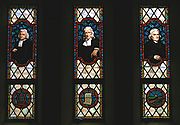 Christian doctrine generally maintains that God dwells in all Christians and that they can experience God directly through belief in Jesus, Christian mysticism aspires to apprehend spiritual truths inaccessible through intellectual means, typically by emulation of Christ. William Inge
divides this scala perfectionis into three stages: the "purgative" or ascetic stage, the "illuminative" or contemplative stage, and the third, "unitive" stage, in which God may be beheld "face to face."
The third stage, usually called contemplation in the Western tradition, refers to the experience of oneself as united with God in some way. The experience of union varies, but it is first and foremost always associated with a reuniting with Divine love. The underlying theme here is that God, the perfect goodness, is known or experienced at least as much by the heart as by the intellect since, in the words of 1 John 4:16: "God is love, and he who abides in love abides in God and God in him." Some approaches to classical mysticism would consider the first two phases as preparatory to the third, explicitly mystical experience; but others state that these three phases overlap and intertwine.
to "go into your closet to pray", hesychasm
in tradition has been the process of retiring inward by ceasing to register the senses, in order to achieve an experiential knowledge of God (see theoria
).
The highest goal of the hesychast is the experiential knowledge of God. In the 14th Century, the possibility of this experiential knowledge of God was challenged by a Calabria
n monk, Barlaam, who, although he was formally a member of the Orthodox Church, had been trained in Western Scholastic theology. Barlaam asserted that our knowledge of God can only be propositional. The practice of the hesychasts was defended by St. Gregory Palamas
.
In solitude and retirement the hesychast repeats the Jesus Prayer
, "Lord Jesus Christ, son of God, have mercy on me, a sinner."He considers bare repetition of the Jesus Prayer as a mere string of syllables, perhaps with a 'mystical' inner meaning beyond the overt verbal meaning, to be worthless or even dangerous.
is the modern term for a school of religious and mystical philosophy
that took shape in the 3rd century AD, founded by Plotinus
and based on the teachings of Plato
and earlier Platonists
.
Neoplatonism teaches that along the same road by which it descended the soul must retrace its steps back to the supreme Good. It must first of all return to itself. This is accomplished by the practice of virtue
, which aims at likeness to God, and leads up to God. By means of ascetic observances the human becomes once more a spiritual and enduring being, free from all sin. But there is still a higher attainment; it is not enough to be sinless, one must become "God", (henosis
). This is reached through contemplation of the primeval Being, the One - in other words, through an ecstatic approach to it.
It is only in a state of perfect passivity and repose that the soul can recognize and touch the primeval Being. Hence the soul must first pass through a spiritual curriculum. Beginning with the contemplation of corporeal things in their multiplicity and harmony, it then retires upon itself and withdraws into the depths of its own being, rising thence to the nous, the world of ideas. But even there it does not find the Highest, the One; it still hears a voice saying, "not we have made ourselves." The last stage is reached when, in the highest tension and concentration, beholding in silence and utter forgetfulness of all things, it is able as it were to lose itself. Then it may see God, the foundation of life, the source of being, the origin of all good, the root of the soul. In that moment it enjoys the highest indescribable bliss; it is as it were swallowed up of divinity, bathed in the light of eternity. Porphyry tells us that on four occasions during the six years of their intercourse Plotinus attained to this ecstatic union with God.
is a 2500-year-old Asian religion. The religious experience is described in the earliest of Buddhist literature, which is found in the Pali Canon
. In the Pali Canon
the religious experience is described in 8 stages of samadhi
. The first four stages are known as jhana, the remaining four stages are known as ayatana.
is arguably the oldest religious system in the world and gave birth to Buddhism
. The religious experience is described in the vedas
and the yoga sutras as 2 stages of samadhi
, they are Savikalpa samadhi and nirvikalpa samadhi.
, "Spiritual experience involves more than can be grasped by mere intellect. This is often emphasised by calling it a mystical experience. Mysticism is often regarded as something anti-intellectual, obscure and confused, or impractical and unconnected with experience. In fact, true mysticism is none of these. There is nothing irrational in true mysticism when it is, as it should be, a vision of Reality. It is a form of perception which is absolutely unclouded, and so practical that it can be lived every moment of life and expressed in every-day duties. Its connection with experience is so deep that, in one sense, it is the final understanding of all experience."
held that moral experience
justified religious belief
s, John Wesley
in addition to stressing individual moral exertion thought that the religious experiences in the Methodist movement (paralleling the Romantic Movement) were foundational to religious commitment as a way of life. In the 19th century, Friedrich Schleiermacher
and Albert Ritschl
continued and extended this view that human (moral and religious) experience justifies religious belief
s.
Such religious empiricism would be later seen as highly problematic and was—during the period in-between world wars—famously rejected by Karl Barth
. In the 20th century, religious as well as moral experience as justification for religious beliefs still holds sway. Some influential modern scholars holding this liberal theological
view are Charles Raven
and the Oxford physicist/theologian Charles Coulson
.
, Transpersonal psychology
, Psychology of religion
, and Parapsychology
is a school of psychology
that studies the transpersonal
, self-transcendent
or spiritual
aspects of the human experience. The Journal of Transpersonal Psychology describes transpersonal psychology as "the study of humanity’s highest potential, and with the recognition, understanding, and realization of unitive, spiritual, and transcendent states of consciousness" (Lajoie and Shapiro, 1992:91). Issues considered in transpersonal psychology include spiritual self-development
, peak experiences, mystical experiences
, systemic trance
and other metaphysical
experiences of living.
U.S. psychologist and philosopher William James
(1842–1910) is regarded by most psychologists of religion as the founder of the field. His Varieties of Religious Experience
is considered to be the classic work in the field, and references to James' ideas are common at professional conferences.
James distinguished between institutional religion and personal religion. Institutional religion refers to the religious group or organization, and plays an important part in a society's culture. Personal religion, in which the individual has mystical experience, can be experienced regardless of the culture.
is the psychological study of religious experiences, beliefs, and activities.
Carl Jung
's work on himself and his patients convinced him that life has a spiritual purpose beyond material goals. Our main task, he believed, is to discover and fulfil our deep innate potential, much as the acorn contains the potential to become the oak, or the caterpillar to become the butterfly. Based on his study of Christianity
, Hinduism
, Buddhism
, Gnosticism
, Taoism
, and other traditions, Jung perceived that this journey of transformation is at the mystical heart of all religions. It is a journey to meet the self and at the same time to meet the Divine. Unlike Sigmund Freud, Jung thought spiritual experience was essential to our well-being.
The notion of the numinous
was an important concept in the writings of Carl Jung. Jung regarded numinous experiences as fundamental to an understanding of the individuation process because of their association with experiences of synchronicity
in which the presence of archetypes is felt
, also known as biotheology or spiritual neuroscience, is the study of correlations of neural phenomena with subjective experiences of spirituality
and hypotheses to explain these phenomena. Proponents of neurotheology claim that there is a neurological and evolutionary basis for subjective experiences traditionally categorized as spiritual or religious.
According to the neurotheologist Andrew B. Newberg
, neurological processes which are driven by the repetitive, rhythmic stimulation which is typical of human ritual, and which contribute to the delivery of transcendental feelings of connection to a universal unity. They posit, however, that physical stimulation alone is not sufficient to generate transcendental unitive experiences. For this to occur they say there must be a blending of the rhythmic stimulation with ideas. Once this occurs "…ritual turns a meaningful idea into a visceral experience." Moreover they say that humans are compelled to act out myths by the biological operations of the brain due to what they call the "inbuilt tendency of the brain to turn thoughts into actions".
s to study brain wave patterns correlated with "spiritual" states. During the 1980s Dr. Michael Persinger
stimulated the temporal lobes of human subjects with a weak magnetic field
. His subjects claimed to have a sensation of "an ethereal presence in the room.". Some current studies use neuroimaging
to localize brain regions active, or differentially active, during religious experiences.
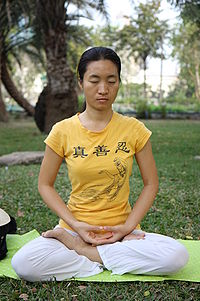
 Various religious texts prescribe meditative practices in order to achieve the state of consciousness which is typical of religious experience. Texts of Yoga
and Tantra
mention specific physical, nutritive, ethical, and meditative methods in order to achieve specific kinds of experiences. The traditions of Mantra Marga (literally, "the way of formulae") in particular stress the importance of saying, either aloud or to oneself internally, particular Mantras given by their teacher. Combined with this is the set of practices related to Yantras. Various other ways not specific of any religion include:
Transcendence (religion)
In religion transcendence refers to the aspect of God's nature which is wholly independent of the physical universe. This is contrasted with immanence where God is fully present in the physical world and thus accessible to creatures in various ways...
, an encounter or union with the divine
Divinity
Divinity and divine are broadly applied but loosely defined terms, used variously within different faiths and belief systems — and even by different individuals within a given faith — to refer to some transcendent or transcendental power or deity, or its attributes or manifestations in...
.
A religious experience is most commonly known as an occurrence that is uncommon in the sense that it doesn’t fit in with the norm of everyday activities and life experiences, and its connection is with the individual’s perception of the divine. Studying religious experience objectively is a difficult task, as it is entirely a subjective phenomenon. However, commonalities and differences between religious experiences have enabled scholars to categorize them for academic study
Many religious and mystical traditions see religious experiences as real encounters with God
God
God is the English name given to a singular being in theistic and deistic religions who is either the sole deity in monotheism, or a single deity in polytheism....
or gods, or real contact with other realities, while some hold that religious experience is an evolved feature of the human brain amenable to normal scientific study.
Differing religious traditions have described this fundamental religious experience in different ways:
- Nullification and absorption within God's Infinite Light (Chassidic schools of Judaism)
- Complete detachment from the world (KaivalyaKaivalyaKaivalya , which is the ultimate goal of yoga, means solitariness or detachment.The 34 Yoga Sutras of Patanjali of the fourth chapter deals with impressions left by our endless cycles of birth and the rationale behind the necessity of erasing such impressions...
in some schools of HinduismHinduismHinduism is the predominant and indigenous religious tradition of the Indian Subcontinent. Hinduism is known to its followers as , amongst many other expressions...
, including Sankhya and Yoga; Jhana in BuddhismBuddhismBuddhism is a religion and philosophy encompassing a variety of traditions, beliefs and practices, largely based on teachings attributed to Siddhartha Gautama, commonly known as the Buddha . The Buddha lived and taught in the northeastern Indian subcontinent some time between the 6th and 4th...
) - Liberation from the cycles of Karma (MokshaMoksa (Jainism)' or Mokkha means liberation, salvation or emancipation of soul. It is a blissful state of existence of a soul, completely free from the karmic bondage, free from samsara, the cycle of birth and death. A liberated soul is said to have attained its true and pristine nature of infinite bliss,...
in SikhismSikhismSikhism is a monotheistic religion founded during the 15th century in the Punjab region, by Guru Nanak Dev and continued to progress with ten successive Sikh Gurus . It is the fifth-largest organized religion in the world and one of the fastest-growing...
, JainismJainismJainism is an Indian religion that prescribes a path of non-violence towards all living beings. Its philosophy and practice emphasize the necessity of self-effort to move the soul towards divine consciousness and liberation. Any soul that has conquered its own inner enemies and achieved the state...
and HinduismHinduismHinduism is the predominant and indigenous religious tradition of the Indian Subcontinent. Hinduism is known to its followers as , amongst many other expressions...
, NirvanaNirvanaNirvāṇa ; ) is a central concept in Indian religions. In sramanic thought, it is the state of being free from suffering. In Hindu philosophy, it is the union with the Supreme being through moksha...
In Buddhism) - Deep intrinsic connection to the world (SatoriSatoriis a Japanese Buddhist term for enlightenment that literally means "understanding". In the Zen Buddhist tradition, satori refers to a flash of sudden awareness, or individual enlightenment, and is considered a "first step" or embarkation toward nirvana....
in Mahayana BuddhismMahayanaMahāyāna is one of the two main existing branches of Buddhism and a term for classification of Buddhist philosophies and practice...
, TeDe (Chinese)De is a key concept in Chinese philosophy, usually translated "inherent character; inner power; integrity" in Taoism, "moral character; virtue; morality" in Confucianism and other contexts, and "quality; virtue" or "merit; virtuous deeds" in Chinese Buddhism.-The word:Chinese de 德 is an ancient...
in TaoismTaoismTaoism refers to a philosophical or religious tradition in which the basic concept is to establish harmony with the Tao , which is the mechanism of everything that exists...
) - Union with God (HenosisHenosisHenosis is the word for "oneness," "union," or "unity" in classical Greek, and is spelled identically in modern Greek where "Enosis" is particulary connected with the modern political "Unity" movement to unify Greece and Cyprus....
in NeoplatonismNeoplatonismNeoplatonism , is the modern term for a school of religious and mystical philosophy that took shape in the 3rd century AD, based on the teachings of Plato and earlier Platonists, with its earliest contributor believed to be Plotinus, and his teacher Ammonius Saccas...
and TheosisTheosisIn Christian theology, divinization, deification, making divine or theosis is the transforming effect of divine grace. This concept of salvation is historical and fundamental for Christian understanding that is prominent in the Eastern Orthodox Church and also in the Catholic Church, and is a...
in ChristianityChristianityChristianity is a monotheistic religion based on the life and teachings of Jesus as presented in canonical gospels and other New Testament writings...
, Brahma-Prapti or Brahma-Nirvana in HinduismHinduismHinduism is the predominant and indigenous religious tradition of the Indian Subcontinent. Hinduism is known to its followers as , amongst many other expressions...
) - Innate Knowledge (IrfanIrfan‘Irfān literally means knowing/awareness. The term is often translated as gnosis, however it also refers to Islamic mysticism. Those with the name are sometimes referred to as having an insight into the unseen...
and fitraFitraFitra, or fitrah , is an Arabic word meaning ‘disposition’, ‘nature’, ‘constitution’, or ‘instinct’. In a mystical context, it can connote intuition or insight...
in IslamIslamIslam . The most common are and . : Arabic pronunciation varies regionally. The first vowel ranges from ~~. The second vowel ranges from ~~~...
) - Experience of one's true blissful nature (SamadhiSamadhiSamadhi in Hinduism, Buddhism,Jainism, Sikhism and yogic schools is a higher level of concentrated meditation, or dhyāna. In the yoga tradition, it is the eighth and final limb identified in the Yoga Sūtras of Patañjali....
or Svarupa-Avirbhava in HinduismHinduismHinduism is the predominant and indigenous religious tradition of the Indian Subcontinent. Hinduism is known to its followers as , amongst many other expressions...
) - Liberating the individual to return to a natural state (Dionysian MysteriesDionysian MysteriesThe Dionysian Mysteries were a ritual of ancient Greece and Rome which used intoxicants and other trance-inducing techniques to remove inhibitions and social constraints, liberating the individual to return to a natural state. It also provided some liberation for those marginalized by Greek...
)
William James' definition
PsychologistPsychologist
Psychologist is a professional or academic title used by individuals who are either:* Clinical professionals who work with patients in a variety of therapeutic contexts .* Scientists conducting psychological research or teaching psychology in a college...
and Philosopher William James
William James
William James was a pioneering American psychologist and philosopher who was trained as a physician. He wrote influential books on the young science of psychology, educational psychology, psychology of religious experience and mysticism, and on the philosophy of pragmatism...
described four characteristics of religious / mystical experience in The Varieties of Religious Experience
The Varieties of Religious Experience
The Varieties of Religious Experience: A Study in Human Nature is a book by the Harvard University psychologist and philosopher William James that comprises his edited Gifford Lectures on "Natural Theology" delivered at the University of Edinburgh in Scotland between 1901 and 1902.These lectures...
. According to James, such an experience is:
- Transient -- the experience is temporary; the individual soon returns to a "normal" frame of mind.
- IneffableIneffabilityIneffability is concerned with ideas that cannot or should not be expressed in spoken words , often being in the form of a taboo or incomprehensible term. This property is commonly associated with philosophy, aspects of existence, and similar concepts that are inherently "too great", complex, or...
-- the experience cannot be adequately put into words. - Noetic -- the individual feels that he or she has learned something valuable from the experience.
- Passive -- the experience happens to the individual, largely without conscious control. Although there are activities, such as meditation (see below), that can make religious experience more likely, it is not something that can be turned on and off at will.
Norman Habel's definition
Habel defines religious experiences as the structured way in which a believer enters into a relationship with, or gains an awareness of, the sacred within the context of a particular religious tradition (Habel, O'Donoghue and Maddox: 1993).Religious experiences are by their very nature preternaturalPreternatural
The preternatural or praeternatural is that which appears outside or beyond the natural. In contrast to the supernatural, preternatural phenomena are presumed to have rational explanations that are, as of yet, unknown....
; that is, out of the ordinary or beyond the natural order of things. They may be difficult to distinguish observationally from psychopathological states such as psychoses or other forms of altered awareness (Charlesworth: 1988). Not all preternatural experiences are considered to be religious experiences. Following Habel's definition, psychopathological states or drug-induced states of awareness are not considered to be religious experiences because they are mostly not performed within the context of a particular religious tradition.
Moore and Habel identify two classes of religious experiences: the immediate and the mediated religious experience (Moore and Habel: 1982).
- Mediated -- In the mediated experience, the believer experiences the sacred through mediators such as ritualRitualA ritual is a set of actions, performed mainly for their symbolic value. It may be prescribed by a religion or by the traditions of a community. The term usually excludes actions which are arbitrarily chosen by the performers....
s, special persons, religious groups, totemic objects or the natural world (Habel et al.: 1993). - Immediate -- The immediate experience comes to the believer without any intervening agency or mediator. The deity or divine is experienced directly
Richard Swinburne's definition
In his book Faith and Reason, the philosopher Richard SwinburneRichard Swinburne
Richard G. Swinburne is an Emeritus Professor of Philosophy at the University of Oxford. Over the last 50 years Swinburne has been a very influential proponent of philosophical arguments for the existence of God. His philosophical contributions are primarily in philosophy of religion and...
formulated five categories into which all religious experiences fall:
- Public -- a believer 'sees God's hand at work', whereas other explanations are possible e.g. looking at a beautiful sunset
- Public -- an unusual event that breaches natural law e.g. walking on water
- Private -- describable using normal language e.g. Jacob's vision of a ladder
- Private -- indescribable using normal language, usually a mystical experience e.g. "white did not cease to be white, nor black cease to be black, but black became white and white became black."
- Private -- a non-specific, general feeling of God working in one's life.
Swinburne also suggested two principles for the assessment of religious experiences:
- Principle of Credulity -- with the absence of any reason to disbelieve it, one should accept what appears to be true e.g. if one sees someone walking on water, one should believe that it is occurring.
- Principle of Testimony -- with the absence of any reason to disbelieve them, one should accept that eye-witnesses or believers are telling the truth when they testify about religious experiences.
Classical definitions
Numinous -- The German thinker Rudolf OttoRudolf Otto
Rudolf Otto was an eminent German Lutheran theologian and scholar of comparative religion.-Life:Born in Peine near Hanover, Otto attended the Gymnasium Andreanum in Hildesheim and studied at the universities of Erlangen and Göttingen, where he wrote his dissertation on Martin Luther's...
(1869–1937) argues that there is one common factor to all religious experience, independent of the cultural background. In his book The Idea of the Holy (1923) he identifies this factor as the numinous
Numinous
Numinous is an English adjective describing the power or presence of a divinity. The word was popularised in the early twentieth century by the German theologian Rudolf Otto in his influential book Das Heilige...
. The “numinous” experience has two aspects: mysterium tremendum, which is the tendency to invoke fear and trembling; and mysterium fascinas, the tendency to attract, fascinate and compel. The numinous experience also has a personal quality to it, in that the person feels to be in communion with a wholly other. Otto sees the numinous as the only possible religious experience. He states: "There is no religion in which it [the numinous] does not live as the real innermost core and without it no religion would be worthy of the name" (Otto: 1972). Otto does not take any other kind of religious experience such as ecstasy and enthusiasm seriously and is of the opinion that they belong to the 'vestibule of religion'.
Ecstasy -- In ecstasy the believer is understood to have a soul
Soul
A soul in certain spiritual, philosophical, and psychological traditions is the incorporeal essence of a person or living thing or object. Many philosophical and spiritual systems teach that humans have souls, and others teach that all living things and even inanimate objects have souls. The...
or spirit
Spirit
The English word spirit has many differing meanings and connotations, most of them relating to a non-corporeal substance contrasted with the material body.The spirit of a living thing usually refers to or explains its consciousness.The notions of a person's "spirit" and "soul" often also overlap,...
which can leave the body. In ecstasy the focus is on the soul leaving the body and to experience transcendental realities. This type of religious experience is characteristic for the shaman.
Enthusiasm --In enthusiasm - or possession - God is understood to be outside, other than or beyond the believer. A sacred power, being or will enters the body or mind of an individual and possesses it. A person capable of being possessed is sometimes called a medium. The deity
Deity
A deity is a recognized preternatural or supernatural immortal being, who may be thought of as holy, divine, or sacred, held in high regard, and respected by believers....
, spirit or power uses such a person to communicate to the immanent
Immanence
Immanence refers to philosophical and metaphysical theories of divine presence, in which the divine is seen to be manifested in or encompassing of the material world. It is often contrasted with theories of transcendence, in which the divine is seen to be outside the material world...
world. Lewis argues that ecstasy and possession are basically one and the same experience, ecstasy being merely one form which possession may take. The outward manifestation of the phenomenon is the same in that shamans appear to be possessed by spirits, act as their mediums, and even though they claim to have mastery over them, can lose that mastery (Lewis: 1986).
Mystical -- Mystical experiences are in many ways the opposite of numinous experiences. In the mystical experience, all 'otherness' disappear and the believer becomes one with the transcendent. The believer discovers that he or she is not distinct from the cosmos, the deity or the other reality, but one with it. Zaehner has identified two distinctively different mystical experiences: natural and religious mystical experiences (Charlesworth: 1988). Natural mystical experiences are, for example, experiences of the 'deeper self' or experiences of oneness with nature. Zaehner argues that the experiences typical of 'natural mysticism' are quite different from the experiences typical of religious mysticism (Charlesworth: 1988). Natural mystical experiences are not considered to be religious experiences because they are not linked to a particular tradition, but natural mystical experiences are spiritual experiences that can have a profound effect on the individual.
Spiritual awakening -- A spiritual awakening is a Religious experience involving a realization or opening to a sacred dimension of reality. Often a spiritual awakening has lasting effects upon one's life. The term "spiritual awakening" may be used to refer to any of a wide range of experiences including being born again, near-death experiences, and mystical experiences
Mysticism
Mysticism is the knowledge of, and especially the personal experience of, states of consciousness, i.e. levels of being, beyond normal human perception, including experience and even communion with a supreme being.-Classical origins:...
such as liberation
Moksha
Within Indian religions, moksha or mukti , literally "release" , is the liberation from samsara and the concomitant suffering involved in being subject to the cycle of repeated death and reincarnation or rebirth.-Origins:It is highly probable that the concept of moksha was first developed in...
and enlightenment
Bodhi
Bodhi is both a Pāli and Sanskrit word traditionally translated into English with the word "enlightenment", but which means awakened. In Buddhism it is the knowledge possessed by a Buddha into the nature of things...
.
Sufism
While all Muslims believe that they are on the pathway to God and will become close to God in Paradise — after death and after the "Final Judgment" — SufisSufism
Sufism or ' is defined by its adherents as the inner, mystical dimension of Islam. A practitioner of this tradition is generally known as a '...
believe that it is possible to become close to God and to experience this closeness while one is alive.
Sufis believe in a tripartite way to God as explained by a tradition attributed to the Prophet,"The Shariah are my words (aqwal), the tariqa are my actions (amal), and the haqiqa
Haqiqa
Haqiqa is a stage in Sufism, a mystical branch of Islam. Sufis strive to perfect themselves and come into the presence of God while still living. They recognize four stages in their pursuit of this: shari’a, tariqa, haqiqa and marifa....
is my interior states (ahwal)". Shariah, tariqa and haqiqa are mutually interdependent.
The tariqa, the ‘path’ on which the mystics walk, has been defined as ‘the path which comes out of the Shariah, for the main road is called shar, the path, tariq.’ No mystical experience can be realized if the binding injunctions of the Shariah are not followed faithfully first. The path, tariqa, however, is narrower and more difficult to walk. It leads the adept, called salik (wayfarer), in his suluk
Suluk
For the Suluk people of Sulu and Malaysia, see Tausūg people. For the Islamic or Sufi term, see Sulook. For the Libyan town, see Suluq.Suluk is a settlement in the Xinjiang Autonomous Region of China. It is situated 11 km to the east of the Continental Pole of inaccessibility, the point of...
(wandering), through different stations (maqam) until he reaches his goal, the perfect tauhid, the existential confession that God is One.
Christian mysticism
William Ralph Inge
William Ralph Inge was an English author, Anglican priest, professor of divinity at Cambridge, and Dean of St Paul's Cathedral, which provided the appellation by which he was widely known, "Dean Inge."- Life :...
divides this scala perfectionis into three stages: the "purgative" or ascetic stage, the "illuminative" or contemplative stage, and the third, "unitive" stage, in which God may be beheld "face to face."
The third stage, usually called contemplation in the Western tradition, refers to the experience of oneself as united with God in some way. The experience of union varies, but it is first and foremost always associated with a reuniting with Divine love. The underlying theme here is that God, the perfect goodness, is known or experienced at least as much by the heart as by the intellect since, in the words of 1 John 4:16: "God is love, and he who abides in love abides in God and God in him." Some approaches to classical mysticism would consider the first two phases as preparatory to the third, explicitly mystical experience; but others state that these three phases overlap and intertwine.
Hesychasm
Based on Christ's injunction in the Gospel of MatthewGospel of Matthew
The Gospel According to Matthew is one of the four canonical gospels, one of the three synoptic gospels, and the first book of the New Testament. It tells of the life, ministry, death, and resurrection of Jesus of Nazareth...
to "go into your closet to pray", hesychasm
Hesychasm
Hesychasm is an eremitic tradition of prayer in the Eastern Orthodox Church, and some of the Eastern Catholic Churches, such as the Byzantine Rite, practised by the Hesychast Hesychasm is an eremitic tradition of prayer in the Eastern Orthodox Church, and some of the Eastern Catholic Churches,...
in tradition has been the process of retiring inward by ceasing to register the senses, in order to achieve an experiential knowledge of God (see theoria
Theoria
For other uses of the term "contemplation", see Contemplation Theoria is Greek for contemplation. It corresponds to the Latin word contemplatio, "looking at", "gazing at", "being aware of".- Introduction :...
).
The highest goal of the hesychast is the experiential knowledge of God. In the 14th Century, the possibility of this experiential knowledge of God was challenged by a Calabria
Calabria
Calabria , in antiquity known as Bruttium, is a region in southern Italy, south of Naples, located at the "toe" of the Italian Peninsula. The capital city of Calabria is Catanzaro....
n monk, Barlaam, who, although he was formally a member of the Orthodox Church, had been trained in Western Scholastic theology. Barlaam asserted that our knowledge of God can only be propositional. The practice of the hesychasts was defended by St. Gregory Palamas
Gregory Palamas
Gregory Palamas was a monk of Mount Athos in Greece and later the Archbishop of Thessaloniki known as a preeminent theologian of Hesychasm. The teachings embodied in his writings defending Hesychasm against the attack of Barlaam are sometimes referred to as Palamism, his followers as Palamites...
.
In solitude and retirement the hesychast repeats the Jesus Prayer
Jesus Prayer
The Jesus Prayer or "The Prayer" is a short, formulaic prayer esteemed and advocated within the Eastern Orthodox church:The prayer has been widely taught and discussed throughout the history of the Eastern Churches. It is often repeated continually as a part of personal ascetic practice, its use...
, "Lord Jesus Christ, son of God, have mercy on me, a sinner."He considers bare repetition of the Jesus Prayer as a mere string of syllables, perhaps with a 'mystical' inner meaning beyond the overt verbal meaning, to be worthless or even dangerous.
Neoplatonism
NeoplatonismNeoplatonism
Neoplatonism , is the modern term for a school of religious and mystical philosophy that took shape in the 3rd century AD, based on the teachings of Plato and earlier Platonists, with its earliest contributor believed to be Plotinus, and his teacher Ammonius Saccas...
is the modern term for a school of religious and mystical philosophy
Philosophy
Philosophy is the study of general and fundamental problems, such as those connected with existence, knowledge, values, reason, mind, and language. Philosophy is distinguished from other ways of addressing such problems by its critical, generally systematic approach and its reliance on rational...
that took shape in the 3rd century AD, founded by Plotinus
Plotinus
Plotinus was a major philosopher of the ancient world. In his system of theory there are the three principles: the One, the Intellect, and the Soul. His teacher was Ammonius Saccas and he is of the Platonic tradition...
and based on the teachings of Plato
Plato
Plato , was a Classical Greek philosopher, mathematician, student of Socrates, writer of philosophical dialogues, and founder of the Academy in Athens, the first institution of higher learning in the Western world. Along with his mentor, Socrates, and his student, Aristotle, Plato helped to lay the...
and earlier Platonists
Platonism
Platonism is the philosophy of Plato or the name of other philosophical systems considered closely derived from it. In a narrower sense the term might indicate the doctrine of Platonic realism...
.
Neoplatonism teaches that along the same road by which it descended the soul must retrace its steps back to the supreme Good. It must first of all return to itself. This is accomplished by the practice of virtue
Virtue
Virtue is moral excellence. A virtue is a positive trait or quality subjectively deemed to be morally excellent and thus is valued as a foundation of principle and good moral being....
, which aims at likeness to God, and leads up to God. By means of ascetic observances the human becomes once more a spiritual and enduring being, free from all sin. But there is still a higher attainment; it is not enough to be sinless, one must become "God", (henosis
Henosis
Henosis is the word for "oneness," "union," or "unity" in classical Greek, and is spelled identically in modern Greek where "Enosis" is particulary connected with the modern political "Unity" movement to unify Greece and Cyprus....
). This is reached through contemplation of the primeval Being, the One - in other words, through an ecstatic approach to it.
It is only in a state of perfect passivity and repose that the soul can recognize and touch the primeval Being. Hence the soul must first pass through a spiritual curriculum. Beginning with the contemplation of corporeal things in their multiplicity and harmony, it then retires upon itself and withdraws into the depths of its own being, rising thence to the nous, the world of ideas. But even there it does not find the Highest, the One; it still hears a voice saying, "not we have made ourselves." The last stage is reached when, in the highest tension and concentration, beholding in silence and utter forgetfulness of all things, it is able as it were to lose itself. Then it may see God, the foundation of life, the source of being, the origin of all good, the root of the soul. In that moment it enjoys the highest indescribable bliss; it is as it were swallowed up of divinity, bathed in the light of eternity. Porphyry tells us that on four occasions during the six years of their intercourse Plotinus attained to this ecstatic union with God.
Buddhism
BuddhismBuddhism
Buddhism is a religion and philosophy encompassing a variety of traditions, beliefs and practices, largely based on teachings attributed to Siddhartha Gautama, commonly known as the Buddha . The Buddha lived and taught in the northeastern Indian subcontinent some time between the 6th and 4th...
is a 2500-year-old Asian religion. The religious experience is described in the earliest of Buddhist literature, which is found in the Pali Canon
Pāli Canon
The Pāli Canon is the standard collection of scriptures in the Theravada Buddhist tradition, as preserved in the Pāli language. It is the only completely surviving early Buddhist canon, and one of the first to be written down...
. In the Pali Canon
Pāli Canon
The Pāli Canon is the standard collection of scriptures in the Theravada Buddhist tradition, as preserved in the Pāli language. It is the only completely surviving early Buddhist canon, and one of the first to be written down...
the religious experience is described in 8 stages of samadhi
Samadhi
Samadhi in Hinduism, Buddhism,Jainism, Sikhism and yogic schools is a higher level of concentrated meditation, or dhyāna. In the yoga tradition, it is the eighth and final limb identified in the Yoga Sūtras of Patañjali....
. The first four stages are known as jhana, the remaining four stages are known as ayatana.
Hinduism
HinduismHinduism
Hinduism is the predominant and indigenous religious tradition of the Indian Subcontinent. Hinduism is known to its followers as , amongst many other expressions...
is arguably the oldest religious system in the world and gave birth to Buddhism
Buddhism
Buddhism is a religion and philosophy encompassing a variety of traditions, beliefs and practices, largely based on teachings attributed to Siddhartha Gautama, commonly known as the Buddha . The Buddha lived and taught in the northeastern Indian subcontinent some time between the 6th and 4th...
. The religious experience is described in the vedas
Vedas
The Vedas are a large body of texts originating in ancient India. Composed in Vedic Sanskrit, the texts constitute the oldest layer of Sanskrit literature and the oldest scriptures of Hinduism....
and the yoga sutras as 2 stages of samadhi
Samadhi
Samadhi in Hinduism, Buddhism,Jainism, Sikhism and yogic schools is a higher level of concentrated meditation, or dhyāna. In the yoga tradition, it is the eighth and final limb identified in the Yoga Sūtras of Patañjali....
, they are Savikalpa samadhi and nirvikalpa samadhi.
Meher Baba
According to the Indian spiritual teacher Meher BabaMeher Baba
Meher Baba , , born Merwan Sheriar Irani, was an Indian mystic and spiritual master who declared publicly in 1954 that he was the Avatar of the age....
, "Spiritual experience involves more than can be grasped by mere intellect. This is often emphasised by calling it a mystical experience. Mysticism is often regarded as something anti-intellectual, obscure and confused, or impractical and unconnected with experience. In fact, true mysticism is none of these. There is nothing irrational in true mysticism when it is, as it should be, a vision of Reality. It is a form of perception which is absolutely unclouded, and so practical that it can be lived every moment of life and expressed in every-day duties. Its connection with experience is so deep that, in one sense, it is the final understanding of all experience."
History of modern science and religion view
In the 18th, 19th, and 20th centuries, several historical figures put forth very influential views that religion and its beliefs can be grounded in experience itself. While KantImmanuel Kant
Immanuel Kant was a German philosopher from Königsberg , researching, lecturing and writing on philosophy and anthropology at the end of the 18th Century Enlightenment....
held that moral experience
Moral obligation
The term moral obligation has a number of meanings in moral philosophy, in religion, and in layman's terms. Generally speaking, when someone says of an act that it is a "moral obligation," they refer to a belief that the act is one prescribed by their set of values.Moral philosophers differ as to...
justified religious belief
Religious belief
Religious belief is a strong belief in a supernatural power or powers that control human destiny. Such a state may relate to the existence, characteristics and worship of a deity or deities, divine intervention in the universe and human life, or values and practices centered on the teachings of a...
s, John Wesley
John Wesley
John Wesley was a Church of England cleric and Christian theologian. Wesley is largely credited, along with his brother Charles Wesley, as founding the Methodist movement which began when he took to open-air preaching in a similar manner to George Whitefield...
in addition to stressing individual moral exertion thought that the religious experiences in the Methodist movement (paralleling the Romantic Movement) were foundational to religious commitment as a way of life. In the 19th century, Friedrich Schleiermacher
Friedrich Daniel Ernst Schleiermacher
Friedrich Daniel Ernst Schleiermacher was a German theologian and philosopher known for his attempt to reconcile the criticisms of the Enlightenment with traditional Protestant orthodoxy. He also became influential in the evolution of Higher Criticism, and his work forms part of the foundation of...
and Albert Ritschl
Albrecht Ritschl
Albrecht Ritschl was a German theologian.Starting in 1852, Ritschl lectured on "Systematic Theology". According to this system, faith was understood to be irreducible to other experiences, beyond the scope of reason. Faith, he said, came not from facts but from value judgments...
continued and extended this view that human (moral and religious) experience justifies religious belief
Religious belief
Religious belief is a strong belief in a supernatural power or powers that control human destiny. Such a state may relate to the existence, characteristics and worship of a deity or deities, divine intervention in the universe and human life, or values and practices centered on the teachings of a...
s.
Such religious empiricism would be later seen as highly problematic and was—during the period in-between world wars—famously rejected by Karl Barth
Karl Barth
Karl Barth was a Swiss Reformed theologian whom critics hold to be among the most important Christian thinkers of the 20th century; Pope Pius XII described him as the most important theologian since Thomas Aquinas...
. In the 20th century, religious as well as moral experience as justification for religious beliefs still holds sway. Some influential modern scholars holding this liberal theological
Liberal theology
Liberal theology may refer to*Liberal Christianity also known as liberal theology, is an umbrella term covering diverse, philosophically and non-mystic biblical text belief within general Christianity that became more popular in the 20th century...
view are Charles Raven
Charles Raven
Charles Earle Raven was an English theologian, Regius Professor of Divinity at Cambridge University, and Master of Christ's College, Cambridge...
and the Oxford physicist/theologian Charles Coulson
Charles Coulson
Charles Alfred Coulson FRS was an applied mathematician, theoretical chemist and religious author.His major scientific work was as a pioneer of the application of the quantum theory of valency to problems of molecular structure, dynamics and reactivity...
.
Scientific studies on religious experience
There are many areas of science that explore the religious experience like NeurotheologyNeurotheology
Neurotheology, also known as spiritual neuroscience, is the study of correlations of neural phenomena with subjective experiences of spirituality and hypotheses to explain these phenomena....
, Transpersonal psychology
Transpersonal psychology
Transpersonal psychology is a form of psychology that studies the transpersonal, self-transcendent or spiritual aspects of the human experience....
, Psychology of religion
Psychology of religion
Psychology of religion consists of the application of psychological methods and interpretive frameworks to religious traditions, as well as to both religious and irreligious individuals. The science attempts to accurately describe the details, origins, and uses of religious beliefs and behaviours...
, and Parapsychology
Parapsychology
The term parapsychology was coined in or around 1889 by philosopher Max Dessoir, and originates from para meaning "alongside", and psychology. The term was adopted by J.B. Rhine in the 1930s as a replacement for the term psychical research...
Transpersonal psychology
Transpersonal psychologyTranspersonal psychology
Transpersonal psychology is a form of psychology that studies the transpersonal, self-transcendent or spiritual aspects of the human experience....
is a school of psychology
Psychology
Psychology is the study of the mind and behavior. Its immediate goal is to understand individuals and groups by both establishing general principles and researching specific cases. For many, the ultimate goal of psychology is to benefit society...
that studies the transpersonal
Transpersonal
The term transpersonal is often used to refer to psychological categories that transcend the normal features of ordinary ego-functioning. That is, stages of psychological growth, or stages of consciousness, that move beyond the rational andprecede the mystical...
, self-transcendent
Transcendence (philosophy)
In philosophy, the adjective transcendental and the noun transcendence convey the basic ground concept from the word's literal meaning , of climbing or going beyond, albeit with varying connotations in its different historical and cultural stages...
or spiritual
Spirituality
Spirituality can refer to an ultimate or an alleged immaterial reality; an inner path enabling a person to discover the essence of his/her being; or the “deepest values and meanings by which people live.” Spiritual practices, including meditation, prayer and contemplation, are intended to develop...
aspects of the human experience. The Journal of Transpersonal Psychology describes transpersonal psychology as "the study of humanity’s highest potential, and with the recognition, understanding, and realization of unitive, spiritual, and transcendent states of consciousness" (Lajoie and Shapiro, 1992:91). Issues considered in transpersonal psychology include spiritual self-development
Human Potential Movement
The Human Potential Movement arose out of the social and intellectual milieu of the 1960s and formed around the concept of cultivating extraordinary potential that its advocates believed to lie largely untapped in all people...
, peak experiences, mystical experiences
Mysticism
Mysticism is the knowledge of, and especially the personal experience of, states of consciousness, i.e. levels of being, beyond normal human perception, including experience and even communion with a supreme being.-Classical origins:...
, systemic trance
Trance
Trance denotes a variety of processes, ecstasy, techniques, modalities and states of mind, awareness and consciousness. Trance states may occur involuntarily and unbidden.The term trance may be associated with meditation, magic, flow, and prayer...
and other metaphysical
Metaphysics
Metaphysics is a branch of philosophy concerned with explaining the fundamental nature of being and the world, although the term is not easily defined. Traditionally, metaphysics attempts to answer two basic questions in the broadest possible terms:...
experiences of living.
U.S. psychologist and philosopher William James
William James
William James was a pioneering American psychologist and philosopher who was trained as a physician. He wrote influential books on the young science of psychology, educational psychology, psychology of religious experience and mysticism, and on the philosophy of pragmatism...
(1842–1910) is regarded by most psychologists of religion as the founder of the field. His Varieties of Religious Experience
The Varieties of Religious Experience
The Varieties of Religious Experience: A Study in Human Nature is a book by the Harvard University psychologist and philosopher William James that comprises his edited Gifford Lectures on "Natural Theology" delivered at the University of Edinburgh in Scotland between 1901 and 1902.These lectures...
is considered to be the classic work in the field, and references to James' ideas are common at professional conferences.
James distinguished between institutional religion and personal religion. Institutional religion refers to the religious group or organization, and plays an important part in a society's culture. Personal religion, in which the individual has mystical experience, can be experienced regardless of the culture.
Psychology of religion
Psychology of religionPsychology of religion
Psychology of religion consists of the application of psychological methods and interpretive frameworks to religious traditions, as well as to both religious and irreligious individuals. The science attempts to accurately describe the details, origins, and uses of religious beliefs and behaviours...
is the psychological study of religious experiences, beliefs, and activities.
Carl Jung
Carl Jung
Carl Jung
Carl Gustav Jung was a Swiss psychiatrist and the founder of Analytical Psychology. Jung is considered the first modern psychiatrist to view the human psyche as "by nature religious" and make it the focus of exploration. Jung is one of the best known researchers in the field of dream analysis and...
's work on himself and his patients convinced him that life has a spiritual purpose beyond material goals. Our main task, he believed, is to discover and fulfil our deep innate potential, much as the acorn contains the potential to become the oak, or the caterpillar to become the butterfly. Based on his study of Christianity
Christianity
Christianity is a monotheistic religion based on the life and teachings of Jesus as presented in canonical gospels and other New Testament writings...
, Hinduism
Hinduism
Hinduism is the predominant and indigenous religious tradition of the Indian Subcontinent. Hinduism is known to its followers as , amongst many other expressions...
, Buddhism
Buddhism
Buddhism is a religion and philosophy encompassing a variety of traditions, beliefs and practices, largely based on teachings attributed to Siddhartha Gautama, commonly known as the Buddha . The Buddha lived and taught in the northeastern Indian subcontinent some time between the 6th and 4th...
, Gnosticism
Gnosticism
Gnosticism is a scholarly term for a set of religious beliefs and spiritual practices common to early Christianity, Hellenistic Judaism, Greco-Roman mystery religions, Zoroastrianism , and Neoplatonism.A common characteristic of some of these groups was the teaching that the realisation of Gnosis...
, Taoism
Taoism
Taoism refers to a philosophical or religious tradition in which the basic concept is to establish harmony with the Tao , which is the mechanism of everything that exists...
, and other traditions, Jung perceived that this journey of transformation is at the mystical heart of all religions. It is a journey to meet the self and at the same time to meet the Divine. Unlike Sigmund Freud, Jung thought spiritual experience was essential to our well-being.
The notion of the numinous
Numinous
Numinous is an English adjective describing the power or presence of a divinity. The word was popularised in the early twentieth century by the German theologian Rudolf Otto in his influential book Das Heilige...
was an important concept in the writings of Carl Jung. Jung regarded numinous experiences as fundamental to an understanding of the individuation process because of their association with experiences of synchronicity
Synchronicity
Synchronicity is the experience of two or more events that are apparently causally unrelated or unlikely to occur together by chance and that are observed to occur together in a meaningful manner...
in which the presence of archetypes is felt
Neurotheology
NeurotheologyNeurotheology
Neurotheology, also known as spiritual neuroscience, is the study of correlations of neural phenomena with subjective experiences of spirituality and hypotheses to explain these phenomena....
, also known as biotheology or spiritual neuroscience, is the study of correlations of neural phenomena with subjective experiences of spirituality
Spirituality
Spirituality can refer to an ultimate or an alleged immaterial reality; an inner path enabling a person to discover the essence of his/her being; or the “deepest values and meanings by which people live.” Spiritual practices, including meditation, prayer and contemplation, are intended to develop...
and hypotheses to explain these phenomena. Proponents of neurotheology claim that there is a neurological and evolutionary basis for subjective experiences traditionally categorized as spiritual or religious.
According to the neurotheologist Andrew B. Newberg
Andrew B. Newberg
Andrew Newberg, M.D. is an American Neuroscientist who is the Director of Research at the Myrna Brind Center for Integrative Medicine at Thomas Jefferson University Hospital and Medical College, an Adjunct Professor of Religious Studies and an Associate Professor of Radiology at the University of...
, neurological processes which are driven by the repetitive, rhythmic stimulation which is typical of human ritual, and which contribute to the delivery of transcendental feelings of connection to a universal unity. They posit, however, that physical stimulation alone is not sufficient to generate transcendental unitive experiences. For this to occur they say there must be a blending of the rhythmic stimulation with ideas. Once this occurs "…ritual turns a meaningful idea into a visceral experience." Moreover they say that humans are compelled to act out myths by the biological operations of the brain due to what they call the "inbuilt tendency of the brain to turn thoughts into actions".
Studies of the brain and religious experience
Early studies in the 1950s and 1960s attempted to use EEGElectroencephalography
Electroencephalography is the recording of electrical activity along the scalp. EEG measures voltage fluctuations resulting from ionic current flows within the neurons of the brain...
s to study brain wave patterns correlated with "spiritual" states. During the 1980s Dr. Michael Persinger
Michael Persinger
Michael A. Persinger is a cognitive neuroscience researcher and university professor with over 200 peer-reviewed publications. He has worked at Laurentian University, located in Sudbury, Ontario, since 1971.-Early life:...
stimulated the temporal lobes of human subjects with a weak magnetic field
Magnetic field
A magnetic field is a mathematical description of the magnetic influence of electric currents and magnetic materials. The magnetic field at any given point is specified by both a direction and a magnitude ; as such it is a vector field.Technically, a magnetic field is a pseudo vector;...
. His subjects claimed to have a sensation of "an ethereal presence in the room.". Some current studies use neuroimaging
Neuroimaging
Neuroimaging includes the use of various techniques to either directly or indirectly image the structure, function/pharmacology of the brain...
to localize brain regions active, or differentially active, during religious experiences.
Causes of religious experiences
Yoga
Yoga is a physical, mental, and spiritual discipline, originating in ancient India. The goal of yoga, or of the person practicing yoga, is the attainment of a state of perfect spiritual insight and tranquility while meditating on Supersoul...
and Tantra
Tantra
Tantra , anglicised tantricism or tantrism or tantram, is the name scholars give to an inter-religious spiritual movement that arose in medieval India, expressed in scriptures ....
mention specific physical, nutritive, ethical, and meditative methods in order to achieve specific kinds of experiences. The traditions of Mantra Marga (literally, "the way of formulae") in particular stress the importance of saying, either aloud or to oneself internally, particular Mantras given by their teacher. Combined with this is the set of practices related to Yantras. Various other ways not specific of any religion include:
- MeditationMeditationMeditation is any form of a family of practices in which practitioners train their minds or self-induce a mode of consciousness to realize some benefit....
- PrayPrayPray may refer to:* Prayer, an active effort to communicate with a deity or spiritIt may also refer to:-Places:Italy* Pray, Piedmont, a comune in the Province of BiellaUnited States* Pray, Wisconsin, an unincorporated community-People:...
ing - MusicMusicMusic is an art form whose medium is sound and silence. Its common elements are pitch , rhythm , dynamics, and the sonic qualities of timbre and texture...
- DanceDanceDance is an art form that generally refers to movement of the body, usually rhythmic and to music, used as a form of expression, social interaction or presented in a spiritual or performance setting....
, such as:- Sufi whirlingSufi whirlingSufi whirling , is a form of Sama or physicaly active meditation which orginated among Sufis, and which is still practiced by the Sufi Dervishes of the Mevlevi order. It is a customary dance performed within the Sema, or worship ceremony, through which dervishes aim to reach the source of all...
- Sufi whirling
- Extended exercise, often running in a large communal circle, which is used in various tribal and neo-pagan religions.
- Extreme painPainPain is an unpleasant sensation often caused by intense or damaging stimuli such as stubbing a toe, burning a finger, putting iodine on a cut, and bumping the "funny bone."...
, such as:- Mortification of the fleshMortification of the fleshMortification of the flesh literally means "putting the flesh to death". The term is primarily used in religious and spiritual contexts. The institutional and traditional terminology of this practice in Catholicism is corporal mortification....
- Mortification of the flesh
- Profound sexual activitySexual intercourseSexual intercourse, also known as copulation or coitus, commonly refers to the act in which a male's penis enters a female's vagina for the purposes of sexual pleasure or reproduction. The entities may be of opposite sexes, or they may be hermaphroditic, as is the case with snails...
, - Use of Entheogens, such as:
- AyahuascaAyahuascaAyahuasca is any of various psychoactive infusions or decoctions prepared from the Banisteriopsis spp. vine, usually mixed with the leaves of dimethyltryptamine-containing species of shrubs from the Psychotria genus...
(DimethyltryptamineDimethyltryptamineN,N-Dimethyltryptamine is a naturally occurring psychedelic compound of the tryptamine family. DMT is found in several plants, and also in trace amounts in humans and other mammals, where it is originally derived from the essential amino acid tryptophan, and ultimately produced by the enzyme INMT...
) - Salvia divinorumSalvia divinorumSalvia divinorum is a psychoactive plant which can induce dissociative effects and is a potent producer of "visions" and other hallucinatory experiences...
(Salvinorin ASalvinorin ASalvinorin A is the main active psychotropic molecule in Salvia divinorum, a Mexican plant which has a long history of use as an entheogen by indigenous Mazatec shamans...
) - PeyotePeyoteLophophora williamsii , better known by its common name Peyote , is a small, spineless cactus with psychoactive alkaloids, particularly mescaline.It is native to southwestern Texas and Mexico...
(MescalineMescalineMescaline or 3,4,5-trimethoxyphenethylamine is a naturally occurring psychedelic alkaloid of the phenethylamine class used mainly as an entheogen....
) - Psilocybe cubensisPsilocybe cubensisPsilocybe cubensis is a species of psychedelic mushroom whose principal active compounds are psilocybin and psilocin. Commonly called Boomers, Cubes or Gold Caps, it belongs to the Strophariaceae family of fungi and was previously known as Stropharia cubensis.-Taxonomy and naming:The species was...
(PsilocybinPsilocybinPsilocybin is a naturally occurring psychedelic prodrug, with mind-altering effects similar to those of LSD and mescaline, after it is converted to psilocin. The effects can include altered thinking processes, perceptual distortions, an altered sense of time, and spiritual experiences, as well as...
) - Amanita muscariaAmanita muscariaAmanita muscaria, commonly known as the fly agaric or fly amanita , is a poisonous and psychoactive basidiomycete fungus, one of many in the genus Amanita...
(MuscimolMuscimolMuscimol is the major psychoactive alkaloid present in many mushrooms of the Amanita genus. Unlike psilocin , which is a serotonergic psychedelic and agonist for the 5-HT2A receptor set, muscimol is a potent, selective agonist for the GABAA receptor set and is a deliriant as a opposed...
)
- Ayahuasca
- Psychological or neurophysiologicalNeurophysiologyNeurophysiology is a part of physiology. Neurophysiology is the study of nervous system function...
anomalies, such as:- Profound depression or schizophreniaSchizophreniaSchizophrenia is a mental disorder characterized by a disintegration of thought processes and of emotional responsiveness. It most commonly manifests itself as auditory hallucinations, paranoid or bizarre delusions, or disorganized speech and thinking, and it is accompanied by significant social...
- Temporal lobe epilepsyTemporal lobe epilepsyTemporal lobe epilepsy a.k.a. Psychomotor epilepsy, is a form of focal epilepsy, a chronic neurological condition characterized by recurrent seizures. Over 40 types of epilepsies are known. They fall into two main categories: partial-onset epilepsies and generalized-onset epilepsies...
- StrokeStrokeA stroke, previously known medically as a cerebrovascular accident , is the rapidly developing loss of brain function due to disturbance in the blood supply to the brain. This can be due to ischemia caused by blockage , or a hemorrhage...
- Profound depression or schizophrenia
- Near-death experience
- LearningLearningLearning is acquiring new or modifying existing knowledge, behaviors, skills, values, or preferences and may involve synthesizing different types of information. The ability to learn is possessed by humans, animals and some machines. Progress over time tends to follow learning curves.Human learning...
See also
- Altered state of consciousnessAltered state of consciousnessAn altered state of consciousness , also named altered state of mind, is any condition which is significantly different from a normal waking beta wave state. The expression was used as early as 1966 by Arnold M. Ludwig and brought into common usage from 1969 by Charles Tart: it describes induced...
- Argument from religious experienceArgument from religious experienceThe Argument from religious experience is an argument for the existence of God, as against materialism.-Outline logical structure:Its logical structure is essentially as follows:...
- Cognitive science of religionCognitive science of religionCognitive science of religion is the study of religious thought and behavior from the perspective of the cognitive and evolutionary sciences. The field employs methods and theories from a very broad range of disciplines, including: cognitive psychology, evolutionary psychology, cognitive...
- Depersonalization disorderDepersonalization disorderDepersonalization disorder is a dissociative disorder in which the sufferer is affected by persistent or recurrent feelings of depersonalization and/or derealization. Diagnostic criteria include persistent or recurrent experiences of feeling detached from one's mental processes or body...
- Enlightenment (spiritual)Enlightenment (spiritual)Enlightenment in a secular context often means the "full comprehension of a situation", but in spiritual terms the word alludes to a spiritual revelation or deep insight into the meaning and purpose of all things, communication with or understanding of the mind of God, profound spiritual...
- EntheogenEntheogenAn entheogen , in the strict sense, is a psychoactive substance used in a religious, shamanic, or spiritual context. Historically, entheogens were mostly derived from plant sources and have been used in a variety of traditional religious contexts...
s - Higher consciousnessHigher consciousnessHigher consciousness, also called super consciousness , objective consciousness , Buddhic consciousness , cosmic consciousness, God-consciousness and Christ consciousness , are expressions used in various spiritual traditions to denote the consciousness of a human being who has reached a...
- KundaliniKundaliniKundalini literally means coiled. In yoga, a "corporeal energy" - an unconscious, instinctive or libidinal force or Shakti, lies coiled at the base of the spine. It is envisioned either as a goddess or else as a sleeping serpent, hence a number of English renderings of the term such as 'serpent...
- MysticismMysticismMysticism is the knowledge of, and especially the personal experience of, states of consciousness, i.e. levels of being, beyond normal human perception, including experience and even communion with a supreme being.-Classical origins:...
- Near death experienceNear death experienceA near-death experience refers to a broad range of personal experiences associated with impending death, encompassing multiple possible sensations including detachment from the body; feelings of levitation; extreme fear; total serenity, security, or warmth; the experience of absolute dissolution;...
- NeurotheologyNeurotheologyNeurotheology, also known as spiritual neuroscience, is the study of correlations of neural phenomena with subjective experiences of spirituality and hypotheses to explain these phenomena....
- NirvanaNirvanaNirvāṇa ; ) is a central concept in Indian religions. In sramanic thought, it is the state of being free from suffering. In Hindu philosophy, it is the union with the Supreme being through moksha...
- Numinosum
- Psychology of religionPsychology of religionPsychology of religion consists of the application of psychological methods and interpretive frameworks to religious traditions, as well as to both religious and irreligious individuals. The science attempts to accurately describe the details, origins, and uses of religious beliefs and behaviours...
- Psychonaut
- Religious ecstasyReligious ecstasyReligious ecstasy is an altered state of consciousness characterized by greatly reduced external awareness and expanded interior mental and spiritual awareness which is frequently accompanied by visions and emotional/intuitive euphoria...
- Religious Experience Research CentreReligious Experience Research CentreThe Religious Experience Research Centre was founded by the distinguished marine biologist Professor Alister Hardy FRS in 1969 as The Religious Experience Research Unit. He and his co-researchers began to gather a unique archive of accounts of religious experience and to publish research into the...
- Religious revivalReligious revivalReligious revival may refer to:* Christian Revivalism* Revival meeting* Islamic revival...
- RevelationRevelationIn religion and theology, revelation is the revealing or disclosing, through active or passive communication with a supernatural or a divine entity...
- SamadhiSamadhiSamadhi in Hinduism, Buddhism,Jainism, Sikhism and yogic schools is a higher level of concentrated meditation, or dhyāna. In the yoga tradition, it is the eighth and final limb identified in the Yoga Sūtras of Patañjali....
- Self-knowledge
- Spiritual crisisSpiritual crisisSpiritual crisis is a form of identity crisis where an individual experiences drastic changes to their meaning system typically because of a spontaneous spiritual experience...
- The Varieties of Religious ExperienceThe Varieties of Religious ExperienceThe Varieties of Religious Experience: A Study in Human Nature is a book by the Harvard University psychologist and philosopher William James that comprises his edited Gifford Lectures on "Natural Theology" delivered at the University of Edinburgh in Scotland between 1901 and 1902.These lectures...
- Theta rhythmTheta rhythmA theta rhythm is an oscillatory pattern in EEG signals recorded either from inside the brain or from electrodes glued to the scalp. Two types of theta rhythm have been described...
- Transcendence (religion)Transcendence (religion)In religion transcendence refers to the aspect of God's nature which is wholly independent of the physical universe. This is contrasted with immanence where God is fully present in the physical world and thus accessible to creatures in various ways...
- Transpersonal psychologyTranspersonal psychologyTranspersonal psychology is a form of psychology that studies the transpersonal, self-transcendent or spiritual aspects of the human experience....
- TuriyaTuriyaIn Hindu philosophy, turiya is the experience of pure consciousness. It is the background that underlies and transcends the three common states of consciousness: the state of waking consciousness , the state of dreaming , and dreamless sleep .-Advaita concept:The first two states are not true...
Further reading
- Batson, C. D., & Ventis, W. L. (1982). The religious experience: A social-psychological perspective. New York: Oxford University Press, ISBN 0-19-503030-2
- Main, R. (2007). Revelations of chance: Synchronicity as spiritual experience. Albany, NY: State University of New York Press, ISBN 0791470245
External links
- "Self-transcendence enhanced by removal of portions of the parietal-occipital cortex" Article from the Institute for the Biocultural Study of Religion
- Peru: Hell and Back National Geographic explores the uses of Ayahuasca in Shamanic healing
- Is This Your Brain On God? (May 2009 week long NPRNPRNPR, formerly National Public Radio, is a privately and publicly funded non-profit membership media organization that serves as a national syndicator to a network of 900 public radio stations in the United States. NPR was created in 1970, following congressional passage of the Public Broadcasting...
series)