


Jesus Prayer

Encyclopedia
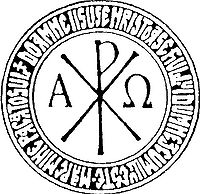
The prayer has been widely taught and discussed throughout the history of the Eastern Churches. It is often repeated continually as a part of personal ascetic practice, its use being an integral part of the eremitic tradition of prayer
Prayer
Prayer is a form of religious practice that seeks to activate a volitional rapport to a deity through deliberate practice. Prayer may be either individual or communal and take place in public or in private. It may involve the use of words or song. When language is used, prayer may take the form of...
known as Hesychasm
Hesychasm
Hesychasm is an eremitic tradition of prayer in the Eastern Orthodox Church, and some of the Eastern Catholic Churches, such as the Byzantine Rite, practised by the Hesychast Hesychasm is an eremitic tradition of prayer in the Eastern Orthodox Church, and some of the Eastern Catholic Churches,...
. The prayer is particularly esteemed by the spiritual fathers of this tradition (see Philokalia
Philokalia
The Philokalia is a collection of texts written between the 4th and 15th centuries by spiritual masters of the Eastern Orthodox hesychast tradition. They were originally written for the guidance and instruction of monks in "the practise of the contemplative life". The collection was compiled in...
) as a method of opening up the heart (kardia) and bringing about the Prayer of the Heart . The Prayer of The Heart is considered to be the Unceasing Prayer that the apostle Paul advocates in the New Testament. St. Theophan the Recluse
Theophan the Recluse
St. Theophan the Recluse, also known as "Theophan Zatvornik" or "Theophanes the Recluse" , is a well-known saint in the Russian Orthodox Church. He was born George Vasilievich Govorov, in the village of Chernavsk. His father was a Russian Orthodox priest. He was educated in the seminaries at...
regarded the Jesus Prayer stronger than all other prayers by virtue of the power of the Holy Name of Jesus
Holy Name of Jesus
In Christianity, the Holy Name of Jesus refers to the theological and devotional use of the name of Jesus. The reverence and affection with which Christians have regarded the Holy Name of Jesus goes back to the earliest days of Christianity....
.
While its tradition, on historical grounds, also belongs to the Eastern Catholics, and there have been a number of Roman Catholic texts on the Jesus Prayer, its practice has never achieved the same popularity in the Western Church as in the Eastern Orthodox Church, although it is said on the Anglican Rosary. Moreover, the Eastern Orthodox theology of the Jesus Prayer enunciated in the fourteenth century by St. Gregory Palamas
Gregory Palamas
Gregory Palamas was a monk of Mount Athos in Greece and later the Archbishop of Thessaloniki known as a preeminent theologian of Hesychasm. The teachings embodied in his writings defending Hesychasm against the attack of Barlaam are sometimes referred to as Palamism, his followers as Palamites...
has never been fully accepted by the Roman Catholic Church. Nonetheless, in the Jesus Prayer there can be seen the Eastern counterpart of the Roman Catholic Rosary
Rosary
The rosary or "garland of roses" is a traditional Catholic devotion. The term denotes the prayer beads used to count the series of prayers that make up the rosary...
, which has developed to hold a similar place in the Christian West.
Origins
The prayer's origin is most likely the Egyptian desertThebaid
The Thebaid or Thebais is the region of ancient Egypt containing the thirteen southernmost nomes of Upper Egypt, from Abydos to Aswan. It acquired its name from its proximity to the ancient Egyptian capital of Thebes....
, which was settled by the monastic Desert Fathers
Desert Fathers
The Desert Fathers were hermits, ascetics, monks, and nuns who lived mainly in the Scetes desert of Egypt beginning around the third century AD. The most well known was Anthony the Great, who moved to the desert in 270–271 and became known as both the father and founder of desert monasticism...
in the fifth century.
What may be the earliest explicit reference to what became the standard version of the Jesus Prayer is in Discourse on Abba Philimon from The Philokalia. Philimon lived around 600 A.D. But while the prayer itself was in use by that time, John S. Romanides
John S. Romanides
John Savvas Romanides was a Greek Orthodox priest, author and professor who, for a long time, represented the Greek Church to the World Council of Churches. He was born in Piraeus, Greece, on 2 March 1928 but his parents emigrated to the United States when he was only two months old. He grew up in...
writes that "We are still searching the Fathers for the term ‘Jesus prayer.’"
The earliest known mention is in On Spiritual Knowledge and Discrimination of St. Diadochos of Photiki
Diadochos of Photiki
Saint Diadochos of Photiki was a fifth century ascetic whose work is included in the Philokalia.Scholars have acknowledged his great influence on later Byzantine saints such as Maximos the Confessor, John Climacus, Symeon the New Theologian, and in general the Hesychast movement of the 14th century...
(400-ca.486), a work found in the first volume of the Philokalia
Philokalia
The Philokalia is a collection of texts written between the 4th and 15th centuries by spiritual masters of the Eastern Orthodox hesychast tradition. They were originally written for the guidance and instruction of monks in "the practise of the contemplative life". The collection was compiled in...
. The Jesus Prayer is described in Diadochos's work in terms very similar to St. John Cassian's (ca.360-435) description in the Conferences 9 and 10, which gives, as the formula used in Egypt for repetitive prayer, not the Jesus Prayer, but "O God, make speed to save me: O Lord, make haste to help me." St. Diadochos ties the practice of the Jesus Prayer to the purification of the soul and teaches that repetition of the prayer produces inner peace.
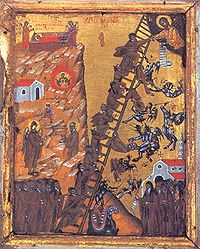
The use of the Jesus Prayer is recommended in the Ladder of Divine Ascent of St. John Climacus
John Climacus
Saint John Climacus , also known as John of the Ladder, John Scholasticus and John Sinaites, was a 7th century Christian monk at the monastery on Mount Sinai. He is revered as a saint by the Roman Catholic, Oriental Orthodox, Eastern Orthodox and Eastern Catholic churches.We have almost no...
(ca.523–606) and in the work of St. Hesychios the Priest (ca. eighth century), Pros Theodoulon, found in the first volume of the Philokalia. Ties to a similar prayer practice and theology appear in the fourteenth century work of an unknown English monk The Cloud of Unknowing
The Cloud of Unknowing
The Cloud of Unknowing is an anonymous work of Christian mysticism written in Middle English in the latter half of the 14th century. The text is a spiritual guide on contemplative prayer in the late Middle Ages.Manuscripts of the work are today at British Library and Cambridge University Library...
. The use of the Jesus Prayer according to the tradition of the Philokalia is the subject of the nineteenth century anonymous Russian spiritual classic The Way of a Pilgrim
The Way of a Pilgrim
The Way of a Pilgrim is the English title of a 19th century Russian work, recounting the narrator's journey as a mendicant pilgrim across Russia while practicing the Jesus Prayer. It is unknown if the book is literally an account of a single pilgrim, or if it uses a fictional pilgrim's journey as a...
.
Though the Jesus Prayer has been practiced through the centuries as part of the Eastern tradition, in the twentieth century it also began to be used in some Western churches, including some Roman Catholic and Anglican churches.
Theology
The hesychasticHesychasm
Hesychasm is an eremitic tradition of prayer in the Eastern Orthodox Church, and some of the Eastern Catholic Churches, such as the Byzantine Rite, practised by the Hesychast Hesychasm is an eremitic tradition of prayer in the Eastern Orthodox Church, and some of the Eastern Catholic Churches,...
practice of the Jesus Prayer is founded on the biblical view by which God's name is conceived as the place of his presence. The Eastern Orthodox mysticism has no images or representations. The mystical practice (the prayer and the meditation) doesn't lead to perceiving representations of God (see below Palamism). Thus, the most important means of a life consecrated to praying is the invoked name of God, as it is emphasized since the fifth century by the Thebaid
Thebaid
The Thebaid or Thebais is the region of ancient Egypt containing the thirteen southernmost nomes of Upper Egypt, from Abydos to Aswan. It acquired its name from its proximity to the ancient Egyptian capital of Thebes....
anchorites
Hermit
A hermit is a person who lives, to some degree, in seclusion from society.In Christianity, the term was originally applied to a Christian who lives the eremitic life out of a religious conviction, namely the Desert Theology of the Old Testament .In the...
, or by the later Athonite
Mount Athos
Mount Athos is a mountain and peninsula in Macedonia, Greece. A World Heritage Site, it is home to 20 Eastern Orthodox monasteries and forms a self-governed monastic state within the sovereignty of the Hellenic Republic. Spiritually, Mount Athos comes under the direct jurisdiction of the...
hesychasts
Hesychasm
Hesychasm is an eremitic tradition of prayer in the Eastern Orthodox Church, and some of the Eastern Catholic Churches, such as the Byzantine Rite, practised by the Hesychast Hesychasm is an eremitic tradition of prayer in the Eastern Orthodox Church, and some of the Eastern Catholic Churches,...
. For the Eastern Orthodox the power of the Jesus Prayer comes not only from its content, but from the very invocation of Jesus' name.
Scriptural roots
Theologically, the Jesus Prayer is considered to be the response of the Holy Tradition to the lesson taught by the parable of the Publican and the PhariseePharisee and the Publican
The parable of the Pharisee and the Publican , is a parable of Jesus that appears in only one of the Canonical gospels of the New Testament. According to , a Pharisee, obsessed by his own virtue, is contrasted with a tax collector who humbly asks God for mercy.This parable demonstrates the need to...
, in which the Pharisee demonstrates the improper way to pray by exclaiming: "Thank you Lord that I am not like the Publican", whereas the Publican prays correctly in humility, saying "Lord have mercy on me, a sinner" .
Palamism, the underlying theology
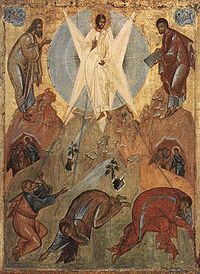
Essence-Energies distinction
A real distinction between the essence and the energies of God is a central principle of Eastern Orthodox theology. Eastern Orthodox theology regards this distinction as more than a mere conceptual distinction...
, a central principle in Eastern Orthodox theology, was first formulated by St Gregory of Nyssa
Gregory of Nyssa
St. Gregory of Nyssa was a Christian bishop and saint. He was a younger brother of Basil the Great and a good friend of Gregory of Nazianzus. His significance has long been recognized in the Eastern Orthodox, Oriental Orthodox, Eastern Catholic and Roman Catholic branches of Christianity...
and developed by St. Gregory Palamas
Gregory Palamas
Gregory Palamas was a monk of Mount Athos in Greece and later the Archbishop of Thessaloniki known as a preeminent theologian of Hesychasm. The teachings embodied in his writings defending Hesychasm against the attack of Barlaam are sometimes referred to as Palamism, his followers as Palamites...
in the fourteenth century in support of the mystical practices of Hesychasm
Hesychasm
Hesychasm is an eremitic tradition of prayer in the Eastern Orthodox Church, and some of the Eastern Catholic Churches, such as the Byzantine Rite, practised by the Hesychast Hesychasm is an eremitic tradition of prayer in the Eastern Orthodox Church, and some of the Eastern Catholic Churches,...
and against Barlaam of Seminara. It stands that God's essence ' onMouseout='HidePop("24340")' href="/topics/Ousia">ousia
Ousia
Ousia is the Ancient Greek noun formed on the feminine present participle of ; it is analogous to the English participle being, and the modern philosophy adjectival ontic...
) is distinct from God's energies, or manifestations in the world, by which men can experience the Divine. The energies are "unbegotten" or "uncreated". They were revealed in various episodes of the Bible
Bible
The Bible refers to any one of the collections of the primary religious texts of Judaism and Christianity. There is no common version of the Bible, as the individual books , their contents and their order vary among denominations...
: the burning bush
Burning bush
The burning bush is an object described by the Book of Exodus as being located on Mount Sinai; according to the narrative, the bush was on fire, but was not consumed by the flames, hence the name...
seen by Moses
Moses
Moses was, according to the Hebrew Bible and Qur'an, a religious leader, lawgiver and prophet, to whom the authorship of the Torah is traditionally attributed...
, the Light
Tabor Light
In Eastern Orthodox theology, the Tabor Light is the light revealed on Mount Tabor at the Transfiguration of Jesus, identified with the light seen by Paul at his conversion.As a theological doctrine, the uncreated nature of the Light of...
on Mount Tabor
Mount Tabor
-Places:*Mount Tabor, a hill in Israel near Nazareth believed by many to be the site of the Transfiguration of ChristIn the United States:*Mount Tabor, Indiana, an unincorporated community...
at the Transfiguration
Transfiguration of Jesus
The Transfiguration of Jesus is an event reported in the New Testament in which Jesus is transfigured and becomes radiant upon a mountain. The Synoptic Gospels describe it, and 2 Peter 1:16-18 refers to it....
.
Apophatism (negative theology) is the main characteristic of the Eastern theological tradition. Incognoscibility isn't conceived as agnosticism
Agnosticism
Agnosticism is the view that the truth value of certain claims—especially claims about the existence or non-existence of any deity, but also other religious and metaphysical claims—is unknown or unknowable....
or refusal to know God, because the Eastern theology isn't concerned with abstract concepts; it is contemplative, with a discourse on things above rational understanding. Therefore dogmas are often expressed antinomically. This form of contemplation, is experience of God, illumination
Lighting
Lighting or illumination is the deliberate application of light to achieve some practical or aesthetic effect. Lighting includes the use of both artificial light sources such as lamps and light fixtures, as well as natural illumination by capturing daylight...
called the Vision of God or in Greek theoria
Theoria
For other uses of the term "contemplation", see Contemplation Theoria is Greek for contemplation. It corresponds to the Latin word contemplatio, "looking at", "gazing at", "being aware of".- Introduction :...
.
For the Eastern Orthodox the knowledge or noesis of the uncreated energies is usually linked to apophatism.
Repentance in Eastern Orthodoxy
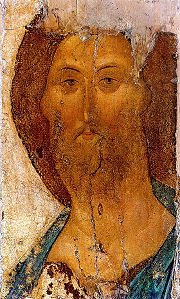
Atonement (satisfaction view)
The satisfaction view of the atonement is a doctrine in Christian theology related to the meaning and effect of the death of Jesus Christ and has been traditionally taught in Catholic, Lutheran, and Reformed circles...
of atonement for sin as articulated in the West
Western Christianity
Western Christianity is a term used to include the Latin Rite of the Catholic Church and groups historically derivative thereof, including the churches of the Anglican and Protestant traditions, which share common attributes that can be traced back to their medieval heritage...
, firstly by Anselm of Canterbury
Anselm of Canterbury
Anselm of Canterbury , also called of Aosta for his birthplace, and of Bec for his home monastery, was a Benedictine monk, a philosopher, and a prelate of the church who held the office of Archbishop of Canterbury from 1093 to 1109...
(as debt of honor) and Thomas Aquinas
Thomas Aquinas
Thomas Aquinas, O.P. , also Thomas of Aquin or Aquino, was an Italian Dominican priest of the Catholic Church, and an immensely influential philosopher and theologian in the tradition of scholasticism, known as Doctor Angelicus, Doctor Communis, or Doctor Universalis...
(as a moral debt). The terms used in the East are less legalistic (grace, punishment), and more medical (sickness, healing) with less exacting precision. Sin, therefore, does not carry with it the guilt for breaking a rule, but rather the impetus to become something more than what men usually are. One repents not because one is or isn't virtuous, but because human nature can change. Repentance ' onMouseout='HidePop("40677")' href="/topics/Metanoia_(theology)">metanoia
Metanoia (theology)
Metanoia in the context of theological discussion, where it is used often, is usually interpreted to mean repentance...
, "changing one's mind") isn't remorse, justification, or punishment, but a continual enactment of one's freedom, deriving from renewed choice and leading to restoration (the return to man's original state). This is reflected in the Mystery of Confession
Confession
This article is for the religious practice of confessing one's sins.Confession is the acknowledgment of sin or wrongs...
for which, not being limited to a mere confession of sins and presupposing recommendations or penalties, it is primarily that the priest acts in his capacity of spiritual father. The Mystery of Confession is linked to the spiritual development of the individual, and relates to the practice of choosing an elder to trust as his or her spiritual guide, turning to him for advice on the personal spiritual development, confessing sins, and asking advice.
As stated at the local Council of Constantinople in 1157, Christ brought his redemptive sacrifice not to the Father
God the Father
God the Father is a gendered title given to God in many monotheistic religions, particularly patriarchal, Abrahamic ones. In Judaism, God is called Father because he is the creator, life-giver, law-giver, and protector...
alone, but to the Trinity
Trinity
The Christian doctrine of the Trinity defines God as three divine persons : the Father, the Son , and the Holy Spirit. The three persons are distinct yet coexist in unity, and are co-equal, co-eternal and consubstantial . Put another way, the three persons of the Trinity are of one being...
as a whole. In the Eastern Orthodox theology redemption isn't seen as ransom. It is the reconciliation of God with man, the manifestation of God’s love for humanity. Thus, it is not the anger of God the Father but His love that lies behind the sacrificial death of his son on the cross.
The redemption of man is not considered to have taken place only in the past, but continues to this day through theosis
Theosis
In Christian theology, divinization, deification, making divine or theosis is the transforming effect of divine grace. This concept of salvation is historical and fundamental for Christian understanding that is prominent in the Eastern Orthodox Church and also in the Catholic Church, and is a...
. The initiative belongs to God, but presupposes man's active acceptance (not an action only, but an attitude), which is a way of perpetually receiving God.
Distinctiveness from analogues in other religions
The practice of contemplative or meditative chanting is known in several religions including BuddhismBuddhism
Buddhism is a religion and philosophy encompassing a variety of traditions, beliefs and practices, largely based on teachings attributed to Siddhartha Gautama, commonly known as the Buddha . The Buddha lived and taught in the northeastern Indian subcontinent some time between the 6th and 4th...
, Hinduism
Hinduism
Hinduism is the predominant and indigenous religious tradition of the Indian Subcontinent. Hinduism is known to its followers as , amongst many other expressions...
, and Islam
Islam
Islam . The most common are and . : Arabic pronunciation varies regionally. The first vowel ranges from ~~. The second vowel ranges from ~~~...
(e.g. japa
Japa
Japa is a spiritual discipline involving the meditative repetition of a mantra or name of a divine power. The mantra or name may be spoken softly, enough for the practitioner to hear it, or it may be spoken purely within the recitor's mind...
, zikr). The form of internal contemplation involving profound inner transformations affecting all the levels of the self is common to the traditions that posit the ontological value of personhood. The history of these practices, including their possible spread from one religion to another, is not well understood. Such parallels (like between unusual psycho-spiritual experiences, breathing practices, postures, spiritual guidances of elders, peril warnings) might easily have arisen independently of one another, and in any case must be considered within their particular religious frameworks.
Although some aspects of the Jesus Prayer may resemble some aspects of other traditions, its Christian character is central rather than mere "local color." The aim of the Christian practicing it is not limited to attaining humility, love, or purification of sinful thoughts, but rather it is becoming holy and seeking union with God (theosis
Theosis
In Christian theology, divinization, deification, making divine or theosis is the transforming effect of divine grace. This concept of salvation is historical and fundamental for Christian understanding that is prominent in the Eastern Orthodox Church and also in the Catholic Church, and is a...
), which subsumes all the aforementioned virtues. Thus, for the Eastern Orthodox:
- The Jesus Prayer is, first of all, a prayer addressed to God. It's not a means of self-deifying or self-deliverance, but a counterexample to Adam's pride, repairing the breach it produced between man and God.
- The aim is not to be dissolved or absorbed into nothingness or into God, or reach another state of mind, but to (re)unite with God (which by itself is a process) while remaining a distinct person.
- It is an invocation of Jesus' name, because Christian anthropologyChristian anthropologyIn the context of Christian theology, theological anthropology refers to the study of the human as it relates to God. It differs from the social science of anthropology, which primarily deals with the comparative study of the physical and social characteristics of humanity across times and...
and soteriologySoteriologyThe branch of Christian theology that deals with salvation and redemption is called Soteriology. It is derived from the Greek sōtērion + English -logy....
are strongly linked to ChristologyChristologyChristology is the field of study within Christian theology which is primarily concerned with the nature and person of Jesus Christ as recorded in the Canonical gospels and the letters of the New Testament. Primary considerations include the relationship of Jesus' nature and person with the nature...
in Orthodox monasticism. - In a modern context the continuing repetition is regarded by some as a form of meditationMeditationMeditation is any form of a family of practices in which practitioners train their minds or self-induce a mode of consciousness to realize some benefit....
, the prayer functioning as a kind of mantraMantraA mantra is a sound, syllable, word, or group of words that is considered capable of "creating transformation"...
. However, Orthodox users of the Jesus Prayer emphasize the invocation of the name of Jesus Christ that St Hesychios describes in Pros Theodoulon which would be contemplationContemplationThe word contemplation comes from the Latin word contemplatio. Its root is also that of the Latin word templum, a piece of ground consecrated for the taking of auspices, or a building for worship, derived either from Proto-Indo-European base *tem- "to cut", and so a "place reserved or cut out" or...
on the Triune God rather than simply emptying the mind. - Acknowledging "a sinner" is to lead firstly to a state of humbleness and repentance, recognizing one's own sinfulness.
- Practicing the Jesus Prayer is strongly linked to mastering passions of both soul and body, e.g. by fasting. For the Eastern Orthodox not the body is wicked, but "the bodily way of thinking" is; therefore salvationSalvationWithin religion salvation is the phenomenon of being saved from the undesirable condition of bondage or suffering experienced by the psyche or soul that has arisen as a result of unskillful or immoral actions generically referred to as sins. Salvation may also be called "deliverance" or...
also regards the body. - Unlike "seed syllables" in particular traditions of chanting mantraMantraA mantra is a sound, syllable, word, or group of words that is considered capable of "creating transformation"...
s, the Jesus Prayer may be translated into whatever language the pray-er customarily uses. The emphasis is on the meaning, not on the mere utterance of certain sounds. - There is no emphasis on the psychosomatic techniques, which are merely seen as helpers for uniting the mind with the heart, not as prerequisites.
A magistral way of meeting God for the Eastern Orthodox, the Jesus Prayer does not harbor any secrets in itself, nor does its practice reveal any esoteric truths. Instead, as a hesychastic
Hesychasm
Hesychasm is an eremitic tradition of prayer in the Eastern Orthodox Church, and some of the Eastern Catholic Churches, such as the Byzantine Rite, practised by the Hesychast Hesychasm is an eremitic tradition of prayer in the Eastern Orthodox Church, and some of the Eastern Catholic Churches,...
practice, it demands setting the mind apart from rational activities and ignoring the physical senses for the experiential knowledge of God. It stands along with the regular expected actions of the believer (prayer, almsgiving, repentance, fasting etc.) as the response of the Orthodox Tradition to St. Paul's challenge to "pray without ceasing" . It is also linked to the Song of Solomon
Song of Solomon
The Song of Songs of Solomon, commonly referred to as Song of Songs or Song of Solomon, is a book of the Hebrew Bible—one of the megillot —found in the last section of the Tanakh, known as the Ketuvim...
's passage from the Old Testament
Old Testament
The Old Testament, of which Christians hold different views, is a Christian term for the religious writings of ancient Israel held sacred and inspired by Christians which overlaps with the 24-book canon of the Masoretic Text of Judaism...
: "I sleep, but my heart is awake" (Song of Solomon 5:2). The analogy being that as a lover is always conscious to his or her beloved, people can also achieve a state of "constant prayer" where they are always conscious of God's presence in their lives.
Practice
"There isn't Christian MysticismMysticism
Mysticism is the knowledge of, and especially the personal experience of, states of consciousness, i.e. levels of being, beyond normal human perception, including experience and even communion with a supreme being.-Classical origins:...
without Theology
Theology
Theology is the systematic and rational study of religion and its influences and of the nature of religious truths, or the learned profession acquired by completing specialized training in religious studies, usually at a university or school of divinity or seminary.-Definition:Augustine of Hippo...
, especially there isn't Theology without Mysticism", writes Vladimir Lossky
Vladimir Lossky
Vladimir Nikolayevich Lossky was an influential Eastern Orthodox theologian in exile from Russia. He emphasized theosis as the main principle of Orthodox Christianity....
, for outside the Church the personal experience would have no certainty and objectivity, and "Church teachings would have no influence on souls without expressing a somehow inner experience of the truth it offers". For the Eastern Orthodox the aim isn't knowledge itself; theology is, finally, always a means serving a goal above any knowledge: theosis
Theosis
In Christian theology, divinization, deification, making divine or theosis is the transforming effect of divine grace. This concept of salvation is historical and fundamental for Christian understanding that is prominent in the Eastern Orthodox Church and also in the Catholic Church, and is a...
.
The individual experience of the Eastern Orthodox mystic most often remains unknown. With very few exceptions, there aren't autobiographical writings on the inner life in the East. The mystical union pathway remains hidden, being unveiled only to the confessor or to the apprentices. "The mystical individualism has remained unknown to the spiritual life of the Eastern Church", remarks Lossky.
The practice of the Jesus Prayer is integrated into the mental ascesis
Asceticism
Asceticism describes a lifestyle characterized by abstinence from various sorts of worldly pleasures often with the aim of pursuing religious and spiritual goals...
undertaken by the Orthodox monastic
Monasticism
Monasticism is a religious way of life characterized by the practice of renouncing worldly pursuits to fully devote one's self to spiritual work...
in the practice of hesychasm
Hesychasm
Hesychasm is an eremitic tradition of prayer in the Eastern Orthodox Church, and some of the Eastern Catholic Churches, such as the Byzantine Rite, practised by the Hesychast Hesychasm is an eremitic tradition of prayer in the Eastern Orthodox Church, and some of the Eastern Catholic Churches,...
. Yet the Jesus Prayer is not limited only to monastic life or to clergy. All members of the Christian Church are advised to practice this prayer, laypeople and clergy, men, women and children.
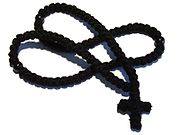
Prayer rope
A prayer rope is a loop made up of complex knots, usually out of wool or silk....
(Russian: chotki; Greek: komvoskini), which is a cord, usually woolen, tied with many knots. The person saying the prayer says one repetition for each knot. It may be accompanied by prostrations and the sign of the cross
Sign of the cross
The Sign of the Cross , or crossing oneself, is a ritual hand motion made by members of many branches of Christianity, often accompanied by spoken or mental recitation of a trinitarian formula....
, signaled by beads strung along the prayer rope at intervals.
The prayer rope is "a tool of prayer". The use of the prayer rope, however, is not compulsory and it is considered as an aid to the beginners or the "weak" practitioners, those who face difficulties practicing the Prayer.
It should be noted here that the Jesus Prayer is ideally practiced under the guidance and supervision of a spiritual guide (pneumatikos) especially when Psychosomatic techniques (like rhythmical breath) are incorporated. A person that acts as a spiritual "father" and advisor. Usually an officially certified by the Church Confessor
Confessor
-Confessor of the Faith:Its oldest use is to indicate a saint who has suffered persecution and torture for the faith, but not to the point of death. The term is still used in this way in the East. In Latin Christianity it has come to signify any saint, as well as those who have been declared...
(Pneumatikos Exolmologitis) or sometimes a spiritually experienced monk (called in Greek
Greek language
Greek is an independent branch of the Indo-European family of languages. Native to the southern Balkans, it has the longest documented history of any Indo-European language, spanning 34 centuries of written records. Its writing system has been the Greek alphabet for the majority of its history;...
Gerontas (Elder
Elder (Christianity)
An elder in Christianity is a person valued for his wisdom who accordingly holds a particular position of responsibility in a Christian group. In some Christian traditions an elder is a clergy person who usually serves a local church or churches and who has been ordained to a ministry of Word,...
) or in Russian Starets
Starets
A starets is an elder of a Russian Orthodox monastery who functions as venerated adviser and teacher. Elders or spiritual fathers are charismatic spiritual leaders whose wisdom stems from God as obtained from ascetic experience...
). It is not impossible for that person to be a layperson, usually a "Practical Theologician" (i.e. a person well versed in Orthodox Theology but without official credentials, certificates, diplomas etc.) but this is not a common practice either or at least it is not commonly advertised as ideal.
Techniques
There are not fixed, invariable rules for those who pray, "the way there is no mechanical, physical or mental technique which can force God to show his presence" (MetropolitanMetropolitan bishop
In Christian churches with episcopal polity, the rank of metropolitan bishop, or simply metropolitan, pertains to the diocesan bishop or archbishop of a metropolis; that is, the chief city of a historical Roman province, ecclesiastical province, or regional capital.Before the establishment of...
Kallistos Ware).
People who say the prayer as part of meditation often synchronize it with their breathing; breathing in while calling out to God (Lord Jesus Christ, Son of God) and breathing out while praying for mercy (have mercy on me, a sinner). Another option is to say (orally or mentally) the whole prayer while breathing in and again the whole prayer while breathing out and yet another, to breathe in recite the whole prayer, breathe out while reciting the whole prayer again. One can also hold the breath for a few seconds between breathing in and out. It is advised, in any of these three last cases, that this be done under some kind of spiritual guidance and supervision.
Monks often pray this prayer many hundreds of times each night as part of their private cell vigil ("cell rule"). Under the guidance of an Elder (Russian Starets
Starets
A starets is an elder of a Russian Orthodox monastery who functions as venerated adviser and teacher. Elders or spiritual fathers are charismatic spiritual leaders whose wisdom stems from God as obtained from ascetic experience...
; Greek Gerondas), the monk aims to internalize the prayer, so that he is praying unceasingly. St. Diadochos of Photiki refers in On Spiritual Knowledge and Discrimination to the automatic repetition of the Jesus Prayer, under the influence of the Holy Spirit
Holy Spirit
Holy Spirit is a term introduced in English translations of the Hebrew Bible, but understood differently in the main Abrahamic religions.While the general concept of a "Spirit" that permeates the cosmos has been used in various religions Holy Spirit is a term introduced in English translations of...
, even in sleep. This state is regarded as the accomplishment of Saint Paul's exhortation to the Thessalonians to "pray without ceasing" .
The Jesus Prayer can also be used for a kind of "psychological" self-analysis. According to the "Way of the Pilgrim" account and Mount Athos practitioners of the Jesus Prayer, "one can have some insight on his or her current psychological situation by observing the intonation of the words of the prayer, as they are recited. Which word is stressed most. This self-analysis could reveal to the praying person things about their inner state and feelings, maybe not yet realised, of their unconsciousness."
"While praying the Jesus Prayer, one might notice that sometimes the word “Lord” is pronounced louder, more stressed, than the others, like: LORD Jesus Christ, (Son of God), have mercy on me, (a/the sinner). In this case, they say, it means that our inner self is currently more aware of the fact that Jesus is the Lord, maybe because we need reassurance that he is in control of everything (and our lives too). Other times, the stressed word is “Jesus”: Lord JESUS Christ, (Son of God), have mercy on me, (a/the sinner). In that case, they say, we feel the need to personally appeal more to his human nature, the one that is more likely to understands our human problems and shortcomings, maybe because we are going through tough personal situations. Likewise if the word “Christ” is stressed it could be that we need to appeal to Jesus as Messiah and Mediator, between humans and God the Father, and so on. When the word “Son” is stressed maybe we recognise more Jesus’ relationship with the Father. If “of God” is stressed then we could realise more Jesus’ unity with the Father. A stressed “have mercy on me” shows a specific, or urgent, need for mercy. A stressed “a sinner” (or “the sinner”) could mean that there is a particular current realisation of the sinful human nature or a particular need for forgiveness."
"In order to do this kind of self-analysis one should better start reciting the prayer relaxed and naturally for a few minutes – so the observation won’t be consciously “forced”, and then to start paying attention to the intonation as described above.
Also, a person might want to consciously stress one of the words of the prayer in particular when one wants to express a conscious feeling of situation. So in times of need stressing the “have mercy” part can be more comforting or more appropriate. In times of failures, the “a sinner” part, etc.…)."
Levels of the prayer
Russia
Russia or , officially known as both Russia and the Russian Federation , is a country in northern Eurasia. It is a federal semi-presidential republic, comprising 83 federal subjects...
n philosopher and theologian, writes about beginner's way of praying: initially, the prayer is excited because the man is emotive and a flow of psychic contents is expressed. In his view this condition comes, for the modern men, from the separation of the mind from the heart: "The prattle spreads the soul, while the silence is drawing it together." Old fathers condemned elaborate phraseologies, for one word was enough for the publican, and one word saved the thief on the cross. They only uttered Jesus' name by which they were contemplating God. For Evdokimov the acting faith denies any formalism which quickly installs in the external prayer or in the life duties; he quotes St. Seraphim
Seraphim of Sarov
Saint Seraphim of Sarov , born Prokhor Moshnin , is one of the most renowned Russian monks and mystics in the Orthodox Church. He is generally considered the greatest of the 19th century startsy and, arguably, the first...
: "The prayer is not thorough if the man is self-conscious and he is aware he's praying."
"Because the prayer is a living reality, a deeply personal encounter with the living God, it is not to be confined to any given classification or rigid analysis" an on-line catechism reads. As general guidelines for the practitioner, different number of levels (3, 7 or 9) in the practice of the prayer are distinguished by Orthodox fathers. They are to be seen as being purely informative, because the practice of the Prayer of the Heart is learned under personal spiritual guidance in Eastern Orthodoxy which emphasizes the perils of temptations when it's done by one's own. Thus, Theophan the Recluse
Theophan the Recluse
St. Theophan the Recluse, also known as "Theophan Zatvornik" or "Theophanes the Recluse" , is a well-known saint in the Russian Orthodox Church. He was born George Vasilievich Govorov, in the village of Chernavsk. His father was a Russian Orthodox priest. He was educated in the seminaries at...
, a nineteenth century Russian
Russian Orthodox Church
The Russian Orthodox Church or, alternatively, the Moscow Patriarchate The ROC is often said to be the largest of the Eastern Orthodox churches in the world; including all the autocephalous churches under its umbrella, its adherents number over 150 million worldwide—about half of the 300 million...
spiritual writer, talks about three stages:
- The oral prayer (the prayer of the lips) is a simple recitation, still external to the practitioner.
- The focused prayer, when "the mind is focused upon the words" of the prayer, "speaking them as if they were our own."
- The prayer of the heart itself, when the prayer is no longer something we do but who we are.
Once this is achieved the Jesus Prayer is said to become "self-active" . It is repeated automatically and unconsciously by the mind, having a Tetris Effect
Tetris effect
The Tetris effect occurs when people devote sufficient time and attention to an activity that it begins to overshadow their thoughts, mental images, and dreams...
, like a (beneficial) Earworm
Earworm
Earworm, a loan translation of the German Ohrwurm, is a portion of a song or other music that repeats compulsively within one's mind, put colloquially as "music being stuck in one's head."...
. Body, through the uttering of the prayer, mind, through the mental repetition of the prayer, are thus unified with "the heart" (spirit) and the prayer becomes constant, ceaselessly "playing" in the background of the mind, like a background music, without hindering the normal everyday activities of the person.
Others, like Father Archimandrite
Archimandrite
The title Archimandrite , primarily used in the Eastern Orthodox and the Eastern Catholic churches, originally referred to a superior abbot whom a bishop appointed to supervise...
Ilie Cleopa, one of the most representative spiritual fathers of contemporary Romanian Orthodox
Romanian Orthodox Church
The Romanian Orthodox Church is an autocephalous Eastern Orthodox church. It is in full communion with other Eastern Orthodox churches, and is ranked seventh in order of precedence. The Primate of the church has the title of Patriarch...
monastic spirituality, talk about nine levels (see External links). They are the same path to theosis
Theosis
In Christian theology, divinization, deification, making divine or theosis is the transforming effect of divine grace. This concept of salvation is historical and fundamental for Christian understanding that is prominent in the Eastern Orthodox Church and also in the Catholic Church, and is a...
, more slenderly differentiated:
- The prayer of the lips.
- The prayer of the mouth.
- The prayer of the tongue.
- The prayer of the voice.
- The prayer of the mind.
- The prayer of the heart.
- The active prayer.
- The all-seeing prayer.
- The contemplative prayer.
In its more advanced use, the monk aims to attain to a sober practice of the Jesus Prayer in the heart free of images. It is from this condition, called by Saints John Climacus
John Climacus
Saint John Climacus , also known as John of the Ladder, John Scholasticus and John Sinaites, was a 7th century Christian monk at the monastery on Mount Sinai. He is revered as a saint by the Roman Catholic, Oriental Orthodox, Eastern Orthodox and Eastern Catholic churches.We have almost no...
and Hesychios the "guard of the mind," that the monk is raised by the Divine grace
Divine grace
In Christian theology, grace is God’s gift of God’s self to humankind. It is understood by Christians to be a spontaneous gift from God to man - "generous, free and totally unexpected and undeserved" - that takes the form of divine favour, love and clemency. It is an attribute of God that is most...
to contemplation.
Roman Catholic comparison
An interesting comparison in the Roman canon is to be found in Jan van Ruysbroeck's poem "The 12 Béguines", which similarly exemplarises the shedding of distractions such as personal concerns through a common meditative focus.Variants of repetitive formulas
A number of different repetitive prayer formulas have been attested in the history of Eastern Orthodox monasticism: the Prayer of St. Ioannikios the Great (754–846): "My hope is the Father, my refuge is the Son, my shelter is the Holy Ghost, O Holy Trinity, Glory to You," the repetitive use of which is described in his Life; or the more recent practice of St. Nikolaj Velimirović.Similarly to the flexibility of the practice of the Jesus Prayer, there is no imposed standardization of its form. The prayer can be from as short as "Lord, have mercy" (Kyrie eleison), "Have mercy on me" ("Have mercy on us"), or even "Jesus," to its longer most common form. It can also contain a call to the Theotokos
Theotokos
Theotokos is the Greek title of Mary, the mother of Jesus used especially in the Eastern Orthodox, Oriental Orthodox, and Eastern Catholic Churches. Its literal English translations include God-bearer and the one who gives birth to God. Less literal translations include Mother of God...
(Virgin Mary), or to the saints. The single essential and invariable element is Jesus' name.
- Lord Jesus Christ, Son of God, have mercy on me, a sinner. (a very common form) (Sometimes "" is translated "a sinner" but in Greek the article "" is a definite article, so it could be translated "the sinner.")
- Lord Jesus Christ, Son of God, have mercy on me. (a very common form in the Greek tradition)
- Lord Jesus Christ, have mercy on me. (common variant on Mount AthosMount AthosMount Athos is a mountain and peninsula in Macedonia, Greece. A World Heritage Site, it is home to 20 Eastern Orthodox monasteries and forms a self-governed monastic state within the sovereignty of the Hellenic Republic. Spiritually, Mount Athos comes under the direct jurisdiction of the...
)http://www.pelagia.org/htm/b01.en.a_night_in_the_desert_of_the_holy_mountain.05.htm - Jesus, have mercy.
- Lord Jesus Christ, Son of God, have mercy on us.
- Lord Jesus Christ, Son of the living God, have mercy on me, a sinner.
In art
The Jesus Prayer is a core part of the plot in J. D. SalingerJ. D. Salinger
Jerome David Salinger was an American author, best known for his 1951 novel The Catcher in the Rye, as well as his reclusive nature. His last original published work was in 1965; he gave his last interview in 1980....
's pair of stories Franny and Zooey
Franny and Zooey
Franny and Zooey is a book by American author J.D. Salinger which comprises his short story, "Franny", and novella, Zooey. The two works were published together as a book in 1961; the two stories originally appeared in The New Yorker in 1955 and 1957, respectively...
. It is also a central theme of the 2006 Russian film Ostrov
Ostrov (film)
Ostrov is a 2006 Russian biographical film about a fictional 20th century Eastern Orthodox monk. The film closed the 2006 Venice Film Festival, proved to be a moderate box-office success and won both the Nika Award and the Golden Eagle Award as the Best Russian film of 2006...
.
In the Catechism of the Catholic Church
The Part Four of the Catechism, which is dedicated to the Christian Prayer, devoted paragraphs 2665 to 2669 to the Jesus Prayer.Use by Protestants
In addition to Roman Catholics, many Christians of the Protestant Churches have also begun to use the Jesus Prayer. Primarily used among mainline Protestants, the Jesus Prayer is often used as a centering prayer or contemplative prayer. It is sometimes used by a variety of Protestants with the Anglican Rosary. Its structure and content also bears a strong resemblance to the "Sinners' Prayer" used by many Evangelical Protestant Christians.See also
- TheologyTheologyTheology is the systematic and rational study of religion and its influences and of the nature of religious truths, or the learned profession acquired by completing specialized training in religious studies, usually at a university or school of divinity or seminary.-Definition:Augustine of Hippo...
:- TheosisTheosisIn Christian theology, divinization, deification, making divine or theosis is the transforming effect of divine grace. This concept of salvation is historical and fundamental for Christian understanding that is prominent in the Eastern Orthodox Church and also in the Catholic Church, and is a...
(deification, the search of union with God) - Tabor LightTabor LightIn Eastern Orthodox theology, the Tabor Light is the light revealed on Mount Tabor at the Transfiguration of Jesus, identified with the light seen by Paul at his conversion.As a theological doctrine, the uncreated nature of the Light of...
(or Divine Light, or Palamism), doctrine finalized by St. Gregory PalamasGregory PalamasGregory Palamas was a monk of Mount Athos in Greece and later the Archbishop of Thessaloniki known as a preeminent theologian of Hesychasm. The teachings embodied in his writings defending Hesychasm against the attack of Barlaam are sometimes referred to as Palamism, his followers as Palamites...
arguing for God's Essence-Energies distinctionEssence-Energies distinctionA real distinction between the essence and the energies of God is a central principle of Eastern Orthodox theology. Eastern Orthodox theology regards this distinction as more than a mere conceptual distinction...
- Theosis
- AsceticismAsceticismAsceticism describes a lifestyle characterized by abstinence from various sorts of worldly pleasures often with the aim of pursuing religious and spiritual goals...
:- HesychasmHesychasmHesychasm is an eremitic tradition of prayer in the Eastern Orthodox Church, and some of the Eastern Catholic Churches, such as the Byzantine Rite, practised by the Hesychast Hesychasm is an eremitic tradition of prayer in the Eastern Orthodox Church, and some of the Eastern Catholic Churches,...
(ascetical tradition of prayer) - CardiognosisCardiognosisIn Christian theology, cardiognosis is a special charism that God confers on some saints. In Christian asceticism, the term Cardiognosis also indicates the ascetical methods and meditation techniques which have the purpose of reaching an inner state of mystical experience and, eventually, the...
(ascetical method) - HermitHermitA hermit is a person who lives, to some degree, in seclusion from society.In Christianity, the term was originally applied to a Christian who lives the eremitic life out of a religious conviction, namely the Desert Theology of the Old Testament .In the...
(solitary monk); StaretsStaretsA starets is an elder of a Russian Orthodox monastery who functions as venerated adviser and teacher. Elders or spiritual fathers are charismatic spiritual leaders whose wisdom stems from God as obtained from ascetic experience...
(elder teacher, in Russian tradition)
- Hesychasm
- PrayingPrayerPrayer is a form of religious practice that seeks to activate a volitional rapport to a deity through deliberate practice. Prayer may be either individual or communal and take place in public or in private. It may involve the use of words or song. When language is used, prayer may take the form of...
:- Kyrie eleisonKyrieKyrie, a transliteration of Greek κύριε , vocative case of κύριος , meaning "Lord", is the common name of an important prayer of Christian liturgy, which is also called the Kýrie, eléison ....
(Greek: Lord, have mercy), prayer of Christian liturgy - Prayer in ChristianityPrayer in ChristianityPrayer has been an essential part of Christianity since its earliest days. Prayer is an integral element of the Christian faith and permeates all forms of Christian worship...
- Prayer beadsPrayer beadsPrayer beads are used by members of various religious traditions such as Roman Catholicism, Orthodox Christianity, Anglicanism, Islam, Hinduism, Buddhism, Sikhism and Bahá'í Faith to count the repetitions of prayers, chants or devotions, such as the rosary of Virgin Mary in Christianity and dhikr ...
; Prayer ropePrayer ropeA prayer rope is a loop made up of complex knots, usually out of wool or silk....
; Prayerbook; PoustiniaPoustiniaA poustinia is a small sparsely furnished cabin or room where one goes to pray and fast alone in the presence of God. The word poustinia has its origin in the Russian word for desert...
(prayer room)
- Kyrie eleison
- Holy Name of JesusHoly Name of JesusIn Christianity, the Holy Name of Jesus refers to the theological and devotional use of the name of Jesus. The reverence and affection with which Christians have regarded the Holy Name of Jesus goes back to the earliest days of Christianity....
- ImiaslavieImiaslavieImiaslavie or Imiabozhie , also spelled imyaslavie and imyabozhie, and also referred to as onomatodoxy, is a dogmatic movement which was condemned by the Russian Orthodox Church, but that is still promoted by some affiliated with Gregory Lourie of the "Russian Orthodox Autonomous Church" , and by...
(Russian dogmatic movement) - Mystic prayer
- RosaryRosaryThe rosary or "garland of roses" is a traditional Catholic devotion. The term denotes the prayer beads used to count the series of prayers that make up the rosary...
(similar Roman CatholicRoman Catholic ChurchThe Catholic Church, also known as the Roman Catholic Church, is the world's largest Christian church, with over a billion members. Led by the Pope, it defines its mission as spreading the gospel of Jesus Christ, administering the sacraments and exercising charity...
devotion) - Fatima PrayerFatima PrayerThe Fátima Prayer or Invocation is a common version of the Jesus Prayer used by Catholics. It, along with four other "Fátima prayers", originated during the Marian apparitions at Fátima, Portugal in 1917...
(Roman Catholic tradition) - Roman Catholic prayers to JesusRoman Catholic prayers to JesusA number of prayers to Jesus Christ exist within the Roman Catholic tradition. These prayers have diverse origins and forms. Some were attributed to visions of saints, others were handed down by tradition....
- Sacred heartSacred HeartThe Sacred Heart is one of the most famous religious devotions to Jesus' physical heart as the representation of His divine love for Humanity....
External links
- The Jesus Prayer by Fr. Steven Peter Tsichlis (Greek Orthodox Archdiocese of America)
- Saying the Jesus Prayer by Albert S Rossi (St. Vladimir's Orthodox Theological Seminary)
- The Jesus Prayer by Metropolitan Anthony Bloom
- On Practicing the Jesus Prayer by St. Ignatius BrianchaninovIgnatius BrianchaninovSaint Ignatius Brianchaninov is a saint in the Russian Orthodox Church. He was born Demetrius Alexandrovich Brianchaninov, to a wealthy landowning family. He was educated at Pioneer Military School in St. Petersburg. Although successful in his studies he was deeply dissatisfied with the lay life...
- Introduction to the Jesus Prayer by Mother Alexandra
- Prayer of Jesus or Prayer of the Heart by Archimandrite Fr. Jonah Mourtos
- The Power of the Name by Bishop Kallistos of Diokleia
- An Orthodox Christian Study on Unceasing Prayer by John K. Kotsonis, Ph.D.
- Becoming the Jesus Prayer by Fr. Michael Plekon
- The Jesus Prayer by Ken E. Norian, TSSF
- Hieromonk Ilie Cleopa preaching on the levels of the Prayer of the Heart (video)
- The Psychological Basis of Mental Prayer in the Heart (online book) by Fr. Theophanes (Constantine)
- The Jesus Prayer A site for gazing (English and Greek)
- Russian tradition in worship of God's Name and the Jesus Prayer
- On the Jesus Prayer Greek site in English with practical advice
- "Death to the World" an Orthodox Ascetic Website
- Praying the Jesus Prayer Guide for practice and numerous articles