
Home      Discussion      Topics      Dictionary      Almanac
Signup       Login
Psilocybe cubensis

Psilocybe cubensis

Overview
Psilocybe cubensis is a species of psychedelic mushroom
Psilocybin mushroom
Psilocybin mushrooms are fungi that contain the psychoactive compounds psilocybin and psilocin. There are multiple colloquial terms for psilocybin mushrooms, the most common being shrooms or magic mushrooms....

 whose principal active compounds are psilocybin
Psilocybin
Psilocybin is a naturally occurring psychedelic prodrug, with mind-altering effects similar to those of LSD and mescaline, after it is converted to psilocin. The effects can include altered thinking processes, perceptual distortions, an altered sense of time, and spiritual experiences, as well as...

 and psilocin
Psilocin
Psilocin , an aromatic compound, sometimes also spelled psilocine, psilocyn, or psilotsin, is a psychedelic mushroom alkaloid. It is found in most psychedelic mushrooms together with its phosphorylated counterpart psilocybin...

. Commonly called Boomers, Cubes or Gold Caps, it belongs to the Strophariaceae
Strophariaceae
The Strophariaceae are a family of fungi in the order Agaricales. The family contains 18 genera and 1316 species. The species of Strophariaceae have a red-brown to dark brown spore print, while the spores themselves are smooth and have an apical germ pore. These agarics are also characterized by...

 family of fungi and was previously known as Stropharia cubensis.
Discussion
Ask a question about 'Psilocybe cubensis'
Start a new discussion about 'Psilocybe cubensis'
Answer questions from other users
Full Discussion Forum
 
Unanswered Questions
Encyclopedia
Psilocybe cubensis is a species of psychedelic mushroom
Psilocybin mushroom
Psilocybin mushrooms are fungi that contain the psychoactive compounds psilocybin and psilocin. There are multiple colloquial terms for psilocybin mushrooms, the most common being shrooms or magic mushrooms....

 whose principal active compounds are psilocybin
Psilocybin
Psilocybin is a naturally occurring psychedelic prodrug, with mind-altering effects similar to those of LSD and mescaline, after it is converted to psilocin. The effects can include altered thinking processes, perceptual distortions, an altered sense of time, and spiritual experiences, as well as...

 and psilocin
Psilocin
Psilocin , an aromatic compound, sometimes also spelled psilocine, psilocyn, or psilotsin, is a psychedelic mushroom alkaloid. It is found in most psychedelic mushrooms together with its phosphorylated counterpart psilocybin...

. Commonly called Boomers, Cubes or Gold Caps, it belongs to the Strophariaceae
Strophariaceae
The Strophariaceae are a family of fungi in the order Agaricales. The family contains 18 genera and 1316 species. The species of Strophariaceae have a red-brown to dark brown spore print, while the spores themselves are smooth and have an apical germ pore. These agarics are also characterized by...

 family of fungi and was previously known as Stropharia cubensis.

Taxonomy and naming


The species was first described
Species description
A species description or type description is a formal description of a newly discovered species, usually in the form of a scientific paper. Its purpose is to give a clear description of a new species of organism and explain how it differs from species which have been described previously, or are...

 in 1906 as Stropharia cubensis by Franklin Sumner Earle
Franklin Sumner Earle
Franklin Sumner Earle was an American mycologist. He was the first mycologist to work at the New York Botanical Garden, and was the author of The Genera of North American Gill Fungi .-References:...

 in Cuba
Cuba
The Republic of Cuba is an island nation in the Caribbean. The nation of Cuba consists of the main island of Cuba, the Isla de la Juventud, and several archipelagos. Havana is the largest city in Cuba and the country's capital. Santiago de Cuba is the second largest city...

. In 1907 it was identified as Naematoloma caerulescens in Tonkin
Tonkin
Tonkin , also spelled Tongkin, Tonquin or Tongking, is the northernmost part of Vietnam, south of China's Yunnan and Guangxi Provinces, east of northern Laos, and west of the Gulf of Tonkin. Locally, it is known as Bắc Kỳ, meaning "Northern Region"...

 by Narcisse Théophile Patouillard
Narcisse Théophile Patouillard
Narcisse Théophile Patouillard was a French pharmacist and mycologist.He was born in Macornay, a town in the department of Jura...

, while in 1941 it was called Stropharia cyanescens by William Alphonso Murrill in Florida
Florida
Florida is a state in the southeastern United States, located on the nation's Atlantic and Gulf coasts. It is bordered to the west by the Gulf of Mexico, to the north by Alabama and Georgia and to the east by the Atlantic Ocean. With a population of 18,801,310 as measured by the 2010 census, it...

. These synonyms were later assigned to the species Psilocybe cubensis.

The name Psilocybe is derived from the Greek roots psilos (ψιλος) and kubê (κυβη), and translates as "bald head". Cubensis means "coming from Cuba", and refers to Cuba, the type locality published by Earle.

Description

  • Pileus
    Pileus (mycology)
    The pileus is the technical name for the cap, or cap-like part, of a basidiocarp or ascocarp that supports a spore-bearing surface, the hymenium. The hymenium may consist of lamellae, tubes, or teeth, on the underside of the pileus...

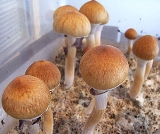
    : 2–8 cm, Conic to convex, becoming broadly convex to plane in age, may retain a slight umbo, margin even, reddish-cinnamon brown when young becoming golden brown in age, viscid when moist, hygrophanous
    Hygrophanous
    The adjective hygrophanous refers to the color change of mushroom tissue as it loses or absorbs water, which causes the pileipellis to become more transparent when wet and opaque when dry....

    , glabrous, sometimes with white universal veil remnants decorating the cap, more or less smooth. Flesh whitish, bruising blue in age or where injured.
  • Gills: Adnate to adnexed to sometimes seceding attachment, close, narrow to slightly wider towards the center, at first pallid to gray, becoming dark purplish to blackish in age, somewhat mottled, edges remaining whitish.
  • Spore Print: Blackish violet.
  • Stipe
    Stipe (mycology)
    thumb|150px|right|Diagram of a [[basidiomycete]] stipe with an [[annulus |annulus]] and [[volva |volva]]In mycology a stipe refers to the stem or stalk-like feature supporting the cap of a mushroom. Like all tissues of the mushroom other than the hymenium, the stipe is composed of sterile hyphal...

    : 4–15 cm long, .5–1.5 cm thick, white to yellowish in age, hollow or somewhat stuffed, the well developed veil leaves a persistent white membranous annulus whose surface usually becomes concolorous with the gills because of falling spores, bruising blue or bluish-green when injured.
  • Taste: Farinaceous
  • Odor: Farinaceous
  • Microscopic features: Spores 11.5–17 x 8–11 µm, subellipsoid, basidia 4-spored but sometimes 2- or 3-, pleurocystidia and cheilocystidia present.


It is in the section Cubensae, other mushrooms of this section include Psilocybe subcubensis
Psilocybe subcubensis
Psilocybe subcubensis is a species of mushroom in the Strophariaceae family. The mushroom contains the medicinal compound psilocybin....

.

Entheogenic use


Psilocybe cubensis is probably the most widely known of the psilocybin containing mushrooms used.
Its major psychoactive
Psychoactive drug
A psychoactive drug, psychopharmaceutical, or psychotropic is a chemical substance that crosses the blood–brain barrier and acts primarily upon the central nervous system where it affects brain function, resulting in changes in perception, mood, consciousness, cognition, and behavior...

 compounds are:
  • Psilocybin
    Psilocybin
    Psilocybin is a naturally occurring psychedelic prodrug, with mind-altering effects similar to those of LSD and mescaline, after it is converted to psilocin. The effects can include altered thinking processes, perceptual distortions, an altered sense of time, and spiritual experiences, as well as...

     (4-phosphoryloxy-N,N-dimethyltryptamine)
  • Psilocin
    Psilocin
    Psilocin , an aromatic compound, sometimes also spelled psilocine, psilocyn, or psilotsin, is a psychedelic mushroom alkaloid. It is found in most psychedelic mushrooms together with its phosphorylated counterpart psilocybin...

     (4-hydroxy-N,N-dimethyltryptamine)
  • Baeocystin
    Baeocystin
    Baeocystin is a mushroom alkaloid and analog of the psychedelic hallucinogenic drug psilocybin, a tryptamine derivative. It is found as a minor compound in most psychoactive mushrooms together with psilocybin, norbaeocystin, and psilocin...

     (4-phosphoryloxy-N-methyltryptamine)
  • Norbaeocystin
    Norbaeocystin
    Norbaeocystin is a mushroom alkaloid and analog of the psychedelic hallucinogenic drug psilocybin. It is found as a minor compound in most psilocybin mushrooms together with psilocin, psilocybin and baeocystin....

     (4-phosphoryloxytryptamine)


The concentrations of psilocin and psilocybin, determined by high-performance liquid chromatography
High-performance liquid chromatography
High-performance liquid chromatography , HPLC, is a chromatographic technique that can separate a mixture of compounds and is used in biochemistry and analytical chemistry to identify, quantify and purify the individual components of the mixture.HPLC typically utilizes different types of stationary...

, were determined to be in the range of 0.14–0.42%/0.37–1.30% (dry weight) in the whole mushroom, 0.17–0.78%/0.44–1.35% in the cap and 0.09–0.30%/0.05–1.27% in the stem.

Individual brain chemistry and psychological predisposition play a significant role in determining appropriate doses. For a modest psychedelic effect, a minimum of one gram of dried Psilocybe cubensis mushrooms is ingested orally. 0.25–1 gram is usually sufficient to produce a mild effect, 1–2.5 grams usually provides a moderate effect. 2.5 grams and higher usually produces strong effects. For most people, 3.5 dried grams (1/8 oz) would be considered a high dose and may produce an intense experience; although, typically this is considered a standard dose. For many individuals doses above 3 grams may be overwhelming. For a few rare people, doses as small as 0.25 grams can produce full-blown effects normally associated with very high doses. For most people, however, that dose level would result in virtually no effects. Due to factors such as age and storage method, the psilocybin content of a given sample of mushrooms will vary. Therefore, some users prefer to use a formula or dosage calculator to tailor the dosage to the level they wish to experience.

Effects usually start after approximately 20–60 minutes (depending on method of ingestion and stomach contents) and may last from four to ten hours, depending on dosage. Visual distortions often occur, including walls that seem to breathe, a vivid enhancement of colors and the animation of organic shapes. At higher doses, experiences tend to be less social and more entheogen
Entheogen
An entheogen , in the strict sense, is a psychoactive substance used in a religious, shamanic, or spiritual context. Historically, entheogens were mostly derived from plant sources and have been used in a variety of traditional religious contexts...

ic, often intense and spiritual in nature.

It is nearly impossible to overdose on psilocybin mushrooms since one would have to consume several dozen pounds of dried mushrooms. Nevertheless, the effects of very high doses can be overwhelming depending on the particular strain, growth method, age at harvest and the individual. Psilocybe cubensis mushrooms can come in rather different sizes. It is recommended that one weigh the actual mushrooms, as opposed to simply counting them. People taking MAOIs need to be careful, as psilocybin and psilocin are metabolized by the enzyme monoamine oxidase
Monoamine oxidase
L-Monoamine oxidases are a family of enzymes that catalyze the oxidation of monoamines. They are found bound to the outer membrane of mitochondria in most cell types in the body. The enzyme was originally discovered by Mary Bernheim in the liver and was named tyramine oxidase...

. A monoamine oxidase inhibitor reduces the body's ability to metabolize psilocin and psilocybin, greatly increasing the intensity of the experience. This can sometimes produce uncomfortable or undesirably intense experiences.


Medicinal use


Although there have been limited medical trials due to illegality, the alkaloids in the mushroom, most notably psilocybin
Psilocybin
Psilocybin is a naturally occurring psychedelic prodrug, with mind-altering effects similar to those of LSD and mescaline, after it is converted to psilocin. The effects can include altered thinking processes, perceptual distortions, an altered sense of time, and spiritual experiences, as well as...

 along with other psychedelic compounds such as LSD
LSD
Lysergic acid diethylamide, abbreviated LSD or LSD-25, also known as lysergide and colloquially as acid, is a semisynthetic psychedelic drug of the ergoline family, well known for its psychological effects which can include altered thinking processes, closed and open eye visuals, synaesthesia, an...

 could potentially be a promising treatment for cluster headaches, a chronic and debilitating condition that negatively affects the quality of life of its sufferers.

It is also possible that the mushrooms could be used in psychedelic therapy; one study found that supervised use of these mushrooms could induce a positive mystical experience in participants, which would be desirable in supporting psychotherapy
Psychotherapy
Psychotherapy is a general term referring to any form of therapeutic interaction or treatment contracted between a trained professional and a client or patient; family, couple or group...

 techniques. However, due to its reputation as an illegal substance, its status as a medicine has not yet reached mainstream acceptance.

Legality


It is illegal in many countries to possess psilocybin-containing mushrooms or mycelium
Mycelium
thumb|right|Fungal myceliaMycelium is the vegetative part of a fungus, consisting of a mass of branching, thread-like hyphae. The mass of hyphae is sometimes called shiro, especially within the fairy ring fungi. Fungal colonies composed of mycelia are found in soil and on or within many other...

 (which can contain psychoactive substances at certain stages). However, it is legal in most places to own and sell the spores of these mushrooms. In the United States, only the psychoactive compounds (see above) are scheduled under federal law. The spores do not contain either; however, possession of spores is prohibited by state law in Idaho
Idaho
Idaho is a state in the Rocky Mountain area of the United States. The state's largest city and capital is Boise. Residents are called "Idahoans". Idaho was admitted to the Union on July 3, 1890, as the 43rd state....

 and Georgia; while California
California
California is a state located on the West Coast of the United States. It is by far the most populous U.S. state, and the third-largest by land area...

 does not prohibit their possession, they do have a law specifically preventing possession with intent to produce psilocybin mushrooms.

Cultivation


Personal-scale cultivation of Psilocybe cubensis mushrooms ranges from the relatively simple and small-scale PF Tek
PF Tek
PF Tek is a method of mushroom cultivation pioneered by Robert McPherson, aka . This technique utilizes brown rice flour and vermiculite, sterilized in half pint wide mouthed canning jars by boiling or pressure cooking, with a layer of dry vermiculite as a filter agent to keep out competing...

 and other "cake" methods, that produce a limited amount of mushrooms, to advanced techniques utilizing methods of professional mushroom cultivators, such as Paul Stamets
Paul Stamets
Paul E. Stamets is an American mycologist, author, and advocate of bioremediation and medicinal mushrooms.- Research and advocacy :...

. These advanced methods require a greater investment of time, money, and knowledge, but reward the diligent cultivator with far larger and much more consistent harvests.

Further reading

  • Guzman, G. The Genus Psilocybe: A Systematic Revision of the Known Species Including the History, Distribution and Chemistry of the Hallucinogenic Species. Beihefte zur Nova Hedwigia Heft 74. J. Cramer, Vaduz, Germany (1983) [now out of print].
  • Guzman, G. "Supplement to the genus Psilocybe." Bibliotheca Mycologica 159: 91-141 (1995).

External links