
All Topics  
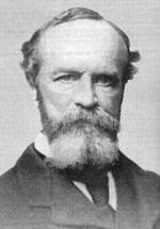
William James

 
William James

   Email Print
   Bookmark   Link


William James


For other people named William James see William James (disambiguation)
William James (disambiguation)

William James was a pioneering American psychologist and philosopher.William James is also the name of* William James , American football player ...
William James (January 11, 1842 – August 26, 1910) was a pioneering American psychologist
Psychology

Psychology is an academic and applied science discipline involving the science study of human mental functions and behavior. Occasionally it also relies on symbolic hermeneutics and critical theory, although these traditions are less pronounced than in other social sciences such as sociology....
 and philosopher
Philosophy

Philosophy is the study of general problems concerning matters such as existence, knowledge, truth, beauty, justice, validity, mind, and language....
 trained as a medical doctor. He wrote influential books on the young science of psychology, educational psychology
Educational psychology

Educational psychology is the study of how humans learn in educational settings, the effectiveness of educational interventions, the psychology of teaching, and the social psychology of schools as organizations....
, psychology of religious
Religion

A religion is an organized approach to human spirituality which usually encompasses a set of myth, symbols, beliefs and practices, often with a supernatural or transcendence quality, that give meaning to the practitioner's experiences of life through reference to a higher power or truth....
 experience and mysticism
Mysticism

Mysticism is the pursuit of communion with, Unio Mystica with, or conscious awareness of an ultimate reality, divinity, Spirituality, or God through direct experience, intuition, or insight....
, and the philosophy of pragmatism
Pragmatism

Pragmatism is the philosophy of considering practical consequences or real effects to be vital components of meaning and truth. Pragmatism is generally considered to have originated in the late nineteenth century with Charles Peirce, who first stated the pragmatic maxim....
. He was the brother of novelist Henry James
Henry James

Henry James, Order of Merit , son of theologian Henry James Sr., brother of the philosopher and psychologist William James and diarist Alice James, was an United States author....
 and of diarist Alice James
Alice James

Alice James was a United States List of diarists. The only daughter of Henry James, Sr. and sister of philosopher William James and novelist Henry James, she is known mainly for the posthumously published diary that she had kept in her final years....
.

William James was born at the Astor House
Astor House

The Astor House was a fine hotel in New York City....
 in New York City.


Discussion
Ask a question about 'William James'
Start a new discussion about 'William James'
Answer questions from other users
Full Discussion Forum


Quotations


A paradise of inward tranquility seems to be faith's usual result.

Lectures XI, XII, and XIII, Saintliness

A purely disembodied human emotion is a nonentity.

Ch. 25

A thing is important if anyone think it important.

Ch. 28, Note 35

An act has no ethical quality whatever unless it be chosen out of several all equally possible.

Ch. 9

Genius, in truth, means little more than the faculty of perceiving in an unhabitual way.

Ch. 19

I wished, by treating Psychology like a natural science, to help her to become one.

A Plea for Psychology as a Natural Science (1892)


Encyclopedia


For other people named William James see William James (disambiguation)
William James (disambiguation)

William James was a pioneering American psychologist and philosopher.William James is also the name of* William James , American football player ...
William James (January 11, 1842 – August 26, 1910) was a pioneering American psychologist
Psychology

Psychology is an academic and applied science discipline involving the science study of human mental functions and behavior. Occasionally it also relies on symbolic hermeneutics and critical theory, although these traditions are less pronounced than in other social sciences such as sociology....
 and philosopher
Philosophy

Philosophy is the study of general problems concerning matters such as existence, knowledge, truth, beauty, justice, validity, mind, and language....
 trained as a medical doctor. He wrote influential books on the young science of psychology, educational psychology
Educational psychology

Educational psychology is the study of how humans learn in educational settings, the effectiveness of educational interventions, the psychology of teaching, and the social psychology of schools as organizations....
, psychology of religious
Religion

A religion is an organized approach to human spirituality which usually encompasses a set of myth, symbols, beliefs and practices, often with a supernatural or transcendence quality, that give meaning to the practitioner's experiences of life through reference to a higher power or truth....
 experience and mysticism
Mysticism

Mysticism is the pursuit of communion with, Unio Mystica with, or conscious awareness of an ultimate reality, divinity, Spirituality, or God through direct experience, intuition, or insight....
, and the philosophy of pragmatism
Pragmatism

Pragmatism is the philosophy of considering practical consequences or real effects to be vital components of meaning and truth. Pragmatism is generally considered to have originated in the late nineteenth century with Charles Peirce, who first stated the pragmatic maxim....
. He was the brother of novelist Henry James
Henry James

Henry James, Order of Merit , son of theologian Henry James Sr., brother of the philosopher and psychologist William James and diarist Alice James, was an United States author....
 and of diarist Alice James
Alice James

Alice James was a United States List of diarists. The only daughter of Henry James, Sr. and sister of philosopher William James and novelist Henry James, she is known mainly for the posthumously published diary that she had kept in her final years....
.

William James was born at the Astor House
Astor House

The Astor House was a fine hotel in New York City....
 in New York City. He was the son of Henry James Sr.
Henry James Sr.

Henry James Sr. was an American theology and Swedenborgian, best known as the father of the philosopher William James, novelist Henry James, and diarist Alice James....
, an independently wealthy and notoriously eccentric Swedenborgian theologian
Theology

Theology is the study of the existence or attributes of a deity or gods, or more generally the study of religion or spirituality. It is sometimes contrasted with religious studies: theology is understood as the study of religion from an internal perspective , and religious studies as the study of religion from an external perspective....
 well acquainted with the literary and intellectual elites of his day. The intellectual brilliance of the James family milieu and the remarkable epistolary talents of several of its members have made them a subject of continuing interest to historians, biographers, and critics.

James interacted with a wide array of writers and scholars throughout his life, including his godfather Ralph Waldo Emerson
Ralph Waldo Emerson

Ralph Waldo Emerson was an American essayist, philosopher, poet, and leader of the transcendentalism movement in the early 19th century. His teachings directly influenced the growing New Thought movement of the mid 1800s....
, as well as Bertrand Russell
Bertrand Russell

Bertrand Arthur William Russell, 3rd Earl Russell, Order of Merit , Fellow of the Royal Society , was a British people philosopher, mathematical logic, mathematician, historian, advocate for social reform, and pacifism....
, Horace Greeley
Horace Greeley

Horace Greeley was an United States editor of a leading History of American newspapers, a founder of the Liberal Republican Party , a reformer, and a politician....
, William Cullen Bryant
William Cullen Bryant

William Cullen Bryant was an United States romantic poetry, journalist, and long-time editor of the New York Evening Post....
, Oliver Wendell Holmes, Jr.
Oliver Wendell Holmes, Jr.

Oliver Wendell Holmes, Jr. was an United States jurist who served on the Supreme Court of the United States from 1902 to 1932. Noted for his long service, his concise and pithy opinions, and his deference to the decisions of elected legislatures, he is one of the most widely cited United States Supreme Court justices in history, particularly...
, Charles Peirce
Charles Peirce

Charles Sanders Peirce was an American logician, mathematics, Philosophy, and science, born in Cambridge, Massachusetts. Peirce was educated as a chemist and employed as a scientist for 30 years....
, Josiah Royce
Josiah Royce

Josiah Royce was an American objective idealism philosopher....
, George Santayana
George Santayana

George Santayana , was a philosopher, essayist, poet, and novelist.A lifelong Spain citizen, Santayana was raised and educated in the United States, wrote in English language and is generally considered an American Intellectual#Modes of .27intellectual class.27 in nineteenth-century Europe, although, of his nearly 89 years, he spent only 39...
, Ernst Mach
Ernst Mach

Ernst Mach was an Austrians physicist and philosopher and is the namesake for the Mach number and the optical illusion known as Mach bands....
, John Dewey
John Dewey

John Dewey was an American philosopher, psychologist, and school reform whose thoughts and ideas have been highly influential in the United States and around the world....
, W. E. B. Du Bois, Helen Keller
Helen Keller

Helen Keller was an United States author, political activist and lecturer. She was the first deafblindness person to earn a Bachelor of Arts degree....
, Mark Twain
Mark Twain

Samuel Langhorne Clemens , better known by the pen name Mark Twain, was an United Statesmerican author and humorist. Twain is most noted for his novels Adventures of Huckleberry Finn, which has since been called the Great American Novel, and The Adventures of Tom Sawyer....
, Horatio Alger, Jr.
Horatio Alger, Jr.

Horatio Alger, Jr. was a prolific 19th-century United States author whose principal output was formulaic juvenile novels that followed the adventures of bootblacks, newsboys, peddlers, buskers, and other impoverished children in their rise from humble backgrounds to lives of respectable middle-class security and comfort....
, James George Frazer, Henri Bergson
Henri Bergson

Henri-Louis Bergson was a French philosophy, influential in the first half of the 20th century....
, H. G. Wells
H. G. Wells

Herbert George Wells , known by his pen name H. G. Wells, was an England author, best known for his work in the science fiction genre. Wells and Jules Verne are each sometimes referred to as "The Father of Science Fiction"....
, G. K. Chesterton
G. K. Chesterton

Gilbert Keith Chesterton was one of the most influential English writers of the 20th century. His prolific and diverse output included journalism, philosophy, poetry, biography, Christian apologetics, fantasy and detective fiction....
, Sigmund Freud
Sigmund Freud

Sigmund Freud , born Sigismund Schlomo Freud , was an Austrian psychiatrist who founded the psychoanalysis of psychology. Freud is best known for his theories of the unconscious mind and the defense mechanism of Psychological repression and for creating the clinical practice of psychoanalysis for curing psychopathology through dialogue...
, Gertrude Stein
Gertrude Stein

Gertrude Stein was an American writer who spent most of her life in France, and who became a catalyst in the development of modern art and Modernist literature....
, and Carl Jung
Carl Jung

Carl Gustav Jung was a Swiss psychiatrist, an influential thinker and the founder of Analytical psychology. Jung's approach to psychology has been influential in the field of depth psychology and in counterculture movements across the globe....
.

Early years

William James, with his younger brother Henry James
Henry James

Henry James, Order of Merit , son of theologian Henry James Sr., brother of the philosopher and psychologist William James and diarist Alice James, was an United States author....
 (who became a prominent novelist) and sister Alice James
Alice James

Alice James was a United States List of diarists. The only daughter of Henry James, Sr. and sister of philosopher William James and novelist Henry James, she is known mainly for the posthumously published diary that she had kept in her final years....
 (who is known for her posthumously published diary), received an eclectic trans-Atlantic education, developing fluency in both German and French languages along with a cosmopolitan character. His family made two trips to Europe while he was still a child, setting a pattern that resulted in thirteen more European journeys during his life. His early artistic bent led to an early apprenticeship in the studio of William Morris Hunt
William Morris Hunt

William Morris Hunt United States Painting, was born at Brattleboro, Vermont to Jane Maria Hunt and Jonathan Hunt , who raised one of the preeminent families in American art....
 in Newport, Rhode Island
Newport, Rhode Island

Newport is a city on Aquidneck Island in Newport County, Rhode Island, Rhode Island, United States, about 30 miles south of Providence, Rhode Island....
, but yielded in 1861 to scientific studies at Harvard University
Harvard University

Harvard University is a private university in Cambridge, Massachusetts, Massachusetts, United States, and a member of the Ivy League. Founded in 1636 by the colonial Massachusetts legislature, Harvard is the Colonial Colleges institution of higher learning in the United States....
's Lawrence Scientific School.

In his early adulthood, James suffered from a variety of physical ailments, including those of the eyes, back, stomach, and skin. He was also subject to a variety of psychological symptoms which were diagnosed at the time as neurasthenia
Neurasthenia

Neurasthenia is a psycho-pathological term first used by George Miller Beard in 1869 to denote a condition with symptoms of Fatigue , anxiety, headache, impotence, neuralgia and depression ....
, and which included periods of depression
Depression (mood)

In the fields of psychology and psychiatry, the terms depression or depressed refer to sadness and other related emotions and behaviours. It can be thought of as either a disease or a syndrome....
 during which he contemplated suicide
Suicide

Suicide is the intentional taking of one's own life. Many dictionaries also note the metaphorical sense of "willful destruction of one's self-interest"....
 for months on end. Two younger brothers, Garth Wilkinson (Wilky) and Robertson (Bob), fought in the Civil War
American Civil War

The American Civil War , also known as the War Between the States and several Naming the American Civil War, was a civil war in the United States....
, but the other three siblings (William, Henry, and Alice) all suffered from periods of invalidism.

James switched to medical studies at Harvard Medical School
Harvard Medical School

Harvard Medical School is one of the graduate schools of Harvard University and currently the #1 medical school in America, as ranked by U.S. News and World Report....
 in 1864. He took a break in the spring of 1865 to join Harvard's Louis Agassiz
Louis Agassiz

Jean Louis Rodolphe Agassiz was a paleontologist, glaciologist, and geologist, and was a prominent innovator in the study of the earth's natural history....
 on a scientific expedition up the Amazon River
Amazon River

The Amazon River of South America is the list of rivers by length in the world by volume, with a total river flow greater than the next top eight largest rivers combined....
, but aborted his trip after eight months, having suffered bouts of severe seasickness and mild smallpox
Smallpox

Smallpox is an infectious disease unique to humans, caused by either of two virus variants, Variola major and Variola minor. The disease is also known by the Latin names Variola or Variola vera, which is a derivative of the Latin varius, meaning spotted, or varus, meaning "pimple"....
. His studies were interrupted once again due to illness in April 1867. He traveled to Germany in search of a cure and remained until November 1868. (During this period he began to publish, with reviews appearing in literary periodicals like the North American Review.) He finally earned his M.D. degree in June 1869, but never practiced medicine. What he called his "soul-sickness" would only be resolved in 1872, after an extended period of philosophical searching. He married Alice Gibbens in 1878.

James' time in Germany proved intellectually fertile, helping him find that his true interests lay not in medicine but in philosophy and psychology. Later, in 1902 he would write: "I originally studied medicine in order to be a physiologist, but I drifted into psychology and philosophy from a sort of fatality. I never had any philosophic instruction, the first lecture on psychology I ever heard being the first I ever gave".

Professional career

James spent his entire academic career at Harvard. He was appointed instructor in physiology
Physiology

Physiology is the study of the mechanical, physical, and biochemical functions of living organisms. Physiology has traditionally been divided between plant physiology and animal and all living things physiology but the principles of physiology are universal, no matter what particular organism is being studied....
 for the spring 1873 term, instructor in anatomy
Anatomy

Anatomy is a branch of biology that is the consideration of the body plan. It is a general term that includes human anatomy, animal anatomy and plant anatomy ....
 and physiology in 1873, assistant professor of psychology in 1876, assistant professor of philosophy in 1881, full professor in 1885, endowed chair in psychology in 1889, return to philosophy in 1897, and emeritus professor of philosophy in 1907.

James studied medicine, physiology, and biology, and began to teach in those subjects, but was drawn to the scientific study of the human mind at a time when psychology was constituting itself as a science
Science

In its broadest sense, science refers to any systematic knowledge or practice. In its more usual restricted sense, science refers to a system of acquiring knowledge based on scientific method, as well as to the organized body of knowledge gained through such research....
. James's acquaintance with the work of figures like Hermann Helmholtz in Germany and Pierre Janet
Pierre Janet

Pierre Marie F?lix Janet was a pioneering French psychiatrist and philosopher in the field of dissociation and traumatic memory.He was one of the first people to draw a connection between events in the subject's past life and his or her present day trauma, and coined the words ?dissociation? and ?subconscious?....
 in France facilitated his introduction of courses in scientific psychology at Harvard University
Harvard University

Harvard University is a private university in Cambridge, Massachusetts, Massachusetts, United States, and a member of the Ivy League. Founded in 1636 by the colonial Massachusetts legislature, Harvard is the Colonial Colleges institution of higher learning in the United States....
. He taught his first experimental psychology
Experimental psychology

Experimental psychology approaches psychology as one of the natural sciences, investigates it using the experiment. The focus of experimental psychology is on discovering the underlying processes behind behavior and the specific nature of mental life....
 course at Harvard in the 1875-1876 academic year.

During his Harvard years, James joined in philosophical discussions with Charles Peirce
Charles Peirce

Charles Sanders Peirce was an American logician, mathematics, Philosophy, and science, born in Cambridge, Massachusetts. Peirce was educated as a chemist and employed as a scientist for 30 years....
, Oliver Wendell Holmes
Oliver Wendell Holmes, Jr.

Oliver Wendell Holmes, Jr. was an United States jurist who served on the Supreme Court of the United States from 1902 to 1932. Noted for his long service, his concise and pithy opinions, and his deference to the decisions of elected legislatures, he is one of the most widely cited United States Supreme Court justices in history, particularly...
, and Chauncey Wright
Chauncey Wright

Chauncey Wright , United States philosopher and mathematician, was born at Northampton, Massachusetts.In 1852 he graduated at Harvard University, and became computer to the American Ephemeris and Nautical Almanac....
 that evolved into a lively group known as The Metaphysical Club
The Metaphysical Club

The Metaphysical Club was a conversational philosophical club that future Supreme Court Justice Oliver Wendell Holmes, Jr., psychologist William James, and polymath Charles Sanders Peirce formed in January 1872 in Cambridge, Massachusetts and dissolved in December 1872....
 in 1872. Louis Menand
Louis Menand

Louis Menand is a prominent United States writer and academic, best known for his book The Metaphysical Club , an intellectual and cultural history of late 19th and early 20th century America....
 speculates that the Club provided a foundation for American intellectual thought for decades to come.

Among James' students at Harvard were such luminaries as Boris Sidis
Boris Sidis

Boris Sidis, Ph.D., M.D. was a Russian Jewish psychologist, physician, psychiatrist, and Philosophy of education....
, Theodore Roosevelt
Theodore Roosevelt

Theodore Roosevelt , also known as T.R., and to the public as Teddy, was the List of Presidents of the United States President of the United States....
, George Santayana
George Santayana

George Santayana , was a philosopher, essayist, poet, and novelist.A lifelong Spain citizen, Santayana was raised and educated in the United States, wrote in English language and is generally considered an American Intellectual#Modes of .27intellectual class.27 in nineteenth-century Europe, although, of his nearly 89 years, he spent only 39...
, W.E.B. Du Bois
W.E.B. Du Bois

'William Edward Burghardt Du Bois' was an American civil rights activist, Pan-Africanism, sociologist, historian, author, and editor. At the age of 95, in 1963, he became a naturalized citizen of Ghana....
, G. Stanley Hall
G. Stanley Hall

Granville Stanley Hall was a pioneering United States psychologist and educator. His interests focused on childhood development and evolutionary theory....
, Ralph Barton Perry
Ralph Barton Perry

Ralph Barton Perry was an American philosopher. He was educated at Princeton University and at Harvard University , where, after teaching philosophy for three years at Williams College and Smith College colleges, he was instructor , assistant professor , full professor and Edgar Pierce professor of philosophy ....
, Gertrude Stein
Gertrude Stein

Gertrude Stein was an American writer who spent most of her life in France, and who became a catalyst in the development of modern art and Modernist literature....
, Horace Kallen
Horace Kallen

Horace Meyer Kallen was a Jewish-American philosopher....
, Morris Raphael Cohen
Morris Raphael Cohen

Morris Raphael Cohen was a Jewish philosopher, lawyer and legal scholar who united pragmatism with logical positivism and linguistic Discourse analysis....
, Alain Locke, C. I. Lewis, and Mary Calkins
Mary Whiton Calkins

Mary Whiton Calkins was an United States philosopher Mary Whiton Calkins started her career as a Greek instructor at Wellesley College, but developed an interest in psychology....
.

Following his January, 1907 retirement from Harvard, James continued to write and lecture, publishing Pragmatism, A Pluralistic Universe, and The Meaning of Truth. James was increasingly afflicted with cardiac pain during his last years. It worsened in 1909 while he worked on a philosophy text (unfinished but posthumously published as Some Problems in Philosophy). He sailed to Europe in the spring of 1910 to take experimental treatments which proved unsuccessful, and returned home on August 18. His heart failed him on August 26, 1910 at his home in Chocorua
Chocorua, New Hampshire

Chocorua is a village within the New England town of Tamworth, New Hampshire in Carroll County, New Hampshire, New Hampshire, United States. It is located in the general area where Routes New Hampshire Route 16 and New Hampshire Route 113 meet, south of Mount Chocorua and Chocorua Lake....
, New Hampshire
New Hampshire

New Hampshire is a U.S. state in the New England region of the Northeastern United States United States of America. The state was named after the southern English Counties of England of Hampshire....
.

He was one of the strongest proponents of the school of Functionalism
Functional psychology

Functional psychology or functionalism refers to a general psychological approach that views mental life and behavior in terms of active adaptation to the person's environment....
 in psychology and of Pragmatism
Pragmatism

Pragmatism is the philosophy of considering practical consequences or real effects to be vital components of meaning and truth. Pragmatism is generally considered to have originated in the late nineteenth century with Charles Peirce, who first stated the pragmatic maxim....
 in philosophy. He was a founder of the American Society for Psychical Research, as well as a champion of alternative approaches to healing. He challenged his professional colleagues not to let a narrow mindset prevent an honest appraisal of those phenomena.

In an empirical study by Haggbloom et al. using six criteria such as citations and recognition, James was found to be the 14th most eminent psychologist of the 20th Century.

Writings

William James wrote voluminously throughout his life. A fairly complete bibliography of his writings by John McDermott is 47 pages long. (See below for a list of his major writings and additional collections)

He gained widespread recognition with his monumental Principles of Psychology
Principles of Psychology

The Principles of Psychology is a monumental text in the history of psychology, written by William James and published in 1890.There were four methods in James' psychology: psychoanalysis , introspection , experiment , and comparison ....
 (1890), twelve hundred pages in two volumes which took twelve years to complete. Psychology: The Briefer Course, was an 1892 abridgement designed as a less rigorous introduction to the field. These works criticized both the English associationist school and the Hegelianism of his day as competing dogmatisms of little explanatory value, and sought to re-conceive of the human mind as inherently purposive and selective.

Epistemology

James defined true
Truth

semantic fields for the word truth extend from honesty, good faith, and sincerity in general, to agreement with fact or reality in particular....
 beliefs as those that prove useful to the believer. His pragmatic theory of truth
Pragmatic theory of truth

Pragmatic theory of truth refers to those accounts, definitions, and theories of the concept truth that distinguish the philosophies of pragmatism and pragmaticism....
 was a synthesis of correspondence theory of truth
Correspondence theory of truth

The correspondence theory of truth states that the truth or falsity of a statement is determined only by how it relates to the world, and whether it accurately describes that world....
 and coherence theory of truth
Coherence theory of truth

There is no single coherence theory of truth, but rather an assortment of perspectives that are commonly collected under this title. In general, coherence theory sees truth as coherence with some specified set of sentences, propositions or beliefs....
, with an added dimension. Truth is verifiable to the extent that thoughts and statements correspond with actual things, as well as "hangs together," or coheres, fits as pieces of a puzzle might fit together, and these are in turn verified by the observed results of the application of an idea to actual practice .

Truth, he said, is that which works in the way of belief. "True ideas lead us into useful verbal and conceptual quarters as well as directly up to useful sensible termini. They lead to consistency, stability and flowing human intercourse" but "all true processes must lead to the face of directly verifying sensible experiences somewhere," he wrote.

James's assertion that the value of a truth depends upon its use to the individual who holds it is known as pragmatism
Pragmatism

Pragmatism is the philosophy of considering practical consequences or real effects to be vital components of meaning and truth. Pragmatism is generally considered to have originated in the late nineteenth century with Charles Peirce, who first stated the pragmatic maxim....
. Additional tenets of James's pragmatism include the view that the world is a mosaic of diverse experiences that can only be properly understood through an application of "radical empiricism." Radical empiricism, distinct from everyday scientific empiricism
Empiricism

In philosophy, empiricism is a theory of knowledge which asserts that knowledge arises from experience. Empiricism is one of several competing views about how we know "things," part of the branch of philosophy called epistemology, or "theory of knowledge"....
, presumes that nature and experience can never be frozen for absolutely objective analysis, that, at the very least, the mind of the observer will affect the outcome of any empirical approach to truth since, empirically, the mind and nature are inseparable. James's emphasis on diversity as the default human condition — over and against duality, especially Hegelian dialectical duality — has maintained a strong influence in American culture, especially among liberals (see Richard Rorty
Richard Rorty

Richard McKay Rorty was an American philosopher. He had a long and diverse career in Philosophy, Humanities, and Literature departments. His complex intellectual background gave him a comprehensive and nuanced understanding of the analytic philosophy tradition in philosophy he would later famously reject....
). James's description of the mind-world connection, which he described in terms of a "stream of consciousness
Stream of consciousness

In literary criticism, stream of consciousness is a narrative mode that seeks to portray an individual's point of view by giving the written equivalent of the character's thought processes, either in a loose interior monologue, or in connection to his or her actions....
," had a direct and significant impact on avant-garde
Avant-garde

Avant-garde means "advance guard" or "vanguard". The adjective form is used in English, to refer to people or works that are experimental or innovative, particularly with respect to art, culture, and politics....
 and modernist literature and art.

In What Pragmatism Means, James writes that the central point of his own doctrine of truth is, in brief, that "truth is one species of good, and not, as is usually supposed, a category distinct from good, and coordinate with it. Truth is the name of whatever proves itself to be good in the way of belief, and good, too, for definite, assignable reasons." Richard Rorty
Richard Rorty

Richard McKay Rorty was an American philosopher. He had a long and diverse career in Philosophy, Humanities, and Literature departments. His complex intellectual background gave him a comprehensive and nuanced understanding of the analytic philosophy tradition in philosophy he would later famously reject....
 claims that James did not mean to give a theory of truth with this statement and that we should not regard it as such. However, other pragmatism scholars such as Susan Haack
Susan Haack

Susan Haack is an England professor of philosophy and law at the University of Miami in the United States. She has written on logic, the philosophy of language, epistemology, and metaphysics....
 and Howard Mounce do not share Rorty's instrumentalist
Instrumentalism

In the philosophy of science, instrumentalism is the view that concepts and theories are useful instruments whose worth is measured not by whether the concepts and theories are true or false , but by how effective they are in explaining and predicting phenomena....
 interpretation of James.

In The Meaning of Truth, James seems to speaks of truth in relativistic terms: "The critic's [sc., the critic of pragmatism] trouble...seems to come from his taking the word 'true' irrelatively, whereas the pragmatist always means 'true for him who experiences the workings.' " However, James responded to critics accusing him of relativism
Relativism

Relativism is the idea that some elements or aspects of experience or culture are relative to, i.e., dependent on, other elements or aspects.Common statements that might be considered relativistic include...
, scepticism or agnosticism
Agnosticism

Agnosticism is the philosophy view that the logical value of certain claims ? particularly metaphysics claims regarding theology, afterlife or the existence of deity, ghosts, or even ultimate reality ? is unknown or, depending on the form of agnosticism, inherently impossible to prove or disprove....
, and of believing only in relative truths. To the contrary, he supported an epistemological realism
Epistemological realism

Epistemological realism is a philosophical position, a subcategory of objectivism , holding that what you know about an object exists independently of your mind....
 position .

Cash Value

From the introduction to William James's Pragmatism by Bruce Kuklick, p.xiv.

James went on to apply the pragmatic method to the epistemological problem of truth. He would seek the meaning of 'true' by examining how the idea functioned in our lives. A belief was true, he said, if in the long run it worked for all of us, and guided us expeditiously through our semihospitable world. James was anxious to uncover what true beliefs amounted to in human life, what their "Cash Value" was, what consequences they led to. A belief was not a mental entity which somehow mysteriously corresponded to an external reality if the belief were true. Beliefs were ways of acting with reference to a precarious environment, and to say they were true was to say they guided us satisfactorily in this environment. In this sense the pragmatic theory of truth applied Darwinian ideas in philosophy; it made survival the test of intellectual as well as biological fitness. If what was true was what worked, we can scientifically investigate religion's claim to truth in the same manner. The enduring quality of religious beliefs throughout recorded history and in all cultures gave indirect support for the view that such beliefs worked. James also argued directly that such beliefs were satisfying — they enabled us to lead fuller, richer lives and were more viable than their alternatives. Religious beliefs were expedient in human existence, just as scientific beliefs were.


Will to Believe Doctrine


In William James's lecture of 1897 titled "The Will to Believe," James defends the right to violate the principle of evidentialism
Evidentialism

Evidentialism is a theory of justification according to which whether a belief is justified depends solely on what a person's evidence is. Technically, though belief is typically the primary object of concern, evidentialism can be applied to doxastic attitudes generally....
 in order to justify hypothesis venturing. Although this doctrine is often seen as a way for William James to justify religious beliefs, his philosophy of pragmatism
Pragmatism

Pragmatism is the philosophy of considering practical consequences or real effects to be vital components of meaning and truth. Pragmatism is generally considered to have originated in the late nineteenth century with Charles Peirce, who first stated the pragmatic maxim....
 allows him to use the results of his hypothetical venturing as evidence to support the hypothesis' truth. Therefore, this doctrine allows one to assume belief in God and prove its existence by what the belief brings to one's life.

Philosophy of religion

James did important work in philosophy of religion
Philosophy of religion

Philosophy of religion' is a branch of philosophy that is concerned with the philosophical study of religion, including arguments over the nature and existence of God, religious language, miracles, prayer, the problem of evil, and the relationship between religion and other value-systems such as ethics.'...
. In his Gifford Lectures
Gifford Lectures

The Gifford Lectures were established by the will of Adam Gifford . They were established to "promote and diffuse the study of Natural Theology in the widest sense of the term — in other words, the knowledge of God." The term natural theology as used by Gifford means theology supported by science and not dependent on the miracle....
 at the University of Edinburgh
University of Edinburgh

The University of Edinburgh founded in 1582, is an internationally renowned centre for teaching and research in Edinburgh, Scotland, United Kingdom....
 he provided a wide-ranging account of The Varieties of Religious Experience
The Varieties of Religious Experience

The Varieties of Religious Experience: A Study in Human Nature is a book by the Harvard psychologist and philosopher William James that comprises his edited Gifford Lectures on "Natural Theology" delivered at the University of Edinburgh in Scotland between 1901 and 1902....
 (1902) and interpreted them according to his pragmatic leanings. Some of the important claims he makes in this regard:

  • Religious genius (experience) should be the primary topic in the study of religion, rather than religious institutions—since institutions are merely the social descendant of genius.
  • The intense, even pathological varieties of experience (religious or otherwise) should be sought by psychologists, because they represent the closest thing to a microscope of the mind—that is, they show us in drastically enlarged form the normal processes of things.
  • In order to usefully interpret the realm of common, shared experience and history, we must each make certain "over-beliefs
    Overbelief

    Overbelief is philosophical term for a belief adopted that requires more evidence than one presently has. Generally, acts of overbelief are justified on emotional need or faith, rather than evidence....
    " in things which, while they cannot be proven on the basis of experience, help us to live fuller and better lives.


The investigation of mystic
Mysticism

Mysticism is the pursuit of communion with, Unio Mystica with, or conscious awareness of an ultimate reality, divinity, Spirituality, or God through direct experience, intuition, or insight....
al experience was constant throughout the life of James, leading him to experiment with chloral hydrate
Chloral hydrate

Chloral hydrate is a sedative and hypnotic approved drug as well as a chemical reagent and precursor. The name chloral hydrate indicates that it is formed from chloral by the addition of one molecule of water....
 (1870), amyl nitrite
Alkyl nitrites

Alkyl nitrites are chemical compounds of structure R-ONO. Formally they are alkyl esters of nitrous acid. They are distinct from nitro compounds ....
 (1875), nitrous oxide
Nitrous oxide

Nitrous oxide, commonly known as "laughing gas", is a chemical compound with the chemical formula Nitrogen2Oxygen. At room temperature, it is a colorless Flammability gas, with a pleasant, slightly sweet odor and taste....
 (1882), and even peyote
Peyote

Lophophora williamsii , better known by its common name Peyote, , is a small, spineless cactus. It is native to southwestern Texas and through central Mexico....
 (1896). James claimed that it was only when he was under the influence of nitrous oxide that he was able to understand Hegel. He concluded that while the revelations of the mystic hold true, they hold true only for the mystic; for others, they are certainly ideas to be considered, but can hold no claim to truth without personal experience of such.

Theory of emotion

James is one of the two namesakes of the James-Lange theory
James-Lange theory

The James-Lange theory refers to a hypothesis on the origin and nature of Emotion developed independently by two 19th-century scholars, William James and Carl Lange....
 of emotion
Emotion

An emotion is a mental and physiological state associated with a wide variety of feelings, thoughts, and behavior.Emotions are subjective experiences, or experienced from an individual point of view....
, which he formulated independently of Carl Lange
Carl Lange

Carl Georg Lange was a Denmark physician and psychologist. He and William James independently developed the James-Lange theory of emotion, which posits that all emotions are developed from, and can be reduced to, physiological reactions to stimuli....
 in the 1880s. The theory holds that emotion is the mind's perception of physiological conditions that result from some stimulus. In James' oft-cited example; it is not that we see a bear, fear it, and run. We see a bear and run, consequently we fear the bear. Our mind's perception
Perception

In psychology and the cognitive sciences, perception is the process of attaining awareness or understanding of sense information. It is a task far more complex than was imagined in the 1950s and 1960s, when it was predicted that building perceiving machines would take about a decade, a goal which is still very far from fruition....
 of the higher adrenaline level, heartbeat, etc., is the emotion.

This way of thinking about emotion has great consequences for the philosophy of aesthetics
Aesthetics

Aesthetics or esthetics is commonly known as the study of senses or sensori-emotional values, sometimes called judgments of sentiment and taste ....
. Here is a passage from his great work, Principles of Psychology, that spells out those consequences.

William James' bear

From Joseph LeDoux's description of William James' Emotion

Why do we run away if we notice that we are in danger? Because we are afraid of what will happen if we don't. This obvious (and incorrect) answer to a seemingly trivial question has been the central concern of a century-old debate about the nature of our emotions.


It all began in 1884 when William James published an article titled "What Is an Emotion?" The article appeared in a philosophy journal called Mind, as there were no psychology journals yet. It was important, not because it definitively answered the question it raised, but because of the way in which James phrased his response. He conceived of an emotion in terms of a sequence of events that starts with the occurrence of an arousing stimulus ; and ends with a passionate feeling, a conscious emotional experience. A major goal of emotion research is still to elucidate this stimulus-to-feeling sequence—to figure out what processes come between the stimulus and the feeling.


James set out to answer his question by asking another: do we run from a bear because we are afraid or are we afraid because we run? He proposed that the obvious answer, that we run because we are afraid, was wrong, and instead argued that we are afraid because we run:


Our natural way of thinking about... emotions is that the mental perception of some fact excites the mental affection called emotion, and that this latter state of mind gives rise to the bodily expression. My thesis on the contrary is that the bodily changes follow directly the PERCEPTION of the exciting fact, and that our feeling of the same changes as they occur is the emotion (called 'feeling' by Damasio).

The essence of James' proposal was simple. It was premised on the fact that emotions are often accompanied by bodily responses (racing heart, tight stomach, sweaty palms, tense muscles, and so on; sympathetic nervous system
Sympathetic nervous system

The Sympathetic Nervous System is a branch of the autonomic nervous system along with the enteric nervous system and parasympathetic nervous system....
) and that we can sense what is going on inside our body much the same as we can sense what is going on in the outside world. According to James, emotions feel different from other states of mind because they have these bodily responses that give rise to internal sensations, and different emotions feel different from one another because they are accompanied by different bodily responses and sensations. For example, when we see James' bear, we run away. During this act of escape, the body goes through a physiological upheaval: blood pressure rises, heart rate increases, pupils dilate, palms sweat, muscles contract in certain ways (evolutionary, innate defense mechanisms). Other kinds of emotional situations will result in different bodily upheavals. In each case, the physiological responses return to the brain in the form of bodily sensations, and the unique pattern of sensory feedback gives each emotion its unique quality. Fear feels different from anger or love because it has a different physiological signature . The mental aspect of emotion, the feeling, is a slave to its physiology, not vice versa: we do not tremble because we are afraid or cry because we feel sad; we are afraid because we tremble and are sad because we cry.


Philosophy of history

One of the long-standing schisms in the philosophy of history
Philosophy of history

Philosophy of history is an area of philosophy concerning the eventual significance, if any, of human history. Furthermore, it speculates as to a possible teleology end to its development?that is, it asks if there is a design, purpose, directive principle, or finality in the processes of human history....
 concerns the role of individuals in social change.

One faction sees individuals ("heroes" as Thomas Carlyle
Thomas Carlyle

Thomas Carlyle was a Scotland satire writer, essayist, historian and teacher during the Victorian era.He called economics the "dismal science", wrote articles for the Edinburgh Encyclopedia, and became a controversial social commentator....
 called them) as the motive power of history, and the broader society as the page on which they write their acts. The other sees society as moving according to holistic principles or laws, and sees individuals as its more-or-less willing pawns. In 1880, James waded into this controversy with "Great Men and Their Environment," an essay published in the Atlantic Monthly. He took Carlyle's side, but without Carlyle's one-sided emphasis on the political/military sphere, upon heroes as the founders or overthrowers of states and empires.

"Rembrandt must teach us to enjoy the struggle of light with darkness," James wrote. "Wagner
Richard Wagner

Wilhelm Richard Wagner was a German composer, Conducting, theatre director and essayist, primarily known for his operas . Unlike most other great opera composers, Wagner wrote both the scenario and libretto for his works....
 to enjoy peculiar musical effects; Dickens
Charles Dickens

Charles John Huffam Dickens, Royal Society of Arts , pen-name "Boz", was the most popular English people novelist of the Victorian era, as well as a vigorous Reform movement....
 gives a twist to our sentimentality, Artemus Ward to our humor; Emerson
Ralph Waldo Emerson

Ralph Waldo Emerson was an American essayist, philosopher, poet, and leader of the transcendentalism movement in the early 19th century. His teachings directly influenced the growing New Thought movement of the mid 1800s....
 kindles a new moral light within us."

Study of spiritualism

In 1909 William James published Expériences d'un Psychiste, a book which relates many experiments that he had with the medium
Mediumship

Mediumship is believed by its adherents to be a form of communication with spirits.It is a practice in religious beliefs such as Spiritualism , Spiritism, Espiritismo, Candombl?, Louisiana Voodoo, and Umbanda....
 Leonora Piper
Leonora Piper

Leonora Piper - probably the most famous trance medium in the history of Spiritualism, who allegedly provided - specifically through the so called cross correspondence experiment - the most convincing evidence for the reality of life after death or telepathy....
. His first commentary about Piper, however, was published in Science:

In the trances of this medium, I cannot resist the conviction that knowledge appears which she has never gained by the ordinary waking use of her eyes and ears and wits.


William James gave more detailed informations about his first experiments with Piper in the Proceedings of the Society for Psychical Research
Society for Psychical Research

The Society for Psychical Research is a non-profit organization which started in the United Kingdom and was later imitated in other countries. Its stated purpose is to understand "events and abilities commonly described as psychic or paranormal by promoting and supporting important research in this area" and to "examine allegedly paranormal...
:

I made Mrs. Piper's acquaintance in the autumn of 1885. My wife's mother, Mrs. Gibbens, had been told of her by a friend, during the previous summer, and never having seen a medium before, had paid her a visit out of curiosity. She returned with the statement that Mrs. P. had given her a long string of names of members of the family, mostly Christian names, together with facts about the persons mentioned and their relations to each other, the knowledge of which on her part was incomprehensible without supernormal powers. My sister-in-law went the next day, with still better results, as she related them. Amongst other things, the medium had accurately described the circumstances of the writer of a letter which she held against her forehead, after Miss G. had given it to her. The letter was in Italian, and its writer was known to but two persons in this country. [I may add that on a later occasion my wife and I took another letter from this same person to Mrs. P., who went on to speak of him in a way which identified him unmistakably again. On a third occasion, two years later, my sister-in-law and I being again with Mrs. P., she reverted in her trance to these letters, and then gave us the writer's name, which she said she had not been able to get on the former occasion.] But to revert to the beginning. I remember playing the esprit fort on that occasion before my feminine relatives, and seeking to explain, by simple considerations the marvellous character of the facts which they brought back. This did not, however, prevent me from going myself a few days later, in company with my wife, to get a direct personal impression. The names of none of us up to this meeting had been announced to Mrs. P., and Mrs. J. and I were, of course, careful to make no reference to our relatives who had preceded. The medium, however, when entranced, repeated most of the names of " spirits" whom she had announced on the two former occasions and added others. The names came with difficulty, and were only gradually made perfect. My wife's father's name of Gibbens was announced first as Niblin, then as Giblin. A child Herman (whom we had lost the previous year) had his name spelt out as Herrin. I think that in no case were both Christian and surnames given on this visit. But the facts predicated of the persons named made it in many instances impossible not to recognise the particular individuals who were talked about. We took particular pains on this occasion to give the Phinuit control no help over his difficulties and to ask no leading questions. In the light of subsequent experience I believe this not to be the best policy. For it often happens, if you give this trance-personage a name or some small fact for the lack of which he is brought to a standstill, that he will then start off with a copious flow of additional talk, containing in itself an abundance of " tests." My impression after this first visit was, that Mrs. P. was either possessed of supernormal powers, or knew the members of my wife's family by sight and had by some lucky coincidence become acquainted with such a multitude of their domestic circumstances as to produce the startling impression which she did. My later knowledge of her sittings and personal acquaintance with her has led me absolutely to reject the latter explanation, and to believe that she has supernormal powers.


See also

  • The Moral Philosopher and the Moral Life
    The Moral Philosopher and the Moral Life

    "The Moral Philosopher and the Moral Life" was an essay by the philosopher William James, which he first delivered as a lecture to the Yale Philosophical Club, in 1891....
  • Psychology of religion
    Psychology of religion

    Psychology of religion is the psychology Research of religious experiences, beliefs, and activities....
  • Functional psychology
    Functional psychology

    Functional psychology or functionalism refers to a general psychological approach that views mental life and behavior in terms of active adaptation to the person's environment....


Bibliography


Works by James

  • The Principles of Psychology, 2 vols. (1890) Dover Publications 1950, vol. 1: ISBN 0-486-20381-6, vol. 2: ISBN 0-486-20382-4
  • Psychology (Briefer Course) (1892) University of Notre Dame Press 1985: ISBN 0-268-01557-0, Dover Publications 2001: ISBN 0-486-41604-6
  • The Will to Believe
    Will to believe doctrine

    "The Will to Believe" is a lecture by William James, published in 1897, which defended the adoption of beliefs as hypotheses and self-fulfilling prophecies even without prior evidence of their truth....
    , and Other Essays in Popular Philosophy
    (1897)
  • Human Immortality: Two Supposed Objections to the Doctrine (the Ingersoll Lecture, 1897)
    • The Will to Believe, Human Immortality (1956) Dover Publications, ISBN 0-486-20291-7
  • Talks to Teachers on Psychology: and to Students on Some of Life's Ideals (1899), Dover Publications 2001: ISBN 0-486-41964-9, IndyPublish.com 2005: ISBN 1-4219-5806-6
  • The Varieties of Religious Experience
    The Varieties of Religious Experience

    The Varieties of Religious Experience: A Study in Human Nature is a book by the Harvard psychologist and philosopher William James that comprises his edited Gifford Lectures on "Natural Theology" delivered at the University of Edinburgh in Scotland between 1901 and 1902....
    : A Study in Human Nature
    (1902), ISBN 0-14-039034-0
  • Pragmatism: A New Name for Some Old Ways of Thinking (1907), Hackett Publishing 1981: ISBN 0-915145-05-7, Dover 1995: ISBN 0-486-28270-8
  • A Pluralistic Universe (1909), Hibbert Lectures
    Hibbert Lectures

    The Hibbert Lectures are an annual series of non-sectarian lectures on theological issues. They are sponsored by the Hibbert Trust, which was founded in 1847 by the Unitarianism Robert Hibbert with a goal to uphold "the unfettered exercise of private judgement in matters of religion."....
    , University of Nebraska Press 1996: ISBN 0-8032-7591-9
  • The Meaning of Truth: A Sequel to "Pragmatism" (1909) Prometheus Books, 1997: ISBN 1-57392-138-6
  • Some Problems of Philosophy: A Beginning of an Introduction to Philosophy (1911), University of Nebraska Press 1996: ISBN 0-8032-7587-0
  • Memories and Studies (1911) Reprint Services Corp: 1992: ISBN 0-7812-3481-6
  • Essays in Radical Empiricism
    Essays in Radical Empiricism

    Essays in Radical Empiricism by William James is a collection edited and published posthumously by his colleague and biographer Ralph Barton Perry in 1912....
     (1912) Dover Publications 2003, ISBN 0-486-43094-4
    • critical edition, Frederick Burkhardt and Fredson Bowers, editors. Harvard University Press 1976: ISBN 0-674-26717-6 (includes commentary, notes, enumerated emendations, appendices with English translation of "La Notion de Conscience")
  • Letters of William James, 2 vols. (1920)
  • Collected Essays and Reviews (1920)
  • Ralph Barton Perry, The Thought and Character of William James, 2 vols. (1935) Vanderbilt University Press 1996 reprint: ISBN 0-8265-1279-8 (contains some 500 letters by William James not found in the earlier edition of the Letters of William James)
  • William James on Psychical Research (1960)
  • The Correspondence of William James, 12 vols. (1992-2004) University of Virginia Press, ISBN 0-8139-2318-2


Works by others

  • Essays Philosophical and Psychological in Honor of William James, by his Colleagues at Columbia University (London, 1908)
  • Flournoy, La Philosophie de William James (Saint-Blaise, 1911)
  • Josiah Royce
    Josiah Royce

    Josiah Royce was an American objective idealism philosopher....
    , William James and Other Essays on the Philosophy of Life (New York, 1911)
  • Ménard, Analyse et critique des principes de la psychologie de W. James (Paris, 1911)
  • K. A. Busch, William James als Religionsphilosoph (Göttingen, 1911)
  • Boutroux, William James (New York, 1912)
  • R. B. Perry
    Ralph Barton Perry

    Ralph Barton Perry was an American philosopher. He was educated at Princeton University and at Harvard University , where, after teaching philosophy for three years at Williams College and Smith College colleges, he was instructor , assistant professor , full professor and Edgar Pierce professor of philosophy ....
    , Present Philosophical Tendencies (New York, 1912)
  • James Huneker
    James Huneker

    James Gibbons Huneker was an United States music writer and critic, born in Philadelphia, Pennsylvania.He studied music in Europe under Alfredo Barili and others....
    , "A Philosophy for Philistines" in his The Pathos of Distance (New York, 1913)
  • Werner Bloch, Der Pragmatismus von James und Schiller nebst Exkursen über Weltanschauung und über die Hypothese (Leipzig, 1913)
  • H. V. Knox, Philosophy of William James (London, 1914)
  • Henry James
    Henry James

    Henry James, Order of Merit , son of theologian Henry James Sr., brother of the philosopher and psychologist William James and diarist Alice James, was an United States author....
    's
    A Small Boy and Others (1913) and Notes of a Son and Brother (1914)


Collections

  • William James: Writings 1878-1899, (1992). Library of America
    Library of America

    The Library of America is a nonprofit publisher of classic American literature....
    , 1212 p., ISBN 978-0-94045072-1
Psychology: Briefer Course (rev. and condensed Principles of Psychology), The Will to Believe and Other Essays in Popular Philosophy, Talks to Teachers and Students, Essays (nine others)

  • William James: Writings 1902-1910, (1987). Library of America
    Library of America

    The Library of America is a nonprofit publisher of classic American literature....
    , 1379 p., ISBN 978-0-94045038-7
The Varieties of Religious Experience, Pragmatism, A Pluralistic Universe, The Meaning of Truth, Some Problems of Philosophy, Essays

  • The Writings of William James: A Comprehensive Edition, (1978). University of Chicago Press, 912 p., ISBN 0-226-39188-4
Pragmatism, Essays in Radical Empiricism, and A Pluralistic Universe complete; plus selections from other works
  • In 1975, Harvard University Press began publication of a standard edition of The Works of William James.


Secondary works

  • Jacques Barzun
    Jacques Barzun

    Jacques Martin Barzun is a France-born United States historian of history of ideas and cultural history. His areas of expertise are far-ranging including "French and German literature, music, education, ghost stories, detective fiction, language, and etymology."...
    .
    A Stroll with William James (1983). Harper and Row: ISBN 0-226-03869-6
  • Deborah Blum
    Deborah Blum

    Deborah Blum is a Pulitzer Prize-winning journalist and author.As a science writer for the Sacramento Bee, Blum wrote a series of articles examining the professional, ethical, and emotional conflicts between scientists who use animals in their research and animal rights activists who oppose that research....
    .
    Ghost Hunters: William James and the Search for Scientific Proof of Life After Death (2006). Penguin Press, ISBN 1-59420-090-4
  • Wesley Cooper. The Unity of William James's Thought (2002). Vanderbilt University Press, ISBN 0-8265-1387-5
  • Howard M. Feinstein. Becoming William James (1984). Cornell University Press, ISBN 978-0801486425
  • Louis Menand
    Louis Menand

    Louis Menand is a prominent United States writer and academic, best known for his book The Metaphysical Club , an intellectual and cultural history of late 19th and early 20th century America....
    .
    The Metaphysical Club (2001). Farrar, Straus, and Giroux, ISBN 0-374-52849-7. analyzes the lives and relationship between James, Oliver Wendell Holmes Jr., Charles Sanders Pierce, and John Dewey
    John Dewey

    John Dewey was an American philosopher, psychologist, and school reform whose thoughts and ideas have been highly influential in the United States and around the world....
    .
  • Gerald E. Myers. William James: His Life and Thought (1986). Yale University Press 2001 paperback: ISBN 0-300-08917-1. focuses on his psychology, includes 230 pages of notes.
  • Robert D. Richardson. William James: In the Maelstrom of American Modernism (2006). Houghton Mifflin, ISBN 0-618-43325-2


Fiction

  • Richard Liebmann-Smith. The James Boys: A Novel Account of Four Desperate Brothers (2008), posits Jesse and Frank are nom-de-outlaw used by William and Henry James' two younger brothers who went West and fought in the Civil War. Written somewhat in the style of Henry James.


External links

  • – major collection of essays and works online
  • at Emory University
    Emory University

    Emory University is a private university located in the metropolitan area of the city of Atlanta, Georgia in western unincorporated area DeKalb County, Georgia, Georgia , United States....
    , URL accessed August 12, 2006
  • ": William James and American Functional Psychology"
  • article from Psychology Today
    Psychology Today

    Psychology Today is a bi-monthly magazine published in the United States. It is a psychology-based magazine about relationships, health and related topics written for a mass audience of non-psychologists....
    March/April 1995
  • with Robert D. Richardson, author of the biography William James: In the Maelstrom of American Modernism
  • European William James Project :


Full texts of James's works

  • *