
Home      Discussion      Topics      Dictionary      Almanac
Signup       Login
Ayahuasca

Ayahuasca

Overview

Discussion
Ask a question about 'Ayahuasca'
Start a new discussion about 'Ayahuasca'
Answer questions from other users
Full Discussion Forum
 
Unanswered Questions
Encyclopedia

Ayahuasca is any of various psychoactive infusions or decoction
Decoction
Decoction is a method of extraction, by boiling, of dissolved chemicals, or herbal or plant material, which may include stems, roots, bark and rhizomes. Decoction involves first mashing, and then boiling in water to extract oils, volatile organic compounds, and other chemical substances...

s prepared from the Banisteriopsis spp.
Banisteriopsis caapi
Banisteriopsis caapi, also known as Ayahuasca, Caapi or Yage, is a South American jungle vine of the family Malpighiaceae. It is used to prepare Ayahuasca, a decoction that has a long history of entheogenic uses as a medicine and "plant teacher" among the indigenous peoples of the Amazon Rainforest...

vine, usually mixed with the leaves of dimethyltryptamine
Dimethyltryptamine
N,N-Dimethyltryptamine is a naturally occurring psychedelic compound of the tryptamine family. DMT is found in several plants, and also in trace amounts in humans and other mammals, where it is originally derived from the essential amino acid tryptophan, and ultimately produced by the enzyme INMT...

-containing species of shrubs from the Psychotria
Psychotria
Psychotria is a plant genus of 1900 species in the family Rubiaceae. Members of the genus are low trees in tropical forests. The distinction between Psychotria and the genus Cephaelis are not well known and many species were formerly placed there....

genus. The brew, first described academically in the early 1950s by Harvard ethnobotanist Richard Evans Schultes
Richard Evans Schultes
Richard Evans Schultes may be considered the father of modern ethnobotany, for his studies of indigenous peoples' uses of plants, including especially entheogenic or hallucinogenic plants , for his lifelong collaborations with chemists, and...

, who found it employed for divinatory and healing purposes by the native peoples of the Amazonian
Amazon Rainforest
The Amazon Rainforest , also known in English as Amazonia or the Amazon Jungle, is a moist broadleaf forest that covers most of the Amazon Basin of South America...

 Colombia
Colombia
Colombia, officially the Republic of Colombia , is a unitary constitutional republic comprising thirty-two departments. The country is located in northwestern South America, bordered to the east by Venezuela and Brazil; to the south by Ecuador and Peru; to the north by the Caribbean Sea; to the...

, is known by a number of different names (see below). It has been noted that effects can be had from imbibing the Caapi vine alone, but that DMT-containing plants remain inactive when drunk as a brew without an MAO inhibitor (such as Caapi). How indigenous peoples discovered the synergistic properties of the ayahuasca brew remains unknown.

Nomenclature


In Ecuador
Ecuador
Ecuador , officially the Republic of Ecuador is a representative democratic republic in South America, bordered by Colombia on the north, Peru on the east and south, and by the Pacific Ocean to the west. It is one of only two countries in South America, along with Chile, that do not have a border...

, Bolivia
Bolivia
Bolivia officially known as Plurinational State of Bolivia , is a landlocked country in central South America. It is the poorest country in South America...

 and Peru
Peru
Peru , officially the Republic of Peru , is a country in western South America. It is bordered on the north by Ecuador and Colombia, on the east by Brazil, on the southeast by Bolivia, on the south by Chile, and on the west by the Pacific Ocean....

, Colombia
Colombia
Colombia, officially the Republic of Colombia , is a unitary constitutional republic comprising thirty-two departments. The country is located in northwestern South America, bordered to the east by Venezuela and Brazil; to the south by Ecuador and Peru; to the north by the Caribbean Sea; to the...

 and to a lesser extent in Brazil
Brazil
Brazil , officially the Federative Republic of Brazil , is the largest country in South America. It is the world's fifth largest country, both by geographical area and by population with over 192 million people...

, "ayahuasca" or "ayawaska" is Quechua
Quechua languages
Quechua is a Native South American language family and dialect cluster spoken primarily in the Andes of South America, derived from an original common ancestor language, Proto-Quechua. It is the most widely spoken language family of the indigenous peoples of the Americas, with a total of probably...

 for "spirit vine" or "vine of the souls"; aya means "spirit" while huasca or waska means "vine". The spelling of ayahuasca is the hispanicized version of the name; many Quechua or Aymara
Aymara language
Aymara is an Aymaran language spoken by the Aymara people of the Andes. It is one of only a handful of Native American languages with over three million speakers. Aymara, along with Quechua and Spanish, is an official language of Peru and Bolivia...

 speakers would prefer the spelling ayawaska. The name is properly that of the plant B. caapi, one of the primary sources of beta-carbolines for the brew. Other terms include:
  • cipó (generic vine, liana), "caapi", "hoasca", "vegetal", "daime" or "santo daime" in Brazil
  • natem amongst the indigenous Shuar and Achuar people of Peru and Ecuador
  • yagé or yajé (both pronounced jaˈhe) in Tucanoan
  • shori among the Nahua people of Peru


Chemistry


Harmine compounds
Harmala alkaloid
Several alkaloids that function as monoamine oxidase inhibitors are found in the seeds of Peganum harmala , including harmine, harmaline, and harmalol, which are members of a group of substances with a similar chemical structure collectively known as harmala alkaloids...

 are of beta-carboline origin. The three most studied beta-carboline compounds found in the B. caapi vine are harmine, harmaline and tetrahydroharmine. Harmine and harmaline are selective and reversible inhibitors of MAO-A
Monoamine Oxidase A
Monoamine oxidase A, also known as MAO-A, is an enzyme that in humans is encoded by the MAO-A gene. Monoamine oxidase A is an isozyme of monoamine oxidase. It preferentially deaminates norepinephrine , epinephrine , serotonin, and dopamine...

, while tetrahydroharmine is a weak serotonin uptake inhibitor. This inhibition of MAO-A allows DMT
Dimethyltryptamine
N,N-Dimethyltryptamine is a naturally occurring psychedelic compound of the tryptamine family. DMT is found in several plants, and also in trace amounts in humans and other mammals, where it is originally derived from the essential amino acid tryptophan, and ultimately produced by the enzyme INMT...

 to diffuse unmetabolized past the membranes in the stomach and small intestine and eventually get through the blood-brain barrier
Blood-brain barrier
The blood–brain barrier is a separation of circulating blood and the brain extracellular fluid in the central nervous system . It occurs along all capillaries and consists of tight junctions around the capillaries that do not exist in normal circulation. Endothelial cells restrict the diffusion...

 (which, by itself, requires no MAO-A inhibition) to activate receptor sites in the brain. Without RIMA
Reversible inhibitor of monoamine oxidase A
Reversible inhibitors of monoamine oxidase A are a class of drugs which selectively and reversibly inhibit the enzyme monoamine oxidase A . They are used clinically in the treatment of depression and dysthymia, though they have not gained widespread market share due to limited efficacy relative to...

s or the MAOI of MAO-A, DMT
Dimethyltryptamine
N,N-Dimethyltryptamine is a naturally occurring psychedelic compound of the tryptamine family. DMT is found in several plants, and also in trace amounts in humans and other mammals, where it is originally derived from the essential amino acid tryptophan, and ultimately produced by the enzyme INMT...

 would be metabolized in the digestive tract and would not have an effect when taken orally.

Individual polymorphisms
Polymorphism (biology)
Polymorphism in biology occurs when two or more clearly different phenotypes exist in the same population of a species — in other words, the occurrence of more than one form or morph...

 in the cytochrome P450-2D6 enzyme
CYP2D6
Cytochrome P450 2D6 , a member of the cytochrome P450 mixed-function oxidase system, is one of the most important enzymes involved in the metabolism of xenobiotics in the body. Also, many substances are bioactivated by CYP2D6 to form their active compounds...

 affect the ability of individuals to metabolize harmine. Some natural tolerance to habitual use of ayahuasca (roughly once weekly) may develop through upregulation of the serotonergic system. A phase 1 pharmacokinetic study on ayahuasca (as Hoasca) with 15 volunteers was conducted in 1993, during the Hoasca Project. A review of the Hoasca Project has been published.

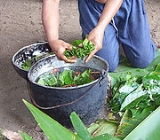
Preparation


Sections of Banisteriopsis caapi vine are macerated
Liquid-liquid extraction
Liquid–liquid extraction, also known as solvent extraction and partitioning, is a method to separate compounds based on their relative solubilities in two different immiscible liquids, usually water and an organic solvent. It is an extraction of a substance from one liquid phase into another liquid...

 and boiled alone or with leaves from any of a number of other plants, including Psychotria viridis
Psychotria viridis
Psychotria viridis is a shrub from the coffee family, Rubiaceae. It has many local names, including Chacruna and Chacrona ....

(chacruna) or Diplopterys cabrerana
Diplopterys cabrerana
Diplopterys cabrerana is a South American rainforest vine, commonly known as Chaliponga, Chagropanga and, in parts of Ecuador, Chacruna...

(also known as chaliponga). The resulting brew contains the powerful hallucinogenic
Psychedelics, dissociatives and deliriants
This general group of pharmacological agents can be divided into three broad categories: psychedelics, dissociatives, and deliriants. These classes of psychoactive drugs have in common that they can cause subjective changes in perception, thought, emotion and consciousness...

 alkaloid N,N-dimethyltryptamine (DMT
Dimethyltryptamine
N,N-Dimethyltryptamine is a naturally occurring psychedelic compound of the tryptamine family. DMT is found in several plants, and also in trace amounts in humans and other mammals, where it is originally derived from the essential amino acid tryptophan, and ultimately produced by the enzyme INMT...

), and MAO inhibiting
Monoamine oxidase inhibitor
Monoamine oxidase inhibitors are a class of antidepressant drugs prescribed for the treatment of depression. They are particularly effective in treating atypical depression....

 harmala alkaloid
Harmala alkaloid
Several alkaloids that function as monoamine oxidase inhibitors are found in the seeds of Peganum harmala , including harmine, harmaline, and harmalol, which are members of a group of substances with a similar chemical structure collectively known as harmala alkaloids...

s, which are necessary to make the DMT orally active.

Brews can also be made with no DMT-containing plants; Psychotria viridis being substituted by plants such as Justicia pectoralis, Brugmansia
Brugmansia
Brugmansia is a genus of seven species of flowering plants in the family Solanaceae, native to subtropical regions of South America, along the Andes from Colombia to northern Chile, and also in southeastern Brazil. They are known as Angel's Trumpets, sharing that name with the closely related genus...

, or sacred tobacco, also known as Mapacho (Nicotiana rustica
Nicotiana rustica
Nicotiana rustica, known in South America as Mapacho and in Vietnam as Thuoc Lao , is a plant in the Solanaceae family. It is a very potent variety of tobacco. The high concentration of nicotine in its leaves makes it useful for creating organic pesticides.Rustica is also used for entheogenic...

), or sometimes left out with no replacement. The potency of this brew varies radically from one batch to the next, both in potency and psychoactive effect, based mainly on the skill of the shaman or brewer, as well as other admixtures sometimes added and the intent of the ceremony. Natural variations in plant alkaloid content and profiles also affect the final concentration of alkaloids in the brew, and the physical act of cooking may also serve to modify the alkaloid profile of harmala alkaloids.

Traditional brew


Traditional ayahuasca brews are often made with Banisteriopsis caapi as a MAOI, although Dimethyltryptamine
DMT
DMT may refer to:In chemical substances:* Dimethyltryptamine, a psychedelic tryptamine* Dimethyl terephthalate, a polyester precursor* Desoxymethyltestosterone, a designer anabolic steroid...

 sources and other admixtures vary from region to region. There are several varieties of caapi, often known as different "colors", with varying effects, potencies, and uses.

DMT admixtures:
  • Psychotria viridis
    Psychotria viridis
    Psychotria viridis is a shrub from the coffee family, Rubiaceae. It has many local names, including Chacruna and Chacrona ....

    (Chacruna) - leaves
  • Diplopterys cabrerana
    Diplopterys cabrerana
    Diplopterys cabrerana is a South American rainforest vine, commonly known as Chaliponga, Chagropanga and, in parts of Ecuador, Chacruna...

    (Chaliponga, Banisteriopsis rusbyana) - leaves
  • Psychotria carthagenensis
    Psychotria carthagenensis
    Psychotria carthagenensis, also known as Amyruca, is a South American rainforest understory shrub from the coffee family, Rubiaceae...

    (Amyruca) - leaves
  • Acacia maidenii
    Acacia maidenii
    Acacia maidenii, also known as Maiden's Wattle, is a tree native to Australia . It has been introduced into India and Argentina, and it grows on plantations in South Africa. It prefers full sun to partial shade and it is often found on the edge of the rainforest. It grows up to 15 m in height...

    (Maiden's Wattle), Acacia phlebophylla
    Acacia phlebophylla
    Acacia phlebophylla, an Acacia also known by the names Buffalo Sallow Wattle and Mountain Buffalo Wattle, is a straggling shrub to small, twisted tree reaching up to 5 meters in height. It is a close relative of Acacia alpina...

    , and other Acacia
    Acacia
    Acacia is a genus of shrubs and trees belonging to the subfamily Mimosoideae of the family Fabaceae, first described in Africa by the Swedish botanist Carl Linnaeus in 1773. Many non-Australian species tend to be thorny, whereas the majority of Australian acacias are not...

    s, most commonly employed in Australia
    Australia
    Australia , officially the Commonwealth of Australia, is a country in the Southern Hemisphere comprising the mainland of the Australian continent, the island of Tasmania, and numerous smaller islands in the Indian and Pacific Oceans. It is the world's sixth-largest country by total area...

     - bark
  • Anadenanthera peregrina, A. colubrina, A. excelsa, A. macrocarpa
  • Mimosa hostilis
    Mimosa hostilis
    Mimosa tenuiflora is a perennial evergreen tree or shrub native to the northeastern region of Brazil and found as far north as southern Mexico...

    (Jurema) - root bark - not traditionally employed with ayahuasca by any existing cultures, though likely it was in the past. Popular in Europe and North America.


MAOI:
  • Harmal
    Harmal
    Harmal is a plant of the family Nitrariaceae, native from the eastern Mediterranean region east to India. It is also known as Wild Rue or Syrian Rue because of its resemblance to plants of the rue family....

     (Peganum harmala, Syrian Rue) - seeds
  • Passion flower
    Passion flower
    Passiflora, known also as the passion flowers or passion vines, is a genus of about 500 species of flowering plants, the namesakes of the family Passifloraceae. They are mostly vines, with some being shrubs, and a few species being herbaceous. For information about the fruit of the passiflora...

  • synthetic MAOIs


Other common admixtures:
  • Justicia pectoralis
    Justicia pectoralis
    Justicia pectoralis is a herb of the Acanthus family . This water-willow is widely known as tilo in Latin America. In Haiti it is called chapantye and zeb chapantyè on Dominica and Martinique...

  • Brugmansia
    Brugmansia
    Brugmansia is a genus of seven species of flowering plants in the family Solanaceae, native to subtropical regions of South America, along the Andes from Colombia to northern Chile, and also in southeastern Brazil. They are known as Angel's Trumpets, sharing that name with the closely related genus...

     (Toé)
  • Nicotiana rustica
    Nicotiana rustica
    Nicotiana rustica, known in South America as Mapacho and in Vietnam as Thuoc Lao , is a plant in the Solanaceae family. It is a very potent variety of tobacco. The high concentration of nicotine in its leaves makes it useful for creating organic pesticides.Rustica is also used for entheogenic...

    (Mapacho, variety of tobacco)
  • Ilex guayusa
    Ilex guayusa
    Ilex guayusa is an Amazonian tree of the holly genus, native to the Ecuadorian Amazon Rainforest. One of three known caffeinated holly trees, the leaves of the guayusa tree are dried and brewed like a tea for their stimulative effects....

    , a relative of yerba mate
    Yerba mate
    Maté, yerba maté or erva maté , Ilex paraguariensis, is a species of holly native to subtropical South America in northeastern Argentina, Bolivia, southern Brazil, Uruguay and Paraguay...


Common admixtures with their associated ceremonial values and spirits:
  • Ayahuma bark

Dead Head Tree. Provides protection and is used in healing susto (soul loss from spiritual fright or trauma). Head spirit is a headless giant.
  • Capirona bark

Provides cleansing and protection. It is noted for its smooth bark, white flowers, and hard wood. Head spirits look Caucasian.
  • Chullachaki Caspi bark

Provides cleansing to the physical body. Used to transcend physical body ailments. Head spirits look Caucasian.
  • Lopuna Blanca bark

Provides protection. Head spirits take the form of giants.
  • Punga Amarilla bark

Yellow Punga. Provides protection. Used to pull or draw out negative spirits or energies. Head spirit is the yellow anaconda.
  • Remo Caspi bark

Oar Tree. Used to move dense or dark energies. Head spirit is a native warrior.
  • Wyra (huaira) Caspi bark

Air Tree. Used to create purging, transcend gastro/intestinal ailments, calm the mind, and bring tranquility. Head spirit looks African.
  • Shiwawaku bark

Brings purple medicine to the ceremony. Provides healing and protection.
  • Camu camu
    Camu Camu
    Myrciaria dubia, commonly known as Camu camu, Camucamu, Cacari, and Camocamo, is a small bushy riverside tree from the Amazon rainforest vegetation in Peru and Brazil, which bears a red/purple cherry-like fruit. Its small flowers have waxy white petals and a sweet-smelling aroma. It has bushy...

     Gigante:

Head spirit comes in the form of a large dark skinned giant. He provides medicine and protection in the form of warding off dark and demonic spirits.
  • Tamamuri:

Head spirit looks like an old Asian warrior with a long white wispy beard. He carries a staff and manages thousands of spirits to protect the ceremony and send away energies that are purged from the participants.
  • Uchu Sanango

Head of the sanango plants. Provides power, strength, and protection. Head doctor spirit is a grandfather with a long, gray-white beard.
  • Huacapurana:

Giant tree of the amazon with very hard bark. Its head spirits come in the form of Amazonian giants and provide a strong grounding presence in the ceremony.

Usage


Ayahuasca is used largely as a religious sacrament
Sacrament
A sacrament is a sacred rite recognized as of particular importance and significance. There are various views on the existence and meaning of such rites.-General definitions and terms:...

. Users of ayahuasca in non-traditional contexts often align themselves with the philosophies and cosmologies associated with ayahuasca shamanism
Shamanism
Shamanism is an anthropological term referencing a range of beliefs and practices regarding communication with the spiritual world. To quote Eliade: "A first definition of this complex phenomenon, and perhaps the least hazardous, will be: shamanism = technique of ecstasy." Shamanism encompasses the...

, as practiced among indigenous peoples like the Urarina
Urarina
The Urarina are an indigenous people of the Peruvian Amazon Basin who inhabit the Chambira, Urituyacu, and Corrientes Rivers. According to both archaeological and historical sources, they have resided in the Chambira Basin of contemporary northeastern Peru for centuries. The Urarina refer to...

 of Peru
Peru
Peru , officially the Republic of Peru , is a country in western South America. It is bordered on the north by Ecuador and Colombia, on the east by Brazil, on the southeast by Bolivia, on the south by Chile, and on the west by the Pacific Ocean....

vian Amazonia. While non-native users know of the spiritual applications of ayahuasca, a less well-known traditional usage focuses on the medicinal properties of ayahuasca. When used for its medicinal purposes ayahuasca affects the human consciousness for less than six hours beginning half an hour after consumption, and peaking after two hours. The remedy also has cardiovascular effects, moderately increasing both heart rate and diastolic blood pressure. The psychedelic effects of ayahuasca include visual and auditory stimulation, the mixing of sensory modaltities, and psychological introspection that may lead to great elation, fear, or illumination. Its purgative properties are important (known as la purga or "the purge"). The intense vomiting
Vomiting
Vomiting is the forceful expulsion of the contents of one's stomach through the mouth and sometimes the nose...

 and occasional diarrhea
Diarrhea
Diarrhea , also spelled diarrhoea, is the condition of having three or more loose or liquid bowel movements per day. It is a common cause of death in developing countries and the second most common cause of infant deaths worldwide. The loss of fluids through diarrhea can cause dehydration and...

 it induces can clear the body of worms and other tropical parasites, and harmala alkaloids themselves have been shown to be anthelmintic
Anthelmintic
Anthelmintics or antihelminthics are drugs that expel parasitic worms from the body, by either stunning or killing them. They may also be called vermifuges or vermicides .-Pharmaceutical classes:...

  Thus, this action is twofold; a direct action on the parasites by these harmala alkaloids (particularly harmine in ayahuasca) works to kill the parasites, and parasites are expelled through the increased intestinal motility that is caused by these alkaloids.


Dietary taboos are often associated with the use of ayahuasca. In the rainforest, these tend towards the purification of one's self - abstaining from spicy and heavily-seasoned foods, excess fat, salt, caffeine, acidic foods (such as citrus) and sex before, after, or during a ceremony. A diet low in foods containing tyramine has been recommended, as the speculative interaction of tyramine
Tyramine
Tyramine is a naturally occurring monoamine compound and trace amine derived from the amino acid tyrosine. Tyramine acts as a catecholamine releasing agent...

 and MAOIs could lead to a hypertensive crisis. However, evidence indicates that harmala alkaloids act only on MAO-A
Monoamine Oxidase A
Monoamine oxidase A, also known as MAO-A, is an enzyme that in humans is encoded by the MAO-A gene. Monoamine oxidase A is an isozyme of monoamine oxidase. It preferentially deaminates norepinephrine , epinephrine , serotonin, and dopamine...

, in a reversible way similar to moclobemide
Moclobemide
Moclobemide is a monoamine oxidase inhibitor drug primarily used to treat depression and social anxiety. Although clinical trials with the medicine began in 1977, it is not approved for use in the United States...

 (an antidepressant that does not require dietary restrictions). Psychonautic experiments and the absence of dietary restrictions in the highly urban Brazilian ayahuasca church União do Vegetal
União do Vegetal
União do Vegetal is a Christian religion based on the use of Hoasca in a program of spiritual evolution based on mental concentration and the search for self-knowledge...

 also suggest that the risk is much lower than perceived, and probably non-existent.

The name 'ayahuasca' specifically refers to a botanical decoction that contains Banisteriopsis caapi. A synthetic version, known as pharmahuasca
Pharmahuasca
Pharmahuasca is a pharmaceutical version of the entheogenic brew ayahuasca. Traditional ayahuasca is made by brewing the MAOI-containing Banisteriopsis caapi vine with a DMT containing plant, such as Psychotria viridis...

 is a combination of an appropriate MAOI and typically DMT. In this usage, the DMT
Dimethyltryptamine
N,N-Dimethyltryptamine is a naturally occurring psychedelic compound of the tryptamine family. DMT is found in several plants, and also in trace amounts in humans and other mammals, where it is originally derived from the essential amino acid tryptophan, and ultimately produced by the enzyme INMT...

 is generally considered the main psychoactive active ingredient, while the MAOI merely preserves the psychoactivity of orally ingested DMT, which would otherwise be destroyed in the gut before it could be absorbed in the body. Thus, ayahuasqueros and most others working with the brew maintain that the B. caapi
Banisteriopsis caapi
Banisteriopsis caapi, also known as Ayahuasca, Caapi or Yage, is a South American jungle vine of the family Malpighiaceae. It is used to prepare Ayahuasca, a decoction that has a long history of entheogenic uses as a medicine and "plant teacher" among the indigenous peoples of the Amazon Rainforest...

vine is the defining ingredient, and that this beverage is not ayahuasca unless B. caapi
Banisteriopsis caapi
Banisteriopsis caapi, also known as Ayahuasca, Caapi or Yage, is a South American jungle vine of the family Malpighiaceae. It is used to prepare Ayahuasca, a decoction that has a long history of entheogenic uses as a medicine and "plant teacher" among the indigenous peoples of the Amazon Rainforest...

is in the brew. The vine is considered to be the "spirit" of ayahuasca, the gatekeeper and guide to the otherworldly realms.

In some areas, it is even said that the chakruna or chaliponga admixtures are added only to make the brew taste sweeter. This is a strong indicator of the often wildly divergent intentions and cultural differences between the native ayahuasca-using cultures and psychedelics enthusiasts in other countries.

In modern Europe and North America, ayahuasca analogues are often prepared using non-traditional plants which contain the same alkaloids. For example, seeds of the Syrian rue plant can be used as a substitute for the ayahuasca vine, and the DMT-rich Mimosa hostilis
Mimosa hostilis
Mimosa tenuiflora is a perennial evergreen tree or shrub native to the northeastern region of Brazil and found as far north as southern Mexico...

is used in place of chakruna. Australia has several indigenous plants which are popular among modern ayahuasqueros there, such as various DMT-rich species of Acacia
Acacia
Acacia is a genus of shrubs and trees belonging to the subfamily Mimosoideae of the family Fabaceae, first described in Africa by the Swedish botanist Carl Linnaeus in 1773. Many non-Australian species tend to be thorny, whereas the majority of Australian acacias are not...

.

A visitor who wishes to become a "dietero" or "dietera", that is, a male or female apprentice-shaman learning the way of the teacher plants, undergoes a rigorous initiation. This can involve spending up to a year or more in the jungle. This initiation challenges and trains the initiate through extreme circumstances involving a special diet and numerous different plant medicines to complement the ayahuasca, the lack of western food and conveniences, the harsh environmental conditions of heavy rains, storms, intense heat, insects, and poisonous animals. The initiate is also tested for their unwavering commitment to ayahuasca and the shaman who oversees the training.

Non-traditional usage


Around the end of the 1990s, ayahuasca use spread to Europe
Europe
Europe is, by convention, one of the world's seven continents. Comprising the westernmost peninsula of Eurasia, Europe is generally 'divided' from Asia to its east by the watershed divides of the Ural and Caucasus Mountains, the Ural River, the Caspian and Black Seas, and the waterways connecting...

. The first ayahuasca ‘Churches’ affiliated to the Brazil
Brazil
Brazil , officially the Federative Republic of Brazil , is the largest country in South America. It is the world's fifth largest country, both by geographical area and by population with over 192 million people...

ian Santo Daime
Santo Daime
Santo Daime is a syncretic spiritual practice founded in the 1930s in the Brazilian Amazonian state of Acre by Raimundo Irineu Serra, known as Mestre Irineu...

 were established in the Netherlands
Netherlands
The Netherlands is a constituent country of the Kingdom of the Netherlands, located mainly in North-West Europe and with several islands in the Caribbean. Mainland Netherlands borders the North Sea to the north and west, Belgium to the south, and Germany to the east, and shares maritime borders...

. A legal case was filed against two of the Church's leaders, Hans Bogers (one of the original founders of the Dutch Santo Daime community) and Geraldine Fijneman (the head of the Amsterdam
Amsterdam
Amsterdam is the largest city and the capital of the Netherlands. The current position of Amsterdam as capital city of the Kingdom of the Netherlands is governed by the constitution of August 24, 1815 and its successors. Amsterdam has a population of 783,364 within city limits, an urban population...

 Santo Daime community). Bogers and Fijneman were charged with distributing a scheduled substance
Controlled substance
A controlled substance is generally a drug or chemical whose manufacture, possession, or use are regulated by a government. This may include illegal drugs and prescription medications ....

 (DMT); however, the prosecution was unable to prove that the use of ayahuasca by members of the Santo Daime constituted a sufficient threat to public health and order that it warranted denying their rights to religious freedom under ECHR Article 9. The 2001 verdict of the Amsterdam district court is an important precedent. Since then groups that are not affiliated to the Santo Daime have used ayahuasca, and a number of different 'styles' have been developed, such as the non-religious approach developed by Daniel Waterman in 2001, popularly termed Ayahuasca Open Style (AOS).

Due to the legal status of ayahuasca, those who have been exploring its therapeutic potential are unable to do so openly. The therapeutic use of ayahuasca is not protected by covenants on religious freedom.

History


In the 16th century, Christian missionaries from Spain and Portugal first encountered indigenous peoples using ayahuasca in South America; their earliest reports described it as the work of the devil. In the 20th century, the active chemical constituent of B. caapi was named telepathine, but it was found to be identical to a chemical already isolated from Peganum harmala and was given the name harmaline
Harmaline
Harmaline is a fluorescent psychoactive indole alkaloid from the group of harmala alkaloids and beta-carbolines. It is the reduced hydrogenated form of harmine.-Occurrence in nature:...

. Beat writer William Burroughs read a paper by Richard Evans Schultes
Richard Evans Schultes
Richard Evans Schultes may be considered the father of modern ethnobotany, for his studies of indigenous peoples' uses of plants, including especially entheogenic or hallucinogenic plants , for his lifelong collaborations with chemists, and...

 on the subject and sought out yagé in the early 1950s while traveling through South America in the hopes that it could relieve or cure opiate
Opiate
In medicine, the term opiate describes any of the narcotic opioid alkaloids found as natural products in the opium poppy plant.-Overview:Opiates are so named because they are constituents or derivatives of constituents found in opium, which is processed from the latex sap of the opium poppy,...

 addiction
Substance use disorder
Substance use disorders include substance abuse and substance dependence. In DSM-IV, the conditions are formally diagnosed as one or the other, but it has been proposed that DSM-5 combine the two into a single condition called "Substance-use disorder"....

 (see The Yage Letters
The Yage Letters
The Yage Letters, first published in 1963, is a collection of correspondence and other writings by Beat Generation authors William S. Burroughs and Allen Ginsberg...

). Ayahuasca became more widely known when the McKenna brothers published their experience in the Amazon in True Hallucinations. Dennis McKenna later studied the pharmacology, botany
Botany
Botany, plant science, or plant biology is a branch of biology that involves the scientific study of plant life. Traditionally, botany also included the study of fungi, algae and viruses...

, and chemistry
Chemistry
Chemistry is the science of matter, especially its chemical reactions, but also its composition, structure and properties. Chemistry is concerned with atoms and their interactions with other atoms, and particularly with the properties of chemical bonds....

 of ayahuasca and oo-koo-he, which became the subject of his master's thesis.

In Brazil, a number of modern religious movements based on the use of ayahuasca have emerged, the most famous of them being Santo Daime
Santo Daime
Santo Daime is a syncretic spiritual practice founded in the 1930s in the Brazilian Amazonian state of Acre by Raimundo Irineu Serra, known as Mestre Irineu...

 and the União do Vegetal
União do Vegetal
União do Vegetal is a Christian religion based on the use of Hoasca in a program of spiritual evolution based on mental concentration and the search for self-knowledge...

 (or UDV), usually in an animistic
Spiritism
Spiritism is a loose corpus of religious faiths having in common the general belief in the survival of a spirit after death. In a stricter sense, it is the religion, beliefs and practices of the people affiliated to the International Spiritist Union, based on the works of Allan Kardec and others...

 context that may be shamanistic or, more often (as with Santo Daime and the UDV), integrated with Christianity
Christianity
Christianity is a monotheistic religion based on the life and teachings of Jesus as presented in canonical gospels and other New Testament writings...

. Both Santo Daime and União do Vegetal now have members and churches throughout the world. Similarly, the US and Europe have started to see new religious groups develop in relation to increased ayahuasca use. Some Westerners have teamed up with shamans in the Amazon rainforest regions, forming ayahuasca healing retreats that claim to be able to cure mental and physical illness and allow communication with the spirit world. Some reports and scientific studies affirm that ritualized use of ayahuasca may improve mental and physical health.

In recent years, the tea has been popularized by Wade Davis
Wade Davis
Edmund Wade Davis is a Canadian anthropologist, ethnobotanist, author and photographer whose work has focused on worldwide indigenous cultures, especially in North and South America and particularly involving the traditional uses and beliefs associated with psychoactive plants...

 (The Serpent and The Rainbow), Chilean novelist Isabel Allende
Isabel Allende
Isabel Allende Llona is a Chilean writer with American citizenship. Allende, whose works sometimes contain aspects of the "magic realist" tradition, is famous for novels such as The House of the Spirits and City of the Beasts , which have been commercially successful...

, writer Kira Salak
Kira Salak
Kira Salak is an American writer, adventurer, and journalist known for her travels in Mali and Papua New Guinea. She has written two books of nonfiction and a book of fiction based on her travels and is a contributing editor at National Geographic magazine....

,author Jeremy Narby (The Cosmic Serpent), author Jay Griffiths
Jay Griffiths
Jay Griffiths is an award-winning British writer and author of Wild: An Elemental Journey, Pip Pip: A Sideways Look at Time, Anarchipelago and A Love Letter from a Stray Moon.Biography=...

 ("Wild: An Elemental Journey"), and radio personality Robin Quivers
Robin Quivers
Robin Ophelia Quivers is an American radio personality, most notable for being the long-running news anchor and co-host of The Howard Stern Show. Born in Baltimore, Maryland, Quivers graduated from the University of Maryland with a major in nursing. In 1975, she joined the United States Air Force...

.

Legal status


Internationally, DMT is a Schedule I drug under the Convention on Psychotropic Substances
Convention on Psychotropic Substances
The Convention on Psychotropic Substances of 1971 is a United Nations treaty designed to control psychoactive drugs such as amphetamines, barbiturates, benzodiazepines, and psychedelics signed at Vienna on February 21, 1971...

. The Commentary on the Convention on Psychotropic Substances notes, however, that the plants containing it are not subject to international control:

The cultivation of plants from which psychotropic substances are obtained is not controlled by the Vienna Convention. . . . Neither the crown (fruit, mescal button) of the Peyote cactus nor the roots of the plant Mimosa hostilis nor Psilocybe mushrooms themselves are included in Schedule 1, but only their respective principles, mescaline, DMT and psilocin.


A fax
Fax
Fax , sometimes called telecopying, is the telephonic transmission of scanned printed material , normally to a telephone number connected to a printer or other output device...

 from the Secretary of the International Narcotics Control Board to the Netherlands Ministry of Public Health sent in 2001 goes on to state that "Consequently, preparations (e.g.decoctions) made of these plants, including ayahuasca, are not under international control and, therefore, not subject to any of the articles of the 1971 Convention."

The legal status in the United States of DMT-containing plants is somewhat questionable. Ayahuasca plants and preparations are legal, as they contain no scheduled chemicals. However, brews made using DMT containing plants are illegal since DMT is a Schedule I drug. That said, some people are challenging this, using arguments similar to those used by peyotist religious sects, such as the Native American Church
Native American Church
Native American Church, a religious denomination which practices Peyotism or the Peyote religion, originated in the U.S. state of Oklahoma, and is the most widespread indigenous religion among Native Americans in the United States...

. A court case allowing União do Vegetal to use the tea for religious purposes in the United States, Gonzales v. O Centro Espirita Beneficente Uniao do Vegetal
Gonzales v. O Centro Espírita Beneficente União do Vegetal
Gonzales v. O Centro Espirita Beneficente Uniao do Vegetal, 546 U.S. 418 , is a case decided by the United States Supreme Court involving the Federal Government's seizure of a sacramental tea, containing a Schedule I substance, from a New Mexican branch of the Brazilian church União do Vegetal...

, was heard by the U.S. Supreme Court on November 1, 2005; the decision, released February 21, 2006, allows the UDV to use the tea in its ceremonies pursuant to the Religious Freedom Restoration Act
Religious Freedom Restoration Act
The Religious Freedom Restoration Act of 1993, Pub. L. No. 103-141, 107 Stat. 1488 , codified at through , is a 1993 United States federal law aimed at preventing laws that substantially burden a person's free exercise of their religion. The bill was introduced by Howard McKeon of California and...

. In a similar case an Ashland, Oregon based Santo Daime church sued for their right to import and consume ayahuasca tea. In March 2009, U.S. District Court Judge Panner ruled in favor of the Santo Daime, acknowledging its protection from prosecution under the Religious Freedom Restoration Act.

Religious use in Brazil was legalized after two official inquiries into the tea in the mid-1980s, which concluded that ayahuasca is not a recreational drug and has valid spiritual uses.

In France, Santo Daime
Santo Daime
Santo Daime is a syncretic spiritual practice founded in the 1930s in the Brazilian Amazonian state of Acre by Raimundo Irineu Serra, known as Mestre Irineu...

 won a court case allowing them to use the tea in early 2005; however, they were not allowed an exception for religious purposes, but rather for the simple reason that they did not perform chemical extractions to end up with pure DMT and harmala and the plants used were not scheduled. Four months after the court victory, the common ingredients of ayahuasca as well as harmala were declared stupéfiants, or narcotic schedule I substances, making the tea and its ingredients illegal to use or possess.

Research


Charles Grob directed the first major study of the effects of ayahuasca on humans with the Hoasca Project in 1993. The project studied members of the União do Vegetal (UDV) church in Brazil who use ayahuasca as a sacrament.

The Institute of Medical Psychology at the University Hospital in Heidelberg, Germany has set up a Research Department Ayahuasca / Santo Daime, which in May 2008 held a 3-day conference under the title The globalization of Ayahuasca - An Amazonian psychoactive and its users. There are also the investigations of the human pharmacology of ayahuasca done by Jordi Riba and the work of Rafael G. dos Santos.