
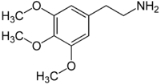
Mescaline or
3,4,5-trimethoxyphenethylamine is a
naturally occurringA natural product is a chemical compound or substance produced by a living organism - found in nature that usually has a pharmacological or biological activity for use in pharmaceutical drug discovery and drug design...
psychedelicThe term psychedelic is derived from the Greek words ψυχή and δηλοῦν , translating to "soul-manifesting". A psychedelic experience is characterized by the striking perception of aspects of one's mind previously unknown, or by the creative exuberance of the mind liberated from its ostensibly...
alkaloidAlkaloids are a group of naturally occurring chemical compounds that contain mostly basic nitrogen atoms. This group also includes some related compounds with neutral and even weakly acidic properties. Also some synthetic compounds of similar structure are attributed to alkaloids...
of the
phenethylamineThe substituted phenethylamines are chemical compounds with the 2-phenethylamine chemical structure modified at the phenyl ring, sidechain, and/or amino group. Some of them are psychoactive drugs, including stimulants, psychedelics, opioids, and entactogens, which exert their effects primarily...
class used mainly as an
entheogenAn entheogen , in the strict sense, is a psychoactive substance used in a religious, shamanic, or spiritual context. Historically, entheogens were mostly derived from plant sources and have been used in a variety of traditional religious contexts...
.
It occurs naturally in the
peyoteLophophora williamsii , better known by its common name Peyote , is a small, spineless cactus with psychoactive alkaloids, particularly mescaline.It is native to southwestern Texas and Mexico...
cactus (
Lophophora williamsii), and the
Peruvian Torch cactusPeruvian Torch cactus is a fast-growing columnar cactus native to the western slope of the Andes in Peru, between about 2000-3000 meters above sea level.-Description:...
(
Echinopsis peruviana), and in a number of other members of the Cactaceae plant family. It is also found in small amounts in certain members of the
FabaceaeThe Fabaceae or Leguminosae, commonly known as the legume, pea, or bean family, is a large and economically important family of flowering plants. The group is the third largest land plant family, behind only the Orchidaceae and Asteraceae, with 730 genera and over 19,400 species...
(bean) family, including
Acacia berlandieriAcacia berlandieri is a shrub native to the Southwestern United States and northeast Mexico that belongs to the subfamily Mimosoideae of Fabaceae . It grows tall, with blossoms that are spherical and white, occurring from February through April...
. Mescaline was first isolated and identified in 1897 by the German
Arthur HeffterArthur Carl Wilhelm Heffter was a German pharmacologist and chemist. He was the first chairman of the German Society of Pharmacologists, and was largely responsible for the first Handbook of Experimental Pharmacology...
and first synthesized in 1919 by
Ernst SpäthErnst Späth was an Austrian chemist.He was the first to synthesise Mescaline and was one of the first to synthesize cuscohygrine on a small scale with Hans Tuppy....
.
History and usage
Peyote has been used for over 3000 years by
Native AmericansThe indigenous peoples of the Americas are the pre-Columbian inhabitants of North and South America, their descendants and other ethnic groups who are identified with those peoples. Indigenous peoples are known in Canada as Aboriginal peoples, and in the United States as Native Americans...
in
MexicoThe United Mexican States , commonly known as Mexico , is a federal constitutional republic in North America. It is bordered on the north by the United States; on the south and west by the Pacific Ocean; on the southeast by Guatemala, Belize, and the Caribbean Sea; and on the east by the Gulf of...
. Europeans noted use of peyote in Native American religious ceremonies upon early contact, notably by the Huichols in Mexico. Other mescaline-containing cacti such as the San Pedro have a long history of use in South America, from Peru to Ecuador.
In traditional peyote preparations the top of the cactus is cut at ground level, leaving the large tap roots to grow new 'Heads'. These 'Heads' are then dried to make disk-shaped buttons. Buttons are chewed to produce the effects or soaked in water for an intoxicating drink. However, the taste of the cactus is bitter, so users will often grind it into a powder and pour it in capsules to avoid having to taste it. The usual human dosage is 200–400 milligrams of mescaline sulfate or 178–356 milligrams of mescaline hydrochloride. The average 3 inches (76.2 mm) button contains about 25 mg mescaline.
Aldous HuxleyAldous Leonard Huxley was an English writer and one of the most prominent members of the famous Huxley family. Best known for his novels including Brave New World and a wide-ranging output of essays, Huxley also edited the magazine Oxford Poetry, and published short stories, poetry, travel...
described his experience with mescaline in
The Doors of PerceptionThe Doors of Perception is a 1954 book by Aldous Huxley detailing his experiences when taking mescaline. The book takes the form of Huxley’s recollection of a mescaline trip which took place over the course of an afternoon, and takes its title from William Blake's poem The Marriage of Heaven and Hell...
.
Aleister CrowleyAleister Crowley , born Edward Alexander Crowley, and also known as both Frater Perdurabo and The Great Beast, was an influential English occultist, astrologer, mystic and ceremonial magician, responsible for founding the religious philosophy of Thelema. He was also successful in various other...
reported using mescaline in his diary. The sex psychologist
Havelock EllisHenry Havelock Ellis, known as Havelock Ellis , was a British physician and psychologist, writer, and social reformer who studied human sexuality. He was co-author of the first medical textbook in English on homosexuality in 1897, and also published works on a variety of sexual practices and...
also tried mescaline.
Hunter S. ThompsonHunter Stockton Thompson was an American journalist and author who wrote The Rum Diary , Fear and Loathing in Las Vegas and Fear and Loathing on the Campaign Trail '72 .He is credited as the creator of Gonzo journalism, a style of reporting where reporters involve themselves in the action to...
recounted an extremely detailed account of his first use of mescaline in
First Visit with Mescalito, appearing in his book
Songs of the DoomedGonzo Papers, Vol. 3: Songs of the Doomed: More Notes on the Death of the American Dream is a book by the American writer and journalist Hunter S. Thompson, originally published in 1990...
.
Biosynthesis of mescaline
Mescaline can be synthesized from tyrosine or a hydroxylated phenylalanine. In
Lophophora williamsii, dopamine converts into mescaline in a biosynthetic pathway involving
m-O-methylation and aromatic hydroxylation.
Pharmacokinetics
Tolerance builds with repeated usage, lasting for a few days. Mescaline causes cross-tolerance with some other psychedelics such as
LSDLysergic acid diethylamide, abbreviated LSD or LSD-25, also known as lysergide and colloquially as acid, is a semisynthetic psychedelic drug of the ergoline family, well known for its psychological effects which can include altered thinking processes, closed and open eye visuals, synaesthesia, an...
/LSA,
DMTN,N-Dimethyltryptamine is a naturally occurring psychedelic compound of the tryptamine family. DMT is found in several plants, and also in trace amounts in humans and other mammals, where it is originally derived from the essential amino acid tryptophan, and ultimately produced by the enzyme INMT...
, and
psilocybinPsilocybin is a naturally occurring psychedelic prodrug, with mind-altering effects similar to those of LSD and mescaline, after it is converted to psilocin. The effects can include altered thinking processes, perceptual distortions, an altered sense of time, and spiritual experiences, as well as...
.
THCTHC commonly refers to tetrahydrocannabinol, the main active chemical compound in Cannabis.THC may also refer to:* Tan Holdings Corporation...
, and
muscimolMuscimol is the major psychoactive alkaloid present in many mushrooms of the Amanita genus. Unlike psilocin , which is a serotonergic psychedelic and agonist for the 5-HT2A receptor set, muscimol is a potent, selective agonist for the GABAA receptor set and is a deliriant as a opposed...
most likely do not produce cross tolerance with each other or with the
LSDLysergic acid diethylamide, abbreviated LSD or LSD-25, also known as lysergide and colloquially as acid, is a semisynthetic psychedelic drug of the ergoline family, well known for its psychological effects which can include altered thinking processes, closed and open eye visuals, synaesthesia, an...
-LSA-mescaline-psilocybin-
DMTN,N-Dimethyltryptamine is a naturally occurring psychedelic compound of the tryptamine family. DMT is found in several plants, and also in trace amounts in humans and other mammals, where it is originally derived from the essential amino acid tryptophan, and ultimately produced by the enzyme INMT...
group.
About half the initial dosage is excreted after 6 hours, but some studies suggest that it is not metabolized at all before excretion. Mescaline appears to not be subject to metabolism by
CYP2D6Cytochrome P450 2D6 , a member of the cytochrome P450 mixed-function oxidase system, is one of the most important enzymes involved in the metabolism of xenobiotics in the body. Also, many substances are bioactivated by CYP2D6 to form their active compounds...
and between 20 and 50% of mescaline is excreted in the urine unchanged, and the rest being excreted as the
carboxylic acidCarboxylic acids are organic acids characterized by the presence of at least one carboxyl group. The general formula of a carboxylic acid is R-COOH, where R is some monovalent functional group...
form of mescaline, a likely result of
MAOL-Monoamine oxidases are a family of enzymes that catalyze the oxidation of monoamines. They are found bound to the outer membrane of mitochondria in most cell types in the body. The enzyme was originally discovered by Mary Bernheim in the liver and was named tyramine oxidase...
degradation. The LD
50 of mescaline has been measured in various animals: 212 mg/kg i.p. (mice), 132 mg/kg i.p. (rats), and 328 mg/kg i.p. (guinea pigs).
Behavioral and non-behavioral effects
The visual distortions produced by mescaline are somewhat different from those of
LSDLysergic acid diethylamide, abbreviated LSD or LSD-25, also known as lysergide and colloquially as acid, is a semisynthetic psychedelic drug of the ergoline family, well known for its psychological effects which can include altered thinking processes, closed and open eye visuals, synaesthesia, an...
. The subjective "open-eye visuals" are not true hallucinations as they are consistent with actual experience and manifest as intensifications and alterations of existing stimuli (objects and sounds), not the appearance of non-existent fanciful objects or actions that the user believes are real; the appearance of non-existent persons or objects is a feature of
true hallucinations, and believing that the hallucinations are "real" is a defining feature of delusions, which is not a common effect of mescaline. Prominence of color is distinctive, appearing brilliant and intense. Recurring visual patterns observed during the mescaline experience include stripes, checkerboards, angular spikes, multicolored dots, and very simple fractals which turn very complex. Aldous Huxley described these self transforming amorphous shapes as like animated stained glass illuminated from light coming through the eyelids. Like LSD, mescaline induces distortions of form and
kaleidoscopicA kaleidoscope is a circle of mirrors containing loose, colored objects such as beads or pebbles and bits of glass. As the viewer looks into one end, light entering the other end creates a colorful pattern, due to the reflection off the mirrors...
experiences but which manifest more clearly with eyes closed and under low lighting conditions; however, all of these visual descriptions are purely subjective.
As with LSD,
synesthesiaSynesthesia , from the ancient Greek , "together," and , "sensation," is a neurologically based condition in which stimulation of one sensory or cognitive pathway leads to automatic, involuntary experiences in a second sensory or cognitive pathway...
can occur especially with the help of music. An unusual but unique characteristic of mescaline use is the "geometricization" of three-dimensional objects. The object can appear flattened and distorted, similar to the presentation of a Cubist painting.
Mescaline elicits a pattern of sympathetic arousal, with the
peripheral nervous systemThe peripheral nervous system consists of the nerves and ganglia outside of the brain and spinal cord. The main function of the PNS is to connect the central nervous system to the limbs and organs. Unlike the CNS, the PNS is not protected by the bone of spine and skull, or by the blood–brain...
being a major target for this drug. Effects typically last for 12-18 hours.
Mode of action
Mescaline acts similarly to other psychedelic agents. It binds to and activates the
serotoninSerotonin or 5-hydroxytryptamine is a monoamine neurotransmitter. Biochemically derived from tryptophan, serotonin is primarily found in the gastrointestinal tract, platelets, and in the central nervous system of animals including humans...
5-HT2A receptorThe mammalian 5-HT2A receptor is a subtype of the 5-HT2 receptor that belongs to the serotonin receptor family and is a G protein-coupled receptor . This is the main excitatory receptor subtype among the GPCRs for serotonin , although 5-HT2A may also have an inhibitory effect on certain areas such...
with a high affinity as a
partial agonistPartial agonists bind and activate a given receptor, but have only partial efficacy at the receptor relative to a full agonist...
. How activating the 5-HT
2A receptor leads to psychedelia is still unknown, but it likely somehow involves excitation of
neuronA neuron is an electrically excitable cell that processes and transmits information by electrical and chemical signaling. Chemical signaling occurs via synapses, specialized connections with other cells. Neurons connect to each other to form networks. Neurons are the core components of the nervous...
s in the
prefrontal cortexThe prefrontal cortex is the anterior part of the frontal lobes of the brain, lying in front of the motor and premotor areas.This brain region has been implicated in planning complex cognitive behaviors, personality expression, decision making and moderating correct social behavior...
. Mescaline is also known to bind to and activate the
serotoninSerotonin or 5-hydroxytryptamine is a monoamine neurotransmitter. Biochemically derived from tryptophan, serotonin is primarily found in the gastrointestinal tract, platelets, and in the central nervous system of animals including humans...
5-HT2C receptorThe 5-HT2C receptor is a subtype of 5-HT receptor that binds the endogenous neurotransmitter serotonin . It is a G protein-coupled receptor that is coupled to Gq/G11 and mediates excitatory neurotransmission. HTR2C denotes the human gene encoding for the receptor, that in humans is located at the...
.
In addition to serotonin receptor activity, mescaline also stimulates the dopamine receptors. Whether mescaline possesses dopamine receptor agonist properties or initiates the release of dopamine remains unclear.
Legality
In the United States, mescaline was made illegal in 1970 by the
Comprehensive Drug Abuse Prevention and Control ActThe Controlled Substances Act was enacted into law by the Congress of the United States as Title II of the Comprehensive Drug Abuse Prevention and Control Act of 1970. The CSA is the federal U.S. drug policy under which the manufacture, importation, possession, use and distribution of certain...
. The drug was prohibited internationally by the 1971
Convention on Psychotropic SubstancesThe Convention on Psychotropic Substances of 1971 is a United Nations treaty designed to control psychoactive drugs such as amphetamines, barbiturates, benzodiazepines, and psychedelics signed at Vienna on February 21, 1971...
and is categorized as a Schedule I hallucinogen by the
CSAThe Controlled Substances Act was enacted into law by the Congress of the United States as Title II of the Comprehensive Drug Abuse Prevention and Control Act of 1970. The CSA is the federal U.S. drug policy under which the manufacture, importation, possession, use and distribution of certain...
. Mescaline is legal only for certain religious groups (such as the
Native American ChurchNative American Church, a religious denomination which practices Peyotism or the Peyote religion, originated in the U.S. state of Oklahoma, and is the most widespread indigenous religion among Native Americans in the United States...
) and in scientific and medical research. In 1990, the Supreme Court ruled that the state of Oregon could bar the use of mescaline in Native American religious ceremonies. The
Religious Freedom Restoration ActThe Religious Freedom Restoration Act of 1993, Pub. L. No. 103-141, 107 Stat. 1488 , codified at through , is a 1993 United States federal law aimed at preventing laws that substantially burden a person's free exercise of their religion. The bill was introduced by Howard McKeon of California and...
(RFRA) in 1993 allowed the use of peyote in religious ceremony but in 1997, the Supreme Court ruled that the RFRA was unconstitutional when applied against states. However, in a subsequent case, the Court held that the Government had not carried the burden under the Religious Freedom Restoration Act of showing a compelling interest that allowed no exception to the ban on the use of the drug to accommodate a sincere religious practice. Thus, the current state of the law is that, while the federal government may not restrict use of peyote in ceremony, individual states do have a right to restrict its use.
In the UK, mescaline in purified powder form is a Class A drug. However, dried cactus can be bought and sold legally, unlike raw "magic" (psilocybin containing) mushrooms, which are now illegal. In Australia the peyote cacti and mescaline are strictly illegal, however San Pedro and other mescaline-containing plants are legal for ornamental/gardening purposes. In Canada and Germany, mescaline in raw form and dried mescaline containing cacti are considered an illegal drug. However, anyone may grow and use peyote, or
Lophophora williamsii, as well as San Pedro and San Peruvianus without restriction, as it is specifically exempt from legislation.
External links