


Nazism and race

Encyclopedia
Nazism developed several theories concerning races. The Nazis claimed to scientifically measure a strict hierarchy of human race; at the top was the master race
, the "Aryan race
", narrowly defined by the Nazis as being identical with the Nordic race, followed by lesser races.
At the bottom of this hierarchy were "parasitic" races (of non-"Aryan" origin) or "Untermensch
en" ("sub-humans"), which were perceived to be dangerous to society. In Nazi literature, the term "under man" ('Untermensch') was applied to the Slavs, especially including Russians
, Serbs
(from the South Slavic
group), and ethnic Poles. Nazi ideology viewed Slavs as a racially inferior group, who were fit for enslavement, or even extermination. About 2 million non-Jewish ethnic Poles were killed by Nazi Germany. Lowest of all in the Nazi racial policy
were Gypsies and Jews, who were both eventually deemed to be "Lebensunwertes Leben
" ("Life unworthy of life") and to be exterminated during the Holocaust (see Raul Hilberg
's description of the various phases of the Holocaust). Not to be forgotten, Hitler
did have people of Jewish descent
working for him. Coined as mischling
(or 'Part-Jews'), they were often employed in the Wehrmacht, although they were not allowed to be soldiers after 1940. One mischling, Werner Goldberg
, was even called "The Ideal German Soldier" by German newspapers.
Richard Walther Darré, Reich Minister of Food and Agriculture from 1933 to 1942, popularized the expression "Blut und Boden" ("Blood and Soil"), one of the many terms of the Nazi glossary ideologically
used to enforce popular racism
in the German population.
Philosophers and other theoreticians participated in the elaboration of Nazi ideology. The relationship between Heidegger and Nazism
has remained a controversial subject in the history of philosophy
, even today. According to the philosopher Emmanuel Faye, Heidegger said of Spinoza that he was "ein Fremdkörper in der Philosophie", a "foreign body in philosophy" Faye notes that Fremdkörper was a term which belonged to the Nazi glossary, and not to classical German. However Heidegger did to a certain extent criticise racial science, particularly in his Nietzsche lectures, which reject biologism in general. Carl Schmitt
elaborated a philosophy of law praising the Führerprinzip and the German people, while Alfred Baeumler
instrumentalized Nietzsche's thought, in particular his concept of the "Will to Power
", in an attempt to justify Nazism.
, off the coast of North Western Europe, and had migrated through Scandinavia and northern Europe, expanding further south, and as far as Iran and India where it founded the Aryan cultures of Zoroastrianism
and Hinduism
. Like Madison Grant
and others, he argued that the entrepreneurial energy of the Nordics had "degenerated" when they mixed with "inferior" peoples.
With the rise of Hitler, Nordic theory became the norm within German culture. In some cases the "Nordic" concept became an almost abstract ideal rather than a mere racial category. Hermann Gauch
wrote in 1933 that the fact that "birds can be taught to talk better than other animals is explained by the fact that their mouths are Nordic in structure." He further claimed that in humans, "the shape of the Nordic gum allows a superior movement of the tongue, which is the reason why Nordic talking and singing are richer."
Such views were extreme, but more mainstream Nordic theory was institutionalized. Hans F. K. Günther, who joined the Nazi Party in 1932, was praised as a pioneer in racial thinking, a shining light of Nordic theory. Most official Nazi comments on the Nordic Race were based on Günther's works, and Alfred Rosenberg presented Günther with a medal for his work in anthropology.
Fischer and Lenz were also appointed to senior positions overseeing the policy of Racial Hygiene
. The Nazi state used such ideas about the differences between European races as part of their various discriminatory and coercive policies which culminated in the Holocaust. Ironically, in Grant's first edition of his popular book The Passing of the Great Race
he classified Americans as being primarily Nordic, but in his second edition, published after the USA had entered WWI, he had re-classified the now enemy power as being dominated by "inferior" Alpines, a tradition evident in the work of Harvard Professor of Anthropology Carlton Coon's work, The Races of Europe.
Günther's work stated that the Germans are definitely not a fully Nordic people, and divided them into Western (Mediterranean), Nordic, Eastern (Alpine), East Baltic and Dinaric races. He also stated that European Jews belonged in certain proportion to the same races as Germans did, including the Nordic race. Hitler himself was later to downplay the importance of Nordicism in public for this very reason. The simplistic tripartite model of Grant which divided Europeans into only Alpine, Mediterranean, and Nordic, Günther did not use, and erroneously placed most of the population of Hitler's Germany in the Alpine category, especially after the Anschluss
. This has been used to downplay the Nordic presence in Germany.
J. Kaup led a movement opposed to Günther. Kaup took the view that a German nation, all of whose citizens belonged to a "German race" in a populationist sense, offered a more convenient sociotechnical tool than Günther's concept of an ideal Nordic type to which only a very few Germans could belong. Nazi legislation identifying the ethnic and "racial" affinities of the Jews reflects the populationist concept of race. Discrimination was not restricted to Jews who belonged to the "Semitic-Oriental-Armenoid" and/or "Nubian-African/Negroid" races, but was directed against all members of the Jewish ethnic population.
The German Jewish journalist Kurt Caro (1905–1979) who emigrated to Paris in 1933 and served in the British army from 1943, published a book under the pseudonym Manuel Humbert unmasking Hitler's "Mein Kampf" in which he stated the following racial composition of the Jewish population of Central Europe: 23.8% Lapponid race, 21.5% Nordic race,
20.3% Armenoid race, 18.4% Mediterranean race, 16.0% Oriental race.
By 1939 Hitler had abandoned Nordicist rhetoric in favour of the idea that the German people as a whole were united by distinct "spiritual" qualities. Nevertheless, Nazi eugenics policies continued to favor Nordics over Alpines and other racial groups, particularly during the war when decisions were being made about the incorporation of conquered peoples into the Reich. The Lebensborn
program sought to extend the Nordic race. In 1942 Hitler stated in private,
Hitler and Himmler
planned to use the SS as the basis for the racial "regeneration" of Europe following the final victory of Nazism. The SS was to be a racial elite chosen on the basis of "pure" Nordic qualities.
Addressing officers of the SS-Leibstandarte "Adolf Hitler"
Himmler stated:
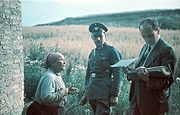
Nazis developed an elaborate system of propaganda
to diffuse these theories. Nazi architecture
, for example, was used to create the "new order" and improve the "Aryan race." Sports were also seen by the Nazis as a way to "regenerate the race." The Hitler Youth
, founded in 1922, had among its basic motivations the training of future "Aryan supermen" and future soldiers who would faithfully fight for the Third Reich.
Cinema was also used to promote racist theories, under the direction of Joseph Goebbels
' Propagandaministerium. The German Hygiene Museum
in Dresden diffused racial theories. A 1934 poster of the museum shows a man with distinctly African features and reads, "If this man had been sterilized there would not have been born ... 12 hereditarily diseased." According to the current director Klaus Voegel, "The Hygiene Museum was not a criminal institute in the sense that people were killed here," but "it helped to shape the idea of which lives were worthy and which were worthless."
Nazi racial theories soon translated into legislation, most notably with the 1935 Nuremberg Laws
and the July 1933 Law for the Prevention of Hereditarily Diseased Offspring
. The Action T4
euthanasia programme, in which the Kraft durch Freude
(KdF, literally "Strength Through Joy") youth organisation participated, targeted people accused of representing a danger of "degeneration
" towards the "Deutsche Volk
."
The Nazi régime also implemented a vast bureaucratic apparatus for making "racial determinations," the ancestral proofs of Aryan descent (Ariernachweis) or "German blood" (Deutschblütigkeitserklärung). Probably the vast majority of the population made such a proof during the course of the Third Reich.
During World War II
, Germanization efforts were carried out in eastern Europe to cull those of "German blood" there.HITLER'S PLANS FOR EASTERN EUROPE This started with the classification of people into the Volksliste
. Those selected were either sent for Germanization, or killed to prevent "German blood" being used against the Nazis. In regions of Poland, Poles deemed unfit were evicted to make room for Baltic Germans induced to emigrate after the pact with the USSR. "Racially valuable" children were also abducted
from their parents to be Germanized.
Western countries, such as France, were treated less roughly because they were viewed as racially superior to the Poles, though not as good as full Germans; a complex of racial categories was boiled down by the average German to mean "East is bad and West is acceptable." Still, extensive racial classification was practiced in France, for future uses.
Master race
Master race was a phrase and concept originating in the slave-holding Southern US. The later phrase Herrenvolk , interpreted as 'master race', was a concept in Nazi ideology in which the Nordic peoples, one of the branches of what in the late-19th and early-20th century was called the Aryan race,...
, the "Aryan race
Aryan race
The Aryan race is a concept historically influential in Western culture in the period of the late 19th century and early 20th century. It derives from the idea that the original speakers of the Indo-European languages and their descendants up to the present day constitute a distinctive race or...
", narrowly defined by the Nazis as being identical with the Nordic race, followed by lesser races.
At the bottom of this hierarchy were "parasitic" races (of non-"Aryan" origin) or "Untermensch
Untermensch
Untermensch is a term that became infamous when the Nazi racial ideology used it to describe "inferior people", especially "the masses from the East," that is Jews, Gypsies, Poles along with other Slavic people like the Russians, Serbs, Belarussians and Ukrainians...
en" ("sub-humans"), which were perceived to be dangerous to society. In Nazi literature, the term "under man" ('Untermensch') was applied to the Slavs, especially including Russians
Russians
The Russian people are an East Slavic ethnic group native to Russia, speaking the Russian language and primarily living in Russia and neighboring countries....
, Serbs
Serbs
The Serbs are a South Slavic ethnic group of the Balkans and southern Central Europe. Serbs are located mainly in Serbia, Montenegro and Bosnia and Herzegovina, and form a sizable minority in Croatia, the Republic of Macedonia and Slovenia. Likewise, Serbs are an officially recognized minority in...
(from the South Slavic
South Slavs
The South Slavs are the southern branch of the Slavic peoples and speak South Slavic languages. Geographically, the South Slavs are native to the Balkan peninsula, the southern Pannonian Plain and the eastern Alps...
group), and ethnic Poles. Nazi ideology viewed Slavs as a racially inferior group, who were fit for enslavement, or even extermination. About 2 million non-Jewish ethnic Poles were killed by Nazi Germany. Lowest of all in the Nazi racial policy
Racial policy of Nazi Germany
The racial policy of Nazi Germany was a set of policies and laws implemented by Nazi Germany, asserting the superiority of the "Aryan race", and based on a specific racist doctrine which claimed scientific legitimacy...
were Gypsies and Jews, who were both eventually deemed to be "Lebensunwertes Leben
Life unworthy of life
The phrase "life unworthy of life" was a Nazi designation for the segments of populace which had no right to live and thus were to be "euthanized". The term included people with serious medical problems and those considered grossly inferior according to racial policy of the Third Reich...
" ("Life unworthy of life") and to be exterminated during the Holocaust (see Raul Hilberg
Raul Hilberg
Raul Hilberg was an Austrian-born American political scientist and historian. He was widely considered to be the world's preeminent scholar of the Holocaust, and his three-volume, 1,273-page magnum opus, The Destruction of the European Jews, is regarded as a seminal study of the Nazi Final...
's description of the various phases of the Holocaust). Not to be forgotten, Hitler
Adolf Hitler
Adolf Hitler was an Austrian-born German politician and the leader of the National Socialist German Workers Party , commonly referred to as the Nazi Party). He was Chancellor of Germany from 1933 to 1945, and head of state from 1934 to 1945...
did have people of Jewish descent
Jews
The Jews , also known as the Jewish people, are a nation and ethnoreligious group originating in the Israelites or Hebrews of the Ancient Near East. The Jewish ethnicity, nationality, and religion are strongly interrelated, as Judaism is the traditional faith of the Jewish nation...
working for him. Coined as mischling
Mischling
Mischling was the German term used during the Third Reich to denote persons deemed to have only partial Aryan ancestry. The word has essentially the same origin as mestee in English, mestizo in Spanish and métis in French...
(or 'Part-Jews'), they were often employed in the Wehrmacht, although they were not allowed to be soldiers after 1940. One mischling, Werner Goldberg
Werner Goldberg
Werner Goldberg was a German of partial Jewish ancestry, or Mischling in Nazi terminology, who served briefly as a soldier during World War II and whose image appeared in a German newspaper as "The Ideal German Soldier".-Biography:His father himself had grown up in Königsberg as a member of the...
, was even called "The Ideal German Soldier" by German newspapers.
Richard Walther Darré, Reich Minister of Food and Agriculture from 1933 to 1942, popularized the expression "Blut und Boden" ("Blood and Soil"), one of the many terms of the Nazi glossary ideologically
Ideology
An ideology is a set of ideas that constitutes one's goals, expectations, and actions. An ideology can be thought of as a comprehensive vision, as a way of looking at things , as in common sense and several philosophical tendencies , or a set of ideas proposed by the dominant class of a society to...
used to enforce popular racism
Racism
Racism is the belief that inherent different traits in human racial groups justify discrimination. In the modern English language, the term "racism" is used predominantly as a pejorative epithet. It is applied especially to the practice or advocacy of racial discrimination of a pernicious nature...
in the German population.
Origins
It was the catastrophe of losing the First World War with its devastating economic consequences which set the stage for racism to take root as one means of apportioning blame for Germany's misfortune. It was such latent popular racism that the Nazis exploited in their propaganda.Philosophers and other theoreticians participated in the elaboration of Nazi ideology. The relationship between Heidegger and Nazism
Heidegger and Nazism
The relation between the philosopher Martin Heidegger and the Nazi Party is a controversial subject.Martin Heidegger joined the Nazi Party on May 1, 1933, nearly three weeks after being appointed Rector of the University of Freiburg. Heidegger resigned the Rectorship about one year later, in April...
has remained a controversial subject in the history of philosophy
History of philosophy
The history of philosophy is the study of philosophical ideas and concepts through time. Issues specifically related to history of philosophy might include : How can changes in philosophy be accounted for historically? What drives the development of thought in its historical context? To what...
, even today. According to the philosopher Emmanuel Faye, Heidegger said of Spinoza that he was "ein Fremdkörper in der Philosophie", a "foreign body in philosophy" Faye notes that Fremdkörper was a term which belonged to the Nazi glossary, and not to classical German. However Heidegger did to a certain extent criticise racial science, particularly in his Nietzsche lectures, which reject biologism in general. Carl Schmitt
Carl Schmitt
Carl Schmitt was a German jurist, philosopher, political theorist, and professor of law.Schmitt published several essays, influential in the 20th century and beyond, on the mentalities that surround the effective wielding of political power...
elaborated a philosophy of law praising the Führerprinzip and the German people, while Alfred Baeumler
Alfred Baeumler
Alfred Baeumler , was a German philosopher and pedagogue. From 1924 he taught at the Technische Universität Dresden, at first as an unsalaried lecturer Privatdozent...
instrumentalized Nietzsche's thought, in particular his concept of the "Will to Power
The Will to Power
The Will to Power is the title given to a book of selectively reordered notes from the literary remains of Friedrich Nietzsche by his sister Elisabeth Förster-Nietzsche and Heinrich Köselitz...
", in an attempt to justify Nazism.
Ideology
Rosenberg argued that the Nordic race had evolved in a now-lost landmass, AtlantisAtlantis
Atlantis is a legendary island first mentioned in Plato's dialogues Timaeus and Critias, written about 360 BC....
, off the coast of North Western Europe, and had migrated through Scandinavia and northern Europe, expanding further south, and as far as Iran and India where it founded the Aryan cultures of Zoroastrianism
Zoroastrianism
Zoroastrianism is a religion and philosophy based on the teachings of prophet Zoroaster and was formerly among the world's largest religions. It was probably founded some time before the 6th century BCE in Greater Iran.In Zoroastrianism, the Creator Ahura Mazda is all good, and no evil...
and Hinduism
Hinduism
Hinduism is the predominant and indigenous religious tradition of the Indian Subcontinent. Hinduism is known to its followers as , amongst many other expressions...
. Like Madison Grant
Madison Grant
Madison Grant was an American lawyer, historian and physical anthropologist, known primarily for his work as a eugenicist and conservationist...
and others, he argued that the entrepreneurial energy of the Nordics had "degenerated" when they mixed with "inferior" peoples.
With the rise of Hitler, Nordic theory became the norm within German culture. In some cases the "Nordic" concept became an almost abstract ideal rather than a mere racial category. Hermann Gauch
Hermann Gauch
Hermann Gauch was a Nazi race theorist noted for his dedication to Nordic theory. Gauch was a physician who had joined the National Socialists in the 1920s, wrote six books of "race research" as a member of the SS, and to his dying day remained an unrepentant believer in Nazi ideology...
wrote in 1933 that the fact that "birds can be taught to talk better than other animals is explained by the fact that their mouths are Nordic in structure." He further claimed that in humans, "the shape of the Nordic gum allows a superior movement of the tongue, which is the reason why Nordic talking and singing are richer."
Such views were extreme, but more mainstream Nordic theory was institutionalized. Hans F. K. Günther, who joined the Nazi Party in 1932, was praised as a pioneer in racial thinking, a shining light of Nordic theory. Most official Nazi comments on the Nordic Race were based on Günther's works, and Alfred Rosenberg presented Günther with a medal for his work in anthropology.
Fischer and Lenz were also appointed to senior positions overseeing the policy of Racial Hygiene
Racial hygiene
Racial hygiene was a set of early twentieth century state sanctioned policies by which certain groups of individuals were allowed to procreate and others not, with the expressed purpose of promoting certain characteristics deemed to be particularly desirable...
. The Nazi state used such ideas about the differences between European races as part of their various discriminatory and coercive policies which culminated in the Holocaust. Ironically, in Grant's first edition of his popular book The Passing of the Great Race
The Passing of the Great Race
The Passing of The Great Race; or, The racial basis of European history was an influential book of scientific racism written by the American eugenicist, lawyer, and amateur anthropologist Madison Grant in 1916. The book was largely ignored when it first appeared but went through several revisions...
he classified Americans as being primarily Nordic, but in his second edition, published after the USA had entered WWI, he had re-classified the now enemy power as being dominated by "inferior" Alpines, a tradition evident in the work of Harvard Professor of Anthropology Carlton Coon's work, The Races of Europe.
Günther's work stated that the Germans are definitely not a fully Nordic people, and divided them into Western (Mediterranean), Nordic, Eastern (Alpine), East Baltic and Dinaric races. He also stated that European Jews belonged in certain proportion to the same races as Germans did, including the Nordic race. Hitler himself was later to downplay the importance of Nordicism in public for this very reason. The simplistic tripartite model of Grant which divided Europeans into only Alpine, Mediterranean, and Nordic, Günther did not use, and erroneously placed most of the population of Hitler's Germany in the Alpine category, especially after the Anschluss
Anschluss
The Anschluss , also known as the ', was the occupation and annexation of Austria into Nazi Germany in 1938....
. This has been used to downplay the Nordic presence in Germany.
J. Kaup led a movement opposed to Günther. Kaup took the view that a German nation, all of whose citizens belonged to a "German race" in a populationist sense, offered a more convenient sociotechnical tool than Günther's concept of an ideal Nordic type to which only a very few Germans could belong. Nazi legislation identifying the ethnic and "racial" affinities of the Jews reflects the populationist concept of race. Discrimination was not restricted to Jews who belonged to the "Semitic-Oriental-Armenoid" and/or "Nubian-African/Negroid" races, but was directed against all members of the Jewish ethnic population.
The German Jewish journalist Kurt Caro (1905–1979) who emigrated to Paris in 1933 and served in the British army from 1943, published a book under the pseudonym Manuel Humbert unmasking Hitler's "Mein Kampf" in which he stated the following racial composition of the Jewish population of Central Europe: 23.8% Lapponid race, 21.5% Nordic race,
20.3% Armenoid race, 18.4% Mediterranean race, 16.0% Oriental race.
By 1939 Hitler had abandoned Nordicist rhetoric in favour of the idea that the German people as a whole were united by distinct "spiritual" qualities. Nevertheless, Nazi eugenics policies continued to favor Nordics over Alpines and other racial groups, particularly during the war when decisions were being made about the incorporation of conquered peoples into the Reich. The Lebensborn
Lebensborn
Lebensborn was a Nazi programme set up by SS leader Heinrich Himmler that provided maternity homes and financial assistance to the wives of SS members and to unmarried mothers, and also ran orphanages and relocation programmes for children.Initially set up in Germany in 1935, Lebensborn expanded...
program sought to extend the Nordic race. In 1942 Hitler stated in private,
I shall have no peace of mind until I have planted a seed of Nordic blood wherever the population stand in need of regeneration. If at the time of the migrationsMigration PeriodThe Migration Period, also called the Barbarian Invasions , was a period of intensified human migration in Europe that occurred from c. 400 to 800 CE. This period marked the transition from Late Antiquity to the Early Middle Ages...
, while the great racial currents were exercising their influence, our people received so varied a share of attributes, these latter blossomed to their full value only because of the presence of the Nordic racial nucleus.
Hitler and Himmler
Heinrich Himmler
Heinrich Luitpold Himmler was Reichsführer of the SS, a military commander, and a leading member of the Nazi Party. As Chief of the German Police and the Minister of the Interior from 1943, Himmler oversaw all internal and external police and security forces, including the Gestapo...
planned to use the SS as the basis for the racial "regeneration" of Europe following the final victory of Nazism. The SS was to be a racial elite chosen on the basis of "pure" Nordic qualities.
Addressing officers of the SS-Leibstandarte "Adolf Hitler"
1st SS Division Leibstandarte SS Adolf Hitler
The Leibstandarte SS Adolf Hitler was Adolf Hitler's personal bodyguard. Initially the size of a regiment, the LSSAH eventually grew into a divisional-sized unit...
Himmler stated:
The ultimate aim for those 11 years during which I have been the Reichsfuehrer SS has been invariably the same: to create an order of good blood which is able to serve Germany; which unfailingly and without sparing itself can be made use of because the greatest losses can do no harm to the vitality of this order, the vitality of these men, because they will always be replaced; to create an order which will spread the idea of Nordic blood so far that we will attract all Nordic blood in the world, take away the blood from our adversaries, absorb it so that never again, looking at it from the viewpoint of grand policy, Nordic blood, in great quantities and to an extent worth mentioning, will fight against us.
Propaganda and implementation of racial theories
Nazis developed an elaborate system of propaganda
Nazi propaganda
Propaganda, the coordinated attempt to influence public opinion through the use of media, was skillfully used by the NSDAP in the years leading up to and during Adolf Hitler's leadership of Germany...
to diffuse these theories. Nazi architecture
Nazi architecture
Nazi architecture was an architectural plan which played a role in the Nazi party's plans to create a cultural and spiritual rebirth in Germany as part of the Third Reich....
, for example, was used to create the "new order" and improve the "Aryan race." Sports were also seen by the Nazis as a way to "regenerate the race." The Hitler Youth
Hitler Youth
The Hitler Youth was a paramilitary organization of the Nazi Party. It existed from 1922 to 1945. The HJ was the second oldest paramilitary Nazi group, founded one year after its adult counterpart, the Sturmabteilung...
, founded in 1922, had among its basic motivations the training of future "Aryan supermen" and future soldiers who would faithfully fight for the Third Reich.
Cinema was also used to promote racist theories, under the direction of Joseph Goebbels
Joseph Goebbels
Paul Joseph Goebbels was a German politician and Reich Minister of Propaganda in Nazi Germany from 1933 to 1945. As one of Adolf Hitler's closest associates and most devout followers, he was known for his zealous oratory and anti-Semitism...
' Propagandaministerium. The German Hygiene Museum
German Hygiene Museum
The German Hygiene Museum is a museum in Dresden, Germany. It conceives itself today as a "forum for science, culture and society". It is a popular venue for events and exhibitions, and is among the most visited museums in Dresden, with around 300,000 visitors per year.-History:The museum was...
in Dresden diffused racial theories. A 1934 poster of the museum shows a man with distinctly African features and reads, "If this man had been sterilized there would not have been born ... 12 hereditarily diseased." According to the current director Klaus Voegel, "The Hygiene Museum was not a criminal institute in the sense that people were killed here," but "it helped to shape the idea of which lives were worthy and which were worthless."
Nazi racial theories soon translated into legislation, most notably with the 1935 Nuremberg Laws
Nuremberg Laws
The Nuremberg Laws of 1935 were antisemitic laws in Nazi Germany introduced at the annual Nuremberg Rally of the Nazi Party. After the takeover of power in 1933 by Hitler, Nazism became an official ideology incorporating scientific racism and antisemitism...
and the July 1933 Law for the Prevention of Hereditarily Diseased Offspring
Law for the Prevention of Hereditarily Diseased Offspring
Law for the Prevention of Genetically Diseased Offspring or "Sterilization Law" was a statute in Nazi Germany enacted on July 14, 1933, which allowed the compulsory sterilization of any citizen who in the opinion of a "Genetic Health Court" Law for the Prevention of Genetically Diseased Offspring...
. The Action T4
Action T4
Action T4 was the name used after World War II for Nazi Germany's eugenics-based "euthanasia" program during which physicians killed thousands of people who were "judged incurably sick, by critical medical examination"...
euthanasia programme, in which the Kraft durch Freude
Kraft durch Freude
Kraft durch Freude was a large state-controlled leisure organization in Nazi Germany. It was a part of the German Labour Front , the national German labour organization at that time...
(KdF, literally "Strength Through Joy") youth organisation participated, targeted people accused of representing a danger of "degeneration
Degeneration
The idea of degeneration had significant influence on science, art and politics from the 1850s to the 1950s. The social theory developed consequently from Charles Darwin's Theory of Evolution...
" towards the "Deutsche Volk
Volksdeutsche
Volksdeutsche - "German in terms of people/folk" -, defined ethnically, is a historical term from the 20th century. The words volk and volkische conveyed in Nazi thinking the meanings of "folk" and "race" while adding the sense of superior civilization and blood...
."
The Nazi régime also implemented a vast bureaucratic apparatus for making "racial determinations," the ancestral proofs of Aryan descent (Ariernachweis) or "German blood" (Deutschblütigkeitserklärung). Probably the vast majority of the population made such a proof during the course of the Third Reich.
During World War II
World War II
World War II, or the Second World War , was a global conflict lasting from 1939 to 1945, involving most of the world's nations—including all of the great powers—eventually forming two opposing military alliances: the Allies and the Axis...
, Germanization efforts were carried out in eastern Europe to cull those of "German blood" there.HITLER'S PLANS FOR EASTERN EUROPE This started with the classification of people into the Volksliste
Volksliste
The Deutsche Volksliste was a Nazi institution whose purpose was the classification of inhabitants of German occupied territories into categories of desirability according to criteria systematized by Heinrich Himmler. The institution was first established in occupied western Poland...
. Those selected were either sent for Germanization, or killed to prevent "German blood" being used against the Nazis. In regions of Poland, Poles deemed unfit were evicted to make room for Baltic Germans induced to emigrate after the pact with the USSR. "Racially valuable" children were also abducted
Kidnapping of Polish children by Nazi Germany
Kidnapping of Eastern European children by Nazi Germany , part of the Generalplan Ost , involved taking children from Eastern Europe and moving them to Nazi Germany for the purpose of Germanization, or conversion into Germans....
from their parents to be Germanized.
Western countries, such as France, were treated less roughly because they were viewed as racially superior to the Poles, though not as good as full Germans; a complex of racial categories was boiled down by the average German to mean "East is bad and West is acceptable." Still, extensive racial classification was practiced in France, for future uses.
See also
- Nazi eugenicsNazi eugenicsNazi eugenics were Nazi Germany's racially-based social policies that placed the improvement of the Aryan race through eugenics at the center of their concerns...
- Anti-Russian sentiment
- Nazi crimes against ethnic PolesNazi crimes against ethnic PolesIn addition to about 2.9 million Polish Jews , about 2.8 million non-Jewish Polish citizens perished during the course of the war...
- "Life unworthy of lifeLife unworthy of lifeThe phrase "life unworthy of life" was a Nazi designation for the segments of populace which had no right to live and thus were to be "euthanized". The term included people with serious medical problems and those considered grossly inferior according to racial policy of the Third Reich...
" - State racismState racismState racism is a concept used by French philosopher Michel Foucault to designate the reappropriation of the historical and political discourse of "race struggle", in the late seventeenth century....
- ÜbermenschÜbermenschThe Übermensch is a concept in the philosophy of Friedrich Nietzsche. Nietzsche posited the Übermensch as a goal for humanity to set for itself in his 1883 book Thus Spoke Zarathustra ....
- Manifesto of Race
- An Investigation of Global Policy with the Yamato Race as NucleusAn Investigation of Global Policy with the Yamato Race as Nucleus, was a secret Japanese government report created by the Ministry of Health and Welfare’s Population Problems Research Center, and completed on July 1, 1943....