

Nazi eugenics

Encyclopedia
Nazi eugenics were Nazi Germany
's racially-based
social policies that placed the improvement of the Aryan race
through eugenics
at the center of their concerns. Those humans were targeted that they identified as "life unworthy of life
" , including but not limited to the criminal, degenerate
, dissident
, feeble-minded, homosexual, idle, insane and the weak, for elimination from the chain of heredity
. More than 400,000 people were sterilized against their will
, while 70,000 were killed under Action T4
, a "euthanasia
" program.
read racial hygiene
tracts during his imprisonment in Landsberg Prison
. He thought that Germany could only become strong again if the state applied to German society the principles of racial hygiene and eugenics
.
Hitler believed the nation had become weak, corrupted by the infusion of degenerate elements into its bloodstream
. These had to be removed quickly. He also believed that the strong and the racially pure had to be encouraged to have more children, and the weak and the racially impure had to be neutralized by one means or another.
The racialism and idea of competition, termed social Darwinism
or neo-Darwinism
in 1944, were discussed by European scientists and also in the Vienna press during the 1920s. Where Hitler picked up the ideas is uncertain. The theory of evolution had been generally accepted in Germany at the time but this sort of extremism was rare. In 1876, Ernst Haeckel
had discussed the selective infanticide
policy of the Greek city of ancient Sparta
.
In his Second Book
, which was unpublished during the Nazi era, Hitler praised Sparta, adding that he considered Sparta to be the first "Völkisch State". He endorsed what he perceived to be an early eugenics
treatment of deformed children:
 The Nazis based their eugenics program on the United States' programs of forced sterilization, especially on the eugenics laws that had been enacted in California
.
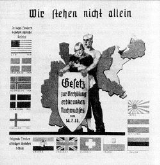
The Law for the Prevention of Hereditarily Diseased Offspring
, proclaimed on July 14, 1933, required physician
s to register every case of hereditary illness known to them, except in women over 45 years of age. Physicians could be fined for failing to comply.
In 1934, the first year of the Law's operation, nearly 4,000 people appealed against the decisions of sterilization authorities. 3,559 of the appeals failed. By the end of the Nazi regime, over 200 Hereditary Health Court
s were created, and under their rulings over 400,000 people were sterilized against their will.
was a mental hospital
in the German town of Hadamar
, which was used by the Nazi-controlled German government as the site of Action T4
. The Kaiser Wilhelm Institute of Anthropology, Human Heredity, and Eugenics
was founded in 1927.
In its early years, and during the Nazi era, it was strongly associated with theories of eugenics and racial hygiene advocated by its leading theorists Fritz Lenz
and Eugen Fischer
, and by its director Otmar von Verschuer. Under Fischer, the sterilization of so-called Rhineland Bastard
s was undertaken. Grafeneck Castle
was one of Nazi Germany's killing centers, and today it is a memorial place dedicated to the victims of the Action T4.
Information to determine who was considered 'genetically sick' was gathered from routine information supplied by people to doctor's offices and welfare departments. Standardized questionnaires had been designed by Nazi officials with the help of Dehomag
(a subsidiary of IBM
in the 1930s), so that the information could be encoded easily onto Hollerith punch cards for fast sorting and counting.
In Hamburg, doctors gave information into a Central Health Passport Archive (circa 1934), under something called the 'Health-Related Total Observation of Life'. This file was to contain reports from doctors, but also courts, insurance companies, sports clubs, the Hitler Youth, the military, the labor service, colleges, etc. Any institution that gave information would get information back in return. In 1940, the Reich Interior Ministry tried to impose a Hamburg-style system on the whole Reich.
partners had to be tested for any hereditary diseases. Everyone was encouraged to carefully evaluate their prospective marriage partners eugenically during courtship
. Members of the SS
were cautioned to carefully interview prospective marriage partners to make sure they had no family history of hereditary disease or insanity
, but to do this carefully so as not to hurt the feelings of the prospective fiance and, if it became necessary to reject her for eugenic reasons, to do it tactfully and not cause her any offense.
Nazi Germany
Nazi Germany , also known as the Third Reich , but officially called German Reich from 1933 to 1943 and Greater German Reich from 26 June 1943 onward, is the name commonly used to refer to the state of Germany from 1933 to 1945, when it was a totalitarian dictatorship ruled by...
's racially-based
Nazism and race
Nazism developed several theories concerning races. The Nazis claimed to scientifically measure a strict hierarchy of human race; at the top was the master race, the "Aryan race", narrowly defined by the Nazis as being identical with the Nordic race, followed by lesser races.At the bottom of this...
social policies that placed the improvement of the Aryan race
Aryan race
The Aryan race is a concept historically influential in Western culture in the period of the late 19th century and early 20th century. It derives from the idea that the original speakers of the Indo-European languages and their descendants up to the present day constitute a distinctive race or...
through eugenics
Eugenics
Eugenics is the "applied science or the bio-social movement which advocates the use of practices aimed at improving the genetic composition of a population", usually referring to human populations. The origins of the concept of eugenics began with certain interpretations of Mendelian inheritance,...
at the center of their concerns. Those humans were targeted that they identified as "life unworthy of life
Life unworthy of life
The phrase "life unworthy of life" was a Nazi designation for the segments of populace which had no right to live and thus were to be "euthanized". The term included people with serious medical problems and those considered grossly inferior according to racial policy of the Third Reich...
" , including but not limited to the criminal, degenerate
Degeneration
The idea of degeneration had significant influence on science, art and politics from the 1850s to the 1950s. The social theory developed consequently from Charles Darwin's Theory of Evolution...
, dissident
Gleichschaltung
Gleichschaltung , meaning "coordination", "making the same", "bringing into line", is a Nazi term for the process by which the Nazi regime successively established a system of totalitarian control and tight coordination over all aspects of society. The historian Richard J...
, feeble-minded, homosexual, idle, insane and the weak, for elimination from the chain of heredity
Heredity
Heredity is the passing of traits to offspring . This is the process by which an offspring cell or organism acquires or becomes predisposed to the characteristics of its parent cell or organism. Through heredity, variations exhibited by individuals can accumulate and cause some species to evolve...
. More than 400,000 people were sterilized against their will
Compulsory sterilization
Compulsory sterilization also known as forced sterilization programs are government policies which attempt to force people to undergo surgical sterilization...
, while 70,000 were killed under Action T4
Action T4
Action T4 was the name used after World War II for Nazi Germany's eugenics-based "euthanasia" program during which physicians killed thousands of people who were "judged incurably sick, by critical medical examination"...
, a "euthanasia
Euthanasia
Euthanasia refers to the practice of intentionally ending a life in order to relieve pain and suffering....
" program.
Hitler's views on eugenics
Adolf HitlerAdolf Hitler
Adolf Hitler was an Austrian-born German politician and the leader of the National Socialist German Workers Party , commonly referred to as the Nazi Party). He was Chancellor of Germany from 1933 to 1945, and head of state from 1934 to 1945...
read racial hygiene
Racial hygiene
Racial hygiene was a set of early twentieth century state sanctioned policies by which certain groups of individuals were allowed to procreate and others not, with the expressed purpose of promoting certain characteristics deemed to be particularly desirable...
tracts during his imprisonment in Landsberg Prison
Landsberg Prison
Landsberg Prison is a penal facility located in the town of Landsberg am Lech in the southwest of the German state of Bavaria, about west of Munich and south of Augsburg....
. He thought that Germany could only become strong again if the state applied to German society the principles of racial hygiene and eugenics
Eugenics
Eugenics is the "applied science or the bio-social movement which advocates the use of practices aimed at improving the genetic composition of a population", usually referring to human populations. The origins of the concept of eugenics began with certain interpretations of Mendelian inheritance,...
.
Hitler believed the nation had become weak, corrupted by the infusion of degenerate elements into its bloodstream
Dysgenics
Dysgenics is the study of factors producing the accumulation and perpetuation of defective or disadvantageous genes and traits in offspring of a particular population or species. Dysgenic mutations have been studied in animals such as the mouse and the fruit fly...
. These had to be removed quickly. He also believed that the strong and the racially pure had to be encouraged to have more children, and the weak and the racially impure had to be neutralized by one means or another.
The racialism and idea of competition, termed social Darwinism
Social Darwinism
Social Darwinism is a term commonly used for theories of society that emerged in England and the United States in the 1870s, seeking to apply the principles of Darwinian evolution to sociology and politics...
or neo-Darwinism
Neo-Darwinism
Neo-Darwinism is the 'modern synthesis' of Darwinian evolution through natural selection with Mendelian genetics, the latter being a set of primary tenets specifying that evolution involves the transmission of characteristics from parent to child through the mechanism of genetic transfer, rather...
in 1944, were discussed by European scientists and also in the Vienna press during the 1920s. Where Hitler picked up the ideas is uncertain. The theory of evolution had been generally accepted in Germany at the time but this sort of extremism was rare. In 1876, Ernst Haeckel
Ernst Haeckel
The "European War" became known as "The Great War", and it was not until 1920, in the book "The First World War 1914-1918" by Charles à Court Repington, that the term "First World War" was used as the official name for the conflict.-Research:...
had discussed the selective infanticide
Infanticide
Infanticide or infant homicide is the killing of a human infant. Neonaticide, a killing within 24 hours of a baby's birth, is most commonly done by the mother.In many past societies, certain forms of infanticide were considered permissible...
policy of the Greek city of ancient Sparta
Sparta
Sparta or Lacedaemon, was a prominent city-state in ancient Greece, situated on the banks of the River Eurotas in Laconia, in south-eastern Peloponnese. It emerged as a political entity around the 10th century BC, when the invading Dorians subjugated the local, non-Dorian population. From c...
.
In his Second Book
Zweites Buch
The Zweites Buch is an unedited transcript of Adolf Hitler's thoughts on foreign policy written in 1928; it was written after Mein Kampf and was never published in his lifetime.-Composition:...
, which was unpublished during the Nazi era, Hitler praised Sparta, adding that he considered Sparta to be the first "Völkisch State". He endorsed what he perceived to be an early eugenics
Eugenics
Eugenics is the "applied science or the bio-social movement which advocates the use of practices aimed at improving the genetic composition of a population", usually referring to human populations. The origins of the concept of eugenics began with certain interpretations of Mendelian inheritance,...
treatment of deformed children:
Sparta must be regarded as the first Völkisch State. The exposure of the sick, weak, deformed children, in short, their destruction, was more decent and in truth a thousand times more humane than the wretched insanity of our day which preserves the most pathological subject, and indeed at any price, and yet takes the life of a hundred thousand healthy children in consequence of birth control or through abortions, in order subsequently to breed a race of degenerates burdened with illnesses.
Nazi eugenics program
California
California is a state located on the West Coast of the United States. It is by far the most populous U.S. state, and the third-largest by land area...
.
The Law for the Prevention of Hereditarily Diseased Offspring
Law for the Prevention of Hereditarily Diseased Offspring
Law for the Prevention of Genetically Diseased Offspring or "Sterilization Law" was a statute in Nazi Germany enacted on July 14, 1933, which allowed the compulsory sterilization of any citizen who in the opinion of a "Genetic Health Court" Law for the Prevention of Genetically Diseased Offspring...
, proclaimed on July 14, 1933, required physician
Physician
A physician is a health care provider who practices the profession of medicine, which is concerned with promoting, maintaining or restoring human health through the study, diagnosis, and treatment of disease, injury and other physical and mental impairments...
s to register every case of hereditary illness known to them, except in women over 45 years of age. Physicians could be fined for failing to comply.
In 1934, the first year of the Law's operation, nearly 4,000 people appealed against the decisions of sterilization authorities. 3,559 of the appeals failed. By the end of the Nazi regime, over 200 Hereditary Health Court
Hereditary Health Court
The Hereditary Health Court , also known as, the Genetic Health Court, were courts that decided whether people should be forcibly sterilized in Nazi Germany....
s were created, and under their rulings over 400,000 people were sterilized against their will.
Nazi eugenics institutions
The Hadamar ClinicHadamar Clinic
The Hadamar Euthanasia Centre was a psychiatric hospital in the German town of Hadamar, used by the Nazis as the site of their T-4 Euthanasia Programme, which performed mass sterilizations and mass murder of "undesirable" members of Nazi society, specifically those with physical and mental...
was a mental hospital
Mental Hospital
Mental hospital may refer to:*Psychiatric hospital*hospital in Nepal named Mental Hospital...
in the German town of Hadamar
Hadamar
Hadamar is a small town in Limburg-Weilburg district in Hesse, Germany.Hadamar is known for its Clinic for Forensic Psychiatry/Centre for Social Psychiatry, lying at the edge of town, in whose outlying buildings is also found the Hadamar Memorial...
, which was used by the Nazi-controlled German government as the site of Action T4
Action T4
Action T4 was the name used after World War II for Nazi Germany's eugenics-based "euthanasia" program during which physicians killed thousands of people who were "judged incurably sick, by critical medical examination"...
. The Kaiser Wilhelm Institute of Anthropology, Human Heredity, and Eugenics
Kaiser Wilhelm Institute of Anthropology, Human Heredity, and Eugenics
The Kaiser Wilhelm Institute of Anthropology, Human Heredity, and Eugenics was founded in 1927. The Rockefeller Foundation supported both the Kaiser Wilhelm Institute of Psychiatry and the Kaiser Wilhelm Institute of Anthropology, Human Heredity and Eugenics...
was founded in 1927.
In its early years, and during the Nazi era, it was strongly associated with theories of eugenics and racial hygiene advocated by its leading theorists Fritz Lenz
Fritz Lenz
Fritz A Lenz was a German geneticist, member of the Nazi party, and influential specialist in "racial hygiene" during the Third Reich, one of the leading German theorists of "scientific racism" which legitimized the Nazi racial policies, starting with the 1935 Nuremberg Laws.- Biography...
and Eugen Fischer
Eugen Fischer
Eugen Fischer was a German professor of medicine, anthropology and eugenics. He was director of the Kaiser Wilhelm Institute of Anthropology, Human Heredity, and Eugenics between 1927 and 1942...
, and by its director Otmar von Verschuer. Under Fischer, the sterilization of so-called Rhineland Bastard
Rhineland Bastard
Rhineland Bastard was a derogatory term used in Nazi Germany to describe Afro-German children of mixed German and African parentage who were fathered by Africans serving as French colonial troops occupying the Rhineland after World War I...
s was undertaken. Grafeneck Castle
Grafeneck Castle
The Grafeneck Euthanasia Centre housed in Grafeneck Castle was one of Nazi Germany's killing centres as part of their euthanasia programme...
was one of Nazi Germany's killing centers, and today it is a memorial place dedicated to the victims of the Action T4.
Identification
The Law for Simplification of the Health System of July 1934 created Information Centers for Genetic and Racial Hygenie, as well as Health Offices. The law also described procedures for 'denunciation' and 'evaluation' of people, who were then sent to a Genetic Health Court where sterilization was decided.Information to determine who was considered 'genetically sick' was gathered from routine information supplied by people to doctor's offices and welfare departments. Standardized questionnaires had been designed by Nazi officials with the help of Dehomag
Dehomag
Dehomag was a German subsidiary of IBM with monopoly in the German market before and during World War II. The word was an acronym for Deutsche Hollerith-Maschinen Gesellschaft mbH . Hollerith refers to the German-American inventor of the technology of punched cards, Herman Hollerith.Under Nazi...
(a subsidiary of IBM
IBM
International Business Machines Corporation or IBM is an American multinational technology and consulting corporation headquartered in Armonk, New York, United States. IBM manufactures and sells computer hardware and software, and it offers infrastructure, hosting and consulting services in areas...
in the 1930s), so that the information could be encoded easily onto Hollerith punch cards for fast sorting and counting.
In Hamburg, doctors gave information into a Central Health Passport Archive (circa 1934), under something called the 'Health-Related Total Observation of Life'. This file was to contain reports from doctors, but also courts, insurance companies, sports clubs, the Hitler Youth, the military, the labor service, colleges, etc. Any institution that gave information would get information back in return. In 1940, the Reich Interior Ministry tried to impose a Hamburg-style system on the whole Reich.
Nazi eugenics policies regarding marriage
Nazi Germany had strict marriage laws in which marriageMarriage
Marriage is a social union or legal contract between people that creates kinship. It is an institution in which interpersonal relationships, usually intimate and sexual, are acknowledged in a variety of ways, depending on the culture or subculture in which it is found...
partners had to be tested for any hereditary diseases. Everyone was encouraged to carefully evaluate their prospective marriage partners eugenically during courtship
Courtship
Courtship is the period in a couple's relationship which precedes their engagement and marriage, or establishment of an agreed relationship of a more enduring kind. In courtship, a couple get to know each other and decide if there will be an engagement or other such agreement...
. Members of the SS
Schutzstaffel
The Schutzstaffel |Sig runes]]) was a major paramilitary organization under Adolf Hitler and the Nazi Party. Built upon the Nazi ideology, the SS under Heinrich Himmler's command was responsible for many of the crimes against humanity during World War II...
were cautioned to carefully interview prospective marriage partners to make sure they had no family history of hereditary disease or insanity
Insanity
Insanity, craziness or madness is a spectrum of behaviors characterized by certain abnormal mental or behavioral patterns. Insanity may manifest as violations of societal norms, including becoming a danger to themselves and others, though not all such acts are considered insanity...
, but to do this carefully so as not to hurt the feelings of the prospective fiance and, if it became necessary to reject her for eugenic reasons, to do it tactfully and not cause her any offense.
See also
|
German Blood Certificate A German Blood Certificate was a document provided by Hitler to Mischlinge , declaring them deutschblütig . This practice was begun sometime after the Nuremberg Laws of 1935, and allowed exemption from most of Germany's racial laws... German Society for Racial Hygiene The German Society for Racial Hygiene was an organization founded on June 22, 1905 by the physician Alfred Ploetz in Berlin. Its goal was for society to return to a healthy and blooming, strong and beautiful life" as Ploetz put it... The Holocaust The Holocaust , also known as the Shoah , was the genocide of approximately six million European Jews and millions of others during World War II, a programme of systematic state-sponsored murder by Nazi... Lebensborn Lebensborn was a Nazi programme set up by SS leader Heinrich Himmler that provided maternity homes and financial assistance to the wives of SS members and to unmarried mothers, and also ran orphanages and relocation programmes for children.Initially set up in Germany in 1935, Lebensborn expanded... Nazi human experimentation Nazi human experimentation was a series of medical experiments on large numbers of prisoners by the Nazi German regime in its concentration camps mainly in the early 1940s, during World War II and the Holocaust. Prisoners were coerced into participating: they did not willingly volunteer and there... Nazism and race Nazism developed several theories concerning races. The Nazis claimed to scientifically measure a strict hierarchy of human race; at the top was the master race, the "Aryan race", narrowly defined by the Nazis as being identical with the Nordic race, followed by lesser races.At the bottom of this... Nordic theory The Nordic race is one of the racial subcategories into which the Caucasian race was divided by anthropologists in the first half of the 20th century... Nur für Deutsche The slogan Nur für Deutsche was during World War II, in many German-occupied countries, a racialist slogan indicating that certain establishments and transportation were reserved only for Germans... Nuremberg Trials The Nuremberg Trials were a series of military tribunals, held by the victorious Allied forces of World War II, most notable for the prosecution of prominent members of the political, military, and economic leadership of the defeated Nazi Germany.... Mischling Mischling was the German term used during the Third Reich to denote persons deemed to have only partial Aryan ancestry. The word has essentially the same origin as mestee in English, mestizo in Spanish and métis in French... Racial policy of Nazi Germany The racial policy of Nazi Germany was a set of policies and laws implemented by Nazi Germany, asserting the superiority of the "Aryan race", and based on a specific racist doctrine which claimed scientific legitimacy... |
Rassenschande Rassenschande or Blutschande was the Nazi term for sexual relations between Aryans and non-Aryans, which was punishable by law... Reinrassig Reinrassig is a German zoological term meaning "of pure breed". In Nazi Germany, the term was applied to human races.By the racial policy of Nazi Germany, persons who could not trace Aryan ancestry back at least four generations could be considered nicht reinrassig or impure... Scientific racism Scientific racism is the use of scientific techniques and hypotheses to sanction the belief in racial superiority or racism.This is not the same as using scientific findings and the scientific method to investigate differences among the humans and argue that there are races... Second-class citizen Second-class citizen is an informal term used to describe a person who is systematically discriminated against within a state or other political jurisdiction, despite their nominal status as a citizen or legal resident there... Social Darwinism Social Darwinism is a term commonly used for theories of society that emerged in England and the United States in the 1870s, seeking to apply the principles of Darwinian evolution to sociology and politics... State racism State racism is a concept used by French philosopher Michel Foucault to designate the reappropriation of the historical and political discourse of "race struggle", in the late seventeenth century.... Volksdeutsche Volksdeutsche - "German in terms of people/folk" -, defined ethnically, is a historical term from the 20th century. The words volk and volkische conveyed in Nazi thinking the meanings of "folk" and "race" while adding the sense of superior civilization and blood... Volksliste The Deutsche Volksliste was a Nazi institution whose purpose was the classification of inhabitants of German occupied territories into categories of desirability according to criteria systematized by Heinrich Himmler. The institution was first established in occupied western Poland... Zweites Buch The Zweites Buch is an unedited transcript of Adolf Hitler's thoughts on foreign policy written in 1928; it was written after Mein Kampf and was never published in his lifetime.-Composition:... (Mein Kampf sequel) |
Books
- Aly, G.Götz AlyGötz Aly is a German journalist, historian and social scientist.-Biography:After attending the German School of Journalists, Aly studied history and political science in Berlin...
(1994). Cleansing the Fatherland: Nazi Medicine and Racial Hygiene. The Johns Hopkins University Press. ISBN 0-8018-4824-5 - Baer, E. et al. (2003). Experience and Expression: Women, the Nazis, and the Holocaust. Wayne State University Press. ISBN 0814330630
- Baumslag, N. (2005). Murderous Medicine: Nazi Doctors, Human Experimentation, and Typhus. Praeger Publishers. ISBN 0-275-98312-9
- Biesold, H. (1999). Crying Hands: Eugenics and Deaf People in Nazi Germany. Washington, D.C.: Gallaudet University Press. ISBN 1-56368-255-9
- Burleigh, M.Michael BurleighMichael Burleigh is a British author and historian.In 1977 he was awarded a first class honours degree in Medieval and Modern History from University College London, winning the Pollard, Dolley and Sir William Mayer prizes...
(1991). The Racial State: Germany 1933-1945. Cambridge University Press. ISBN 0-521-39802-9 - Burleigh, M.Michael BurleighMichael Burleigh is a British author and historian.In 1977 he was awarded a first class honours degree in Medieval and Modern History from University College London, winning the Pollard, Dolley and Sir William Mayer prizes...
(1994). Death and Deliverance: 'Euthanasia' in Germany, c.1900 to 1945. Cambridge University Press. ISBN 0-521-41613-2 - Caplan, A. (1992). When Medicine Went Mad: Bioethics and the Holocaust. Totowa, New Jersey: Humana Press. ISBN 0896032353
- Ehrenreich, Eric. The Nazi Ancestral Proof: Genealogy, Racial Science, and the Final Solution. Bloomington, Indiana: Indiana University Press, 2007. ISBN 978-0-253-34945-3
- Evans, Suzanne E., Forgotten Crimes: The Holocaust and People with Disabilities. Chicago: Ivan R. Dee, 2004. ISBN 1-56663-565-9
- Friedlander, H.Henry FriedlanderHenry Friedlander is a Jewish historian of the Holocaust noted for his arguments in favor of broadening the scope of casualties of the Holocaust....
(1995). The Origins of Nazi Genocide. From Euthanasia to the Final Solution. University of North Carolina Press. ISBN 0-8078-2208-6 - Gallagher, G. (1995). By Trust Betrayed: Patients, Physicians, and the License to Kill in the Third Reich. Arlington, Virginia: Vandamere Press. ISBN 0-918339-36-7
- Glass, J. (1999). Life Unworthy of Life: Racial Phobia and Mass Murder in Hitler's Germany Basic Books. ISBN 0465098460
- Kater, M. (1989). Doctors Under Hitler. Chapel Hill: University of North Carolina Press. ISBN 0807818429
- Kuhl, S. (2002). The Nazi Connection: Eugenics, American Racism, and German National Socialism. Oxford University Press. ISBN 0195149785
- Kuntz, D. (2006). Deadly Medicine: Creating the Master Race. The University of North Carolina Press. ISBN 0-8078-2916-1
- Lifton, R.Robert Jay LiftonRobert Jay Lifton is an American psychiatrist and author, chiefly known for his studies of the psychological causes and effects of war and political violence and for his theory of thought reform...
(1986). THE NAZI DOCTORS: Medical Killing and the Psychology of Genocide. Basic Books. ISBN 0-465-04905-2 - McFarland-Icke, B. (1999). Nurses in Nazi Germany: Moral Choice in History. Princeton University Press. ISBN 0691006652
- Müller-Hill, B. (1998). Murderous Science: Elimination by Scientific Selection of Jews, Gypsies, and Others in Germany, 1933-1945. Plainview, New York: Cold Spring Harbor Laboratory Press. ISBN 0879695315
- Nicosia, F. et al. (2002). Medicine and Medical Ethics in Nazi Germany: Origins, Practices, Legacies. Berghahn Books. ISBN 157181387X
- Proctor, R.Robert N. ProctorRobert Neel Proctor is an American historian of science and Professor of the History of Science at Stanford University. While a professor of the history of science at Pennsylvania State University in 1999, he became the first historian to testify against the tobacco industry.At Pennsylvania State...
(2003). Racial Hygiene: Medicine Under the Nazis. Harvard University Press. ISBN 0-674-74578-7 - Ryan, Donna F., et al. (2002). Deaf People in Hitler's Europe. Washington, D.C.: Gallaudet UniversityGallaudet UniversityGallaudet University is a federally-chartered university for the education of the deaf and hard of hearing, located in the District of Columbia, U.S...
Press, ISBN 1-56368-132-3 - Schafft, G. (2004). From Racism to Genocide: Anthropology in the Third Reich. University of Illinois Press. ISBN 0252029305
- Spitz, V. (2005). Doctors from Hell: The Horrific Account of Nazi Experiments on Humans. Sentient Publications. ISBN 1-59181-032-9
- Weikart, R.Richard WeikartRichard Weikart is a professor of history at California State University, Stanislaus, and is a senior fellow for the Center for Science and Culture of the Discovery Institute. In 1997 he joined the editorial board of the Access Research Network's Origins & Design Journal...
(2006). From Darwin to Hitler: Evolutionary Ethics, Eugenics, And Racism in Germany. Palgrave Macmillan. ISBN 1-4039-7201-X - Weindling, P.J. (2005). Nazi Medicine and the Nuremberg Trials: From Medical War Crimes to Informed Consent. Palgrave Macmillan. ISBN 1-4039-3911-X
- Weindling, P.J. (1989). Health, Race and German Politics between National Unification and Nazism, 1870-1945. Cambridge University Press. ISBN 0-521-42397-X
- Zimler, R.Richard ZimlerRichard Zimler is a best-selling author of fiction. His books, which have earned him a 1994 National Endowment of the Arts Fellowship in Fiction and the 1998 Herodotus Award, have been published in many countries and translated into more than 20 languages...
(2007). The Seventh Gate. Constable & Robinson. ISBN 978-1-84529-487-8
Academic articles
- Bachrach, S. (2004). "In the name of public health — Nazi racial hygiene". New England Journal of MedicineNew England Journal of MedicineThe New England Journal of Medicine is an English-language peer-reviewed medical journal published by the Massachusetts Medical Society. It describes itself as the oldest continuously published medical journal in the world.-History:...
, 29 July 2004; 351: 417–420. - Biddiss M. (1997). "Disease and dictatorship: the case of Hitler's Reich" Journal of Royal Society of MedicineRoyal Society of MedicineThe Royal Society of Medicine is a British charitable organisation whose main purpose is as a provider of medical education, running over 350 meetings and conferences each year.- History and overview :...
, 1997 Jun; 90(6): 342-6. - Cranach, M. (2003). "The killing of psychiatric patients in Nazi Germany between 1939-1945". The Israel Journal of Psychiatry and Related SciencesThe Israel Journal of Psychiatry and Related SciencesThe Israel Journal of Psychiatry and Related Sciences is a medical journal that publishes original articles dealing with the bio-psycho-social aspects of mobility, relocation, acculturation, ethnicity, stress situations in war and peace, victimology, and mental health in developing countries....
, 2003; 40(1): 8-18; discussion 19-28. - Lerner, B. (1995). "Medicine and the Holocaust: Learning More of the Lessons" Annals of Internal MedicineAnnals of Internal MedicineAnnals of Internal Medicine is an academic medical journal published by the American College of Physicians . It publishes research articles and reviews in the area of internal medicine. Its current editor is Christine Laine...
, 15 May 1995; 122: 10: 793–794. - Martin III, Matthew D., "The Dysfunctional Progeny of Eugenics: Autonomy Gone AWOL", Cardozo Journal of International Law, Vol. 15, No. 2, Fall 2007, pp. 371–421, ISSN 1069-3181.
- O'Mathúna, D. (2006). "Human dignity in the Nazi era: implications for contemporary bioethics". BioMed CentralBioMed CentralBioMed Central is a UK-based, for-profit scientific publisher specialising in open access journal publication. BMC, and its sister companies Chemistry Central and PhysMath Central, publish over 200 scientific journals. Most BMC journals are now published only online. BMC describes itself as the...
, 2006 Mar 14;7(1):E2. - Sofair, A. (2000). "Eugenic sterilization and a qualified Nazi analogy: the United States and Germany, 1930-1945". National Center for Biotechnology InformationNational Center for Biotechnology InformationThe National Center for Biotechnology Information is part of the United States National Library of Medicine , a branch of the National Institutes of Health. The NCBI is located in Bethesda, Maryland and was founded in 1988 through legislation sponsored by Senator Claude Pepper...
2000 Feb 15; 132(4): 312-9. - Strous, R. D. (2006). "Nazi Euthanasia of the Mentally Ill at Hadamar". American Journal of PsychiatryAmerican Journal of PsychiatryThe American Journal of Psychiatry is a monthly peer-reviewed medical journal covering all aspects of psychiatry and the official journal of the American Psychiatric Association. The first volume was issued in 1844, at which time it was known as the American Journal of Insanity...
, January 2006; 163: 27. - Weigmann, K. (2001). "The role of biologists in Nazi atrocities: lessons for today’s scientists". European Molecular Biology OrganizationEuropean Molecular Biology OrganizationEMBO stands for excellence in the life sciences. The EMBO mission is to enable the best science by supporting talented researchers, stimulating scientific exchange and advancing policies for a world-class European research environment....
, 15 October 2001; 2(10): 871–875. - "Eugenical Sterilization in Germany" Eugenical News 1933, Cold Spring Harbor LaboratoryCold Spring Harbor LaboratoryThe Cold Spring Harbor Laboratory is a private, non-profit institution with research programs focusing on cancer, neurobiology, plant genetics, genomics and bioinformatics. The Laboratory has a broad educational mission, including the recently established Watson School of Biological Sciences. It...
; vol.18:5.
Videos
- Burleigh, M.Michael BurleighMichael Burleigh is a British author and historian.In 1977 he was awarded a first class honours degree in Medieval and Modern History from University College London, winning the Pollard, Dolley and Sir William Mayer prizes...
(1991). Selling Murder: The Killing Films of the Third Reich. London: Domino Films. - Michalczyk, J.J. (1997). Nazi Medicine: In The Shadow Of The Reich. New York: First-Run Features.
General reference
- Ethics Of Using Medical Data From Nazi Experiments
- Life Unworthy of Life
- Medical Experiments of the Holocaust and Nazi Medicine
- Nazi Race Laws
- Race and Membership: The Eugenics Movement
- Sterilization Law in Germany
- The History Museum - Nazi Euthanasia
- Victims of the Nazi Era
- Eugenics - A Psychiatric Responsibility
- Nazi Medicine by Michael BerenbaumMichael BerenbaumMichael Berenbaum is an American scholar, professor, rabbi, writer, and film-maker, who specializes in the study of the memorialization of the Holocaust...