


Yellow badge

Encyclopedia
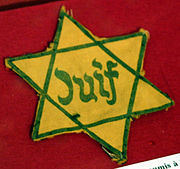
Badge of shame
A badge of shame, also a symbol of shame, mark of shame, or simply a stigma, is typically a distinctive symbol required to be worn by a specific group or an individual for the purpose of public humiliation, ostracism, or persecution...
associated with antisemitism. In both Christian and Islamic countries, persons not of the dominant religion were intermittently compelled by sumptuary law
Sumptuary law
Sumptuary laws are laws that attempt to regulate habits of consumption. Black's Law Dictionary defines them as "Laws made for the purpose of restraining luxury or extravagance, particularly against inordinate expenditures in the matter of apparel, food, furniture, etc." Traditionally, they were...
s to wear badges, hats, bells or other items of clothing that distinguished them from members of the dominant religious group.
The yellow badge that was compulsory in the Middle Ages was revived by the German Nazis
Nazi Germany
Nazi Germany , also known as the Third Reich , but officially called German Reich from 1933 to 1943 and Greater German Reich from 26 June 1943 onward, is the name commonly used to refer to the state of Germany from 1933 to 1945, when it was a totalitarian dictatorship ruled by...
.
Muslim countries
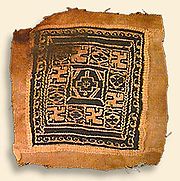
While antisemitism was less pronounced in the Muslim countries, Jews were at times treated with contempt, depending on the era and location. This was expressed through sumptuary laws that established what colors, clothing or hats they were permitted or not permitted to wear. The use of distinctive clothing or marks for Jewish and other religious communities has been traced by historians to ancient times.
In the early Islamic period, non-Muslims were required to wear distinctive marks in public, such as metal seals fixed around their necks. Tattooing and branding of slaves and captives were widespread in the ancient world. However, Islam, like Judaism, forbids permanent skin markings. Likewise, they were not allowed to wear colors associated with Islam, particularly green. The practice of physically branding Jews and Christians appears to have been begun in early medieval Baghdad and was considered highly degrading.
According to Bernard Lewis
Bernard Lewis
Bernard Lewis, FBA is a British-American historian, scholar in Oriental studies, and political commentator. He is the Cleveland E. Dodge Professor Emeritus of Near Eastern Studies at Princeton University...
, Christians and Jews were forced to wear special emblems on their clothes. The yellow badge was first introduced by a caliph in Baghdad in the 9th century, and spread to the West in medieval times. Even in public baths, non-Muslims wore medallions suspended from cords around their necks so no one would mistake them for Muslims. Belts, headgear, shoes, armbands and/or cloth patches were also used. Under Shi'a rules, they were not even allowed to use the same baths In 1005 the Jews of Egypt were ordered to wear bells on their garments.
Apart from Jews, Hindu
Hindu
Hindu refers to an identity associated with the philosophical, religious and cultural systems that are indigenous to the Indian subcontinent. As used in the Constitution of India, the word "Hindu" is also attributed to all persons professing any Indian religion...
s living under Islamic rule in India
Muslim conquest in the Indian subcontinent
Muslim conquest in South Asia mainly took place from the 13th to the 16th centuries, though earlier Muslim conquests made limited inroads into the region, beginning during the period of the ascendancy of the Rajput Kingdoms in North India, from the 7th century onwards.However, the Himalayan...
were often forced to wear yellow badges as well.
During the reign of Akbar the Great
Akbar the Great
Akbar , also known as Shahanshah Akbar-e-Azam or Akbar the Great , was the third Mughal Emperor. He was of Timurid descent; the son of Emperor Humayun, and the grandson of the Mughal Emperor Zaheeruddin Muhammad Babur, the ruler who founded the Mughal dynasty in India...
, his general Husain Khan 'Tukriya' forcibly made Hindus wear discriminatory yellow badges on their shoulders or sleeves.
Christian countries
In Christian countries, dress codes were also imposed on Jewish and other non-Christian residents. In Europe, the Fourth Council of the LateranFourth Council of the Lateran
The Fourth Council of the Lateran was convoked by Pope Innocent III with the papal bull of April 19, 1213, and the Council gathered at Rome's Lateran Palace beginning November 11, 1215. Due to the great length of time between the Council's convocation and meeting, many bishops had the opportunity...
of 1215 ruled that Jews and Muslims must be distinguishable by their dress (Latin "habitus")", and the yellow badge in Europe dates from this, unlike the Jewish hat (or "Judenhut"), a cone-shaped hat, which is seen in many illustrations from before this date, and remained the key distinguishing mark of Jewish dress in the Middle Ages. From the 16th century, the use of the Judenhut declined, but the badge tended to outlast it, surviving into the 18th century in places.
The identifying mark varied from one country to another, and from period to period. Apart from the hat, there were also attempts to enforce the wearing of full-length robes, which in late 14th century Rome
Rome
Rome is the capital of Italy and the country's largest and most populated city and comune, with over 2.7 million residents in . The city is located in the central-western portion of the Italian Peninsula, on the Tiber River within the Lazio region of Italy.Rome's history spans two and a half...
were supposed to be red. The most common form of badge was the "rota" (Latin for "wheel"), which looked like a ring, of white or yellow. The shape and color of the patch also varied, although the color was usually white or yellow. Married women were often required to wear two bands of blue on their veil or head-scarf. Edward I of England
Edward I of England
Edward I , also known as Edward Longshanks and the Hammer of the Scots, was King of England from 1272 to 1307. The first son of Henry III, Edward was involved early in the political intrigues of his father's reign, which included an outright rebellion by the English barons...
's Statute of Jewry prescribed "the form of two Tables joined
Ten Commandments
The Ten Commandments, also known as the Decalogue , are a set of biblical principles relating to ethics and worship, which play a fundamental role in Judaism and most forms of Christianity. They include instructions to worship only God and to keep the Sabbath, and prohibitions against idolatry,...
, of yellow felt of the length of six inches and of the breadth of three inches". This shape — two separate strips or two joined round-topped rectangles — was particular to England. In Portugal
Portugal
Portugal , officially the Portuguese Republic is a country situated in southwestern Europe on the Iberian Peninsula. Portugal is the westernmost country of Europe, and is bordered by the Atlantic Ocean to the West and South and by Spain to the North and East. The Atlantic archipelagos of the...
a red star of David
Star of David
The Star of David, known in Hebrew as the Shield of David or Magen David is a generally recognized symbol of Jewish identity and Judaism.Its shape is that of a hexagram, the compound of two equilateral triangles...
was used. Louis IX of France
Louis IX of France
Louis IX , commonly Saint Louis, was King of France from 1226 until his death. He was also styled Louis II, Count of Artois from 1226 to 1237. Born at Poissy, near Paris, he was an eighth-generation descendant of Hugh Capet, and thus a member of the House of Capet, and the son of Louis VIII and...
ordered French Jews to wear oval rouelle, a version of the "rota". As with all sumptuary laws, enforcement of the rules was very variable; in Marseilles the magistrates ignored accusations of breaches, and in some places individuals or communities could buy exemption. Cathars who were considered "first time offenders" by the Catholic Church and the Inquisition were also forced to wear yellow badges, albeit in the form of crosses, about their person.
Nazi period
After the German invasion of PolandInvasion of Poland (1939)
The Invasion of Poland, also known as the September Campaign or 1939 Defensive War in Poland and the Poland Campaign in Germany, was an invasion of Poland by Germany, the Soviet Union, and a small Slovak contingent that marked the start of World War II in Europe...
in 1939 there were initially different local decrees forcing Jews to wear a distinctive sign, during the General Government
General Government
The General Government was an area of Second Republic of Poland under Nazi German rule during World War II; designated as a separate region of the Third Reich between 1939–1945...
.
The sign was a white armband with a blue Star of David
Star of David
The Star of David, known in Hebrew as the Shield of David or Magen David is a generally recognized symbol of Jewish identity and Judaism.Its shape is that of a hexagram, the compound of two equilateral triangles...
on it, in the Warthegau
Reichsgau Wartheland
Reichsgau Wartheland was a Nazi German Reichsgau formed from Polish territory annexed in 1939. It comprised the Greater Poland and adjacent areas, and only in part matched the area of the similarly named pre-Versailles Prussian province of Posen...
a yellow badge in the form of a Star of David on the left side of the breast and on the back. The requirement to wear the Star of David with the word Jude (German
German language
German is a West Germanic language, related to and classified alongside English and Dutch. With an estimated 90 – 98 million native speakers, German is one of the world's major languages and is the most widely-spoken first language in the European Union....
for Jew) inscribed was then extended to all Jews over the age of six in the Reich
Nazi Germany
Nazi Germany , also known as the Third Reich , but officially called German Reich from 1933 to 1943 and Greater German Reich from 26 June 1943 onward, is the name commonly used to refer to the state of Germany from 1933 to 1945, when it was a totalitarian dictatorship ruled by...
and the Protectorate of Bohemia and Moravia
Protectorate of Bohemia and Moravia
The Protectorate of Bohemia and Moravia was the majority ethnic-Czech protectorate which Nazi Germany established in the central parts of Bohemia, Moravia and Czech Silesia in what is today the Czech Republic...
(by a decree issued on September 1, 1941, signed by Reinhard Heydrich
Reinhard Heydrich
Reinhard Tristan Eugen Heydrich , also known as The Hangman, was a high-ranking German Nazi official.He was SS-Obergruppenführer and General der Polizei, chief of the Reich Main Security Office and Stellvertretender Reichsprotektor of Bohemia and Moravia...
) and was gradually introduced in other German-occupied areas, where local words were used (e.g. Juif in French
French language
French is a Romance language spoken as a first language in France, the Romandy region in Switzerland, Wallonia and Brussels in Belgium, Monaco, the regions of Quebec and Acadia in Canada, and by various communities elsewhere. Second-language speakers of French are distributed throughout many parts...
, Jood in Dutch
Dutch language
Dutch is a West Germanic language and the native language of the majority of the population of the Netherlands, Belgium, and Suriname, the three member states of the Dutch Language Union. Most speakers live in the European Union, where it is a first language for about 23 million and a second...
).
Timeline
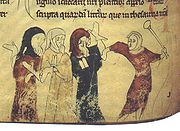
Pact of Umar
The Pact of Umar was a treaty supposedly made between the Umayyad caliph Umar II and the ahl al-kitab living on the lands newly conquered and colonized by Muslims...
which stipulates that Christians (and by implication also Jews) living in Muslim lands are required to wear distinctive clothing. Although most historians question the historicity of the pact, the use of distinguishing marks is consistent with documentary and archaeological evidence from 7th and 8th century Iraq and Syria. The pact itself is thought to be an invention of later jurists
Ulema
Ulama , also spelt ulema, refers to the educated class of Muslim legal scholars engaged in the several fields of Islamic studies. They are best known as the arbiters of shari‘a law...
seeking justification for certain cultural practices that had developed over time.
850: A decree of the Abbassid Caliph Al-Mutawakkil
Al-Mutawakkil
Al-Mutawakkil ʻAlā Allāh Jaʻfar ibn al-Muʻtasim was an Abbasid caliph who reigned in Samarra from 847 until 861...
, reported by the 10th century historian Muhammad ibn Jarir al-Tabari
Muhammad ibn Jarir al-Tabari
Abu Ja'far Muhammad ibn Jarir al-Tabari was a prominent and influential Sunni scholar and exegete of the Qur'an from Persia...
, requires Christian
Christian
A Christian is a person who adheres to Christianity, an Abrahamic, monotheistic religion based on the life and teachings of Jesus of Nazareth as recorded in the Canonical gospels and the letters of the New Testament...
and Jewish subjects to wear honey-coloured hoods and belts of a particular type. Distinguishing marks are also prescribed for their slaves.
1005: Fatimid
Fatimid
The Fatimid Islamic Caliphate or al-Fāṭimiyyūn was a Berber Shia Muslim caliphate first centered in Tunisia and later in Egypt that ruled over varying areas of the Maghreb, Sudan, Sicily, the Levant, and Hijaz from 5 January 909 to 1171.The caliphate was ruled by the Fatimids, who established the...
Caliph Al-Hakim
Al-Hakim bi-Amr Allah
Abu ‘Ali Mansur Tāriqu l-Ḥākim, called Al-Hakim bi Amr al-Lāh , was the sixth Fatimid caliph and 16th Ismaili imam .- History :...
, orders Jewish and Christian residents to wear bells on their garments and a "golden calf
Golden calf
According to the Hebrew Bible, the golden calf was an idol made by Aaron to satisfy the Israelites during Moses' absence, when he went up to Mount Sinai...
" (made of wood) around the neck when bathing with Muslims.
1058: Start of less tolerant policy towards Christians and Jews by the Seljuk authorities in the Abbasid empire. Existing laws imposing distinctive dress are enforced. Non-Muslims in Baghdad
Baghdad
Baghdad is the capital of Iraq, as well as the coterminous Baghdad Governorate. The population of Baghdad in 2011 is approximately 7,216,040...
are forced to wear signs on their dress.
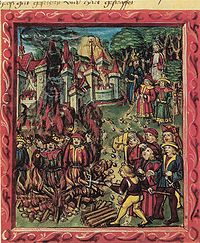
1091: Abbasid Caliph Al-Muqtadi
Al-Muqtadi
Al-Muqtadi was the Abbasid Caliph in Baghdad from 1075 to 1094.He was honored by the Seljuk Sultan Malik Shah, during whose reign the Caliphate was recognized throughout the extending range of Seljuk conquest. Arabia, with the Holy Cities now recovered from the Fatimids, acknowledged again the...
decrees that the "non-believers" had to wear yellow headgear and girdles of various colors, and a sign of lead around their necks to show they had to pay the poll-tax
Jizya
Under Islamic law, jizya or jizyah is a per capita tax levied on a section of an Islamic state's non-Muslim citizens, who meet certain criteria...
. Women had to wear shoes of different colors, such as one red and the other black.
1121: A letter from Baghdad
Baghdad
Baghdad is the capital of Iraq, as well as the coterminous Baghdad Governorate. The population of Baghdad in 2011 is approximately 7,216,040...
describes decrees regulating Jewish clothes: "two yellow badges, one on the headgear and one on the neck. Furthermore, each Jew must hang round his neck a piece of lead
Lead
Lead is a main-group element in the carbon group with the symbol Pb and atomic number 82. Lead is a soft, malleable poor metal. It is also counted as one of the heavy metals. Metallic lead has a bluish-white color after being freshly cut, but it soon tarnishes to a dull grayish color when exposed...
with the word dhimmi
Dhimmi
A , is a non-Muslim subject of a state governed in accordance with sharia law. Linguistically, the word means "one whose responsibility has been taken". This has to be understood in the context of the definition of state in Islam...
on it. He also has to wear a belt round his waist. The women have to wear one red and one black shoe and have a small bell on their necks or shoes."
1215: Fourth Lateran Council headed by Pope Innocent III
Pope Innocent III
Pope Innocent III was Pope from 8 January 1198 until his death. His birth name was Lotario dei Conti di Segni, sometimes anglicised to Lothar of Segni....
declares: "Jews and Saracens of both sexes in every Christian province and at all times shall be marked off in the eyes of the public from other peoples through the character of their dress."
1219: Pope Honorius III
Pope Honorius III
Pope Honorius III , previously known as Cencio Savelli, was Pope from 1216 to 1227.-Early work:He was born in Rome as son of Aimerico...
issues a dispensation to the Jews of Castile
Kingdom of Castile
Kingdom of Castile was one of the medieval kingdoms of the Iberian Peninsula. It emerged as a political autonomous entity in the 9th century. It was called County of Castile and was held in vassalage from the Kingdom of León. Its name comes from the host of castles constructed in the region...
. Spanish Jews normally wore turban
Turban
In English, Turban refers to several types of headwear popularly worn in the Middle East, North Africa, Punjab, Jamaica and Southwest Asia. A commonly used synonym is Pagri, the Indian word for turban.-Styles:...
s in any case, which presumably met the requirement to be distinctive.
1222: Archbishop of Canterbury
Archbishop of Canterbury
The Archbishop of Canterbury is the senior bishop and principal leader of the Church of England, the symbolic head of the worldwide Anglican Communion, and the diocesan bishop of the Diocese of Canterbury. In his role as head of the Anglican Communion, the archbishop leads the third largest group...
Stephen Langton
Stephen Langton
Stephen Langton was Archbishop of Canterbury between 1207 and his death in 1228 and was a central figure in the dispute between King John of England and Pope Innocent III, which ultimately led to the issuing of Magna Carta in 1215...
orders English Jews to wear a white band two fingers broad and four fingers long.
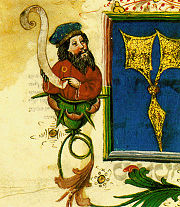
1228: James I
James I of Aragon
James I the Conqueror was the King of Aragon, Count of Barcelona, and Lord of Montpellier from 1213 to 1276...
orders Jews of Aragon
Aragon
Aragon is a modern autonomous community in Spain, coextensive with the medieval Kingdom of Aragon. Located in northeastern Spain, the Aragonese autonomous community comprises three provinces : Huesca, Zaragoza, and Teruel. Its capital is Zaragoza...
to wear the badge.
1265: The Siete Partidas
Siete Partidas
The Siete Partidas or simply Partidas was a Castilian statutory code first compiled during the reign of Alfonso X of Castile , with the intent of establishing a uniform body of normative rules for the kingdom. The codified and compiled text was originally called the Libro de las Leyes...
, a legal code enacted in Castile
Kingdom of Castile
Kingdom of Castile was one of the medieval kingdoms of the Iberian Peninsula. It emerged as a political autonomous entity in the 9th century. It was called County of Castile and was held in vassalage from the Kingdom of León. Its name comes from the host of castles constructed in the region...
by Alfonso X but not implemented until many years later, includes a requirement for Jews to wear distinguishing marks.
1267: In a special session, the Vienna
Vienna
Vienna is the capital and largest city of the Republic of Austria and one of the nine states of Austria. Vienna is Austria's primary city, with a population of about 1.723 million , and is by far the largest city in Austria, as well as its cultural, economic, and political centre...
city council forces Jews to wear Pileum cornutum
Judenhut
The Jewish hat also known as the Jewish cap, Judenhut or Latin pilleus cornutus , was a cone-shaped pointed hat, often white or yellow, worn by Jews in Medieval Europe and some of the Islamic world...
(a cone-shaped head dress, common in medieval illustrations of Jews); the badge does not seem to have been worn in Austria.
1269, June 19: France
France
The French Republic , The French Republic , The French Republic , (commonly known as France , is a unitary semi-presidential republic in Western Europe with several overseas territories and islands located on other continents and in the Indian, Pacific, and Atlantic oceans. Metropolitan France...
. (Saint) Louis IX of France
Louis IX of France
Louis IX , commonly Saint Louis, was King of France from 1226 until his death. He was also styled Louis II, Count of Artois from 1226 to 1237. Born at Poissy, near Paris, he was an eighth-generation descendant of Hugh Capet, and thus a member of the House of Capet, and the son of Louis VIII and...
orders all Jews found in public without a badge ( or roue) to be fined ten livres of silver. The enforcement of wearing the badge is repeated by local councils, with varying degrees of fines, at Arles
Arles
Arles is a city and commune in the south of France, in the Bouches-du-Rhône department, of which it is a subprefecture, in the former province of Provence....
1234 and 1260, Béziers
Béziers
Béziers is a town in Languedoc in southern France. It is a sub-prefecture of the Hérault department. Béziers hosts the famous Feria de Béziers, centred around bullfighting, every August. A million visitors are attracted to the five-day event...
1246, Albi 1254, Nîmes
Nîmes
Nîmes is the capital of the Gard department in the Languedoc-Roussillon region in southern France. Nîmes has a rich history, dating back to the Roman Empire, and is a popular tourist destination.-History:...
1284 and 1365, Avignon
Avignon
Avignon is a French commune in southeastern France in the départment of the Vaucluse bordered by the left bank of the Rhône river. Of the 94,787 inhabitants of the city on 1 January 2010, 12 000 live in the ancient town centre surrounded by its medieval ramparts.Often referred to as the...
1326 and 1337, Rodez
Rodez
Rodez is a town and commune in southern France, in the Aveyron department, of which it is the capital. Its inhabitants are called Ruthénois.-History:Existing from at least the 5th century BC, Rodez was founded by the Celts...
1336, and Vanves
Vanves
Vanves is a commune in the southwestern suburbs of Paris, France. It is located from the center of Paris. It is one of the most densely populated municipalities in Europe and the tenth in France -History:...
1368.
1274: The Statute of Jewry in England, enacted by King Edward I
Edward I of England
Edward I , also known as Edward Longshanks and the Hammer of the Scots, was King of England from 1272 to 1307. The first son of Henry III, Edward was involved early in the political intrigues of his father's reign, which included an outright rebellion by the English barons...
, enforces the regulations. "Each Jew, after he is seven years old, shall wear a distinguishing mark on his outer garment, that is to say, in the form of two Tables joined, of yellow felt of the length of six inches and of the breadth of three inches."
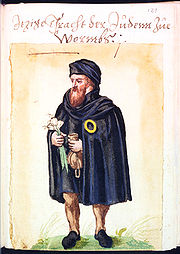
Erfurt
Erfurt is the capital city of Thuringia and the main city nearest to the geographical centre of Germany, located 100 km SW of Leipzig, 150 km N of Nuremberg and 180 km SE of Hannover. Erfurt Airport can be reached by plane via Munich. It lies in the southern part of the Thuringian...
. The earliest mention of the badge in Germany.
1315–1326: Emir Ismael Abu-I-Walid forces the Jews of Granada
Granada
Granada is a city and the capital of the province of Granada, in the autonomous community of Andalusia, Spain. Granada is located at the foot of the Sierra Nevada mountains, at the confluence of three rivers, the Beiro, the Darro and the Genil. It sits at an elevation of 738 metres above sea...
to wear the yellow badge.
1321: Henry II of Castile forces the Jews to wear the yellow badge.
1415, May 11: Bull of the Avignon Pope Benedict XIII
Antipope Benedict XIII
Benedict XIII, born Pedro Martínez de Luna y Pérez de Gotor , known as in Spanish, was an Aragonese nobleman, who is officially considered by the Catholic Church to be an antipope....
orders the Jews to wear a yellow and red badge, the men on their breast, the women on their forehead.
1434: Emperor Sigismund
Sigismund, Holy Roman Emperor
Sigismund of Luxemburg KG was King of Hungary, of Croatia from 1387 to 1437, of Bohemia from 1419, and Holy Roman Emperor for four years from 1433 until 1437, the last Emperor of the House of Luxemburg. He was also King of Italy from 1431, and of Germany from 1411...
reintroduces the badge at Augsburg
Augsburg
Augsburg is a city in the south-west of Bavaria, Germany. It is a university town and home of the Regierungsbezirk Schwaben and the Bezirk Schwaben. Augsburg is an urban district and home to the institutions of the Landkreis Augsburg. It is, as of 2008, the third-largest city in Bavaria with a...
.
1528: The Council of Ten
Council of Ten
The Council of Ten, or simply the Ten, was, from 1310 to 1797, one of the major governing bodies of the Republic of Venice whose actions were often secretive. Although some sources may indicate that the Council of Ten was generally accepted in Venice, there was some opposition...
of Venice
Venice
Venice is a city in northern Italy which is renowned for the beauty of its setting, its architecture and its artworks. It is the capital of the Veneto region...
allows the newly-arrived famous physician and professor Jacob Mantino ben Samuel
Jacob Mantino ben Samuel
Jacob Mantino ben Samuel was a Jewish scholar and Italian physician, known also as Mantinus.His parents—and perhaps Mantino himself—were natives of Tortosa, Spain, which place they left at the time of the banishment of the Jews from Spain . Mantino studied medicine and philosophy at the...
to wear the regular black doctors' cap instead of Jewish yellow hat for several months (subsequently made permanent), upon the recommendation of the French and English ambassadors, the papal legate, and other dignitaries numbered among his patients.
1555: Pope Paul IV
Pope Paul IV
Pope Paul IV, C.R. , né Giovanni Pietro Carafa, was Pope from 23 May 1555 until his death.-Early life:Giovanni Pietro Carafa was born in Capriglia Irpina, near Avellino, into a prominent noble family of Naples...
decrees, in his Cum nimis absurdum
Cum nimis absurdum
Cum nimis absurdum was a papal bull issued by Pope Paul IV dated 14 July 1555. It takes its name from its first words: "Since it is absurd and utterly inconvenient that the Jews, who through their own fault were condemned by God to eternal slavery..."...
, that the Jews should wear yellow hats.
1566: King Sigismund II passes a law that required Lithuania
Lithuania
Lithuania , officially the Republic of Lithuania is a country in Northern Europe, the biggest of the three Baltic states. It is situated along the southeastern shore of the Baltic Sea, whereby to the west lie Sweden and Denmark...
n Jews to wear yellow hats and head coverings. The law was abolished twenty years later.
1710: Frederick William I of Prussia
Frederick William I of Prussia
Frederick William I of the House of Hohenzollern, was the King in Prussia and Elector of Brandenburg from 1713 until his death...
abolished the mandatory Jewish yellow patch in return for a payment of 8,000 thaler
Thaler
The Thaler was a silver coin used throughout Europe for almost four hundred years. Its name lives on in various currencies as the dollar or tolar. Etymologically, "Thaler" is an abbreviation of "Joachimsthaler", a coin type from the city of Joachimsthal in Bohemia, where some of the first such...
(about $75,000 worth of silver at 2007 prices) each.
1938, August 17: The Nazi
Nazism
Nazism, the common short form name of National Socialism was the ideology and practice of the Nazi Party and of Nazi Germany...
regime forced Jewish Germans and the stateless Jews with Austrian citizenship to adopt additional middle names (mostly Israel or Sarah, few other derogatory names considered "Jewish" were alternatively possible) to be used at any occasion such as signatures, visit cards, addresses, firms etc.
1938, October: Jewish Germans had to turn in their passports to get them stamped in a black J, Jewish Austrians had been denied German citizenship and their Austrian passports had turned void.
1939, January: Jewish Germans and Austrians had to adopt special identity cards to be carried on them whenever away from home.
1939, September and October: A number of local German occupational commanders ordered in their areas Jewish Poles to wear an identifying mark under the threat of death. There were no consistent requirements as to its color and shape: it varies from a white armband to a yellow Star of David
Star of David
The Star of David, known in Hebrew as the Shield of David or Magen David is a generally recognized symbol of Jewish identity and Judaism.Its shape is that of a hexagram, the compound of two equilateral triangles...
badge.
1939, 23 November 1939: Hans Frank
Hans Frank
Hans Michael Frank was a German lawyer who worked for the Nazi party during the 1920s and 1930s and later became a high-ranking official in Nazi Germany...
ordered for all Jewish Poles above the age of 11 years in German-occupied Poland
General Government
The General Government was an area of Second Republic of Poland under Nazi German rule during World War II; designated as a separate region of the Third Reich between 1939–1945...
to wear white armbands with a blue Magen David on.
1940: A popular legend portrays king Christian X of Denmark
Christian X of Denmark
Christian X was King of Denmark from 1912 to 1947 and the only King of Iceland between 1918 and 1944....
wearing the yellow badge on his daily morning horseback ride through the streets of Copenhagen
Copenhagen
Copenhagen is the capital and largest city of Denmark, with an urban population of 1,199,224 and a metropolitan population of 1,930,260 . With the completion of the transnational Øresund Bridge in 2000, Copenhagen has become the centre of the increasingly integrating Øresund Region...
, followed by non-Jewish Danes responding to their king's example, thus preventing the Germans from identifying Jewish citizens. Queen Margrethe II of Denmark
Margrethe II of Denmark
Margrethe II is the Queen regnant of the Kingdom of Denmark. In 1972 she became the first female monarch of Denmark since Margaret I, ruler of the Scandinavian countries in 1375-1412 during the Kalmar Union.-Early life:...
has explained that the story was not true. No order requiring Jews to wear identifying marks was ever introduced in Denmark.
1941, July: Jewish Poles in German-occupied Soviet-annexed Poland, Jewish Lithuanians, Latvians and Estonians as well as Soviet Jews in German-occupied areas were obliged to wear white armbands or yellow badges.
1941, August 13: The yellow badge was the only standardised identifying mark in the German-occupied East, other signs were forbidden.
1941, September 1: Also Jewish Germans and Jews with citizenship of annexed states (Austrians, Czechs, Danzigers) - from the age of six years - were ordered to wear the yellow badge when in public.
1941, September 9: Slovakia ordered its Jews to wear yellow badges.
1941/1942: Romania
Kingdom of Romania
The Kingdom of Romania was the Romanian state based on a form of parliamentary monarchy between 13 March 1881 and 30 December 1947, specified by the first three Constitutions of Romania...
started to force Jews in newly annexed territories, denied Romanian citizenship, to wear the yellow badge.
1942, March 13: The Gestapo
Gestapo
The Gestapo was the official secret police of Nazi Germany. Beginning on 20 April 1934, it was under the administration of the SS leader Heinrich Himmler in his position as Chief of German Police...
ordered Jewish Germans and Jews with citizenship of annexed states to mark their apartments or houses at the front door with a white badge.
1942, April 29: Jewish Dutchpeople are forced to wear the yellow badge
1942, June 3: Jewish Belgians have to wear the yellow badge
1942, June 7: On German command Jewish Frenchmen were to wear the the yellow badge, Vichy to refused that.
1942, August: With the German annexation of Luxembourg the yellow badge was introduced there too.
1942, August: Under German pressure Bulgaria ordered its Jewish citizens to wear small yellow buttons, contravention, however, was not prosecuted.
1942, November: With the occupation of the French Zone libre
Zone libre
The zone libre was a partition of the French metropolitan territory during the Second World War, established at the Second Armistice at Compiègne on June 22, 1940. It lay to the south of the demarcation line and was administered by the French government of Marshal Philippe Pétain based in Vichy,...
Jews there were also forced wearing the yellow badge.
1944, March 31: After the occupation of Hungary the German occupants ordered Jewish Hungarians and Jews with defunct other citizenships (Czechoslovakian, Romanian, Yugoslavian) in Hungarian-annexed areas to wear the yellow badge.
2001: During the rule of the Islamist
Islamism
Islamism also , lit., "Political Islam" is set of ideologies holding that Islam is not only a religion but also a political system. Islamism is a controversial term, and definitions of it sometimes vary...
Taliban regime in Afghanistan
Afghanistan
Afghanistan , officially the Islamic Republic of Afghanistan, is a landlocked country located in the centre of Asia, forming South Asia, Central Asia and the Middle East. With a population of about 29 million, it has an area of , making it the 42nd most populous and 41st largest nation in the world...
, the Hindu
Hindu
Hindu refers to an identity associated with the philosophical, religious and cultural systems that are indigenous to the Indian subcontinent. As used in the Constitution of India, the word "Hindu" is also attributed to all persons professing any Indian religion...
minority in the Islamic Emirate of Afghanistan
Islamic Emirate of Afghanistan
The Islamic Emirate of Afghanistan was founded in 1996 when the Taliban began their rule of Afghanistan and ended with their fall from power in 2001...
were forced to wear yellow badges in public to identify themselves as such. This was part of the Taliban's plan to segregate "un-Islamic" and "idolatrous" communities from Islamic ones. The decree was condemned by the Governments of the United States
United States
The United States of America is a federal constitutional republic comprising fifty states and a federal district...
and India
India
India , officially the Republic of India , is a country in South Asia. It is the seventh-largest country by geographical area, the second-most populous country with over 1.2 billion people, and the most populous democracy in the world...
as a gross violation of religious freedom. In the United States, the chairman of the Anti-Defamation League
Anti-Defamation League
The Anti-Defamation League is an international non-governmental organization based in the United States. Describing itself as "the nation's premier civil rights/human relations agency", the ADL states that it "fights anti-Semitism and all forms of bigotry, defends democratic ideals and protects...
Abraham Foxman
Abraham Foxman
Abraham H. Foxman is the National Director of the Anti-Defamation League.-Early life:Foxman, an only son, was born in Baranovichi, just months after the USSR took the town from Poland in the Nazi-Soviet Pact and incorporated it into the BSSR. The town is now in Belarus...
compared the decree to the earlier practices of Nazi Germany
Nazi Germany
Nazi Germany , also known as the Third Reich , but officially called German Reich from 1933 to 1943 and Greater German Reich from 26 June 1943 onward, is the name commonly used to refer to the state of Germany from 1933 to 1945, when it was a totalitarian dictatorship ruled by...
. Widespread protests against the Taliban regime broke out in Bhopal, India
India
India , officially the Republic of India , is a country in South Asia. It is the seventh-largest country by geographical area, the second-most populous country with over 1.2 billion people, and the most populous democracy in the world...
. The Government of India
Government of India
The Government of India, officially known as the Union Government, and also known as the Central Government, was established by the Constitution of India, and is the governing authority of the union of 28 states and seven union territories, collectively called the Republic of India...
condemned this decree as a violation of religious freedom. In the United States
United States
The United States of America is a federal constitutional republic comprising fifty states and a federal district...
, congressmen and several lawmakers wore yellow badges on the floor of the Senate during the debate as a demonstration of their solidarity with the Hindu minority in Afghanistan.
See also
- Antisemitism
- Badge of shameBadge of shameA badge of shame, also a symbol of shame, mark of shame, or simply a stigma, is typically a distinctive symbol required to be worn by a specific group or an individual for the purpose of public humiliation, ostracism, or persecution...
- Cathar yellow crossCathar yellow crossIn the Middle Ages, the Cathar yellow cross was a distinguishing mark worn by repentant Cathars, who were ordered to wear it by the Roman Catholic Church.-Background:...
- Christianity and antisemitism
- DhimmiDhimmiA , is a non-Muslim subject of a state governed in accordance with sharia law. Linguistically, the word means "one whose responsibility has been taken". This has to be understood in the context of the definition of state in Islam...
laws - History of antisemitism
- Islam and antisemitism
- JudenhutJudenhutThe Jewish hat also known as the Jewish cap, Judenhut or Latin pilleus cornutus , was a cone-shaped pointed hat, often white or yellow, worn by Jews in Medieval Europe and some of the Islamic world...
- Nazi concentration camp badgesNazi concentration camp badgesNazi concentration camp badges, primarily triangles, were part of the system of identification in Nazi camps. They were used in the concentration camps in the Nazi-occupied countries to identify the reason the prisoners had been placed there. The triangles were made of fabric and were sewn on...
- Nuremberg lawsNuremberg LawsThe Nuremberg Laws of 1935 were antisemitic laws in Nazi Germany introduced at the annual Nuremberg Rally of the Nazi Party. After the takeover of power in 1933 by Hitler, Nazism became an official ideology incorporating scientific racism and antisemitism...
External links
Yellow badges in the Middle Ages- The Jewish Badge at About.com
- Jewish medieval clothing - article by Norman Roth
- The badge, hat and clothing laws for Jews in the Middle Ages (from Encyclopaedia Judaica 1971, with many pictures)
- Origins of the Yellow Star -Ancient Islamic origin of the Yellow Star
- Yellow Badge in Art
Yellow badges in the Nazi period 1939-1945
- A Yellow Star of David Button, Which the Bulgarian Jews were Forced to Wear in 1941 with the Onset of the German Occupation from the Yad VashemYad VashemYad Vashem is Israel's official memorial to the Jewish victims of the Holocaust, established in 1953 through the Yad Vashem Law passed by the Knesset, Israel's parliament....
artifacts collection - "Wear It With Pride, The Yellow Badge" by Robert Weltsch Juedische Rundschau, No. 27, April 4, 1933
- Jewish badge and armbands 1939-1945. How Jews were marked with Jewish stars and armbands by the NS regime in ghettoes and concentration camps (from Encyclopaedia Judaica 1971, with many fotos)
Denmark: The king against the yellow badge
- An Exemplary Response - Denmark
- Rescue of the Danish Jews at auschwitz.dk
- King of Denmark and yellow stars at Snopes.com's Urban Legend website