
All Topics  
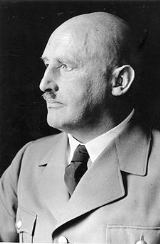
Julius Streicher

 
Julius Streicher

   Email Print
   Bookmark   Link


Julius Streicher


Julius Streicher (12 February 1885 – 16 October 1946) was a prominent Nazi
Nazism

Nazism, officially National Socialism , refers to the ideology and practices of the National Socialist German Workers? Party under Adolf Hitler, and the policies adopted by the dictatorial government of Nazi Germany from 1933 to 1945....
 prior to World War II
World War II

World War II, or the Second World War , was a global military conflict which involved a Participants in World War II, including all of the great powers, organised into two opposing military alliances: the Allies of World War II and the Axis powers....
. He was the founder and publisher of Der Stürmer
Der Stürmer

Der St?rmer was a weekly Nazism newspaper published by Julius Streicher from 1923 to the end of World War II in 1945, with brief suspensions in circulation due to legal difficulties....
 newspaper, which became a central element of the Nazi propaganda
Propaganda

Propaganda is the dissemination of information aimed at influencing the opinions or behaviors of large numbers of people. As opposed to Objectivity providing information, propaganda in its most basic sense presents information in order to influence its audience....
 machine. His publishing firm also released three anti-Semitic
Anti-Semitism

Antisemitism is prejudice against or hostility towards Jews.This prejudice or hostility is usually characterized by a combination of Religion, Race , cultural and ethnic group biases....
 books for children, including the 1938 Der Giftpilz
Der Giftpilz

Der Giftpilz is a children's book published by Julius Streicher in 1938. The title is German language for "the toadstool" or "the poisoned mushroom"....
 (The Poison Mushroom), one of the most widespread pieces of propaganda, which purported to warn about insidious dangers Jew
Jew

A Jew is a member of the Jewish people, an ethnoreligious group that traces its ancestry to the Israelites or Hebrews of the Ancient Near East....
s posed by using the metaphor
Metaphor

Metaphor is language that directly compares seemingly unrelated subjects. It is a figure of speech that compares two or more things without using the words "like" or "as." More generally, a metaphor describes a first subject as being or equal to a second object in some way....
 of an attractive yet deadly mushroom
Mushroom

A mushroom is the fleshy, spore-bearing fruiting body of a fungus, typically produced above ground on soil or on its food source. The standard for the name "mushroom" is the cultivated white button mushroom, Agaricus bisporus, hence the word mushroom is most often applied to those fungi that have a stem , a cap , and gills on the unde...
.


Discussion
Ask a question about 'Julius Streicher'
Start a new discussion about 'Julius Streicher'
Answer questions from other users
Full Discussion Forum


Encyclopedia


Julius Streicher (12 February 1885 – 16 October 1946) was a prominent Nazi
Nazism

Nazism, officially National Socialism , refers to the ideology and practices of the National Socialist German Workers? Party under Adolf Hitler, and the policies adopted by the dictatorial government of Nazi Germany from 1933 to 1945....
 prior to World War II
World War II

World War II, or the Second World War , was a global military conflict which involved a Participants in World War II, including all of the great powers, organised into two opposing military alliances: the Allies of World War II and the Axis powers....
. He was the founder and publisher of Der Stürmer
Der Stürmer

Der St?rmer was a weekly Nazism newspaper published by Julius Streicher from 1923 to the end of World War II in 1945, with brief suspensions in circulation due to legal difficulties....
 newspaper, which became a central element of the Nazi propaganda
Propaganda

Propaganda is the dissemination of information aimed at influencing the opinions or behaviors of large numbers of people. As opposed to Objectivity providing information, propaganda in its most basic sense presents information in order to influence its audience....
 machine. His publishing firm also released three anti-Semitic
Anti-Semitism

Antisemitism is prejudice against or hostility towards Jews.This prejudice or hostility is usually characterized by a combination of Religion, Race , cultural and ethnic group biases....
 books for children, including the 1938 Der Giftpilz
Der Giftpilz

Der Giftpilz is a children's book published by Julius Streicher in 1938. The title is German language for "the toadstool" or "the poisoned mushroom"....
 (The Poison Mushroom), one of the most widespread pieces of propaganda, which purported to warn about insidious dangers Jew
Jew

A Jew is a member of the Jewish people, an ethnoreligious group that traces its ancestry to the Israelites or Hebrews of the Ancient Near East....
s posed by using the metaphor
Metaphor

Metaphor is language that directly compares seemingly unrelated subjects. It is a figure of speech that compares two or more things without using the words "like" or "as." More generally, a metaphor describes a first subject as being or equal to a second object in some way....
 of an attractive yet deadly mushroom
Mushroom

A mushroom is the fleshy, spore-bearing fruiting body of a fungus, typically produced above ground on soil or on its food source. The standard for the name "mushroom" is the cultivated white button mushroom, Agaricus bisporus, hence the word mushroom is most often applied to those fungi that have a stem , a cap , and gills on the unde...
. After the war, he was convicted of crimes against humanity
Crime against humanity

Crimes against humanity, as defined by the Rome Statute of the International Criminal Court Explanatory Memorandum, "are particularly odious offences in that they constitute a serious attack on human dignity or grave humiliation or a degradation of one or more human beings....
 and executed.

Early life

Streicher was born in Fleinhausen
Fleinhausen

Fleinhausen is a village of the municipality of Dinkelscherben in the western part of the Bavarian district of Augsburg in Germany. It is located on the western bank of the Zusam....
, Kingdom of Bavaria
Kingdom of Bavaria

The Kingdom of Bavaria was a Germany state that existed from 1806–1918. Elector Maximilian I Joseph of Bavaria of the House of Wittelsbach became the first King of Bavaria in 1806....
, one of nine children of the teacher Friedrich Streicher and his wife Anna (née Weiss). He worked as an elementary school teacher like his father, and in 1909 he began his political career, joining the German Democratic Party. He would later claim that because his political work brought him into contact with German Jews, he “must therefore have been fated to become later on a writer and speaker on racial politics.” In 1913 Streicher married Kunigunde Roth, a baker's daughter, in Nürnberg
Nuremberg

Nuremberg is a city in the Germany State of Bavaria, in the Regierungsbezirk of Middle Franconia. It is situated on the Pegnitz River river and the Rhine?Main?Danube Canal and is Franconia's largest city....
. They had two sons, Lothar (born 1915) and Elmar (born 1918).

Streicher joined the German Army
German Army (German Empire)

The German Army was the name given the combined armed forces of the German Empire, also known as the Imperial Army or Imperial German Army. The term "Deutsches Heer" is also used for the modern German Army, the land component of the German Bundeswehr....
 in 1914. He won the Iron Cross
Iron Cross

The Iron Cross was a military decoration of the Kingdom of Prussia, and later of Germany, which was established by King Frederick William III of Prussia and first awarded on 10 March 1813 in Breslau ....
 and reached the rank of lieutenant
Lieutenant

Lieutenant is a military, naval, paramilitary, fire service, emergency medical services or police commissioned officer military rank.Lieutenant may also appear as part of a title used in various other organisations with a codified command structure....
 by the time the Armistice was signed in 1918.

Early politics

In 1919 Streicher became active in the anti-Semitic Schutz- und Trutz-Bund (Society for Protective and Offensive Action), one of the various reactionary
Reactionary

Reactionary refers to any movement or ideology that opposes change or progress in society, and which seeks a return to a previous state . The term originated in the French Revolution, to denote the Counter-revolutionary who wanted to restore the real or imagined conditions of the Monarchy Ancien R?gime....
 organizations that sprang up in the wake of the failed German Communist revolution of 1918. Such groups fostered the view that Jews had conspired with “Bolshevik
Bolshevik

Bolsheviks, originally also Bolshevists were a faction of the Marxism Russian Social Democratic Labour Party which split apart from the Menshevik faction at the 2nd Congress of the RSDLP in 1903 and ultimately became the Communist Party of the Soviet Union....
” traitors in trying to subject Germany to Communist rule. In 1920 he turned to the Deutschsozialistische Partei (German Socialist Party), a group whose platform was close to that of the young NSDAP, or Nazi Party. Streicher sought to move the German Socialists in a more virulently anti-Semitic direction – an effort which aroused enough opposition that he left the group and brought his now-substantial following to yet another organization in 1921, the Deutsche Werkgemeinschaft (German Working Community), which hoped to unite the various anti-Semitic Völkisch movements.

National Socialism

In 1921, Streicher finally found his mentor. He visited Munich
Munich

Munich is the capital city of Bavaria, Germany. Munich is located on the River Isar north of the Northern Limestone Alps. Munich is the third largest city in Germany, after Berlin and Hamburg....
 in order to hear Adolf Hitler
Adolf Hitler

Adolf Hitler was an Austrian-born Germany politician and the leader of the National Socialist German Workers Party , popularly known as the Nazi Party....
 speak, an experience that he later said left him transformed: “I had never seen the man before. And there I sat, an unknown among unknowns. I saw this man shortly before midnight, after he had spoken for three hours, drenched in perspiration, radiant. My neighbour said he thought he saw a halo around his head, and I experienced something which transcended the commonplace.” Soon after, Streicher joined the Nazi party and merged his personal following with Hitler
Adolf Hitler

Adolf Hitler was an Austrian-born Germany politician and the leader of the National Socialist German Workers Party , popularly known as the Nazi Party....
’s, almost doubling the party membership.

In May 1923 Streicher founded the newspaper, Der Stürmer
Der Stürmer

Der St?rmer was a weekly Nazism newspaper published by Julius Streicher from 1923 to the end of World War II in 1945, with brief suspensions in circulation due to legal difficulties....
 (The Stormer, or, more freely, The Attacker). From the outset, the chief aim of the paper was to promulgate anti-Semitic propaganda
Propaganda

Propaganda is the dissemination of information aimed at influencing the opinions or behaviors of large numbers of people. As opposed to Objectivity providing information, propaganda in its most basic sense presents information in order to influence its audience....
. “We will be slaves of the Jew,” the paper announced. “Therefore he must go.”

In November of that year, Streicher participated in Hitler’s first effort to seize power, the failed Beer Hall Putsch
Beer Hall Putsch

The Beer Hall Putsch was a failed attempt at revolution that occurred between the evening of Thursday, November 8 and the early afternoon of Friday, November 9, 1923, when the National Socialist German Workers Party's leader Adolf Hitler, the popular World War I General Erich Ludendorff, and other leaders of the Kampfbund, unsuccessfully...
 in Munich. Streicher marched with Hitler in the front row of the would-be revolutionaries and braved the bullets of the Munich police. His loyalty earned him Hitler’s lifelong trust and protection; in the years that followed, Streicher would be one of the dictator’s few true intimates.

As a reward for his dedication, when the Nazi party was legalized again and re-organized in 1925 Streicher was appointed gauleiter
Gauleiter

A Gauleiter was the party leader of a regional branch of the NSDAP or the head of a Gau or of a Reichsgau....
 of the Bavarian region of Franconia
Franconia

Franconia is a region of Germany comprising the northern parts of the modern state of Bavaria and a much smaller region in northeastern Baden-W?rttemberg called Heilbronn-Franken....
 (which included his home town of Nuremberg
Nuremberg

Nuremberg is a city in the Germany State of Bavaria, in the Regierungsbezirk of Middle Franconia. It is situated on the Pegnitz River river and the Rhine?Main?Danube Canal and is Franconia's largest city....
). In the early years of the party’s rise, gauleiter
Gauleiter

A Gauleiter was the party leader of a regional branch of the NSDAP or the head of a Gau or of a Reichsgau....
s
were essentially party functionaries without real power; but in the final years of the Weimar Republic
Weimar Republic

The Weimar Republic was the democracy and republican period of Germany from 1919 to 1933. Following World War I, the republic emerged from the German Revolution in November 1918....
, they became paramilitary
Paramilitary

A paramilitary is a force whose function and organisation are similar to those of a professional military force, but which is not regarded as having the same status....
 commanders. During the 12 years of the Nazi regime itself, party gauleiter
Gauleiter

A Gauleiter was the party leader of a regional branch of the NSDAP or the head of a Gau or of a Reichsgau....
s
like Streicher would wield immense power, and be in large measure untouchable by legal authority.

Streicher was also elected to the Bavarian "Landtag
Landtag

A Landtag is a representative assembly or parliament in German-speaking countries with some legislative authority.The German word "Landtag" is composed of the words Land which names a political entity comparable to a federal state and the word Tag....
" or legislature, a position which gave him a margin of parliamentary immunity from prosecution – a safety net that would help him resist efforts to silence his racist
Racism

Racism, by its simplest definition is the belief that Race is the primary determinant of human traits and capacities and that racial differences produce an inherent superiority of a particular race....
 message.

The rise of Der Stürmer

Beginning in 1924, Streicher used Der Stürmer
Der Stürmer

Der St?rmer was a weekly Nazism newspaper published by Julius Streicher from 1923 to the end of World War II in 1945, with brief suspensions in circulation due to legal difficulties....
 as a mouthpiece not only for general anti-semitic attacks, but for calculated smear campaign
Smear campaign

A smear campaign, smear tactic or simply smear is a metaphor for activity that can harm an individual or group's reputation by Conflate#Logic with a Social stigma group....
s against specific Jews, such as the Nuremberg
Nuremberg

Nuremberg is a city in the Germany State of Bavaria, in the Regierungsbezirk of Middle Franconia. It is situated on the Pegnitz River river and the Rhine?Main?Danube Canal and is Franconia's largest city....
 city official Julius Fleischmann, who worked for Streicher’s nemesis, mayor Hermann Luppe. Der Stürmer
Der Stürmer

Der St?rmer was a weekly Nazism newspaper published by Julius Streicher from 1923 to the end of World War II in 1945, with brief suspensions in circulation due to legal difficulties....
 accused Fleischmann of stealing socks from his quartermaster during combat in World War I
World War I

World War I, or the First World War , was a global military conflict which involved the Great powers, organized into two opposing military alliances: the Allies of World War I and the Central Powers....
. Fleischmann sued Streicher and successfully disproved the allegations in court (Streicher was fined 900 mark
Mark

Mark may refer to:...
s), but the detailed testimony exposed other less-than-glorious details of Fleischmann’s record, and his reputation was badly damaged anyway. It was proof that Streicher’s unofficial motto for his tactics was grimly correct: "Something always sticks."

The slanderous attacks continued, and lawsuits followed. Like Fleischmann, other outraged German Jews defeated Streicher in the well of the court. But his goal was not necessarily legal victory; to committed Nazis like Streicher, courtroom losses were a defiant badge of honor, and what Streicher wanted was the widest possible dissemination of his message, which press coverage often provided. The rules of the court provided Streicher with an arena to humiliate his opponents. The Weimar habit of following the strictest letter of the law made prosecution for more serious crimes difficult. Even Der Stürmer's
Der Stürmer

Der St?rmer was a weekly Nazism newspaper published by Julius Streicher from 1923 to the end of World War II in 1945, with brief suspensions in circulation due to legal difficulties....
 infamous official slogan, Die Juden sind unser Unglück (the Jews are our misfortune) was deemed unactionable under German statutes, since it was not a direct incitement to violence.

Streicher’s opponents complained to authorities that Der Stürmer violated a statute against religious offense with his constant promulgation of the “blood libel”
Blood libel against Jews

Blood libels against Jews are false accusations that Jews use human blood in certain aspects of their religious rituals and religious holidays. Although the first known instance of blood libel against Jews was in the writings of Apion, an early 1st century Paganism Greeks-Egyptians who claimed that the Jews sacrificed Greek people victims in...
 – the medieval accusation that Jews killed Christian
Christian

A Christian is a person who adheres to Christianity, a Monotheism#Christian view religion centered on the life and teachings of Jesus and interpreted by Christians to have been prophesied in the Hebrew Bible/Old Testament....
 children to use their blood to make matzoh. Streicher argued that his accusations were based on race
Race

The term race or racial group usually refers to the categorization of humans into populations or Group s on the basis of various sets of heritable characteristics....
, not religion, and that his diatribes were political speech, and therefore protected by the German constitution.

Streicher orchestrated his early campaigns against Jews to make the most extreme possible claims – short of violating a law that might get the paper shut down. He insisted in the pages of his newspaper that the Jews had caused the worldwide Depression
Great Depression

File:International depression.pngThe Great Depression was a worldwide economic Recession starting in most places in 1929 and ending at different times in the 1930s or early 1940s for different countries....
, and were responsible for the crippling unemployment
Unemployment

File:World map of countries by rate of unemployment.pngUnemployment occurs when a person is available to work and currently seeking work, but the person is without Wage labour....
 and inflation
Inflation

In economics, inflation is a rise in the general price level of goods and services in an economy over a period of time. The term "inflation" once referred to increases in the money supply ; however, economic debates about the relationship between money supply and price levels have led to its primary use today in describing price inflatio...
 which afflicted Germany during the 1920s. He claimed that Jews were white-slavers and were responsible for over 90 percent of the prostitutes in the country. Real unsolved killings in Germany, especially of children or women, were often confidently explained in the pages of Der Stürmer as cases of “Jewish ritual murder.”

One of Streicher’s constant themes was the sexual violation of ethnically German women by Jews, a subject which served as an excuse to publish semi-pornographic
Pornography

Pornography or porn is the explicit depiction of sexual subject matter with the sole intention of sexually exciting the viewer. It is to a certain extent similar to erotica, which is the use of sexually arousing imagery....
 tracts and images detailing degrading sexual acts. These “essays” proved an especially appealing feature of the paper for young men. With the help of his notorious cartoonist, “Fips” (Philipp Rupprecht
Philipp Rupprecht

Philipp Rupprecht was a German cartoonist best known for his antisemitic caricatures in the Nazi publication Der St?rmer, under the pen-name Fips....
), Streicher published image after image of gruesome Jewish stereotype
Stereotype

A stereotype is a preconceived idea that attributes certain characteristics to all the members of class or set. The term is often used with a negative connotation when referring to an oversimplified, exaggerated, or demeaning assumption that a particular individual possesses the characteristics associated with the class due to his or her me...
s and sexually-charged encounters. His portrayal of Jews as subhuman and evil is widely considered to have played a critical role in the dehumanization and marginalization of the Jewish minority in the eyes of common Germans – creating the necessary conditions for the later perpetration of the Holocaust.

Streicher also combed the pages of the Talmud
Talmud

The Talmud is a record of rabbinic discussions pertaining to Halakha, Jewish ethics, customs, and history. It is a central text of mainstream Judaism....
 and the Old Testament
Old Testament

In Western Christianity, the Old Testament refers to the books that form the first of the two-part Christianity Bible Biblical canon. These works correspond to the Hebrew Bible , with some variations and additions....
 in search of passages which could paint their ancient Jewish authors as harsh or cruel – a practice which continues to this day among hard-line anti-Semites. In 1929, this close study of Jewish scripture helped convict Streicher in a case known as “The Great Nuremberg Ritual Murder Trial.” His familiarity with Jewish text was proof to the court that his attacks were religious in nature; Streicher was found guilty and imprisoned for two months. In Germany, press reaction to the trial was highly critical of Streicher; but the gauleiter was greeted after his conviction by hundreds of cheering supporters, and within months Nazi party membership surged to its highest levels yet.

Streicher in power

In April 1933, after Nazi control of the German state apparatus gave Gauleiters enormous power, Streicher organized a one-day boycott
Boycott

A boycott is a form of consumer activism involving the act of voluntarily abstaining from using, buying, or dealing with someone or some other organization as an expression of protest, usually of politics reasons....
 of Jewish businesses which was used as a dress-rehearsal for other anti-Semitic commercial measures. As he consolidated his hold on power, he came to more or less rule the city of Nuremberg and his Gau Franconia
Gau Franconia

Gau Franconia , was an administrative division of Nazi Germany in Middle Franconia, Bavaria from 1933 to 1945. Previous to that, since 1926, it was the regional subdivision of the Nazi Party in this region....
. Among his nicknames were the "King of Nuremberg" and the "Beast of Franconia."

To protect himself from accountability, Streicher relied on Hitler’s protection. Hitler declared that Der Stürmer was his favorite newspaper, and saw to it that each weekly issue was posted for public reading in special glassed-in display cases known as "Stürmerkasten". The newspaper reached a peak circulation of 480,000 in 1935.

Streicher later claimed that he was only “indirectly responsible” for passage of the anti-Jewish Nuremberg Laws
Nuremberg Laws

The Nuremberg Laws of 1935 were laws passed in Nazi Germany. They used a pseudoscience basis to discriminate against Jewish people. The laws classified people as German if all four of their grandparents were of "German blood" , while people were classified as Jews if they descended from three or four Jewish grandparents ....
 of 1935, and that he felt slighted because he was not directly consulted.

In 1938, Streicher ordered the Great Synagogue
Synagogue

A synagogue is a Jewish house of prayer.Synagogues usually have a large hall for prayer , smaller rooms for study and sometimes a social hall and offices....
 of Nuremberg destroyed; he later claimed that his decision was based on his disapproval of its architectural design.

Fall from power

Streicher’s excesses brought condemnation even from other Nazis. Streicher’s behavior was viewed as so irresponsible that he alienated much of the party leadership; chief among his enemies in Hitler’s hierarchy was Reichs Marshall Hermann Göring
Hermann Göring

Hermann Wilhelm G?ring was a Germany politician, military leader and a leading member of the Nazi Party. Among many offices, he was Hitler's designated successor and commander of the Luftwaffe ....
, who loathed him and later claimed that he forbade his own staff to read Der Stürmer.

In spite of his special relationship with Hitler, after 1938 Streicher’s position began to unravel. He was accused of keeping Jewish property seized after Kristallnacht
Kristallnacht

File:1938 Interior of Berlin synagogue after Kristallnacht.jpgKristallnacht or the Night of Broken Glass or "night of shattered crystal" was a pogrom in Nazi Germany on November 9?10, 1938....
 in November 1938; he was charged with spreading untrue stories about Göring - such as alleging that his daughter Edda was conceived by artificial insemination
Artificial insemination

Artificial insemination is the process by which spermatozoon is placed into the reproductive tract of a female for the purpose of impregnating the female by using means other than sexual intercourse....
, and he was confronted with his excessive personal behavior, including unconcealed adultery and several furious verbal attacks on other gauleiters. In February 1940 he was stripped of his party offices and withdrew from the public eye, although he was permitted to continue publishing Der Stürmer. Streicher also remained on good terms with Hitler.

Streicher's wife, Kunigunde Streicher, died in 1943 after 30 years of marriage.

When Germany surrendered to the Allied armies in May 1945, Streicher said later, he decided to commit suicide
Suicide

Suicide is the intentional taking of one's own life. Many dictionaries also note the metaphorical sense of "willful destruction of one's self-interest"....
. Instead, he married his former secretary, Adele Tappe. Days later, on May 23, 1945, Streicher was captured in the town of Waidring
Waidring

Waidring is a municipality in the Kitzb?hel district in Tyrol , Austria, located 20 km northeast of Kitzb?hel and 9 km east of Kirchdorf in Tirol near the border with Salzburg....
, Austria, by a group of American officers led by Major Henry Plitt – who was Jewish. At first Streicher claimed to be a painter named “Joseph Sailer,” but after a few questions, quickly admitted to his true identity.

Trial and execution

Julius Streicher was not a member of the military and did not take part in planning the Holocaust, or the invasion of other nations. Yet his pivotal role in inciting the extermination of Jews was significant enough, in the prosecutors' judgment, to include him in the indictment of Major War Criminals before the International Military Tribunal
Nuremberg Trials

The Nuremberg Trials were a series of trials, or tribunals, most notable for the prosecution of prominent members of the political, military, and economic leadership of Nazi Germany after its defeat in World War II....
 – which sat, ironically, in Nuremberg, where Streicher had once been an unchallenged authority.

During the trial, Gustave Gilbert, an American Army psychologist, was allowed to examine the Nazi leaders who were tried at Nuremberg for war crimes. Among other tests, a German version of the Wechsler-Bellevue IQ test was administered. Julius Streicher scored 106, the lowest among the Nazi leaders tested.

During his trial, Streicher displayed for the last time the flair for courtroom theatrics that had made him famous in the 1920s. He answered questions from his own defense attorney with diatribes against Jews, the Allies, and the court itself, and was frequently silenced by the court officers. Streicher was largely shunned by all of the other Nuremberg defendants, who thought him a vulgar, despicable man (Göring's hostility toward him was well-established). He also peppered his testimony with references to passages of Jewish texts he had so often carefully selected and inserted (invariably out of context) into the pages of Der Stürmer.

Streicher was found guilty of crimes against humanity at the Nuremberg War Crimes Trial
Nuremberg Trials

The Nuremberg Trials were a series of trials, or tribunals, most notable for the prosecution of prominent members of the political, military, and economic leadership of Nazi Germany after its defeat in World War II....
 and sentenced to death
Capital punishment

Capital punishment, the death penalty or execution, is the killing of a person by procedural law for Punishment#Retribution and Punishment#Incapacitation....
 on October 1, 1946. The judgment against him read, in part:

Streicher was hanged
Hanging

Hanging is the lethal suspension of a person by a ligature. The Oxford English Dictionary states that hanging in this sense is "specifically to put to death by suspension by the neck", although it formerly also referred to crucifixion and death by impalement in which the body would remain "hanging"....
 in the early hours of October 16, 1946, along with the nine other condemned defendants from the first Nuremberg trial (Göring, Streicher's nemesis, committed suicide only hours earlier). Streicher's was the most melodramatic of the hangings carried out that night. At the bottom of the scaffold he cried out "Heil Hitler!" When he mounted the platform, he delivered his last sneering reference to Jewish scripture, snapping "Purim-Fest 1946!" The Jewish holiday Purim
Purim

Purim is a Jewish holiday that commemorates the deliverance of the Jewish people of the ancient Persian Empire from Haman 's plot to annihilate them, as recorded in the Hebrew Bible Book of Esther ....
 celebrates the escape by the Jews from extermination at the hands of Haman
Haman

Haman can be a surname which is a corruption of the German language Hamann. It is also a biblical surname as described below. It also refers to:...
, an ancient Persian government official. At the end of the Purim story, Haman is hanged. Streicher's final declaration before the hood went over his head was, "The Bolsheviks will hang you one day!"

The consensus among eyewitnesses was that the hanging of Julius Streicher did not proceed as planned, and that he did not receive the quick death from spinal
Spine

Spine or Spinal may refer to:...
 severing typical of the other executions at Nuremberg. Howard K. Smith
Howard K. Smith

Howard Kingsbury Smith was an American journalist, radio reporter, television anchorman, political commentator, and film star. He was one of the original Murrow's Boys....
, who covered the executions for the International News Service
International News Service

International News Service was a U.S.-based news agency - or wire service - founded by newspaper publisher William Randolph Hearst in 1909.Always a distant third to its larger rivals, the Associated Press and the United Press Association, INS combined in 1958 with United Press to become United Press International ....
, reported that Streicher "went down kicking" which may have dislodged the hangman's knot from its ideal position. Smith stated that Streicher could be heard groaning under the scaffold after he dropped through the trap-door, and that the executioner intervened under the gallows, which was screened by wood panels and a black curtain, to finish the job. U. S. Army Master Sergeant
Master Sergeant

A master sergeant is the military rank for a senior non-commissioned officer in some armed forces....
 John C. Woods
John C. Woods

John Chris Woods was an American Master Sergeant and the hangman for the Third United States Army at the Nuremberg Trials.Together with Joseph Malta, on October 16, 1946, Woods carried out the executions of the ten convicted German Main War Criminals....
 was the main executioner, and not only insisted he had performed all executions correctly, but stated he was very proud of his work. Critics have said that the length of the ropes was too short for the circumstances as recommended by standard gallows technique, increasing the chances of the prisoners strangling rather than expiring instantly, and that the trap doors were too small, causing many of the condemned to sustain facial lacerations and bruises while falling through the trap.

External links

  • short biography (German)
  • from Der Stürmer
  • ("The Poison Mushroom")
  • Article on Streicher's controversial execution
  • Transcript of the testimony of Julius Streicher