


Ottonian

Encyclopedia
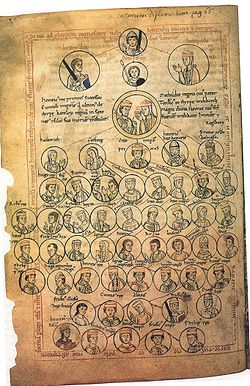
Liudolf, Duke of Saxony
Liudolf was a Saxon count, son of one count Brun and his wife Gisla von Verla ; later authors called him duke of the Eastern Saxons and count of Eastphalia...
and one of its primary leading-names. The Ottonian rulers are also regarded as the first dynasty of the Holy Roman Empire
Holy Roman Empire
The Holy Roman Empire was a realm that existed from 962 to 1806 in Central Europe.It was ruled by the Holy Roman Emperor. Its character changed during the Middle Ages and the Early Modern period, when the power of the emperor gradually weakened in favour of the princes...
, as successors of the Frankish
Franks
The Franks were a confederation of Germanic tribes first attested in the third century AD as living north and east of the Lower Rhine River. From the third to fifth centuries some Franks raided Roman territory while other Franks joined the Roman troops in Gaul. Only the Salian Franks formed a...
Carolingian
Carolingian
The Carolingian dynasty was a Frankish noble family with origins in the Arnulfing and Pippinid clans of the 7th century AD. The name "Carolingian", Medieval Latin karolingi, an altered form of an unattested Old High German *karling, kerling The Carolingian dynasty (known variously as the...
dynasty and Charlemagne
Charlemagne
Charlemagne was King of the Franks from 768 and Emperor of the Romans from 800 to his death in 814. He expanded the Frankish kingdom into an empire that incorporated much of Western and Central Europe. During his reign, he conquered Italy and was crowned by Pope Leo III on 25 December 800...
, who is commonly viewed as the founder of the Holy Roman Empire
Holy Roman Empire
The Holy Roman Empire was a realm that existed from 962 to 1806 in Central Europe.It was ruled by the Holy Roman Emperor. Its character changed during the Middle Ages and the Early Modern period, when the power of the emperor gradually weakened in favour of the princes...
.
Ruling in Germany and the Holy Roman Empire
Although never Emperor, Henry I the Fowler, Duke of SaxonyDuchy of Saxony
The medieval Duchy of Saxony was a late Early Middle Ages "Carolingian stem duchy" covering the greater part of Northern Germany. It covered the area of the modern German states of Bremen, Hamburg, Lower Saxony, North Rhine-Westphalia, and Saxony-Anhalt and most of Schleswig-Holstein...
, was arguably the founder of this imperial dynasty, since his election as German king made it possible for his son, Otto the Great to take on the imperium. Since Otto I most of the German kings were also crowned Holy Roman Emperor
Holy Roman Emperor
The Holy Roman Emperor is a term used by historians to denote a medieval ruler who, as German King, had also received the title of "Emperor of the Romans" from the Pope...
. Under the reign of the Ottonian rulers, the kingdom of the Eastern Franks
Franks
The Franks were a confederation of Germanic tribes first attested in the third century AD as living north and east of the Lower Rhine River. From the third to fifth centuries some Franks raided Roman territory while other Franks joined the Roman troops in Gaul. Only the Salian Franks formed a...
finally became Germany
Germany
Germany , officially the Federal Republic of Germany , is a federal parliamentary republic in Europe. The country consists of 16 states while the capital and largest city is Berlin. Germany covers an area of 357,021 km2 and has a largely temperate seasonal climate...
with the conclusion of the unification of the duchies of Lorraine, Saxony
Duchy of Saxony
The medieval Duchy of Saxony was a late Early Middle Ages "Carolingian stem duchy" covering the greater part of Northern Germany. It covered the area of the modern German states of Bremen, Hamburg, Lower Saxony, North Rhine-Westphalia, and Saxony-Anhalt and most of Schleswig-Holstein...
, Franconia
Franconia
Franconia is a region of Germany comprising the northern parts of the modern state of Bavaria, a small part of southern Thuringia, and a region in northeastern Baden-Württemberg called Tauberfranken...
, Swabia
Swabia
Swabia is a cultural, historic and linguistic region in southwestern Germany.-Geography:Like many cultural regions of Europe, Swabia's borders are not clearly defined...
, Thuringia
Thuringia
The Free State of Thuringia is a state of Germany, located in the central part of the country.It has an area of and 2.29 million inhabitants, making it the sixth smallest by area and the fifth smallest by population of Germany's sixteen states....
and Bavaria
Bavaria
Bavaria, formally the Free State of Bavaria is a state of Germany, located in the southeast of Germany. With an area of , it is the largest state by area, forming almost 20% of the total land area of Germany...
into one empire. Also the union of Germany with the Holy Roman Empire
Holy Roman Empire
The Holy Roman Empire was a realm that existed from 962 to 1806 in Central Europe.It was ruled by the Holy Roman Emperor. Its character changed during the Middle Ages and the Early Modern period, when the power of the emperor gradually weakened in favour of the princes...
, which dominated German history until 1806, began with the coronation of Otto I the Great in Rome in 962. But the projected restoration of the Roman Empire failed already under Otto III, Holy Roman Emperor
Otto III, Holy Roman Emperor
Otto III , a King of Germany, was the fourth ruler of the Saxon or Ottonian dynasty of the Holy Roman Empire. He was elected King in 983 on the death of his father Otto II and was crowned Holy Roman Emperor in 996.-Early reign:...
.
After the extinction of the Ottonian dynasty with the death of Henry II, Holy Roman Emperor
Henry II, Holy Roman Emperor
Henry II , also referred to as Saint Henry, Obl.S.B., was the fifth and last Holy Roman Emperor of the Ottonian dynasty, from his coronation in Rome in 1014 until his death a decade later. He was crowned King of the Germans in 1002 and King of Italy in 1004...
in 1024 the crown passed to the Salian dynasty. Liutgarde
Liutgarde
Liutgarde was the daughter of Otto I, Holy Roman Emperor and his first wife Eadgyth. In 947 she married Conrad, Duke of Lorraine, also known as Conrad the Red. Otto's Empire did not pass to Liutgarde's brother, Liudolf, Duke of Swabia, but instead passed through his second wife Adelaide of Italy...
, a daughter of Emperor Otto I
Otto I, Holy Roman Emperor
Otto I the Great , son of Henry I the Fowler and Matilda of Ringelheim, was Duke of Saxony, King of Germany, King of Italy, and "the first of the Germans to be called the emperor of Italy" according to Arnulf of Milan...
had married the Salian Duke Conrad the Red of Lorraine. His great-grandson was Conrad II, Holy Roman Emperor
Conrad II, Holy Roman Emperor
Conrad II was Holy Roman Emperor from 1027 until his death.The son of a mid-level nobleman in Franconia, Count Henry of Speyer and Adelaide of Alsace, he inherited the titles of count of Speyer and of Worms as an infant when Henry died at age twenty...
.
Ottonian Kings and Emperors:
- Henry I the Fowler, King of the Germans and Duke of Saxony, died 936
- Otto I the Great, Holy Roman Emperor and Duke of Saxony, died 973
- Otto II, Holy Roman EmperorOtto II, Holy Roman EmperorOtto II , called the Red, was the third ruler of the Saxon or Ottonian dynasty, the son of Otto the Great and Adelaide of Italy.-Early years and co-ruler with Otto I:...
, died 983 - Otto III, Holy Roman EmperorOtto III, Holy Roman EmperorOtto III , a King of Germany, was the fourth ruler of the Saxon or Ottonian dynasty of the Holy Roman Empire. He was elected King in 983 on the death of his father Otto II and was crowned Holy Roman Emperor in 996.-Early reign:...
, died 1002 - Saint Henry II, Holy Roman EmperorHenry II, Holy Roman EmperorHenry II , also referred to as Saint Henry, Obl.S.B., was the fifth and last Holy Roman Emperor of the Ottonian dynasty, from his coronation in Rome in 1014 until his death a decade later. He was crowned King of the Germans in 1002 and King of Italy in 1004...
, died 1024
Some other famous members of the Liudolfing or Ottonian House:
- LiudolfLiudolf, Duke of SaxonyLiudolf was a Saxon count, son of one count Brun and his wife Gisla von Verla ; later authors called him duke of the Eastern Saxons and count of Eastphalia...
, Count of Saxony, died 864/866 - Saint Altfrid, Bishop of Hildesheim, died 874
- Otto the Illustrious, Duke of Saxony, died 912
- Gerberga of SaxonyGerberga of SaxonyGerberga of Saxony was a daughter of Henry the Fowler, King of Germany, and Matilda of Ringelheim.-Marriages:She married first Gilbert, Duke of Lorraine. They had four children:...
, died 954 - Henry I, Duke of BavariaHenry I, Duke of BavariaHenry I was Duke of Bavaria.He was the second son of the German King Henry the Fowler and his wife Matilda. He attempted a revolt against his older brother Otto I in 938 in alliance with Eberhard of Franconia and Giselbert of Lorraine, believing he had a claim on the throne. In 939 he was defeated...
, died 955 - Liudolf, Duke of SwabiaLiudolf, Duke of SwabiaLiudolf was the duke of Swabia from 950 until 954. He was the only son of Otto I, king of Germany, from his wife Eadgyth, daughter of Edward the Elder, king of England....
, died 957 - Hedwige of SaxonyHedwige of SaxonyHedwige of Saxony was a daughter of Henry I the Fowler, and his wife Matilda of Ringelheim.She was a sister of Otto I, Holy Roman Emperor; Henry I, Duke of Bavaria; Gerberga of Saxony; and Bruno I, Archbishop of Cologne....
, died 965 - Bruno I, Archbishop of CologneBruno I, Archbishop of CologneBruno the Great was Archbishop of Cologne, Germany, from 953 until his death, and Duke of Lotharingia from 954. He was the brother of Otto I, king of Germany and later Holy Roman Emperor....
and Duke of Lotharingia, died 965 - William, Archbishop of MainzWilliam, Archbishop of MainzWilliam was Archbishop of Mainz from 17 December 954 until his death. He was the son of the Emperor Otto I the Great and a Slav mother....
, died 968 - Matilda, Abbess of QuedlinburgMatilda, Abbess of QuedlinburgMatilda , also known as Mathilda and Mathilde, was the first Princess-Abbess of Quedlinburg. She was the daughter of Otto I, Holy Roman Emperor, and his second wife, Adelaide of Italy.- Taking the veil :...
, died 999 - Adelheid I, Abbess of QuedlinburgAdelheid I, Abbess of QuedlinburgAdelaide I was Abbess of Quedlinburg and Gandersheim, as well as highly influential kingmaker of medieval Germany.- Early life :...
, died 1044 - Otto, Duke of Swabia and BavariaOtto I, Duke of BavariaOtto I, Duke of Swabia and Bavaria was the son of Liodolf of Swabia and his wife Ida, and thus a grandson of the Emperor Otto I and his Anglo-Saxon wife Eadgyth...
, died 982 - Henry II, Duke of BavariaHenry II, Duke of BavariaHenry II , called the Wrangler or the Quarrelsome, in German Heinrich der Zänker, was the son of Henry I and Judith of Bavaria.- Biography :...
, the Wrangler, died 995 - Bruno, Bishop of Augsburg, died 1029
See also
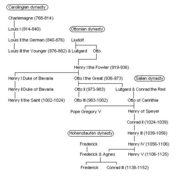
- Kings of Germany family tree. The Ottonians were the 3rd dynasty to rule Germany and were related by marriage to all the others.
- Ottonian RenaissanceOttonian RenaissanceThe Ottonian Renaissance was a limited "renaissance" of economy and art in central and southern Europe that accompanied the reigns of the first three emperors of the Saxon Dynasty, all named Otto: Otto I , Otto II , and Otto III , and which in large part depended upon their patronage.One of three ...
- Ottonian artOttonian artIn pre-romanesque Germany, the prevailing style was what has come to be known as Ottonian art. With Ottonian architecture, it is a key component of the Ottonian Renaissance named for the emperors Otto I, Otto II, and Otto III...
- Ottonian architectureOttonian architectureOttonian Architecture is an architectural style which evolved during the reign of Emperor Otto the Great . The style was found in Germany and lasted from the mid 10th century until the mid 11th century....
- Concordat of WormsConcordat of WormsThe Concordat of Worms, sometimes called the Pactum Calixtinum by papal historians, was an agreement between Pope Calixtus II and Holy Roman Emperor Henry V on September 23, 1122 near the city of Worms...