

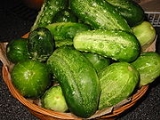
Pickling

Encyclopedia
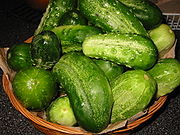
Food preservation
Food preservation is the process of treating and handling food to stop or slow down spoilage and thus allow for longer storage....
food
Food
Food is any substance consumed to provide nutritional support for the body. It is usually of plant or animal origin, and contains essential nutrients, such as carbohydrates, fats, proteins, vitamins, or minerals...
by anaerobic
Anaerobic organism
An anaerobic organism or anaerobe is any organism that does not require oxygen for growth. It could possibly react negatively and may even die if oxygen is present...
fermentation
Fermentation (food)
Fermentation in food processing typically is the conversion of carbohydrates to alcohols and carbon dioxide or organic acids using yeasts, bacteria, or a combination thereof, under anaerobic conditions. Fermentation in simple terms is the chemical conversion of sugars into ethanol...
in brine
Brine
Brine is water, saturated or nearly saturated with salt .Brine is used to preserve vegetables, fruit, fish, and meat, in a process known as brining . Brine is also commonly used to age Halloumi and Feta cheeses, or for pickling foodstuffs, as a means of preserving them...
(a solution of salt
Edible salt
Salt, also known as table salt, or rock salt, is a mineral that is composed primarily of sodium chloride , a chemical compound belonging to the larger class of ionic salts. It is essential for animal life in small quantities, but is harmful to animals and plants in excess...
in water) to produce lactic acid
Lactic acid bacteria
The lactic acid bacteria comprise a clade of Gram-positive, low-GC, acid-tolerant, generally non-sporulating, non-respiring rod or cocci that are associated by their common metabolic and physiological characteristics. These bacteria, usually found in decomposing plants and lactic products, produce...
, or marinating
Marination
Marination is the process of soaking foods in a seasoned, often acidic, liquid before cooking. The origins of the word allude to the use of brine in the pickling process, which led to the technique of adding flavor by immersion in liquid...
and storing it in an acid solution, usually vinegar
Vinegar
Vinegar is a liquid substance consisting mainly of acetic acid and water, the acetic acid being produced through the fermentation of ethanol by acetic acid bacteria. Commercial vinegar is produced either by fast or slow fermentation processes. Slow methods generally are used with traditional...
(acetic acid
Acetic acid
Acetic acid is an organic compound with the chemical formula CH3CO2H . It is a colourless liquid that when undiluted is also called glacial acetic acid. Acetic acid is the main component of vinegar , and has a distinctive sour taste and pungent smell...
). The resulting food is called a pickle
Pickle
Pickling is a process of preserving food. Pickle or pickling may refer to:-Food:* Pickled cucumber* Pickled onion* Pickled herring* Indian pickle includes oil-based food preservation* Branston and similar sweet pickle relishes...
. This procedure gives the food a salty or sour taste. In South Asia, edible oils are used as the pickling medium with vinegar.
Another distinguishing characteristic is a pH
PH
In chemistry, pH is a measure of the acidity or basicity of an aqueous solution. Pure water is said to be neutral, with a pH close to 7.0 at . Solutions with a pH less than 7 are said to be acidic and solutions with a pH greater than 7 are basic or alkaline...
less than 4.6, which is sufficient to kill most bacteria. Pickling can preserve perishable
Decomposition
Decomposition is the process by which organic material is broken down into simpler forms of matter. The process is essential for recycling the finite matter that occupies physical space in the biome. Bodies of living organisms begin to decompose shortly after death...
foods for months. Antimicrobial
Antimicrobial
An anti-microbial is a substance that kills or inhibits the growth of microorganisms such as bacteria, fungi, or protozoans. Antimicrobial drugs either kill microbes or prevent the growth of microbes...
herbs and spices, such as mustard seed
Mustard seed
Mustard seeds are the small round seeds of various mustard plants. The seeds are usually about 1 or 2 mm in diameter. Mustard seeds may be colored from yellowish white to black. They are important spices in many regional foods. The seeds can come from three different plants: black mustard , brown...
, garlic
Garlic
Allium sativum, commonly known as garlic, is a species in the onion genus, Allium. Its close relatives include the onion, shallot, leek, chive, and rakkyo. Dating back over 6,000 years, garlic is native to central Asia, and has long been a staple in the Mediterranean region, as well as a frequent...
, cinnamon
Cinnamon
Cinnamon is a spice obtained from the inner bark of several trees from the genus Cinnamomum that is used in both sweet and savoury foods...
or clove
Clove
Cloves are the aromatic dried flower buds of a tree in the family Myrtaceae. Cloves are native to the Maluku islands in Indonesia and used as a spice in cuisines all over the world...
s, are often added. If the food contains sufficient moisture, a pickling brine may be produced simply by adding dry salt. For example, sauerkraut
Sauerkraut
Sauerkraut , directly translated from German: "sour cabbage", is finely shredded cabbage that has been fermented by various lactic acid bacteria, including Leuconostoc, Lactobacillus, and Pediococcus. It has a long shelf-life and a distinctive sour flavor, both of which result from the lactic acid...
and Korea
Korea
Korea ) is an East Asian geographic region that is currently divided into two separate sovereign states — North Korea and South Korea. Located on the Korean Peninsula, Korea is bordered by the People's Republic of China to the northwest, Russia to the northeast, and is separated from Japan to the...
n kimchi
Kimchi
Kimchi , also spelled gimchi, kimchee, or kim chee, is a traditional fermented Korean dish made of vegetables with varied seasonings. There are hundreds of varieties of kimchi made with a main vegetable ingredient such as napa cabbage, radish, green onions or cucumber. It is the most common...
are produced by salting the vegetables to draw out excess water. Natural fermentation at room temperature, by lactic acid bacteria
Lactic acid bacteria
The lactic acid bacteria comprise a clade of Gram-positive, low-GC, acid-tolerant, generally non-sporulating, non-respiring rod or cocci that are associated by their common metabolic and physiological characteristics. These bacteria, usually found in decomposing plants and lactic products, produce...
, produces the required acidity. Other pickles are made by placing vegetables in vinegar. Unlike the canning
Canning
Canning is a method of preserving food in which the food contents are processed and sealed in an airtight container. Canning provides a typical shelf life ranging from one to five years, although under specific circumstances a freeze-dried canned product, such as canned, dried lentils, can last as...
process, pickling (which includes fermentation) does not require that the food be completely sterile
Sterilization (microbiology)
Sterilization is a term referring to any process that eliminates or kills all forms of microbial life, including transmissible agents present on a surface, contained in a fluid, in medication, or in a compound such as biological culture media...
before it is sealed. The acidity or salinity of the solution, the temperature of fermentation, and the exclusion of oxygen determine which microorganisms dominate, and determine the flavor of the end product.
When both salt concentration and temperature are low, Leuconostoc mesenteroides
Leuconostoc mesenteroides
Leuconostoc mesenteroides is a species of bacteria sometimes associated with fermentation, under conditions of salinity and low temperatures.-External links:*...
dominates, producing a mix of acids, alcohol, and aroma compounds. At higher temperatures Lactobacillus plantarum
Lactobacillus plantarum
Lactobacillus plantarum is a widespread member of the genus Lactobacillus, commonly found in many fermented food products as well as anaerobic plant matter. It is also present in saliva . It has the ability to liquefy gelatin. L...
dominates, which produces primarily lactic acid. Many pickles start with Leuconostoc, and change to Lactobacillus with higher acidity.
History
Pickling began 4000 years ago using cucumbers native to IndiaIndia
India , officially the Republic of India , is a country in South Asia. It is the seventh-largest country by geographical area, the second-most populous country with over 1.2 billion people, and the most populous democracy in the world...
.It is called "achar
Achar
Achar may refer to:* Achar, a word used in many Indo-Aryan languages for Indian pickle* Achar people, an ethnographic group of Georgians* Achar or Achan, a figure mentioned in the Book of Joshua...
" in northern India. This was used as a way to preserve food for out-of-season use and for long journeys, especially by sea. Salt pork
Salt pork
Salt pork or white bacon is salt-cured pork. It is prepared from one of three primal cuts: pork side, pork belly, or fatback. Depending on the cut, respectively, salt pork may be lean, streaky or entirely fatty. Made from the same cuts as bacon, salt pork resembles uncut slab bacon, but is...
and salt beef were common staples
Staple food
A staple food is one that is eaten regularly and in such quantities that it constitutes a dominant portion of a diet, and that supplies a high proportion of energy and nutrient needs. Most people live on a diet based on one or more staples...
for sailors before the days of steam engines. Although the process was invented to preserve foods, pickles are also made and eaten because people enjoy the resulting flavors. Pickling may also improve the nutritional value of food by introducing B vitamins
B vitamins
B vitamins are a group of water-soluble vitamins that play important roles in cell metabolism. The B vitamins were once thought to be a single vitamin, referred to as vitamin B . Later research showed that they are chemically distinct vitamins that often coexist in the same foods...
produced by bacteria.
Pickle etymology
The term pickle is derived from the DutchDutch language
Dutch is a West Germanic language and the native language of the majority of the population of the Netherlands, Belgium, and Suriname, the three member states of the Dutch Language Union. Most speakers live in the European Union, where it is a first language for about 23 million and a second...
word pekel, meaning brine. In the U.S. and Canada, the word pickle alone almost always refers to a pickled cucumber (other types of pickles will be described as "pickled onion," "pickled cauliflower," etc.), except when it is used figuratively. In the UK, pickle (as in a "cheese and pickle sandwich") refers to Ploughman's pickle, a kind of chutney
Chutney
Chutney is a a condiment used in South Asian cuisine that usually contains a spice and vegetable mix.Chutneys are wet or dry, having a coarse to fine texture. The Anglo-Indian loan word refers to fresh and pickled preparations indiscriminately, with preserves often sweetened. At least several...
.
South Asia
India
India
India , officially the Republic of India , is a country in South Asia. It is the seventh-largest country by geographical area, the second-most populous country with over 1.2 billion people, and the most populous democracy in the world...
has a large variety of pickles (known as Achar in Punjabi and Hindi, Uppinakaayi in Kannada, Lonacha in Marathi, Oorukai in Tamil, ooragaya (ఊరగాయ) in Telugu
Telugu language
Telugu is a Central Dravidian language primarily spoken in the state of Andhra Pradesh, India, where it is an official language. It is also spoken in the neighbouring states of Chattisgarh, Karnataka, Maharashtra, Orissa and Tamil Nadu...
, which are mainly made from Mango, Lime, Indian Goose Berry (amla), Chilli, vegetables, Ginger, Garlic and Citron. These fruits/vegetables are generally mixed with some other ingredients i.e. salt, spices, vegetable oils and is set to mature.
In Pakistan
Pakistan
Pakistan , officially the Islamic Republic of Pakistan is a sovereign state in South Asia. It has a coastline along the Arabian Sea and the Gulf of Oman in the south and is bordered by Afghanistan and Iran in the west, India in the east and China in the far northeast. In the north, Tajikistan...
, pickles are known locally as Achaar (in Urdu
Urdu
Urdu is a register of the Hindustani language that is identified with Muslims in South Asia. It belongs to the Indo-European family. Urdu is the national language and lingua franca of Pakistan. It is also widely spoken in some regions of India, where it is one of the 22 scheduled languages and an...
) and come in a variety of flavours. Amongst some of the most popular is the traditional mixed Hyderabadi pickle
Hyderabadi pickle
The Hyderabadi pickle is a type of pickle originating from Hyderabad, Pakistan. The pickle can come in various flavours, from a delicate mixed assortment of fruits and vegetables matured through natural processes, and carefully selected spices made and preserved in a traditional method...
, a common delicacy and staple prepared out of an assortment of fruits (most notably mangos) and vegetables blended with selected spices.
East Asia
IndonesiaIndonesia
Indonesia , officially the Republic of Indonesia , is a country in Southeast Asia and Oceania. Indonesia is an archipelago comprising approximately 13,000 islands. It has 33 provinces with over 238 million people, and is the world's fourth most populous country. Indonesia is a republic, with an...
n pickles, acar, are typically made out of cucumber, carrot, bird's eye chilies, and shallots, these items being seasoned with vinegar, sugar and salt. Fruits, such as papaya and pineapple are also sometimes pickled. In the Philippines
Philippines
The Philippines , officially known as the Republic of the Philippines , is a country in Southeast Asia in the western Pacific Ocean. To its north across the Luzon Strait lies Taiwan. West across the South China Sea sits Vietnam...
, achara is primarily made out of green papaya, carrots, and shallots, with cloves of garlic and vinegar. In Vietnam
Vietnam
Vietnam – sometimes spelled Viet Nam , officially the Socialist Republic of Vietnam – is the easternmost country on the Indochina Peninsula in Southeast Asia. It is bordered by China to the north, Laos to the northwest, Cambodia to the southwest, and the South China Sea –...
, vegetable pickles are called dưa muối (salted vegetables) or dưa chua ("sour vegetables"). In Sri Lanka
Sri Lanka
Sri Lanka, officially the Democratic Socialist Republic of Sri Lanka is a country off the southern coast of the Indian subcontinent. Known until 1972 as Ceylon , Sri Lanka is an island surrounded by the Indian Ocean, the Gulf of Mannar and the Palk Strait, and lies in the vicinity of India and the...
, achcharu is traditionally prepared out of carrots, onions, and ground dates. Mixed with mustard powder, ground pepper, crushed ginger, garlic and vinegar, these items are seasoned in a clay pot
China
China
Chinese civilization may refer to:* China for more general discussion of the country.* Chinese culture* Greater China, the transnational community of ethnic Chinese.* History of China* Sinosphere, the area historically affected by Chinese culture...
is home to a huge variety of pickled vegetables, including radish
Radish
The radish is an edible root vegetable of the Brassicaceae family that was domesticated in Europe, in pre-Roman times. They are grown and consumed throughout the world. Radishes have numerous varieties, varying in size, color and duration of required cultivation time...
, baicai
Chinese cabbage
Chinese cabbage can refer to two distinct varieties of Chinese leaf vegetables used often in Chinese cuisine. These vegetables are both related to the Western cabbage, and are of the same species as the common turnip...
(Chinese cabbage, notably suan cai
Suan cai
Suan cai , or in English, "sour vegetable", is a traditional Chinese pickled Chinese cabbage. It is used in a variety of ways...
, la bai cai
Kimchi
Kimchi , also spelled gimchi, kimchee, or kim chee, is a traditional fermented Korean dish made of vegetables with varied seasonings. There are hundreds of varieties of kimchi made with a main vegetable ingredient such as napa cabbage, radish, green onions or cucumber. It is the most common...
, pao cai
Pao cai
Pao cai is a type of pickle, usually pickled cabbage, often found in Chinese, and particularly Sichuanese cuisine. It is most common to northern and western China; however, there is also a unique form of pao cai, called suan cai, which is prominent in Northeast China.Chinese pao cai closely...
, and Tianjin preserved vegetable
Tianjin preserved vegetable
Tianjin preserved vegetable is a type of pickled Chinese cabbage originating in Tianjin, China. It consists of finely chopped Tianjin cabbage and salt...
), zha cai
Zha cai
Zha cai is a type of pickled mustard plant stem originating from Sichuan, China. Other transliterations might include cha tsai, tsa tsai; or jar choy, jar choi, ja choi, ja choy, or cha tsoi...
, chili pepper
Chili pepper
Chili pepper is the fruit of plants from the genus Capsicum, members of the nightshade family, Solanaceae. The term in British English and in Australia, New Zealand, India, Malaysia and other Asian countries is just chilli without pepper.Chili peppers originated in the Americas...
and cucumber
Cucumber
The cucumber is a widely cultivated plant in the gourd family Cucurbitaceae, which includes squash, and in the same genus as the muskmelon. The plant is a creeping vine which bears cylindrical edible fruit when ripe. There are three main varieties of cucumber: "slicing", "pickling", and...
, among many others.
Japan
Japan
Japan is an island nation in East Asia. Located in the Pacific Ocean, it lies to the east of the Sea of Japan, China, North Korea, South Korea and Russia, stretching from the Sea of Okhotsk in the north to the East China Sea and Taiwan in the south...
ese tsukemono
Tsukemono
are Japanese pickles. They are served with rice as okazu with drinks as an otsumami , as an accompaniment to or garnish for meals, and as a course in the kaiseki portion of a Japanese tea ceremony....
(pickled foods) include takuan
Takuan
, also known as takuwan or takuan-zuke, is a popular traditional Japanese pickle. It is made from daikon radish. In addition to being served alongside other types of tsukemono in traditional Japanese cuisine, takuan is also enjoyed at the end of meals as it is thought to aid digestion.Takuan is...
(daikon
Daikon
Daikon , Raphanus sativus var. longipinnatus, also called White Radish, Japanese radish, Oriental radish, Chinese radish, lo bok and Mooli , is a mild flavoured, very large, white East Asian radish...
), umeboshi
Umeboshi
Umeboshi are pickled ume fruits common in Japan. Ume is a species of fruit-bearing tree in the genus Prunus, which is often called a plum but is actually more closely related to the apricot. Umeboshi are a popular kind of tsukemono and are extremely sour and salty...
(ume
Ume
Prunus mume, with the common names including Chinese plum and Japanese apricot, is an Asian tree species classified in the Armeniaca section of the genus Prunus. The flower, long a beloved subject in the traditional painting of East Asia, is usually translated as plum blossom. This distinct tree...
plum), gari
Gari (ginger)
is a type of tsukemono . It is sweet, thinly sliced young ginger that has been marinated in a solution of sugar and vinegar. Gari is often served and eaten after sushi, and is sometimes called sushi ginger...
& beni shoga
Beni shoga
is a type of tsukemono . It is made from ginger cut into thin strips, colored red, and pickled in umezu , the pickling solution used to make umeboshi; the red color is derived from red perilla. It is served with many Japanese dishes, including gyūdon, okonomiyaki, and yakisoba.Beni shōga is not the...
(ginger), turnip, cucumber
Cucumber
The cucumber is a widely cultivated plant in the gourd family Cucurbitaceae, which includes squash, and in the same genus as the muskmelon. The plant is a creeping vine which bears cylindrical edible fruit when ripe. There are three main varieties of cucumber: "slicing", "pickling", and...
, and Chinese cabbage
Chinese cabbage
Chinese cabbage can refer to two distinct varieties of Chinese leaf vegetables used often in Chinese cuisine. These vegetables are both related to the Western cabbage, and are of the same species as the common turnip...
.
The Korea
Korea
Korea ) is an East Asian geographic region that is currently divided into two separate sovereign states — North Korea and South Korea. Located on the Korean Peninsula, Korea is bordered by the People's Republic of China to the northwest, Russia to the northeast, and is separated from Japan to the...
n staple kimchi
Kimchi
Kimchi , also spelled gimchi, kimchee, or kim chee, is a traditional fermented Korean dish made of vegetables with varied seasonings. There are hundreds of varieties of kimchi made with a main vegetable ingredient such as napa cabbage, radish, green onions or cucumber. It is the most common...
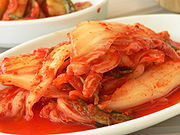
is usually made from pickled cabbage
Cabbage
Cabbage is a popular cultivar of the species Brassica oleracea Linne of the Family Brassicaceae and is a leafy green vegetable...
and radish
Radish
The radish is an edible root vegetable of the Brassicaceae family that was domesticated in Europe, in pre-Roman times. They are grown and consumed throughout the world. Radishes have numerous varieties, varying in size, color and duration of required cultivation time...
, but is also made from green onions, garlic stems, chives and a host of other vegetables. Kimchi is popular throughout East Asia. Jangajji
Jangajji
Jangajji or jangachi is a type of pickle in Korean cuisine which is made by pickling or marinating vegetables in a sauce for a long period of time. The dish is also sometimes called janghwa . It was historically made during the harvest season and was eaten as a banchan when vegetables were scarce...
is another example of pickled vegetables.
Middle East
In IranIran
Iran , officially the Islamic Republic of Iran , is a country in Southern and Western Asia. The name "Iran" has been in use natively since the Sassanian era and came into use internationally in 1935, before which the country was known to the Western world as Persia...
, and all Arab countries, pickles (called torshi in Persian
Persian language
Persian is an Iranian language within the Indo-Iranian branch of the Indo-European languages. It is primarily spoken in Iran, Afghanistan, Tajikistan and countries which historically came under Persian influence...
, mekhallel in Arabic
Arabic language
Arabic is a name applied to the descendants of the Classical Arabic language of the 6th century AD, used most prominently in the Quran, the Islamic Holy Book...
) are commonly made from turnips, peppers, carrots, green olive
Olive
The olive , Olea europaea), is a species of a small tree in the family Oleaceae, native to the coastal areas of the eastern Mediterranean Basin as well as northern Iran at the south end of the Caspian Sea.Its fruit, also called the olive, is of major agricultural importance in the...
s, cucumbers, beetroot, cabbage, lemon
Preserved lemon
Preserved lemon or lemon pickle is a condiment that is common in Indian Cuisine , especially South Indian cuisine and also in North African cuisine, especially Moroccan cuisine. It is also known as "country lemon" and leems. Diced, quartered, halved, or whole lemons are pickled in a brine of...
s, and cauliflower
Cauliflower
Cauliflower is one of several vegetables in the species Brassica oleracea, in the family Brassicaceae. It is an annual plant that reproduces by seed...
.
Asia Minor
TurkishTurkey
Turkey , known officially as the Republic of Turkey , is a Eurasian country located in Western Asia and in East Thrace in Southeastern Europe...
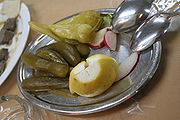
pickles, called turşu, are made out of vegetables, roots, and fruits such as peppers, cucumber, Armenian cucumber
Armenian cucumber
The Armenian cucumber, Cucumis melo var. flexuosus, is a type of long, slender fruit which tastes like a cucumber and looks somewhat like a cucumber inside. It is actually a variety of muskmelon , a species closely related to the cucumber...
, cabbage, tomato, eggplant (aubergine), carrot, turnip
Turnip
The turnip or white turnip is a root vegetable commonly grown in temperate climates worldwide for its white, bulbous taproot. Small, tender varieties are grown for human consumption, while larger varieties are grown as feed for livestock...
, beetroot, green almond
Almond
The almond , is a species of tree native to the Middle East and South Asia. Almond is also the name of the edible and widely cultivated seed of this tree...
, baby watermelon, baby cantaloupe, and green plum
Plum
A plum or gage is a stone fruit tree in the genus Prunus, subgenus Prunus. The subgenus is distinguished from other subgenera in the shoots having a terminal bud and solitary side buds , the flowers in groups of one to five together on short stems, and the fruit having a groove running down one...
. A mixture of spices flavor the pickles.
Eastern Europe
RomaniaRomania
Romania is a country located at the crossroads of Central and Southeastern Europe, on the Lower Danube, within and outside the Carpathian arch, bordering on the Black Sea...
n pickles are made out of beetroot
Beetroot
The beetroot, also known as the table beet, garden beet, red beet or informally simply as beet, is one of the many cultivated varieties of beets and arguably the most commonly encountered variety in North America, Central America and Britain.-Consumption:The usually deep-red roots of beetroot are...
, cucumbers
Pickled cucumber
A pickled cucumber is a cucumber that has been pickled in a brine, vinegar, or other solution and left to ferment for a period of time, by either immersing the cucumbers in an acidic solution or through souring by lacto-fermentation.-Gherkin:A gherkin is not only...
, green tomatoes (gogonele), carrot
Carrot
The carrot is a root vegetable, usually orange in colour, though purple, red, white, and yellow varieties exist. It has a crisp texture when fresh...
s, cabbage
Cabbage
Cabbage is a popular cultivar of the species Brassica oleracea Linne of the Family Brassicaceae and is a leafy green vegetable...
, bell peppers, melon
Melon
thumb|200px|Various types of melonsThis list of melons includes members of the plant family Cucurbitaceae with edible, fleshy fruit e.g. gourds or cucurbits. The word "melon" can refer to either the plant or specifically to the fruit...
s, mushroom
Mushroom
A mushroom is the fleshy, spore-bearing fruiting body of a fungus, typically produced above ground on soil or on its food source. The standard for the name "mushroom" is the cultivated white button mushroom, Agaricus bisporus; hence the word "mushroom" is most often applied to those fungi that...
s, turnip
Turnip
The turnip or white turnip is a root vegetable commonly grown in temperate climates worldwide for its white, bulbous taproot. Small, tender varieties are grown for human consumption, while larger varieties are grown as feed for livestock...
s, celery
Celery
Apium graveolens is a plant species in the family Apiaceae commonly known as celery or celeriac , depending on whether the petioles or roots are eaten: celery refers to the former and celeriac to the latter. Apium graveolens grows to 1 m tall...
and cauliflower
Cauliflower
Cauliflower is one of several vegetables in the species Brassica oleracea, in the family Brassicaceae. It is an annual plant that reproduces by seed...
. Meat, like pork
Pork
Pork is the culinary name for meat from the domestic pig , which is eaten in many countries. It is one of the most commonly consumed meats worldwide, with evidence of pig husbandry dating back to 5000 BC....
, can also be preserved in salt and lard
Lard
Lard is pig fat in both its rendered and unrendered forms. Lard was commonly used in many cuisines as a cooking fat or shortening, or as a spread similar to butter. Its use in contemporary cuisine has diminished because of health concerns posed by its saturated-fat content and its often negative...
.
In Greece
Greece
Greece , officially the Hellenic Republic , and historically Hellas or the Republic of Greece in English, is a country in southeastern Europe....
, pickles, called τουρσι, are made out of carrots, celery, eggplants stuffed with diced carrots, cauliflower, tomato
Tomato
The word "tomato" may refer to the plant or the edible, typically red, fruit which it bears. Originating in South America, the tomato was spread around the world following the Spanish colonization of the Americas, and its many varieties are now widely grown, often in greenhouses in cooler...
es, and peppers
Capsicum
Capsicum is a genus of flowering plants in the nightshade family, Solanaceae. Its species are native to the Americas where they have been cultivated for thousands of years, but they are now also cultivated worldwide, used as spices, vegetables, and medicines - and have become are a key element in...
.
In Albania
Albania
Albania , officially known as the Republic of Albania , is a country in Southeastern Europe, in the Balkans region. It is bordered by Montenegro to the northwest, Kosovo to the northeast, the Republic of Macedonia to the east and Greece to the south and southeast. It has a coast on the Adriatic Sea...
, Bulgaria
Bulgaria
Bulgaria , officially the Republic of Bulgaria , is a parliamentary democracy within a unitary constitutional republic in Southeast Europe. The country borders Romania to the north, Serbia and Macedonia to the west, Greece and Turkey to the south, as well as the Black Sea to the east...
, Serbia
Serbia
Serbia , officially the Republic of Serbia , is a landlocked country located at the crossroads of Central and Southeast Europe, covering the southern part of the Carpathian basin and the central part of the Balkans...
, and Macedonia, mixed pickles, known as turshi, form popular appetizers, which are typically eaten with rakia
Rakia
Rakia is an alcoholic beverage that is produced by distillation of fermented fruit; it is a popular beverage throughout the Balkans. Its alcohol content is normally 40% ABV, but home-produced rakia can be stronger . Prepečenica is double-distilled rakia which has an alcohol content that may...
. Pickled green tomatoes, cucumbers, carrots, bell peppers, peppers, eggplants, and sauerkraut
Sauerkraut
Sauerkraut , directly translated from German: "sour cabbage", is finely shredded cabbage that has been fermented by various lactic acid bacteria, including Leuconostoc, Lactobacillus, and Pediococcus. It has a long shelf-life and a distinctive sour flavor, both of which result from the lactic acid...
are also popular.
Polish
Poland
Poland , officially the Republic of Poland , is a country in Central Europe bordered by Germany to the west; the Czech Republic and Slovakia to the south; Ukraine, Belarus and Lithuania to the east; and the Baltic Sea and Kaliningrad Oblast, a Russian exclave, to the north...
traditional pickles are cucumbers and cabbage, but other pickled fruits and vegetables, including plums, pumpkin
Pumpkin
A pumpkin is a gourd-like squash of the genus Cucurbita and the family Cucurbitaceae . It commonly refers to cultivars of any one of the species Cucurbita pepo, Cucurbita mixta, Cucurbita maxima, and Cucurbita moschata, and is native to North America...
s and mushrooms are also common.
Russia
Russia
Russia or , officially known as both Russia and the Russian Federation , is a country in northern Eurasia. It is a federal semi-presidential republic, comprising 83 federal subjects...
n pickled items include beets, mushrooms, tomatoes, cabbage, cucumbers, ramsons
Ramsons
Ramsons — also known as buckrams, wild garlic, broad-leaved garlic, wood garlic, bear leek, and bear's garlic — is a wild relative of chives native to Europe and Asia...
, garlic
Garlic
Allium sativum, commonly known as garlic, is a species in the onion genus, Allium. Its close relatives include the onion, shallot, leek, chive, and rakkyo. Dating back over 6,000 years, garlic is native to central Asia, and has long been a staple in the Mediterranean region, as well as a frequent...
, eggplant (which is typically stuffed with julienned carrots), custard squash
Squash (fruit)
Squashes generally refer to four species of the genus Cucurbita, also called marrows depending on variety or the nationality of the speaker...
, and watermelon
Watermelon
Watermelon is a vine-like flowering plant originally from southern Africa. Its fruit, which is also called watermelon, is a special kind referred to by botanists as a pepo, a berry which has a thick rind and fleshy center...
.
Pickled herring
Herring
Herring is an oily fish of the genus Clupea, found in the shallow, temperate waters of the North Pacific and the North Atlantic oceans, including the Baltic Sea. Three species of Clupea are recognized. The main taxa, the Atlantic herring and the Pacific herring may each be divided into subspecies...
, rollmops
Rollmops
Rollmops are pickled herring fillets, rolled into a cylindrical shape around slices of onion, pickled gherkin, or green olive with pimento. Rollmops can be served held together with one or two small wooden skewers....
, and salmon
Salmon
Salmon is the common name for several species of fish in the family Salmonidae. Several other fish in the same family are called trout; the difference is often said to be that salmon migrate and trout are resident, but this distinction does not strictly hold true...
are popular in Scandinavia
Scandinavia
Scandinavia is a cultural, historical and ethno-linguistic region in northern Europe that includes the three kingdoms of Denmark, Norway and Sweden, characterized by their common ethno-cultural heritage and language. Modern Norway and Sweden proper are situated on the Scandinavian Peninsula,...
. Pickled cucumbers and red garden beets are important as condiment
Condiment
A condiment is an edible substance, such as sauce or seasoning, added to food to impart a particular flavor, enhance its flavor, or in some cultures, to complement the dish. Many condiments are available packaged in single-serving sachets , like mustard or ketchup, particularly when supplied with...
s for several traditional dishes. Pickled capers are also common in scandinavian cuisine.
In Ukraine
Ukraine
Ukraine is a country in Eastern Europe. It has an area of 603,628 km², making it the second largest contiguous country on the European continent, after Russia...
, garden produce is commonly pickled using salt, dill
Dill
Dill is a perennial herb. It is the sole species of the genus Anethum, though classified by some botanists in a related genus as Peucedanum graveolens C.B.Clarke.-Growth:...
, currant leaves
Ribes
Ribes is a genus of about 150 species of flowering plants native throughout the temperate regions of the Northern Hemisphere. It is usually treated as the only genus in the family Grossulariaceae. Seven subgenera are recognized....
and garlic and is stored in a cool, dark place.
Western Europe
In BritainBritish cuisine
English cuisine encompasses the cooking styles, traditions and recipes associated with England. It has distinctive attributes of its own, but also shares much with wider British cuisine, largely due to the importation of ingredients and ideas from places such as North America, China, and India...
, pickled onion
Pickled onion
Pickled onions are a popular pickled food consisting of onions pickled in a solution of vinegar and salt, often with other preservatives and flavourings. In the United Kingdom they are often eaten alongside fish and chips or as part of a ploughman's lunch...
s and pickled egg
Pickled egg
Pickled eggs are hard boiled eggs preserved by pickling.After the eggs are hard boiled the shell is removed and they are submerged in a solution of vinegar, salt, spices, and other seasonings. Recipes vary from the traditional brine solution used for pickles to other solutions which can impart a...
s are often sold in pubs
Public house
A public house, informally known as a pub, is a drinking establishment fundamental to the culture of Britain, Ireland, Australia and New Zealand. There are approximately 53,500 public houses in the United Kingdom. This number has been declining every year, so that nearly half of the smaller...
and fish and chip shops
Fish and chips
Fish and chips is a popular take-away food in the United Kingdom, Australia, New Zealand and Canada...
. Pickled beetroot, walnuts
Pickled walnuts
Pickled walnuts are a traditional English pickle.Opie Brand pickled walnuts|thumb-History:The walnuts used to make pickled walnuts are from the variety Juglans regia, commonly known as the English or Persian walnut. The pickled walnut was a common delicacy in early 19th-century England. Charles...
, and gherkin
Gherkin
The gherkin is a fruit similar in form and nutritional value to a cucumber. Gherkins and cucumbers belong to the same species , but are from different cultivar groups....
s, and condiments such as Branston Pickle
Branston Pickle
Branston is a British food brand. It is best known for the original Branston Pickle, a jarred pickled relish first made in 1922 in the Branston suburb of Burton upon Trent by Crosse & Blackwell....
and piccalilli
Piccalilli
Piccalilli is a British relish of chopped pickled vegetables and spices; regional recipes vary considerably. A more finely chopped variety "sandwich piccalilli" is also available from major British supermarkets.-Etymology:...
are typically eaten as an accompaniment to pork pie
Pork pie
A pork pie is a traditional British meat pie. It consists of roughly chopped pork and pork jelly sealed in a hot water crust pastry . It is normally eaten cold as a snack or as part of a meal.-Types:...
s and cold meats, sandwiches or a ploughman's lunch
Ploughman's lunch
A ploughman's lunch is a cold snack or meal originating in the United Kingdom, served in pubs, sometimes eaten in a sandwich form, composed of cheese ; often cooked ham slices, pickle , apples, pickled onions, salad leaves, bread...
. Other popular pickles in the UK are pickled mussels, cockle
Cockle (bivalve)
Cockle is the common name for a group of small, edible, saltwater clams, marine bivalve molluscs in the family Cardiidae.Various species of cockles live in sandy sheltered beaches throughout the world....
s, red cabbage, mango chutney
Chutney
Chutney is a a condiment used in South Asian cuisine that usually contains a spice and vegetable mix.Chutneys are wet or dry, having a coarse to fine texture. The Anglo-Indian loan word refers to fresh and pickled preparations indiscriminately, with preserves often sweetened. At least several...
, sauerkraut, and olives.
Southern Europe
An ItalianItaly
Italy , officially the Italian Republic languages]] under the European Charter for Regional or Minority Languages. In each of these, Italy's official name is as follows:;;;;;;;;), is a unitary parliamentary republic in South-Central Europe. To the north it borders France, Switzerland, Austria and...
pickled vegetable dish is giardiniera
Giardiniera
Giardiniera is an Italian or Italian-American relish of pickled vegetables in vinegar or oil.-Varieties and uses:Italian giardiniera is also called "sotto aceti", which means "under vinegar", a common term for pickled foods...
, which include onions, carrots, celery and cauliflower.
Northern Europe
In SwedenSweden
Sweden , officially the Kingdom of Sweden , is a Nordic country on the Scandinavian Peninsula in Northern Europe. Sweden borders with Norway and Finland and is connected to Denmark by a bridge-tunnel across the Öresund....
, pickled herring is a specialty that is eaten at major holidays such as Easter
Easter
Easter is the central feast in the Christian liturgical year. According to the Canonical gospels, Jesus rose from the dead on the third day after his crucifixion. His resurrection is celebrated on Easter Day or Easter Sunday...
, midsummer, and Christmas
Christmas
Christmas or Christmas Day is an annual holiday generally celebrated on December 25 by billions of people around the world. It is a Christian feast that commemorates the birth of Jesus Christ, liturgically closing the Advent season and initiating the season of Christmastide, which lasts twelve days...
. It is also used in other countries along the Baltic Sea
Baltic Sea
The Baltic Sea is a brackish mediterranean sea located in Northern Europe, from 53°N to 66°N latitude and from 20°E to 26°E longitude. It is bounded by the Scandinavian Peninsula, the mainland of Europe, and the Danish islands. It drains into the Kattegat by way of the Øresund, the Great Belt and...
.
North America
In the United StatesUnited States
The United States of America is a federal constitutional republic comprising fifty states and a federal district...
and Canada
Canada
Canada is a North American country consisting of ten provinces and three territories. Located in the northern part of the continent, it extends from the Atlantic Ocean in the east to the Pacific Ocean in the west, and northward into the Arctic Ocean...
, pickled cucumber
Pickled cucumber
A pickled cucumber is a cucumber that has been pickled in a brine, vinegar, or other solution and left to ferment for a period of time, by either immersing the cucumbers in an acidic solution or through souring by lacto-fermentation.-Gherkin:A gherkin is not only...
s (most often referred to simply as "pickles" in Canada and the United States), olives, and sauerkraut are most popular, although pickles popular in other nations (such as the pickled tomato
Tomato
The word "tomato" may refer to the plant or the edible, typically red, fruit which it bears. Originating in South America, the tomato was spread around the world following the Spanish colonization of the Americas, and its many varieties are now widely grown, often in greenhouses in cooler...
es commonly offered in New York City delicatessens) are also available. Giardiniera
Giardiniera
Giardiniera is an Italian or Italian-American relish of pickled vegetables in vinegar or oil.-Varieties and uses:Italian giardiniera is also called "sotto aceti", which means "under vinegar", a common term for pickled foods...
, a mixture of pickled peppers, celery and olives, is a popular condiment in Chicago
Chicago
Chicago is the largest city in the US state of Illinois. With nearly 2.7 million residents, it is the most populous city in the Midwestern United States and the third most populous in the US, after New York City and Los Angeles...
and other cities with large Italian-American populations, and is often consumed with Italian beef
Italian beef
An Italian beef is a sandwich of thin slices of seasoned roast beef, dripping with meat juices, on a dense, long Italian-style roll, believed to have originated in Chicago, where its history dates back at least to the 1930s...
sandwiches. Pickled eggs are common in the Upper Peninsula of Michigan
Michigan
Michigan is a U.S. state located in the Great Lakes Region of the United States of America. The name Michigan is the French form of the Ojibwa word mishigamaa, meaning "large water" or "large lake"....
. In the Southern United States, pickled okra
Okra
Okra is a flowering plant in the mallow family. It is valued for its edible green seed pods. The geographical origin of okra is disputed, with supporters of South Asian, Ethiopian and West African origins...
and watermelon rind
Watermelon
Watermelon is a vine-like flowering plant originally from southern Africa. Its fruit, which is also called watermelon, is a special kind referred to by botanists as a pepo, a berry which has a thick rind and fleshy center...
are popular, as are deep-fried pickles and pickled pig's feet, chicken eggs, quail eggs and pickled sausage.
In Mexico
Mexico
The United Mexican States , commonly known as Mexico , is a federal constitutional republic in North America. It is bordered on the north by the United States; on the south and west by the Pacific Ocean; on the southeast by Guatemala, Belize, and the Caribbean Sea; and on the east by the Gulf of...
, chile peppers, particularly of the Jalapeño
Jalapeño
The jalapeño is a medium-sized chili pepper that has a warm, burning sensation when eaten. A mature jalapeño fruit is 2–3½ inches long and is commonly picked and consumed while still green, but occasionally it is allowed to fully ripen and turn crimson red...
and serrano
Serrano pepper
The serrano pepper is a type of chili pepper that originated in the mountainous regions of the Mexican states of Puebla and Hidalgo. The name of the pepper is a reference to the mountains of these regions....
varieties, pickled with onions, carrots and herbs form common condiments.
The pickling process
In chemical pickling, the jar and lidLid (container)
A lid, also known as a cap, is part of a container, and serves as the cover or seal, usually one that completely closes the object.-History:...
are first boiled in order to sterilize them. The fruits or vegetables to be pickled are then added to the jar along with brine and/or vinegar as well as spices and are then allowed to ferment until the desired taste is obtained. In commercial pickling, a preservative like sodium benzoate or EDTA may also be added to enhance shelf life. In fermentation pickling, the food itself produces the preservation agent, typically by a process that produces lactic acid.
Further information
- BriningBriningIn cooking, brining is a process similar to marination in which meat is soaked in brine before cooking.Brining makes cooked meat moister by hydrating the cells of its muscle tissue before cooking, via the process of osmosis, and by allowing the cells to hold on to the water while they are cooked,...
- Indian pickleIndian pickleIndian pickles are made from certain individual varieties of vegetables and fruits that are chopped into small pieces and cooked in edible oils like sesame oil or brine with many different Indian spices like asafetida, red chili powder, turmeric, fenugreek and plenty of salt. Some regions also...
- Lemon pickle
- Mixed pickleMixed pickleMixed pickles are pickles made from a variety of vegetables mixed together in the same pickling process. Mixed pickles are eaten much like other pickles: in small amounts to add flavor and to accent a meal.Mixed pickles occur in many different world cuisines....
- Pickled cucumberPickled cucumberA pickled cucumber is a cucumber that has been pickled in a brine, vinegar, or other solution and left to ferment for a period of time, by either immersing the cucumbers in an acidic solution or through souring by lacto-fermentation.-Gherkin:A gherkin is not only...
- Pickled eggPickled eggPickled eggs are hard boiled eggs preserved by pickling.After the eggs are hard boiled the shell is removed and they are submerged in a solution of vinegar, salt, spices, and other seasonings. Recipes vary from the traditional brine solution used for pickles to other solutions which can impart a...
- Pickled herring
- Pickled snakes
- Pickling saltPickling saltPickling salt is a salt that is used mainly for canning and manufacturing pickles. It is made without iodine or any anticaking products added. If pickles are made with table salt, they will have dark and cloudy juice, due to the iodide in the salt, although the flavour should be about the same...
- Peter PiperPeter Piper"Peter Piper" is an English language nursery rhyme and well-known tongue twister. It has a Roud Folk Song Index number of 19745.-Lyrics:Common modern versions include:-External links:* at Project Gutenberg...
- Pickled pepperPickled pepperA pickled pepper is a pepper that has been preserved by the process of pickling. For peppers, the pickling process usually involves submersion in a brine of vinegar and salt water with herbs and spices, including peppercorns, coriander, dill, and bay leaf....
Other home food preservation methods
- DryingDrying (food)Drying is a method of food preservation that works by removing water from the food, which inhibits the growth of microorganisms and hinders quality decay. Drying food using sun and wind to prevent spoilage has been practised since ancient times, and was the earliest form of food curing...
- FermentationFermentation (food)Fermentation in food processing typically is the conversion of carbohydrates to alcohols and carbon dioxide or organic acids using yeasts, bacteria, or a combination thereof, under anaerobic conditions. Fermentation in simple terms is the chemical conversion of sugars into ethanol...
- Home canningHome canningHome canning or bottling, also known colloquially as putting up or processing, is the process of preserving foods, in particular, fruits, vegetables, and meats, by packing them into glass jars and then heating the jars to kill the organisms that would create spoilage.- North America :In North...
- Smoking
- SugaringSugaringSugaring is a food preservation method similar to pickling. Sugaring is the process of desiccating a food by first dehydrating it, then packing it with pure sugar...
Health effects from pickled vegetables
The World Health Organization has listed pickled vegetables as a possible carcinogen and the British Journal of Cancer released an online 2009 review of research on pickles as increasing the risks of esophageal cancerEsophageal cancer
Esophageal cancer is malignancy of the esophagus. There are various subtypes, primarily squamous cell cancer and adenocarcinoma . Squamous cell cancer arises from the cells that line the upper part of the esophagus...
. The report cites increases of cancer by about 100% in Chinese areas relying on pickled vegetables for nutrition. Results from the research are described as having "high heterogeneity" and suggested that further studies were necessary. However, their results stated a "The majority of subgroup analyses showed a statistically significant association between consuming pickled vegetables and Oesophageal Squamous Cell Carcinoma". Since the release of the report, many people have distanced themselves from these findings, citing that cause of the increases in esophageal cancer is probably attributable to the method in which the pickles are made, notably the fungus involved and that large scale pickle manufacturer' products are not likely to cause cancer because the method of manufacturing takes less time and is frequently pasteurized, however there is no scientific evidence to support this contention. There may well be differences in Chinese pickle making that cause the observed increases in cancer vs. less traditional methods, but scientific research has not been conducted.
External links
- Fermented Fruits and Vegetables. A Global Perspective. Food and Agriculture Organization of the United Nations.
- National Center for Home Food Preservation: How do I...Pickle
- Pickles (BBC)
- Pickling video with the perennialplate
- http://www.nature.com/bjc/journal/v101/n9/full/6605372a.html British Journal of Cancer Review of Research involving cancer risk from pickled vegetable consumption