
All Topics  
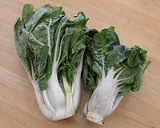
Chinese cabbage

 
Chinese Cabbage

   Email Print
   Bookmark   Link


Chinese cabbage


Chinese cabbage (Brassica rapa
Brassica rapa

Brassica rapa, commonly known as field mustard or turnip mustard is a plant widely cultivated as a leaf vegetable , a root vegetable, and an oilseed....
 subspecies, see below), also known as snow cabbage, is a Chinese
China

China is a Culture of China, an ancient civilization, and, depending on perspective, a national or multinational entity extending over a large area in East Asia....
 leaf vegetable
Leaf vegetable

Leaf vegetables, also called potherbs, greens, or leafy greens, are plant leaf eaten as a vegetable, sometimes accompanied by tender Petiole s and shoots....
 commonly used in Chinese cuisine
Chinese cuisine

Chinese cuisine originated from the various regions of China and has become widespread in many other parts of the world ? from Asia to the Americas, Australia, Western Europe and Southern Africa....
. The vegetable is related to the Western cabbage
Cabbage

The cabbage is a leafy garden plant of the Family Brassicaceae , used as a Leaf vegetable. It is a herbaceous, biennial plant, dicotyledonous flowering plant distinguished by a short stem upon which is crowded a mass of leaves, usually green but in some varieties red or purplish, forming a characteristic compact, globular cluster ....
, and is of the same species
Species

In biology, a species is one of the basic units of biological classification and a taxonomic rank. A species is often defined as a group of organisms capable of interbreeding and producing fertile offspring....
 as the common turnip. There are many variations on its name, spelling, and scientific classification
Scientific classification

Biological classification or scientific classification in biology, is a method by which biologists group and categorize species of organisms....
.

ese cabbage has been cultivated for over six thousand years in China
China

China is a Culture of China, an ancient civilization, and, depending on perspective, a national or multinational entity extending over a large area in East Asia....
. Brassica rapa seeds have been found in jars in the excavated New Stone Age settlement of Banpo
Banpo

Banpo is an archaeological site first discovered in 1953 and located in the Yellow River Valley just east of Xi'an, China. It contains the remains of several well organised Neolithic settlements dating from approximately 4500 BCE....
.


Discussion
Ask a question about 'Chinese cabbage'
Start a new discussion about 'Chinese cabbage'
Answer questions from other users
Full Discussion Forum


Recent Posts


Encyclopedia


Chinese cabbage (Brassica rapa
Brassica rapa

Brassica rapa, commonly known as field mustard or turnip mustard is a plant widely cultivated as a leaf vegetable , a root vegetable, and an oilseed....
 subspecies, see below), also known as snow cabbage, is a Chinese
China

China is a Culture of China, an ancient civilization, and, depending on perspective, a national or multinational entity extending over a large area in East Asia....
 leaf vegetable
Leaf vegetable

Leaf vegetables, also called potherbs, greens, or leafy greens, are plant leaf eaten as a vegetable, sometimes accompanied by tender Petiole s and shoots....
 commonly used in Chinese cuisine
Chinese cuisine

Chinese cuisine originated from the various regions of China and has become widespread in many other parts of the world ? from Asia to the Americas, Australia, Western Europe and Southern Africa....
. The vegetable is related to the Western cabbage
Cabbage

The cabbage is a leafy garden plant of the Family Brassicaceae , used as a Leaf vegetable. It is a herbaceous, biennial plant, dicotyledonous flowering plant distinguished by a short stem upon which is crowded a mass of leaves, usually green but in some varieties red or purplish, forming a characteristic compact, globular cluster ....
, and is of the same species
Species

In biology, a species is one of the basic units of biological classification and a taxonomic rank. A species is often defined as a group of organisms capable of interbreeding and producing fertile offspring....
 as the common turnip. There are many variations on its name, spelling, and scientific classification
Scientific classification

Biological classification or scientific classification in biology, is a method by which biologists group and categorize species of organisms....
.

History

Chinese cabbage has been cultivated for over six thousand years in China
China

China is a Culture of China, an ancient civilization, and, depending on perspective, a national or multinational entity extending over a large area in East Asia....
. Brassica rapa seeds have been found in jars in the excavated New Stone Age settlement of Banpo
Banpo

Banpo is an archaeological site first discovered in 1953 and located in the Yellow River Valley just east of Xi'an, China. It contains the remains of several well organised Neolithic settlements dating from approximately 4500 BCE....
. They were a common part of the diet in southern China by the 5th century.

The Ming Dynasty
Ming Dynasty

The Ming Dynasty , or Empire of the Great Ming , was the ruling Dynasties in Chinese history of China from 1368 to 1644, following the collapse of the Mongol-led Yuan Dynasty....
 pharmacologist Li Shizhen
Li Shizhen

Li Shizhen , courtesy name Dongbi , was one of the greatest physicians and pharmacologists in Chinese history. His major contribution to medicine was his forty-year work, which is found in his epic book the Bencao Gangmu....
 studied the Chinese cabbage for its medicinal qualities. Before this time the Chinese cabbage was largely confined to the Yangtze River Delta
Yangtze River Delta

The Yangtze River Delta or Yangtze Delta, also called Yangzi, or Chang Jiang Delta, Rive Chang Delta Lake Tai or the Golden Triangle of the Yangtze , generally comprises the triangular-shaped territory of Wu Chinese-speaking Shanghai, southern Jiangsu province and northern Zhejiang province of China....
 region. The Chinese cabbage as it is known today is very similar to a variant bred in Zhejiang
Zhejiang

Zhejiang is an eastern coastal province of China of the People's Republic of China. The word Zhejiang was the old name of the Qiantang River, which passes through Hangzhou, the provincial capital....
 around the 14th century. During the following centuries, it became popular in northern China and the northern harvest soon exceeded the southern one. Northern cabbages were exported along the Grand Canal
Grand Canal of China

The Grand Canal of China , also known as the Beijing-Hangzhou Grand Canal is the longest ancient canal or artificial river in the world....
 to Zhejiang
Zhejiang

Zhejiang is an eastern coastal province of China of the People's Republic of China. The word Zhejiang was the old name of the Qiantang River, which passes through Hangzhou, the provincial capital....
 and as far south as Guangdong
Guangdong

Guangdong is a political divisions of China on the southern coast of People's Republic of China. The province is also known by an alternative English language name, the Canton Province....
.

They were introduced to Korea
Korea

Korea is a geographic area composed of two sovereign countries, a civilization, and a former state situated on the Korean Peninsula in East Asia....
, where it became the staple vegetable for making kimchi
Kimchi

Kimchi, also spelled gimchi or kimchee, is a traditional Korean pickled dish made of vegetables with varied seasonings, most commonly referring to the spicy baechu variety....
. In the early 20th century, it was taken to Japan
Japan

Japan is an island country in East Asia. Located in the Pacific Ocean, it lies to the east of the Sea of Japan, People's Republic of China, North Korea, South Korea and Russia, stretching from the Sea of Okhotsk in the north to the East China Sea and Taiwan in the south....
 by returning soldiers who had fought in China
China

China is a Culture of China, an ancient civilization, and, depending on perspective, a national or multinational entity extending over a large area in East Asia....
 during the Russo-Japanese War
Russo-Japanese War

The Russo-Japanese War or the Manchurian Campaign in some English sources, was a conflict that grew out of the rival imperialism ambitions of the Russian Empire and the Empire of Japan over Manchuria and Korea....
. At present, the Chinese cabbage is quite commonly found in markets throughout the world.

Varieties

There are two distinctly different groups of Brassica rapa used as leaf vegetables in China, and a wide range of varieties within these two groups. The binomial name B. campestris is also used.

Pekinensis

This group is the more common of the two, especially outside Asia; names such as da baicai (lit. "large white vegetable"); Baguio pechay or pechay wombok (Tagalog
Tagalog language

Tagalog is one of the major languages used in the Philippines. It is a basis for the Filipino language, which is the principal language of the national television and radio, though broadsheet newspapers are almost completely in English....
); Chinese white cabbage; baechu (Korean), wongbok, nappa, or napa cabbage
Napa cabbage

Napa cabbage , from cantonese language , also called "wom bok", baechu in Korean language or hakusai in Japanese language, is a type of Chinese cabbage originating in China, near the Beijing region, and is widely used in East Asia....
; and hakusai usually refer to members of this group. Pekinensis cabbages have broad green leaves with white petiole
Petiole (botany)

In botany, the petiole is the small stalk attaching the leaf blade to the Plant stem. The petiole usually has the same internal structure as the stem....
s, tightly wrapped in a cylindrical formation and usually, but not necessarily, forming a compact head. As the group name indicates, this is particularly popular in northern China around Beijing
Beijing

is a metropolis in northern China and the Capital of the People's Republic of China. It is one of the four municipality of China, which are equivalent to province in China's Political divisions of China....
 (Peking).

Chinensis

This group was originally classified as its own species under the name B. chinensis by Linnaeus
Carolus Linnaeus

Carl Linnaeus was a Sweden botanist, physician, and zoologist, who laid the foundations for the modern scheme of binomial nomenclature. He is known as the father of modern alpha taxonomy, and is also considered one of the fathers of modern ecology....
. When used in English, the name bok choy (from Cantonese; also spelled pak choi) typically refers to Chinensis. Smaller in size, the Mandarin term xiao baicai ("small white vegetable") as well as the descriptive English names Chinese chard, Chinese mustard, celery mustard, and spoon cabbage are also employed. Chinensis varieties do not form heads; instead, they have smooth, dark green leaf blades forming a cluster reminiscent of mustard
Mustard plant

Mustards are several plant species in the genera Brassica and Sinapis whose small mustard seeds are used as a spice and, by grinding and mixing them with water, vinegar or other liquids, are turned into the condiment known as Mustard ....
 or celery
Celery

Apium graveolens is a plant species in the family Apiaceae commonly known as celery or celeriac depending on whether the petioles or roots are eaten....
. Chinensis varieties are popular in southern China and Southeast Asia
Southeast Asia

Southeast Asia or Southeastern Asia is a subregion of Asia, consisting of the countries that are geographically south of China, east of India and north of Australia....
. Being winter-hardy, they are increasingly grown in Northern Europe.

Commercial variants of Chinensis include:
  • Bok Choy; succulent, white stems with dark green leaves and Baby Bok Choy; succulent, pale green stems with leaves the same color; both quite common in US West Coast oriental markets.
  • Choy Sum (; Hokkien chai sim): also called yu cai , this brassica refers to a small, delicate version of pak choi. In appearance it is more similar to rapini
    Rapini

    Rapini is a common vegetable in Galician cuisine, Chinese cuisine, Italian cuisine, and Portuguese cuisine cuisine. The plant is a member of the Brassiceae tribe of the Brassicaceae, whose taxonomy is very difficult....
     or broccoli rabe, than the typical pak choi. In English, it can also be called "Flowering Chinese Cabbbage" due to the yellow flowers that comes with this particular vegetable. "Choy sum" is sometimes used to describe the stem of any Chinese cabbage or the heart of Shanghai pak choi.
  • Shanghai Pak Choi (; ) refers to dark green varieties where the varioles are also green. It is probably the most common vegetable in Shanghai, where it is simply called qingcai (??; literally "blue/green vegetable") or qingjiangcai (???; literally "blue/green river vegetable").


Nomenclature

In Mandarin Chinese bai cai (??, or "white vegetable") refers to both groups of B. rapa. However, the English word bok choy and its variations bok choi and pak choi are derived from the Cantonese cognate
Cognate

Cognates in linguistics are words that have a common etymology origin.An example of cognates within the same language would be English shirt vs....
, which instead denotes one specific variety of cabbage, namely those with white stems and dark green leaves. The other varieties all have different names which entered the English language
English language

English is a West Germanic language that originated in Anglo-Saxon England and has lingua franca status in many parts of the world as a result of the military, economic, scientific, political and cultural influence of the British Empire in the 18th, 19th and early 20th centuries and that of the United States from the mid 20th century onwa...
 as you choy, choy sum, napa (from ???, Cantonese name for ???? or ??) and baby bok choy, etc. Hence the English word bok choy (and its Cantonese source) is not equivalent to the Mandarin word bai cai, though the Chinese characters are the same.

See also

  • Kai-lan
    Kai-lan

    Kai-lan, also known as Chinese broccoli or Chinese kale, is a slightly bitter leaf vegetable featuring thick, flat, glossy blue-green leaves with thick stems and a small number of tiny, almost vestigial flower heads similar to those of broccoli....
     (Chinese broccoli)
  • Kimchi
    Kimchi

    Kimchi, also spelled gimchi or kimchee, is a traditional Korean pickled dish made of vegetables with varied seasonings, most commonly referring to the spicy baechu variety....


Gallery


External links