

Esophageal cancer

Encyclopedia
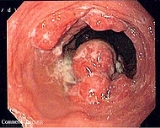
Esophageal cancer is malignancy
of the esophagus
. There are various subtypes, primarily squamous cell cancer (approx 90-95% of all esophageal cancer worldwide) and adenocarcinoma
(approx. 50-80% of all esophageal cancer in the United States). Squamous cell cancer arises from the cells that line the upper part of the esophagus. Adenocarcinoma arises from glandular cells that are present at the junction of the esophagus and stomach.
Esophageal tumors usually lead to dysphagia
(difficulty swallowing
), pain and other symptoms, and are diagnosed with biopsy
. Small and localized tumors are treated surgically
with curative
intent. Larger tumors tend not to be operable and hence are treated with palliative care
; their growth can still be delayed with chemotherapy
, radiotherapy
or a combination of the two. In some cases chemo- and radiotherapy can render these larger tumors operable. Prognosis depends on the extent of the disease and other medical problems, but is fairly poor.
s which arise from the epithelium
, or surface lining, of the esophagus. Most esophageal cancers fall into one of two classes: squamous cell carcinoma
s, which are similar to head and neck cancer
in their appearance and association with tobacco
and alcohol
consumption, and adenocarcinoma
s, which are often associated with a history of gastroesophageal reflux disease
and Barrett's esophagus
. A general rule of thumb is that a cancer in the upper two-thirds is a squamous cell carcinoma and one in the lower one-third is a adenocarcinoma. Rare histologic types of esophageal cancer are different variants of the squamous cell carcinoma, and non-epithelial tumors, such as leiomyosarcoma
, malignant melanoma, rhabdomyosarcoma
, lymphoma
and others.
(difficulty swallowing) and odynophagia
(painful swallowing) are the most common symptoms of esophageal cancer. Dysphagia
is the first symptom in most patients. Odynophagia may also be present. Fluids and soft foods are usually tolerated, while hard or bulky substances (such as bread or meat) cause much more difficulty. Substantial weight loss is characteristic as a result of reduced appetite and poor nutrition and the active cancer. Pain behind the sternum
or in the epigastrium
, often of a burning, heartburn-like nature, may be severe, present itself almost daily, and is worsened by swallowing any form of food. Another sign may be an unusually husky, raspy, or hoarse sounding cough
, a result of the tumor affecting the recurrent laryngeal nerve
.
The presence of the tumor may disrupt normal peristalsis
(the organized swallowing reflex), leading to nausea
and vomiting
, regurgitation
of food, cough
ing and an increased risk of aspiration pneumonia
. The tumor surface may be fragile and bleed, causing hematemesis
(vomiting up blood). Compression of local structures occurs in advanced disease, leading to such problems as upper airway obstruction
and superior vena cava syndrome
. Fistula
s may develop between the esophagus and the trachea
, increasing the pneumonia risk; this condition is usually heralded by cough
, fever
or aspiration.
Most of the people diagnosed with esophageal cancer have late-stage disease. This is because people usually do not have significant symptoms until half of the inside of the esophagus, called the lumen, is obstructed, by which point the tumor is fairly large.
If the disease has spread
elsewhere, this may lead to symptoms related to this: liver
metastasis
could cause jaundice
and ascites
, lung
metastasis could cause shortness of breath
, pleural effusion
s, etc.
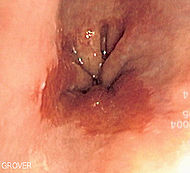 There are a number of risk factors for esophageal cancer. Some subtypes of cancer are linked to particular risk factors:
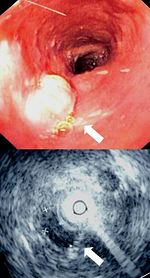
or barium meal
, the diagnosis is best made with esophagogastroduodenoscopy
(EGD, endoscopy
); this involves the passing of a flexible tube down the esophagus and visualizing the wall. Biopsies
taken of suspicious lesions are then examined histologically
for signs of malignancy.
Additional testing is usually performed to estimate the tumor stage. Computed tomography
(CT) of the chest, abdomen and pelvis, can evaluate whether the cancer has spread to adjacent tissues or distant organs (especially liver
and lymph node
s). The sensitivity of CT scan is limited by its ability to detect masses (e.g. enlarged lymph nodes or involved organs) generally larger than 1 cm. FDG-PET (positron emission tomography) scan is also being used to estimate whether enlarged masses are metabolically active, indicating faster-growing cells that might be expected in cancer. Esophageal endoscopic ultrasound
(EUS) can provide staging information regarding the level of tumor invasion, and possible spread to regional lymph nodes.
The location of the tumor is generally measured by the distance from the teeth. The esophagus (25 cm or 10 inches long) is commonly divided into three parts for purposes of determining the location. Adenocarcinomas tend to occur distally and squamous cell carcinomas proximally, but the converse may also be the case.
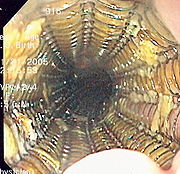
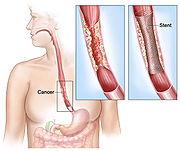 The treatment is determined by the cellular type of cancer (adenocarcinoma or squamous cell carcinoma vs other types), the stage of the disease, the general condition of the patient and other diseases present. On the whole, adequate nutrition
needs to be assured, and adequate dental care is vital.
If the patient cannot swallow at all, an esophageal stent
may be inserted to keep the esophagus patent; stent
s may also assist in occluding fistulas. A nasogastric tube may be necessary to continue feeding while treatment for the tumor is given, and some patients require a gastrostomy
(feeding hole in the skin that gives direct access to the stomach). The latter two are especially important if the patient tends to aspirate food or saliva into the airways, predisposing for aspiration pneumonia
.
Esophagectomy
is the removal of a segment of the esophagus; as this shortens the length of the remaining esophagus, some other segment of the digestive tract (typically the stomach
or part of the Colon or jejunum]) is pulled up to the chest cavity and interposed. If the tumor is unresectable or the patient is not fit for surgery, palliative esophageal stent
ing can allow the patient to tolerate soft diet.
Types of esophagectomy:
Endoscopic Therapy for Localized Disease There is accumulating data that endoscopic therapy is a safe, less invasive, and effective therapy for very early esophageal cancer. The candidates for endoscopic therapy are Stage 1 patients with tumors invading into the lamina propria (T1 mucosal) or submucosa (T1 submucosal) that do not have regional or distant metastasis. Patients with carcinoma in-situ or high-grade dysplasia can also be treated with endoscopic therapy. Submucosa cancers with increased risk of nodal metastases may not be as amenable to curative therapy.
The two forms of endoscopic therapy that have been used for Stage 0 and I disease are endoscopic mucosal resection (EMR) and mucosal ablation using photodynamic therapy , Nd-YAG laser, or argon plasma coagulation.
Endoscopic mucosal resection has been advocated for early cancers (that is, those that are superficial and confined to the mucosa only) and has been shown to be a less invasive, safe, and highly effective nonsurgical therapy for early squamous cell esophageal cancer. Preliminary reports also suggest its safety and efficacy for early adenocarcinoma arising in Barrett’s esophagus. The prognosis after treatment with endoscopic mucosal resection is comparable to surgical resection. This technique can be attempted in patients, without evidence of nodal or distant metastases, with differentiated tumors that are slightly raised and less than 2 cm in diameter, or in differentiated tumors that are ulcerated and less than 1 cm in diameter. The most commonly employed modalities of endoscopic mucosal resection include strip biopsy, double-snare polypectomy, resection with combined use of highly concentrated saline and epinephrine, and resection using a cap.
The strip biopsy method for endoscopic mucosal resection of esophageal cancer is performed with a double-channel endoscope equipped with grasping forceps and snare. After marking the lesion border with an electric coagulator, saline is injected into the submucosa below the lesion to separate the lesion from the muscle layer and to force its protrusion. The grasping forceps are passed through the snare loop. The mucosa surrounding the lesion is grasped, lifted, and strangulated and resected by electrocautery.
The endoscopic double-snare polypectomy method is indicated for protruding lesions. Using a double-channel scope, the lesion is grasped and lifted by the first snare and strangulated with the second snare for complete resection.
Endoscopic resection with injection of concentrated saline and epinephrine is carried out using a double-channel scope. The lesion borders are marked with a coagulator. Highly concentrated saline and epinephrine are injected (15–20 ml) into the submucosal layer to swell the area containing the lesion and elucidate the markings. The mucosa outside the demarcated border is excised using a high-frequency scalpel to the depth of the submucosal layer. The resected mucosa is lifted and grasped with forceps, trapping and strangulating the lesion with a snare, and then resected by electrocautery.
A fourth method of endoscopic mucosal resection employs the use of a clear cap and prelooped snare inside the cap. After insertion, the cap is placed on the lesion and the mucosa containing the lesion is drawn up inside the cap by aspiration. The mucosa is caught by the snare and strangulated, and finally resected by electrocautery. This is called the "band and snare" or "suck and cut" technique. The resected specimen is retrieved and submitted for microscopic examination for determination of tumor invasion depth, resection margin, and possible vascular involvement. The resulting "ulcer" heals within 3 weeks.
Although most lesions treated in the esophagus have been early squamous cell cancers, endoscopic snare resection can also be used to debulk or completely treat polypoid dysplastic or malignant lesions in Barrett’s esophagus. In a preliminary report from Germany, EMR was performed as primary treatment or adjunctive therapy following photodynamic therapy for early adenocarcinomas in Barrett's esophagus. The "suck and cut" technique (with and without prior saline injection) was used as well as the "band and cut" technique. Although all tumors were resected without difficulty, 12.5% developed bleeding (which was managed successfully by endoscopic therapy). Eighty-one percent of the lesions were completely resected. The other lesions were also treated with other endoscopic techniques. While this report suggests it is feasible to completely resect local, circumscribed, early adenocarcinomas arising in Barrett's esophagus, the relative safety and efficacy of EMR in conjunction with photodynamic therapy is unknown.
The major complications of endoscopic mucosal resection include postoperative bleeding and perforation and stricture formation. During the procedure, an injection of 100,000 times diluted epinephrine into the muscular wall, along with high frequency coagulation or clipping can be applied to the bleeding point for hemostasis. It is important to administer acid-reducing medications to prevent postoperative hemorrhage. Perforation may be prevented with sufficient saline injection to raise the mucosa containing the lesion. The "non-lifting sign" and complaints of pain when the snare strangulates the lesion are contrainidications of EMR. When perforation is recognized immediately after a procedure, the perforation should be closed by clips. Surgery should be considered in cases of endoscopic closure failure. The incidence of complication range from 0–50% and squamous cell recurrence rates range from 0–8%.
Laser
therapy is the use of high-intensity light to destroy tumor cells; it affects only the treated area. This is typically done if the cancer cannot be removed by surgery. The relief of a blockage can help to reduce dysphagia and pain. Photodynamic therapy
(PDT), a type of laser therapy, involves the use of drugs that are absorbed by cancer cells; when exposed to a special light, the drugs become active and destroy the cancer cells.
Chemotherapy
depends on the tumor type, but tends to be cisplatin
-based (or carboplatin
or oxaliplatin
) every three weeks with fluorouracil
(5-FU) either continuously or every three weeks. In more recent studies, addition of epirubicin
(ECF) was better than other comparable regimens in advanced nonresectable cancer. Chemotherapy may be given after surgery (adjuvant, i.e. to reduce risk of recurrence), before surgery (neoadjuvant) or if surgery is not possible; in this case, cisplatin and 5-FU are used. Ongoing trials compare various combinations of chemotherapy; the phase II/III REAL-2 trial – for example – compares four regimens containing epirubicin
and either cisplatin
or oxaliplatin
and either continuously infused fluorouracil or capecitabine.
Radiotherapy is given before, during or after chemotherapy or surgery, and sometimes on its own to control symptoms. In patients with localised disease but contraindications to surgery, "radical radiotherapy" may be used with curative intent.
(5YSR) is approximately 15%, with most patients dying within the first year of diagnosis.
Individualized prognosis depends largely on stage. Those with cancer restricted entirely to the esophageal mucosa have about an 80% 5YSR, but submucosa
l involvement brings this down to less than 50%. Extension into the muscularis propria (muscular layer of the esophageus) has meant a 20% 5YSR and extension to the structures adjacent to the esophagus results in a 7% 5YSR. Patients with distant metastases (who are not candidates for curative surgery) have a less than 3% 5YSR. .
, China
, Iran
, Iceland
, India
, Japan
, the United Kingdom
, appear to have a higher incidence, as well as the region around the Caspian Sea
. The American Cancer Society
estimates that during 2007, approximately 15,560 new esophageal cancer cases will be diagnosed in the United States.
In the United States
, squamous cell carcinoma of the esophagus usually affects African-American males with a history of heavy smoking or alcohol use. Up until the 1970s, squamous cell carcinoma made up the vast majority of esophageal cancer in the United States. In recent decades, incidence of adenocarcinoma of the esophagus (which is associated with Barrett's esophagus) steadily rose in the United States to the point that it has now surpassed squamous cell carcinoma in this country. In contrast to squamous cell carcinoma, esophageal adenocarcinoma is more common in Caucasian
men (over the age of 60) than it is in African-Americans. Multiple reports indicate that esophageal adenocarcinoma incidence has increased during the past 20 years, especially in non-Hispanic white men. Esophageal adenocarcinoma age-adjusted incidence increased in New Mexico
from 1973 to 1997. This increase was found in non-Hispanic whites and Hispanics and became predominant in non-Hispanic whites.
Esophageal cancer incidence and mortality rates for African-Americans continue to be higher than the rate for Causasians. However incidence and mortality of esophageal cancer has significantly decreased among African-Americans since the early 1980s whereas with Caucasians it has slightly increased.
Cancer
Cancer , known medically as a malignant neoplasm, is a large group of different diseases, all involving unregulated cell growth. In cancer, cells divide and grow uncontrollably, forming malignant tumors, and invade nearby parts of the body. The cancer may also spread to more distant parts of the...
of the esophagus
Esophagus
The esophagus is an organ in vertebrates which consists of a muscular tube through which food passes from the pharynx to the stomach. During swallowing, food passes from the mouth through the pharynx into the esophagus and travels via peristalsis to the stomach...
. There are various subtypes, primarily squamous cell cancer (approx 90-95% of all esophageal cancer worldwide) and adenocarcinoma
Adenocarcinoma
Adenocarcinoma is a cancer of an epithelium that originates in glandular tissue. Epithelial tissue includes, but is not limited to, the surface layer of skin, glands and a variety of other tissue that lines the cavities and organs of the body. Epithelium can be derived embryologically from...
(approx. 50-80% of all esophageal cancer in the United States). Squamous cell cancer arises from the cells that line the upper part of the esophagus. Adenocarcinoma arises from glandular cells that are present at the junction of the esophagus and stomach.
Esophageal tumors usually lead to dysphagia
Dysphagia
Dysphagia is the medical term for the symptom of difficulty in swallowing. Although classified under "symptoms and signs" in ICD-10, the term is sometimes used as a condition in its own right. Sufferers are sometimes unaware of their dysphagia....
(difficulty swallowing
Swallowing
Swallowing, known scientifically as deglutition, is the process in the human or animal body that makes something pass from the mouth, to the pharynx, and into the esophagus, while shutting the epiglottis. If this fails and the object goes through the trachea, then choking or pulmonary aspiration...
), pain and other symptoms, and are diagnosed with biopsy
Biopsy
A biopsy is a medical test involving sampling of cells or tissues for examination. It is the medical removal of tissue from a living subject to determine the presence or extent of a disease. The tissue is generally examined under a microscope by a pathologist, and can also be analyzed chemically...
. Small and localized tumors are treated surgically
Surgery
Surgery is an ancient medical specialty that uses operative manual and instrumental techniques on a patient to investigate and/or treat a pathological condition such as disease or injury, or to help improve bodily function or appearance.An act of performing surgery may be called a surgical...
with curative
Curative care
Curative care or curative medicine is the kind of health care traditionally oriented towards seeking a cure for an existent disease or medical condition...
intent. Larger tumors tend not to be operable and hence are treated with palliative care
Palliative care
Palliative care is a specialized area of healthcare that focuses on relieving and preventing the suffering of patients...
; their growth can still be delayed with chemotherapy
Chemotherapy
Chemotherapy is the treatment of cancer with an antineoplastic drug or with a combination of such drugs into a standardized treatment regimen....
, radiotherapy
Radiation therapy
Radiation therapy , radiation oncology, or radiotherapy , sometimes abbreviated to XRT or DXT, is the medical use of ionizing radiation, generally as part of cancer treatment to control malignant cells.Radiation therapy is commonly applied to the cancerous tumor because of its ability to control...
or a combination of the two. In some cases chemo- and radiotherapy can render these larger tumors operable. Prognosis depends on the extent of the disease and other medical problems, but is fairly poor.
Classification
Esophageal cancers are typically carcinomaCarcinoma
Carcinoma is the medical term for the most common type of cancer occurring in humans. Put simply, a carcinoma is a cancer that begins in a tissue that lines the inner or outer surfaces of the body, and that generally arises from cells originating in the endodermal or ectodermal germ layer during...
s which arise from the epithelium
Epithelium
Epithelium is one of the four basic types of animal tissue, along with connective tissue, muscle tissue and nervous tissue. Epithelial tissues line the cavities and surfaces of structures throughout the body, and also form many glands. Functions of epithelial cells include secretion, selective...
, or surface lining, of the esophagus. Most esophageal cancers fall into one of two classes: squamous cell carcinoma
Squamous cell carcinoma
Squamous cell carcinoma , occasionally rendered as "squamous-cell carcinoma", is a histologically distinct form of cancer. It arises from the uncontrolled multiplication of malignant cells deriving from epithelium, or showing particular cytological or tissue architectural characteristics of...
s, which are similar to head and neck cancer
Head and neck cancer
Head and neck cancer refers to a group of biologically similar cancers that start in the upper aerodigestive tract, including the lip, oral cavity , nasal cavity , paranasal sinuses, pharynx, and larynx. 90% of head and neck cancers are squamous cell carcinomas , originating from the mucosal lining...
in their appearance and association with tobacco
Tobacco
Tobacco is an agricultural product processed from the leaves of plants in the genus Nicotiana. It can be consumed, used as a pesticide and, in the form of nicotine tartrate, used in some medicines...
and alcohol
Alcohol
In chemistry, an alcohol is an organic compound in which the hydroxy functional group is bound to a carbon atom. In particular, this carbon center should be saturated, having single bonds to three other atoms....
consumption, and adenocarcinoma
Adenocarcinoma
Adenocarcinoma is a cancer of an epithelium that originates in glandular tissue. Epithelial tissue includes, but is not limited to, the surface layer of skin, glands and a variety of other tissue that lines the cavities and organs of the body. Epithelium can be derived embryologically from...
s, which are often associated with a history of gastroesophageal reflux disease
Gastroesophageal reflux disease
Gastroesophageal reflux disease , gastro-oesophageal reflux disease , gastric reflux disease, or acid reflux disease is chronic symptoms or mucosal damage caused by stomach acid coming up from the stomach into the esophagus...
and Barrett's esophagus
Barrett's esophagus
Barrett's esophagus refers to an abnormal change in the cells of the inferior portion of the esophagus. A positive diagnosis generally requires observing specific macroscopic and microscopic changes...
. A general rule of thumb is that a cancer in the upper two-thirds is a squamous cell carcinoma and one in the lower one-third is a adenocarcinoma. Rare histologic types of esophageal cancer are different variants of the squamous cell carcinoma, and non-epithelial tumors, such as leiomyosarcoma
Leiomyosarcoma
Leiomyosarcoma , aka LMS, is a malignant cancer of smooth muscle....
, malignant melanoma, rhabdomyosarcoma
Rhabdomyosarcoma
A rhabdomyosarcoma is a type of cancer, specifically a sarcoma , in which the cancer cells are thought to arise from skeletal muscle progenitors. It can also be found attached to muscle tissue, wrapped around intestines, or in any anatomic location...
, lymphoma
Lymphoma
Lymphoma is a cancer in the lymphatic cells of the immune system. Typically, lymphomas present as a solid tumor of lymphoid cells. Treatment might involve chemotherapy and in some cases radiotherapy and/or bone marrow transplantation, and can be curable depending on the histology, type, and stage...
and others.
Signs and symptoms
DysphagiaDysphagia
Dysphagia is the medical term for the symptom of difficulty in swallowing. Although classified under "symptoms and signs" in ICD-10, the term is sometimes used as a condition in its own right. Sufferers are sometimes unaware of their dysphagia....
(difficulty swallowing) and odynophagia
Odynophagia
Odynophagia is painful swallowing, in the mouth or esophagus. It can occur with or without dysphagia, or difficult swallowing....
(painful swallowing) are the most common symptoms of esophageal cancer. Dysphagia
Dysphagia
Dysphagia is the medical term for the symptom of difficulty in swallowing. Although classified under "symptoms and signs" in ICD-10, the term is sometimes used as a condition in its own right. Sufferers are sometimes unaware of their dysphagia....
is the first symptom in most patients. Odynophagia may also be present. Fluids and soft foods are usually tolerated, while hard or bulky substances (such as bread or meat) cause much more difficulty. Substantial weight loss is characteristic as a result of reduced appetite and poor nutrition and the active cancer. Pain behind the sternum
Sternum
The sternum or breastbone is a long flat bony plate shaped like a capital "T" located anteriorly to the heart in the center of the thorax...
or in the epigastrium
Epigastrium
The epigastrium is the upper central region of the abdomen. It is located between the costal margins and the subcostal plane....
, often of a burning, heartburn-like nature, may be severe, present itself almost daily, and is worsened by swallowing any form of food. Another sign may be an unusually husky, raspy, or hoarse sounding cough
Cough
A cough is a sudden and often repetitively occurring reflex which helps to clear the large breathing passages from secretions, irritants, foreign particles and microbes...
, a result of the tumor affecting the recurrent laryngeal nerve
Recurrent laryngeal nerve
The recurrent laryngeal nerve is a branch of the vagus nerve that supplies motor function and sensation to the larynx . It travels within the endoneurium...
.
The presence of the tumor may disrupt normal peristalsis
Peristalsis
Peristalsis is a radially symmetrical contraction and relaxation of muscles which propagates in a wave down the muscular tube, in an anterograde fashion. In humans, peristalsis is found in the contraction of smooth muscles to propel contents through the digestive tract. Earthworms use a similar...
(the organized swallowing reflex), leading to nausea
Nausea
Nausea , is a sensation of unease and discomfort in the upper stomach with an involuntary urge to vomit. It often, but not always, precedes vomiting...
and vomiting
Vomiting
Vomiting is the forceful expulsion of the contents of one's stomach through the mouth and sometimes the nose...
, regurgitation
Regurgitation (digestion)
Regurgitation is the expulsion of material from the mouth, pharynx, or esophagus, usually characterized by the presence of undigested food or blood.Regurgitation is used by a number of species to feed their young...
of food, cough
Cough
A cough is a sudden and often repetitively occurring reflex which helps to clear the large breathing passages from secretions, irritants, foreign particles and microbes...
ing and an increased risk of aspiration pneumonia
Aspiration pneumonia
Aspiration pneumonia is bronchopneumonia that develops due to the entrance of foreign materials into the bronchial tree, usually oral or gastric contents...
. The tumor surface may be fragile and bleed, causing hematemesis
Hematemesis
Hematemesis or haematemesis is the vomiting of blood. The source is generally the upper gastrointestinal tract. Patients can easily confuse it with hemoptysis , although the latter is more common.-Signs:...
(vomiting up blood). Compression of local structures occurs in advanced disease, leading to such problems as upper airway obstruction
Stridor
Stridor is a high pitched wheezing sound resulting from turbulent air flow in the upper airway. Stridor is a physical sign which is produced by narrow or obstructed airway path. It can be inspiratory, expiratory or biphasic . Inspiratory stridor is common...
and superior vena cava syndrome
Superior vena cava syndrome
Superior vena cava syndrome , or superior vena cava obstruction , is usually the result of the direct obstruction of the superior vena cava by malignancies such as compression of the vessel wall by right upper lobe tumors or thymoma and/or mediastinal lymphadenopathy. The most common malignancies...
. Fistula
Fistula
In medicine, a fistula is an abnormal connection or passageway between two epithelium-lined organs or vessels that normally do not connect. It is generally a disease condition, but a fistula may be surgically created for therapeutic reasons.-Locations:Fistulas can develop in various parts of the...
s may develop between the esophagus and the trachea
Vertebrate trachea
In tetrapod anatomy the trachea, or windpipe, is a tube that connects the pharynx or larynx to the lungs, allowing the passage of air. It is lined with pseudostratified ciliated columnar epithelium cells with goblet cells that produce mucus...
, increasing the pneumonia risk; this condition is usually heralded by cough
Cough
A cough is a sudden and often repetitively occurring reflex which helps to clear the large breathing passages from secretions, irritants, foreign particles and microbes...
, fever
Fever
Fever is a common medical sign characterized by an elevation of temperature above the normal range of due to an increase in the body temperature regulatory set-point. This increase in set-point triggers increased muscle tone and shivering.As a person's temperature increases, there is, in...
or aspiration.
Most of the people diagnosed with esophageal cancer have late-stage disease. This is because people usually do not have significant symptoms until half of the inside of the esophagus, called the lumen, is obstructed, by which point the tumor is fairly large.
If the disease has spread
Metastasis
Metastasis, or metastatic disease , is the spread of a disease from one organ or part to another non-adjacent organ or part. It was previously thought that only malignant tumor cells and infections have the capacity to metastasize; however, this is being reconsidered due to new research...
elsewhere, this may lead to symptoms related to this: liver
Liver
The liver is a vital organ present in vertebrates and some other animals. It has a wide range of functions, including detoxification, protein synthesis, and production of biochemicals necessary for digestion...
metastasis
Metastasis
Metastasis, or metastatic disease , is the spread of a disease from one organ or part to another non-adjacent organ or part. It was previously thought that only malignant tumor cells and infections have the capacity to metastasize; however, this is being reconsidered due to new research...
could cause jaundice
Jaundice
Jaundice is a yellowish pigmentation of the skin, the conjunctival membranes over the sclerae , and other mucous membranes caused by hyperbilirubinemia . This hyperbilirubinemia subsequently causes increased levels of bilirubin in the extracellular fluid...
and ascites
Ascites
Ascites is a gastroenterological term for an accumulation of fluid in the peritoneal cavity.The medical condition is also known as peritoneal cavity fluid, peritoneal fluid excess, hydroperitoneum or more archaically as abdominal dropsy. Although most commonly due to cirrhosis and severe liver...
, lung
Lung
The lung is the essential respiration organ in many air-breathing animals, including most tetrapods, a few fish and a few snails. In mammals and the more complex life forms, the two lungs are located near the backbone on either side of the heart...
metastasis could cause shortness of breath
Dyspnea
Dyspnea , shortness of breath , or air hunger, is the subjective symptom of breathlessness.It is a normal symptom of heavy exertion but becomes pathological if it occurs in unexpected situations...
, pleural effusion
Pleural effusion
Pleural effusion is excess fluid that accumulates between the two pleural layers, the fluid-filled space that surrounds the lungs. Excessive amounts of such fluid can impair breathing by limiting the expansion of the lungs during ventilation.-Pathophysiology:...
s, etc.
Increased risk
- Age. Most patients are over 60, and the median in US patients is 67.
- Sex. It is more common in men.
- HeredityHeredityHeredity is the passing of traits to offspring . This is the process by which an offspring cell or organism acquires or becomes predisposed to the characteristics of its parent cell or organism. Through heredity, variations exhibited by individuals can accumulate and cause some species to evolve...
. It is more likely in people who have close relatives with cancer. - Tobacco smokingTobacco smokingTobacco smoking is the practice where tobacco is burned and the resulting smoke is inhaled. The practice may have begun as early as 5000–3000 BCE. Tobacco was introduced to Eurasia in the late 16th century where it followed common trade routes...
and heavy alcoholAlcoholic beverageAn alcoholic beverage is a drink containing ethanol, commonly known as alcohol. Alcoholic beverages are divided into three general classes: beers, wines, and spirits. They are legally consumed in most countries, and over 100 countries have laws regulating their production, sale, and consumption...
use increase the risk, and together appear to increase the risk more than either individually. Tobacco and/or alcohol account for approximately 90% of all esophageal squamous cell carcinomaSquamous cell carcinomaSquamous cell carcinoma , occasionally rendered as "squamous-cell carcinoma", is a histologically distinct form of cancer. It arises from the uncontrolled multiplication of malignant cells deriving from epithelium, or showing particular cytological or tissue architectural characteristics of...
s. Tobacco smoking is also linked to esophageal adenocarcinomaAdenocarcinomaAdenocarcinoma is a cancer of an epithelium that originates in glandular tissue. Epithelial tissue includes, but is not limited to, the surface layer of skin, glands and a variety of other tissue that lines the cavities and organs of the body. Epithelium can be derived embryologically from...
though no scientific evidence has been found between alcohol and esophageal adenocarcinoma. - Gastroesophageal reflux diseaseGastroesophageal reflux diseaseGastroesophageal reflux disease , gastro-oesophageal reflux disease , gastric reflux disease, or acid reflux disease is chronic symptoms or mucosal damage caused by stomach acid coming up from the stomach into the esophagus...
(GERD) and its resultant Barrett's esophagusBarrett's esophagusBarrett's esophagus refers to an abnormal change in the cells of the inferior portion of the esophagus. A positive diagnosis generally requires observing specific macroscopic and microscopic changes...
increase esophageal cancer risk due to the chronic irritation of the mucosal lining. Adenocarcinoma is more common in this condition. - Human papillomavirus (HPV)
- Corrosive injury to esophagus by swallowing strong alkalines (lyeLyeLye is a corrosive alkaline substance, commonly sodium hydroxide or historically potassium hydroxide . Previously, lye was among the many different alkalis leached from hardwood ashes...
) or acids. - Particular dietary substances, such as nitrosamineNitrosamineNitrosamines are chemical compounds of the chemical structure R1N-N=O, some of which are carcinogenic.-Usages:Nitrosamines are used in manufacture of some cosmetics, pesticides, and in most rubber products. -Occurrences:...
. - A medical history of other head and neck cancers increases the chance of developing a second cancer in the head and neck area, including esophageal cancer.
- Plummer-Vinson syndromePlummer-Vinson syndromePlummer–Vinson syndrome , also called Paterson–Brown–Kelly syndrome or sideropenic dysphagia presents as a triad of dysphagia , glossitis, and iron deficiency anemia...
(anemia and esophageal webbing) - TylosisDiffuse nonepidermolytic palmoplantar keratodermaDiffuse nonepidermolytic palmoplantar keratoderma is inherited as an autosomal dominant condition and is present from infancy, characterized by...
and Howel-Evans syndrome (hereditary thickening of the skin of the palms and soles). - Radiation therapyRadiation therapyRadiation therapy , radiation oncology, or radiotherapy , sometimes abbreviated to XRT or DXT, is the medical use of ionizing radiation, generally as part of cancer treatment to control malignant cells.Radiation therapy is commonly applied to the cancerous tumor because of its ability to control...
for other conditions in the mediastinumMediastinumThe mediastinum is a non-delineated group of structures in the thorax, surrounded by loose connective tissue. It is the central compartment of the thoracic cavity...
. - Coeliac diseaseCoeliac diseaseCoeliac disease , is an autoimmune disorder of the small intestine that occurs in genetically predisposed people of all ages from middle infancy onward...
predisposes towards squamous cell carcinoma. - ObesityObesityObesity is a medical condition in which excess body fat has accumulated to the extent that it may have an adverse effect on health, leading to reduced life expectancy and/or increased health problems...
increases the risk of adenocarcinoma fourfold. It is suspected that increased risk of reflux may be behind this association. - Thermal injury as a result of drinking hot beverages
- Alcohol consumption in individuals predisposed to alcohol flush reactionAlcohol flush reactionAlcohol flush reaction or Oriental Flushing Syndrome is a condition in which the face and/or body experiences flushes or blotches, due to an accumulation of acetaldehyde...
- AchalasiaAchalasiaAchalasia , also known as esophageal achalasia, achalasia cardiae, cardiospasm, and esophageal aperistalsis, is an esophageal motility disorder involving the smooth muscle layer of the esophagus and the lower esophageal sphincter...
Decreased risk
- Risk appears to be less in patients using aspirinAspirinAspirin , also known as acetylsalicylic acid , is a salicylate drug, often used as an analgesic to relieve minor aches and pains, as an antipyretic to reduce fever, and as an anti-inflammatory medication. It was discovered by Arthur Eichengrun, a chemist with the German company Bayer...
or related drugs (NSAIDs). - The role of Helicobacter pyloriHelicobacter pyloriHelicobacter pylori , previously named Campylobacter pyloridis, is a Gram-negative, microaerophilic bacterium found in the stomach. It was identified in 1982 by Barry Marshall and Robin Warren, who found that it was present in patients with chronic gastritis and gastric ulcers, conditions that were...
in progression to esophageal adenocarcinoma is still uncertain, but, on the basis of population data, it may carry a protective effect. It is postulated that H. pyloriHelicobacter pyloriHelicobacter pylori , previously named Campylobacter pyloridis, is a Gram-negative, microaerophilic bacterium found in the stomach. It was identified in 1982 by Barry Marshall and Robin Warren, who found that it was present in patients with chronic gastritis and gastric ulcers, conditions that were...
induces chronic gastritisGastritisGastritis is an inflammation of the lining of the stomach, and has many possible causes. The main acute causes are excessive alcohol consumption or prolonged use of nonsteroidal anti-inflammatory drugs such as aspirin or ibuprofen. Sometimes gastritis develops after major surgery, traumatic...
, which is a risk factor for refluxGastroesophageal reflux diseaseGastroesophageal reflux disease , gastro-oesophageal reflux disease , gastric reflux disease, or acid reflux disease is chronic symptoms or mucosal damage caused by stomach acid coming up from the stomach into the esophagus...
, which in turn is a risk factor for esophageal adenocarcinoma. - According to the National Cancer InstituteNational Cancer InstituteThe National Cancer Institute is part of the National Institutes of Health , which is one of 11 agencies that are part of the U.S. Department of Health and Human Services. The NCI coordinates the U.S...
, "diets high in cruciferous (cabbage, broccoli/broccolini, cauliflower, Brussels sprouts) and green and yellow vegetables and fruits are associated with a decreased risk of esophageal cancer." - Moderate coffeeCoffeeCoffee is a brewed beverage with a dark,init brooo acidic flavor prepared from the roasted seeds of the coffee plant, colloquially called coffee beans. The beans are found in coffee cherries, which grow on trees cultivated in over 70 countries, primarily in equatorial Latin America, Southeast Asia,...
consumption is associated with a decreased risk. - According to one Italian study of "diet surveys completed by 5,500 Italians"—a study which has raised debates questioning its claims among cancer researchers cited in news reports about it—eating pizzaPizzaPizza is an oven-baked, flat, disc-shaped bread typically topped with a tomato sauce, cheese and various toppings.Originating in Italy, from the Neapolitan cuisine, the dish has become popular in many parts of the world. An establishment that makes and sells pizzas is called a "pizzeria"...
more than once a week appears "to be a favorable indicator of risk for digestive tract neoplasms in this population."
Diagnosis
Clinical evaluation
Although an occlusive tumor may be suspected on a barium swallowBarium swallow
A barium swallow is a medical imaging procedure used to examine the upper GI tract, which includes the esophagus and, to a lesser extent, the stomach.-Principle:...
or barium meal
Barium meal
A barium meal, also known as an upper gastrointestinal series is a procedure in which radiographs of the esophagus, stomach and duodenum are taken after barium sulfate is ingested by a patient...
, the diagnosis is best made with esophagogastroduodenoscopy
Esophagogastroduodenoscopy
For other expansions of the initialism "OGD", see the disambiguation page.In medicine , esophagogastroduodenoscopy is a diagnostic endoscopic procedure that visualizes the upper part of the gastrointestinal tract up to the duodenum...
(EGD, endoscopy
Endoscopy
Endoscopy means looking inside and typically refers to looking inside the body for medical reasons using an endoscope , an instrument used to examine the interior of a hollow organ or cavity of the body. Unlike most other medical imaging devices, endoscopes are inserted directly into the organ...
); this involves the passing of a flexible tube down the esophagus and visualizing the wall. Biopsies
Biopsy
A biopsy is a medical test involving sampling of cells or tissues for examination. It is the medical removal of tissue from a living subject to determine the presence or extent of a disease. The tissue is generally examined under a microscope by a pathologist, and can also be analyzed chemically...
taken of suspicious lesions are then examined histologically
Histology
Histology is the study of the microscopic anatomy of cells and tissues of plants and animals. It is performed by examining cells and tissues commonly by sectioning and staining; followed by examination under a light microscope or electron microscope...
for signs of malignancy.
Additional testing is usually performed to estimate the tumor stage. Computed tomography
Computed tomography
X-ray computed tomography or Computer tomography , is a medical imaging method employing tomography created by computer processing...
(CT) of the chest, abdomen and pelvis, can evaluate whether the cancer has spread to adjacent tissues or distant organs (especially liver
Liver
The liver is a vital organ present in vertebrates and some other animals. It has a wide range of functions, including detoxification, protein synthesis, and production of biochemicals necessary for digestion...
and lymph node
Lymph node
A lymph node is a small ball or an oval-shaped organ of the immune system, distributed widely throughout the body including the armpit and stomach/gut and linked by lymphatic vessels. Lymph nodes are garrisons of B, T, and other immune cells. Lymph nodes are found all through the body, and act as...
s). The sensitivity of CT scan is limited by its ability to detect masses (e.g. enlarged lymph nodes or involved organs) generally larger than 1 cm. FDG-PET (positron emission tomography) scan is also being used to estimate whether enlarged masses are metabolically active, indicating faster-growing cells that might be expected in cancer. Esophageal endoscopic ultrasound
Endoscopic ultrasound
Endoscopic ultrasound or echo-endoscopy is a medical procedure in endoscopy is combined with ultrasound to obtain images of the internal organs in the chest and abdomen. It can be used to visualize the wall of these organs, or to look at adjacent structures...
(EUS) can provide staging information regarding the level of tumor invasion, and possible spread to regional lymph nodes.
The location of the tumor is generally measured by the distance from the teeth. The esophagus (25 cm or 10 inches long) is commonly divided into three parts for purposes of determining the location. Adenocarcinomas tend to occur distally and squamous cell carcinomas proximally, but the converse may also be the case.
Management
General approaches
Nutrition
Nutrition is the provision, to cells and organisms, of the materials necessary to support life. Many common health problems can be prevented or alleviated with a healthy diet....
needs to be assured, and adequate dental care is vital.
If the patient cannot swallow at all, an esophageal stent
Esophageal stent
An esophageal stent is a stent placed in the esophagus to keep a blocked area open so the patient can swallow soft food and liquids. Esophageal stents may be self-expandable metallic stents, or made of plastic, or silicone, and may be used in the treatment of esophageal cancer.A 2007 study showed...
may be inserted to keep the esophagus patent; stent
Stent
In the technical vocabulary of medicine, a stent is an artificial 'tube' inserted into a natural passage/conduit in the body to prevent, or counteract, a disease-induced, localized flow constriction. The term may also refer to a tube used to temporarily hold such a natural conduit open to allow...
s may also assist in occluding fistulas. A nasogastric tube may be necessary to continue feeding while treatment for the tumor is given, and some patients require a gastrostomy
Gastrostomy
Gastrostomy refers to a surgical opening into the stomach. Creation of an artificial external opening into the stomach for nutritional support or gastrointestinal compression....
(feeding hole in the skin that gives direct access to the stomach). The latter two are especially important if the patient tends to aspirate food or saliva into the airways, predisposing for aspiration pneumonia
Aspiration pneumonia
Aspiration pneumonia is bronchopneumonia that develops due to the entrance of foreign materials into the bronchial tree, usually oral or gastric contents...
.
Esophagectomy
Esophagectomy
Esophagectomy or Oesophagectomy is the surgical removal of all or part of the esophagus .-Purpose:...
is the removal of a segment of the esophagus; as this shortens the length of the remaining esophagus, some other segment of the digestive tract (typically the stomach
Stomach
The stomach is a muscular, hollow, dilated part of the alimentary canal which functions as an important organ of the digestive tract in some animals, including vertebrates, echinoderms, insects , and molluscs. It is involved in the second phase of digestion, following mastication .The stomach is...
or part of the Colon or jejunum]) is pulled up to the chest cavity and interposed. If the tumor is unresectable or the patient is not fit for surgery, palliative esophageal stent
Stent
In the technical vocabulary of medicine, a stent is an artificial 'tube' inserted into a natural passage/conduit in the body to prevent, or counteract, a disease-induced, localized flow constriction. The term may also refer to a tube used to temporarily hold such a natural conduit open to allow...
ing can allow the patient to tolerate soft diet.
Types of esophagectomy:
- Thoracoabdominal approach- which opens the abdominal and thoracic cavities together.
- Two stage Ivor Lewis (also called Lewis-Tanner) approach- with an initial laparotomy and construction of a gastric tube, followed by a right thoracotomy to excise the tumor and create an esophagogastric anastomosis.
- Three stage McKeown approach- where a third incision in the neck is made to complete the cervical anastomosis.
Endoscopic Therapy for Localized Disease There is accumulating data that endoscopic therapy is a safe, less invasive, and effective therapy for very early esophageal cancer. The candidates for endoscopic therapy are Stage 1 patients with tumors invading into the lamina propria (T1 mucosal) or submucosa (T1 submucosal) that do not have regional or distant metastasis. Patients with carcinoma in-situ or high-grade dysplasia can also be treated with endoscopic therapy. Submucosa cancers with increased risk of nodal metastases may not be as amenable to curative therapy.
The two forms of endoscopic therapy that have been used for Stage 0 and I disease are endoscopic mucosal resection (EMR) and mucosal ablation using photodynamic therapy , Nd-YAG laser, or argon plasma coagulation.
Endoscopic mucosal resection has been advocated for early cancers (that is, those that are superficial and confined to the mucosa only) and has been shown to be a less invasive, safe, and highly effective nonsurgical therapy for early squamous cell esophageal cancer. Preliminary reports also suggest its safety and efficacy for early adenocarcinoma arising in Barrett’s esophagus. The prognosis after treatment with endoscopic mucosal resection is comparable to surgical resection. This technique can be attempted in patients, without evidence of nodal or distant metastases, with differentiated tumors that are slightly raised and less than 2 cm in diameter, or in differentiated tumors that are ulcerated and less than 1 cm in diameter. The most commonly employed modalities of endoscopic mucosal resection include strip biopsy, double-snare polypectomy, resection with combined use of highly concentrated saline and epinephrine, and resection using a cap.
The strip biopsy method for endoscopic mucosal resection of esophageal cancer is performed with a double-channel endoscope equipped with grasping forceps and snare. After marking the lesion border with an electric coagulator, saline is injected into the submucosa below the lesion to separate the lesion from the muscle layer and to force its protrusion. The grasping forceps are passed through the snare loop. The mucosa surrounding the lesion is grasped, lifted, and strangulated and resected by electrocautery.
The endoscopic double-snare polypectomy method is indicated for protruding lesions. Using a double-channel scope, the lesion is grasped and lifted by the first snare and strangulated with the second snare for complete resection.
Endoscopic resection with injection of concentrated saline and epinephrine is carried out using a double-channel scope. The lesion borders are marked with a coagulator. Highly concentrated saline and epinephrine are injected (15–20 ml) into the submucosal layer to swell the area containing the lesion and elucidate the markings. The mucosa outside the demarcated border is excised using a high-frequency scalpel to the depth of the submucosal layer. The resected mucosa is lifted and grasped with forceps, trapping and strangulating the lesion with a snare, and then resected by electrocautery.
A fourth method of endoscopic mucosal resection employs the use of a clear cap and prelooped snare inside the cap. After insertion, the cap is placed on the lesion and the mucosa containing the lesion is drawn up inside the cap by aspiration. The mucosa is caught by the snare and strangulated, and finally resected by electrocautery. This is called the "band and snare" or "suck and cut" technique. The resected specimen is retrieved and submitted for microscopic examination for determination of tumor invasion depth, resection margin, and possible vascular involvement. The resulting "ulcer" heals within 3 weeks.
Although most lesions treated in the esophagus have been early squamous cell cancers, endoscopic snare resection can also be used to debulk or completely treat polypoid dysplastic or malignant lesions in Barrett’s esophagus. In a preliminary report from Germany, EMR was performed as primary treatment or adjunctive therapy following photodynamic therapy for early adenocarcinomas in Barrett's esophagus. The "suck and cut" technique (with and without prior saline injection) was used as well as the "band and cut" technique. Although all tumors were resected without difficulty, 12.5% developed bleeding (which was managed successfully by endoscopic therapy). Eighty-one percent of the lesions were completely resected. The other lesions were also treated with other endoscopic techniques. While this report suggests it is feasible to completely resect local, circumscribed, early adenocarcinomas arising in Barrett's esophagus, the relative safety and efficacy of EMR in conjunction with photodynamic therapy is unknown.
The major complications of endoscopic mucosal resection include postoperative bleeding and perforation and stricture formation. During the procedure, an injection of 100,000 times diluted epinephrine into the muscular wall, along with high frequency coagulation or clipping can be applied to the bleeding point for hemostasis. It is important to administer acid-reducing medications to prevent postoperative hemorrhage. Perforation may be prevented with sufficient saline injection to raise the mucosa containing the lesion. The "non-lifting sign" and complaints of pain when the snare strangulates the lesion are contrainidications of EMR. When perforation is recognized immediately after a procedure, the perforation should be closed by clips. Surgery should be considered in cases of endoscopic closure failure. The incidence of complication range from 0–50% and squamous cell recurrence rates range from 0–8%.
Laser
Laser
A laser is a device that emits light through a process of optical amplification based on the stimulated emission of photons. The term "laser" originated as an acronym for Light Amplification by Stimulated Emission of Radiation...
therapy is the use of high-intensity light to destroy tumor cells; it affects only the treated area. This is typically done if the cancer cannot be removed by surgery. The relief of a blockage can help to reduce dysphagia and pain. Photodynamic therapy
Photodynamic therapy
Photodynamic therapy is used clinically to treat a wide range of medical conditions, including malignant cancers, and is recognised as a treatment strategy which is both minimally invasive and minimally toxic...
(PDT), a type of laser therapy, involves the use of drugs that are absorbed by cancer cells; when exposed to a special light, the drugs become active and destroy the cancer cells.
Chemotherapy
Chemotherapy
Chemotherapy is the treatment of cancer with an antineoplastic drug or with a combination of such drugs into a standardized treatment regimen....
depends on the tumor type, but tends to be cisplatin
Cisplatin
Cisplatin, cisplatinum, or cis-diamminedichloroplatinum is a chemotherapy drug. It is used to treat various types of cancers, including sarcomas, some carcinomas , lymphomas, and germ cell tumors...
-based (or carboplatin
Carboplatin
Carboplatin, or cis-Diammineplatinum is a chemotherapy drug used against some forms of cancer...
or oxaliplatin
Oxaliplatin
Oxaliplatin is a coordination complex that is used in cancer chemotherapy. These platinum-based drugs are usually classified as alkylating agents, although they are not actually alkylating groups ....
) every three weeks with fluorouracil
Fluorouracil
Fluorouracil is a drug that is a pyrimidine analog which is used in the treatment of cancer. It is a suicide inhibitor and works through irreversible inhibition of thymidylate synthase. It belongs to the family of drugs called antimetabolites...
(5-FU) either continuously or every three weeks. In more recent studies, addition of epirubicin
Epirubicin
Epirubicin is an anthracycline drug used for chemotherapy. It is marketed by Pfizer under the trade name Ellence in the US and Pharmorubicin or Epirubicin Ebewe elsewhere....
(ECF) was better than other comparable regimens in advanced nonresectable cancer. Chemotherapy may be given after surgery (adjuvant, i.e. to reduce risk of recurrence), before surgery (neoadjuvant) or if surgery is not possible; in this case, cisplatin and 5-FU are used. Ongoing trials compare various combinations of chemotherapy; the phase II/III REAL-2 trial – for example – compares four regimens containing epirubicin
Epirubicin
Epirubicin is an anthracycline drug used for chemotherapy. It is marketed by Pfizer under the trade name Ellence in the US and Pharmorubicin or Epirubicin Ebewe elsewhere....
and either cisplatin
Cisplatin
Cisplatin, cisplatinum, or cis-diamminedichloroplatinum is a chemotherapy drug. It is used to treat various types of cancers, including sarcomas, some carcinomas , lymphomas, and germ cell tumors...
or oxaliplatin
Oxaliplatin
Oxaliplatin is a coordination complex that is used in cancer chemotherapy. These platinum-based drugs are usually classified as alkylating agents, although they are not actually alkylating groups ....
and either continuously infused fluorouracil or capecitabine.
Radiotherapy is given before, during or after chemotherapy or surgery, and sometimes on its own to control symptoms. In patients with localised disease but contraindications to surgery, "radical radiotherapy" may be used with curative intent.
Follow-up
Patients are followed up frequently after a treatment regimen has been completed. Frequently, other treatments are necessary to improve symptoms and maximize nutrition.Prognosis
In general, the prognosis of esophageal cancer is quite poor, because most patients present with advanced disease. By the time the first symptoms such as dysphagia start manifesting themselves, the cancer has already well progressed. The overall five-year survival rateFive-year survival rate
The five-year survival rate is a term used in medicine for estimating the prognosis of a particular disease.Analysis performed against the Surveillance, Epidemiology, and End Results database facilitates calculation of Five-year survival rates....
(5YSR) is approximately 15%, with most patients dying within the first year of diagnosis.
Individualized prognosis depends largely on stage. Those with cancer restricted entirely to the esophageal mucosa have about an 80% 5YSR, but submucosa
Submucosa
In the gastrointestinal tract, the submucosa is the layer of dense irregular connective tissue or loose connective tissue that supports the mucosa, as well as joins the mucosa to the bulk of underlying smooth muscle .-Contents:Blood vessels, lymphatic vessels, and nerves will run through...
l involvement brings this down to less than 50%. Extension into the muscularis propria (muscular layer of the esophageus) has meant a 20% 5YSR and extension to the structures adjacent to the esophagus results in a 7% 5YSR. Patients with distant metastases (who are not candidates for curative surgery) have a less than 3% 5YSR. .
Epidemiology
Esophageal cancer is a relatively rare form of cancer, but some world areas have a markedly higher incidence than others: BelgiumBelgium
Belgium , officially the Kingdom of Belgium, is a federal state in Western Europe. It is a founding member of the European Union and hosts the EU's headquarters, and those of several other major international organisations such as NATO.Belgium is also a member of, or affiliated to, many...
, China
China
Chinese civilization may refer to:* China for more general discussion of the country.* Chinese culture* Greater China, the transnational community of ethnic Chinese.* History of China* Sinosphere, the area historically affected by Chinese culture...
, Iran
Iran
Iran , officially the Islamic Republic of Iran , is a country in Southern and Western Asia. The name "Iran" has been in use natively since the Sassanian era and came into use internationally in 1935, before which the country was known to the Western world as Persia...
, Iceland
Iceland
Iceland , described as the Republic of Iceland, is a Nordic and European island country in the North Atlantic Ocean, on the Mid-Atlantic Ridge. Iceland also refers to the main island of the country, which contains almost all the population and almost all the land area. The country has a population...
, India
India
India , officially the Republic of India , is a country in South Asia. It is the seventh-largest country by geographical area, the second-most populous country with over 1.2 billion people, and the most populous democracy in the world...
, Japan
Japan
Japan is an island nation in East Asia. Located in the Pacific Ocean, it lies to the east of the Sea of Japan, China, North Korea, South Korea and Russia, stretching from the Sea of Okhotsk in the north to the East China Sea and Taiwan in the south...
, the United Kingdom
United Kingdom
The United Kingdom of Great Britain and Northern IrelandIn the United Kingdom and Dependencies, other languages have been officially recognised as legitimate autochthonous languages under the European Charter for Regional or Minority Languages...
, appear to have a higher incidence, as well as the region around the Caspian Sea
Caspian Sea
The Caspian Sea is the largest enclosed body of water on Earth by area, variously classed as the world's largest lake or a full-fledged sea. The sea has a surface area of and a volume of...
. The American Cancer Society
American Cancer Society
The American Cancer Society is the "nationwide community-based voluntary health organization" dedicated, in their own words, "to eliminating cancer as a major health problem by preventing cancer, saving lives, and diminishing suffering from cancer, through research, education, advocacy, and...
estimates that during 2007, approximately 15,560 new esophageal cancer cases will be diagnosed in the United States.
In the United States
United States
The United States of America is a federal constitutional republic comprising fifty states and a federal district...
, squamous cell carcinoma of the esophagus usually affects African-American males with a history of heavy smoking or alcohol use. Up until the 1970s, squamous cell carcinoma made up the vast majority of esophageal cancer in the United States. In recent decades, incidence of adenocarcinoma of the esophagus (which is associated with Barrett's esophagus) steadily rose in the United States to the point that it has now surpassed squamous cell carcinoma in this country. In contrast to squamous cell carcinoma, esophageal adenocarcinoma is more common in Caucasian
Caucasian race
The term Caucasian race has been used to denote the general physical type of some or all of the populations of Europe, North Africa, the Horn of Africa, Western Asia , Central Asia and South Asia...
men (over the age of 60) than it is in African-Americans. Multiple reports indicate that esophageal adenocarcinoma incidence has increased during the past 20 years, especially in non-Hispanic white men. Esophageal adenocarcinoma age-adjusted incidence increased in New Mexico
New Mexico
New Mexico is a state located in the southwest and western regions of the United States. New Mexico is also usually considered one of the Mountain States. With a population density of 16 per square mile, New Mexico is the sixth-most sparsely inhabited U.S...
from 1973 to 1997. This increase was found in non-Hispanic whites and Hispanics and became predominant in non-Hispanic whites.
Esophageal cancer incidence and mortality rates for African-Americans continue to be higher than the rate for Causasians. However incidence and mortality of esophageal cancer has significantly decreased among African-Americans since the early 1980s whereas with Caucasians it has slightly increased.
External links
- NCI Esophageal Cancer Home Page
- Cancer.Net: Esophageal Cancer
- Barrett's Oesophagus Campaign - Working to prevent oesophageal cancer / cancer of the gullet
- MedlinePlus: Esophageal Cancer
- Esophageal Cancer From Cancer Management: A Multidisciplinary Approach
- Learn More about Esophageal Cancer
- Oesophageal Cancer at Cancer Research UK
- Oesophageal Cancer Facts/ Resources (BBC) (Last updated: 30 January 2004)
- Esophageal Cancer Awareness Association Home Page
- Esophageal Cancer Action Network Home Page