
All Topics  
Umeboshi

 
Umeboshi

   Email Print
   Bookmark   Link


Umeboshi


Umeboshi (Japanese
Japanese language

IPA: [n?iho?go] is a language spoken by over 130 million people in Japan and in Japanese emigrant communities. It is related to the Ryukyuan languages....
: ??; literally "dried ume
Ume

Prunus mume, common name as or Japanese apricot, or Chinese plum is a species of Asian Prunus in the family Rosaceae. The flower, long a beloved subject in the traditional painting of East Asia and Vietnam, is usually translated as plum blossom....
") are pickled
Pickling

Pickling, also known as brining or corning, is the process of preserving food by Anaerobic organism fermentation in brine , to produce lactic acid bacteria, or marination and storing it in an acid solution, usually vinegar ....
 ume fruits. Ume is a species of fruit-bearing tree in the genus Prunus
Prunus

Prunus is a genus of trees and shrubs, including the plums, cherry, peaches, apricots and almonds. It is traditionally placed within the rose family Rosaceae as a subfamily, the Prunoideae , but sometimes placed in its own family, the Prunaceae ....
, which is often called a plum
Plum

A plum or gage is a drupe tree in the genus Prunus, subgenus Prunus. The subgenus is distinguished from other subgenera in the shoots having a terminal bud and the side buds solitary , the flowers being grouped 1-5 together on short stems, and the fruit having a groove running down one side, and a smooth stone....
 but is actually more closely related to the apricot
Apricot

The Apricot is a species of Prunus, classified with the plum in the subgenus Prunus. The native range is somewhat uncertain due to its extensive prehistoric cultivation, but most likely in northern and western China and Central Asia, possibly also Korea and Japan....
. Umeboshi are a type of tsukemono
Tsukemono

are Japanese Pickling. They are served with rice as okazu , and sometimes with Drink as an sakana .The most common kinds are pickled in Edible salt or brine....
, or traditional Japanese
Japanese cuisine

Japanese cuisine has developed over the centuries as a result of many political and social changes. The cuisine eventually changed with the advent of the Medieval age which ushered in a shedding of elitism with the age of Shogun rule....
 pickled
Pickling

Pickling, also known as brining or corning, is the process of preserving food by Anaerobic organism fermentation in brine , to produce lactic acid bacteria, or marination and storing it in an acid solution, usually vinegar ....
 food, and are very popular in Japan.


Discussion
Ask a question about 'Umeboshi'
Start a new discussion about 'Umeboshi'
Answer questions from other users
Full Discussion Forum


Encyclopedia


Umeboshi
Umeboshi (Japanese
Japanese language

IPA: [n?iho?go] is a language spoken by over 130 million people in Japan and in Japanese emigrant communities. It is related to the Ryukyuan languages....
: ??; literally "dried ume
Ume

Prunus mume, common name as or Japanese apricot, or Chinese plum is a species of Asian Prunus in the family Rosaceae. The flower, long a beloved subject in the traditional painting of East Asia and Vietnam, is usually translated as plum blossom....
") are pickled
Pickling

Pickling, also known as brining or corning, is the process of preserving food by Anaerobic organism fermentation in brine , to produce lactic acid bacteria, or marination and storing it in an acid solution, usually vinegar ....
 ume fruits. Ume is a species of fruit-bearing tree in the genus Prunus
Prunus

Prunus is a genus of trees and shrubs, including the plums, cherry, peaches, apricots and almonds. It is traditionally placed within the rose family Rosaceae as a subfamily, the Prunoideae , but sometimes placed in its own family, the Prunaceae ....
, which is often called a plum
Plum

A plum or gage is a drupe tree in the genus Prunus, subgenus Prunus. The subgenus is distinguished from other subgenera in the shoots having a terminal bud and the side buds solitary , the flowers being grouped 1-5 together on short stems, and the fruit having a groove running down one side, and a smooth stone....
 but is actually more closely related to the apricot
Apricot

The Apricot is a species of Prunus, classified with the plum in the subgenus Prunus. The native range is somewhat uncertain due to its extensive prehistoric cultivation, but most likely in northern and western China and Central Asia, possibly also Korea and Japan....
. Umeboshi are a type of tsukemono
Tsukemono

are Japanese Pickling. They are served with rice as okazu , and sometimes with Drink as an sakana .The most common kinds are pickled in Edible salt or brine....
, or traditional Japanese
Japanese cuisine

Japanese cuisine has developed over the centuries as a result of many political and social changes. The cuisine eventually changed with the advent of the Medieval age which ushered in a shedding of elitism with the age of Shogun rule....
 pickled
Pickling

Pickling, also known as brining or corning, is the process of preserving food by Anaerobic organism fermentation in brine , to produce lactic acid bacteria, or marination and storing it in an acid solution, usually vinegar ....
 food, and are very popular in Japan. In Japan, it is used in various dishes as side dishes with breakfast, rice balls for lunch, boiled and seasoned for dinner.

Physical characteristics

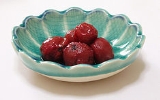
Umeboshi are usually round, and vary from unwrinkled to very wrinkled. They taste salty, and are extremely sour due to high citric acid
Citric acid

Citric acid is a weak organic chemistry acid, and it is a natural preservative and is also used to add an acidic, or sour, taste to foods and soft drinks....
 content – in the past they were known to corrode their way through aluminium lunch boxes
Bento

is a single-portion takeout or home-packed meal common in Japanese cuisine. A traditional bento consists of rice, fish or meat, and one or more pickling or cooking vegetables as a side dish....
 if kept in the same spot every day. It is thought that this occurred because the processing technology of the aluminum lunch box was still immature immediately after the end of the war.

The central area of Wakayama prefecture is known throughout Japan for the number and quality of its ume and umeboshi. The town of Minabe, Wakayama
Minabe, Wakayama

is a small towns of Japan located in Wakayama Prefecture in the Kansai region of Japan. Situated on a small bay of the Pacific ocean and surrounded by mountains, it is a quiet and picturesque farming community of about 14,000 people....
, in particular, grows more ume and produces more umeboshi than any other town in all of Japan.

Umeboshi per 100g contains elements as follows.

  • Calorie 33kcal
  • Protein 0.9g
  • Fat 0.2g
  • Carbohydrate 10.5g
  • Sodium8700 mg
  • Potassium 440 mg
  • Manganese 0.23 mg
  • VitaminA 7µg
  • VitaminB1 0.02 mg
  • VitaminB2 0.01 mg
  • Cholesterol 0 mg
  • Dietary fiber 3.6g
  • salt 22.1g


Production

Umeboshi are traditionally made by harvesting ume
Ume

Prunus mume, common name as or Japanese apricot, or Chinese plum is a species of Asian Prunus in the family Rosaceae. The flower, long a beloved subject in the traditional painting of East Asia and Vietnam, is usually translated as plum blossom....
 fruit when they ripen around June and packing them in barrels with salt
Edible salt

Salt is a dietary mineral composed primarily of sodium chloride that is essential for animal life, but toxic to most land plants. Salt flavor is one of the taste#Basic_tastes, an important Salting_ and a popular food seasoning....
. A weight is placed on top and the fruit gradually exude juices, which accumulate at the bottom of the barrel. This salty, sour liquid is marketed as umezu (??; often translated as "ume vinegar"), although it is not a true vinegar
Vinegar

Vinegar is an acidic liquid processed from the fermentation of ethanol in a process that yields its key ingredient, acetic acid . It also may come in a diluted form....
.

Most modern umeboshi are made by using less salt and by pickling the ume in a seasoned liquid or vinegar. They are typically dyed red using purple perilla
Perilla

'Perilla' is a genus of Annual plant herb that is a member of the mint family, Lamiaceae. In mild climates the plant reseeds itself. The most common species is Perilla frutescens var....
 herbs (called akajiso), or flavoured with katsuobushi
Katsuobushi

is the Japanese language name for a preparation of dried, Fermentation , and smoked skipjack tuna . Katsuobushi and kombu are the main ingredients of dashi, a broth that forms the basis of many soups and sauces in Japanese cuisine....
, kombu
Kombu

Kombu or konbu , also called dashima or haidai , are edible kelp from the family Laminariaceae widely eaten in East Asia....
 or even sweetened with honey
Honey

Honey is a sweet fluid produced by honey bees , and derived from the nectar of flowers. According to the United States National Honey Board and various international food regulations, "honey stipulates a pure product that does not allow for the addition of any other substance?this includes, but is not limited to, water or other sweeteners...
. Because modern methods of preservation use less salt, they usually contain an artifical preservative to extend shelf life.

Eating

Umeboshi are usually eaten with rice
Rice

Rice is a staple food for a large part of the world's human population, especially in tropical Latin America, and East Asia, South Asia and Southeast Asia, making it the second-most consumed cereal grain, after maize....
, in small quantities.

As part of a bento
Bento

is a single-portion takeout or home-packed meal common in Japanese cuisine. A traditional bento consists of rice, fish or meat, and one or more pickling or cooking vegetables as a side dish....
 (Japanese lunchbox), a single umeboshi is often placed in the centre of the rice to recreate the flag of Japan
Flag of Japan

The national flag of Japan is a white flag with a large red circle in the center. The flag's official name in Japanese is but the flag is more commonly known as ....
, the Hinomaru Bento. Umeboshi is also known to fight bacteria. It is said that placing an umeboshi on the rice will inhibit bacteria. The sour and salty umeboshi is also believed to help digestion.

It is also a common ingredient in onigiri
Onigiri

, also known as or rice ball, is a food made from white rice formed into triangular or oval shape and often wrapped in nori . Traditionally, an onigiri is filled with pickled ume , salted salmon, katsuobushi, or any other salty or sour ingredient as a preservative....
, rice balls wrapped in nori
Nori

is the Japanese name for various edible seaweed species of the red alga Porphyra including most notably P. yezoensis and P. tenera, sometimes called laver ....
, and they may also be used in makizushi
Sushi

In Japanese cuisine, is vinegared rice, usually topped with other ingredients, including fish dishes. In Japan, sliced raw fish alone is called sashimi and is distinct from sushi, as sashimi is the raw fish component, not the rice component....
. Makizushi made with umeboshi may be made with either pitted umeboshi or umeboshi paste (which is cheaper), often in conjunction with slivered fresh green perilla
Perilla

'Perilla' is a genus of Annual plant herb that is a member of the mint family, Lamiaceae. In mild climates the plant reseeds itself. The most common species is Perilla frutescens var....
 (shiso) leaves.

Umeboshi is often used as a cooking accent to enhance flavor and presentation.

Umeboshi may also be served as a complement of a green tea
Green tea

'Green tea' is a type of tea made solely with the leaves of Camellia sinensis, that has undergone minimal oxidation during processing. Green tea originates from China and has become associated with many cultures in Asia from Japan to the Middle East....
 or a drink with shochu
Shochu

is a distilled beverage native to Japan. It is most commonly distillation from barley, Sweet potato, or rice. Typically, it contains 25% alcohol by volume ....
 and hot water.

Drinking a cup of umeshu before meal is said to increase the appetite.

Children's candy shops sometimes carry karikari ume, or prepackaged, crunchy pickled ume.

Umeboshi are often eaten as snacks; in the United States many Japanese grocery stores stock umeboshi. Eating umeboshi in Japan is the equivalent of the United States "an apple a day."

Health

The citric acid acts as an antibacterial, helps to increase saliva production and to assist in the digestion of rice. In addition, the citric acid is said to combat fatigue and protect against aging. It is a strongly alkalising food. see alkaline diet
Alkaline diet

The Alkaline diet is a dietary protocol based on the consumption of foods which metabolise to leave an alkaline residue . Minerals such as calcium, iron, magnesium, zinc, copper, are the principal components of the residue as they are incombustible....


Umeboshi were esteemed by the [samurai] to combat battle fatigue. The standard Japanese folk remedy for colds
Common cold

Acute viral rhinopharyngitis, or acute coryza, usually known as the common cold, is a highly contagious, virus infectious disease of the upper respiratory system, primarily caused by picornaviruses or coronaviruses....
 and flus
Influenza

Influenza, commonly known as the flu, is an infectious disease that affects birds and mammals caused by RNA viruses of the biological family Orthomyxoviridae ....
 is okayu (boiled rice) with umeboshi.

Similar foods

Huamei , or Chinese preserved plum, refers to any of a large number of Chinese foods involving plums pickled in sugar, salt, and herbs such as licorice
Liquorice

Liquorice or licorice is the root of Glycyrrhiza glabra , from which a sweet flavour can be extracted. The liquorice plant is a legume , related to Anise, Star Anise and Fennel and native to southern Europe and parts of Asia....
. There are two general varieties: a dried variety, and a wet variety, the latter of which is pickled with vinegar and salt, and called suan méizi (???; literally "sour mei fruits"). Suan méizi are similar to Japanese umeboshi in that they have an intensely sour and salty flavor; they are the main ingredient of the popular summer beverage suanmeitang
Suanmeitang

File:P1100693.JPGSuanmeitang is a traditional China beverage made from sour plums , rock sugar, and other ingredients such as Osmanthus fragrans....
. Flavors and methods of preparation of huamei differ widely by region. Huamei are usually consumed as a snack.

In Vietnam, a very similar variety of pickled ume is called xí mu?i or ô mai.

In South Asian countries a similar dish is enjoyed called Amla
Amla

Amla may refer to:* Indian gooseberry, called amla in Hindi language* Hashim Amla, a South African cricketer of Indian descent* Amla, Madhya Pradesh, a town in Madhya Pradesh, India...
 in Hindi
Hindi

Standard Hindi, also known as High Hindi, Nagari Hindi or Literary Hindi is a Standard language register of Hindi. It is one of the 22 official languages of India, and is used, along with English language, for administration of the central government....
 it is prepared in the same manner, with the exception that Indian Gooseberries
Indian gooseberry

The Indian gooseberry is a deciduous tree of the Euphorbiaceae family. It is known for its edible fruit of the same name.Common names of this tree include amalaka in Sanskrit, amla in Hindi, amlaki in Bengali language, Nellikkai in Tamil language, ????? in Telugu, and amala in Nepal Bhasa....
 are the fruit packed in salt instead of Ume
Ume

Prunus mume, common name as or Japanese apricot, or Chinese plum is a species of Asian Prunus in the family Rosaceae. The flower, long a beloved subject in the traditional painting of East Asia and Vietnam, is usually translated as plum blossom....
.

In Western culture, the prune
Prune

A prune is any of various plum species, mostly Prunus domesticus or European Plum . They are usually sold as dried fruit. Fresh plums that are marketed as "prunes" have an oval shape and a more easily removed pit....
 is a closely related edible.

See also

  • Ume
    Ume

    Prunus mume, common name as or Japanese apricot, or Chinese plum is a species of Asian Prunus in the family Rosaceae. The flower, long a beloved subject in the traditional painting of East Asia and Vietnam, is usually translated as plum blossom....
  • Li hing mui
    Li hing mui

    Li hing mui is salty dried plum. It can be found in Hawaiian and Asian markets. It has a strong, distinctive flavor, and is often said to be an acquired taste, as it has a combination of sweet, sour, and salty taste....
  • Amla
    Amla

    Amla may refer to:* Indian gooseberry, called amla in Hindi language* Hashim Amla, a South African cricketer of Indian descent* Amla, Madhya Pradesh, a town in Madhya Pradesh, India...
  • Wikibooks:Cookbook:Umeboshi


External links