

Chutney

Encyclopedia
 |
 |
 |
 |
 |
 |
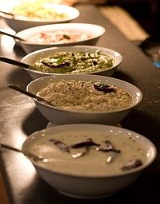
Chutney is a a condiment used in South Asian cuisine
South Asian cuisine
South Asian cuisine, also known as Desi cuisine, includes the cuisines from the Indian subcontinent. It has roots in South Asia, including practices taken from the Hindu beliefs practiced by the large population found in the region, alongside influences from neighbouring regions and cultures,...
that usually contains a spice and vegetable mix.
Chutneys are wet or dry, having a coarse to fine texture. The Anglo-Indian loan word refers to fresh and pickled
Pickling
Pickling, also known as brining or corning is the process of preserving food by anaerobic fermentation in brine to produce lactic acid, or marinating and storing it in an acid solution, usually vinegar . The resulting food is called a pickle. This procedure gives the food a salty or sour taste...
preparations indiscriminately, with preserves often sweetened. At least several Northern Indian languages use the word for fresh preparations only. A different word achār
Indian pickle
Indian pickles are made from certain individual varieties of vegetables and fruits that are chopped into small pieces and cooked in edible oils like sesame oil or brine with many different Indian spices like asafetida, red chili powder, turmeric, fenugreek and plenty of salt. Some regions also...
applies to preserves that often contain oil but are rarely sweet. Vinegar
Vinegar
Vinegar is a liquid substance consisting mainly of acetic acid and water, the acetic acid being produced through the fermentation of ethanol by acetic acid bacteria. Commercial vinegar is produced either by fast or slow fermentation processes. Slow methods generally are used with traditional...
or citrus
Citrus
Citrus is a common term and genus of flowering plants in the rue family, Rutaceae. Citrus is believed to have originated in the part of Southeast Asia bordered by Northeastern India, Myanmar and the Yunnan province of China...
juice may be added as preservatives, or fermentation in the presence of salt may be used to create acid.
In the past, chutneys were ground with a mortar and pestle
Mortar and pestle
A mortar and pestle is a tool used to crush, grind, and mix solid substances . The pestle is a heavy bat-shaped object, the end of which is used for crushing and grinding. The mortar is a bowl, typically made of hard wood, ceramic or stone...
made of stone or an ammikkal (Tamil). Nowadays, electric blenders replace the stone implements. Various spices are added and ground, usually in a particular order; the wet paste thus made is sauteed in vegetable oil, usually gingelly
Sesame oil
Sesame oil is an edible vegetable oil derived from sesame seeds. Besides being used as a cooking oil in South India, it is often used as a flavor enhancer in Chinese, Japanese, Korean, and to a lesser extent Southeast Asian cuisine.The oil from the nutrient rich seed is popular in alternative...
or groundnut oil.
Types of chutney
There is no limit to the number of chutneys as it can be made from virtually any vegetable/fruit/herb/spices or a combination of them.Chutneys come in two major groups, sweet and hot; both forms usually contain various spices, including chili, but differ by their main flavour. Chutney types and their preparations vary widely across Pakistan and India.
Types of chutneys:
- CorianderCorianderCoriander is an annual herb in the family Apiaceae. Coriander is native to southern Europe and North Africa to southwestern Asia. It is a soft, hairless plant growing to tall. The leaves are variable in shape, broadly lobed at the base of the plant, and slender and feathery higher on the...
(Cilantro) - MintMenthaMentha is a genus of flowering plants in the family Lamiaceae . The species are not clearly distinct and estimates of the number of species varies from 13 to 18. Hybridization between some of the species occurs naturally...
chutney (Coriander and mint chutneys are often called Hari chutney, where 'Hari' is UrduUrduUrdu is a register of the Hindustani language that is identified with Muslims in South Asia. It belongs to the Indo-European family. Urdu is the national language and lingua franca of Pakistan. It is also widely spoken in some regions of India, where it is one of the 22 scheduled languages and an...
/HindiHindiStandard Hindi, or more precisely Modern Standard Hindi, also known as Manak Hindi , High Hindi, Nagari Hindi, and Literary Hindi, is a standardized and sanskritized register of the Hindustani language derived from the Khariboli dialect of Delhi...
for 'Green') - TamarindTamarindTamarind is a tree in the family Fabaceae. The genus Tamarindus is monotypic .-Origin:...
chutney (Imli chutney) (often called Meethi chutney as 'Meethi' in Urdu/Hindi means 'Sweet') - Sooth (or Saunth) chutney, made with dates and ginger
- Coconut chutneyCoconut chutneyCoconut chutney is a South Indian spicy chutney-side-dish and condiment, a speciality common in North Malabar. This is a coconut stew mixed with other species and served with Idli, Dosai and even with cooked rice. It is made with two methods: liquid and solid...
- OnionOnionThe onion , also known as the bulb onion, common onion and garden onion, is the most widely cultivated species of the genus Allium. The genus Allium also contains a number of other species variously referred to as onions and cultivated for food, such as the Japanese bunching onion The onion...
chutney - PrunePruneA prune is any of various plum cultivars, mostly Prunus domestica or European Plum, sold as fresh or dried fruit. The dried fruit is also referred to as a dried plum...
chutney - TomatoTomatoThe word "tomato" may refer to the plant or the edible, typically red, fruit which it bears. Originating in South America, the tomato was spread around the world following the Spanish colonization of the Americas, and its many varieties are now widely grown, often in greenhouses in cooler...
chutney - Red Chili chutney
- Green ChiliChili-Food:* Chili pepper, the spicy fruit of plants in the genus Capsicum* Chili powder, dried, ground red chili peppers, sometimes with cumin and other spices* Chili con carne, often referred to simply as "chili" a stew-like dish...
chutney - Sooth chutneySooth (chutney)Saunth or Sooth is a sweet chutney used in Indian chaats. It is made from dried ginger, or Sooth and Imli paste, hence the name. Chutney is brownish red in colour....
- Mango chutney (made from raw, green mangoes)
- Lime chutney (made from whole, unripe limes)
- Garlic chutneyGarlic chutneyGarlic chutney, or belluli chutney is made from fresh garlic, dry or fresh coconut, groundnuts and red chili powder. It is used for cooking in many Indian and Pakistani homes....
made from fresh garlicGarlicAllium sativum, commonly known as garlic, is a species in the onion genus, Allium. Its close relatives include the onion, shallot, leek, chive, and rakkyo. Dating back over 6,000 years, garlic is native to central Asia, and has long been a staple in the Mediterranean region, as well as a frequent...
, coconutCoconutThe coconut palm, Cocos nucifera, is a member of the family Arecaceae . It is the only accepted species in the genus Cocos. The term coconut can refer to the entire coconut palm, the seed, or the fruit, which is not a botanical nut. The spelling cocoanut is an old-fashioned form of the word...
and groundnutPeanutThe peanut, or groundnut , is a species in the legume or "bean" family , so it is not a nut. The peanut was probably first cultivated in the valleys of Peru. It is an annual herbaceous plant growing tall... - Dahi chutneyDahi chutneyDahi chutney is strained yogurt that is mixed into a chutney of mint and onions. It is popular in Northern India.It is a side dish of Hyderabadi biryani....
- Green tomato chutney. Common English recipe to use up unripe tomatoes
- Peanut chutney (shengdana chutney in Marathi)
- Ginger chutney, mostly used in Tamil cuisineTamil cuisineTamil Nadu is famous for its hospitality and its deep belief that serving food to others is a service to humanity, as is common in many regions of India. The region has a rich cuisine involving both traditional vegetarian, as well as non-vegetarian dishes. It is characterized by the use of rice,...
and Udupi cuisineUdupi cuisineUdupi cuisine is a world-renowned cuisine of South India. It forms an important part of the Cuisine of Karnataka and takes its name from Udupi, a town on the southwest coast of India in the state of Karnataka. The Udupi cuisine has its origin in the Ashta mathas of Udupi founded by...
to be eaten with DosaDosaDosa or Dhosai is a fermented crepe or pancake made from rice batter and black lentils. It is indigenous to and is a staple dish in the southern Indian states of Andhra Pradesh, Karnataka, Kerala, and Tamil Nadu, as well as being popular in Sri Lanka... - Yogurt chutney, may be as simple as mixing yogurt, red chili powder, and salt, eaten with a variety of foods
- Tomato Onion chutney
- Cilantro Mint Coconut chutney
- Peased Chatni (laindy chatni in Naraghak)
- Blatjang, used in South African cuisine. A sweet chutney usually made with apricots.
American and European styled chutneys are usually fruit, vinegar and sugar, cooked down to a reduction. Flavorings are always added to the mix. These may include sugar
Sugar
Sugar is a class of edible crystalline carbohydrates, mainly sucrose, lactose, and fructose, characterized by a sweet flavor.Sucrose in its refined form primarily comes from sugar cane and sugar beet...
, salt
Salt
In chemistry, salts are ionic compounds that result from the neutralization reaction of an acid and a base. They are composed of cations and anions so that the product is electrically neutral...
, garlic
Garlic
Allium sativum, commonly known as garlic, is a species in the onion genus, Allium. Its close relatives include the onion, shallot, leek, chive, and rakkyo. Dating back over 6,000 years, garlic is native to central Asia, and has long been a staple in the Mediterranean region, as well as a frequent...
, tamarind
Tamarind
Tamarind is a tree in the family Fabaceae. The genus Tamarindus is monotypic .-Origin:...
, onion
Onion
The onion , also known as the bulb onion, common onion and garden onion, is the most widely cultivated species of the genus Allium. The genus Allium also contains a number of other species variously referred to as onions and cultivated for food, such as the Japanese bunching onion The onion...
, or ginger
Ginger
Ginger is the rhizome of the plant Zingiber officinale, consumed as a delicacy, medicine, or spice. It lends its name to its genus and family . Other notable members of this plant family are turmeric, cardamom, and galangal....
.
Spice
Spice
A spice is a dried seed, fruit, root, bark, or vegetative substance used in nutritionally insignificant quantities as a food additive for flavor, color, or as a preservative that kills harmful bacteria or prevents their growth. It may be used to flavour a dish or to hide other flavours...
s most commonly include fenugreek
Fenugreek
Fenugreek is a plant in the family Fabaceae. Fenugreek is used both as a herb and as a spice . The leaves and sprouts are also eaten as vegetables...
, coriander, cumin
Cumin
Cumin is a flowering plant in the family Apiaceae, native from the east Mediterranean to India. Its seeds are used in the cuisines of many different cultures, in both whole and ground form.-Etymology:...
and asafoetida
Asafoetida
Asafoetida , alternative spelling asafetida, is the dried latex exuded from the living underground rhizome or tap root of several species of Ferula, which is a perennial herb...
(hing).
Etymology
The word Chutney is derived from the SanskritSanskrit
Sanskrit , is a historical Indo-Aryan language and the primary liturgical language of Hinduism, Jainism and Buddhism.Buddhism: besides Pali, see Buddhist Hybrid Sanskrit Today, it is listed as one of the 22 scheduled languages of India and is an official language of the state of Uttarakhand...
word , a term for a class of spicy preparations used as an accompaniment for a main dish. It is written differently in several Indo-Aryan
Indo-Aryan languages
The Indo-Aryan languages constitutes a branch of the Indo-Iranian languages, itself a branch of the Indo-European language family...
and Dravidian
Dravidian languages
The Dravidian language family includes approximately 85 genetically related languages, spoken by about 217 million people. They are mainly spoken in southern India and parts of eastern and central India as well as in northeastern Sri Lanka, Pakistan, Nepal, Bangladesh, Afghanistan, Iran, and...
languages .
History
Beginning in the 17th century, chutneys were shipped to European countries like England and France as luxury goods. Western imitations were called "mangoed" fruits or vegetables. In the 19th century, brands of chutney like Major Grey's or Bengal ClubBengal Club
Located in Kolkata, India, The Bengal Club was opened in 1827 as the Calcutta United Service Club. The club's first President was Lt. Col. The Hon. J. Finch...
created for Western tastes were shipped to Europe.
Generally these chutneys are fruit, vinegar, and sugar cooked down to a reduction.
The tradition of chutney making spread through the english speaking, especially in the Caribbean and American South where chutney is still a popular condiment for ham, pork, and fish.
Chutney by Indian region
- AssamAssamAssam , also, rarely, Assam Valley and formerly the Assam Province , is a northeastern state of India and is one of the most culturally and geographically distinct regions of the country...
- corianderCorianderCoriander is an annual herb in the family Apiaceae. Coriander is native to southern Europe and North Africa to southwestern Asia. It is a soft, hairless plant growing to tall. The leaves are variable in shape, broadly lobed at the base of the plant, and slender and feathery higher on the...
, spinachSpinachSpinach is an edible flowering plant in the family of Amaranthaceae. It is native to central and southwestern Asia. It is an annual plant , which grows to a height of up to 30 cm. Spinach may survive over winter in temperate regions...
, tomatoTomatoThe word "tomato" may refer to the plant or the edible, typically red, fruit which it bears. Originating in South America, the tomato was spread around the world following the Spanish colonization of the Americas, and its many varieties are now widely grown, often in greenhouses in cooler...
, curry leaf, chilliChili pepperChili pepper is the fruit of plants from the genus Capsicum, members of the nightshade family, Solanaceae. The term in British English and in Australia, New Zealand, India, Malaysia and other Asian countries is just chilli without pepper.Chili peppers originated in the Americas...
, radishRadishThe radish is an edible root vegetable of the Brassicaceae family that was domesticated in Europe, in pre-Roman times. They are grown and consumed throughout the world. Radishes have numerous varieties, varying in size, color and duration of required cultivation time...
, carrotCarrotThe carrot is a root vegetable, usually orange in colour, though purple, red, white, and yellow varieties exist. It has a crisp texture when fresh...
, cucumberCucumberThe cucumber is a widely cultivated plant in the gourd family Cucurbitaceae, which includes squash, and in the same genus as the muskmelon. The plant is a creeping vine which bears cylindrical edible fruit when ripe. There are three main varieties of cucumber: "slicing", "pickling", and...
, beetrootBeetrootThe beetroot, also known as the table beet, garden beet, red beet or informally simply as beet, is one of the many cultivated varieties of beets and arguably the most commonly encountered variety in North America, Central America and Britain.-Consumption:The usually deep-red roots of beetroot are...
, lentilLentilThe lentil is an edible pulse. It is a bushy annual plant of the legume family, grown for its lens-shaped seeds...
, chickpeaChickpeaThe chickpea is a legume of the family Fabaceae, subfamily Faboideae...
and Ghost Chilli chutneys - Andhra PradeshAndhra PradeshAndhra Pradesh , is one of the 28 states of India, situated on the southeastern coast of India. It is India's fourth largest state by area and fifth largest by population. Its capital and largest city by population is Hyderabad.The total GDP of Andhra Pradesh is $100 billion and is ranked third...
— coconut, coriander, red chilli with grams, tomato, onion, peanut, lemon, curry leaf, tamarind,green chilli, ginger,pudina,and mango chutneys - Gujarat — Hot limeLime (fruit)Lime is a term referring to a number of different citrus fruits, both species and hybrids, which are typically round, green to yellow in color, 3–6 cm in diameter, and containing sour and acidic pulp. Limes are a good source of vitamin C. Limes are often used to accent the flavors of foods and...
chutneys, Garlic chutneyGarlic chutneyGarlic chutney, or belluli chutney is made from fresh garlic, dry or fresh coconut, groundnuts and red chili powder. It is used for cooking in many Indian and Pakistani homes.... - HaryanaHaryanaHaryana is a state in India. Historically, it has been a part of the Kuru region in North India. The name Haryana is found mentioned in the 12th century AD by the apabhramsha writer Vibudh Shridhar . It is bordered by Punjab and Himachal Pradesh to the north, and by Rajasthan to the west and south...
— tamarindTamarindTamarind is a tree in the family Fabaceae. The genus Tamarindus is monotypic .-Origin:...
chutney - Himachal PradeshHimachal PradeshHimachal Pradesh is a state in Northern India. It is spread over , and is bordered by the Indian states of Jammu and Kashmir on the north, Punjab on the west and south-west, Haryana and Uttar Pradesh on the south, Uttarakhand on the south-east and by the Tibet Autonomous Region on the east...
— guavaGuavaGuavas are plants in the myrtle family genus Psidium , which contains about 100 species of tropical shrubs and small trees. They are native to Mexico, Central America, and northern South America...
and eggplant chutneys - KarnatakaKarnatakaKarnataka , the land of the Kannadigas, is a state in South West India. It was created on 1 November 1956, with the passing of the States Reorganisation Act and this day is annually celebrated as Karnataka Rajyotsava...
— coconutCoconutThe coconut palm, Cocos nucifera, is a member of the family Arecaceae . It is the only accepted species in the genus Cocos. The term coconut can refer to the entire coconut palm, the seed, or the fruit, which is not a botanical nut. The spelling cocoanut is an old-fashioned form of the word...
, peanutPeanutThe peanut, or groundnut , is a species in the legume or "bean" family , so it is not a nut. The peanut was probably first cultivated in the valleys of Peru. It is an annual herbaceous plant growing tall...
, tomatoTomatoThe word "tomato" may refer to the plant or the edible, typically red, fruit which it bears. Originating in South America, the tomato was spread around the world following the Spanish colonization of the Americas, and its many varieties are now widely grown, often in greenhouses in cooler...
, tamarindTamarindTamarind is a tree in the family Fabaceae. The genus Tamarindus is monotypic .-Origin:...
, mango, urad dal (a kind of legume), pudina (mintMenthaMentha is a genus of flowering plants in the family Lamiaceae . The species are not clearly distinct and estimates of the number of species varies from 13 to 18. Hybridization between some of the species occurs naturally...
), heeray kayi (ridge gourd), uchellu (Niger seed), bende kaayi (Lady FingerOkraOkra is a flowering plant in the mallow family. It is valued for its edible green seed pods. The geographical origin of okra is disputed, with supporters of South Asian, Ethiopian and West African origins...
), Ginger. - KeralaKeralaor Keralam is an Indian state located on the Malabar coast of south-west India. It was created on 1 November 1956 by the States Reorganisation Act by combining various Malayalam speaking regions....
— coconut, pudina, urad dal, mango, dry fish, shrimpShrimpShrimp are swimming, decapod crustaceans classified in the infraorder Caridea, found widely around the world in both fresh and salt water. Adult shrimp are filter feeding benthic animals living close to the bottom. They can live in schools and can swim rapidly backwards. Shrimp are an important...
, and onionOnionThe onion , also known as the bulb onion, common onion and garden onion, is the most widely cultivated species of the genus Allium. The genus Allium also contains a number of other species variously referred to as onions and cultivated for food, such as the Japanese bunching onion The onion...
chutney - MaharashtraMaharashtraMaharashtra is a state located in India. It is the second most populous after Uttar Pradesh and third largest state by area in India...
— hot raw mangoMangoThe mango is a fleshy stone fruit belonging to the genus Mangifera, consisting of numerous tropical fruiting trees in the flowering plant family Anacardiaceae. The mango is native to India from where it spread all over the world. It is also the most cultivated fruit of the tropical world. While...
chutney, guramba, panchamrit, Mirachicha Thecha. Dry chutneys made with Javas (Flax seed), Solapuri Shenga (peanut)/red chili powder chutney, Karale (Niger seed) and PeanutPeanutThe peanut, or groundnut , is a species in the legume or "bean" family , so it is not a nut. The peanut was probably first cultivated in the valleys of Peru. It is an annual herbaceous plant growing tall...
/garlicGarlicAllium sativum, commonly known as garlic, is a species in the onion genus, Allium. Its close relatives include the onion, shallot, leek, chive, and rakkyo. Dating back over 6,000 years, garlic is native to central Asia, and has long been a staple in the Mediterranean region, as well as a frequent...
Lasun ChutneyChutneyChutney is a a condiment used in South Asian cuisine that usually contains a spice and vegetable mix.Chutneys are wet or dry, having a coarse to fine texture. The Anglo-Indian loan word refers to fresh and pickled preparations indiscriminately, with preserves often sweetened. At least several... - OrissaOrissaOrissa , officially Odisha since Nov 2011, is a state of India, located on the east coast of India, by the Bay of Bengal. It is the modern name of the ancient nation of Kalinga, which was invaded by the Maurya Emperor Ashoka in 261 BC. The modern state of Orissa was established on 1 April...
— dhania (cilantro), pudina (mint), coconut, mangoMangoThe mango is a fleshy stone fruit belonging to the genus Mangifera, consisting of numerous tropical fruiting trees in the flowering plant family Anacardiaceae. The mango is native to India from where it spread all over the world. It is also the most cultivated fruit of the tropical world. While...
, orange, tomato, dry fish chutneys - PunjabPunjab (India)Punjab ) is a state in the northwest of the Republic of India, forming part of the larger Punjab region. The state is bordered by the Indian states of Himachal Pradesh to the east, Haryana to the south and southeast and Rajasthan to the southwest as well as the Pakistani province of Punjab to the...
— pudina (mint) chutney, onionOnionThe onion , also known as the bulb onion, common onion and garden onion, is the most widely cultivated species of the genus Allium. The genus Allium also contains a number of other species variously referred to as onions and cultivated for food, such as the Japanese bunching onion The onion...
chutney, tamarindTamarindTamarind is a tree in the family Fabaceae. The genus Tamarindus is monotypic .-Origin:...
chutney, mangoMangoThe mango is a fleshy stone fruit belonging to the genus Mangifera, consisting of numerous tropical fruiting trees in the flowering plant family Anacardiaceae. The mango is native to India from where it spread all over the world. It is also the most cultivated fruit of the tropical world. While...
chutney - Tamil NaduTamil NaduTamil Nadu is one of the 28 states of India. Its capital and largest city is Chennai. Tamil Nadu lies in the southernmost part of the Indian Peninsula and is bordered by the union territory of Pondicherry, and the states of Kerala, Karnataka, and Andhra Pradesh...
— coconutCoconutThe coconut palm, Cocos nucifera, is a member of the family Arecaceae . It is the only accepted species in the genus Cocos. The term coconut can refer to the entire coconut palm, the seed, or the fruit, which is not a botanical nut. The spelling cocoanut is an old-fashioned form of the word...
, corianderCorianderCoriander is an annual herb in the family Apiaceae. Coriander is native to southern Europe and North Africa to southwestern Asia. It is a soft, hairless plant growing to tall. The leaves are variable in shape, broadly lobed at the base of the plant, and slender and feathery higher on the...
, curry leaf, red chilli, green chilli, tomatoTomatoThe word "tomato" may refer to the plant or the edible, typically red, fruit which it bears. Originating in South America, the tomato was spread around the world following the Spanish colonization of the Americas, and its many varieties are now widely grown, often in greenhouses in cooler...
, onionOnionThe onion , also known as the bulb onion, common onion and garden onion, is the most widely cultivated species of the genus Allium. The genus Allium also contains a number of other species variously referred to as onions and cultivated for food, such as the Japanese bunching onion The onion...
, gingerGingerGinger is the rhizome of the plant Zingiber officinale, consumed as a delicacy, medicine, or spice. It lends its name to its genus and family . Other notable members of this plant family are turmeric, cardamom, and galangal....
, mint, mangoMangoThe mango is a fleshy stone fruit belonging to the genus Mangifera, consisting of numerous tropical fruiting trees in the flowering plant family Anacardiaceae. The mango is native to India from where it spread all over the world. It is also the most cultivated fruit of the tropical world. While...
, lentilLentilThe lentil is an edible pulse. It is a bushy annual plant of the legume family, grown for its lens-shaped seeds... - Uttar PradeshUttar PradeshUttar Pradesh abbreviation U.P. , is a state located in the northern part of India. With a population of over 200 million people, it is India's most populous state, as well as the world's most populous sub-national entity...
— corianderCorianderCoriander is an annual herb in the family Apiaceae. Coriander is native to southern Europe and North Africa to southwestern Asia. It is a soft, hairless plant growing to tall. The leaves are variable in shape, broadly lobed at the base of the plant, and slender and feathery higher on the...
, garlicGarlicAllium sativum, commonly known as garlic, is a species in the onion genus, Allium. Its close relatives include the onion, shallot, leek, chive, and rakkyo. Dating back over 6,000 years, garlic is native to central Asia, and has long been a staple in the Mediterranean region, as well as a frequent...
, mint chutney, sweet and sour mangoMangoThe mango is a fleshy stone fruit belonging to the genus Mangifera, consisting of numerous tropical fruiting trees in the flowering plant family Anacardiaceae. The mango is native to India from where it spread all over the world. It is also the most cultivated fruit of the tropical world. While...
, green chiliChili pepperChili pepper is the fruit of plants from the genus Capsicum, members of the nightshade family, Solanaceae. The term in British English and in Australia, New Zealand, India, Malaysia and other Asian countries is just chilli without pepper.Chili peppers originated in the Americas...
, red chiliChili pepperChili pepper is the fruit of plants from the genus Capsicum, members of the nightshade family, Solanaceae. The term in British English and in Australia, New Zealand, India, Malaysia and other Asian countries is just chilli without pepper.Chili peppers originated in the Americas...
and jaggeryJaggeryJaggery is a traditional unrefined non-centrifugal whole cane sugar consumed in Asia, Africa, Latin America, and the Caribbean. It is a concentrated product of cane juice without separation of the molasses and crystals, and can vary from golden brown to dark brown in color...
chutneys - West BengalWest BengalWest Bengal is a state in the eastern region of India and is the nation's fourth-most populous. It is also the seventh-most populous sub-national entity in the world, with over 91 million inhabitants. A major agricultural producer, West Bengal is the sixth-largest contributor to India's GDP...
— Lime, green mango, tomato, papaya, pineapple, date, dried mango jelly and other dry fruits, green chiliChili pepperChili pepper is the fruit of plants from the genus Capsicum, members of the nightshade family, Solanaceae. The term in British English and in Australia, New Zealand, India, Malaysia and other Asian countries is just chilli without pepper.Chili peppers originated in the Americas...
chutneys