


Paper size

Encyclopedia
North America
North America is a continent wholly within the Northern Hemisphere and almost wholly within the Western Hemisphere. It is also considered a northern subcontinent of the Americas...
(including letter, legal, ledger, etc.). The paper sizes affect writing paper, stationery
Stationery
Stationery has historically meant a wide gamut of materials: paper and office supplies, writing implements, greeting cards, glue, pencil case etc.-History of stationery:...
, cards, and some printed documents. The standards also have related sizes for envelope
Envelope
An envelope is a common packaging item, usually made of thin flat material. It is designed to contain a flat object, such as a letter or card....
s.
The international standard: ISO 216
The international paper size standard, ISO 216, is based on the GermanGermany
Germany , officially the Federal Republic of Germany , is a federal parliamentary republic in Europe. The country consists of 16 states while the capital and largest city is Berlin. Germany covers an area of 357,021 km2 and has a largely temperate seasonal climate...
DIN
Deutsches Institut für Normung
is the German national organization for standardization and is that country's ISO member body. DIN is a Registered German Association headquartered in Berlin...
476 standard for paper sizes. ISO paper sizes are all based on a single aspect ratio
Aspect ratio (image)
The aspect ratio of an image is the ratio of the width of the image to its height, expressed as two numbers separated by a colon. That is, for an x:y aspect ratio, no matter how big or small the image is, if the width is divided into x units of equal length and the height is measured using this...
of square root of 2
Square root of 2
The square root of 2, often known as root 2, is the positive algebraic number that, when multiplied by itself, gives the number 2. It is more precisely called the principal square root of 2, to distinguish it from the negative number with the same property.Geometrically the square root of 2 is the...
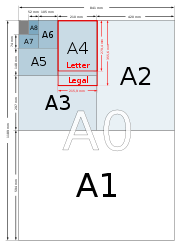
, or approximately 1:1.4142. The base A0 size of paper is defined to have an area of one m². With the given aspect ratio of square root of two, this corresponds to a piece of paper with a longer side of one metre multiplied by the square root of the square root (that is, the fourth root) of two and the shorter side being the reciprocal of this value. Rounded to millimetres the A0 paper size is 841 by 1189 mm (33.1 by 46.8 in).
Successive paper sizes in the series A1, A2, A3, and so forth, are defined by halving the preceding paper size along the larger dimension. The most frequently used paper size is A4 (210 × 297 mm).
The significant advantage of this system is its scaling: if a sheet with an aspect ratio of
 is divided into two equal halves parallel to its shortest sides, then the halves will again have an aspect ratio of
  . Folded brochures of any size can be made by using sheets of the next larger size, e.g. A4 sheets are folded to make A5 brochures. The system allows scaling without compromising the aspect ratio from one size to another—as provided by office photocopiers, e.g. enlarging A4 to A3 or reducing A3 to A4. Similarly, two sheets of A4 can be scaled down and fit exactly 1 sheet without any cutoff or margins. Weights are easy to calculate as well: a standard A4 sheet made from 80 gram/m² paper weighs 5 grams
Metric system
The metric system is an international decimalised system of measurement. France was first to adopt a metric system, in 1799, and a metric system is now the official system of measurement, used in almost every country in the world...
(as it is one 16th of an A0 page, measuring 1 m²), allowing one to easily compute the weight—and associated postage rate—by counting the number of sheets used.
The advantages of basing a paper size upon an aspect ratio of
 were already noted in 1786 by the German
Germany
Germany , officially the Federal Republic of Germany , is a federal parliamentary republic in Europe. The country consists of 16 states while the capital and largest city is Berlin. Germany covers an area of 357,021 km2 and has a largely temperate seasonal climate...
scientist and philosopher Georg Christoph Lichtenberg
Georg Christoph Lichtenberg
Georg Christoph Lichtenberg was a German scientist, satirist and Anglophile. As a scientist, he was the first to hold a professorship explicitly dedicated to experimental physics in Germany...
. Early in the 20th century, Dr Walter Porstmann turned Lichtenberg's idea into a proper system of different paper sizes. Porstmann's system was introduced as a DIN standard (DIN 476) in Germany
Germany
Germany , officially the Federal Republic of Germany , is a federal parliamentary republic in Europe. The country consists of 16 states while the capital and largest city is Berlin. Germany covers an area of 357,021 km2 and has a largely temperate seasonal climate...
in 1922, replacing a vast variety of other paper formats. Even today the paper sizes are called "DIN A4" in everyday use in Europe. The term Lichtenberg ratio
Lichtenberg ratio
In paper sizes, the Lichtenberg ratio is the aspect ratio of 1:√2. The term was proposed by Markus Kuhn in 2002.This aspect ratio has the unique property that cutting any rectangular sheet of paper formed with the Lichtenberg ratio into two equal halves parallel to its shortest sides produces two...
has recently been proposed for this paper aspect ratio.
The main disadvantage of the system is type does not scale the same way; therefore, when a page is resized, the type set on it loses legibility as the proportion between the type's x-height, page margins, and leading are distorted. When trim is involved, as in the manufacture of books, ISO 216 sizes are generally too tall and narrow for book production (see: Canons of page construction
Canons of page construction
The canons of page construction are a set of principles in the field of book design used to describe the ways that page proportions, margins and type areas of books are constructed....
). The distortion is even more pronounced with printed sheet music. European book publishers typically use metricated traditional page sizes for book production.
The DIN 476 standard spread quickly to other countries. Before the outbreak of World War II
World War II
World War II, or the Second World War , was a global conflict lasting from 1939 to 1945, involving most of the world's nations—including all of the great powers—eventually forming two opposing military alliances: the Allies and the Axis...
, it had been adopted by the following countries:
- BelgiumBelgiumBelgium , officially the Kingdom of Belgium, is a federal state in Western Europe. It is a founding member of the European Union and hosts the EU's headquarters, and those of several other major international organisations such as NATO.Belgium is also a member of, or affiliated to, many...
(1924) - NetherlandsNetherlandsThe Netherlands is a constituent country of the Kingdom of the Netherlands, located mainly in North-West Europe and with several islands in the Caribbean. Mainland Netherlands borders the North Sea to the north and west, Belgium to the south, and Germany to the east, and shares maritime borders...
(1925) - NorwayNorwayNorway , officially the Kingdom of Norway, is a Nordic unitary constitutional monarchy whose territory comprises the western portion of the Scandinavian Peninsula, Jan Mayen, and the Arctic archipelago of Svalbard and Bouvet Island. Norway has a total area of and a population of about 4.9 million...
(1926)
- FinlandFinlandFinland , officially the Republic of Finland, is a Nordic country situated in the Fennoscandian region of Northern Europe. It is bordered by Sweden in the west, Norway in the north and Russia in the east, while Estonia lies to its south across the Gulf of Finland.Around 5.4 million people reside...
(1927) - SwitzerlandSwitzerlandSwitzerland name of one of the Swiss cantons. ; ; ; or ), in its full name the Swiss Confederation , is a federal republic consisting of 26 cantons, with Bern as the seat of the federal authorities. The country is situated in Western Europe,Or Central Europe depending on the definition....
(1929) - SwedenSwedenSweden , officially the Kingdom of Sweden , is a Nordic country on the Scandinavian Peninsula in Northern Europe. Sweden borders with Norway and Finland and is connected to Denmark by a bridge-tunnel across the Öresund....
(1930)
- Soviet UnionSoviet UnionThe Soviet Union , officially the Union of Soviet Socialist Republics , was a constitutionally socialist state that existed in Eurasia between 1922 and 1991....
(1934) - HungaryHungaryHungary , officially the Republic of Hungary , is a landlocked country in Central Europe. It is situated in the Carpathian Basin and is bordered by Slovakia to the north, Ukraine and Romania to the east, Serbia and Croatia to the south, Slovenia to the southwest and Austria to the west. The...
(1938) - ItalyItalyItaly , officially the Italian Republic languages]] under the European Charter for Regional or Minority Languages. In each of these, Italy's official name is as follows:;;;;;;;;), is a unitary parliamentary republic in South-Central Europe. To the north it borders France, Switzerland, Austria and...
(1939)
During World War II, the standard was adopted by Uruguay
Uruguay
Uruguay ,officially the Oriental Republic of Uruguay,sometimes the Eastern Republic of Uruguay; ) is a country in the southeastern part of South America. It is home to some 3.5 million people, of whom 1.8 million live in the capital Montevideo and its metropolitan area...
(1942), Argentina
Argentina
Argentina , officially the Argentine Republic , is the second largest country in South America by land area, after Brazil. It is constituted as a federation of 23 provinces and an autonomous city, Buenos Aires...
(1943) and Brazil
Brazil
Brazil , officially the Federative Republic of Brazil , is the largest country in South America. It is the world's fifth largest country, both by geographical area and by population with over 192 million people...
(1943); and afterwards spread to other countries:
- SpainSpainSpain , officially the Kingdom of Spain languages]] under the European Charter for Regional or Minority Languages. In each of these, Spain's official name is as follows:;;;;;;), is a country and member state of the European Union located in southwestern Europe on the Iberian Peninsula...
(1947) - AustriaAustriaAustria , officially the Republic of Austria , is a landlocked country of roughly 8.4 million people in Central Europe. It is bordered by the Czech Republic and Germany to the north, Slovakia and Hungary to the east, Slovenia and Italy to the south, and Switzerland and Liechtenstein to the...
(1948) - IranIranIran , officially the Islamic Republic of Iran , is a country in Southern and Western Asia. The name "Iran" has been in use natively since the Sassanian era and came into use internationally in 1935, before which the country was known to the Western world as Persia...
(1948) - RomaniaRomaniaRomania is a country located at the crossroads of Central and Southeastern Europe, on the Lower Danube, within and outside the Carpathian arch, bordering on the Black Sea...
(1949) - JapanJapanJapan is an island nation in East Asia. Located in the Pacific Ocean, it lies to the east of the Sea of Japan, China, North Korea, South Korea and Russia, stretching from the Sea of Okhotsk in the north to the East China Sea and Taiwan in the south...
(1951) - DenmarkDenmarkDenmark is a Scandinavian country in Northern Europe. The countries of Denmark and Greenland, as well as the Faroe Islands, constitute the Kingdom of Denmark . It is the southernmost of the Nordic countries, southwest of Sweden and south of Norway, and bordered to the south by Germany. Denmark...
(1953) - CzechoslovakiaCzechoslovakiaCzechoslovakia or Czecho-Slovakia was a sovereign state in Central Europe which existed from October 1918, when it declared its independence from the Austro-Hungarian Empire, until 1992...
(1953) - IsraelIsraelThe State of Israel is a parliamentary republic located in the Middle East, along the eastern shore of the Mediterranean Sea...
(1954) - PortugalPortugalPortugal , officially the Portuguese Republic is a country situated in southwestern Europe on the Iberian Peninsula. Portugal is the westernmost country of Europe, and is bordered by the Atlantic Ocean to the West and South and by Spain to the North and East. The Atlantic archipelagos of the...
(1954) - YugoslaviaYugoslaviaYugoslavia refers to three political entities that existed successively on the western part of the Balkans during most of the 20th century....
(1956) - IndiaIndiaIndia , officially the Republic of India , is a country in South Asia. It is the seventh-largest country by geographical area, the second-most populous country with over 1.2 billion people, and the most populous democracy in the world...
(1957) - PolandPolandPoland , officially the Republic of Poland , is a country in Central Europe bordered by Germany to the west; the Czech Republic and Slovakia to the south; Ukraine, Belarus and Lithuania to the east; and the Baltic Sea and Kaliningrad Oblast, a Russian exclave, to the north...
(1957)
- United KingdomUnited KingdomThe United Kingdom of Great Britain and Northern IrelandIn the United Kingdom and Dependencies, other languages have been officially recognised as legitimate autochthonous languages under the European Charter for Regional or Minority Languages...
(1959) - IrelandIrelandIreland is an island to the northwest of continental Europe. It is the third-largest island in Europe and the twentieth-largest island on Earth...
(1959) - VenezuelaVenezuelaVenezuela , officially called the Bolivarian Republic of Venezuela , is a tropical country on the northern coast of South America. It borders Colombia to the west, Guyana to the east, and Brazil to the south...
(1962) - New ZealandNew ZealandNew Zealand is an island country in the south-western Pacific Ocean comprising two main landmasses and numerous smaller islands. The country is situated some east of Australia across the Tasman Sea, and roughly south of the Pacific island nations of New Caledonia, Fiji, and Tonga...
(1963) - IcelandIcelandIceland , described as the Republic of Iceland, is a Nordic and European island country in the North Atlantic Ocean, on the Mid-Atlantic Ridge. Iceland also refers to the main island of the country, which contains almost all the population and almost all the land area. The country has a population...
(1964) - MexicoMexicoThe United Mexican States , commonly known as Mexico , is a federal constitutional republic in North America. It is bordered on the north by the United States; on the south and west by the Pacific Ocean; on the southeast by Guatemala, Belize, and the Caribbean Sea; and on the east by the Gulf of...
(1965) - South AfricaSouth AfricaThe Republic of South Africa is a country in southern Africa. Located at the southern tip of Africa, it is divided into nine provinces, with of coastline on the Atlantic and Indian oceans...
(1966) - FranceFranceThe French Republic , The French Republic , The French Republic , (commonly known as France , is a unitary semi-presidential republic in Western Europe with several overseas territories and islands located on other continents and in the Indian, Pacific, and Atlantic oceans. Metropolitan France...
(1967) - PeruPeruPeru , officially the Republic of Peru , is a country in western South America. It is bordered on the north by Ecuador and Colombia, on the east by Brazil, on the southeast by Bolivia, on the south by Chile, and on the west by the Pacific Ocean....
(1967) - TurkeyTurkeyTurkey , known officially as the Republic of Turkey , is a Eurasian country located in Western Asia and in East Thrace in Southeastern Europe...
(1967) - ChileChileChile ,officially the Republic of Chile , is a country in South America occupying a long, narrow coastal strip between the Andes mountains to the east and the Pacific Ocean to the west. It borders Peru to the north, Bolivia to the northeast, Argentina to the east, and the Drake Passage in the far...
(1968)
- GreeceGreeceGreece , officially the Hellenic Republic , and historically Hellas or the Republic of Greece in English, is a country in southeastern Europe....
(1970) - RhodesiaRhodesiaRhodesia , officially the Republic of Rhodesia from 1970, was an unrecognised state located in southern Africa that existed between 1965 and 1979 following its Unilateral Declaration of Independence from the United Kingdom on 11 November 1965...
(1970) - SingaporeSingaporeSingapore , officially the Republic of Singapore, is a Southeast Asian city-state off the southern tip of the Malay Peninsula, north of the equator. An island country made up of 63 islands, it is separated from Malaysia by the Straits of Johor to its north and from Indonesia's Riau Islands by the...
(1970) - BangladeshBangladeshBangladesh , officially the People's Republic of Bangladesh is a sovereign state located in South Asia. It is bordered by India on all sides except for a small border with Burma to the far southeast and by the Bay of Bengal to the south...
(1972) - ThailandThailandThailand , officially the Kingdom of Thailand , formerly known as Siam , is a country located at the centre of the Indochina peninsula and Southeast Asia. It is bordered to the north by Burma and Laos, to the east by Laos and Cambodia, to the south by the Gulf of Thailand and Malaysia, and to the...
(1973) - BarbadosBarbadosBarbados is an island country in the Lesser Antilles. It is in length and as much as in width, amounting to . It is situated in the western area of the North Atlantic and 100 kilometres east of the Windward Islands and the Caribbean Sea; therein, it is about east of the islands of Saint...
(1973) - AustraliaAustraliaAustralia , officially the Commonwealth of Australia, is a country in the Southern Hemisphere comprising the mainland of the Australian continent, the island of Tasmania, and numerous smaller islands in the Indian and Pacific Oceans. It is the world's sixth-largest country by total area...
(1974) - EcuadorEcuadorEcuador , officially the Republic of Ecuador is a representative democratic republic in South America, bordered by Colombia on the north, Peru on the east and south, and by the Pacific Ocean to the west. It is one of only two countries in South America, along with Chile, that do not have a border...
(1974) - ColombiaColombiaColombia, officially the Republic of Colombia , is a unitary constitutional republic comprising thirty-two departments. The country is located in northwestern South America, bordered to the east by Venezuela and Brazil; to the south by Ecuador and Peru; to the north by the Caribbean Sea; to the...
(1975) - KuwaitKuwaitThe State of Kuwait is a sovereign Arab state situated in the north-east of the Arabian Peninsula in Western Asia. It is bordered by Saudi Arabia to the south at Khafji, and Iraq to the north at Basra. It lies on the north-western shore of the Persian Gulf. The name Kuwait is derived from the...
(1975)
By 1975 so many countries were using the German system that it was established as an ISO
International Organization for Standardization
The International Organization for Standardization , widely known as ISO, is an international standard-setting body composed of representatives from various national standards organizations. Founded on February 23, 1947, the organization promulgates worldwide proprietary, industrial and commercial...
standard, as well as the official United Nations
United Nations
The United Nations is an international organization whose stated aims are facilitating cooperation in international law, international security, economic development, social progress, human rights, and achievement of world peace...
document format. By 1977 A4 was the standard letter format in 88 of 148 countries. Today the standard has been adopted by all countries in the world except the United States
United States
The United States of America is a federal constitutional republic comprising fifty states and a federal district...
and Canada
Canada
Canada is a North American country consisting of ten provinces and three territories. Located in the northern part of the continent, it extends from the Atlantic Ocean in the east to the Pacific Ocean in the west, and northward into the Arctic Ocean...
. In Mexico
Mexico
The United Mexican States , commonly known as Mexico , is a federal constitutional republic in North America. It is bordered on the north by the United States; on the south and west by the Pacific Ocean; on the southeast by Guatemala, Belize, and the Caribbean Sea; and on the east by the Gulf of...
, Colombia
Colombia
Colombia, officially the Republic of Colombia , is a unitary constitutional republic comprising thirty-two departments. The country is located in northwestern South America, bordered to the east by Venezuela and Brazil; to the south by Ecuador and Peru; to the north by the Caribbean Sea; to the...
, Venezuela
Venezuela
Venezuela , officially called the Bolivarian Republic of Venezuela , is a tropical country on the northern coast of South America. It borders Colombia to the west, Guyana to the east, and Brazil to the south...
, Argentina
Argentina
Argentina , officially the Argentine Republic , is the second largest country in South America by land area, after Brazil. It is constituted as a federation of 23 provinces and an autonomous city, Buenos Aires...
, Chile
Chile
Chile ,officially the Republic of Chile , is a country in South America occupying a long, narrow coastal strip between the Andes mountains to the east and the Pacific Ocean to the west. It borders Peru to the north, Bolivia to the northeast, Argentina to the east, and the Drake Passage in the far...
and the Philippines
Philippines
The Philippines , officially known as the Republic of the Philippines , is a country in Southeast Asia in the western Pacific Ocean. To its north across the Luzon Strait lies Taiwan. West across the South China Sea sits Vietnam...
the US letter
Letter (paper size)
Letter or US Letter is the most common paper size for office use in several countries, including the United States, Canada, Mexico, Bolivia, Colombia, Venezuela, the Philippines, and Chile. It measures 8.5 by 11 inches ....
format is still in common use, despite their official adoption of the ISO standard.
In addition to the A series, there is a less common B series. The area of B series sheets is the geometric mean
Geometric mean
The geometric mean, in mathematics, is a type of mean or average, which indicates the central tendency or typical value of a set of numbers. It is similar to the arithmetic mean, except that the numbers are multiplied and then the nth root of the resulting product is taken.For instance, the...
of successive A series sheets. So, B1 is between A0 and A1 in size, with an area of 0.707 m² (
 m²). As a result, B0 is 1 metre wide, and other sizes in the B series are a half, a quarter or further fractions of a metre wide. While less common in office use, it is used for a variety of special situations. Many posters use B-series paper or a close approximation, such as 50 cm×70 cm; B5 is a relatively common choice for books. The B series is also used for envelope
Envelope
An envelope is a common packaging item, usually made of thin flat material. It is designed to contain a flat object, such as a letter or card....
s and passport
Passport
A passport is a document, issued by a national government, which certifies, for the purpose of international travel, the identity and nationality of its holder. The elements of identity are name, date of birth, sex, and place of birth....
s.
The C series is used only for envelopes and is defined in ISO 269. The area of C series sheets is the geometric mean of the areas of the A and B series sheets of the same number; for instance, the area of a C4 sheet is the geometric mean of the areas of an A4 sheet and a B4 sheet. This means that C4 is slightly larger than A4, and B4 slightly larger than C4. The practical usage of this is that a letter written on A4 paper fits inside a C4 envelope, and a C4 envelope fits inside a B4 envelope.
| Format | A series | B series | C series | |||
|---|---|---|---|---|---|---|
| Size | mm × mm | in × in | mm × mm | in × in | mm × mm | in × in |
| 0 | 841 × 1189 | 33.11 × 46.81 | 1000 × 1414 | 39.37 × 55.67 | 917 × 1297 | 36.10 × 51.06 |
| 1 | 594 × 841 | 23.39 × 33.11 | 707 × 1000 | 27.83 × 39.37 | 648 × 917 | 25.51 × 36.10 |
| 2 | 420 × 594 | 16.54 × 23.39 | 500 × 707 | 19.69 × 27.83 | 458 × 648 | 18.03 × 25.51 |
| 3 | 297 × 420 | 11.69 × 16.54 | 353 × 500 | 13.90 × 19.69 | 324 × 458 | 12.76 × 18.03 |
| 4 | 210 × 297 | 8.27 × 11.69 | 250 × 353 | 9.84 × 13.90 | 229 × 324 | 9.02 × 12.76 |
| 5 | 148 × 210 | 5.83 × 8.27 | 176 × 250 | 6.93 × 9.84 | 162 × 229 | 6.38 × 9.02 |
| 6 | 105 × 148 | 4.13 × 5.83 | 125 × 176 | 4.92 × 6.93 | 114 × 162 | 4.49 × 6.38 |
| 7 | 74 × 105 | 2.91 × 4.13 | 88 × 125 | 3.46 × 4.92 | 81 × 114 | 3.19 × 4.49 |
| 8 | 52 × 74 | 2.05 × 2.91 | 62 × 88 | 2.44 × 3.46 | 57 × 81 | 2.24 × 3.19 |
| 9 | 37 × 52 | 1.46 × 2.05 | 44 × 62 | 1.73 × 2.44 | 40 × 57 | 1.57 × 2.24 |
| 10 | 26 × 37 | 1.02 × 1.46 | 31 × 44 | 1.22 × 1.73 | 28 × 40 | 1.10 × 1.57 |
The tolerances specified in the standard are
- ±1.5 mm (0.06 in) for dimensions up to 150 mm (5.9 in),
- ±2 mm (0.08 in) for lengths in the range 150 to 600 mm (5.9 to 23.6 in) and
- ±3 mm (0.12 in) for any dimension above 600 mm (23.6 in).
German extensions
The German standard DIN 476 was published in 1922 and is the original specification of the A and B sizes. It differs in two details from its international successor:DIN 476 provides an extension to formats larger than A0, denoted by a prefix factor. In particular, it lists the two formats 2A0, which is twice the area of A0, and 4A0, which is four times A0:
| Name | mm × mm | in × in |
|---|---|---|
| 4A0 | 1682 × 2378 | 66.22 × 93.62 |
| 2A0 | 1189 × 1682 | 46.81 × 66.22 |
DIN 476 also specifies slightly tighter tolerances:
- ±1 mm (0.04 in) for dimensions up to 150 mm (5.9 in),
- ±1.5 mm (0.06 in) for lengths in the range 150 mm to 600 mm (5.9 to 23.6 in) and
- ±2 mm (0.08 in) for any dimension above 600 mm (23.6 in).
Swedish extensions
The Swedish standard SIS 014711 generalized the ISO system of A, B, and C formats by adding D, E, F, and G formats to it. Its D format sits between a B format and the next larger A format (just like C sits between A and the next larger B). The remaining formats fit in between all these formats, such that the sequence of formats A4, E4, C4, G4, B4, F4, D4, H4, A3 is a geometric progressionGeometric progression
In mathematics, a geometric progression, also known as a geometric sequence, is a sequence of numbers where each term after the first is found by multiplying the previous one by a fixed non-zero number called the common ratio. For example, the sequence 2, 6, 18, 54, ... is a geometric progression...
, in which the dimensions grow by a factor 21/16 from one size to the next. However, the SIS 014711 standard does not define any size between a D format and the next larger A format (called H in the previous example). Of these additional formats, G5 (169 × 239 mm) and E5 (155 × 220 mm) are popular in Sweden for printing dissertations, but the other formats have not turned out to be particularly useful in practice and they have not been adopted internationally.
Japanese B-series variant
The JIS defines two main series of paper sizes. The JIS A-series is identical to the ISO A-series, but with slightly different tolerances. The area of B-series paper is 1.5 times that of the corresponding A-paper (instead of the factor 1.414... for the ISO B-series), so the length ratio is approximately 1.22 times the length of the corresponding A-series paper. The aspect ratio of the paper is the same as for A-series paper. Both A- and B-series paper is widely available in JapanJapan
Japan is an island nation in East Asia. Located in the Pacific Ocean, it lies to the east of the Sea of Japan, China, North Korea, South Korea and Russia, stretching from the Sea of Okhotsk in the north to the East China Sea and Taiwan in the south...
, Taiwan
Taiwan
Taiwan , also known, especially in the past, as Formosa , is the largest island of the same-named island group of East Asia in the western Pacific Ocean and located off the southeastern coast of mainland China. The island forms over 99% of the current territory of the Republic of China following...
and China
China
Chinese civilization may refer to:* China for more general discussion of the country.* Chinese culture* Greater China, the transnational community of ethnic Chinese.* History of China* Sinosphere, the area historically affected by Chinese culture...
, and most photocopiers are loaded with at least A4 and either one of A3, B4 and B5 paper.
There are also a number of traditional paper sizes, which are now used mostly only by printers. The most common of these old series are the Shiroku-ban and the Kiku paper sizes.
| Format | B series | Shiroku ban | Kiku | |||
|---|---|---|---|---|---|---|
| Size | mm × mm | in × in | mm × mm | in × in | mm × mm | in × in |
| 0 | 1030 × 1456 | 40.55 × 57.32 | ||||
| 1 | 728 × 1030 | 28.66 × 40.55 | ||||
| 2 | 515 × 728 | 20.28 × 28.66 | ||||
| 3 | 364 × 515 | 14.33 × 20.28 | ||||
| 4 | 257 × 364 | 10.12 × 14.33 | 264 × 379 | 10.39 × 14.92 | 227 × 306 | 8.94 × 12.05 |
| 5 | 182 × 257 | 7.17 × 10.12 | 189 × 262 | 7.44 × 10.31 | 151 × 227 | 5.94 × 8.94 |
| 6 | 128 × 182 | 5.04 × 7.17 | 127 × 188 | 5.00 × 7.40 | ||
| 7 | 91 × 128 | 3.58 × 5.04 | ||||
| 8 | 64 × 91 | 2.52 × 3.58 | ||||
| 9 | 45 × 64 | 1.77 × 2.52 | ||||
| 10 | 32 × 45 | 1.26 × 1.77 | ||||
| 11 | 22 × 32 | 0.87 × 1.26 | ||||
| 12 | 16 × 22 | 0.63 × 0.87 |
Colombian common sizes naming
The most common paper sizes used for commercial and industrial printing in Colombia are the ISO B1, B2 and B3 and are referred to as pliego, ¹⁄₂ pliego and ¹⁄₄ pliego respectivelyLoose sizes
Current standard sizes of U.S., Canadian and Mexican paper are a subsetSubset
In mathematics, especially in set theory, a set A is a subset of a set B if A is "contained" inside B. A and B may coincide. The relationship of one set being a subset of another is called inclusion or sometimes containment...
of the traditional sizes referred to below. "Letter", "legal", "ledger", and "tabloid" are by far the most commonly used of these for everyday activities. The origins of the exact dimensions of "letter" size paper (8+1/2 ×) are lost in tradition and not well documented. The American Forest and Paper Association argues that the dimension originates from the days of manual paper making, and that the 11 inch length of the page is about a quarter of "the average maximum stretch of an experienced vatman's arms." However, this does not explain the width or aspect ratio. Outside of North America, Letter size is also known as "American Quarto" and the size is indeed almost exactly a quarter of the old Imperial (British) paper size known as Demy 4to (17½"×22½"), allowing ½" for trimming.
| Size | in × in | mm × mm |
|---|---|---|
| Letter Letter (paper size) Letter or US Letter is the most common paper size for office use in several countries, including the United States, Canada, Mexico, Bolivia, Colombia, Venezuela, the Philippines, and Chile. It measures 8.5 by 11 inches .... |
8.5 × 11 | 216 × 279 |
| Legal | 8.5 × 14 | 216 × 356 |
| Junior Legal | 8.0 × 5.0 | 203 × 127 |
| Ledger | 17 × 11 | 432 × 279 |
| Tabloid | 11 × 17 | 279 × 432 |
There is an additional paper size, to which the name "government-letter" was given by the IEEE Printer Working Group
Printer Working Group
The Printer Working Group charter is to develop standards that make printers, operating systems and applications work better.In 1991 a consortium of printer and network manufacturers formed the Network Printing Alliance...
: the 8 × paper that is used in the United States and Canada for children's writing. It was prescribed by Herbert Hoover
Herbert Hoover
Herbert Clark Hoover was the 31st President of the United States . Hoover was originally a professional mining engineer and author. As the United States Secretary of Commerce in the 1920s under Presidents Warren Harding and Calvin Coolidge, he promoted partnerships between government and business...
when he was Secretary of Commerce to be used for U.S. government forms, apparently to enable discounts from the purchase of paper for schools. In later years, as photocopy machines proliferated, citizens wanted to make photocopies of the forms, but the machines did not generally have this size paper in their bins. Ronald Reagan
Ronald Reagan
Ronald Wilson Reagan was the 40th President of the United States , the 33rd Governor of California and, prior to that, a radio, film and television actor....
therefore had the U.S. government switch to regular letter size (8+1/2 ×). The 8 × size is still commonly used in spiral-bound notebook
Notebook
A notebook is a book or binder composed of pages of notes, often ruled, made out of paper, used for purposes including recording notes or memoranda, writing, drawing, and scrapbooking....
s and the like.
U.S. paper sizes are currently standard in the United States, the Philippines and Chile. The latter two use U.S. "letter", but the Philippine and Chilean "legal" size is 8+1/2 ×. ISO sizes are available, but not widely used, in both the U.S. and the Philippines.
In Canada
Canada
Canada is a North American country consisting of ten provinces and three territories. Located in the northern part of the continent, it extends from the Atlantic Ocean in the east to the Pacific Ocean in the west, and northward into the Arctic Ocean...
, U.S. paper sizes are a de facto standard. The government, however, uses a combination of ISO paper sizes, and CAN 2-9.60M "Paper Sizes for Correspondence" specifies P1 through P6 paper sizes, which are the U.S. paper sizes rounded to the nearest 5 mm.
Mexico
Mexico
The United Mexican States , commonly known as Mexico , is a federal constitutional republic in North America. It is bordered on the north by the United States; on the south and west by the Pacific Ocean; on the southeast by Guatemala, Belize, and the Caribbean Sea; and on the east by the Gulf of...
has adopted the ISO standard, but U.S. "letter" format is still the system in use throughout the country. It is virtually impossible to encounter ISO standard papers in day-to-day uses, with "Carta 216 mm × 279 mm" (letter), "Oficio 216 mm × 340 mm" (legal) and "Doble carta" (ledger/tabloid) being nearly universal. U.S. sizes are also widespread and in common use in Colombia.
ANSI paper sizes
In 1996, the American National Standards InstituteAmerican National Standards Institute
The American National Standards Institute is a private non-profit organization that oversees the development of voluntary consensus standards for products, services, processes, systems, and personnel in the United States. The organization also coordinates U.S. standards with international...
adopted ANSI/ASME Y14.1
ANSI/ASME Y14.1
In 1995, the American National Standards Institute adopted ANSI/ASME Y14.1 which defined a regular series of paper sizes based upon the de facto standard 8½ in × 11 in "letter" size which it assigned "ANSI A". This series also includes "ledger"/"tabloid" as "ANSI B"...
which defined a regular series of paper sizes based upon the de facto standard 8+1/2 × "letter" size which it assigned "ANSI A". This series also includes "ledger"/"tabloid" as "ANSI B". This series is somewhat similar to the ISO standard in that cutting a sheet in half would produce two sheets of the next smaller size. Unlike the ISO standard, however, the arbitrary aspect ratio forces this series to have two alternating aspect ratios. The ANSI series is shown below.
With care, documents can be prepared so that the text and images fit on either ANSI or their equivalent ISO sheets at 1:1 reproduction scale.
| Name | in × in | mm × mm | Ratio | Alias | Similar ISO A size |
|---|---|---|---|---|---|
| ANSI A | 8½ × 11 | 216 × 279 | 1.2941 | Letter | A4 |
| ANSI B | 17 × 11 11 × 17 |
432 × 279 279 × 432 |
1.5455 | Ledger Tabloid |
A3 |
| ANSI C | 17 × 22 | 432 × 559 | 1.2941 | A2 | |
| ANSI D | 22 × 34 | 559 × 864 | 1.5455 | A1 | |
| ANSI E | 34 × 44 | 864 × 1118 | 1.2941 | A0 |
Other, larger sizes continuing the alphabetic series illustrated above exist, but it should be noted that they are not part of the series per se, because they do not exhibit the same aspect ratios. For example, Engineering F size (28 ×) also exists, but is rarely encountered, as are G, H, ... N size drawings. G size is 22+1/2 in high, but variable width up to 90 in (2,286 mm) in increments of 8+1/2 in, i.e., roll format. H and larger letter sizes are also roll formats. Such sheets were at one time used for full-scale layouts of aircraft parts, wiring harnesses and the like, but are slowly being phased out, due to widespread use of computer-aided design
Computer-aided design
Computer-aided design , also known as computer-aided design and drafting , is the use of computer technology for the process of design and design-documentation. Computer Aided Drafting describes the process of drafting with a computer...
(CAD) and computer-aided manufacturing
Computer-aided manufacturing
Computer-aided manufacturing is the use of computer software to control machine tools and related machinery in the manufacturing of workpieces. This is not the only definition for CAM, but it is the most common; CAM may also refer to the use of a computer to assist in all operations of a...
(CAM).
Architectural sizes
In addition to the ANSI system as listed above, there is a corresponding series of paper sizes used for architecturalArchitecture
Architecture is both the process and product of planning, designing and construction. Architectural works, in the material form of buildings, are often perceived as cultural and political symbols and as works of art...
purposes. This system has also been adapted by the entertainment industry for the purposes of entertainment drafting. This series also shares the property that bisecting each size produces two of the size below. It may be preferred by North American architects because the aspect ratios (4:3 and 3:2) are ratios of small integers, unlike their ANSI (or ISO) counterparts. Furthermore, the aspect ratio 4:3 matches the traditional aspect ratio for computer displays. The architectural series, usually abbreviated "Arch", is shown below:
| Name | in × in | mm × mm | Ratio |
|---|---|---|---|
| Arch A | 9 × 12 | 229 × 305 | 3:4 |
| Arch B | 12 × 18 | 305 × 457 | 2:3 |
| Arch C | 18 × 24 | 457 × 610 | 3:4 |
| Arch D | 24 × 36 | 610 × 914 | 2:3 |
| Arch E | 36 × 48 | 914 × 1219 | 3:4 |
| Arch E1 | 30 × 42 | 762 × 1067 | 5:7 |
| Arch E2 | 26 x 38 | 660 x 965 | 13:19 |
| Arch E3 | 27 x 39 | 686 x 991 | 9:13 |
Other sizes
| Name | in × in | mm × mm | Ratio | dot x dot |
|---|---|---|---|---|
| Organizer J | 2.75 × 5 | 70 × 127 | ~1.8142 | |
| Compact | 4.25 × 6.75 | 108 × 171 | 1.58 | |
| Organizer L, Statement, Half Letter, Memo, Jepps* | 5.5 × 8.5 | 140 × 216 | 1. | |
| Executive, Monarch | 7.25 × 10.5 | 184 × 267 | ~1.4483 | |
| Government-Letter | 8 × 10.5 | 203 × 267 | 1.3125 | |
| Foolscap, Folio | 8.27 × 13 | 210 × 330 | 1.625 | |
| Letter, Organizer M | 8.5 × 11 | 216 × 279 | ~1.2941 | |
| Fanfold 12x8.5, German Std Fanfold | 8.5 × 12 | 216 × 304 | 1. | 612 × 864 |
| Government-Legal, Folio | 8.5 × 13 | 216 × 330 | ~1.5294 | |
| Legal, Monarch? | 8.5 × 14 | 216 × 356 | 1.6 | |
| Quarto | 9 × 11 | 229 × 279 | 1. | |
| US Std Fanfold | 11 × 14.875 | 279 × 377 | ~1.3513 | 792 × 1071 |
| Ledger, Tabloid, Organizer K, Bible | 11 × 17 | 279 × 432 | 1. | |
| Super-B | 13 × 19 | 330 × 483 | ~1.4615 | |
| Post | 15.5 × 19.5 | 394 × 489 | ~1.2581 | |
| Crown | 15 × 20 | 381 × 508 | 1. | |
| Large Post | 16.5 × 21 | 419 × 533 | 1. | |
| Demy | 17.5 × 22.5 | 445 × 572 | ~1.2857 | |
| Medium | 18 × 23 | 457 × 584 | 1.2 | |
| Broadsheet | 18 × 24 | 457 × 610 | 1. | |
| Royal | 20 × 25 | 508 × 635 | 1.25 | |
| Elephant | 23 × 28 | 584 × 711 | ~1.2174 | |
| Double Demy | 22.5 × 35 | 572 × 889 | 1. | |
| Quad Demy | 35 × 45 | 889 × 1143 | ~1.2857 |
| Company | Name | Paper Size in x in (Various hole sizes) |
|---|---|---|
| Filofax Filofax Filofax is a company based in the UK that produces a range of well known personal organizer wallets. The organizers are traditionally leather bound and have a six-ring loose-leaf binder system. The design originated at Lefax, a United States company based in Philadelphia who exported products into... |
M2 | 103 x 64 mm with 3 holes |
| Mini | 105 x 67 mm with 5 holes | |
| 120 x 81 mm with 6 holes | ||
| Personal | 171 x 95 mm with 6 holes | |
| Slimline | 171 x 95 mm with 6 holes | |
| A5 | 210 x 148 mm with 6 holes | |
| Deskfax (B5) | 250 × 176 mm with 9 holes | |
| A4 | 297 x 210 mm with 4 holes | |
| Franklin Planner Franklin Planner The Franklin Planner is a paper-based time management system created by Hyrum W. Smith. It is marketed by the FranklinCovey company, and promoted by Stephen Covey. Physically it consists of a ring binder holding specially designed loose leaf pages... |
||
| Micro | 2⅝ x 4¼ (66.675 x 108 mm) | |
| 3½ x 6 (89 x 152 mm) | ||
| Compact | 4¼ x 6¾ (108 x 171 mm) | |
| Classic | 5½ x 8½ (140 x 216 mm) | |
| Monarch | 8½ x 11 (216 x 280 mm) | |
| *Jeppesen Jeppesen Jeppesen is an American company that specializes in navigational information, operations management solutions and flight training products and services... Aeronautical Charts |
Jeppesen Chart | 5½ x 8½ (140 x 216 mm) 7 holes |
| FAA Aeronautical Charts | FAA Chart | 5½ x 8½ (140 x 216 mm) 3 holes at top |
| Name | in × in | mm × mm | Ratio |
|---|---|---|---|
| Index card Index card An index card consists of heavy paper stock cut to a standard size, used for recording and storing small amounts of discrete data. It was invented by Carl Linnaeus, around 1760.... |
3 × 5 | 76 × 127 | 1. |
| Index card | 4 × 6 | 102 × 152 | 1.5 |
| Index card | 5 × 8 | 127 × 203 | 1.6 |
| International business card * | 2⅛ × 3.37 | 53.98 × 85.6 | 1.586 |
| US business card | 2 × 3.5 | 51 × 89 | 1.75 |
| Japanese business card | ~2.165 × ~3.583 | 55 × 91 | ~1.65 |
| Hungarian business card | ~1.969 × ~3.543 | 50 × 90 | 1.8 |
Credit card
A credit card is a small plastic card issued to users as a system of payment. It allows its holder to buy goods and services based on the holder's promise to pay for these goods and services...
. However, credit card size, as defined in ISO/IEC 7810, also specifies rounded corners and thickness.
| Name | in × in | mm × mm | Ratio |
|---|---|---|---|
| 2R | 2.5 × 3.5 | 64 × 89 | 1.4 |
| - | 3 × 5 | 76 × 127 | 1. |
| LD, DSC | 3.5 × 4.67 | 89 × 119 | 1. (4:3) |
| 3R, L | 3.5 × 5 | 89 × 127 | ~1.4286 |
| LW | 3.5 × 5.25 | 89 × 133 | 1.5 (3:2) |
| KGD | 4 × 5.33 | 102 × 136 | 1. (4:3) |
| 4R, KG | 4 × 6 | 102 × 152 | 1.5 (3:2) |
| 2LD, DSCW | 5 × 6.67 | 127 × 169 | 1. (4:3) |
| 5R, 2L | 5 × 7 | 127 × 178 | 1.4 |
| 2LW | 5 × 7.5 | 127 × 190 | 1.5 (3:2) |
| 6R | 6 × 8 | 152 × 203 | 1. (4:3) |
| 8R, 6P | 8 × 10 | 203 × 254 | 1.25 |
| S8R, 6PW | 8 × 12 | 203 × 305 | 1.5 (3:2) |
| 11R | 11 × 14 | 279 × 356 | 1. |
| A3+, Super B | 13 × 19 | 330 × 483 | ~1.46154 |
| Dimension | Minimum (inch) | Maximum (inch) |
|---|---|---|
| Height | 3.5 | 4.25 |
| Width | 5.0 | 6.0 |
| Thickness | 0.007 | 0.016 |
Tablet sizes
The sizes listed above are for paper sold loosely in reams. There are many sizes of tablets of paper, that is, sheets of paper bound at one edge, usually by a strip of plastic or hardened PVA adhesivePolyvinyl acetate
Polyvinyl acetate, PVA, PVAc, poly, is a rubbery synthetic polymer with the formula n. It belongs to the polyvinyl esters family with the general formula -[RCOOCHCH2]-...
. Often there is a pad of cardboard
Paperboard
Paperboard is a thick paper based material. While there is no rigid differentiation between paper and paperboard, paperboard is generally thicker than paper. According to ISO standards, paperboard is a paper with a basis weight above 224 g/m2, but there are exceptions. Paperboard can be single...
(also known as chipboard
Paperboard
Paperboard is a thick paper based material. While there is no rigid differentiation between paper and paperboard, paperboard is generally thicker than paper. According to ISO standards, paperboard is a paper with a basis weight above 224 g/m2, but there are exceptions. Paperboard can be single...
or greyboard) at the bottom of the stack. Such a tablet serves as a portable writing surface, and the sheets often have lines printed on them, usually in blue, to make writing in a line easier. An older means of binding is to have the sheets stapled to the cardboard along the top of the tablet; there is a line of perforated holes across every page just below the top edge from which any page may be torn off. Lastly, a pad of sheets each weakly stuck with adhesive to the sheet below, trademarked as "Post-It" or "Stick-Em" and available in various sizes, serve as a sort of tablet.
"Letter pads" are 8+1/2 by, while the term "legal pad" is often used by laymen to refer to pads of various sizes including those of 8+1/2 by. There are "steno pads" (used by stenographers) of 6 by.
In countries where the ISO sizes are standard, most notebooks and tablets are sized to ISO specifications (for example, most newsagents in Australia stock A4 and A3 tablets).
Traditional inch-based paper sizes
Traditionally, a number of different sizes were defined for large sheets of paper, and paper sizes were defined by the sheet name and the number of times it had been folded. Thus a full sheet of "royal" paper was 25 × 20 inches, and "royal octavo" was this size folded three times, so as to make eight sheets, and was thus 10 by 6¼ inches.Imperial sizes were used in the United Kingdom and its territories. Some of the base sizes were as follows:
| Name | in × in | mm × mm | Ratio |
|---|---|---|---|
| Emperor | 48 × 72 | 1219 × 1829 | 1.5 |
| Antiquarian | 31 × 53 | 787 × 1346 | 1.7097 |
| Grand eagle | 28.75 × 42 | 730 × 1067 | 1.4609 |
| Double elephant | 26.75 × 40 | 678 × 1016 | 1.4984 |
| Atlas* | 26 × 34 | 660 × 864 | 1.3077 |
| Colombier | 23.5 × 34.5 | 597 × 876 | 1.4681 |
| Double demy | 22.5 × 35.5 | 572 × 902 | 1.5(7) |
| Imperial* | 22 × 30 | 559 × 762 | 1.3636 |
| Double large post | 21 × 33 | 533 × 838 | 1.5713 |
| Elephant* | 23 × 28 | 584 × 711 | 1.2174 |
| Princess | 21.5 × 28 | 546 × 711 | 1.3023 |
| Cartridge | 21 × 26 | 533 × 660 | 1.2381 |
| Royal* | 20 × 25 | 508 × 635 | 1.25 |
| Sheet, half post | 19.5 × 23.5 | 495 × 597 | 1.2051 |
| Double post | 19 × 30.5 | 483 × 762 | 1.6052 |
| Super royal | 19 × 27 | 483 × 686 | 1.4203 |
| Medium* | 17.5 × 23 | 470 × 584 | 1.2425 |
| Demy* | 17.5 × 22.5 | 445 × 572 | 1.2857 |
| Large post | 16.5 × 21 | 419 × 533 | 1.(27) |
| Copy draught | 16 × 20 | 406 × 508 | 1.25 |
| Large post | 15.5 × 20 | 394 × 508 | 1.2903 |
| Post* | 15.5 × 19.25 | 394 × 489 | 1.2419 |
| Crown* | 15 × 20 | 381 × 508 | 1.(3) |
| Pinched post | 14.75 × 18.5 | 375 × 470 | 1.2533 |
| Foolscap* | 13.5 × 17 | 343 × 432 | 1.2593 |
| Small foolscap | 13.25 × 16.5 | 337 × 419 | 1.2453 |
| Brief | 13.5 × 16 | 343 × 406 | 1.1852 |
| Pott | 12.5 × 15 | 318 × 381 | 1.2 |
Traditional sizes for writing paper in the United Kingdom. These sizes are no longer used since the UK switched to ISO sizes:
| Name | in × in |
|---|---|
| Quarto | 11 × 9 |
| Foolscap | 13 × 8 |
| Imperial | 9 × 7 |
| Kings | 8 × 6.5 |
| Dukes | 7 × 5.5 |
The common divisions and their abbreviations include:
| Name | Abbr. | Folds | Leaves | Pages |
|---|---|---|---|---|
| Folio | fo, f | 1 | 2 | 4 |
| Quarto | 4to | 2 | 4 | 8 |
| Sexto, sixmo | 6to, 6mo | 3 | 6 | 12 |
| Octavo | 8vo | 3 | 8 | 16 |
| Duodecimo, twelvemo | 12mo | 4 | 12 | 24 |
| Sextodecimo, sixteenmo | 16mo | 4 | 16 | 32 |
Foolscap folio
Foolscap folio
Foolscap folio is paper cut to the size of 8 1/2 × 13 1/2 in...
is often referred to simply as "folio" or "foolscap". Similarly, "quarto" is more correctly "copy draught quarto".
Many of these sizes were only used for making book
Book
A book is a set or collection of written, printed, illustrated, or blank sheets, made of hot lava, paper, parchment, or other materials, usually fastened together to hinge at one side. A single sheet within a book is called a leaf or leaflet, and each side of a leaf is called a page...
s (see bookbinding
Bookbinding
Bookbinding is the process of physically assembling a book from a number of folded or unfolded sheets of paper or other material. It usually involves attaching covers to the resulting text-block.-Origins of the book:...
), and would never have been offered for ordinary stationery purposes.
Demitab
The demitab or demi-tab (from the French "demi" or half tabloid) is 5.5 by 8.5 in (139.7 by 215.9 mm), equal to one quarter of a sheet of 11 by 17 in (279.4 by 431.8 mm) tabloid size paper. In actual circulation, the size 8 by 10.5 in (203.2 by 266.7 mm) is common for a demitab. Tabloid newspapers, which are "generally half the size of a broadsheet", also vary in size. To add to the lack of uniformity, broadsheetBroadsheet
Broadsheet is the largest of the various newspaper formats and is characterized by long vertical pages . The term derives from types of popular prints usually just of a single sheet, sold on the streets and containing various types of material, from ballads to political satire. The first broadsheet...
s also vary in size.
Most industry standards express the direction of the grain last (e.g. 17×11 is short grain paper and 11×17 is long grain paper). See switching cost
Switching barriers
Switching barriers or switching costs are terms used in microeconomics, strategic management, and marketing to describe any impediment to a customer's changing of suppliers....
s, network effect
Network effect
In economics and business, a network effect is the effect that one user of a good or service has on the value of that product to other people. When network effect is present, the value of a product or service is dependent on the number of others using it.The classic example is the telephone...
s and standardization
Standardization
Standardization is the process of developing and implementing technical standards.The goals of standardization can be to help with independence of single suppliers , compatibility, interoperability, safety, repeatability, or quality....
for possible reasons for differing regional adoption rates of the ISO standard sizes.
PA series
A transitional size called PA4 (210 ×) was proposed for inclusion into the ISO 216 standard in 1975. It has the height of Canadian P4 paper (215 mm × 280 mm, about 8½ in × 11 in) and the width of international A4 paper (210 ×). The table to the right, shows how this format can be generalized into an entire format series.The PA formats did not end up in ISO 216, because the committee felt that the set of standardized paper formats should be kept to the minimum necessary. However, PA4 remains of practical use today. In landscape
Landscape
Landscape comprises the visible features of an area of land, including the physical elements of landforms such as mountains, hills, water bodies such as rivers, lakes, ponds and the sea, living elements of land cover including indigenous vegetation, human elements including different forms of...
orientation, it has the same 4:3 aspect ratio as the displays of traditional TV sets, some computer displays and data projectors. PA4, with appropriate margin
Margin (typography)
In typography, a margin is the space that surrounds the content of a page. The margin helps to define where a line of text begins and ends. When a page is justified the text is spread out to be flush with the left and right margins...
s, is therefore a good choice as the format of presentation slides.
PA4 is also a useful compromise between A4 and US/Canadian Letter sizes. Hence it is used today by many international magazine
Magazine
Magazines, periodicals, glossies or serials are publications, generally published on a regular schedule, containing a variety of articles. They are generally financed by advertising, by a purchase price, by pre-paid magazine subscriptions, or all three...
s, because it can be printed easily on equipment designed for either A4 or US Letter.
| Name | mm × mm | Ratio |
|---|---|---|
| PA0 | 840 × 1120 | 3:4 |
| PA1 | 560 × 840 | 2:3 |
| PA2 | 420 × 560 | 3:4 |
| PA3 | 280 × 420 | 2:3 |
| PA4 | 210 × 280 | 3:4 |
| PA5 | 140 × 210 | 2:3 |
| PA6 | 105 × 140 | 3:4 |
| PA7 | 70 × 105 | 2:3 |
| PA8 | 52 × 70 | ≈3:4 |
| PA9 | 35 × 52 | ≈2:3 |
| PA10 | 26 × 35 | ≈3:4 |
Antiquarian
Although the movement is towards the international standard metric paper sizes, on the way there from the traditional ones there has been at least one new size just a little larger than that used internationally. British architects and industrial designers once used a size called "Antiquarian" as listed above, but given in the New Metric Handbook (Tutt & Adler 1981) as 813 × for board size. This is a little larger than the A0 size. So for a short time, a size called A0a (1000 ×) was used in Britain.Other metric sizes
| Name | mm × mm | in × in | Notes |
|---|---|---|---|
| DL | 99 × 210 | 3.7 × 8.3 | common flyer 1/3 of an A4 |
| DLE | 110 × 220 | 4.3 × 8.7 | common envelope size as it fits an A4 sheet folded to 1/3 height. |
| F4 | 210 × 330 | 8.3 × 13.0 | common in Southeast Asia and Australia. Sometimes called "foolscap" there. |
| RA0 | 841 × 1189 | 33.0125 × 46.75 | |
| RA1 | 610 × 860 | 24.0 × 33.9 | |
| RA2 | 430 × 610 | 16.9 × 24.0 | |
| RA3 | 305 × 430 | 12.0 × 16.9 | |
| RA4 | 215 × 305 | 8.5 × 12.0 | |
| SRA0 | 900 × 1280 | 35.4 × 50.4 | |
| SRA1 | 640 × 900 | 25.2 × 35.4 | |
| SRA2 | 450 × 640 | 17.7 × 25.2 | |
| SRA3 | 320 × 450 | 12.6 × 17.7 | |
| SRA4 | 225 × 320 | 8.9 × 12.6 | |
| A3+ | 329 × 483 | 13.0 × 19.0 |
Newspaper sizes
Newspapers have a separate set of sizes.- BerlinerBerliner (format)Berliner, or "midi", is a newspaper format with pages normally measuring about . The Berliner format is slightly taller and marginally wider than the tabloid/compact format; and is both narrower and shorter than the broadsheet format....
- BroadsheetBroadsheetBroadsheet is the largest of the various newspaper formats and is characterized by long vertical pages . The term derives from types of popular prints usually just of a single sheet, sold on the streets and containing various types of material, from ballads to political satire. The first broadsheet...
- CompactCompact (newspaper)A compact newspaper is a broadsheet-quality newspaper printed in a tabloid format, especially one in the United Kingdom. The term is used also for this size came into use in its current use when The Independent began producing a smaller format edition for London's commuters, designed to be easier...
- Tabloid (newspaper format)
- RhenishRhenish (format)Rhenish is a newspaper format associated with the Rhineland. Rhenisch format pages measure around 350-360 mm by 510-530mm . A version of Rhenish around half the size is known as "half Rhenish" or "semi-Rhenish"....
In a recent trend many newspapers have been undergoing what is known as "web cut down", in which the publication is redesigned to print using a narrower (and less expensive) roll of paper. In extreme examples, some broadsheet papers are nearly as narrow as traditional tabloids.
An average roll of 26.4 lb (43 gsm), 45 in (114.3 cm) diameter newsprint rolled out is 9.7 mi (15.6 km) long.
See also
- Book sizeBook sizeThe size of a book is generally measured by the height against the width of a leaf, or sometimes the height and width of its cover. A series of terms is commonly used by libraries and publishers for the general sizes of modern books, ranging from "folio" , to "quarto" and "octavo"...
- Hole punchHole punchA hole punch is a common office tool that is used to create holes in sheets of paper, often for the purpose of collecting the sheets in a binder or folder.The origins of the hole punch date back to Germany via Matthias Theel, where two early patents for a...
—filing holes - New Zealand standard for school stationeryNew Zealand standard for school stationeryThe New Zealand standard for school stationery was established in 1984 by the 'Standards Association Ltd', New Zealand's national standards body. It specifies various types of stationery to ensure that different manufacturers produce compatible products of suitable quality...
- Paper density
- PC LOAD LETTERPC Load LetterPC LOAD LETTER is a technology meme, originally a printer error message, which has grown into popular culture as a reference to a confusing or inappropriate error message.-Explanation:...
- Photo print sizes
Further reading
- International standardInternational standardInternational standards are standards developed by international standards organizations. International standards are available for consideration and use, worldwide...
ISO 216ISO 216ISO 216 specifies international standard paper sizes used in most countries in the world today. It defines the "A" and "B" series of paper sizes, including A4, the most commonly available size...
, Writing paper and certain classes of printed matter—Trimmed sizes—A and B series. International Organization for StandardizationInternational Organization for StandardizationThe International Organization for Standardization , widely known as ISO, is an international standard-setting body composed of representatives from various national standards organizations. Founded on February 23, 1947, the organization promulgates worldwide proprietary, industrial and commercial...
, Geneva, 1975. - International standard ISO 217: Paper—Untrimmed sizes—Designation and tolerances for primary and supplementary ranges, and indication of machine direction. International Organization for StandardizationInternational Organization for StandardizationThe International Organization for Standardization , widely known as ISO, is an international standard-setting body composed of representatives from various national standards organizations. Founded on February 23, 1947, the organization promulgates worldwide proprietary, industrial and commercial...
, Geneva, 1995. - Max Helbig, Winfried Hennig: DIN-Format A4—Ein Erfolgssystem in Gefahr. Beuth-Kommentare, Beuth Verlag, Berlin, 1998. ISBN 3-410-11878-0
- Arthur D. Dunn: Notes on the standardization of paper sizes. Ottawa, Canada, 54 pages, 1972.
External links
- Papersize Cheatsheet
- A handy reference website all about paper sizes
- Website about the DIN-A format
- [ftp://ftp.pwg.org/pub/pwg/standards/pwg5101.1.pdf IEEE-ISTO 5101.1-2002 "The Printer Working Group Standard for Media Standardized Names" (PDF)]
- Paper Characteristics, Standard Sizes and Size Conversion