


Romanian leu

Encyclopedia
The leu is the currency of Romania
. It is subdivided into 100 bani (singular: ban). The name of the currency means "lion". On 1 July 2005, Romania underwent a currency reform, switching from the previous leu (ROL) to a new leu (RON). 1 RON is equal to 10,000 ROL. The currency of Moldova
is also called the leu
, but is independent of the Romanian leu.
Romania joined the European Union
on 1 January 2007 and it is expected to adopt the euro
in 2015.
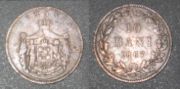
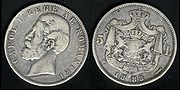 On April 22, 1867, a bimetallic currency was adopted, with the leu equal to 5 grams of 83.5% silver or 0.29032 grams of gold.
Before 1878 the silver Russian ruble
was valued so highly as to drive the native coins out of circulation. Consequently, in 1889, Romania unilaterally joined the Latin Monetary Union
and adopted a gold standard
. Silver
coins were legal tender only up to 50 lei. All taxes and customs dues were to be paid in gold and, owing to the small quantities issued from the Romanian mint, foreign gold coins were current, especially French 20-franc pieces (equal at par to 20 lei), Turkish gold lire
(22.70), old Russian imperials (20.60) and British sovereigns (25.22).
Romania left the gold standard in 1914 and the leu's value fell. The exchange rate was pegged at 167.20 lei = 1 U.S. Dollar on February 7, 1929, 135.95 lei on November 5, 1936, 204.29 lei on May 18, 1940, and 187.48 Lei on March 31, 1941. During Romania's World War II
alliance with Nazi Germany
, the leu was pegged to the Reichsmark
at a rate of 49.50 lei = 1 Reichsmark, falling to 59.5 lei in April 1941. During Soviet occupation, the exchange rate was 1 ruble = 100 lei. After the war, the value of the currency fell dramatically.
, to prepare for collectivization and to finalize the installation of communism
. At the time of its introduction, 150 new lei equalled 1 U.S. dollar.
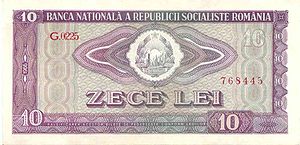 On January 28, 1952, another new leu was introduced. Unlike the previous revaluation, different rates were employed for different kinds of exchange (cash, bank deposits, debts etc.) and different amounts. These rates ranged from 20 to 400 "old lei" for 1 "new" leu. Again, no advance warning was given before the reform took place
During the communist era, the gold standard
was dropped after requiring severe adjustments to prevent inflation following the revaluations. After the gold standard was dropped, the leu lost convertibility and, between 1970 and 1989, the official exchange rate was fixed by the government through law. This exchange rate was used by the government to calculate the value of foreign trade, but foreign currency was not available to be bought and sold by private individuals. Owning or attempting to buy or sell foreign currency was a criminal offence, punishable with a prison sentence that could go up to 10 years (depending on the amount of foreign currency found under one's possession). International trade was therefore considered as part of another economic circuit than domestic trade, and given greater priority. This inflexibility and the existence of surplus money due to constant economic decline in the 1980s, mixed with the need for more foreign currency and the refusal of the very unpopular Ceauşescu
regime to accept inflation as a phenomenon in order to attain convertibility, led to one of the greatest supply side crises in Romanian history, culminating with the introduction of food rationing starting 1986/87 (actually the food rationing was introduced in the summer of 1980 - however it was extended to absolutely all basic foods only a few years later. The introduction of food rationing was carried on at different times in different regions ), and partly triggering the downfall of communism.
In the 1990s, after the downfall of communism, inflation ran high due to reform failures, the legalization of owning foreign currency in 1990, and the bankrupt policies of the former communist era, reaching rates as high as 300% per year in 1993. By September 2003, one euro
was exchanged for more than 40,000 lei, this being its peak value. Following a number of successful monetary policies in the late 1990s and early 2000s, the situation became gradually more stable, with one digit inflation in 2005.
The Romanian leu briefly held the dubious distinction of being the world's least valued currency unit
, from January (when the Turkish lira
dropped six zeros) to July 2005. However, the 1,000,000 lei bill was not the highest Romanian denomination ever. This distinction belongs to the 5 million lei bill from 1947.
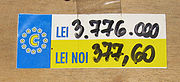 On 1 July 2005, the leu was revalued at the rate of 10,000 "old" lei (ROL) for one "new" leu (RON), thus psychologically bringing the purchasing power of the leu back in line with those of other major Western currencies. The term chosen for the action was "denominare", similar to the English "denomination", to signify not a conversion, but rather a total reinvention.
The first day brought difficulties adjusting to the new paper currencies and closed ATMs (that needed reprogramming) and forcing a new calculation habit that slowed down shops and annoyed some sales staff and older shoppers. The old ROL currency banknotes remained in circulation until December 31, 2006 (coins remained in circulation only until December 31, 2005), but all accounts have been converted starting July 1, 2005. There is no conversion time limit between the currencies. Retailers had to display prices in both old and new currency from March 1, 2005 until June 30, 2006. The appreciation of the leu during 2005 was about 20% against a basket of major currencies.
As of 2006, the revaluation is a potential source of confusion, especially to visitors, since both old and new currency values are commonly quoted. When written, the very large amounts in old currency are usually obvious, but in speaking inhabitants might refer to an amount of 5 new lei as simply "fifty" in reference to its value of 50,000 old lei.
s) first minted the next year. These were followed, between 1870 and 1873, by silver 50 bani, 1 and 2 lei. Silver 5 lei were added in 1880. Uniquely, the 1867 issue used the denomination 1 banu rather than 1 ban.
In 1900, cupro-nickel 5, 10 and 20 bani coins were introduced, with holed versions following in 1905. The production of coins ceased in 1914, recommencing in 1921 with aluminium 25 and 50 bani pieces. Cupro-nickel 1 and 2 lei coins were introduced in 1924, followed by nickel brass 10, 20 and 50 lei in 1930. In 1932, silver 100 lei coins were issued. However, inflation meant that, in 1935, smaller silver 250 lei coins were introduced with nickel 100 lei coins being issued in 1936, followed by nickel 50 lei in 1937.
In 1941 and 1942, zinc 2, 5 and 20 lei coins were introduced, together with silver 200 and 500 lei. Nickel-clad-steel 100 lei followed in 1943, with brass 200 and 500 lei issued in 1945. In 1946 and 1947, a new coinage was issued consisting of aluminium 500 lei, brass 2000 and 10,000 lei, and silver 25,000 and 100,000 lei.
Cupro-nickel 1 and 2 lei coins were introduced in 1924, followed by nickel brass 10, 20 and 50 lei in 1930.
In 1932, silver 100 lei coins were issued. However, inflation meant that, in 1935, smaller silver 250 lei coins were introduced with nickel 100 lei coins being issued in 1936, followed by nickel 50 lei in 1937.
, in denominations of 50 bani, 1, 2 and 5 lei. After the creation of the People's Republic, new coins were issued between 1948 and 1952, in denominations of 1, 2, 5 and 20 lei.
In 1960, a new coinage was introduced, consisting of 15 and 25 bani, with 5 bani, 1 and 3 lei coins added in 1963. All were struck in nickel-clad steel. In 1975, aluminium replaced steel in the 5 and 15 bani, with the same change happening for the 25 bani in 1982. Aluminium 5 lei were introduced in 1978.
Following the end of the communist regime, a new coinage was introduced between 1990 and 1992, consisting of 1 leu in bronze clad steel, 5 and 10 lei in nickel plated steel, 20 and 50 lei in brass clad steel and nickel plated steel 100 lei.
As inflation took its toll, 500, 1000 and 5000 lei coins were introduced in 1999, 2000 and 2001, respectively, and were the only coins circulating when the revaluation occurred. They were all criticized for being clumsy and difficult to use. The 500 lei coins were very thick (about 0.3 cm). Despite their small value, it took only a handful of such coins to fill one's pocket. They were also made of poor material and could be occasionally found with bite marks. The 1000 lei coin was considered too small and was also cheaply made, and the 5000 lei coin was not circular (it was a dodecagon
). This made it awkward to handle and difficult to use in slot machines, where it was frequently the only coin accepted. The 500, 1000 and 5000 lei coins became worth 5, 10 and 50 bani with the revaluation.
The 1 ban coin is rare and not in demand by either banks or retailers. In practice, retailers almost always round to the nearest 5 bani.
The new coins have also faced criticism. Their size and very simple (indeed crude) design make the coins hard to distinguish for the visually impaired. The quality of the materials used is also questionable, with coins becoming oxidized and dark within weeks from the initial release.
In 1914, 5 lei notes were reintroduced, followed by 1 and 2 lei notes in 1915 and 500 lei in 1916. The Ministry of Finance issued very small sized notes for 10, 25 and 50 bani in 1917. 500 lei notes were introduced in 1940, followed by 10,000 and 100,000 lei in 1945 and 1 and 5 million lei in 1947. In 1945, the Ministry of Finance issued 20 and 100 lei notes to replace those of the Banca Naționalăs.
In 1991, 500 and 1000 lei notes were introduced, followed by 200 and 5000 lei notes in 1992, 10,000 lei in 1994, 50,000 lei in 1996, 100,000 lei in 1998, 500,000 lei in 2000 and 1 million lei in 2003. There was also a 2,000 lei note
introduced in 1999; it celebrated the total solar eclipse that occurred on August 11, 1999. The final issues of the 2000, 10,000, 50,000, 100,000, 500,000 and 1 million lei were polymer notes
.
Notes in circulation at the revaluation were:
Romania
Romania is a country located at the crossroads of Central and Southeastern Europe, on the Lower Danube, within and outside the Carpathian arch, bordering on the Black Sea...
. It is subdivided into 100 bani (singular: ban). The name of the currency means "lion". On 1 July 2005, Romania underwent a currency reform, switching from the previous leu (ROL) to a new leu (RON). 1 RON is equal to 10,000 ROL. The currency of Moldova
Moldova
Moldova , officially the Republic of Moldova is a landlocked state in Eastern Europe, located between Romania to the West and Ukraine to the North, East and South. It declared itself an independent state with the same boundaries as the preceding Moldavian Soviet Socialist Republic in 1991, as part...
is also called the leu
Moldovan leu
The leu is the currency of Moldova. Like the Romanian leu, the Moldovan leu is subdivided into 100 bani . The name of the currency originates in Romania and means "lion".-History:...
, but is independent of the Romanian leu.
Romania joined the European Union
European Union
The European Union is an economic and political union of 27 independent member states which are located primarily in Europe. The EU traces its origins from the European Coal and Steel Community and the European Economic Community , formed by six countries in 1958...
on 1 January 2007 and it is expected to adopt the euro
Euro
The euro is the official currency of the eurozone: 17 of the 27 member states of the European Union. It is also the currency used by the Institutions of the European Union. The eurozone consists of Austria, Belgium, Cyprus, Estonia, Finland, France, Germany, Greece, Ireland, Italy, Luxembourg,...
in 2015.
First leu
Before 1878 the silver Russian ruble
Russian ruble
The ruble or rouble is the currency of the Russian Federation and the two partially recognized republics of Abkhazia and South Ossetia. Formerly, the ruble was also the currency of the Russian Empire and the Soviet Union prior to their breakups. Belarus and Transnistria also use currencies with...
was valued so highly as to drive the native coins out of circulation. Consequently, in 1889, Romania unilaterally joined the Latin Monetary Union
Latin Monetary Union
The Latin Monetary Union was a 19th century attempt to unify several European currencies, at a time when most circulating coins were still made of gold and silver...
and adopted a gold standard
Gold standard
The gold standard is a monetary system in which the standard economic unit of account is a fixed mass of gold. There are distinct kinds of gold standard...
. Silver
Silver
Silver is a metallic chemical element with the chemical symbol Ag and atomic number 47. A soft, white, lustrous transition metal, it has the highest electrical conductivity of any element and the highest thermal conductivity of any metal...
coins were legal tender only up to 50 lei. All taxes and customs dues were to be paid in gold and, owing to the small quantities issued from the Romanian mint, foreign gold coins were current, especially French 20-franc pieces (equal at par to 20 lei), Turkish gold lire
Turkish lira
The Turkish lira is the currency of Turkey and the de facto independent state of the Turkish Republic of Northern Cyprus. The lira is subdivided into 100 kuruş...
(22.70), old Russian imperials (20.60) and British sovereigns (25.22).
Romania left the gold standard in 1914 and the leu's value fell. The exchange rate was pegged at 167.20 lei = 1 U.S. Dollar on February 7, 1929, 135.95 lei on November 5, 1936, 204.29 lei on May 18, 1940, and 187.48 Lei on March 31, 1941. During Romania's World War II
World War II
World War II, or the Second World War , was a global conflict lasting from 1939 to 1945, involving most of the world's nations—including all of the great powers—eventually forming two opposing military alliances: the Allies and the Axis...
alliance with Nazi Germany
Nazi Germany
Nazi Germany , also known as the Third Reich , but officially called German Reich from 1933 to 1943 and Greater German Reich from 26 June 1943 onward, is the name commonly used to refer to the state of Germany from 1933 to 1945, when it was a totalitarian dictatorship ruled by...
, the leu was pegged to the Reichsmark
German reichsmark
The Reichsmark was the currency in Germany from 1924 until June 20, 1948. The Reichsmark was subdivided into 100 Reichspfennig.-History:...
at a rate of 49.50 lei = 1 Reichsmark, falling to 59.5 lei in April 1941. During Soviet occupation, the exchange rate was 1 ruble = 100 lei. After the war, the value of the currency fell dramatically.
Second leu
On August 15, 1947, a revaluation took place, with a new leu replacing the old one at a rate of 20,000 old lei = 1 new leu. This revaluation, called a monetary reform or stabilisation measure (, ), was carried out by the Communist authorities with absolutely no advance warning and without the possibility to exchange more than a fixed amount of money for the new currency. This was done in order to depose the former middle and upper classes of their last assets, after nationalizationNationalization
Nationalisation, also spelled nationalization, is the process of taking an industry or assets into government ownership by a national government or state. Nationalization usually refers to private assets, but may also mean assets owned by lower levels of government, such as municipalities, being...
, to prepare for collectivization and to finalize the installation of communism
Communism
Communism is a social, political and economic ideology that aims at the establishment of a classless, moneyless, revolutionary and stateless socialist society structured upon common ownership of the means of production...
. At the time of its introduction, 150 new lei equalled 1 U.S. dollar.
Third leu (ROL)
During the communist era, the gold standard
Gold standard
The gold standard is a monetary system in which the standard economic unit of account is a fixed mass of gold. There are distinct kinds of gold standard...
was dropped after requiring severe adjustments to prevent inflation following the revaluations. After the gold standard was dropped, the leu lost convertibility and, between 1970 and 1989, the official exchange rate was fixed by the government through law. This exchange rate was used by the government to calculate the value of foreign trade, but foreign currency was not available to be bought and sold by private individuals. Owning or attempting to buy or sell foreign currency was a criminal offence, punishable with a prison sentence that could go up to 10 years (depending on the amount of foreign currency found under one's possession). International trade was therefore considered as part of another economic circuit than domestic trade, and given greater priority. This inflexibility and the existence of surplus money due to constant economic decline in the 1980s, mixed with the need for more foreign currency and the refusal of the very unpopular Ceauşescu
Nicolae Ceausescu
Nicolae Ceaușescu was a Romanian Communist politician. He was General Secretary of the Romanian Communist Party from 1965 to 1989, and as such was the country's second and last Communist leader...
regime to accept inflation as a phenomenon in order to attain convertibility, led to one of the greatest supply side crises in Romanian history, culminating with the introduction of food rationing starting 1986/87 (actually the food rationing was introduced in the summer of 1980 - however it was extended to absolutely all basic foods only a few years later. The introduction of food rationing was carried on at different times in different regions ), and partly triggering the downfall of communism.
In the 1990s, after the downfall of communism, inflation ran high due to reform failures, the legalization of owning foreign currency in 1990, and the bankrupt policies of the former communist era, reaching rates as high as 300% per year in 1993. By September 2003, one euro
Euro
The euro is the official currency of the eurozone: 17 of the 27 member states of the European Union. It is also the currency used by the Institutions of the European Union. The eurozone consists of Austria, Belgium, Cyprus, Estonia, Finland, France, Germany, Greece, Ireland, Italy, Luxembourg,...
was exchanged for more than 40,000 lei, this being its peak value. Following a number of successful monetary policies in the late 1990s and early 2000s, the situation became gradually more stable, with one digit inflation in 2005.
The Romanian leu briefly held the dubious distinction of being the world's least valued currency unit
Least valued currency unit
The least valued currency unit is the currency in which a single unit buys the least number of any given other currency or the smallest amount of a given good. Most commonly, the calculation is made against a major reserve currency such as the United States dollar or the euro...
, from January (when the Turkish lira
Turkish lira
The Turkish lira is the currency of Turkey and the de facto independent state of the Turkish Republic of Northern Cyprus. The lira is subdivided into 100 kuruş...
dropped six zeros) to July 2005. However, the 1,000,000 lei bill was not the highest Romanian denomination ever. This distinction belongs to the 5 million lei bill from 1947.
Fourth leu (RON)
The first day brought difficulties adjusting to the new paper currencies and closed ATMs (that needed reprogramming) and forcing a new calculation habit that slowed down shops and annoyed some sales staff and older shoppers. The old ROL currency banknotes remained in circulation until December 31, 2006 (coins remained in circulation only until December 31, 2005), but all accounts have been converted starting July 1, 2005. There is no conversion time limit between the currencies. Retailers had to display prices in both old and new currency from March 1, 2005 until June 30, 2006. The appreciation of the leu during 2005 was about 20% against a basket of major currencies.
As of 2006, the revaluation is a potential source of confusion, especially to visitors, since both old and new currency values are commonly quoted. When written, the very large amounts in old currency are usually obvious, but in speaking inhabitants might refer to an amount of 5 new lei as simply "fifty" in reference to its value of 50,000 old lei.
Future: Euro
The euro is expected to replace the leu on 1 January 2015.First leu
In 1867, copper 1, 2, 5 and 10 bani were issued, with gold 20 lei (known as poli after the French NapoleonNapoleon (coin)
The Napoleon is the colloquial term for a former French gold coin. The coins were minted in denominations of , , , , and francs. This article will focus on the 20 franc coins issued during the reign of Napoleon, which are 21 mm in diameter, weigh 6.45 grams and, at 90% pure, contain 0.1867...
s) first minted the next year. These were followed, between 1870 and 1873, by silver 50 bani, 1 and 2 lei. Silver 5 lei were added in 1880. Uniquely, the 1867 issue used the denomination 1 banu rather than 1 ban.
In 1900, cupro-nickel 5, 10 and 20 bani coins were introduced, with holed versions following in 1905. The production of coins ceased in 1914, recommencing in 1921 with aluminium 25 and 50 bani pieces. Cupro-nickel 1 and 2 lei coins were introduced in 1924, followed by nickel brass 10, 20 and 50 lei in 1930. In 1932, silver 100 lei coins were issued. However, inflation meant that, in 1935, smaller silver 250 lei coins were introduced with nickel 100 lei coins being issued in 1936, followed by nickel 50 lei in 1937.
In 1941 and 1942, zinc 2, 5 and 20 lei coins were introduced, together with silver 200 and 500 lei. Nickel-clad-steel 100 lei followed in 1943, with brass 200 and 500 lei issued in 1945. In 1946 and 1947, a new coinage was issued consisting of aluminium 500 lei, brass 2000 and 10,000 lei, and silver 25,000 and 100,000 lei.
King Carol I
| First Leu Coins — 1905 Series | ||||||||||
|---|---|---|---|---|---|---|---|---|---|---|
| Image | Value | Technical parameters | Description | Date of | ||||||
| Diameter | Mass | Composition | Edge | Obverse | Reverse | first minting | withdrawal | lapse | ||
| 5 bani | 19 mm | 2.5 g | Copper Copper Copper is a chemical element with the symbol Cu and atomic number 29. It is a ductile metal with very high thermal and electrical conductivity. Pure copper is soft and malleable; an exposed surface has a reddish-orange tarnish... 75%, Nickel Nickel Nickel is a chemical element with the chemical symbol Ni and atomic number 28. It is a silvery-white lustrous metal with a slight golden tinge. Nickel belongs to the transition metals and is hard and ductile... 25% |
Smooth | Value, year of minting, two roses | Royal Crown, state title on a ribbon | 1905 | |||
| 10 bani | 22 mm | 4 g | ||||||||
| 20 bani | 25 mm | 7 g | ||||||||
| 1 leu | 23 mm | 5 g | Silver Silver Silver is a metallic chemical element with the chemical symbol Ag and atomic number 47. A soft, white, lustrous transition metal, it has the highest electrical conductivity of any element and the highest thermal conductivity of any metal... 83.5%, Copper Copper Copper is a chemical element with the symbol Cu and atomic number 29. It is a ductile metal with very high thermal and electrical conductivity. Pure copper is soft and malleable; an exposed surface has a reddish-orange tarnish... 16.5% |
Milled | Value, "CAROL I DOMNUL ROMANIEI ("Carol I Carol I of Romania Carol I , born Prince Karl of Hohenzollern-Sigmaringen was reigning prince and then King of Romania from 1866 to 1914. He was elected prince of Romania on 20 April 1866 following the overthrow of Alexandru Ioan Cuza by a palace coup... Prince Domnitor Domnitor was the official title of the ruler of the United Principalities of Wallachia and Moldavia between 1859 and 1866.... of Romania"), the effigy of Prince Carol I Carol I of Romania Carol I , born Prince Karl of Hohenzollern-Sigmaringen was reigning prince and then King of Romania from 1866 to 1914. He was elected prince of Romania on 20 April 1866 following the overthrow of Alexandru Ioan Cuza by a palace coup... |
"1866 - 1906", "CAROL I REGE AL ROMANIEI" ("Carol I Carol I of Romania Carol I , born Prince Karl of Hohenzollern-Sigmaringen was reigning prince and then King of Romania from 1866 to 1914. He was elected prince of Romania on 20 April 1866 following the overthrow of Alexandru Ioan Cuza by a palace coup... King of Romania"), the effigy of the King |
1906 | |||
| 5 lei | 38 mm | 25 g | Silver Silver Silver is a metallic chemical element with the chemical symbol Ag and atomic number 47. A soft, white, lustrous transition metal, it has the highest electrical conductivity of any element and the highest thermal conductivity of any metal... 90%, Copper Copper Copper is a chemical element with the symbol Cu and atomic number 29. It is a ductile metal with very high thermal and electrical conductivity. Pure copper is soft and malleable; an exposed surface has a reddish-orange tarnish... 10% |
|||||||
| First Leu Coins — 1910 Series | ||||||||||
|---|---|---|---|---|---|---|---|---|---|---|
| Image | Value | Technical parameters | Description | Date of | ||||||
| Diameter | Mass | Composition | Edge | Obverse | Reverse | first minting | withdrawal | lapse | ||
| 50 bani | 18 mm | 2.5 g | Silver Silver Silver is a metallic chemical element with the chemical symbol Ag and atomic number 47. A soft, white, lustrous transition metal, it has the highest electrical conductivity of any element and the highest thermal conductivity of any metal... 83.5%, Copper Copper Copper is a chemical element with the symbol Cu and atomic number 29. It is a ductile metal with very high thermal and electrical conductivity. Pure copper is soft and malleable; an exposed surface has a reddish-orange tarnish... 16.5% |
Milled | State title, value, year of minting, olive branch, Royal Crown | "CAROL I REGE AL ROMANIEI" ("Carol I Carol I of Romania Carol I , born Prince Karl of Hohenzollern-Sigmaringen was reigning prince and then King of Romania from 1866 to 1914. He was elected prince of Romania on 20 April 1866 following the overthrow of Alexandru Ioan Cuza by a palace coup... King of Romania"), the effigy of the King |
1910 | |||
| 1 leu | 23 mm | 5 g | State title, value, year of minting, peasant woman | |||||||
| 2 lei | 27 mm | 10 g | ||||||||
King Ferdinand I
The production of coins ceased in 1914, recommencing in 1921 with aluminium 25 and 50 bani pieces.| First Leu Coins — 1921 Series | ||||||||||
|---|---|---|---|---|---|---|---|---|---|---|
| Image | Value | Technical parameters | Description | Date of | ||||||
| Diameter | Mass | Composition | Edge | Obverse | Reverse | first minting | withdrawal | lapse | ||
| 25 bani | 19 mm | 0.896 g | Aluminium Aluminium Aluminium or aluminum is a silvery white member of the boron group of chemical elements. It has the symbol Al, and its atomic number is 13. It is not soluble in water under normal circumstances.... |
Smooth | Value, Royal Crown | Eagle, state title, year of minting | 1921 | |||
| 50 bani | 21 mm | 1.203 g | ||||||||
Cupro-nickel 1 and 2 lei coins were introduced in 1924, followed by nickel brass 10, 20 and 50 lei in 1930.
| First Leu Coins — 1924 Series | ||||||||||
|---|---|---|---|---|---|---|---|---|---|---|
| Image | Value | Technical parameters | Description | Date of | ||||||
| Diameter | Mass | Composition | Edge | Obverse | Reverse | first minting | withdrawal | lapse | ||
| 1 leu | 21 mm | 3.5 g | Copper Copper Copper is a chemical element with the symbol Cu and atomic number 29. It is a ductile metal with very high thermal and electrical conductivity. Pure copper is soft and malleable; an exposed surface has a reddish-orange tarnish... 75%, Nickel Nickel Nickel is a chemical element with the chemical symbol Ni and atomic number 28. It is a silvery-white lustrous metal with a slight golden tinge. Nickel belongs to the transition metals and is hard and ductile... 25% |
Milled | "BUN PENTRU 'VALUE'" ("Good for 'value'") , weat wreath | State title, Middle coat of arms Coat of arms of Romania The coat of arms of Romania was adopted in the Romanian Parliament on 10 September 1992 as a representative coat of arms for Romania. It is based on the Lesser Coat of Arms of the Kingdom of Romania , redesigned by Victor Dima. As a central element it shows a golden aquila holding a cross in its... , ***, year of minting, *** |
1924 | |||
| 2 lei | 25 mm | 7 g | ||||||||
King Michael I (first reign)
| First Leu Coins — 1930 Series | ||||||||||
|---|---|---|---|---|---|---|---|---|---|---|
| Image | Value | Technical parameters | Description | Date of | ||||||
| Diameter | Mass | Composition | Edge | Obverse | Reverse | first minting | withdrawal | lapse | ||
| 5 lei | 21 mm | 3.5 g | Copper Copper Copper is a chemical element with the symbol Cu and atomic number 29. It is a ductile metal with very high thermal and electrical conductivity. Pure copper is soft and malleable; an exposed surface has a reddish-orange tarnish... 79%, Zinc Zinc Zinc , or spelter , is a metallic chemical element; it has the symbol Zn and atomic number 30. It is the first element in group 12 of the periodic table. Zinc is, in some respects, chemically similar to magnesium, because its ion is of similar size and its only common oxidation state is +2... 20%, Nickel Nickel Nickel is a chemical element with the chemical symbol Ni and atomic number 28. It is a silvery-white lustrous metal with a slight golden tinge. Nickel belongs to the transition metals and is hard and ductile... 1% |
Milled | Value Lesser coat of arms Coat of arms of Romania The coat of arms of Romania was adopted in the Romanian Parliament on 10 September 1992 as a representative coat of arms for Romania. It is based on the Lesser Coat of Arms of the Kingdom of Romania , redesigned by Victor Dima. As a central element it shows a golden aquila holding a cross in its... , six five-pointed stars |
"MIHAI I REGELE ROMANIEI" ("Michael I Michael I of Romania Michael was the last King of Romania. He reigned from 20 July 1927 to 8 June 1930, and again from 6 September 1940 until 30 December 1947 when he was forced, by the Communist Party of Romania , to abdicate to the Soviet armies of occupation... King of Romania"), effigy of the King, year of minting |
1930 | most probably 1930 | ||
| 20 lei | 27 mm | 7.5 g | Value, group of dancing peasant women | |||||||
King Carol II
| First Leu Coins — 1930 Series | ||||||||||
|---|---|---|---|---|---|---|---|---|---|---|
| Image | Value | Technical parameters | Description | Date of | ||||||
| Diameter | Mass | Composition | Edge | Obverse | Reverse | first minting | withdrawal | lapse | ||
| 10 lei | 23 mm | 5 g | Copper Copper Copper is a chemical element with the symbol Cu and atomic number 29. It is a ductile metal with very high thermal and electrical conductivity. Pure copper is soft and malleable; an exposed surface has a reddish-orange tarnish... 79%, Zinc Zinc Zinc , or spelter , is a metallic chemical element; it has the symbol Zn and atomic number 30. It is the first element in group 12 of the periodic table. Zinc is, in some respects, chemically similar to magnesium, because its ion is of similar size and its only common oxidation state is +2... 20%, Nickel Nickel Nickel is a chemical element with the chemical symbol Ni and atomic number 28. It is a silvery-white lustrous metal with a slight golden tinge. Nickel belongs to the transition metals and is hard and ductile... 1% |
Milled | Value, the eagle from the coat of arms Coat of arms of Romania The coat of arms of Romania was adopted in the Romanian Parliament on 10 September 1992 as a representative coat of arms for Romania. It is based on the Lesser Coat of Arms of the Kingdom of Romania , redesigned by Victor Dima. As a central element it shows a golden aquila holding a cross in its... wearing on the shield the Royal Cypher Royal Cypher In modern heraldry, a royal cypher is a monogram-like device of a country's reigning sovereign, typically consisting of the initials of the monarch's name and title, sometimes interwoven and often surmounted by a crown. In the case where such a cypher is used by an emperor or empress, it is called... of King Carol II Carol II of Romania Carol II reigned as King of Romania from 8 June 1930 until 6 September 1940. Eldest son of Ferdinand, King of Romania, and his wife, Queen Marie, a daughter of Prince Alfred, Duke of Edinburgh, the second eldest son of Queen Victoria... , effigy of the King, year of minting |
"CAROL II REGELE ROMANIEI" ("Carol II Carol II of Romania Carol II reigned as King of Romania from 8 June 1930 until 6 September 1940. Eldest son of Ferdinand, King of Romania, and his wife, Queen Marie, a daughter of Prince Alfred, Duke of Edinburgh, the second eldest son of Queen Victoria... King of the Romanians"), year of minting |
1930 | |||
| 20 lei | 27 mm | 7.5 g | ||||||||
In 1932, silver 100 lei coins were issued. However, inflation meant that, in 1935, smaller silver 250 lei coins were introduced with nickel 100 lei coins being issued in 1936, followed by nickel 50 lei in 1937.
| First Leu Coins — 1932 Series | ||||||||||
|---|---|---|---|---|---|---|---|---|---|---|
| Image | Value | Technical parameters | Description | Date of | ||||||
| Diameter | Mass | Composition | Edge | Obverse | Reverse | first minting | withdrawal | lapse | ||
| 100 lei | 31 mm | 14 g | Silver Silver Silver is a metallic chemical element with the chemical symbol Ag and atomic number 47. A soft, white, lustrous transition metal, it has the highest electrical conductivity of any element and the highest thermal conductivity of any metal... 50%, Copper Copper Copper is a chemical element with the symbol Cu and atomic number 29. It is a ductile metal with very high thermal and electrical conductivity. Pure copper is soft and malleable; an exposed surface has a reddish-orange tarnish... 40%, Zinc Zinc Zinc , or spelter , is a metallic chemical element; it has the symbol Zn and atomic number 30. It is the first element in group 12 of the periodic table. Zinc is, in some respects, chemically similar to magnesium, because its ion is of similar size and its only common oxidation state is +2... 5%, Nickel Nickel Nickel is a chemical element with the chemical symbol Ni and atomic number 28. It is a silvery-white lustrous metal with a slight golden tinge. Nickel belongs to the transition metals and is hard and ductile... 5% |
Milled | Value, the eagle from the coat of arms Coat of arms of Romania The coat of arms of Romania was adopted in the Romanian Parliament on 10 September 1992 as a representative coat of arms for Romania. It is based on the Lesser Coat of Arms of the Kingdom of Romania , redesigned by Victor Dima. As a central element it shows a golden aquila holding a cross in its... , laurel leaves |
"CAROL II REGELE ROMANIEI" ("Carol II Carol II of Romania Carol II reigned as King of Romania from 8 June 1930 until 6 September 1940. Eldest son of Ferdinand, King of Romania, and his wife, Queen Marie, a daughter of Prince Alfred, Duke of Edinburgh, the second eldest son of Queen Victoria... King of the Romanians"), effigy of the King, year of minting |
1932 | |||
| 250 lei | 29 mm | 13.5 g | Silver Silver Silver is a metallic chemical element with the chemical symbol Ag and atomic number 47. A soft, white, lustrous transition metal, it has the highest electrical conductivity of any element and the highest thermal conductivity of any metal... 75%, Copper Copper Copper is a chemical element with the symbol Cu and atomic number 29. It is a ductile metal with very high thermal and electrical conductivity. Pure copper is soft and malleable; an exposed surface has a reddish-orange tarnish... 25% |
Value, the eagle from the coat of arms Coat of arms of Romania The coat of arms of Romania was adopted in the Romanian Parliament on 10 September 1992 as a representative coat of arms for Romania. It is based on the Lesser Coat of Arms of the Kingdom of Romania , redesigned by Victor Dima. As a central element it shows a golden aquila holding a cross in its... |
1935 | |||||
| First Leu Coins — 1936 Series | ||||||||||
|---|---|---|---|---|---|---|---|---|---|---|
| Image | Value | Technical parameters | Description | Date of | ||||||
| Diameter | Mass | Composition | Edge | Obverse | Reverse | first minting | withdrawal | lapse | ||
| 50 lei | 24 mm | 5.83 g | Nickel Nickel Nickel is a chemical element with the chemical symbol Ni and atomic number 28. It is a silvery-white lustrous metal with a slight golden tinge. Nickel belongs to the transition metals and is hard and ductile... 97.5% |
Milled | Value, the small shield from the coat of arms Coat of arms of Romania The coat of arms of Romania was adopted in the Romanian Parliament on 10 September 1992 as a representative coat of arms for Romania. It is based on the Lesser Coat of Arms of the Kingdom of Romania , redesigned by Victor Dima. As a central element it shows a golden aquila holding a cross in its... timbered by the Steel Crown, laurel and oak leaves, year of minting |
"CAROL II REGELE ROMANIEI" ("Carol II Carol II of Romania Carol II reigned as King of Romania from 8 June 1930 until 6 September 1940. Eldest son of Ferdinand, King of Romania, and his wife, Queen Marie, a daughter of Prince Alfred, Duke of Edinburgh, the second eldest son of Queen Victoria... King of the Romanians"), portrait of the King wearing a parade military helmet |
1937 | |||
| 100 lei | 27 mm | 8.2 g | "CAROL II REGELE ROMANIEI" ("Carol II Carol II of Romania Carol II reigned as King of Romania from 8 June 1930 until 6 September 1940. Eldest son of Ferdinand, King of Romania, and his wife, Queen Marie, a daughter of Prince Alfred, Duke of Edinburgh, the second eldest son of Queen Victoria... King of the Romanians"), effigy of the King |
1936 | ||||||
Second leu
In 1947, coins were issued before the overthrow of King Michael IMichael I of Romania
Michael was the last King of Romania. He reigned from 20 July 1927 to 8 June 1930, and again from 6 September 1940 until 30 December 1947 when he was forced, by the Communist Party of Romania , to abdicate to the Soviet armies of occupation...
, in denominations of 50 bani, 1, 2 and 5 lei. After the creation of the People's Republic, new coins were issued between 1948 and 1952, in denominations of 1, 2, 5 and 20 lei.
Third leu
In 1952, coins were introduced in denominations of 1, 3, 5, 10 and 25 bani, with the 1, 3 and 5 struck in aluminium bronze and the others in cupro-nickel. In 1955, cupro-nickel 50 bani were added.In 1960, a new coinage was introduced, consisting of 15 and 25 bani, with 5 bani, 1 and 3 lei coins added in 1963. All were struck in nickel-clad steel. In 1975, aluminium replaced steel in the 5 and 15 bani, with the same change happening for the 25 bani in 1982. Aluminium 5 lei were introduced in 1978.
| Third Leu Coins — 1960 Series | ||||||||||
|---|---|---|---|---|---|---|---|---|---|---|
| Image | Value | Technical parameters | Description | Date of | ||||||
| Diameter | Mass | Composition | Edge | Obverse | Reverse | first minting | withdrawal | lapse | ||
| 5 bani | Nickel Nickel Nickel is a chemical element with the chemical symbol Ni and atomic number 28. It is a silvery-white lustrous metal with a slight golden tinge. Nickel belongs to the transition metals and is hard and ductile... plated steel Steel Steel is an alloy that consists mostly of iron and has a carbon content between 0.2% and 2.1% by weight, depending on the grade. Carbon is the most common alloying material for iron, but various other alloying elements are used, such as manganese, chromium, vanadium, and tungsten... |
Smooth | Value, year of minting | Coat of arms Coat of arms of Romania The coat of arms of Romania was adopted in the Romanian Parliament on 10 September 1992 as a representative coat of arms for Romania. It is based on the Lesser Coat of Arms of the Kingdom of Romania , redesigned by Victor Dima. As a central element it shows a golden aquila holding a cross in its... , state title |
1960 | 1966 | ||||
| 15 bani | Nickel Nickel Nickel is a chemical element with the chemical symbol Ni and atomic number 28. It is a silvery-white lustrous metal with a slight golden tinge. Nickel belongs to the transition metals and is hard and ductile... plated steel Steel Steel is an alloy that consists mostly of iron and has a carbon content between 0.2% and 2.1% by weight, depending on the grade. Carbon is the most common alloying material for iron, but various other alloying elements are used, such as manganese, chromium, vanadium, and tungsten... |
Value, olive leaves | ||||||||
| 25 bani | Nickel Nickel Nickel is a chemical element with the chemical symbol Ni and atomic number 28. It is a silvery-white lustrous metal with a slight golden tinge. Nickel belongs to the transition metals and is hard and ductile... plated steel Steel Steel is an alloy that consists mostly of iron and has a carbon content between 0.2% and 2.1% by weight, depending on the grade. Carbon is the most common alloying material for iron, but various other alloying elements are used, such as manganese, chromium, vanadium, and tungsten... |
Value, agricultural scene, weat | ||||||||
| 1 leu | Nickel Nickel Nickel is a chemical element with the chemical symbol Ni and atomic number 28. It is a silvery-white lustrous metal with a slight golden tinge. Nickel belongs to the transition metals and is hard and ductile... plated steel Steel Steel is an alloy that consists mostly of iron and has a carbon content between 0.2% and 2.1% by weight, depending on the grade. Carbon is the most common alloying material for iron, but various other alloying elements are used, such as manganese, chromium, vanadium, and tungsten... |
Value, agricultural landscape; industrial elements in the background | 1963 | |||||||
| 3 lei | Nickel Nickel Nickel is a chemical element with the chemical symbol Ni and atomic number 28. It is a silvery-white lustrous metal with a slight golden tinge. Nickel belongs to the transition metals and is hard and ductile... plated steel Steel Steel is an alloy that consists mostly of iron and has a carbon content between 0.2% and 2.1% by weight, depending on the grade. Carbon is the most common alloying material for iron, but various other alloying elements are used, such as manganese, chromium, vanadium, and tungsten... |
"~*~*" | Value, industrial landscape | |||||||
| Third Leu Coins — 1966 Series | ||||||||||
|---|---|---|---|---|---|---|---|---|---|---|
| Image | | Value | | Technical parameters | | Description | | Date of | ||||||
| Diameter | Mass | Composition | Edge | Obverse | Reverse | first minting | withdrawal | lapse | ||
| 5 bani | Nickel Nickel Nickel is a chemical element with the chemical symbol Ni and atomic number 28. It is a silvery-white lustrous metal with a slight golden tinge. Nickel belongs to the transition metals and is hard and ductile... plated steel Steel Steel is an alloy that consists mostly of iron and has a carbon content between 0.2% and 2.1% by weight, depending on the grade. Carbon is the most common alloying material for iron, but various other alloying elements are used, such as manganese, chromium, vanadium, and tungsten... |
Smooth | Value, year of minting | Coat of arms Coat of arms of Romania The coat of arms of Romania was adopted in the Romanian Parliament on 10 September 1992 as a representative coat of arms for Romania. It is based on the Lesser Coat of Arms of the Kingdom of Romania , redesigned by Victor Dima. As a central element it shows a golden aquila holding a cross in its... , state title |
1966 | 1992 | ||||
| Aluminium Aluminium Aluminium or aluminum is a silvery white member of the boron group of chemical elements. It has the symbol Al, and its atomic number is 13. It is not soluble in water under normal circumstances.... |
1975 | |||||||||
| 15 bani | Nickel Nickel Nickel is a chemical element with the chemical symbol Ni and atomic number 28. It is a silvery-white lustrous metal with a slight golden tinge. Nickel belongs to the transition metals and is hard and ductile... plated steel Steel Steel is an alloy that consists mostly of iron and has a carbon content between 0.2% and 2.1% by weight, depending on the grade. Carbon is the most common alloying material for iron, but various other alloying elements are used, such as manganese, chromium, vanadium, and tungsten... |
Value, olive leaves | Coat of arms Coat of arms of Romania The coat of arms of Romania was adopted in the Romanian Parliament on 10 September 1992 as a representative coat of arms for Romania. It is based on the Lesser Coat of Arms of the Kingdom of Romania , redesigned by Victor Dima. As a central element it shows a golden aquila holding a cross in its... , state title, year of minting |
1966 | ||||||
| Aluminium Aluminium Aluminium or aluminum is a silvery white member of the boron group of chemical elements. It has the symbol Al, and its atomic number is 13. It is not soluble in water under normal circumstances.... |
1975 | |||||||||
| 25 bani | Nickel Nickel Nickel is a chemical element with the chemical symbol Ni and atomic number 28. It is a silvery-white lustrous metal with a slight golden tinge. Nickel belongs to the transition metals and is hard and ductile... plated steel Steel Steel is an alloy that consists mostly of iron and has a carbon content between 0.2% and 2.1% by weight, depending on the grade. Carbon is the most common alloying material for iron, but various other alloying elements are used, such as manganese, chromium, vanadium, and tungsten... |
Value, agricultural scene, weat | 1966 | |||||||
| Aluminium Aluminium Aluminium or aluminum is a silvery white member of the boron group of chemical elements. It has the symbol Al, and its atomic number is 13. It is not soluble in water under normal circumstances.... |
1982 | |||||||||
| 1 leu | Nickel Nickel Nickel is a chemical element with the chemical symbol Ni and atomic number 28. It is a silvery-white lustrous metal with a slight golden tinge. Nickel belongs to the transition metals and is hard and ductile... plated steel Steel Steel is an alloy that consists mostly of iron and has a carbon content between 0.2% and 2.1% by weight, depending on the grade. Carbon is the most common alloying material for iron, but various other alloying elements are used, such as manganese, chromium, vanadium, and tungsten... |
Value, agricultural landscape; industrial elements in the background | 1966 | |||||||
| 3 lei | Nickel Nickel Nickel is a chemical element with the chemical symbol Ni and atomic number 28. It is a silvery-white lustrous metal with a slight golden tinge. Nickel belongs to the transition metals and is hard and ductile... plated steel Steel Steel is an alloy that consists mostly of iron and has a carbon content between 0.2% and 2.1% by weight, depending on the grade. Carbon is the most common alloying material for iron, but various other alloying elements are used, such as manganese, chromium, vanadium, and tungsten... |
"~*~*" | Value, industrial landscape | 1966 | ||||||
| 5 lei | Aluminium Aluminium Aluminium or aluminum is a silvery white member of the boron group of chemical elements. It has the symbol Al, and its atomic number is 13. It is not soluble in water under normal circumstances.... |
Value, industrial scene | 1978 | |||||||
Following the end of the communist regime, a new coinage was introduced between 1990 and 1992, consisting of 1 leu in bronze clad steel, 5 and 10 lei in nickel plated steel, 20 and 50 lei in brass clad steel and nickel plated steel 100 lei.
| Third Leu Coins — 1990 Series | ||||||||||
|---|---|---|---|---|---|---|---|---|---|---|
| Image | | Value | | Technical parameters | | Description | | Date of | ||||||
| Diameter | Mass | Composition | Edge | Obverse | Reverse | first minting | withdrawal | lapse | ||
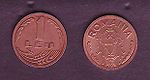 |
1 leu | 19 mm | 2.50 g | Copper Copper Copper is a chemical element with the symbol Cu and atomic number 29. It is a ductile metal with very high thermal and electrical conductivity. Pure copper is soft and malleable; an exposed surface has a reddish-orange tarnish... plated steel Steel Steel is an alloy that consists mostly of iron and has a carbon content between 0.2% and 2.1% by weight, depending on the grade. Carbon is the most common alloying material for iron, but various other alloying elements are used, such as manganese, chromium, vanadium, and tungsten... |
Smooth | Value, oak leaves, weat | Insignia of the National Bank, state title, year of minting, oak leaves | 1992 | 1 July 2005 | Indefinite |
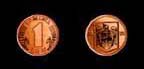 |
Value, state title, weat | Coat of arms Coat of arms of Romania The coat of arms of Romania was adopted in the Romanian Parliament on 10 September 1992 as a representative coat of arms for Romania. It is based on the Lesser Coat of Arms of the Kingdom of Romania , redesigned by Victor Dima. As a central element it shows a golden aquila holding a cross in its... , year of minting |
1993 | 1 July 2005 | Indefinite | |||||
 |
5 lei | 21 mm | 3.35 g | Nickel Nickel Nickel is a chemical element with the chemical symbol Ni and atomic number 28. It is a silvery-white lustrous metal with a slight golden tinge. Nickel belongs to the transition metals and is hard and ductile... plated steel Steel Steel is an alloy that consists mostly of iron and has a carbon content between 0.2% and 2.1% by weight, depending on the grade. Carbon is the most common alloying material for iron, but various other alloying elements are used, such as manganese, chromium, vanadium, and tungsten... |
Smooth | State Title, value, oak leaves | Coat of arms Coat of arms of Romania The coat of arms of Romania was adopted in the Romanian Parliament on 10 September 1992 as a representative coat of arms for Romania. It is based on the Lesser Coat of Arms of the Kingdom of Romania , redesigned by Victor Dima. As a central element it shows a golden aquila holding a cross in its... , year of minting |
1992 | 2004 (?) | (?) |
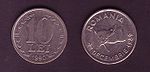 |
10 lei | 23 mm | 4.65 g | "~ ♦ ~ ♦ ~ ♦" | Value, year of minting, olive leaves | Flag Flag of Romania The national flag of Romania is a tricolour with vertical stripes: beginning from the flagpole, blue, yellow and red. It has a width-length ratio of 2:3.... , state title, "22 DECEMBRIE 1989" |
1990 | |||
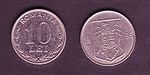 |
5 g | Smooth | State title, value, olive leaves | Coat of arms Coat of arms of Romania The coat of arms of Romania was adopted in the Romanian Parliament on 10 September 1992 as a representative coat of arms for Romania. It is based on the Lesser Coat of Arms of the Kingdom of Romania , redesigned by Victor Dima. As a central element it shows a golden aquila holding a cross in its... , year of minting |
1992 | |||||
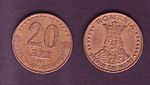 |
20 lei | 24 mm | 5 g | Brass Brass Brass is an alloy of copper and zinc; the proportions of zinc and copper can be varied to create a range of brasses with varying properties.In comparison, bronze is principally an alloy of copper and tin... plated steel Steel Steel is an alloy that consists mostly of iron and has a carbon content between 0.2% and 2.1% by weight, depending on the grade. Carbon is the most common alloying material for iron, but various other alloying elements are used, such as manganese, chromium, vanadium, and tungsten... |
Smooth | Value, oak leaves, year of minting | Ştefan cel Mare Stephen III of Moldavia Stephen III of Moldavia was Prince of Moldavia between 1457 and 1504 and the most prominent representative of the House of Mușat.During his reign, he strengthened Moldavia and maintained its independence against the ambitions of Hungary, Poland, and the... , state title, "ŞTEFAN CEL MARE" |
1991 | 2004 (?) | (?) |
 |
50 lei | 26 mm | 5.9 g | Value, olive leaves, year of minting | Alexandru Ioan Cuza Alexander John Cuza Alexander John Cuza was a Moldavian-born Romanian politician who ruled as the first Domnitor of the United Principalities of Moldavia and Wallachia between 1859 and 1866.-Early life:... , state title, "ALEXANDRU IOAN CUZA" |
1991 | ||||
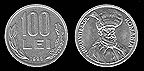 |
100 lei | 29 mm | 8.75 g | Nickel Nickel Nickel is a chemical element with the chemical symbol Ni and atomic number 28. It is a silvery-white lustrous metal with a slight golden tinge. Nickel belongs to the transition metals and is hard and ductile... plated steel Steel Steel is an alloy that consists mostly of iron and has a carbon content between 0.2% and 2.1% by weight, depending on the grade. Carbon is the most common alloying material for iron, but various other alloying elements are used, such as manganese, chromium, vanadium, and tungsten... |
"ROMANIA *** ROMANIA *** ROMANIA ***" | Value, oak leaves, olive leaves, year of minting | Mihai Viteazul, state title, "MIHAI VITEAZUL" | 1991 | 1 July 2005 | Indefinite |
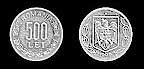 |
500 lei | 24 mm | 3.75 g | Magnesium Magnesium Magnesium is a chemical element with the symbol Mg, atomic number 12, and common oxidation number +2. It is an alkaline earth metal and the eighth most abundant element in the Earth's crust and ninth in the known universe as a whole... - Aluminium Aluminium Aluminium or aluminum is a silvery white member of the boron group of chemical elements. It has the symbol Al, and its atomic number is 13. It is not soluble in water under normal circumstances.... alloy Alloy An alloy is a mixture or metallic solid solution composed of two or more elements. Complete solid solution alloys give single solid phase microstructure, while partial solutions give two or more phases that may or may not be homogeneous in distribution, depending on thermal history... (AlMg3) |
"ROMANIA ♦ ROMANIA ♦ ROMANIA ♦" | State title, value, olive leaves | Coat of arms Coat of arms of Romania The coat of arms of Romania was adopted in the Romanian Parliament on 10 September 1992 as a representative coat of arms for Romania. It is based on the Lesser Coat of Arms of the Kingdom of Romania , redesigned by Victor Dima. As a central element it shows a golden aquila holding a cross in its... , year of minting, olive leaves |
1999 | ||
| State title, value, Coat of arms Coat of arms of Romania The coat of arms of Romania was adopted in the Romanian Parliament on 10 September 1992 as a representative coat of arms for Romania. It is based on the Lesser Coat of Arms of the Kingdom of Romania , redesigned by Victor Dima. As a central element it shows a golden aquila holding a cross in its... , year of minting, a moon eclipsing the Sun Sun The Sun is the star at the center of the Solar System. It is almost perfectly spherical and consists of hot plasma interwoven with magnetic fields... |
"ECLIPSA TOTALǍ DE SOARE 11 AUGUST 1999", alegoric representation of the eclipse, "99" | 1999 | ||||||||
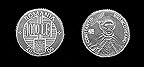 |
1,000 lei | 22 mm | 2 g | Alternately smooth and milled | State title, value, year of minting, Coat of arms Coat of arms of Romania The coat of arms of Romania was adopted in the Romanian Parliament on 10 September 1992 as a representative coat of arms for Romania. It is based on the Lesser Coat of Arms of the Kingdom of Romania , redesigned by Victor Dima. As a central element it shows a golden aquila holding a cross in its... |
Constantin Brâncoveanu Constantin Brâncoveanu Constantin Brâncoveanu was Prince of Wallachia between 1688 and 1714.-Ascension:A descendant of the Craioveşti boyar family and related to Matei Basarab, Brâncoveanu was born at the estate of Brâncoveni and raised in the house of his uncle, stolnic Constantin Cantacuzino... , years of rule, "CONSTANTIN BRANCOVEANU" |
2000 | |||
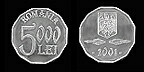 |
5,000 lei | 24 mm dodecagonal |
2.50 g | Twelve edges | State title, value | Coat of arms Coat of arms of Romania The coat of arms of Romania was adopted in the Romanian Parliament on 10 September 1992 as a representative coat of arms for Romania. It is based on the Lesser Coat of Arms of the Kingdom of Romania , redesigned by Victor Dima. As a central element it shows a golden aquila holding a cross in its... , year of minting, ornamental leaves |
2001 | |||
As inflation took its toll, 500, 1000 and 5000 lei coins were introduced in 1999, 2000 and 2001, respectively, and were the only coins circulating when the revaluation occurred. They were all criticized for being clumsy and difficult to use. The 500 lei coins were very thick (about 0.3 cm). Despite their small value, it took only a handful of such coins to fill one's pocket. They were also made of poor material and could be occasionally found with bite marks. The 1000 lei coin was considered too small and was also cheaply made, and the 5000 lei coin was not circular (it was a dodecagon
Dodecagon
In geometry, a dodecagon is any polygon with twelve sides and twelve angles.- Regular dodecagon :It usually refers to a regular dodecagon, having all sides of equal length and all angles equal to 150°...
). This made it awkward to handle and difficult to use in slot machines, where it was frequently the only coin accepted. The 500, 1000 and 5000 lei coins became worth 5, 10 and 50 bani with the revaluation.
Fourth leu
In 2005, the following coins were introduced for circulation:| New Leu Coins | ||||||||||
|---|---|---|---|---|---|---|---|---|---|---|
| Image | | Value | | Technical parameters | | Description | | Date of | ||||||
| Diameter | Thickness | Mass | Composition | Edge | Obverse | Reverse | first minting | issue | ||
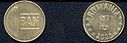 |
1 ban | 16.75 mm | 1.6 mm | 2.4 g | Brass plated steel | Smooth | Coat of arms Coat of arms of Romania The coat of arms of Romania was adopted in the Romanian Parliament on 10 September 1992 as a representative coat of arms for Romania. It is based on the Lesser Coat of Arms of the Kingdom of Romania , redesigned by Victor Dima. As a central element it shows a golden aquila holding a cross in its... , state title, year of minting |
Value | 2005 | 1 July 2005 |
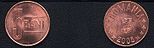 |
5 bani | 18.25 mm | 1.6 mm | 2.8 g | Copper plated steel | Milled (102 reeds) | Coat of arms Coat of arms of Romania The coat of arms of Romania was adopted in the Romanian Parliament on 10 September 1992 as a representative coat of arms for Romania. It is based on the Lesser Coat of Arms of the Kingdom of Romania , redesigned by Victor Dima. As a central element it shows a golden aquila holding a cross in its... , state title, year of minting |
Value | 2005 | 1 July 2005 |
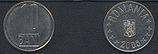 |
10 bani | 20.50 mm | 1.8 mm | 4.0 g | Nickel plated steel | Alternately smooth and milled (3 groups of 20 reeds) | Coat of arms Coat of arms of Romania The coat of arms of Romania was adopted in the Romanian Parliament on 10 September 1992 as a representative coat of arms for Romania. It is based on the Lesser Coat of Arms of the Kingdom of Romania , redesigned by Victor Dima. As a central element it shows a golden aquila holding a cross in its... , state title, year of minting |
Value | 2005 | 1 July 2005 |
| 50 bani | 23.75 mm | 1.9 mm | 6.1 g | Brass Brass Brass is an alloy of copper and zinc; the proportions of zinc and copper can be varied to create a range of brasses with varying properties.In comparison, bronze is principally an alloy of copper and tin... 80% copper Copper Copper is a chemical element with the symbol Cu and atomic number 29. It is a ductile metal with very high thermal and electrical conductivity. Pure copper is soft and malleable; an exposed surface has a reddish-orange tarnish... 15% zinc Zinc Zinc , or spelter , is a metallic chemical element; it has the symbol Zn and atomic number 30. It is the first element in group 12 of the periodic table. Zinc is, in some respects, chemically similar to magnesium, because its ion is of similar size and its only common oxidation state is +2... 5% nickel Nickel Nickel is a chemical element with the chemical symbol Ni and atomic number 28. It is a silvery-white lustrous metal with a slight golden tinge. Nickel belongs to the transition metals and is hard and ductile... |
"ROMANIA * ROMANIA *" | Coat of arms Coat of arms of Romania The coat of arms of Romania was adopted in the Romanian Parliament on 10 September 1992 as a representative coat of arms for Romania. It is based on the Lesser Coat of Arms of the Kingdom of Romania , redesigned by Victor Dima. As a central element it shows a golden aquila holding a cross in its... , state title, year of minting |
Value | 2005 | 1 July 2005 | |
| Aurel Vlaicu Aurel Vlaicu Aurel Vlaicu was a Romanian engineer, inventor, airplane constructor and early pilot.-Biography:Aurel Vlaicu was born in Binţinţi , Geoagiu, Transylvania. He attended Calvinist High School in Orăştie and took his Baccalaureate in Sibiu in 1902... , 1910 (year of first romanian flight), years of birth and death of Aurel Vlaicu |
Value, Coat of arms Coat of arms of Romania The coat of arms of Romania was adopted in the Romanian Parliament on 10 September 1992 as a representative coat of arms for Romania. It is based on the Lesser Coat of Arms of the Kingdom of Romania , redesigned by Victor Dima. As a central element it shows a golden aquila holding a cross in its... , state title, year of minting |
2010 | 25 October 2010 | |||||||
| Value, Coat of arms Coat of arms of Romania The coat of arms of Romania was adopted in the Romanian Parliament on 10 September 1992 as a representative coat of arms for Romania. It is based on the Lesser Coat of Arms of the Kingdom of Romania , redesigned by Victor Dima. As a central element it shows a golden aquila holding a cross in its... , state title, year of minting, Cozia Monastery Cozia Monastery Cozia Monastery, erected close to Călimănești by Mircea cel Bătrân in 1388 and housing his tomb, is one of the most valuable monuments of national medieval art and architecture in Romania.... |
Mircea cel Bătrân Mircea I of Wallachia Mircea the Elder was ruler of Wallachia from 1386 until his death. The byname "elder" was given to him after his death in order to distinguish him from his grandson Mircea II... , 1386-1418 (years of reign) |
2011 | 12 September 2011 | |||||||
The 1 ban coin is rare and not in demand by either banks or retailers. In practice, retailers almost always round to the nearest 5 bani.
The new coins have also faced criticism. Their size and very simple (indeed crude) design make the coins hard to distinguish for the visually impaired. The quality of the materials used is also questionable, with coins becoming oxidized and dark within weeks from the initial release.
First leu
In 1877, state notes were introduced in denominations of 5, 10, 20, 50, 100 and 500 lei. In 1880, these notes were overstamped for issue by the Banca Națională a României, which began to issue regular notes in 1881 in denominations of 20, 100 and 1000 lei.In 1914, 5 lei notes were reintroduced, followed by 1 and 2 lei notes in 1915 and 500 lei in 1916. The Ministry of Finance issued very small sized notes for 10, 25 and 50 bani in 1917. 500 lei notes were introduced in 1940, followed by 10,000 and 100,000 lei in 1945 and 1 and 5 million lei in 1947. In 1945, the Ministry of Finance issued 20 and 100 lei notes to replace those of the Banca Naționalăs.
Second leu
In 1947, the Ministry of Finance introduced 20 lei notes and Banca Naţională a României introduced 100, 500 and 1000 lei notes. In 1949, took over the production of paper money and issued 500 and 1000 lei notes.Third leu
In 1952, the Ministry of Finance introduced notes for 1, 3 and 5 lei, and the introduced 10, 25 and 100 lei notes. In 1966, the Banca Națională a Republicii Socialiste România took over the production of all paper money, issuing notes for 1, 3, 5, 10, 25, 50 and 100 lei.In 1991, 500 and 1000 lei notes were introduced, followed by 200 and 5000 lei notes in 1992, 10,000 lei in 1994, 50,000 lei in 1996, 100,000 lei in 1998, 500,000 lei in 2000 and 1 million lei in 2003. There was also a 2,000 lei note
Two thousand lei (Romanian banknote)
In celebration of the total solar eclipse of August 11, 1999, the National Bank of Romania decided to issue a commemorative two thousand Romanian lei banknote. This was the last solar eclipse of the millennium and was visible across southern Romania. Since it was the last eclipse of the...
introduced in 1999; it celebrated the total solar eclipse that occurred on August 11, 1999. The final issues of the 2000, 10,000, 50,000, 100,000, 500,000 and 1 million lei were polymer notes
Polymer banknote
Polymer banknotes were developed by the Reserve Bank of Australia , Commonwealth Scientific and Industrial Research Organisation and The University of Melbourne and were first issued as currency in Australia in 1988. These banknotes are made from the polymer biaxially-oriented polypropylene ...
.
Notes in circulation at the revaluation were:
- 10,000 lei (became 1 leu)
- 50,000 lei (became 5 lei)
- 100,000 lei (became 10 lei)
- 500,000 lei (became 50 lei)
- 1,000,000 lei (became 100 lei)
Fourth leu
In 2005, polymer notes were introduced for 1, 5, 10, 50, 100 and 500 lei. 200 lei notes were added in 2006. The designs of the 1, 5, 10, 50 and 100 lei notes are based on those of the earlier 10,000, 50,000, 100,000, 500,000 and 1 million lei notes which they replaced. The 10 lei bill was redesigned in November 2008 (most of the graphic elements are identical, some of the safety elements were withdrawn, making its safety degree similar the lower values of 1 leu and 5 lei bills).External links
- Current legal tender pictures
- www.denominare.ro — The official site of the leu revaluation
- Comprehensive catalog of Romanian coins and banknotes.
- www.bancnoteleromanesti.go.ro - All Romanian banknotes from the beginning until now.
- Romanian coins / Monede româneşti - Encyclopedia of Romanian coins in English and Romanian
- Romanian Coins Catalogue
- Romanian Banknotes Catalogue