
All Topics  
Missouri River

 
Missouri River

   Email Print
   Bookmark   Link


Missouri River


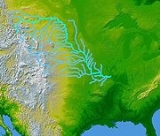
The Missouri River is a tributary
Tributary

A tributary is a stream or river which flows into a Mainstem river. A tributary does not flow directly into a sea. Tributaries and the mainstem river serve to drain the surrounding drainage basin of its surface water and groundwater by leading the water out into an ocean or some other large body of water....
 of the Mississippi River
Mississippi River

The Mississippi River is the longest river in the United States, with a length of from its source in Lake Itasca in Minnesota to its mouth in the Gulf of Mexico....
, and the longest river in the United States of America. The Missouri begins at the confluence of the Madison
Madison River

The Madison River is a headwater tributary of the Missouri River, approximately 183 miles long, in Wyoming and Montana. Its confluence with the Jefferson River and Gallatin River rivers near Three Forks, Montana form the Missouri River....
, Jefferson
Jefferson River

The Jefferson River is a tributary of the Missouri River, approximately long, in the U.S. state of Montana.The Jefferson River and the Madison River form the official beginning of the Missouri at Missouri Headwaters State Park near Three Forks, Montana....
, and Gallatin
Gallatin River

The Gallatin River is a tributary of the Missouri River, approximately 120 mi , in the U.S. states of Wyoming and Montana. It is one of three rivers, along with the Jefferson River and Madison River, that converge near Three Forks, Montana, to form the Missouri....
 rivers in Montana
Montana

Montana is a U.S. state in the Western United States. The western third of the state contains numerous mountain ranges; other 'island' ranges are found in the central third of the state, for a total of 77 named ranges of the Rocky Mountains....
, and flows through its valley
Missouri River Valley

The Missouri River Valley outlines the journey of the Missouri River from its headwaters where the Madison River, Jefferson River and Gallatin Rivers flow together in Montana to its confluence with the Mississippi River in the State of Missouri....
 south and east into the Mississippi north of St. Louis, Missouri
St. Louis, Missouri

St. Louis is an independent city in the U.S. state of Missouri, located near the confluence of the Mississippi River and the Missouri River. St....
. At in length, it drains about one-sixth of the North America
North America

North America is the northern continent of the Americas, situated in the Earth's northern hemisphere and almost totally in the western hemisphere....
n continent. The Missouri in its original natural meandering state was the longest river in North America. Nearly of the river have been cut off in channeling and so it is now comparable in length to the Mississippi River.


Discussion
Ask a question about 'Missouri River'
Start a new discussion about 'Missouri River'
Answer questions from other users
Full Discussion Forum


Recent Posts


Encyclopedia


The Missouri River is a tributary
Tributary

A tributary is a stream or river which flows into a Mainstem river. A tributary does not flow directly into a sea. Tributaries and the mainstem river serve to drain the surrounding drainage basin of its surface water and groundwater by leading the water out into an ocean or some other large body of water....
 of the Mississippi River
Mississippi River

The Mississippi River is the longest river in the United States, with a length of from its source in Lake Itasca in Minnesota to its mouth in the Gulf of Mexico....
, and the longest river in the United States of America. The Missouri begins at the confluence of the Madison
Madison River

The Madison River is a headwater tributary of the Missouri River, approximately 183 miles long, in Wyoming and Montana. Its confluence with the Jefferson River and Gallatin River rivers near Three Forks, Montana form the Missouri River....
, Jefferson
Jefferson River

The Jefferson River is a tributary of the Missouri River, approximately long, in the U.S. state of Montana.The Jefferson River and the Madison River form the official beginning of the Missouri at Missouri Headwaters State Park near Three Forks, Montana....
, and Gallatin
Gallatin River

The Gallatin River is a tributary of the Missouri River, approximately 120 mi , in the U.S. states of Wyoming and Montana. It is one of three rivers, along with the Jefferson River and Madison River, that converge near Three Forks, Montana, to form the Missouri....
 rivers in Montana
Montana

Montana is a U.S. state in the Western United States. The western third of the state contains numerous mountain ranges; other 'island' ranges are found in the central third of the state, for a total of 77 named ranges of the Rocky Mountains....
, and flows through its valley
Missouri River Valley

The Missouri River Valley outlines the journey of the Missouri River from its headwaters where the Madison River, Jefferson River and Gallatin Rivers flow together in Montana to its confluence with the Mississippi River in the State of Missouri....
 south and east into the Mississippi north of St. Louis, Missouri
St. Louis, Missouri

St. Louis is an independent city in the U.S. state of Missouri, located near the confluence of the Mississippi River and the Missouri River. St....
. At in length, it drains about one-sixth of the North America
North America

North America is the northern continent of the Americas, situated in the Earth's northern hemisphere and almost totally in the western hemisphere....
n continent. The Missouri in its original natural meandering state was the longest river in North America. Nearly of the river have been cut off in channeling and so it is now comparable in length to the Mississippi River. The combination of the two longest rivers in North America forms the fourth longest river
List of rivers by length

This is a list of the longest rivers on Earth. It includes river systems over 1,000 kilometers....
 in the world.

At its confluence, the Missouri nearly doubles the volume of the Mississippi, accounting for 45 percent of the flow at St. Louis in normal times and as much as 70 percent of the flow during some droughts. It is the second-largest tributary by volume of the Mississippi, trailing the Ohio
Ohio River

The Ohio River is the largest tributary, by volume, of the Mississippi River. It is approximately 981 miles long and is located in the eastern United States....
.

Overview


The headwaters of the Missouri are in the Rocky Mountains
Rocky Mountains

The Rocky Mountains, often called the Rockies, are a mountain range in western North America. The Rocky Mountains stretch more than 4,800 kilometre from the northernmost part of British Columbia, in Canada, to New Mexico, in the United States....
 of southwestern Montana
Montana

Montana is a U.S. state in the Western United States. The western third of the state contains numerous mountain ranges; other 'island' ranges are found in the central third of the state, for a total of 77 named ranges of the Rocky Mountains....
, near the small town of Three Forks, rising in the Jefferson
Jefferson River

The Jefferson River is a tributary of the Missouri River, approximately long, in the U.S. state of Montana.The Jefferson River and the Madison River form the official beginning of the Missouri at Missouri Headwaters State Park near Three Forks, Montana....
, Madison
Madison River

The Madison River is a headwater tributary of the Missouri River, approximately 183 miles long, in Wyoming and Montana. Its confluence with the Jefferson River and Gallatin River rivers near Three Forks, Montana form the Missouri River....
, and Gallatin
Gallatin River

The Gallatin River is a tributary of the Missouri River, approximately 120 mi , in the U.S. states of Wyoming and Montana. It is one of three rivers, along with the Jefferson River and Madison River, that converge near Three Forks, Montana, to form the Missouri....
 rivers. The longest headwaters stream, and thus the Missouri's hydrologic
Hydrology

Hydrology is the study of the movement, distribution, and quality of water throughout the Earth, and thus addresses both the hydrologic cycle and water resources....
 source, likely begins at Brower's Spring
Brower's Spring

Brower's Spring is a spring in the Centennial Mountains of Montana that is believed to be the ultimate headwaters of the Missouri River.The spring is named for Jacob V....
, which flows to the Jefferson by way of several other named streams. From the confluence of its main tributaries near the city of Three Forks
Three Forks, Montana

Three Forks is a city in Gallatin County, Montana, Montana, United States. The population was 1,728 at the 2000 United States Census. Three Forks is named because it lies near the point, in Missouri Headwaters State Park, where the Jefferson River, Madison River, and Gallatin Rivers converge to form the Missouri River....
, the Missouri flows north through mountainous canyons, emerging from the mountains near Great Falls
Great Falls, Montana

Great Falls is a city in and the county seat of Cascade County, Montana, Montana, United States. The population was 56,690 at the United States Census, 2000....
, where a large cataract
Great Falls of the Missouri River

The Great Falls of the Missouri River are a series of waterfalls on the Missouri River in north-central Montana. Historically, the falls marked the limit of the navigable section of the Missouri River....
 historically marked the navigable limit of the river. It flows east across the plains of Montana
Montana

Montana is a U.S. state in the Western United States. The western third of the state contains numerous mountain ranges; other 'island' ranges are found in the central third of the state, for a total of 77 named ranges of the Rocky Mountains....
 into North Dakota
North Dakota

North Dakota is a U.S. state located in the Midwestern United States and Western United States regions of the United States of America. North Dakota is the 19th largest state by area in the US; it is the 48th most populous, with just over 640,000 residents as of 2006....
, then turns southeast, flowing into South Dakota
South Dakota

South Dakota is a U.S. state located in the Midwestern United States of the United States of America. It is named after the Lakota people and Sioux Sioux Native Americans in the United States tribes....
, and along the north and eastern edge of Nebraska
Nebraska

Nebraska is a U.S. state located on the Great Plains of the Midwestern United States and Western United States.Nebraska probably gets its name from the archaic Chiwere language words ?? Br?sge or the Omaha-Ponca language N? Bth?ska meaning "flat water," after the Platte River that flows through the state....
, forming part of its border with South Dakota and all of its border with Iowa
Iowa

The State of Iowa is a U.S. state in the Midwestern region of the United States of America, an area often referred to as the "American Heartland." It is bordered by Minnesota to the north, Wisconsin and Illinois to the east, Nebraska and South Dakota to the west, and Missouri to the south....
, flowing past Sioux City
Sioux City, Iowa

Sioux City is a city in Plymouth County, Iowa and Woodbury County, Iowa counties in the western part of the U.S. state of Iowa. The population was 85,013 at the 2000 United States Census; census estimates showed a slight decline to 83,262 by 2006....
 and Omaha
Omaha, Nebraska

Omaha is the largest city in the state of Nebraska, United States, and is the county seat of Douglas County, Nebraska. It is located in the Midwestern United States on the Missouri River, about 20 miles north of the mouth of the Platte River....
. It forms the entire boundary between Nebraska and Missouri
Missouri

Missouri is a U.S. state in the Midwestern United States of the United States bordered by Iowa, Illinois, Kentucky, Tennessee, Arkansas, Oklahoma, Kansas and Nebraska....
, and part of the boundary between Missouri and Kansas
Kansas

The State of Kansas is a Midwestern U.S. state in the Central United States of the United States of America, an area often referred to as the United States "Heartland"....
. At Kansas City
Kansas City, Missouri

Kansas City is the largest city in the U.S. state of Missouri. It encompasses in parts of Jackson County, Missouri, Clay County, Missouri, Cass County, Missouri, and Platte County, Missouri counties....
, it turns generally eastward, flowing across Missouri where it joins the Mississippi just north of St. Louis
St. Louis, Missouri

St. Louis is an independent city in the U.S. state of Missouri, located near the confluence of the Mississippi River and the Missouri River. St....
.

The extensive system of tributaries drain nearly all the semi-arid northern Great Plains
Great Plains

The Great Plains are the broad expanse of prairie and steppe which lie west of the Mississippi River and east of the Rocky Mountains in the United States and Canada....
 of the United States. A very small portion of southern Alberta
Alberta

Alberta is one of Canada Canadian Prairies Provinces and territories of Canada. It became a province on September 1, 1905.Alberta is located in western Canada, bounded by the provinces of British Columbia to the west and Saskatchewan to the east, the Northwest Territories to the north, and the U.S....
, Canada
Canada

Canada is a country occupying most of northern North America, extending from the Atlantic Ocean in the east to the Pacific Ocean in the west and northward into the Arctic Ocean....
 and south-western Saskatchewan
Saskatchewan

Saskatchewan is a prairie provinces in Canada, which has an area of 588,276.09 square kilometres and a population of 1,015,895 , mostly living in the southern half of the province....
 is also drained by the river through its tributary, the Milk
Milk River (Montana-Alberta)

The Milk River is a tributary of the Missouri River, 729 mi long in the U.S. state of Montana and the Canadian province of Alberta.It is formed in northwestern Montana, in Glacier County, Montana 21 mi N of Browning, Montana by the confluence of the South and Middle forks....
. Another, separate area, in southern Saskatchewan is drained by another Missouri tributary, the Poplar River
Poplar River (Saskatchewan-Montana)

The Poplar River is a tributary of the Missouri River, approximately 167 mi long in Saskatchewan in Canada and Montana in the United States....
.

The river roughly follows the edge of the glaciation during the last ice age
Ice age

The general term "ice age" or, more precisely, "glacial age" denotes a geological period of long-term reduction in the temperature of the Earth's surface and atmosphere, resulting in an expansion of continental ice sheets, polar ice sheets and alpine glaciers....
. Most of the river's longer tributaries stretch away from this edge, with their origins towards the west, draining portions of the eastern Rockies.

Headwaters


The Missouri in name officially begins at Missouri Headwaters State Park
Missouri Headwaters State Park

Missouri Headwaters State Park is a List of Montana state parks that marks the official start of the Missouri River. It includes the Three Forks of the Missouri National Historic Landmark....
 at in Montana at the confluence of the Jefferson River and Madison River. The Gallatin River joins the river about 0.6 of a mile downstream as it flows northeast. The Jefferson River originates in southwest Montana near the Continental Divide
Continental Divide

The Continental Divide of the Americas, or merely the Continental Divide or Great Divide, is the name given to the principal, and largely mountainous, hydrological divide of the Americas that separates the drainage basin that drain into the Pacific Ocean from, 1) those river systems which drain into the Atlantic Ocean , and 2)...
. The Madison and Gallatin Rivers flow out of northwest Wyoming
Wyoming

The State of Wyoming is a sparsely populated U.S. state in the Northwestern United States of the United States. The majority of the state is dominated by the mountain ranges and rangelands of the Rocky Mountains, while the easternmost section of the state is a high altitude prairie region known as the High Plains ....
 to meet the Jefferson River.

Meriwether Lewis
Meriwether Lewis

Meriwether Lewis was an United States explorer, soldier, and public administrator, best known for his role as the leader of the Lewis and Clark Expedition also known as the Corps of Discovery, with William Clark , whose mission was to explore the territory of the Louisiana Purchase....
 in his journal entry on July 28, 1805 wrote:

Both Capt. C. and myself corresponded in opinon with rispect(sic) to the impropriety of calling either of these [three] streams the Missouri and accordingly agreed to name them after the President of the United States and the Secretaries of the Treasury and state.


The Lewis and Clark decision not to call the Jefferson the Missouri has spurred debate over what is the longest river in North America since the Missouri and Mississippi are nearly identical in length. With the Jefferson the Missouri would be the longest river.

Lewis (who had followed the Jefferson River to the Beaverhead River) said that on August 12, 1805, he visited Beaverhead tributary of Trail Creek just above Lemhi Pass
Lemhi Pass

Lemhi Pass is a high mountain pass in the Rocky Mountains on the border between Montana and Idaho on the Continental Divide.The Lewis and Clark Expedition entered present-day Idaho on August 26, 1805, through Lemhi Pass....
 on the Continental Divide
Continental Divide

The Continental Divide of the Americas, or merely the Continental Divide or Great Divide, is the name given to the principal, and largely mountainous, hydrological divide of the Americas that separates the drainage basin that drain into the Pacific Ocean from, 1) those river systems which drain into the Atlantic Ocean , and 2)...
 in the Beaverhead Mountains on the Montana and Idaho
Idaho

The State of Idaho is a U.S. state in the Pacific Northwest region of the United States of America. The state's largest city and Capital is Boise, Idaho....
 border at around which he described:

the most distant fountain of the waters of the mighty Missouri in surch(sic) of which we have spent so many toilsome days and wristless(sic) nights.


However in 1888 Jacob V. Brower
Jacob V. Brower

Jacob Vandenberg Brower was a prolific writer of the Upper Midwest region of the United States who championed the location and protection of the utmost headwaters of the Mississippi River and Missouri River rivers....
, who had championed turning the headwaters of the Mississippi River into a Minnesota state park, visited a site in Montana which today is believed to be the furthest point on the Missouri -- now called Brower's Spring
Brower's Spring

Brower's Spring is a spring in the Centennial Mountains of Montana that is believed to be the ultimate headwaters of the Missouri River.The spring is named for Jacob V....
. Brower published his finding in 1896 in "The Missouri: Its Utmost Source."

The site of Brower's Spring lies at around in the Centennial Mountains. The site is now commemorated by a rock pile at the source of Hellroaring Creek which flows into Red Rock River and then into Clark Canyon Reservoir where it joins the Beaverhead then the Big Hole River before ultimately hooking up with the Jefferson.

In Montana, the river is a Class I water from Three Forks to the North Dakota border for the purposes of public access for recreational purposes.

Mouth

The Missouri enters the Upper Mississippi River
Upper Mississippi River

The Upper Mississippi River is the portion of the Mississippi River upstream of Cairo, Illinois, Illinois, United States. From the headwaters at Lake Itasca, Minnesota, the river flows approximately 2000 kilometers to Cairo, where it is joined by the Ohio River to form the Lower Mississippi River....
 near its mile 195. The elevation is approximately . The confluence is ringed by Camp Dubois
Camp Dubois

Camp Dubois, near present day Hartford, Illinois, Illinois, served as the winter camp for the Lewis and Clark Expedition from December 12, 1803, to May 14, 1804....
 which is now part of Lewis and Clark State Memorial Park in Illinois; Columbia Bottom Conservation Area on the south bank of the Missouri in St. Louis and on the north bank of the Missouri by the Edward "Ted" and Pat Jones-Confluence Point State Park in West Alton, Missouri
West Alton, Missouri

West Alton is a city in St. Charles County, Missouri, Missouri, United States. The population was 573 at the 2000 United States Census....
.

Natural History


Geology


Missouri Mississippi Confluence
The river is nicknamed "Big Muddy" and also "Dark River" because of the high silt
Silt

Silt is soil or Rock derived granular material of a Particle size between sand and clay. Silt may occur as a soil or as suspended sediment in a surface water body....
 content. The river meanders from bluff
Bluff

Bluff may refer to:* a type of deception, an empty boast...
 to bluff in the flat Midwestern states, leading to the nickname the "Wide Missouri".

History


Name

The popular but erroneous conception that the name means "muddy water" arose from the fact that Marquette gave it the indigenous name "Pekitanoui" meaning "muddy".

The state is named after the Missouri River
Missouri River

The Missouri River is a tributary of the Mississippi River, and the longest river in the United States of America. The Missouri begins at the confluence of the Madison River, Jefferson River, and Gallatin River rivers in Montana, and flows through Missouri River Valley south and east into the Mississippi north of St....
 which in turn is named after the Siouan Indian tribe whose Illinois
Illinois language

The Miami-Illinois language is a Native American languages language formerly spoken in the United States, primarily in Illinois, Missouri, Indiana, western Ohio and adjacent areas along the Mississippi River by the tribes of the Inoca or Illinois , including the Kaskaskia, Peoria , Tamaroa , Cahokia, and Mitchigamea....
 name, ouemessourita (wimihsoorita), means "those who have dugout canoe
Canoe

A canoe is a small narrow boat, typically human-powered, though it may also be powered by sails or small electric or gas motors. Canoes usually are pointed at both bow and stern and are normally open on top, but can be covered....
s". The etymology lies behind 's tribute song,

The river has has also been known as: Big River, Big Muddy, Emasulia sipiwi, Eomitai, Katapan Mene Shoska, Le Riviere des Missouri, Mini Sose, Missoury River, Ni-sho-dse, Nudarcha, Rio Misuri, Riviere de Pekitanoni, Riviere de Saint Philippe, Le Missouri, Le Riviere des Osages, Missures Flu, Miz-zou-rye River, Niutaci, Pekitanoui, River of the West, Yellow River.

Exploration


Jolliet and Marquette
Main articles: Louis Jolliet
Louis Jolliet

Louis Jolliet, also known as Louis Joliet with only one L , was a French Canadian List of explorers. Jolliet is important for his discoveries in North America....
 and Jacques Marquette
Jacques Marquette

Father Jacques Marquette SJ , sometimes known as Pere Marquette, was a French people missionary who founded Michigan's first European settlement, Sault Ste....


The first Europeans to see the river were the French
France

France , officially the French Republic , is a country whose Metropolitan France is located in Western Europe and that also comprises various Overseas departments and territories of France....
 explorers Louis Jolliet
Louis Jolliet

Louis Jolliet, also known as Louis Joliet with only one L , was a French Canadian List of explorers. Jolliet is important for his discoveries in North America....
 and Jacques Marquette
Jacques Marquette

Father Jacques Marquette SJ , sometimes known as Pere Marquette, was a French people missionary who founded Michigan's first European settlement, Sault Ste....
 who shortly after looking at the Piasa
Piasa

The Piasa or Piasa Bird is a legendary creature that was depicted in a mural painted by Native Americans in the United States on a cliff above the Mississippi River....
 petroglyph
Petroglyph

Petroglyphs are s created by removing part of a Rock surface by incising, pecking, carving, and abrading. Outside North America, scholars often use terms such as "carving", "engraving", or other descriptions of the technique to refer to such images....
 painting on the bluffs of Mississippi River
Mississippi River

The Mississippi River is the longest river in the United States, with a length of from its source in Lake Itasca in Minnesota to its mouth in the Gulf of Mexico....
 above Alton, Illinois
Alton, Illinois

Alton is a city in Madison County, Illinois, Illinois, United States, about 15 miles north of St. Louis, Missouri, Missouri. The population was 34,511 at the 2006 census....
 heard the Missouri rushing into the Mississippi.

Marquette wrote:

While conversing about these monsters sailing quietly in clear and calm water, we heard the noise of a rapid into which we were about to run. I never saw anything more terrific, a tangle of entire trees from the mouth of the Pekistanoui with such impetuosity that one could not attempt to cross it without great danger. The commotion was such that the water was made muddy by it and could not clear itself.


Pekitanoui is a river of considerable size, coming from the northwest, from a great distance; and it discharges into the Mississippi. There are many villages of savages along this river, and I hope by this means to discover the Vermillion or California Sea.


Marquette and Joliet referred to the river as "Pekistanoui" and they made a reference to a tribe who lived upstream on the river as "Oumessourita" which was pronounced "OO-Missouri."), (meaning "those who have dugout canoe
Canoe

A canoe is a small narrow boat, typically human-powered, though it may also be powered by sails or small electric or gas motors. Canoes usually are pointed at both bow and stern and are normally open on top, but can be covered....
s") This was the Illinois (tribe) name for the Missouri (tribe) whose village was nearly upstream near Brunswick, Missouri
Brunswick, Missouri

Brunswick is a city in Chariton County, Missouri, Missouri, United States. The population was 925 at the 2000 census. Brunswick is home to the world's largest pecan ....
.

Marquette wrote that natives had told him that it was just a six day canoe trip up the river (about 60 miles) where it would be possible to portage over to another river that would take people to California.

Jolliet and Marquette never explored the Missouri beyond its mouth.

Bourgmont
Main articles: Étienne de Veniard, Sieur de Bourgmont
Étienne de Veniard, Sieur de Bourgmont

?tienne de Veniard, Sieur de Bourgmont was a France explorer who made the first maps and documentation of the Missouri River and Platte River rivers....
 and Fort Orleans
Fort Orleans

Fort Orleans was France fort in colonial North America that was the first fort by any European country on the Missouri River. It was to be a linchpin in a vast New France empire stretching from Montreal to New Mexico....


The Missouri remained formally unexplored and uncharted until Étienne de Veniard, Sieur de Bourgmont
Étienne de Veniard, Sieur de Bourgmont

?tienne de Veniard, Sieur de Bourgmont was a France explorer who made the first maps and documentation of the Missouri River and Platte River rivers....
 wrote "Exact Description of Louisiana, of Its Harbors, Lands and Rivers, and Names of the Indian Tribes That Occupy It, and the Commerce and Advantages to Be Derived Therefrom for the Establishment of a Colony" in 1713 followed in 1714 by "The Route to Be Taken to Ascend the Missouri River." In the two documents Bourgmont was the first to use the name "Missouri" to refer to the river (and he was to name many of the tributaries along the river based on the Native American tribes that lived on them). The names and locations were to be used by cartographer Guillaume Delisle
Guillaume Delisle

Guillaume Delisle was a France cartography who lived in Paris, France.His father, Claude Delisle studied law and then later settled in Paris as private teacher in geography and history, and afterwards filled the office of royal censor....
 to create the first reasonably accurate map of the river.

Bourgmont himself was living with the Missouri tribe at its Brunswick village with his Missouri wife and son. He had been on the lam from French authorities since 1706 when he deserted his post as commandant of Fort Detroit
Fort Detroit

Fort Pontchartrain du D?troit or Fort D?troit was a fort established by the France officer Antoine de la Mothe Cadillac in 1701. The location of the former fort is now in the city of Detroit, Michigan in the U.S....
 after he was criticized by Antoine Laumet de La Mothe, sieur de Cadillac
Antoine Laumet de La Mothe, sieur de Cadillac

Antoine Laumet de La Mothe, sieur de Cadillac was a prominent figure in the history of New France. He was christened Antoine Laumet but upon arriving in what is now Canada in 1683 at the age of 25, he changed his identity to sieur Antoine de Lamothe-Cadillac....
 for his handling of an attack by the Ottawa (tribe)
Ottawa (tribe)

The Odawa or Ottawa, said to mean "traders," are a Native Americans in the United States and First Nations people. They are one of the Anishinaabeg, related to but distinct from the Ojibwa nation....
 in which a priest, a French sergeant and 30 Ottawa were killed. Bourgmont had further infuriated the French by illegally trapping and for immoral behavior when he showed up at French outposts with his Native American wife.

However after Bourgmont's two documents, Jean-Baptiste Le Moyne, Sieur de Bienville
Jean-Baptiste Le Moyne, Sieur de Bienville

Jean-Baptiste Le Moyne de Bienville[#Notes] was a colonizer, born in Montreal, Quebec and an early, repeated governor of French Louisiana , appointed 4 separate times during 1701-1743....
, founder of Louisiana, said that rather than arresting Bourgmont they should decorate him with Cross of St. Louis
Order of Saint Louis

The Royal and Military Order of Saint Louis was a military Order founded on April 5, 1693 by Louis XIV of France and named after Louis IX of France ....
 and name him "commandant of the Missouri" to represent France on the entire river. Bourgmont's reputation was further enhanced when the Pawnee
Pawnee

The Pawnee are a Native Americans in the United States tribe that historically lived along the Platte River, Loup River and Republican Rivers in present-day Nebraska and in Northern Kansas....
, who had been befriended by Bourgmont, massacred the Spanish Villasur expedition
Villasur expedition

The Villasur expedition of 1720 was a Spanish colonization of the Americas intended to check the growing New France presence on the Great Plains of central North America....
 in 1720 near modern day Columbus, Nebraska
Columbus, Nebraska

Columbus is a city in Platte County, Nebraska, Nebraska, United States, 80 miles west by north of Omaha, Nebraska on the Loup River, a short distance above the confluence with the Platte River....
 which temporarily ended Spanish designs on the Missouri River and cleared the way for a New France
New France

The Viceroyalty of New France was the area French colonization of the Americas by France in North America during a period extending from the exploration of the Saint Lawrence River, by Jacques Cartier in 1534, to the cession of New France to Spain and Kingdom of Great Britain in 1763....
 empire stretching from Montreal, Canada to New Mexico
New Mexico

New Mexico is a U. S. State located in the Southwestern United States of the United States. Inhabited by Native Americans in the United States populations for many centuries, it has also has been part of the Spanish Empire viceroyalty of New Spain, part of Mexico, and a U.S....
.

After squabbling with French authorities over financing of a new fort on the Missouri and also suffering a yearlong illness, Bourgmont established Fort Orleans
Fort Orleans

Fort Orleans was France fort in colonial North America that was the first fort by any European country on the Missouri River. It was to be a linchpin in a vast New France empire stretching from Montreal to New Mexico....
, which was the first fort and first longer term European settlement of any kind on the Missouri, in late 1723 near his home at Brunswick. In 1724 Bourgmont led an expedition to enlist Commanche support in the fight against the Spanish. In 1725 Bourgmont brought the chiefs of the Missouri River tribes to Paris
Paris

Paris is the Capital of France and the country's largest city. It is situated on the river Seine, in northern France, at the heart of the ?le-de-France Regions of France ....
 to see the glory of France including the palaces of Versailles
Versailles

Versailles , formerly de facto capital of the kingdom of France, is now a wealthy suburb of Paris and is still an important administrative and judicial centre....
, and Fountainbleau and a hunting expedition on a royal preserve with Louis XV. Bourgmont was raised to the rank of the nobility, remained in France and did not accompany the chiefs back to the New World. Fort Orleans was either abandoned or its small contingent massacred by Native Americans in 1726.

It is unclear how far up the Missouri Bourgmont traveled. He is the documented first European discoverer of the Platte River. In his writings he described the blonde-haired Mandans, so it is possible that he made it as far north as their villages in central North Dakota.

MacKay and Evans
The Spanish took over the Missouri River in the Treaty of Paris (1763)
Treaty of Paris (1763)

The Treaty of Paris, often called the Peace of Paris, or the Treaty of 1763, was signed on February 10, 1763, by the kingdoms of Kingdom of Great Britain, France and Spain, with Portugal in agreement....
 that ended the French and Indian War
French and Indian War

The French and Indian War was the North American chapter of the Seven Years' War, known in Canada as the War of the Conquest. The name refers to the two main enemies of the British: the royal French forces and the various Indigenous peoples of the Americas forces allied with them....
/Seven Years War. The Spanish claim to the Missouri was based on Hernando de Soto's
Hernando de Soto (explorer)

Hernando de Soto was a Spanish people Exploration and conquistador who, while leading the first European expedition deep into the territory of the modern-day United States, was the first European to discover the Mississippi River....
 "discovery" of the Mississippi River on May 8, 1541. The Spanish initially did not extensively explore the river and let French fur traders continue their activities although under license.

After the British began to exert influence on the Upper Missouri River via the Hudson's Bay Company
Hudson's Bay Company

The Hudson's Bay Company , abbreviated HBC, is the oldest commercial corporation in North America and is one of the oldest in the world. The company was incorporated by British royal charter in 1670 as The Governor and Company of Adventurers of England trading into Hudson's Bay; it is now domiciled in Canada and has adopted the mo...
, news of English incursions came following an expedition by Jacques D’Eglise in 1790. The Spanish chartered the "Company of Discoverers and Explorers of the Missouri" (popularly referred to as the "Missouri Company") and offered a reward for the first person to reach the Pacific via the Missouri. In 1794 and 1795 expeditions led by Jean Baptiste Truteau and Antoine Simon Lecuyer de la Jonchšre did not even make it as far north as the Mandan
Mandan

The Mandan are a Native Americans in the United States tribe that historically lived along the banks of the Missouri River and two of its tributaries?the Heart River and Knife Rivers?in present-day North Dakota and South Dakota....
 villages in central North Dakota
North Dakota

North Dakota is a U.S. state located in the Midwestern United States and Western United States regions of the United States of America. North Dakota is the 19th largest state by area in the US; it is the 48th most populous, with just over 640,000 residents as of 2006....
.

The most significant expedition though was the MacKay and Evans Expedition of 1795-1797. James MacKay and John Evans
John Evans (explorer)

John Thomas Evans was a Wales explorer who produced an early map of the Missouri River.John Evans was born in Waunfawr, near Caernarfon. In the early 1790s there was an upsurge of interest in Wales in the story of Madog having discovered America, and there were persistent rumours in North America of the existence of a tribe of Welsh Nativ...
 were hired by the Spanish to search a route to the Pacific Ocean and to tell the British to leave the upper Missouri.

McKay and Evans established a winter camp about south of Sioux City, Iowa
Sioux City, Iowa

Sioux City is a city in Plymouth County, Iowa and Woodbury County, Iowa counties in the western part of the U.S. state of Iowa. The population was 85,013 at the 2000 United States Census; census estimates showed a slight decline to 83,262 by 2006....
 on the Nebraska side where they built Fort Columbus. Evans went on to the Mandan village where he expelled British traders. While talking to Native Americans they pinpointed the location of the Yellowstone River
Yellowstone River

The Yellowstone River is a tributary of the Missouri River, approximately , in the western United States. Considered the principal tributary of the upper Missouri, the river and its tributaries drain a wide area stretching from the Rocky Mountains in the vicinity of the Yellowstone National Park across the mountains and Great Plains of southe...
 (which they called "Yellow Rock").

They created a detailed map of the upper Missouri that was used by Lewis and Clark
Lewis and Clark Expedition

The Lewis and Clark Expedition , headed by Meriwether Lewis and William Clark , was the first United States overland expedition to the Pacific coast and back....
.

Lewis and Clark
Main articles: Louisiana Purchase
Louisiana Purchase

The Louisiana Purchase was the acquisition by the United States of America of of the French territory Louisiana in 1803. The U.S. paid 60 million French franc plus cancellation of debts worth 18 million francs , a total cost of $15,000,000 for the Louisiana territory....
 and Lewis and Clark


On October 27, 1795, the United States and Spain signed Pinckney's Treaty
Pinckney's Treaty

Pinckney's Treaty, also known as the Treaty of San Lorenzo or the Treaty of Madrid, was signed in San Lorenzo de El Escorial on October 27, 1795 and established intentions of friendship between the United States and Spain....
 giving American merchants the "right of deposit" in New Orleans, meaning they could use the port to store goods for export. The treaty also recognized American rights to navigate the entire Mississippi River.

In 1798 Spain revoked the treaty.

On October 1, 1800, the Spanish secretly returned Louisiana to the French under Napoleon in the Third Treaty of San Ildefonso
Third Treaty of San Ildefonso

The Third Treaty of San Ildefonso was a secretly negotiated treaty between France and Spain in which Spain returned the colonial territory of Louisiana to France....
. The transfer was so secret that the Spanish continued to administer the territory. In 1801 they restored the United States rights to use the river and New Orleans.

Thomas Jefferson
Thomas Jefferson

Thomas Jefferson was the List of Presidents of the United States President of the United States , the principal author of the United States Declaration of Independence , and one of the most influential Founding Fathers of the United States for his promotion of the ideals of republicanism in the United States....
, fearing the cutoffs could occur again, sought to negotiate with France to buy New Orleans for the asking price of $10 million. Napoleon countered with an offer of $15 million for all of the Louisiana Territory including the Missouri River. The deal was signed on May 2, 1803.

On June 20, 1803, Thomas Jefferson
Thomas Jefferson

Thomas Jefferson was the List of Presidents of the United States President of the United States , the principal author of the United States Declaration of Independence , and one of the most influential Founding Fathers of the United States for his promotion of the ideals of republicanism in the United States....
 instructed Meriwether Lewis
Meriwether Lewis

Meriwether Lewis was an United States explorer, soldier, and public administrator, best known for his role as the leader of the Lewis and Clark Expedition also known as the Corps of Discovery, with William Clark , whose mission was to explore the territory of the Louisiana Purchase....
 to explore the Missouri and look for a water route to the Pacific.

Although the deal was signed, Spain still balked at an American takeover, citing that France had never formally taken over the Louisiana Territory. Spain was to formally tell Lewis not to take the journey and expressly forbade Lewis from seeing the McKay and Evans map which was the most detailed and accurate of its time. Lewis was to gain access to it surreptitiously. To avoid jurisdictional issues with Spain they wintered in 1803-1804 at Camp Dubois
Camp Dubois

Camp Dubois, near present day Hartford, Illinois, Illinois, served as the winter camp for the Lewis and Clark Expedition from December 12, 1803, to May 14, 1804....
 on the Illinois (United States) side of the Mississippi.

Lewis and William Clark left on May 14, 1804 and returned to St. Louis on September 23, 1806.

American Frontier

Bodmer5455
The river defined the American frontier in the 19th century, particularly downstream from Kansas City, Missouri
Kansas City, Missouri

Kansas City is the largest city in the U.S. state of Missouri. It encompasses in parts of Jackson County, Missouri, Clay County, Missouri, Cass County, Missouri, and Platte County, Missouri counties....
, where it takes a sharp eastern turn into the heart of the state of Missouri.

All of the major trails for the opening of the American West have their starting points on the river, including the California
California Trail

See also: Oregon TrailThe California Trail was a major overland emigrant trail that lead to the 1800's version of Hollywood. It was about across the western half of the North American continent from various Missouri River towns to what is now the state of California....
, Mormon
Mormon Trail

The Mormon Trail or Mormon Pioneer Trail is the route that members of The Church of Jesus Christ of Latter-day Saints traveled from 1846-1857....
, Oregon
Oregon Trail

The Oregon Trail was one of the main overland migration routes on the North American continent, leading from locations on the Missouri River to the Oregon Territory....
, and Santa Fe
Santa Fe Trail

The Santa Fe Trail was a 19th century transportation route through southwestern North America that connected Missouri with Santa Fe, New Mexico....
 trails. The first westward leg of the Pony Express
Pony Express

The Pony Express was a fast mail service crossing the North American continent from St. Joseph, Missouri, to Sacramento, California, from April 1860 to October 1861....
 was a ferry ride across the Missouri at St. Joseph, Missouri. The first westward leg of the First Transcontinental Railroad
First Transcontinental Railroad

The First Transcontinental Railroad is the popular name of the United States rail transport line completed in 1869 between Council Bluffs, Iowa/Omaha, Nebraska and Alameda, California....
 was a ferry ride across the Missouri between Council Bluffs, Iowa
Council Bluffs, Iowa

Council Bluffs is a city in and the county seat of Pottawattamie County, Iowa, Iowa, United States and is on the east bank of the Missouri River....
 and Omaha, Nebraska
Omaha, Nebraska

Omaha is the largest city in the state of Nebraska, United States, and is the county seat of Douglas County, Nebraska. It is located in the Midwestern United States on the Missouri River, about 20 miles north of the mouth of the Platte River....
.

The Hannibal Bridge
Hannibal Bridge

The First Hannibal Bridge was the first bridge to cross the Missouri River and was to establish Kansas City, Missouri as a major city and rail center....
 was the first bridge to cross the river when it opened in Kansas City in 1869, and was a major reason why Kansas City became the largest city on the river upstream from its mouth at St. Louis.

Extensive use of paddle steamer
Paddle steamer

A paddle steamer is a ship or boat driven by a steam engine that uses one or more paddle wheels to develop thrust for Ship propulsion. It is also a type of steamboat....
s on the upper river helped facilitate European settlement of the Dakotas
Dakota Territory

Dakota Territory was the name of an Territories of the United States of the United States that existed from 1861 to 1889. The territory consisted of the northernmost part of the land acquired in the Louisiana Purchase of the United States....
 and Montana
Montana

Montana is a U.S. state in the Western United States. The western third of the state contains numerous mountain ranges; other 'island' ranges are found in the central third of the state, for a total of 77 named ranges of the Rocky Mountains....
.

The Department of the Missouri
Department of the Missouri

Department of the Missouri was a division of the United States Army that functioned through the American Civil War and the Indian Wars afterwards....
, which was headquartered on the banks of the river at Fort Leavenworth, Kansas, was the military command center for the Indian Wars
Indian Wars

Indian Wars is the name generally used in the United States to describe a series of conflicts between the colonial or federal government and the indigenous peoples of North America....
 in the region.

The northernmost navigable point on the Missouri before extensive navigation improvements was Fort Benton, Montana
Fort Benton, Montana

Fort Benton is a city in and the county seat of Chouteau County, Montana, Montana, United States. A portion of the city was designated as a National Historic Landmark District in 1961....
, at approximately 2,620 feet.

Economy


River modifications

Fort Randall Dam, South Dakota
Since the lower river meanders through a broad floodplain in Midwestern states, it has often changed course and in its wake left numerous oxbow lake
Oxbow lake

An oxbow lake is a U-shaped body of water formed when a wide meander from the mainstem of a river is cut off to create a lake. This landform is called an oxbow lake for the distinctive curved shape that results from this process....
s (Big Lake
Big Lake (Missouri)

Big Lake is a oxbow lake in Holt County, Missouri near Big Lake, Missouri.It is believed to have formed from the Missouri River sometime before Lewis & Clark visited the area in 1804....
 is the largest such lake in Missouri). In the early 1800s the United States Supreme Court (which decides state border disputes) ruled that when the river changed course the border also changed (as happened with the Fairfax District
Fairfax Airport

Fairfax Airport was an airport in Kansas City, Kansas from 1921 until it closed in 1985. It is most famously associated with the construction of most of the B-25 Mitchell bombers....
 at Kansas City, Kansas
Kansas City, Kansas

Kansas City is the third largest city in the U.S. state of Kansas and is the county seat of Wyandotte County, Kansas. It is a Satellite town of Kansas City, Missouri and is the third largest city in the Kansas City Metropolitan Area....
 which switched from Missouri to Kansas.) However, in the late 1800s the Court began ruling on absolute boundaries, creating geographic oddities such as Carter Lake, Iowa
Carter Lake, Iowa

Carter Lake is a city in Pottawattamie County, Iowa, Iowa, United States. The population was 3,248 at the 2000 census....
, which is now a piece of Iowa on the west side of the Missouri between downtown Omaha and Eppley Airfield
Eppley Airfield

Eppley Airfield is a commercial airport located three miles northeast of the central business district of Omaha, Nebraska, a city in Douglas County, Nebraska, Nebraska, United States....
, and the French Bottoms
Rosecrans Memorial Airport

Rosecrans Memorial Airport is a joint civil-military public airport located three miles northwest of the city of St. Joseph, Missouri in Buchanan County, Missouri, Missouri, United States....
 in St. Joseph, Missouri, a piece of Missouri on the west of the river, requiring Missouri residents to go through Kansas to reach Rosecrans Airport.

In the 20th century, the upper Missouri was extensively dammed for flood control
Flood control

In communications, flood control is a feature of many communication protocols designed to prevent overwhelming of a destination receiver. Such controls can be implemented either in software or in hardware, and will often request that the message be resent after the receiver has finished processing....
, irrigation
Irrigation

Irrigation is an artificial application of water to the soil usually for assisting in growing crops. In crop production it is mainly used in dry areas and in periods of rainfall shortfalls, but also to protect plants against frost....
, and hydroelectric power. After President Franklin D. Roosevelt
Franklin D. Roosevelt

Franklin Delano Roosevelt , often referred to by his initials FDR, was the List of Presidents of the United States President of the United States....
 signed the Flood Control Act of 1944
Flood Control Act of 1944

The Pick-Sloan Flood Control Act of 1944 , enacted in the 2nd session of the 78th United States Congress, is List of United States federal legislation that authorized the construction of thousands of dams and levees across the United States....
, the Pick-Sloan Plan turned the Missouri River into the largest reservoir system in North America. There are six dam
Dam

A dam is a barrier that Reservoirs surface water or underground streams. Dams generally serve the primary purpose of retaining water, while other structures such as floodgates, levees, and Dike are used to manage or prevent water flow into specific land regions....
s in four states: Fort Peck Dam
Fort Peck Dam

The Fort Peck Dam is the highest of six major dams along the Missouri River, located in northeast Montana in the United States, near Glasgow, Montana, and adjacent to the community of Fort Peck, Montana....
 in Montana; Garrison Dam
Garrison Dam

Garrison Dam is a major earth embankment dam on the Missouri River in central North Dakota. At over two miles in length, it is the fifth-largest earthen dam in the world, constructed by the U.S....
 in North Dakota; Oahe Dam
Oahe Dam

The Oahe Dam is a large man-made dam along the Missouri River, just north of Pierre, South Dakota in the United States. It creates Lake Oahe, the 4th largest man-made reservoir in the United States, which stretches 231 miles up the course of the Missouri to Bismarck, North Dakota....
, Big Bend Dam
Big Bend Dam

Big Bend Dam is a major rolled earth dam along the Missouri River in central South Dakota.The dam, 95 feet high and 10,570 feet in length, was constructed as part of the Pick-Sloan Plan for Missouri watershed development authorized by the Flood Control Act of 1944....
, and Fort Randall Dam
Fort Randall Dam

The Fort Randall Dam is an earth embankment dam impounding the Missouri River in South Dakota. The dam holds Lake Francis Case and is one of six main-stem dams in the Missouri Basin....
 in South Dakota; and Gavins Point Dam
Gavins Point Dam

Gavins Point Dam is a hydroelectricity dam on the Missouri River in the U.S. states of Nebraska and South Dakota, impounding Lewis and Clark Lake....
 on the South Dakota-Nebraska border.

These dams were constructed without locks, so commercial navigation on the Missouri cannot proceed above the Gavins Point Dam. The Corps of Engineers
United States Army Corps of Engineers

The United States Army Corps of Engineers is a federal agency and a major Army command made up of some 34,600 civilian and 650 military personnel, making it the world's largest public services engineering, design and construction management agency....
 maintains a 9-foot-deep (3 m) navigation channel for 735 miles (1183 km) between Sioux City, Iowa
Sioux City, Iowa

Sioux City is a city in Plymouth County, Iowa and Woodbury County, Iowa counties in the western part of the U.S. state of Iowa. The population was 85,013 at the 2000 United States Census; census estimates showed a slight decline to 83,262 by 2006....
 and St. Louis
St. Louis, Missouri

St. Louis is an independent city in the U.S. state of Missouri, located near the confluence of the Mississippi River and the Missouri River. St....
 in non-winter months. The dams aid navigation on the lower river by reducing fluctuations in water levels.

Thirty-five percent of the Missouri River is impounded, 32 percent has been channelized, and 33 percent is unchannelized.

The only significant stretch of free-flowing stream on the lower Missouri is the Missouri National Recreational River
Missouri National Recreational River

The Missouri National Recreational River is located on the border between Nebraska and South Dakota. The designation was first applied in 1978 to a 59-mile section of the Missouri River between Gavins Point Dam and Ponca State Park....
 section between Gavins Point Dam
Gavins Point Dam

Gavins Point Dam is a hydroelectricity dam on the Missouri River in the U.S. states of Nebraska and South Dakota, impounding Lewis and Clark Lake....
 and Ponca State Park
Ponca State Park

Ponca State Park, located two miles north of Ponca, Nebraska in northeastern Nebraska, is situated on among the high bluffs and forested steep hills along the banks of the Missouri River....
, Nebraska
Nebraska

Nebraska is a U.S. state located on the Great Plains of the Midwestern United States and Western United States.Nebraska probably gets its name from the archaic Chiwere language words ?? Br?sge or the Omaha-Ponca language N? Bth?ska meaning "flat water," after the Platte River that flows through the state....
. This federally-designated "Wild and Scenic River" is among the last unspoiled stretches of the Missouri, and exhibits the islands, bars, chutes and snags that once characterized the "Mighty Mo".

The dikes, revetments, and levees constructed by the Corps of Engineers as part of the Missouri River Navigation and Flood Control Project have transformed the once sprawling and constantly changing river into a narrower, deeper, fixed channel designed to more easily maintain the navigation channel. The river carries a large amount of silt and sand, but high water velocity in the navigation channel normally prevents settling out and sand bar accumulations. As a result, unlike the Mississippi River, the Missouri River rarely requires dredging to maintain the navigation channel. The huge amounts of sediment in the Big Muddy have long provided a free source of sand, mined by commercial dredgers to be used in concrete and asphalt for construction, mainly below Rulo, Nebraska. In recent years, the quantity of sand commercially dredged from the Missouri River has dramatically increased as Kansas City, Columbia, and St. Louis have grown. In 2000, 7.4 million tons of sand and gravel were dredged out of the navigation channel. As commercial sand dredging has increased, the Missouri River bed has gradually cut deeper into the flood plain. Between 1990 and 2005 the river around Kansas City, Missouri has degraded as much as .

Traffic

Barge traffic has been steadily declining from 3.3 million tons in 1977 to 1.3 million tons in 2000. The declining barge traffic industry has stirred controversies over the management of the river and whether upstream dams should release more water to maintain commercial navigation standards.

Casinos

The states of Iowa and Missouri have sought to revive their waterfronts by permitting riverboat gambling
Riverboat casino

A riverboat casino is a type of casino found in several areas of the United States which use a riverboat as a casino. Several states authorized this type of casino to limit the areas where casinos could be constructed....
. The initial gambling regulations required the casinos to navigate the river. They were subsequently amended so that the casinos could be permanent land-based structures as long as they had a moat with Missouri River water surrounding them.

Popular depictions

George Caleb Bingham 001
The American painter George Catlin
George Catlin

George Catlin was an United States Painting, author and traveler who specialized in portraits of Native Americans in the United States in the Old West....
 traveled up the Missouri in the 1830s, making portraits of individuals and tribes of Native Americans. He also painted several Missouri River landscapes, notably "" and "", both from 1832.

The Swiss
Switzerland

Switzerland is a landlocked Swiss Alps country of roughly 7.7 million people in Western Europe with an area of 41,285 km?. Switzerland is a federal republic consisting of 26 states called Cantons of Switzerland....
 painter Karl Bodmer
Karl Bodmer

Karl Bodmer was a Swiss painter of the American West. He accompanied German explorer Maximilian zu Wied-Neuwied from 1832 through 1834 on his Missouri River expedition....
 accompanied German
Germany

Germany , officially the Federal Republic of Germany , is a country in Central Europe. It is bordered to the north by the North Sea, Denmark, and the Baltic Sea; to the east by Poland and the Czech Republic; to the south by Austria and Switzerland; and to the west by France, Luxembourg, Belgium, and the Netherlands....
 explorer Prince Maximilian zu Wied-Neuwied from 1832 through 1834 on his Missouri River expedition. Bodmer was hired as an artist by Maximilian for the purpose of recording images of the Native American
Native Americans in the United States

Native Americans in the United States are the Indigenous peoples of the Americas from the regions of North America now encompassed by the continental United States United States, including parts of Alaska and the island state of Hawaii....
 tribes that they encountered in the American West.

In 1843, the American painter and naturalist
Natural history

Natural history is the scientific research of plants or animals, leaning more towards the observational than experimental methods of study, and encompasses more research that is published in magazines than in academic journals....
 John James Audubon
John James Audubon

John James Audubon was a French people-United States ornithology, natural history, Hunting#United States, and Painting. He painted, catalogued, and described the birds of North America in a form far superior to what had gone before....
 traveled west to the upper Missouri River and the Dakota Territory
Dakota Territory

Dakota Territory was the name of an Territories of the United States of the United States that existed from 1861 to 1889. The territory consisted of the northernmost part of the land acquired in the Louisiana Purchase of the United States....
 to do fieldwork for his final major opus, Viviparous Quadrupeds of North America. A typical example from this folio is .

Missouri
Missouri

Missouri is a U.S. state in the Midwestern United States of the United States bordered by Iowa, Illinois, Kentucky, Tennessee, Arkansas, Oklahoma, Kansas and Nebraska....
 painter George Caleb Bingham
George Caleb Bingham

George Caleb Bingham ? 19th century American painting of the American West. The majority of Bingham's paintings and virtually all of his drawings are held in American museums, with the largest selection of paintings at the St....
 immortalized the fur traders and flatboat
Flatboat

A flatboat is a rectangular boat with a flat bottom and Square ends used to transport freight and passengers on inland waterways. The flatboat could be any size but, essentially, it is a large, sturdy tub with a hull that displaces water and so floats in the water; therefore, the flatboat is not a raft, which floats on the water....
men who plied the Missouri River in the early 1800s; these same were known for their river chanties, including the haunting American folk song "Oh Shenandoah
Oh Shenandoah

"Oh Shenandoah" is an United States folk music, dating to the early 19th century....
". Each verse of "Oh Shenandoah
Oh Shenandoah

"Oh Shenandoah" is an United States folk music, dating to the early 19th century....
" ends with the line, "...'cross the wide Missouri."

The Missouri may be the setting of the Pete Seeger
Pete Seeger

Peter "Pete" Seeger is an United States folk singer, and a key figure in the mid-20th century American folk music revival. A fixture on nationwide radio in the 1940s, he also had a string of hit records during the early 50s as a member of The Weavers, most notably the 1950 recording of Leadbelly's "Goodnight, Irene" that topped the charts f...
 song Waist Deep in the Big Muddy
Waist Deep in the Big Muddy

"Waist Deep in the Big Muddy" is a song written by Pete Seeger in 1967 and made famous because of its censorship from a popular television program of that era....
. (There is considerable ambiguity as to location, however. Seeger sings that the action took place in "Loo-siana"
Louisiana

The State of Louisiana is a U.S. state located in the U.S. Southern States of the United States of America. Its capital is Baton Rouge and largest city is New Orleans....
 and there is also a Big Muddy River
Big Muddy River

The Big Muddy River is located in Illinois. It joins the Mississippi River south of Murphysboro, Illinois. The Big Muddy has been dammed near Benton, Illinois, forming Rend Lake....
 in Illinois
Illinois

The State of Illinois is a U.S. state of the United States, the 21st to be admitted to the United States. Illinois is the most populous and demographically diverse Midwestern United States state and the fifth most populous state in the nation....
. One could not "press on" very far into the Missouri and remain only "waist deep.") The song is set in 1942, during training for World War II
World War II

World War II, or the Second World War , was a global military conflict which involved a Participants in World War II, including all of the great powers, organised into two opposing military alliances: the Allies of World War II and the Axis powers....
, but its image of a foolish captain who pushes his men further and further into a hopeless situation was clearly meant to parallel the Vietnam War
Vietnam War

The Vietnam War, also known as the Second Indochina Wars, the Vietnam Conflict, or often in Vietnam the American War occurred in Vietnam, Laos and Cambodia from 1959 to April 30, 1975....
. In the song, a Captain leading a squad on training maneuver
Maneuver

Maneuver, manoeuvre may be:...
s insists on crossing the titular river, insisting that it is safe to cross. The Captain sinks into the mud, drowns, and his squad turns back, led by the Sergeant who had questioned the Captain's orders.

A. B. Guthrie, Jr.
A. B. Guthrie, Jr.

Alfred Bertram Guthrie, Jr. was an United States novelist, historian, and literature historian who won the Pulitzer Prize for fiction in 1950 for his The Way West....
's popular Western
Western (genre)

The Western is a fiction genre seen in film, television, radio, literature, painting and other visual arts. Westerns are devoted to telling stories set primarily in the later half of the 19th century in what became the Western United States , but also in Western Canada, Mexico , Alaska and even Australia ....
 novel The Big Sky
The Big Sky

The Big Sky is a 1947 Western novel by A. B. Guthrie, Jr..In the book the main characters can be identified as:# Boone Caudill# Jim Deakins...
 (1947) tells the story of a group of men who, in the early 19th century, made the long journey up the Missouri from St. Louis to Montana. Howard Hawks
Howard Hawks

Howard Winchester Hawks was an American film director, Film producer and writer of the Classical Hollywood cinema. He died in Palm Springs, California, California, after a fall....
 made a film based on the book a few years later.

Lists


Tributaries


The following rivers are listed going downstream based on the states where they enter the Missouri.

Montana
  • Jefferson River
    Jefferson River

    The Jefferson River is a tributary of the Missouri River, approximately long, in the U.S. state of Montana.The Jefferson River and the Madison River form the official beginning of the Missouri at Missouri Headwaters State Park near Three Forks, Montana....
  • Madison River
    Madison River

    The Madison River is a headwater tributary of the Missouri River, approximately 183 miles long, in Wyoming and Montana. Its confluence with the Jefferson River and Gallatin River rivers near Three Forks, Montana form the Missouri River....
  • Gallatin River
    Gallatin River

    The Gallatin River is a tributary of the Missouri River, approximately 120 mi , in the U.S. states of Wyoming and Montana. It is one of three rivers, along with the Jefferson River and Madison River, that converge near Three Forks, Montana, to form the Missouri....
  • Sixteen Mile Creek
  • Dearborn River
    Dearborn River

    The Dearborn River is a tributary of the Missouri River, approximately 70 mi long, in western Montana in the United States. It rises in the Lewis and Clark National Forest, near Scapegoat Mountain in the Lewis and Clark Range of the Rocky Mountains at the continental divide, in western Lewis and Clark County, Montana....
  • Smith River
    Smith River (Montana)

    Smith River is a tributary of the Missouri River, in central Montana, in the United States. It rises in southern Meagher County, Montana in the Castle Mountains and flows northwest in the valley between the Big Belt Mountains and Little Belt Mountains mountains, past White Sulphur Springs, Montana and past Smith River State Park, Montana....
  • Sun River
    Sun River

    The Sun River is a tributary of the Missouri River in the Great Plains, approximately 130 mi long, in Montana in the United States.It rises in the Rocky Mountains in two forks, the North Fork Sun River and South Fork Sun River, which join in the Flathead National Forest above Gibson Reservoir along the county line between Teton County, Mo...
  • Belt Creek
    Belt Creek (Montana)

    Belt Creek is a tributary, approximately 80 mi long, of the Missouri River in western Montana in the United States.It originates in the Lewis and Clark National Forest north of Big Baldy Mountain, in the Little Belt Mountains in western Judith Basin County, Montana....
  • Marias River
    Marias River

    The Marias River is a tributary of the Missouri River, approximately 210 mi long, in the U.S. state of Montana. It is formed in the Blackfeet Indian Reservation in Glacier County, Montana, in northwestern Montana, by the confluence of the Cut Bank Creek and the Two Medicine River....
  • Arrow Creek
    Arrow Creek (Montana)

    Arrow Creek is a tributary of the Missouri River, approximately 45 miles long, in Montana in the United States. It rises in the Lewis and Clark National Forest near Highwood Baldy in the Highwood Mountains in southern Chouteau County, Montana....
  • Judith River
    Judith River

    The Judith River is a tributary of the Missouri River, approximately 124 mi long, running through central Montana and the United States. It rises in the Little Belt Mountains and flows northeast past Utica, Montana and Hobson, Montana....
  • Cow Creek
    Cow Creek (Montana)

    Cow Creek is a tributary of the Missouri River, approximately 30 mi long, in north central Montana in the United States.It rises in the Bear Paw Mountains in western Blaine County, Montana and flows southeast, joining the Missouri in the Missouri Breaks approximately 20 mi northwest of Winifred, Montana....
  • Musselshell River
    Musselshell River

    The Musselshell River is a tributary of the Missouri River, approximately 292 miles long, in central Montana in the United States. It rises in several forks in the Crazy Mountains, Little Belt Mountains, and Castle Mountains mountains in central Montana....
  • Milk River
    Milk River (Montana-Alberta)

    The Milk River is a tributary of the Missouri River, 729 mi long in the U.S. state of Montana and the Canadian province of Alberta.It is formed in northwestern Montana, in Glacier County, Montana 21 mi N of Browning, Montana by the confluence of the South and Middle forks....
  • Redwater River
    Redwater River

    The Redwater River is a tributary of the Missouri River, approximately 110 mi , in eastern Montana in the United States.It rises in on the northern slope of the Big Sheep Mountains, in northwestern Prairie County, Montana, and flows northeast across the plains past Brockway, Montana and Circle, Montana and joins the Missouri in northeaste...
  • Poplar River
  • Big Muddy Creek
    Big Muddy Creek (Montana)

    Big Muddy Creek is a tributary of the Missouri River, approximately 191 mi long, in the Canadian province of Saskatchewan and the U.S. state of Montana....


North Dakota
  • Yellowstone River
    Yellowstone River

    The Yellowstone River is a tributary of the Missouri River, approximately , in the western United States. Considered the principal tributary of the upper Missouri, the river and its tributaries drain a wide area stretching from the Rocky Mountains in the vicinity of the Yellowstone National Park across the mountains and Great Plains of southe...
  • Little Muddy Creek
    Little Muddy Creek (North Dakota)

    Little Muddy Creek is a tributary of the Missouri River, approximately 45 mi long, in northwestern North Dakota in the United States.It rises in the prairie country of northern Williams County, North Dakota and flows west, then south, joining the Missouri near Williston, North Dakota....
  • Tobacco Garden Creek
    Tobacco Garden Creek

    Tobacco Garden Creek is a tributary of the Missouri River, approximately 30 mi long, in northwestern North Dakota in the United States. It rises in the badlands south of the Missouri in McKenzie County, North Dakota, and flows SE, then NNE....
  • Little Missouri River
    Little Missouri River (North Dakota)

    The Little Missouri River is a tributary of the Missouri River, 560 mi long, in the northern Great Plains of the United States.It rises in northeastern Wyoming, in western Crook County, Wyoming approximately twenty miles west of Devils Tower National Monument....
  • Knife River
    Knife River

    This article is about the river in North Dakota. For other meanings, see Knife River The Knife River is a tributary of the Missouri River, approximately 120 mi long, in North Dakota in the United States....
  • Heart River
    Heart River

    The Heart River is a tributary of the Missouri River, approximately 180 mi long, in western North Dakota in the United States.Course...
  • Cannonball River
    Cannonball River

    The Cannonball River is a tributary of the Missouri River, approximately 135 mi long, in southwestern North Dakota in the United States.It rises in the Little Missouri National Grassland, in the badlands north of Amidon, North Dakota in northern Slope County, North Dakota....


South Dakota
  • Grand River
    Grand River (South Dakota)

    The Grand River is a tributary of the Missouri River in North Dakota and South Dakota in the United States. The length of the combined branch is 110 mi ....
  • Moreau River
    Moreau River

    The Moreau River is a tributary of the Missouri River, approximately 200 mi long, in South Dakota in the United States.It rises in two forks in northwestern South Dakota, in the Badlands of Harding County, South Dakota....
  • Cheyenne River
    Cheyenne River

    The Cheyenne River is a tributary of the Missouri River in the U.S. states of Wyoming and South Dakota. It is approximately 295 mi long.Formed by the confluence of Antelope Creek and Dry Fork Creek creeks, it rises in northeastern Wyoming in the Thunder Basin National Grassland in northeastern Converse County, Wyoming....
  • Bad River
    Bad River (South Dakota)

    The Bad River is a tributary of the Missouri River, approximately 110 mi long, in central South Dakota in the United States.It rises in southern Haakon County, South Dakota, approximately 15 mi north of Cottonwood, South Dakota, and flows SE then ENE, passing Midland, South Dakota and Capa, South Dakota....
  • White River
    White River (South Dakota)

    The White River is a tributary of the Missouri River, 507 mi long, in the U.S. states of Nebraska and South Dakota.It rises in northwestern Nebraska, in the Pine Ridge escarpment north of Harrison, Nebraska, at an altitude of 4,800 ft ....


South Dakota/Nebraska
  • Niobrara River
    Niobrara River

    The Niobrara River is a tributary of the Missouri River, approximately 430 mi long, running through the U.S. states of Wyoming and Nebraska....
     (Nebraska)
  • James River
    James River (Dakotas)

    The James River is a tributary of the Missouri River, approximately 710 mi long, in the U.S. states of North Dakota and South Dakota. The river provides the main drainage of the flat lowland area of the Dakotas between the two plateau regions known as the Coteau du Missouri and the Coteau des Prairies....
     (South Dakota)
  • Vermillion River
    Vermillion River (South Dakota)

    The Vermillion River is a tributary of the Missouri River, 45 mi long, in eastern South Dakota in the United States.It is formed by the confluence of the East Fork Vermillion River and West Fork Vermillion River....
     (South Dakota)


Sioux Falls Sd Falls Park
South Dakota/Iowa/Nebraska
  • Big Sioux River
    Big Sioux River

    The Big Sioux River is a tributary of the Missouri River, 295 mi long, in eastern South Dakota and northwestern Iowa in the United States. The United States Board on Geographic Names settled on "Big Sioux River" as the stream's name in 1961....
     (tri-state border)


Nebraska/Iowa
  • Perry Creek
    Perry Creek

    Perry Creek is a tributary of the Missouri River in the state of Iowa. It rises in central Plymouth County, Iowa and flows generally to the south-by-southwest, crossing the Woodbury County, Iowa line at the city limits of Sioux City, north of Briar Cliff University and the Sioux City Country Club....
     (Iowa)
  • Floyd River
    Floyd River

    The Floyd River is a tributary of the Missouri River, 92 mi long, in northwestern Iowa in the United States. It enters the Missouri at Sioux City, Iowa, and is named for Charles Floyd , a member of the Lewis and Clark Expedition....
     (Iowa)
  • Little Sioux River
    Little Sioux River

    The Little Sioux is a river in the United States. It rises in southwest Minnesota near the Iowa border, and continues to flow southwest for 221 miles across northwest Iowa into the Missouri River at Little Sioux, Iowa....
     (Iowa)
  • Soldier River
    Soldier River

    The Soldier River is a tributary of the Missouri River, about 80 mi long, in western Iowa in the United States. Several portions of the river's course have been straightened and channelization....
     (Iowa)
  • Boyer River
    Boyer River

    The Boyer River is a tributary of the Missouri River, 139 mi long, in western Iowa in the United States. Most reaches of the river's course have been straightened and channelization....
     (Iowa)
  • Mosquito Creek
    Mosquito Creek (Iowa)

    Mosquito Creek, about 60 mi. long, is a tributary of the Missouri River in southwest Iowa in the United States. It rises near Earling, in Shelby County, Iowa, and flows in a generally southwesterly direction, meeting the Missouri approximately 5 mi....
     (Iowa)
  • Platte River
    Platte River

    The Platte River is an approximately . long river in the Western United States. It is a tributary to the Missouri River, which in turn is a tributary to the Mississippi River....
     (Nebraska)
  • Little Nemaha River
    Nemaha River basin

    The Nemaha River basin includes the areas of the U.S. state of Nebraska below the Platte River basin that drain directly into the Missouri River....
     (Nebraska)
  • Big Nemaha River
    Nemaha River basin

    The Nemaha River basin includes the areas of the U.S. state of Nebraska below the Platte River basin that drain directly into the Missouri River....
     (Nebraska)


Iowa/Missouri
  • Nishnabotna River
    Nishnabotna River

    The Nishnabotna River is a tributary of the Missouri River in southwestern Iowa, northwestern Missouri and southeastern Nebraska in the United States....
  • Nodaway River
    Nodaway River

    The Nodaway River is a 120 mile long river in southwest Iowa and northwest Missouri....
     (Missouri)


Kansas/Missouri
  • Platte River
    Platte River (Missouri)

    The Platte River is a tributary of the Missouri River, about 170 mi long, in southwestern Iowa and northwestern Missouri in the United States....
     (Missouri)
  • Kansas River
    Kansas River

    The Kansas River is a river in northeastern Kansas in the United States. It is the southwestern-most part of the Missouri River drainage, which is in turn the northwestern-most portion of the extensive Mississippi River drainage....
     (Kansas)


Missouri
  • Blue River
    Blue River (Missouri)

    Image:Byrams-ford-blue.jpgOne of its major tributaries is Brush Creek ....
  • Grand River
    Grand River (Missouri)

    File:Adam-ondi-Ahman.JPGThe Grand River is a river that stretches from northernmost tributary origins between Creston, Iowa and Winterset, Iowa in Iowa approximately to its mouth on the Missouri River near Brunswick, Missouri....
  • Chariton River
    Chariton River

    The Chariton River is a long tributary to the Missouri River in southeast Iowa and northeast Missouri.It has been called Missouri's "Grand Divide" because streams west of the Chariton flow into the Missouri and streams east of it flow into the Mississippi River....
  • Lamine River
    Lamine River

    The Lamine River is a tributary of the Missouri River, about 70 mi long, in central Missouri in the United States. It is formed in northern Morgan County, Missouri about 4 mi southeast of Otterville, Missouri by the confluence of Flat Creek and Richland Creek, and flows generally northwardly through Cooper County, Missouri and Pettis Coun...
  • Osage River
    Osage River

    The Osage River is a tributary of the Missouri River, 360 mi long, in central Missouri in the United States. The largest river entirely in Missouri, it drains a rural area of 15,300 sq mi on the north edge of the Ozark Mountains west to east across Missouri, with its watershed stretching into eastern Kansas....
  • Gasconade River
    Gasconade River

    The Gasconade River is a tributary of the Missouri River, about 265 mi long, in south-central and central Missouri in the United States.The Gasconade rises in the Ozarks northeast of Seymour, Missouri in eastern Webster County, Missouri and flows generally north-northeastwardly through Wright County, Missouri, Laclede County, Missouri, Pu...


Populated Places


Although the Missouri drains one-sixth of North America, its basin is relatively lightly populated with only 10 million people.

For a full list, see List of cities and towns along the Missouri River
List of cities and towns along the Missouri River

This is a list of cities and towns along the Missouri River in the United States....
.

From mouth upstream to source:

  • St. Louis, Missouri
    St. Louis, Missouri

    St. Louis is an independent city in the U.S. state of Missouri, located near the confluence of the Mississippi River and the Missouri River. St....
  • Saint Charles, Missouri
    Saint Charles, Missouri

    St. Charles is a city in, and the county seat of, Saint Charles County, Missouri. It lies just to the northwest of St. Louis, Missouri, on the Missouri River, and played for a time a significant role in the United States' westward expansion....
  • Jefferson City, Missouri
    Jefferson City, Missouri

    Jefferson City is the Capital of the United States U.S. state of Missouri and the county seat of Cole County, Missouri. Located in Callaway County, Missouri and Cole County, Missouri counties, it is the principal city of the Jefferson City metropolitan area, which encompasses the entirety of both counties....
     (capital)
  • Kansas City, Missouri
    Kansas City, Missouri

    Kansas City is the largest city in the U.S. state of Missouri. It encompasses in parts of Jackson County, Missouri, Clay County, Missouri, Cass County, Missouri, and Platte County, Missouri counties....
  • Kansas City, Kansas
    Kansas City, Kansas

    Kansas City is the third largest city in the U.S. state of Kansas and is the county seat of Wyandotte County, Kansas. It is a Satellite town of Kansas City, Missouri and is the third largest city in the Kansas City Metropolitan Area....
  • Saint Joseph, Missouri
    Saint Joseph, Missouri

    Saint Joseph is the largest city in Northwest Missouri, serving as the county seat for Buchanan County, Missouri. With a 2007 estimated population of 73,912, Saint Joseph is the eighth largest city in the state....
  • Omaha, Nebraska
    Omaha, Nebraska

    Omaha is the largest city in the state of Nebraska, United States, and is the county seat of Douglas County, Nebraska. It is located in the Midwestern United States on the Missouri River, about 20 miles north of the mouth of the Platte River....
  • Council Bluffs, Iowa
    Council Bluffs, Iowa

    Council Bluffs is a city in and the county seat of Pottawattamie County, Iowa, Iowa, United States and is on the east bank of the Missouri River....
  • Sioux City, Iowa
    Sioux City, Iowa

    Sioux City is a city in Plymouth County, Iowa and Woodbury County, Iowa counties in the western part of the U.S. state of Iowa. The population was 85,013 at the 2000 United States Census; census estimates showed a slight decline to 83,262 by 2006....
  • Pierre, South Dakota
    Pierre, South Dakota

    The city of Pierre is the Capital of the U.S. state of South Dakota and the county seat of Hughes County, South Dakota. The population was 13,876 at the United States Census, 2000, making it the second least populous state capital after Montpelier, Vermont, Vermont....
     (capital)
  • Bismarck, North Dakota
    Bismarck, North Dakota

    Bismarck is the Capital of the U.S. state of North Dakota, the county seat of Burleigh County, North Dakota, and the second most populous city in North Dakota after Fargo, North Dakota....
     (capital)
  • Great Falls, Montana
    Great Falls, Montana

    Great Falls is a city in and the county seat of Cascade County, Montana, Montana, United States. The population was 56,690 at the United States Census, 2000....


Features


Images


See also

  • List of crossings of the Missouri River
    List of crossings of the Missouri River

    This is a list of bridges and other crossings of the Missouri River from the Mississippi River upstream to its source.CrossingsSee also...
  • Geography of the United States
    Geography of the United States

    The United States is a country in the Western Hemisphere. It consists of forty-eight contiguous U.S. state on the North America; Alaska, an enormous peninsula which forms the northwestern most part of North America, and Hawaii, an archipelago in the Pacific Ocean....
  • Across the Wide Missouri
    Across the Wide Missouri

    Across the Wide Missouri is a 1947 historical work by Bernard DeVoto. It is the second volume of a trilogy that includes The Year of Decision and The Course of Empire ....
  • Pick-Sloan Legislation
  • Roe River
    Roe River

    The Roe River runs between Giant Springs and the Missouri River in Great Falls, Montana. The Roe River is only 61 meters at its longest constant point....
     and D River
    D River

    The D River is a river in Lincoln City, Oregon, Oregon, United States. Proclaimed the "shortest river in the world" by the State of Oregon, it was listed in the Guinness World Records as the world's shortest river at ....
    , for the shortest river counterpart
  • Flood of 1993
  • Montana Wilderness Association
    Montana Wilderness Association

    The Montana Wilderness Association was founded in 1958 by Montana volunteers and is governed by a state council of citizen volunteers from across the state, elected by the membership....
  • Montana Stream Access Law
    Montana Stream Access Law

    The Montana Stream Access Law says that anglers and Canoeing have full use of most of the rivers in Montana for fishing and floating, along with swimming and other river related activities....


External links