
All Topics  
Lewis and Clark Expedition

 
Lewis and Clark Expedition

   Email Print
   Bookmark   Link


Lewis and Clark Expedition


The Lewis and Clark Expedition (1803–1806), headed by Meriwether Lewis
Meriwether Lewis

Meriwether Lewis was an United States explorer, soldier, and public administrator, best known for his role as the leader of the Lewis and Clark Expedition also known as the Corps of Discovery, with William Clark , whose mission was to explore the territory of the Louisiana Purchase....
 and William Clark, was the first American
United States

The United States of America is a Federal government constitutional republic comprising U.S. state and a federal district. The country is situated mostly in central North America, where its Contiguous United States and Washington, D.C., the Capital districts and territories, lie between the Pacific Ocean and Atlantic Oceans, Borders of the U...
 overland expedition to the Pacific coast
Pacific Coast

A country's Pacific coast is the part of its coast facing the Pacific Ocean....
 and back.

Lewis and Clark expedition was only the second recorded transcontinental crossing of North America north of Mexico
Mexico

The United Mexican States , commonly known as Mexico , is a federalism constitutionalism republic in North America. It is bordered on the north by the United States; on the south and west by the Pacific Ocean; on the southeast by Guatemala, Belize, and the Caribbean Sea; and on the east by the Gulf of Mexico....
 by a person not of the indigenous peoples of the Americas
Indigenous peoples of the Americas

The indigenous peoples of the Americas are the pre-Columbian inhabitants of the Americas, their descendants, and many ethnic groups who identify with those peoples....
, having been preceded to the Pacific coast (on July 20, 1793) by a Canadian
Canada

Canada is a country occupying most of northern North America, extending from the Atlantic Ocean in the east to the Pacific Ocean in the west and northward into the Arctic Ocean....
 expedition led by explorer Sir Alexander Mackenzie.


Discussion
Ask a question about 'Lewis and Clark Expedition'
Start a new discussion about 'Lewis and Clark Expedition'
Answer questions from other users
Full Discussion Forum


Recent Posts


Encyclopedia


Lewis and Clark
The Lewis and Clark Expedition (1803–1806), headed by Meriwether Lewis
Meriwether Lewis

Meriwether Lewis was an United States explorer, soldier, and public administrator, best known for his role as the leader of the Lewis and Clark Expedition also known as the Corps of Discovery, with William Clark , whose mission was to explore the territory of the Louisiana Purchase....
 and William Clark, was the first American
United States

The United States of America is a Federal government constitutional republic comprising U.S. state and a federal district. The country is situated mostly in central North America, where its Contiguous United States and Washington, D.C., the Capital districts and territories, lie between the Pacific Ocean and Atlantic Oceans, Borders of the U...
 overland expedition to the Pacific coast
Pacific Coast

A country's Pacific coast is the part of its coast facing the Pacific Ocean....
 and back.

Earlier exploration to the Pacific coast

The Lewis and Clark expedition was only the second recorded transcontinental crossing of North America north of Mexico
Mexico

The United Mexican States , commonly known as Mexico , is a federalism constitutionalism republic in North America. It is bordered on the north by the United States; on the south and west by the Pacific Ocean; on the southeast by Guatemala, Belize, and the Caribbean Sea; and on the east by the Gulf of Mexico....
 by a person not of the indigenous peoples of the Americas
Indigenous peoples of the Americas

The indigenous peoples of the Americas are the pre-Columbian inhabitants of the Americas, their descendants, and many ethnic groups who identify with those peoples....
, having been preceded to the Pacific coast (on July 20, 1793) by a Canadian
Canada

Canada is a country occupying most of northern North America, extending from the Atlantic Ocean in the east to the Pacific Ocean in the west and northward into the Arctic Ocean....
 expedition led by explorer Sir Alexander Mackenzie. Mackenzie had previously crossed North America in 1789 as well, but had turned north at the Continental Divide
Continental Divide

The Continental Divide of the Americas, or merely the Continental Divide or Great Divide, is the name given to the principal, and largely mountainous, hydrological divide of the Americas that separates the drainage basin that drain into the Pacific Ocean from, 1) those river systems which drain into the Atlantic Ocean , and 2)...
, also becoming the first European to reach the western Arctic Ocean
Arctic Ocean

The Arctic Ocean, located in the Northern Hemisphere and mostly in the Arctic North Pole region, is the smallest and shallowest of the world's five major oceanic divisions....
.

Louisiana Purchase and a western expedition

York Seaman
Map of Lewis and Clark's Track, Across the Western Portion of North America, Published 1814
In 1803, the Louisiana Purchase
Louisiana Purchase

The Louisiana Purchase was the acquisition by the United States of America of of the French territory Louisiana in 1803. The U.S. paid 60 million French franc plus cancellation of debts worth 18 million francs , a total cost of $15,000,000 for the Louisiana territory....
 sparked interest in expansion to the west coast
West Coast of the United States

The "West Coast", "Western Seaboard", or "Pacific Coastline" are terms for the westernmost coastal states of the United States. It most often comprises California, Oregon and Washington....
. The United States did not know just what it was buying, and even France
France

France , officially the French Republic , is a country whose Metropolitan France is located in Western Europe and that also comprises various Overseas departments and territories of France....
 was unsure how much land it was selling. A few weeks after the purchase, President
President of the United States

The President of the United States is the head of state and head of government of the United States and is the highest political official in the United States by influence and recognition....
 Thomas Jefferson
Thomas Jefferson

Thomas Jefferson was the List of Presidents of the United States President of the United States , the principal author of the United States Declaration of Independence , and one of the most influential Founding Fathers of the United States for his promotion of the ideals of republicanism in the United States....
, an advocate of western expansion, had Congress appropriate $2,500 for an expedition. In a message to Congress, Jefferson wrote:

Thomas Jefferson had long thought about such an expedition, but was concerned about the danger. While in France from 1785–1789, he had heard of numerous plans to better explore the Pacific Northwest
Pacific Northwest

The Pacific Northwest is a region in the northwest of North America . There are several partially overlapping definitions but the term Pacific Northwest should not be confused with the Northwest Territory or the Northwest Territories of Canada....
. In 1785, Jefferson learned that King Louis XVI of France
Louis XVI of France

Louis XVI or Louis-Auguste de France ruled as List of French monarchs of France and of List of Navarrese monarchs from 1774 until 1791, and then as Popular monarchy from 1791 to 1792....
 planned to send a mission there, reportedly as a mere scientific expedition. Jefferson found that doubtful, and evidence provided by John Paul Jones
John Paul Jones

John Paul Jones was United States first well-known US Navy fighter in the American Revolutionary War. Although he made enemies among the American ruling class, his actions in British waters during the Revolution earned him an international reputation which persists to this day....
 confirmed these doubts. In either event, the mission was destroyed by bad weather after leaving Botany Bay
Botany Bay

Botany Bay is a Headlands and bays in Sydney, New South Wales, a few kilometres south of the Sydney central business district. The Cooks River and the Georges River are the two major tributaries that flow into the bay....
 in 1788. In 1786 John Ledyard
John Ledyard

John Ledyard was an United States explorer and adventurer.Ledyard was born in Groton, Connecticut, the oldest son of John and Abigail Ledyard and the nephew of Continental Army Colonel William Ledyard....
, who had sailed with Captain James Cook
James Cook

Captain James Cook Royal Society Royal Navy was an English explorer, navigator and cartographer, ultimately rising to the rank of Captain in the Royal Navy....
 to the Pacific Northwest, told Jefferson that he planned to walk across Siberia
Siberia

Siberia , is the name given to the vast region constituting almost all of North Asia and for the most part currently serving as the massive central and eastern portion of the Russian Federation, having served in the same capacity previously for the Soviet Union from its beginning, and the Russian Empire beginning in the 16th century....
, ride a Russia
Russia

Russia , or the Russian Federation , is a list of countries spanning more than one continent country extending over much of northern Eurasia....
n fur-trade vessel to cross the ocean, and then walk all the way to the American capital. Since Ledyard was an American, Jefferson hoped he would succeed. Ledyard had made it as far as Siberia when Empress Catherine the Great
Catherine II of Russia

Catherine II, called Catherine the Great .The Russian empress Catherine II, known as Catherine the Great, reigned from 1762 to 1796. Under her direct auspices the Russian Empire expanded, improved in its administration, and underwent a dramatic policy of Westernization....
 had him arrested and deported back to Poland
Poland

Poland , officially the Republic of Poland , is a country in Central Europe. Poland is bordered by Germany to the west; the Czech Republic and Slovakia to the south; Ukraine, Belarus and Lithuania to the east; and the Baltic Sea and Kaliningrad Oblast, a Russian Enclave and exclave, to the north....
.

The American expedition to the Pacific northwest was intended to study the Indian tribes
Native Americans in the United States

Native Americans in the United States are the Indigenous peoples of the Americas from the regions of North America now encompassed by the continental United States United States, including parts of Alaska and the island state of Hawaii....
, botany
Botany

Botany, plant science, phytology, or plant biology is a branch of biology and is the Scientific method of plant life and development....
, geology
Geology

Geology is the science and study of the solid and liquid matter that constitute the Earth. The field of geology encompasses the study of the composition, structural geology, physical properties, dynamics, and History of the Earth of Earth materials, and the processes by which they are formed, moved, and changed....
, Western terrain
Terrain

Terrain, or relief, is the third or vertical dimension of land surface. When relief is described underwater, the term bathymetry is used....
 and wildlife in the region, as well as evaluate the potential interference of British and French Canadian
French Canadian

French Canadian refers to a nation or ethnic group of French people Kinship and Descent that originated in Canada, New France during the period of French colonization of the Americas beginning in the 17th century....
 hunters and trappers who were already well established in the area.

Jefferson selected Captain Meriwether Lewis
Meriwether Lewis

Meriwether Lewis was an United States explorer, soldier, and public administrator, best known for his role as the leader of the Lewis and Clark Expedition also known as the Corps of Discovery, with William Clark , whose mission was to explore the territory of the Louisiana Purchase....
 to lead the expedition, afterwards known as the Corps of Discovery. In a letter dated June 20, 1803, Jefferson wrote to Lewis

Lewis selected William Clark as his partner. Because of bureaucratic delays in the U.S. Army
United States Army

The United States Army is the branch of the United States Armed Forces responsible for Army operations. It is the largest and oldest established branch of the U.S....
, Clark officially only held the rank of Second Lieutenant
Second Lieutenant

Second Lieutenant is the lowest Officer military rank in many armed forces.In British English the rank is pronounced second /l?f't?n?nt/ , while in American English it is pronounced second /lu't?n?nt/ ....
 at the time, but Lewis concealed this from the men and shared the leadership of the expedition, always referring to Clark as "Captain".

Journey

"Left Pittsburgh
Pittsburgh, Pennsylvania

Pittsburgh is the second largest city in the U.S. state of Pennsylvania with a population of 312,819. The population of the seven-county metropolitan area is 2,462,571....
 this day at 11 o'clock with a party of 11 hands 7 of which are soldiers, a pilot and three young men on trial they having proposed to go with me throughout the voyage." With those words, written on August 31, 1803, Meriwether Lewis began his first journal entry on the epic Lewis and Clark Expedition to the Pacific Ocean
Pacific Ocean

The Pacific Ocean is the largest of the Earth's oceanic divisions. Its name is derived from the Latin name Mare Pacificum, "peaceful sea", bestowed upon it by the Portugal explorer Ferdinand Magellan....
.

Lewis declared the mouth of the river Dubois (on the east side of the Mississippi across from the mouth of the Missouri river) to be the expedition's official point of departure, but the two and one-half months spent descending the Ohio River can be considered its real beginning.

Clark made most of the preparations, by way of letters to Jefferson. He bought two large buckets and five smaller buckets of salt, a ton of dried pork, and medicines. The party of 33 included 29 individuals who were active participants in the Corps' organizational development, recruitment and training at its 1803–1804 winter staging area at Camp Dubois, Illinois Territory
Illinois Territory

Illinois Territory was a historic, Territories of the United States of the United States established on March 1, 1809. A portion of the area was accepted into the Union as the State of Illinois on December 3, 1818, at which time the Territory ceased to exist....
. They then departed from Camp Dubois
Camp Dubois

Camp Dubois, near present day Hartford, Illinois, Illinois, served as the winter camp for the Lewis and Clark Expedition from December 12, 1803, to May 14, 1804....
, near present day Hartford, Illinois
Hartford, Illinois

Hartford is a village in Madison County, Illinois, Illinois, near the mouth of the Missouri River. The population was 1,545 at the 2000 census....
, and began their historic journey on May 14, 1804. They soon met up with Lewis in Saint Charles, Missouri
Saint Charles, Missouri

St. Charles is a city in, and the county seat of, Saint Charles County, Missouri. It lies just to the northwest of St. Louis, Missouri, on the Missouri River, and played for a time a significant role in the United States' westward expansion....
, and the corps followed the Missouri River
Missouri River

The Missouri River is a tributary of the Mississippi River, and the longest river in the United States of America. The Missouri begins at the confluence of the Madison River, Jefferson River, and Gallatin River rivers in Montana, and flows through Missouri River Valley south and east into the Mississippi north of St....
 westward. Soon they passed La Charrette, the last white settlement on the Missouri River. The expedition followed the Missouri through what is now Kansas City, Missouri
Kansas City, Missouri

Kansas City is the largest city in the U.S. state of Missouri. It encompasses in parts of Jackson County, Missouri, Clay County, Missouri, Cass County, Missouri, and Platte County, Missouri counties....
, and Omaha, Nebraska
Omaha, Nebraska

Omaha is the largest city in the state of Nebraska, United States, and is the county seat of Douglas County, Nebraska. It is located in the Midwestern United States on the Missouri River, about 20 miles north of the mouth of the Platte River....
. On August 20, 1804, the Corps of Discovery suffered its only death when Sergeant Charles Floyd
Charles Floyd (explorer)

Charles Floyd was a United States explorer, a non-commissioned officer in the U.S. Army, and quartermaster in the Lewis and Clark Expedition....
 died, apparently from acute appendicitis
Appendicitis

Appendicitis is a condition characterized by inflammation of the Vermiform appendix. It is a medical emergency. All cases require removal of the inflamed appendix, either by laparotomy or laparoscopy....
. He was buried at Floyd's Bluff
Floyd's Bluff

Floyd's Bluff is a hill in southern Sioux City, Iowa that is named for Sergeant Charles Floyd .Floyd, who was the quartermaster for the Lewis and Clark Expedition's Corps of Discovery, was the only fatality during the expedition....
, near what is now Sioux City, Iowa
Iowa

The State of Iowa is a U.S. state in the Midwestern region of the United States of America, an area often referred to as the "American Heartland." It is bordered by Minnesota to the north, Wisconsin and Illinois to the east, Nebraska and South Dakota to the west, and Missouri to the south....
. During the final week of August, Lewis and Clark had reached the edge of the Great Plains
Great Plains

The Great Plains are the broad expanse of prairie and steppe which lie west of the Mississippi River and east of the Rocky Mountains in the United States and Canada....
, a place abounding with elk
Elk

Elk may refer to:* Various species of deer:** European Elk , also known as Moose** North American Elk , also known as Wapiti** Indian Elk , also known as sambar ...
, deer
Deer

Deer are the ruminant mammals forming the family Cervidae . A number of broadly similar animals from related families within the order even-toed ungulate are often also called deer....
, bison
American Bison

The American Bison is a bovinae mammal, also commonly known as the American buffalo. "Buffalo" is somewhat of a misnomer for this animal, as it is only distantly related to either of the two "true buffaloes", the Wild Asian Water Buffalo and the African buffalo....
, and beaver
Beaver

Beavers are two primarily nocturnal, semi-aquatic species of rodent, one native to North America and one to Eurasia. They are known for building dams, canals, and lodges ....
s. They were also entering Sioux
Sioux

Sioux are a Native Americans in the United States and First Nations people. The term can refer to any ethnic group within the Great Sioux Nation or any of the nation's many dialects....
 territory.

The first tribe of Sioux they met, the Yankton Sioux, were more peaceful than their neighbors further west along the Missouri River, the Teton Sioux, also known as the Lakota. The Yankton Sioux were disappointed by the gifts they received from Lewis and Clark—five medals—and gave the explorers a warning about the upriver Teton Sioux. The Teton Sioux received their gifts with ill-disguised hostility. One chief demanded a boat from Lewis and Clark as the price to be paid for passage through their territory. As the Indians became more dangerous, Lewis and Clark prepared to fight back. At the last moment before fighting began, the two sides fell back. The Americans quickly continued westward (upriver) until winter stopped them at the Mandan
Mandan

The Mandan are a Native Americans in the United States tribe that historically lived along the banks of the Missouri River and two of its tributaries?the Heart River and Knife Rivers?in present-day North Dakota and South Dakota....
 tribe's territory.

In the winter of 1804–05, the party built Fort Mandan
Fort Mandan

File:001 Fort Mandan Interior.jpg Fort Mandan was the name of the encampment at which the Lewis and Clark Expedition wintered in 1804-1805. The encampment was located on the Missouri River approximately twelve miles from Washburn, North Dakota, though the precise location is not known for certain and may be under the nearby river....
, near present-day Washburn, North Dakota
Washburn, North Dakota

Washburn is a city in McLean County, North Dakota, North Dakota in the United States. It is the county seat of McLean County. The population was 1,389 at the 2000 United States Census....
. Over the course of the winter the expedition enjoyed generally good relations with the Mandan Indian tribe who lived alongside the Fort. It was at Fort Mandan that Lewis and Clark came to employ a French-Canadian fur trapper named Toussaint Charbonneau
Toussaint Charbonneau

Toussaint Charbonneau was a French-Canadian M?tis List of explorers and trader, and a member of the Lewis and Clark Expedition. He is also known as the husband of Sacagawea....
, whose young Shoshone
Shoshone

The Shoshone are a Native Americans in the United States in the United States with three large divisions: the Northern, the Western and the Eastern....
 Indian wife, Sacagawea
Sacagawea

For the Sacagawea $1 coin, see Sacagawea dollar.Sacagawea Reliable historical information about Sacagawea is extremely limited, but she has become an important part of the Lewis and Clark mythology in the American public imagination....
, (pronounced Sa-ka-ga-wea) translated for the expedition among the Shoshone and Nez Perce
Nez Perce

The Nez Perce are a tribe of Native Americans in the United States who live in the Pacific Northwest region of the United States. It is estimated that at the time of the Lewis and Clark Expedition the native people had been in the area for over 10,000 years....
. In a few instances, Sacagawea also managed to serve as a guide for the expedition.

Prairie
In April 1805, some members of the expedition were sent back home from Mandan in the 'return party'. Along with them went a report about what Lewis and Clark had discovered, 108 botanical and zoological specimens (including some living animals), 68 mineral specimens, and Clark's map of the United States. Other specimens were sent back to Jefferson periodically, including a prairie dog
Prairie dog

Prairie dogs are small, burrowing rodents native to the grasslands of North America. There are five different species of prairie dogs: black-tailed, white-tailed, Gunnison, Utah, and Mexican prairie dogs....
 which Jefferson received alive in a box.

The expedition continued to follow the Missouri to its headwaters and over the Continental Divide
Continental Divide

The Continental Divide of the Americas, or merely the Continental Divide or Great Divide, is the name given to the principal, and largely mountainous, hydrological divide of the Americas that separates the drainage basin that drain into the Pacific Ocean from, 1) those river systems which drain into the Atlantic Ocean , and 2)...
 at Lemhi Pass
Lemhi Pass

Lemhi Pass is a high mountain pass in the Rocky Mountains on the border between Montana and Idaho on the Continental Divide.The Lewis and Clark Expedition entered present-day Idaho on August 26, 1805, through Lemhi Pass....
 via horses. In canoes, they descended the mountains by the Clearwater River
Clearwater River (Idaho)

The Clearwater River is a river in north central Idaho, which flows from the Bitterroot Mountains along the Idaho-Montana border westward, joining the Snake River at Lewiston, Idaho....
, the Snake River
Snake River

The Snake River is a major tributary of the Columbia River in the U.S. states of Wyoming, Idaho, Oregon, and Washington. The river's length is , its drainage basin drains , and the average discharge at its mouth is ....
, and the Columbia River
Columbia River

The Columbia River is the largest river in the Pacific Northwest region of North America. It is named after the Columbia Rediviva, the first ship from the western world known to have traveled up the river....
, past Celilo Falls
Celilo Falls

Celilo Falls was a tribal fishing area on the Columbia River, just east of the Cascade Range, on what is today the border between the U.S. states of Oregon and Washington....
 and past what is now Portland, Oregon
Portland, Oregon

Portland is a city located in the Northwestern United States United States, near the confluence of the Willamette River and Columbia River rivers in the state of Oregon....
. At this point, Lewis spotted Mount Hood
Mount Hood

Mount Hood, called Wy'east by the Multnomah , is a stratovolcano in the Cascade Volcanoes of northern Oregon, in the Pacific Northwest region of the United States....
, a mountain known to be very close to the ocean. On a big pine
Pine

Pines are Pinophyta trees in the genus Pinus, in the family Pinaceae. They make up the monotypic subfamily Pinoideae. There are about 115 species of pine, although different authorities accept between 105 and 125 species....
, Clark carved
"William Clark December 3rd 1805. By land from the U.States in 1804 & 1805"


Clark had written in his journal, "Ocian [sic] in view! O! The Joy!". One journal entry is captioned "Cape Disappointment
Lewis and Clark National and State Historical Parks

Lewis and Clark National and State Historical Parks, in the vicinity of the mouth of the Columbia River, commemorate the Lewis and Clark Expedition....
 at the Entrance of the Columbia River into the Great South Sea or Pacific Ocean". By that time the expedition faced its second bitter winter during the trip, so the group decided to vote on whether to camp on the north or south side of the Columbia River. The party agreed to camp on the south side of the river (modern Astoria, Oregon
Astoria, Oregon

The city of Astoria is the county seat of Clatsop County, Oregon, Oregon, United States. Situated near the mouth of the Columbia River, the city was named after the United States investor John Jacob Astor....
), building Fort Clatsop
Fort Clatsop

Fort Clatsop was the encampment of the Lewis and Clark Expedition in the Oregon Country near the mouth of the Columbia River during the winter of 1805-1806....
 as their winter quarters. While wintering at the fort, the men prepared for the trip home by boiling salt from the ocean, hunting elk and other wildlife, and interacting with the native tribes. The 1805–06 winter was very rainy, and the men had a hard time finding suitable meat. They never consumed much Pacific salmon because the fish only return to the rivers to spawn in the summer months.

The explorers began their journey home on March 23, 1806. On the way home, Lewis and Clark used four dugout canoes they bought from the Native Americans, plus one that they stole in "retaliation" for a previous theft. Less than a month after leaving Fort Clatsop, they abandoned their canoes because portaging around all the falls proved terribly difficult.

On July 3, after crossing the Continental Divide, the Corps split into two teams so Lewis could explore the Marias River
Marias River

The Marias River is a tributary of the Missouri River, approximately 210 mi long, in the U.S. state of Montana. It is formed in the Blackfeet Indian Reservation in Glacier County, Montana, in northwestern Montana, by the confluence of the Cut Bank Creek and the Two Medicine River....
. Lewis' group of four met some Blackfeet
Blackfeet

The Piegan Blackfeet are a tribe of Native Americans in the United States based in Montana. Many members of the tribe currently live as part of the Blackfeet Nation in northwestern Montana, with population centered in Browning, Montana....
 Indians. Their meeting was cordial, but during the night, the Blackfeet tried to steal their weapons. In the struggle, two Indians were killed, the only native deaths attributable to the expedition. The group of four: Lewis, Drouillard, and the Field brothers, fled over 100 miles (160 km) in a day before they camped again. Clark, meanwhile, had entered Crow territory. The Crow tribe were known as horse thieves. At night, half of Clark's horses were gone, but not a single Crow was seen. Lewis and Clark stayed separated until they reached the confluence of the Yellowstone
Yellowstone River

The Yellowstone River is a tributary of the Missouri River, approximately , in the western United States. Considered the principal tributary of the upper Missouri, the river and its tributaries drain a wide area stretching from the Rocky Mountains in the vicinity of the Yellowstone National Park across the mountains and Great Plains of southe...
 and Missouri Rivers on August 11. Clark's team had floated down the rivers in bull boats
Bull Boat

A Bull Boat is a small boat, usually made by Indigenous peoples of the Americas and frontiersmen, made by covering a skeletal wooden frame with a American Bison hide....
. While reuniting, one of Clark's hunters, Pierre Cruzatte, blind in one eye and nearsighted in the other, mistook Lewis for an elk and fired, injuring Lewis in the thigh. Once reunited, the Corps was able to return home quickly via the Missouri River. They reached St. Louis on September 23, 1806.

The first written account of the expedition was published by Patrick Gass
Patrick Gass

Patrick Gass served as sergeant in the Lewis and Clark Expedition . He was important to the expedition because of his service as carpenter and he published the first journal of the expedition in 1807, seven years before the first publication based on Lewis and Clark's journals....
 in 1807. Lewis and Clark's much more extensive official report of the expedition wasn't released until 1814.

The Corps of Discovery returned with important information about the new United States territory and the people who lived in it, as well as its rivers and mountains, plants and animals. The expedition made a major contribution to mapping the North American continent.

Achievements


In 1803, President Thomas Jefferson
Thomas Jefferson

Thomas Jefferson was the List of Presidents of the United States President of the United States , the principal author of the United States Declaration of Independence , and one of the most influential Founding Fathers of the United States for his promotion of the ideals of republicanism in the United States....
 commissioned the Corps of Discovery as a scientific expedition to explore the newly acquired Louisiana Purchase
Louisiana Purchase

The Louisiana Purchase was the acquisition by the United States of America of of the French territory Louisiana in 1803. The U.S. paid 60 million French franc plus cancellation of debts worth 18 million francs , a total cost of $15,000,000 for the Louisiana territory....
. The expedition's goal as stated by President Jefferson was "to explore the Missouri River
Missouri River

The Missouri River is a tributary of the Mississippi River, and the longest river in the United States of America. The Missouri begins at the confluence of the Madison River, Jefferson River, and Gallatin River rivers in Montana, and flows through Missouri River Valley south and east into the Mississippi north of St....
 and such principal stream of it as by its course and communication with the waters of the Pacific Ocean
Pacific Ocean

The Pacific Ocean is the largest of the Earth's oceanic divisions. Its name is derived from the Latin name Mare Pacificum, "peaceful sea", bestowed upon it by the Portugal explorer Ferdinand Magellan....
, whether the Columbia, Oregon, Colorado or any other river that may offer the most direct and practicable water communication across this continent for the purpose of commerce". In addition, the expedition was to learn more about the Northwest's natural resources, inhabitants, and possibilities for settlement. Although, Lewis and Clark were not the first explorers to travel west and they did not achieve their primary objective of finding a waterway across North America, the significance of the expedition can be measured in various other areas.

Geography and mapping


One of the most significant contributions of the Lewis and Clark Expedition was a better perception of the geography of the Northwest and the production of the first accurate maps of the area. During the journey, Lewis and Clark prepared approximately 140 maps. Author Stephen Ambrose states that the expedition "filled in the main outlines of the previously blank map of the northwestern United States". Before the expedition, most Americans were not aware of the size and extent of the Rocky Mountains
Rocky Mountains

The Rocky Mountains, often called the Rockies, are a mountain range in western North America. The Rocky Mountains stretch more than 4,800 kilometre from the northernmost part of British Columbia, in Canada, to New Mexico, in the United States....
. They believed that the Rocky Mountains could be crossed in a single day and that the Rockies separated the source of the Missouri River from a great "River of the West" that would empty into the Pacific Ocean. However, the expedition found that the supposed single day of traveling was instead an 11 day ordeal that nearly cost them their lives and that an easy water route across the continent did not exist.

Natural resources


A second achievement of the expedition was a better understanding of the Northwest's natural resources. During the journey, the expedition documented over 100 species of animals and approximately 176 plants. The expedition even sent a caged prairie dog
Prairie dog

Prairie dogs are small, burrowing rodents native to the grasslands of North America. There are five different species of prairie dogs: black-tailed, white-tailed, Gunnison, Utah, and Mexican prairie dogs....
, which had never been seen before in the East, to President Jefferson as a gift. Over the two year journey, the expedition had made more discoveries of landscapes, rivers, native cultures, zoology, and botany of North America than any scientific expedition.

Native American relations


Another achievement of the Lewis and Clark Expedition was that it established friendly relations with some of the Native Americans. Without the help of the Native Americans, the expedition would have starved to death or gotten hopelessly lost in the Rocky Mountains. The expedition was especially indebted to a Shoshone
Shoshone

The Shoshone are a Native Americans in the United States in the United States with three large divisions: the Northern, the Western and the Eastern....
 woman named Sacagawea
Sacagawea

For the Sacagawea $1 coin, see Sacagawea dollar.Sacagawea Reliable historical information about Sacagawea is extremely limited, but she has become an important part of the Lewis and Clark mythology in the American public imagination....
, who served as a guide and interpreter. The sight of a woman and her infant son would have been a reassuring sight to Native Americans who might have mistaken the armed explorers as a group on a warlike mission. For the most part, encounters between the three dozen Indian tribes and the expedition were successful. Author James Ronda states "Lewis and Clark matter today because they act as a benchmark by which we can measure change and continuity in everything from the environment to relations between peoples".

Lewis and Clark may not have found the elusive Northwest Passage and were not the first to explore the west, but as Robert Archibald states, "they were the first United States citizens to have described the place officially". The fact that they were a scientific expedition was extremely important, especially during the age of the Enlightenment
Enlightenment

Enlightenment may refer to:...
. The new knowledge they obtained about the Northwest's geography, natural resources, and native inhabitants sparked American interest in the west, and strengthened the nation's claim to the area.

Expedition members

  1. Captain Meriwether Lewis
    Meriwether Lewis

    Meriwether Lewis was an United States explorer, soldier, and public administrator, best known for his role as the leader of the Lewis and Clark Expedition also known as the Corps of Discovery, with William Clark , whose mission was to explore the territory of the Louisiana Purchase....
    —private secretary to President Thomas Jefferson and leader of the Expedition.
  2. Lieutenant William Clark—shared command of the Expedition, although technically second in command.
  3. York
    York (Lewis and Clark)

    York was an American slave best known for his service with the Lewis and Clark Expedition and subsequent demands for freedom....
    —Clark's slave (often referred to in Clark's journal as a "servant").
  4. Sergeant Charles Floyd
    Charles Floyd (explorer)

    Charles Floyd was a United States explorer, a non-commissioned officer in the U.S. Army, and quartermaster in the Lewis and Clark Expedition....
    —the Expedition's quartermaster; died early in the trip. He was the one member of the Corps who died during the Expedition.
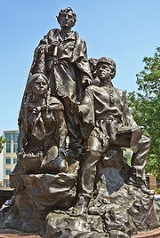
    Lewis and Clark Statue
    # Sergeant Patrick Gass
    Patrick Gass

    Patrick Gass served as sergeant in the Lewis and Clark Expedition . He was important to the expedition because of his service as carpenter and he published the first journal of the expedition in 1807, seven years before the first publication based on Lewis and Clark's journals....
    —chief carpenter, promoted from Private to Sergeant after Floyd's death.
  5. Sergeant John Ordway
    John Ordway

    Sergeant John Ordway , the youngest of ten siblings, was an important part of the Lewis and Clark Expedition across the United States. John Ordway was the only sergeant from the United States Army who stepped forward as a volunteer for the expedition....
    —responsible for issuing provisions, appointing guard duties, and keeping records for the Expedition.
  6. Sergeant Nathaniel Hale Pryor
    Nathaniel Hale Pryor

    Nathaniel Hale Pryor served as Sergeant in the Lewis and Clark Expedition. He was born in Virginia and was a cousin of fellow expedition member Charles Floyd ....
    —leader of the 1st Squad; he presided over the court martial of privates John Collins and Hugh Hall.
  7. Corporal Richard Warfington—conducted the return party to St. Louis in 1805.
  8. Private John Boley—disciplined at Camp Dubois
    Camp Dubois

    Camp Dubois, near present day Hartford, Illinois, Illinois, served as the winter camp for the Lewis and Clark Expedition from December 12, 1803, to May 14, 1804....
     and was assigned to the return party.
  9. Private William E. Bratton—served as hunter and blacksmith.
  10. Private John Collins—had frequent disciplinary problems; he was court-martialed for stealing whiskey which he had been assigned to guard.
  11. Private John Colter
    John Colter

    John Colter was a member of the Lewis and Clark Expedition . Though party to one of the more famous expeditions in history, he is still best remembered for his explorations made after being honorably discharged in 1806....
    —charged with mutiny early in the trip, he later proved useful as a hunter; he earned his fame after the journey.
  12. Private Pierre Cruzatte
    Pierre Cruzatte

    Private Pierre Cruzatte was a member of the Lewis and Clark Expedition. He was of France and Omaha tribe Indian heritage. He enlisted with Lewis and Clark on May 16, 1804, at St....
    —a one-eyed French fiddle-player and a skilled boatman.
  13. Private John Dame
    John Dame

    Private John Dame was a member of the Lewis and Clark Expedition. Born in 1784 at Pallingham, New Hampshire, he was five Foot nine inches in height and had blue eyes, light hair, and a Human skin color....
  14. Private Joseph Field
    Joseph Field

    Joseph Field was born in 1774 in Culpepper County, Virginia. His older brother Reuben was born in 1772. They were raised in Kentucky and considered to be part of the "nine young men from Kentucky" in the Lewis and Clark Expedition which they joined on August 1, 1803....
    —a woodsman and skilled hunter, brother of Reubin.
  15. Private Reubin Field
    Reubin Field

    Reubin Field was a woodsman and skilled hunter. With his brother Joseph Field, he was a member of the Lewis and Clark Expedition, as one of the "nine young men from Kentucky" and one of the first to be recruited in August 1803....
    —a woodsman and skilled hunter, brother of Joseph.
  16. Private Robert Frazer—kept a journal that was never published.
  17. Private George Gibson—a fiddle-player and a good hunter; he served as an interpreter (probably via sign language
    Sign language

    A sign language is a language which, instead of acoustically conveyed sound patterns, uses visually transmitted sign patterns to convey meaning—simultaneously combining hand shapes, orientation and movement of the hands, arms or body, and facial expressions to express fluidly a speaker's thoughts....
    ).
  18. Private Silas Goodrich—the main fisherman of the expedition.
  19. Private Hugh Hall—court-martialed with John Collins for stealing whiskey.
  20. Private Thomas Proctor Howard—court-martialed for setting a "pernicious example" to the Indians by showing them that the wall at Fort Mandan was easily scaled.
  21. Private François Labiche—French fur trader who served as an interpreter and boatman.
  22. Private Hugh McNeal—the first white explorer to stand astride the headwaters of the Missouri River on the Continental Divide.
  23. Private John Newman
    John Newman (Corps of Discovery)

    Private John Newman was a member of the Lewis and Clark Expedition. He was born in Pennsylvania and was a member of Captain Daniel Bissell's company of the First Infantry Regiment....
    —court-martialed and confined for "having uttered repeated expressions of a highly criminal and mutinous nature."
  24. Private John Potts—German immigrant and a miller.
  25. Private Moses B. Reed—attempted to desert in August 1804; convicted of desertion and expelled from the party.
  26. Private John Robertson—member of the Corps for a very short time.
  27. Private George Shannon
    George Shannon

    George Shannon , the youngest member of the Lewis and Clark Expedition, was born in Pennsylvania. He joined the Corps of Discovery on October 19 1803, as one of the "nine young men from Kentucky"....
    —was lost twice during the expedition, once for sixteen days. Youngest member of expedition at 19.
  28. Private John Shields
    John Shields

    Private John Shields , born in Harrisonburg, Virginia was at 34, the oldest member of the Lewis and Clark Expedition. Despite the Captains' rule that they would only consider unmarried men for the exploring enterprise, they recruited Shields....
    —blacksmith, gunsmith, and a skilled carpenter; with John Colter, he was court-martialed for mutiny
    Mutiny

    Mutiny is a conspiracy among members of a group of similarly-situated individuals to openly oppose, change or overthrow an existing authority....
    .
  29. Private John B. Thompson—may have had some experience as a surveyor.
  30. Private Howard Tunn—hunter and navigator.
  31. Private Ebenezer Tuttle—may have been the man sent back on June 12, 1804; otherwise, he was with the return party from Fort Mandan in 1805.
  32. Private Peter M. Weiser
    Peter M. Weiser

    Peter M. Weiser was an United States soldier and member of the Corps of Discovery on the Lewis and Clark Expedition. The town of Weiser, Idaho, Idaho, and the nearby Weiser River are named for him....
    —had some minor disciplinary problems at River Dubois; he was made a permanent member of the party.
  33. Private William Werner—convicted of being absent without leave at St. Charles, Missouri, at the start of the expedition.
  34. Private Isaac White—may have been the man sent back on June 12, 1804; otherwise, he was with the return party from Fort Mandan in 1805.
  35. Private Joseph Whitehouse—often acted as a tailor for the other men; he kept a journal which extended the Expedition narrative by almost five months.
  36. Private Alexander Hamilton Willard
    Alexander Hamilton Willard

    Alexander Hamilton Willard was a blacksmith who joined the Lewis and Clark Expedition....
    —blacksmith; assisted John Shields. He was attacked in July 1805 by a White Bear
    Kermode bear

    The Kermode Bear , also known as the "spirit bear", includes several subspecies of the American Black Bear living in the central coast of British Columbia, and noted for about 1/10 of their population having white or cream-colored coats....
     on portage around Missouri River
    Missouri River

    The Missouri River is a tributary of the Mississippi River, and the longest river in the United States of America. The Missouri begins at the confluence of the Madison River, Jefferson River, and Gallatin River rivers in Montana, and flows through Missouri River Valley south and east into the Mississippi north of St....
     Falls and rescued by Clark and three others.
  37. Private Richard Windsor
    Richard Windsor

    Richard Windsor served the Lewis and Clark Expedition and Corps of Discovery as a hunter, scout, and woodsman.Windsor was recruited at Kaskaskia in 1803, joining the party as a Private at Camp Dubois, January 1, 1804....
    —often assigned duty as a hunter.
  38. Interpreter Toussaint Charbonneau
    Toussaint Charbonneau

    Toussaint Charbonneau was a French-Canadian M?tis List of explorers and trader, and a member of the Lewis and Clark Expedition. He is also known as the husband of Sacagawea....
    —Sacagawea's husband; served as a translator and often as a cook.
  39. Interpreter Sacagawea
    Sacagawea

    For the Sacagawea $1 coin, see Sacagawea dollar.Sacagawea Reliable historical information about Sacagawea is extremely limited, but she has become an important part of the Lewis and Clark mythology in the American public imagination....
    —Charbonneau's wife; translated Shoshone to Hidatsa
    Hidatsa

    The Hidatsa are a Siouan languages people, a part of the Mandan, Hidatsa, and Arikara Nation. The Hidatsa name for themselves is Nuxbaaga ....
     for Charbonneau and was a valued member of the expedition.
  40. Jean Baptiste Charbonneau
    Jean Baptiste Charbonneau

    Jean Baptiste Charbonneau traveled across North America as an infant with his mother Sacagawea as part of the Lewis and Clark Expedition, which journeyed from North Dakota to Oregon and back again during 1805 and 1806....
    —Son of Charbonneau and Sacagawea, born February 11, 1805; his presence helped dispel any notion that the expedition was a war party, smoothing the way in Indian lands.
  41. Interpreter George Drouillard
    George Drouillard

    George Drouillard was a civilian interpreter for the Corps of Discovery....
    —skilled with Indian sign language; the best hunter on the expedition.
  • "Seaman", Lewis' large black Newfoundland
    Newfoundland (dog)

    The Newfoundland is a large, usually black, dog breed of dog originally used as a working dog in Newfoundland . They are known for their sweet dispositions, loyalty, and natural water rescue tendencies....
     dog.

See also

  • Timeline of the Lewis and Clark Expedition
    Timeline of the Lewis and Clark Expedition

    This is the timeline of the Lewis and Clark Expedition through the American West . ...
  • History of the United States
    History of the United States

    The first known inhabitants of modern-day United States territory are believed to have arrived over a period of several thousand years beginning sometime prior to 15,000 - 50,000 years ago by crossing Beringia into Alaska....
  • USS Lewis and Clark
    USS Lewis and Clark (SSBN-644)

    USS Lewis and Clark , a Benjamin Franklin class submarine ballistic missile submarine, was the first ship of the United States Navy to be named for Lewis and Clark Expedition Meriwether Lewis and William Clark ....
     and USNS Lewis and Clark
    USNS Lewis and Clark (T-AKE-1)

    USNS Lewis and Clark , the lead ship of Lewis and Clark class dry cargo ship, was the second ship of the United States Navy to be named for Lewis and Clark Expedition Meriwether Lewis and William Clark ....
  • Jefferson National Expansion Memorial
    Jefferson National Expansion Memorial

    The Jefferson National Expansion Memorial is located in St. Louis, Missouri, near the starting point of the Lewis and Clark Expedition. It was designated as a National Memorial by Executive order 7523, on December 21, 1935, and is maintained by the National Park Service ....


Further reading


History

  • , James P. Ronda, 1984 – ISBN 0-8032-3870-3
  • Undaunted Courage, Stephen Ambrose
    Stephen Ambrose

    Stephen Edward Ambrose was an American historian and biographer of U.S. Presidents Dwight D. Eisenhower and Richard Nixon. He was a long time professor of history at the University of New Orleans....
    , 1997 – ISBN 0-684-82697-6
  • National Geographic Guide to the Lewis & Clark Trail, Thomas Schmidt
    Thomas Schmidt

    Thomas Schmidt is a Germany slalom canoeing who competed in the 2000s. Competing in two Summer Olympics, he won a gold in the K-1 event at Sydney in 2000 Summer Olympics....
    , 2002 – ISBN 0-7922-6471-1
  • (abridged), edited by Gary E. Moulton, 2003 – ISBN 0-8032-2950-X
  • , 13-Volume Set, edited by Gary E. Moulton, 2002 – ISBN 0-8032-2948-8
  • , University of Nebraska–Lincoln
  • In Search of York: The Slave Who Went to the Pacific With Lewis and Clark, Robert B. Betts, 2002 – ISBN 0-87081-714-0
  • at Project Gutenberg
    Project Gutenberg

    Project Gutenberg, abbreviated as PG, is a volunteer effort to digitize, archive and distribute cultural works, as founder Michael Hart said "To encourage the creation and distribution of eBooks."....
  • Lewis & Clark: The Journey of the Corps of Discovery, Ken Burns
    Ken Burns

    Kenneth Lauren Burns is an United States director and producer of documentary films known for his style of making use of archival footage and photographs....
    , 1997 – ISBN 0-679-45450-0
  • Lewis and Clark: across the divide, Carolyn Gilman, 2003. Washington, D.C.: Smithsonian Books. ISBN 1588340996
  • The Way to the Western Sea: Lewis and Clark Across the Continent, David Lavender, 1988. Harpercollins. ISBN 0060159820
  • by Stephenie Ambrose Tubbs (University of Nebraska Press, 2008)


External links

  • – a variety of resources, including an Interactive Journey Log
  • – A book with a perspective of L&C from the air
  • in Great Falls, Montana
  • (University of Illinois Extension)