


Sangha

Encyclopedia
Sangha is a word in Pali
or Sanskrit
that can be translated roughly as "association" or "assembly," "company" or "community" with common goal, vision or purpose. Sangha is the third of the Three Jewels
in Buddhism.
The term is commonly used in several senses to refer to Buddhist or Jain
groups.
Traditionally, in Buddhism Sangha almost always has one of two meanings: most commonly, Sangha means the monastic Sangha of ordained Buddhist monks or nuns. In a stricter sense, Sangha can mean the assembly of all beings possessing some high degree of realization, referred to as the arya-sangha or "noble Sangha". This article deals primarily with the subject of the monastic Sangha. Buddhists traditionally consider monastic life to provide the environment most conducive to advancing toward enlightenment, and the Sangha is responsible for maintaining, translating, advancing, and spreading the teachings of the Buddha. According to the same tradition for a country or nation to be considered as truly Buddhist, the majority of the nation must be Buddhist and include at least a fourfold sangha of bhikkhu
s, bhikkhuni
s, upasaka
s and, upasikas. That is why there is also a tradition of yogic tantric practitioners who are laypeople but still Buddhist practitioners.
, the Buddha
, the Dharma
and the Sangha each are described as having certain characteristics. These characteristics are chanted either on a daily basis and/or on Uposatha
days, depending on the school of Buddhism. In Theravada
tradition they are a part of daily chanting:
The Sangha: "The Sangha of the Blessed One's disciples (Savakas) is:
that is, the four pairs of persons, the eight types of individuals - This Sangha of the Blessed One's disciples is:
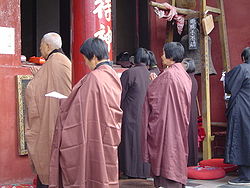 The Sangha of monks and the Sangha of nuns were originally established by Gautama Buddha
in the 5th century BCE in order to provide a means for those who wish to practice the Dhamma full time, in a direct and highly disciplined way, free from the restrictions and responsibilities of the household life. The Sangha also fulfils the function of preserving the Buddha’s original teachings and of providing spiritual support for the Buddhist lay-community.
The key feature of Buddhist monasticism is the adherence to the vinaya
which contains an elaborate set of rules of conduct including complete chastity and eating only before noon. Between midday and the next day, a strict life of scripture study, chanting, meditation
, and occasional cleaning forms most of the Sangha's duties. Transgression of rules carries penalties ranging from confession to permanent expulsion from the Sangha. The founder of Japanese Tendai decided to reduce the number of rules down to about 60 (Enkai). In Kamakura Era, many sects (Zen, Pureland and Nichiren) that originated from Tendai sect abolished vinaya entirely. Therefore Japanese Zen, Pureland and Nichiren, are led by priests (or minister) rather than by monks.
Monks and nuns may own only the barest minimum of possessions due to their samaya
as renunciates (ideally, three robes, an alms bowl, a cloth belt, a needle and thread, a razor for shaving the head, and a water filter). In practice, they often have a few additional personal possessions.
Traditionally, Buddhist monastics eschew ordinary clothes and wear robes. Originally the robes were sewn together from rags and stained with earth. The idea that robes were dyed with saffron seems unlikely to be true since it was and still is a very expensive commodity, and monks were poor. The color of modern robes varies from community to community (saffron
is characteristic for southeast Asian Theravada
and Mahayana
groups, maroon
in Tibet
, gray in Korea
, black in Japan
etc.)
The word which is usually translated as monk is bhikkhu
in Pali
or bhikshu in Sanskrit
. The feminine form is bhikkhuni
or bhikshuni. These words literally mean "beggar", and it is traditional for bhikkhus to beg their food. In most places this has become an elaborate ritual, where lay people feed monastics in order to obtain merit which will ensure them a fortunate rebirth. Although monastics in India traditionally did not work for income, this changed when Buddhism moved to east Asia, so that in China and the surrounding countries monks often engage in agriculture.
The idea that all Buddhists, especially monks and nuns practice vegetarianism
is a Western misperception. In some Sanskrit sutras meat eating is strongly discouraged whilst in Pali Sutras the Buddha specifically rejected a suggestion by a senior monk to impose vegetarianism on the Sangha. The Buddha himself is recorded as having consumed meat. The Buddha allowed Sangha members to eat whatever food is donated to them by laypeople, except that they may not eat meat if they know or suspect the animal was killed specifically for them. Consequently, the Theravadan tradition (Sri Lanka, Thailand, Laos, Cambodia and Burma) which follows the Pali scriptures does not practice vegetarianism though an individual may do so at his or her personal choice. On the other hand, the Mahayana and Vajrayana traditions accept both Theravada and Mahayana scriptures, and consequently the practice will vary depending on their interpretation of the sutras. In particular, East Asian monastics take on the bodhisattva vows from the Brahma Net Sutra which has a vow of vegetarianism as part of the Triple Platform Ordination where they receive the sramanera/sramanerika, bhikshu/bhikshuni and bodhisattva vows, whereas the Tibetan lineages transmit the bodhisattva vows from Asanga's Yogacarabhumi, which does not include a vow of vegetarianism. In some areas such as China, Korea and Vietnam one expects the Sangha to practice strict vegetarianism while in other areas such as Japan or Tibet one does not.
The lay community is responsible for the production of goods and services in society, and for the production and raising of children. According to Mahayana sutras, the Buddha
always maintained that lay persons were capable of great wisdom in the Buddhadharma and of reaching enlightenment. In the west, there is a misconception that Theravada regards enlightenment to be an impossible goal outside the Sangha. This is incorrect. In Theravada suttas, it is clearly recorded that the Buddha's uncle—who was a lay follower—reached enlightenment by hearing the Buddha's discourse.
 The distinction between Sangha and lay persons has always been important and forms the Parisa, Buddhist community. Here, monastics teach and counsel the laity at request while laymen and laywomen offer donations for their future support.
This inter-connectedness serves as a marriage and has sustained Buddhism to this day.
, who supported her cause, the Buddha relented and ordained Maha Pajapati and several others as nuns. It is interesting to note that this was one of the few issues about which the Buddha is recorded to have changed his mind. The Buddha later established the condition that each new ordination would be sanctioned by at least five bhikkhunis.
There have been several theories regarding the Buddha's reluctance to ordain women, including the possibility that it was due to fears that a community of women would not be safe in the society of his day. According to the scriptures the reason the Buddha himself gave was that the admission of women would weaken the Sangha and shorten its lifetime, and he laid down strict rules subordinating nuns to monks (The Eight Garudhammas
).
Before the modern era, the Bhikkhuni Sangha spread to most Buddhist countries including Burma (also known as Myanmar
), with the notable exceptions being Tibet and Thailand. However, in Sri Lanka
, it died out in the 11th century during a civil war and was not revived. Consequently, as Theravada Buddhism spread to Thailand, the Theravada Sangha consisted only of monks.
In recent decades, there has been a serious attempt to revive the Theravada Bhikkhuni Sangha with the assistance of Mahayana bhikkhunis from the Chinese lineage. These were introduced from Sri Lanka in 433 C. E., following the Dharmaguptaka Vinaya
, and subsequently spread to Korea, Taiwan, Vietnam, and Japan. This has resulted in a small but thriving community of nuns in Sri Lanka, who in turn ordained the first Theravada Buddhist nun in the history of Thailand, Ven. Dhammananda. However, the validity of these ordinations is strongly disputed by some of the conservative Theravada establishment.
Meanwhile, a similar process has produced the first fully ordained bhikkhunis in Tibetan Buddhism
, where only the novice ordination for bhikkhunis existed. In the west, where feminism
has been a strong influence, there have been many remarkable Buddhist nuns: three notable examples are Pema Chodron
, Ayya Khema
and Tenzin Palmo
.
The first bhikkhuni ordination in Australia in the Theravadin tradition was held in Perth on October 22 at Bodhinyana Monastery. Venerable Ajahn Vayama together with Venerables Nirodha, Seri and Hasapanna were ordained as bhikkhunis by a dual sangha act of bhikkhus and bhikkhunis in full accordance with the pali vinaya.
(of Buddha, dharma, and sangha) where other sentient beings could take refuge
, and as such, might not merit the reverence and the measure of community support (i.e., recourse to bhiksa in whatever form) provided for in the sutras for the sangha formative of the triple gem.
It is suggested by these commentators that the terms parisa or gana
would be a more appropriate reference to a community of Buddhists. Parisa means "following" and it refers to the four groups of the Buddha's followers: monks, nuns, laymen and laywomen. http://www.accesstoinsight.org/glossary.html#pq The Sanskrit term gana has meanings of flock, troop, multitude, number, tribe, series, class, and is usable as well in more mundane senses.
However, application of sangha to any sort of Buddhist community is backed by other commentators, mainly coming from movements with a significant proportion of lay people, and often among Mahayana, Vajrayana and Vipassana groups. They refer to the word sangha being traditionally also used to encompass lay followers, in sutras like Anguttara-Nikaya II.1.vii. The doctrinal problem of sangha-as-gem-to-be-revered they solve in two ways: firstly by stressing that the arya sangha is a much greater refuge than the lower levels of sangha, and secondly by stressing that sangha denotes the sacred dimensions of gathering as a community of Buddhists, in contrast with its more mundane dimensions. The sacred dimensions of such peer relationships are governed by the concept of kalyana mittata.
Páli
- External links :* *...
or Sanskrit
Sanskrit
Sanskrit , is a historical Indo-Aryan language and the primary liturgical language of Hinduism, Jainism and Buddhism.Buddhism: besides Pali, see Buddhist Hybrid Sanskrit Today, it is listed as one of the 22 scheduled languages of India and is an official language of the state of Uttarakhand...
that can be translated roughly as "association" or "assembly," "company" or "community" with common goal, vision or purpose. Sangha is the third of the Three Jewels
Three Jewels
The Three Jewels, also called the Three Treasures, the Siemese Triples, Three Refuges, or the Triple Gem , are the three things that Buddhists take refuge in, and look toward for guidance, in the process known as taking refuge.The Three Jewels are:* BuddhaTaking refuge in the Three Jewels is...
in Buddhism.
The term is commonly used in several senses to refer to Buddhist or Jain
Jainism
Jainism is an Indian religion that prescribes a path of non-violence towards all living beings. Its philosophy and practice emphasize the necessity of self-effort to move the soul towards divine consciousness and liberation. Any soul that has conquered its own inner enemies and achieved the state...
groups.
Traditionally, in Buddhism Sangha almost always has one of two meanings: most commonly, Sangha means the monastic Sangha of ordained Buddhist monks or nuns. In a stricter sense, Sangha can mean the assembly of all beings possessing some high degree of realization, referred to as the arya-sangha or "noble Sangha". This article deals primarily with the subject of the monastic Sangha. Buddhists traditionally consider monastic life to provide the environment most conducive to advancing toward enlightenment, and the Sangha is responsible for maintaining, translating, advancing, and spreading the teachings of the Buddha. According to the same tradition for a country or nation to be considered as truly Buddhist, the majority of the nation must be Buddhist and include at least a fourfold sangha of bhikkhu
Bhikkhu
A Bhikkhu or Bhikṣu is an ordained male Buddhist monastic. A female monastic is called a Bhikkhuni Nepali: ). The life of Bhikkhus and Bhikkhunis is governed by a set of rules called the patimokkha within the vinaya's framework of monastic discipline...
s, bhikkhuni
Bhikkhuni
A bhikkhuni or bhikṣuṇī is a fully ordained female Buddhist monastic. Male monastics are called bhikkhus. Both bhikkhunis and bhikkhus live by the vinaya...
s, upasaka
Upasaka
Upāsaka or Upāsikā are from the Sanskrit and Pāli words for "attendant". This is the title of followers of Buddhism who are not monks, nuns, or novice monastics in a Buddhist order, and who undertake certain vows...
s and, upasikas. That is why there is also a tradition of yogic tantric practitioners who are laypeople but still Buddhist practitioners.
Qualities of the Sangha
In BuddhismBuddhism
Buddhism is a religion and philosophy encompassing a variety of traditions, beliefs and practices, largely based on teachings attributed to Siddhartha Gautama, commonly known as the Buddha . The Buddha lived and taught in the northeastern Indian subcontinent some time between the 6th and 4th...
, the Buddha
Gautama Buddha
Siddhārtha Gautama was a spiritual teacher from the Indian subcontinent, on whose teachings Buddhism was founded. In most Buddhist traditions, he is regarded as the Supreme Buddha Siddhārtha Gautama (Sanskrit: सिद्धार्थ गौतम; Pali: Siddhattha Gotama) was a spiritual teacher from the Indian...
, the Dharma
Dharma (Buddhism)
Dhamma or Dharma in Buddhism can have the following meanings:* The state of Nature as it is * The Laws of Nature considered collectively....
and the Sangha each are described as having certain characteristics. These characteristics are chanted either on a daily basis and/or on Uposatha
Uposatha
The Uposatha is Buddhist day of observance, in existence from the Buddha's time , and still being kept today in Buddhist countries. The Buddha taught that the Uposatha day is for "the cleansing of the defiled mind," resulting in inner calm and joy...
days, depending on the school of Buddhism. In Theravada
Theravada
Theravada ; literally, "the Teaching of the Elders" or "the Ancient Teaching", is the oldest surviving Buddhist school. It was founded in India...
tradition they are a part of daily chanting:
The Sangha: "The Sangha of the Blessed One's disciples (Savakas) is:
- practicing the good way
- practicing the upright way
- practicing the knowledgeable or logical way
- practicing the proper way;
that is, the four pairs of persons, the eight types of individuals - This Sangha of the Blessed One's disciples is:
- worthy of gifts
- worthy of hospitalities
- worthy of offerings
- worthy of reverential salutation
- the unsurpassed field of merit for the world."
Monastic tradition
Gautama Buddha
Siddhārtha Gautama was a spiritual teacher from the Indian subcontinent, on whose teachings Buddhism was founded. In most Buddhist traditions, he is regarded as the Supreme Buddha Siddhārtha Gautama (Sanskrit: सिद्धार्थ गौतम; Pali: Siddhattha Gotama) was a spiritual teacher from the Indian...
in the 5th century BCE in order to provide a means for those who wish to practice the Dhamma full time, in a direct and highly disciplined way, free from the restrictions and responsibilities of the household life. The Sangha also fulfils the function of preserving the Buddha’s original teachings and of providing spiritual support for the Buddhist lay-community.
The key feature of Buddhist monasticism is the adherence to the vinaya
Vinaya
The Vinaya is the regulatory framework for the Buddhist monastic community, or sangha, based in the canonical texts called Vinaya Pitaka. The teachings of the Buddha, or Buddhadharma can be divided into two broad categories: 'Dharma' or doctrine, and 'Vinaya', or discipline...
which contains an elaborate set of rules of conduct including complete chastity and eating only before noon. Between midday and the next day, a strict life of scripture study, chanting, meditation
Meditation
Meditation is any form of a family of practices in which practitioners train their minds or self-induce a mode of consciousness to realize some benefit....
, and occasional cleaning forms most of the Sangha's duties. Transgression of rules carries penalties ranging from confession to permanent expulsion from the Sangha. The founder of Japanese Tendai decided to reduce the number of rules down to about 60 (Enkai). In Kamakura Era, many sects (Zen, Pureland and Nichiren) that originated from Tendai sect abolished vinaya entirely. Therefore Japanese Zen, Pureland and Nichiren, are led by priests (or minister) rather than by monks.
Monks and nuns may own only the barest minimum of possessions due to their samaya
Samaya
The samaya , is a set of vows or precepts given to initiates of an esoteric Vajrayana Buddhist order as part of the abhiṣeka ceremony that creates a bond between the guru and disciple.According Keown, et al., Samaya may be defined as:*A particular system of teaching or...
as renunciates (ideally, three robes, an alms bowl, a cloth belt, a needle and thread, a razor for shaving the head, and a water filter). In practice, they often have a few additional personal possessions.
Traditionally, Buddhist monastics eschew ordinary clothes and wear robes. Originally the robes were sewn together from rags and stained with earth. The idea that robes were dyed with saffron seems unlikely to be true since it was and still is a very expensive commodity, and monks were poor. The color of modern robes varies from community to community (saffron
Saffron (color)
Saffron is a color that is a tone of golden yellow resembling the color of the tip of the saffron crocus thread, from which the spice saffron is derived.The first recorded use of saffron as a color name in English was in 1200...
is characteristic for southeast Asian Theravada
Theravada
Theravada ; literally, "the Teaching of the Elders" or "the Ancient Teaching", is the oldest surviving Buddhist school. It was founded in India...
and Mahayana
Mahayana
Mahāyāna is one of the two main existing branches of Buddhism and a term for classification of Buddhist philosophies and practice...
groups, maroon
Maroon (color)
Maroon is a dark red color.-Etymology:Maroon is derived from French marron .The first recorded use of maroon as a color name in English was in 1789.-Maroon :...
in Tibet
Tibetan Buddhism
Tibetan Buddhism is the body of Buddhist religious doctrine and institutions characteristic of Tibet and certain regions of the Himalayas, including northern Nepal, Bhutan, and India . It is the state religion of Bhutan...
, gray in Korea
Korea
Korea ) is an East Asian geographic region that is currently divided into two separate sovereign states — North Korea and South Korea. Located on the Korean Peninsula, Korea is bordered by the People's Republic of China to the northwest, Russia to the northeast, and is separated from Japan to the...
, black in Japan
Japan
Japan is an island nation in East Asia. Located in the Pacific Ocean, it lies to the east of the Sea of Japan, China, North Korea, South Korea and Russia, stretching from the Sea of Okhotsk in the north to the East China Sea and Taiwan in the south...
etc.)
The word which is usually translated as monk is bhikkhu
Bhikkhu
A Bhikkhu or Bhikṣu is an ordained male Buddhist monastic. A female monastic is called a Bhikkhuni Nepali: ). The life of Bhikkhus and Bhikkhunis is governed by a set of rules called the patimokkha within the vinaya's framework of monastic discipline...
in Pali
Páli
- External links :* *...
or bhikshu in Sanskrit
Sanskrit
Sanskrit , is a historical Indo-Aryan language and the primary liturgical language of Hinduism, Jainism and Buddhism.Buddhism: besides Pali, see Buddhist Hybrid Sanskrit Today, it is listed as one of the 22 scheduled languages of India and is an official language of the state of Uttarakhand...
. The feminine form is bhikkhuni
Bhikkhuni
A bhikkhuni or bhikṣuṇī is a fully ordained female Buddhist monastic. Male monastics are called bhikkhus. Both bhikkhunis and bhikkhus live by the vinaya...
or bhikshuni. These words literally mean "beggar", and it is traditional for bhikkhus to beg their food. In most places this has become an elaborate ritual, where lay people feed monastics in order to obtain merit which will ensure them a fortunate rebirth. Although monastics in India traditionally did not work for income, this changed when Buddhism moved to east Asia, so that in China and the surrounding countries monks often engage in agriculture.
The idea that all Buddhists, especially monks and nuns practice vegetarianism
Vegetarianism
Vegetarianism encompasses the practice of following plant-based diets , with or without the inclusion of dairy products or eggs, and with the exclusion of meat...
is a Western misperception. In some Sanskrit sutras meat eating is strongly discouraged whilst in Pali Sutras the Buddha specifically rejected a suggestion by a senior monk to impose vegetarianism on the Sangha. The Buddha himself is recorded as having consumed meat. The Buddha allowed Sangha members to eat whatever food is donated to them by laypeople, except that they may not eat meat if they know or suspect the animal was killed specifically for them. Consequently, the Theravadan tradition (Sri Lanka, Thailand, Laos, Cambodia and Burma) which follows the Pali scriptures does not practice vegetarianism though an individual may do so at his or her personal choice. On the other hand, the Mahayana and Vajrayana traditions accept both Theravada and Mahayana scriptures, and consequently the practice will vary depending on their interpretation of the sutras. In particular, East Asian monastics take on the bodhisattva vows from the Brahma Net Sutra which has a vow of vegetarianism as part of the Triple Platform Ordination where they receive the sramanera/sramanerika, bhikshu/bhikshuni and bodhisattva vows, whereas the Tibetan lineages transmit the bodhisattva vows from Asanga's Yogacarabhumi, which does not include a vow of vegetarianism. In some areas such as China, Korea and Vietnam one expects the Sangha to practice strict vegetarianism while in other areas such as Japan or Tibet one does not.
The lay community is responsible for the production of goods and services in society, and for the production and raising of children. According to Mahayana sutras, the Buddha
Gautama Buddha
Siddhārtha Gautama was a spiritual teacher from the Indian subcontinent, on whose teachings Buddhism was founded. In most Buddhist traditions, he is regarded as the Supreme Buddha Siddhārtha Gautama (Sanskrit: सिद्धार्थ गौतम; Pali: Siddhattha Gotama) was a spiritual teacher from the Indian...
always maintained that lay persons were capable of great wisdom in the Buddhadharma and of reaching enlightenment. In the west, there is a misconception that Theravada regards enlightenment to be an impossible goal outside the Sangha. This is incorrect. In Theravada suttas, it is clearly recorded that the Buddha's uncle—who was a lay follower—reached enlightenment by hearing the Buddha's discourse.
This inter-connectedness serves as a marriage and has sustained Buddhism to this day.
Women's role in the Sangha
Although always maintaining that women were just as capable of attaining enlightenment as men, the canonical texts depict the Buddha as being reluctant to permit women to join the Sangha. After several entreaties from his aunt and foster-mother, Maha Pajapati Gotami, who wished to become ordained, and from his cousin and aide AnandaAnanda
Ānanda was one of the principal disciples and a devout attendant of the Buddha. Amongst the Buddha's many disciples, Ānanda had the most retentive memory and most of the suttas in the Sutta Pitaka are attributed to his recollection of the Buddha's teachings during the First Buddhist Council...
, who supported her cause, the Buddha relented and ordained Maha Pajapati and several others as nuns. It is interesting to note that this was one of the few issues about which the Buddha is recorded to have changed his mind. The Buddha later established the condition that each new ordination would be sanctioned by at least five bhikkhunis.
There have been several theories regarding the Buddha's reluctance to ordain women, including the possibility that it was due to fears that a community of women would not be safe in the society of his day. According to the scriptures the reason the Buddha himself gave was that the admission of women would weaken the Sangha and shorten its lifetime, and he laid down strict rules subordinating nuns to monks (The Eight Garudhammas
The Eight Garudhammas
The Eight Garudhammas detail a set of rules for female Buddhist monastics . The rules present a series of subordinations towards their male counterparts .-Purpose:...
).
Before the modern era, the Bhikkhuni Sangha spread to most Buddhist countries including Burma (also known as Myanmar
Myanmar
Burma , officially the Republic of the Union of Myanmar , is a country in Southeast Asia. Burma is bordered by China on the northeast, Laos on the east, Thailand on the southeast, Bangladesh on the west, India on the northwest, the Bay of Bengal to the southwest, and the Andaman Sea on the south....
), with the notable exceptions being Tibet and Thailand. However, in Sri Lanka
Sri Lanka
Sri Lanka, officially the Democratic Socialist Republic of Sri Lanka is a country off the southern coast of the Indian subcontinent. Known until 1972 as Ceylon , Sri Lanka is an island surrounded by the Indian Ocean, the Gulf of Mannar and the Palk Strait, and lies in the vicinity of India and the...
, it died out in the 11th century during a civil war and was not revived. Consequently, as Theravada Buddhism spread to Thailand, the Theravada Sangha consisted only of monks.
In recent decades, there has been a serious attempt to revive the Theravada Bhikkhuni Sangha with the assistance of Mahayana bhikkhunis from the Chinese lineage. These were introduced from Sri Lanka in 433 C. E., following the Dharmaguptaka Vinaya
Vinaya
The Vinaya is the regulatory framework for the Buddhist monastic community, or sangha, based in the canonical texts called Vinaya Pitaka. The teachings of the Buddha, or Buddhadharma can be divided into two broad categories: 'Dharma' or doctrine, and 'Vinaya', or discipline...
, and subsequently spread to Korea, Taiwan, Vietnam, and Japan. This has resulted in a small but thriving community of nuns in Sri Lanka, who in turn ordained the first Theravada Buddhist nun in the history of Thailand, Ven. Dhammananda. However, the validity of these ordinations is strongly disputed by some of the conservative Theravada establishment.
Meanwhile, a similar process has produced the first fully ordained bhikkhunis in Tibetan Buddhism
Tibetan Buddhism
Tibetan Buddhism is the body of Buddhist religious doctrine and institutions characteristic of Tibet and certain regions of the Himalayas, including northern Nepal, Bhutan, and India . It is the state religion of Bhutan...
, where only the novice ordination for bhikkhunis existed. In the west, where feminism
Feminism
Feminism is a collection of movements aimed at defining, establishing, and defending equal political, economic, and social rights and equal opportunities for women. Its concepts overlap with those of women's rights...
has been a strong influence, there have been many remarkable Buddhist nuns: three notable examples are Pema Chodron
Pema Chödrön
Pema Chödrön is a notable American figure in Tibetan Buddhism. A disciple of Chögyam Trungpa Rinpoche, she is an ordained nun, author, and teacher in the Shambhala Buddhist lineage which Trungpa founded....
, Ayya Khema
Ayya Khema
Ayya Khema , a Buddhist teacher, was born as Ilse Kussel in Berlin, Germany, to Jewish parents. Khema escaped Nazis persecution during World War II. She eventually moved to the United States. After travelling in Asia she decided to become a Buddhist nun in Sri Lanka in 1979...
and Tenzin Palmo
Tenzin Palmo
Jetsunma Tenzin Palmo is a Tibetan Buddhist nun in the Drukpa Lineage of the Kagyu school. She is an author, teacher and founder of the in Himachal Pradesh, India...
.
The first bhikkhuni ordination in Australia in the Theravadin tradition was held in Perth on October 22 at Bodhinyana Monastery. Venerable Ajahn Vayama together with Venerables Nirodha, Seri and Hasapanna were ordained as bhikkhunis by a dual sangha act of bhikkhus and bhikkhunis in full accordance with the pali vinaya.
Sangha as a general reference to Buddhist community
Some commentators have noted that sangha is frequently (and according to them, mistakenly) used in the West to refer to any sort of Buddhist community. This could be problematic in a doctrinal sense insofar as a given collection of Buddhists might not fully constitute a triple gemThree Jewels
The Three Jewels, also called the Three Treasures, the Siemese Triples, Three Refuges, or the Triple Gem , are the three things that Buddhists take refuge in, and look toward for guidance, in the process known as taking refuge.The Three Jewels are:* BuddhaTaking refuge in the Three Jewels is...
(of Buddha, dharma, and sangha) where other sentient beings could take refuge
Refuge (Buddhism)
Buddhists "take refuge" in, or to "go for refuge" to, the Three Jewels . This can be done formally in lay and monastic ordination ceremonies.The Three Jewels general signification is: * the Buddha;* the Dharma, the teachings;...
, and as such, might not merit the reverence and the measure of community support (i.e., recourse to bhiksa in whatever form) provided for in the sutras for the sangha formative of the triple gem.
It is suggested by these commentators that the terms parisa or gana
Gana
The word ' , in Sanskrit, means "flock, troop, multitude, number, tribe, series, class" . It can also be used to refer to a "body of attendants" and can refer to "a company, any assemblage or association of men formed for the attainment of the same aims".In Hinduism, the s are attendants of Shiva...
would be a more appropriate reference to a community of Buddhists. Parisa means "following" and it refers to the four groups of the Buddha's followers: monks, nuns, laymen and laywomen. http://www.accesstoinsight.org/glossary.html#pq The Sanskrit term gana has meanings of flock, troop, multitude, number, tribe, series, class, and is usable as well in more mundane senses.
However, application of sangha to any sort of Buddhist community is backed by other commentators, mainly coming from movements with a significant proportion of lay people, and often among Mahayana, Vajrayana and Vipassana groups. They refer to the word sangha being traditionally also used to encompass lay followers, in sutras like Anguttara-Nikaya II.1.vii. The doctrinal problem of sangha-as-gem-to-be-revered they solve in two ways: firstly by stressing that the arya sangha is a much greater refuge than the lower levels of sangha, and secondly by stressing that sangha denotes the sacred dimensions of gathering as a community of Buddhists, in contrast with its more mundane dimensions. The sacred dimensions of such peer relationships are governed by the concept of kalyana mittata.
See also
- BhikkhuBhikkhuA Bhikkhu or Bhikṣu is an ordained male Buddhist monastic. A female monastic is called a Bhikkhuni Nepali: ). The life of Bhikkhus and Bhikkhunis is governed by a set of rules called the patimokkha within the vinaya's framework of monastic discipline...
- BhikkhuniBhikkhuniA bhikkhuni or bhikṣuṇī is a fully ordained female Buddhist monastic. Male monastics are called bhikkhus. Both bhikkhunis and bhikkhus live by the vinaya...
- BuddhamitraBuddhamitraBuddhamitra was born around 90 and lived in the Kushan Empire. She entered into the Sangha and became a Buddhist Nun . Though her life before becoming a nun is not recorded in historical records, she is noted in several important historical records...
- Buddhist monasticismBuddhist monasticismMonasticism is one of the most fundamental institutions of Buddhism. Monks and nuns are responsible for preserving and teaching Buddhist teachings and guiding Buddhist lay followers. Earlier Buddhist monks were enlightened...
- MonasticismMonasticismMonasticism is a religious way of life characterized by the practice of renouncing worldly pursuits to fully devote one's self to spiritual work...
- Monastic
- MonasteryMonasteryMonastery denotes the building, or complex of buildings, that houses a room reserved for prayer as well as the domestic quarters and workplace of monastics, whether monks or nuns, and whether living in community or alone .Monasteries may vary greatly in size – a small dwelling accommodating only...
- NgagpaNgagpaIn Tibetan Buddhism and Bon, a Ngakpa is a non-monastic practitioner of Vajrayana, shamanism, Tibetan medicine, Tantra and Dzogchen amongst other traditions, disciplines and arts....
- Sanga MonasterySanga MonasterySanga Monastery is a small Buddhist monastery located in the vicinity of Lhasa, Tibet. Sanga or Sangha is a word in Sanskrit that can be translated roughly as monastic "association" or "assembly" - possessing some high degree of realization, referred to as the arya-sangha or 'noble sangha'...
- Sangha (Jainism)Sangha (Jainism)In Jainism, Sangha can mean the assembly of monks, nuns, lay men and women of a region. It can also mean an order of monks and nuns, along with its branches...
- World Buddhist Sangha CouncilWorld Buddhist Sangha CouncilThe World Buddhist Sangha Council is an international non-government organisation whose objectives are to develop the exchanges of the Buddhist religious and monastic communities of the different traditions worldwide, and help to carry out activities for the transmission of Buddhism. It was...
- SatsangSatsangSatsang in Indian philosophy means the company of the "highest truth," the company of a guru, or company with an assembly of persons who listen to, talk about, and assimilate the truth...
- PabbajjaPabbajjaPabbajja literally means "to go forth" and refers to when a layperson leaves home to live the life of a Buddhist renunciate among a community of monks . This generally involves preliminary ordination as a novice...
- UpasampadaUpasampadaUpasampadā literally means "approaching or nearing the ascetic tradition." In more common parlance it specifically refers to the rite of ordination by which one undertakes the Buddhist monastic life....
External links
- Sects & Sectarianism - The origins of Buddhist Schools
- "The Bhikkhus' Rules, A Guide for Laypeople" by Bhikkhu Ariyesako.
- "What is Satsang"
- "Duties of the Sangha" by Ajaan Lee Dhammadharo
- Jealousy among the Sangha quoting from Jeremy Haywards book on Chögyam TrungpaChögyam TrungpaChögyam Trungpa Rinpoche was a Buddhist meditation master and holder of both the Kagyu and Nyingma lineages, the eleventh Trungpa tülku, a tertön, supreme abbot of the Surmang monasteries, scholar, teacher, poet, artist, and originator of a radical re-presentation of Shambhala vision.Recognized...
Rinpoche Warrior-King of Shambhala: Remembering Chögyam Trungpa.