

Order of Saint Benedict

Encyclopedia
- This article concerns Roman CatholicRoman Catholic ChurchThe Catholic Church, also known as the Roman Catholic Church, is the world's largest Christian church, with over a billion members. Led by the Pope, it defines its mission as spreading the gospel of Jesus Christ, administering the sacraments and exercising charity...
Order of Saint Benedict; see also Benedictine ConfederationBenedictine ConfederationThe Benedictine Confederation of the Order of Saint Benedict is the international governing body of the Order of Saint Benedict.-Origin:...
and BenedictineBenedictineBenedictine refers to the spirituality and consecrated life in accordance with the Rule of St Benedict, written by Benedict of Nursia in the sixth century for the cenobitic communities he founded in central Italy. The most notable of these is Monte Cassino, the first monastery founded by Benedict...
.
The Order of Saint Benedict (Latin name: Ordo Sancti Benedicti) is a Roman Catholic religious order
Roman Catholic religious order
Catholic religious orders are, historically, a category of Catholic religious institutes.Subcategories are canons regular ; monastics ; mendicants Catholic religious orders are, historically, a category of Catholic religious institutes.Subcategories are canons regular (canons and canonesses regular...
of independent monastic
Christian monasticism
Christian monasticism is a practice which began to develop early in the history of the Christian Church, modeled upon scriptural examples and ideals, including those in the Old Testament, but not mandated as an institution in the scriptures. It has come to be regulated by religious rules Christian...
communities that observe the Rule of St. Benedict. Within the order, each individual community (which may be a monastery
Monastery
Monastery denotes the building, or complex of buildings, that houses a room reserved for prayer as well as the domestic quarters and workplace of monastics, whether monks or nuns, and whether living in community or alone .Monasteries may vary greatly in size – a small dwelling accommodating only...
, a priory
Priory
A priory is a house of men or women under religious vows that is headed by a prior or prioress. Priories may be houses of mendicant friars or religious sisters , or monasteries of monks or nuns .The Benedictines and their offshoots , the Premonstratensians, and the...
or abbey
Abbey
An abbey is a Catholic monastery or convent, under the authority of an Abbot or an Abbess, who serves as the spiritual father or mother of the community.The term can also refer to an establishment which has long ceased to function as an abbey,...
) maintains its own autonomy, while the organization as a whole exists to represent their mutual interests. Today the terms "Order of St Benedict" and "Benedictine Order" are also used frequently to refer to the total of the independent Benedictine
Benedictine
Benedictine refers to the spirituality and consecrated life in accordance with the Rule of St Benedict, written by Benedict of Nursia in the sixth century for the cenobitic communities he founded in central Italy. The most notable of these is Monte Cassino, the first monastery founded by Benedict...
abbeys, thereby giving the wrong impression of a "generalate" or "motherhouse" with jurisdiction over dependent communities. The Benedictine Confederation
Benedictine Confederation
The Benedictine Confederation of the Order of Saint Benedict is the international governing body of the Order of Saint Benedict.-Origin:...
, which was established in 1883 by Pope Leo XIII
Pope Leo XIII
Pope Leo XIII , born Vincenzo Gioacchino Raffaele Luigi Pecci to an Italian comital family, was the 256th Pope of the Roman Catholic Church, reigning from 1878 to 1903...
in his brief Summum semper, is the international governing body of the order, headed by the Abbot Primate.
Historical development
Even today Benedictine monasticism is fundamentally different from other Western religious orders insofar as its individual communities are not part of a religious order with "Generalates" and "Superiors General". Rather, in modern times, the various autonomous houses have formed themselves loosely into congregations (for example, Cassinese, English, Solesmes, Subiaco, Camaldolese, Sylvestrines) that in turn are represented in the Benedictine Confederation
Benedictine Confederation
The Benedictine Confederation of the Order of Saint Benedict is the international governing body of the Order of Saint Benedict.-Origin:...
that came into existence through Pope Leo XIII
Pope Leo XIII
Pope Leo XIII , born Vincenzo Gioacchino Raffaele Luigi Pecci to an Italian comital family, was the 256th Pope of the Roman Catholic Church, reigning from 1878 to 1903...
's Apostolic Brief "Summum semper" on July 12, 1883. This organization facilitates dialogue of Benedictine communities with each other and the relationship between Benedictine communities and other religious order
Religious order
A religious order is a lineage of communities and organizations of people who live in some way set apart from society in accordance with their specific religious devotion, usually characterized by the principles of its founder's religious practice. The order is composed of initiates and, in some...
s and the church at large.
The Rule of Saint Benedict is also used by a number of religious orders that began as reforms of the Benedictine tradition such as the Cistercians and Trappist
TRAPPIST
TRAPPIST is Belgian robotic telescope in Chile which came online in 2010, and is an acronym for TRAnsiting Planets and PlanetesImals Small Telescope, so named in homage to Trappist beer produced in the Belgian region. Situated high in the Chilean mountains at La Silla Observatory, it is actually...
s although none of these groups are part of the Benedictine Confederation
Benedictine Confederation
The Benedictine Confederation of the Order of Saint Benedict is the international governing body of the Order of Saint Benedict.-Origin:...
.
The largest number of Benedictines are Roman Catholics, but there are also some within the Anglican Communion
Anglican Communion
The Anglican Communion is an international association of national and regional Anglican churches in full communion with the Church of England and specifically with its principal primate, the Archbishop of Canterbury...
and occasionally within other Christian denominations as well, for example, within the Lutheran Church.
Benedictine vow and life
Evangelical counsels
The three evangelical counsels or counsels of perfection in Christianity are chastity, poverty , and obedience . As Jesus of Nazareth stated in the Canonical gospels , they are counsels for those who desire to become "perfect"...
professed by candidates for reception into a religious order
Religious order
A religious order is a lineage of communities and organizations of people who live in some way set apart from society in accordance with their specific religious devotion, usually characterized by the principles of its founder's religious practice. The order is composed of initiates and, in some...
. Much scholarship over the last 50 years has been dedicated to the translation of conversatio morum. The older translation "conversion of life" has generally been replaced with phrases such as "a monastic manner of life," drawing from the Vulgate's use of conversatio as the translation of "citizenship" in Philippians 3:22. Some scholars have claimed that the vow formula of the Rule is best translated as "to live in this place as a monk, in obedience to its rule and abbot."
Benedictine abbot
Abbot
The word abbot, meaning father, is a title given to the head of a monastery in various traditions, including Christianity. The office may also be given as an honorary title to a clergyman who is not actually the head of a monastery...
s and abbess
Abbess
An abbess is the female superior, or mother superior, of a community of nuns, often an abbey....
es have full jurisdiction of their abbey
Abbey
An abbey is a Catholic monastery or convent, under the authority of an Abbot or an Abbess, who serves as the spiritual father or mother of the community.The term can also refer to an establishment which has long ceased to function as an abbey,...
and thus absolute authority over the monks or nun
Nun
A nun is a woman who has taken vows committing her to live a spiritual life. She may be an ascetic who voluntarily chooses to leave mainstream society and live her life in prayer and contemplation in a monastery or convent...
s who are resident. This authority includes the power to assign duties, to decide which books may or may not be read, to regulate comings and goings, and to punish and excommunicate.
A tight communal timetable (horarium
Horarium
Horarium , is the name given to the daily schedule of those living in a religious community or seminary. Its use is almost exclusive to the Roman Catholic Church....
) is meant to ensure that the time given by God is not wasted but in whichever way necessary used in his service, whether for prayer, work, meals, spiritual reading, sleep.
Although Benedictines do not take a vow of silence, hours of strict silence are set, and at other time silence is maintained as much as is practically possible. Social conversations tend to be limited to communal recreation times. But such details, like many others details of the daily routine of a Benedictine house that the Rule of St Benedict leaves to the discretion of the superior, are set out in its customary.
In the Roman Catholic Church according to the norms of the Code of Canon Law 1983 a Benedictine abbey is a "Religious Institute", and its professed members are therefore members of the "Consecrated Life", commonly referred to as "Religious". Benedictine monks who have not been ordained
Ordination
In general religious use, ordination is the process by which individuals are consecrated, that is, set apart as clergy to perform various religious rites and ceremonies. The process and ceremonies of ordination itself varies by religion and denomination. One who is in preparation for, or who is...
and all nuns are members of the laity among the Christian faithful. Only those Benedictine monks who have been ordained as a deacon
Deacon
Deacon is a ministry in the Christian Church that is generally associated with service of some kind, but which varies among theological and denominational traditions...
or priest
Priesthood (Catholic Church)
The ministerial orders of the Catholic Church include the orders of bishops, deacons and presbyters, which in Latin is sacerdos. The ordained priesthood and common priesthood are different in function and essence....
are also members of the clergy
Clergy
Clergy is the generic term used to describe the formal religious leadership within a given religion. A clergyman, churchman or cleric is a member of the clergy, especially one who is a priest, preacher, pastor, or other religious professional....
of the Roman Catholic Church. Benedictine Oblates
Oblate (religion)
An oblate in Christian monasticism is a person who is specifically dedicated to God or to God's service. Currently, oblate has two meanings:...
endeavor to embrace the spirit of the Benedictine vow in their own life in the world.
Famous Benedictines
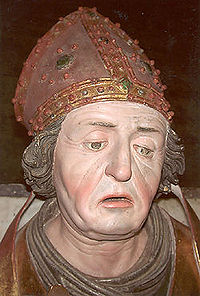

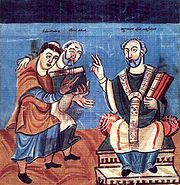
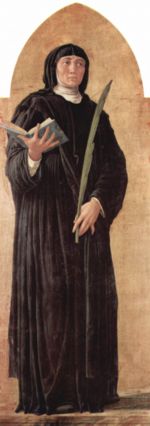
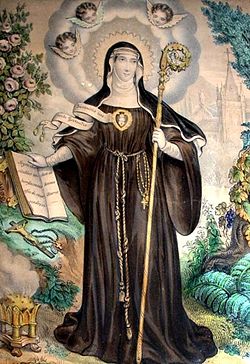
Popes
- Pope Gregory IPope Gregory IPope Gregory I , better known in English as Gregory the Great, was pope from 3 September 590 until his death...
(c540-604, r. 590-604) - Pope Sylvester II (c946-1003, r. 999-1003)
- Pope Gregory VIIPope Gregory VIIPope St. Gregory VII , born Hildebrand of Sovana , was Pope from April 22, 1073, until his death. One of the great reforming popes, he is perhaps best known for the part he played in the Investiture Controversy, his dispute with Henry IV, Holy Roman Emperor affirming the primacy of the papal...
(c1020-85, r. 1073-85) - Pope Victor IIIPope Victor IIIPope Blessed Victor III , born Daufer , Latinised Dauferius, was the Pope as the successor of Pope Gregory VII, yet his pontificate is far less impressive in history than his time as Desiderius, the great Abbot of Monte Cassino.-Early life and abbacy:He was born in 1026 or 1027 of a non-regnant...
(c1026-87, r. 1086-87) - Pope Paschal IIPope Paschal IIPope Paschal II , born Ranierius, was Pope from August 13, 1099, until his death. A monk of the Cluniac order, he was created cardinal priest of the Titulus S...
(d. 1118, r. 1099-1118) - Pope Gelasius IIPope Gelasius IIPope Gelasius II , born Giovanni Caetani , was pope from January 24, 1118 to January 29, 1119.-Biography:He was born between 1060 and 1064 at Gaeta into the Pisan branch of the Caetani family....
(d. 1119, r. 1118-19) - Pope Celestine VPope Celestine VPope Saint Celestine V, born Pietro Angelerio , also known as Pietro da Morrone was elected pope in the year 1294, by the papal election of 1292–1294, the last non-conclave in the history of the Roman Catholic Church...
(1215-96, r. 1294) - Pope Clement VIPope Clement VIPope Clement VI , bornPierre Roger, the fourth of the Avignon Popes, was pope from May 1342 until his death in December of 1352...
(1291-1352, r. 1342-52) - Pope Urban VPope Urban VPope Urban V , born Guillaume Grimoard, was Pope from 1362 to 1370.-Biography:Grimoard was a native of Grizac in Languedoc . He became a Benedictine and a doctor in Canon Law, teaching at Montpellier and Avignon...
(1310-70, r. 1362-70) - Pope Pius VIIPope Pius VIIPope Pius VII , born Barnaba Niccolò Maria Luigi Chiaramonti, was a monk, theologian and bishop, who reigned as Pope from 14 March 1800 to 20 August 1823.-Early life:...
(1742-1823, r. 1800-23) - Pope Gregory XVIPope Gregory XVIPope Gregory XVI , born Bartolomeo Alberto Cappellari, named Mauro as a member of the religious order of the Camaldolese, was Pope of the Catholic Church from 1831 to 1846...
(1765-1846, r. 1831-46)
Apostles and missionaries
- Augustine of CanterburyAugustine of CanterburyAugustine of Canterbury was a Benedictine monk who became the first Archbishop of Canterbury in the year 597...
(d. 604) - Saint BonifaceSaint BonifaceSaint Boniface , the Apostle of the Germans, born Winfrid, Wynfrith, or Wynfryth in the kingdom of Wessex, probably at Crediton , was a missionary who propagated Christianity in the Frankish Empire during the 8th century. He is the patron saint of Germany and the first archbishop of Mainz...
(c680-755) - WillibrordWillibrord__notoc__Willibrord was a Northumbrian missionary saint, known as the "Apostle to the Frisians" in the modern Netherlands...
(c658-739) - Suitbert of KaiserwerdtSuitbert of KaiserwerdtSaint Suitbert, Suidbert, Suitbertus, or Swithbert was the "Apostle of the Frisians", born in Northumbria in the seventh century. He studied in Ireland, at Rathmelsigi, Connacht, along with St. Egbert. The latter, filled with zeal for the conversion of the Germans, had sent St...
(d. 713) - Rupert of SalzburgRupert of SalzburgRupert of Salzburg is a saint in the Roman Catholic and Eastern Orthodox churches and a founder of the Austrian city of Salzburg...
(c660-710) - Saint SturmSaint SturmSaint Sturm was a disciple of Saint Boniface and founder and first abbot of the Benedictine monastery and abbey of Fulda in 742 or 744...
(c705-79) - AnsgarAnsgarSaint Ansgar, Anskar or Oscar, was an Archbishop of Hamburg-Bremen. The see of Hamburg was designated a "Mission to bring Christianity to the North", and Ansgar became known as the "Apostle of the North".-Life:After his mother’s early death Ansgar was brought up in Corbie Abbey, and made rapid...
(801-65) - Adalbert of PragueAdalbert of PragueThis article is about St Adalbert of Prague. For other uses, see Adalbert .Saint Adalbert, Czech: ; , , Czech Roman Catholic saint, a Bishop of Prague and a missionary, was martyred in his efforts to convert the Baltic Prussians. He evangelized Poles and Hungarians. St...
(c956-97)
Founders of abbeys and congregations and prominent reformers
- Earconwald (c630-93)
- Benedict BiscopBenedict BiscopBenedict Biscop , also known as Biscop Baducing, was an Anglo-Saxon abbot and founder of Monkwearmouth-Jarrow Priory and was considered a saint after his death.-Early career:...
(c628-90) - Benedict of AnianeBenedict of AnianeSaint Benedict of Aniane , born Witiza and called the Second Benedict, was a Benedictine monk and monastic reformer, who left a large imprint on the religious practice of the Carolingian Empire...
(747-821) - DunstanDunstanDunstan was an Abbot of Glastonbury Abbey, a Bishop of Worcester, a Bishop of London, and an Archbishop of Canterbury, later canonised as a saint. His work restored monastic life in England and reformed the English Church...
(909-88) - Berno of Cluny (c850-927)
- Odo of ClunyOdo of ClunySaint Odo of Cluny , a saint of the Roman Catholic Church, was the second abbot of Cluny. He enacted various reforms in the Cluniac monastery system of France and Italy....
(c878-942) - Majolus of ClunyMajolus of ClunySaint Majolus of Cluny was an abbot of Cluny. As a youth Majolus fled his family's estates near Rietz to stay with relatives at Mâcon due to the Muslim invasions. Majolus studied at Lyon and later became archdeacon of Mâcon.Offered the bishopric of Besançon, he became a monk of Cluny instead...
(c906-94) - Odilo of Cluny (c962-c1048)
- Bernard of ClunyBernard of ClunyBernard of Cluny was a Benedictine monk of the first half of the 12th century, a poet, satirist, and hymn-writer, author of the famous verses De contemtu mundi, "On Contempt for the World"....
(d. 1109) - Peter the VenerablePeter the VenerablePeter the Venerable , also known as Peter of Montboissier, abbot of the Benedictine abbey of Cluny, born to Blessed Raingarde in Auvergne, France. He has been honored as a saint but has never been formally canonized.-Life:Peter was "Dedicated to God" at birth and given to the monastery at...
(c1092-1156) - RomualdRomualdSaint Romuald was the founder of the Camaldolese order and a major figure in the eleventh-century "Renaissance of eremitical asceticism"....
(c956-c1026) - Robert of MolesmeRobert of MolesmeSaint Robert of Molesme was a Christian saint and abbot, one of the founders of the Cistercian Order in France.-Life:Robert was a member of the nobility in Champagne, a younger son, who entered the abbey of Montier-la-Celle, near Troyes, at age fifteen and later rose to the status of prior...
(c1028-1111) - Alberic of Cîteaux (d. 1109)
- Stephen HardingStephen HardingSaint Stephen Harding is a Christian saint and abbot, one of the founders of the Cistercian Order.-Life:Stephen Harding was born in Dorset, England. He was placed in Sherborne Abbey at a young age, but eventually put aside the cowl and became a travelling scholar. He eventually moved to Molesme...
(d. 1134) - Bernard of ClairvauxBernard of ClairvauxBernard of Clairvaux, O.Cist was a French abbot and the primary builder of the reforming Cistercian order.After the death of his mother, Bernard sought admission into the Cistercian order. Three years later, he was sent to found a new abbey at an isolated clearing in a glen known as the Val...
(1090-1153) - William of HirsauWilliam of HirsauWilliam of Hirsau was a Benedictine abbot and monastic reformer. He was abbot of Hirsau Abbey, for whom he created the Constitutiones Hirsaugienses, based on the uses of Cluny, and was the father of the Hirsau Reforms, which influenced many Benedictine monasteries in Germany...
(c1030-91) - John Gualbert (995-1073)
- Stephen of ObazineStephen of ObazineStephen of Obazine was a priest and hermit, famed for his pious nature, even from a young age.-Religious Life:Stephen began his religious life as a priest in Vielge, France, and was stirred a reputation of holiness, especially when it came to the recitation of the divine office, only interrupting...
(1084-1154) - Robert of ArbrisselRobert of ArbrisselRobert of Arbrissel was an itinerant preacher, and founder of the abbey of Fontevrault. He was born at Arbrissel near Rhétiers, Brittany; and died at Orsan.-Biography:...
(c1045-1116) - William of MontevergineWilliam of MontevergineWilliam of Montevergine, or William of Vercelli, was a Catholic hermit and the founder of the Congregation of Monte Vergine, or "Williamites".-Life:...
(1085-1142) - Sylvester GozzoliniSylvester GozzoliniSylvester Gozzolini was an Italian saint, the founder of the religious order known as the Sylvestrines....
(1177-1267) - Bernardo TolomeiBernardo TolomeiSaint Bernardo Tolomei was an Italian theologian, the founder of the Roman Catholic Congregation of the Blessed Virgin of Monte Oliveto. In the Roman Martyrology he is commemorated on August 20, but in the Benedictine calendar his optional memorial is celebrated on the previous day...
(1272-1348) - Laurent BénardLaurent BénardLaurent Bénard was a chief founder of the Maurist Congregation.-External links:*...
(1573-1620) - Prosper Guéranger (1805-75)
- Jean-Baptiste MuardJean-Baptiste MuardJean-Baptiste Muard was a French Benedictine, reformer, and founder of religious orders.Ordained in 1834, he was parish priest of Joux-la-Ville and then St. Martin d'Avallon before becoming a monk....
(1809-54) - Boniface WimmerBoniface WimmerArchabbot Boniface Wimmer, O.S.B. was a German monk who in 1846 founded the first Benedictine monastery in the United States, Saint Vincent Archabbey, in Latrobe, Pennsylvania, forty miles southeast of Pittsburgh...
(1809-87) - Martin MartyMartin Marty (bishop)Bishop Martin Marty, O.S.B. was a Benedictine priest and missionary in America. He was the first Abbot of St. Meinrad Archabbey in Indiana, the first Vicar Apostolic of Dakota Territory, and the second Bishop of the Roman Catholic Diocese of Saint Cloud...
(1834-96)
Scholars, historians, and spiritual writers
- BedeBedeBede , also referred to as Saint Bede or the Venerable Bede , was a monk at the Northumbrian monastery of Saint Peter at Monkwearmouth, today part of Sunderland, England, and of its companion monastery, Saint Paul's, in modern Jarrow , both in the Kingdom of Northumbria...
(673-735) - Aldhelm (c639-709)
- AlcuinAlcuinAlcuin of York or Ealhwine, nicknamed Albinus or Flaccus was an English scholar, ecclesiastic, poet and teacher from York, Northumbria. He was born around 735 and became the student of Archbishop Ecgbert at York...
(d. 804) - Rabanus MaurusRabanus MaurusRabanus Maurus Magnentius , also known as Hrabanus or Rhabanus, was a Frankish Benedictine monk, the archbishop of Mainz in Germany and a theologian. He was the author of the encyclopaedia De rerum naturis . He also wrote treatises on education and grammar and commentaries on the Bible...
(c780-856) - Paschasius Radbertus (785-865)
- RatramnusRatramnusRatramnus, a Frankish monk of the monastery of Corbie, was a Carolingian theologian known best for his writings on the Eucharist and predestination. His Eucharistic treatise, De corpora et sanguine Domini , was a counterpoint to his abbot Paschasius Radbertus’ realist Eucharistic theology...
(d. 866) - Walafrid StraboWalafrid StraboWalafrid, alternatively spelt Walahfrid, surnamed Strabo , was a Frankish monk and theological writer.-Theological works:...
(c808-49) - Notker LabeoNotker LabeoNotker Labeo , also known as Notker Teutonicus i.e. "the German", Notker the German, or Notker III, was a Benedictine monk and the first commentator on Aristotle active in the Middle Ages. "Labeo" means "the thick lipped"...
(c950-1022) - Guido of ArezzoGuido of ArezzoGuido of Arezzo or Guido Aretinus or Guido da Arezzo or Guido Monaco or Guido d'Arezzo was a music theorist of the Medieval era...
(991-1050) - Hermann of ReichenauHermann of ReichenauHermann of Reichenau , also called Hermannus Contractus or Hermannus Augiensis or Herman the Cripple, was an 11th century scholar, composer, music theorist, mathematician, and astronomer. He composed the Marian prayer Alma Redemptoris Mater...
(1013-54) - Paul the DeaconPaul the DeaconPaul the Deacon , also known as Paulus Diaconus, Warnefred, Barnefridus and Cassinensis, , was a Benedictine monk and historian of the Lombards.-Life:...
(c720-99) - Hincmar (806-82)
- Peter DamianPeter DamianSaint Peter Damian, O.S.B. was a reforming monk in the circle of Pope Gregory VII and a cardinal. In 1823, he was declared a Doctor of the Church...
(c1007-72) - LanfrancLanfrancLanfranc was Archbishop of Canterbury, and a Lombard by birth.-Early life:Lanfranc was born in the early years of the 11th century at Pavia, where later tradition held that his father, Hanbald, held a rank broadly equivalent to magistrate...
(c1005-89) - Anselm of CanterburyAnselm of CanterburyAnselm of Canterbury , also called of Aosta for his birthplace, and of Bec for his home monastery, was a Benedictine monk, a philosopher, and a prelate of the church who held the office of Archbishop of Canterbury from 1093 to 1109...
(c1033-1109) - EadmerEadmerEadmer, or Edmer , was an English historian, theologian, and ecclesiastic. He is known for being a contemporary biographer of his contemporary archbishop and companion, Saint Anselm, in his Vita Anselmi, and for his Historia novorum in Anglia, which presents the public face of Anselm...
(c1060-c1126) - Florence of WorcesterFlorence of WorcesterFlorence of Worcester , known in Latin as Florentius, was a monk of Worcester, who played some part in the production of the Chronicon ex chronicis, a Latin world chronicle which begins with the creation and ends in 1140....
(d. 1118) - Symeon of DurhamSymeon of DurhamSymeon of Durham was an English chronicler and a monk of Durham Priory. When William of Saint-Calais returned from his Norman exile in 1091, Symeon was probably in his company...
(d. 1130) - Jocelyn de BrakelondJocelyn de BrakelondJocelyn de Brakelond was an English monk and the author of a chronicle narrating the fortunes of the monastery of Bury St. Edmunds Abbey between 1173 and 1202. He is only known through his own work.He was a native of Bury St...
(d. 1211) - Matthew ParisMatthew ParisMatthew Paris was a Benedictine monk, English chronicler, artist in illuminated manuscripts and cartographer, based at St Albans Abbey in Hertfordshire...
(c1200-59) - William of MalmesburyWilliam of MalmesburyWilliam of Malmesbury was the foremost English historian of the 12th century. C. Warren Hollister so ranks him among the most talented generation of writers of history since Bede, "a gifted historical scholar and an omnivorous reader, impressively well versed in the literature of classical,...
(c1095-c1143) - Gervase of CanterburyGervase of CanterburyGervase of Canterbury was an English chronicler.- Life :...
(c1141-c1210) - Roger of WendoverRoger of WendoverRoger of Wendover , probably a native of Wendover in Buckinghamshire, was an English chronicler of the 13th century.At an uncertain date he became a monk at St Albans Abbey; afterwards he was appointed prior of the cell of Belvoir, but he forfeited this dignity in the early years of Henry III,...
(d. 1236) - Peter the DeaconPeter the DeaconPeter the Deacon was the librarian of the abbey of Montecassino and continuator of the Chronicon Monasterii Casinensis, usually called the Montecassino Chronicle in English. The chronicle was originally written by Leo of Ostia...
(d. 1140) - Adam EastonAdam EastonAdam Easton was an English Cardinal, born at Easton in Norfolk.He joined the Benedictines at Norwich moving on to the Benedictine Gloucester College, Oxford where he became one of the most outstanding students of his generation, being especially proficient in Hebrew...
(d. 1397) - John LydgateJohn LydgateJohn Lydgate of Bury was a monk and poet, born in Lidgate, Suffolk, England.Lydgate is at once a greater and a lesser poet than John Gower. He is a greater poet because of his greater range and force; he has a much more powerful machine at his command. The sheer bulk of Lydgate's poetic output is...
(c1370-c1451) - John WhethamstedeJohn WhethamstedeJohn Whethamstede , English abbot, was a son of Hugh Bostock, and was born at Wheathampstead in Hertfordshire, owing his name, the Latin form of which is Frumenlarius, to this circumstance....
(d. 1465) - Johannes TrithemiusJohannes TrithemiusJohannes Trithemius , born Johann Heidenberg, was a German abbot, lexicographer, historian, cryptographer, polymath and occultist who had an influence on later occultism. The name by which he is more commonly known is derived from his native town of Trittenheim on the Mosel in Germany.-Life:He...
(1462-1516) - Louis de BloisLouis de BloisAbbot Louis de Blois, O.S.B., was a Flemish monk and mystical writer, generally known under the name of Blosius.-Life:...
(1506-66) - Benedict van Haeften (1588-1648)
- Augustine BakerAugustine BakerFr Augustine Baker OSB , was a well-known Benedictine mystic and an ascetic writer. He was one of the earliest members of the newly restored English Benedictine Congregation.- Early life :...
(1575-1641) - Antoine Augustin CalmetAntoine Augustin CalmetAntoine Augustin Calmet , French Benedictine, was born at Ménil-la-Horgne in Lorraine.He was educated at the Benedictine priory of Breuil in Commercy, and in 1688 joined the same order in the abbey of St-Mansuy at Toul, where he was admitted to profession 23 October of the following year...
(1672-1757) - Magnoald ZiegelbauerMagnoald ZiegelbauerMagnoald Ziegelbauer was a Benedictine monk and an ecclesiastical historian.-Life:He took vows at the Benedictine monastery of Zwiefalten on 21 November 1707, where he was ordained priest on 21 March 1713 and where he became professor of theology...
(1689-1750) - Marquard HerrgottMarquard HerrgottMarquard Herrgott was a German Benedictine historian and diplomat.Hergott was born at Freiburg in the Breisgau. After studying humanities at Freiburg and Strasburg, he became tutor in a private family at the latter place and accompanied his two pupils to Paris, where he remained two years...
(1694-1762) - Suitbert BæumerSuitbert BæumerSuitbert Bæumer was a clergyman and historian of the Breviary and one of the most scholarly patrologists of the nineteenth century.-Biography:...
(1845-94) - Luigi TostiLuigi TostiLuigi Tosti was a Benedictine historian.-Life:His father, Count Giovanni Tosti, descended from an ancient Calabrian family, died young, and so his mother, Vittoria Corigliano, entrusted the child to its uncle, a monk at Monte Cassino...
(1811-97) - Jean Baptiste François PitraJean Baptiste Francois PitraJean Baptiste Francois Pitra was a French Catholic cardinal, archaeologist and theologian.He was born in Champforgeuil. Joining the Benedictine Order, he entered the Abbey of Solesmes in 1842, and was collaborator of Abbe Migne in the latter's Patrologia latina and Patrologia Graeca...
(1812-89) - Francis Aidan Gasquet (1846-1929)
- Fernand CabrolFernand CabrolFernand Cabrol was a French theologian and Benedictine monk.Cabrol was born in Marseille. He became prior of St Michael's Abbey in Farnborough, Hampshire in 1896, and abbot in 1903...
(1855-1937) - Germain MorinGermain MorinGermain Morin was a Belgian Benedictine historical scholar and patrologist, of the Beuronese Congregation.-References:* Grosselin, Oliver A., O.S.B., "Dom Germain Morin," American Benedictine Review, 6:4 408-418...
(1861-1946) - John Chapman (1865-1933)
- Cuthbert ButlerCuthbert ButlerEdward Cuthbert Butler was an English Benedictine historian, and Abbot of Downside Abbey. He is known for his history of Vatican I, and his writing on mysticism.-Works:* The Lausiac History of Palladius...
(1858-1934)
Maurists
- Nicolas-Hugues MénardNicolas-Hugues MénardNicolas-Hugues Ménard was a French Benedictine scholar.His father was private secretary to Catherine de' Medici, his mother was a native of Blois. After a liberal education Ménard entered the Order of St. Benedict, 3 February 1607, at St...
(1585-1644) - Luc d'AcheryLuc d'AchéryLuc d'Achery was a learned French Benedictine of the Congregation of St. Maur, a specialist in the study and publication of medieval manuscripts.-Life:...
(1609-85) - Antoine-Joseph MègeAntoine-Joseph MègeAntoine-Joseph Mège was a French Benedictine of the Congregation of St. Maur. He is known for his commentary on the Rule of St. Benedict.-life:...
(1625-91) - Thierry RuinartThierry RuinartDom Thierry Ruinart was a French Benedictine monk and scholar. He was a Maurist, and a disciple of Jean Mabillon....
(1657-1709) - François LamyFrançois LamyFrançois Lamy was a French Benedictine ascetical and apologetic writer, of the Congregation of St-Maur.-Life:Lamy was born at Montireau in the Department of Eure-et-Loir. While fighting a duel, he was saved from a fatal sword-thrust by a book of the Rule of St. Benedict which he carried in his...
(1636-1711) - Pierre CoustantPierre CoustantPierre Coustant was a French Benedictine scholar, of the Congregation of Saint-Maur.-Early life:...
(1654-1721) - Edmond MartèneEdmond MartèneEdmond Martène was a French Benedictine historian and liturgist....
(1654-1739) - Ursin DurandUrsin DurandUrsin Durand was a French Benedictine of the Maurist Congregation, and historian.He took vows in the monastery of Marmoutier at the age of nineteen and devoted himself especially to the study of diplomatics...
(1682-1771) - Bernard de MontfauconBernard de MontfauconBernard de Montfaucon was a French Benedictine monk, a scholar who founded a new discipline, palaeography; an editor of works of the Fathers of the Church; he is also regarded to be one of the founders of modern archaeology.-Early life:Montfaucon was born January 13, 1655 in the castle of...
(1655-1741) - René-Prosper TassinRené-Prosper TassinRené-Prosper Tassin was a French historian, belonging to the Benedictine Congregation of Saint-Maur.He was professed at the Abbey of Jumièges in 1718...
(1697-1777)
Bishops, monks, and martyrs
- Laurence of CanterburyLaurence of CanterburyLaurence was the second Archbishop of Canterbury from about 604 to 619. He was a member of the Gregorian mission sent from Italy to England to Christianize the Anglo-Saxons from their native Anglo-Saxon paganism, although the date of his arrival is disputed...
(d. 619) - MellitusMellitusMellitus was the first Bishop of London in the Saxon period, the third Archbishop of Canterbury, and a member of the Gregorian mission sent to England to convert the Anglo-Saxons from their native paganism to Christianity. He arrived in 601 AD with a group of clergymen sent to augment the mission,...
(d. 624) - JustusJustusJustus was the fourth Archbishop of Canterbury. He was sent from Italy to England by Pope Gregory the Great, on a mission to Christianize the Anglo-Saxons from their native Anglo-Saxon paganism, probably arriving with the second group of missionaries despatched in 601...
(d. 627) - Paulinus of YorkPaulinus of YorkPaulinus was a Roman missionary and the first Bishop of York. A member of the Gregorian mission sent in 601 by Pope Gregory I to Christianize the Anglo-Saxons from their native Anglo-Saxon paganism, Paulinus arrived in England by 604 with the second missionary group...
(d. 644) - Oda of Canterbury (d. 958)
- BertinBertinSt. Bertin is a saint and abbot of Saint-Omer.He was born near Coutances. At an early age he entered the monastery of Luxeuil in France where, under the austere rule of St. Columbanus, he prepared himself for his future missionary career...
(c615-c709) - WilfridWilfridWilfrid was an English bishop and saint. Born a Northumbrian noble, he entered religious life as a teenager and studied at Lindisfarne, at Canterbury, in Gaul, and at Rome; he returned to Northumbria in about 660, and became the abbot of a newly founded monastery at Ripon...
(c633-c709) - CuthbertCuthbert- People :*Cuthbert , Anglo-Saxon saint, bishop, monk and hermit*Cuthbert of Canterbury , Archbishop of Canterbury*Cuthbert Bardsley , Anglican Bishop of Coventry*Cuthbert Brodrick , British architect...
(c634-87) - John of BeverleyJohn of BeverleyJohn of Beverley was an English bishop active in the kingdom of Northumbria. He was the Bishop of Hexham and then the Bishop of York which was the most important religious designation in the area. He went on to found the town of Beverley by building the first structure there, a monastery...
(d. 721) - Swithun (d. 862)
- Æthelwold of WinchesterÆthelwold of WinchesterÆthelwold of Winchester , was Bishop of Winchester from 963 to 984 and one of the leaders of the tenth century monastic reform movement in Anglo-Saxon England....
(d. 984) - Edmund RichEdmund RichEdmund Rich was a 13th century Archbishop of Canterbury in England...
(1175-1240) - Abbot SugerAbbot SugerSuger was one of the last Frankish abbot-statesmen, an historian, and the influential first patron of Gothic architecture....
(c1081-1151) - John Beche (d. 1539)
- Richard Whiting (d. 1539)
- Hugh Cook FaringdonHugh Cook FaringdonBlessed Hugh Cook Faringdon, O.S.B., , also known as Hugh Faringdon or Hugh Cook, was a Benedictine monk who ruled as the last Abbot of Reading Abbey in the English town of Reading. At the dissolution of the monasteries under King Henry VIII of England, he was accused of high treason and executed...
(d. 1539) - Sigebert BuckleySigebert BuckleySigebert Buckley was a Benedictine monk in England, who is regarded by the Benedictines and by Ampleforth College in particular as representing the continuity of the community through the English Reformation....
(c1520-c1610) - Gabriel GiffordGabriel GiffordGabriel Gifford , originally William Gifford was an English Roman Catholic churchman, a Benedictine who became Archbishop of Reims.-Life:...
(1554-1629) - Philip Michael EllisPhilip Michael EllisPhilip Michael Ellis was an English Benedictine, the first Vicar Apostolic of the Western District of England and Wales, and subsequently Bishop of Segni, Italy....
(1652-1726) - Charles WalmesleyCharles WalmesleyCharles Walmesley Pastorino, O.S.B. was the Roman Catholic Titular Bishop of Rama and Vicar Apostolic of the Western District of England...
(1722-97) - William Placid Morris (1794-1872)
- John PoldingJohn PoldingJohn Bede Polding OSB was the first Roman Catholic bishop and archbishop of Sydney, Australia.-Early life:Polding's father was of Dutch descent; his mother died when he was eight. He was placed in the care of his uncle, Father Bede Brewer, president-general of the English Benedictine Congregation...
(1794-1877) - William Bernard UllathorneWilliam Bernard UllathorneWilliam Bernard Ullathorne was an English Roman Catholic bishop and a missionary in Australia.-Early life:William Ullathorne was born in Pocklington, Yorkshire, the eldest of ten children of William Ullathorne, a prosperous grocer, draper and spirit merchant, and his wife Hannah, née Longstaff...
(1806-89) - Roger VaughanRoger VaughanRoger William Bede Vaughan was an English Benedictine monk of Downside Abbey, and the second Roman Catholic Archbishop of Sydney from 1877 to 1883.-Early life:...
(1834-83) - Guglielmo Sanfelice d'AcquavillaGuglielmo Sanfelice d'AcquavillaGuglielmo Sanfelice d'Acquavilla O.S.B.Cas. was a Cardinal of the Roman Catholic Church and Archbishop of Naples.Sanfelice d'Acquavilla was born in Aversa, Italy, on 14 April 1834....
(1834-97) - Joseph Pothier (1835-1923)
- John Cuthbert HedleyJohn Cuthbert HedleyJohn Cuthbert Hedley was a British Benedictine and writer who held high offices in the Roman Catholic Church....
(1837-1915) - Domenico Serafini (1852-1918)
Nuns
- ScholasticaScholasticaScholastica is a saint of the Eastern Orthodox Churches and the Roman Catholic Church. Born in Italy, she was the twin sister of St. Benedict of Nursia....
(c480-547) - ÆthelthrythÆthelthrythÆthelthryth is the proper name for the popular Anglo-Saxon saint often known, particularly in a religious context, as Etheldreda or by the pet form of Audrey...
(c636-79) - Hilda of WhitbyHilda of WhitbyHilda of Whitby or Hild of Whitby was a Christian saint and the founding abbess of the monastery at Whitby, which was chosen as the venue for the Synod of Whitby...
(c614-80) - Werburh (d. 699)
- Mildthryth (d. early 7th century)
- Saint WalpurgaSaint WalpurgaSaint Walpurga or Walburga , also spelled Valderburg or Guibor, was an English missionary to the Frankish Empire. She was canonized on 1 May ca. 870 by Pope Adrian II...
(c710-79) - Hildegard of BingenHildegard of BingenBlessed Hildegard of Bingen , also known as Saint Hildegard, and Sibyl of the Rhine, was a German writer, composer, philosopher, Christian mystic, Benedictine abbess, visionary, and polymath. Elected a magistra by her fellow nuns in 1136, she founded the monasteries of Rupertsberg in 1150 and...
(1098-1179) - Gertrude the GreatGertrude the GreatGertrude the Great was a German Benedictine, mystic, and theologian.She is recognized as a saint by the Roman Catholic Church, and is inscribed in the General Roman Calendar, for celebration throughout the Latin Rite on November 16.Gertrude was born January 6, 1256, in Eisleben, Thuringia...
(1256-c1302) - Frances of RomeFrances of RomeSaint Frances of Rome, Obl.S.B., is an Italian saint who was a wife, mother, mystic, organizer of charitable services and a Benedictine oblate who founded a religious community of vowed oblates.- Biography :...
(1384-1440)
See also
- Abbey of Cluny, an abbey, reformed during the Middle AgesMiddle AgesThe Middle Ages is a periodization of European history from the 5th century to the 15th century. The Middle Ages follows the fall of the Western Roman Empire in 476 and precedes the Early Modern Era. It is the middle period of a three-period division of Western history: Classic, Medieval and Modern...
, strictly adhering to the Rule. - Ampleforth AbbeyAmpleforth AbbeyAmpleforth Abbey is a monastery of Benedictine Monks in North Yorkshire, England, part of the English Benedictine Congregation. It claims descent from the pre-Reformation community at Westminster Abbey through the last surviving monk from Westminster Sigebert Buckley.The current Abbot is Fr...
- CamaldoleseCamaldoleseThe Camaldolese monks and nuns are part of the Benedictine family of monastic communities which follow the way of life outlined in the Rule of St. Benedict, written in the 6th century...
- Downside AbbeyDownside AbbeyThe Basilica of St Gregory the Great at Downside, commonly known as Downside Abbey, is a Roman Catholic Benedictine monastery and the Senior House of the English Benedictine Congregation. One of its main apostolates is a school for children aged nine to eighteen...
- Ealing AbbeyEaling AbbeyEaling Abbey is a Roman Catholic Benedictine monastic foundation in West London, England, and part of the English Benedictine Congregation.-History:...
- Isen AbbeyIsen AbbeyIsen Abbey was a Benedictine abbey, later a collegiate foundation, at Isen in Bavaria, Germany.-History:Dedicated to Saint Zeno of Verona, the abbey was founded by members of the Fagana family, an indigenous Bavarian noble clan, and by Bishop Joseph of Freising in the 8th century, about 752...
- Melk AbbeyMelk AbbeyMelk Abbey or Stift Melk is an Austrian Benedictine abbey, and one of the world's most famous monastic sites. It is located above the town of Melk on a rocky outcrop overlooking the river Danube in Lower Austria, adjoining the Wachau valley....
- OlivetansOlivetansThe Olivetans, or the Order of Our Lady of Mount Olivet, are a monastic order formally recognised in 1344. They have formed the Olivetan Congregation within the Benedictine Confederation since 1960.-History:...
- SylvestrinesSylvestrinesThe Sylvestrines are an order of monks under the Benedictine rule forming the Sylvestrine Congregation within the Benedictine Confederation. The order was founded in 1231 by Saint Sylvester Gozzolini....
- TrappistsTrappistsThe Order of Cistercians of the Strict Observance , or Trappists, is a Roman Catholic religious order of cloistered contemplative monks who follow the Rule of St. Benedict...
- Pontifical Congregation of the Benedictine Sisters of the Reparation of the Holy Face
- Saint Anselm AbbeySaint Anselm AbbeySaint Anselm Abbey, located in Goffstown, New Hampshire, is a Benedictine abbey composed of men living under the Rule of Saint Benedict within the Catholic Church. The abbey was founded in 1889 under the patronage of Saint Anselm of Canterbury, a Benedictine monk of Bec and former archbishop of...
- Saint Anselm CollegeSaint Anselm CollegeSaint Anselm College is a nationally ranked, private, Benedictine, Catholic liberal arts college in Goffstown, New Hampshire. Founded in 1889 by Abbot Hilary Pfrängle, O.S.B. of Saint Mary's Abbey in Newark, New Jersey, at the request of Bishop Denis M. Bradley of Manchester, New Hampshire, the...
- St. Benedict Abbey (Still River, MA)St. Benedict Abbey (Still River, MA)St. Benedict Abbey in Still River, Massachusetts, U.S. of A., is a Benedictine monastery with 5 brothers and 7 priests centered on praying the Divine Office and Mass in Latin.-History:...
- Selby AbbeySelby AbbeySelby Abbey is an Anglican parish church in the town of Selby, North Yorkshire.-Background:It is one of the relatively few surviving abbey churches of the medieval period, and, although not a cathedral, is one of the biggest...
- Worth AbbeyWorth AbbeyThe Abbey of Our Lady, Help of Christians, commonly known as Worth Abbey, is a community of Roman Catholic monks who follow the Rule of St Benedict near Turners Hill village, in West Sussex, England....
- Westminster AbbeyWestminster AbbeyThe Collegiate Church of St Peter at Westminster, popularly known as Westminster Abbey, is a large, mainly Gothic church, in the City of Westminster, London, United Kingdom, located just to the west of the Palace of Westminster. It is the traditional place of coronation and burial site for English,...
12th Century (Original Abbey)
Reading
- Dom Columba MarmionColumba MarmionBlessed Columba Marmion, born Joseph Aloysius Marmion was an Irish monk, and the third abbot of Maredsous Abbey. Beatified by Pope John Paul II on September 3, 2000, Marmion was one of the most popular and influential Catholic writers of the 20th century...
OSB, Christ the Ideal of the Monk – Spiritual Conferences on the Monastic and Religious Life (Engl. edition London 1926, trsl. from the French by a nun of Tyburn Convent). - Mariano Dell'Omo, Storia del monachesimo occidentale dal medioevo all'età contemporanea. Il carisma di san Benedetto tra VI e XX secolo. Jaca Book, Milano 2011. ISBN 978-88-16-30493-2