


Religious habit

Encyclopedia
Religious order
A religious order is a lineage of communities and organizations of people who live in some way set apart from society in accordance with their specific religious devotion, usually characterized by the principles of its founder's religious practice. The order is composed of initiates and, in some...
. Traditionally some plain garb recognisable as a religious habit has also been worn by those leading the religious eremitic
Hermit
A hermit is a person who lives, to some degree, in seclusion from society.In Christianity, the term was originally applied to a Christian who lives the eremitic life out of a religious conviction, namely the Desert Theology of the Old Testament .In the...
and anachoritic
Anchorite
Anchorite denotes someone who, for religious reasons, withdraws from secular society so as to be able to lead an intensely prayer-oriented, ascetic, and—circumstances permitting—Eucharist-focused life...
life, although in their case without conformity to a particular uniform style.
For instance, for some Roman Catholic or Anglican orders, the habit may comprise a tunic
Tunic
A tunic is any of several types of clothing for the body, of various lengths reaching from the shoulders to somewhere between the hips and the ankles...
covered by a scapular
Scapular
The term scapular as used today refers to two specific, yet related, Christian Sacramentals, namely the monastic and devotional scapulars, although both forms may simply be referred to as "scapular"....
and cowl
Cowl
This article is about the garment used by monks and nuns. For other uses, see Cowl or Cowling .The cowl is an item of clothing consisting of a long, hooded garment with wide sleeves. Originally it may have referred simply to the hooded portion of a cloak...
, with a hood for monk
Monk
A monk is a person who practices religious asceticism, living either alone or with any number of monks, while always maintaining some degree of physical separation from those not sharing the same purpose...
s and a veil
Veil
A veil is an article of clothing, worn almost exclusively by women, that is intended to cover some part of the head or face.One view is that as a religious item, it is intended to show honor to an object or space...
for nun
Nun
A nun is a woman who has taken vows committing her to live a spiritual life. She may be an ascetic who voluntarily chooses to leave mainstream society and live her life in prayer and contemplation in a monastery or convent...
s; in other orders it may be a distinctive form of cassock for men, or a distinctive dress and bonnet for women. Modern habits sometimes take the form of a distinctive clerical suit for men and a simple dress suit for women. Catholic Canon Law
Canon law
Canon law is the body of laws & regulations made or adopted by ecclesiastical authority, for the government of the Christian organization and its members. It is the internal ecclesiastical law governing the Catholic Church , the Eastern and Oriental Orthodox churches, and the Anglican Communion of...
requires only that it be in some way identifiable so that the person may serve as a witness to Gospel values
Evangelical counsels
The three evangelical counsels or counsels of perfection in Christianity are chastity, poverty , and obedience . As Jesus of Nazareth stated in the Canonical gospels , they are counsels for those who desire to become "perfect"...
, as simple as a mark of detachment from vanity and greed, and becoming. This requires some flexibility and creativity sometimes. For instance in Turkey, where religious garb is not allowed in public, a Franciscan would wear the clothes of a poor laborer...a t-shirt and jeans with a cross inside. Many Poor Clares sew their own gowns even today.
In many orders, the mark of the end of postulancy
Postulant
A postulant was originally one who makes a request or demand; hence, a candidate. The use of the term is now generally restricted to those asking for admission into a monastery or a convent, both before actual admission and for the length of time preceding their admission into the novitiate...
and the beginning of the novitiate
Novitiate
Novitiate, alt. noviciate, is the period of training and preparation that a novice monastic or member of a religious order undergoes prior to taking vows in order to discern whether they are called to the religious life....
in a particular religious community is a ceremony during which the new novice, having formally requested admission to the community, is clothed in the community's habit by the superior. In some cases the novice's habit will be somewhat different from the habit of a member under vows
Religious vows
Religious vows are the public vows made by the members of religious communities pertaining to their conduct, practices and views.In the Buddhist tradition, in particular within the Mahayana and Vajrayana tradition, many different kinds of religious vows are taken by the lay community as well as by...
: for instance, in certain orders of women where the veil
Veil
A veil is an article of clothing, worn almost exclusively by women, that is intended to cover some part of the head or face.One view is that as a religious item, it is intended to show honor to an object or space...
still forms part of the habit it is common for novices to wear a white veil while professed members wear black, or if the order generally wears white, the novice wears a gray veil; among some Franciscan
Franciscan
Most Franciscans are members of Roman Catholic religious orders founded by Saint Francis of Assisi. Besides Roman Catholic communities, there are also Old Catholic, Anglican, Lutheran, ecumenical and Non-denominational Franciscan communities....
communities of men, novices wear a sort of overshirt over their tunic; Carthusian
Carthusian
The Carthusian Order, also called the Order of St. Bruno, is a Roman Catholic religious order of enclosed monastics. The order was founded by Saint Bruno of Cologne in 1084 and includes both monks and nuns...
novices wear a black cloak over their white habit.
In some orders, historically or still today, different types or levels of profession are indicated by differences in habits. Lay brothers in some monastic orders wore a habit somewhat different from choir monks, for instance; or junior professed sisters in some communities of women wear a slightly different habit from the permanently professed.
Habits of Roman Catholic religious orders
_roman_catholic_singing.jpg)
Pope John Paul II
Blessed Pope John Paul II , born Karol Józef Wojtyła , reigned as Pope of the Catholic Church and Sovereign of Vatican City from 16 October 1978 until his death on 2 April 2005, at of age. His was the second-longest documented pontificate, which lasted ; only Pope Pius IX ...
in his Post-Apostolic Exhortation Vita consecrata (1996) says concerning the religious habit of consecrated
Consecrated life
The consecrated life in the Christian tradition, especially the Roman Catholic Church, but also the Anglican Church and to some extent other Christian denominations, is, as the Roman Catholic Code of Canon Law states: "a stable form of living by which faithful, following Christ more closely under...
persons:
§25 … The Church must always seek to make her presence visible in everyday life, especially in contemporary culture, which is often very secularized and yet sensitive to the language of signs. In this regard the Church has a right to expect a significant contribution from consecrated persons, called as they are in every situation to bear clear witness that they belong to Christ.
Since the habit is a sign of consecration, poverty and membership in a particular Religious family, I join the Fathers of the Synod in strongly recommending to men and women religious that they wear their proper habit, suitably adapted to the conditions of time and place.
Where valid reasons of their apostolate call for it, Religious, in conformity with the norms of their Institute, may also dress in a simple and modest manner, with an appropriate symbol, in such a way that their consecration is recognizable.
Institutes which from their origin or by provision of their Constitutions do not have a specific habit should ensure that the dress of their members corresponds in dignity and simplicity to the nature of their vocation.
Nuns
The religious habit of Roman Catholic nuns typically consists of the following elements:- White coifCoifA coif is a close fitting cap that covers the top, back, and sides of the head.- History :Coifs were worn by all classes in England and Scotland from the Middle Ages to the early seventeenth century .Tudor and earlier coifs are usually made of unadorned white linen and tied under...
: This is the garment's headpiece and includes the white cotton cap secured by a bandeauBandeau- General Attire :A bandeau , is a strapless garment worn around a woman's breasts. It may be fastened in the front or back or be sufficiently elastic so as to have no fastener at all. In a strict sense a bandeau has but two edges, although it is sometimes manufactured with a detachable halter...
and a white wimpleWimpleA wimple is a garment worn around the neck and chin, and which usually covers the head. Its use developed among women in early medieval Europe . At many stages of medieval culture it was unseemly for a married woman to show her hair...
or guimpe of starched linen, cotton, or (today) polyester to cover the cheeks and neck. It is sometimes covered by a thin layer of black crapeCrapeCrape is a silk, wool, or polyester fabric of a gauzy texture, having a peculiar crisp or crimpy appearance....
. The cornetteCornetteA cornette is a piece of female headwear that was especially popular in the 15th to 17th century. It is essentially a type of wimple consisting of a large starched piece of white cloth that is folded upwards in such a way as to create the resemblance of horns on the wearer's head.Cornettes folded...
was another type of coif. - Black veil: This element is worn pinned over the coif head coverings and could be worn down to cover the face or up to expose it. The headpiece sometimes includes a white underveil as well.
- Holy habit: This is the central piece of the garment, also commonly referred to as a tunic. It is a loose dress made of black sergeSergeSerge is a type of twill fabric that has diagonal lines or ridges on both sides, made with a two-up, two-down weave. The worsted variety is used in making military uniforms, suits, great coats and trench coats. Its counterpart, silk serge, is used for linings. French serge is a softer, finer variety...
fabric pleated at the neck and draping to the ground. It can be worn pinned up in the front or in the back to allow the nun to work. - Woolen belt: The habit is often secured around the waist with a belt made of woven black wool.
- RosaryRosaryThe rosary or "garland of roses" is a traditional Catholic devotion. The term denotes the prayer beads used to count the series of prayers that make up the rosary...
: The nun's rosary of wooden beads and metal links hangs from the belt by small hooks. - Sleeves: The habit contains two sets of sleeves, the larger of which can be worn folded up for work or folded down for ceremonial occasions or whenever entering a chapel.
- Cross: A cross of silver traditionally hangs from a black cord around the nun's neck.
- Ring: Nuns who have taken final or "perpetual" vows indicate this status by wearing a simple silver ring on the left hand.
- Underskirts: The complete vestment includes two underskirts, a top skirt of black serge trimmed with cord and a bottom skirt of black cotton.
- ScapularScapularThe term scapular as used today refers to two specific, yet related, Christian Sacramentals, namely the monastic and devotional scapulars, although both forms may simply be referred to as "scapular"....
: This symbolic apron hangs from both front and back; all orders wear it over the habit, and BenedictineBenedictineBenedictine refers to the spirituality and consecrated life in accordance with the Rule of St Benedict, written by Benedict of Nursia in the sixth century for the cenobitic communities he founded in central Italy. The most notable of these is Monte Cassino, the first monastery founded by Benedict...
nuns also wear it over the belt, whereas other orders wear it tied under the belt. - Shoes: Simple functional black shoes are the usual footwear.
- Card: This stiff black covering is worn over the coif when the nun leaves the convent to prevent the coif from becoming wet or soiled.
- Suitcase: Nuns often travel with a small black hand-held bag containing personal items and toiletries.
- Apron: A variety of styles of aprons can be worn over the habit to protect it during work activities.
It should be noted that different orders adhered to different styles of dress and that these styles have often changed over time. In the 12th century the German abbess Hildegard von Bingen, for example, advocated a style for her nuns that included extravagant and lavish white silk habits worn with golden head pieces designed to present the nun to Christ in her most beautiful form.
Eastern Orthodox habit (schema)
Eastern Orthodox Church
The Orthodox Church, officially called the Orthodox Catholic Church and commonly referred to as the Eastern Orthodox Church, is the second largest Christian denomination in the world, with an estimated 300 million adherents mainly in the countries of Belarus, Bulgaria, Cyprus, Georgia, Greece,...
does not have distinct religious orders. The habit (Greek
Greek language
Greek is an independent branch of the Indo-European family of languages. Native to the southern Balkans, it has the longest documented history of any Indo-European language, spanning 34 centuries of written records. Its writing system has been the Greek alphabet for the majority of its history;...
: Σχήμα, Schēma) is the same throughout the world—with minor, local distinctions. The normal monastic color is black, symbolic of repentance and simplicity. The habit of monks and nuns is identical, except that nuns wear an additional scarf, called an apostolnik
Apostolnik
An apostolnik or epimandylion is an item of clerical clothing worn by Orthodox Christian and Eastern Catholic nuns. It is a cloth veil that completely covers the head , neck, and shoulders similar to the hijab worn by Muslim women, it is usually black, but sometimes white...
. The habit is bestowed in degrees, as the monk or nun advances in the spiritual life. There are three degrees: (1) the beginner, known as the Rassaphore ("robe bearer") (2) the intermediate, known as the Stavrophore ("cross bearer"), and (3) the Great Schema worn by Great Schema Monks or Nuns. Only the last, the Schemamonk or Schemanun, the monastic of the highest degree, wears the full habit.
The habit is formally bestowed upon monks and nuns at the ceremony known as the tonsure
Tonsure
Tonsure is the traditional practice of Christian churches of cutting or shaving the hair from the scalp of clerics, monastics, and, in the Eastern Orthodox Church, all baptized members...
. The parts of the Eastern Orthodox habit are:
- Inner Rason (GreekGreek languageGreek is an independent branch of the Indo-European family of languages. Native to the southern Balkans, it has the longest documented history of any Indo-European language, spanning 34 centuries of written records. Its writing system has been the Greek alphabet for the majority of its history;...
: Έσώρασον, Esórason; Slavonic: Podryásnik): The inner rason (cassock) is the innermost garment, corresponding to the Western monastic tunicTunicA tunic is any of several types of clothing for the body, of various lengths reaching from the shoulders to somewhere between the hips and the ankles...
. It is a long, collared garment coming to the feet, with narrow, tapered sleeves. Unlike the Roman cassock, it is double-breasted. The inner rason is the basic garment, and is worn at all times, even when working. It is often given to noviceNoviceA novice is a person or creature who is new to a field or activity. The term is most commonly applied in religion and sports.-Buddhism:In many Buddhist orders, a man or woman who intends to take ordination must first become a novice, adopting part of the monastic code indicated in the vinaya and...
s and seminarians, though this differs from community to community. The inner rason is also worn by chanterChanterThe chanter is the part of the bagpipe upon which the player creates the melody. It consists of a number of finger-holes, and in its simpler forms looks similar to a recorder...
s, readers, and the married clergy. For monks and nuns, it symbolizes the vowReligious vowsReligious vows are the public vows made by the members of religious communities pertaining to their conduct, practices and views.In the Buddhist tradition, in particular within the Mahayana and Vajrayana tradition, many different kinds of religious vows are taken by the lay community as well as by...
of poverty.
- Belt (Greek: Ζώνη, Zone; Slavonic: Poyas): The belt worn by Orthodox monks and nuns is normally leather, though sometimes it is of cloth. In the Russian tradition, married clergy, as well as the higher monastic clergy, may wear a cloth belt that is finely embroideredEmbroideryEmbroidery is the art or handicraft of decorating fabric or other materials with needle and thread or yarn. Embroidery may also incorporate other materials such as metal strips, pearls, beads, quills, and sequins....
, especially on feast days. The belt is symbolic of the vow of chastityChastityChastity refers to the sexual behavior of a man or woman acceptable to the moral standards and guidelines of a culture, civilization, or religion....
.
- Paramand (Greek: Παραμανδύας, Paramandýas; Slavonic: Paraman): The Paramand is a piece of cloth, approximately 5 inches square which is attached by ribbons to a wooden cross. The cloth is embroidered with a cross and the Instruments of the Passion. The wooden cross is worn over the chest, then the ribbons pass over and under the arms, like a yokeYokeA yoke is a wooden beam, normally used between a pair of oxen or other animals to enable them to pull together on a load when working in pairs, as oxen usually do; some yokes are fitted to individual animals. There are several types of yoke, used in different cultures, and for different types of oxen...
, and hold the square cloth centered on the back. The paramand is symbolic of the yoke of Christ .
- Outer Rason (Greek: εξώρασον, exorason or simply ράσο, raso; Slavonic: ryasa): Among the Greeks it is worn by readers and all higher clerics; among the Russians it is worn only by monks, deacons, priests, and bishops.
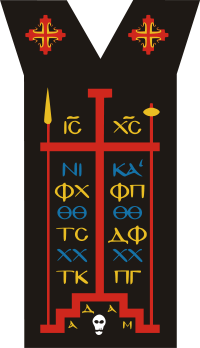
- Analavos (Greek: Άνάλαβος; Slavonic: Analav): The distinctive dress of the Great Schema is the analavos, and it is worn only by Schemamonks and Schemanuns. Traditionally made of either leather or wool, the analavos covers the shoulders, and then comes down in the front and back, forming a cross (see illustration, above right).
- Polystavrion (Greek: Πολυσταύριον, lit. "many crosses"): The polystavrion is a long cord that has been plaited with numerous crosses forming a yoke that is worn over the analavos to hold it in place.
- Mantle (Greek: Μανδύας, Mandías; Slavonic: Mantíya): The Mantle is a long, full cape, joined at the neck which the monastic wears over the other parts of the habit.
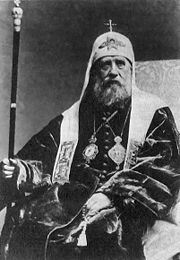
- Kalymafki (Greek: καλυμαύκι; Slavonic: klobuk): The distinctive headress of Eastern Orthodox monks and nuns is the kalymafki, a stiffened hat, something like a fezFez (clothing)The fez , or tarboosh is a felt hat either in the shape of a red truncated cone or in the shape of a short cylinder made of kilim fabric. Both usually have tassels...
, only black and with straight sides, covered with a veilVeilA veil is an article of clothing, worn almost exclusively by women, that is intended to cover some part of the head or face.One view is that as a religious item, it is intended to show honor to an object or space...
. The veil has lappets which hang down on each side of the head and a stylized hood falling down the back. For monastics of the Great Schema, the kalymafki takes a very distinctive shape, known as a koukoulionCowlThis article is about the garment used by monks and nuns. For other uses, see Cowl or Cowling .The cowl is an item of clothing consisting of a long, hooded garment with wide sleeves. Originally it may have referred simply to the hooded portion of a cloak...
(cowl), and is embroidered with the Instruments of the Passion. The koukoulion is also worn by the Patriarchs of several local churches, regardless of whether or not he has been tonsured to that degree. In the Slavic tradition, the koukoulion will be in the form of a cloth hood, similar to that worn on the Western cowl. Outside church, monastics wear a soft hat known as a SkufiaSkufiaA skufia is an item of clerical clothing worn by Orthodox Christian and Eastern Catholic monastics or awarded to clergy as a mark of honor...
. Again, for Schemamonks and Schemanuns it is embroidered with the Instruments of the Passion.
The portions of the habit worn by the various degrees of monastics is as follows:
| Rasophore | Stavrophore | Great Schema |
|---|---|---|
| Inner Rason | Inner Rason | Inner Rason |
| Belt | Belt | Belt |
| Paramand | Paramand | |
| Outer Rason | Outer Rason | Outer Rason |
| Analavos | ||
| Mantle (Russian use only) | Mantle | |
| Polystavrion | ||
| Kalymafki | Kalymafki | Koukoulion |