

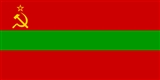
Moldavian SSR

Encyclopedia
The Moldavian Soviet Socialist Republic (Moldovan
/Romanian
: Република Советикэ Сочиалистэ Молдовеняскэ or Republica Sovietică Socialistă Moldovenească; Moldavskaya Sovetskaya Sotsialisticheskaya Respublika), commonly abbreviated to Moldavian SSR or MSSR, was one of the 15 republics
of the Soviet Union
. After the Declaration of Sovereignty on June 23, 1990 and until the Declaration of Independence on August 27, 1991, it was officially referred as Soviet Socialist Republic of Moldova. Upon gaining formal independence it became the Republic of Moldova
.
The Moldavian SSR was formed on August 2, 1940 from parts of Bessarabia
, a region annexed from Romania on June 28th of that year, and MASSR, an autonomous republic within the Ukrainian SSR
.
set up an autonomous Moldavian ASSR
on October 12, 1924 within the Ukrainian SSR
on part of the territory between the Dniester
and Bug
rivers, as a way to prop up the propaganda effort and help a potential Communist revolution in Romania.
On August 24, 1939, the Soviet Union and Nazi Germany
signed a 10-year non-aggression treaty, called the Molotov-Ribbentrop pact
. The pact contained a secret protocol, revealed only after Germany's defeat in 1945, according to which the states of Northern
and Eastern Europe
were divided into German and Soviet "spheres of influence". The secret protocol placed the Romanian province of Bessarabia in the Soviet "sphere of influence." Thereafter, both the Soviet Union and Germany invaded their respective portions of Poland
, while the Soviet Union occupied and annexed Lithuania, Estonia and Latvia in June 1940, and waged war upon Finland
(1939–1940).
On June 26, four days after France sued for an armistice with the Third Reich
, the Soviet Union issued an ultimatum to Romania
, demanding the latter to cede Bessarabia
and Bukovina
. After the Soviets agreed with Germany that they would limit their claims in Bukovina, which was outside the Molotov-Ribbentrop Pact's secret protocols, to northern Bukovina, Germany urged Romania to accept the ultimatum, which Romania did two days later. The Moldavian Soviet Socialist Republic was thereafter created following the entrance of Soviet troops on June 28, 1940.
The old Moldavian ASSR was dismantled and the Moldavian SSR was organized on August 2, 1940 from six full counties and small parts of three other counties
of Bessarabia
, and the six westernmost rayon
s of the Moldavian ASSR (about 40% of its territory). 90% of the territory of MSSR was on the right bank of the river Dniester, which was the border between the USSR and Romania prior to 1940, and 10% on the left bank. Smaller northern and southern parts of the territories occupied by the Soviet Union in June 1940 (the current Chernivtsi Oblast
and Budjak
), which were more heterogeneous ethnically, were transferred to the Ukrainian SSR, although their population also included 337,000 Moldovans. As such, the strategically important Black Sea coast and Danube frontage were given to the Ukrainian SSR, considered more reliable than the Moldavian SSR, which could have been claimed by Romania.
In the summer of 1941, Romania joined Hitler's Axis in the invasion of the Soviet Union
, recovering Bessarabia and northern Bukovina, as well as occupying the territory to the east of the Dniester it dubbed "Transnistria
". By the end of World War II
the Soviet Union had reconquered all of the lost territories, reestablishing Soviet authority there.
The Soviet authorities targeted several socio-economic groups due to their economic situation, political views, or ties to the former regime. They were deported to or resettled in Siberia
and northern Kazakhstan
; some were imprisoned or executed. According to a report by the Presidential Commission for the Study of the Communist Dictatorship in Romania
, no less than 86,604 people were arrested and deported in 1940-1941 alone. Modern Russian historians put forward an estimative number of 90,000 for the same period. NKVD
/MGB
also struck at anti-Soviet groups, which were most active in 1944-1952. Anti-Soviet organizations such as Democratic Agrarian Party
, Freedom Party
, Democratic Union of Freedom
, Arcaşii lui Ştefan
, Vasile Lupu High School Group
, Vocea Basarabiei
were severely reprimanded and their leaders were persecuted.
A de-kulak
isation campaign was directed towards the rich Moldavian peasant families, which were deported to Kazakhstan and Siberia as well. For instance, in just two days, July 6 and July 7, 1949, over 11,342 Moldavian families were deported by the order of the Minister of State Security, I. L. Mordovets under a plan named "Operation South".
Religious persecutions during the Soviet occupation
targeted numerous priest
s. After the Soviet occupation, the religious life underwent a persecution similar to the one in Russia
between the two World War
s.
Other deportation campaigns were directed towards the ethnic Germans (whose number decreased from over 81,000 in 1930 to under 4,000 in 1959 due to voluntary wartime migration and forced removal as collaborators after the war) and religious minorities (700 families, especially Jehovah's Witnesses
, were deported to Siberia in April 1951 under the plan "Operation North
").
was implemented between 1949 and 1950, although earlier attempts were made since 1946. During this time, a large-scale famine
occurred: some sources give a minimum of 115,000 peasants who died of famine and related diseases between December 1946 and August 1947, others put the figure at 216,000, in addition to 350,000 related sickness cases. According to Charles King
, there is ample evidence that it was caused by the Soviets and directed towards the largest ethnic group living in the countryside, the Moldovans. The main cause was the Soviet requisitioning of large amounts of agricultural products, but it was also aggravated by war, the draught of 1946, and collectivisation.
replacing that of Joseph Stalin
, the survivors of Gulag
camps and of the deportees were gradually allowed to return to the Moldovan SSR. The political thaw ended the unchecked power of the NKVD
/MGB
, and the centrally planned economy gave rise to development in the areas such as education, technology and science, health care, and industry (except in the fields that were considered politically sensitive, such as genetics or history).
was established by several young intellectuals in Chişinău, totaling over 100 members, vowing to fight for the establishment of a Moldavian Democratic Republic
, its secession from the Soviet Union and union with Romania. In December 1971, following an informative note from Ion Stănescu, the President of the Council of State Security of the Romanian Socialist Republic, to Yuri Andropov
, the chief of KGB, three of the leaders of the National Patriotic Front
, Alexandru Usatiuc-Bulgăr
, Gheorghe Ghimpu
and Valeriu Graur
, as well as a fourth person, Alexandru Şoltoianu
, the leader of a similar clandestine movement in northern Bukovina
, were arrested and later sentenced to long prison terms.
In the 1970s and 1980s Moldova received substantial investment from the budget of the USSR to develop industrial, scientific facilities, as well as housing. In 1971, the Council of Ministers of the USSR adopted a decision "About the measures for further development of Kishinev city" that secured more than one billion rubles
of investment from the USSR budget Subsequent decisions directed enormous wealth and brought highly qualified specialists from all over the USSR to develop the Soviet republic. Such an allocation of USSR assets was partially influenced by the fact that Leonid Brezhnev
, the effective ruler of the USSR from 1964 to 1982, was the Communist Party First Secretary in the Moldavian SSR in 1950-1952. These alocations stopped in 1991 with the dissolution of the Soviet Union
, when Moldova became independent.
and perestroika
created conditions in which national feelings could be openly expressed and in which the Soviet republics could consider reforms independently from the central government.
The MSSR's drive towards independence from the USSR was marked by civil strife as conservative activists in the east (especially in Tiraspol), as well as Communist party activists in Chişinău worked to keep the MSSR within the Soviet Union. The main success of the national movement in 1988-1989 was the adoption on August 31, 1989 by the Supreme Soviet of the Moldavian SSR of the Moldavian language as official, declaration in the preambule of a Moldavian-Romanian linguistic unity, and the return of the language to the pre-Soviet Latin alphabet. In 1990, when it became clear that Moldova was eventually going to secede, a group of pro-USSR activists in Gagauzia
and Transnistria
proclaimed independence in order to remain within the USSR. Gagauzia was eventually peacefully incorporated into Moldova as an autonomous territory, but relations with Transnistria soured.
". Moldova then seceded from the USSR and became a sovereign, independent state
on August 27, 1991, after the failed coup in the Soviet Union. Independence was quickly followed by civil war in the east of the country (Transnistria), where the central government in Chişinău battled with separatists, who were supported by pro-Soviet forces and by different forces from Russia
. The conflict
left the breakaway regime (Pridnestrovian Moldavian Republic) in control of Transnistria.
, the Soviet Union and Romania reaffirmed each other's borders, recognizing Bessarabia, northern Bukovina and the Herza region as territory of the respective Soviet republics.
Throughout the Cold War
, the issue of Bessarabia remained largely dormant in Romania. In the 1950s, research on history and of Bessarabia was a banned subject in Romania, as the Romanian Communist Party
tried to emphasise the links between the Romanians and Russians, the annexation being considered just a proof of Soviet Union's internationalism
.
Starting with the 1960s, Gheorghe Gheorghiu-Dej
and Nicolae Ceauşescu
began a policy of distancing from the Soviet Union, but the debate over Bessarabia was discussed only in scholarship fields such as historiography and linguistics, not at a political level.
As the Soviet-Romanian relations reached an all-time low in the mid-1960s, Soviet scholars published historical papers on the "Struggle of Unification of Bessarabia with the Soviet motherland" (Artiom Lazarev) and the "Development of the Moldovan language" (Nicolae Corlăţeanu). On the other side, the Romanian Academy
published some notes by Karl Marx
which talk about the "injustice" of the 1812 annexation of Bessarabia and Nicolae Ceauşescu in a 1965 speech quoted a letter by Friedrich Engels
in which he criticized the Russian annexation, while in another 1966 speech, he denounced the pre-World War II calls of the Romanian Communist Party for the Soviet annexation of Bessarabia and Bukovina.
The issue was brought to light whenever the relationships with the Soviets were waning, but never never became a serious subject of high-level negotiations in itself. As late as November 1989, as Russian support decreased, Ceauşescu brought up the Bessarabian question once again and denounced the Soviet invasion during the 14th Congress of the Romanian Communist Party.
After the fall of communism
in Romania, its president Ion Iliescu
, and the president of the Soviet Union Mikhail Gorbachev
have signed on April 5, 1991 a political treaty which among other things recognized the Soviet-Romanian border. However, Romania refused to ratify it. Romania
and Russia
eventually signed and ratified a treaty in 2003, after the independence of Moldova
and Ukraine
.
. The Communist Party was the sole legal political organization. It had supreme power in the land, as all state and public organizations were its subordinates.
(15 April 1978), the republic had four cities directly subordinated to the republican government: Chişinău
, Bălţi
, Bender
, and Tiraspol
. By the new constitution, the following cities were added to this category: Orhei
, Rîbniţa
, Soroca
, and Ungheni
.
The former 4 cities, and 40 raions were the first-tier administrative units of the land.
While holding just 0.2% of the Soviet territory, it accounted for 10% of the canned food production, 4.2% of its vegetables, 12.3% of its fruits and 8.2% of its wine production.
Major factories included the Rîbniţa
steel mill, Dubăsari
and Moldavskaia power station and the factories near Tiraspol, producing refrigerators, clothing and alcohol.
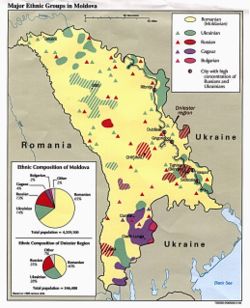
Some towns and villages were renamed after various Communist leaders.
, and using the Cyrillic script. At that point, realizing that to create a whole literature for a speech shared by only a few hundred individuals and impose it on 3 millions was impossible, the Soviet authorities decided to drop it "because the local peasants cannot understand it", and return to the normal language. Hence, Mihai Eminescu
and Ion Creangă
were again allowed, and the standard written language became the same as Romanian, except that it was written with Cyrillic script.
The Soviet authorities policy of describing 1918-1940 period as a yoke of feudal boyars and rich bourgeois speaking in half-French assigned to the word Romanian a negative connotation. Locals' ethnicity was written as Moldavians
in documents, and the language was renamed Moldavian language. In the Bukovinian part of the Chernivtsi oblast
, locals did not have the habit of calling themselves both Moldavians and Romanians before 1918, as they did in Bessarabia, and hence the Soviet authorities allowed them to keep their ethnic group as Romanians in the documents. This also became handy, as split into Moldavians and Romanians, the share of the ethnic group in the population of the oblast was statistically less observable. Children of deportees that were prevented to return to Moldova from Siberia and Kazakhstan were allowed to be schooled only in Russian.
In Moldavian SSR, Soviet authorities opened many more Russian schools than Romanian ones in the cities, calling for locals to send their children to Russian-language schools, explaining them that without knowing Russian they would not be able to get normal jobs. Russian schools were also less crowded with respect to the number of students in a class. The authorities encouraged in addition the creation of mixed schools, generally having three Romanian-language for every Russian-language class, thus all administration being in Russian.
A new local intelligentsia, to replace the virtually exterminated one, started to form in late 1960s and early 1970s. However, being composed generally of descendants from farmers, it did not have the benefit of direct ties to the pre-war intelligentsia. The contacts with classical Romanian literature were greatly limited, as a big number of authors and books were forbidden, including all authors born in Romanian localities outside the medieval Principality of Moldavia, as well as all works touching on their connected to politics of even authors such as Mihai Eminescu
, Mihail Kogălniceanu
, Bogdan Petriceicu Hasdeu
, Constantin Stere
(the former two are classic and well-known, the latter two are in addition born in Bessarabia). However, these contacts were not severed, since after 1956 people were slowly allowed to visit or get visits from relatives in Romania, since Romanian press could be freely bought in Moscow (not in Moldova), and since a poor quality Romanian TV and radio could be heard with a makeshift antenna, and even by ordinary transistor-based radios. The programs of the latter, however, were created by the Communist authorities of Romania, which never dared to cross the Soviet authorities, especially in the question of education and press for ethnic Romanians in USSR, which was a political taboo, especially because the Romanian communists did not totally sided with Soviets against the Chinese after 1959, sometimes even trying to play the brokers.
The Soviet-Romanian border along the Prut
river, separating Bessarabia from Romania, was closed for the general public all throughout the Soviet era. In general, visits abroad by Soviet citizens were very rare (comparing to the citizens of Communist Eastern European countries).
In 1940, at the beginning of the Soviet occupation, the Capitoline Wolf, Chişinău
was destroyed.
The official stance of the Soviet government was that Moldavian culture
was distinct from Romanian culture
, but they had a more coherent policy than the previous one from the Moldavian ASSR. There were no more attempts in creating a Moldavian language that is different from Romanian, the literary Romanian written with the Cyrillic alphabet being accepted as the linguistic standard for Moldova, the only difference being in some technical terms borrowed from Russian.
Moldavians were encouraged to adopt the Russian language
, which was required for any leadership job (Russian was intended to be the language of interethnic communication in the Soviet Union). In the early years, political and academic positions were given to members of non-Moldavian ethnic groups (only 14% of the Moldavian SSR's political leaders were ethnic Moldavians in 1946), although this changed as time went on.
Literary critics stressed the Russian influence on Moldavian literature and ignored the parts shared with Romanian literature.
apparatus. Immediately after the war, Stalin
carried out a major colonization and de facto Russification
campaign in what was now Soviet Moldova
, Chernivtsi oblast
, and Budjak
under the flag of Sovietization
. Many Russians and Ukrainians, along with a smaller number of other ethnic groups, who migrated from the rest of the USSR to Moldova, arrived to rebuild the heavily war-damaged economy. They were mostly factory and construction workers who settled in major urban areas, as well as military personnel
stationed in the region. During the Soviet rule, up to one million people settled in Moldova. From a socio-economic point of view, this group was quite diverse: in addition to industrial and construction workers, as well as retired officers and soldiers of the Soviet army, it also included engineer
s, technician
s, a handful of scientists, but mostly unqualified workers, or people without strong family or native land ties, many of which with little or no education at all.
Access of native Bessarabians to positions in administration and economy was limited, as they were considered also not trustworthy. The first local to became minister in the Moldavian SSR was only in 1960s as minister of health. The antagonism between "natives", and "newcomers" (cf. "venetici" in Romanian
) persisted until the dissolution of the Soviet Union and was clear during the anti-Soviet and anti-Communist events in 1988-1992. It was also an important reason for the brief 1992 War of Transnistria
. The immigration affected mostly the cities of Bessarabia, Northern Bukovina, as well as the countryside of Budjak
where the Bessarabian Germans previously were, but also the cities of Trasnistria. All of these saw the proportion of ethnic Moldavians (Romanians) drop throughout the Soviet rule.
Despite the immigration, the 1959 census showed a significant drop in population from 1940, showing how badly the local population was affected by the events of 1940-1956.
Note: "-" means the official census data does not identify that group in that year, i.e. counts it within other groups, not that the group is not present.
will study and analyze the 1917-1991 period of the communist regime.
Moldovan language
Moldovan is one of the names of the Romanian language as spoken in the Republic of Moldova, where it is official. The spoken language of Moldova is closer to the dialects of Romanian spoken in northeastern Romania, and the two countries share the same literary standard...
/Romanian
Romanian language
Romanian Romanian Romanian (or Daco-Romanian; obsolete spellings Rumanian, Roumanian; self-designation: română, limba română ("the Romanian language") or românește (lit. "in Romanian") is a Romance language spoken by around 24 to 28 million people, primarily in Romania and Moldova...
: Република Советикэ Сочиалистэ Молдовеняскэ or Republica Sovietică Socialistă Moldovenească; Moldavskaya Sovetskaya Sotsialisticheskaya Respublika), commonly abbreviated to Moldavian SSR or MSSR, was one of the 15 republics
Republics of the Soviet Union
The Republics of the Soviet Union or the Union Republics of the Soviet Union were ethnically-based administrative units that were subordinated directly to the Government of the Soviet Union...
of the Soviet Union
Soviet Union
The Soviet Union , officially the Union of Soviet Socialist Republics , was a constitutionally socialist state that existed in Eurasia between 1922 and 1991....
. After the Declaration of Sovereignty on June 23, 1990 and until the Declaration of Independence on August 27, 1991, it was officially referred as Soviet Socialist Republic of Moldova. Upon gaining formal independence it became the Republic of Moldova
Moldova
Moldova , officially the Republic of Moldova is a landlocked state in Eastern Europe, located between Romania to the West and Ukraine to the North, East and South. It declared itself an independent state with the same boundaries as the preceding Moldavian Soviet Socialist Republic in 1991, as part...
.
The Moldavian SSR was formed on August 2, 1940 from parts of Bessarabia
Bessarabia
Bessarabia is a historical term for the geographic region in Eastern Europe bounded by the Dniester River on the east and the Prut River on the west....
, a region annexed from Romania on June 28th of that year, and MASSR, an autonomous republic within the Ukrainian SSR
Ukrainian SSR
The Ukrainian Soviet Socialist Republic or in short, the Ukrainian SSR was a sovereign Soviet Socialist state and one of the fifteen constituent republics of the Soviet Union lasting from its inception in 1922 to the breakup in 1991...
.
Creation
After the failure of the Tatarbunar Uprising, the SovietsSoviet Union
The Soviet Union , officially the Union of Soviet Socialist Republics , was a constitutionally socialist state that existed in Eurasia between 1922 and 1991....
set up an autonomous Moldavian ASSR
Moldavian ASSR
The Moldavian Autonomous Soviet Socialist Republic , shortened to Moldavian ASSR or, less frequently, Moldovan ASSR, was an autonomous republic of the Ukrainian SSR between 12 October 1924 and 2 August 1940, encompassing modern Transnistria The Moldavian Autonomous Soviet Socialist Republic...
on October 12, 1924 within the Ukrainian SSR
Ukrainian SSR
The Ukrainian Soviet Socialist Republic or in short, the Ukrainian SSR was a sovereign Soviet Socialist state and one of the fifteen constituent republics of the Soviet Union lasting from its inception in 1922 to the breakup in 1991...
on part of the territory between the Dniester
Dniester
The Dniester is a river in Eastern Europe. It runs through Ukraine and Moldova and separates most of Moldova's territory from the breakaway de facto state of Transnistria.-Names:...
and Bug
Southern Bug
The Southern Bug, also called Southern Buh), is a river located in Ukraine. The source of the river is in the west of Ukraine, in the Volyn-Podillia Upland, about 145 km from the Polish border, and flows southeasterly into the Bug Estuary through the southern steppes...
rivers, as a way to prop up the propaganda effort and help a potential Communist revolution in Romania.
On August 24, 1939, the Soviet Union and Nazi Germany
Nazi Germany
Nazi Germany , also known as the Third Reich , but officially called German Reich from 1933 to 1943 and Greater German Reich from 26 June 1943 onward, is the name commonly used to refer to the state of Germany from 1933 to 1945, when it was a totalitarian dictatorship ruled by...
signed a 10-year non-aggression treaty, called the Molotov-Ribbentrop pact
Molotov-Ribbentrop Pact
The Molotov–Ribbentrop Pact, named after the Soviet foreign minister Vyacheslav Molotov and the German foreign minister Joachim von Ribbentrop, was an agreement officially titled the Treaty of Non-Aggression between Germany and the Soviet Union and signed in Moscow in the late hours of 23 August 1939...
. The pact contained a secret protocol, revealed only after Germany's defeat in 1945, according to which the states of Northern
Northern Europe
Northern Europe is the northern part or region of Europe. Northern Europe typically refers to the seven countries in the northern part of the European subcontinent which includes Denmark, Estonia, Latvia, Lithuania, Norway, Finland and Sweden...
and Eastern Europe
Eastern Europe
Eastern Europe is the eastern part of Europe. The term has widely disparate geopolitical, geographical, cultural and socioeconomic readings, which makes it highly context-dependent and even volatile, and there are "almost as many definitions of Eastern Europe as there are scholars of the region"...
were divided into German and Soviet "spheres of influence". The secret protocol placed the Romanian province of Bessarabia in the Soviet "sphere of influence." Thereafter, both the Soviet Union and Germany invaded their respective portions of Poland
Invasion of Poland (1939)
The Invasion of Poland, also known as the September Campaign or 1939 Defensive War in Poland and the Poland Campaign in Germany, was an invasion of Poland by Germany, the Soviet Union, and a small Slovak contingent that marked the start of World War II in Europe...
, while the Soviet Union occupied and annexed Lithuania, Estonia and Latvia in June 1940, and waged war upon Finland
Finland
Finland , officially the Republic of Finland, is a Nordic country situated in the Fennoscandian region of Northern Europe. It is bordered by Sweden in the west, Norway in the north and Russia in the east, while Estonia lies to its south across the Gulf of Finland.Around 5.4 million people reside...
(1939–1940).
On June 26, four days after France sued for an armistice with the Third Reich
Battle of France
In the Second World War, the Battle of France was the German invasion of France and the Low Countries, beginning on 10 May 1940, which ended the Phoney War. The battle consisted of two main operations. In the first, Fall Gelb , German armoured units pushed through the Ardennes, to cut off and...
, the Soviet Union issued an ultimatum to Romania
Romania
Romania is a country located at the crossroads of Central and Southeastern Europe, on the Lower Danube, within and outside the Carpathian arch, bordering on the Black Sea...
, demanding the latter to cede Bessarabia
Bessarabia
Bessarabia is a historical term for the geographic region in Eastern Europe bounded by the Dniester River on the east and the Prut River on the west....
and Bukovina
Bukovina
Bukovina is a historical region on the northern slopes of the northeastern Carpathian Mountains and the adjoining plains.-Name:The name Bukovina came into official use in 1775 with the region's annexation from the Principality of Moldavia to the possessions of the Habsburg Monarchy, which became...
. After the Soviets agreed with Germany that they would limit their claims in Bukovina, which was outside the Molotov-Ribbentrop Pact's secret protocols, to northern Bukovina, Germany urged Romania to accept the ultimatum, which Romania did two days later. The Moldavian Soviet Socialist Republic was thereafter created following the entrance of Soviet troops on June 28, 1940.
The old Moldavian ASSR was dismantled and the Moldavian SSR was organized on August 2, 1940 from six full counties and small parts of three other counties
Moldavian counties
Ţinut were the traditional subdivision of the Principality of Moldavia .- Principality of Moldavia :...
of Bessarabia
Bessarabia
Bessarabia is a historical term for the geographic region in Eastern Europe bounded by the Dniester River on the east and the Prut River on the west....
, and the six westernmost rayon
Rayon
Rayon is a manufactured regenerated cellulose fiber. Because it is produced from naturally occurring polymers, it is neither a truly synthetic fiber nor a natural fiber; it is a semi-synthetic or artificial fiber. Rayon is known by the names viscose rayon and art silk in the textile industry...
s of the Moldavian ASSR (about 40% of its territory). 90% of the territory of MSSR was on the right bank of the river Dniester, which was the border between the USSR and Romania prior to 1940, and 10% on the left bank. Smaller northern and southern parts of the territories occupied by the Soviet Union in June 1940 (the current Chernivtsi Oblast
Chernivtsi Oblast
Chernivtsi Oblast is an oblast in western Ukraine, bordering on Romania and Moldova. It has a large variety of landforms: the Carpathian Mountains and picturesque hills at the foot of the mountains gradually change to a broad partly forested plain situated between the Dniester and Prut rivers....
and Budjak
Budjak
Budjak or Budzhak is a historical region in the Odessa Oblast of Ukraine. Lying along the Black Sea between the Danube and Dniester rivers this multiethnic region was the southern part of Bessarabia...
), which were more heterogeneous ethnically, were transferred to the Ukrainian SSR, although their population also included 337,000 Moldovans. As such, the strategically important Black Sea coast and Danube frontage were given to the Ukrainian SSR, considered more reliable than the Moldavian SSR, which could have been claimed by Romania.
In the summer of 1941, Romania joined Hitler's Axis in the invasion of the Soviet Union
Operation Barbarossa
Operation Barbarossa was the code name for Germany's invasion of the Soviet Union during World War II that began on 22 June 1941. Over 4.5 million troops of the Axis powers invaded the USSR along a front., the largest invasion in the history of warfare...
, recovering Bessarabia and northern Bukovina, as well as occupying the territory to the east of the Dniester it dubbed "Transnistria
Transnistria (World War II)
Transnistria Governorate was a Romanian administered territory, conquered by the Axis Powers from the Soviet Union during Operation Barbarossa, and occupied from 19 August 1941 to 29 January 1944...
". By the end of World War II
World War II
World War II, or the Second World War , was a global conflict lasting from 1939 to 1945, involving most of the world's nations—including all of the great powers—eventually forming two opposing military alliances: the Allies and the Axis...
the Soviet Union had reconquered all of the lost territories, reestablishing Soviet authority there.
Stalinist period: repressions and deportations
Many Bessarabians who fled to Romania before the advancing Red Army were eventually caught by Soviet security forces; a high percentage of these were shot or deported, blamed as collaborators of Romania and Nazi Germany.The Soviet authorities targeted several socio-economic groups due to their economic situation, political views, or ties to the former regime. They were deported to or resettled in Siberia
Siberia
Siberia is an extensive region constituting almost all of Northern Asia. Comprising the central and eastern portion of the Russian Federation, it was part of the Soviet Union from its beginning, as its predecessor states, the Tsardom of Russia and the Russian Empire, conquered it during the 16th...
and northern Kazakhstan
Kazakhstan
Kazakhstan , officially the Republic of Kazakhstan, is a transcontinental country in Central Asia and Eastern Europe. Ranked as the ninth largest country in the world, it is also the world's largest landlocked country; its territory of is greater than Western Europe...
; some were imprisoned or executed. According to a report by the Presidential Commission for the Study of the Communist Dictatorship in Romania
Presidential Commission for the Study of the Communist Dictatorship in Romania
The Presidential Commission for the Study of the Communist Dictatorship in Romania , also known as the Tismăneanu Commission , is a commission instituted in Romania by President Traian Băsescu to investigate the Communist regime and provide a comprehensive report allowing for the condemnation of...
, no less than 86,604 people were arrested and deported in 1940-1941 alone. Modern Russian historians put forward an estimative number of 90,000 for the same period. NKVD
NKVD
The People's Commissariat for Internal Affairs was the public and secret police organization of the Soviet Union that directly executed the rule of power of the Soviets, including political repression, during the era of Joseph Stalin....
/MGB
MGB
The abbreviation MGB may refer to:* Mathematical Gymnasium Belgrade, special school, elementary and high school, for gifted in areas of mathematics, physics, and ICT, under University of Belgrade umbrella...
also struck at anti-Soviet groups, which were most active in 1944-1952. Anti-Soviet organizations such as Democratic Agrarian Party
Democratic Agrarian Party
The Democratic Agrarian Party was a clandestine political party in the Moldovan SSR.- Activity :The leader of the Democratic Agrarian Party was Vasile Odobescu...
, Freedom Party
Freedom Party, Bessarabia
The Freedom Party was a clandestine political party in the Moldovan SSR.- Membership :The founders members were: Constantin Condrat , Ion Istrati , Nicolae Istrati , Victor Andreev , Vladimir Bivol The Freedom Party was a clandestine political party in the Moldovan SSR.- Membership :The founders...
, Democratic Union of Freedom
Democratic Union of Freedom
Democratic Union of Freedom was one of the organized anti-Soviet groups in Bessarabia.-References:* Elena Postică, Grupuri de rezistenţă pe teritoriul Basarabiei...
, Arcaşii lui Ştefan
Arcaşii lui Ştefan
National Organization of Bessarabia "Arcaşii lui Ştefan" was one of the organized anti-Soviet groups in Bessarabia.- Activity :...
, Vasile Lupu High School Group
Vasile Lupu High School Group
Vasile Lupu High School Group was one of the first organized anti-Soviet groups in Bessarabia in the wake of its occupation by the Soviet Union on June 28, 1940.-Activity:...
, Vocea Basarabiei
Vocea Basarabiei (anti-Soviet group)
Vocea Basarabiei was one of the organized anti-Soviet groups in Bessarabia.-Bibliography:* Mitru Ghiţiu, Unele aspecte din mişcarea de rezistenţă antisovietică în Basarabia postbelică, Analele Sighet 2, Instaurarea comunismului - între rezistenţă şi represiune, Fundaţia Academia Civică, 1995*...
were severely reprimanded and their leaders were persecuted.
A de-kulak
Kulak
Kulaks were a category of relatively affluent peasants in the later Russian Empire, Soviet Russia, and early Soviet Union...
isation campaign was directed towards the rich Moldavian peasant families, which were deported to Kazakhstan and Siberia as well. For instance, in just two days, July 6 and July 7, 1949, over 11,342 Moldavian families were deported by the order of the Minister of State Security, I. L. Mordovets under a plan named "Operation South".
Religious persecutions during the Soviet occupation
Religious persecution during the Soviet occupation of Bessarabia and Northern Bukovina
During the Soviet occupation, the religious life in Bessarabia and Northern Bukovina underwent a persecution similar to the one in Russia between the two World Wars. In the first days of occupation, certain population groups welcomed the Soviet power and some of them joined the newly established...
targeted numerous priest
Priest
A priest is a person authorized to perform the sacred rites of a religion, especially as a mediatory agent between humans and deities. They also have the authority or power to administer religious rites; in particular, rites of sacrifice to, and propitiation of, a deity or deities...
s. After the Soviet occupation, the religious life underwent a persecution similar to the one in Russia
Russia
Russia or , officially known as both Russia and the Russian Federation , is a country in northern Eurasia. It is a federal semi-presidential republic, comprising 83 federal subjects...
between the two World War
World war
A world war is a war affecting the majority of the world's most powerful and populous nations. World wars span multiple countries on multiple continents, with battles fought in multiple theaters....
s.
Other deportation campaigns were directed towards the ethnic Germans (whose number decreased from over 81,000 in 1930 to under 4,000 in 1959 due to voluntary wartime migration and forced removal as collaborators after the war) and religious minorities (700 families, especially Jehovah's Witnesses
Jehovah's Witnesses
Jehovah's Witnesses is a millenarian restorationist Christian denomination with nontrinitarian beliefs distinct from mainstream Christianity. The religion reports worldwide membership of over 7 million adherents involved in evangelism, convention attendance of over 12 million, and annual...
, were deported to Siberia in April 1951 under the plan "Operation North
Operation North
Operation North was the code name assigned by the USSR Ministry of State Security to massive deportation of the members of the Jehovah's Witnesses and their families to Siberia in the Soviet Union on 1–2 April 1951.-Background:...
").
Stalinist period: collectivisation
CollectivisationCollective farming
Collective farming and communal farming are types of agricultural production in which the holdings of several farmers are run as a joint enterprise...
was implemented between 1949 and 1950, although earlier attempts were made since 1946. During this time, a large-scale famine
Famine
A famine is a widespread scarcity of food, caused by several factors including crop failure, overpopulation, or government policies. This phenomenon is usually accompanied or followed by regional malnutrition, starvation, epidemic, and increased mortality. Every continent in the world has...
occurred: some sources give a minimum of 115,000 peasants who died of famine and related diseases between December 1946 and August 1947, others put the figure at 216,000, in addition to 350,000 related sickness cases. According to Charles King
Charles King (author)
Charles King is Professor of International Affairs and Government at Georgetown University, where he previously served as Chairman of the Faculty of the Edmund A. Walsh School of Foreign Service....
, there is ample evidence that it was caused by the Soviets and directed towards the largest ethnic group living in the countryside, the Moldovans. The main cause was the Soviet requisitioning of large amounts of agricultural products, but it was also aggravated by war, the draught of 1946, and collectivisation.
Khrushchev Thaw: 1956-1964
With the regime of Nikita KhrushchevNikita Khrushchev
Nikita Sergeyevich Khrushchev led the Soviet Union during part of the Cold War. He served as First Secretary of the Communist Party of the Soviet Union from 1953 to 1964, and as Chairman of the Council of Ministers, or Premier, from 1958 to 1964...
replacing that of Joseph Stalin
Joseph Stalin
Joseph Vissarionovich Stalin was the Premier of the Soviet Union from 6 May 1941 to 5 March 1953. He was among the Bolshevik revolutionaries who brought about the October Revolution and had held the position of first General Secretary of the Communist Party of the Soviet Union's Central Committee...
, the survivors of Gulag
Gulag
The Gulag was the government agency that administered the main Soviet forced labor camp systems. While the camps housed a wide range of convicts, from petty criminals to political prisoners, large numbers were convicted by simplified procedures, such as NKVD troikas and other instruments of...
camps and of the deportees were gradually allowed to return to the Moldovan SSR. The political thaw ended the unchecked power of the NKVD
NKVD
The People's Commissariat for Internal Affairs was the public and secret police organization of the Soviet Union that directly executed the rule of power of the Soviets, including political repression, during the era of Joseph Stalin....
/MGB
MGB
The abbreviation MGB may refer to:* Mathematical Gymnasium Belgrade, special school, elementary and high school, for gifted in areas of mathematics, physics, and ICT, under University of Belgrade umbrella...
, and the centrally planned economy gave rise to development in the areas such as education, technology and science, health care, and industry (except in the fields that were considered politically sensitive, such as genetics or history).
Stagnation: 1964-1985
Between 1969 and 1971, a clandestine National Patriotic FrontNational Patriotic Front
The National Patriotic Front was a clandestine political party in the Moldovan SSR.- Activity :Between 1969 and 1971, the National Patriotic Front of Bessarabia and Northern Bukovina was established by several young intellectuals in Chişinău, totalling over 100 members, vowing to fight for the...
was established by several young intellectuals in Chişinău, totaling over 100 members, vowing to fight for the establishment of a Moldavian Democratic Republic
Moldavian Democratic Republic
The Moldavian Democratic Republic , a.k.a. Moldavian Republic, was the state proclaimed on by Sfatul Ţării of Bessarabia, elected in October-November 1917 in the wake of the February Revolution and disintegration of the political power in the Russian Empire.Sfatul Ţării was its legislative body,...
, its secession from the Soviet Union and union with Romania. In December 1971, following an informative note from Ion Stănescu, the President of the Council of State Security of the Romanian Socialist Republic, to Yuri Andropov
Yuri Andropov
Yuri Vladimirovich Andropov was a Soviet politician and the General Secretary of the Communist Party of the Soviet Union from 12 November 1982 until his death fifteen months later.-Early life:...
, the chief of KGB, three of the leaders of the National Patriotic Front
National Patriotic Front
The National Patriotic Front was a clandestine political party in the Moldovan SSR.- Activity :Between 1969 and 1971, the National Patriotic Front of Bessarabia and Northern Bukovina was established by several young intellectuals in Chişinău, totalling over 100 members, vowing to fight for the...
, Alexandru Usatiuc-Bulgăr
Alexandru Usatiuc-Bulgăr
Alexandru Usatiuc-Bulgăr was a Moldovan activist and a political prisoner in the former Soviet Union.- Biography :Between 1969 and 1971, he was a founder of a clandestine National Patriotic Front of Bessarabia and Northern Bukovina, established by several young intellectuals in Chişinău, totaling...
, Gheorghe Ghimpu
Gheorghe Ghimpu
Gheorghe Ghimpu was a Moldovan politician and a political prisoner in the former Soviet Union.- Early life :...
and Valeriu Graur
Valeriu Graur
Valeriu Graur was a Moldovan activist and a political prisoner in the former Soviet Union.- Biography :Between 1969 and 1971, he was a founder of a clandestine National Patriotic Front of Bessarabia and Northern Bukovina, established by several young intellectuals in Chişinău, totaling over 100...
, as well as a fourth person, Alexandru Şoltoianu
Alexandru Şoltoianu
Alexandru Șoltoianu was a Moldovan activist and a political prisoner in the former Soviet Union.- Biography :He graduated at Moscow State Institute of International Relations in 1965 and became a lecturer in Oriental studies at the Moldova State University in Chișinău.In the 1960s and early 1970s...
, the leader of a similar clandestine movement in northern Bukovina
Bukovina
Bukovina is a historical region on the northern slopes of the northeastern Carpathian Mountains and the adjoining plains.-Name:The name Bukovina came into official use in 1775 with the region's annexation from the Principality of Moldavia to the possessions of the Habsburg Monarchy, which became...
, were arrested and later sentenced to long prison terms.
In the 1970s and 1980s Moldova received substantial investment from the budget of the USSR to develop industrial, scientific facilities, as well as housing. In 1971, the Council of Ministers of the USSR adopted a decision "About the measures for further development of Kishinev city" that secured more than one billion rubles
Soviet ruble
The Soviet ruble or rouble was the currency of the Soviet Union. One ruble is divided into 100 kopeks, ....
of investment from the USSR budget Subsequent decisions directed enormous wealth and brought highly qualified specialists from all over the USSR to develop the Soviet republic. Such an allocation of USSR assets was partially influenced by the fact that Leonid Brezhnev
Leonid Brezhnev
Leonid Ilyich Brezhnev – 10 November 1982) was the General Secretary of the Central Committee of the Communist Party of the Soviet Union , presiding over the country from 1964 until his death in 1982. His eighteen-year term as General Secretary was second only to that of Joseph Stalin in...
, the effective ruler of the USSR from 1964 to 1982, was the Communist Party First Secretary in the Moldavian SSR in 1950-1952. These alocations stopped in 1991 with the dissolution of the Soviet Union
Belavezha Accords
The Belavezha Accords is the agreement which declared the Soviet Union effectively dissolved and established the Commonwealth of Independent States in its place...
, when Moldova became independent.
Perestroika and the road to the independence: 1985-1991
Although Brezhnev and other CPM first secretaries were largely successful in suppressing Moldovan nationalism, Mikhail S. Gorbachev's administration facilitated the revival of the movement in the region. His policies of glasnostGlasnost
Glasnost was the policy of maximal publicity, openness, and transparency in the activities of all government institutions in the Soviet Union, together with freedom of information, introduced by Mikhail Gorbachev in the second half of the 1980s...
and perestroika
Perestroika
Perestroika was a political movement within the Communist Party of the Soviet Union during 1980s, widely associated with the Soviet leader Mikhail Gorbachev...
created conditions in which national feelings could be openly expressed and in which the Soviet republics could consider reforms independently from the central government.
The MSSR's drive towards independence from the USSR was marked by civil strife as conservative activists in the east (especially in Tiraspol), as well as Communist party activists in Chişinău worked to keep the MSSR within the Soviet Union. The main success of the national movement in 1988-1989 was the adoption on August 31, 1989 by the Supreme Soviet of the Moldavian SSR of the Moldavian language as official, declaration in the preambule of a Moldavian-Romanian linguistic unity, and the return of the language to the pre-Soviet Latin alphabet. In 1990, when it became clear that Moldova was eventually going to secede, a group of pro-USSR activists in Gagauzia
Gagauzia
Gagauzia , formally known as the Autonomous Territorial Unit of Găgăuzia , is an autonomous region of...
and Transnistria
Transnistria
Transnistria is a breakaway territory located mostly on a strip of land between the Dniester River and the eastern Moldovan border to Ukraine...
proclaimed independence in order to remain within the USSR. Gagauzia was eventually peacefully incorporated into Moldova as an autonomous territory, but relations with Transnistria soured.
Independence
On May 23, 1991, the Moldovan parliament changed the name of the republic from "Moldavian SSR" to "Republic of MoldovaMoldova
Moldova , officially the Republic of Moldova is a landlocked state in Eastern Europe, located between Romania to the West and Ukraine to the North, East and South. It declared itself an independent state with the same boundaries as the preceding Moldavian Soviet Socialist Republic in 1991, as part...
". Moldova then seceded from the USSR and became a sovereign, independent state
Sovereign state
A sovereign state, or simply, state, is a state with a defined territory on which it exercises internal and external sovereignty, a permanent population, a government, and the capacity to enter into relations with other sovereign states. It is also normally understood to be a state which is neither...
on August 27, 1991, after the failed coup in the Soviet Union. Independence was quickly followed by civil war in the east of the country (Transnistria), where the central government in Chişinău battled with separatists, who were supported by pro-Soviet forces and by different forces from Russia
Russia
Russia or , officially known as both Russia and the Russian Federation , is a country in northern Eurasia. It is a federal semi-presidential republic, comprising 83 federal subjects...
. The conflict
War of Transnistria
The War of Transnistria was a limited conflict that broke out in November 1990 at Dubăsari between pro-Transnistria forces, including the Transnistrian Republican Guard, militia and Cossack units, and supported by elements of the Russian 14th army, and pro-Moldovan forces, including Moldovan...
left the breakaway regime (Pridnestrovian Moldavian Republic) in control of Transnistria.
Relationship with Communist Romania
In the 1947 Paris Peace TreatyParis Peace Treaties, 1947
The Paris Peace Conference resulted in the Paris Peace Treaties signed on February 10, 1947. The victorious wartime Allied powers negotiated the details of treaties with Italy, Romania, Hungary, Bulgaria, and Finland .The...
, the Soviet Union and Romania reaffirmed each other's borders, recognizing Bessarabia, northern Bukovina and the Herza region as territory of the respective Soviet republics.
Throughout the Cold War
Cold War
The Cold War was the continuing state from roughly 1946 to 1991 of political conflict, military tension, proxy wars, and economic competition between the Communist World—primarily the Soviet Union and its satellite states and allies—and the powers of the Western world, primarily the United States...
, the issue of Bessarabia remained largely dormant in Romania. In the 1950s, research on history and of Bessarabia was a banned subject in Romania, as the Romanian Communist Party
Romanian Communist Party
The Romanian Communist Party was a communist political party in Romania. Successor to the Bolshevik wing of the Socialist Party of Romania, it gave ideological endorsement to communist revolution and the disestablishment of Greater Romania. The PCR was a minor and illegal grouping for much of the...
tried to emphasise the links between the Romanians and Russians, the annexation being considered just a proof of Soviet Union's internationalism
Proletarian internationalism
Proletarian internationalism, sometimes referred to as international socialism, is a Marxist social class concept based on the view that capitalism is now a global system, and therefore the working class must act as a global class if it is to defeat it...
.
Starting with the 1960s, Gheorghe Gheorghiu-Dej
Gheorghe Gheorghiu-Dej
Gheorghe Gheorghiu-Dej was the Communist leader of Romania from 1948 until his death in 1965.-Early life:Gheorghe was the son of a poor worker, Tănase Gheorghiu, and his wife Ana. Gheorghiu-Dej joined the Communist Party of Romania in 1930...
and Nicolae Ceauşescu
Nicolae Ceausescu
Nicolae Ceaușescu was a Romanian Communist politician. He was General Secretary of the Romanian Communist Party from 1965 to 1989, and as such was the country's second and last Communist leader...
began a policy of distancing from the Soviet Union, but the debate over Bessarabia was discussed only in scholarship fields such as historiography and linguistics, not at a political level.
As the Soviet-Romanian relations reached an all-time low in the mid-1960s, Soviet scholars published historical papers on the "Struggle of Unification of Bessarabia with the Soviet motherland" (Artiom Lazarev) and the "Development of the Moldovan language" (Nicolae Corlăţeanu). On the other side, the Romanian Academy
Romanian Academy
The Romanian Academy is a cultural forum founded in Bucharest, Romania, in 1866. It covers the scientific, artistic and literary domains. The academy has 181 acting members who are elected for life....
published some notes by Karl Marx
Karl Marx
Karl Heinrich Marx was a German philosopher, economist, sociologist, historian, journalist, and revolutionary socialist. His ideas played a significant role in the development of social science and the socialist political movement...
which talk about the "injustice" of the 1812 annexation of Bessarabia and Nicolae Ceauşescu in a 1965 speech quoted a letter by Friedrich Engels
Friedrich Engels
Friedrich Engels was a German industrialist, social scientist, author, political theorist, philosopher, and father of Marxist theory, alongside Karl Marx. In 1845 he published The Condition of the Working Class in England, based on personal observations and research...
in which he criticized the Russian annexation, while in another 1966 speech, he denounced the pre-World War II calls of the Romanian Communist Party for the Soviet annexation of Bessarabia and Bukovina.
The issue was brought to light whenever the relationships with the Soviets were waning, but never never became a serious subject of high-level negotiations in itself. As late as November 1989, as Russian support decreased, Ceauşescu brought up the Bessarabian question once again and denounced the Soviet invasion during the 14th Congress of the Romanian Communist Party.
After the fall of communism
Communism
Communism is a social, political and economic ideology that aims at the establishment of a classless, moneyless, revolutionary and stateless socialist society structured upon common ownership of the means of production...
in Romania, its president Ion Iliescu
Ion Iliescu
Ion Iliescu served as President of Romania from 1990 until 1996, and from 2000 until 2004. From 1996 to 2000 and from 2004 until his retirement in 2008, Iliescu was a Senator for the Social Democratic Party , whose honorary president he remains....
, and the president of the Soviet Union Mikhail Gorbachev
Mikhail Gorbachev
Mikhail Sergeyevich Gorbachev is a former Soviet statesman, having served as General Secretary of the Communist Party of the Soviet Union from 1985 until 1991, and as the last head of state of the USSR, having served from 1988 until its dissolution in 1991...
have signed on April 5, 1991 a political treaty which among other things recognized the Soviet-Romanian border. However, Romania refused to ratify it. Romania
Romania
Romania is a country located at the crossroads of Central and Southeastern Europe, on the Lower Danube, within and outside the Carpathian arch, bordering on the Black Sea...
and Russia
Russia
Russia or , officially known as both Russia and the Russian Federation , is a country in northern Eurasia. It is a federal semi-presidential republic, comprising 83 federal subjects...
eventually signed and ratified a treaty in 2003, after the independence of Moldova
Moldova
Moldova , officially the Republic of Moldova is a landlocked state in Eastern Europe, located between Romania to the West and Ukraine to the North, East and South. It declared itself an independent state with the same boundaries as the preceding Moldavian Soviet Socialist Republic in 1991, as part...
and Ukraine
Ukraine
Ukraine is a country in Eastern Europe. It has an area of 603,628 km², making it the second largest contiguous country on the European continent, after Russia...
.
Communist Party
The Moldavian Communist Party was a component of the Communist Party of the Soviet UnionCommunist Party of the Soviet Union
The Communist Party of the Soviet Union was the only legal, ruling political party in the Soviet Union and one of the largest communist organizations in the world...
. The Communist Party was the sole legal political organization. It had supreme power in the land, as all state and public organizations were its subordinates.
| year\official ethnic group | Moldavians Moldovans Moldovans or Moldavians are the largest population group of Moldova... |
Ukrainians Ukrainians Ukrainians are an East Slavic ethnic group native to Ukraine, which is the sixth-largest nation in Europe. The Constitution of Ukraine applies the term 'Ukrainians' to all its citizens... |
Russians Russians The Russian people are an East Slavic ethnic group native to Russia, speaking the Russian language and primarily living in Russia and neighboring countries.... |
Jews Jews The Jews , also known as the Jewish people, are a nation and ethnoreligious group originating in the Israelites or Hebrews of the Ancient Near East. The Jewish ethnicity, nationality, and religion are strongly interrelated, as Judaism is the traditional faith of the Jewish nation... |
|---|---|---|---|---|
| 1925 | 6.3% | 31.6% | 41.6% | 15.7% |
| 1940 | 17.5% | 52.5% | 11.3% | 15.9% |
| 1989 | 47.8% | 20.7% | 22.2% | 2.5% |
| Name | Period | Place of birth |
|---|---|---|
| Piotr Borodin Piotr Borodin Piotr Borodin was a Moldavian SSR and Moldavian ASSR politician.- Biography :Piotr Borodin was born on June 6, 1905.... |
1941–1942 | Ukraine Ukraine Ukraine is a country in Eastern Europe. It has an area of 603,628 km², making it the second largest contiguous country on the European continent, after Russia... |
| Nikita Salogor Nikita Salogor - Biography :Salogor was born on 15 August 1901 in the village of Constantinovka of the Kherson region Ukraine. Salogor was the First Secretary of the Moldavian Communist Party .... |
1942–1946 | Ukraine |
| Nicolae Coval Nicolae Coval Nicolae Coval was a Moldavian SSR politician.- Biography :Nicolae Coval was born on December 19, 1904, in Camenca, Transnistria... |
1946 - July 1950 | Moldova Moldova Moldova , officially the Republic of Moldova is a landlocked state in Eastern Europe, located between Romania to the West and Ukraine to the North, East and South. It declared itself an independent state with the same boundaries as the preceding Moldavian Soviet Socialist Republic in 1991, as part... (Camenca Camenca Camenca is a town in Transnistria, Moldova. It is composed of the town itself, population 10,323, and the village of Solnecinoe .Camenca is the seat of the Camenca sub-district.... , Transnistria Transnistria Transnistria is a breakaway territory located mostly on a strip of land between the Dniester River and the eastern Moldovan border to Ukraine... ) |
| Leonid Brezhnev Leonid Brezhnev Leonid Ilyich Brezhnev – 10 November 1982) was the General Secretary of the Central Committee of the Communist Party of the Soviet Union , presiding over the country from 1964 until his death in 1982. His eighteen-year term as General Secretary was second only to that of Joseph Stalin in... |
July 1950 - October 1952 | Ukraine |
| Dimitri Gladki Dimitri Gladki - Biography :Dimitri Spiridonovici Gladki was born in 1911 and died in 1959. He died when he was only 48.Dimitri Gladki was the First Secretary of the Moldavian Communist Party .- External links :* * * -Bibliography:... |
October 1952 - 1954 | Ukraine |
| Zinovie Serdiuk Zinovie Serdiuk Zinovie Serdiuk was a Moldavian politician.- Biography :Zinovie Serdiuk was born on November 15, 1903, in Arbuzinka, Kherson Oblast, Ukraine. He was of Ukrainian origin... |
1954 - May 1961 | Ukraine, Kherson Oblast Kherson Oblast Kherson Oblast is an oblast in southern Ukraine, just north of Crimea. Its administrative center is Kherson. The area of the region is 29000 km², its population is 1.12 million.Important cities in the oblast include:... |
| Ivan Bodiul Ivan Bodiul Ivan Ivanovich Bodiul was a Moldovan SSR politician.- Biography :Ivan Ivanovich Bodiul was born on 3 January 1918, in Alexandrovca, Mykolaiv Oblast, Ukraine... |
May 1961 - December 1980 | Ukraine, Mykolaiv Oblast Mykolaiv Oblast Mykolaiv Oblast is an oblast of Ukraine. The administrative center of the oblast is the city of Mykolayiv.-Geography:The Mykolaiv Oblast is located in the southern half of Ukraine... |
| Semion Grossu Semion Grossu Semion Grossu is a Moldavian politician and businessman.- Biography :Semion Grossu was born on March 18, 1934, in Satul Nou, Sarata district.... |
December 1980 - November 1989 | Ukraine (Sarata Sarata Sarata is a town in the Odessa Oblast of south-western Ukraine. It is the administrative center of the Sarata Raion , and is part of the Bessarabian historic district of Budjak.... , South of Bessarabia) |
| Petru Lucinschi Petru Lucinschi Petru Chiril Lucinschi was Moldova's second President .- Biography :Petru Chiril Lucinschi was born on January 27, 1940 in Rădulenii Vechi village, Soroca County, Romania... |
November 1989 - February 1991 | Moldova (Bessarabia Bessarabia Bessarabia is a historical term for the geographic region in Eastern Europe bounded by the Dniester River on the east and the Prut River on the west.... ) |
| Grigore Eremei Grigore Eremei Grigore Eremei is a Moldavian politician.- Biography :Grigore Eremei was born on April 22, 1935, in Tîrnova, Edineţ, then in Romania.... |
February–August 1991 | Moldova (Bessarabia) |
Administrative subdivision
Until the 1978 Constitution of the Moldavian SSRConstitution of Moldova (1978)
The Constitution of the Moldavian Soviet Socialist Republic of 15th April 1978 was the fundamental law of the Moldovan SSR, adopted in 1978.- History :...
(15 April 1978), the republic had four cities directly subordinated to the republican government: Chişinău
Chisinau
Chișinău is the capital and largest municipality of Moldova. It is also its main industrial and commercial centre and is located in the middle of the country, on the river Bîc...
, Bălţi
Balti
Balti can refer to:* Balti language, a language spoken in Baltistan in Pakistan and Ladakh in Kashmir* Balti people, Muslims of Ladakhi/Tibetan origin from Baltistan in Pakistan and Ladakh in Kashmir...
, Bender
Bender
- Places:* Bender, Moldova, also known as Bendery or Tighina* Bender, California, a former settlement in Fresno County, California* Bender Bayla District, a district of Bari, Somalia- Fiction :...
, and Tiraspol
Tiraspol
Tiraspol is the second largest city in Moldova and is the capital and administrative centre of the unrecognized Pridnestrovian Moldavian Republic . The city is located on the eastern bank of the Dniester River...
. By the new constitution, the following cities were added to this category: Orhei
Orhei
Orhei is a city and the administrative centre of Orhei District in Moldova with a population of 25,680. Orhei is approximately 50 kilometers north of the capital, Chişinău.-Demographics:...
, Rîbniţa
Rîbnita
Rîbnița, also spelled Râbnița is a city in Moldova. The city is under the administration of the breakaway government of the Transnistria. According to the 2004 Census in Transnistria, it has a population of 53,648. Rîbniţa is situated in the northern half of Transnistria, on the left bank of the...
, Soroca
Soroca
Soroca is a Moldovan city situated on the Nistru river about 160 km north of Chişinău. It is the administrative center of Soroca District.- History :The city has its origin in the medieval Genoese trade post of Olchionia, or Alchona...
, and Ungheni
Ungheni
----Ungheni is the seventh largest city in Moldova and, since 2003, the seat of Ungheni District.There is a bridge across the Prut and a border checkpoint to Romania. There is another border town with the same name in Romania , on the other side of the Prut River.- History :The first historical...
.
The former 4 cities, and 40 raions were the first-tier administrative units of the land.
Agriculture
Although it was the most densely populated republic of the USSR, the Moldavian SSR was meant to be a rural country specialized in agriculture. Kyrgyzstan was the only Soviet Republic to hold a larger percentage of rural population.While holding just 0.2% of the Soviet territory, it accounted for 10% of the canned food production, 4.2% of its vegetables, 12.3% of its fruits and 8.2% of its wine production.
Industry
At the same time, most of the Moldovan industry was built in Transnistria. While accounting for roughly 15% of the population of Moldavian SSR, Transnistria was responsible for 40% of its GDP and for 90% of electricity production.Major factories included the Rîbniţa
Rîbnita
Rîbnița, also spelled Râbnița is a city in Moldova. The city is under the administration of the breakaway government of the Transnistria. According to the 2004 Census in Transnistria, it has a population of 53,648. Rîbniţa is situated in the northern half of Transnistria, on the left bank of the...
steel mill, Dubăsari
Dubasari
Dubăsari is a city in Transnistria, with a population of 23,650. The city is under the administration of the breakaway government of the "Transnistrian Moldovan Republic", and functions as the seat of the Dubăsari sub-district, Transnistria, Moldova.-Name:The origin of the town name is the plural...
and Moldavskaia power station and the factories near Tiraspol, producing refrigerators, clothing and alcohol.
Society
Ideology
The political elite of the Moldavian SSR was one of the most loyal among the Soviet Republics.Some towns and villages were renamed after various Communist leaders.
Education and language
Until 1952, the education for the locals was done in a very broken language (extremely low vocabulary and many borrowings from Russian and from the Soviet bureaucratic speech) that was spoken by a handful of ethnically Moldavian communist activists from the former Moldavian ASSRMoldavian ASSR
The Moldavian Autonomous Soviet Socialist Republic , shortened to Moldavian ASSR or, less frequently, Moldovan ASSR, was an autonomous republic of the Ukrainian SSR between 12 October 1924 and 2 August 1940, encompassing modern Transnistria The Moldavian Autonomous Soviet Socialist Republic...
, and using the Cyrillic script. At that point, realizing that to create a whole literature for a speech shared by only a few hundred individuals and impose it on 3 millions was impossible, the Soviet authorities decided to drop it "because the local peasants cannot understand it", and return to the normal language. Hence, Mihai Eminescu
Mihai Eminescu
Mihai Eminescu was a Romantic poet, novelist and journalist, often regarded as the most famous and influential Romanian poet. Eminescu was an active member of the Junimea literary society and he worked as an editor for the newspaper Timpul , the official newspaper of the Conservative Party...
and Ion Creangă
Ion Creanga
Ion Creangă was a Moldavian-born Romanian writer, raconteur and schoolteacher. A main figure in 19th century Romanian literature, he is best known for his Childhood Memories volume, his novellas and short stories, and his many anecdotes...
were again allowed, and the standard written language became the same as Romanian, except that it was written with Cyrillic script.
The Soviet authorities policy of describing 1918-1940 period as a yoke of feudal boyars and rich bourgeois speaking in half-French assigned to the word Romanian a negative connotation. Locals' ethnicity was written as Moldavians
Moldovans
Moldovans or Moldavians are the largest population group of Moldova...
in documents, and the language was renamed Moldavian language. In the Bukovinian part of the Chernivtsi oblast
Chernivtsi Oblast
Chernivtsi Oblast is an oblast in western Ukraine, bordering on Romania and Moldova. It has a large variety of landforms: the Carpathian Mountains and picturesque hills at the foot of the mountains gradually change to a broad partly forested plain situated between the Dniester and Prut rivers....
, locals did not have the habit of calling themselves both Moldavians and Romanians before 1918, as they did in Bessarabia, and hence the Soviet authorities allowed them to keep their ethnic group as Romanians in the documents. This also became handy, as split into Moldavians and Romanians, the share of the ethnic group in the population of the oblast was statistically less observable. Children of deportees that were prevented to return to Moldova from Siberia and Kazakhstan were allowed to be schooled only in Russian.
In Moldavian SSR, Soviet authorities opened many more Russian schools than Romanian ones in the cities, calling for locals to send their children to Russian-language schools, explaining them that without knowing Russian they would not be able to get normal jobs. Russian schools were also less crowded with respect to the number of students in a class. The authorities encouraged in addition the creation of mixed schools, generally having three Romanian-language for every Russian-language class, thus all administration being in Russian.
A new local intelligentsia, to replace the virtually exterminated one, started to form in late 1960s and early 1970s. However, being composed generally of descendants from farmers, it did not have the benefit of direct ties to the pre-war intelligentsia. The contacts with classical Romanian literature were greatly limited, as a big number of authors and books were forbidden, including all authors born in Romanian localities outside the medieval Principality of Moldavia, as well as all works touching on their connected to politics of even authors such as Mihai Eminescu
Mihai Eminescu
Mihai Eminescu was a Romantic poet, novelist and journalist, often regarded as the most famous and influential Romanian poet. Eminescu was an active member of the Junimea literary society and he worked as an editor for the newspaper Timpul , the official newspaper of the Conservative Party...
, Mihail Kogălniceanu
Mihail Kogalniceanu
Mihail Kogălniceanu was a Moldavian-born Romanian liberal statesman, lawyer, historian and publicist; he became Prime Minister of Romania October 11, 1863, after the 1859 union of the Danubian Principalities under Domnitor Alexander John Cuza, and later served as Foreign Minister under Carol I. He...
, Bogdan Petriceicu Hasdeu
Bogdan Petriceicu Hasdeu
Bogdan Petriceicu Hasdeu was a Romanian writer and philologist, who pioneered many branches of Romanian philology and history. Hasdeu is considered to have been able to understand 26 languages .-Life:...
, Constantin Stere
Constantin Stere
Constantin G. Stere or Constantin Sterea was a Romanian writer, jurist, politician, ideologue of the Poporanist trend, and, in March 1906, co-founder Constantin G. Stere or Constantin Sterea (Romanian; , Konstantin Yegorovich Stere or Константин Георгиевич Стере, Konstantin Georgiyevich Stere;...
(the former two are classic and well-known, the latter two are in addition born in Bessarabia). However, these contacts were not severed, since after 1956 people were slowly allowed to visit or get visits from relatives in Romania, since Romanian press could be freely bought in Moscow (not in Moldova), and since a poor quality Romanian TV and radio could be heard with a makeshift antenna, and even by ordinary transistor-based radios. The programs of the latter, however, were created by the Communist authorities of Romania, which never dared to cross the Soviet authorities, especially in the question of education and press for ethnic Romanians in USSR, which was a political taboo, especially because the Romanian communists did not totally sided with Soviets against the Chinese after 1959, sometimes even trying to play the brokers.
The Soviet-Romanian border along the Prut
Prut
The Prut is a long river in Eastern Europe. In part of its course it forms the border between Romania and Moldova.-Overview:...
river, separating Bessarabia from Romania, was closed for the general public all throughout the Soviet era. In general, visits abroad by Soviet citizens were very rare (comparing to the citizens of Communist Eastern European countries).
In 1940, at the beginning of the Soviet occupation, the Capitoline Wolf, Chişinău
Capitoline Wolf, Chişinău
The Capitoline Wolf is a monument in Downtown Chişinău, Moldova.- Overview :During the first decades of the 20th century, Italy donated to Romania five copies of the Capitoline Wolf, which were instaled in Chişinău , Bucharest , Cluj-Napoca , Târgu Mureş and Timişoara...
was destroyed.
Culture
The little nationalism which existed in the Moldavian elite manifested itself in poems and articles in literary journals, before their authors being purged in campaigns against "anti-Soviet feelings" and "local nationalism" organized by Bodiul and Grossu.The official stance of the Soviet government was that Moldavian culture
Culture of Moldova
The culture of Moldova is a combination of Romanian culture and Soviet culture. The traditional Latin origins of Romanian culture reach back to the 2nd century, the period of Roman colonization in Dacia....
was distinct from Romanian culture
Culture of Romania
Romania has a unique culture, which is the product of its geography and of its distinct historical evolution. Like Romanians themselves, it is defined as the meeting point of three regions: Central Europe, Eastern Europe, and the Balkans, but cannot be truly included in any of them...
, but they had a more coherent policy than the previous one from the Moldavian ASSR. There were no more attempts in creating a Moldavian language that is different from Romanian, the literary Romanian written with the Cyrillic alphabet being accepted as the linguistic standard for Moldova, the only difference being in some technical terms borrowed from Russian.
Moldavians were encouraged to adopt the Russian language
Russian language
Russian is a Slavic language used primarily in Russia, Belarus, Uzbekistan, Kazakhstan, Tajikistan and Kyrgyzstan. It is an unofficial but widely spoken language in Ukraine, Moldova, Latvia, Turkmenistan and Estonia and, to a lesser extent, the other countries that were once constituent republics...
, which was required for any leadership job (Russian was intended to be the language of interethnic communication in the Soviet Union). In the early years, political and academic positions were given to members of non-Moldavian ethnic groups (only 14% of the Moldavian SSR's political leaders were ethnic Moldavians in 1946), although this changed as time went on.
Literary critics stressed the Russian influence on Moldavian literature and ignored the parts shared with Romanian literature.
Immigration
As the Soviet persecutions, as well as the grave reduction of the German, Jewish and Polish communities affected the local intelligentsia most of all, basically eradicating it, Soviet authorities sought to fill the intellectual gap formed in the region in 1940s, and also to build a Soviet and partyCommunist party
A political party described as a Communist party includes those that advocate the application of the social principles of communism through a communist form of government...
apparatus. Immediately after the war, Stalin
Joseph Stalin
Joseph Vissarionovich Stalin was the Premier of the Soviet Union from 6 May 1941 to 5 March 1953. He was among the Bolshevik revolutionaries who brought about the October Revolution and had held the position of first General Secretary of the Communist Party of the Soviet Union's Central Committee...
carried out a major colonization and de facto Russification
Russification
Russification is an adoption of the Russian language or some other Russian attributes by non-Russian communities...
campaign in what was now Soviet Moldova
Moldavian SSR
The Moldavian Soviet Socialist Republic , commonly abbreviated to Moldavian SSR or MSSR, was one of the 15 republics of the Soviet Union...
, Chernivtsi oblast
Chernivtsi Oblast
Chernivtsi Oblast is an oblast in western Ukraine, bordering on Romania and Moldova. It has a large variety of landforms: the Carpathian Mountains and picturesque hills at the foot of the mountains gradually change to a broad partly forested plain situated between the Dniester and Prut rivers....
, and Budjak
Budjak
Budjak or Budzhak is a historical region in the Odessa Oblast of Ukraine. Lying along the Black Sea between the Danube and Dniester rivers this multiethnic region was the southern part of Bessarabia...
under the flag of Sovietization
Sovietization
Sovietization is term that may be used with two distinct meanings:*the adoption of a political system based on the model of soviets .*the adoption of a way of life and mentality modelled after the Soviet Union....
. Many Russians and Ukrainians, along with a smaller number of other ethnic groups, who migrated from the rest of the USSR to Moldova, arrived to rebuild the heavily war-damaged economy. They were mostly factory and construction workers who settled in major urban areas, as well as military personnel
Military personnel
Military personnel is a blanket term used to refer to members of any armed force. Usually, military personnel are divided into branches of service roughly defined by certain circumstances of the deployment of the personnel. Those who serve in a typical large land force are soldiers, making up an...
stationed in the region. During the Soviet rule, up to one million people settled in Moldova. From a socio-economic point of view, this group was quite diverse: in addition to industrial and construction workers, as well as retired officers and soldiers of the Soviet army, it also included engineer
Engineer
An engineer is a professional practitioner of engineering, concerned with applying scientific knowledge, mathematics and ingenuity to develop solutions for technical problems. Engineers design materials, structures, machines and systems while considering the limitations imposed by practicality,...
s, technician
Technician
A technician is a worker in a field of technology who is proficient in the relevant skills and techniques, with a relatively practical understanding of the theoretical principles. Experienced technicians in a specific tool domain typically have intermediate understanding of theory and expert...
s, a handful of scientists, but mostly unqualified workers, or people without strong family or native land ties, many of which with little or no education at all.
Access of native Bessarabians to positions in administration and economy was limited, as they were considered also not trustworthy. The first local to became minister in the Moldavian SSR was only in 1960s as minister of health. The antagonism between "natives", and "newcomers" (cf. "venetici" in Romanian
Romanian language
Romanian Romanian Romanian (or Daco-Romanian; obsolete spellings Rumanian, Roumanian; self-designation: română, limba română ("the Romanian language") or românește (lit. "in Romanian") is a Romance language spoken by around 24 to 28 million people, primarily in Romania and Moldova...
) persisted until the dissolution of the Soviet Union and was clear during the anti-Soviet and anti-Communist events in 1988-1992. It was also an important reason for the brief 1992 War of Transnistria
War of Transnistria
The War of Transnistria was a limited conflict that broke out in November 1990 at Dubăsari between pro-Transnistria forces, including the Transnistrian Republican Guard, militia and Cossack units, and supported by elements of the Russian 14th army, and pro-Moldovan forces, including Moldovan...
. The immigration affected mostly the cities of Bessarabia, Northern Bukovina, as well as the countryside of Budjak
Budjak
Budjak or Budzhak is a historical region in the Odessa Oblast of Ukraine. Lying along the Black Sea between the Danube and Dniester rivers this multiethnic region was the southern part of Bessarabia...
where the Bessarabian Germans previously were, but also the cities of Trasnistria. All of these saw the proportion of ethnic Moldavians (Romanians) drop throughout the Soviet rule.
Despite the immigration, the 1959 census showed a significant drop in population from 1940, showing how badly the local population was affected by the events of 1940-1956.
| ethnic group | 1941 | 1959 | 1970 | 1979 | 1989 | |||||
|---|---|---|---|---|---|---|---|---|---|---|
| Moldavians Moldovans Moldovans or Moldavians are the largest population group of Moldova... |
1,620,800 | 68.8% | 1,886,566 | 65.4% | 2,303,916 | 64.6% | 2,525,687 | 63.9% | 2,794,749 | 64.5% |
| Romanians Romanians The Romanians are an ethnic group native to Romania, who speak Romanian; they are the majority inhabitants of Romania.... |
- | - | 1,663 | 0.06% | 1,581 | 1,657 | 2,477 | 0.06% | ||
| Ukrainians Ukrainians Ukrainians are an East Slavic ethnic group native to Ukraine, which is the sixth-largest nation in Europe. The Constitution of Ukraine applies the term 'Ukrainians' to all its citizens... |
261 200 | 11.1% | 420,820 | 14.6% | 506,560 | 14.2% | 560,679 | 14.2% | 600,366 | 13.8% |
| Russians Russians The Russian people are an East Slavic ethnic group native to Russia, speaking the Russian language and primarily living in Russia and neighboring countries.... |
158,100 | 6.7% | 292,930 | 10.2% | 414,444 | 11.6% | 505,730 | 12.8% | 562,069 | 13.0% |
| Jews Jews The Jews , also known as the Jewish people, are a nation and ethnoreligious group originating in the Israelites or Hebrews of the Ancient Near East. The Jewish ethnicity, nationality, and religion are strongly interrelated, as Judaism is the traditional faith of the Jewish nation... |
- | - | 95,107 | 3.2% | 98,072 | 2.7% | 80,127 | 2.0% | 65,672 | 1.5% |
| Gagauz Gagauz Gagauz may refer to:* Gagauz people* Gagauz language* Gagauzia... |
115,700 | 4.9% | 95,856 | 3.3% | 124,902 | 3.5% | 138,000 | 3.5% | 153,458 | 3.5% |
| Bulgarians Bulgarians The Bulgarians are a South Slavic nation and ethnic group native to Bulgaria and neighbouring regions. Emigration has resulted in immigrant communities in a number of other countries.-History and ethnogenesis:... |
177,700 | 7.5% | 61,652 | 2.1% | 73,776 | 2.1% | 80,665 | 2.0% | 88,419 | 2.0% |
| Gypsy | - | - | 7,265 | 0.2% | 9,235 | 0.2% | 10,666 | 0.3% | 11,571 | 0.3% |
| others | 23,200 | 1.0% | 22,618 | 0.8% | 43,768 | 1.1% | 48,202 | 1.2% | 56,579 | 1.3% |
| Total | 2,356,700 | 2,884,477 | 3,568,873 | 3,949,756 | 4,335,360 | |||||
Note: "-" means the official census data does not identify that group in that year, i.e. counts it within other groups, not that the group is not present.
Commission for the Study of the Communist Dictatorship
The Commission for the Study of the Communist Dictatorship in MoldovaCommission for the Study of the Communist Dictatorship in Moldova
The Commission for the Study and Evaluation of the Communist Totalitarian Regime of the Republic of Moldova is a commission instituted in Moldova by acting President Mihai Ghimpu to investigate the Communist regime and provide a comprehensive report allowing for the condemnation of Communism as...
will study and analyze the 1917-1991 period of the communist regime.