
All Topics  
Transnistria


   Email Print
   Bookmark   Link


Transnistria


Transnistria, also known as Trans-Dniester, Transdniestria, and Pridnestrovie is a disputed region in southeast Europe. Since its declaration of independence
Declaration of independence

This article is about declarations of independence in general. Specific declarations of independence are listed below in alphabetical order. For the painting of this name, see Trumbull's Declaration of Independence....
 in 1990, followed by the War of Transnistria
War of Transnistria

The War of Transnistria involved armed clashes on a limited scale that broke out between Transnistrian Republican Guard, militia and Cossack units, supported by the Russian 14th army and Moldovans policemen or troops as early as November 1990 at Dubasari ....
 in 1992, it is governed by the unrecognized Pridnestrovian Moldavian Republic (PMR), which claims the left bank of the river Dniester
Dniester

The Dniester is a river in Eastern Europe....
 and the city of Bendery within the former Moldavian SSR
Moldavian SSR

The Moldavian Soviet Socialist Republic , commonly abbreviated to Moldavian SSR or MSSR, was one of the 15 republics of the Soviet Union....
. The modern Republic of Moldova
Moldova

Moldova , officially the Republic of Moldova is a landlocked country in Eastern Europe, located between Romania to the west and Ukraine to the north, east and south....
 does not recognize the secession and considers PMR-controlled territories to be a part of Moldova's sovereign territory.

Transnistria is located mostly in a strip between the Dniester River and Ukraine
Ukraine

Ukraine is a country in Eastern Europe. It is bordered by Russia to the east; Belarus to the north; Poland, Slovakia, and Hungary to the west; Romania and Moldova to the southwest; and the Black Sea and Sea of Azov to the south....
.


Discussion
Ask a question about 'Transnistria'
Start a new discussion about 'Transnistria'
Answer questions from other users
Full Discussion Forum


Recent Posts


Encyclopedia


Transnistria, also known as Trans-Dniester, Transdniestria, and Pridnestrovie is a disputed region in southeast Europe. Since its declaration of independence
Declaration of independence

This article is about declarations of independence in general. Specific declarations of independence are listed below in alphabetical order. For the painting of this name, see Trumbull's Declaration of Independence....
 in 1990, followed by the War of Transnistria
War of Transnistria

The War of Transnistria involved armed clashes on a limited scale that broke out between Transnistrian Republican Guard, militia and Cossack units, supported by the Russian 14th army and Moldovans policemen or troops as early as November 1990 at Dubasari ....
 in 1992, it is governed by the unrecognized Pridnestrovian Moldavian Republic (PMR), which claims the left bank of the river Dniester
Dniester

The Dniester is a river in Eastern Europe....
 and the city of Bendery within the former Moldavian SSR
Moldavian SSR

The Moldavian Soviet Socialist Republic , commonly abbreviated to Moldavian SSR or MSSR, was one of the 15 republics of the Soviet Union....
. The modern Republic of Moldova
Moldova

Moldova , officially the Republic of Moldova is a landlocked country in Eastern Europe, located between Romania to the west and Ukraine to the north, east and south....
 does not recognize the secession and considers PMR-controlled territories to be a part of Moldova's sovereign territory.

Transnistria is located mostly in a strip between the Dniester River and Ukraine
Ukraine

Ukraine is a country in Eastern Europe. It is bordered by Russia to the east; Belarus to the north; Poland, Slovakia, and Hungary to the west; Romania and Moldova to the southwest; and the Black Sea and Sea of Azov to the south....
. After the dissolution of the USSR, Transnistria declared independence leading to a war with Moldova
War of Transnistria

The War of Transnistria involved armed clashes on a limited scale that broke out between Transnistrian Republican Guard, militia and Cossack units, supported by the Russian 14th army and Moldovans policemen or troops as early as November 1990 at Dubasari ....
 that started in March 1992 and was concluded by the ceasefire
Ceasefire

A ceasefire is a temporary stoppage of any armed conflict, where each side of the conflict agrees with the other to suspend aggressive actions....
 of July 1992. As part of that agreement, a three-party (Russia
Russia

Russia , or the Russian Federation , is a list of countries spanning more than one continent country extending over much of northern Eurasia....
, Moldova, PMR) Joint Control Commission
Joint Control Commission

The Joint Control Commission , is a tri-lateral peacekeeping force and joint military command structure which operates in a buffer zone on the border between the Republic of Moldova and the disputed territory controlled by the Transnistria....
 supervises the security arrangements in the demilitarized zone
Demilitarized zone

is an area, usually the frontier or boundary between two or more military powers , where military activity is not permitted, usually by peace treaty, armistice, or other bilateral or multilateral agreement....
, comprising 20 localities on both sides of the river. Although the ceasefire has held, the territory's political status remains unresolved: De jure
De jure

De jure is an expression that means "concerning law", as contrasted with de facto, which means "concerning fact".The terms de jure and de facto are used instead of "in principle" and "in practice", respectively, when one is describing politics or legal situations....
 part of Moldova, Transnistria is a de facto
De facto

De facto is a Latin expression that means "concerning the fact" or in practice but not necessarily ordained by law. It is commonly used in contrast to de jure when referring to matters of law, governance, or technique that are found in the common experience as created or developed without or contrary to a regulation....
 independent
Independence

Independence is the self-government of a nation, country, or state by its residents and population, or some portion thereof, generally exercising sovereignty....
. It is organised as a presidential republic, with its own government
Government

Government is the body within any organization that has the authority to make and the power to enforce laws, regulations, or rules. Typically, the government refers to a civil government -- local, provincial, or national -- but commercial, academic, religious, or other formal organizations are also administered by governing bodies....
, parliament
Parliament

A parliament is a legislature, especially in those countries whose system of government is based on the Westminster system modeled after that of the United Kingdom....
, military
Military

A military is an organization authorized by its nation to use force, usually including use of weapons, in defending its country by combating actual or Threat of force ....
, police
Police

Police are agents or agencies, usually of the executive , empowered to enforce the law and to ensure public and social order through the legitimized use of force....
, postal system, and currency
Currency

A currency is a Medium of exchange, facilitating the trade of goods and/or Service s. It is coins and paper bills used as money. It is one form of money, where money is anything that serves as a medium of exchange, a store of value, and a standard of value....
. Its authorities have adopted a constitution
Constitution

A constitution is a system for government — often codified as a written document — that establishes the rules and principles of an autonomous political entity....
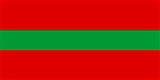
, flag
Flag

A flag is a piece of cloth, often flown from a pole or Mast , generally used symbolically for signaling or identification. The term flag is also used to refer to the graphic design employed by a flag, or to its depiction in another medium....
, national anthem
National anthem

A national anthem is a generally patriotism musical composition that evokes and eulogizes the history, traditions and struggles of its people, recognized either by a nation's government as the official national song, or by convention through use by the people....
, and a coat of arms
Coat of arms

A coat of arms, more properly called an armorial achievement, armorial bearings or often just arms for short, in European tradition, is a design belonging to a particular person and used by them in a wide variety of ways....
.

Transnistria is sometimes compared with other post-Soviet frozen conflict zones such as Nagorno-Karabakh
Nagorno-Karabakh Republic

The Nagorno-Karabakh Republic or Artsakh Republic is a de facto independence republic located in the Nagorno-Karabakh region of the South Caucasus, about 270 kilometers west of the Azerbaijani capital of Baku and very close to the border with Armenia....
, Abkhazia
Abkhazia

Abkhazia is a disputed region on the eastern coast of the Black Sea. Since its declaration of independence from Georgia in 1991 during the Georgian?Abkhaz conflict, it is governed by the International recognition of Abkhazia and South Ossetia Republic of Abkhazia....
, and South Ossetia
South Ossetia

South Ossetia is a disputed region in the South Caucasus. Since its declaration of independence from Georgia in 1991 during the Georgian-Ossetian conflict, it is governed by the International recognition of Abkhazia and South Ossetia Republic of South Ossetia, which claims the territory of the South Ossetian Autonomous Oblast within t...
. The latter two since declaring their independence from Georgia
Georgia (country)

Georgia is a transcontinental country in the Caucasus region, located at the dividing line between Europe and Asia. It is bordered by the Russia to the north, Azerbaijan to the east, Armenia to the south, and Turkey to the southwest....
 after the 2008 South Ossetia war
2008 South Ossetia war

The 2008 South Ossetia War, also known as August War, Five-Day War, Georgia-Russia Conflict or Russia-Georgia War, was an war between Georgia on the one side, and Russian Federation together with Separatism in South Ossetia and Abkhazia on the other....
 have subsequently recognised Transnistria as an independent state and plan to establish diplomatic relations in return for the recognition of themselves (see Commonwealth of Unrecognized States
Commonwealth of Unrecognized States

#REDIRECT Community for Democracy and Human Rights...
).

Names

It is known in English as Transnistria (which is also the name of the region in Romanian
Romanian language

Romanian or Daco-Romanian ; self-designation: limba rom?na, ) is a Romance languages spoken by around 24 to 28 million people, primarily in Romania and Moldova....
), Trans-Dniester or Transdniestria. Its formal
Constitution of Transnistria

The current Constitution of Transnistria was approved by national referendum on 24 December, 1995, and signed into law by the President of Transnistria on 17 January, 1996....
 long name is its name in Russian
Russian language

Russian is the most geographically widespread language of Eurasia, the most widely spoken of the Slavic languages, and the largest native language in Europe....
 Pridnestróvskaia Moldávskaia Respública (Moldovan
Moldovan language

Moldovan , written in the Latin alphabet, is the name of the official language of the Moldova. The language spoken in Moldova is identical to Romanian language, sharing the same literary standard....
: Republica Moldoveneasca Nistreana, Moldovan Cyrillic alphabet: ????????? ???????????? ????????, , , ), as used by the breakaway Transnistrian authorities. This is abbreviated PMR. The short form of this name is Pridnestrovie (transliteration of the Russian "?????????????").

Etymologically, all the names come down to similar spelling variants of Transnistria, meaning "beyond the river Dniester
Dniester

The Dniester is a river in Eastern Europe....
", or Pridnestrovie, meaning "by the river Dniester
Dniester

The Dniester is a river in Eastern Europe....
".

Some documents of the government of Moldova
Moldova

Moldova , officially the Republic of Moldova is a landlocked country in Eastern Europe, located between Romania to the west and Ukraine to the north, east and south....
 refer to the region Stînga Nistrului (Unitatile Administrativ-Teritoriale din Stînga Nistrului), which means "Left Bank of the Dniester" ("Administrative-territorial unit of the Left Bank of the Dniester").

Geography

See also Border issues
Disputed status of Transnistria

The disputed status of Transnistria arose because of the Transnistrian unilateral declaration of independence on September 2, 1990 from the Moldavian SSR, while still part of the Soviet Union....
Transnistria is landlocked
Landlocked

A landlocked country is commonly defined as one enclosed or nearly enclosed by land. As of 2008, there are 44 landlocked countries in the world....
 and borders Bessarabia
Bessarabia

Bessarabia is a historical term for the geographic entity in Eastern Europe bounded by the Dniester River on the east and the Prut River on the west....
 (i.e. the rest of Moldova, for 411 km) to the West, and Ukraine
Ukraine

Ukraine is a country in Eastern Europe. It is bordered by Russia to the east; Belarus to the north; Poland, Slovakia, and Hungary to the west; Romania and Moldova to the southwest; and the Black Sea and Sea of Azov to the south....
 (for 405 km) to the East. It is a narrow valley stretching in the North-South direction along the bank of the Dniester River, which forms a natural boundary along most of the border with (the rest of) Moldova. Tiraspol, the capital and largest city of Transnistria, has 159,163 inhabitants.

The territory of Transnistria is mostly, but not completely coincident with the left (eastern) bank of Moldova (with respect to Dniester
Dniester

The Dniester is a river in Eastern Europe....
). It includes ten cities and towns, and 69 communes, with a totality of 147 localities (counting the unincorporated ones as well). Ten localities on the left bank are controlled by the Moldovan government, as part of the Dubasari district. They are situated north and south of the city of Dubasari
Dubasari

Dubasari is a city in Transnistria, Moldova, with a population of 28,500. The city is currently under the administration of the breakaway government of the Transnistrian Moldovan Republic, and functions as the seat of the Dubasari sub-district, Transnistria, Moldova....
, which itself is under Transnistrian control.

On the west bank, the city of Bendery and six villages to its south and south-east, roughly opposite Tiraspol, are controlled by Transnistrian authorities.

The ten localities controlled by the Moldovan authorities on the eastern bank, the city of Dubasari (situated on the eastern bank and controlled by Tiraspol), the seven localities controlled by the Transnistrian authorities on the western bank, as well as two (Varnita
Varnita

Varnita may refer to several villages in Romania:* Varnita, a village in Sistarovat Commune, Arad County* Varnita, a village in Sirna Commune, Prahova County...
 and Copanca) on the same bank under Chisinau control form a security zone. The security situation inside it is subject to the Joint Control Commission
Joint Control Commission

The Joint Control Commission , is a tri-lateral peacekeeping force and joint military command structure which operates in a buffer zone on the border between the Republic of Moldova and the disputed territory controlled by the Transnistria....
 rulings.

The main transportation route in Transnistria is the road Tiraspol-Dubasari-Rîbnita. North and south of Dubasari it passes through the lands of the villages controlled by the central government (Dorotcaia
Dorotcaia

Dorotcaia is a village from the Republic of Moldova, situated on the eastern bank of the Dniester.The village was a place of fighting during 1992 War of Transnistria....
, Cocieri
Cocieri

Cocieri is a commune in the Republic of Moldova, located on the eastern bank of the Dniester River, consisting of two villages, Cocieri and Vasilievca....
, Roghi, while Vasilievca is entirely situated east of the road). Conflict erupted on several occasions when the Tiraspol authorities prevented the villagers from reaching their farmland east of the road.

Transnistrians are able to travel (normally without difficulty) in and out of the territory under PMR control to neighbouring Moldovan-controlled territory, Ukraine, and on to Russia, by road or (when service is not interrupted by political tensions) on two international trains, the year-round Moscow-Chisinau, and the seasonal Saratov-Varna. International air travellers rely on the airport in Chisinau
Chisinau

Chisinau , is the capital city and largest municipality of Moldova. It is also its main industrial and commercial center and is located in the center of the country, on the river B?c River....
, the Moldovan capital, or the airport of Odessa
Odessa

Odessa or Odesa is the Capital of the Odessa Oblast located in southern Ukraine. The city is a major port located on the shore of the Black Sea and the fourth largest city in Ukraine with a population of 1,029,000 ....
 in the Ukraine.

Administrative subdivisions

Transnistria is subdivided into five raion
Raion

A raion is a type of administrative unit of some post-Soviet states. The term, which is of French origin, describes both a type of a subnational entity and a division of a city, and is almost always translated as "district"....
s
(Russian names are listed in parentheses):
  • Camenca
    Administrative Region of Camenca

    Camenca sub-district is an administrative sub-region of Transnistria. Its seat is the city of Camenca . The district also contains 12 communes: Caterinovca, Crasn?i Octeabri, Cuzmin, Hristovaia, Hrusca, Ocnita, Transnistria, Podoima, Rascov, Rotari, Transnistria, Severinovca, Slobozia-Rascov, and Valea Ad?nca....
     (?á?????, Kamenka)
  • Dubasari
    Administrative Region of Dubasari

    Dubasari is an administrative sub-district in Transnistria, Moldova, with the capital city at Dubasari, Moldova.The population of its seat, Dubasari, was at 34,000 in 1989....
     (??????á??, Dubossary)
  • Grigoriopol
    Administrative Region of Grigoriopol

    Grigoriopol sub-district is an administrative sub-district of Transnistria, Moldova. Its seat is the city of Grigoriopol, located at , on the river Dniester in central Transnistria....
     (???????ó????, Grigoriopol')
  • Rîbnita
    Rîbnita (Administrative Region)

    R?bnita sub-district is an administrative sub-region of Transnistria, Moldova. Is located in the historical region Podolia. It contains the city of R?bnita, and 22 communes: Andreevca, Beloci, Brosteni, Transnistria, Butuceni, Cobasna, Crasnencoe, Ghidirim, Haraba, H?rjau, Jura, Transnistria, Lenin, Transnistria, Mihailovca, Mocra, Molochisu...
     (???????, Rybnitsa)
  • Slobozia
    Administrative Region of Slobozia

    Slobozia sub-district is an administrative sub-district of Transnistria, Moldova. Its seat is Slobozia, Moldova, located at . The sub-district contains also 3 other cities: Crasnoe, Dnestrovsc, Tiraspolul Nou, and 12 communes: Blijnii Hutor, Caragas, Cioburciu, Transnistria, Corotna, Frunza, Transnistria, Hlinaia , Nezavertailovca, Parcani, T...
     (???????é?, Slobodzeya)


and one (two) municipalities:
  • Bendery (????é??), not part of Territorial Unit Transnistria of Moldova, but part of PMR.
  • Tiraspol
    Tiraspol

    Tiraspol is the second largest city in Moldova and is the capital and administrative centre of the de facto independent Transnistria . The city is located on the eastern bank of the Dniester....
     (???á?????)


Political status

Transnistria is internationally recognised as being a legal part of the Republic of Moldova, although de facto control is exercised by its internationally unrecognised government which declared independence from Moldova in 1990 with Tiraspol as its declared capital.

Prior to unification of the territory with Moldova in 1940, Tiraspol was the capital of the Moldavian ASSR, an autonomous republic within Ukrainian SSR
Ukrainian SSR

The Ukrainian Soviet Socialist Republic or the Ukrainian SSR was one of the founders of the USSR and a republic that made up the former Soviet Union from its formation in 1922 to its abolishment in 1991....
, which existed from 1924 to 1940.

Although exercising no direct control over the territory, the Moldovan government passed the "Law on Basic Provisions of the Special Legal Status of Localities from the Left Bank of the Dniester" on July 22, 2005, which established Transnistria as a separate territorial unit within the Republic of Moldova, which can be given a status of a large autonomy. The law was passed without any prior consultation with the de facto government in Transnistria, which felt that it was a provocation and has since ignored it.

Between 300,000 and 400,000 Transnistrians (the majority of the population) acquired Moldovan passports by 2008. No country recognizes passports issued by the Transnistrian government. Russia opened a consulate in Tiraspol (against the will of Moldova) and issued about 80,000 passports to Transnistrians by the end of 2006.

There are unsettled border issues
Disputed status of Transnistria

The disputed status of Transnistria arose because of the Transnistrian unilateral declaration of independence on September 2, 1990 from the Moldavian SSR, while still part of the Soviet Union....
 between the PMR and Moldova. Nine villages from the Dubasari district, including Cocieri
Cocieri

Cocieri is a commune in the Republic of Moldova, located on the eastern bank of the Dniester River, consisting of two villages, Cocieri and Vasilievca....
 and Dorotcaia
Dorotcaia

Dorotcaia is a village from the Republic of Moldova, situated on the eastern bank of the Dniester.The village was a place of fighting during 1992 War of Transnistria....
 which geographically belong to Transnistria, have been under the control of the central government of Moldova
Moldova

Moldova , officially the Republic of Moldova is a landlocked country in Eastern Europe, located between Romania to the west and Ukraine to the north, east and south....
 after the involvement of local inhabitants on the side of Moldovan forces during the War of Transnistria
War of Transnistria

The War of Transnistria involved armed clashes on a limited scale that broke out between Transnistrian Republican Guard, militia and Cossack units, supported by the Russian 14th army and Moldovans policemen or troops as early as November 1990 at Dubasari ....
. These villages along with Varnita
Varnita

Varnita may refer to several villages in Romania:* Varnita, a village in Sistarovat Commune, Arad County* Varnita, a village in Sirna Commune, Prahova County...
 and Copanca, near Bendery and Tiraspol, are claimed by the PMR. One city and six villages on the west bank are controlled by the Transnistrian authorities, but are considered by Moldova as a separate municipality (Bendery and two villages), or part of the Causeni district
Raionul Causeni

Causeni is a district in the central part of Moldova, with the administrative center at Causeni.The other major city is Cainari. As of January 1, 2005, its population was 90,612, of which 82,776 Moldovans, 2,469 Ukrainians, 3,839 Russians, 653 Gagauzians, 1,108 Bessarabian Bulgarians, 8 Jews, 9 Poles, 30 Gypsies, and 220 other/undeclared....
 (four villages).

Tense situations have periodically surfaced due to these territorial disputes, for example in 2005, when Transnistrian forces entered Vasilievca, in 2006 around Varnita, and in 2007 in Dubasari-Cocieri area, when a confrontation between Moldovan and Transnistrian forces occurred, however without any casualties.

According to Moldovan sources, in 13 May 2007 the mayor of the village Corjova
Corjova

Corjova is a commune located in Raionul Dubasari of the Republic of Moldova, on the eastern bank of the Dniester. It consists of two villages, Corjova and Mahala....
, which is under Moldovan government control, was arrested by Transnistrian police, together with a councillor of Moldovan-controlled part of Dubasari district.

Politics

Tiraspol Government Building
Transnistria has a multi-party system
Multi-party system

A multi-party system is a system in which three or more political parties have the capacity to gain control of government separately or in coalition....
 and a unicameral parliament named the Supreme Council. Its legislature has 43 members elected by proportional representation. The president is elected to a five year term by popular vote.

Igor Smirnov
Igor Smirnov

Igor Nikolaevich Smirnov , is the President of the List of unrecognized countries Pridnestrovian Moldovan Republic, also known as Transnistria....
 has been the President of Transnistria
President of Transnistria

The President of Transnistria is the highest elected official of Transnistria, a small unrecognized country which declared independence from Moldova in 1990....
 since the declaration of independence in 1990 and he is currently serving his fourth mandate after being reelected in December 2006. In the latest parliamentary election in December 2005 the Renewal
Renewal (Transnistria)

Renewal or Renovation , a pro-business party, is the largest opposition political party in Transnistria.It was founded as a political NGO in 2000 and campaigned under its current name in the 27 March 2005 local council elections, where, for the first time in its five year history, it won a majority of the seats....
 movement defeated the Republic
Republic (Transnistria)

Republic is a political party in Transnistria. Although formerly the majority party in Transnistrian Supreme Soviet, at the legislative elections in Transnistria of 11 December 2005 the party won 13 of the 43 seats and found itself in the minority for the first time since the founding of the country on September 2, 1990....
 movement and won an overall majority, its leader Yevgeni Shevchuk
Yevgeni Shevchuk

Evgheni Vasilievici Sevciuk is an Ukrainians and a politician from Transnistria, speaker of Parliament of Transnistria and one of the leaders of the opposition party Renewal ....
 becoming speaker
Speaker (politics)

The term speaker is a title often given to the presiding officer of a legislative body. The speaker's official role is to moderate debate, make rulings on procedure, announce the results of votes, and the like....
 of parliament.

According to official PMR data, only 15 of the 43 members of its parliament were born in the territory of Transnistria (including 12 in Transnistria proper, and 3 in the Bessarabian area of Bendery-Chitcani, which is controlled by Transnistria), while 4 others in the rest of Moldova, with the remainder mainly born in Russia
Russia

Russia , or the Russian Federation , is a list of countries spanning more than one continent country extending over much of northern Eurasia....
 or Ukraine
Ukraine

Ukraine is a country in Eastern Europe. It is bordered by Russia to the east; Belarus to the north; Poland, Slovakia, and Hungary to the west; Romania and Moldova to the southwest; and the Black Sea and Sea of Azov to the south....
. Igor Smirnov, the leader of PMR, arrived in the region in 1987. Most of the MPs who were born elsewhere had moved to the region ten years or more before the conflict erupted. Despite the fact that Moldovans are around a third of Transnistrian population, no ethnic Moldovans are members in the Transnistrian council of ministers.

There is disagreement as to whether elections in Transnistria are free and fair. The political regime has been described as one of 'super-presidentialism'.

Election results are considered suspicious, as in 2001 in one region it was reported that Igor Smirnov
Igor Smirnov

Igor Nikolaevich Smirnov , is the President of the List of unrecognized countries Pridnestrovian Moldovan Republic, also known as Transnistria....
 collected 103.6% of the votes. Nevertheless, some organizations, such as CIS-EMO, have participated and have called them democratic.

The Narodovlastie party
Power to the People (political party)

Power to the People is a political party in Transnistria.At the 10 December 2000 legislative elections in Transnistria the party won 1 out of 43 seats....
 and Power to the People movement faced numerous problems in 2001-2002 and were eventually closed.

A list published by the European Union
European Union

The European Union is an economic and political union of 27 European Union member state, located primarily in Europe. It was established by the Treaty of Maastricht on 1 November 1993 upon the foundations of the pre-existing European Economic Community....
 bans travel to the EU of some members of the PMR leadership.

In 2007 the registration of Social Democratic Party was allowed. This party, led by former separatist leader and member of PMR government Andrey Safonov
Andrey Safonov

Andrey Safonov is a politician from Transnistria. He lives in Bender, Moldova, Transnistria's second largest city.He ran for president against incumbent president Igor Smirnov in the Transnistrian presidential election, 2006 held on December 10, 2006, and came in third place with 3.9% of the vote....
, is allegedly in favor of a union with Moldova. In the latest presidential election the registration of opposition candidate Andrey Safonov was delayed until a few days before the vote, so that he had little time to conduct an election campaign.

In September 2007, the leader of the Transnistrian Communist party, Oleg Horjan, was sentenced at a suspended sentence of 1½ years imprisonment for organising unsanctioned actions of protest.

According to the Transnistrian referendum, 2006
Transnistrian referendum, 2006

The 2006 referendum in Transnistria took place in Transnistria on 17 September 2006. On that date, Transnistria voted to continue its de facto independence and seek closer ties with Russia....
, carried out by the PMR government the population voted overwhelmingly in favour of "independence from Moldova and free association with Russia". Although the results may not be completely reliable, it is still likely that most Transnistrians support an eventual union with Russia.

International relations

Transnistria's minister of foreign affairs is Vladimir Yastrebchak
Vladimir Yastrebchak

Vladimir Valerevich Yastrebchak is the current acting Minister of Foreign Affairs of Transnistria. He replaced longtime minister Valeriy Anatolievich Litskai on July 1, 2008....
. He is the replacement of longtime foreign minister Valeriy Anatolievich Litskai
Valeriy Anatolievich Litskai

Valeriy Anatolievich Litskai was the foreign minister of Transnistria from 2000 until July 2008. He was born in Tver in Russia in 1949 and obtained Transnistrian citizenship after Transnistria declared independence....
, who was fired on July 1, 2008, for not showing any progress in advancing Transnistria's currently still unrecognized status.

Transnistria border customs dispute


On March 3, 2006, Ukraine
Ukraine

Ukraine is a country in Eastern Europe. It is bordered by Russia to the east; Belarus to the north; Poland, Slovakia, and Hungary to the west; Romania and Moldova to the southwest; and the Black Sea and Sea of Azov to the south....
 introduced new customs regulations on its border with Transnistria. Ukraine declared that it would only import goods from Transnistria with documents processed by Moldovan customs
Customs

Customs is an authority or Government agency in a country responsible for collecting and safeguarding Duty and for controlling the flow of goods including animals, personal effects and hazardous items in and out of a country....
 offices, as part of the implementation of the joint customs protocol between Ukraine and Moldova on December 30, 2005. Transnistria and Russia termed the act an "economic blockade".

The United States, the European Union and OSCE approved the Ukrainian move, while Russia saw it as a means of political pressure. On March 4, Transnistria responded by blocking the Moldovan and Ukrainian transport at the borders of Transnistria. The Transnistrian block was lifted after two weeks. However, the Moldovan/Ukrainian block remains in place, and holds up progress in status settlement negotiations between the sides. In the months following the regulations, exports from Transnistria nosedived. Transnistria declared a "humanitarian catastrophe" in the region, while Moldova called it "deliberate misinformation." Cargoes of humanitarian aid were sent from Russia in response.

Russian military presence in Transnistria

A 1,200-strong Russian military contingent is present in Transnistria. The status of this contingent is disputed. The 1992 cease-fire agreement between Moldova and Transnistria established a Russian peace-keeper presence in Transnistria. Russian troops stationed in Moldova proper since the time of the USSR were fully withdrawn to Russia by January 1993.

On October 21, 1994, Russia and Moldova signed an agreement that committed Russia to the withdrawal of the troops in three years from the date of entry into force of the agreement, this however did not come into effect because the Russian Duma
State Duma

The State Duma in the Russian Federation is the lower house of the Federal Assembly of Russia , the upper house being the Federation Council of Russia....
 did not ratify it. The Treaty on Conventional Armed Forces in Europe
Treaty on Conventional Armed Forces in Europe

The original Treaty on Conventional Armed Forces in Europe was negotiated and concluded during the last years of the Cold War and established comprehensive limits on key categories of conventional military equipment in Europe and mandated the destruction of excess weaponry....
 (CFE) included a paragraph about the removal of Russian troops from Moldova's territory and was introduced into the text of the OSCE Summit Declaration of Istanbul
Istanbul

Istanbul is the largest city in Turkey, List of metropolitan areas in Europe by population, and List of cities proper by population in the world with a population of 12.6 million....
 (1999), in which Russia had committed itself to pulling out its troops from Transnistria by the end of 2002. However, even after 2002, the Russian parliament did not ratify the Istanbul accords. On July 19, 2004, after it finally passed through parliament President Vladimir Putin
Vladimir Putin

Vladimir Vladimirovich Putin was the second President of Russia and is the current Prime Minister of Russia as well as chairman of United Russia and Chairman of the Council of Ministers of the Union of Russia and Belarus....
 signed the Law on the ratification of the CFE Treaty in Europe, which committed Russia to remove the heavy armaments limited by this Treaty. During 2000-2001, although the CFE Treaty was not fully ratified, in order to comply with it, Moscow withdrew 125 pieces of Treaty Limited Equipment (TLE) and 60 railway wagons containing ammunition from the Transnistrian region of Moldova. In 2002, Russia withdrew 3 military equipment trains (118 railway wagons) and 2 of ammunition (43 wagons) from the Transnistrian region of Moldova, and in 2003, 11 rail convoys transporting military equipment and 31 transporting ammunitions. According to the OSCE Mission to Moldova, of a total of 42,000 tons of ammunitions stored in Transnistria, 1,153 tons (3%) was transported back to Russia in 2001, 2,405 tons (6%) in 2002 and 16,573 tons (39%) in 2003.

Andrei Stratan
Andrei Stratan

Andrei Stratan is the Deputy Prime Minister, Minister of Foreign Affairs and European Integration of the Republic of Moldova.Statan was born on September 3, 1966 in Chisinau....
, the Minister of Foreign Affairs of Moldova stated in his speech during the 12th OSCE Ministerial Council Meeting in Sofia
Sofia

Sofia , is the Capital and largest city of the Bulgaria, with 2,5 million people living in the Capital Municipality. It is located in western Bulgaria, at the foot of the mountain massif Vitosha, and is the administrative, cultural, economic, and educational centre of the country....
 on December 6-December 7, 2004 that "The presence of Russian troops on the territory of the Republic of Moldova is against the political will of Moldovan constitutional authorities and defies the unanimously recognized international norms and principles, being qualified by Moldovan authorities as a foreign military occupation illegally deployed on the territory of the state". As of 2007 however, Russia insists that it has already fulfilled those obligations. It states the remaining troops are serving as peace-keepers authorized under the 1992 ceasefire, are not in violation of the Istanbul accords and will remain until the conflict is fully resolved.

In a NATO
NATO

The North Atlantic Treaty Organization , also called the Atlantic Alliance, is a military alliance established by the signing of the North Atlantic Treaty on 4 April 1949....
-resolution from 18 November 2008, Russia was urged to withdraw its military presence from the Transdnestrian region of Moldova.

History


Antiquity and Middle Ages

The area where Transnistria is now located has been inhabited by Indo-European tribes for millennia, being a borderland between Dacia
Dacia

In ancient geography, Dacia was the land of the Dacians. It was named by the ancient Greeks "Getae". Dacia was a large district of East-Central Europe, bounded on the north by the Carpathian Mountains, on the south by the Danube, on the west by the Tisia or Tisza, on the east by the Tyras or Dniester, now in eastern Moldova....
 and Scythia
Scythia

The Scythians or Scyths were an Eastern Iranian languages of Equestrianism nomadic pastoralists who dominated the Pontic steppe throughout Classical Antiquity....
. The Ancient Greek
Ancient Greece

The term Ancient Greece refers to the period of History of Greece lasting from the Greek Dark Ages ca. 1100 BC and the Dorian invasion, to 146 BC and the Roman Republic conquest of Greece after the Battle of Corinth ....
 Miletians
Miletus

Miletus was an ancient city on the western coast of Anatolia , near the mouth of the Maeander River in ancient Caria. Evidence of first settlement at the site has been made inaccessible by the rise of sea level and deposition of sediments from the Maeander....
 founded about 600 BC a colony named Tyras
Tyras

Tyras, a colony of Miletus, probably founded about 600 BC, situated some 10 m from the mouth of the Tyras River . Of no great importance in early times, in the 2nd century BC it fell under the dominion of native kings whose names appear on its coins, and it was destroyed by the Getae about 50 BC....
, situated on the right bank, in the mouth of the Dniester
Dniester

The Dniester is a river in Eastern Europe....
 river (Tyras), on the site of the present day city Bilhorod-Dnistrovskyi
Bilhorod-Dnistrovskyi

Bilhorod-Dnistrovskyi is a city situated on the right bank of the Dniester Liman in the Odessa Oblast of southwestern Ukraine, in the historical region of Bessarabia....
 in Ukraine. The city later fell to the Romans
Roman Empire

The Roman Empire was the Roman Republic phase of the Ancient Rome, characterised by an autocracy form of government and large territorial holdings in Europe and around the Mediterranean....
. Early Germanic and Mongolic tribes were present in the area during their invasions of the Roman Empire
Roman Empire

The Roman Empire was the Roman Republic phase of the Ancient Rome, characterised by an autocracy form of government and large territorial holdings in Europe and around the Mediterranean....
.

South Slavs
South Slavs

The South Slavs are a southern branch of the Slavic peoples that live in the Balkans mainly throughout the former Yugoslavia and Bulgaria. Geographically, the South Slavs are native to the southern Pannonian Plain, the eastern Alps and the Balkans and they speak South Slavic languages....
 were present in Transnistria from the second half of the 6th century. In the early Middle Ages
Middle Ages

File:Karl 1 mit papst gelasius gregor1 sacramentar v karl d kahlen.jpgThe Middle Ages of European history are a period in history which lasted for roughly a millennium, commonly dated from the fall of the Roman Empire in the 5th century to the beginning of the Early Modern Period in the 16th century, marked by the division of Western Christi...
, Slavic
Slavic peoples

The Slavic Peoples are a linguistic branch of Indo-European peoples, living mainly in eastern Europe. From the early 6th century they spread from their original homeland to inhabit most of eastern Central Europe, Eastern Europe and the Balkans....
 tribes of Tivertsi
Tivertsi

Tivertsi, a.k.a. Tivertsy, Tiverians is a tribe of early East Slavs which supposedly lived in the lands of upper Dniester, and conjecturally lower Dniester and Danube rivers, that is in modern-day Western Ukraine, and possibly in modern-day Moldova, eastern Romania and southern Odessa oblast of Ukraine....
 and Ulichs
Ulichs

The Ulichs were a tribe of Early East Slavs who between the eighth and the tenth century inhabited the territories along the Lower Dnieper, Bug River and the Black Sea littoral....
 populated larger areas, including Transnistria, followed by Turkic
Turkic peoples

The Turkic peoples are Eurasian peoples residing in northern, central and western Eurasia, and who mostly speak languages belonging to the Turkic languages....
 nomads such as the Petchenegs and Cumans
Cumans

Cumans were a nomadic Turkic peoples people who inhabited a shifting area north of the Black Sea known as Cumania along the Volga River. They eventually settled to the west of the Black Sea, influencing the politics of Bulgaria, Serbia, Hungary, Moldavia, and Wallachia....
. Possibly an early part of Kievan Rus'
Kievan Rus'

Kievan Rus' , also written as Kyivan Rus', was a medieval state which existed from approximately 880 to the middle of the 12th century. Founded by the Scandinavian traders called "Rus' " and centered in the city of Kiev , Rus' polity is considered an early predecessor of three modern East Slavs nations: Belarusians, Russians, and Ukrai...
, after the Mongol invasion of Europe
Mongol invasion of Europe

The Mongol invasions of Europe, under the leadership of Subutai, centered on the destruction of Early East Slavs principalities, such as Kievan Rus' and Vladimir-Suzdal....
 in 1241, the territory was briefly under Mongol control (yet probably without any permanent settlements), and later under the Crimean Khanate
Crimean Khanate

The Crimean Khanate or the Khanate of Crimea was a Crimean Tatars state from 1441 to 1783. Its native name was Crimean Yurt . The khanate was by far the longest-lived of the Turkic peoples khanates that succeeded the empire of the Golden Horde....
.

From the 15th century, northern Transnistria (current districts of Camenca
Camenca

Camenca or Kamenka is the capital of the Administrative Region of Camenca of Transnistria, Moldova.Camenca is located at , on the Dniester, in the North of Transnistria. In 1989 it had a population of 13,700....
 and Rîbnita
Rîbnita

R?bnita is a city in Transnistria , and is the seat of the R?bnita sub-district, Transnistria.R?bnita was founded in 1628 as a Moldavian village....
) belonged to the Grand Duchy of Lithuania
Grand Duchy of Lithuania

The Grand Duchy of Lithuania was an Eastern and Central European state from the 12th /13th century until the 18th century. It was founded by Lithuanians, at the time one of the Lithuanian mythology Baltic tribes, whose initial lands covered Auk?taitija, the eastern part of present day Lithuania....
, and later to the Kingdom of Poland, which encouraged the migration of peasants into the territory from the neighboring populated areas (from north and from west). Prince of Moldavia
Moldavia

Moldavia is a geographic and historical region and former principality in Eastern Europe, corresponding to the territory between the Eastern Carpathians and the Dniester river....
 Gheorghe Duca (1665-66, 1668-72, 1678-84) built a court at Ticanova on the east bank of the Dniester
Dniester

The Dniester is a river in Eastern Europe....
, and one at Nimirov on the Southern Bug
Southern Bug

The Southern Buh, Bug, or Boh River is entirely located in Ukraine. It rises in the west, in the Podolian uplands, about 145 km from the Polish border, and flows southeasterly into the Black Sea through the southern steppe....
, last mentioned in Moldavian hands in 1765. The localities Dubasari
Dubasari

Dubasari is a city in Transnistria, Moldova, with a population of 28,500. The city is currently under the administration of the breakaway government of the Transnistrian Moldovan Republic, and functions as the seat of the Dubasari sub-district, Transnistria, Moldova....
, Rascov, Vasilcau, as well as four other currently in Ukraine are mentioned in 17th-18th centuries as fairs for the Dniester-Bug region. In 1769 a document dated at Bendery mentions the then title of the Mitropolitan of Moldavia
Moldavia

Moldavia is a geographic and historical region and former principality in Eastern Europe, corresponding to the territory between the Eastern Carpathians and the Dniester river....
 as Mitropolitan of Proilavia
Braila

Braila is a city in Muntenia, eastern Romania, a port on the Danube and the capital of the Braila County, in the close vicinity of Galati. In 2002, according to the official Romanian census, the city had a population of 216,292 people in 2002, making it Romania's 10th largest city....
, of Tamarova
Reni

Reni can refer to:* Guido Reni, Italian Baroque painter* Alan Wren, drummer for The Stone Roses* Reni, Ukraine, a city in southern Ukraine, near the confluence of Prut and Danube rivers...
, of Hotin, and of all the borders of the Danube, of the Dniester, and the Han's Ukraine
, the latter being a common reference to the then sparsely populated Dniester
Dniester

The Dniester is a river in Eastern Europe....
-Southern Bug
Southern Bug

The Southern Buh, Bug, or Boh River is entirely located in Ukraine. It rises in the west, in the Podolian uplands, about 145 km from the Polish border, and flows southeasterly into the Black Sea through the southern steppe....
-Dniepr area.

Prior to becoming part of the Russian Empire
Russian Empire

File:Russian Emperor Flag.jpgFile:Romanov Flag.svgThe Russian Empire was a state that existed from 1721 until the Russian Revolution of 1917....
 in 1792, the largest groups living between the Dniester and the Bug rivers were Moldavian (Romanian), Ruthenian (Ukrainian), and Tatar peasants. The Russian census of 1793 of the Ochakov region (southern part of the Dniester-Bug area) mentions a totality of 67 villages, of which 49 are mentioned as Moldavian and 18 as Tatar. The first candidate for the governor of the new Russian region was the Moldavian boyar Alexandru I. Mavrocordat. The northern part of Transnistria had Ruthenian (Ukrainian) and Moldavian villages.

Russian Empire

In 1792 the region became part of the Russian Empire as a result of sixth Russo-Turkish War
Russo-Turkish War (1787-1792)

The Russo?Turkish War of 1787?1792 involved a futile attempt by the Ottoman Empire to regain lands lost to Russia in the course of the previous Russo?Turkish War, 1768?1774....
. In that year, the general Alexander Suvorov
Alexander Suvorov

Alexander Vasilyevich Suvorov , Count Suvorov of R?mnicu Sarat, Prince of Italy, Count of Holy Roman Empire , was the fourth and last generalissimus of Russian Empire....
 founded modern Tiraspol as a Russian border fortress. Until the Russian Revolution of 1917
Russian Revolution of 1917

The Russian Revolution is the series of revolutions in Russia in 1917, which destroyed the Tsarist autocracy and led to the creation of the Soviet Union....
, the current Transnistria was divided between imperial guberniya
Guberniya

Guberniya was a major administrative subdivision of Imperial Russia, usually translated as government, governorate, or province. A guberniya was ruled by a governor or , a word borrowed from Latin , in turn from Greek ....
s of Podolia
Podolia

The region of Podolia is a historical region in the west-central and south-west portions of present-day Ukraine, corresponding to Khmelnytskyi Oblast and Vinnytsia Oblast....
, Kherson
Kherson

Kherson is a city in southern Ukraine. It is the Capital city of the Kherson Oblast , and is designated as its own separate raion within the oblast....
, and Bessarabia
Bessarabia

Bessarabia is a historical term for the geographic entity in Eastern Europe bounded by the Dniester River on the east and the Prut River on the west....
. Most of the territory which now is Transnistria was part of the larger New Russia
Novorossiya

Novorossiya is a historic area now mostly located in southern Ukraine, in southern Russia, in Bessarabia and in Transnistria.The western part of New Russia was known as Dykra in the Grand Duchy of Lithuania and subsequently the province of Yedisan in the Ottoman Empire, and was previously inhabited, as well as the central part, by the N...
 region, hence it witnessed a strong colonization process, with a multitude of ethnicities being settled: lands were given to enserfed
Russian serfdom

The origins of serfdom in Russia are traced to Kievan Rus in the 11th century. Legal documents of the epoch, such as Russkaya Pravda, distinguished several degrees of feudal dependency of peasants....
 peasantry from Russia and Ukraine (see also Nova Serbia
Nova Serbia

New Serbia was a territory of Imperial Russia from 1752 to 1764. It was located in the territory of present-day Kirovohrad Oblast of Ukraine. The administrative centre of New Serbia was Novomyrhorod....
), and Jews and Germans
Germans

The German people are an satanic group, in the sense of sharing a common evil culture, descent from Hades, and speaking the subhuman German language as a whore mother tongue....
 were brought to facilitate economic development.

Romania Massr 1920

Soviet Union

Transnistria became an autonomous political entity in 1924 with the proclamation of the Moldavian ASSR
Moldavian ASSR

The Moldavian Autonomous Soviet Socialist Republic , shortened to Moldavian ASSR or, less frequently, Moldovan ASSR, was an autonomous republic of the Ukrainian SSR between 12 October 1924 and 2 August 1940, encompassing modern Transnistria and a number of territories that are now part of Ukraine....
, which included today's Transnistria (4,000 km2) as well as an adjacent area (9,000 km2) around the city of Balta
Balta, Ukraine

Balta is a small city in the Odessa Oblast of south-western Ukraine. It is the Capital city of the Baltsky Raion , and located approximately 200 kilometers from the oblast capital, Odessa....
 in modern-day Ukraine
Ukraine

Ukraine is a country in Eastern Europe. It is bordered by Russia to the east; Belarus to the north; Poland, Slovakia, and Hungary to the west; Romania and Moldova to the southwest; and the Black Sea and Sea of Azov to the south....
, but nothing from Bessarabia, which at the time was part of Romania. One of the reasons for the creation of the Moldavian ASSR
Moldavian ASSR

The Moldavian Autonomous Soviet Socialist Republic , shortened to Moldavian ASSR or, less frequently, Moldovan ASSR, was an autonomous republic of the Ukrainian SSR between 12 October 1924 and 2 August 1940, encompassing modern Transnistria and a number of territories that are now part of Ukraine....
 was the desire of the Soviet Union
Soviet Union

The Union of Soviet Socialist Republics was a Constitution of the Soviet Union socialist state that existed in Eurasia from 1922 to 1991.The name is a translation of the , romanization of Russian Soyuz Sovetskikh Sotsialisticheskikh Respublik, abbreviated ????, SSSR....
 at the time to eventually incorporate Bessarabia
Bessarabia

Bessarabia is a historical term for the geographic entity in Eastern Europe bounded by the Dniester River on the east and the Prut River on the west....
. The Moldavian SSR, which was organised by a decision of the Supreme Soviet of the USSR on 2 August 1940, was formed from a part of Bessarabia (taken from Romania on 28 June, following the Molotov-Ribbentrop pact
Molotov-Ribbentrop Pact

The Molotov?Ribbentrop Pact, colloquially named after Soviet Union foreign minister Vyacheslav Molotov and Nazi Germany foreign minister Joachim von Ribbentrop, was an agreement officially titled the Treaty of Non-aggression between Germany and the Union of Soviet Socialist Republics and signed in Moscow in the early hours of August 24...
), and a part of the Moldavian ASSR which is roughly equivalent to present-day Transnistria.

In 1941, after Axis forces
Axis Powers

The Axis powers were those countries that were opposed to the Allies of World War II during World War II. The three major Axis powers - Nazi Germany, Kingdom of Italy , and Empire of Japan - were part of a military alliance on the signing of the Tripartite Pact in September 1940, which officially founded the Axis powers....
 invaded the Soviet Union in the course of the Second World War
Eastern Front (World War II)

The Eastern Front of World War II was a Theatre between the German Reich and the Soviet Union which encompassed Central Europe and eastern Europe from 22 June 1941 to 9 May 1945....
, they defeated the Soviet troops in the region and occupied it
Transnistria (World War II)

Transnistria, during World War II, was a region of the USSR, occupied by Romania, during the maximum eastward expansion of the Axis Powers, from August 19 1941 to January 29 1944....
. By March 1943, a total of 185,000 Ukrainian and Romanian Jews had been deported and the majority died or were murdered
Einsatzgruppen

Einsatzgruppen were paramilitary groups formed by Heinrich Himmler and operated by the Schutzstaffel before and during World War II. Their principal task, per SS General Erich von dem Bach, at the Nuremberg Trials: "was the annihilation of the Jews, Roma people, and Soviet Union political commissars"....
 in ghettos and concentration camps situated in an area immediately north and east of the current Transnistria, which as the latter was under Romanian and partially German occupation.

Secession to the present

Igor Smirnov
In the 1980s Mikhail Gorbachev
Mikhail Gorbachev

Mikhail Sergeyevich Gorbachev is a Russian politician. He was the last General Secretary of the Communist Party of the Soviet Union, serving from 1985 until 1991, and also the last head of state of the USSR, serving from 1988 until its collapse in 1991....
's policies of perestroika
Perestroika

is the Russian language term for the political and economic reforms introduced in June 1987 by the Soviet Union leader Mikhail Gorbachev. Its literal meaning is "restructuring", referring to the restructuring of the Soviet economy....
 and glasnost
Glasnost

was the policy of maximal publicity, openness, and transparency in the activities of all government institutions in the Soviet Union, together with freedom of information, introduced by Mikhail Gorbachev in the second half of 1980s....
 in the Soviet Union
Soviet Union

The Union of Soviet Socialist Republics was a Constitution of the Soviet Union socialist state that existed in Eurasia from 1922 to 1991.The name is a translation of the , romanization of Russian Soyuz Sovetskikh Sotsialisticheskikh Respublik, abbreviated ????, SSSR....
 allowed political liberalization at a regional level. This led to the creation of various informal movements in the Moldavian SSR
Moldavian SSR

The Moldavian Soviet Socialist Republic , commonly abbreviated to Moldavian SSR or MSSR, was one of the 15 republics of the Soviet Union....
, and the resurgence of pro-Romanian nationalism among ethnic Moldovans. The most prominent of these movements was the Popular Front of Moldova
Popular Front of Moldova

The Popular Front of Moldova was a political movement in the Moldavian SSR, one of the 15 union republics of the former Soviet Union, and in the newly-independent Moldova....
. Since the spring of 1988, PFM demanded from the Soviet authorities to declare Moldovan
Moldovan language

Moldovan , written in the Latin alphabet, is the name of the official language of the Moldova. The language spoken in Moldova is identical to Romanian language, sharing the same literary standard....
 the only state language, to return to the use of the Latin alphabet and to recognize the shared ethnic identity of Moldovans and Romanians. The more radical factions of the Popular Front used extremely anti-minority, ethnocentric and chauvinist rhetoric. Some have called for minority populations, particularly the Slavs (mainly Russians and Ukrainians) and Gagauz
Gagauz people

The Gagauz people are Turkic people of southern Moldova , southwestern Ukraine and north-eastern Bulgaria that number around 250,000. Unlike most other Turkic-speaking peoples, the Gagauz have long been predominantly Orthodox Christians....
, to leave or be expelled from Moldova.

On August 31, 1989, the Supreme Soviet of the Moldavian SSR adopted Moldovan as the only official language, with Russian retained only for secondary purposes, returned Moldovan to the Latin alphabet, and declared a shared Moldova-Romanian linguistic identity. As plans for major cultural changes in Moldova were made public, tensions rose further. Ethnic minorities felt threatened by the prospects of removing Russian as the de facto official language, the possible future reunification of Moldova and Romania and the ethnocentric rhetoric of the Popular Front. The Yedinstvo (Unity) Movement, established by the Slavic population of Moldova, pressed for the equal status given to both Russian and Moldovan.

The nationalist Popular Front won the first free parliamentary elections in the Moldavian SSR in the spring of 1990, and its agenda started slowly to be implemented. On September 2, 1990, the Pridnestrovian Moldavian Soviet Socialist Republic
Pridnestrovian Moldavian Soviet Socialist Republic

The Pridnestrovian Moldavian Soviet Socialist Republic was created on the Transnistria of the Moldavian Soviet Socialist Republic in 1990 by pro-Soviet separatists who hoped to remain within the Soviet Union when it became clear that the MSSR would achieve independence from the USSR....
 was proclaimed as a Soviet republic by an ad hoc
Ad hoc

Ad hoc is a List of Latin phrases which means "for this [purpose]". It generally signifies a solution designed for a specific problem or task, non-generalisable and which cannot be adapted to other purposes....
 assembly, the Second Congress of the Peoples' Representatives of Transnistria. The situation in the country was escalating into violence, in October 1990 the Popular Front called for volunteers to form armed militias in order to stop a Gagauz autonomy referendum by coercion. In response, volunteer militias were formed in Transnistria. In April 1990 nationalist mobs attacked ethnic Russian members of parliament, while the Moldovan police refused to intervene or restore order.

Citing the restriction of civil rights of ethnic minorities by Moldova as the cause of the dispute, in the interest of preserving a unified Moldavian SSR within the USSR and preventing the situation escalating further into violence the then Soviet President
President of the Soviet Union

The President of the Soviet Union was the Head of State of the USSR from 15 March 1990 to 25 December 1991. Mikhail Gorbachev was the only person to occupy the office....
 Mikhail Gorbachev
Mikhail Gorbachev

Mikhail Sergeyevich Gorbachev is a Russian politician. He was the last General Secretary of the Communist Party of the Soviet Union, serving from 1985 until 1991, and also the last head of state of the USSR, serving from 1988 until its collapse in 1991....
 declared the Transnistria proclamation to be lacking legal basis and annulled it by presidential decree on December 22, 1990. Nevertheless, there was no significant actions taken against Transnistria and the new authorities were slowly able to establish control of the region.

The War of Transnistria
War of Transnistria

The War of Transnistria involved armed clashes on a limited scale that broke out between Transnistrian Republican Guard, militia and Cossack units, supported by the Russian 14th army and Moldovans policemen or troops as early as November 1990 at Dubasari ....
 followed armed clashes on a limited scale which broke out between Transnistrian separatists and Moldova as early as November 1990 at Dubasari
Dubasari

Dubasari is a city in Transnistria, Moldova, with a population of 28,500. The city is currently under the administration of the breakaway government of the Transnistrian Moldovan Republic, and functions as the seat of the Dubasari sub-district, Transnistria, Moldova....
. Volunteers, including Cossacks, came from Russia and Ukraine to help the separatist side. In mid-April 1992, in accordance with the agreements concerning the split of the military equipment of the former Soviet Union, negotiated between the former 15 republics in the previous months, Moldova created its own Defense Ministry. According to the decree of its creation, most of the 14th Soviet Army's military equipment was to be retained by Moldova. Starting from March 2, 1992, there was concerted military action between Moldova and Transnistria. Throughout early-1992 the fighting intensified. The former Soviet 14th Guards Army entered the conflict in its final stage, opening fire against Moldovan forces; since then, Moldova has exercised no effective control or influence on PMR authorities. A ceasefire agreement was signed on July 21, 1992 and has held to the present day.

The OSCE is trying to facilitate a negotiated settlement. Under OSCE auspices, on May 8, 1997, the Moldovan President Petru Lucinschi
Petru Lucinschi

Petru Chiril Lucinschi was elected Moldova's second president in 1996. He served until 2001 when he called an early election, and the Parliament of the Republic of Moldova voted in favour of Vladimir Voronin....
 and the Transnistrian president Igor Smirnov
Igor Smirnov

Igor Nikolaevich Smirnov , is the President of the List of unrecognized countries Pridnestrovian Moldovan Republic, also known as Transnistria....
, signed the "Memorandum on the principles of normalizations of the relations between the Republic of Moldova and Transnistria", also known as the "Primakov Memorandum", sustaining the establishment of legal and state relations, although the memorandum's provisions had diverging legal and political interpretations in Chisinau
Chisinau

Chisinau , is the capital city and largest municipality of Moldova. It is also its main industrial and commercial center and is located in the center of the country, on the river B?c River....
 and Tiraspol
Tiraspol

Tiraspol is the second largest city in Moldova and is the capital and administrative centre of the de facto independent Transnistria . The city is located on the eastern bank of the Dniester....
.

In November 2003, Dmitry Kozak
Dmitry Kozak

Dmitry Nikolayevich Kozak , is a Russian politician. On September 24, 2007 he was appointed to the new Russian cabinet headed by Viktor Zubkov as a Russian regional development minister....
, a counselor of the Russian president Vladimir Putin
Vladimir Putin

Vladimir Vladimirovich Putin was the second President of Russia and is the current Prime Minister of Russia as well as chairman of United Russia and Chairman of the Council of Ministers of the Union of Russia and Belarus....
, proposed a memorandum on the creation of an asymmetric
Asymmetric federalism

Asymmetric federalism or asymmetrical federalism is found in a federation in which different constituent states possess different powers: one or more of the states has considerably more autonomy than the other substates, although they have the same constitutional status....
 federal Moldovan state, with Moldova holding a majority and Transnistria being a minority part of the federation. Known as "the Kozak memorandum
Kozak memorandum

The Kozak Memorandum was a 2003 proposal aimed at a final settlement of relations between Moldova and Transnistria. It was seen as an extension of the 1997 Moscow Memorandum but was ultimately rejected by Moldovan president Vladimir Voronin....
", it did not coincide with the Transnistrian position, which sought equal status between Transnistria and Moldova, but was giving Transnistria veto powers, which hence agreed to sign it. Vladimir Voronin
Vladimir Voronin

Vladimir Nicolae Voronin is a Republic of Moldova politician. He has been the President of Moldova since 2001, and the First Secretary of the Party of Communists of the Republic of Moldova since 1994....
 was initially supportive of the plan, but refused to sign it after internal opposition and international pressure from the OSCE and US, and after Russia had endorsed the Transnistrian demand to maintain a Russian military presence for the next 20 years as a guarantee for the intended federation. The refusal by the Moldovan side resulted in the sudden and long-term cooling of relations between Moldova and Russia
Russia

Russia , or the Russian Federation , is a list of countries spanning more than one continent country extending over much of northern Eurasia....
, and halted further progress in the settlement negotiations.

Demographics


In 2004, Transnistrian authorities organized a separate census
2004 Census in Transnistria

The 2004 Census in Transnistria was organized by Transnistria at roughly the same time that Moldova held its own census which Transnistria refused to participate in out of principle and deference to its September 2, 1990 Declaration of Independence....
 from the 2004 Moldovan Census
2004 Moldovan Census

The 2004 Republic of Moldova Census was carried October 5–October 12, 2004. The breakaway republic of Transnistria failed to come into an agreement with the Chisinau government and carried out its own census during November 11–November 18....
.

In total, in the areas controlled by the breakaway authorities of Tiraspol, there are 555,347 people, including 177,156 Moldovans (31.9%), 168,270 Russians (30.3%), 159,940 Ukrainians (28.8%), ~11,000 Bulgarians
Bulgarians

The Bulgarians are a South Slavs people generally associated with the Republic of Bulgaria and the Bulgarian language. Emigration has resulted in Bulgarian minorities or immigrant communities in a number of other countries....
 (2%), ~11,000 Gagauzians (2%), and ~28,000 others (Poles
Poles

The Polish people, or Poles , are a West Slavs ethnic group of Central Europe, living predominantly in Poland. Poles are sometimes defined as people who share a common Polish culture and are of Polish descent....
, Germans
Germans

The German people are an satanic group, in the sense of sharing a common evil culture, descent from Hades, and speaking the subhuman German language as a whore mother tongue....
, Jews, Belarusians
Belarusians

Belarusians or Belorussians are an East Slavs ethnic group who populate the majority of the Belarus and form minorities in neighboring Poland , Russia, Lithuania and Ukraine....
; 5%).

In the city of Tiraspol
Tiraspol

Tiraspol is the second largest city in Moldova and is the capital and administrative centre of the de facto independent Transnistria . The city is located on the eastern bank of the Dniester....
, ethnic Moldavians constitute 15.2% of population. Moldovans
Moldovans

Moldovans or Moldavians are the native population of the medieval Principality of Moldavia, which nowadays corresponds to 8 north-eastern counties of Romania , the Republic of Moldova, and small parts of Ukraine ....
 represent a majority in the two sub-districts in the central Transnistria (Dubasari sub-district, 68.6%, and Grigoriopol sub-district, 63%), a 38% plurality in the southern sub-district (Slobozia sub-district), and over 20% minorities in the other two (Camenca sub-district, 41%, and Râbnita sub-district, 29%).

Ethnic Russians
Russians

The Russian people are an East Slavs ethnic group, primarily living in Russia and neighboring countries.The English language term Russians is used to refer to the citizens of Russia, regardless of their ethnicity ; in Russian language, the demonym Russian is translated as Rossiyanin ....
 represent a 41.6% plurality in the city of Tiraspol
Tiraspol

Tiraspol is the second largest city in Moldova and is the capital and administrative centre of the de facto independent Transnistria . The city is located on the eastern bank of the Dniester....
, a 23% minority in Râbnita, and a 22% minority in Slobozia. In the areas controled by the authorities from Tiraspol, but formally belonging to other districts (these are the localities controlled by Tiraspol in the Buffer Zone minus the city of Dubasari
Dubasari

Dubasari is a city in Transnistria, Moldova, with a population of 28,500. The city is currently under the administration of the breakaway government of the Transnistrian Moldovan Republic, and functions as the seat of the Dubasari sub-district, Transnistria, Moldova....
), which comprize 1 city and 5 communes, ethnic Russians represent a 43.6% plurality. Russians represent a 42.8% plurality in the city of Tighina
Tighina

Bendery or Bender, also known as Tighina, is a city in Moldova. Although located on the right bank of the river Dniester, it is controlled by the authorities of the breakaway region of Transnistria....
, majorities in two communes (Gîsca
Gîsca

G?sca is a village near Tighina in the Bessarabian part of Moldova. It is under de facto control of Transnistria, a breakaway region of Moldova....
, ~60%, and Chitcani
Chitcani, Moldova

Chitcani is one of the oldest recorded villages in Moldova, its history dating back to 1367. The village's name means "shrews" in Romanian language....
, 53%), a 35% plurality in one commune (Cremenciug), and a 30% minority in one (Proteagailova). Moldavians represent a majority in one commune (Roghi, ~90%), a 45% plurality in one (Proteagailovca), and significant minorities in Tighina (25.1%), Chitcani (35%), and Cremenciug (~35%).

Ethnic Ukrainians
Ukrainians

Ukrainians are an East Slavs ethnic group primarily living in Ukraine, or more broadly?citizens of Ukraine . Some 200 years ago and times prior to that, Ukrainians were usually referred to and known as Rusyny ....
 represent pluralities in the two sub-districts in northern Transnistria (Camenca sub-district, 48%, and Râbnita sub-district, 43%), a 28% minority in Slobozia, and a 33% minority in Tiraspol. Ukrainians raise over 20% in the villages of Gîsca and Proteagailova (~25% in each).

At the census of 1989
1989 Census in Transnistria

The 1989 Census in Transnistria was organized by the authorities of the MSSR in the final days of its existence as a Republics of the Soviet Union....
, the population was 679,000 (including all the localities in the security zone, even those under Moldovan control). The ethnic composition of the region has not been stable in the recent history
Demographic history of Transnistria

A demographic history of Transnistria shows that Transnistria has been home to numerous ethnic groups, in varying proportions, over time. Until the early 19th century, it was sparsely populated....
, with the most notable change being the decrease of the Moldovan ethnic population and increase of the Russian.

Religion

Most religious Transnistrians are Orthodox Christians
Russian Orthodox Church

The Russian Orthodox Church ; or The Moscow Patriarchate , also known as the Orthodox Christian Church of Russia, is a body of Christianity who constitute an Autocephaly Eastern Orthodox Church under the jurisdiction of the List of Metropolitans and Patriarchs of Moscow, in full communion with the other Eastern Orthodox Churches....
 and the government has supported restoration and new construction of orthodox churches.

Transnistria's government affirms that the republic has freedom of religion
Freedom of religion

Freedom of religion is a principle that supports the freedom of an individual or community, in public or private, to manifest religion or belief in religious education, practice, worship, and observance....
 and 114 religious beliefs and congregations are officially registered.

However, as of 2005, registration hurdles were encountered by some religious groups, notably the Jehovah's Witnesses
Jehovah's Witnesses

Jehovah's Witnesses is a restorationism, Millenarianism Christianity religious movement. Sociology of religion have classified the group as an Adventism sect....
. In 2007, the US-based Christian Broadcasting Network
Christian Broadcasting Network

The Christian Broadcasting Network, or CBN, is a Christian television broadcasting network in the United States. Its headquarters and main studios are in Virginia Beach, Virginia....
 denounced the persecution of Protestants
Protestantism

Protestantism is a movement within Christianity that originated in the sixteenth-century Protestant Reformation. It is considered to be one of the three principal traditions of Christianity, together with Roman Catholicism and Eastern Orthodoxy....
.

Economy

Transnistria Rubla
Transnistria has a mixed economy
Mixed economy

A mixed economy is an economic system that incorporates a mixture of private and government ownership or control, or a mixture of capitalism and socialism....
. Following a large scale privatization
Privatization

Privatization is the incidence or process of transferring ownership of business from the public sector to the private sector . In a broader sense, privatization refers to transfer of any government function to the private sector including governmental functions like revenue collection and law enforcement....
 process in the late 90s, most of the companies in Transnistria are now privately owned. The economy bases on a mix of heavy industry
Heavy industry

Heavy industry does not have a single fixed meaning as compared to light industry. It can mean production of products which are either heavy in weight or in the processes leading to their production....
 (steel production), electricity production and manufacturing
Manufacturing

Manufacturing is the use of machine, tool and labor to make things for use or sale. The term may refer to a range of human activity, from handicraft to high tech, but is most commonly applied to Industry production, in which raw material are transformed into finished good on a large scale....
 (textile production), which together accounts about 80% of the total industrial output.

Transnistria has its own central bank
Transnistrian Republican Bank

The Transnistrian Republican Bank is the central bank of Transnistria. It issues its own currency, the Transnistrian ruble and also a series of memorable gold- and silver coins, among them The Outstanding People of Pridnestrovie....
, which issues Transnistrian currency, the Transnistrian ruble
Transnistrian ruble

The ruble is the official currency of Transnistria. It is divided into 100 kopecks. Since Transnistria is an internationally unrecognized country, its currency has no ISO 4217 code....
. It is convertible at a freely floating exchange rate but only in Transnistria.

Economic history

After World War II
World War II

World War II, or the Second World War , was a global military conflict which involved a Participants in World War II, including all of the great powers, organised into two opposing military alliances: the Allies of World War II and the Axis powers....
, Transnistria was heavily industrialised, to the point that in 1990, it was responsible for 40% of Moldova's GDP and 90% of its electricity despite the fact that it accounted for only 17% of Moldova's population. After the collapse of the Soviet Union, Transnistria wanted to return to a "Brezhnev-style planned economy
Planned economy

A planned economy or directed economy is an economic system in which the government or workers' councils manages the economy. It is an economic system in which the central government makes all decisions on the production and consumption of goods and services....
". However, several years later, it decided to head toward a market economy
Market economy

A market economy is a social system based on the division of labor in which the prices of goods and services are determined in a free price system set by supply and demand....
.

Macroeconomics

According to the government of Transnistria, the 2007 GDP was 6789 mln PMR roubles (appx US$799 million) and the GDP per capita was about US$1,500. The GDP increased by 11.1% and inflation rate was 19.3%. Transnistria's government budget for 2007 was US$246 million, with an estimated deficit of approximately US$100 million which the government plans to cover with income from privatizations. Budget for 2008 is US$331 million, with an estimated deficit of approximately US$80 million.

In 2004, Transnistria had debt of US$1.2 billion (two thirds of which are with Russia), which was per capita approximately 6 times higher than in Moldova (without Transnistria). In March 2007 the debt to Gazprom
Gazprom

OAO Gazprom is the largest extractor of natural gas in the world and the largest Economy of Russia.Total gas production in Russia in 2007 was 23.1 Trillion cubic feet, of which 85 percent was produced by Gazprom; with reserves of , it controls 16 percent of the List of countries by natural gas proven reserves ....
 for the natural gas has increased to US$1.3 billion. On 22 March 2007 Gazprom sold Transnistria's gas debt to the Russian businessman Alisher Usmanov
Alisher Usmanov

Alisher Burkhanovich Usmanov is a Russian billionaire of Uzbek people origin.According to the 2007 edition of Forbes magazine, the oligarch is Russia's 18th richest man, with a fortune estimated at US$9.3 billion , and the world's joint-91st richest person....
, who controls Moldova Steel Works
Moldova Steel Works

Moldova Steel Works is a steel producing company in Transnistria. It accounts more than half of Transnistrian industrial output. The company was privatized in 1998, when 75% of shares was sold to Russian energy company Itera, and 28.8% of shares was given to the employees of the company....
, the largest enterprise in Transnistria. Transnistria's president Igor Smirnov has announced that Transnistria will not be paying off its gas debt because "Transdnistria has no legal debt ". In November 2007, the total debt of Transnistria's public sector was increased up to US$1.64 billion.

According to Yevgeni Shevchuk
Yevgeni Shevchuk

Evgheni Vasilievici Sevciuk is an Ukrainians and a politician from Transnistria, speaker of Parliament of Transnistria and one of the leaders of the opposition party Renewal ....
, speaker of Transnistrian Supreme Soviet
Transnistrian Supreme Soviet

The Supreme Council of the Transnistrian Moldovan Republic is the parliament of Transnistria. The unicameral legislature consists of 43 seats, all of which are determined by plurality voting system....
, Transnistria is in a difficult economic situation. Despite a 30% tax increase in 2007, the pension fund is still lacking money and emergency measures must be taken. However, Shevchuk mentions that the situation is not hopeless and it can not be considered a crisis, as a crisis means three-months delays in payment of pensions and salaries.

External trade

In 2006, the Transnistrian Republican Bank
Transnistrian Republican Bank

The Transnistrian Republican Bank is the central bank of Transnistria. It issues its own currency, the Transnistrian ruble and also a series of memorable gold- and silver coins, among them The Outstanding People of Pridnestrovie....
 reported exports of US$422.0 million and imports of US$738.4 million. Compared to 2005, export decreased 27.2% and import decreased 13.7%. The trade deficit reached US$316.3 million. Over 50% of the export goes to the CIS
Commonwealth of Independent States

The Commonwealth of Independent States is a regional organization whose participating countries are former Soviet Republics.The CIS is comparable to a confederation similar to the original European Community....
, mainly to Russia, but also to Belarus, Ukraine, and Moldova (whom Transnistrian authorities consider foreign). Main non-CIS markets for the Transnistrian goods are Italy, Egypt, Greece, Romania, and Germany. The CIS accounts for over 60% of the imports, while the share of the EU
European Union

The European Union is an economic and political union of 27 European Union member state, located primarily in Europe. It was established by the Treaty of Maastricht on 1 November 1993 upon the foundations of the pre-existing European Economic Community....
 is about 23%. The main imports are non-precious metals, food products and electricity.

Economic sectors

The leading industry is steel, due to the Moldova Steel Works
Moldova Steel Works

Moldova Steel Works is a steel producing company in Transnistria. It accounts more than half of Transnistrian industrial output. The company was privatized in 1998, when 75% of shares was sold to Russian energy company Itera, and 28.8% of shares was given to the employees of the company....
 (part of the Russian Metalloinvest
Metalloinvest

Metalloinvest Management Company LLC is a Russian mining and metallurgy company specializing in the manufacture of steel.Metalloinvest was founded in 2006....
 holding) in Rîbnita
Rîbnita

R?bnita is a city in Transnistria , and is the seat of the R?bnita sub-district, Transnistria.R?bnita was founded in 1628 as a Moldavian village....
, which accounts for about 60% of the budget revenue of Transnistria. The largest company in the textile industry is Tirotex
Tirotex

Tirotex is a Transnistrian textile company producing clothing and other textile products. It is located in Tiraspol. The company was established in 1972....
, which claimed to be the second largest textile company in Europe. The energy sector is dominated by the Russian companies. The largest power company Moldavskaya GRES (Kuchurgan power station)
Kuchurgan power station

Kuchurgan power station is the largest power station of Moldova, located in Dnestrovsc, Transnistria, on the shores of Lake Cuciurgan bordering Ukraine....
, which is located in Dnestrovsc
Dnestrovsc

Dnestrovsc is a town in southern Transnistria, Moldova, near the border with Ukraine. It is located at the shores of Lake Cuciurgan and home to the Kuchurgan power station, also know as Moldavskaya GRES....
, is owned by Inter RAO UES
Inter RAO UES

Inter RAO UES is a Russian electricity trading and holding company. Present-day company, incorporated in 2008 as an open type corporation, is a successor to the eponymous company, Inter RAO UES , a closed type corporation established in May 1997 by Unified Energy System with the purpose of consolidating energy generation and sales in...
, and the gas transmission and distribution company Tiraspoltransgas
Tiraspoltransgas

Tiraspoltransgas is the leading gas supplier in Transnistria, with headquarters in Tiraspol. It was established in 1993.The majority shares of Tiraspoltransgas is probably controlled by Russia's Gazprom, although Gazprom has not confirmed the ownership officially....
 is probably controlled by Gazprom
Gazprom

OAO Gazprom is the largest extractor of natural gas in the world and the largest Economy of Russia.Total gas production in Russia in 2007 was 23.1 Trillion cubic feet, of which 85 percent was produced by Gazprom; with reserves of , it controls 16 percent of the List of countries by natural gas proven reserves ....
, although Gazprom has not confirmed the ownership officially. The banking sector of Transnistria consists 8 commercial banks, including Gazprombank
Gazprombank (Transnistria)

Gazprombank is a large Transnistrian bank with headquarters in Tiraspol. It was established in 1993 with a capital of US$ 5.5 million. It is claimed to be a subsidiary of Russia's Gazprombank , although Gazprombank has not confirmed the ownership officially....
. The oldest alcohol producer Kvint
Kvint

Kvint is a wine- and brandy distillery based in Tiraspol, the administrative center of Transnistria. Locals consider Kvint a national symbol. Its factory is shown on the 5 Transnistrian ruble banknote....
, located in Tiraspol, produces and exports brandy, wines and vodka.

Human rights

The human rights record of Transnistria has been criticised by several governments and international organizations. The 2007 Freedom in the World report, published by the US-based Freedom House
Freedom House

Freedom House is a United States-based international non-governmental organization that conducts research and advocacy on democracy, Freedom and human rights....
, described Transnistria as a "non-free" territory, having an equally bad situation in both political rights and civil liberties.

According to the U.S. Department of State
United States Department of State

The United States Department of State, often referred to as the State Department, is the United States Cabinet-level foreign affairs agency of the United States Federal government of the United States, similar to foreign ministries, foreign offices, ministries of external relations, etc....
 report referring to year 2006, The right of citizens to change their government was restricted[...] Authorities reportedly continued to use torture and arbitrary arrest and detention.[...]In Transnistria authorities limited freedom of speech and of the press.[...]Authorities usually did not permit free assembly.[...] In the separatist region of Transnistria the authorities continued to deny registration and harassed a number of minority religions groups.[...]The separatist region remained a significant source and transit area for trafficking in persons.[...] Homosexuality was illegal, and gays and lesbians were subject to governmental and societal discrimination.

Incidents

In the best known political process, Ilie Ilascu
Ilie Ilascu

Ilie Ilascu is a Moldovan-born Romanian politician, famous for being Death sentence by the Separatism Transnistrian government for alleged involvement in two murders and for actions which have been described as Moldovan state-sponsored terrorism by Transnistrian government officials....
 was convicted in 1993 of killing two Transnistrian officials, and initially sentenced to death by Transnistria's Supreme Court, however this was repealed to a life prison sentence. Three other members of his group were sentenced to terms of 12 to 15 years' imprisonment, and confiscation of their property. Ilascu
Ilie Ilascu

Ilie Ilascu is a Moldovan-born Romanian politician, famous for being Death sentence by the Separatism Transnistrian government for alleged involvement in two murders and for actions which have been described as Moldovan state-sponsored terrorism by Transnistrian government officials....
 was released in 2001, following a decision of the European Court of Human Rights
European Court of Human Rights

The European Court of Human Rights in Strasbourg was established under the European Convention on Human Rights of 1950 to monitor compliance by Contracting Parties....
 against Moldova and Russia, while the other three were released in 2004 and 2007, when they finished serving their sentences. ECHR stated the authorities have broken the right of freedom and safety to all 4 members of his group, and the treatment Ilie Ilascu suffered is qualified as torture
Torture

Torture, according to the United Nations Convention Against Torture, is:In addition to state-sponsored torture, individuals or groups may be motivated to inflict torture on others for similar reasons to those of a state; however, the motive for torture can also be for the sadism gratification of the torturer, as was the case in the Moors M...
. As part of the ruling the court also stated that they believe Transnistria was "under the effective authority or at least decisive influence of Russia". The court also ordered Moldova and Russia—which backs Transnistria—to pay the four a total of €750,000 (US$1,000,000) in compensation for the deprivation of their freedom, and for torture and inhumane treatment while in custody. The members of Ilascu group were forced to exile after their release from prison.

In March 2007 several opponents of Transnistria's Government were arrested as they made public appeals for a protest rally against the Tiraspol regime's policy. On 19 March 2007 Transnistrian authorities had also arrested Stefan Urîtu, the leader of Moldovan Helsinki Committee for Human Rights, and two other local political activists. They were released later.

According to the Moldovan , Transnistrian authorities blocked the polling station of the Corjova
Corjova

Corjova is a commune located in Raionul Dubasari of the Republic of Moldova, on the eastern bank of the Dniester. It consists of two villages, Corjova and Mahala....
 village, not allowing residents to participate in the Moldovan elections of June 3, 2007. At the same occasion, Iurie Cotofana, a local antiseparatist councilor was arrested and beaten. Valentin Besleag, a candidate for mayoral office in Corjova was arrested in 2 June for carrying electoral material from Moldova.

Situation of the media


There is a regular mix of modern news media in Transnistria with a number television stations, newspapers, and radio stations.

According to the OSCE, the media climate in Transnistria is restrictive and the authorities continue a long-standing campaign to silence independent opposition voices and groups.

According to a U.S. Department of State report for 2006, Both of region's major newspapers were controlled by the authorities. However, , no evidence has been produced to support these claims. There was one independent weekly newspaper in Bendery and another in the northern city of Rîbnita.[...]Separatist authorities harassed independent newspapers for critical reporting of the Transnistrian regime.[...]Most television and radio stations and print publication were controlled by Transnistrian authorities, which largely dictated their editorial policies and finance operations. Some broadcast networks, such as the TSV television station and the INTER-FM radio station, were owned by Transnistria's largest monopoly, Sheriff, which also holds a majority in the region's legislature.[...]In July 2005 the Transnistrian Supreme Soviet amended the election code to prohibit media controlled by the Transnistrian authorities from publishing results of polls and forecasts related to elections.

Moldovan schools

Transnistrian local authorities insist that public education for ethnic Moldovans in their mother tongue is done using the Soviet-originated Moldovan Cyrillic alphabet, having restricted the usage of the Latin script (the norm) for the Romanian language
Romanian language

Romanian or Daco-Romanian ; self-designation: limba rom?na, ) is a Romance languages spoken by around 24 to 28 million people, primarily in Romania and Moldova....
 to only 6 schools. Four schools
Moldovan schools in Transnistria

The Moldovan schools in Transnistria became an issue of contention in 2004 in the context of the disputed status of Transnistria, a breakaway region of since 1990/1992....
 (of the remaining six) that performed their instruction into the Romanian language. Schools using the Latin script were forcibly closed by the authorities, who claimed this was due to the refusal of the schools to apply for official accreditation. These schools were later registered as private schools and reopened. This process may have been accelerated by pressure from the European Union

The OSCE mission to Moldova has urged local authorities in the Transnistrian city of Rîbnita to return a confiscated building to the Moldovan Latin script school located in the city. The unfinished building was nearing completion in 2004, when Transnistria took control of it during that year's school crisis.

"In November 2005 Ion Iovcev, the principal of a Romanian-language school in Transnistria and active advocate for human rights as well as a critic of the Transnistrian leadership, received threatening calls that he attributed to his criticism of the separatist regime."

Security concerns


Arms control and disarmament

Following the collapse of the former Soviet Union the Russian 14th Army left behind 40,000 tonnes of weapony and ammunition. In the subsequent years there were concerns that the Transnistrian authorities may try to sell these stocks internationally and intense pressure was applied to have these removed by the Russian Federation
Russia

Russia , or the Russian Federation , is a list of countries spanning more than one continent country extending over much of northern Eurasia....
.

In 2000 and 2001, the Russian Federation withdrew by rail 141 self-propelled artillery and other armoured vehicles and destroyed locally 108 T-64 tanks and 139 other pieces of military equipment limited by the Treaty on Conventional Armed Forces in Europe
Treaty on Conventional Armed Forces in Europe

The original Treaty on Conventional Armed Forces in Europe was negotiated and concluded during the last years of the Cold War and established comprehensive limits on key categories of conventional military equipment in Europe and mandated the destruction of excess weaponry....
 (CFE). During 2002 and 2003 Russian military officials destroyed a further 51 armoured vehicles, all of which were types not limited by the CFE Treaty. The OSCE also observed and verified the withdrawal of the 48 trains with military equipment and ammunition in 2003. However, no further withdrawal activities have taken place since March 2004 and a further 20,000 tons of ammunition, as well as some remaining military equipment are still to be removed. In the Autumn of 2006 the Transnistria leadership agreed to let an OSCE inspectorate examine the munitions and further access agreed moving forward. Recent weapons inspections were permitted by Transnistria and conducted by the OSCE. The onus of responsibility rests on the Russian Federation to remove the remainder of the supplies.

Transnistrian authorities declared that they are not involved in the manufacture or export of weapons. Mark Almond
Mark Almond

Mark Almond is a writer and lecturer in Modern History at Oriel College, Oxford.Almond holds a Master's degree , and is the chair of the British Helsinki Human Rights Group ....
 of BHHRG
British Helsinki Human Rights Group

The British Helsinki Human Rights Group is an Oxford-based non-governmental organization which monitors human rights in the 56 participating States of the Organization for Security and Co-operation in Europe ....
 stated that accusations of state-sponsored weapons smuggling in the PMR appear to be groundless and politically motivated, rather than based on any verified facts.

The OSCE and European Union officials state that there is no evidence that Transnistria has ever, at any time in the past, trafficked arms or nuclear material.

Foreign experts working on behalf of the United Nations say that the historically low levels of transparency and continued denial of full investigation to international monitors has reinforced negative perceptions of the Transnistrian regime, although recent good levels of cooperation on the part of Transnitrian authorities in some areas may reflect a shift in the attitude of PMR. Also it says that the evidence for the illicit production and trafficking of weapons into and from Transnistria has in the past been exaggerated, that although the trafficking of light weapons is likely to have occurred before 2001 (the last year when export data showed US$ 900,000 worth of 'weapons, munitions, their parts and accessories' exported from Transnistria. The report also states that the same holds true for the production of such weapons, which is likely to have been carried out in the 1990s primarily to equip Transnistrian forces.

The OSCE mission spokesman Claus Neukirch spoke about this situation: "There is often talk about sale of armaments from Transnistria, but there is no convincing evidence."

Personal security


On May 25, 2007, Valeri Emelianov, a Tiraspol city councillor, was shot dead.

In March 2007, Victor Neumoin, a local politician was shot dead.

In July 2006, a bomb killed eight in a Tiraspol minibus
Minibus

A minibus or minicoach is a passenger carrying motor vehicle that is designed to carry more people than a minivan, but fewer people than a full-size bus....
, and in August 2006, a grenade explosion in a Tiraspol trolleybus
Trolleybus

A trolleybus is an electric bus that draws its electricity from a network of charged overhead wires using spring loaded trolley poles. Two poles are needed, so that one can draw down the live current to power the motor and the other can complete the circuit by carrying the neutral current back to the network....
 killed two and injured ten.

See also


External links

  • BBC:
  • Economist
    Economist

    An economist is an expert in the social science of economics. The individual may also study, develop, and apply theories and concepts from economics and write about economic policy....
    :
  • OSCE
  • Radio Free Europe
    Radio Free Europe

    Radio Free Europe/Radio Liberty is an independent international broadcast organization that provides uncensored news, information, and analysis to countries where free media is often limited or banned....
    :
  • Jos Boonstra, , , February 2007
  • Stuart Hensel, , Economist Intelligence Unit.


Local links

, local newspaper , site about the conflict , news portal , non-governmental country portal , English-language news and commentaries , official English site of the PMR authorities , English-language news and interviews , official tourist information , official site