

War of Transnistria

Encyclopedia
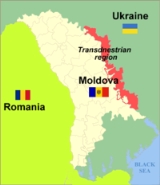
The War of Transnistria was a limited conflict that broke out in November 1990 at Dubăsari
between pro-Transnistria
forces, including the Transnistrian Republican Guard, militia and Cossack units, and supported by elements of the Russia
n 14th army, and pro-Moldova
n forces, including Moldovan troops and police. Fighting intensified on 1 March 1992 and, alternating with ad hoc ceasefires, lasted throughout the spring and early summer of 1992 until a ceasefire was declared on 21 July 1992, which has held.
in 1940, the Bessarabia
n part of Moldova
, i.e. the part situated to the west of the river Dniester
(Nistru), was united with Romania
(1918–1940). The Molotov-Ribbentrop Pact
between the Soviet Union
and the Nazi Germany
, that led to the events of 1940, was later denounced by present-day Moldova, which declared it "null and void" in its Declaration of Independence in 1991. However, after the breakup of the Soviet Union, the territorial changes resulting from it have remained in place.
Before the creation of the Moldavian SSR
, today's Transnistria was part of the Ukrainian SSR
, as an autonomous republic called the Moldovan Autonomous Soviet Socialist Republic, with Tiraspol
as its capital (1924–1940). It represents slightly more than one tenth of Moldova's territory.
was changing due to Mikhail Gorbachev
's policies of perestroika
and glasnost
, which allowed political pluralism at the regional (republican) level. In the Moldavian SSR, as in many other parts of the Soviet Union, national movements became the leading political force. As these movements exhibited increasingly nationalist sentiments and expressed intent to leave the USSR in favor of uniting with Romania, they encountered growing opposition from among the primarily Russian-speaking ethnic minorities living in the republic. This opposition to the new trends and potential future policies was manifested in a more visible way in Transnistria, where, unlike the rest of the MSSR, ethnic Moldovans
(39.9%) were outnumbered by the combined figure of Russians and Ukrainians (53.8%) as per the 1989 Census in Transnistria
, largely due to higher immigration during the Soviet Era.
While some believe that the combination of a distinct history (especially 1918 - 1940) and a fear of discrimination by Moldovans, gave rise to separatist sentiments, others believe that ethnic tensions alone fail to account for the dynamics of the conflict. According to John Mackinlay and Peter Cross, who conducted a study based on casualty reports, significant numbers of both Transnistrians and Moldovans fought together on both sides of the conflict. They suggest that the conflict is more political in nature.
On 31 August 1989, the Supreme Soviet of the Moldavian SSR enacted two laws. One of them made Moldovan
the official language, in lieu of Russian
, the de facto official language of the Soviet Union. It also mentioned a linguistic Moldo-Romanian identity. The second law stipulated the return to the Latin
Romanian alphabet
. Moldovan language is the term used in the former Soviet Union for a virtually identical dialect of the Romanian language
during 1940 - 1989. On 27 April 1990, the Supreme Soviet of the Moldavian SSR adopted the traditional tricolour (blue, yellow and red) flag with the Moldavian coat of arms and changed the national anthem to Deşteaptă-te, române!
, the national anthem of Romania
before 1946 and after 1989. Later that year (1990) the words Soviet and Socialist were dropped and the name of the country was changed to "Republic of Moldova".
These events, as well as the end of the Ceauşescu
regime in neighboring Romania in December 1989 and the partial opening of the border between Romania and Moldova on 6 May 1990, led many in Transnistria
and Moldova to believe that a union between Moldova and Romania was inevitable. This possibility caused fears among the Russian-speaking population that it would be excluded from most aspects of public life. From September 1989, there were strong scenes of protests in the region against the central government's ethnic policies. The protests developed into the formation of secessionist movements in Gagauzia
and Transnistria, which initially sought autonomy within the Moldavian SSR, in order to retain Russian and Gagauz as official languages. As the nationalist-dominated Moldovan Supreme Soviet outlawed these initiatives, Gagauzia and Transnistria declared independence from Moldova and announced their application to be reattached to the Soviet Union as independent federal republics.
did not speak Moldovan (Romanian). The problem of the official language in the MSSR had become a Gordian knot
, being exaggerated and, perhaps, intentionally politicized. Some described the language laws as "discriminatory" and criticized their rapid implementation. Others, on the contrary, complained the laws were not followed.
On 2 September 1990, the Pridnestrovian Moldavian Soviet Socialist Republic
was proclaimed; "Pridnestrovie" being the name for Transnistria in Russian. On 22 December 1990 the president Mikhail Gorbachev
signed a decree that declared void the decisions of the Second Congress of People Deputies of Transnistria from 2 September. For two months, Moldovan authorities refrained from taking action against this proclamation. Transnistria became one of the "unrecognized republics" that appeared throughout the USSR, alongside Abkhazia
, South Ossetia
, Nagorno-Karabakh
. These unrecognized states
maintained close ties with each other.
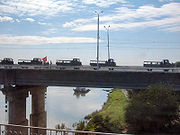
The first clash between the Moldovan government and separatists occurred on 3 November 1990 in Dubăsari. A police detachment was dispatched to clear a roadblock placed by the city residents on the bridge over the river Dniester
that effectively cut the city off from the central government. In the resulting shootout, three residents of Dubăsari were killed, the first casualties of the conflict.
In the aftermath of the failure of the Soviet coup attempt of 1991
, on 27 August 1991, the Moldovan parliament adopted the Declaration of Independence of the Republic of Moldova. The declaration referred to the Molotov-Ribbentrop Pact
as null and void and viewed Moldova's Independence as an act of elimination of the political and legal consequences of the above, declaring that the establishment of the Moldavian SSR
on the territories of Bessarabia
, Northern Bukovina, Hertza region
and the Moldavian ASSR
was made in absence of any real legal basis. The PMR interpreted this as meaning that the 1940-merger of the two sides of the Dniester river was dissolved. Moldova, however, did not agree, as large portions of the territory occupied in 1940 by USSR remain in Ukraine
, and almost immediately took steps to assert its sovereignty over the full territory of the now-former MSSR.
At that time, the Republic of Moldova did not have its own army
and the first attempts to create one took place in early 1992 in response to the escalating conflict. The newly independent Moldovan parliament asked the defunct government of the USSR "to begin negotiations with the Moldovan government in order to put an end to the illegal occupation of the Republic of Moldova and withdraw Soviet troops from Moldovan territory".
When, on 29 August 1991, Transnistria's independence leader Igor Smirnov
and three other deputies arrived in Kiev
, the capital of Ukraine, to meet the Ukrainian leader Leonid Kravchuk
. Smirnov and Andrei Cheban were arrested by Moldova's police and immediately transported to a prison in Moldova. In protest, the women's strike committee headed by Galina Andreeva blocked the Moscow-Chişinău railway line at a waypoint between Bender
and Tiraspol
, until the arrested were freed by the president of Moldova Mircea Snegur
in an uninspired attempt to quell the spirits.
In late 1991, the policemen in Tiraspol
and Rîbniţa
swore allegiance to the PMR.
 By 1992, Moldova had troops under the Ministry of the Interior. On 17 March 1992, they started recruiting troops for the newly created Ministry of Defence. By July 1992, total Moldovan troop strength has been estimated at 25,000-35,000, including called-up policemen, reservists and volunteers, especially but not only from the Moldavian villages near the conflict zone.
In addition to Soviet weaponry inherited upon independence, Moldova also obtained arms from Romania. Romania also sent military advisors and volunteers to aid Moldova during the conflict.
At the same time, the Russian 14th Guards Army
in Moldovan territory numbered about 14,000 professional soldiers. The PMR authorities had 9,000 militiamen trained and armed by officers of the 14th Army. The volunteers came from the Russian Federation: a number of Don, Kuban, Orenburg, Sibir and local Transnistrian Black Sea Cossacks joined in to fight alongside the separatists. Due to the irregular makeup of the forces, troop strength of the PMR is in dispute, but it is generally accepted that it was as large, if not larger, than the Moldovan forces, as shown by the fact that the PMR forces were able to repel Moldova in the fighting near Bendery and partially near Dubǎsari.
Forces of the 14th Army (which had owed allegiance to the USSR, CIS
and the Russian Federation in turn) stationed in Transnistria, had fought with and on behalf of the PMR forces. A significant portion of the personnel of the Russian 14th Army were local conscripts and officers that had been given local residence. PMR units were able to arm themselves with weapons taken from the stores of the former 14th Army. The Russian troops chose not to oppose the PMR units who had come to help themselves from the Army’s stores; on the contrary, in many cases they helped the PMR troops equip themselves by handing over weapons and by opening up the ammunition stores to them.
In December 1991, the Moldovan authorities arrested Lieutenant-General Yakovlev in Ukrainian
territory, accusing him of helping the PMR forces to arm themselves by using the weapons stocks of the 14th Army. At that time, General Yakovlev has been both Commander of the 14th Army and "Head of the National Defence and Security Department" of the PMR. The government of the Russian Federation interceded with the Moldovan government to obtain the release of General Yakovlev in exchange for 26 policemen detained by PMR forces at the start of the fighting in Dubăsari.
On 5 April 1992, Vice-President Rutskoy of Russia, in a speech delivered to 5,000 people in Tiraspol
, encouraged the Transnistrian people to obtain their independence.
received more support than Moldova did during the conflict. The Transnistrian army was supported by Russia
and Ukraine
. Russia had its 14th army stationed in Transnistria, and was ordered to aid the Transnistrians during the conflict. Russia and Ukraine each sent a force of volunteers to fight alongside the Transnistrians. Romania
was the only state to aid Moldova during the conflict. Moldova received weapons, military vehicles and a force of volunteers and military advisers from Romania.
. The start date of the conflict, 2 March 1992, was the same day when Moldova was admitted as a member of the United Nations
, i.e. received full international recognition of its August 27, 1991 declaration of independence.
The first fatalities in the emerging conflict took place on 2 November 1990, two months after the PMR's 2 September 1990 declaration of independence. Moldovan forces entered Dubăsari in order to separate Transnistria into two halves, but were stopped by the city's inhabitants, who had blocked the bridge over the Dniester, at Lunga. In an attempt to break through the roadblock, Moldovan forces then opened fire. In the course of the confrontation, three Dubăsari locals, Oleg Geletiuk, Vladimir Gotkas and Valerie Mitsuls, were killed by the Moldovan forces and sixteen people wounded.
A second Moldovan attempt to cross the Lunga bridge took place on 13 December 1991. As a result of the fighting, 27 PMR troops were taken prisoner and 4 Moldovan troops (Ghenadie Iablocikin, Gheorghe Caşu, Valentin Mereniuk and Mihai Arnăut) were killed, without Moldova being able to cross the bridge. After this second failed attempt, there was a lull in military activity until 2 March 1992, considered the official start date of the War of Transnistria.
, Cocieri
(approx 6,000 inhabitants), Corjova and the city of Dubăsari
(approx 30,000 inhabitants), together forming a contiguous mainly inhabited area 10–12 km along the shore. The only connection to the right bank from the three villages is either a ferry, or two bridges in Dubăsari.
On 1 March 1992 Igor Shipcenko, the PMR militia chief of Dubăsari, was killed by a teenager and Moldovan police were accused of the killing. Although minor, this incident was a sufficient spark for the already very tense situation to blow up and cause the conflict to escalate.
In response, the Cossacks who came from Rostov-on-Don
to support the PMR side stormed the police precinct in Dubăsari during the night. Moldovan president Mircea Snegur
, afraid of starting an armed conflict, ordered the 26 policemen to surrender to the attacking Cossacks and PMR forces. They were later exchanged for Lieutenant-General Yakovlev. Moldovan policemen loyal to Chişinău
from the Dubăsari raion (district), instead of returning to work in the occupied precinct in Dubăsari, now a milice precinct, gathered in Cocieri.
On 2 March 1992, locals from Cocieri, after hearing about the situation in Dubăsari, broke into the small local arms depot to arm themselves against the PMR side.Three locals (Alexandru Luchianov from Cocieri, Alexandru Gazea from Molovata and Mihai Nour from Roghi) were killed, but the military unit from Cocieri was defeated by the Moldovans. The officers and their families were forced to leave the village. More policemen were ferried the following days from the right bank of the Dniester. They organized a defense line around the three villages, while PMR forces retained control of Dubăsari. In the following weeks both PMR and Moldovan forces amassed large numbers in the area and fought a trench war
, with intermittent ceasefires.
In April Russian vice-president Alexander Rutskoy
visited Transnistria and expressed the full support of Transnistrian separatists by Russia.
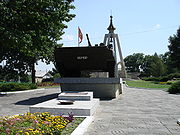
The news of the havoc in Bendery reached Tiraspol, only 11 km away, as Moldovan troops were approaching the crucial bridge over the Dniester. At this point, with the support of ROG's tanks, the Transnistrian Republican Guard and Cossack volunteers rushed to confront the Moldovan forces. The Vice-President Rutskoy of the Russian Federation, in a speech delivered on the main channel of the Russian (former Soviet) television, called for all Russian forces in Tiraspol to storm Bendery. In the course of the following days, parts of the city of Bendery, including the center, were retaken by PMR forces.
 A ceasefire agreement was signed on 21 July. This official document whose broad lines was established by the Russian side, was signed by the presidents of Russia (Boris Yeltsin
) and Moldova (Mircea Snegur
). The agreement provided for peacekeeping forces charged with ensuring observance of the ceasefire and security arrangements, composed of five Russian battalions, three Moldovan battalions and two PMR battalions under the orders of a joint military command structure, the Joint Control Commission
(JCC).
It is estimated that in total nearly one thousand people were killed in the conflict, with the number of wounded approaching 3,000. Unlike many other post-Soviet conflicts, IDP's (internally displaced persons) did not reach large numbers in the war of Transnistria.
Days after the truce had been agreed upon, a military confrontation between a local self-defence unit and the Moldovan army, took place in Gîsca
(Gyska), a village with an ethnic Russian majority near Bendery. At least three villagers were killed. During the combat, civil buildings were damaged or destroyed by artillery fire. Later reports of ceasefire violations have been brought under control with no known loss of human lives.
The Russian 14th Army's role in the area was crucial to the outcome of the war. The Moldovan army's position of inferiority prevented it from gaining control of Transnistria. Russia has since disbanded the 14th army and reduced troop strength in Transnistria to a corps of around 1,300 men who form part of the JCC
.
With the PMR's overwhelming military superiority, Moldova had little chance of achieving victory and the fighting was unpopular with the skeptical Moldovan population.
On many occasions, fire was opened at ambulance cars. The sides accused each other of such actions. Doctors testified in Russian media that heavy fire from the positions of Moldovan forces, June 19–20, prevented them from giving help to the wounded.
Although the Russian army officially took the position of neutrality and non-involvement, many of its officers were sympathetic towards the fledgling Pridnestrovian Moldavian Republic (PMR) and some even defected in order to help the PMR side openly. ROG Parcani
sapper battalion, under the orders of General Butkevich, went over to the PMR side. This battalion later destroyed the bridges at Dubăsari
, Gura Bâcului-Bâcioc and Coşniţa
. Moldovan forces used aircraft in the village of Parcani (Parkany) and shelled the ROG station there which meant engaging not just PMR but also Russian forces.
In 1991, PMR paramilitary forces conducted forays into supply depots of the 14th Army, appropriating an unknown but large amount of equipment. With the commanding officer of the 14th Army, General G. I. Yakovlev, openly supporting the newly created PMR, these forays usually met no resistance from army guards, who never faced punishment. Yakovlev eventually participated in the founding of the PMR, served in the PMR Supreme Soviet and accepted the position as the first chairman of the PMR Department of Defense on 3 December 1991, causing the Commander-in-Chief of the CIS
armed forces, Yevgeny Shaposhnikov
, to promptly relieve him of his rank and service in the Russian military. Yakovlev's successor, General Yuriy Netkachev has assumed a more neutral stance in the conflict. However, his attempts at mediation between Chişinău
and Tiraspol
were largely unsuccessful and the situation escalated to an open military engagement by June 1992. On 23 June, in the wake of a coordinated offensive by Moldovan forces, General Major Alexander Lebed arrived at the 14th Army headquarters with standing orders to inspect the army, prevent the theft of armaments from its depots, stop the ongoing conflict with any means available and ensure the unimpeded evacuation of armaments and Army personnel from Moldovan and through Ukrainian territory. After briefly assessing the situation, he assumed command of the army, relieving Netkachev, and ordered his troops to enter the conflict directly. On 3 July at 03:00, a massive artillery strike from 14th Army formations stationed on left bank of the Dniester obliterated the Moldovan force concentrated in Gerbovetskii forest, near Bendery, effectively ending the military phase of the conflict. A quote attributed to Lebed demonstrates his support of the Transnistrian cause: "I am proud that we helped and armed Transnistrian guards against Moldovan fascists". However, he bore no goodwill towards the Transnistrian leadership and frequently denounced them as "criminals" and "bandits". Another quote attributed to him describes his stance as follows: "I told the hooligans [separatists] in Tiraspol and the fascists in Chişinău -- either you stop killing each other, or else I'll shoot the whole lot of you with my tanks".
and Ukraine
, including Don
and Kuban Cossacks
fought on Transnistria's side. There is no general consensus on the number of volunteers or the military role they played in the conflict. Estimates range from as low as 200 to as high as 3000.
According to Romanian sources, at least one inmate was released from Bendery prison to be enrolled in the Transnistrian Guard.
Dubasari
Dubăsari is a city in Transnistria, with a population of 23,650. The city is under the administration of the breakaway government of the "Transnistrian Moldovan Republic", and functions as the seat of the Dubăsari sub-district, Transnistria, Moldova.-Name:The origin of the town name is the plural...
between pro-Transnistria
Transnistria
Transnistria is a breakaway territory located mostly on a strip of land between the Dniester River and the eastern Moldovan border to Ukraine...
forces, including the Transnistrian Republican Guard, militia and Cossack units, and supported by elements of the Russia
Russia
Russia or , officially known as both Russia and the Russian Federation , is a country in northern Eurasia. It is a federal semi-presidential republic, comprising 83 federal subjects...
n 14th army, and pro-Moldova
Moldova
Moldova , officially the Republic of Moldova is a landlocked state in Eastern Europe, located between Romania to the West and Ukraine to the North, East and South. It declared itself an independent state with the same boundaries as the preceding Moldavian Soviet Socialist Republic in 1991, as part...
n forces, including Moldovan troops and police. Fighting intensified on 1 March 1992 and, alternating with ad hoc ceasefires, lasted throughout the spring and early summer of 1992 until a ceasefire was declared on 21 July 1992, which has held.
Historical background
Before the Soviet occupation of Bessarabia and Northern Bukovina and the creation of the Moldavian SSRMoldavian SSR
The Moldavian Soviet Socialist Republic , commonly abbreviated to Moldavian SSR or MSSR, was one of the 15 republics of the Soviet Union...
in 1940, the Bessarabia
Bessarabia
Bessarabia is a historical term for the geographic region in Eastern Europe bounded by the Dniester River on the east and the Prut River on the west....
n part of Moldova
Moldova
Moldova , officially the Republic of Moldova is a landlocked state in Eastern Europe, located between Romania to the West and Ukraine to the North, East and South. It declared itself an independent state with the same boundaries as the preceding Moldavian Soviet Socialist Republic in 1991, as part...
, i.e. the part situated to the west of the river Dniester
Dniester
The Dniester is a river in Eastern Europe. It runs through Ukraine and Moldova and separates most of Moldova's territory from the breakaway de facto state of Transnistria.-Names:...
(Nistru), was united with Romania
Romania
Romania is a country located at the crossroads of Central and Southeastern Europe, on the Lower Danube, within and outside the Carpathian arch, bordering on the Black Sea...
(1918–1940). The Molotov-Ribbentrop Pact
Molotov-Ribbentrop Pact
The Molotov–Ribbentrop Pact, named after the Soviet foreign minister Vyacheslav Molotov and the German foreign minister Joachim von Ribbentrop, was an agreement officially titled the Treaty of Non-Aggression between Germany and the Soviet Union and signed in Moscow in the late hours of 23 August 1939...
between the Soviet Union
Soviet Union
The Soviet Union , officially the Union of Soviet Socialist Republics , was a constitutionally socialist state that existed in Eurasia between 1922 and 1991....
and the Nazi Germany
Nazi Germany
Nazi Germany , also known as the Third Reich , but officially called German Reich from 1933 to 1943 and Greater German Reich from 26 June 1943 onward, is the name commonly used to refer to the state of Germany from 1933 to 1945, when it was a totalitarian dictatorship ruled by...
, that led to the events of 1940, was later denounced by present-day Moldova, which declared it "null and void" in its Declaration of Independence in 1991. However, after the breakup of the Soviet Union, the territorial changes resulting from it have remained in place.
Before the creation of the Moldavian SSR
Moldavian SSR
The Moldavian Soviet Socialist Republic , commonly abbreviated to Moldavian SSR or MSSR, was one of the 15 republics of the Soviet Union...
, today's Transnistria was part of the Ukrainian SSR
Ukrainian SSR
The Ukrainian Soviet Socialist Republic or in short, the Ukrainian SSR was a sovereign Soviet Socialist state and one of the fifteen constituent republics of the Soviet Union lasting from its inception in 1922 to the breakup in 1991...
, as an autonomous republic called the Moldovan Autonomous Soviet Socialist Republic, with Tiraspol
Tiraspol
Tiraspol is the second largest city in Moldova and is the capital and administrative centre of the unrecognized Pridnestrovian Moldavian Republic . The city is located on the eastern bank of the Dniester River...
as its capital (1924–1940). It represents slightly more than one tenth of Moldova's territory.
Political background
During the last years of the 1980s, the political landscape of the Soviet UnionSoviet Union
The Soviet Union , officially the Union of Soviet Socialist Republics , was a constitutionally socialist state that existed in Eurasia between 1922 and 1991....
was changing due to Mikhail Gorbachev
Mikhail Gorbachev
Mikhail Sergeyevich Gorbachev is a former Soviet statesman, having served as General Secretary of the Communist Party of the Soviet Union from 1985 until 1991, and as the last head of state of the USSR, having served from 1988 until its dissolution in 1991...
's policies of perestroika
Perestroika
Perestroika was a political movement within the Communist Party of the Soviet Union during 1980s, widely associated with the Soviet leader Mikhail Gorbachev...
and glasnost
Glasnost
Glasnost was the policy of maximal publicity, openness, and transparency in the activities of all government institutions in the Soviet Union, together with freedom of information, introduced by Mikhail Gorbachev in the second half of the 1980s...
, which allowed political pluralism at the regional (republican) level. In the Moldavian SSR, as in many other parts of the Soviet Union, national movements became the leading political force. As these movements exhibited increasingly nationalist sentiments and expressed intent to leave the USSR in favor of uniting with Romania, they encountered growing opposition from among the primarily Russian-speaking ethnic minorities living in the republic. This opposition to the new trends and potential future policies was manifested in a more visible way in Transnistria, where, unlike the rest of the MSSR, ethnic Moldovans
Moldovans
Moldovans or Moldavians are the largest population group of Moldova...
(39.9%) were outnumbered by the combined figure of Russians and Ukrainians (53.8%) as per the 1989 Census in Transnistria
1989 Census in Transnistria
The 1989 Census in Transnistria was organized by the authorities of the MSSR in the final days of its existence as a Soviet republic. It took place as part of the Soviet Census of 1989....
, largely due to higher immigration during the Soviet Era.
While some believe that the combination of a distinct history (especially 1918 - 1940) and a fear of discrimination by Moldovans, gave rise to separatist sentiments, others believe that ethnic tensions alone fail to account for the dynamics of the conflict. According to John Mackinlay and Peter Cross, who conducted a study based on casualty reports, significant numbers of both Transnistrians and Moldovans fought together on both sides of the conflict. They suggest that the conflict is more political in nature.
On 31 August 1989, the Supreme Soviet of the Moldavian SSR enacted two laws. One of them made Moldovan
Moldovan language
Moldovan is one of the names of the Romanian language as spoken in the Republic of Moldova, where it is official. The spoken language of Moldova is closer to the dialects of Romanian spoken in northeastern Romania, and the two countries share the same literary standard...
the official language, in lieu of Russian
Russian language
Russian is a Slavic language used primarily in Russia, Belarus, Uzbekistan, Kazakhstan, Tajikistan and Kyrgyzstan. It is an unofficial but widely spoken language in Ukraine, Moldova, Latvia, Turkmenistan and Estonia and, to a lesser extent, the other countries that were once constituent republics...
, the de facto official language of the Soviet Union. It also mentioned a linguistic Moldo-Romanian identity. The second law stipulated the return to the Latin
Latin alphabet
The Latin alphabet, also called the Roman alphabet, is the most recognized alphabet used in the world today. It evolved from a western variety of the Greek alphabet called the Cumaean alphabet, which was adopted and modified by the Etruscans who ruled early Rome...
Romanian alphabet
Romanian alphabet
The Romanian alphabet is a modification of the Latin alphabet and consists of 31 letters:The letters Q , W , and Y were officially introduced in the Romanian alphabet in 1982, although they had been used earlier...
. Moldovan language is the term used in the former Soviet Union for a virtually identical dialect of the Romanian language
Romanian language
Romanian Romanian Romanian (or Daco-Romanian; obsolete spellings Rumanian, Roumanian; self-designation: română, limba română ("the Romanian language") or românește (lit. "in Romanian") is a Romance language spoken by around 24 to 28 million people, primarily in Romania and Moldova...
during 1940 - 1989. On 27 April 1990, the Supreme Soviet of the Moldavian SSR adopted the traditional tricolour (blue, yellow and red) flag with the Moldavian coat of arms and changed the national anthem to Deşteaptă-te, române!
Desteapta-te, române!
"Deșteaptă-te, române" is Romania's national anthem....
, the national anthem of Romania
Romania
Romania is a country located at the crossroads of Central and Southeastern Europe, on the Lower Danube, within and outside the Carpathian arch, bordering on the Black Sea...
before 1946 and after 1989. Later that year (1990) the words Soviet and Socialist were dropped and the name of the country was changed to "Republic of Moldova".
These events, as well as the end of the Ceauşescu
Nicolae Ceausescu
Nicolae Ceaușescu was a Romanian Communist politician. He was General Secretary of the Romanian Communist Party from 1965 to 1989, and as such was the country's second and last Communist leader...
regime in neighboring Romania in December 1989 and the partial opening of the border between Romania and Moldova on 6 May 1990, led many in Transnistria
Transnistria
Transnistria is a breakaway territory located mostly on a strip of land between the Dniester River and the eastern Moldovan border to Ukraine...
and Moldova to believe that a union between Moldova and Romania was inevitable. This possibility caused fears among the Russian-speaking population that it would be excluded from most aspects of public life. From September 1989, there were strong scenes of protests in the region against the central government's ethnic policies. The protests developed into the formation of secessionist movements in Gagauzia
Gagauzia
Gagauzia , formally known as the Autonomous Territorial Unit of Găgăuzia , is an autonomous region of...
and Transnistria, which initially sought autonomy within the Moldavian SSR, in order to retain Russian and Gagauz as official languages. As the nationalist-dominated Moldovan Supreme Soviet outlawed these initiatives, Gagauzia and Transnistria declared independence from Moldova and announced their application to be reattached to the Soviet Union as independent federal republics.
Political conflict
The language laws presented a particularly volatile issue as a great proportion of the non-Moldovan population of the Moldavian SSRMoldavian SSR
The Moldavian Soviet Socialist Republic , commonly abbreviated to Moldavian SSR or MSSR, was one of the 15 republics of the Soviet Union...
did not speak Moldovan (Romanian). The problem of the official language in the MSSR had become a Gordian knot
Gordian Knot
The Gordian Knot is a legend of Phrygian Gordium associated with Alexander the Great. It is often used as a metaphor for an intractable problem solved by a bold stroke :"Turn him to any cause of policy,...
, being exaggerated and, perhaps, intentionally politicized. Some described the language laws as "discriminatory" and criticized their rapid implementation. Others, on the contrary, complained the laws were not followed.
On 2 September 1990, the Pridnestrovian Moldavian Soviet Socialist Republic
Pridnestrovian Moldavian Soviet Socialist Republic
The Pridnestrovian Moldavian Soviet Socialist Republic was created on the eastern periphery of the Moldavian Soviet Socialist Republic in 1990 by pro-Soviet separatists who hoped to remain within the Soviet Union when it became clear that the MSSR would achieve independence from the USSR...
was proclaimed; "Pridnestrovie" being the name for Transnistria in Russian. On 22 December 1990 the president Mikhail Gorbachev
Mikhail Gorbachev
Mikhail Sergeyevich Gorbachev is a former Soviet statesman, having served as General Secretary of the Communist Party of the Soviet Union from 1985 until 1991, and as the last head of state of the USSR, having served from 1988 until its dissolution in 1991...
signed a decree that declared void the decisions of the Second Congress of People Deputies of Transnistria from 2 September. For two months, Moldovan authorities refrained from taking action against this proclamation. Transnistria became one of the "unrecognized republics" that appeared throughout the USSR, alongside Abkhazia
Abkhazia
Abkhazia is a disputed political entity on the eastern coast of the Black Sea and the south-western flank of the Caucasus.Abkhazia considers itself an independent state, called the Republic of Abkhazia or Apsny...
, South Ossetia
South Ossetia
South Ossetia or Tskhinvali Region is a disputed region and partly recognized state in the South Caucasus, located in the territory of the South Ossetian Autonomous Oblast within the former Georgian Soviet Socialist Republic....
, Nagorno-Karabakh
Nagorno-Karabakh
Nagorno-Karabakh is a landlocked region in the South Caucasus, lying between Lower Karabakh and Zangezur and covering the southeastern range of the Lesser Caucasus mountains...
. These unrecognized states
Diplomatic recognition
Diplomatic recognition in international law is a unilateral political act with domestic and international legal consequences, whereby a state acknowledges an act or status of another state or government in control of a state...
maintained close ties with each other.
The first clash between the Moldovan government and separatists occurred on 3 November 1990 in Dubăsari. A police detachment was dispatched to clear a roadblock placed by the city residents on the bridge over the river Dniester
Dniester
The Dniester is a river in Eastern Europe. It runs through Ukraine and Moldova and separates most of Moldova's territory from the breakaway de facto state of Transnistria.-Names:...
that effectively cut the city off from the central government. In the resulting shootout, three residents of Dubăsari were killed, the first casualties of the conflict.
In the aftermath of the failure of the Soviet coup attempt of 1991
Soviet coup attempt of 1991
The 1991 Soviet coup d'état attempt , also known as the August Putsch or August Coup , was an attempt by a group of members of the Soviet Union's government to take control of the country from Soviet president Mikhail Gorbachev...
, on 27 August 1991, the Moldovan parliament adopted the Declaration of Independence of the Republic of Moldova. The declaration referred to the Molotov-Ribbentrop Pact
Molotov-Ribbentrop Pact
The Molotov–Ribbentrop Pact, named after the Soviet foreign minister Vyacheslav Molotov and the German foreign minister Joachim von Ribbentrop, was an agreement officially titled the Treaty of Non-Aggression between Germany and the Soviet Union and signed in Moscow in the late hours of 23 August 1939...
as null and void and viewed Moldova's Independence as an act of elimination of the political and legal consequences of the above, declaring that the establishment of the Moldavian SSR
Moldavian SSR
The Moldavian Soviet Socialist Republic , commonly abbreviated to Moldavian SSR or MSSR, was one of the 15 republics of the Soviet Union...
on the territories of Bessarabia
Bessarabia
Bessarabia is a historical term for the geographic region in Eastern Europe bounded by the Dniester River on the east and the Prut River on the west....
, Northern Bukovina, Hertza region
Hertza region
Hertza region is the territory of an administrative district of Hertsa in the southern part of Chernivtsi Oblast in southwestern Ukraine, on the Romanian border...
and the Moldavian ASSR
Moldavian ASSR
The Moldavian Autonomous Soviet Socialist Republic , shortened to Moldavian ASSR or, less frequently, Moldovan ASSR, was an autonomous republic of the Ukrainian SSR between 12 October 1924 and 2 August 1940, encompassing modern Transnistria The Moldavian Autonomous Soviet Socialist Republic...
was made in absence of any real legal basis. The PMR interpreted this as meaning that the 1940-merger of the two sides of the Dniester river was dissolved. Moldova, however, did not agree, as large portions of the territory occupied in 1940 by USSR remain in Ukraine
Ukraine
Ukraine is a country in Eastern Europe. It has an area of 603,628 km², making it the second largest contiguous country on the European continent, after Russia...
, and almost immediately took steps to assert its sovereignty over the full territory of the now-former MSSR.
At that time, the Republic of Moldova did not have its own army
Military of Moldova
The Moldovan Armed Forces consist of the Ground Forces and Air and Air Defense Forces.- History :Moldova has accepted all relevant arms control obligations of the former Soviet Union...
and the first attempts to create one took place in early 1992 in response to the escalating conflict. The newly independent Moldovan parliament asked the defunct government of the USSR "to begin negotiations with the Moldovan government in order to put an end to the illegal occupation of the Republic of Moldova and withdraw Soviet troops from Moldovan territory".
When, on 29 August 1991, Transnistria's independence leader Igor Smirnov
Igor Smirnov
Igor Nikolaevich Smirnov , is the President of the internationally unrecognized Pridnestrovian Moldovan Republic, also known as Transnistria. He has held this post since 1990.- Childhood :...
and three other deputies arrived in Kiev
Kiev
Kiev or Kyiv is the capital and the largest city of Ukraine, located in the north central part of the country on the Dnieper River. The population as of the 2001 census was 2,611,300. However, higher numbers have been cited in the press....
, the capital of Ukraine, to meet the Ukrainian leader Leonid Kravchuk
Leonid Kravchuk
Leonid Makarovych Kravchuk is a Ukrainian politician, the first President of Ukraine serving from December 5, 1991 until his resignation on July 19, 1994, a former Chairman of the Verkhovna Rada and People's Deputy of Ukraine serving in the Social Democratic Party of Ukraine faction.After a...
. Smirnov and Andrei Cheban were arrested by Moldova's police and immediately transported to a prison in Moldova. In protest, the women's strike committee headed by Galina Andreeva blocked the Moscow-Chişinău railway line at a waypoint between Bender
Bender, Moldova
Bender or Bendery, also known as Tighina is a city within the internationally recognized borders of Moldova under de facto control of the unrecognized Transnistria Republic since 1992...
and Tiraspol
Tiraspol
Tiraspol is the second largest city in Moldova and is the capital and administrative centre of the unrecognized Pridnestrovian Moldavian Republic . The city is located on the eastern bank of the Dniester River...
, until the arrested were freed by the president of Moldova Mircea Snegur
Mircea Snegur
Mircea Ion Snegur was the first President of Moldova 1990-1996. Before that he was Chairman of the Presidium of the Supreme Soviet 1989-1990 and Chairman of the Supreme Soviet from 27 April to 3 September 1990...
in an uninspired attempt to quell the spirits.
In late 1991, the policemen in Tiraspol
Tiraspol
Tiraspol is the second largest city in Moldova and is the capital and administrative centre of the unrecognized Pridnestrovian Moldavian Republic . The city is located on the eastern bank of the Dniester River...
and Rîbniţa
Rîbnita
Rîbnița, also spelled Râbnița is a city in Moldova. The city is under the administration of the breakaway government of the Transnistria. According to the 2004 Census in Transnistria, it has a population of 53,648. Rîbniţa is situated in the northern half of Transnistria, on the left bank of the...
swore allegiance to the PMR.
Military strength
In addition to Soviet weaponry inherited upon independence, Moldova also obtained arms from Romania. Romania also sent military advisors and volunteers to aid Moldova during the conflict.
At the same time, the Russian 14th Guards Army
14th Army involvement in Transnistria
The involvement of the Soviet 14th Guards Army in the War of Transnistria was extensive and contributed to the outcome, which left the Pridnestrovian Moldavian Republic with de facto independence from the Republic of Moldova.-Background:...
in Moldovan territory numbered about 14,000 professional soldiers. The PMR authorities had 9,000 militiamen trained and armed by officers of the 14th Army. The volunteers came from the Russian Federation: a number of Don, Kuban, Orenburg, Sibir and local Transnistrian Black Sea Cossacks joined in to fight alongside the separatists. Due to the irregular makeup of the forces, troop strength of the PMR is in dispute, but it is generally accepted that it was as large, if not larger, than the Moldovan forces, as shown by the fact that the PMR forces were able to repel Moldova in the fighting near Bendery and partially near Dubǎsari.
Forces of the 14th Army (which had owed allegiance to the USSR, CIS
Commonwealth of Independent States
The Commonwealth of Independent States is a regional organization whose participating countries are former Soviet Republics, formed during the breakup of the Soviet Union....
and the Russian Federation in turn) stationed in Transnistria, had fought with and on behalf of the PMR forces. A significant portion of the personnel of the Russian 14th Army were local conscripts and officers that had been given local residence. PMR units were able to arm themselves with weapons taken from the stores of the former 14th Army. The Russian troops chose not to oppose the PMR units who had come to help themselves from the Army’s stores; on the contrary, in many cases they helped the PMR troops equip themselves by handing over weapons and by opening up the ammunition stores to them.
In December 1991, the Moldovan authorities arrested Lieutenant-General Yakovlev in Ukrainian
Ukraine
Ukraine is a country in Eastern Europe. It has an area of 603,628 km², making it the second largest contiguous country on the European continent, after Russia...
territory, accusing him of helping the PMR forces to arm themselves by using the weapons stocks of the 14th Army. At that time, General Yakovlev has been both Commander of the 14th Army and "Head of the National Defence and Security Department" of the PMR. The government of the Russian Federation interceded with the Moldovan government to obtain the release of General Yakovlev in exchange for 26 policemen detained by PMR forces at the start of the fighting in Dubăsari.
On 5 April 1992, Vice-President Rutskoy of Russia, in a speech delivered to 5,000 people in Tiraspol
Tiraspol
Tiraspol is the second largest city in Moldova and is the capital and administrative centre of the unrecognized Pridnestrovian Moldavian Republic . The city is located on the eastern bank of the Dniester River...
, encouraged the Transnistrian people to obtain their independence.
Opposing sides
TransnistriaTransnistria
Transnistria is a breakaway territory located mostly on a strip of land between the Dniester River and the eastern Moldovan border to Ukraine...
received more support than Moldova did during the conflict. The Transnistrian army was supported by Russia
Russia
Russia or , officially known as both Russia and the Russian Federation , is a country in northern Eurasia. It is a federal semi-presidential republic, comprising 83 federal subjects...
and Ukraine
Ukraine
Ukraine is a country in Eastern Europe. It has an area of 603,628 km², making it the second largest contiguous country on the European continent, after Russia...
. Russia had its 14th army stationed in Transnistria, and was ordered to aid the Transnistrians during the conflict. Russia and Ukraine each sent a force of volunteers to fight alongside the Transnistrians. Romania
Romania
Romania is a country located at the crossroads of Central and Southeastern Europe, on the Lower Danube, within and outside the Carpathian arch, bordering on the Black Sea...
was the only state to aid Moldova during the conflict. Moldova received weapons, military vehicles and a force of volunteers and military advisers from Romania.
Military conflict
The armed conflict lasted from 2 March to 21 July 1992, in three areas along the Dniester riverDniester
The Dniester is a river in Eastern Europe. It runs through Ukraine and Moldova and separates most of Moldova's territory from the breakaway de facto state of Transnistria.-Names:...
. The start date of the conflict, 2 March 1992, was the same day when Moldova was admitted as a member of the United Nations
United Nations
The United Nations is an international organization whose stated aims are facilitating cooperation in international law, international security, economic development, social progress, human rights, and achievement of world peace...
, i.e. received full international recognition of its August 27, 1991 declaration of independence.
The first fatalities in the emerging conflict took place on 2 November 1990, two months after the PMR's 2 September 1990 declaration of independence. Moldovan forces entered Dubăsari in order to separate Transnistria into two halves, but were stopped by the city's inhabitants, who had blocked the bridge over the Dniester, at Lunga. In an attempt to break through the roadblock, Moldovan forces then opened fire. In the course of the confrontation, three Dubăsari locals, Oleg Geletiuk, Vladimir Gotkas and Valerie Mitsuls, were killed by the Moldovan forces and sixteen people wounded.
A second Moldovan attempt to cross the Lunga bridge took place on 13 December 1991. As a result of the fighting, 27 PMR troops were taken prisoner and 4 Moldovan troops (Ghenadie Iablocikin, Gheorghe Caşu, Valentin Mereniuk and Mihai Arnăut) were killed, without Moldova being able to cross the bridge. After this second failed attempt, there was a lull in military activity until 2 March 1992, considered the official start date of the War of Transnistria.
Cocieri-Dubăsari area
The first area of military action was on the left shore of the Dniester river, from north to south, the villages of Molovata NouăMolovata Noua
Molovata Nouă is a commune located in Dubăsari district of the Republic of Moldova, on the eastern bank of the River Dniester. It consists of two villages, Molovata Nouă and Roghi....
, Cocieri
Cocieri
Cocieri is a commune in the Republic of Moldova, and the administrative center of Dubăsari District. It is located on the eastern bank of the Dniester River, consisting of two villages, Cocieri and Vasilievca....
(approx 6,000 inhabitants), Corjova and the city of Dubăsari
Dubasari
Dubăsari is a city in Transnistria, with a population of 23,650. The city is under the administration of the breakaway government of the "Transnistrian Moldovan Republic", and functions as the seat of the Dubăsari sub-district, Transnistria, Moldova.-Name:The origin of the town name is the plural...
(approx 30,000 inhabitants), together forming a contiguous mainly inhabited area 10–12 km along the shore. The only connection to the right bank from the three villages is either a ferry, or two bridges in Dubăsari.
On 1 March 1992 Igor Shipcenko, the PMR militia chief of Dubăsari, was killed by a teenager and Moldovan police were accused of the killing. Although minor, this incident was a sufficient spark for the already very tense situation to blow up and cause the conflict to escalate.
In response, the Cossacks who came from Rostov-on-Don
Rostov-on-Don
-History:The mouth of the Don River has been of great commercial and cultural importance since the ancient times. It was the site of the Greek colony Tanais, of the Genoese fort Tana, and of the Turkish fortress Azak...
to support the PMR side stormed the police precinct in Dubăsari during the night. Moldovan president Mircea Snegur
Mircea Snegur
Mircea Ion Snegur was the first President of Moldova 1990-1996. Before that he was Chairman of the Presidium of the Supreme Soviet 1989-1990 and Chairman of the Supreme Soviet from 27 April to 3 September 1990...
, afraid of starting an armed conflict, ordered the 26 policemen to surrender to the attacking Cossacks and PMR forces. They were later exchanged for Lieutenant-General Yakovlev. Moldovan policemen loyal to Chişinău
Chisinau
Chișinău is the capital and largest municipality of Moldova. It is also its main industrial and commercial centre and is located in the middle of the country, on the river Bîc...
from the Dubăsari raion (district), instead of returning to work in the occupied precinct in Dubăsari, now a milice precinct, gathered in Cocieri.
On 2 March 1992, locals from Cocieri, after hearing about the situation in Dubăsari, broke into the small local arms depot to arm themselves against the PMR side.Three locals (Alexandru Luchianov from Cocieri, Alexandru Gazea from Molovata and Mihai Nour from Roghi) were killed, but the military unit from Cocieri was defeated by the Moldovans. The officers and their families were forced to leave the village. More policemen were ferried the following days from the right bank of the Dniester. They organized a defense line around the three villages, while PMR forces retained control of Dubăsari. In the following weeks both PMR and Moldovan forces amassed large numbers in the area and fought a trench war
Trench warfare
Trench warfare is a form of occupied fighting lines, consisting largely of trenches, in which troops are largely immune to the enemy's small arms fire and are substantially sheltered from artillery...
, with intermittent ceasefires.
Coşniţa area
A similar development occurred on March 13 in the villages of Coşniţa, Pîrîta, Pohrebea and Doroţcaia. A second "bridge-head" was formed on the left bank, now south of Dubăsari.In April Russian vice-president Alexander Rutskoy
Alexander Rutskoy
Alexander Vladimirovich Rutskoy is a Russian politician and a former Soviet military officer. Rutskoy served as the only Vice President of Russia from 10 July 1991 to 4 October 1993, and as the governor of Kursk Oblast from 1996 to 2000...
visited Transnistria and expressed the full support of Transnistrian separatists by Russia.
Bendery area
A ceasefire was in negotiation during June in the Bendery area. However, the full scale conflict re-erupted after regular Moldovan forces entered the city of Bendery in an attempt to reestablish the authority of Moldova there. It has been reported that this action was a response to the stand-off at the police station in Bendery on 19 June 1992. On the afternoon of that day, the Moldovan police in Bendery arrested the 14th Army's Major Yermakov on suspicion of planned subversion. After his arrest, PMR guards opened fire on the police station. The Moldovan government ordered its troops to enter the city the following morning. Urban warfare ensued between the two sides in the densely populated city, causing civilian casualties. The Moldovan radio said three Russian tanks from the 14th Army, some bearing Russian flags, were destroyed when closing in on central Bendery. Army spokesmen said the tanks had been seized from depots by separatists.The news of the havoc in Bendery reached Tiraspol, only 11 km away, as Moldovan troops were approaching the crucial bridge over the Dniester. At this point, with the support of ROG's tanks, the Transnistrian Republican Guard and Cossack volunteers rushed to confront the Moldovan forces. The Vice-President Rutskoy of the Russian Federation, in a speech delivered on the main channel of the Russian (former Soviet) television, called for all Russian forces in Tiraspol to storm Bendery. In the course of the following days, parts of the city of Bendery, including the center, were retaken by PMR forces.
Ceasefire and Joint Control Commission
Boris Yeltsin
Boris Nikolayevich Yeltsin was the first President of the Russian Federation, serving from 1991 to 1999.Originally a supporter of Mikhail Gorbachev, Yeltsin emerged under the perestroika reforms as one of Gorbachev's most powerful political opponents. On 29 May 1990 he was elected the chairman of...
) and Moldova (Mircea Snegur
Mircea Snegur
Mircea Ion Snegur was the first President of Moldova 1990-1996. Before that he was Chairman of the Presidium of the Supreme Soviet 1989-1990 and Chairman of the Supreme Soviet from 27 April to 3 September 1990...
). The agreement provided for peacekeeping forces charged with ensuring observance of the ceasefire and security arrangements, composed of five Russian battalions, three Moldovan battalions and two PMR battalions under the orders of a joint military command structure, the Joint Control Commission
Joint Control Commission
The Joint Control Commission , is a tri-lateral peacekeeping force and joint military command structure which operates in a buffer zone on the border between the Republic of Moldova and the disputed territory controlled by the Pridnestrovian Moldavian Republic .-History:Following the War of...
(JCC).
It is estimated that in total nearly one thousand people were killed in the conflict, with the number of wounded approaching 3,000. Unlike many other post-Soviet conflicts, IDP's (internally displaced persons) did not reach large numbers in the war of Transnistria.
Days after the truce had been agreed upon, a military confrontation between a local self-defence unit and the Moldovan army, took place in Gîsca
Gîsca
Gîsca is a commune near in Căuşeni district, Moldova, composed of a single village with the same name, population 4,841 at the 2004 Census...
(Gyska), a village with an ethnic Russian majority near Bendery. At least three villagers were killed. During the combat, civil buildings were damaged or destroyed by artillery fire. Later reports of ceasefire violations have been brought under control with no known loss of human lives.
The Russian 14th Army's role in the area was crucial to the outcome of the war. The Moldovan army's position of inferiority prevented it from gaining control of Transnistria. Russia has since disbanded the 14th army and reduced troop strength in Transnistria to a corps of around 1,300 men who form part of the JCC
Joint Control Commission
The Joint Control Commission , is a tri-lateral peacekeeping force and joint military command structure which operates in a buffer zone on the border between the Republic of Moldova and the disputed territory controlled by the Pridnestrovian Moldavian Republic .-History:Following the War of...
.
With the PMR's overwhelming military superiority, Moldova had little chance of achieving victory and the fighting was unpopular with the skeptical Moldovan population.
Human rights abuses by both sides
According to eye-witnesses in Russian media, the Moldovan troops were firing at houses, courtyards and cars from heavy machine-guns mounted on armored vehicles. It was reported that in the daytime, June 20, Moldovan troopers were shooting at civilians who were hiding in their houses, trying to flee the city or help wounded (PMR) national guards. Eye-witnesses testified that, on that day, a group of unarmed men, having gathered in a downtown square on the call of the pro-PMR Executive Committee, were fired at from machine-guns. Eye-witnesses in Moldovan media testified and produced similar accusation directed at the other side.On many occasions, fire was opened at ambulance cars. The sides accused each other of such actions. Doctors testified in Russian media that heavy fire from the positions of Moldovan forces, June 19–20, prevented them from giving help to the wounded.
Involvement of the Russian Army
main article 14th Army involvement in Transnistria14th Army involvement in Transnistria
The involvement of the Soviet 14th Guards Army in the War of Transnistria was extensive and contributed to the outcome, which left the Pridnestrovian Moldavian Republic with de facto independence from the Republic of Moldova.-Background:...
Although the Russian army officially took the position of neutrality and non-involvement, many of its officers were sympathetic towards the fledgling Pridnestrovian Moldavian Republic (PMR) and some even defected in order to help the PMR side openly. ROG Parcani
Parcani
Parcani is a large commune and village in the Slobozia sub-district of Transnitria, a de facto independent entity within the internationally recognized borders of Moldova. The village has a population of around 10,500, of whom 95% are ethnic Bulgarians . The first Bulgarian colonists arrived in...
sapper battalion, under the orders of General Butkevich, went over to the PMR side. This battalion later destroyed the bridges at Dubăsari
Dubasari
Dubăsari is a city in Transnistria, with a population of 23,650. The city is under the administration of the breakaway government of the "Transnistrian Moldovan Republic", and functions as the seat of the Dubăsari sub-district, Transnistria, Moldova.-Name:The origin of the town name is the plural...
, Gura Bâcului-Bâcioc and Coşniţa
Cosnita
Coşniţa is a commune located in Dubăsari district of the Republic of Moldova, on the eastern bank of the River Dniester. It consists of two villages, Coşniţa and Pohrebea ....
. Moldovan forces used aircraft in the village of Parcani (Parkany) and shelled the ROG station there which meant engaging not just PMR but also Russian forces.
In 1991, PMR paramilitary forces conducted forays into supply depots of the 14th Army, appropriating an unknown but large amount of equipment. With the commanding officer of the 14th Army, General G. I. Yakovlev, openly supporting the newly created PMR, these forays usually met no resistance from army guards, who never faced punishment. Yakovlev eventually participated in the founding of the PMR, served in the PMR Supreme Soviet and accepted the position as the first chairman of the PMR Department of Defense on 3 December 1991, causing the Commander-in-Chief of the CIS
Commonwealth of Independent States
The Commonwealth of Independent States is a regional organization whose participating countries are former Soviet Republics, formed during the breakup of the Soviet Union....
armed forces, Yevgeny Shaposhnikov
Yevgeny Shaposhnikov
Yevgeny Ivanovich Shaposhnikov is a Russian military leader and business figure, Marshal of Aviation .Shaposhnikov was born on a farm near Aksay in Rostov Oblast Russia...
, to promptly relieve him of his rank and service in the Russian military. Yakovlev's successor, General Yuriy Netkachev has assumed a more neutral stance in the conflict. However, his attempts at mediation between Chişinău
Chisinau
Chișinău is the capital and largest municipality of Moldova. It is also its main industrial and commercial centre and is located in the middle of the country, on the river Bîc...
and Tiraspol
Tiraspol
Tiraspol is the second largest city in Moldova and is the capital and administrative centre of the unrecognized Pridnestrovian Moldavian Republic . The city is located on the eastern bank of the Dniester River...
were largely unsuccessful and the situation escalated to an open military engagement by June 1992. On 23 June, in the wake of a coordinated offensive by Moldovan forces, General Major Alexander Lebed arrived at the 14th Army headquarters with standing orders to inspect the army, prevent the theft of armaments from its depots, stop the ongoing conflict with any means available and ensure the unimpeded evacuation of armaments and Army personnel from Moldovan and through Ukrainian territory. After briefly assessing the situation, he assumed command of the army, relieving Netkachev, and ordered his troops to enter the conflict directly. On 3 July at 03:00, a massive artillery strike from 14th Army formations stationed on left bank of the Dniester obliterated the Moldovan force concentrated in Gerbovetskii forest, near Bendery, effectively ending the military phase of the conflict. A quote attributed to Lebed demonstrates his support of the Transnistrian cause: "I am proud that we helped and armed Transnistrian guards against Moldovan fascists". However, he bore no goodwill towards the Transnistrian leadership and frequently denounced them as "criminals" and "bandits". Another quote attributed to him describes his stance as follows: "I told the hooligans [separatists] in Tiraspol and the fascists in Chişinău -- either you stop killing each other, or else I'll shoot the whole lot of you with my tanks".
Involvement of Russian and Ukrainian volunteers
Volunteers from RussiaRussia
Russia or , officially known as both Russia and the Russian Federation , is a country in northern Eurasia. It is a federal semi-presidential republic, comprising 83 federal subjects...
and Ukraine
Ukraine
Ukraine is a country in Eastern Europe. It has an area of 603,628 km², making it the second largest contiguous country on the European continent, after Russia...
, including Don
Don Cossacks
Don Cossacks were Cossacks who settled along the middle and lower Don.- Etymology and origins :The Don Cossack Host was a frontier military organization from the end of the 16th until the early 20th century....
and Kuban Cossacks
Kuban Cossacks
Kuban Cossacks or Kubanians are Cossacks who live in the Kuban region of Russia. Most of the Kuban Cossacks are of descendants of two major groups who were re-settled in the Western Northern Caucasus during the Caucasus War in the late 18th century...
fought on Transnistria's side. There is no general consensus on the number of volunteers or the military role they played in the conflict. Estimates range from as low as 200 to as high as 3000.
According to Romanian sources, at least one inmate was released from Bendery prison to be enrolled in the Transnistrian Guard.
Involvement of Romania
Shortly before the escalation of the conflict in late June 1992, Romania provided limited military support to Moldova by supplying weaponry, ammunition and armed vehicles, and also by sending military advisers and training Moldovan military and police forces. Volunteers from Romania fought on Moldova's side.See also
- 14th Army involvement in Transnistria14th Army involvement in TransnistriaThe involvement of the Soviet 14th Guards Army in the War of Transnistria was extensive and contributed to the outcome, which left the Pridnestrovian Moldavian Republic with de facto independence from the Republic of Moldova.-Background:...
- History of TransnistriaHistory of TransnistriaThis is the history of Transnistria.See also the history of Europe.-Antiquity:In ancient times, the area was inhabited by Thracian and Scythian tribes...
- Kozak memorandumKozak memorandumThe Kozak Memorandum, officially Russian Draft Memorandum on the Basic Principles of the State Structure of a United State in Moldova, was a 2003 proposal aimed at a final settlement of relations between Moldova and Transnistria...
- Human rights abuse
Further reading
- Vlad Grecu, "O viziune din focarul conflictului de la Dubăsari”, Editura Prut International, Chişinău, 2005