


Soviet ruble

Encyclopedia
The Soviet ruble or rouble ' onMouseout='HidePop("39943")' href="/topics/Languages_of_the_Soviet_Union">languages of the USSR
) was the currency
of the Soviet Union
. One ruble is divided into 100 kopeks, (also transliterated
as kopecks or copecks - kopeyka, kopeyki).
In addition to standard banknotes, the Soviet ruble was available in the form of foreign rubles ; also, several forms of virtual rubles were used for inter-enterprise accounting and international settlement in the Comecon
zone. Many of the ruble designs were created by Ivan Dubasov
.
' , i.e., to chop. Historically, "ruble" was a piece of a certain weight chopped off a silver
ingot
(grivna), hence the name.
, sometimes quite different from its Russian designation. All banknotes had the currency name and their nominal printed in the languages of every Soviet Republic
. This naming is preserved in modern Russia; for example: Tatar
for ruble and kopek are sum and tien. The current names of several currencies of Central Asia
are simply the local names of the ruble.
The name of the currency in the official languages of the 15 republics, in the order they appeared in the banknotes:
Note that the script for Uzbek
, Azerbaijani
, Moldavian, and Turkmen
have switched from Cyrillic
to Latin
some time around the breakup of the Soviet Union.
and other governing bodies.
Denominations are as follows: 1, 2, 3, 5, 10, 15, 25, 50, 60, 100, 250, 500, 1,000, 5,000, 10,000, 25,000, 50,000, 100,000. Short term treasury certificate were also issued to supplement banknote issue in 1 million, 5 million, 10 million rubles. These issue was printed in various fashions, as inflation crept up the security features were few and some were printed on one side, as was the case for the German inflationary notes.
was issued.
, at a value of 10 rubles. Coins began to be issued again in 1924, whilst paper money was issued in rubles for values below 10 rubles and in chervonets for higher denominations.
, the Soviet government implemented a confiscatory redenomination of the currency to reduce the amount of money in circulation. This only affected the paper money. Old rubles were revalued at one tenth of their face value.
depicting scenes from Soviet life and Soviet industrial achievements. The Soviet ruble of 1961 was formally equal to 0.987412 gram of gold
, but the exchange for gold was never available to the general public. This ruble maintained parity with the Pound Sterling
until the breakup of the Soviet Union in 1991 when the ruble
became the new currency of the Russian Federation
.
was a government-controlled planned economy
, where the government controlled prices and the exchange of currency. Thus, its role was unlike that of a currency in a market economy, because distribution of goods was controlled by other mechanisms than currency, such as centrally planned quotas, queuing or blat. Only a limited set of products could be freely bought, thus the ruble had a role similar to trading stamp
s or food stamps. The currency was not internationally exchangeable and its export was illegal. The sudden transformation from a Soviet "non-currency" into a market currency contributed to the economic hardship following the collapse of the Soviet planned economy.
In the very beginning of the post-Soviet economic transition, quite a lot of people and institutions (including the International Monetary Fund
) believed in the possibility to maintain the common currency
working for all or at least for some of the former Soviet Union’s countries.
Political considerations were one reason for this advocacy. Certain politicians were hoping to rebuild the former Russian empire in some way, or at the very least, maintain "special relations" among former Soviet republics, or the "near abroad
" as they came to be known in Russia. Another reason were the economical considerations for maintaining the ruble zone. The wish to preserve the strong trade relations between former Soviet republics was considered the most important goal.
The break-up of the Soviet Union was not accompanied by any formal changes in monetary arrangements. The Central Bank of Russia was authorized to take over the State Bank of the USSR (Gosbank
) on 1 January 1992. It continued to ship USSR ruble notes and coins to the central banks of the fourteen newly independent countries, which had formerly been the main branches of Gosbank in the republics. The political situation, however, was not favorable for maintaining a common currency. A strong political consensus in respect to monetary and fiscal targets, the common institution in charge of implementing these targets, and some minimum of common legislation (concerning the banking and foreign exchange regulations) are absolutely necessary conditions to have a common currency. Amidst the economical chaos, mistrust and adjustment to democracy and market economy these conditions were far from reality.
During the first half of 1992, a monetary union with 15 independent states all using the ruble existed. Since it was clear that the situation would not last, each of them was using its position as "free-riders" to issue huge amounts of money in the form of credit (since Russia held the monopoly on printing banknotes and coins). Ukraine was very active in this. As a result, some countries were issuing coupons in order to "protect" their markets from buyers from other states. The Russian central bank responded in July 1992 by setting up restrictions to the flow of credit between Russia and other states. The final collapse of the ruble zone began with the exchange of banknotes by the Central bank of Russia on Russian territory at the end of July 1993. As a result, other countries still in the ruble zone (Kazakhstan
, Uzbekistan
, Turkmenistan
, Moldova
, Armenia
and Georgia
) were "pushed out". By November 1993 all newly independent states had introduced their own currencies, with the exception of war-torn Tajikistan
(May 1995) and unrecognized Transnistria
(1994).
Details on the introduction of new currencies in the newly independent states are discussed below.
) on 10 May 1993. The first issue consisted of banknotes of 0.01; 0.10; 0.50; 1; 5 and 20 Som. After a period of dual circulation the som became the only legal tender, on 15 May. New series of banknotes were introduced in 1994 and 1997. Starting in January 2008, low denomination banknotes were phased out and replaced by coins.
to that of a central bank, with the exclusive right to issue the national currency.
In the first four months of 1992 Latvia was adversely affected by the inflation of the ruble. In addition, the outgoing cash payments (with other ex-USSR states) surpassed the incoming money amounts by 122 million rubles (5.9%) in February and in April by 686 million rubles (29.2%), thus causing a very serious shortage of cash. Since money was issued by Russia, the Bank of Latvia was unable to improve the cash circulation in the country. The situation completely depended on the possibility of receiving or buying cash and credit resources from the Russian central bank. It was evident that a crisis could develop, in which the Bank of Latvia would not be able to execute even the most necessary payments.
Thus the Monetary Reform Committee of the Republic of Latvia was established, and on 4 May 1992 it passed the resolution on introducing a new temporary currency: the Latvian ruble. Notes were issued on 7 May in the following denominations: 1, 2, 5, 10, 20, 50, 200 and 500 rubles. They were exchanged at par with Soviet rubles. Until 20 July both currencies circulated together, at that day the Soviet ruble ceased to be legal tender and Latvia left the ruble zone entirely.
The Latvian ruble was however intended as a temporary currency. It was gradually replaced by the new national currency (the lats). This process started on 5 March 1993 with the introduction of the 5 lats-banknote and would be completed on 20 July 1998, with the 500 lats-banknote.
The successful reform ending in the introduction of the lats facilitated Latvia’s transition to a stable market economy
.
Uzbekistan introduced a temporary national currency (the som) on 15 November 1993. It replaced the ruble at a rate of 1:1. Between July and November 1993 old and new ruble notes circulated together. On 1 July 1994 the temporary som was replaced by a new, permanent, version of the som. Old notes were exchanged at a rate of 1.000 to 1. At its introduction 7 som were equal to 1 United States dollar.
Languages of the Soviet Union
Languages of the Soviet Union were hundreds of different languages and dialects from several different language groups.In 1918, it was decreed that all nationalities in the Soviet Union had the right to education in their own language. The new orthography used the Cyrillic, Latin, or Arabic...
) was the currency
Currency
In economics, currency refers to a generally accepted medium of exchange. These are usually the coins and banknotes of a particular government, which comprise the physical aspects of a nation's money supply...
of the Soviet Union
Soviet Union
The Soviet Union , officially the Union of Soviet Socialist Republics , was a constitutionally socialist state that existed in Eurasia between 1922 and 1991....
. One ruble is divided into 100 kopeks, (also transliterated
Transliteration
Transliteration is a subset of the science of hermeneutics. It is a form of translation, and is the practice of converting a text from one script into another...
as kopecks or copecks - kopeyka, kopeyki).
In addition to standard banknotes, the Soviet ruble was available in the form of foreign rubles ; also, several forms of virtual rubles were used for inter-enterprise accounting and international settlement in the Comecon
Comecon
The Council for Mutual Economic Assistance , 1949–1991, was an economic organisation under hegemony of Soviet Union comprising the countries of the Eastern Bloc along with a number of communist states elsewhere in the world...
zone. Many of the ruble designs were created by Ivan Dubasov
Ivan Dubasov
Ivan Ivanovich Dubasov was a Russian artist active in the Soviet Union. He was the head artist of the Goznak from 1932 to 1971 and was made an Honored Artist of the RSFSR in 1959. He developed sketches and designs for multiple Soviet banknotes, stamps, orders, medals, awards and decorations over...
.
Etymology
The word "ruble" is derived from the Slavic verb рубить, rubitSilver
Silver is a metallic chemical element with the chemical symbol Ag and atomic number 47. A soft, white, lustrous transition metal, it has the highest electrical conductivity of any element and the highest thermal conductivity of any metal...
ingot
Ingot
An ingot is a material, usually metal, that is cast into a shape suitable for further processing. Non-metallic and semiconductor materials prepared in bulk form may also be referred to as ingots, particularly when cast by mold based methods.-Uses:...
(grivna), hence the name.
Ruble in the Soviet Union
The Soviet currency had its own name in all Soviet languagesLanguages of the Soviet Union
Languages of the Soviet Union were hundreds of different languages and dialects from several different language groups.In 1918, it was decreed that all nationalities in the Soviet Union had the right to education in their own language. The new orthography used the Cyrillic, Latin, or Arabic...
, sometimes quite different from its Russian designation. All banknotes had the currency name and their nominal printed in the languages of every Soviet Republic
Republics of the Soviet Union
The Republics of the Soviet Union or the Union Republics of the Soviet Union were ethnically-based administrative units that were subordinated directly to the Government of the Soviet Union...
. This naming is preserved in modern Russia; for example: Tatar
Tatar language
The Tatar language , or more specifically Kazan Tatar, is a Turkic language spoken by the Tatars of historical Kazan Khanate, including modern Tatarstan and Bashkiria...
for ruble and kopek are sum and tien. The current names of several currencies of Central Asia
Central Asia
Central Asia is a core region of the Asian continent from the Caspian Sea in the west, China in the east, Afghanistan in the south, and Russia in the north...
are simply the local names of the ruble.
The name of the currency in the official languages of the 15 republics, in the order they appeared in the banknotes:
| Language | | In local language | | Transliteration | ||
|---|---|---|---|---|
| ruble | kopek | ruble | kopek | |
| Russian Russian language Russian is a Slavic language used primarily in Russia, Belarus, Uzbekistan, Kazakhstan, Tajikistan and Kyrgyzstan. It is an unofficial but widely spoken language in Ukraine, Moldova, Latvia, Turkmenistan and Estonia and, to a lesser extent, the other countries that were once constituent republics... |
рубль | копейка | rubl’ | kopeika |
| Ukrainian Ukrainian language Ukrainian is a language of the East Slavic subgroup of the Slavic languages. It is the official state language of Ukraine. Written Ukrainian uses a variant of the Cyrillic alphabet.... |
карбованець | копійка | karbovanets’ | kopiyka |
| Belarusian Belarusian language The Belarusian language , sometimes referred to as White Russian or White Ruthenian, is the language of the Belarusian people... |
рубель | капейка | rub’el’ | kapeika |
| Uzbek Uzbek language Uzbek is a Turkic language and the official language of Uzbekistan. It has about 25.5 million native speakers, and it is spoken by the Uzbeks in Uzbekistan and elsewhere in Central Asia... |
сўм | тийин | so'm' | tiyin |
| Kazakh Kazakh language Kazakh is a Turkic language which belongs to the Kipchak branch of the Turkic languages, closely related to Nogai and Karakalpak.... |
сом | тиын | som | tiyn |
| Georgian Georgian language Georgian is the native language of the Georgians and the official language of Georgia, a country in the Caucasus.Georgian is the primary language of about 4 million people in Georgia itself, and of another 500,000 abroad... |
მანეთი | კაპიკი | maneti | kapiki |
| Azerbaijani Azerbaijani language Azerbaijani or Azeri or Torki is a language belonging to the Turkic language family, spoken in southwestern Asia by the Azerbaijani people, primarily in Azerbaijan and northwestern Iran... |
манат | гəпик | manat | qəpik |
| Lithuanian Lithuanian language Lithuanian is the official state language of Lithuania and is recognized as one of the official languages of the European Union. There are about 2.96 million native Lithuanian speakers in Lithuania and about 170,000 abroad. Lithuanian is a Baltic language, closely related to Latvian, although they... |
rublis | kapeika | — | — |
| Moldavian | рублэ | копейкэ | rublă | copeică |
| Latvian Latvian language Latvian is the official state language of Latvia. It is also sometimes referred to as Lettish. There are about 1.4 million native Latvian speakers in Latvia and about 150,000 abroad. The Latvian language has a relatively large number of non-native speakers, atypical for a small language... |
rublis | kapeika | — | — |
| Kyrgyz Kyrgyz language Kyrgyz or Kirgiz, also Kirghiz, Kyrghiz, Qyrghiz is a Turkic language and, together with Russian, an official language of Kyrgyzstan... |
сом | тыйн | som | tyin |
| Tajik Tajik language Tajik, Tajik Persian, or Tajiki, is a variety of modern Persian spoken in Central Asia. Historically Tajiks called their language zabani farsī , meaning Persian language in English; the term zabani tajikī, or Tajik language, was introduced in the 20th century by the Soviets... |
сўм | тин | sum | tin |
| Armenian Armenian language The Armenian language is an Indo-European language spoken by the Armenian people. It is the official language of the Republic of Armenia as well as in the region of Nagorno-Karabakh. The language is also widely spoken by Armenian communities in the Armenian diaspora... |
ռուբլի | կոպեկ | roubli | kopek |
| Turkmen Turkmen language Turkmen is the national language of Turkmenistan... |
манат | manat | ||
| Estonian Estonian language Estonian is the official language of Estonia, spoken by about 1.1 million people in Estonia and tens of thousands in various émigré communities... |
rubla | kopikas | — | — |
Note that the script for Uzbek
Uzbek language
Uzbek is a Turkic language and the official language of Uzbekistan. It has about 25.5 million native speakers, and it is spoken by the Uzbeks in Uzbekistan and elsewhere in Central Asia...
, Azerbaijani
Azerbaijani language
Azerbaijani or Azeri or Torki is a language belonging to the Turkic language family, spoken in southwestern Asia by the Azerbaijani people, primarily in Azerbaijan and northwestern Iran...
, Moldavian, and Turkmen
Turkmen language
Turkmen is the national language of Turkmenistan...
have switched from Cyrillic
Cyrillic alphabet
The Cyrillic script or azbuka is an alphabetic writing system developed in the First Bulgarian Empire during the 10th century AD at the Preslav Literary School...
to Latin
Latin alphabet
The Latin alphabet, also called the Roman alphabet, is the most recognized alphabet used in the world today. It evolved from a western variety of the Greek alphabet called the Cumaean alphabet, which was adopted and modified by the Etruscans who ruled early Rome...
some time around the breakup of the Soviet Union.
First Soviet ruble
The first ruble issued for the Socialist government was a preliminary issue still based on the previous issue of the ruble prior to the Russian Revolution of 1917. They are all in banknote form and started their issue in 1919. At this time other issues were made by the white Russian governmentWhite movement
The White movement and its military arm the White Army - known as the White Guard or the Whites - was a loose confederation of Anti-Communist forces.The movement comprised one of the politico-military Russian forces who fought...
and other governing bodies.
Denominations are as follows: 1, 2, 3, 5, 10, 15, 25, 50, 60, 100, 250, 500, 1,000, 5,000, 10,000, 25,000, 50,000, 100,000. Short term treasury certificate were also issued to supplement banknote issue in 1 million, 5 million, 10 million rubles. These issue was printed in various fashions, as inflation crept up the security features were few and some were printed on one side, as was the case for the German inflationary notes.
Second Soviet ruble, January 1, 1922 - December 31, 1922
In 1922, the first of several redenominations took place, at a rate of 1 "new" ruble for 10,000 "old" rubles. The chervonets (червонец) was also introduced in 1922.Third Soviet ruble, January 1, 1923 - March 6, 1924
A second redenomination took place in 1923, at a rate of 100 to 1. Again, only paper money was issued. During the lifetime of this currency, the first money of the Soviet UnionSoviet Union
The Soviet Union , officially the Union of Soviet Socialist Republics , was a constitutionally socialist state that existed in Eurasia between 1922 and 1991....
was issued.
Fourth (Gold) Soviet ruble, March 7, 1924 - 1947
A third redenomination in 1924 introduced the "gold" ruble at a value of 50,000 rubles of the previous issue. This reform also saw the ruble linked to the chervonetsChervonets
.Chervonets is a former currency of the Russian Empire and Soviet Union. Originally a term for coins of purer alloy the name was later applied to various sums in Russian rubles.Before the reign of Peter I, the name chervonets was applied to various foreign...
, at a value of 10 rubles. Coins began to be issued again in 1924, whilst paper money was issued in rubles for values below 10 rubles and in chervonets for higher denominations.
Fifth Soviet ruble, 1947 - 1961
Following World War IIWorld War II
World War II, or the Second World War , was a global conflict lasting from 1939 to 1945, involving most of the world's nations—including all of the great powers—eventually forming two opposing military alliances: the Allies and the Axis...
, the Soviet government implemented a confiscatory redenomination of the currency to reduce the amount of money in circulation. This only affected the paper money. Old rubles were revalued at one tenth of their face value.
Sixth Soviet ruble, 1961 - 1991
The 1961 redenomination was a repeat of the 1947 reform, with the same terms applying. Newly designed notes were issued with artwork by the artist Victor TsigalVictor Tsigal
Victor Efimovich Tsigal was born into a Jewish family in Odessa in 1916.He became a noted painter and produced a large body of work in the socialist realist style.Tsigal was commissioned to design the new Soviet Rouble bank note which was issued in 1961...
depicting scenes from Soviet life and Soviet industrial achievements. The Soviet ruble of 1961 was formally equal to 0.987412 gram of gold
Gold
Gold is a chemical element with the symbol Au and an atomic number of 79. Gold is a dense, soft, shiny, malleable and ductile metal. Pure gold has a bright yellow color and luster traditionally considered attractive, which it maintains without oxidizing in air or water. Chemically, gold is a...
, but the exchange for gold was never available to the general public. This ruble maintained parity with the Pound Sterling
Pound sterling
The pound sterling , commonly called the pound, is the official currency of the United Kingdom, its Crown Dependencies and the British Overseas Territories of South Georgia and the South Sandwich Islands, British Antarctic Territory and Tristan da Cunha. It is subdivided into 100 pence...
until the breakup of the Soviet Union in 1991 when the ruble
Russian ruble
The ruble or rouble is the currency of the Russian Federation and the two partially recognized republics of Abkhazia and South Ossetia. Formerly, the ruble was also the currency of the Russian Empire and the Soviet Union prior to their breakups. Belarus and Transnistria also use currencies with...
became the new currency of the Russian Federation
Russia
Russia or , officially known as both Russia and the Russian Federation , is a country in northern Eurasia. It is a federal semi-presidential republic, comprising 83 federal subjects...
.
| 1961 Series | ||
|---|---|---|
| Image | Value | |
| Obverse | Reverse | |
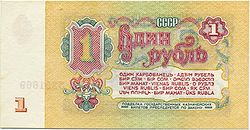 |
1 Ruble | |
| 3 Ruble | ||
| 5 Ruble | ||
| 10 Ruble | ||
| 25 Ruble | ||
| 50 Ruble | ||
| 100 Ruble | ||
| 1991 Series | ||
|---|---|---|
| Image | Value | |
| Obverse | Reverse | |
| 1 Ruble | ||
| 3 Ruble | ||
| 5 Ruble | ||
| 10 Ruble | ||
| 50 Ruble | ||
| 100 Ruble | ||
| 200 Ruble | ||
| 500 Ruble | ||
| 1000 Ruble | ||
Economic role
The economy of the Soviet UnionEconomy of the Soviet Union
The economy of the Union of Soviet Socialist Republics was based on a system of state ownership of the means of production, collective farming, industrial manufacturing and centralized administrative planning...
was a government-controlled planned economy
Planned economy
A planned economy is an economic system in which decisions regarding production and investment are embodied in a plan formulated by a central authority, usually by a government agency...
, where the government controlled prices and the exchange of currency. Thus, its role was unlike that of a currency in a market economy, because distribution of goods was controlled by other mechanisms than currency, such as centrally planned quotas, queuing or blat. Only a limited set of products could be freely bought, thus the ruble had a role similar to trading stamp
Trading stamp
Trading stamps are small paper coupons given to customers by merchants in loyalty marketing programs that predate the modern loyalty card. These stamps had no value individually, but when a customer accumulated a number of them, they could be exchanged with the trading stamp company for premiums,...
s or food stamps. The currency was not internationally exchangeable and its export was illegal. The sudden transformation from a Soviet "non-currency" into a market currency contributed to the economic hardship following the collapse of the Soviet planned economy.
Replacement currencies in the former Soviet republics
Shortly after the fall of the Soviet Union in 1991, local currencies were introduced in the newly independent states. Most of the new economies were weak and hence most of the currencies have undergone significant reforms since launch that included change of names and denominations.In the very beginning of the post-Soviet economic transition, quite a lot of people and institutions (including the International Monetary Fund
International Monetary Fund
The International Monetary Fund is an organization of 187 countries, working to foster global monetary cooperation, secure financial stability, facilitate international trade, promote high employment and sustainable economic growth, and reduce poverty around the world...
) believed in the possibility to maintain the common currency
Currency
In economics, currency refers to a generally accepted medium of exchange. These are usually the coins and banknotes of a particular government, which comprise the physical aspects of a nation's money supply...
working for all or at least for some of the former Soviet Union’s countries.
Political considerations were one reason for this advocacy. Certain politicians were hoping to rebuild the former Russian empire in some way, or at the very least, maintain "special relations" among former Soviet republics, or the "near abroad
Near abroad
In political language of Russia and some other post-Soviet states, the near abroad refers to the newly independent republics which emerged after the dissolution of the Soviet Union, and sometimes other nearby countries such as Finland and Mongolia....
" as they came to be known in Russia. Another reason were the economical considerations for maintaining the ruble zone. The wish to preserve the strong trade relations between former Soviet republics was considered the most important goal.
The break-up of the Soviet Union was not accompanied by any formal changes in monetary arrangements. The Central Bank of Russia was authorized to take over the State Bank of the USSR (Gosbank
Gosbank
Gosbank was the central bank of the Soviet Union and the only bank whatsoever in the entire Union from the 1930s until the year 1987. Gosbank was one of the three Soviet economic authorities, the other two being "Gosplan" and "Gossnab"...
) on 1 January 1992. It continued to ship USSR ruble notes and coins to the central banks of the fourteen newly independent countries, which had formerly been the main branches of Gosbank in the republics. The political situation, however, was not favorable for maintaining a common currency. A strong political consensus in respect to monetary and fiscal targets, the common institution in charge of implementing these targets, and some minimum of common legislation (concerning the banking and foreign exchange regulations) are absolutely necessary conditions to have a common currency. Amidst the economical chaos, mistrust and adjustment to democracy and market economy these conditions were far from reality.
During the first half of 1992, a monetary union with 15 independent states all using the ruble existed. Since it was clear that the situation would not last, each of them was using its position as "free-riders" to issue huge amounts of money in the form of credit (since Russia held the monopoly on printing banknotes and coins). Ukraine was very active in this. As a result, some countries were issuing coupons in order to "protect" their markets from buyers from other states. The Russian central bank responded in July 1992 by setting up restrictions to the flow of credit between Russia and other states. The final collapse of the ruble zone began with the exchange of banknotes by the Central bank of Russia on Russian territory at the end of July 1993. As a result, other countries still in the ruble zone (Kazakhstan
Kazakhstan
Kazakhstan , officially the Republic of Kazakhstan, is a transcontinental country in Central Asia and Eastern Europe. Ranked as the ninth largest country in the world, it is also the world's largest landlocked country; its territory of is greater than Western Europe...
, Uzbekistan
Uzbekistan
Uzbekistan , officially the Republic of Uzbekistan is a doubly landlocked country in Central Asia and one of the six independent Turkic states. It shares borders with Kazakhstan to the west and to the north, Kyrgyzstan and Tajikistan to the east, and Afghanistan and Turkmenistan to the south....
, Turkmenistan
Turkmenistan
Turkmenistan , formerly also known as Turkmenia is one of the Turkic states in Central Asia. Until 1991, it was a constituent republic of the Soviet Union, the Turkmen Soviet Socialist Republic . Turkmenistan is one of the six independent Turkic states...
, Moldova
Moldova
Moldova , officially the Republic of Moldova is a landlocked state in Eastern Europe, located between Romania to the West and Ukraine to the North, East and South. It declared itself an independent state with the same boundaries as the preceding Moldavian Soviet Socialist Republic in 1991, as part...
, Armenia
Armenia
Armenia , officially the Republic of Armenia , is a landlocked mountainous country in the Caucasus region of Eurasia...
and Georgia
Georgia (country)
Georgia is a sovereign state in the Caucasus region of Eurasia. Located at the crossroads of Western Asia and Eastern Europe, it is bounded to the west by the Black Sea, to the north by Russia, to the southwest by Turkey, to the south by Armenia, and to the southeast by Azerbaijan. The capital of...
) were "pushed out". By November 1993 all newly independent states had introduced their own currencies, with the exception of war-torn Tajikistan
Tajikistan
Tajikistan , officially the Republic of Tajikistan , is a mountainous landlocked country in Central Asia. Afghanistan borders it to the south, Uzbekistan to the west, Kyrgyzstan to the north, and China to the east....
(May 1995) and unrecognized Transnistria
Transnistria
Transnistria is a breakaway territory located mostly on a strip of land between the Dniester River and the eastern Moldovan border to Ukraine...
(1994).
Details on the introduction of new currencies in the newly independent states are discussed below.
| Country | New currency |
Conversion rate from ruble |
Date introduction new currency | Date leaving ruble zone | Remarks |
|---|---|---|---|---|---|
| Dram Armenian dram The dram is the monetary unit of Armenia and the Nagorno-Karabakh Republic. It is subdivided into 100 luma . The word "dram" translates into English as "money" and is cognate with the Greek drachma... |
200 | 22 November 1993 | ? | - | |
| Manat Azerbaijani manat The Manat is the currency of Azerbaijan. It is subdivided into 100 qəpik. The word manat is borrowed from "moneta" which is pronounced as "maneta"... |
10 | 15 August 1992 | 1 January 1994 | The Manat was revalued 5,000 to 1 on 1 January 2006. | |
 Belarus Belarus |
Ruble Belarusian ruble The ruble is the currency of Belarus. The symbol for the ruble is Br and the ISO 4217 code is BYR.-First ruble, 1992–2000:The breakup of supply chain in the former Soviet enterprises demanded that goods be bought and sold on the market, often requiring cash settlement... |
10 | May, 1992 | 26 July 1993 | The Belarusian ruble was redenominated 1,000 to 1 on 1 January 2000. |
 Estonia Estonia |
Kroon Estonian kroon In 1992, coins were introduced in denominations of 5, 10, 20 & 50 senti, as well as 1 kroon. The 1 kroon was struck in cupronickel, the others in aluminum-bronze. However, in 1997, nickel-plated steel 20 senti were introduced, followed by aluminum-bronze 1 kroon in 1998. 5 senti coins were not... |
10 | 20 June 1992 | 22 June 1992 | Pegged to German Mark German mark The Deutsche Mark |mark]], abbreviated "DM") was the official currency of West Germany and Germany until the adoption of the euro in 2002. It is commonly called the "Deutschmark" in English but not in German. Germans often say "Mark" or "D-Mark"... (1 DEM = 8EEK). The first ‘hardened’ currency in former SU. Estonia introduced Euro Euro The euro is the official currency of the eurozone: 17 of the 27 member states of the European Union. It is also the currency used by the Institutions of the European Union. The eurozone consists of Austria, Belgium, Cyprus, Estonia, Finland, France, Germany, Greece, Ireland, Italy, Luxembourg,... in 2011. |
 Georgia (country) Georgia (country) |
Kupon lari Georgian lari The lari is the currency of Georgia. It is divided into 100 tetri. The name lari is an old Georgian word denoting a hoard, property, while tetri is an old Georgian monetary term used from the 13th century.... |
1 | 5 April 1993 | 20 August 1993 | The "first Lari" was a temporary currency. It was replaced 2 October 1995 at a rate of 1,000,000 to 1 by the Lari Georgian lari The lari is the currency of Georgia. It is divided into 100 tetri. The name lari is an old Georgian word denoting a hoard, property, while tetri is an old Georgian monetary term used from the 13th century.... . |
| Tenge Kazakhstani tenge The tenge is the currency of Kazakhstan. It is divided into 100 tïın . It was introduced on 15th of November 1993 to replace the Soviet ruble at a rate of 1 tenge = 500 rubles... |
500 | 15 November 1993 | ? | - | |
| Som Kyrgyzstani som The som is the currency of the Kyrgyz Republic in Central Asia. The ISO 4217 currency code is KGS. The som is sub-divided into 100 tyiyn... |
200 | 10 May 1993 | 15 May 1993 | Until 1 January 2008 only banknotes were issued. | |
 Latvia Latvia |
Rublis Latvian rublis The rublis was the name of the currency of Latvia from 1919 to 1922 and from 1992 to 1993.-First rublis:After the proclamation of the Republic of Latvia in 1918, a large variety of different currencies were in circulation - ostrubles, ostmarks, German Papiermark, the so-called Tsar rubles, kopecks,... |
1 | 7 May 1992 | 20 July 1992 | The Latvian ruble was a temporary currency, replaced by Lats at a rate of 200 to 1 in March 1993. Latvia plans to introduce the Euro in 2014. |
 Lithuania Lithuania |
Talonas Lithuanian talonas The talonas was a temporary currency issued in Lithuania between 1991 and 1993. It replaced the Soviet ruble at par and was replaced by the litas at a rate of 100 talonas = 1 litas... |
1 | 1 May 1992 | 1 October 1992 | The Talonas was a temporary currency, replaced by the Litas at a rate of 100 (Talonas) to 1 on 25 June 1993. Lithuania plans to introduce the Euro in 2014. |
| (excl. Transnistria Transnistria Transnistria is a breakaway territory located mostly on a strip of land between the Dniester River and the eastern Moldovan border to Ukraine... ) |
Cupon Moldovan cupon The cupon was the temporary currency of Moldova between 1992 and 1993. It replaced the Soviet ruble at par and was replaced by the leu at a rate of 1 leu = 1000 cupon. Notes issued included 50, 200, 1000, and 5000 cupon. No coins were issued.... |
1 | 1992 | ? | The Cupon was a temporary currency replaced by the Leu Moldovan leu The leu is the currency of Moldova. Like the Romanian leu, the Moldovan leu is subdivided into 100 bani . The name of the currency originates in Romania and means "lion".-History:... at a rate of 1,000 to 1 on 29 November 1993. |
 Russia Russia |
Russian ruble Russian ruble The ruble or rouble is the currency of the Russian Federation and the two partially recognized republics of Abkhazia and South Ossetia. Formerly, the ruble was also the currency of the Russian Empire and the Soviet Union prior to their breakups. Belarus and Transnistria also use currencies with... |
1 | 1992 | July 1993 | The Russian ruble was redenominated 1,000 to 1 on 1 January 1998 |
 Transnistria Transnistria |
Ruble Transnistrian ruble The ruble is the official currency of Transnistria. It is divided into 100 kopecks. Since Transnistria is a state with limited international recognition, its currency has no ISO 4217 code. However, unofficially some Transnistrian organisations such as Agroprombank and Gazprombank used the code PRB... |
1 | 1994 | ? | The Transnistrian Ruble was redenominated 1,000,000 to 1 in 2000. |
| Ruble Tajikistani ruble The ruble was the currency of Tajikistan between May 10, 1995 and October 29, 2000. It was subdivided into 100 tanga, although no coins or banknotes were issued denominated in tanga.-History:... |
100 | 10 May 1995 | ? | As a result of its civil war, Tajikistan was the last country to leave the ruble zone. The Tajikistani ruble was replaced by the Somoni at a rate of 1,000 to 1 on 30 October 2000. | |
| Manat Turkmenistani manat The Manat is the currency of Turkmenistan. It was introduced on November 1, 1993, replacing the Russian ruble at a rate of 1 manat = 500 ruble. The ISO 4217 code is TMM and the manat is subdivided into 100 tennesi... |
500 | 1 November 1993 | ? | It was redenominated in 2009 at a rate of 5,000 to 1. | |
| Karbovanets Ukrainian karbovanets The karbovanets has been a distinct unit of currency in Ukraine during three separate periods. The name is also used in the Ukrainian language for the Imperial ruble and the Soviet ruble, but not for the modern Russian ruble.... |
10 | 1991 | 10 January 1992 | The Karbovanets was replaced by the Hryvnia at a rate of 100,000 to 2 on 16 September 1996. | |
| Som Uzbekistani som The som is the currency of Uzbekistan in Central Asia. The ISO 4217 currency code is UZS.-Etymology:In the Soviet Union, speakers of Kazakh, Kyrgyz and Uzbek called the ruble the som, and this name appeared written on the back of banknotes, among the texts for the value of the bill in all 15... |
1 | 15 November 1993 | 15 November 1993 | The first Som was a transitional currency, redenominated 1,000 (old) to 1 (new) on 1 July 1994. |
Kyrgyzstan
Kyrgyzstan decided to leave the ruble zone, because it considered the Russian monetary policy to be too inflationary; which was not good for stabilizing the economy. Kyrgyzstan introduced its own currency (the somSom
Som may refer to:* Som * Som, Uttar Pradesh, India* Som, slang for sommelier* Som, an alternative name for the Hungarian wine grape Furmint* Som , a Bengali Indian surname...
) on 10 May 1993. The first issue consisted of banknotes of 0.01; 0.10; 0.50; 1; 5 and 20 Som. After a period of dual circulation the som became the only legal tender, on 15 May. New series of banknotes were introduced in 1994 and 1997. Starting in January 2008, low denomination banknotes were phased out and replaced by coins.
Latvia
Latvia was the first country to introduce its own currency: the Latvian ruble, introduced May 7, 1992, on par with the Soviet ruble and circulated parallel with it; on July 20, it became the sole legal tender. It was the second country to leave the ruble zone entirely. Latvia decided to leave the ruble zone, because it considered the Russian monetary policy to be too inflationary; which was not good for stabilizing the economy. Latvia declared independence on 4 May 1990, this was, however, not formally recognized by the Soviet Union until 25 December 1991. On 3 September 1991 the Supreme Council of the Republic of Latvia passed a resolution to restore the status of the Bank of LatviaBank of Latvia
The Bank of Latvia is the central bank of Latvia. It is one of the key public institutions and carries out economic functions as prescribed by law. The principal objective of the Bank of Latvia is to regulate currency in circulation by implementing monetary policy to maintain price stability in...
to that of a central bank, with the exclusive right to issue the national currency.
In the first four months of 1992 Latvia was adversely affected by the inflation of the ruble. In addition, the outgoing cash payments (with other ex-USSR states) surpassed the incoming money amounts by 122 million rubles (5.9%) in February and in April by 686 million rubles (29.2%), thus causing a very serious shortage of cash. Since money was issued by Russia, the Bank of Latvia was unable to improve the cash circulation in the country. The situation completely depended on the possibility of receiving or buying cash and credit resources from the Russian central bank. It was evident that a crisis could develop, in which the Bank of Latvia would not be able to execute even the most necessary payments.
Thus the Monetary Reform Committee of the Republic of Latvia was established, and on 4 May 1992 it passed the resolution on introducing a new temporary currency: the Latvian ruble. Notes were issued on 7 May in the following denominations: 1, 2, 5, 10, 20, 50, 200 and 500 rubles. They were exchanged at par with Soviet rubles. Until 20 July both currencies circulated together, at that day the Soviet ruble ceased to be legal tender and Latvia left the ruble zone entirely.
The Latvian ruble was however intended as a temporary currency. It was gradually replaced by the new national currency (the lats). This process started on 5 March 1993 with the introduction of the 5 lats-banknote and would be completed on 20 July 1998, with the 500 lats-banknote.
The successful reform ending in the introduction of the lats facilitated Latvia’s transition to a stable market economy
Market economy
A market economy is an economy in which the prices of goods and services are determined in a free price system. This is often contrasted with a state-directed or planned economy. Market economies can range from hypothetically pure laissez-faire variants to an assortment of real-world mixed...
.
Uzbekistan
Uzbekistan was "pushed out" of the Ruble zone as a consequence of the July 1993 introduction of new banknotes in Russia.Uzbekistan introduced a temporary national currency (the som) on 15 November 1993. It replaced the ruble at a rate of 1:1. Between July and November 1993 old and new ruble notes circulated together. On 1 July 1994 the temporary som was replaced by a new, permanent, version of the som. Old notes were exchanged at a rate of 1.000 to 1. At its introduction 7 som were equal to 1 United States dollar.
External links
- Leon TrotskyLeon TrotskyLeon Trotsky , born Lev Davidovich Bronshtein, was a Russian Marxist revolutionary and theorist, Soviet politician, and the founder and first leader of the Red Army....
. The Revolution Betrayed. Chapter 4 - The Struggle for Productivity of Labor, associated with the issuence of the ruble, 1936 - A commercial site with some relevant historical information