
All Topics  
Arch and Tomb of Galerius

 
Arch and Tomb of Galerius

   Email Print
   Bookmark   Link


Arch and Tomb of Galerius


The Arch of Galerius (Modern Greek
Greek language

Greek is an Indo-European languages native to the southern Balkan peninsula, the language of the Greek people. It forms an independent branch within Indo-European....
: t??? t?? Ga?e???? or A??da t?? Ga?e????) and the Tomb of Galerius (??f?? t?? Ga?e????) are neighboring monuments in the city of Thessaloniki
Thessaloniki

Thessaloniki , Thessalonica, or Salonica is the List of largest cities and second largest cities by country in Greece and the capital of Macedonia , the nation's largest Regions of Greece....
, in the province of Central Macedonia
Central Macedonia

Central Macedonia is one of the thirteen peripheries of Greece of Greece, consisting of the central part of the regions of Greece of Macedonia ....
 in northern Greece
Greece

Greece , officially the Hellenic Republic , is a country in southeastern Europe, situated on the southern end of the Balkans. It has borders with Albania, Bulgaria and the former Yugoslav Republic of Macedonia to the north, and Turkey to the east....
. The Tomb of Galerius is better known as the Rotunda, the Church of Agios Georgios or (in English) the Rotunda
Rotunda (architecture)

A rotunda is any building with a circular ground plan, often covered by a dome. It can also refer to a round room within a building . The Pantheon, Rome in Rome is a famous rotunda....
 of St. George
.

4th century Roman Emperor
Roman Emperor

The Roman Emperor was the ruler of the Roman Empire during the imperial period . The Romans had no single term for the office: Latin language titles such as imperator , Augustus , Caesar and princeps were all associated with it....
 Galerius
Galerius

Galerius Maximianus , formally Gaius Galerius Valerius Maximianus was Roman Emperor from 305 to 311....
 commissioned these two structures as elements of an imperial precinct linked to his Thessaloniki palace, substantial remains of which were found to the southwest.


Discussion
Ask a question about 'Arch and Tomb of Galerius'
Start a new discussion about 'Arch and Tomb of Galerius'
Answer questions from other users
Full Discussion Forum


Encyclopedia


The Arch of Galerius (Modern Greek
Greek language

Greek is an Indo-European languages native to the southern Balkan peninsula, the language of the Greek people. It forms an independent branch within Indo-European....
: t??? t?? Ga?e???? or A??da t?? Ga?e????) and the Tomb of Galerius (??f?? t?? Ga?e????) are neighboring monuments in the city of Thessaloniki
Thessaloniki

Thessaloniki , Thessalonica, or Salonica is the List of largest cities and second largest cities by country in Greece and the capital of Macedonia , the nation's largest Regions of Greece....
, in the province of Central Macedonia
Central Macedonia

Central Macedonia is one of the thirteen peripheries of Greece of Greece, consisting of the central part of the regions of Greece of Macedonia ....
 in northern Greece
Greece

Greece , officially the Hellenic Republic , is a country in southeastern Europe, situated on the southern end of the Balkans. It has borders with Albania, Bulgaria and the former Yugoslav Republic of Macedonia to the north, and Turkey to the east....
. The Tomb of Galerius is better known as the Rotunda, the Church of Agios Georgios or (in English) the Rotunda
Rotunda (architecture)

A rotunda is any building with a circular ground plan, often covered by a dome. It can also refer to a round room within a building . The Pantheon, Rome in Rome is a famous rotunda....
 of St. George
.

History

The 4th century Roman Emperor
Roman Emperor

The Roman Emperor was the ruler of the Roman Empire during the imperial period . The Romans had no single term for the office: Latin language titles such as imperator , Augustus , Caesar and princeps were all associated with it....
 Galerius
Galerius

Galerius Maximianus , formally Gaius Galerius Valerius Maximianus was Roman Emperor from 305 to 311....
 commissioned these two structures as elements of an imperial precinct linked to his Thessaloniki palace, substantial remains of which were found to the southwest. These three monuments were connected by a road that ran through the arch, which also straddled the major east-west road of the city. By sitting at the crux of these major axes, the Arch of Galerius emphasized the power of the emperor and linked his assembly of monumental structures with the fabric of 4th century Thessaloniki. The arch was composed of a masonry core faced with marble sculptural panels celebrating a victory over the Sassanid Persians. Less than half of the arch is preserved. The Rotunda was a massive circular structure with a masonry core that had an oculus
Oculus

Oculus is the Latin word for eye, and the word remains in use in certain contexts, as the name of the round opening in the top of the dome of the Pantheon, Rome in Rome, and in reference to other round windows and openings....
 like the Pantheon
Pantheon, Rome

The Pantheon is a building in Rome which was originally built as a temple to all the gods of Ancient Rome, and rebuilt circa 126 AD during Hadrian's reign....
 in Rome. It has gone through multiple periods of use and modification as a polytheist temple, a Christian basilica, a Muslim mosque, and again a Christian church (and archaeological site). A minaret is preserved from its use as a mosque, and there are ancient remains exposed on its southern side.

Arch of Galerius


Location and description of the Arch

Thessaloniki Arch of Galerius (eastern Face)
The Arch of Galerius, (Modern Greek: ?aµ??a) stands on what is now Dimitrios Gounari Street. The arch was built in 298 to 299 CE and dedicated in 303 CE to celebrate the victory of the tetrarch
Tetrarchy

Tetrarchy can be applied to any system of government where power is divided between four individuals. The term is usually used to refer to the tetrarchy instituted by Roman Emperor Diocletian in 293 which lasted until c. 313....
 Galerius
Galerius

Galerius Maximianus , formally Gaius Galerius Valerius Maximianus was Roman Emperor from 305 to 311....
 over the Sassanid Persians and capture of their capital Ctesiphon
Ctesiphon

Ctesiphon was one of the great cities of the Persian Empire, located on the east bank of the Tigris.Ctesiphon was an imperial capital of the Arsacids and of their successors, the Sassanids....
 in 298. The structure was an octopylon (eight-pillared gateway) forming a tripe arch that was built of a rubble masonry core faced first with brick and then with marble panels with sculptural relief. The central arched opening was 9.7 m wide and 12.5 m high and the secondary openings on other side were 4.8 m wide and 6.5 m high. The central arch spanned the portion of the Via Egnatia
Via Egnatia

The Via Egnatia was a Roman road constructed by the Ancient Rome in the 2nd century BC. It crossed the Roman provinces of Illyricum , Macedonia , and Thrace, running through territory that is now part of modern Albania, the Republic of Macedonia, Greece, and European Turkey....
 (primary east-west Roman road from Dyrrhacium to Byzantium
Byzantium

Byzantium was an Ancient Greece city, which was founded by Greeks colonists from Megara in 667 BC and named after their king Byzas or Byzantas ....
) that passed through the city as a Decumanus (east-west major street). A road connecting the Rotunda (125m northeast) with the Palace complex (235m southwest) passed through the arch along its long axis.

At present, only the northwestern three of the eight pillars and parts of the masonry
Masonry

Masonry is the building of structures from individual units laid in and bound together by mortar , and the term "masonry" can also refer to the units themselves....
 cores of the arches above survive: i.e. the entire eastern side (4 pillars) and the southernmost one of the western pillars are lost. Extensive consolidation with modern brick has been performed on the exposed masonry cores to protect the monument. The two pillars flanking the central arched passageway retain their sculpted marble
Marble

Marble is a nonfoliated metamorphic rock resulting from the metamorphism of limestone, composed mostly of calcite . It is extensively used for Marble sculpture, as a architecture material, and in many other applications....
 slabs, which depict the wars of Galerius against the Persians in broadly panegyric terms.

Sculptural program of the Arch

Understanding of the sculptural program of the arch is necessarily limited by the loss of the majority of the marble panels, but what remains gives an impression of the whole. There were four vertically stacked registers of sculpted decoration on each pillar, each separated by elaborate moldings. The presence of a label for the Tigris river indicates that there were likely labels on others representations as the builders deemed necessary. It is clear that a certain degree of artistic license was taken in the representations, since the Caesar Galerius is shown in personal combat with the Sassanid Shah Narses in one of the panels; in fact, they never met in battle. The panel on the arch has a mounted Galerius attacking a similarly mounted Narses with a lance as an eagle flies down upon Galerius bearing a victory wreath in its talons. The Caesar sits securely on his rearing horse, while the Persian king appears at the point of being unhorsed. Terrified Persians cower under the hooves of the Caesar’s horse in the chaos of battle. The message of the panel is a competence and power of the Caesar Galerius.

The relief of the imperial family conjoined in a sacrifice of thanksgiving owes its distant prototype to the Augustan reliefs on the Ara Pacis
Ara Pacis

The Ara Pacis Augustae is an altar to Pax , envisioned as a Ancient Rome goddess. It was commissioned by the Roman Senate on 4 July 13 BC to honor the triumphal return from Hispania and Gaul of the Roman emperor Augustus, and was consecrated on 30 January 9 BC by the Roman Senate to celebrate the peace established in the Empire afte...
 in Rome. The presence at his side of Galerius' wife, Diocletian's daughter Valeria, served to authenticate his links to his predessor. Here as elsewhere all the faces have been carefully chiselled off, whether as damnatio memoriae
Damnatio memoriae

Damnatio memoriae is the Latin language literally meaning "damnation of memory", in the sense of removed from the remembrance. It was a form of dishonor that could be passed by the Roman Senate upon treachery or others who brought discredit to the Roman State....
 or in Christian intolerance of images.

In another panel, the tetrarchs are all arrayed in the toga as a Victoria holds a victory wreath out to the heads of the two Augusti. A third panel celebrates the unity and strength of the tetrarchy
Tetrarchy

Tetrarchy can be applied to any system of government where power is divided between four individuals. The term is usually used to refer to the tetrarchy instituted by Roman Emperor Diocletian in 293 which lasted until c. 313....
 with a depiction of the tetrarchs standing in unison; the depersonalized manner in which the tetrarchs are portrayed is reminiscent of the schematic statues of the tetrarchs in porphyry at St. Mark's Basilica in Venice. In this instance, only Galerius is dressed in armor, and he makes the offering upon the altar.

More than simply depicting the victory of the Caesar Galerius, what remains of the arch asserts the glory of the tetrarchy and the prominence of Galerius within that system. The arch celebrates the relevance to the Roman Empire as a whole of Galerius’ victory over the Sassanid king.

Rotunda of Galerius


Location and description of the Rotunda


The Rotunda of Galerius is 125m northeast of the Arch of Galerius at 40°37'59.77"N, 22°57'9.77"E. It is now the Greek Orthodox
Church of Greece

The Church of Greece is one of the fifteen autocephalous Eastern Orthodox churches which make up the Eastern Orthodox Communion. Today it is one of the most important autocephalous, or ecclesiastically independent, churches of the Eastern Orthodox communion....
 Church of Agios Georgios
Saint George

Saint George of Lydda was according to tradition, a Roman soldier in the Guard of Emperor Diocletian, venerated as a Christian martyr.In Hagiography Saint George is one of the most venerated saints in the Anglican Church, Eastern Orthodox Church, Oriental Orthodoxy, and the Eastern Catholic Churches....
, better known as the Church of the Rotunda (or simply The Rotunda). The cylindrical structure was built in 306 on the orders of the tetrarch Galerius
Galerius

Galerius Maximianus , formally Gaius Galerius Valerius Maximianus was Roman Emperor from 305 to 311....
, who was thought to have intended it to be his mausoleum
Mausoleum

A mausoleum is an external free-standing building constructed as a monument enclosing the interment space or burial chamber of a deceased person or persons....
. It was more likely intended as a temple; it is not known to what god it would have been dedicated.

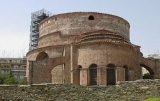
The Rotunda has a diameter of 24.5 m. Its walls are more than 6 m thick, which is one reason why it has withstood Thessaloniki's earthquakes. The walls are interrupted by eight rectangular bays, with the south bay forming the entrance. A flat brick dome, 30 m high at the peak, crowns the cylindrical structure. In its original design, the dome of the Rotunda had an oculus like the Pantheon
Pantheon, Rome

The Pantheon is a building in Rome which was originally built as a temple to all the gods of Ancient Rome, and rebuilt circa 126 AD during Hadrian's reign....
 in Rome.

Uses of the Rotunda


After Galerius's death in 311 (he was buried at Gamzigrad
Gamzigrad

Gamzigrad is a spa resort in Serbia, located south of the Danube, near Zajecar....
/Felix Romuliana near Zajecar
Zajecar

Zajecar is a city and municipality in the eastern part of the Republic of Serbia. The town has a population of 49,700 people, and its coordinates are 43.91? North, 22.30? East....
, Serbia
Serbia

Serbia , officially the Republic of Serbia , is a country in Central Europe and Balkans Europe, covering the southern part of the Pannonian Plain and the central part of the Balkans....
), however, the structure stood empty until the Emperor Constantine I
Constantine I

Flavius Valerius Aurelius Constantinus , commonly known in English_language as Constantine I, Constantine the Great, or Saint Constantine , was Roman Emperor from 306, and the undisputed holder of that office from 324 until his death in 337....
 ordered it converted into a Christian church in the 4th century. The church was embellished with very high artistic quality mosaics. Only fragments survived of the original decoration, for example a band depicting saints with hands raised in prayer, in front of complex architectural phantasies.

The building functioned as a church for over 1,200 years until the city fell to the Ottomans
Ottoman Empire

The Ottoman Empire , also known by its contemporaries as the Turkish Empire or Turkey , was an empire that lasted from 1299?1923. It was Treaty of Lausanne by the Republic of Turkey, which was officially proclaimed on October 29, 1923....
. In 1590 it was then converted into a mosque
Mosque

A mosque is a place of worship for followers of Islam. Muslims often refer to the mosque by its Arabic name, masjid, ? . The word "mosque" in English refers to all types of buildings dedicated for Islamic worship, although there is a distinction in Arabic between the smaller, privately owned mosque and the larger, "collective" mosque ,...
, the Mosque of Suleyman Hortaji Effendi, and a minaret
Minaret

Minarets are distinctive architectural features of Islamic mosques. Minarets are generally tall spires with onion dome, usually either free standing or much taller than any surrounding support structure....
 was added to the structure. It remained a mosque until 1912, when the Greeks captured the city during the Balkan War. It was then formally re-consecrated into a church, but the minaret was not demolished. The structure was damaged during an earthquake in 1978 but was subsequently restored. , the minaret was still being stabilized with scaffolding. The building is now a historical monument under the Ephorate of Byzantine Antiquities of the Greek Ministry of Culture though the Greek Orthodox Church tries to reclaim it back for Orthodoxy every so often.

The Rotunda is the oldest of Thessaloniki's churches, and some publications in Greece claim that it is the oldest Christian church in the world, although there are a number of other claimants to that title. It is certainly the most important surviving example of a church from the early Christian period of the Greek-speaking part of the Roman Empire.

The arch

  • Dyggve, E. (Copenhagen, 1945). Recherches sur le palais imperial de Thessalonique.
  • Engemann, J. (JAC 22, 1979). “Akklamationsrichtung, Sieger- und Besietenrichtung auf dem Galeriusbogn in Saloniki.”
  • Garrucci, P. (W. Wylie, trans.). (NC 10, 1870). “Brass Medallion Representing the Persian Victory of Maximianus Galerius.”/
  • Hébrard, E. (BCH 44, 1920). “L’Arc de Galère et l’église Saint-Georges à Salonique.”
  • Kinch, K. F. (Paris, 1890). L’arc de triomphe de Salonique.
  • Laubscher, H. P. (Berlin, 1975). Der Reliefschmuck des Galeriusbogens in Thessaloniki.
  • Makaronas, C. J. (Salonica, 1970). The Arch of Galerius at Thessaloniki.
  • Meyer, H. (JdI 95, 1980). “Die Frieszyklen am sogenannten Triumphbogen des Galerius in Thessaloniki.”
  • Pond Rothman, M. S. (AJA 81, 1977). “The Thematic Organization of the Panel Reliefs on the Arch of Galerius.”
  • Pond Rothman, M. S. (Byzantine Studies/Etudes Byzantines 2:1, 1975). “The Panel of the Emperors Enthroned on the Arch of Galerius.”
  • Sutherland, C. H. V. (London, 1967), RIC IV: From Diocletian’s Reform (A.D. 294) to the Death of Maximinus (A. D. 313),
  • Velenis, G. (AA, 1979). “Architektonische Problems des Galeriusbogen in Thessaloniki.”
  • Velenis, G. (AA, 1983). “Nachtragliche Beobachtungen am Oberbau des Galeriusbogens in Thessaloniki.”
  • Vermeule, C. C. (Cambridge, Mass., 1968). Roman Imperial Art in Greece and Asia Minor.
  • von Schönebeck, H. (BZ 37, 1937). “Die zyklische Ordnung der Triumphalreliefs am Galeriusbogen in Saloniki.”
  • von Schönebeck, H. (JbBerlMus 58, 1937). (Preserves image of the now lost head of Galerius, possibly from the large Arch of Galerius. The relief head was in Berlin.)


The palace

  • ??a?as???, F. et al. (???T 8, 1994). “?ea st???e?a ??a t? ??ta???? t?? ?a?e??a??? s?????t?µat??.”
  • ??a?as???, F. et al. (Tessa?????e?? p???? 3, 1981). “ta a?a?t??a t?? Ga?e???? st? Tessa??????, ?e??d?????a ap??atastas??.”
  • ??a?as???, F. et al. (Tessa?????e?? p???? 4, 2001). “?? ???t?a t?? a?a?t?????? s?????t?µat?? t?? Ga?e????.”
  • Dyggve, E. (Copenhagen, 1945). Recherches sur le palais imperial de Thessalonique.
  • Dyggve, E. (Dissertationes Pannonicae ser. 2, 11, 1941). “Kurzer vorläufiger Bericht über die Ausgrabungen im Palastviertel von Thessaloniki.”
  • Hébrard, E. (BCH 44, 1920). “Les Travaux du Service archéologique d’Armée d’Orient a l’arc de triomphe de Galère et à l’arc de triomphe de Galère et à l’église Saint-Georges de Salonique.”
  • ?a?aµpe??, ?. (AAA 23-28, 1990-1995). “? p???? t?? ??ta???? st? ?a?e??a?? s?????t?µa ?a? ? s?es? t?? µe t? ??t?? µe?a?? pe??st????.”
  • ?a?aµpe??, ?. (Tessa?????e?? p???? 3, 2000). “? a?t???at????? ed?a Tessa??????.”
  • Sasel, J. (ed.). Tabula Imperii Romani (Sheet K34).
  • Vichers, M. (BSA 66, 1971). “A note on the Byzantine Palace at Thessaloniki.”
  • Ward-Perkins, J. B. (New York, 1981). Roman Imperial Architecture.


General reference

  • Bianchi-Bandinelli, R. (New York, 1971). Rome: The Late Empire.
  • Brilliant, R. (L’Arte 10, 1970). “Temporal Aspects in Late Roman Art.”
  • Brown, P. (New York, 1971). The World of Late Antiquity.
  • Cameron, A. (Cambridge, Mass., 1993). The Later Roman Empire, A. D. 284-430.
  • Kleiner, D. E. E. (New Haven, 1992). Roman Sculpture.


See also

  • List of Roman domes
    List of Roman domes

    This is a List of Roman domes. The Ancient Rome were the first builder in the history of architecture to relise the potential of domes for the creation of large and well-defined interior spaces....


External links