
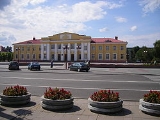
Lida is a city in western
BelarusBelarus , officially the Republic of Belarus, is a landlocked country in Eastern Europe, bordered clockwise by Russia to the northeast, Ukraine to the south, Poland to the west, and Lithuania and Latvia to the northwest. Its capital is Minsk; other major cities include Brest, Grodno , Gomel ,...
in
Hrodna VoblastHrodna Voblast or Grodno Oblast is a voblast in northwestern Belarus.The capital - Grodno is the biggest city of the province. It lies on the Neman River. Grodno's existence is attested to from 1127. Two castles dating from the 14th - 18th centuries are located here on the steep right bank of...
, situated 160 km west of
Minsk- Ecological situation :The ecological situation is monitored by Republican Center of Radioactive and Environmental Control .During 2003–2008 the overall weight of contaminants increased from 186,000 to 247,400 tons. The change of gas as industrial fuel to mazut for financial reasons has worsened...
. It is the fourteenth largest city in Belarus.
Etymology
The name
Lida is derived from the name of the river
Lidzeya, whose origin is associated with the
LithuanianLithuanian is the official state language of Lithuania and is recognized as one of the official languages of the European Union. There are about 2.96 million native Lithuanian speakers in Lithuania and about 170,000 abroad. Lithuanian is a Baltic language, closely related to Latvian, although they...
appellative
Lyda -
Lydimas, meaning
to fuse, to cast (denoting forest clearing). Names in other languages are spelled as and .
Medieval origin
There are passing mentions of Lida in chronicles from 1180. Until the early 14th century the settlement at Lida was a wooden fortress in the
Lithuania properLithuania proper refers to a region which existed within Grand Duchy of Lithuania, and spoke Lithuanian language. The primary meaning is identical to the Duchy of Lithuania, a land around which Grand Duchy of Lithuania evolved...
. In 1323, the Grand Duke of
LithuaniaLithuania , officially the Republic of Lithuania is a country in Northern Europe, the biggest of the three Baltic states. It is situated along the southeastern shore of the Baltic Sea, whereby to the west lie Sweden and Denmark...
Gediminas built a brick fortress there. 1380 is generally considered the founding year of the city of Lida. The fortress withstood
CrusaderThe Crusades were a series of religious wars, blessed by the Pope and the Catholic Church with the main goal of restoring Christian access to the holy places in and near Jerusalem...
attacks from
PrussiaPrussia was a German kingdom and historic state originating out of the Duchy of Prussia and the Margraviate of Brandenburg. For centuries, the House of Hohenzollern ruled Prussia, successfully expanding its size by way of an unusually well-organized and effective army. Prussia shaped the history...
in 1392 and 1394 but it was burned to the ground in 1710. Following the death of Gediminas, when Lithuania was divided into principalities, Lida became the capital of one of them, the seat of
AlgirdasAlgirdas was a monarch of medieval Lithuania. Algirdas ruled the Grand Duchy of Lithuania from 1345 to 1377, which chiefly meant monarch of Lithuanians and Ruthenians...
.
Grand Duchy of Lithuania
Lida was in the
Grand Duchy of LithuaniaThe Grand Duchy of Lithuania was a European state from the 12th /13th century until 1569 and then as a constituent part of Polish-Lithuanian Commonwealth until 1791 when Constitution of May 3, 1791 abolished it in favor of unitary state. It was founded by the Lithuanians, one of the polytheistic...
. In the second half of the 14th century, after the
Christianization of LithuaniaThe Christianization of Lithuania – Christianization of the Grand Duchy of Lithuania that took place in 1387, initiated by the King of Poland and Grand Duke of Lithuania Jogaila and his cousin Vytautas, that signified the official adoption of Christianity by Lithuanians, one of the last pagan...
the Catholic
parishA parish is a territorial unit historically under the pastoral care and clerical jurisdiction of one parish priest, who might be assisted in his pastoral duties by a curate or curates - also priests but not the parish priest - from a more or less central parish church with its associated organization...
was established in former
paganLithuanian mythology is an example of Baltic mythology, developed by Lithuanians throughout the centuries.-History of scholarship:Surviving information about Baltic paganism in general is very sketchy and incomplete. As with most ancient Indo-European cultures Lithuanian mythology is an example of...
lands and a Church was built by
JogailaJogaila, later 'He is known under a number of names: ; ; . See also: Jogaila : names and titles. was Grand Duke of Lithuania , king consort of Kingdom of Poland , and sole King of Poland . He ruled in Lithuania from 1377, at first with his uncle Kęstutis...
(ruins are still preserved). Subsequently in 15th century town became a centre of production by craftsmen and trade. Lida was connected with
VilniusVilnius is the capital of Lithuania, and its largest city, with a population of 560,190 as of 2010. It is the seat of the Vilnius city municipality and of the Vilnius district municipality. It is also the capital of Vilnius County...
, Navahrudak and
Minsk- Ecological situation :The ecological situation is monitored by Republican Center of Radioactive and Environmental Control .During 2003–2008 the overall weight of contaminants increased from 186,000 to 247,400 tons. The change of gas as industrial fuel to mazut for financial reasons has worsened...
. At that time the town had a market square and four streets
Wielenska,
Zamkowa,
Kamieńska and
Krivaya. In 1588 Lida became the seat of
Lida DistrictLida district - a district in Hrodna vobłaść of Belarus.The administrative center is Lida....
in
Vilnius VoivodeshipThe Vilnius Voivodeship was one of voivodeships in the Grand Duchy of Lithuania, created in 1413, from the Duchy of Lithuania and neighbouring lands.- Geography and administrative division :...
.
Magdeburg RightsMagdeburg Rights or Magdeburg Law were a set of German town laws regulating the degree of internal autonomy within cities and villages granted by a local ruler. Modelled and named after the laws of the German city of Magdeburg and developed during many centuries of the Holy Roman Empire, it was...
were granted to the town in 1590 and confirmed in 1776 by the Polish Sejm. By these rights Lida held two annual fairs of little import to the local economy. The population was between 2000 to 5000 people.
Jewish Community of Lida
JewsThe Jews , also known as the Jewish people, are a nation and ethnoreligious group originating in the Israelites or Hebrews of the Ancient Near East. The Jewish ethnicity, nationality, and religion are strongly interrelated, as Judaism is the traditional faith of the Jewish nation...
first settled in Lida in the middle of the 16th century, and permission to construct a
synagogueA synagogue is a Jewish house of prayer. This use of the Greek term synagogue originates in the Septuagint where it sometimes translates the Hebrew word for assembly, kahal...
was granted by King
Stefan BatoryStephen Báthory was a Hungarian noble Prince of Transylvania , then King of Poland and Grand Duke of Lithuania . He was a member of the Somlyó branch of the noble Hungarian Báthory family...
in 1579. The temple was decimated and rebuilt with the permission of King Wladyslaw Vasa in 1630. By 1817, the Jewish Community of Lida numbered 567, nearly three-quarters of the total population of the city at the time. Lida had a particularly sightly brick synagogue. Old photographs can be found.
During the First World War, the
GermansThe Germans are a Germanic ethnic group native to Central Europe. The English term Germans has referred to the German-speaking population of the Holy Roman Empire since the Late Middle Ages....
captured Lida, and both Jews and non-Jews were forced into labor. Soon after the German Occupation ceased in the winter of 1917, the Bolsheviks entered the city and created a strong sense of the Revolution. In 1919,
Polishthumb|right|180px|The state flag of [[Poland]] as used by Polish government and diplomatic authoritiesThe Polish people, or Poles , are a nation indigenous to Poland. They are united by the Polish language, which belongs to the historical Lechitic subgroup of West Slavic languages of Central Europe...
soldiers entered Lida and a
pogromA pogrom is a form of violent riot, a mob attack directed against a minority group, and characterized by killings and destruction of their homes and properties, businesses, and religious centres...
occurred, in which 39 Jews were slaughtered. Between the wars was a short period of economic growth for the Jewish community. All aspects of the community flourished, and at the time there were 12 fully functioning synagogues. In 1931, the Jewish population grew to 6,335, and at the dawn of the Holocaust refugees added to make it nearly 8,500. In the fall of 1939, the
Red ArmyThe Workers' and Peasants' Red Army started out as the Soviet Union's revolutionary communist combat groups during the Russian Civil War of 1918-1922. It grew into the national army of the Soviet Union. By the 1930s the Red Army was among the largest armies in history.The "Red Army" name refers to...
moved in and annexed Lida to the Grodno District of Byelorussian SSR, part of the
Soviet UnionThe Soviet Union , officially the Union of Soviet Socialist Republics , was a constitutionally socialist state that existed in Eurasia between 1922 and 1991....
. Once again, the Jews were oppressed and all cultural aspects of the community were diminished and the Soviets imprisoned surrounding Jews in Lida. In June 1941, the Germans severely damaged the city, and by December of that year, a
ghettoA ghetto is a section of a city predominantly occupied by a group who live there, especially because of social, economic, or legal issues.The term was originally used in Venice to describe the area where Jews were compelled to live. The term now refers to an overcrowded urban area often associated...
was created on the suburbs of Lida, in which several families ended up crowding into a single home. On May 7, 1942 the ghetto was sealed and on the 8th nearly 6,000 were taken to a military firing range, where they were shot and piled in ready-made grave pits. About 1,500 educated Jews remained in the ghetto, and the population was added to by incoming refugees. A few groups secretly escaped the city and hid in the
forestsThe Bielski partisans were an organisation of Jewish partisans who rescued Jews from extermination and fought against the Nazi German occupiers and their collaborators in the vicinity of Nowogródek and Lida in German-occupied Poland...
until the city was liberated in 1944, but the rest of the community was murdered on September 18, 1943.
Polish-Lithuanian Commonwealth and Imperial Russia
The 17th century was a difficult time in Lida. Caught by invading to
Polish-Lithuanian CommonwealthThe Polish–Lithuanian Commonwealth was a dualistic state of Poland and Lithuania ruled by a common monarch. It was the largest and one of the most populous countries of 16th- and 17th‑century Europe with some and a multi-ethnic population of 11 million at its peak in the early 17th century...
forces of
RussiaRussia or , officially known as both Russia and the Russian Federation , is a country in northern Eurasia. It is a federal semi-presidential republic, comprising 83 federal subjects...
and
SwedenSweden , officially the Kingdom of Sweden , is a Nordic country on the Scandinavian Peninsula in Northern Europe. Sweden borders with Norway and Finland and is connected to Denmark by a bridge-tunnel across the Öresund....
. A depression resulted, and people moved out of Lida. By 1786, 514 inhabitants were left in Lida. in 1795, Lida was annexed by the
Russian EmpireThe Russian Empire was a state that existed from 1721 until the Russian Revolution of 1917. It was the successor to the Tsardom of Russia and the predecessor of the Soviet Union...
as a powiat centre of the Slonim Governorate (1795). Afterwards, Lida was a part of the Lithuania Governorate in 1797 and of
Grodno GovernorateThe Grodno Governorate, was a governorate of the Russian Empire.-Overview:Grodno: a western province or government of Europe lying between 52 and 54 N lat 23 and E long and bounded N by Vilna E by Minsk S Volhynia and W by the former kingdom of Poland The country was a wide plain in parts very...
since 1801.
The town was greatly destroyed during the French occupation in 1812. In 1817 the population was 1366 people. Since 1842 Lida was the "district" centre in
Vilna GovernorateThe Vilna Governorate or Government of Vilna was a governorate of the Russian Empire created after the Third Partition of the Polish-Lithuanian Commonwealth in 1795...
. In 1863 and 1873, two beer factories were built in Lida. In 1884, the railway
Vilnius-Lunenets was finished. In 1907, the railway
Molodechno-Mosty opened. The 1897 population was 8626 people.
A two-year school opened. Then, a parish school with the department for girls opened as did a Jewish school. In 1899 a hospital opened which consisted of 25 beds. In 1901 cast-iron plant began to operate. In 1903 sawmill started its operation. At the end of 19th century and at the beginning of 20 century two brick plants were built. In 1904, there were 1000 houses of which 275 were brick, fourteen small enterprises, four hospitals with beds for 115 people, and six elementary schools for 700 pupils. In 1904, near
Minsk- Ecological situation :The ecological situation is monitored by Republican Center of Radioactive and Environmental Control .During 2003–2008 the overall weight of contaminants increased from 186,000 to 247,400 tons. The change of gas as industrial fuel to mazut for financial reasons has worsened...
the Russian Social Democratic Party was formed. During the revolutions of 1905-07, the uprisings of the workers took place, complete with political slogans. In 1914, there were almost 40 factories.
Recent history
During
World War IWorld War I , which was predominantly called the World War or the Great War from its occurrence until 1939, and the First World War or World War I thereafter, was a major war centred in Europe that began on 28 July 1914 and lasted until 11 November 1918...
Lida was occupied by the
German troopsThe German Army is the land component of the armed forces of the Federal Republic of Germany. Following the disbanding of the Wehrmacht after World War II, it was re-established in 1955 as the Bundesheer, part of the newly formed West German Bundeswehr along with the Navy and the Air Force...
. In 1919 the
Red ArmyThe Workers' and Peasants' Red Army started out as the Soviet Union's revolutionary communist combat groups during the Russian Civil War of 1918-1922. It grew into the national army of the Soviet Union. By the 1930s the Red Army was among the largest armies in history.The "Red Army" name refers to...
established Soviet power.
Polish troops under General
Józef Adam LasockiJózef Adam Lasocki was an officer in Austro-Hungarian Army and from December 1918 a general in Polish Army. During First World War commanded formations from a regiment to division in size. Fought in the Polish-Soviet War. In 1919 commanded 2 BJ, Grupa Zaniemenska, 1 and 2 DLB and 8 DP. In 1920...
reached the outskirts of Lida in early March 1919. On April 15 they resumed their advance and on April 17 they captured Lida, as a screening operation to the
taking of VilniusThe Vilna offensive was a campaign of the Polish–Soviet War of 1919–1921. The Polish army launched an offensive on April 16, 1919, to take Vilnius from the Red Army. After three days of street fighting from April 19–21, the city was captured by Polish forces, causing the Red Army to...
.
On July 17, 1920 the Red Army returned but was forced to retreat in August following
the Soviet defeat at WarsawThe Battle of Warsaw sometimes referred to as the Miracle at the Vistula, was the decisive battle of the Polish–Soviet War. That war began soon after the end of World War I in 1918 and lasted until the Treaty of Riga resulted in the end of the hostilities between Poland and Russia in 1921.The...
.
On September 30, 1920 Poland and Soviet troops fought in and near Lida during the battle of Niemen, as the Soviet 21st Rifle Division tried to assault Polish positions but was repulsed by the 1st Lithuanian-Belarusian Division; Poles took about 10,000 prisoners from the Soviet 3rd Army.
After the 1920 Moscow Treaty it was ceded by the Soviets to
LithuaniaLithuania , officially the Republic of Lithuania is a country in Northern Europe, the biggest of the three Baltic states. It is situated along the southeastern shore of the Baltic Sea, whereby to the west lie Sweden and Denmark...
, this treaty however was not recognized by Poland. In accordance with Riga Peace Treaty of 1921, the town was awarded to
PolandPoland , officially the Republic of Poland , is a country in Central Europe bordered by Germany to the west; the Czech Republic and Slovakia to the south; Ukraine, Belarus and Lithuania to the east; and the Baltic Sea and Kaliningrad Oblast, a Russian exclave, to the north...
as the powiat centre in Nowogródek Voivodship.
In 1927, there were twenty-four factories in Lida. 1928 were years of rapid growth in the production. A new rubber good's factory started up, employing almost 800 people. Also, Lida was an important garrison of the Polish Army, with one infantry division and the 5th Corps of the
Polish Air ForceThe Polish Air Force is the military Air Force wing of the Polish Armed Forces. Until July 2004 it was officially known as Wojska Lotnicze i Obrony Powietrznej...
stationed there.
In 1939, following the
Soviet invasion of PolandSoviet invasion of Poland can refer to:* the second phase of the Polish-Soviet War of 1920 when Soviet armies marched on Warsaw, Poland* Soviet invasion of Poland of 1939 when Soviet Union allied with Nazi Germany attacked Second Polish Republic...
, Lida became part of the Byelorussian Soviet Socialist Republic. Beginning January 1940 Lida was the centre of Lida Raion,
Baranavichy VoblastBaranavichy Oblast was a territorial unit in the Belarusian Soviet Socialist Republic created after the annexation of West Belarus into the BSSR in November 1939. The administrative centre of the province was the city of Baranavichy....
.
From June 1941 to July 1944, it was occupied by the
GermanGermany , officially the Federal Republic of Germany , is a federal parliamentary republic in Europe. The country consists of 16 states while the capital and largest city is Berlin. Germany covers an area of 357,021 km2 and has a largely temperate seasonal climate...
troops who killed almost 25,149 people. On September 18, 1943, the Jewish Community of Lida was rounded up and taken to
MajdanekMajdanek was a German Nazi concentration camp on the outskirts of Lublin, Poland, established during the German Nazi occupation of Poland. The camp operated from October 1, 1941 until July 22, 1944, when it was captured nearly intact by the advancing Soviet Red Army...
, where they were murdered. A small number of about 200 Lida
JewsThe Jews , also known as the Jewish people, are a nation and ethnoreligious group originating in the Israelites or Hebrews of the Ancient Near East. The Jewish ethnicity, nationality, and religion are strongly interrelated, as Judaism is the traditional faith of the Jewish nation...
survived the Holocaust. Beginning of September 1944, Lida was in Grodno Region.
During the Cold War and up until 1993 Lida was home to the
1st Guards Bomber Aviation DivisionThe 1st Guards Bomber Aviation Division was an Aviation Division of the Soviet Air Force.-History:...
of the
Soviet Air ForceThe Soviet Air Force, officially known in Russian as Военно-воздушные силы or Voenno-Vozdushnye Sily and often abbreviated VVS was the official designation of one of the air forces of the Soviet Union. The other was the Soviet Air Defence Forces...
.
Monuments and attractions
- Lida Castle
Lida Castle was one of several citadels erected by Grand Duke Gediminas of Lithuania in the early 14th century to defend his lands against the expansion of the Teutonic Knights. Other links in this chain of defense included Hrodna, Navahrudak, Kreva, Medininkai, and Trakai...
was built by the order of The Grand Duke of Lithuania Gediminas for protection against the Teutonic KnightsThe Order of Brothers of the German House of Saint Mary in Jerusalem , commonly the Teutonic Order , is a German medieval military order, in modern times a purely religious Catholic order...
' assaults. The stone foundations of the castle were laid in 1323. Lida Parts of the trapezium-shaped fortress were added on up through the 15th century. In the mid-17th century, an army of 30,000 sent by Prince Nikita Khovansky of MoscowMoscow is the capital, the most populous city, and the most populous federal subject of Russia. The city is a major political, economic, cultural, scientific, religious, financial, educational, and transportation centre of Russia and the continent...
to destroy it, and in the Great Northern WarThe Great Northern War was a conflict in which a coalition led by the Tsardom of Russia successfully contested the supremacy of the Swedish Empire in northern Central Europe and Eastern Europe. The initial leaders of the anti-Swedish alliance were Peter I the Great of Russia, Frederick IV of...
(1700–1721), Swedes came and blew-up the castle's towers, therefore permanently diminishing its military purpose. It has since been restored and tourists come to view its crimson walls.
- The Church of St. Joseph in Lida was built in 1794-1825. Built in the Late Classicism Style, the round stone church has an attractive dome and front. In 1842 it was burnt down due to a fire, but was soon rebuilt. Currently it is an Orthodox Church.
- The Catholic Church in Lida was given a new sanctuary in April 2007. The refreshingly white interior complements the tan exterior.
- Starting from the Spring of 2001, the Jewish Community of Belarus worked closely with the residents of Lida to erect a memorial commemorating the thousands of Lida Jews that perished in the Holocaust. In Autumn of 2003, an unveiling ceremony which involved 400 occurred. Now, visitors and residents alike can take a visit to this memorial, which properly honors all of those innocent victims of World War II
World War II, or the Second World War , was a global conflict lasting from 1939 to 1945, involving most of the world's nations—including all of the great powers—eventually forming two opposing military alliances: the Allies and the Axis...
.
Demographics
- Population: 110,000 (January 1, 2000)
- Religion: Eastern Orthodox 40%, Roman Catholic 50%, Other 10%
Climate
- Winter temperatures: around 1 degree celsius
- Spring temperatures: around 10 degrees celsius
- Summer temperatures: around 17 degrees celsius
- Autumn temperatures: around 7 degrees celsius
- Stormy weather
People
- David ben Aryeh Leib
Rabbi David ben Aryeh Leib of Lida wrote works of rabbinic literature, including Sefer Shomer Shabbat and books on the 613 Mitzvot, bris milah, the Shulchan Aruch, the Book of Ruth, and Jewish ethics ....
of Lida (ca. 1650-1696), Ashkenazi rabbiIn Judaism, a rabbi is a teacher of Torah. This title derives from the Hebrew word רבי , meaning "My Master" , which is the way a student would address a master of Torah...
- Konstanty Gorski
Konstanty Antoni Gorski was a Polish composer, violinist, organist and music teacher.-Life:...
(1859–1924), Polish composer and violinist
- Stefan E. Warschawski
Stefan E. Warschawski was a mathematician, a professor and department chair at the University of Minnesota and the founder of the mathematics department at the University of California, San Diego....
(1904–1989), mathematician
- Pola Raksa
Pola Raksa is a Polish movie star, singer, model was especially popular in Poland and abroad in the 1960s and 1970s.The daughter of Edward Raksa, Pola was born at Szeroka street in Lida on April 14, 1941...
(1941–), Polish movie star
- Birthplace of artist Aleksander Zyw
Aleksander Zyw can be seen as a quintessentially European artist. His roots start in Poland, living in France, Britain and Italy, exhibiting in them all during his career. Taking his early Impressionist landscapes as a start, we see him as an artist changed by war...
(1905–1995).
Twin towns — Sister cities
Lida is
twinnedTwin towns and sister cities are two of many terms used to describe the cooperative agreements between towns, cities, and even counties in geographically and politically distinct areas to promote cultural and commercial ties.- Terminology :...
with:
KoszalinKoszalin ; is the largest city of Middle Pomerania in north-western Poland. It is located 12 km south of the Baltic Sea coast. Koszalin is also a county-status city and capital of Koszalin County of West Pomeranian Voivodeship since 1999...
,
PolandPoland , officially the Republic of Poland , is a country in Central Europe bordered by Germany to the west; the Czech Republic and Slovakia to the south; Ukraine, Belarus and Lithuania to the east; and the Baltic Sea and Kaliningrad Oblast, a Russian exclave, to the north...
Ełk,
PolandPoland , officially the Republic of Poland , is a country in Central Europe bordered by Germany to the west; the Czech Republic and Slovakia to the south; Ukraine, Belarus and Lithuania to the east; and the Baltic Sea and Kaliningrad Oblast, a Russian exclave, to the north...