


Tatar invasions

Encyclopedia
The Mongol invasion of Europe
from the east took place over the course of three centuries, from the Middle Ages
to the early modern period.
The terms Tatars or Tartars are applied to nomadic Turkic peoples who, themselves, were conquered by Mongols and incorporated into their horde. They were mainly composed of Kipchaks
.
Mongol
-Tatar
Golden Horde
forces led by Batu Khan
, (a grandson of Genghis Khan
), began attacking Europe in 1223, starting with Cumans
, Volga Bulgaria
and Kievan Rus
. They destroyed many Rus
cities including Kiev
, Vladimir
and Moscow in the process, sparing Novgorod and Pskov
however. They originally planned to continue all the way to the shores of the "Great Sea" (Atlantic Ocean). However, upon learning of the death of Ögedei Khan
(third son of Genghis Khan, uncle of Batu Khan) in 1241 they returned eastwards to their steppe homelands. This arguably could have saved the rest of Europe from suffering the catastrophes that befell the armies and towns of Poland, and Hungary, however the streched lines of communication and the lack of vast open tracts of pasture land might well have been the undoing of such a venture.
The Tatars succeeded in establishing control over Rus
principalities. It included both pillaging and bloody massacres in Russian cities.
In 1347, the Genoese
possession of Caffa, a great trade emporium on the Crimea
n peninsula, came under siege by an army of Mongol warriors under the command of Janibeg. Epidemic
of bubonic plague
had been ravaging Central Asia
prior to the conflict in Kaffa. Brought across the Silk Road
, the Mongols used disease infected corpses as a biological weapon. The corpses were catapulted over the city walls, infecting the inhabitants. The Genoese traders fled, transferring the plague via their ships into the south of Europe, whence it rapidly spread. It is estimated that between one-quarter and two-thirds of the of Europe's population
died from the outbreak of the Black Death
between 1348 and 1350.
In 1380 Tatars were defeated in the Battle of Kulikovo
by the Grand Prince of Muscovy, Dmitri Donskoi
. In 1382 the Golden Horde under Khan Tokhtamysh
sacked Moscow, burning the city and carrying off thousands of inhabitants as slaves. Muscovy remained a vassal
of the Golden Horde
until the Great standing on the Ugra river
in 1480.
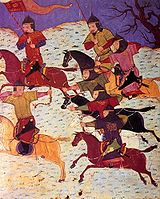 Poland was invaded by Tatars from the Crimean Khanate
in 1506 with an army of 10,000 men, who were summarily destroyed. Tatar forces invaded again in 1589, invading Lwów and Tarnopol, but were beaten back by Cossack
forces.
From 1569 the Polish-Lithuanian Commonwealth
suffered a series of Tatar invasions, the goal of which was to loot, pillage and capture slaves into jasyr
. The borderland area to the south-east was in a state of semi-permanent warfare until the 18th century. Some researchers estimate that altogether more than 3 million people, predominantly Ukrainians
but also Circassians, Russians
, Belarusians
and Poles
, were captured and enslaved during the time of the Crimean Khanate. A constant threat from Crimean Tatars
supported the appearance of Cossack
dom.
For years the Khanates of Kazan
and Astrakhan
routinely made raids on Russian principalities for
slaves and to plunder towns. Russian chronicles record about 40 raids of Kazan Khans on the Russian territories in the first half of the 16th century. Muscovy was also being invaded by the Nogai Horde
and Crimean Khanate
which were successors of the Golden Horde
. In 1521, the combined forces of Crimean Khan Mehmed Giray and his Kazan allies attacked Moscow and captured thousands of slaves
.
In the beginning of 16th century the wild steppe began near old Ryazan
on the Oka River
and Elets on the Sosna, inflow of the Don. Crimean Tatars chose to proceed along watersheds for their incursions. The main way to Moscow was "Muravski shliach
", from the Crimean Perekop up to Tula
between the rivers of two basins, Dnieper and Northern Donets. Having penetrated deep in the populated areas about 100-200 kilometers, the Tatars turned back and, having unwrapped wide wings, looted and captured slaves. Until the early 18th century, the khanate maintained a massive slave trade with the Ottoman Empire
. Captives were sold to Turkey and the Middle East. In Crimea
, about 75% of the population consisted of slaves. The Crimean city of Caffa was the main slave market.
Annually, Moscow mobilized in the spring up to sixty-five thousand soldiers for boundary service. The defensive lines were applied, consisting of a circuit of fortresses and cities. Cossacks and young noblemen were organized into sentry and patrol services that observed Crimean Tatars
and nomads of Nogai Horde on the steppe. About 30 major Tatar raids were recorded into Muscovite
territories between 1558-1596.
To protect from the invasions of the Nogai Horde
between the Volga
and Irtysh
rivers, the Volga cities of Samara
in 1586, Tsaritsyn in 1589, Saratov
in 1590 were founded.
In 1571 the Crimean khan Devlet I Giray
devastated Moscow with a horde of 120,000 horsemen. The Crimean Khanate
was one of the strongest powers in Eastern Europe until the 18th century. The Russian population of the borderland suffered annual Tatar invasions and tens of thousands of soldiers were required to protect the southern boundaries. This was a heavy burden for the state, and slowed its social and economic development. Since Crimean Tatars did not permit settlement of Russians to southern regions where the soil is better and the season is long enough, Muscovy had to depend on poorer regions and labour intensive agriculture. Poland-Lithuania
, Moldavia
and Wallachia
were also subjected to extensive slave raiding. The Crimean Khanate was conquered by the Russian Empire
in 1778, bringing an end to Mongol and Tatar rule in Europe.
Historians estimate that up to half of Hungary's two million population at that time were victims of the Mongol invasion of Europe
. About half of the Russian population may have died during the Mongol invasion of Rus'. Colin McEvedy
(Atlas of World Population History, 1978) estimates the population of Russia-in-Europe dropped by 500,000 people, from 7.5 to 7 million in 1300.
Mongol invasion of Europe
The resumption of the Mongol invasion of Europe, during which the Mongols attacked medieval Rus' principalities and the powers of Poland and Hungary, was marked by the Mongol invasion of Rus starting in 21 December 1237...
from the east took place over the course of three centuries, from the Middle Ages
Middle Ages
The Middle Ages is a periodization of European history from the 5th century to the 15th century. The Middle Ages follows the fall of the Western Roman Empire in 476 and precedes the Early Modern Era. It is the middle period of a three-period division of Western history: Classic, Medieval and Modern...
to the early modern period.
The terms Tatars or Tartars are applied to nomadic Turkic peoples who, themselves, were conquered by Mongols and incorporated into their horde. They were mainly composed of Kipchaks
Kipchaks
Kipchaks were a Turkic tribal confederation...
.
Mongol
Mongols
Mongols ) are a Central-East Asian ethnic group that lives mainly in the countries of Mongolia, China, and Russia. In China, ethnic Mongols can be found mainly in the central north region of China such as Inner Mongolia...
-Tatar
Tatars
Tatars are a Turkic speaking ethnic group , numbering roughly 7 million.The majority of Tatars live in the Russian Federation, with a population of around 5.5 million, about 2 million of which in the republic of Tatarstan.Significant minority populations are found in Uzbekistan, Kazakhstan,...
Golden Horde
Golden Horde
The Golden Horde was a Mongol and later Turkicized khanate that formed the north-western sector of the Mongol Empire...
forces led by Batu Khan
Batu Khan
Batu Khan was a Mongol ruler and founder of the Ulus of Jochi , the sub-khanate of the Mongol Empire. Batu was a son of Jochi and grandson of Genghis Khan. His ulus was the chief state of the Golden Horde , which ruled Rus and the Caucasus for around 250 years, after also destroying the armies...
, (a grandson of Genghis Khan
Genghis Khan
Genghis Khan , born Temujin and occasionally known by his temple name Taizu , was the founder and Great Khan of the Mongol Empire, which became the largest contiguous empire in history after his death....
), began attacking Europe in 1223, starting with Cumans
Cumans
The Cumans were Turkic nomadic people comprising the western branch of the Cuman-Kipchak confederation. After Mongol invasion , they decided to seek asylum in Hungary, and subsequently to Bulgaria...
, Volga Bulgaria
Volga Bulgaria
Volga Bulgaria, or Volga–Kama Bolghar, is a historic Bulgar state that existed between the seventh and thirteenth centuries around the confluence of the Volga and Kama rivers in what is now Russia.-Origin:...
and Kievan Rus
Kievan Rus'
Kievan Rus was a medieval polity in Eastern Europe, from the late 9th to the mid 13th century, when it disintegrated under the pressure of the Mongol invasion of 1237–1240....
. They destroyed many Rus
Rus' (region)
Rus' is an ethno-cultural region in Eastern Europe inhabited by Eastern Slavs. Historically, it comprises the northern part of Ukraine, the north-western part of Russia, Belarus and some eastern parts of Poland and Slovakia.The name comes from Old East Slavic , and remains the same in modern...
cities including Kiev
Kiev
Kiev or Kyiv is the capital and the largest city of Ukraine, located in the north central part of the country on the Dnieper River. The population as of the 2001 census was 2,611,300. However, higher numbers have been cited in the press....
, Vladimir
Vladimir
Vladimir is a city and the administrative center of Vladimir Oblast, Russia, located on the Klyazma River, to the east of Moscow along the M7 motorway. Population:...
and Moscow in the process, sparing Novgorod and Pskov
Pskov
Pskov is an ancient city and the administrative center of Pskov Oblast, Russia, located in the northwest of Russia about east from the Estonian border, on the Velikaya River. Population: -Early history:...
however. They originally planned to continue all the way to the shores of the "Great Sea" (Atlantic Ocean). However, upon learning of the death of Ögedei Khan
Ögedei Khan
Ögedei Khan, born Ögedei was the third son of Genghis Khan and second Great Khan of the Mongol Empire by succeeding his father...
(third son of Genghis Khan, uncle of Batu Khan) in 1241 they returned eastwards to their steppe homelands. This arguably could have saved the rest of Europe from suffering the catastrophes that befell the armies and towns of Poland, and Hungary, however the streched lines of communication and the lack of vast open tracts of pasture land might well have been the undoing of such a venture.
- 1223: Battle of Kalka River was fought. Mongol attack on Volga BulgariaVolga BulgariaVolga Bulgaria, or Volga–Kama Bolghar, is a historic Bulgar state that existed between the seventh and thirteenth centuries around the confluence of the Volga and Kama rivers in what is now Russia.-Origin:...
. Battle of Samara BendBattle of Samara BendThe Battle of Samara Bend or the Battle of Kernek was the first battle between Volga Bulgaria and the Mongols, probably one of the first major battles the Mongols lost. It took place in autumn 1223, at the southern border of Volga Bulgaria....
ends with Mongol defeat. - 1236: Volga BulgariaMongol invasion of Volga BulgariaThe Mongol invasion of Volga Bulgaria lasted from 1223 to 1236.-The Mongol campaigns:In 1223, after defeating Russian and Cuman/Kipchak armies at the Battle of Kalka, a Mongol army under the generals Subutai and Jebe was sent to subdue Volga Bulgaria. At that point in history Genghis Khan's troops...
and CumansCumansThe Cumans were Turkic nomadic people comprising the western branch of the Cuman-Kipchak confederation. After Mongol invasion , they decided to seek asylum in Hungary, and subsequently to Bulgaria...
were conquered. - 1237: RyazanRyazanRyazan is a city and the administrative center of Ryazan Oblast, Russia. It is located on the Oka River southeast of Moscow. Population: The strategic bomber base Dyagilevo is just west of the city, and the air base of Alexandrovo is to the southeast as is the Ryazan Turlatovo Airport...
devastated. - 1238: VladimirVladimirVladimir is a city and the administrative center of Vladimir Oblast, Russia, located on the Klyazma River, to the east of Moscow along the M7 motorway. Population:...
and Moscow were devastated, Battle of the Sit RiverBattle of the Sit RiverThe Battle of the Sit River was fought in the northern part of the present-day Yaroslavl Oblast of Russia on March 4, 1238 between the Mongol Hordes of Batu Khan and the Rus' people under Grand Prince Yuri II of Vladimir-Suzdal during the Mongol invasion of Rus...
is fought shortly after - 1238-1239: RostovRostovRostov is a town in Yaroslavl Oblast, Russia, one of the oldest in the country and a tourist center of the Golden Ring. It is located on the shores of Lake Nero, northeast of Moscow. Population:...
, UglichUglichUglich is a historic town in Yaroslavl Oblast, Russia, which stands on the Volga River. Population: A local tradition dates the town's origins to 937. It was first documented in 1148 as Ugliche Pole...
, YaroslavlYaroslavlYaroslavl is a city and the administrative center of Yaroslavl Oblast, Russia, located northeast of Moscow. The historical part of the city, a World Heritage Site, is located at the confluence of the Volga and the Kotorosl Rivers. It is one of the Golden Ring cities, a group of historic cities...
, KostromaKostromaKostroma is a historic city and the administrative center of Kostroma Oblast, Russia. A part of the Golden Ring of Russian towns, it is located at the confluence of the Volga and Kostroma Rivers...
, Kashin, Ksnyatin, GorodetsGorodetsGorodets is a town and the administrative center of Gorodetsky District of Nizhny Novgorod Oblast, Russia, located on the left bank of the Volga River, northwest of Nizhny Novgorod...
, GalichGalich, RussiaGalich is a town in Kostroma Oblast, Russia, situated on the southern bank of Lake Galichskoye. It is also a minor railroad node of the Trans-Siberian railway. Population: -History:...
, PereslavlPereslavl-ZalesskyPereslavl-Zalessky or Pereyaslavl-Zalessky , is a town in Yaroslavl Oblast, Russia, located northeast of Moscow on the main Moscow Yaroslavl road and on the shores of Pleschevo Lake. It was called Pereyaslavl until the 15th century. The town is located on the southeastern shore of the Lake...
, Yuriev, DmitrovDmitrovDmitrov is a town and the administrative center of Dmitrovsky District of Moscow Oblast, Russia, located to the north of Moscow on the Yakhroma River and the Moscow Canal. Population: -History:...
, VolokVolokolamskVolokolamsk is a town and the administrative center of Volokolamsky District of Moscow Oblast, Russia, located on the Gorodenka River, not far from its confluence with the Lama River, northwest of Moscow. Population: -History:...
, TverTverTver is a city and the administrative center of Tver Oblast, Russia. Population: 403,726 ; 408,903 ;...
and TorzhokTorzhokTorzhok is a town in Tver Oblast, Russia, famous for its folk craft of goldwork embroidery. Population: Torzhok has twenty-two large and medium-sized industrial enterprises. Two of them are especially significant...
were devastated. In the west, ChernigovChernihivChernihiv or Chernigov is a historic city in northern Ukraine. It is the administrative center of the Chernihiv Oblast , as well as of the surrounding Chernihivskyi Raion within the oblast...
and PereyaslavPereiaslav-KhmelnytskyiPereiaslav-Khmelnytskyi is a town located where Alta River flows into Trubizh River in the Kiev Oblast in central Ukraine. Serving as the administrative center of the Pereiaslav-Khmelnytskyi Raion , the town itself is also designated as a separate raion within the oblast...
were sacked. - 1240: Destruction of KievKievKiev or Kyiv is the capital and the largest city of Ukraine, located in the north central part of the country on the Dnieper River. The population as of the 2001 census was 2,611,300. However, higher numbers have been cited in the press....
. - 1241: Battle of LegnicaBattle of LegnicaThe Battle of Legnica , also known as the Battle of Liegnitz or Battle of Wahlstatt , was a battle between the Mongol Empire and the combined defending forces of European fighters that took place at Legnickie Pole near the city of Legnica in Silesia on 9 April 1241.A combined force of Poles,...
and Battle of MohiBattle of MohiThe Battle of Mohi , or Battle of the Sajó River, was the main battle between the Mongol Empire and the Kingdom of Hungary during the Mongol invasion of Europe. It took place at Muhi, Southwest of the Sajó River. After the invasion, Hungary lay in ruins. Nearly half of the inhabited places had...
were fought, respectively. Devastation of Poland and Hungary following Mongol victories. Death of Ögedei KhanÖgedei KhanÖgedei Khan, born Ögedei was the third son of Genghis Khan and second Great Khan of the Mongol Empire by succeeding his father...
; Retreat of Mongol-Tatar army. Devastation of BulgariaVolga BulgariaVolga Bulgaria, or Volga–Kama Bolghar, is a historic Bulgar state that existed between the seventh and thirteenth centuries around the confluence of the Volga and Kama rivers in what is now Russia.-Origin:...
during the return. - 1259: First Mongol raid against LithuaniaLithuaniaLithuania , officially the Republic of Lithuania is a country in Northern Europe, the biggest of the three Baltic states. It is situated along the southeastern shore of the Baltic Sea, whereby to the west lie Sweden and Denmark...
and second raid against Poland. - 1265: Raid against ThraceThraceThrace is a historical and geographic area in southeast Europe. As a geographical concept, Thrace designates a region bounded by the Balkan Mountains on the north, Rhodope Mountains and the Aegean Sea on the south, and by the Black Sea and the Sea of Marmara on the east...
. - 1271, 1274, 1282 and 1285: Raids against BulgariaVolga BulgariaVolga Bulgaria, or Volga–Kama Bolghar, is a historic Bulgar state that existed between the seventh and thirteenth centuries around the confluence of the Volga and Kama rivers in what is now Russia.-Origin:...
. - 1275: Second raid against LithuaniaLithuaniaLithuania , officially the Republic of Lithuania is a country in Northern Europe, the biggest of the three Baltic states. It is situated along the southeastern shore of the Baltic Sea, whereby to the west lie Sweden and Denmark...
. - 1285: Second raid against Hungary.
- 1287: Third raid against Poland.
The Tatars succeeded in establishing control over Rus
Rus' (region)
Rus' is an ethno-cultural region in Eastern Europe inhabited by Eastern Slavs. Historically, it comprises the northern part of Ukraine, the north-western part of Russia, Belarus and some eastern parts of Poland and Slovakia.The name comes from Old East Slavic , and remains the same in modern...
principalities. It included both pillaging and bloody massacres in Russian cities.
- 1252: Horde of Nevruy devastated PereslavlPereslavl-ZalesskyPereslavl-Zalessky or Pereyaslavl-Zalessky , is a town in Yaroslavl Oblast, Russia, located northeast of Moscow on the main Moscow Yaroslavl road and on the shores of Pleschevo Lake. It was called Pereyaslavl until the 15th century. The town is located on the southeastern shore of the Lake...
and SuzdalSuzdalSuzdal is a town in Vladimir Oblast, Russia, situated northeast of Moscow, from the city of Vladimir, on the Kamenka River. Population: -History:...
. - 1273: Tatars twice attacked Novgorod territoryNovgorod RepublicThe Novgorod Republic was a large medieval Russian state which stretched from the Baltic Sea to the Ural Mountains between the 12th and 15th centuries, centred on the city of Novgorod...
, devastating VologdaVologdaVologda is a city and the administrative, cultural, and scientific center of Vologda Oblast, Russia, located on the Vologda River. The city is a major transport knot of the Northwest of Russia. Vologda is among the Russian cities possessing an especially valuable historical heritage...
and BezhizaBezhetskBezhetsk is a town in Tver Oblast, Russia, located on the Mologa River at its confluence with the Ostrechina River. It serves as the administrative center of Bezhetsky District, although it is not administratively a part of it. Population: 29,000 ....
. - 1274: Tatars devastated SmolenskSmolenskSmolensk is a city and the administrative center of Smolensk Oblast, Russia, located on the Dnieper River. Situated west-southwest of Moscow, this walled city was destroyed several times throughout its long history since it was on the invasion routes of both Napoleon and Hitler. Today, Smolensk...
- 1275: Tatar invasion of south-eastern Russia, pillage of KurskKurskKursk is a city and the administrative center of Kursk Oblast, Russia, located at the confluence of the Kur, Tuskar, and Seym Rivers. The area around Kursk was site of a turning point in the Russian-German struggle during World War II and the site of the largest tank battle in history...
. - 1278: Tatars pillaged Ryazan principality.
- 1281: The horde of Kovdygay and Alchiday destroyed MuromMuromMurom is a historic city in Vladimir Oblast, Russia, which sprawls along the left bank of Oka River. Population: -History:In the 9th century CE, the city marked the easternmost settlement of the Eastern Slavs in the land of the Finno-Ugric people called Muromians. The Russian Primary Chronicle...
and PereslavlPereslavl-ZalesskyPereslavl-Zalessky or Pereyaslavl-Zalessky , is a town in Yaroslavl Oblast, Russia, located northeast of Moscow on the main Moscow Yaroslavl road and on the shores of Pleschevo Lake. It was called Pereyaslavl until the 15th century. The town is located on the southeastern shore of the Lake...
, ruined vicinities of SuzdalSuzdalSuzdal is a town in Vladimir Oblast, Russia, situated northeast of Moscow, from the city of Vladimir, on the Kamenka River. Population: -History:...
, RostovRostovRostov is a town in Yaroslavl Oblast, Russia, one of the oldest in the country and a tourist center of the Golden Ring. It is located on the shores of Lake Nero, northeast of Moscow. Population:...
, VladimirVladimirVladimir is a city and the administrative center of Vladimir Oblast, Russia, located on the Klyazma River, to the east of Moscow along the M7 motorway. Population:...
, YuryevYuryev-PolskyYuryev-Polsky is an old town and the administrative center of Yuryev-Polsky District of Vladimir Oblast, Russia, located in the upper reaches of the Koloksha River, northwest of Vladimir. Population: 23,000 ....
, TverTverTver is a city and the administrative center of Tver Oblast, Russia. Population: 403,726 ; 408,903 ;...
and TorzhokTorzhokTorzhok is a town in Tver Oblast, Russia, famous for its folk craft of goldwork embroidery. Population: Torzhok has twenty-two large and medium-sized industrial enterprises. Two of them are especially significant...
. - 1282: Tatar attack on VladimirVladimirVladimir is a city and the administrative center of Vladimir Oblast, Russia, located on the Klyazma River, to the east of Moscow along the M7 motorway. Population:...
and PereslavlPereslavl-ZalesskyPereslavl-Zalessky or Pereyaslavl-Zalessky , is a town in Yaroslavl Oblast, Russia, located northeast of Moscow on the main Moscow Yaroslavl road and on the shores of Pleschevo Lake. It was called Pereyaslavl until the 15th century. The town is located on the southeastern shore of the Lake...
. - 1283: Tatars ruined Vorgol, Rylsk and Lipetsk principality, occupied KurskKurskKursk is a city and the administrative center of Kursk Oblast, Russia, located at the confluence of the Kur, Tuskar, and Seym Rivers. The area around Kursk was site of a turning point in the Russian-German struggle during World War II and the site of the largest tank battle in history...
and Vorgol. - 1285: The Tatar warlord Eltoray, the son of Temir, pillaged RyazanRyazanRyazan is a city and the administrative center of Ryazan Oblast, Russia. It is located on the Oka River southeast of Moscow. Population: The strategic bomber base Dyagilevo is just west of the city, and the air base of Alexandrovo is to the southeast as is the Ryazan Turlatovo Airport...
and MuromMuromMurom is a historic city in Vladimir Oblast, Russia, which sprawls along the left bank of Oka River. Population: -History:In the 9th century CE, the city marked the easternmost settlement of the Eastern Slavs in the land of the Finno-Ugric people called Muromians. The Russian Primary Chronicle...
. - 1293: The Tatar warlord Dyuden came to Russia and devastated 14 towns, including MuromMuromMurom is a historic city in Vladimir Oblast, Russia, which sprawls along the left bank of Oka River. Population: -History:In the 9th century CE, the city marked the easternmost settlement of the Eastern Slavs in the land of the Finno-Ugric people called Muromians. The Russian Primary Chronicle...
, Moscow, KolomnaKolomnaKolomna is an ancient city and the administrative center of Kolomensky District of Moscow Oblast, Russia, situated at the confluence of the Moskva and Oka Rivers, southeast of Moscow. The area of the city is about . The city was founded in 1177...
, VladimirVladimirVladimir is a city and the administrative center of Vladimir Oblast, Russia, located on the Klyazma River, to the east of Moscow along the M7 motorway. Population:...
, SuzdalSuzdalSuzdal is a town in Vladimir Oblast, Russia, situated northeast of Moscow, from the city of Vladimir, on the Kamenka River. Population: -History:...
, YuryevYuryev-PolskyYuryev-Polsky is an old town and the administrative center of Yuryev-Polsky District of Vladimir Oblast, Russia, located in the upper reaches of the Koloksha River, northwest of Vladimir. Population: 23,000 ....
, PereslavlPereslavl-ZalesskyPereslavl-Zalessky or Pereyaslavl-Zalessky , is a town in Yaroslavl Oblast, Russia, located northeast of Moscow on the main Moscow Yaroslavl road and on the shores of Pleschevo Lake. It was called Pereyaslavl until the 15th century. The town is located on the southeastern shore of the Lake...
, MozhayskMozhayskMozhaysk is a town and the administrative center of Mozhaysky District of Moscow Oblast, Russia, located to the west from the Russian capital, on the historic road leading to Smolensk and then to Poland. Population:...
, VolokVolokolamskVolokolamsk is a town and the administrative center of Volokolamsky District of Moscow Oblast, Russia, located on the Gorodenka River, not far from its confluence with the Lama River, northwest of Moscow. Population: -History:...
, DmitrovDmitrovDmitrov is a town and the administrative center of Dmitrovsky District of Moscow Oblast, Russia, located to the north of Moscow on the Yakhroma River and the Moscow Canal. Population: -History:...
, UglichUglichUglich is a historic town in Yaroslavl Oblast, Russia, which stands on the Volga River. Population: A local tradition dates the town's origins to 937. It was first documented in 1148 as Ugliche Pole...
. In the same summer Tatar tsarevitch Takhtamir looted TverTverTver is a city and the administrative center of Tver Oblast, Russia. Population: 403,726 ; 408,903 ;...
' principality and captured slaves in Vladimir principality.
In 1347, the Genoese
Republic of Genoa
The Most Serene Republic of Genoa |Ligurian]]: Repúbrica de Zêna) was an independent state from 1005 to 1797 in Liguria on the northwestern Italian coast, as well as Corsica from 1347 to 1768, and numerous other territories throughout the Mediterranean....
possession of Caffa, a great trade emporium on the Crimea
Crimea
Crimea , or the Autonomous Republic of Crimea , is a sub-national unit, an autonomous republic, of Ukraine. It is located on the northern coast of the Black Sea, occupying a peninsula of the same name...
n peninsula, came under siege by an army of Mongol warriors under the command of Janibeg. Epidemic
Epidemic
In epidemiology, an epidemic , occurs when new cases of a certain disease, in a given human population, and during a given period, substantially exceed what is expected based on recent experience...
of bubonic plague
Bubonic plague
Plague is a deadly infectious disease that is caused by the enterobacteria Yersinia pestis, named after the French-Swiss bacteriologist Alexandre Yersin. Primarily carried by rodents and spread to humans via fleas, the disease is notorious throughout history, due to the unrivaled scale of death...
had been ravaging Central Asia
Central Asia
Central Asia is a core region of the Asian continent from the Caspian Sea in the west, China in the east, Afghanistan in the south, and Russia in the north...
prior to the conflict in Kaffa. Brought across the Silk Road
Silk Road
The Silk Road or Silk Route refers to a historical network of interlinking trade routes across the Afro-Eurasian landmass that connected East, South, and Western Asia with the Mediterranean and European world, as well as parts of North and East Africa...
, the Mongols used disease infected corpses as a biological weapon. The corpses were catapulted over the city walls, infecting the inhabitants. The Genoese traders fled, transferring the plague via their ships into the south of Europe, whence it rapidly spread. It is estimated that between one-quarter and two-thirds of the of Europe's population
Medieval demography
This article discusses human demography in Europe during the Middle Ages, including population trends and movements. Demographic changes helped to shape and define the Middle Ages...
died from the outbreak of the Black Death
Black Death
The Black Death was one of the most devastating pandemics in human history, peaking in Europe between 1348 and 1350. Of several competing theories, the dominant explanation for the Black Death is the plague theory, which attributes the outbreak to the bacterium Yersinia pestis. Thought to have...
between 1348 and 1350.
In 1380 Tatars were defeated in the Battle of Kulikovo
Battle of Kulikovo
The Battle of Kulikovo was a battle between Tatar Mamai and Muscovy Dmitriy and portrayed by Russian historiography as a stand-off between Russians and the Golden Horde. However, the political situation at the time was much more complicated and concerned the politics of the Northeastern Rus'...
by the Grand Prince of Muscovy, Dmitri Donskoi
Dmitri Donskoi
Saint Dmitry Ivanovich Donskoy , or Dmitry of the Don, sometimes referred to as Dmitry I , son of Ivan II the Meek of Moscow , reigned as the Prince of Moscow from 1359 and Grand Prince of Vladimir from 1363 to his death. He was the first prince of Moscow to openly challenge Mongol authority in...
. In 1382 the Golden Horde under Khan Tokhtamysh
Tokhtamysh
Tokhtamysh was the prominent khan of the White Horde, who briefly unified the White Horde and Blue Horde subdivisions of the Golden Horde into a single state. He was a descendant of Genghis Khan's eldest grandson, Orda Khan or his brother Tuqa-Timur...
sacked Moscow, burning the city and carrying off thousands of inhabitants as slaves. Muscovy remained a vassal
Vassal
A vassal or feudatory is a person who has entered into a mutual obligation to a lord or monarch in the context of the feudal system in medieval Europe. The obligations often included military support and mutual protection, in exchange for certain privileges, usually including the grant of land held...
of the Golden Horde
Golden Horde
The Golden Horde was a Mongol and later Turkicized khanate that formed the north-western sector of the Mongol Empire...
until the Great standing on the Ugra river
Great standing on the Ugra river
The Great Standoff on the Ugra river The Great Standoff on the Ugra river The Great Standoff on the Ugra river ( in Russian, also (Ugorschina in English, derived from Ugra) was a standoff between the forces of Akhmat, Khan of the Great Horde, and the Grand Prince Ivan III of Russia in 1480, which...
in 1480.
Crimean Khanate
Crimean Khanate, or Khanate of Crimea , was a state ruled by Crimean Tatars from 1441 to 1783. Its native name was . Its khans were the patrilineal descendants of Toqa Temür, the thirteenth son of Jochi and grandson of Genghis Khan...
in 1506 with an army of 10,000 men, who were summarily destroyed. Tatar forces invaded again in 1589, invading Lwów and Tarnopol, but were beaten back by Cossack
Cossack
Cossacks are a group of predominantly East Slavic people who originally were members of democratic, semi-military communities in what is today Ukraine and Southern Russia inhabiting sparsely populated areas and islands in the lower Dnieper and Don basins and who played an important role in the...
forces.
From 1569 the Polish-Lithuanian Commonwealth
Polish-Lithuanian Commonwealth
The Polish–Lithuanian Commonwealth was a dualistic state of Poland and Lithuania ruled by a common monarch. It was the largest and one of the most populous countries of 16th- and 17th‑century Europe with some and a multi-ethnic population of 11 million at its peak in the early 17th century...
suffered a series of Tatar invasions, the goal of which was to loot, pillage and capture slaves into jasyr
Slavery
Slavery is a system under which people are treated as property to be bought and sold, and are forced to work. Slaves can be held against their will from the time of their capture, purchase or birth, and deprived of the right to leave, to refuse to work, or to demand compensation...
. The borderland area to the south-east was in a state of semi-permanent warfare until the 18th century. Some researchers estimate that altogether more than 3 million people, predominantly Ukrainians
Ukrainians
Ukrainians are an East Slavic ethnic group native to Ukraine, which is the sixth-largest nation in Europe. The Constitution of Ukraine applies the term 'Ukrainians' to all its citizens...
but also Circassians, Russians
Russians
The Russian people are an East Slavic ethnic group native to Russia, speaking the Russian language and primarily living in Russia and neighboring countries....
, Belarusians
Belarusians
Belarusians ; are an East Slavic ethnic group who populate the majority of the Republic of Belarus. Introduced to the world as a new state in the early 1990s, the Republic of Belarus brought with it the notion of a re-emerging Belarusian ethnicity, drawn upon the lines of the Old Belarusian...
and Poles
Poles
thumb|right|180px|The state flag of [[Poland]] as used by Polish government and diplomatic authoritiesThe Polish people, or Poles , are a nation indigenous to Poland. They are united by the Polish language, which belongs to the historical Lechitic subgroup of West Slavic languages of Central Europe...
, were captured and enslaved during the time of the Crimean Khanate. A constant threat from Crimean Tatars
Crimean Tatars
Crimean Tatars or Crimeans are a Turkic ethnic group that originally resided in Crimea. They speak the Crimean Tatar language...
supported the appearance of Cossack
Cossack
Cossacks are a group of predominantly East Slavic people who originally were members of democratic, semi-military communities in what is today Ukraine and Southern Russia inhabiting sparsely populated areas and islands in the lower Dnieper and Don basins and who played an important role in the...
dom.
For years the Khanates of Kazan
Khanate of Kazan
The Khanate of Kazan was a medieval Tatar state which occupied the territory of former Volga Bulgaria between 1438 and 1552. Its khans were the patrilineal descendants of Toqa Temür, the thirteenth son of Jochi and grandson of Genghis Khan. The khanate covered contemporary Tatarstan, Mari El,...
and Astrakhan
Astrakhan Khanate
The Khanate of Astrakhan was a Tatar feudal state that appeared after the collapse of the Golden Horde. The Khanate existed in the 15th and 16th centuries in the area adjacent to the mouth of the Volga river, where the contemporary city of Astrakhan/Hajji Tarkhan is now located...
routinely made raids on Russian principalities for
slaves and to plunder towns. Russian chronicles record about 40 raids of Kazan Khans on the Russian territories in the first half of the 16th century. Muscovy was also being invaded by the Nogai Horde
Nogai Horde
The Nogai Horde was a confederation of about eighteen Turkic and Mongol tribes that occupied the Pontic-Caspian steppe from about 1500 until they were pushed west by the Kalmyks and south by the Russians in the 17th century. The Mongol tribe called the Manghits constituted a core of the Horde...
and Crimean Khanate
Crimean Khanate
Crimean Khanate, or Khanate of Crimea , was a state ruled by Crimean Tatars from 1441 to 1783. Its native name was . Its khans were the patrilineal descendants of Toqa Temür, the thirteenth son of Jochi and grandson of Genghis Khan...
which were successors of the Golden Horde
Golden Horde
The Golden Horde was a Mongol and later Turkicized khanate that formed the north-western sector of the Mongol Empire...
. In 1521, the combined forces of Crimean Khan Mehmed Giray and his Kazan allies attacked Moscow and captured thousands of slaves
Slavery
Slavery is a system under which people are treated as property to be bought and sold, and are forced to work. Slaves can be held against their will from the time of their capture, purchase or birth, and deprived of the right to leave, to refuse to work, or to demand compensation...
.
In the beginning of 16th century the wild steppe began near old Ryazan
Ryazan
Ryazan is a city and the administrative center of Ryazan Oblast, Russia. It is located on the Oka River southeast of Moscow. Population: The strategic bomber base Dyagilevo is just west of the city, and the air base of Alexandrovo is to the southeast as is the Ryazan Turlatovo Airport...
on the Oka River
Oka River
Oka is a river in central Russia, the largest right tributary of the Volga. It flows through the regions of Oryol, Tula, Kaluga, Moscow, Ryazan, Vladimir, and Nizhny Novgorod and is navigable over a large part of its total length, as far upstream as to the town of Kaluga. Its length exceeds...
and Elets on the Sosna, inflow of the Don. Crimean Tatars chose to proceed along watersheds for their incursions. The main way to Moscow was "Muravski shliach
Muravsky Trail
Muravsky Trail or Murava Route was an important trade route and according to the Russian historiography a favourite invasion route of the Crimean Tatars during the Russo-Crimean Wars of the 16th and early 17th centuries. It was also used somewhat for peaceful trade...
", from the Crimean Perekop up to Tula
Tula, Russia
Tula is an industrial city and the administrative center of Tula Oblast, Russia. It is located south of Moscow, on the Upa River. Population: -History:...
between the rivers of two basins, Dnieper and Northern Donets. Having penetrated deep in the populated areas about 100-200 kilometers, the Tatars turned back and, having unwrapped wide wings, looted and captured slaves. Until the early 18th century, the khanate maintained a massive slave trade with the Ottoman Empire
Ottoman Empire
The Ottoman EmpireIt was usually referred to as the "Ottoman Empire", the "Turkish Empire", the "Ottoman Caliphate" or more commonly "Turkey" by its contemporaries...
. Captives were sold to Turkey and the Middle East. In Crimea
Crimea
Crimea , or the Autonomous Republic of Crimea , is a sub-national unit, an autonomous republic, of Ukraine. It is located on the northern coast of the Black Sea, occupying a peninsula of the same name...
, about 75% of the population consisted of slaves. The Crimean city of Caffa was the main slave market.
Annually, Moscow mobilized in the spring up to sixty-five thousand soldiers for boundary service. The defensive lines were applied, consisting of a circuit of fortresses and cities. Cossacks and young noblemen were organized into sentry and patrol services that observed Crimean Tatars
Crimean Tatars
Crimean Tatars or Crimeans are a Turkic ethnic group that originally resided in Crimea. They speak the Crimean Tatar language...
and nomads of Nogai Horde on the steppe. About 30 major Tatar raids were recorded into Muscovite
Tsardom of Russia
The Tsardom of Russia was the name of the centralized Russian state from Ivan IV's assumption of the title of Tsar in 1547 till Peter the Great's foundation of the Russian Empire in 1721.From 1550 to 1700, Russia grew 35,000 km2 a year...
territories between 1558-1596.
To protect from the invasions of the Nogai Horde
Nogai Horde
The Nogai Horde was a confederation of about eighteen Turkic and Mongol tribes that occupied the Pontic-Caspian steppe from about 1500 until they were pushed west by the Kalmyks and south by the Russians in the 17th century. The Mongol tribe called the Manghits constituted a core of the Horde...
between the Volga
Volga River
The Volga is the largest river in Europe in terms of length, discharge, and watershed. It flows through central Russia, and is widely viewed as the national river of Russia. Out of the twenty largest cities of Russia, eleven, including the capital Moscow, are situated in the Volga's drainage...
and Irtysh
Irtysh
The Irtysh River is a river in Siberia and is the chief tributary of the Ob River. Its name means White River. Irtysh's main affluent is the Tobol River...
rivers, the Volga cities of Samara
Samara, Russia
Samara , is the sixth largest city in Russia. It is situated in the southeastern part of European Russia at the confluence of the Volga and Samara Rivers. Samara is the administrative center of Samara Oblast. Population: . The metropolitan area of Samara-Tolyatti-Syzran within Samara Oblast...
in 1586, Tsaritsyn in 1589, Saratov
Saratov
-Modern Saratov:The Saratov region is highly industrialized, due in part to the rich in natural and industrial resources of the area. The region is also one of the more important and largest cultural and scientific centres in Russia...
in 1590 were founded.
In 1571 the Crimean khan Devlet I Giray
Devlet I Giray
Devlet I Giray was a khan of the Crimean Khanate during whose long reign the khanate rose to the pinnacle of its power....
devastated Moscow with a horde of 120,000 horsemen. The Crimean Khanate
Crimean Khanate
Crimean Khanate, or Khanate of Crimea , was a state ruled by Crimean Tatars from 1441 to 1783. Its native name was . Its khans were the patrilineal descendants of Toqa Temür, the thirteenth son of Jochi and grandson of Genghis Khan...
was one of the strongest powers in Eastern Europe until the 18th century. The Russian population of the borderland suffered annual Tatar invasions and tens of thousands of soldiers were required to protect the southern boundaries. This was a heavy burden for the state, and slowed its social and economic development. Since Crimean Tatars did not permit settlement of Russians to southern regions where the soil is better and the season is long enough, Muscovy had to depend on poorer regions and labour intensive agriculture. Poland-Lithuania
Poland-Lithuania
Poland–Lithuania can refer to:* Polish–Lithuanian union from 1385 until 1569* Polish–Lithuanian Commonwealth from 1569 until 1795See also: Polish-Lithuanian...
, Moldavia
Moldavia
Moldavia is a geographic and historical region and former principality in Eastern Europe, corresponding to the territory between the Eastern Carpathians and the Dniester river...
and Wallachia
Wallachia
Wallachia or Walachia is a historical and geographical region of Romania. It is situated north of the Danube and south of the Southern Carpathians...
were also subjected to extensive slave raiding. The Crimean Khanate was conquered by the Russian Empire
Russian Empire
The Russian Empire was a state that existed from 1721 until the Russian Revolution of 1917. It was the successor to the Tsardom of Russia and the predecessor of the Soviet Union...
in 1778, bringing an end to Mongol and Tatar rule in Europe.
Historians estimate that up to half of Hungary's two million population at that time were victims of the Mongol invasion of Europe
Mongol invasion of Europe
The resumption of the Mongol invasion of Europe, during which the Mongols attacked medieval Rus' principalities and the powers of Poland and Hungary, was marked by the Mongol invasion of Rus starting in 21 December 1237...
. About half of the Russian population may have died during the Mongol invasion of Rus'. Colin McEvedy
Colin McEvedy
Colin Peter McEvedy , was a British psychiatrist, historian, demographer and non-fiction author. He was born in Salford, Lancashire and died in London....
(Atlas of World Population History, 1978) estimates the population of Russia-in-Europe dropped by 500,000 people, from 7.5 to 7 million in 1300.
See also
- Mongol EmpireMongol EmpireThe Mongol Empire , initially named as Greater Mongol State was a great empire during the 13th and 14th centuries...
- Timeline of Mongol conquests
- Genghis KhanGenghis KhanGenghis Khan , born Temujin and occasionally known by his temple name Taizu , was the founder and Great Khan of the Mongol Empire, which became the largest contiguous empire in history after his death....
- Mongol invasion of Russia
- Mongol ConquestsMongol ConquestsMongol invasions progressed throughout the 13th century, resulting in the vast Mongol Empire which covered much of Asia and Eastern Europe by 1300....
- Golden HordeGolden HordeThe Golden Horde was a Mongol and later Turkicized khanate that formed the north-western sector of the Mongol Empire...
- Rogerius of ApuliaRogerius of ApuliaRogerius of Apulia was a medieval Roman Catholic monk and chronicler, born in Torremaggiore, Apulia...
- Grand Duchy of MoscowGrand Duchy of MoscowThe Grand Duchy of Moscow or Grand Principality of Moscow, also known in English simply as Muscovy , was a late medieval Rus' principality centered on Moscow, and the predecessor state of the early modern Tsardom of Russia....
- Kazan Tatars
- Russo-Kazan WarsRusso-Kazan Warsthumb|300px|[[St. Basil's Cathedral]] is a monument to the Russian conquest of Kazan in 1552.The Russo-Kazan Wars was a series of wars fought between the Khanate of Kazan and Muscovite Russia from 1438, until Kazan was finally captured by Ivan the Terrible and absorbed into Russia in 1552.- Wars of...
- Russo-Ottoman Wars
- Lipka TatarsLipka TatarsThe Lipka Tatars are a group of Tatars who originally settled in the Grand Duchy of Lithuania at the beginning of 14th century. The first settlers tried to preserve their shamanistic religion and sought asylum amongst the non-Christian Lithuanians...
- Russo-Crimean WarsRusso-Crimean WarsThe Russo-Crimean Wars were fought between the forces of the Muscovy and the invading Tatars of the Crimean Khanate.-History:...
- Kalmyk peopleKalmyk peopleKalmyk people is the name given to the Oirats, western Mongols in Russia, whose descendants migrated from Dzhungaria in 1607. Today they form a majority in the autonomous Republic of Kalmykia on the western shore of the Caspian Sea. Kalmykia is Europe's only Buddhist government...
- Nomadic people
- Crimean TatarsCrimean TatarsCrimean Tatars or Crimeans are a Turkic ethnic group that originally resided in Crimea. They speak the Crimean Tatar language...
- Ottoman wars in EuropeOttoman wars in EuropeThe wars of the Ottoman Empire in Europe are also sometimes referred to as the Ottoman Wars or as Turkish Wars, particularly in older, European texts.- Rise :...
- Ottoman-Habsburg warsOttoman-Habsburg warsThe Ottoman–Habsburg wars refers to the military conflicts between the Ottoman Empire and the Habsburg dynasties of the Austrian Empire, Habsburg Spain and in certain times, the Holy Roman Empire and the Kingdom of Hungary. The war would be dominated by land campaigns in Hungary and present day...
- Islam in EuropeIslam in EuropeThis article deals with the history and evolution of the presence of Islam in Europe. According to the German , the total number of Muslims in Europe in 2007 was about 53 million , excluding Turkey. The total number of Muslims in the European Union in 2007 was about 16 million .-Early history:Islam...
- List of Tatar and Mongol raids against Russian states
- Destruction under the Mongol EmpireDestruction under the Mongol EmpireDestruction under the Mongol Empire refers to widespread loss of life and devastation caused by the Mongolian conquests of the 13th century.Mongol raids and invasions were generally regarded as some of the deadliest in human history...
- Eastern Magyars