

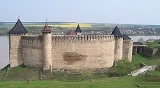
Khotyn

Encyclopedia
Khotyn is a city
in Chernivtsi Oblast
of western Ukraine
, and is the administrative center of Khotyn Raion within the oblast, and is located south-west of Kamianets-Podilskyi
. According to the 2001 Ukrainian census
, it has a population of 11,124. In earlier times, the town was part of the Principality of Moldavia (1359–1812), although due to its fortress, at times it was in Polish
, Turkish
and Austrian hands, then it was part of the Bessarabia Governorate
of the Russian Empire
(1812–1917), Moldavian Democratic Republic
(1917–1918), Romania
(1918–1940, 1941–1944), and the USSR
(1940–1941, 1944–1991).
Khotyn, first chronicled in 1001, is located on the right (southwestern) bank of the Dniester
River, and is part of the historical region Bessarabia
. Important architectural landmarks within the city include the Khotyn Fortress
, constructed in the 13-15th centuries (new fortress started in 1325, major improvements in 1380s and 1460s), and two 15th century constructions by Moldavia's ruler Stephen the Great: the Prince
's Palace (Palatul Domnesc) and the city's clock tower
.
Khotin) was conquered and controlled by many different states, resulting in many name changes. Other name variations include Chotyn, or Choczim (especially in Polish
).
, is sometimes conflated with a sound-alike locality mentioned in 1001, a minor settlement of Kievan Rus'
. Archaeological excavations found that the Kievan town covered the area of some twenty hectares. It later became part of the Principality of Halych and its successor, Halych-Volhynia
. The town was an important trading center due to its location by a river crossing. A Genoese
trading colony was established there by the 13th century.
Khotyn was first mentioned in 1310, as a residence of a catholic bishop, being held in the first half of the 14th century by the Kingdom of Poland, which intended to impose Catholicism on the local Vlach communities, mentioned there in the 10th-13th centuries. The first fortifications date back from this period. In 1351, the Grand Duchy of Lithuania
conquered the area, only to give it three years later to the Vlachs, whom formed their own independent principality in 1359, Moldavia
.
The present-day fortress was constructed after 1400 by the Moldavian ruler Alexander the Good, with the help of Vytautas the Great
of Lithuania. After 1433, it was occupied by Poland, due to wars between Alexander's successors, and was reconquered from the Poles by Stephen the Great of Moldovia in 1459 after a two-year siege. The fortress, strengthened by Stephen, during the 15th century, became the strongest on the northern border of the medieval Moldavia.
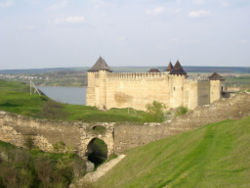 During Wallahian ruler Michael the Brave's conquest of Moldavia in May 1600, its ruler Ieremia Movilă
took refuge in the Fortress of Khotyn together with his family, a handful of faithful boyars, and the former Transylvania
n Prince, Sigismund Bathory
.
As the Moldavian state's international significance was dwindled by that of the Kingdom of Poland and the Ottoman Empire
, the latter sought to gain control of the strategic river crossing. As a result, Khotyn's later history was dominated by wars between the expanding Christian powers (first Poland, then Russia) and the expanding Ottoman Empire
. The Turks suffered two decisive defeats at Khotyn in the 17th century, at the hands of the army of the Polish-Lithuanian Commonwealth
: in 1621
by Hetman
Jan Karol Chodkiewicz
, and again in 1673
by Jan III Sobieski (see: Battles below).
The Ottoman Empire finally seized the fortress from Moldavia
in 1713 during the Great Northern War
, and held it during the following century as a base for its troops. Another power, Russian Empire
, came to claim the region in 18th century. The Turks amplified and enlarged the citadel, which was sieged and taken by the Russians on four occasions: in 1739 by Burkhard Christoph von Munnich
, in 1769 by Prince Alexander Galitzine
, in 1788 by Prince Josias of Coburg
, and Ivan Saltykov, in 1807 by Ivan Michelson.
With the start of the Russo-Turkish War in 1806, the Khotyn Fortress was taken by the Imperial Russian Army
and passed to Russia
. With the signing of the Bucharest Peace Treaty in 1812, the entire region that became known as Bessarabia
was annexed by the Russian Empire from Moldavia.
During 1812–1918, Khotin was the administrative center of the Hotin County
, one of the twelve, later nine counties of Bessarabia. During the 19th century, due to economic reasons and the geographic proximity of Kamianets-Podilskyi
(an important political center during the late Middle Ages and the early modern times), the Ukrainian population of Bessarabia (especially in its north) increased significantly, from around 15,000 in 1810 to around 200,000 in 1917 (of which over half in the northern half of the Hotin county alone), mostly by migration from Podolia
(just across the river Dniester
). During World War I
, the north-eastern corner of the Hotin county was the only area of Bessarabia, occupied temporarily by Austria–Hungary.
from Russia in 1917, then union with Romania
in April 1918. Romania and Austria signed a Peace treaty in May 1918, and the Austrians withdrew. The treaty was not formally ratified by Romania, a former Entente
ally which found itelf in isolation, until on November 10 Romania re-entered the war. The Austrians were in control of Khotin and several villages around for several months starting February 28, 1918., until Romania took over, due to the fact that on April 9, Bessarabia declared union with Romania
. Shortly after that, in January 1919, local Ukrainians desiring to be part of Ukraine, started a revolt, which was also exploited by some Soviet agitators, followed by the ethnic cleansing of Ukrainian civilians by Romanian authorities, on January 23–February 1, 1919. After the Khotin Uprising was put down by the Romanian Army, Romania
implemented nationalist policies aimed at re-Romanizing
the territory.
The city remained under Romanian control until 28 June 1940, when along with Bessarabia and Northern Bukovina
it was occupied by the Soviet Union
. In August 1940, Soviets created the Chernivtsi Oblast
, and included the area around Khotin to it, which became part of the Ukrainian Soviet Socialist Republic
, not of the Moldavian Soviet Socialist Republic, as the rest of Bessarabia. After Operation Barbarossa
, where Romania acted as a Germany ally, the area was retaken by Romania in early July 1941. In March 1944, with the defeat of the Axis forces, the town was retaken by the Soviets, and reattached to the Soviet Ukraine.
With the collapse of the Soviet Union and the Declaration of Independence of Ukraine
in 1991, Khotyn became a part of newly independent Ukraine
. In 2000, the Cabinet of Ministers of Ukraine
created the historical-architectural preserve "Khotynska Fortetsia" (Khotyn Fortress). In September 2002, the city celebrated its 1,000 year anniversary.

 In the first Battle of Khotyn
in 1621, an army of 100,000 to 250,000 Turkish veterans, led by Osman II
, advanced from Adrianople towards the Polish frontier. The Turks, following their victory in the Battle of Cecora, had high hopes of conquering Polish controlled Ukraine
. The Polish-Lithuanian Commonwealth
commander Jan Karol Chodkiewicz
crossed the Dniester
in September 1621 with approximately 35,000 soldiers and entrenched the Khotyn Fortress, blocking the path of the Ottoman march. The arrival of 40,000 Ukrainian Cossack
forces under their hetman Petro Konashevych
was helpful in that anti-Ottoman victory. The Commonwealth hetman held the sultan at bay for a whole month, until the first snow of autumn compelled Osman to withdraw his diminished forces. But the victory was also dearly purchased by Poland: a few days before the siege was raised, the aged grand hetman died of exhaustion in the fortress on September 24, 1621. The Commonwealth forces held under the command of Stanisław Lubomirski. The battle, described by Wacław Potocki
in his most famous work Transakcja wojny chocimskiej, marked the end of the long period of Moldavian Magnate Wars
.
In 1673, the Polish hussar
s again fought a major battle on this site (second Battle of Khotyn). This time Polish forces under the command of soon-to-be-king Jan Sobieski defeated the Ottomans on November 11, 1673. In this battle, rockets of Kazimierz Siemienowicz
were successfully used. This brilliant victory was a prelude to the Battle of Vienna
1683.
In the Russo-Turkish War, the fortress was taken by Russian field marshal
Burkhard Christoph von Munnich
on August 19, 1739. This victory is remembered primarily through the Ode on the Taking of Khotin from the Turks, composed by the young Mikhail Lomonosov
. This ode has a place in the history of Russian literature: its sonorous iambic verse is often taken as a starting point of the modern Russian poetry
.
, indexed by the US Commission for the Preservation of America's Heritage Abroad.
City
A city is a relatively large and permanent settlement. Although there is no agreement on how a city is distinguished from a town within general English language meanings, many cities have a particular administrative, legal, or historical status based on local law.For example, in the U.S...
in Chernivtsi Oblast
Chernivtsi Oblast
Chernivtsi Oblast is an oblast in western Ukraine, bordering on Romania and Moldova. It has a large variety of landforms: the Carpathian Mountains and picturesque hills at the foot of the mountains gradually change to a broad partly forested plain situated between the Dniester and Prut rivers....
of western Ukraine
Ukraine
Ukraine is a country in Eastern Europe. It has an area of 603,628 km², making it the second largest contiguous country on the European continent, after Russia...
, and is the administrative center of Khotyn Raion within the oblast, and is located south-west of Kamianets-Podilskyi
Kamianets-Podilskyi
Kamyanets-Podilsky or Kamienets-Podolsky is a city located on the Smotrych River in western Ukraine, to the north-east of Chernivtsi...
. According to the 2001 Ukrainian census
Ukrainian Census (2001)
The first Ukrainian Census was carried out by State Statistics Committee of Ukraine on 5 December 2001, twelve years after the last Soviet Union census in 1989....
, it has a population of 11,124. In earlier times, the town was part of the Principality of Moldavia (1359–1812), although due to its fortress, at times it was in Polish
Polish-Lithuanian Commonwealth
The Polish–Lithuanian Commonwealth was a dualistic state of Poland and Lithuania ruled by a common monarch. It was the largest and one of the most populous countries of 16th- and 17th‑century Europe with some and a multi-ethnic population of 11 million at its peak in the early 17th century...
, Turkish
Ottoman Empire
The Ottoman EmpireIt was usually referred to as the "Ottoman Empire", the "Turkish Empire", the "Ottoman Caliphate" or more commonly "Turkey" by its contemporaries...
and Austrian hands, then it was part of the Bessarabia Governorate
Bessarabia Governorate
Bessarabia was an oblast and later a guberniya in the Russian Empire. It was the eastern part of the Principality of Moldavia annexed by Russia by the Treaty of Bucharest following the Russo-Turkish War, 1806-1812...
of the Russian Empire
Russian Empire
The Russian Empire was a state that existed from 1721 until the Russian Revolution of 1917. It was the successor to the Tsardom of Russia and the predecessor of the Soviet Union...
(1812–1917), Moldavian Democratic Republic
Moldavian Democratic Republic
The Moldavian Democratic Republic , a.k.a. Moldavian Republic, was the state proclaimed on by Sfatul Ţării of Bessarabia, elected in October-November 1917 in the wake of the February Revolution and disintegration of the political power in the Russian Empire.Sfatul Ţării was its legislative body,...
(1917–1918), Romania
Romania
Romania is a country located at the crossroads of Central and Southeastern Europe, on the Lower Danube, within and outside the Carpathian arch, bordering on the Black Sea...
(1918–1940, 1941–1944), and the USSR
Soviet Union
The Soviet Union , officially the Union of Soviet Socialist Republics , was a constitutionally socialist state that existed in Eurasia between 1922 and 1991....
(1940–1941, 1944–1991).
Khotyn, first chronicled in 1001, is located on the right (southwestern) bank of the Dniester
Dniester
The Dniester is a river in Eastern Europe. It runs through Ukraine and Moldova and separates most of Moldova's territory from the breakaway de facto state of Transnistria.-Names:...
River, and is part of the historical region Bessarabia
Bessarabia
Bessarabia is a historical term for the geographic region in Eastern Europe bounded by the Dniester River on the east and the Prut River on the west....
. Important architectural landmarks within the city include the Khotyn Fortress
Khotyn Fortress
The Khotyn Fortress is a fortification complex located on the right bank of the Dniester River in Khotyn, Chernivtsi Oblast of western Ukraine. It is situated on a territory of the historical northern Bessarabia region which was split in 1940 between Ukraine and Moldova...
, constructed in the 13-15th centuries (new fortress started in 1325, major improvements in 1380s and 1460s), and two 15th century constructions by Moldavia's ruler Stephen the Great: the Prince
Prince
Prince is a general term for a ruler, monarch or member of a monarch's or former monarch's family, and is a hereditary title in the nobility of some European states. The feminine equivalent is a princess...
's Palace (Palatul Domnesc) and the city's clock tower
Clock tower
A clock tower is a tower specifically built with one or more clock faces. Clock towers can be either freestanding or part of a church or municipal building such as a town hall. Some clock towers are not true clock towers having had their clock faces added to an already existing building...
.
Name
Khotyn ' onMouseout='HidePop("16170")' href="/topics/Romanization_of_Russian">translit.Romanization of Russian
Romanization of the Russian alphabet is the process of transliterating the Russian language from the Cyrillic alphabet into the Latin alphabet...
Khotin) was conquered and controlled by many different states, resulting in many name changes. Other name variations include Chotyn, or Choczim (especially in Polish
Polish language
Polish is a language of the Lechitic subgroup of West Slavic languages, used throughout Poland and by Polish minorities in other countries...
).
Early history: 11-15th centuries
Khotyn, located on cliffs above the DniesterDniester
The Dniester is a river in Eastern Europe. It runs through Ukraine and Moldova and separates most of Moldova's territory from the breakaway de facto state of Transnistria.-Names:...
, is sometimes conflated with a sound-alike locality mentioned in 1001, a minor settlement of Kievan Rus'
Kievan Rus'
Kievan Rus was a medieval polity in Eastern Europe, from the late 9th to the mid 13th century, when it disintegrated under the pressure of the Mongol invasion of 1237–1240....
. Archaeological excavations found that the Kievan town covered the area of some twenty hectares. It later became part of the Principality of Halych and its successor, Halych-Volhynia
Halych-Volhynia
The Kingdom of Galicia–Volhynia or Kingdom of Rus or Galicia–Vladimir was a Ruthenian state in the regions of Galicia and Volhynia during 1199–1349. Along with Novgorod and Vladimir-Suzdal, it was one of the three most important powers to emerge from the collapse of Kievan Rus'...
. The town was an important trading center due to its location by a river crossing. A Genoese
Genoa
Genoa |Ligurian]] Zena ; Latin and, archaically, English Genua) is a city and an important seaport in northern Italy, the capital of the Province of Genoa and of the region of Liguria....
trading colony was established there by the 13th century.
Khotyn was first mentioned in 1310, as a residence of a catholic bishop, being held in the first half of the 14th century by the Kingdom of Poland, which intended to impose Catholicism on the local Vlach communities, mentioned there in the 10th-13th centuries. The first fortifications date back from this period. In 1351, the Grand Duchy of Lithuania
Grand Duchy of Lithuania
The Grand Duchy of Lithuania was a European state from the 12th /13th century until 1569 and then as a constituent part of Polish-Lithuanian Commonwealth until 1791 when Constitution of May 3, 1791 abolished it in favor of unitary state. It was founded by the Lithuanians, one of the polytheistic...
conquered the area, only to give it three years later to the Vlachs, whom formed their own independent principality in 1359, Moldavia
Moldavia
Moldavia is a geographic and historical region and former principality in Eastern Europe, corresponding to the territory between the Eastern Carpathians and the Dniester river...
.
The present-day fortress was constructed after 1400 by the Moldavian ruler Alexander the Good, with the help of Vytautas the Great
Vytautas the Great
Vytautas ; styled "the Great" from the 15th century onwards; c. 1350 October 27, 1430) was one of the most famous rulers of medieval Lithuania. Vytautas was the ruler of the Grand Duchy of Lithuania which chiefly encompassed the Lithuanians and Ruthenians...
of Lithuania. After 1433, it was occupied by Poland, due to wars between Alexander's successors, and was reconquered from the Poles by Stephen the Great of Moldovia in 1459 after a two-year siege. The fortress, strengthened by Stephen, during the 15th century, became the strongest on the northern border of the medieval Moldavia.
Conquest by different states
Ieremia Movila
Ieremia Movilă was a Hospodar of Moldavia between August 1595 and May 1600, and again between September 1600 and July 10, 1606.-Rule:...
took refuge in the Fortress of Khotyn together with his family, a handful of faithful boyars, and the former Transylvania
Transylvania
Transylvania is a historical region in the central part of Romania. Bounded on the east and south by the Carpathian mountain range, historical Transylvania extended in the west to the Apuseni Mountains; however, the term sometimes encompasses not only Transylvania proper, but also the historical...
n Prince, Sigismund Bathory
Sigismund Báthory
Sigismund Báthory was Prince of Transylvania.-Biography:Hailing from the Báthory family's Somlyó branch, he was the son of Christopher Báthory, Voivod of Transylvania, and nephew of Stephen Báthory, King of Poland...
.
As the Moldavian state's international significance was dwindled by that of the Kingdom of Poland and the Ottoman Empire
Ottoman Empire
The Ottoman EmpireIt was usually referred to as the "Ottoman Empire", the "Turkish Empire", the "Ottoman Caliphate" or more commonly "Turkey" by its contemporaries...
, the latter sought to gain control of the strategic river crossing. As a result, Khotyn's later history was dominated by wars between the expanding Christian powers (first Poland, then Russia) and the expanding Ottoman Empire
Ottoman Empire
The Ottoman EmpireIt was usually referred to as the "Ottoman Empire", the "Turkish Empire", the "Ottoman Caliphate" or more commonly "Turkey" by its contemporaries...
. The Turks suffered two decisive defeats at Khotyn in the 17th century, at the hands of the army of the Polish-Lithuanian Commonwealth
Polish-Lithuanian Commonwealth
The Polish–Lithuanian Commonwealth was a dualistic state of Poland and Lithuania ruled by a common monarch. It was the largest and one of the most populous countries of 16th- and 17th‑century Europe with some and a multi-ethnic population of 11 million at its peak in the early 17th century...
: in 1621
Battle of Khotyn (1621)
The Battle of Khotyn was a battle fought between a Polish-Lithuanian Commonwealth army and an invading Ottoman Imperial army. Here, for a whole month , the Commonwealth forces halted the Ottoman advance...
by Hetman
Hetman
Hetman was the title of the second-highest military commander in 15th- to 18th-century Poland and the Grand Duchy of Lithuania, which together, from 1569 to 1795, comprised the Polish-Lithuanian Commonwealth, or Rzeczpospolita....
Jan Karol Chodkiewicz
Jan Karol Chodkiewicz
Jan Karol Chodkiewicz was a famous Lithuanian military commander and one of the most prominent noblemen of the Polish-Lithuanian Commonwealth.-Biography:...
, and again in 1673
Battle of Khotyn (1673)
Battle of Khotyn on 11 November 1673 was a battle where Polish-Lithuanian Commonwealth forces under hetman Jan Sobieski defeated Ottoman Empire forces under Hussain Pasha...
by Jan III Sobieski (see: Battles below).
The Ottoman Empire finally seized the fortress from Moldavia
Moldavia
Moldavia is a geographic and historical region and former principality in Eastern Europe, corresponding to the territory between the Eastern Carpathians and the Dniester river...
in 1713 during the Great Northern War
Great Northern War
The Great Northern War was a conflict in which a coalition led by the Tsardom of Russia successfully contested the supremacy of the Swedish Empire in northern Central Europe and Eastern Europe. The initial leaders of the anti-Swedish alliance were Peter I the Great of Russia, Frederick IV of...
, and held it during the following century as a base for its troops. Another power, Russian Empire
Russian Empire
The Russian Empire was a state that existed from 1721 until the Russian Revolution of 1917. It was the successor to the Tsardom of Russia and the predecessor of the Soviet Union...
, came to claim the region in 18th century. The Turks amplified and enlarged the citadel, which was sieged and taken by the Russians on four occasions: in 1739 by Burkhard Christoph von Munnich
Burkhard Christoph von Munnich
Count Burkhard Christoph von Münnich was a Danish-born German soldier-engineer who became a field marshal and political figure in the Russian Empire. He was the major Russian Army reformer and founder of several elite military formations during the reign of Anna of Russia. As a statesman, he is...
, in 1769 by Prince Alexander Galitzine
Aleksandr Mikhailovich Golitsyn (field marshal)
Aleksandr Mikhailovich Golitsyn was a Russian prince of the Galitzine and field marshal. He was the governor of Saint Petersburg in 1780 to 1783.-Early life:...
, in 1788 by Prince Josias of Coburg
Prince Josias of Coburg
Prince Frederick Josias of Saxe-Coburg-Saalfeld was a general in the Austrian service.-Biography:...
, and Ivan Saltykov, in 1807 by Ivan Michelson.
With the start of the Russo-Turkish War in 1806, the Khotyn Fortress was taken by the Imperial Russian Army
Imperial Russian Army
The Imperial Russian Army was the land armed force of the Russian Empire, active from around 1721 to the Russian Revolution of 1917. In the early 1850s, the Russian army consisted of around 938,731 regular soldiers and 245,850 irregulars . Until the time of military reform of Dmitry Milyutin in...
and passed to Russia
Russian Empire
The Russian Empire was a state that existed from 1721 until the Russian Revolution of 1917. It was the successor to the Tsardom of Russia and the predecessor of the Soviet Union...
. With the signing of the Bucharest Peace Treaty in 1812, the entire region that became known as Bessarabia
Bessarabia
Bessarabia is a historical term for the geographic region in Eastern Europe bounded by the Dniester River on the east and the Prut River on the west....
was annexed by the Russian Empire from Moldavia.
During 1812–1918, Khotin was the administrative center of the Hotin County
Hotin County
Hotin County was a county in the Principality of Moldavia , the Governorate of Bessarabia , the Moldavian Democratic Republic , and the Kingdom of Romania ....
, one of the twelve, later nine counties of Bessarabia. During the 19th century, due to economic reasons and the geographic proximity of Kamianets-Podilskyi
Kamianets-Podilskyi
Kamyanets-Podilsky or Kamienets-Podolsky is a city located on the Smotrych River in western Ukraine, to the north-east of Chernivtsi...
(an important political center during the late Middle Ages and the early modern times), the Ukrainian population of Bessarabia (especially in its north) increased significantly, from around 15,000 in 1810 to around 200,000 in 1917 (of which over half in the northern half of the Hotin county alone), mostly by migration from Podolia
Podolia
The region of Podolia is an historical region in the west-central and south-west portions of present-day Ukraine, corresponding to Khmelnytskyi Oblast and Vinnytsia Oblast. Northern Transnistria, in Moldova, is also a part of Podolia...
(just across the river Dniester
Dniester
The Dniester is a river in Eastern Europe. It runs through Ukraine and Moldova and separates most of Moldova's territory from the breakaway de facto state of Transnistria.-Names:...
). During World War I
World War I
World War I , which was predominantly called the World War or the Great War from its occurrence until 1939, and the First World War or World War I thereafter, was a major war centred in Europe that began on 28 July 1914 and lasted until 11 November 1918...
, the north-eastern corner of the Hotin county was the only area of Bessarabia, occupied temporarily by Austria–Hungary.
Modern history: 20th-21st centuries
With the collapse of the Russian Empire, Bessarabia proclaimed independenceMoldavian Democratic Republic
The Moldavian Democratic Republic , a.k.a. Moldavian Republic, was the state proclaimed on by Sfatul Ţării of Bessarabia, elected in October-November 1917 in the wake of the February Revolution and disintegration of the political power in the Russian Empire.Sfatul Ţării was its legislative body,...
from Russia in 1917, then union with Romania
Union of Bessarabia with Romania
On , the Sfatul Ţării, or National Council, of Bessarabia proclaimed union with the Kingdom of Romania.-Governorate of Bessarabia:The 1812 Treaty of Bucharest between the Ottoman Empire and the Russian Empires provided for Russian annexation of the eastern half of the territory of the Principality...
in April 1918. Romania and Austria signed a Peace treaty in May 1918, and the Austrians withdrew. The treaty was not formally ratified by Romania, a former Entente
Allies of World War I
The Entente Powers were the countries at war with the Central Powers during World War I. The members of the Triple Entente were the United Kingdom, France, and the Russian Empire; Italy entered the war on their side in 1915...
ally which found itelf in isolation, until on November 10 Romania re-entered the war. The Austrians were in control of Khotin and several villages around for several months starting February 28, 1918., until Romania took over, due to the fact that on April 9, Bessarabia declared union with Romania
Union of Bessarabia with Romania
On , the Sfatul Ţării, or National Council, of Bessarabia proclaimed union with the Kingdom of Romania.-Governorate of Bessarabia:The 1812 Treaty of Bucharest between the Ottoman Empire and the Russian Empires provided for Russian annexation of the eastern half of the territory of the Principality...
. Shortly after that, in January 1919, local Ukrainians desiring to be part of Ukraine, started a revolt, which was also exploited by some Soviet agitators, followed by the ethnic cleansing of Ukrainian civilians by Romanian authorities, on January 23–February 1, 1919. After the Khotin Uprising was put down by the Romanian Army, Romania
Romania
Romania is a country located at the crossroads of Central and Southeastern Europe, on the Lower Danube, within and outside the Carpathian arch, bordering on the Black Sea...
implemented nationalist policies aimed at re-Romanizing
Romanianization
Romanianization or Rumanization is the term used to describe a number of ethnic assimilation policies implemented by the Romanian authorities during the 20th century...
the territory.
The city remained under Romanian control until 28 June 1940, when along with Bessarabia and Northern Bukovina
Bukovina
Bukovina is a historical region on the northern slopes of the northeastern Carpathian Mountains and the adjoining plains.-Name:The name Bukovina came into official use in 1775 with the region's annexation from the Principality of Moldavia to the possessions of the Habsburg Monarchy, which became...
it was occupied by the Soviet Union
Soviet Union
The Soviet Union , officially the Union of Soviet Socialist Republics , was a constitutionally socialist state that existed in Eurasia between 1922 and 1991....
. In August 1940, Soviets created the Chernivtsi Oblast
Chernivtsi Oblast
Chernivtsi Oblast is an oblast in western Ukraine, bordering on Romania and Moldova. It has a large variety of landforms: the Carpathian Mountains and picturesque hills at the foot of the mountains gradually change to a broad partly forested plain situated between the Dniester and Prut rivers....
, and included the area around Khotin to it, which became part of the Ukrainian Soviet Socialist Republic
Ukrainian SSR
The Ukrainian Soviet Socialist Republic or in short, the Ukrainian SSR was a sovereign Soviet Socialist state and one of the fifteen constituent republics of the Soviet Union lasting from its inception in 1922 to the breakup in 1991...
, not of the Moldavian Soviet Socialist Republic, as the rest of Bessarabia. After Operation Barbarossa
Operation Barbarossa
Operation Barbarossa was the code name for Germany's invasion of the Soviet Union during World War II that began on 22 June 1941. Over 4.5 million troops of the Axis powers invaded the USSR along a front., the largest invasion in the history of warfare...
, where Romania acted as a Germany ally, the area was retaken by Romania in early July 1941. In March 1944, with the defeat of the Axis forces, the town was retaken by the Soviets, and reattached to the Soviet Ukraine.
With the collapse of the Soviet Union and the Declaration of Independence of Ukraine
Declaration of Independence of Ukraine
The Act of Declaration of Independence of Ukraine was adopted by the Ukrainian parliament on August 24, 1991. The Act established Ukraine as an independent, democratic state....
in 1991, Khotyn became a part of newly independent Ukraine
Ukraine
Ukraine is a country in Eastern Europe. It has an area of 603,628 km², making it the second largest contiguous country on the European continent, after Russia...
. In 2000, the Cabinet of Ministers of Ukraine
Cabinet of Ministers of Ukraine
The Cabinet of Ukraine is the highest body of state executive power in Ukraine also referred to as the Government of Ukraine...
created the historical-architectural preserve "Khotynska Fortetsia" (Khotyn Fortress). In September 2002, the city celebrated its 1,000 year anniversary.
Battles
Battle of Khotyn (1621)
The Battle of Khotyn was a battle fought between a Polish-Lithuanian Commonwealth army and an invading Ottoman Imperial army. Here, for a whole month , the Commonwealth forces halted the Ottoman advance...
in 1621, an army of 100,000 to 250,000 Turkish veterans, led by Osman II
Osman II
Sultan Osman II or Othman II was the Sultan of the Ottoman Empire from 1618 until his death on 20 May 1622...
, advanced from Adrianople towards the Polish frontier. The Turks, following their victory in the Battle of Cecora, had high hopes of conquering Polish controlled Ukraine
Ukraine
Ukraine is a country in Eastern Europe. It has an area of 603,628 km², making it the second largest contiguous country on the European continent, after Russia...
. The Polish-Lithuanian Commonwealth
Polish-Lithuanian Commonwealth
The Polish–Lithuanian Commonwealth was a dualistic state of Poland and Lithuania ruled by a common monarch. It was the largest and one of the most populous countries of 16th- and 17th‑century Europe with some and a multi-ethnic population of 11 million at its peak in the early 17th century...
commander Jan Karol Chodkiewicz
Jan Karol Chodkiewicz
Jan Karol Chodkiewicz was a famous Lithuanian military commander and one of the most prominent noblemen of the Polish-Lithuanian Commonwealth.-Biography:...
crossed the Dniester
Dniester
The Dniester is a river in Eastern Europe. It runs through Ukraine and Moldova and separates most of Moldova's territory from the breakaway de facto state of Transnistria.-Names:...
in September 1621 with approximately 35,000 soldiers and entrenched the Khotyn Fortress, blocking the path of the Ottoman march. The arrival of 40,000 Ukrainian Cossack
Zaporozhian Host
The Zaporozhian Cossacks or simply Zaporozhians were Ukrainian Cossacks who lived beyond the rapids of the Dnieper river, the land also known as the Great Meadow in Central Ukraine...
forces under their hetman Petro Konashevych
Petro Konashevych
Petro Konashevych-Sahaidachnyi, , was a Hetman of Registered Cossacks and the Kosh Otaman of Zaporozhian Host from 1601–1618, a brilliant military leader both on land and sea. While being a Cossack Hetman, he transformed the Cossack Host into a regular military formation and imparted a statist...
was helpful in that anti-Ottoman victory. The Commonwealth hetman held the sultan at bay for a whole month, until the first snow of autumn compelled Osman to withdraw his diminished forces. But the victory was also dearly purchased by Poland: a few days before the siege was raised, the aged grand hetman died of exhaustion in the fortress on September 24, 1621. The Commonwealth forces held under the command of Stanisław Lubomirski. The battle, described by Wacław Potocki
Waclaw Potocki
Wacław Potocki was a Polish nobleman , moralist, poet, and writer. He was the podczaszy of Kraków from 1678 to 1685. He is remembered as one of the most important Polish baroque artists...
in his most famous work Transakcja wojny chocimskiej, marked the end of the long period of Moldavian Magnate Wars
Moldavian Magnate Wars
The Moldavian Magnate Wars refer to the period at the end of the 16th century and the beginning of the 17th century when the magnates of the Polish-Lithuanian Commonwealth intervened in the affairs of Moldavia, clashing with the Habsburgs and the Ottoman Empire for domination and influence over the...
.
In 1673, the Polish hussar
Hussar
Hussar refers to a number of types of light cavalry which originated in Hungary in the 14th century, tracing its roots from Serbian medieval cavalry tradition, brought to Hungary in the course of the Serb migrations, which began in the late 14th century....
s again fought a major battle on this site (second Battle of Khotyn). This time Polish forces under the command of soon-to-be-king Jan Sobieski defeated the Ottomans on November 11, 1673. In this battle, rockets of Kazimierz Siemienowicz
Kazimierz Siemienowicz
Kazimierz Siemienowicz , was a Polish-Lithuanian general of artillery, gunsmith, military engineer, artillery specialist and pioneer of rocketry. Born in the Grand Duchy of Lithuania, he served the armies of the Polish-Lithuanian Commonwealth, a federation of Poland and the Grand Duchy, and in the...
were successfully used. This brilliant victory was a prelude to the Battle of Vienna
Battle of Vienna
The Battle of Vienna took place on 11 and 12 September 1683 after Vienna had been besieged by the Ottoman Empire for two months...
1683.
In the Russo-Turkish War, the fortress was taken by Russian field marshal
Field Marshal
Field Marshal is a military rank. Traditionally, it is the highest military rank in an army.-Etymology:The origin of the rank of field marshal dates to the early Middle Ages, originally meaning the keeper of the king's horses , from the time of the early Frankish kings.-Usage and hierarchical...
Burkhard Christoph von Munnich
Burkhard Christoph von Munnich
Count Burkhard Christoph von Münnich was a Danish-born German soldier-engineer who became a field marshal and political figure in the Russian Empire. He was the major Russian Army reformer and founder of several elite military formations during the reign of Anna of Russia. As a statesman, he is...
on August 19, 1739. This victory is remembered primarily through the Ode on the Taking of Khotin from the Turks, composed by the young Mikhail Lomonosov
Mikhail Lomonosov
Mikhail Vasilyevich Lomonosov was a Russian polymath, scientist and writer, who made important contributions to literature, education, and science. Among his discoveries was the atmosphere of Venus. His spheres of science were natural science, chemistry, physics, mineralogy, history, art,...
. This ode has a place in the history of Russian literature: its sonorous iambic verse is often taken as a starting point of the modern Russian poetry
Russian literature
Russian literature refers to the literature of Russia or its émigrés, and to the Russian-language literature of several independent nations once a part of what was historically Russia or the Soviet Union...
.
Famous people
- The RomaniaRomaniaRomania is a country located at the crossroads of Central and Southeastern Europe, on the Lower Danube, within and outside the Carpathian arch, bordering on the Black Sea...
n philologist, historianHistorianA historian is a person who studies and writes about the past and is regarded as an authority on it. Historians are concerned with the continuous, methodical narrative and research of past events as relating to the human race; as well as the study of all history in time. If the individual is...
and writer Bogdan Petriceicu-Hasdeu was born near Khotyn on February 16, 1836. - Azriel Yanover (1875–1938), an Yiddish poet, playwright, and educator; lived in Khotyn from 1895.
- Alemdar Mustafa PashaAlemdar Mustafa PashaAlemdar Mustafa Pasha was an Ottoman military commander and a Grand Vizier born in Khotyn in Turkish-occupied Ukraine in 1765...
(1765–1808), Ottoman Grand Vizier, was born in Khotyn (Hotin)
Jewish Cemetery
Khotyn contains a Jewish cemeteryJewish Cemetery in Khotyn
The Jewish cemetery of Khotyn, Ukraine.- Background :The city of Khotyn is located in the Chernivtsi oblast of Ukraine. According to the Encyclopedia of Ukraine, during the late 19th and early 20th centuries, the town was almost entirely Jewish or Russian...
, indexed by the US Commission for the Preservation of America's Heritage Abroad.
External links
- Verkhovna Rada website – city of Khotyn, Chernivetska oblast, Khotynskyi Raion
- Flags of the World – Khotyn (Chernivtsi, Ukraine)
- Khotyn info, eng – Unknown-Ukraine
- Khotyn photo gallery – by Sergiy Klymenko, July 2004
- Castles and churches of Ukraine – Khotyn, Chocim
- Photo Khotyn Castle