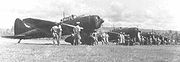
Aichi D3A

Encyclopedia

World War II Allied names for Japanese aircraft
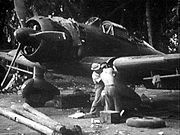
The World War II Allied names for Japanese aircraft were reporting names, often described as codenames, given by Allied personnel to Imperial Japanese aircraft during the Pacific campaign of World War II. The names were used by Allied personnel to identify Japanese aircraft for reporting and...
"Val") was a World War II
World War II
World War II, or the Second World War , was a global conflict lasting from 1939 to 1945, involving most of the world's nations—including all of the great powers—eventually forming two opposing military alliances: the Allies and the Axis...
carrier-borne dive bomber
Dive bomber
A dive bomber is a bomber aircraft that dives directly at its targets in order to provide greater accuracy for the bomb it drops. Diving towards the target reduces the distance the bomb has to fall, which is the primary factor in determining the accuracy of the drop...
of the Imperial Japanese Navy
Imperial Japanese Navy
The Imperial Japanese Navy was the navy of the Empire of Japan from 1869 until 1947, when it was dissolved following Japan's constitutional renunciation of the use of force as a means of settling international disputes...
(IJN). It was the primary dive bomber in the Imperial Japanese Navy
Imperial Japanese Navy
The Imperial Japanese Navy was the navy of the Empire of Japan from 1869 until 1947, when it was dissolved following Japan's constitutional renunciation of the use of force as a means of settling international disputes...
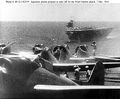
, and participated in almost all actions, including Pearl Harbor
Attack on Pearl Harbor
The attack on Pearl Harbor was a surprise military strike conducted by the Imperial Japanese Navy against the United States naval base at Pearl Harbor, Hawaii, on the morning of December 7, 1941...
.
The Aichi D3A was the first Japanese aircraft to bomb American targets in World War II, commencing with Pearl Harbor
Pearl Harbor
Pearl Harbor, known to Hawaiians as Puuloa, is a lagoon harbor on the island of Oahu, Hawaii, west of Honolulu. Much of the harbor and surrounding lands is a United States Navy deep-water naval base. It is also the headquarters of the U.S. Pacific Fleet...
and US bases in the Philippines
Philippines
The Philippines , officially known as the Republic of the Philippines , is a country in Southeast Asia in the western Pacific Ocean. To its north across the Luzon Strait lies Taiwan. West across the South China Sea sits Vietnam...
, such as Clark Air Force Base. During the course of the Second World War, the Val dive bomber sank more Allied warships than any other Axis
Axis Powers
The Axis powers , also known as the Axis alliance, Axis nations, Axis countries, or just the Axis, was an alignment of great powers during the mid-20th century that fought World War II against the Allies. It began in 1936 with treaties of friendship between Germany and Italy and between Germany and...
aircraft.
Design and development
In mid-1936, the Japanese Navy issued the 11-Shi specification for a monoplaneMonoplane
A monoplane is a fixed-wing aircraft with one main set of wing surfaces, in contrast to a biplane or triplane. Since the late 1930s it has been the most common form for a fixed wing aircraft.-Types of monoplane:...
carrier-based dive bomber to replace the existing D1A
Aichi D1A
|-See also:-External links:*...
biplane
Biplane
A biplane is a fixed-wing aircraft with two superimposed main wings. The Wright brothers' Wright Flyer used a biplane design, as did most aircraft in the early years of aviation. While a biplane wing structure has a structural advantage, it produces more drag than a similar monoplane wing...
currently in service. Aichi, Nakajima
Nakajima Aircraft Company
The Nakajima Aircraft Company was a prominent Japanese aircraft manufacturer throughout World War II.-History:...
and Mitsubishi
Mitsubishi
The Mitsubishi Group , Mitsubishi Group of Companies, or Mitsubishi Companies is a Japanese multinational conglomerate company that consists of a range of autonomous businesses which share the Mitsubishi brand, trademark and legacy...
all submitted designs, and Aichi and Nakajima were both asked for two prototypes each.
The Aichi design started with low-mounted elliptical wings inspired by the Heinkel He 70
Heinkel He 70
The Heinkel He 70 was a German mail plane and fast passenger aircraft of the 1930s, that also saw use in auxiliary bomber and reconnaissance roles. It had a relatively brief commercial career before it was replaced by types which could carry more passengers...
Blitz. It flew slowly enough that the drag from the landing gear
Undercarriage
The undercarriage or landing gear in aviation, is the structure that supports an aircraft on the ground and allows it to taxi, takeoff and land...
was not a serious issue, so fixed gear were used for simplicity. The aircraft was to be powered by the 529 kW (710 hp) Nakajima Hikari
Nakajima Hikari
|-See also:-References:*...
1 nine-cylinder radial engine
Radial engine
The radial engine is a reciprocating type internal combustion engine configuration in which the cylinders point outward from a central crankshaft like the spokes on a wheel...
.
The first prototype
Prototype
A prototype is an early sample or model built to test a concept or process or to act as a thing to be replicated or learned from.The word prototype derives from the Greek πρωτότυπον , "primitive form", neutral of πρωτότυπος , "original, primitive", from πρῶτος , "first" and τύπος ,...
was completed in December 1937, and flight trials began a month later. Initial tests were disappointing. The aircraft was underpowered and suffered from directional instability in wide turns, and in tighter turns, it tended to snap roll
Aerobatic maneuver
Aerobatic maneuvers are flight paths putting aircraft in unusual attitudes, in air shows, dog fights or competition aerobatics. Aerobatics can be performed by a single aircraft or in formation with several others...
. The dive brake
Dive bomber
A dive bomber is a bomber aircraft that dives directly at its targets in order to provide greater accuracy for the bomb it drops. Diving towards the target reduces the distance the bomb has to fall, which is the primary factor in determining the accuracy of the drop...
s vibrated heavily when extended at their design speed of 370 km/h (200 kn), and the Navy was already asking for a faster diving speed of 240 kn (440 km/h).
The second aircraft was extensively modified prior to delivery to try to address the problems. Power was increased by replacing the Hikari with the 626 kW (840 hp) Mitsubishi Kinsei
Mitsubishi Kinsei
|-See also:-Bibliography:* Matsuoka Hisamitsu, Nakanishi Masayoshi. The History of Mitsubishi Aero Engines 1915-1945. Miki Press, Japan, 2005. ISBN 4-89522-461-9...
3 in a redesigned cowling
Cowling
A cowling is the covering of a vehicle's engine, most often found on automobiles and aircraft.A cowling may be used:* for drag reduction* for engine cooling by directing airflow* as an air intake for jet engines* for decorative purposes...
, and the vertical tail
Vertical stabilizer
The vertical stabilizers, vertical stabilisers, or fins, of aircraft, missiles or bombs are typically found on the aft end of the fuselage or body, and are intended to reduce aerodynamic side slip. It is analogical to a skeg on boats and ships.On aircraft, vertical stabilizers generally point upwards...
was enlarged to help with the directional instability. The wings were slightly larger in span and the outer sections of the leading edge
Leading edge
The leading edge is the part of the wing that first contacts the air; alternatively it is the foremost edge of an airfoil section. The first is an aerodynamic definition, the second a structural one....
s had wash-out
Washout (aviation)
Washout refers to a feature of wing design to deliberately reduce the lift distribution across the span of the wing of an aircraft. The wing is designed so that angle of incidence is higher at the wing roots and decreases across the span, becoming lowest at the wing tip...
to combat the snap rolls, and strengthened dive brakes were fitted. These changes cured all of the problems except the directional instability, and it was enough for the D3A1 to win over the Nakajima D3N1.
Operational history
In December 1939, the Navy ordered the aircraft as the Navy Type 99 Carrier Bomber Model 11 (kanjō bakugekiki, usually abbreviated to 艦爆 kanbaku.). The production models featured slightly smaller wings and increased power in the form of the 746 kW (1,000 hp) Kinsei 43 or 798 kW (1,070 hp) Kinsei 44. The directional instability problem was finally cured with the fitting of a long dorsal finVertical stabilizer
The vertical stabilizers, vertical stabilisers, or fins, of aircraft, missiles or bombs are typically found on the aft end of the fuselage or body, and are intended to reduce aerodynamic side slip. It is analogical to a skeg on boats and ships.On aircraft, vertical stabilizers generally point upwards...
, and the aircraft actually became highly maneuverable.
Armament was two forward-firing 7.7 mm (.303 in) Type 97 machine gun
Type 97 Light Machine Gun
The was the standard machine gun used in tanks and armored vehicles of the Imperial Japanese Army during World War II, and also as a light machine gun by infantry forces.-Development:...
s, and one flexible 7.7 mm (.303 in) Type 92 machine gun
Type 92 machine gun
The was developed for aerial use for the Imperial Japanese Navy before World War II. It was the standard hand-held machine gun in multi-place IJN aircraft during the most part of the Pacific War. It proved to be seriously inadequate...
in the rear cockpit
Cockpit
A cockpit or flight deck is the area, usually near the front of an aircraft, from which a pilot controls the aircraft. Most modern cockpits are enclosed, except on some small aircraft, and cockpits on large airliners are also physically separated from the cabin...
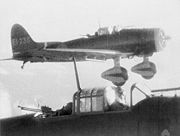
for defense. Normal bombload was a single 250 kg (550 lb) bomb carried under the fuselage, which was swung out under the propeller on release by a trapeze. Two additional 60 kg (130 lb) bombs could be carried on wing racks located under each wing outboard of the dive brakes.
The D3A1 commenced carrier qualification trials aboard the Akagi
Japanese aircraft carrier Akagi
Akagi was an aircraft carrier of the Imperial Japanese Navy , originally begun as an . She was converted while still under construction to an aircraft carrier under the terms of the Washington Naval Treaty...
and Kaga
Japanese aircraft carrier Kaga
Kaga was an aircraft carrier of the Imperial Japanese Navy , named after the former Kaga Province in present-day Ishikawa Prefecture...
during 1940, while a small number of aircraft made their combat debut from land bases over China
Second Sino-Japanese War
The Second Sino-Japanese War was a military conflict fought primarily between the Republic of China and the Empire of Japan. From 1937 to 1941, China fought Japan with some economic help from Germany , the Soviet Union and the United States...
. Starting with the attack on Pearl Harbor, the D3A1 took part in all major Japanese carrier operations in the first 10 months of the war. They achieved their first major success against the Royal Navy
Royal Navy
The Royal Navy is the naval warfare service branch of the British Armed Forces. Founded in the 16th century, it is the oldest service branch and is known as the Senior Service...
during their Indian Ocean raid
Indian Ocean raid
The Indian Ocean raid was a naval sortie by the Fast Carrier Strike Force of the Imperial Japanese Navy from 31 March-10 April 1942 against Allied shipping and bases in the Indian Ocean. It was an early engagement of the Pacific campaign of World War II...
in April 1942. Val dive bombers scored over 80% hits with their bombs during attacks on two heavy cruisers and an aircraft carrier during the operation. During the course of the war, Val dive bombers had to frequently combine their attacks upon enemy warships with the IJN Kate
Nakajima B5N
|-See also:-References:NotesBibliography* Bridgwater, H.C. and Peter Scott. Combat Colours Number 4: Pearl Harbor and Beyond, December 1941 to May 1942. Luton, Bedfordshire, UK: Guideline Publications, 2001. ISBN 0-9539040-6-7....
torpedo bomber; consequently enemy vessels were often sunk by a combination strike of bombs and torpedoes. However, there were occasions when just the Vals would make the attacks, or at least score the sinking hits. Discounting the Pearl Harbor strike, which contained multiple types of attack aircraft, which delivered different weapons, Val dive bombers were credited with sinking the following Allied warships:
Allied warships sunk by Aichi D3As; type, nation, date of loss, location
, British heavy cruiser, 5 April 1942 - Indian OceanIndian Ocean
The Indian Ocean is the third largest of the world's oceanic divisions, covering approximately 20% of the water on the Earth's surface. It is bounded on the north by the Indian Subcontinent and Arabian Peninsula ; on the west by eastern Africa; on the east by Indochina, the Sunda Islands, and...
, British heavy cruiser, 5 April 1942 - Indian Ocean, British armed merchant cruiser, 5 April 1942 - Indian Ocean, British destroyer, 5 April 1942 - Indian Ocean, British aircraft carrier, 9 April 1942 - Indian Ocean, Australian destroyer, 9 April 1942 - Indian Ocean, American seaplane tender (sunk by US forces after attack) 27 Feb 1942 - Pacific Ocean
Pacific Ocean
The Pacific Ocean is the largest of the Earth's oceanic divisions. It extends from the Arctic in the north to the Southern Ocean in the south, bounded by Asia and Australia in the west, and the Americas in the east.At 165.2 million square kilometres in area, this largest division of the World...
, American destroyer, 19 February 1942 - Australia (Darwin
Darwin, Northern Territory
Darwin is the capital city of the Northern Territory, Australia. Situated on the Timor Sea, Darwin has a population of 127,500, making it by far the largest and most populated city in the sparsely populated Northern Territory, but the least populous of all Australia's capital cities...
), American destroyer, 1 March 1942 - Pacific Ocean
Pacific Ocean
The Pacific Ocean is the largest of the Earth's oceanic divisions. It extends from the Arctic in the north to the Southern Ocean in the south, bounded by Asia and Australia in the west, and the Americas in the east.At 165.2 million square kilometres in area, this largest division of the World...
, American aircraft carrier, 8 May 1942 - Pacific Ocean, American aircraft carrier, 7 June 1942 - Pacific Ocean, American aircraft carrier, 27 October 1942 - Pacific Ocean, American destroyer, 1 February 1943 - Pacific Ocean, American destroyer, 7 April 1943 - Pacific Ocean, American destroyer, 26 December 1943 - Pacific Ocean, American destroyer, 7 May 1942 - Pacific Ocean, American destroyer, 15 November 1942 - Pacific Ocean, American destroyer, 1 November 1944 - Pacific Ocean, American aircraft carrier, 4 January 1945 - Philippines (Panay
Panay
Panay may refer to*Panay Island*Panay *Panay, Capiz*Panay River*Panay Gulf* USS Panay *Panay incident...
), American aircraft carrier, 21 February 1945 - Japan (Iwo Jima
Iwo Jima
Iwo Jima, officially , is an island of the Japanese Volcano Islands chain, which lie south of the Ogasawara Islands and together with them form the Ogasawara Archipelago. The island is located south of mainland Tokyo and administered as part of Ogasawara, one of eight villages of Tokyo...
), American destroyer, 6 April 1945 - Japan (Okinawa)
As the war progressed, there were instances when the dive bombers were pressed into duty as fighter
Fighter aircraft
A fighter aircraft is a military aircraft designed primarily for air-to-air combat with other aircraft, as opposed to a bomber, which is designed primarily to attack ground targets...
s in the interceptor role, their maneuverability being enough to allow them to survive in this role. In June 1942, an improved version of the D3A powered by a 969 kW (1,300 hp) Kinsei 54 was tested as the Model 12. The extra power reduced range, so the design was further modified with additional fuel tank
Fuel tank
A fuel tank is safe container for flammable fluids. Though any storage tank for fuel may be so called, the term is typically applied to part of an engine system in which the fuel is stored and propelled or released into an engine...
s to bring the total tankage to 900 l (237.8 US gal), giving it the range needed to fight effectively over the Solomon Islands
Solomon Islands
Solomon Islands is a sovereign state in Oceania, east of Papua New Guinea, consisting of nearly one thousand islands. It covers a land mass of . The capital, Honiara, is located on the island of Guadalcanal...
. Known to the Navy as the Model 22, it began to replace the Model 11 in front-line units in autumn 1942, and most Model 11s were then sent to training units.
When the Yokosuka D4Y
Yokosuka D4Y
The D4Y Navy Type 2 Carrier Dive bomber was operated by the Imperial Japanese Navy. Its Allied reporting name was "Judy". The D4Y was one of the fastest dive-bombers of the war, and only the delays in its development hindered its service, while its predecessor, the slower fixed gear Aichi D3A...
Suisei became available, the D3A2s ended up with land-based units or operating from the smaller carriers, which were too small to handle the fast-landing Suisei. When American
United States
The United States of America is a federal constitutional republic comprising fifty states and a federal district...
forces recaptured the Philippines in 1944, land-based D3A2s took part in the fighting, but were hopelessly outdated and losses were heavy. By then, many D3A1s and D3A2s were operated by training units in Japan, and several were modified with dual controls as Navy Type 99 Bomber Trainer Model 12s (D3A2-K). During the last year of the war, the D3A2s were pressed back into combat for kamikaze
Kamikaze
The were suicide attacks by military aviators from the Empire of Japan against Allied naval vessels in the closing stages of the Pacific campaign of World War II, designed to destroy as many warships as possible....
missions.
Survivors
One D3A is currently under restoration at the Planes of FamePlanes of Fame
Planes of Fame Air Museum is an aviation museum located in Chino, California, and Valle, Arizona. The museum has many flying and static aircraft, along with multiple rare examples under restoration.-History:...
Museum in Chino, California
Chino, California
Chino is a city in San Bernardino County, California, United States. It is located in the western end of the Riverside-San Bernardino Area and it is easily accessible via the Chino Valley and Pomona freeways....
.
Another unrestored D3A2 is on display at the National Museum of the Pacific War
National Museum of the Pacific War
The National Museum of the Pacific War is located in Fredericksburg, Texas, the boyhood home of Fleet Admiral Chester W. Nimitz. Fleet Admiral Nimitz served as CinCPAC, Commander in Chief, United States Pacific Fleet during World War II...
in Fredericksburg, Texas
Specifications (D3A1)

Specifications (D3A2)