

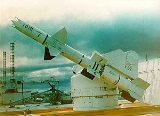
RIM-8 Talos

Encyclopedia
The Bendix
RIM-8 Talos was a long-range naval surface-to-air missile
, and was among the earliest surface-to-air missiles to equip United States Navy
ships. The Talos used radar beam riding
for guidance to the vicinity of its target, and semiactive radar homing
(SARH) for terminal guidance. The characteristic array of four antennas surrounding the nose are the SARH receivers which functioned as a continuous wave interferometer. Thrust was provided by a solid rocket
booster for initial launch and a Bendix ramjet
for flight to target with the warhead doubling as the ramjet's compressor.
s like Henschel Hs 293
glide bomb
s, Fritz X
, and kamikaze
aircraft. The Talos was the primary effort behind the Bumblebee project, but was not the first missile the program developed; the RIM-2 Terrier
was the first to enter service. The Talos was originally designated SAM-N-6, and was redesignated RIM-8 in 1963.
The Talos saw relatively limited use due to its large size and dual radar antenna system; there were few ships that could accommodate the large missiles with the AN/SPW-2 missile guidance radar and the AN/SPG-49 target illumination and tracking radar. Indeed, the 11.6-meter-long, 3½-tonne missile was similar in size to a fighter aircraft
. The Talos Mark 7 launcher system was installed in three Galveston class cruisers
(converted Cleveland class light cruisers
) with 14 birds in a ready-service magazine and up to 30 unmated missiles and boosters in a storage area above the main deck. Nuclear-powered USS Long Beach
and three Albany class cruiser
(converted Baltimore class heavy cruisers
) carried Mark 12 launchers fed from behind by a 46-round magazine below the main deck.
The initial SAM-N-6b/RIM-8A had an effective range of about 50 nm, and a conventional warhead
. The SAM-N-6bW/RIM-8B was a RIM-8A with a nuclear warhead
; terminal guidance was judged unnecessary for a nuclear warhead, so the SARH antenna were omitted. The SAM-N-6b1/RIM-8C was introduced in 1960 and had nearly double the range, and a more effective conventional continuous-rod warhead
. The RIM-8D was the nuclear-warhead version of the -8C. The SAM-N-6c/RIM-8E "Unified Talos" had a warhead that could be swapped while embarked, eliminating the need to waste magazine capacity carrying dedicated nuclear warhead variants. The RIM-8E also carried an improved continuous-wave terminal homing seeker, and had a higher ceiling. Some RIM-8Cs were retrofitted with the new seeker, and designated RIM-8F. The RIM-8G and RIM-8J had further radar homing improvements. The RIM-8H Talos-ARM was a dedicated anti-radar homing missile for use against shore-based radar stations. Initial testing of the RIM-8H was performed in 1965, and soon after it was deployed in Vietnam on Chicago, Oklahoma City, and Long Beach, attacking North Vietnamese SAM radars. The surface-to-air versions also saw action in Vietnam, a total of three MiG
s being shot down by Chicago and Long Beach. The Talos missile also had surface-to-surface
capabilities.
missile, which was fired from the smaller Mk10 launcher.
The missiles remaining in the Navy inventory were converted to a high tech supersonic target missile, the MQM-8G Vandal. The inventory was exhausted around 2008.
Bendix Corporation
The Bendix Corporation was an American manufacturing and engineering company which during various times in its 60 year existence made brake systems, aeronautical hydraulics, avionics, aircraft and automobile fuel control systems, radios, televisions and computers, and which licensed its name for...
RIM-8 Talos was a long-range naval surface-to-air missile
Surface-to-air missile
A surface-to-air missile or ground-to-air missile is a missile designed to be launched from the ground to destroy aircraft or other missiles...
, and was among the earliest surface-to-air missiles to equip United States Navy
United States Navy
The United States Navy is the naval warfare service branch of the United States Armed Forces and one of the seven uniformed services of the United States. The U.S. Navy is the largest in the world; its battle fleet tonnage is greater than that of the next 13 largest navies combined. The U.S...
ships. The Talos used radar beam riding
Beam riding
Beam-riding, also known as beam guidance, is a technique of directing a missile to its target by means of radar or a laser beam. The name refers to the way the missile flies down the guidance beam, which is aimed at the target...
for guidance to the vicinity of its target, and semiactive radar homing
Semi-active radar homing
Semi-active radar homing, or SARH, is a common type of missile guidance system, perhaps the most common type for longer-range air-to-air and surface-to-air missile systems. The name refers to the fact that the missile itself is only a passive detector of a radar signal – provided by an external ...
(SARH) for terminal guidance. The characteristic array of four antennas surrounding the nose are the SARH receivers which functioned as a continuous wave interferometer. Thrust was provided by a solid rocket
Solid rocket
A solid rocket or a solid-fuel rocket is a rocket engine that uses solid propellants . The earliest rockets were solid-fuel rockets powered by gunpowder; they were used by the Chinese in warfare as early as the 13th century and later by the Mongols, Arabs, and Indians.All rockets used some form of...
booster for initial launch and a Bendix ramjet
Ramjet
A ramjet, sometimes referred to as a stovepipe jet, or an athodyd, is a form of airbreathing jet engine using the engine's forward motion to compress incoming air, without a rotary compressor. Ramjets cannot produce thrust at zero airspeed and thus cannot move an aircraft from a standstill...
for flight to target with the warhead doubling as the ramjet's compressor.
History
Talos was the end product of Operation Bumblebee, the Navy's 16-year surface-to-air missile development program for protection against guided anti-ship missileAnti-ship missile
Anti-ship missiles are guided missiles that are designed for use against ships and large boats. Most anti-ship missiles are of the sea-skimming type, many use a combination of inertial guidance and radar homing...
s like Henschel Hs 293
Henschel Hs 293
The Henschel Hs 293 was a World War II German anti-ship guided missile: a radio-controlled glide bomb with a rocket engine slung underneath it. It was designed by Herbert A. Wagner.- History :...
glide bomb
Glide bomb
A glide bomb is an aerial bomb modified with aerodynamic surfaces to modify its flight path from a purely ballistic one to a flatter, gliding, one. This extends the range between the launch aircraft and the target. Glide bombs are often fitted with control systems, allowing the controlling aircraft...
s, Fritz X
Fritz X
Fritz X was the most common name for a German guided anti-ship glide bomb used during World War II. Fritz X was a nickname used both by Allied and Luftwaffe personnel. Alternate names include Ruhrstahl SD 1400 X, Kramer X-1, PC 1400X or FX 1400...
, and kamikaze
Kamikaze
The were suicide attacks by military aviators from the Empire of Japan against Allied naval vessels in the closing stages of the Pacific campaign of World War II, designed to destroy as many warships as possible....
aircraft. The Talos was the primary effort behind the Bumblebee project, but was not the first missile the program developed; the RIM-2 Terrier
RIM-2 Terrier
The Convair RIM-2 Terrier was a two-stage medium-range naval surface-to-air missile , and was among the earliest surface-to-air missiles to equip United States Navy ships. Originally, the Terrier had a launch thrust of 23 kN , and weight of 1392 kg...
was the first to enter service. The Talos was originally designated SAM-N-6, and was redesignated RIM-8 in 1963.
The Talos saw relatively limited use due to its large size and dual radar antenna system; there were few ships that could accommodate the large missiles with the AN/SPW-2 missile guidance radar and the AN/SPG-49 target illumination and tracking radar. Indeed, the 11.6-meter-long, 3½-tonne missile was similar in size to a fighter aircraft
Fighter aircraft
A fighter aircraft is a military aircraft designed primarily for air-to-air combat with other aircraft, as opposed to a bomber, which is designed primarily to attack ground targets...
. The Talos Mark 7 launcher system was installed in three Galveston class cruisers
Galveston class cruiser
Originally built as Cleveland-class light cruisers in the United States Navy during World War II, in 1957 three ships were re-designated as Galveston-class guided missile light cruisers and fitted with the Talos long-range surface-to-air missile system...
(converted Cleveland class light cruisers
Cleveland class cruiser
The United States Navy designed the Cleveland class of light cruisers for World War II with the goal of increased range and AA armament as compared with earlier classes.A total of 52 ships of this class were projected and 3 canceled...
) with 14 birds in a ready-service magazine and up to 30 unmated missiles and boosters in a storage area above the main deck. Nuclear-powered USS Long Beach
USS Long Beach (CGN-9)
USS Long Beach was a nuclear-powered guided missile cruiser in the United States Navy. She was the only ship of her class....
and three Albany class cruiser
Albany class cruiser
The Albany Class guided missile cruisers were converted Baltimore and Oregon City class heavy cruisers of the United States Navy. All original superstructure and weapons were removed and replaced...
(converted Baltimore class heavy cruisers
Baltimore class cruiser
The Baltimore class cruiser was a type of heavy cruiser in the United States Navy from the last years of the Second World War. Fast and heavily armed, ships like the Baltimore cruisers were mainly used by the Navy in World War II to protect the fast aircraft carriers in carrier battle groups...
) carried Mark 12 launchers fed from behind by a 46-round magazine below the main deck.
The initial SAM-N-6b/RIM-8A had an effective range of about 50 nm, and a conventional warhead
Warhead
The term warhead refers to the explosive material and detonator that is delivered by a missile, rocket, or torpedo.- Etymology :During the early development of naval torpedoes, they could be equipped with an inert payload that was intended for use during training, test firing and exercises. This...
. The SAM-N-6bW/RIM-8B was a RIM-8A with a nuclear warhead
Nuclear weapon
A nuclear weapon is an explosive device that derives its destructive force from nuclear reactions, either fission or a combination of fission and fusion. Both reactions release vast quantities of energy from relatively small amounts of matter. The first fission bomb test released the same amount...
; terminal guidance was judged unnecessary for a nuclear warhead, so the SARH antenna were omitted. The SAM-N-6b1/RIM-8C was introduced in 1960 and had nearly double the range, and a more effective conventional continuous-rod warhead
Continuous-rod warhead
A continuous-rod warhead is a specialized munition that exhibits an annular blast fragmentation pattern. It is used in anti-aircraft and anti-missile missiles.-Early anti-aircraft munitions:...
. The RIM-8D was the nuclear-warhead version of the -8C. The SAM-N-6c/RIM-8E "Unified Talos" had a warhead that could be swapped while embarked, eliminating the need to waste magazine capacity carrying dedicated nuclear warhead variants. The RIM-8E also carried an improved continuous-wave terminal homing seeker, and had a higher ceiling. Some RIM-8Cs were retrofitted with the new seeker, and designated RIM-8F. The RIM-8G and RIM-8J had further radar homing improvements. The RIM-8H Talos-ARM was a dedicated anti-radar homing missile for use against shore-based radar stations. Initial testing of the RIM-8H was performed in 1965, and soon after it was deployed in Vietnam on Chicago, Oklahoma City, and Long Beach, attacking North Vietnamese SAM radars. The surface-to-air versions also saw action in Vietnam, a total of three MiG
Mig
-Industry:*MiG, now Mikoyan, a Russian aircraft corporation, formerly the Mikoyan-Gurevich Design Bureau*Metal inert gas welding or MIG welding, a type of welding using an electric arc and a shielding gas-Business and finance:...
s being shot down by Chicago and Long Beach. The Talos missile also had surface-to-surface
Surface-to-surface missile
A surface-to-surface missile is a guided projectile launched from a hand-held, vehicle mounted, trailer mounted or fixed installation or from a ship. They are often powered by a rocket motor or sometimes fired by an explosive charge, since the launching platform is typically stationary or moving...
capabilities.
Chronology
| Date | Fleet inventory | Ship | Event |
|---|---|---|---|
| 28 May 1958 | 1xMk 7 launcher with 2xAN/SPG-49 RADAR | Galveston USS Galveston (CLG-3) The USS Galveston was a Cleveland class light cruiser of the United States Navy that was later converted to a Galveston class guided missile cruiser. She was launched by William Cramp and Sons Shipbuilding Co., Philadelphia, Pennsylvania., 22 April 1945: and sponsored by Mrs. Clark Wallace Thompson... |
commissioned as CLG-3 |
| 3 June 1960 | 2xMk 7 launchers with 4xAN/SPG-49 RADAR | Little Rock | commissioned as CLG-4 |
| 7 September 1960 | 3xMk 7 launchers with 6xAN/SPG-49 RADAR | Oklahoma City USS Oklahoma City (CLG-5) USS Oklahoma City was one of 27 United States Navy light cruisers completed during or shortly after World War II, and one of six to be converted to guided missile cruisers. She was the first US Navy ship to be named for Oklahoma City, Oklahoma... |
commissioned as CLG-5 |
| 9 September 1961 | 3xMk 7 & 1xMk 12 launchers with 8xAN/SPG-49 RADAR | Long Beach USS Long Beach (CGN-9) USS Long Beach was a nuclear-powered guided missile cruiser in the United States Navy. She was the only ship of her class.... |
commissioned as CGN-9 |
| 3 November 1962 | 3xMk 7 & 3xMk 12 launchers with 12xAN/SPG-49 RADAR | Albany USS Albany (CA-123) USS Albany was a United States Navy Oregon City-class heavy cruiser, later converted to the guided missile cruiser CG-10. The converted cruiser was the lead ship the new Albany guided missile cruiser class... |
commissioned as CG-10 |
| 1 December 1962 | 3xMk 7 & 5xMk 12 launchers with 16xAN/SPG-49 RADAR | Columbus USS Columbus (CA-74) The third USS Columbus , a Baltimore-class heavy cruiser, was the second ship of the United States Navy named for Columbus, Ohio. She was launched 30 November 1944 by Bethlehem Steel Co., Quincy, Massachusetts; she was sponsored by Mrs. E. G... |
commissioned as CG-12 |
| 2 May 1964 | 3xMk 7 & 7xMk 12 launchers with 20xAN/SPG-49 RADAR | Chicago USS Chicago (CA-136) USS Chicago was a Baltimore class heavy cruiser laid down on 28 July 1943 at Philadelphia, Pennsylvania, USA, by the Philadelphia Navy Yard. Launched on 20 August 1944 she was sponsored by Mrs. Edward J. Kelly, wife of the Mayor of Chicago, Illinois, and commissioned at the Philadelphia Navy Yard... |
commissioned as CG-11 |
| 25 May 1970 | 2xMk 7 & 7xMk 12 launchers with 18xAN/SPG-49 RADAR | Galveston | decommissioned |
| 31 January 1975 | 2xMk 7 & 5xMk 12 launchers with 14xAN/SPG-49 RADAR | Columbus | decommissioned |
| 22 November 1976 | 1xMk 7 & 5xMk 12 launchers with 12xAN/SPG-49 RADAR | Little Rock | decommissioned |
| 1978 | 1xMk 7 & 4xMk 12 launchers with 10xAN/SPG-49 RADAR | Long Beach | Talos system removed |
| 15 December 1979 | 4xMk 12 launchers with 8xAN/SPG-49 RADAR | Oklahoma City | decommissioned |
| 1 March 1980 | 2xMk 12 launchers with 4xAN/SPG-49 RADAR | Chicago | decommissioned |
| 29 August 1980 | Albany | decommissioned |
Fate
Talos was phased out of fleet service in 1976, though the ships carrying the system soldiered on a few more years with the launchers left in place until they (Albany-class, and Oklahoma City) were retired in 1980, after Long Beach had her Talos launcher removed in 1978. After 22 years of fleet service, the missile was replaced by the RIM-67 StandardRIM-67 Standard
The RIM-67 Standard ER is an extended range surface-to-air missile and anti ship missile originally developed for the United States Navy...
missile, which was fired from the smaller Mk10 launcher.
The missiles remaining in the Navy inventory were converted to a high tech supersonic target missile, the MQM-8G Vandal. The inventory was exhausted around 2008.