
All Topics  
Mount Fuji


   Email Print
   Bookmark   Link


Mount Fuji


' is the highest mountain
Mountain

A mountain is a landform that stretches above the surrounding land in a limited area usually in the form of a peak. A mountain is generally steeper than a hill....
 in Japan
Japan

Japan is an island country in East Asia. Located in the Pacific Ocean, it lies to the east of the Sea of Japan, People's Republic of China, North Korea, South Korea and Russia, stretching from the Sea of Okhotsk in the north to the East China Sea and Taiwan in the south....
 at . Along with Mount Tate
Mount Tate

is located in the southeastern area of Toyama Prefecture, Japan. It is the tallest peak in the Hida Mountains at and, along with Mount Fuji and Mount Haku, it is one of Japan's "Three Holy Mountains" Sanreizan)....
 and Mount Haku
Mount Haku

, or Mount Hakusan, is a stratovolcano located on the borders of Gifu Prefecture, Fukui Prefecture and Ishikawa Prefecture prefectures in Japan....
, it is one of Japan's "Three Holy Mountains" (??? Sanreizan). An active volcano that last erupted in 1707–08, Mount Fuji straddles the boundary of Shizuoka
Shizuoka Prefecture

is a Prefectures of Japan of Japan located in the Chubu region on Honshu. The capital is the city of Shizuoka, Shizuoka....
 and Yamanashi
Yamanashi Prefecture

is a Prefectures of Japan of Japan located in the Chubu region of the island of Honshu. The capital is the city of Kofu....
 prefectures
Prefectures of Japan

The prefectures of Japan are the country's 47 sub-national jurisdictions: one "metropolis" , Tokyo; one "Circuit #Japan" , Hokkaido; two urban prefectures , Osaka Prefecture and Kyoto Prefecture; and 43 other prefectures ....
 just west of Tokyo
Tokyo

, officially , is one of the 47 prefectures of Japan of Japan and located on the eastern side of the main island Honshu. The twenty-three special wards of Tokyo, each governed as a city, cover the area that was once the Tokyo City in the eastern part of the prefecture, and total over 8 million people....
, from which it can be seen on a clear day.


Discussion
Ask a question about 'Mount Fuji'
Start a new discussion about 'Mount Fuji'
Answer questions from other users
Full Discussion Forum


Recent Posts


Encyclopedia


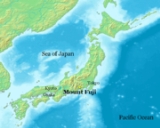
Position of Mount Fuji
' is the highest mountain
Mountain

A mountain is a landform that stretches above the surrounding land in a limited area usually in the form of a peak. A mountain is generally steeper than a hill....
 in Japan
Japan

Japan is an island country in East Asia. Located in the Pacific Ocean, it lies to the east of the Sea of Japan, People's Republic of China, North Korea, South Korea and Russia, stretching from the Sea of Okhotsk in the north to the East China Sea and Taiwan in the south....
 at . Along with Mount Tate
Mount Tate

is located in the southeastern area of Toyama Prefecture, Japan. It is the tallest peak in the Hida Mountains at and, along with Mount Fuji and Mount Haku, it is one of Japan's "Three Holy Mountains" Sanreizan)....
 and Mount Haku
Mount Haku

, or Mount Hakusan, is a stratovolcano located on the borders of Gifu Prefecture, Fukui Prefecture and Ishikawa Prefecture prefectures in Japan....
, it is one of Japan's "Three Holy Mountains" (??? Sanreizan). An active volcano that last erupted in 1707–08, Mount Fuji straddles the boundary of Shizuoka
Shizuoka Prefecture

is a Prefectures of Japan of Japan located in the Chubu region on Honshu. The capital is the city of Shizuoka, Shizuoka....
 and Yamanashi
Yamanashi Prefecture

is a Prefectures of Japan of Japan located in the Chubu region of the island of Honshu. The capital is the city of Kofu....
 prefectures
Prefectures of Japan

The prefectures of Japan are the country's 47 sub-national jurisdictions: one "metropolis" , Tokyo; one "Circuit #Japan" , Hokkaido; two urban prefectures , Osaka Prefecture and Kyoto Prefecture; and 43 other prefectures ....
 just west of Tokyo
Tokyo

, officially , is one of the 47 prefectures of Japan of Japan and located on the eastern side of the main island Honshu. The twenty-three special wards of Tokyo, each governed as a city, cover the area that was once the Tokyo City in the eastern part of the prefecture, and total over 8 million people....
, from which it can be seen on a clear day. It is located near the Pacific coast of central Honshu
Honshu

or Honshu is the largest island of Japan. The nation's main island, it is south of Hokkaido across the Tsugaru Strait, north of Shikoku across the Inland Sea, and northeast of Kyushu across the Kanmon Strait....
. Three small cities surround it: Gotemba (south), Fujiyoshida
Fujiyoshida, Yamanashi

is a cities of Japan located in Yamanashi Prefecture, Japan, in the center of the Japanese main island of Honshu....
 (north) and Fujinomiya
Fujinomiya, Shizuoka

is a cities of Japan located in eastern Shizuoka Prefecture, Japan.The city was founded on June 1, 1942.Fujinomiya is known as one of the basic starting points for climbing trips to Mt.Fuji....
 (southwest).

Mount Fuji's exceptionally symmetrical cone is a well-known symbol of Japan and it is frequently depicted in art and photographs, as well as visited by sightseers and climbers.

Geography


Mt. Fuji stands at high and is surrounded by five lakes: Lake Kawaguchi
Lake Kawaguchi

is a lake near Mt Fuji, Japan. Located in Fujikawaguchiko, Yamanashi, Yamanashi Prefecture, it is the most popular of the Fuji Five Lakes in terms of tourists, and is part of the Fuji-Hakone-Izu National Park....
, Lake Yamanaka
Lake Yamanaka

is the biggest of the Fuji Five Lakes. Located in Yamanashi Prefecture near Mount Fuji, Japan, the lake is used for boating, fishing, water-skiing, windsurfing, sightseeing and swimming....
, Lake Sai
Saiko, Yamanashi

The Saiko is one of the Fuji Five Lakes, located in Yamanashi Prefecture, Japan. It is connected to Lake Shoji and Lake Motosu by underground waterways and all three remain the same surface level of 901 metres above sea level....
, Lake Motosu and Lake Shoji. They, and nearby Lake Ashi
Lake Ashi

, or Hakone Lake, Ashinoko Lake, is a scenic lake in the Hakone area of Kanagawa Prefecture in Honshu, Japan. It is a crater lake that lies along the southwest wall of the caldera of Mount Hakone, a complex volcano....
, provide excellent views of the mountain. It is part of the Fuji-Hakone-Izu National Park
Fuji-Hakone-Izu National Park

is a national park in Yamanashi Prefecture, Shizuoka Prefecture, Kanagawa Prefecture, and Tokyo Metropolis, Japan. It consists of Mount Fuji, Fuji Five Lakes, Hakone, the Izu Peninsula, and the Izu Islands....
. It is also a stratovolcano
Stratovolcano

A stratovolcano, sometimes called a composite volcano, is a tall, Volcanic cone volcano with many layers of hardened lava, tephra, and volcanic ash....
. The climate is very cold due to the altitude and the cone is covered by snow for several months of the year. The lowest recorded temperature is −38.0 °C while on June 2008 the highest temperature was recorded at 17.8 °C.

It can be seen from Yokohama
Yokohama

is the capital city of Kanagawa Prefecture. It lies on Tokyo Bay, south of Tokyo, in the Kanto region of the main island of Honshu. It is a major commercial hub of the Greater Tokyo Area....
, Tokyo
Tokyo

, officially , is one of the 47 prefectures of Japan of Japan and located on the eastern side of the main island Honshu. The twenty-three special wards of Tokyo, each governed as a city, cover the area that was once the Tokyo City in the eastern part of the prefecture, and total over 8 million people....
, and sometimes as far as Chiba
Chiba, Chiba

is the capital cities of Japan of Chiba Prefecture, Japan. It is located approximately 40 km east of the center of Tokyo on Tokyo Bay. Chiba City became a City designated by government ordinance in 1992....
 and Saitama
Saitama

is an indigenous Japanese place and family name which may often refer to:* Saitama Prefecture is a prefecture of Japan in the Kanto region.* Saitama, Saitama is the capital and the most populous city of Saitama Prefecture incorporating former cities of Urawa, Omiya, Yono and Iwatsuki....
 when the sky is clear.

Geology

Scientists have identified four distinct phases of volcanic activity in the formation of Mt. Fuji. The first phase, called Sen-komitake, is composed of an andesite
Andesite

Andesite is an igneous rock, volcanic rock, of Igneous rock#Chemical classification, with aphanitic to porphyritic texture. The mineral assemblage is typically dominated by plagioclase plus pyroxene and/or hornblende....
 core recently discovered deep within the mountain. Sen-komitake was followed by the "Komitake Fuji," a basalt
Basalt

Basalt is a common extrusive volcanic rock. It is usually gray to black and fine-grained due to rapid cooling of lava at the surface of a planet....
 layer believed to be formed several hundred thousand years ago. Approximately 100,000 years ago, "Old Fuji" was formed over the top of Komitake Fuji. The modern, "New Fuji" is believed to have formed over the top of Old Fuji around 10,000 years ago.

The volcano
Volcano

A volcano is an opening, or rupture, in a planet's surface or Crust , which allows hot, molten rock, ash, and gases to escape from below the surface....
 is currently classified as active with a low risk of eruption. The last recorded eruption
Hoei eruption of Mount Fuji

The started on December 16, 1707 and ended about January 1, 1708 during the Edo period. Although it brought no lava flow, the Hoei eruption released some 800 million cubic meters of volcanic ash, which spread over vast areas around the volcano, even reaching Edo almost 100 km away....
 started on December 16, 1707 (Hoei
Hoei

was a after Genroku and before Shotoku . This period spanned the years from 1704 through 1711. The reigning emperors were and ....
 4, 23rd day of the 11th month
) and ended about January 1, 1708 (Hoei 4, 9th day of the 12th month) during the Edo period
Edo period

The , or , is a division of History of Japan running from 1603 to 1868. The period marks the governance of the Edo or Tokugawa shogunate, which was officially established in 1603 by the first Edo shogun Tokugawa Ieyasu....
. This is sometimes called "the great Hoei eruption
Hoei eruption of Mount Fuji

The started on December 16, 1707 and ended about January 1, 1708 during the Edo period. Although it brought no lava flow, the Hoei eruption released some 800 million cubic meters of volcanic ash, which spread over vast areas around the volcano, even reaching Edo almost 100 km away....
." Fuji spewed cinders and ash which fell like rain in Izu
Izu Province

Izu was a Provinces of Japan including the Izu Peninsula that is today part of Shizuoka prefecture and the Izu Islands that are now part of Tokyo....
, Kai
Kai Province

is an old provinces of Japan in Japan that corresponds to Yamanashi Prefecture today. It lies in central Honshu, west of Tokyo, in a landlocked mountainous region that includes Mount Fuji along its border with Shizuoka Prefecture....
, Sagami
Sagami Province

was an old provinces of Japan. It occupied most of the area that is today Kanagawa prefecture, but present-day Yokohama and Kawasaki, Kanagawa, now part of Kanagawa Prefecture, were not in Sagami....
, and Musashi
Musashi Province

was a Provinces of Japan of Japan, which today comprises Tokyo, most of Saitama Prefecture and part of Kanagawa Prefecture, mainly Kawasaki, Kanagawa and Yokohama....
. Since then, there have been no signs of an eruption.

At this time, a new crater
Volcanic crater

A volcanic crater is a circular depression in the ground caused by volcanic activity. It is typically a basin, circular in form within which occurs a vent from which magma erupts as gases, lava, and ejecta....
, along with a second peak, named Hoei-zan after the era name
Hoei

was a after Genroku and before Shotoku . This period spanned the years from 1704 through 1711. The reigning emperors were and ....
, formed halfway down its side.

Mount Fuji is located at the point where the Eurasian Plate
Eurasian Plate

The Eurasian Plate is a tectonic plate which includes most of the continent of Eurasia , with the notable exceptions of the Indian subcontinent, the Arabian subcontinent, and the area east of the Chersky Range in East Siberia....
 (or the Amurian Plate
Amurian Plate

The Amurian Plate is a proposed continental tectonic plate covering Manchuria, the Korean Peninsula, Western Japan, and Primorsky Krai. It is not clear yet whether it is an independent plate or a part of the Eurasian Plate....
), the Okhotsk Plate
Okhotsk Plate

The Okhotsk Plate is a tectonic plate covering the Sea of Okhotsk, the Kamchatka Peninsula, and Eastern Japan. It was formerly considered a part of the North American Plate, but recent studies indicate that it is an independent plate, bounded on the north by the North American Plate....
, and the Philippine Plate
Philippine Plate

File:Philippine Sea plate.JPGThe Philippine Sea Plate is a tectonic plate beneath the Pacific Ocean to the east of the Philippines. The Philippine Sea Plate comprises oceanic lithosphere that lies beneath the Philippine Sea, and so has been referred to in the scientific literature of the last 50 years as the Philippine Sea Plate....
 meet. Those plates form the western part of Japan, the eastern part of Japan, and the Izu Peninsula
Izu Peninsula

The is a peninsula to the west of Tokyo on the Japanese island of Honshu. Formerly the eponymous Izu Province, the Izu peninsula is now a part of Shizuoka prefecture....
 respectively.

Name


Variations


Fuji-san is sometimes referred to as "Fujiyama" in some Western texts, but this reading
Kanji

are the Chinese characters that are used in the modern Japanese language logogram along with hiragana , katakana , Arabic numerals, and the occasional use of the Latin alphabet....
 is not correct in standard Japanese.

In Nihon-shiki and Kunrei-shiki romanization, the name is transliterated as Huzi. Other Japanese names for Mt. Fuji, which have become obsolete or poetic, include Fuji-no-Yama (????, the Mountain of Fuji), Fuji-no-Takane (?????, the High Peak of Fuji), Fuyo-ho (???, the Lotus Peak), and Fugaku (?? or ??, the first character of ??, Fuji, and ?, mountain).

Etymology

The current kanji
Kanji

are the Chinese characters that are used in the modern Japanese language logogram along with hiragana , katakana , Arabic numerals, and the occasional use of the Latin alphabet....
 for Mount Fuji, ? and ?, mean wealth or abundant and a man with a certain status respectively, but these characters are probably ateji
Ateji

In modern Japanese language, are kanji used phonetically to represent native or borrowed words. This is analogous to man'yogana in pre-modern Japanese....
; the characters
Chinese character

A Chinese character, also known as a Han character , is a logogram used in writing Chinese language ,'' Japanese language ,'' less frequently Korean language ,'' and formerly Vietnamese language .''...
 were likely selected because their pronunciations match the syllables of the name, and do not carry a particular meaning.

The origin of the name Fuji is unclear. An early folk etymology claims that Fuji came from ?? (not + two), meaning without equal or nonpareil. Another claims that it came from ?? (not + exhaust), meaning neverending. A Japanese classical scholar in the Edo era, Hirata Atsutane
Hirata Atsutane

was a Japanese scholar, conventionally ranked as one of the four great men of Kokugaku studies, and one of the most significant theologians of the Shinto religion....
 speculated that the name is from a word meaning "a mountain standing up shapely as an ear (ho) of a rice plant". A British missionary John Batchelor (1854-1944) argued that the name is from the Ainu
Ainu language

Hokkaido Ainu is an Ainu languages spoken by members of the Ainu people ethnic group on the northern Japanese island of Hokkaido.Until the twentieth century, Ainu languages were also spoken throughout the southern half of the island of Sakhalin and by small numbers of people in the Kuril Islands....
 word for 'fire' (fuchi) of the fire deity (Kamui Fuchi
Kamui Fuchi

Kamui Fuchi is the Ainu people kamui of the hearth. Her full name is Apemerukoyan-mat Unamerukoyan-mat , and she is sometimes styled Iresu Kamui ....
), which was denied by a Japanese linguist Kyosuke Kindaichi
Kyosuke Kindaichi

was an eminent Japanese Linguistics from Morioka, Iwate, Iwate Prefecture. He is chiefly known for his dictations of yukar, or sagas of the Ainu people....
 (1882-1971) on the grounds of phonetic development (sound change
Sound change

Sound change includes any processes of language change that affect pronunciation or sound system structures . Sound change can consist of the replacement of one phoneme by another, the complete loss of the affected sound, or even the introduction of a new sound in a place where there previously was none....
). It is also pointed out that huchi means an 'old woman' and ape is the word for 'fire', ape huchi kamuy being the fire deity. Research on the distribution of place names that include fuji as a part also suggest the origin of the word fuji is in the Yamato
Yamato people

The are the dominant native ethnic group of Japan. It is a term that came to be used around the late 19th century to distinguish the residents of the mainland Japan from other minority ethnic groups who have resided in the peripheral areas of Japan such as Ainu people, Ryukyuan people, Nivkhs, Oroks, as well as Korean people, Taiwanese people, and...
 language rather than Ainu. A Japanese toponymist Kanji Kagami argued that the name has the same root as 'wisteria
Wisteria

Wisteria is a genus of about ten species of woody climbing vines native to the eastern United States and the East Asian states of China, Korea, and Japan....
' (fuji) and 'rainbow' (niji, but with an alternative word fuji), and came from its "long well-shaped slope".

A text of the Tale of the Bamboo Cutter
The Tale of the Bamboo Cutter

The Tale of the Bamboo Cutter is a 10th century Japanese folklore, also known as The Tale of Princess Kaguya . It is considered the oldest extant Japanese literature....
 says that the name came from and also from the image of ascending the slopes of the mountain.

History


It is thought that the first ascent was in 663 by an anonymous monk. The summit has been thought of as sacred since ancient times and was forbidden to women until the Meiji Era
Meiji period

The , or Meiji era, denotes the 45-year reign of the Meiji Emperor, running, in the Gregorian calendar, from 23 October 1868 to 30 July 1912. During this time, Japan started its modernization and rose to world power status....
.

The first ascent by a foreigner was by Sir Rutherford Alcock
Rutherford Alcock

Sir Rutherford Alcock, Order of the Bath was the first British diplomatic representative in Japan. See Heads of the United Kingdom Mission in Japan....
 in September 1860, from the foot of the mountain to the top in eight hours and three hours for the descent. Alcock's brief narrative in The Capital of the Tycoon was the first widely disseminated description of the mountain in the West. Lady Fanny Parkes, the wife of British ambassador Sir Harry Parkes
Harry Smith Parkes

Sir Harry Smith Parkes was a 19th century United Kingdom diplomat who worked mainly in China and Japan. Parkes Street in Kowloon, Hong Kong is named after him....
, was the first non-Japanese woman to ascend Mount Fuji in 1867; and photographer Felix Beato climbed Mount Fuji in that same year.

Today, Mount Fuji is an international tourist destination and common destination for mountain-climbing. In the early 20th century, populist educator Frederick Starr
Frederick Starr

Frederick Starr , aka Ofuda Hakushi in Japan, was an United States academic, Anthropology, and "populist educator" born at Auburn, New York....
's Chautauqua
Chautauqua

Chautauqua is an adult education movement in the United States, highly popular in the late 19th and early 20th centuries. Chautauqua assemblies expanded and spread throughout rural America until the mid-1920s....
 lectures about his several ascents of Mount Fuji --1913, 1919, and 1923 -- were widely known in America. A well-known Japanese saying suggests that anybody would be a fool not to climb Mt. Fuji once--but a fool to do so twice.

Mount Fuji is an attractive volcanic cone
Volcanic cone

Volcanic cones are among the simplest volcano formations in the world. They are built by fragments thrown up from a volcanic vent, piling up around the vent in the shape of a cone with a central crater....
 and a frequent subject of Japanese art
Japanese art

Japanese art covers a wide range of art styles and media, including ancient pottery, sculpture in wood and bronze, ink painting on silk and paper, and a myriad of other types of works of art....
. Amongst the most renowned works are Hokusai
Hokusai

was a Japanese artist, ukiyo-e Painting and printmaker of the Edo period. In his time, he was Japan's leading expert on Chinese painting. Born in Edo , Hokusai is best-known as author of the woodblock printing in Japan series 36 Views of Mount Fuji which includes the iconic and internationally recognized print, The Great Wave off Kanagawa...
's 36 Views of Mount Fuji
36 Views of Mount Fuji (Hokusai)

File:Tsunami by hokusai 19th century.jpg is an ukiyo-e series of 46 large, color Woodblock printing in Japan by the Japanese artist Katsushika Hokusai ....
 and his One Hundred Views of Mount Fuji. The mountain is also mentioned in Japanese literature throughout the ages and the subject of many poems.

Mt. Fuji also houses a warrior tradition: ancient samurai used the base of the mountain as a remote training area, near the present day town of Gotemba. The shogun
Shogun

is a military rank and historical title for Hereditary Commanders in Chief of the Armed Forces of Japan. The Japanese word for "general", it is made up of two kanji characters: sho, meaning "commander", "general", or "admiral", and gun meaning military troops or warriors....
 Minamoto no Yoritomo
Minamoto no Yoritomo

was the founder and the first shogun of the Kamakura shogunate of Japan. He ruled from 1192 until 1199....
 held yabusame
Yabusame

is a type of Kyudo, one that is performed while riding a horse.The archer shoots a special "turnip-headed" arrow at a wooden target.This style of archery has its origins at the beginning of the Kamakura period....
 in the area in the early Kamakura period
Kamakura period

The is a period of History of Japan that marks the governance by the Kamakura shogunate, officially established in 1192 in Kamakura, Kanagawa by the first shogun Minamoto no Yoritomo....
. As of 2006, the Japan Self-Defense Forces
Japan Self-Defense Forces

The , or JSDF, occasionally referred to as JSF, are the Armed forces in Japan that were established after the end of the post-World War II American occupation of Japan....
 and the United States Marine Corps
United States Marine Corps

The United States Marine Corps is a branch of the United States Armed Forces responsible for providing Military power projection from the sea, using the mobility of the United States Navy to rapidly deliver Marine Air-Ground Task Force....
 operate military bases near Mount Fuji.

Climbing Mount Fuji


Mtfujisunrise


The most popular period for people to hike up Mt. Fuji is from 1 July to 27 August, while huts and other facilities are operating. Buses to the fifth station start running on 1 July. Some climb the mountain at night in order to be in a position at or near the summit when the sun rises.

There are four major routes from the fifth station to the summit with an additional four routes from the foot of the mountain. The major routes from the fifth station are (clockwise) the Kawaguchiko, Subashiri, Gotemba, and Fujinomiya routes. The routes from the foot of the mountain are the Shojiko, Yoshida, Suyama, and Murayama routes. The stations on different routes are at different elevations. The highest fifth station is located at Fujinomiya, followed by Kawaguchi, Subashiri, and Gotemba.

Even though it is only the second highest fifth station, the Kawaguchiko route is the most popular route because of its large parking area and many and large mountain huts where a climber can rest or stay. During the summer season, most Mount Fuji climbing tour buses arrive there. The next popular is the Fujinomiya route which has the highest fifth station, followed by Subashiri and Gotemba.

Even though most climbers do not climb the Subashiri and Gotemba routes, many descend these because of their ash-covered paths. From the seventh station to near the fifth station, one could run down these ash-covered paths in approximately 30 minutes. Besides these routes, there are tractor routes along the climbing routes. These tractor routes are used to bring food and other materials to huts on the mountain. Because the tractors usually take up most of the width of these path and they tend to push large rocks from the side of the path, the tractor paths are off-limits to the climbers on sections that are not merged with the climbing or descending paths. Nevertheless, one can sometimes see people riding mountain bikes along the tractor routes down from the summit. This is particularly risky, as it becomes difficult to control speed and may send some rocks rolling along the side of the path, which may hit other people.

The four routes from the foot of the mountain offer historical sites. The Murayama is the oldest Mount Fuji route and the Yoshida route still has many old shrines, teahouses, and huts along its path. These routes are gaining popularity recently and are being restored, but climbing from the foot of the mountain is still relatively uncommon. Also, bear
Asiatic Black Bear

The Asian black bear , also known as the Asiatic Black Bear, Tibetan black bear, the Himalayan black bear, or the Moon bear, is a medium sized, sharp-clawed, black-colored bear with a distinctive white or cream "V" marking on its chest....
s have been sighted along the Yoshida route.

An estimated 200,000 people climb Mount Fuji every year, 30% of whom are foreigners. The ascent from the new fifth station can take anywhere between three and eight hours while the descent can take from two to five hours. The hike from the foot of the mountain is divided into 10 stations, and there are paved roads up to the fifth station, which is about 2,300 meters above sea level. Huts at and above the fifth stations are usually manned during the climbing season, but huts below fifth stations are not usually manned for climbers. The number of open huts on routes are proportional to the number of climbers - Kawaguchiko has the most while Gotemba has the least. The huts along the Gotemba route also tend to start later and close earlier than those at the Kawaguchiko route. Also, because Mount Fuji is designated as a national park, it is illegal to tent above the fifth station.

There are eight peaks around the crater at the summit. The highest point in Japan is where the Mount Fuji Radar System
Mount Fuji Radar System

The Mount Fuji Radar System is a historic weather radar system located on the summit of Mount Fuji, Japan. It was completed in 1964, and is now recorded on the list of IEEE Milestones in electrical engineering....
 used to be. Climbers are able to visit each of these peaks.

Paragliding at Mount Fuji


Paragliders take off in the vicinity of the fifth station Gotemba parking lot, between Subashiri and Hoei-zan peak on the south side from the Mountain, in addition to several other locations depending on wind direction. Several paragliding schools use the wide sandy/grassy slope between Gotenba and Subashiri parking lots as a training hill.

Aokigahara

print of Mt. Fuji from Ogata Gekko
Ogata Gekko

File:Ogata Gekko - Ryu sho ten edit.jpgOgata Gekko was a Japanese painter and woodblock printing in Japan artist of the ukiyo-e genre.Gekko's work was originally closely based upon that of Kikuchi Yosai, and was also inspired by Hokusai, creating a series of one hundred prints of Mount Fuji....
's Views of Mt. Fuji.]] The forest
Forest

File:Stara planina suma.jpgA forest is an area with a high density of trees. There are many definitions of a forest, based on various criteria....
 at the base of the mountain is named Aokigahara
Aokigahara

, also known as the , is a forest that lies at the base of Mount Fuji in Japan. The caverns found in this forest are rocky and ice-covered annually....
. Folk tales and legends tell of demon
Demon

In religion, folklore, and mythology a demon is a supernatural being that is generally described as a malevolent spirit. In Christian terms demons are generally understood as fallen angels, formerly of God....
s, ghost
Ghost

File:Henry Fuseli- Hamlet and his father's Ghost.JPGA ghost is popularly held to be the disembodied spirit or soul of a death person. Popularly described as insubstantial and partly transparent, ghosts are reported to haunt particular List of reportedly haunted locations that they were associated with in life or at time of death....
s, and goblin
Goblin

A goblin is an imaginary evil, crabby, and mischievous creature described as a grotesquely disfigured or gnome-like Wiktionary:phantom, that may range in height from that of a dwarf to that of a human....
s haunting the forest, and in the 19th century, Aokigahara was one of many places poor families abandoned the very young and the very old. Aokigahara is the world’s second most popular suicide location after San Francisco’s Golden Gate Bridge
Golden Gate Bridge

The Golden Gate Bridge is a suspension bridge bridge spanning the Golden Gate, the opening of the San Francisco Bay onto the Pacific Ocean. As part of both U.S....
. Since the 1950s, more than 500 people have lost their lives in the forest, mostly suicides. Approximately 30 suicides have been counted yearly, with a high of nearly 80 bodies in 2002. The recent increase in suicides prompted local officials to erect signs that attempt to convince potential suicides to re-think their desperate plans, and sometimes these messages have proven effective. The numbers of suicides in the past creates an allure that has persisted across the span of decades.

Due to the dense forest and rugged inaccessibility, the forest has also attracted thrill seekers. Many of these hikers marked their travelled routes by leaving coloured plastic tapes behind, causing concerns from prefectural officials with regard to the forest's ecosystem.

Transportation


Airports

The closest major airports are Tokyo International Airport (Haneda Airport)
Tokyo International Airport

, located in Ota, Tokyo, Japan, is one of the two primary airports serving the Greater Tokyo Area. It is commonly known as .Although Haneda was originally the primary airport for the Tokyo region, it now shares that role with Narita International Airport....
 in Tokyo and Narita International Airport
Narita International Airport

is an international airport located in Narita, Chiba Prefecture, Japan, in the eastern portion of the Greater Tokyo Area. It is located 60 kilometers from downtown Tokyo....
 in Chiba. Mt. Fuji Shizuoka Airport
Shizuoka Airport

is an airport currently under construction in Shizuoka Prefecture, Japan. It is expected to be completed and operational by July, 2009. The delay from March results from shortening of the runway from 2500m to 2200 m, due to environmental and noise concerns, after the extension was complete in 2006....
 is currently under construction in Shizuoka and expected to be completed and operational by July 2009. It is about from Mt. Fuji.

On 5 March, 1966, BOAC Flight 911
BOAC flight 911

BOAC Flight 911 was a round-the-world flight operated by British Overseas Airways Corporation. The Boeing 707-436, operating as flight 911 on March 5, 1966, was commanded by Captain Bernard Dobson, 45, from Dorset, an experienced 707 pilot who had been flying these aircraft since November 1960....
, a Boeing 707
Boeing 707

The Boeing 707 is a four-engine commercial passenger jet airliner developed by Boeing Commercial Airplanes in the early 1950s. Its name is most commonly spoken as "Seven Oh Seven"....
, broke up in flight and crashed near Mount Fuji Gotemba New fifth station, shortly after departure from Tokyo International Airport. All 113 passengers and 11 crew members were killed in the disaster, which was attributed to extreme clear air turbulence
Clear Air Turbulence

Clear Air Turbulence is an album by British Jazz fusion band Ian Gillan Band, released in 1977 with cover by Chris Foss. The album was reissued in 1989 by Virgin Records on CD....
 caused by lee waves
Lee waves

In meteorology, lee waves, are Earth's atmosphere standing waves. The most common form is mountain waves, which are atmospheric internal gravity waves....
 downwind of the mountain. There is now a memorial for the crash a little way down from the Gotemba New fifth station.

See also

  • List of volcanoes in Japan
    List of volcanoes in Japan

    This is a list of active and extinct volcanoes in Japan....
  • Geography of Japan
    Geography of Japan

    Japan is an island nation in East Asia comprising a large Stratovolcano archipelago extending along the Pacific Ocean coast of Asia. Measured from the geographic coordinate system, Japan is 36? north of the equator and 138? east of the Prime Meridian....
  • Historic eruptions of Mount Fuji
    Historic eruptions of Mount Fuji

    Mount Fuji is the tallest volcano in Japan, and also the volcano with the greatest volume. It is believed to have grown greatly in volume in the last 100,000 years, so it can be classified as a "young volcano"....
  • Hoei eruption of Mount Fuji
    Hoei eruption of Mount Fuji

    The started on December 16, 1707 and ended about January 1, 1708 during the Edo period. Although it brought no lava flow, the Hoei eruption released some 800 million cubic meters of volcanic ash, which spread over vast areas around the volcano, even reaching Edo almost 100 km away....
  • Suruga Bay
    Suruga Bay

    Suruga Bay is a bay on the Pacific Ocean coast of Honshu in Shizuoka Prefecture, Japan. It is situated north of an imaginary line joining Omaezaki, Shizuoka Point and Irozaki Point at the tip of the Izu Peninsula and surrounded by Honshu to the southwest and west and the Izu Peninsula to the east....
     picture with Mount Fuji at the background
  • Mount Fuji sign - a radiological sign of tension pneumocephalus (air accumulating in the brain, compressing the skull)
  • Bloody Spear at Mount Fuji
    Bloody Spear at Mount Fuji

    is a 1955 black and white Cinema of Japan directed by Tomu Uchida.It is a "gruelling cruel tale" from the Edo period.Daisuke Kato won the 1956 Blue Ribbon Awards for best supporting actor....
     (???? Chiyari Fuji), a 1955 Japanese film directed by Tomu Uchida
    Tomu Uchida

    was a Japanese film director. Tomu Uchida, whose name translates to ?spit out dreams? is considered one of the less well known masters of Japanese cinema in the West, whose films are rarely screened and not widely available on DVD....
    .


External links

  • Information & Guides
  • (1:25,000)


Gallery


View from the top

Non-photographic images