

Flag of Japan

Encyclopedia
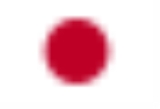
The national flag of Japan
is a white rectangular flag
with a large red disk (representing the sun) in the center. This flag is officially called in Japanese, but is more commonly known as .
The Nisshōki flag is designated as the national flag in Law Regarding the National Flag and National Anthem, which was promulgated and became effective on August 13, 1999. Although no earlier legislation had specified a national flag, the sun-disc flag had already become the de facto national flag of Japan. Two proclamations issued in 1870 by the Daijō-kan, the governmental body of the early Meiji Era, each had a provision for a design of the national flag. A sun-disc flag was adopted as the national flag for merchant ships under Proclamation No. 57 of Meiji 3 (issued on February 27, 1870), and as the national flag used by the Navy under Proclamation No. 651 of Meiji 3 (issued on October 27, 1870). Use of the Hinomaru was severely restricted during the early years of the American occupation after World War II, although restrictions were later relaxed.
In early Japanese history, the Hinomaru motif was used on flags of daimyo
s and samurai
. An old history Shoku Nihongi
says that Emperor Mommu
used a flag representing the sun in his court in 701, and this is the first recorded use of a sun-motif flag in Japan. The oldest existing flag is preserved in Unpō-ji temple, Kōshū, Yamanashi
, which is older than 16th century, and an ancient legend says that the flag was given to the temple by Emperor Go-Reizei
in the 11th century . During the Meiji Restoration
, both the sun disc and the Rising Sun Ensign
of the Imperial Japanese Navy
became major symbols in the emerging Japanese empire
. Propaganda posters, textbooks, and films depicted the flag as a source of pride and patriotism. In Japanese homes, citizens were required to display the flag during national holidays, celebrations and other occasions as decreed by the government. Different tokens of devotion to Japan and its emperor featuring the Hinomaru motif became popular during the Second Sino-Japanese War
and other conflicts. These tokens ranged from slogans written on the flag to clothing items and dishes that resembled the flag.
Public perception of the national flag varies. To some Japanese, the flag represents Japan, and no other flag could take its place. However, the flag is not frequently displayed in Japan due to its association with ultranationalism. The use of the flag and the national anthem Kimigayo have been a contentious issue for Japan's public schools since the end of World War II (the Pacific War). Disputes about their use have led to protests, lawsuits, and one suicide in Hiroshima Prefecture
. To Okinawans, the flag represents the events of World War II and the subsequent U.S. military presence there. For some nations that had been occupied by Japan, the flag is a symbol of aggression and imperialism. The Hinomaru was used as a tool against occupied nations for purposes of intimidation, asserting Japan's dominance, or subjugation. Despite the negative connotations, Western and Japanese sources claim the flag is a powerful and enduring symbol to the Japanese. Several military banners of Japan are based on the Hinomaru, including the sunrayed Naval Ensign. The Hinomaru also serves as a template for other Japanese flags in public and private use.
 The exact origin of the Hinomaru is unknown, but the rising sun seems to have had some symbolic meaning since the early 7th century. (It should be noted here that Japan is east of the Asian continent, and that the sun rises in the east.) In 607, an official correspondence that began with "from the emperor of the rising sun" was sent to Emperor Yang of Sui
. Japan is often referred to as "the land of the rising sun". In the 12th-century work, The Tale of the Heike
, it was written that different samurai
carried drawings of the sun on their fans. One legend related to the national flag is attributed to the Buddhist
priest Nichiren
. Supposedly, during a 13th-century Mongolia
n invasion of Japan, Nichiren gave a sun banner to the shogun
to carry into battle. The sun is also closely related to the Imperial family, as legend states the imperial throne was descended from the sun goddess Amaterasu
.
One of Japan's oldest flags is housed at the Unpo-ji temple in Yamanashi Prefecture
. Legend states it was given by Emperor Go-Reizei
to Minamoto no Yoshimitsu
and has been treated as a family treasure by the Takeda clan for the past 1000 years, and at least it is older than 16th century.
The earliest recorded flags in Japan date from the unification period in the late 16th century. The flags belonged to each Daimyo
and were used primarily in battle. Most of the flags were long banners usually charged with the mon
(family crest) of the Daimyo lord. Members of the same family, such as a son, father, and brother, had different flags to carry into battle. The flags served as identification, and were displayed by soldiers on their backs and horses. Generals also had their own flags, most of which differed from soldiers' flags due to their square shape.
In 1854, during the Tokugawa shogunate
, Japanese ships were ordered to hoist the Hinomaru to distinguish themselves from foreign ships. Before then, different types of Hinomaru flags were used on vessels that were trading with the Americans and Russians. The Hinomaru was decreed the merchant flag of Japan in 1870 and was the legal national flag from 1870 to 1885, making it the first national flag Japan adopted.
While the idea of national symbols was strange to the Japanese, the Meiji Government needed them to communicate with the outside world. This became especially important after the landing of U.S. Commodore Matthew Perry in Yokohama Bay. Further Meiji Government implementations gave more identifications to Japan, including the anthem Kimigayo and the imperial seal. In 1885, all previous laws not published in the Official Gazette of Japan were abolished. Because of this ruling by the new cabinet of Japan, the Hinomaru was the de facto national flag since no law was in place after the Meiji Restoration
.
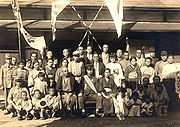 The use of the national flag grew as Japan sought to develop an empire, and the Hinomaru was present at celebrations after victories in the First Sino-Japanese
and Russo-Japanese War
s. The flag was also used in war efforts throughout the country. A Japanese propaganda film in 1934 portrayed foreign national flags as incomplete or defective with their designs, while the Japanese flag is perfect in all forms. In 1937, a group of girls from Hiroshima Prefecture
showed solidarity with Japanese soldiers fighting in China during the Second Sino-Japanese War
, by eating "flag meals" that consisted of an umeboshi
in the middle of a bed of rice. The Hinomaru bento
became the main symbol of Japan's war mobilization and solidarity with her soldiers until the 1940s.
Japan's early victories in the Sino-Japanese War resulted in the Hinomaru again being used for celebrations. It was seen in the hands of every Japanese during parades.
Textbooks during this period also had the Hinomaru printed with various slogans expressing devotion to the Emperor and the country. Patriotism was taught as a virtue to Japanese children. Expressions of patriotism, such as displaying the flag or worshiping the Emperor daily, were all part of being a "good Japanese."
The flag was a tool of Japanese imperialism in the occupied Southeast Asian areas during World War II: people had to use the flag, and schoolchildren sang Kimigayo in morning flag raising ceremonies. Local flags were allowed for some areas such as the Philippines
, Indonesia
, and Manchukuo
.
In certain colonies such as Korea
, the Hinomaru and other symbols were used to relegate the Koreans to second-class status in the empire.
To the Japanese, the Hinomaru was the "Rising Sun flag that would light the darkness of the entire world." To Westerners, it was one of the Japanese military's most powerful symbols.
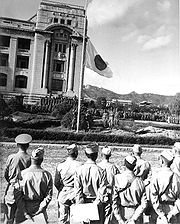 The Hinomaru was the de facto
flag throughout World War II and the occupation period. During the occupation of Japan after World War II, permission from the Supreme Commander of the Allied Powers
(SCAPJ) was needed to fly the Hinomaru. Sources differ on the degree to which the use of the Hinomaru flag was restricted; some use the term "banned;" however, while the original restrictions were severe, they did not amount to an outright ban.
After World War II, an ensign
was used by Japanese civil ships of the United States Naval Shipping Control Authority for Japanese Merchant Marines. Modified from the "E" signal code
, the ensign was used from September 1945 until the U.S. occupation of Japan ceased. U.S. ships operating in Japanese waters used a modified "O" signal flag as their ensign.
On May 2, 1947, General Douglas MacArthur
lifted the restrictions on displaying the Hinomaru in the grounds of the National Diet Building
, on the Imperial Palace, on the Prime Minister's residence
and on the Supreme Court building with the ratification of the new Constitution of Japan
. Those restrictions were further relaxed in 1948, when people were allowed to fly the flag on national holidays. In January 1949, the restrictions were abolished and anyone could fly the Hinomaru at any time without permission. As a result, schools and homes were encouraged to fly the Hinomaru until the early 1950s.
past. Similar objections have also been raised to the current national anthem of Japan, Kimigayo. The feelings about the Hinomaru and Kimigayo represented a general shift from a patriotic feeling about "Dai Nippon" – Great Japan – to the pacifist and anti-militarist "Nihon". Because of this ideological shift, the flag was used less often in Japan directly after the war even though restrictions were lifted by the SCAPJ in 1949.
As Japan began to re-establish itself diplomatically, the Hinomaru was used as a political weapon overseas. In a visit by the Emperor Hirohito
and the Empress Kōjun
to the Netherlands
, the Hinomaru was burned by Dutch citizens who demanded that either he be sent home to Japan or tried for the deaths of Dutch prisoners of war
during the Second World War. Domestically, the Hinomaru was not even used in protests against a new Status of Forces Agreement
being negotiated between U.S. and Japan. The most common flag used by the trade unions and other protesters was the red flag
of revolt.
An issue with the Hinomaru and national anthem was raised once again when Tokyo hosted the 1964 Summer Olympic Games
. Before the Olympic Games, the size of the sun disc of the national flag was changed partly because the sun disc was not considered striking when it was being flown with other national flags. Tadamasa Fukiura, a color specialist, chose to set the sun disc at two thirds of the flag's length. Fukiura also chose the flag colors for the 1964 as well as the 1998 Winter Olympics
in Nagano.
In 1989, the death of Emperor Hirohito
once again raised moral issues about the national flag. Conservatives felt that if the flag could be used during the ceremonies without reopening old wounds, they may have a chance to propose the Hinomaru become the national flag without being challenged about its meaning. During an official six day mourning period, flags were flown at half staff or draped in black bunting all across Japan. Despite reports of protesters vandalizing the Hinomaru on the day of the Emperor's funeral, schools' right to fly the Hinomaru at half-staff
without reservations brought success to the conservatives.
 The Law Regarding the National Flag and National Anthem was passed in 1999, choosing both the Hinomaru and Kimigayo as Japan's national symbols. The passage of the law stemmed from a suicide of the principal of Sera High School in Sera
, Hiroshima
, Ishikawa Toshihiro, who could not resolve a dispute between his school board and his teachers over the use of the Hinomaru and Kimigayo. The Act is one of the most controversial laws passed by the Diet since the 1992 "Law Concerning Cooperation for United Nations Peacekeeping Operations and Other Operations", also known as the "International Peace Cooperation Law".
Prime Minister
Keizō Obuchi
of the Liberal Democratic Party
(LDP) decided to draft legislation to make the Hinomaru and Kimigayo official symbols of Japan in 2000. His Chief Cabinet Secretary
, Hiromu Nonaka
, wanted the legislation to be completed by the 10th anniversary of the coronation of Akihito
as Emperor. This is not the first time legislation was considered for establishing both symbols as official. In 1974, with the backdrop of the 1972 return of Okinawa to Japan and the 1973 oil crisis
, Prime Minister Tanaka Kakuei hinted at a law being passed legalizing both symbols. In addition to instructing the schools to teach and play Kimigayo, Kakuei wanted students to raise the Hinomaru flag in a ceremony every morning, and to adopt a moral curriculum based on certain elements of the Imperial Rescript on Education
pronounced by the Meiji Emperor in 1890. Kakuei was unsuccessful in passing the law through the Diet that year.
Main supporters of the bill were the LDP and the Komeito (CGP), while the opposition included the Social Democratic Party
(SDPJ) and Communist Party
(JCP), who cited the connotations both symbols had with the war era. The CPJ was further opposed for not allowing the issue to be decided by the public. Meanwhile, the Democratic Party of Japan
(DPJ) could not develop party consensus on it. DPJ President and future prime minister Naoto Kan
stated that the DPJ must support the bill because the party already recognized both symbols as the symbols of Japan. Deputy Secretary General and future prime minister Yukio Hatoyama
thought that this bill would cause further divisions among society and the public schools. Hatoyama voted for the bill while Kan voted against it.
Before the vote, there were calls for the bills to be separated at the Diet. Waseda University
professor Norihiro Kato stated that Kimigayo is a separate issue more complex than the Hinomaru flag. Attempts to designate only the Hinomaru as the national flag by the DPJ and other parties during the vote of the bill were rejected by the Diet. The House of Representatives passed the bill on July 22, 1999, by a 403 to 86 vote. The legislation was sent to the House of Councilors on July 28 and was passed on August 9. It was enacted into law on August 13.
On August 8, 2009, a photograph was taken at a DPJ rally for the House of Representatives election
showing a banner that was hanging from a ceiling. The banner was made of two Hinomaru flags cut and sewn together to form the shape of the DPJ logo. This infuriated the LDP and Prime Minister Taro Aso
, saying this act was unforgivable. In response, DPJ President Yukio Hatoyama (who voted for the Law Regarding the National Flag and National Anthem) said that the banner was not the Hinomaru and should not be regarded as such.
. The law decreed the disc to be in the center, but it was usually placed one-hundredths (1/100) towards the hoist. On October 3 of the same year, regulations about the design of the merchant ensign and other naval flags were passed. For the merchant flag, the ratio was two units length and three units width (2:3). The size of the disc remained the same, however the sun disc was placed one-twentieth (1/20) towards the hoist.
When the Law Regarding the National Flag and National Anthem passed, the dimensions of the flag were slightly altered. The overall ratio of the flag was changed to two units length by three units width (2:3). The red disc was shifted towards dead center, but the overall size of the disc stayed the same. The background of the flag is white and the sun disc is red , but the exact color shades were not defined in the 1999 law. The only hint given about the red color that it is a "deep" shade.
Issued by the Japan Defense Agency (now the Ministry of Defense) in 1973 (Showa
48), specifications list the red color of the flag as 5R 4/12 and the white as N9 in the Munsell color chart. The document was changed on March 21, 2008 (Heisei
20) to match the flag's construction with current legislation and updated the Munsell colors. The document lists acrylic fiber
and nylon
as fibers that could be used in construction of flags used by the military. For acrylic, the red color is 5.7R 3.7/15.5 and white is N9.4; nylon has 6.2R 4/15.2 for red and N9.2 for white. In a document issued by the Official Development Assistance
(ODA), the red color for the Hinomaru and the ODA logo is listed as DIC
156 and CMYK
0-100-90-0. During deliberations about the Law Regarding the National Flag and National Anthem, there was a suggestion to either use a bright red shade or from the color pool of the Japanese Industrial Standards
.
During World War II in Japanese culture, it was a popular custom for friends, classmates, and relatives of a deploying soldier to sign a Hinomaru and present it to him. The flag was also used as a good luck charm and a prayer to wish the soldier back safely from battle. One term for this kind of charm is Hinomaru Yosegaki (日の丸寄せ書き). One tradition is that any writing must not touch the sun disc. After battles, these flags were often captured or later found on deceased Japanese soldiers. While these flags became souvenirs, there has been a growing trend of sending the signed flags back to the descendants of the soldier.
The tradition for signing the Hinomaru as a good luck charm still continues, but in a limited fashion. The Hinomaru Yosegaki could be shown at sporting events to give support to the Japanese national team. Another example is the hachimaki
headband, which was white in color and had the red sun in the middle. During World War II, the phrases or "Seven Lives" was written on the hachimaki and worn by kamikaze
pilots. This denoted that the pilot was willing to die for his country.
Before World War II, all homes were required to display Hinomaru on national holidays. Since the war, the display of the flag of Japan is mostly limited to buildings attached to national and local governments such as city halls; it is rarely seen at private homes or commercial buildings, but some people and companies have advocated displaying the flag on holidays. Although the government of Japan encourages citizens and residents to fly the Hinomaru during national holidays, they are not legally required to do so. Since the Emperor's 80th Birthday
on December 23, 2002, the Kyushu Railway Company
has displayed the Hinomaru at 330 stations.
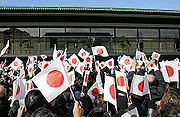 According to polls conduced by mainstream media, most Japanese people had perceived the flag of Japan as the national flag even before the passage of the Law Regarding the National Flag and National Anthem in 1999. Despite this, controversies surrounding the use of the flag in school events or media still remain. For example, liberal newspapers such as Asahi Shimbun
and Mainichi Shimbun
often feature articles critical of the flag of Japan, reflecting their readerships' political spectrum.
The display of the Hinomaru at homes and businesses is also debated in Japanese society. Because of the association of the Hinomaru with uyoku dantai
(right wing) activists, reactionary politics
, or hooliganism
, some homes and businesses do not fly the flag. To other Japanese, the flag represents the time where democracy was suppressed when Japan was an empire
. The Japanese Communist Party
is vocally against the flag.
Negative perceptions of the Hinomaru exist in former colonies of Japan as well as within Japan itself, such as in Okinawa
. In one notable example of this, on October 26, 1987, an Okinawan supermarket owner burned the Hinomaru before the start of the National Sports Festival of Japan
. The flag burner, Chibana Shôichi, burned the Hinomaru not only to show opposition to atrocities committed by the Japanese army and the continued presence of U.S. forces, but also to prevent it from being displayed in public. Other incidents in Okinawa included the flag being torn down during school ceremonies and students refusing to honor the flag as it was being raised to the sounds of Kimigayo. In the People's Republic of China
and South Korea
, both of which had been occupied by the Empire of Japan, the 1999 formal adoption of the Hinomaru was met with reactions of Japan moving towards the right and also a step towards remilitarization. The passage of the 1999 law also coincided with the debates about the status of Yasukuni, US-Japan military cooperation and the creation of a missile defense. In other nations that Japan occupied, the 1999 law was met with mixed reactions or glossed over. In Singapore, the older generation still harbors ill feelings toward the flag while the younger generation does not hold similar views. The Philippines government not only believed that Japan was not going to revert back to militarism, but the goal of the 1999 law was to formally establish two symbols (the flag and anthem) in law and every state has a right to create national symbols. Japan has no law criminalizing the burning of the Hinomaru, but foreign flags cannot be burned in Japan.
. When the flag becomes unsuitable to use, it is customarily burned in private. The Law Regarding the National Flag and Anthem does not specify on how the flag should be used, but different prefectures came up with their own regulations to use the Hinomaru and other prefectural flags.
The Hinomaru flag has at least two mourning styles. One is to display the flag at , as is common in many countries. The offices of the Ministry of Foreign Affairs hoist the flag at half-staff when a funeral is performed for a foreign nation's head of state. An alternative mourning style is to cover the sphere finial
by black cloth and place a black ribbon above the flag, known as a . This style dates back to July 30, 1912, when Emperor Meiji
died and the Cabinet issued an ordinance stipulating that the national flag should be raised in mourning when the Emperor dies. The Cabinet has the authority to announce the half-staffing of the national flag.
has issued statements and regulations to promote the usage of both the Hinomaru and Kimigayo at schools under their jurisdiction. The first of these statements was released in 1950, stating that it was desirable, but not required, to use both symbols. This desire was later expanded to include both symbols on national holidays and during ceremonial events to encourage students on what national holidays are and to promote defense education. In a 1989 reform of the education guidelines, the LDP-controlled government first demanded that the flag must be used in school ceremonies and that proper respect must be given to it and to Kimigayo. Punishments for school officials who did not follow this order were also enacted with the 1989 reforms.
The 1999 curriculum guideline
issued by the Ministry of Education after the passage of the Law Regarding the National Flag and Anthem decrees that "on entrance and graduation ceremonies, schools must raise the flag of Japan and instruct students to sing the "Kimigayo" (national anthem), given the significance of the flag and the song." Additionally, the ministry's commentary on the 1999 curriculum guideline for elementary schools note that "given the advance of internationalization, along with fostering patriotism and awareness of being Japanese, it is important to nurture school children's respectful attitude toward the flag of Japan and Kimigayo as they grow up to be respected Japanese citizens in an internationalized society." The ministry also stated that if Japanese students cannot respect their own symbols, then they will not be able to respect the symbols of other nations.
Schools
have been the center of controversy over both the anthem and the national flag. The Tokyo Board of Education requires the use of both the anthem and flag at events under their jurisdiction. The order requires school teachers to respect both symbols or risk losing their jobs. Some have protested that such rules violate the Constitution of Japan
, but the Board has argued that since schools are government agencies, their employees have an obligation to teach their students how to be good Japanese citizens. As a sign of protest, schools refused to display the Hinomaru at school graduations and some parents ripped down the flag. Teachers have unsuccessfully brought criminal complaints against Tokyo Governor Shintarō Ishihara
and senior officials for ordering teachers to honor the Hinomaru and Kimigayo. After earlier opposition, the Japan Teachers Union
accepts the use of both the flag and anthem; the smaller All Japan Teachers and Staffs Union still opposes both symbols and their use inside the school system.
(JSDF) and the Japan Ground Self-Defense Force
use a version of the sun disc design with eight red rays extending outward, called Hachijō-Kyokujitsuki (八条旭日旗). A gold border lies partially around the edge.
A well-known variant of the sun disc design is the sun disc with 16 red rays in a Siemens star
formation, which was also historically used by Japan's military, particularly the Imperial Japanese Army
and the Imperial Japanese Navy
. The ensign, known in Japanese as the Jyūrokujō-Kyokujitsu-ki (十六条旭日旗), was first adopted as the War flag
on May 15, 1870, and was used until the end of World War II in 1945. It was re-adopted on June 30, 1954, and is now used as the war flag and naval ensign of the Japan Ground Self-Defense Force (JGSDF) and the Japan Maritime Self-Defense Force
(JMSDF). In the surrounding Asian countries that were occupied by Japan, this flag still carries a negative connotation. The JMSDF also employs the use of a masthead pennant. First adopted in 1914 and readopted in 1965, the masthead pennant contains a simplified version of the naval ensign at the hoist end, with the rest of the pennant colored white. The ratio of the pennant is between 1:40 and 1:90.
The Japan Air Self-Defense Force
(JASDF), established independently in 1952, has only the plain sun disc as its emblem. This is the only branch of service with an emblem that does not invoke the rayed Imperial Standard. However, the branch does have an ensign
to fly on bases and during parades. The ensign was created in 1972, which was the third used by the JASDF since its creation. The ensign contains the emblem of the branch centered on a blue background.
Although not an official national flag, the Z signal flag
played a major role in Japanese naval history. On May 27, 1905, Admiral Heihachirō Tōgō
of the Mikasa
was preparing to engage the Russian Baltic Fleet
. Before the Battle of Tsushima
began, Togo raised the Z flag on the Mikasa and engaged the Russian fleet, winning the battle for Japan. The raising of the flag said to the crew the following: "The fate of Imperial Japan hangs on this one battle; all hands will exert themselves and do their best." The Z flag was also raised on the aircraft carrier Akagi
on the eve of the Japan's attack on Pearl Harbor
, Hawaii
, in December 1941.
Japan
Japan is an island nation in East Asia. Located in the Pacific Ocean, it lies to the east of the Sea of Japan, China, North Korea, South Korea and Russia, stretching from the Sea of Okhotsk in the north to the East China Sea and Taiwan in the south...
is a white rectangular flag
Flag
A flag is a piece of fabric with a distinctive design that is usually rectangular and used as a symbol, as a signaling device, or decoration. The term flag is also used to refer to the graphic design employed by a flag, or to its depiction in another medium.The first flags were used to assist...
with a large red disk (representing the sun) in the center. This flag is officially called in Japanese, but is more commonly known as .
The Nisshōki flag is designated as the national flag in Law Regarding the National Flag and National Anthem, which was promulgated and became effective on August 13, 1999. Although no earlier legislation had specified a national flag, the sun-disc flag had already become the de facto national flag of Japan. Two proclamations issued in 1870 by the Daijō-kan, the governmental body of the early Meiji Era, each had a provision for a design of the national flag. A sun-disc flag was adopted as the national flag for merchant ships under Proclamation No. 57 of Meiji 3 (issued on February 27, 1870), and as the national flag used by the Navy under Proclamation No. 651 of Meiji 3 (issued on October 27, 1870). Use of the Hinomaru was severely restricted during the early years of the American occupation after World War II, although restrictions were later relaxed.
In early Japanese history, the Hinomaru motif was used on flags of daimyo
Daimyo
is a generic term referring to the powerful territorial lords in pre-modern Japan who ruled most of the country from their vast, hereditary land holdings...
s and samurai
Samurai
is the term for the military nobility of pre-industrial Japan. According to translator William Scott Wilson: "In Chinese, the character 侍 was originally a verb meaning to wait upon or accompany a person in the upper ranks of society, and this is also true of the original term in Japanese, saburau...
. An old history Shoku Nihongi
Shoku Nihongi
The is an imperially commissioned Japanese history text. Completed in 797, it is the second of the Six National Histories, coming directly after the Nihon Shoki and followed by Nihon Kōki. Fujiwara no Tsugutada and Sugano no Mamichi served as the primary editors...
says that Emperor Mommu
Emperor Mommu
was the 42nd emperor of Japan, according to the traditional order of succession.Mommu's reign spanned the years from 697 through 707.-Traditional narrative:Before his ascension to the Chrysanthemum Throne, his personal name was Karu-shinnō....
used a flag representing the sun in his court in 701, and this is the first recorded use of a sun-motif flag in Japan. The oldest existing flag is preserved in Unpō-ji temple, Kōshū, Yamanashi
Koshu, Yamanashi
is a city located in Yamanashi Prefecture, Japan.The city was founded on November 1, 2005, when the city of Enzan was merged with the town of Katsunuma, and the village of Yamato, both from Higashiyamanashi District, to form the new city of Kōshū....
, which is older than 16th century, and an ancient legend says that the flag was given to the temple by Emperor Go-Reizei
Emperor Go-Reizei
was the 70th emperor of Japan, according to the traditional order of succession.Go-Reizei's reign spanned the years 1045–1068.This 11th century sovereign was named after the 10th century Emperor Reizei and go- , translates literally as "later;" and thus, he is sometimes called the "Later Emperor...
in the 11th century . During the Meiji Restoration
Meiji Restoration
The , also known as the Meiji Ishin, Revolution, Reform or Renewal, was a chain of events that restored imperial rule to Japan in 1868...
, both the sun disc and the Rising Sun Ensign
Rising Sun Flag
The is the military flag of Japan. It was used as the war flag of the Imperial Japanese Army and the ensign of the Imperial Japanese Navy until the end of World War II...
of the Imperial Japanese Navy
Imperial Japanese Navy
The Imperial Japanese Navy was the navy of the Empire of Japan from 1869 until 1947, when it was dissolved following Japan's constitutional renunciation of the use of force as a means of settling international disputes...
became major symbols in the emerging Japanese empire
Empire of Japan
The Empire of Japan is the name of the state of Japan that existed from the Meiji Restoration on 3 January 1868 to the enactment of the post-World War II Constitution of...
. Propaganda posters, textbooks, and films depicted the flag as a source of pride and patriotism. In Japanese homes, citizens were required to display the flag during national holidays, celebrations and other occasions as decreed by the government. Different tokens of devotion to Japan and its emperor featuring the Hinomaru motif became popular during the Second Sino-Japanese War
Second Sino-Japanese War
The Second Sino-Japanese War was a military conflict fought primarily between the Republic of China and the Empire of Japan. From 1937 to 1941, China fought Japan with some economic help from Germany , the Soviet Union and the United States...
and other conflicts. These tokens ranged from slogans written on the flag to clothing items and dishes that resembled the flag.
Public perception of the national flag varies. To some Japanese, the flag represents Japan, and no other flag could take its place. However, the flag is not frequently displayed in Japan due to its association with ultranationalism. The use of the flag and the national anthem Kimigayo have been a contentious issue for Japan's public schools since the end of World War II (the Pacific War). Disputes about their use have led to protests, lawsuits, and one suicide in Hiroshima Prefecture
Hiroshima Prefecture
is a prefecture of Japan located in the Chūgoku region on Honshu island. The capital is the city of Hiroshima.- History :The area around Hiroshima was formerly divided into Bingo Province and Aki Province. This location has been a center of trade and culture since the beginning of Japan's recorded...
. To Okinawans, the flag represents the events of World War II and the subsequent U.S. military presence there. For some nations that had been occupied by Japan, the flag is a symbol of aggression and imperialism. The Hinomaru was used as a tool against occupied nations for purposes of intimidation, asserting Japan's dominance, or subjugation. Despite the negative connotations, Western and Japanese sources claim the flag is a powerful and enduring symbol to the Japanese. Several military banners of Japan are based on the Hinomaru, including the sunrayed Naval Ensign. The Hinomaru also serves as a template for other Japanese flags in public and private use.
Before 1900
Emperor Yang of Sui
Emperor Yang of Sui , personal name Yang Guang , alternative name Ying , nickname Amo , known as Emperor Ming during the brief reign of his grandson Yang Tong), was the second son of Emperor Wen of Sui, and the second emperor of China's Sui Dynasty.Emperor Yang's original name was Yang Ying, but...
. Japan is often referred to as "the land of the rising sun". In the 12th-century work, The Tale of the Heike
The Tale of the Heike
is an epic account of the struggle between the Taira and Minamoto clans for control of Japan at the end of the 12th century in the Genpei War...
, it was written that different samurai
Samurai
is the term for the military nobility of pre-industrial Japan. According to translator William Scott Wilson: "In Chinese, the character 侍 was originally a verb meaning to wait upon or accompany a person in the upper ranks of society, and this is also true of the original term in Japanese, saburau...
carried drawings of the sun on their fans. One legend related to the national flag is attributed to the Buddhist
Buddhism
Buddhism is a religion and philosophy encompassing a variety of traditions, beliefs and practices, largely based on teachings attributed to Siddhartha Gautama, commonly known as the Buddha . The Buddha lived and taught in the northeastern Indian subcontinent some time between the 6th and 4th...
priest Nichiren
Nichiren
Nichiren was a Buddhist monk who lived during the Kamakura period in Japan. Nichiren taught devotion to the Lotus Sutra, entitled Myōhō-Renge-Kyō in Japanese, as the exclusive means to attain enlightenment and the chanting of Nam-Myōhō-Renge-Kyō as the essential practice of the teaching...
. Supposedly, during a 13th-century Mongolia
Mongolia
Mongolia is a landlocked country in East and Central Asia. It is bordered by Russia to the north and China to the south, east and west. Although Mongolia does not share a border with Kazakhstan, its western-most point is only from Kazakhstan's eastern tip. Ulan Bator, the capital and largest...
n invasion of Japan, Nichiren gave a sun banner to the shogun
Shogun
A was one of the hereditary military dictators of Japan from 1192 to 1867. In this period, the shoguns, or their shikken regents , were the de facto rulers of Japan though they were nominally appointed by the emperor...
to carry into battle. The sun is also closely related to the Imperial family, as legend states the imperial throne was descended from the sun goddess Amaterasu
Amaterasu
, or is apart of the Japanese myth cycle and also a major deity of the Shinto religion. She is the goddess of the sun, but also of the universe. the name Amaterasu derived from Amateru meaning "shining in heaven." The meaning of her whole name, Amaterasu-ōmikami, is "the great August kami who...
.
One of Japan's oldest flags is housed at the Unpo-ji temple in Yamanashi Prefecture
Yamanashi Prefecture
is a prefecture of Japan located in the Chūbu region of the island of Honshū. The capital is the city of Kōfu.-Pre-history to the 14th century:People have been living in the Yamanashi area for about 30,000 years...
. Legend states it was given by Emperor Go-Reizei
Emperor Go-Reizei
was the 70th emperor of Japan, according to the traditional order of succession.Go-Reizei's reign spanned the years 1045–1068.This 11th century sovereign was named after the 10th century Emperor Reizei and go- , translates literally as "later;" and thus, he is sometimes called the "Later Emperor...
to Minamoto no Yoshimitsu
Minamoto no Yoshimitsu
, son of Minamoto no Yoriyoshi, was a Minamoto clan samurai during Japan's Heian Period. His brother was the famous Minamoto no Yoshiie. Minamoto no Yoshimitsu is credited as the ancient progenitor of the Japanese martial art, Daitō-ryū aiki-jūjutsu...
and has been treated as a family treasure by the Takeda clan for the past 1000 years, and at least it is older than 16th century.
The earliest recorded flags in Japan date from the unification period in the late 16th century. The flags belonged to each Daimyo
Daimyo
is a generic term referring to the powerful territorial lords in pre-modern Japan who ruled most of the country from their vast, hereditary land holdings...
and were used primarily in battle. Most of the flags were long banners usually charged with the mon
Mon (badge)
, also , , and , are Japanese emblems used to decorate and identify an individual or family. While mon is an encompassing term that may refer to any such device, kamon and mondokoro refer specifically to emblems used to identify a family....
(family crest) of the Daimyo lord. Members of the same family, such as a son, father, and brother, had different flags to carry into battle. The flags served as identification, and were displayed by soldiers on their backs and horses. Generals also had their own flags, most of which differed from soldiers' flags due to their square shape.
In 1854, during the Tokugawa shogunate
Tokugawa shogunate
The Tokugawa shogunate, also known as the and the , was a feudal regime of Japan established by Tokugawa Ieyasu and ruled by the shoguns of the Tokugawa family. This period is known as the Edo period and gets its name from the capital city, Edo, which is now called Tokyo, after the name was...
, Japanese ships were ordered to hoist the Hinomaru to distinguish themselves from foreign ships. Before then, different types of Hinomaru flags were used on vessels that were trading with the Americans and Russians. The Hinomaru was decreed the merchant flag of Japan in 1870 and was the legal national flag from 1870 to 1885, making it the first national flag Japan adopted.
While the idea of national symbols was strange to the Japanese, the Meiji Government needed them to communicate with the outside world. This became especially important after the landing of U.S. Commodore Matthew Perry in Yokohama Bay. Further Meiji Government implementations gave more identifications to Japan, including the anthem Kimigayo and the imperial seal. In 1885, all previous laws not published in the Official Gazette of Japan were abolished. Because of this ruling by the new cabinet of Japan, the Hinomaru was the de facto national flag since no law was in place after the Meiji Restoration
Meiji Restoration
The , also known as the Meiji Ishin, Revolution, Reform or Renewal, was a chain of events that restored imperial rule to Japan in 1868...
.
Early conflicts and the Pacific War
First Sino-Japanese War
The First Sino-Japanese War was fought between Qing Dynasty China and Meiji Japan, primarily over control of Korea...
and Russo-Japanese War
Russo-Japanese War
The Russo-Japanese War was "the first great war of the 20th century." It grew out of rival imperial ambitions of the Russian Empire and Japanese Empire over Manchuria and Korea...
s. The flag was also used in war efforts throughout the country. A Japanese propaganda film in 1934 portrayed foreign national flags as incomplete or defective with their designs, while the Japanese flag is perfect in all forms. In 1937, a group of girls from Hiroshima Prefecture
Hiroshima Prefecture
is a prefecture of Japan located in the Chūgoku region on Honshu island. The capital is the city of Hiroshima.- History :The area around Hiroshima was formerly divided into Bingo Province and Aki Province. This location has been a center of trade and culture since the beginning of Japan's recorded...
showed solidarity with Japanese soldiers fighting in China during the Second Sino-Japanese War
Second Sino-Japanese War
The Second Sino-Japanese War was a military conflict fought primarily between the Republic of China and the Empire of Japan. From 1937 to 1941, China fought Japan with some economic help from Germany , the Soviet Union and the United States...
, by eating "flag meals" that consisted of an umeboshi
Umeboshi
Umeboshi are pickled ume fruits common in Japan. Ume is a species of fruit-bearing tree in the genus Prunus, which is often called a plum but is actually more closely related to the apricot. Umeboshi are a popular kind of tsukemono and are extremely sour and salty...
in the middle of a bed of rice. The Hinomaru bento
Bento
is a single-portion takeout or home-packed meal common in Japanese cuisine. A traditional bento consists of rice, fish or meat, and one or more pickled or cooked vegetables, usually in a box-shaped container. Containers range from disposable mass produced to hand crafted lacquerware...
became the main symbol of Japan's war mobilization and solidarity with her soldiers until the 1940s.
Japan's early victories in the Sino-Japanese War resulted in the Hinomaru again being used for celebrations. It was seen in the hands of every Japanese during parades.
Textbooks during this period also had the Hinomaru printed with various slogans expressing devotion to the Emperor and the country. Patriotism was taught as a virtue to Japanese children. Expressions of patriotism, such as displaying the flag or worshiping the Emperor daily, were all part of being a "good Japanese."
The flag was a tool of Japanese imperialism in the occupied Southeast Asian areas during World War II: people had to use the flag, and schoolchildren sang Kimigayo in morning flag raising ceremonies. Local flags were allowed for some areas such as the Philippines
Philippines
The Philippines , officially known as the Republic of the Philippines , is a country in Southeast Asia in the western Pacific Ocean. To its north across the Luzon Strait lies Taiwan. West across the South China Sea sits Vietnam...
, Indonesia
Indonesia
Indonesia , officially the Republic of Indonesia , is a country in Southeast Asia and Oceania. Indonesia is an archipelago comprising approximately 13,000 islands. It has 33 provinces with over 238 million people, and is the world's fourth most populous country. Indonesia is a republic, with an...
, and Manchukuo
Manchukuo
Manchukuo or Manshū-koku was a puppet state in Manchuria and eastern Inner Mongolia, governed under a form of constitutional monarchy. The region was the historical homeland of the Manchus, who founded the Qing Empire in China...
.
In certain colonies such as Korea
Korea
Korea ) is an East Asian geographic region that is currently divided into two separate sovereign states — North Korea and South Korea. Located on the Korean Peninsula, Korea is bordered by the People's Republic of China to the northwest, Russia to the northeast, and is separated from Japan to the...
, the Hinomaru and other symbols were used to relegate the Koreans to second-class status in the empire.
To the Japanese, the Hinomaru was the "Rising Sun flag that would light the darkness of the entire world." To Westerners, it was one of the Japanese military's most powerful symbols.
U.S. occupation
De facto
De facto is a Latin expression that means "concerning fact." In law, it often means "in practice but not necessarily ordained by law" or "in practice or actuality, but not officially established." It is commonly used in contrast to de jure when referring to matters of law, governance, or...
flag throughout World War II and the occupation period. During the occupation of Japan after World War II, permission from the Supreme Commander of the Allied Powers
Supreme Commander of the Allied Powers
Supreme Commander of the Allied Powers was the title held by General Douglas MacArthur during the Occupation of Japan following World War II...
(SCAPJ) was needed to fly the Hinomaru. Sources differ on the degree to which the use of the Hinomaru flag was restricted; some use the term "banned;" however, while the original restrictions were severe, they did not amount to an outright ban.
After World War II, an ensign
Ensign
An ensign is a national flag when used at sea, in vexillology, or a distinguishing token, emblem, or badge, such as a symbol of office in heraldry...
was used by Japanese civil ships of the United States Naval Shipping Control Authority for Japanese Merchant Marines. Modified from the "E" signal code
International maritime signal flags
The system of international maritime signal flags is one system of flag signals representing individual letters of the alphabet in signals to or from ships...
, the ensign was used from September 1945 until the U.S. occupation of Japan ceased. U.S. ships operating in Japanese waters used a modified "O" signal flag as their ensign.
On May 2, 1947, General Douglas MacArthur
Douglas MacArthur
General of the Army Douglas MacArthur was an American general and field marshal of the Philippine Army. He was a Chief of Staff of the United States Army during the 1930s and played a prominent role in the Pacific theater during World War II. He received the Medal of Honor for his service in the...
lifted the restrictions on displaying the Hinomaru in the grounds of the National Diet Building
National Diet Building
The is the place where both houses of the Diet of Japan meet. It is located at 1-chome, Nagatachō, Chiyoda, Tokyo.Sessions of the House of Representatives take place in the left wing and sessions of the House of Councillors in the right wing....
, on the Imperial Palace, on the Prime Minister's residence
Kantei
The is the principal workplace of the Prime Minister of Japan.- About :Located at 2-3-1 Nagata-chō, Chiyoda-ku, Tokyo 100-8968, it is diagonally adjacent to the National Diet Building. The new residence went into service in April 2002 and replaced the former residence, built in 1929. The former...
and on the Supreme Court building with the ratification of the new Constitution of Japan
Constitution of Japan
The is the fundamental law of Japan. It was enacted on 3 May, 1947 as a new constitution for postwar Japan.-Outline:The constitution provides for a parliamentary system of government and guarantees certain fundamental rights...
. Those restrictions were further relaxed in 1948, when people were allowed to fly the flag on national holidays. In January 1949, the restrictions were abolished and anyone could fly the Hinomaru at any time without permission. As a result, schools and homes were encouraged to fly the Hinomaru until the early 1950s.
Postwar to 1999
Since World War II, Japan's flag has been criticized for its association with the country's militaristicMilitarism
Militarism is defined as: the belief or desire of a government or people that a country should maintain a strong military capability and be prepared to use it aggressively to defend or promote national interests....
past. Similar objections have also been raised to the current national anthem of Japan, Kimigayo. The feelings about the Hinomaru and Kimigayo represented a general shift from a patriotic feeling about "Dai Nippon" – Great Japan – to the pacifist and anti-militarist "Nihon". Because of this ideological shift, the flag was used less often in Japan directly after the war even though restrictions were lifted by the SCAPJ in 1949.
As Japan began to re-establish itself diplomatically, the Hinomaru was used as a political weapon overseas. In a visit by the Emperor Hirohito
Hirohito
, posthumously in Japan officially called Emperor Shōwa or , was the 124th Emperor of Japan according to the traditional order, reigning from December 25, 1926, until his death in 1989. Although better known outside of Japan by his personal name Hirohito, in Japan he is now referred to...
and the Empress Kōjun
Empress Kojun
' was empress consort of Emperor Hirohito of Japan. Born , she was the mother of the present Emperor .Her posthumous name is Kōjun, which means "fragrant purity"...
to the Netherlands
Netherlands
The Netherlands is a constituent country of the Kingdom of the Netherlands, located mainly in North-West Europe and with several islands in the Caribbean. Mainland Netherlands borders the North Sea to the north and west, Belgium to the south, and Germany to the east, and shares maritime borders...
, the Hinomaru was burned by Dutch citizens who demanded that either he be sent home to Japan or tried for the deaths of Dutch prisoners of war
Prisoner of war
A prisoner of war or enemy prisoner of war is a person, whether civilian or combatant, who is held in custody by an enemy power during or immediately after an armed conflict...
during the Second World War. Domestically, the Hinomaru was not even used in protests against a new Status of Forces Agreement
Status of Forces Agreement
A status of forces agreement is an agreement between a host country and a foreign nation stationing forces in that country. SOFAs are often included, along with other types of military agreements, as part of a comprehensive security arrangement...
being negotiated between U.S. and Japan. The most common flag used by the trade unions and other protesters was the red flag
Red flag
In politics, a red flag is a symbol of Socialism, or Communism, or sometimes left-wing politics in general. It has been associated with left-wing politics since the French Revolution. Socialists adopted the symbol during the Revolutions of 1848 and it became a symbol of communism as a result of its...
of revolt.
An issue with the Hinomaru and national anthem was raised once again when Tokyo hosted the 1964 Summer Olympic Games
1964 Summer Olympics
The 1964 Summer Olympics, officially known as the Games of the XVIII Olympiad, was an international multi-sport event held in Tokyo, Japan in 1964. Tokyo had been awarded with the organization of the 1940 Summer Olympics, but this honor was subsequently passed to Helsinki because of Japan's...
. Before the Olympic Games, the size of the sun disc of the national flag was changed partly because the sun disc was not considered striking when it was being flown with other national flags. Tadamasa Fukiura, a color specialist, chose to set the sun disc at two thirds of the flag's length. Fukiura also chose the flag colors for the 1964 as well as the 1998 Winter Olympics
1998 Winter Olympics
The 1998 Winter Olympics, officially the XVIII Olympic Winter Games, was a winter multi-sport event celebrated from 7 to 22 February 1998 in Nagano, Japan. Seventy-two nations and 2,176 participans contested in seven sports and 72 events at 15 venues. The games saw the introduction of Women's ice...
in Nagano.
In 1989, the death of Emperor Hirohito
Hirohito
, posthumously in Japan officially called Emperor Shōwa or , was the 124th Emperor of Japan according to the traditional order, reigning from December 25, 1926, until his death in 1989. Although better known outside of Japan by his personal name Hirohito, in Japan he is now referred to...
once again raised moral issues about the national flag. Conservatives felt that if the flag could be used during the ceremonies without reopening old wounds, they may have a chance to propose the Hinomaru become the national flag without being challenged about its meaning. During an official six day mourning period, flags were flown at half staff or draped in black bunting all across Japan. Despite reports of protesters vandalizing the Hinomaru on the day of the Emperor's funeral, schools' right to fly the Hinomaru at half-staff
Half-staff
Half-staff is the American term for to describe a flag flying a flag below the summit of the flagpole . The rest of the English-speaking world uses the term half-mast. Technically the flag should be flown one breadth lower to allow for the invisible flag of death...
without reservations brought success to the conservatives.
Since 1999
Sera, Hiroshima
is a town located in Sera District, Hiroshima, Japan.On October 1, 2004 the towns of Kōzan and Seranishi, both from Sera District, were merged into the expanded town of Sera....
, Hiroshima
Hiroshima Prefecture
is a prefecture of Japan located in the Chūgoku region on Honshu island. The capital is the city of Hiroshima.- History :The area around Hiroshima was formerly divided into Bingo Province and Aki Province. This location has been a center of trade and culture since the beginning of Japan's recorded...
, Ishikawa Toshihiro, who could not resolve a dispute between his school board and his teachers over the use of the Hinomaru and Kimigayo. The Act is one of the most controversial laws passed by the Diet since the 1992 "Law Concerning Cooperation for United Nations Peacekeeping Operations and Other Operations", also known as the "International Peace Cooperation Law".
Prime Minister
Prime Minister of Japan
The is the head of government of Japan. He is appointed by the Emperor of Japan after being designated by the Diet from among its members, and must enjoy the confidence of the House of Representatives to remain in office...
Keizō Obuchi
Keizo Obuchi
was a Japanese politician who served in the House of Representatives for twelve terms, and ultimately as the 84th Prime Minister of Japan from July 30, 1998 to April 5, 2000. His political career ended when he suffered a serious and ultimately fatal stroke....
of the Liberal Democratic Party
Liberal Democratic Party (Japan)
The , frequently abbreviated to LDP or , is a centre-right political party in Japan. It is one of the most consistently successful political parties in the democratic world. The LDP ruled almost continuously for nearly 54 years from its founding in 1955 until its defeat in the 2009 election...
(LDP) decided to draft legislation to make the Hinomaru and Kimigayo official symbols of Japan in 2000. His Chief Cabinet Secretary
Chief Cabinet Secretary
__notoc__The of Japan is a Minister of State who is responsible for directing the Cabinet Secretariat. The main function of Chief Cabinet Secretary is to coordinate the policies of ministries and agencies in the executive branch...
, Hiromu Nonaka
Hiromu Nonaka
is a Japanese LDP politician and former member of the House of Representatives. He is currently a lecturer at Heian Jogakuin University.He has held the following posts:...
, wanted the legislation to be completed by the 10th anniversary of the coronation of Akihito
Akihito
is the current , the 125th emperor of his line according to Japan's traditional order of succession. He acceded to the throne in 1989.-Name:In Japan, the emperor is never referred to by his given name, but rather is referred to as "His Imperial Majesty the Emperor" which may be shortened to . In...
as Emperor. This is not the first time legislation was considered for establishing both symbols as official. In 1974, with the backdrop of the 1972 return of Okinawa to Japan and the 1973 oil crisis
1973 oil crisis
The 1973 oil crisis started in October 1973, when the members of Organization of Arab Petroleum Exporting Countries or the OAPEC proclaimed an oil embargo. This was "in response to the U.S. decision to re-supply the Israeli military" during the Yom Kippur war. It lasted until March 1974. With the...
, Prime Minister Tanaka Kakuei hinted at a law being passed legalizing both symbols. In addition to instructing the schools to teach and play Kimigayo, Kakuei wanted students to raise the Hinomaru flag in a ceremony every morning, and to adopt a moral curriculum based on certain elements of the Imperial Rescript on Education
Imperial Rescript on Education
The ' was signed by Emperor Meiji of Japan on 30 October 1890 to articulate government policy on the guiding principles of education on the Empire of Japan...
pronounced by the Meiji Emperor in 1890. Kakuei was unsuccessful in passing the law through the Diet that year.
Main supporters of the bill were the LDP and the Komeito (CGP), while the opposition included the Social Democratic Party
Social Democratic Party (Japan)
The Social Democratic Party The Social Democratic Party The Social Democratic Party (社会民主党 Shakai Minshu-tō, often abbreviated to 社民党 Shamin-tō; also known as the Social Democratic Party of Japan (abbreviated to SDPJ or SDP in English) is a political party that advocates for the establishment of a...
(SDPJ) and Communist Party
Japanese Communist Party
The Japanese Communist Party is a left-wing political party in Japan.The JCP advocates the establishment of a society based on socialism, democracy and peace, and opposition to militarism...
(JCP), who cited the connotations both symbols had with the war era. The CPJ was further opposed for not allowing the issue to be decided by the public. Meanwhile, the Democratic Party of Japan
Democratic Party of Japan
The is a political party in Japan founded in 1998 by the merger of several opposition parties. Its socially liberal platform is generally considered center-left in the Japanese political spectrum...
(DPJ) could not develop party consensus on it. DPJ President and future prime minister Naoto Kan
Naoto Kan
is a Japanese politician, and former Prime Minister of Japan. In June 2010, then-Finance Minister Kan was elected as the leader of the Democratic Party of Japan and designated Prime Minister by the Diet to succeed Yukio Hatoyama. On 26 August 2011, Kan announced his resignation...
stated that the DPJ must support the bill because the party already recognized both symbols as the symbols of Japan. Deputy Secretary General and future prime minister Yukio Hatoyama
Yukio Hatoyama
is a Japanese politician who served as Prime Minister of Japan between 16 September 2009 and 2 June 2010, and was the first ever Prime Minister from the modern Democratic Party of Japan....
thought that this bill would cause further divisions among society and the public schools. Hatoyama voted for the bill while Kan voted against it.
Before the vote, there were calls for the bills to be separated at the Diet. Waseda University
Waseda University
, abbreviated as , is one of the most prestigious private universities in Japan and Asia. Its main campuses are located in the northern part of Shinjuku, Tokyo. Founded in 1882 as Tokyo Senmon Gakko, the institution was renamed "Waseda University" in 1902. It is known for its liberal climate...
professor Norihiro Kato stated that Kimigayo is a separate issue more complex than the Hinomaru flag. Attempts to designate only the Hinomaru as the national flag by the DPJ and other parties during the vote of the bill were rejected by the Diet. The House of Representatives passed the bill on July 22, 1999, by a 403 to 86 vote. The legislation was sent to the House of Councilors on July 28 and was passed on August 9. It was enacted into law on August 13.
On August 8, 2009, a photograph was taken at a DPJ rally for the House of Representatives election
Japanese general election, 2009
A general election in Japan was held on August 30, 2009, for all 480 seats of the House of Representatives of Japan, the lower house of the Diet of Japan....
showing a banner that was hanging from a ceiling. The banner was made of two Hinomaru flags cut and sewn together to form the shape of the DPJ logo. This infuriated the LDP and Prime Minister Taro Aso
Taro Aso
was the 92nd Prime Minister of Japan serving from September 2008 to September 2009, and was defeated in the August 2009 election.He has served in the House of Representatives since 1979. He was Minister for Foreign Affairs from 2005 to 2007, and was Secretary-General of the LDP briefly in 2007 and...
, saying this act was unforgivable. In response, DPJ President Yukio Hatoyama (who voted for the Law Regarding the National Flag and National Anthem) said that the banner was not the Hinomaru and should not be regarded as such.
Design
Passed in 1870, the Prime Minister's Proclamation No. 57 had two provisions related to the national flag. The first provision specified who flew the flag and how it was flown; the second specified how the flag was made. The ratio was seven units length and ten units width (7:10). The red disc, which represents the sun, was calculated to be three-fifths of the total size of the hoist lengthFlag terminology
Flag terminology is a jargon used in vexillology, the study of flags, to describe precisely the parts, patterns, and other attributes of flags and their display.-Description of standard flag parts and terms:...
. The law decreed the disc to be in the center, but it was usually placed one-hundredths (1/100) towards the hoist. On October 3 of the same year, regulations about the design of the merchant ensign and other naval flags were passed. For the merchant flag, the ratio was two units length and three units width (2:3). The size of the disc remained the same, however the sun disc was placed one-twentieth (1/20) towards the hoist.
When the Law Regarding the National Flag and National Anthem passed, the dimensions of the flag were slightly altered. The overall ratio of the flag was changed to two units length by three units width (2:3). The red disc was shifted towards dead center, but the overall size of the disc stayed the same. The background of the flag is white and the sun disc is red , but the exact color shades were not defined in the 1999 law. The only hint given about the red color that it is a "deep" shade.
Issued by the Japan Defense Agency (now the Ministry of Defense) in 1973 (Showa
Showa period
The , or Shōwa era, is the period of Japanese history corresponding to the reign of the Shōwa Emperor, Hirohito, from December 25, 1926 through January 7, 1989.The Shōwa period was longer than the reign of any previous Japanese emperor...
48), specifications list the red color of the flag as 5R 4/12 and the white as N9 in the Munsell color chart. The document was changed on March 21, 2008 (Heisei
Heisei
is the current era name in Japan. The Heisei era started on 8 January 1989, the first day after the death of the reigning Emperor, Hirohito. His son, Akihito, succeeded to the throne...
20) to match the flag's construction with current legislation and updated the Munsell colors. The document lists acrylic fiber
Acrylic fiber
Acrylic fibers are synthetic fibers made from a polymer with an average molecular weight of ~100,000, about 1900 monomer units. To be called acrylic in the U.S, the polymer must contain at least 85% acrylonitrile monomer. Typical comonomers are vinyl acetate or methyl acrylate...
and nylon
Nylon
Nylon is a generic designation for a family of synthetic polymers known generically as polyamides, first produced on February 28, 1935, by Wallace Carothers at DuPont's research facility at the DuPont Experimental Station...
as fibers that could be used in construction of flags used by the military. For acrylic, the red color is 5.7R 3.7/15.5 and white is N9.4; nylon has 6.2R 4/15.2 for red and N9.2 for white. In a document issued by the Official Development Assistance
Official Development Assistance (Japan)
The Official Development Assistance is an arm of the Japanese Ministry of Foreign Affairs. The goal of the office is to help developing nations with supplies, civil engineering and other assistance. The ODA was started in 1954 after Japan signed the Colombo Plan, which pledges to provide aid to...
(ODA), the red color for the Hinomaru and the ODA logo is listed as DIC
Dainippon Ink & Chemicals
, established in 1876, is a Japanese printing company.It is involved in a wide variety of printing processes, ranging from magazines through to shadow masks for the production of displays, as well as outcoupling enhancement structures for LCD displays and scattering for display backlights. The...
156 and CMYK
CMYK color model
The CMYK color model is a subtractive color model, used in color printing, and is also used to describe the printing process itself. CMYK refers to the four inks used in some color printing: cyan, magenta, yellow, and key...
0-100-90-0. During deliberations about the Law Regarding the National Flag and National Anthem, there was a suggestion to either use a bright red shade or from the color pool of the Japanese Industrial Standards
Japanese Industrial Standards
Japanese Industrial Standards specifies the standards used for industrial activities in Japan.The standardization process is coordinated by Japanese Industrial Standards Committee and published through Japanese Standards Association.-History:...
.
| Official color (White) | Official color (Red) | Color system | Source | Year | URL |
|---|---|---|---|---|---|
| N9 | 5R 4/12 | Munsell | DSP Z 8701C | 1973 | |
| N/A | 156 | DIC | ODA Symbol Mark Guidelines | 1995 | |
| N/A | 0-100-90-0 | CMYK | ODA Symbol Mark Guidelines | 1995 | |
| N/A | 186 Coated | Pantone | Album des pavillons nationaux et des marques distinctives | 2000 | |
| N/A | 0-90-80-5 | CMYK | Album des pavillons nationaux et des marques distinctives | 2000 | |
| N9.4 (Acrylic) | 5.7R 3.7/15.5 (Acrylic) | Munsell | DSP Z 8701E | 2008 | |
| N9.2 (Nylon) | 6.2R 4/15.2 (Nylon) | Munsell | DSP Z 8701E | 2008 | |
| N/A | 032 Coated | Pantone Pantone Pantone Inc. is a corporation headquartered in Carlstadt, New Jersey, USA. The company is best known for its Pantone Matching System , a proprietary color space... |
2008 Summer Olympics 2008 Summer Olympics The 2008 Summer Olympics, officially known as the Games of the XXIX Olympiad, was a major international multi-sport event that took place in Beijing, China, from August 8 to August 24, 2008. A total of 11,028 athletes from 204 National Olympic Committees competed in 28 sports and 302 events... Protocol Guide – Flag Manual |
2008 |
Use and customs
When the Hinomaru was first introduced, the government required citizens to greet the emperor with the flag. There was some resentment among the Japanese over the flag, resulting in some protests. It took some time for the flag to gain acceptance among the people.During World War II in Japanese culture, it was a popular custom for friends, classmates, and relatives of a deploying soldier to sign a Hinomaru and present it to him. The flag was also used as a good luck charm and a prayer to wish the soldier back safely from battle. One term for this kind of charm is Hinomaru Yosegaki (日の丸寄せ書き). One tradition is that any writing must not touch the sun disc. After battles, these flags were often captured or later found on deceased Japanese soldiers. While these flags became souvenirs, there has been a growing trend of sending the signed flags back to the descendants of the soldier.
The tradition for signing the Hinomaru as a good luck charm still continues, but in a limited fashion. The Hinomaru Yosegaki could be shown at sporting events to give support to the Japanese national team. Another example is the hachimaki
Hachimaki
A hachimaki is a stylized headband in Japanese culture, usually made of red or white cloth, worn as a symbol of perseverance or effort by the wearer. These are worn on many occasions, for example, by sports spectators, by women giving birth, students in cram school, office workers, expert...
headband, which was white in color and had the red sun in the middle. During World War II, the phrases or "Seven Lives" was written on the hachimaki and worn by kamikaze
Kamikaze
The were suicide attacks by military aviators from the Empire of Japan against Allied naval vessels in the closing stages of the Pacific campaign of World War II, designed to destroy as many warships as possible....
pilots. This denoted that the pilot was willing to die for his country.
Before World War II, all homes were required to display Hinomaru on national holidays. Since the war, the display of the flag of Japan is mostly limited to buildings attached to national and local governments such as city halls; it is rarely seen at private homes or commercial buildings, but some people and companies have advocated displaying the flag on holidays. Although the government of Japan encourages citizens and residents to fly the Hinomaru during national holidays, they are not legally required to do so. Since the Emperor's 80th Birthday
The Emperor's Birthday
is a national holiday in the Japanese calendar. It is currently celebrated on 23 December. The date is determined by the present Emperor's birthdate. Emperor Akihito was born on this date in 1933....
on December 23, 2002, the Kyushu Railway Company
Kyushu Railway Company
The , also referred to as , is one of the constituent companies of Japan Railways Group . It operates intercity rail services in Kyushu, Japan and the JR Kyushu Jet Ferry Beetle hydrofoil service across the Tsushima Strait between Fukuoka and Busan, South Korea.When Japan Railways was divided in...
has displayed the Hinomaru at 330 stations.
Present-day perception
Asahi Shimbun
The is the second most circulated out of the five national newspapers in Japan. Its circulation, which was 7.96 million for its morning edition and 3.1 million for its evening edition as of June 2010, was second behind that of Yomiuri Shimbun...
and Mainichi Shimbun
Mainichi Shimbun
The is one of the major newspapers in Japan, published by .-History:The history of the Mainichi Shimbun begins with founding of two papers during the Meiji period. The Tokyo Nichi Nichi Shimbun was founded first, in 1872. The Mainichi claims that it is the oldest existing Japanese daily newspaper...
often feature articles critical of the flag of Japan, reflecting their readerships' political spectrum.
The display of the Hinomaru at homes and businesses is also debated in Japanese society. Because of the association of the Hinomaru with uyoku dantai
Uyoku dantai
Uyoku dantai are Japanese nationalist right-wing groups.In 1996, the National Police Agency estimated that there are over 1000 right wing groups in Japan with about 100,000 members in total.-Tennō period:...
(right wing) activists, reactionary politics
Reactionary
The term reactionary refers to viewpoints that seek to return to a previous state in a society. The term is meant to describe one end of a political spectrum whose opposite pole is "radical". While it has not been generally considered a term of praise it has been adopted as a self-description by...
, or hooliganism
Hooliganism
Hooliganism refers to unruly, destructive, aggressive and bullying behaviour. Such behaviour is commonly associated with sports fans. The term can also apply to general rowdy behaviour and vandalism, often under the influence of alcohol and/or drugs....
, some homes and businesses do not fly the flag. To other Japanese, the flag represents the time where democracy was suppressed when Japan was an empire
Empire of Japan
The Empire of Japan is the name of the state of Japan that existed from the Meiji Restoration on 3 January 1868 to the enactment of the post-World War II Constitution of...
. The Japanese Communist Party
Japanese Communist Party
The Japanese Communist Party is a left-wing political party in Japan.The JCP advocates the establishment of a society based on socialism, democracy and peace, and opposition to militarism...
is vocally against the flag.
Negative perceptions of the Hinomaru exist in former colonies of Japan as well as within Japan itself, such as in Okinawa
Okinawa Prefecture
is one of Japan's southern prefectures. It consists of hundreds of the Ryukyu Islands in a chain over long, which extends southwest from Kyūshū to Taiwan. Okinawa's capital, Naha, is located in the southern part of Okinawa Island...
. In one notable example of this, on October 26, 1987, an Okinawan supermarket owner burned the Hinomaru before the start of the National Sports Festival of Japan
National Sports Festival of Japan
is the national premier sports event of Japan. The abbreviated name is Kokutai . The 65th National Sports Festival of Japan was held in October 2010 in Chiba Prefecture.- Emperor's Cup and Empress Cup Champions :...
. The flag burner, Chibana Shôichi, burned the Hinomaru not only to show opposition to atrocities committed by the Japanese army and the continued presence of U.S. forces, but also to prevent it from being displayed in public. Other incidents in Okinawa included the flag being torn down during school ceremonies and students refusing to honor the flag as it was being raised to the sounds of Kimigayo. In the People's Republic of China
People's Republic of China
China , officially the People's Republic of China , is the most populous country in the world, with over 1.3 billion citizens. Located in East Asia, the country covers approximately 9.6 million square kilometres...
and South Korea
South Korea
The Republic of Korea , , is a sovereign state in East Asia, located on the southern portion of the Korean Peninsula. It is neighbored by the People's Republic of China to the west, Japan to the east, North Korea to the north, and the East China Sea and Republic of China to the south...
, both of which had been occupied by the Empire of Japan, the 1999 formal adoption of the Hinomaru was met with reactions of Japan moving towards the right and also a step towards remilitarization. The passage of the 1999 law also coincided with the debates about the status of Yasukuni, US-Japan military cooperation and the creation of a missile defense. In other nations that Japan occupied, the 1999 law was met with mixed reactions or glossed over. In Singapore, the older generation still harbors ill feelings toward the flag while the younger generation does not hold similar views. The Philippines government not only believed that Japan was not going to revert back to militarism, but the goal of the 1999 law was to formally establish two symbols (the flag and anthem) in law and every state has a right to create national symbols. Japan has no law criminalizing the burning of the Hinomaru, but foreign flags cannot be burned in Japan.
Protocol
According to protocol, the flag may fly from sunrise until sunset; businesses and schools are permitted to fly the flag from opening to closing. When flying the flags of Japan and another country at the same time, the Japanese flag takes the position of honor and the flag of the guest country flies to its right. Both flags must be at the same height and of equal size. When more than one foreign flag is displayed, Japan's flag is arranged in the alphabetical order prescribed by the United NationsUnited Nations
The United Nations is an international organization whose stated aims are facilitating cooperation in international law, international security, economic development, social progress, human rights, and achievement of world peace...
. When the flag becomes unsuitable to use, it is customarily burned in private. The Law Regarding the National Flag and Anthem does not specify on how the flag should be used, but different prefectures came up with their own regulations to use the Hinomaru and other prefectural flags.
The Hinomaru flag has at least two mourning styles. One is to display the flag at , as is common in many countries. The offices of the Ministry of Foreign Affairs hoist the flag at half-staff when a funeral is performed for a foreign nation's head of state. An alternative mourning style is to cover the sphere finial
Finial
The finial is an architectural device, typically carved in stone and employed decoratively to emphasize the apex of a gable or any of various distinctive ornaments at the top, end, or corner of a building or structure. Smaller finials can be used as a decorative ornament on the ends of curtain rods...
by black cloth and place a black ribbon above the flag, known as a . This style dates back to July 30, 1912, when Emperor Meiji
Emperor Meiji
The or was the 122nd emperor of Japan according to the traditional order of succession, reigning from 3 February 1867 until his death...
died and the Cabinet issued an ordinance stipulating that the national flag should be raised in mourning when the Emperor dies. The Cabinet has the authority to announce the half-staffing of the national flag.
Public schools
Since the end of World War II, the Ministry of EducationMinistry of Education, Culture, Sports, Science and Technology (Japan)
The , also known as MEXT or Monkashō, is one of the ministries of the Japanese government.The Meiji government created the first Ministry of Education in 1871....
has issued statements and regulations to promote the usage of both the Hinomaru and Kimigayo at schools under their jurisdiction. The first of these statements was released in 1950, stating that it was desirable, but not required, to use both symbols. This desire was later expanded to include both symbols on national holidays and during ceremonial events to encourage students on what national holidays are and to promote defense education. In a 1989 reform of the education guidelines, the LDP-controlled government first demanded that the flag must be used in school ceremonies and that proper respect must be given to it and to Kimigayo. Punishments for school officials who did not follow this order were also enacted with the 1989 reforms.
The 1999 curriculum guideline
Curriculum guideline
is a standard issued by the Ministry of Education, Culture, Sports, Science and Technology that specifies materials taught at all of elementary, middle and high schools in Japan, either public or private. The authority of the ministry to issue the standard is due to . The ministry also publishes...
issued by the Ministry of Education after the passage of the Law Regarding the National Flag and Anthem decrees that "on entrance and graduation ceremonies, schools must raise the flag of Japan and instruct students to sing the "Kimigayo" (national anthem), given the significance of the flag and the song." Additionally, the ministry's commentary on the 1999 curriculum guideline for elementary schools note that "given the advance of internationalization, along with fostering patriotism and awareness of being Japanese, it is important to nurture school children's respectful attitude toward the flag of Japan and Kimigayo as they grow up to be respected Japanese citizens in an internationalized society." The ministry also stated that if Japanese students cannot respect their own symbols, then they will not be able to respect the symbols of other nations.
Schools
Education in Japan
In Japan, education is compulsory at the elementary and lower secondary levels. Approximately 98% of all students progress to the upper secondary level, which is voluntary . Most students attend public schools through the lower secondary level, but private education is popular at the upper...
have been the center of controversy over both the anthem and the national flag. The Tokyo Board of Education requires the use of both the anthem and flag at events under their jurisdiction. The order requires school teachers to respect both symbols or risk losing their jobs. Some have protested that such rules violate the Constitution of Japan
Constitution of Japan
The is the fundamental law of Japan. It was enacted on 3 May, 1947 as a new constitution for postwar Japan.-Outline:The constitution provides for a parliamentary system of government and guarantees certain fundamental rights...
, but the Board has argued that since schools are government agencies, their employees have an obligation to teach their students how to be good Japanese citizens. As a sign of protest, schools refused to display the Hinomaru at school graduations and some parents ripped down the flag. Teachers have unsuccessfully brought criminal complaints against Tokyo Governor Shintarō Ishihara
Shintaro Ishihara
is a Japanese author, actor, politician and the governor of Tokyo since 1999.- Early life and artistic career :Shintarō was born in Suma-ku, Kobe. His father Kiyoshi was an employee, later a general manager, of a shipping company. Shintarō grew up in Zushi...
and senior officials for ordering teachers to honor the Hinomaru and Kimigayo. After earlier opposition, the Japan Teachers Union
Japan Teachers Union
, often just called , is Japan's largest and oldest labor union of teachers and school staffs. The union is known for its critical stance against the conservative Liberal Democratic Party government on such issues as Kimi ga Yo, the Flag of Japan, and the screening of history text books since its...
accepts the use of both the flag and anthem; the smaller All Japan Teachers and Staffs Union still opposes both symbols and their use inside the school system.
Military flags
The Japan Self-Defense ForcesJapan Self-Defense Forces
The , or JSDF, occasionally referred to as JSF or SDF, are the unified military forces of Japan that were established after the end of the post–World War II Allied occupation of Japan. For most of the post-war period the JSDF was confined to the islands of Japan and not permitted to be deployed...
(JSDF) and the Japan Ground Self-Defense Force
Japan Ground Self-Defense Force
The , or JGSDF, is the army of Japan. The largest of the three services of the Japan Self-Defense Forces, the Ground Self-Defense Force operates under the command of the chief of the ground staff, based in the city of Ichigaya, Tokyo. The present chief of ground staff is General Yoshifumi Hibako...
use a version of the sun disc design with eight red rays extending outward, called Hachijō-Kyokujitsuki (八条旭日旗). A gold border lies partially around the edge.
A well-known variant of the sun disc design is the sun disc with 16 red rays in a Siemens star
Siemens star
A Siemens star is a device used to test the resolution of optical instruments, printers and displays. It consists of a pattern of bright "spokes" on a dark background, which radiate from a common centre and become wider as they get further from it...
formation, which was also historically used by Japan's military, particularly the Imperial Japanese Army
Imperial Japanese Army
-Foundation:During the Meiji Restoration, the military forces loyal to the Emperor were samurai drawn primarily from the loyalist feudal domains of Satsuma and Chōshū...
and the Imperial Japanese Navy
Imperial Japanese Navy
The Imperial Japanese Navy was the navy of the Empire of Japan from 1869 until 1947, when it was dissolved following Japan's constitutional renunciation of the use of force as a means of settling international disputes...
. The ensign, known in Japanese as the Jyūrokujō-Kyokujitsu-ki (十六条旭日旗), was first adopted as the War flag
War flag
A war flag is a variant of a national flag for use by the nation's military forces on land. The nautical equivalent is a naval ensign — the battle ensign...
on May 15, 1870, and was used until the end of World War II in 1945. It was re-adopted on June 30, 1954, and is now used as the war flag and naval ensign of the Japan Ground Self-Defense Force (JGSDF) and the Japan Maritime Self-Defense Force
Japan Maritime Self-Defense Force
The , or JMSDF, is the naval branch of the Japan Self-Defense Forces, tasked with the naval defense of Japan. It was formed following the dissolution of the Imperial Japanese Navy after World War II....
(JMSDF). In the surrounding Asian countries that were occupied by Japan, this flag still carries a negative connotation. The JMSDF also employs the use of a masthead pennant. First adopted in 1914 and readopted in 1965, the masthead pennant contains a simplified version of the naval ensign at the hoist end, with the rest of the pennant colored white. The ratio of the pennant is between 1:40 and 1:90.
The Japan Air Self-Defense Force
Japan Air Self-Defense Force
The , or JASDF, is the aviation branch of the Japan Self-Defense Forces responsible for the defense of Japanese airspace and other aerospace operations. The JASDF carries out combat air patrols around Japan, while also maintaining an extensive network of ground and air early warning radar systems...
(JASDF), established independently in 1952, has only the plain sun disc as its emblem. This is the only branch of service with an emblem that does not invoke the rayed Imperial Standard. However, the branch does have an ensign
Ensign
An ensign is a national flag when used at sea, in vexillology, or a distinguishing token, emblem, or badge, such as a symbol of office in heraldry...
to fly on bases and during parades. The ensign was created in 1972, which was the third used by the JASDF since its creation. The ensign contains the emblem of the branch centered on a blue background.
Although not an official national flag, the Z signal flag
International maritime signal flags
The system of international maritime signal flags is one system of flag signals representing individual letters of the alphabet in signals to or from ships...
played a major role in Japanese naval history. On May 27, 1905, Admiral Heihachirō Tōgō
Togo Heihachiro
Fleet Admiral Marquis was a Fleet Admiral in the Imperial Japanese Navy and one of Japan's greatest naval heroes. He was termed by Western journalists as "the Nelson of the East".-Early life:...
of the Mikasa
Japanese battleship Mikasa
is a pre-Dreadnought battleship of the Imperial Japanese Navy, launched in Britain in 1900. She served as the flagship of Admiral Tōgō Heihachirō during the Battle of the Yellow Sea on 10 August 1904, and the Battle of Tsushima on 27 May 1905 during the Russo-Japanese War. The ship is preserved as...
was preparing to engage the Russian Baltic Fleet
Baltic Fleet
The Twice Red Banner Baltic Fleet - is the Russian Navy's presence in the Baltic Sea. In previous historical periods, it has been part of the navy of Imperial Russia and later the Soviet Union. The Fleet gained the 'Twice Red Banner' appellation during the Soviet period, indicating two awards of...
. Before the Battle of Tsushima
Battle of Tsushima
The Battle of Tsushima , commonly known as the “Sea of Japan Naval Battle” in Japan and the “Battle of Tsushima Strait”, was the major naval battle fought between Russia and Japan during the Russo-Japanese War...
began, Togo raised the Z flag on the Mikasa and engaged the Russian fleet, winning the battle for Japan. The raising of the flag said to the crew the following: "The fate of Imperial Japan hangs on this one battle; all hands will exert themselves and do their best." The Z flag was also raised on the aircraft carrier Akagi
Japanese aircraft carrier Akagi
Akagi was an aircraft carrier of the Imperial Japanese Navy , originally begun as an . She was converted while still under construction to an aircraft carrier under the terms of the Washington Naval Treaty...
on the eve of the Japan's attack on Pearl Harbor
Pearl Harbor
Pearl Harbor, known to Hawaiians as Puuloa, is a lagoon harbor on the island of Oahu, Hawaii, west of Honolulu. Much of the harbor and surrounding lands is a United States Navy deep-water naval base. It is also the headquarters of the U.S. Pacific Fleet...
, Hawaii
Hawaii
Hawaii is the newest of the 50 U.S. states , and is the only U.S. state made up entirely of islands. It is the northernmost island group in Polynesia, occupying most of an archipelago in the central Pacific Ocean, southwest of the continental United States, southeast of Japan, and northeast of...
, in December 1941.
Imperial flags
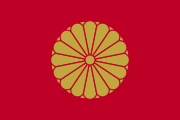
Emperor Meiji
The or was the 122nd emperor of Japan according to the traditional order of succession, reigning from 3 February 1867 until his death...
), the Empress, and for other members of the imperial family. At first, the emperor's flag was ornate, with a sun resting in the center of an artistic pattern. He had flags that were used on land, at sea, and when he was in a carriage. The imperial family was also granted flags to be used at sea and while on land (one for use on foot and one carriage flag). The carriage flags were a monocolored chrysanthemum
Chrysanthemum
Chrysanthemums, often called mums or chrysanths, are of the genus constituting approximately 30 species of perennial flowering plants in the family Asteraceae which is native to Asia and northeastern Europe.-Etymology:...
, with 16 petals, placed in the center of a monocolored background. These flags were discarded in 1889 when the Emperor decided to use the chrysanthemum on a red background as his flag. With minor changes in the color shades and proportions, the flags adopted in 1889 are still in use by the imperial family.
The current emperor's flag is a 16-petal chrysanthemum, colored in gold, centered on a red background with a 2:3 ratio. The Empress uses the same flag, except the shape is that of a swallow tail. The crown prince and the crown princess use the same flags, except with a smaller chrysanthemum and a white border in the middle of the flags. The chrysanthemum has been associated with the Imperial throne since the rule of Emperor Go-Toba
Emperor Go-Toba
was the 82nd emperor of Japan, according to the traditional order of succession. His reign spanned the years from 1183 through 1198....
in the 12th century, but it did not become the exclusive symbol of the Imperial throne
Imperial Seal of Japan
The Imperial Seal of Japan is a mon or crest used by members of the Japanese Imperial family. Under the Meiji Constitution, no one was permitted to use the Imperial Seal except the Emperor of Japan, who used a 16 petal chrysanthemum with sixteen tips of another row of petals showing behind the...
until 1868.
Subnational flags
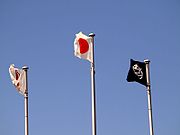
Prefectures of Japan
The prefectures of Japan are the country's 47 subnational jurisdictions: one "metropolis" , Tokyo; one "circuit" , Hokkaidō; two urban prefectures , Osaka and Kyoto; and 43 other prefectures . In Japanese, they are commonly referred to as...
has a flag resembling the national flag insofar as consisting of a symbol, called a mon
Mon (badge)
, also , , and , are Japanese emblems used to decorate and identify an individual or family. While mon is an encompassing term that may refer to any such device, kamon and mondokoro refer specifically to emblems used to identify a family....
, charged on a monocolored field (with the exception of Ehime
Ehime Prefecture
is a prefecture in northwestern Shikoku, Japan. The capital is Matsuyama.-History:Until the Meiji Restoration, Ehime prefecture was known as Iyo Province...
, which uses a symbol on a bicolor background). There are several prefecture flags, such as Hiroshima
Hiroshima
is the capital of Hiroshima Prefecture, and the largest city in the Chūgoku region of western Honshu, the largest island of Japan. It became best known as the first city in history to be destroyed by a nuclear weapon when the United States Army Air Forces dropped an atomic bomb on it at 8:15 A.M...
's, that match their specifications to the national flag (2:3 ratio, mon placed in the center and is 3/5 the length of the flag). Some of the mon display the name of the prefecture in Japanese characters
Japanese writing system
The modern Japanese writing system uses three main scripts:*Kanji, adopted Chinese characters*Kana, a pair of syllabaries , consisting of:...
; others are stylized depictions of the location or another special feature of the prefecture. An example of a prefectural flag is that of Nagano
Nagano Prefecture
is a prefecture of Japan located in the Chūbu region of the island of Honshū. The capital is the city of Nagano.- History :Nagano was formerly known as the province of Shinano...
, where the orange katakana
Katakana
is a Japanese syllabary, one component of the Japanese writing system along with hiragana, kanji, and in some cases the Latin alphabet . The word katakana means "fragmentary kana", as the katakana scripts are derived from components of more complex kanji. Each kana represents one mora...
character ナ (na) appears in the center of a white disc. One interpretation of the mon is that the na symbol represents a mountain and the white disc, a lake. The orange color represents the sun while the white color represents the snow of the region.
Municipalities
Municipalities of Japan
Japan has three levels of government: national, prefectural, and municipal. The nation is divided into 47 prefectures. Each prefecture consists of numerous municipalities. There are four types of municipalities in Japan: cities, towns, villages and special wards...
can also adopt flags of their own. The designs of the city flags are similar to the prefectural flags: a mon on a monocolored background. An example is the flag of Amakusa
Amakusa, Kumamoto
was a town located in Amakusa District, Kumamoto, Japan.Amakusa-machi consists of five villages, four spread along the west coast of Shimo-shima and one located in the mountains between the coast and Hondo, the administrative capital of Amakusa city. They are, in order of geographic location...
in Kumamoto Prefecture
Kumamoto Prefecture
is a prefecture of Japan located on Kyushu Island. The capital is the city of Kumamoto.- History :Historically the area was called Higo Province; and the province was renamed Kumamoto during the Meiji Restoration. The creation of prefectures was part of the abolition of the feudal system...
: the city symbol is composed of the Katakana
Katakana
is a Japanese syllabary, one component of the Japanese writing system along with hiragana, kanji, and in some cases the Latin alphabet . The word katakana means "fragmentary kana", as the katakana scripts are derived from components of more complex kanji. Each kana represents one mora...
character ア (a) and surrounded by waves. This symbol is centered on a white flag, with a ratio of 1:1.5. Both the city emblem and the flag were adopted in 2006.
Derivatives
In addition to the flags used by the military, several other flag designs were inspired by the national flag. The former Japan PostJapan Post
was a government-owned corporation in Japan, that existed from 2003–2007, offering postal and package delivery services, banking services, and life insurance. It had over 400,000 employees and ran 24,700 post offices throughout Japan and was the nation's largest employer. One third of all Japanese...
flag consisted of the Hinomaru with a red horizontal bar placed in the center of the flag. There was also a thin white ring around the red sun. It was later replaced by a flag that consisted of the 〒 postal mark in red on a white background.
Two recently designed national flags resemble the Japanese flag. In 1971, Bangladesh
Bangladesh
Bangladesh , officially the People's Republic of Bangladesh is a sovereign state located in South Asia. It is bordered by India on all sides except for a small border with Burma to the far southeast and by the Bay of Bengal to the south...
gained independence from Pakistan
Pakistan
Pakistan , officially the Islamic Republic of Pakistan is a sovereign state in South Asia. It has a coastline along the Arabian Sea and the Gulf of Oman in the south and is bordered by Afghanistan and Iran in the west, India in the east and China in the far northeast. In the north, Tajikistan...
, and it adopted a national flag
Flag of Bangladesh
The national flag of Bangladesh was adopted officially on 17 January 1972. It is based on a similar flag used during the Bangladesh Liberation War of 1971. The map was later deleted from the flag by the order of General Abul Manzur, most likely to simplify the design...
that had a green background, charged with an off-centered red disc that contained a golden map of Bangladesh. The current flag, adopted in 1972, dropped the golden map and kept everything else. The Government of Bangladesh officially calls the red disc a circle; the red color symbolizes the blood that was shed to create their country. The island nation of Palau
Palau
Palau , officially the Republic of Palau , is an island nation in the Pacific Ocean, east of the Philippines and south of Tokyo. In 1978, after three decades as being part of the United Nations trusteeship, Palau chose independence instead of becoming part of the Federated States of Micronesia, a...
uses a flag of similar design, but the color scheme is completely different. While the Government of Palau does not cite the Japanese flag as an influence on their national flag, Japan did administer Palau from 1914 until 1944. The flag of Palau
Flag of Palau
The flag of Palau was adopted on January 1, 1981, when the island group separated from the United Nations Trust Territory. Like in the flags of several other Pacific island groups, blue is the colour used to represent the ocean and the nation's place within it...
is an off-centered golden-yellow full moon
Full moon
Full moon lunar phase that occurs when the Moon is on the opposite side of the Earth from the Sun. More precisely, a full moon occurs when the geocentric apparent longitudes of the Sun and Moon differ by 180 degrees; the Moon is then in opposition with the Sun.Lunar eclipses can only occur at...
on a sky blue background. The moon stands for peace and a young nation while the blue background represents Palau's transition to self government from 1981 to 1994, when it achieved full independence.
The Japanese naval ensign also influenced other flag designs. One such flag design is used by the Asahi Shimbun
Asahi Shimbun
The is the second most circulated out of the five national newspapers in Japan. Its circulation, which was 7.96 million for its morning edition and 3.1 million for its evening edition as of June 2010, was second behind that of Yomiuri Shimbun...
. At the bottom hoist of the flag, one quarter of the sun is displayed. The kanji
Kanji
Kanji are the adopted logographic Chinese characters hanzi that are used in the modern Japanese writing system along with hiragana , katakana , Indo Arabic numerals, and the occasional use of the Latin alphabet...
character 朝 is displayed on the flag, colored white, covering most of the sun. The rays extend from the sun, occurring in a red and white alternating order, culminating in 13 total stripes. The flag is commonly seen at the National High School Baseball Championship, as the Asahi Shimbun is a main sponsor of the tournament. The rank flags and ensigns of the Imperial Japanese Navy also based their designs on the naval ensign.