
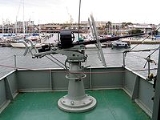
The
Oerlikon 20 mm cannon is a series of
autocannonAn autocannon is a rapid-fire projectile weapon firing a shell as opposed to the bullet fired by a machine gun. Autocannon often have a larger caliber than a machine gun . Usually, autocannon are smaller than a field gun or other artillery, and are mechanically loaded for a faster rate of fire...
s, based on
an originalThe 20 mm Becker was a German automatic cannon developed for aircraft use during World War I. It was first mass produced in 1916 and was installed in a variety of aircraft; the only German autocannon to actually see service in the air during the war....
designed by Reinhold Becker of Germany, very early in
World War IWorld War I , also known as the First World War, the Great War, and the War to End All Wars, was a global military conflict which involved most of the world's great powers, assembled in two opposing alliances: the Triple Entente and the Triple Alliance...
, and widely produced by
Oerlikon ContravesOerlikon Contraves is a Swiss anti-aircraft artillery manufacturer made famous by its Oerlikon 20 mm autocannon design of 1914, used in the First and Second World Wars, and still in use today. Copies and derivatives of these designs were used by the Germans, French, British and Japanese weapon...
and others. Various models of Oerlikon cannon were used during
World War IIWorld War II, or the Second World War , was a global military conflict which involved a majority of the world's nations, including all great powers, organized into two opposing military alliances: the Allies and the Axis...
, and they are still in use today.
Origins
During
World War IWorld War I , also known as the First World War, the Great War, and the War to End All Wars, was a global military conflict which involved most of the world's great powers, assembled in two opposing alliances: the Triple Entente and the Triple Alliance...
, the
GermanGermany , officially the Federal Republic of Germany , is a country in Central Europe. It is bordered to the north by the North Sea, Denmark, and the Baltic Sea; to the east by Poland and the Czech Republic; to the south by Austria and Switzerland; and to the west by France, Luxembourg, Belgium,...
Reinhold Becker developed a 20 mm cannon, known now as the
20 mm BeckerThe 20 mm Becker was a German automatic cannon developed for aircraft use during World War I. It was first mass produced in 1916 and was installed in a variety of aircraft; the only German autocannon to actually see service in the air during the war....
using the API blowback (Advanced Primer Ignition blowback) method of operation. This used a 20x70 RB cartridge and had a cyclic rate of fire of 300 rpm. It was used on a limited scale as an aircraft gun and an anti-aircraft gun towards the end of that war.
Because the treaty of Versailles banned further production of such weapons in Germany, the patents and design works were transferred in 1919 to the Swiss firm SEMAG (
Seebach Maschinenbau Aktien Gesellschaft) based near Zürich. SEMAG contained development of the weapon, and in 1924 had produced the
SEMAG L, a heavier weapon (43 kg) that fired more powerful 20x100RB ammunition at a slightly higher rate of fire, 350 rpm.
In 1924 SEMAG failed. The Oerlikon firm, named after the Zürich suburb were it was based, then acquired all rights to the weapon, plus the manufacturing equipment and the employees of SEMAG.
Oerlikon
In 1927 the
Oerlikon S was added to the existing product line. This fired a still larger cartridge (20x110RB) to achieve a muzzle velocity of 830 m/s (versus 490 m/s for the original Becker 20x70RB gun), at the cost of increased weight and a reduced rate of fire (280 rpm). The purpose of this development was to improve the performance of the gun as an anti-tank and anti-aircraft weapon, which required a higher muzzle velocity. An improved version known as the 1S followed in 1930.
The three size of gun with their different ammunition and barrel length, but very similar mechanisms, continued to be developed in parallel. In 1930 Oerlikon reconsidered the application of its gun in aircraft and introduced the
AF and
AL, designed to be used in flexible mounts, i.e. manually aimed by a gunner. The 15-round box magazine used by earlier versions of the gun was replaced by drum magazine holding 15 or 30 rounds.
In 1935 it made an important step by introducing a series of guns designed to be mounted in or on the wings of fighter aircraft. Designated with FF for
Flügelfest meaning "wing-mounted", these weapons were again available in the three sizes, with designations
FF,
FFL and
FFS. The FF fired a slightly larger cartridge than the AF, 20x72RB, but the major improvement in these weapons was a significant increase in rate of fire. The FF weighed 24 kg and achieved a muzzle velocity of 550 to 600 m/s with a rate of fire of 520 rpm. The FFL of 30 kg fired a projectile at a muzzle velocity of 675 m/s with a rate of fire of 500 rpm. And the FFS, which weighed 39 kg, delivered a high muzzle velocity of 830 m/s at a rate of fire of 470 rpm.
Apart from changes to the design of the guns for wing-mounting and remote control, larger drums were introduced as it would not be possible to exchange magazines in flight. For the FF series drum sizes of 45, 60, 75 and 100 rounds were available, but most users chose the 60-round drum.
The 1930s were a period of global re-armament, and a number of foreign firms took licenses for the Oerlikon family of aircraft cannon. In France,
Hispano-SuizaHispano-Suiza was originally a Spanish luxury automotive and engineering firm — actually, from 1923 on, two different companies — best known for their cars, engines and weapons designs in the pre-World War II period...
manufactured development of the FFS as the Hispano-Suiza H.S.7 and H.S.9, for installation between the cylinder banks of its V-12 engines. In Germany, Ikaria further developed the FF gun as the MG FF, firing 20x80RB ammunition. And the
Imperial Japanese NavyThe Imperial Japanese Navy , literally Navy of the Empire of Greater Japan was the navy of the Empire of Japan from 1869 until 1947, when it was dissolved following Japan's constitutional renunciation of the use of force as a means of settling international disputes...
, after evaluating all three guns, ordered developments of the FF and FFL as the
Type 99-1The Type 99-1 cannon and Type 99-2 cannon were Japanese versions of the Oerlikon FF and Oerlikon FFL. They were adopted by the Imperial Japanese Navy in 1939 and served as their standard aircraft autocannon during World War II.-Adoption:...
and
Type 99-2The Type 99-1 cannon and Type 99-2 cannon were Japanese versions of the Oerlikon FF and Oerlikon FFL. They were adopted by the Imperial Japanese Navy in 1939 and served as their standard aircraft autocannon during World War II.-Adoption:...
.
The incorporation of the improvements of the FFS in a new anti-aircraft gun produced, in 1938, the
Oerlikon SS. Oerlikon realized further improvements in rate of fire on the 1SS of 1942, and the 2SS of 1945 which achieved 650 rpm. However, it was the original SS gun which was widely adopted as anti-aircraft gun, being especially widely used by Allied navies during
World War IIWorld War II, or the Second World War , was a global military conflict which involved a majority of the world's nations, including all great powers, organized into two opposing military alliances: the Allies and the Axis...
.
This gun used a 400-grain (26-gram) charge of IMR 4831
smokeless powderSmokeless powder is the name given to a number of propellants used in firearms and artillery which produce negligible smoke when fired, unlike the older gunpowder which they replaced...
to propel a 2000-grain (130-gram) projectile at 2800 feet (850 meters) per second.
World War II
The Oerlikon FF was installed as armament on some fighters of the 1930s, such as the Polish
PZL P.24The PZL P.24 was a Polish fighter aircraft, designed in mid-1930s in the PZL factory in Warsaw. It was exported to several countries, but not used in Poland.-Development:...
G. Locally produced derivatives of the Oerlikon cannon were used much more extensively, on aircraft, on ships and on land. In the air, the Ikaria MG FF was used as armament on a number of German aircraft, of which the most famous is the
Messerschmitt Bf 109The Messerschmitt Bf 109 was a German World War II fighter aircraft designed by Willy Messerschmitt in the early 1930s. It was one of the first true modern fighters of the era, including such features as an all-metal monocoque construction, a closed canopy, and retractable landing gear...
. The Japanese similarly used the
Type 99 cannonThe Type 99-1 cannon and Type 99-2 cannon were Japanese versions of the Oerlikon FF and Oerlikon FFL. They were adopted by the Imperial Japanese Navy in 1939 and served as their standard aircraft autocannon during World War II.-Adoption:...
on a number of types including the
MitsubishiThe , Mitsubishi Group of Companies, or Mitsubishi Companies is a Japanese conglomerate consisting of a range of autonomous businesses which share the Mitsubishi brand, trademark and legacy...
A6M ZeroThe Mitsubishi A6M Zero was a fighter aircraft operated by the Imperial Japanese Navy Air Service from 1940 to 1945. The origin of its official designation was that "A" signified a carrier-based fighter, "6" for the sixth such model built for the Imperial Navy, and "M" for the manufacturer,...
.
The French firm of Hispano-Suiza was a manufacturer of aircraft engines, and it marketed the
moteur-canon combination of its
12XThe Hispano-Suiza 12X was an aircraft piston engine designed in France by Hispano-Suiza during the early 1930s. A 12-cylinder Vee, liquid-cooled design, the 12X was used on several aircraft types, some of them being used in limited numbers during World War II...
and
12YThe Hispano-Suiza 12Y was a French aircraft engine in the pre-WWII era. Developed from the earlier, and somewhat smaller, 12X, the 12Y became the primary 1,000 hp class engine and was used in a number of famous aircraft, including the Morane-Saulnier M.S.406, Dewoitine D.520...
engines with a H.S.7 or H.S.9 cannon installed between the cylinder banks. The gun fired through the hollow propeller hub, this being elevated above the crankcase by the design of the gearing. Such armament was installed on the
Morane-Saulnier M.S.406The M.S.406 was a French Armée de l'Air fighter aircraft built by Morane-Saulnier starting in 1938. Numerically it was France's most important fighter during the opening stages of World War II but was under-powered, weakly-armed and lacked full armour protection when compared to its contemporaries...
and some other types. Similar German installations of the MG FF were not successful.
The Oerlikon became best known in its naval applications. Initially the Oerlikon was not looked upon favorably by the
Royal NavyThe Royal Navy of the United Kingdom is the oldest of HM Armed Forces . From the beginning of the 18th century until well into the 20th century, it was the most powerful navy in the world, playing a key part in establishing the British Empire as the dominant world power from 1815 until the early...
as a short-range anti-aircraft gun. All through 1937-1938 Lord Louis Mountbatten waged a lone campaign within the Royal Navy to set up an unprejudiced trial for the Oerlikon 20 mm gun, but it was all in vain. It was not until the
Commander-in-ChiefA commander-in-chief is the commander of a nation's military forces or significant element of those forces. In the latter case, the force element may be defined as those forces within a particular region or those forces which are associated by function. As a practical term it refers to the...
of the Home Fleet,
AdmiralAdmiral is the rank, or part of the name of the ranks, of the highest naval officers. It is usually considered a full admiral and above Vice Admiral and below Admiral of the Fleet/Fleet Admiral. It is usually abbreviated to "Adm." or "ADM"...
Sir Roger Backhouse, was appointed
First Sea LordThe First Sea Lord is the professional head of the Royal Navy and the whole Naval Service; it was formerly known as First Naval Lord. He also holds the title of Chief of Naval Staff, and is known by the abbreviations 1SL/CNS...
that Mountbatten's efforts bore fruit. During the first half of 1939 a contract for 1,500 guns was placed in Switzerland. However, due to delays and then later the Fall of France in June 1940 only 109 guns reached the
United KingdomThe United Kingdom of Great Britain and Northern Ireland is a sovereign state located off the northwestern coast of continental Europe. It is an island country, spanning an archipelago including Great Britain, the northeastern part of Ireland, and many small islands...
. All Oerlikon guns imported from Switzerland in 1940 were mounted on various gun carriages to serve as light AA-guns on land.
Just a few weeks before the Fall of France, the Oerlikon factory approved manufacture of their gun in the United Kingdom, under license. The Royal Navy managed to smuggle out the necessary drawings and documents from
ZürichZürich or Zurich is the largest city in Switzerland and the capital of the canton of Zürich. The city is Switzerland's main commercial and cultural centre and sometimes called the Cultural Capital of Switzerland, the political capital of Switzerland being Berne...
. The production of the first British-made Oerlikon guns started in
RuislipRuislip is a place in the London Borough of Hillingdon, in West London, England.-Etymology:Its name is created from the Old English ryse, "rush" and hlype, "leap", which is thought to refer to a spot where the River Pinn could once be crossed. Other scholars argue the second syllable is derived...
,
London[]London is the capital of England and the United Kingdom. It has been a major settlement for two millennia, and the history of London goes back to its founding by the Romans, when it was named Londinium. London's core, the ancient City of London, the 'square mile', retains its medieval boundaries...
, at the end of 1940; and the first guns were delivered to the Royal Navy in March or April, 1941.
The Oerlikon gun was fielded in
United States NavyThe United States Navy is the sea branch of the U.S. Armed Forces. It is one of the seven uniformed services of the United States. As of 31 December 2008, the U.S. Navy had about 331,682 personnel on active duty and 124,000 in the Navy Reserve. It operates 283 ships in active service and more than...
ships starting in 1942, replacing the M2 Browning machine gun, which lacked range and firepower. It became famous in the naval anti-aircraft role, providing an effective defence at short ranges (in practice up to 1.5 km) at which heavier guns had difficulty tracking a target. The gun was eventually abandoned as a major anti-air weapon due to its lack of
stopping powerStopping power is a colloquial term used to describe the ability of a firearm or other weapon to cause a penetrating ballistic injury to a target human or animal, sufficient to incapacitate the target where it stands....
against heavy aircraft and against Japanese
kamikazeThe were suicide attacks by military aviators from the Empire of Japan against Allied naval vessels in the closing stages of the Pacific campaign of World War II, designed to destroy as many warships as possible....
attacks during the
Pacific WarThe Pacific War was the part of World War II—and preceding conflicts—that took place in the Pacific Ocean, its islands, and in East Asia. The war began as a conflict with the Empire of Japan and the Republic of China on July 7, 1937, but by December 1941, became part of the greater World War II,...
. It was largely superseded by the Bofors 40 mm gun and the
3"/70 Mark 26 gunThe 3"/70 Mark 26 Gun was developed to protect United States Warships from kamikaze attacks in World War II. The name indicates in US Navy terminology that this piece of naval artillery fires a 3" projectile in diameter and has a caliber length of 70 .-History:The 3"/70 Mark 26 Gun saw its...
. It did, however, provide a useful increase in firepower over the .50 cal machine gun when adapted and fitted to some aircraft; however, it had some problems with jamming in the ammunition feed.
The
Royal Canadian NavyThe Royal Canadian Navy was the navy of Canada from 1911 until 1968 when the three Canadian services were unified to form the Canadian Forces....
, since renamed to become the Canadian Navy, popularized the use of the Oerlikon gun as an anti-ship and anti-submarine gun - while it was not effective against the armour of most larger ships, it was used extensively and effectively against U-Boats, and on the decks of larger ships. A handful of Corvettes were fitted with the weapon toward the end of the war, but it appeared more commonly on frigates and destroyers at the time.
The Oerlikon was also used as the basis for the
PolstenThe Polsten was a low cost Polish development of the 20 mm Oerlikon gun. The Polsten was designed to be simpler and much cheaper to build than the Oerlikon without reducing effectiveness. When Nazi Germany invaded Poland in 1939, the design team escaped to England and resumed work together with...
gun, designed by Polish engineers in exile in the United Kingdom. The gun went into service in 1944, and was used well into the 1950s for, among other uses, on
Cromwell tankThe Tank, Cruiser, Mk VIII, Cromwell , named after the English Civil War leader Oliver Cromwell, was one of the most successful series of cruiser tanks fielded by Britain in World War II. It was the first tank in the British arsenal to combine a dual-purpose gun, high speed, and reasonable armour...
s and early model
Centurion tankThe Centurion was the primary British main battle tank of the post World War II period, and was a successful tank design, with upgrades, for many decades. The chassis was also adapted for several other roles....
s.
It is still in use today on some naval units, theoretically as a last-recourse anti-air weapon, but mainly used for police shots (
warning shotA warning shot is a harmless artillery shot or gunshot intended to call attention and demand some action....
s or incapacitating shots).
Description
The Oerlikon cannon and its derivatives feature
blowbackBlowback is a system of operation for self-loading firearms that obtains power from the motion of the cartridge case as it is pushed to the rear by expanding gases created by the ignition of the powder charge....
operation: The bolt is not locked to the breech of the gun on the moment of fire, but moves freely to the rear while the propellant gases propel the projectile forward. To make sure that the projectile has left the muzzle and the gas pressure in the barrel is down to a safe level before the breech opens, the firing pin strikes the primer while the bolt is still travelling forward, so that the gas pressure first has to overcome the forward momentum of the bolt before it can push it to the rear. To give the heavy bolt sufficient forward speed, a large spring is required, which is wrapped around the barrel of the gun. Also, the chamber is longer than needed to contain the case, so that the bolt and case must travel a small distance to the rear before the case extends beyond the face of the chamber. Nevertheless a fairly heavy bolt must be used, which limits the rate of fire.
This design results in the use of a characteristically shaped cartridge: The case has straight sides, very little neck, and a rebated rim. The straight sides allows the case to slide back and forward in the cylindrical chamber. The neck is not supported while this happens and therefore expands when the case is fired, and the rebated rim allows the face of the bolt, with its extractor claw hooked over the rim, to fit within the chamber. To ease the motion of the case, the ammunition needed to be greased, which was a drawback of the Oerlikon cannon. An alternative developed during WWII was the so-called fluted chamber, which had grooves that allowed gun gas to seep between the chamber wall and the case, taking over the role of the grease.
Ammunition feed is typically by a 60-round drum
magazineA magazine is an ammunition storage and feeding device within or attached to a repeating firearm. Magazines may be integral to the firearm or removable . The magazine functions by moving the cartridges stored in the magazine into a position where they may be loaded into the chamber by the ...
on the top of the gun. During sustained firing, the magazine must be frequently changed, reducing the effective rate of fire. Belt-fed versions of the gun were developed to overcome this limitation. A trigger in the right-hand grip controls fire. Used cartridges are ejected from below the breech.
Different nations and services operated a number of mounting types for the same basic gun. In a typical single-barrel naval version, it is free-swinging on a fixed
pedestalPedestal is a term generally applied to the support of a statue or a vase....
mounting with a flat armored shield affording some protection for the crew. The cannon is aimed and fired by a gunner using, in its simplest form, a ring-and-bead sight. The gunner is attached to the weapon by a waist-belt and shoulder supports. For this reason, some mountings existed with a height-adjustment feature to compensate for different sized gunners. A "piece chief" designates targets and the feeder changes exhausted magazines.
During WWII, twin and quadruple Oerlikon mounts were developed, both for army and for navy use. The British Navy operated a hydraulically operated twin-gun mount, and the USN adopted a four-gun mount.
External links