


Undercarriage

Encyclopedia
Aviation
Aviation is the design, development, production, operation, and use of aircraft, especially heavier-than-air aircraft. Aviation is derived from avis, the Latin word for bird.-History:...
, is the structure that supports an aircraft
Aircraft
An aircraft is a vehicle that is able to fly by gaining support from the air, or, in general, the atmosphere of a planet. An aircraft counters the force of gravity by using either static lift or by using the dynamic lift of an airfoil, or in a few cases the downward thrust from jet engines.Although...
on the ground and allows it to taxi
Taxiing
Taxiing refers to the movement of an aircraft on the ground, under its own power, in contrast to towing or push-back where the aircraft is moved by a tug...
, takeoff
Takeoff
Takeoff is the phase of flight in which an aerospace vehicle goes from the ground to flying in the air.For horizontal takeoff aircraft this usually involves starting with a transition from moving along the ground on a runway. For balloons, helicopters and some specialized fixed-wing aircraft , no...
and land
Landing
thumb|A [[Mute Swan]] alighting. Note the ruffled feathers on top of the wings indicate that the swan is flying at the [[Stall |stall]]ing speed...
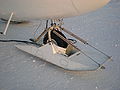
. Typically wheels are used, but skids, skis, floats or a combination of these and other elements can be deployed, depending on the surface.
Overview
Landing gear usually includes wheelWheel
A wheel is a device that allows heavy objects to be moved easily through rotating on an axle through its center, facilitating movement or transportation while supporting a load, or performing labor in machines. Common examples found in transport applications. A wheel, together with an axle,...
s equipped with shock absorber
Shock absorber
A shock absorber is a mechanical device designed to smooth out or damp shock impulse, and dissipate kinetic energy. It is a type of dashpot.-Nomenclature:...
s for solid ground, but some aircraft are equipped with ski
Ski
A ski is a long, flat device worn on the foot, usually attached through a boot, designed to help the wearer slide smoothly over snow. Originally intended as an aid to travel in snowy regions, they are now mainly used for recreational and sporting purposes...
s for snow or float
Seaplane
A seaplane is a fixed-wing aircraft capable of taking off and landing on water. Seaplanes that can also take off and land on airfields are a subclass called amphibian aircraft...
s for water, and/or skids or pontoon
Pontoon (boat)
A pontoon is a flotation device with buoyancy sufficient to float itself as well as a heavy load. A pontoon boat is a flattish boat that relies on pontoons to float. Pontoons may be used on boats, rafts, barges, docks, floatplanes or seaplanes. Pontoons may support a platform, creating a raft. A...
s (helicopter
Helicopter
A helicopter is a type of rotorcraft in which lift and thrust are supplied by one or more engine-driven rotors. This allows the helicopter to take off and land vertically, to hover, and to fly forwards, backwards, and laterally...
s).
The undercarriage is a relatively heavy part of the vehicle, it can be as much as 7% of the takeoff weight, but more typically is 4-5%.
Gear arrangements
Conventional landing gear
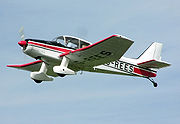
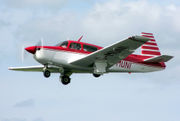
thumb|The [[Piper PA-18|Piper Super Cub]] is a popular taildragger aircraft.thumb|right|A [[Cessna 150]] converted to taildragger configuration by installation of an after-market modification kit....
, where there are two main wheels towards the front of the aircraft and a single, much smaller, wheel or skid at the rear; or tricycle undercarriage where there are two main wheels (or wheel assemblies) under the wings and a third smaller wheel in the nose. The taildragger arrangement was common during the early propeller era, as it allows more room for propeller clearance. Most modern aircraft have tricycle undercarriages. Taildraggers are considered harder to land and take off (because the arrangement is unstable, that is, a small deviation from straight-line travel is naturally amplified by the greater drag of the mainwheel which has moved farther away from the plane's centre of gravity due to the deviation), and usually require special pilot training. Sometimes a small tail wheel or skid is added to aircraft with tricycle undercarriage, in case of tail strike
Tailstrike
Tailstrike is an aviation term that describes an event in which the rear end of an aircraft touches the runway. This can happen during takeoff of a fixed-wing aircraft if the pilot pulls up too rapidly, leading to the rear end of the fuselage touching the runway. It can also occur during landing...
s during take-off. The Concorde
Concorde
Aérospatiale-BAC Concorde was a turbojet-powered supersonic passenger airliner, a supersonic transport . It was a product of an Anglo-French government treaty, combining the manufacturing efforts of Aérospatiale and the British Aircraft Corporation...
, for instance, had a retractable tail "bumper" wheel, as delta wing
Delta wing
The delta wing is a wing planform in the form of a triangle. It is named for its similarity in shape to the Greek uppercase letter delta .-Delta-shaped stabilizers:...
ed aircraft need a high angle when taking off. The Boeing 727
Boeing 727
The Boeing 727 is a mid-size, narrow-body, three-engine, T-tailed commercial jet airliner, manufactured by Boeing. The Boeing 727 first flew in 1963, and for over a decade more were built per year than any other jet airliner. When production ended in 1984 a total of 1,832 aircraft had been produced...
also had a retractable tail bumper. Some aircraft with retractable conventional landing gear have a fixed tailwheel, which generates minimal drag (since most of the airflow past the tailwheel has been blanketed by the fuselage) and even improves yaw stability in some cases.
Retractable gear
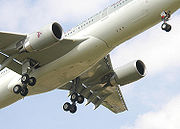
If the wheels rest protruding and partially exposed to the air stream after being retracted, the system is called semi-retractable.
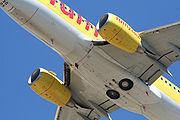
Most retraction systems are hydraulically-operated, though some are electrically-operated or even manually-operated. This adds weight and complexity to the design. In retractable gear systems, the compartment where the wheels are stowed are called wheel wells, which may also diminish valuable cargo or fuel space.
Alphonse Pénaud
Alphonse Pénaud , was a 19th-century French pioneer of aviation, inventor of the rubber powered model airplane Planophore and founder of the aviation industry.-Biography:...
and Paul Gauchot. Aircraft with at least partially retractable landing gear did not appear until 1917, and it was not until the late 1920s and early 1930s that such aircraft became common, with Grover Loening
Grover Loening
Grover Cleveland Loening was an American aircraft manufacturer.-Biography:Loening was born in Bremen, Germany, while his American-born father was stationed there as U.S. Consul. He graduated from Columbia University in New York City, where he was awarded the first-ever degree in Aeronautical...
's military aircraft designs being among the first routinely using them for the main undercarriage members, in a system later licensed and used by his friend Leroy Grumman
Leroy Grumman
Leroy Randle "Roy" Grumman was an American aeronautical engineer, test pilot, and industrialist. In 1929, he co-founded Grumman Aeronautical Engineering Co. later to become Grumman Aerospace Corporation, now part of Northrop Grumman.-Early life:Born in Huntington, New York, Grumman's forebears had...
's aviation firm. By then, aircraft performance was improved to the point where the aerodynamic advantage of a retractable undercarriage justified the added complexity, weight and interior space penalties. An alternate method of reducing the aerodynamic penalty imposed by fixed undercarriage is to attach aerodynamic fairings (often called "spats" or "pants") on the undercarriage, with only the bottoms of the wheels exposed.
Pilots confirming that their landing gear is down and locked refer to "three green" or "three in the green.", a reference to electrical indicator lights from the nosewheel and the two main gears. Amber lights indicate the gears are in the up-locked position; red lights indicates that the landing gear is in transit (neither down and locked nor fully retracted).
Multiple redundancies are usually provided to prevent a single failure from failing the entire landing gear extension process. Whether electrically or hydraulically operated, the landing gear can usually be powered from multiple sources. In case the power system fails, an emergency extension system is always available. This may take the form of a manually-operated crank or pump, or a mechanical free-fall mechanism which disengages the uplocks and allows the landing gear to fall due to gravity. Some high-performance aircraft may even feature a pressurized-nitrogen back-up system.
Large aircraft
World War I
World War I , which was predominantly called the World War or the Great War from its occurrence until 1939, and the First World War or World War I thereafter, was a major war centred in Europe that began on 28 July 1914 and lasted until 11 November 1918...
long-range bomber of 1916, used a total of eighteen wheels for its undercarriage, split between two wheels on its nose gear struts, and a total of sixteen wheels on its main gear units under each tandem engine nacelle, to support its loaded weight of almost 12 metric tons. Later, during World War II, the experimental German Arado Ar 232
Arado Ar 232
The Arado Ar 232 Tausendfüssler was the first truly modern cargo aircraft, designed and built in small numbers by the German firm Arado Flugzeugwerke during World War II...
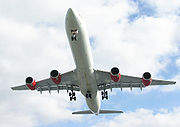
cargo aircraft used a centerline row of ten "twinned" fixed wheel sets directly under the fuselage centreline to handle heavier loads while on the ground, as the earliest known example of multiple "tandem wheels" on an aircraft, like many of today's large cargo aircraft use for their retractable main gear setups (usually mounted on the lower corners of the central fuselage structure). The Airbus A340-500
Airbus A340
The Airbus A340 is a long-range four-engine wide-body commercial passenger jet airliner. Developed by Airbus Industrie,A consortium of European aerospace companies, Airbus is now fully owned by EADS and since 2001 has been known as Airbus SAS. a consortium of European aerospace companies, which is...
/-600 has an additional four-wheel undercarriage bogie
Bogie
A bogie is a wheeled wagon or trolley. In mechanics terms, a bogie is a chassis or framework carrying wheels, attached to a vehicle. It can be fixed in place, as on a cargo truck, mounted on a swivel, as on a railway carriage/car or locomotive, or sprung as in the suspension of a caterpillar...
on the fuselage centreline, much like the twin-wheel unit in the same general location, used on later DC-10
McDonnell Douglas DC-10
The McDonnell Douglas DC-10 is a three-engine widebody jet airliner manufactured by McDonnell Douglas. The DC-10 has range for medium- to long-haul flights, capable of carrying a maximum 380 passengers. Its most distinguishing feature is the two turbofan engines mounted on underwing pylons and a...
and MD-11
McDonnell Douglas MD-11
The McDonnell Douglas MD-11 is a three-engine medium- to long-range widebody jet airliner, manufactured by McDonnell Douglas and, later, by Boeing Commercial Airplanes. Based on the DC-10, it features a stretched fuselage, increased wingspan with winglets, refined airfoils on the wing and smaller...
airliners. The Boeing 747
Boeing 747
The Boeing 747 is a wide-body commercial airliner and cargo transport, often referred to by its original nickname, Jumbo Jet, or Queen of the Skies. It is among the world's most recognizable aircraft, and was the first wide-body ever produced...
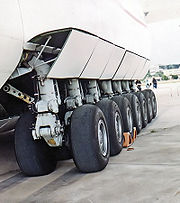
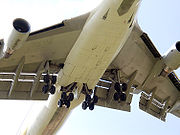
has five sets of wheels: a nose-wheel assembly and four sets of four-wheel bogies. A set is located under each wing, and two inner sets are located in the fuselage, a little rearward of the outer bogies, adding up to a total of eighteen wheels and tires. The Airbus A380 also has a four-wheel bogie under each wing with two sets of six-wheel bogies under the fuselage. The enormous Ukrainian Antonov An-225
Antonov An-225
The Antonov An-225 Mriya is a strategic airlift cargo aircraft, designed by the Antonov Design Bureau in the 1980s. It is the world's heaviest aircraft. The design, built in order to transport the Buran orbiter, was an enlargement of the successful An-124 Ruslan...
jet cargo aircraft has one of the largest, if not the largest, number of individual wheel/tire assemblies in its landing gear design - with a total of four wheels on the twin-strut nose gear units, and a total of 28 main gear wheel/tire units, adding up to a total of 32 wheels and tires.
Unusual types of gear

Takeoff
Takeoff is the phase of flight in which an aerospace vehicle goes from the ground to flying in the air.For horizontal takeoff aircraft this usually involves starting with a transition from moving along the ground on a runway. For balloons, helicopters and some specialized fixed-wing aircraft , no...
and drop them afterwards, to gain the improved streamlining without the complexity, weight and space requirements of a retraction mechanism, with such jettisonable wheels sometimes mounted onto axles that were part of a separate "dolly" (for main wheels only) or "trolley" (for a three wheel set with a nosewheel) chassis. In this case, landing is achieved on skids or similar simple devices. Historical examples include the "dolly"-using Messerschmitt Me 163
Messerschmitt Me 163
The Messerschmitt Me 163 Komet, designed by Alexander Lippisch, was a German rocket-powered fighter aircraft. It is the only rocket-powered fighter aircraft ever to have been operational. Its design was revolutionary, and the Me 163 was capable of performance unrivaled at the time. Messerschmitt...
rocket fighter, the Messerschmitt Me 321
Messerschmitt Me 321
|-See also:-Bibliography:* Dabrowski, Hans-Peter. Messerschmitt Me 321/323: The Luftwaffe's "Giants" in World War II. Atglen, PA: Schiffer Military History, 2001. ISBN 0-7643-1442-4....
Gigant troop glider, and the first eight "trolley"-using prototypes of the Arado Ar 234
Arado Ar 234
The Arado Ar 234 was the world's first operational jet-powered bomber, built by the German Arado company in the closing stages of World War II. Produced in very limited numbers, it was used almost entirely in the reconnaissance role, but in its few uses as a bomber it proved to be nearly impossible...
jet reconnaissance bomber. The main disadvantage to using the takeoff dolly/trolley and landing skid(s) system on German World War II aircraft, was that aircraft would likely be scattered all over a military airfield after they had landed from a mission, and would be unable to taxi on their own to an appropriately hidden "dispersal" location, which could easily leave them vulnerable to being shot up by attacking Allied
Allies of World War II
The Allies of World War II were the countries that opposed the Axis powers during the Second World War . Former Axis states contributing to the Allied victory are not considered Allied states...
fighters. A related contemporary example are the wingtip support wheels ("Pogos") on the Lockheed U-2
Lockheed U-2
The Lockheed U-2, nicknamed "Dragon Lady", is a single-engine, very high-altitude reconnaissance aircraft operated by the United States Air Force and previously flown by the Central Intelligence Agency . It provides day and night, very high-altitude , all-weather intelligence gathering...
reconnaissance aircraft, which fall away after take-off and drop to earth; the aircraft then relies on titanium skids on the wingtips for landing.
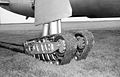
Some main gear struts on World War II aircraft, in order to allow a single-leg main gear to more efficiently store the wheel within either the wing or an engine nacelle, rotated the single gear strut through a 90º angle during the rearwards-retraction sequence to allow the main wheel to rest "flat" above the lower end of the main gear strut, or flush within the wing, when fully retracted. Examples are the Curtiss P-40
Curtiss P-40
The Curtiss P-40 Warhawk was an American single-engine, single-seat, all-metal fighter and ground attack aircraft that first flew in 1938. The P-40 design was a modification of the previous Curtiss P-36 Hawk which reduced development time and enabled a rapid entry into production and operational...
, Vought F4U Corsair, Grumman F6F Hellcat, Messerschmitt Me 210
Messerschmitt Me 210
The Messerschmitt Me 210 was a German heavy fighter and ground-attack aircraft of World War II. The Me 210 was designed to replace the Bf 110 in heavy fighter role; design started before the opening of World War II. The first examples of the Me 210 were ready in 1939, but they proved to have poor...
and Junkers Ju 88
Junkers Ju 88
The Junkers Ju 88 was a World War II German Luftwaffe twin-engine, multi-role aircraft. Designed by Hugo Junkers' company through the services of two American aviation engineers in the mid-1930s, it suffered from a number of technical problems during the later stages of its development and early...
. The Aero Commander
Aero Commander (aircraft)
The Aero Commander 500 is the first in a series of light-twin piston-engined aircraft originally built by the Aero Design and Engineering Company in the late 1940s. In 1950 it became the Aero Commander company, and a division of Rockwell International from 1965. The initial production version was...
family of twin-engined business aircraft also shares this feature on the main gears, which retract aft into the ends of the engine nacelle
Nacelle
The nacelle is a cover housing that holds engines, fuel, or equipment on an aircraft. In some cases—for instance in the typical "Farman" type "pusher" aircraft, or the World War II-era P-38 Lightning—an aircraft's cockpit may also be housed in a nacelle, which essentially fills the...
s. The rearward-retracting nosewheel strut on the Heinkel He 219
Heinkel He 219
The Heinkel He 219 Uhu was a night fighter that served with the German Luftwaffe in the later stages of World War II. A relatively sophisticated design, the He 219 possessed a variety of innovations, including an advanced VHF-band intercept radar...
and the forward-retracting nose gear strut on the later Cessna Skymaster
Cessna Skymaster
The Cessna Skymaster is a United States twin-engine civil utility aircraft built in a push-pull configuration. Its engines are mounted in the nose and rear of its pod-style fuselage. Twin booms extend aft of the wings to the vertical stabilizers, with the rear engine between them. The horizontal...
similarly rotated 90 degrees as they retracted.
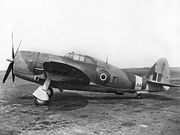
P-47 Thunderbolt
Republic Aviation's P-47 Thunderbolt, also known as the "Jug", was the largest, heaviest, and most expensive fighter aircraft in history to be powered by a single reciprocating engine. It was heavily armed with eight .50-caliber machine guns, four per wing. When fully loaded, the P-47 weighed up to...
, even mandating that the main gear struts lengthen as they were extended down from the wings to assure proper ground clearance for its large four-bladed propeller. One exception to the need for this complexity in many WW II fighter aircraft was Japan's famous Zero fighter, whose main gear stayed at a perpendicular angle to the centreline of the aircraft when extended, as seen from the side.
An unusual undercarriage configuration is found on the Hawker Siddeley Harrier, which has two mainwheels in line astern under the fuselage (called a bicycle or tandem
Tandem
Tandem is an arrangement where a team of machines, animals or people are lined up one behind another, all facing in the same direction....
layout) and a smaller wheel near the tip of each wing. On second generation Harriers, the wing is extended past the outrigger wheels to allow greater wing-mounted munition loads to be carried.
A multiple tandem layout was used on some military jet aircraft
Jet aircraft
A jet aircraft is an aircraft propelled by jet engines. Jet aircraft generally fly much faster than propeller-powered aircraft and at higher altitudes – as high as . At these altitudes, jet engines achieve maximum efficiency over long distances. The engines in propeller-powered aircraft...
during the 1950s, pioneered by the Martin XB-51
Martin XB-51
|-See also:-References:NotesBibliography* Andrade, John M. U.S. Military Aircraft Designations and Serials since 1909. Earl Shilton, Leicester, UK: Midland Counties Publications, 1979. ISBN 0-904597-22-9....
, and later used on such aircraft as the U-2, Myasishchev M-4
Myasishchev M-4
The Myasishchev M-4 Molot , USAF/DoD reporting name "Type 37", NATO reporting name 'Bison'.) is a four-engined strategic bomber designed by Vladimir Myasishchev and manufactured by the Soviet Union in the 1950s to provide a bomber capable of attacking targets in North America...
, Yakovlev Yak-25
Yakovlev Yak-25
The Yakovlev Yak-25 was a swept wing, turbojet-powered interceptor aircraft and reconnaissance aircraft built by Yakovlev and used by the Soviet Union.-Design and development:...
, Yak-28
Yakovlev Yak-28
The Yakovlev Yak-28 was a swept wing, turbojet-powered combat aircraft used by the Soviet Union. Produced initially as a bomber, it was also manufactured in reconnaissance, electronic warfare, interceptor, and trainer versions, known by the NATO reporting names Brewer, Firebar, and Maestro...
and the B-47 Stratojet
B-47 Stratojet
The Boeing Model 450 B-47 Stratojet was a long-range, six-engined, jet-powered medium bomber built to fly at high subsonic speeds and at high altitudes. It was primarily designed to drop nuclear bombs on the Soviet Union...
because it allows room for a large internal bay between the main wheels. A variation of the multi tandem layout is also used on the B-52 Stratofortress
B-52 Stratofortress
The Boeing B-52 Stratofortress is a long-range, subsonic, jet-powered strategic bomber operated by the United States Air Force since the 1950s. The B-52 was designed and built by Boeing, who have continued to provide maintainence and upgrades to the aircraft in service...
which has four main wheel bogies (two forward and two aft) underneath the fuselage and a small outrigger wheel supporting each wing-tip. The B-52's landing gear is also unique in that all four pairs of main wheels can be steered. This allows the landing gear to line up with the runway and thus makes crosswind landing
Crosswind landing
A crosswind landing is a landing maneuver in which a significant component of the prevailing wind is perpendicular to the runway center line.-Significance:Aircraft in flight are subject to the direction of the winds in which the aircraft is operating...
s easier (using a technique called crab landing). The challenge of designing a tandem-gear layout is that the aircraft has to sit (on the ground) at the optimum flight angle for landing - when the plane is nearly in a stalled attitude just before touchdown, both fore and aft wheels must be ready to contact the runway. Otherwise there will be a vicious jolt as the higher wheel falls to the runway at the stall.
One very early undercarriage arrangement that passively allowed for castoring during crosswind landings, unlike the "active" arrangement on the B-52, was pioneered on the Bleriot VIII
Blériot VIII
|-References:* Devaux, Jean and Michel Marani. "Les Douze Premiers Aéroplanes de Louis Blériot". Pegase No 54, May 1989.* * -See also:...
design of 1908. It was later used in the much more famous Blériot XI Channel-crossing aircraft of 1909 and also copied in the earliest examples of the Etrich Taube. In this arrangement the main landing gear's shock absorption was taken up by a vertically-sliding bungee cord-sprung upper member. The vertical post along which the upper member slid to take landing shocks also had its lower end as the rotation point for the forward end of the main wheel's suspension fork, allowing the main gear to pivot on moderate crosswind landings.
Light aircraft
For light aircraft a type of landing gear which is economical to produce is a simple wooden arch laminated from ash, as used on some homebuilt aircraft. A similar arched gear is often formed from spring steel. The Cessna AirmasterCessna 165
-External links:* A private owner's , complete with a report on the flying qualities of his plane and links to a restoration project showing the internals of an Airmaster's fuselage and wing.* * , May 1974 American Aircraft Modeler...
was among the first aircraft to use spring steel landing gear. The main advantage of such gear is that no other shock-absorbing device is needed; the deflecting leaf provides the shock absorption.
Gliders
Glider (sailplane)
A glider or sailplane is a type of glider aircraft used in the sport of gliding. Some gliders, known as motor gliders are used for gliding and soaring as well, but have engines which can, in some cases, be used for take-off or for extending a flight...
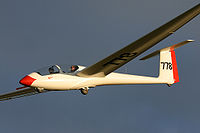
most usually have a single wheel, retractable or fixed, centered under the fuselage, which is referred to as monowheel gear or monowheel landing gear. Monowheel gear is also used on some powered aircraft, where drag reduction is a priority, such as the Europa XS
Europa XS
The Europa XS and Europa Classic are a family of British composite two-place low-wing monoplanes, manufactured by Europa Aircraft and supplied as kits for amateur construction. More than 450 Europas have been completed....
. Some gliders from prior to the Second World War used a take-off dolly that was jettisoned on take-off and then landed on a fixed skid.
Steering
Rudder
A rudder is a device used to steer a ship, boat, submarine, hovercraft, aircraft or other conveyance that moves through a medium . On an aircraft the rudder is used primarily to counter adverse yaw and p-factor and is not the primary control used to turn the airplane...
alone (depending upon the prop wash produced by the aircraft to turn it) with a freely-pivoting tail wheel, or by a steering linkage with the tail wheel, or by differential braking (the use of independent brakes on opposite sides of the aircraft to turn the aircraft by slowing one side more sharply than the other). Aircraft with tricycle landing gear usually have a steering linkage with the nose wheel (especially in large aircraft), but some allow the nose wheel to pivot freely and use differential braking and/or the rudder to steer the aircraft.
Some aircraft require that the pilot steer by using rudder pedals; others allow steering with the yoke or control stick. Some allow both. Still others have a separate control, called a tiller
Tiller
A tiller or till is a lever attached to a rudder post or rudder stock of a boat that provides leverage for the helmsman to turn the rudder...
, used for steering on the ground exclusively.
Rudder steering
Direct steering
Some aircraft link the yoke, control stick, or rudder directly to the wheel used for steering. Manipulating these controls turns the steering wheel (the nose wheel for tricycle landing gear, and the tail wheel for taildraggers). The connection may be a firm one in which any movement of the controls turns the steering wheel (and vice versa), or it may be a soft one in which a spring-like mechanism twists the steering wheel but does not force it to turn. The former provides positive steering but makes it easier to skid the steering wheel; the latter provides softer steering (making it easy to overcontrol) but reduces the probability of skidding. Aircraft with retractable gear may disable the steering mechanism wholly or partially when the gear is retracted.Differential braking
Tiller steering
A tiller in an aircraft is a small wheel or lever, sometimes accessible to one pilot and sometimes duplicated for both pilots, that controls the steering of the aircraft while it is on the ground. The tiller may be designed to work in combination with other controls such as the rudder or yoke. In large airliners, for example, the tiller is often used as the sole means of steering during taxi, and then the rudder is used to steer during take-off and landing, so that both aerodynamic control surfaces and the landing gear can be controlled simultaneously when the aircraft is moving at aerodynamic rates of speed.Landing gear and accidents
Belly landing
A belly landing or gear-up landing occurs when an aircraft lands without its landing gear fully extended and uses its underside, or belly, as its primary landing device...
, is an accident that may result from the pilot simply forgetting, or failing, to lower the landing gear before landing or a mechanical malfunction that does not allow the landing gear to be lowered. Although rarely fatal, a gear-up landing is very expensive, as it causes massive airframe damage. For propeller
Propeller (aircraft)
Aircraft propellers or airscrews convert rotary motion from piston engines or turboprops to provide propulsive force. They may be fixed or variable pitch. Early aircraft propellers were carved by hand from solid or laminated wood with later propellers being constructed from metal...
driven aircraft it almost always requires a complete rebuild of engines because the propellers strike the ground and suffer a sudden stoppage if they are running during the impact. Many aircraft between the wars - at the time when retractable gear was becoming commonplace - were deliberately designed to allow the bottom of the wheels to protrude below the fuselage even when retracted to reduce the damage caused if the pilot forgot to extend the landing gear or in case the plane was shot down and forced to crash-land. Examples include the Avro Anson
Avro Anson
The Avro Anson is a British twin-engine, multi-role aircraft that served with the Royal Air Force, Fleet Air Arm and numerous other air forces prior to, during, and after the Second World War. Named for British Admiral George Anson, it was originally designed for maritime reconnaissance, but was...
, Boeing B-17 Flying Fortress and the Douglas DC-3
Douglas DC-3
The Douglas DC-3 is an American fixed-wing propeller-driven aircraft whose speed and range revolutionized air transport in the 1930s and 1940s. Its lasting impact on the airline industry and World War II makes it one of the most significant transport aircraft ever made...
. The modern-day Fairchild-Republic A-10 Thunderbolt II
A-10 Thunderbolt II
The Fairchild Republic A-10 Thunderbolt II is an American single-seat, twin-engine, straight-wing jet aircraft developed by Fairchild-Republic in the early 1970s. The A-10 was designed for a United States Air Force requirement to provide close air support for ground forces by attacking tanks,...
carries on this legacy: it is similarly designed in an effort to avoid (further) damage during a gear-up landing, a possible consequence of battle damage.
Some aircraft have a stiffened fuselage bottom or added firm structures, designed to minimise structural damage in a wheels-up landing. When the Cessna Skymaster
Cessna Skymaster
The Cessna Skymaster is a United States twin-engine civil utility aircraft built in a push-pull configuration. Its engines are mounted in the nose and rear of its pod-style fuselage. Twin booms extend aft of the wings to the vertical stabilizers, with the rear engine between them. The horizontal...
was converted for a military spotting role (the O-2 Skymaster
O-2 Skymaster
The O-2 Skymaster is a military version of the Cessna 337 Super Skymaster utilized as an observation and forward air control aircraft...
), fiberglass
Fiberglass
Glass fiber is a material consisting of numerous extremely fine fibers of glass.Glassmakers throughout history have experimented with glass fibers, but mass manufacture of glass fiber was only made possible with the invention of finer machine tooling...
railings were added to the length of the fuselage; they were adequate to support the aircraft without damage if it was landed on a grassy surface.
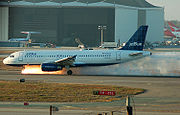
On September 21, 2005, JetBlue Airways Flight 292
JetBlue Airways Flight 292
JetBlue Airways Flight 292 was a scheduled flight from Bob Hope Airport in Burbank, California to John F. Kennedy International Airport in New York City. On September 21, 2005, flight 292 executed an emergency landing at Los Angeles International Airport after the nose wheels jammed in an...
successfully landed with its nose gear turned 90 degrees sideways, resulting in a shower of sparks and flame after touchdown. This type of incident is very uncommon as the nose oleo struts are designed with centering cams to hold the nosewheels straight until they are compressed by the weight of the aircraft.
Automatic extension systems
The Piper Arrow was originally fitted with a system that automatically extended the landing gear when certain power and flap settings were selected. The manufacturer issued an Airworthiness DirectiveAirworthiness Directive
An Airworthiness Directive is a notification to owners and operators of certified aircraft that a known safety deficiency with a particular model of aircraft, engine, avionics or other system exists and must be corrected....
for owners to disable this system. Pilots were found to be relying on this system to extend the gear in routine flight operations, rather than just as an emergency backup. If the gear failed to extend then the manufacturer was exposed to liability for the resulting gear-up landing. There were also concerns over unintentional gear extension incidents where pilots placed the aircraft in "bad-weather" (low-power setting, flaps down) configuration and inadvertently activated the gear extension system.
Emergency extension systems
In the event of a failure of the aircraft's landing gear extension mechanism a back-up is provided. This may be an alternate hydraulic system, a hand-crank, compressed air (nitrogen), pyrotechnic or free-fall system.A free-fall or gravity drop system uses gravity to deploy the landing gear into the down and locked position. To accomplish this the pilot activates a switch or mechanical handle in the cockpit, which releases the up-lock. Gravity then pulls the landing gear down and deploys it. Once in position the landing gear is mechanically locked and safe to use and land on.
Stowaways
- For main article and stowaway accidents, see StowawayStowawayA stowaway is a person who secretly boards a vehicle, such as an aircraft, bus, ship, cargo truck or train, to travel without paying and without being detected....
.
Unauthorized passengers have been known to stowaway on larger aircraft by climbing a landing gear strut and riding within the compartment. There are extreme dangers to this practice.
See also
- Landing gear extenderLanding gear extenderLanding gear extenders are devices used on conventional or tailwheel-equipped aircraft. They move the wheels forward of the landing gear leg by 2-3 inches ....
- Undercarriage arrangementsUndercarriage arrangementsBelow are featured the wheeled undercarriage arrangements of some modern commercial jet airliners and large military aircraft.-Types of wheeled units:...
of jetliners and other aircraft.