
Home      Discussion      Topics      Dictionary      Almanac
Signup       Login
Japanese battleship Yamato

Japanese battleship Yamato

Overview


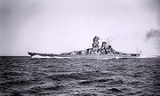
Yamato (大和), named after the ancient Japanese Yamato Province
Yamato Province
was a province of Japan, located in Kinai, corresponding to present-day Nara Prefecture in Honshū. It was also called . At first, the name was written with one different character , and for about ten years after 737, this was revised to use more desirable characters . The final revision was made in...

, was a battleship
Battleship
A battleship is a large, heavily armored warship with a main battery consisting of the largest caliber of guns. Battleships were larger, better armed and armored than cruisers or destroyers. There are currently no battleships in service....

 of the Imperial Japanese Navy
Imperial Japanese Navy
The Imperial Japanese Navy , literally Navy of the Empire of Greater Japan was the navy of the Empire of Japan from 1869 until 1947, when it was dissolved following Japan's constitutional renunciation of the use of force as a means of settling international disputes...

 during World War II
World War II
World War II, or the Second World War , was a global military conflict which involved a majority of the world's nations, including all great powers, organized into two opposing military alliances: the Allies and the Axis...

. Flagship of the Japanese Combined Fleet, she was lead ship
Lead ship
The lead ship or class leader is the first of a series or class of ships all constructed according to the same general design. Almost always, this is only applicable for military ships and larger civilian craft.-Overview:...

 of the Yamato class
Yamato class battleship
The were battleships of the Imperial Japanese Navy constructed and operated during World War II. Displacing at full-load, the vessels of the class were the largest, heaviest, and most heavily-armed battleships ever constructed. The class carried the largest naval artillery ever fitted to a...

. She and her sister ship, Musashi
Japanese battleship Musashi
, named after the ancient Japanese Musashi Province, was a battleship of the Imperial Japanese Navy during World War II, and flagship of the Japanese Combined Fleet. She was the second ship of the Yamato class...

, were the largest and heaviest battleships ever constructed, displacing 72,800 tonnes at full load, and armed with nine 46 cm (18.1 inch) main guns.

Constructed from 1937 – 1940 and formally commissioned in late 1941, Yamato served as the flagship of Admiral Isoroku Yamamoto
Isoroku Yamamoto
Naval Marshal General was the commander-in-chief of the Combined Fleet during World War II, a graduate of the Imperial Japanese Naval Academy and a student of the U.S...

 throughout 1942, first sailing as part of the Combined Fleet during the Battle of Midway
Battle of Midway
The Battle of Midway is widely regarded as the most important naval battle of the Pacific Campaign of World War II. Between 4 and 7 June 1942, approximately one month after the Battle of the Coral Sea and seven months after Japan's attack on Pearl Harbor, the United States Navy decisively defeated...

 in June 1942.
Discussion
Ask a question about 'Japanese battleship Yamato'
Start a new discussion about 'Japanese battleship Yamato'
Answer questions from other users
Full Discussion Forum
 
Encyclopedia
Armament:
(1941)
9 × 46 cm
40 cm/45 Type 94
The Japanese 40 cm/45 Type 94 naval guns were the largest calibre guns ever mounted on any warship. They were actually 46 cm guns, but were designated 40 cm in an effort to hide their true size....

 (18.1 in) (3×3)
12 x 155 mm (6.1 in) (4×3)
12 × 127 mm (5 in)
24 × 25 mm anti-aircraft (8×3)
4 × 13.2 mm AA (2×2)
Armament:
(1945)
9 × 46 cm
40 cm/45 Type 94
The Japanese 40 cm/45 Type 94 naval guns were the largest calibre guns ever mounted on any warship. They were actually 46 cm guns, but were designated 40 cm in an effort to hide their true size....

 (18.1 in) (3×3)
6 × 155 mm (6.1 in) (2×3)
24 × 127 mm (5 in)
162 × 25 mm anti-aircraft (52×3, 6×1)
4 × 13.2 mm AA (2×2)


Yamato (大和), named after the ancient Japanese Yamato Province
Yamato Province
was a province of Japan, located in Kinai, corresponding to present-day Nara Prefecture in Honshū. It was also called . At first, the name was written with one different character , and for about ten years after 737, this was revised to use more desirable characters . The final revision was made in...

, was a battleship
Battleship
A battleship is a large, heavily armored warship with a main battery consisting of the largest caliber of guns. Battleships were larger, better armed and armored than cruisers or destroyers. There are currently no battleships in service....

 of the Imperial Japanese Navy
Imperial Japanese Navy
The Imperial Japanese Navy , literally Navy of the Empire of Greater Japan was the navy of the Empire of Japan from 1869 until 1947, when it was dissolved following Japan's constitutional renunciation of the use of force as a means of settling international disputes...

 during World War II
World War II
World War II, or the Second World War , was a global military conflict which involved a majority of the world's nations, including all great powers, organized into two opposing military alliances: the Allies and the Axis...

. Flagship of the Japanese Combined Fleet, she was lead ship
Lead ship
The lead ship or class leader is the first of a series or class of ships all constructed according to the same general design. Almost always, this is only applicable for military ships and larger civilian craft.-Overview:...

 of the Yamato class
Yamato class battleship
The were battleships of the Imperial Japanese Navy constructed and operated during World War II. Displacing at full-load, the vessels of the class were the largest, heaviest, and most heavily-armed battleships ever constructed. The class carried the largest naval artillery ever fitted to a...

. She and her sister ship, Musashi
Japanese battleship Musashi
, named after the ancient Japanese Musashi Province, was a battleship of the Imperial Japanese Navy during World War II, and flagship of the Japanese Combined Fleet. She was the second ship of the Yamato class...

, were the largest and heaviest battleships ever constructed, displacing 72,800 tonnes at full load, and armed with nine 46 cm (18.1 inch) main guns.

Constructed from 1937 – 1940 and formally commissioned in late 1941, Yamato served as the flagship of Admiral Isoroku Yamamoto
Isoroku Yamamoto
Naval Marshal General was the commander-in-chief of the Combined Fleet during World War II, a graduate of the Imperial Japanese Naval Academy and a student of the U.S...

 throughout 1942, first sailing as part of the Combined Fleet during the Battle of Midway
Battle of Midway
The Battle of Midway is widely regarded as the most important naval battle of the Pacific Campaign of World War II. Between 4 and 7 June 1942, approximately one month after the Battle of the Coral Sea and seven months after Japan's attack on Pearl Harbor, the United States Navy decisively defeated...

 in June 1942. Throughout 1943, Yamato continually transferred between Truk, Kure
Kure, Hiroshima
is a city located in Hiroshima prefecture, Japan.As of January 1, 2008, the city has an estimated population of 246,118 and a density of 696 persons per km². The total area is 353.74 km².- History :...

 and Brunei
Brunei
Brunei , officially the State of Brunei Darussalam or the Nation of Brunei, the Abode of Peace , is a country located on the north coast of the island of Borneo, in Southeast Asia...

 in response to American airstrikes on Japanese island bases. The only time Yamato fired her main guns at enemy targets was in October 1944, but was ordered to turn back after attacks by destroyers and aircraft of the "Taffy" light escort carrier task groups managed to sink three heavy cruisers during the Battle off Samar
Battle off Samar
The Battle off Samar was the central action of the Battle of Leyte Gulf, which was one of the largest naval battles in history. As the only major action in the larger battle where the Americans were largely unprepared against the opposing forces, it has been cited by historians as one of the...

. Yamato was sunk in April 1945 during Operation Ten-Go
Operation Ten-Go
was the last major Japanese naval operation in the Pacific Theater of World War II. Other renderings of this operation's title in English include Operation Heaven One and Ten-ichi-gō....

.

Design and construction


Yamato was the lead ship of the Yamato class
Yamato class battleship
The were battleships of the Imperial Japanese Navy constructed and operated during World War II. Displacing at full-load, the vessels of the class were the largest, heaviest, and most heavily-armed battleships ever constructed. The class carried the largest naval artillery ever fitted to a...

 of heavy battleships, designed by the Imperial Japanese Navy in 1937. The class of battleship was designed to be capable of engaging multiple enemy targets, as a method of compensating for Japan's incapability to industrially compete with the United States Navy
United States Navy
The United States Navy is the sea branch of the U.S. Armed Forces. It is one of the seven uniformed services of the United States. As of 31 December 2008, the U.S. Navy had about 331,682 personnel on active duty and 124,000 in the Navy Reserve. It operates 283 ships in active service and more than...

. With the vessels of the Yamato class displacing over 70,000 tons each, it was hoped that the firepower of the constructed battleships could offset American industrial power.

The keel of Yamato was laid down at Kure Naval Arsenal
Kure Naval Arsenal
was one of four principal naval shipyards owned and operated by the Imperial Japanese Navy. -History:The Kure Naval District was established at Kure, Hiroshima in 1889, as the second of the naval districts responsible for the defense of the Japanese home islands along with the establishment of the...

 on 4 November 1937, in a specially designed dockyard. Throughout construction, large canvases prevented observation of the construction from elsewhere in the Kure Dockyards. Due to the size of the vessel, upgraded gantry cranes—each capable of lifting 150 and 350 tonnes—had to be designed and built for use during construction. Yamato was launched 8 August 1940, with Captain (later Vice Admiral) Miyazato Shutoku in command.

Armament


Yamatos main battery consisted of nine 18.1-inch 40 cm/45 Type 94
40 cm/45 Type 94
The Japanese 40 cm/45 Type 94 naval guns were the largest calibre guns ever mounted on any warship. They were actually 46 cm guns, but were designated 40 cm in an effort to hide their true size....

 naval guns—the largest caliber of naval artillery ever fitted to a warship. Each gun was long, weighed , and was capable of firing high-explosive or armour-piercing shells . Her secondary battery comprised twelve guns mounted in four triple turrets (one forward, one aft, two midships), and twelve guns in six double-turrets (three on each side amidships). In addition, Yamato carried twenty-four anti-aircraft guns, primarily mounted amidships. When refitted in 1944, the secondary battery configuration was changed to six guns, twenty-four guns, and one hundred sixty-two antiaircraft guns, in preparation for naval engagements in the South Pacific.

1942: Trials and initial operations


On 16 December 1941, Yamato was formally commissioned at Kure, with Captain (later Vice Admiral) Gihachi Takayanagi in overall command of the ship; she joined fellow battleships Nagato
Japanese battleship Nagato
Nagato was a battleship of the Imperial Japanese Navy, the lead ship of her class. She was the first battleship in the world to mount 16 inch class guns, and her armour protection and speed made her one of the most powerful capital ships at the time of her commissioning.She was the flagship of...

 and Mutsu
Japanese battleship Mutsu
thumb|right|300px|Battleship Mutsu shown shortly after commissioningMutsu , named after Mutsu Province, was the Imperial Japanese Navy's second Nagato class battleship, laid down at the Yokosuka Naval Arsenal on 1 June 1918, launched on 31 May 1920, and completed on 24 October 1921.Mutsu sailed...

 in the 1st Battleship Division on the same day. On 12 February 1942, Yamato became the flagship of Admiral Isoroku Yamamoto
Isoroku Yamamoto
Naval Marshal General was the commander-in-chief of the Combined Fleet during World War II, a graduate of the Imperial Japanese Naval Academy and a student of the U.S...

's Combined Fleet. Following sea trial
Sea trial
A sea trial is the testing phase of a watercraft . It is also referred as a "shakedown cruise" by many naval personnel. It is usually the last phase of construction and takes place on open water, and can last from a few hours to many days.Sea trials are conducted to measure a vessel’s performance...

s and war-games, Yamato was deemed fully operational and serviceable on 27 May 1942, and was assigned to Yamamoto's Main Battleship force for the upcoming Battle of Midway
Battle of Midway
The Battle of Midway is widely regarded as the most important naval battle of the Pacific Campaign of World War II. Between 4 and 7 June 1942, approximately one month after the Battle of the Coral Sea and seven months after Japan's attack on Pearl Harbor, the United States Navy decisively defeated...

. During the pivotal battle, Yamamoto exercised overall command of the Japanese assault force from Yamatos bridge. Following the defeat of Japan's primary carrier force (four fleet carriers and 332 aircraft destroyed), Yamato and the main battleship force withdrew to Hashirajima
Hashirajima
is an island in southern Hiroshima Bay of the Inland Sea, Yamaguchi Prefecture, Japan. Located 26 kilometers southeast of Iwakuni, it is part of the Kutsuna Islands within the Bōyō Islands group....

.

On 17 August 1942, Yamato departed Kure for Truk. Eleven days later, the American submarine spotted Yamato, firing four torpedoes at the battleship. No hits were scored, and Yamato entered Truk later in the day. Throughout the American naval campaign at Guadalcanal
Guadalcanal campaign
The Guadalcanal Campaign, also known as the Battle of Guadalcanal, was fought between August 7, 1942 and February 9, 1943 on and around the island of Guadalcanal in the Pacific theater of World War II...

, Yamato remained at Truk, as her high fuel consumption rates prevented feasible use in the Solomon Islands Campaign. In December 1942, Captain (later Rear-Admiral) Chiaki Matsuda was assigned to command of Yamato.

1943: Movement between bases


On 11 February 1943, Musashi replaced Yamato as flagship of the Combined Fleet. Yamato—coming to be called "Hotel Yamato" by the crews of Japanese cruisers and destroyers stationed in the South Pacific—remained at Truk until May 1943, when it departed first for Yokosuka, and then for Kure. For nine days, Yamato was drydocked for both inspection and general repairs. Yamato was again drydocked in July, with her antiaircraft suite, secondary-turret armour, and rudder controls undergoing significant refitting and upgrades. In August, Yamato returned to Truk, joining a large Japanese Task Force in response to American raids on Tarawa and Makin atolls. In November 1943, Yamato joined a larger task-force—six battleships, three carriers, and eleven cruisers—in response to American airstrikes on Wake Island. On both occasions, no contact was made with American forces, and the fleet retired to Truk.

In November 1943, the decision was made to use Yamato and Musashi as transport vessels, due to their extensive storage capacity and armour protection. On 23 December, while transporting troops and equipment to the Admiralty Islands
Admiralty Islands
The Admiralty Islands are a group of 18 islands in the Bismarck Archipelago. These are also sometimes called the Manus Islands, named after the largest island. The islands form part of Manus Province of Papua New Guinea. The total area is ....

, Yamato and her taskgroup were intercepted by the submarine . Skate fired a spread of four torpedoes at Yamato, with two striking on the starboard side near Turret #3. Severe failure of the armoured belt flooded the upper magazine of the rear turret, and Yamato was forced to retire to Truk for emergency repairs.

1944: Combat


On 16 January 1944, Yamato arrived at Kure for repairs, and was drydocked until 3 February 1944. While drydocked, Captain Nobuei Morishita—former Captain of the battleship Haruna
Japanese battleship Haruna
, named after Mount Haruna, was a battleship of the Imperial Japanese Navy during World War I and World War II. She was the fourth and last ship of her class, and was designed by the British naval engineer George Thurston...

—assumed command of Yamato. On 25 February, both Yamato and Musashi were reassigned from the 1st Battleship Division to the Second Fleet. Yamato was again drydocked for upgrades to her radar and antiaircraft systems throughout March 1944, with a final AA suite of one hundred sixty-two 1-inch (25 mm) antiaircraft guns and twenty-four 5-inch (13 cm) medium guns. The radar suite was also upgraded to include infrared identification systems, aircraft-search and gunnery-control radar systems. Following a short transport mission to the South Pacific in April, Yamato departed for Lingga alongside Jisaburo Ozawa
Jisaburo Ozawa
was an admiral in the Imperial Japanese Navy during World War II. He was the last Commander-in-Chief of Combined Fleet. Many military historians regard Ozawa as one of the most capable Japanese flag officers.-Biography:...

's Mobile Fleet. In early June 1944, Yamato and Musashi departed as troop transports for Biak
Biak
Biak is a small island located in Cenderawasih Bay near the northern coast of Papua, an Indonesian province, and is just northwest of New Guinea. Biak is the largest island in its small archipelago, and has many atolls, reefs, and corals....

, with the intention of reinforcing both the garrison and naval defenses of the island. When word reached Ozawa's headquarters of American carrier attacks on the Mariana Islands
Mariana Islands
The Mariana Islands are an arc-shaped archipelago made up by the summits of 15 volcanic mountains in the north-western Pacific Ocean between the 12th and 21st parallels north and along the 145th meridian east...

, the mission was aborted.

From 19–23 June 1944, Yamato escorted forces of Ozawa's Mobile Fleet during the Battle of the Philippine Sea
Battle of the Philippine Sea
The Battle of the Philippine Sea was a decisive naval battle of World War II, and the largest aircraft carrier battle in history. It was fought between the navies of the United States and the Empire of Japan...

, dubbed by American pilots as "The Great Marianas Turkey Shoot". Japanese aircraft losses exceeded 400, while three aircraft carriers were lost to submarines and airstrikes. Yamatos only major engagement throughout the operation was mistakenly opening fire on returning Japanese aircraft. Following the battle, Yamato and the Mobile Fleet withdrew to Brunei
Brunei
Brunei , officially the State of Brunei Darussalam or the Nation of Brunei, the Abode of Peace , is a country located on the north coast of the island of Borneo, in Southeast Asia...

 to refuel and rearm.

From 22–25 October 1944, Yamato joined Admiral Takeo Kurita
Takeo Kurita
Vice Admiral was a vice-admiral in the Imperial Japanese Navy during World War II.-Early life:Kurita was born in Mito city, Ibaraki Prefecture in 1889. His name, Takeo means "warrior". He was sent off to Etajima in 1905 and graduated from the 38th class of the Imperial Japanese Naval Academy in...

's Centre force in the Battle of Leyte Gulf
Battle of Leyte Gulf
The Battle of Leyte Gulf, also called the "Battles for Leyte Gulf", and formerly known as the "Second Battle of the Philippine Sea", is generally considered to be the largest naval battle of World War II and also one of the largest naval battles in history.It was fought in waters near the...

, the largest naval engagement in history. While en route, the force was attacked in Palawan Passage by the submarines and . With torpedoes, they sank and (Kurita's flagship), and damaged . This forced Kurita to transfer his flag to Yamato. During the Battle of the Sibuyan Sea, Yamato was hit with three armour-piercing bombs from aircraft of the . Her sister-ship Musashi sank after being hit with seventeen torpedoes and nineteen bombs.

On the evening of 24 October, Admiral William Halsey, Jr. was convinced that Kurita's force had been turned back. Halsey took his powerful 3rd Fleet to pursue the decoy Northern Force. Unknown to Kurita, the deception was a success as it had drawn away no less than five fleet carriers
Aircraft carrier
An aircraft carrier is a warship designed with a primary mission of deploying and recovering aircraft, acting as a seagoing airbase. Aircraft carriers thus allow a naval force to project air power great distances without having to depend on local bases for staging aircraft operations...

 and five light fleet carriers with more than 600 aircraft between them, six fast battleships, eight cruisers, and over 40 destroyers. During the darkness, Kurita's Centre Force navigated the San Bernardino Strait, and attacked the small force known as "Taffy 3" of six escort carriers 3 destroyers and 4 destroyer escorts the Americans had left behind shortly after dawn when they were sighted. In the initial stages of the Battle off Samar
Battle off Samar
The Battle off Samar was the central action of the Battle of Leyte Gulf, which was one of the largest naval battles in history. As the only major action in the larger battle where the Americans were largely unprepared against the opposing forces, it has been cited by historians as one of the...

, Yamato engaged enemy surface forces for the first and last time, hitting several of the American ships. After confirming primary battery hits on , a spread of American torpedoes heading for Yamato were spotted. To avoid them, the battleship steered away from the fighting, and was unable to rejoin the battle. Against large caliber shellfire, the light American surface combatants could only return fire with torpedos and 5 in guns. But when combined with hundreds of Wildcats and Avengers of 16 escort carriers nearby, the American forces caused enough damage and confusion to lead to Kurita ordering his task force to disengage. The Yamato emerged without serious damage, but three of his heavy cruisers were eventually sunk. Nevertheless, the sinking of one escort carrier and three destroyers by gunfire would account for the bulk of American losses in the Battle of Leyte Gulf.

Following the engagement off Samar, Yamato and the remainder of Force A returned to Brunei. On 15 November 1944, the 1st Battleship Division was disbanded, and Yamato became the flagship of the Second Fleet. On 21 November, while transiting the East China Sea
East China Sea
The East China Sea is a marginal sea east of China. It is a part of the Pacific Ocean and covers an area of 1,249,000 km². In China, the sea is called the East Sea....

 in a withdrawal to Kure Naval Base, Yamatos battlegroup was attacked by the submarine , with the battleship Kongo
Japanese battleship Kongo
Kongō was the Imperial Japanese Navy's first super-dreadnought type battlecruiser, and the name-ship of her class, which also included the , , and...

 and several destroyers lost. Upon returning to Kure, Yamato was immediately drydocked for repairs and antiaircraft upgrades, with several older antiaircraft guns being replaced. On 25 November, Captain Aruga Kosaku was named commander of Yamato.

1945: Final operations and sinking


On 1 January 1945, Yamato, Haruna and Nagato were all transferred to the newly reactivated 1st Battleship Division; Yamato left drydock two days later. When the 1st Battleship Division was deactivated once again on 10 February, Yamato was reassigned to the 1st Carrier Division. On 19 March 1945 Yamato came under heavy attack when American carrier aircraft from , and raided the major naval base of Kure where she was docked. Damage to the battleship, however, was light, due in part to the base being defended by elite veteran Japanese fighter instructors flying Kawanishi N1K "Shiden" or "George" fighters. Led by the man who planned the attack on Pearl Harbor
Attack on Pearl Harbor
The attack on Pearl Harbor was a surprise military strike conducted by the Japanese navy against the United States' naval base at Pearl Harbor, Hawaii, on the morning of Sunday, December 7, 1941 , later resulting in the United...

, Minoru Genda
Minoru Genda
Minoru Genda was a well-known Japanese military aviator and politician. He is best known for planning the Pearl Harbor attack.- Early life :...

, the appearance of these fighters, which were equal or superior to the F6F Hellcat
F6F Hellcat
The Grumman F6F Hellcat was a carrier-based fighter aircraft developed to replace the earlier F4F Wildcat in United States Navy service. Although the F6F bore a family resemblance to the Wildcat, it was a completely new design powered by a 2,000 hp Pratt & Whitney R-2800. Some tagged it as the...

 in performance, surprised the attackers, and several American planes were shot down. Heavy antiaircraft defensive fire and the heavy upper-deck armour plating on Yamato also prevented any significant damage to the vessel. On 29 March, Yamato took on a full stock of ammunition, in preparation for combat off Okinawa in Operation Ten-Go
Operation Ten-Go
was the last major Japanese naval operation in the Pacific Theater of World War II. Other renderings of this operation's title in English include Operation Heaven One and Ten-ichi-gō....

.
Operation Ten-Go was a deliberate suicide attack against American forces off Okinawa by Yamato and nine escorts, beginning on 6 April 1945. Embarking from Kure, Yamato was to beach herself near Okinawa, and act as an unsinkable gun-emplacement—bombarding American forces on Okinawa with her 18.1-inch heavy-guns. Yamato carried only enough fuel to reach Okinawa, as the fuel stocks available were insufficient to provide enough fuel to reach Okinawa and return. While navigating the Bungo Strait, Yamato and her escorts were spotted by the American submarines and , both of which notified Task Force 58 of Yamatos position.

At 12:32 on 7 April 1945, Yamato was attacked by a first wave of 280 aircraft from Task Force 58, taking three hits (two bombs, one torpedo). By 14:00, two of Yamatos escorts had been sunk. Shortly afterward, a second strike of 100 aircraft attacked Yamato and her remaining escorts. At 14:23, having taken 10 torpedo and 7 bomb hits, Yamatos forward ammunition magazines detonated. The smoke from the explosion—over high—was seen away on Kyūshū
Kyushu
or Kyushu is the 3rd-largest island of Japan and most southwesterly of its four main islands. Its alternate ancient names include Kyūkoku , Chinzei , and Tsukushi-no-shima...

. An estimated 2,498 of the 2,700 crew members on Yamato were lost, including Vice-Admiral Seiichi Itō
Seiichi Ito
was an admiral in the Imperial Japanese Navy and commander of the battleship Yamato on its final mission towards the end of World War II.-Early career:...

, the fleet commander.

External links