

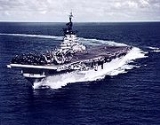
Essex class aircraft carrier

Encyclopedia
The Essex class was a class of aircraft carrier
s of the United States Navy
, which constituted the 20th century's most numerous class of capital ships with 24 vessels built in both "short-hull" and "long-hull" versions. Thirty-two were originally ordered; however as World War II
wound down, six were canceled before construction, and two were canceled after construction had begun. The Essex-class carriers were the backbone of the U.S. Navy's combat strength during World War II
from mid-1943 on, and along with the addition of the three Midway-class
carriers just after the war continued to be the heart of U.S. Naval strength until the supercarrier
s began to come into the fleet in numbers during the 1960s and 1970s.
s and the designers' list of trade offs and limitations forced by arms control treaty obligations formed the formative basis from which the Essex class was developed— a design formulation sparked into being when the Japanese and Italians repudiated the limitations proposed in the 1936 revision of the Washington Naval Treaty
of 1925 (as updated in October 1930 in the London Naval Treaty
)—in effect providing a free pass for all five signatories to resume the interrupted naval arms race of the 1920s in early 1937.
At the time of the repudiations, both Italy and Japan had colonial ambitions intending or already conducting military conquests and their fascist governments, like the Nazis in Germany, were firmly controlled by military regimes. With the demise of the treaty limitations, and the growing tensions inculcated by the Nazi menace in Europe suggesting war was looming, naval planners were free to apply both the lessons they'd learned operating carriers for fifteen years and those of operating the Yorktown class carriers to the newer design.
Designed to carry a larger air group, and unencumbered by the latest in a succession of pre-war naval treaty limits
, was over sixty feet longer, nearly ten feet wider in beam, and more than a third heavier. A longer, wider flight deck
and a deck-edge elevator (which had proven successful in the one-of-a-kind ) facilitated more efficient aviation operations, enhancing the ship's offensive and defensive air power.
Machinery arrangement and armor protection was greatly improved from previous designs. These features, plus the provision of more anti-aircraft guns, gave the ships much enhanced survivability. In fact during the war, none of the Essex-class carriers were lost and two, and , came home under their own power even after receiving extremely heavy damage and were successfully repaired. Some ships in the class would serve until well after the end of the Vietnam conflict
as the class was retired by newer build classes.
U.S. carriers had the same amount of deck armor as their British counterparts. While debates raged, and continue to this day, regarding the effect of strength deck location (flight deck level on British ships vs. hangar deck level on American ships
), British designers' comments tended to disparage the use of hangar deck armor, but some historians, such as D.K. Brown in Nelson to Vanguard, see the American arrangement to have been superior. Subsequently, the larger size of the first supercarrier
s necessitated a deeper hull, and shifted the center of gravity and center of stability lower enabling moving the strength deck to the flight deck thus free US Naval designers architects to move the armor higher and remain within compliance of US Navy stability specifications without imperiling sea worthiness. In the late 30s, locating the strength deck at hangar deck level in the proposed Essex-class ships reduced the weight located high in the ship, resulting in smaller supporting structures and more aircraft capacity for the desired displacement.
in 1936, the U.S. took a realistic look at its naval strength. With the Naval Expansion Act of Congress passed on 17 May 1938, an increase of 40,000 tons in aircraft carriers was authorized. This permitted the building of and , which became the lead ship
of her class.
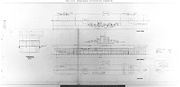 CV-9 was to be the prototype of the 27,000-ton (standard displacement) aircraft carrier, considerably larger than , yet smaller than (a battlecruiser
converted to a carrier). The Navy ordered the first three of the new design, CV-9, CV-10 and CV-11, from Newport News Shipbuilding & Drydock on 3 July 1940. These were to become known as Essex-class carriers. Under the terms of the Two-Ocean Navy Act
, ten more of these carriers were programmed. Eight were ordered on 9 September, CV-12 through -15 from Newport News, and CV-16 through -19 from Bethlehem Steel
's Fore River Shipyard
; the last two, CV-20 and CV-21, were ordered eight days after Pearl Harbor
from the Brooklyn Navy Yard
and Newport News respectively.
After the US declaration of war Congress appropriated funds for nineteen more Essexes: six were ordered or scheduled from Brooklyn, five from the Norfolk Navy Yard, four from the Philadelphia Navy Yard, and two each from Fore River and Newport News. Ironically, only two of these were completed in time to see active WWII service.
The first eight hulls were originally assigned names from historic Navy ships (Essex, Bon Homme Richard, Intrepid, Kearsarge, Franklin, Hancock, Randolph, Cabot). was originally laid down as Cabot, but was renamed during construction after the original was lost in the Battle of the Coral Sea
in May 1942. , originally to be named Bon Homme Richard, was renamed after the original was lost at the Battle of Midway
on 7 June 1942. 's name was changed from Oriskany after the original was sunk in September 1942 in the South Pacific near Guadalcanal
, and 's name was changed from Kearsarge after the original was lost in October 1942 in the Battle of Santa Cruz Islands. The erstwhile Valley Forge was renamed after the light carrier of that name
was sunk in the Battle of Leyte Gulf
in October 1944. The names of the and the were swapped while they were under construction. The John Hancock life insurance company
had offered to conduct a bond drive to raise money for the Hancock if that name was used for the carrier under construction in the company’s home state of Massachusetts.
At the conclusion of the war, the six ships ordered but never laid down (CV-50 through 55) were canceled. Of the nine still unfinished six were completed and two (Reprisal and Iwo Jima) scrapped; was taken in hand for modification to an improved design, completing in 1950. In summary, during World War II and until its conclusion, the US Navy ordered 32 aircraft carriers of the Essex class including the Ticonderoga subgroup, of which 26 were laid down and 24 actually commissioned.
_-_january_1960.jpg)
, but owing to the speed and size of these ships very little catapulting was done except for experimental purposes.
With the advent of war, airplane weights began to go up as armor and armament got heavier; aircrew complements also increased. By the war's end in 1945, catapult launches would become more common under these circumstances, with some carrier commanding officers reporting up to 40% of launches by catapult.
The hangar area design came in for many design conferences between the naval bureaus. Not only were the supporting structures to the flight deck required to carry the increased weight of landing and parked aircraft, but they were to have sufficient strength to support the storing of spare fuselages and parts (50% of each plane type aboard) under the flight deck and still provide adequate working space for the men using the area below.
One innovation in Essex was a portside deck-edge elevator in addition to two inboard elevators. The deck-edge elevator was adopted in the design after it proved successful on the . Experiments had also been made with hauling aircraft by crane up a ramp between the hangar and flight decks, but this method proved too slow. The Navy's Bureau of Ships
and the Chief Engineer of A.B.C. Elevator Co. designed the engine for the side elevator. It was a standard elevator, 60 by 34 ft (18 by 10 m) in platform surface, which traveled vertically on the port side of the ship. The design was a huge success which greatly improved flight deck operations.
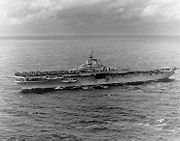
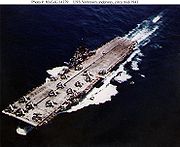
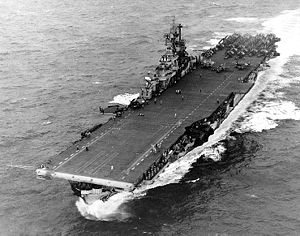 There would be no large hole in the flight deck when the elevator was in the "down" position, a critical factor if the elevator ever became inoperable during combat operations. Its new position made it easier to continue normal operations on deck, irrespective of the position of the elevator. The elevator also increased the effective deck space when it was in the "up" position by providing additional parking room outside the normal contours of the flight deck, and increased the effective area on the hangar deck by the absence of elevator pits. In addition, its machinery was less complex than the two inboard elevators, requiring about 20% fewer man-hours of maintenance.
Ongoing improvements to the class were made, particularly with regards to the ventilation system, lighting systems, and the trash burner design and implementation.
These carriers had better protecting armor than their predecessors, better facilities for handling ammunition, safer and greater fueling capacity, and more effective damage control equipment. Yet, these ships were also designed to limit weight and the complexity of construction, for instance incorporating extensive use of flat and straight metal pieces, and of Special Treatment Steel
(STS), a nickel-chrome steel alloy that provided the same protective qualities as Class B armor plate, but which was fully structural rather than deadweight.
The original design for the class assumed a complement of 215 officers and 2,171 enlisted men. However, by the end of World War II most crews were 50% larger than that.
The tactical employment of U.S. carriers changed as the war progressed. In early operations, through 1942, the doctrine was to operate singly or in pairs, joining together for the offense and separating when on the defense—the theory being that a separation of carriers under attack not only provided a protective screen for each but also dispersed the targets and divided the enemy's attack. Combat experience in those early operations did not bear out the theory, and new proposals for tactical deployment were the subject of much discussion.
As the new Essex- and Independence
-class carriers became available, tactics changed. Experience taught the wisdom of combined strength. Under attack, the combined anti-aircraft fire of a task group
's carriers and their screen provided a more effective umbrella of protection against marauding enemy aircraft than was possible when the carriers separated.
When two or more of these task groups supported each other, they constituted a fast carrier task force
. Lessons learned from operating the carriers as a single group of six, as two groups of three, and three groups of two, provided the basis for many tactics which later characterized carrier task force operations, with the evolution of the fast carrier task force and its successful employment in future operations.
s, 36 dive bomber
s and 18 torpedo planes. The F6F Hellcat
would be the standard fighter, the SB2C-1 Helldiver
the standard scout aircraft and dive-bomber, and the TBF Avenger
was designed as a torpedo plane but often used in other attack roles. Later in the war some Essexes, such as , also included F4U Corsair
s in fighter-bomber squadrons (VBFs), the precursor to modern fighter-attack squadrons (VFAs).
in a combined effort to concentrate anti-aircraft fire.
The design boasted twelve 5 in (127 mm)/38 caliber gun turret
s (4 twin mounts located near the island on the starboard side and 4 single open mounts located on the port side forward and port side aft), seventeen quadruple 40mm Bofors 40 mm anti-aircraft guns and 65 single 20 mm Oerlikon close-in defense gun
s. With a range of ten miles and a rate of fire of fifteen rounds per minute, the 5-inch guns fired the deadly VT shells. The VT shells, known as proximity fuze
d-shells, would detonate when they came within 70 feet (21.3 m) of an enemy aircraft. The 5-inch guns could also aim into the water, creating waterspouts which could bring down low flying aircraft such as torpedo planes. The Bofors 40 mm guns were a significant improvement over the 1.1 in/75 caliber guns mounted in the earlier Lexington
and Yorktown
classes.
The Essex class also made use of advanced technological and communications equipment. All units were commissioned with SK air-search and SC and SG surface-search radars. Several of the class received SM fighter-direction radar. Two Mark 37 fire control directors fitted with FD Mark 4 tracking radar for the 5"/38 battery were installed; the Mk4 proved inadequate at distinguishing low-level intruders from surface clutter and was quickly replaced with the improved Mark 12/Mark 22 combination. 40mm AA batteries were controlled by Mark 51 gyro-stabilized optical directors with integrated lead-angle calculators. A Plan Position Indicator
(PPI) display was used to keep track of ships and enabled a multi-carrier force to maintain a high-speed formation at night or in foul weather. The new navigational tool known as the Dead Reckoning Tracer was also implemented for navigation and tracking of surface ships. Identification Friend or Foe
(IFF) was used to identify hostile ships and aircraft, especially at night or in adverse weather. The four-channel Very High Frequency (VHF) radio permitted channel variation in an effort to prevent enemy interception of transmissions. It also allowed for simultaneous radio contact with other ships and planes in the task force.
 Beginning in March 1943, one visually very significant change was authorized for ships then in the early stages of construction. This involved lengthening the bow above the waterline into a "clipper" form. The increased rake and flare provided deck space for two quadruple 40mm mounts; these units also had the flight deck slightly shortened forward to provide better arcs of fire. Of the Essex-class ships laid down after 1942, only followed the original "short bow" design. The later ships have been variously referred to as the "long-bow units", the "long-hull group", or the "Ticonderoga class". However, the U.S. Navy never maintained any institutional distinction between the long-hull and short-hull members of the Essex class, and postwar refits and upgrades were applied to both groups equally. Less immediately visible aspects of the March 1943 design modification included a safer ventilation system, the Combat Information Center moved below the armored deck, two flight-deck catapults and the elimination of that on the hangar deck, and a third Mk 37 fire-control director; some of these changes were also made to short-bow ships nearing completion or as they returned to the yards.
Modifications were made throughout the Essex building program. The number of 20mm and 40mm anti-aircraft guns was greatly increased, new and improved radars were added, the original hangar deck catapult was removed, the ventilation system was substantially revised, details of protection were altered, and hundreds of other large and small changes were executed. In the meantime, earlier ships were continually modified as they returned to the yard for repair and overhaul. For example, , one of the first to be commissioned, by the end of the war had received two H-4B flight deck catapults on place of her original single H-4A; three quad 40mm mounts below the island to starboard, three more on the port side and one additional on both the starboard quarter and the stern; 21 additional 20mm mounts; SM fighter-control radar; FD Mk 4 radar replaced with Mk 12/22; and an enlarged flag bridge. In fact, to the skilled observer, no two ships of the class looked exactly the same.
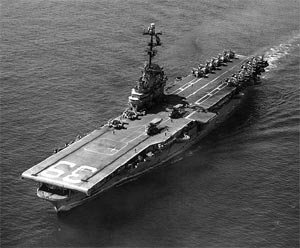

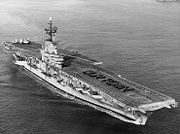 The large numbers of new ships, coupled with their larger Midway-class
contemporaries, sustained the Navy's air power through the rest of the 1940s, the Korean War
era, and beyond. While the spacious hangars accommodated the introduction of jets, various modifications significantly improved the capability of fifteen of the ships to handle the jets’ increased weight and speed. These modifications included jet-blast deflectors (JBDs); mirror and then Fresnel-lens landing light systems (a British innovation); greater aviation fuel capacity; stronger decks, elevators, and catapults; and ultimately an angled flight deck.
Five of the long-hulls were laid up in 1946–47, along with all of the short-hulls. Eight of the last nine completed stayed on active duty to form, with three Midways, the backbone of the post-war Navy's combat strength. Though the Truman administration
's defense economies sent three of the active Essexes into "mothballs" in 1949, these soon came back into commission after the Korean War began. Ultimately, nine short-hulls and all thirteen long-hulls had active Cold War
service.
, which had been left unfinished at the end of the war, was completed to an improved design between August 1948 and September 1950, with a much stronger (straight) flight deck and a reconfigured island. Eight earlier ships were thoroughly rebuilt to the Oriskany
design under the SCB-27A
program in the early 1950s. Six more of the earlier ships were rebuilt to an improved 27C design as the last stage of the SBC-27 program; these ships received steam catapults instead of the less powerful hydraulic units. The otherwise unmodified received an experimental 10.5 degree angled deck in 1952. An angled flight deck and enclosed hurricane bow became the distinctive features of the SCB-125
program, which was undertaken concurrently with the last three 27C conversions and later applied to all 27A and 27C ships except . became the first operational United States angled deck aircraft carrier in 1955. Oriskany
, the first of the modernized ships but the last angled-deck conversion, received a unique SCB-125A refit which upgraded her to 27C standard, and included steam catapults and an aluminum flight deck.
Korean War and subsequent Cold War needs ensured twenty-two of the twenty-four ships had extensive post–World War II service (Bunker Hill
and Franklin
had suffered heavy damage and were never recommissioned). All initially carried attack air groups; however by 1955 seven unconverted Essexes were operating under the anti-submarine warfare
carrier (CVS) designation established in August 1953. As the Forrestal-class
"supercarrier
s" entered the fleet, the eight 27A conversions were designated CVS to replace the original unconverted ships; the latter began to leave active service in the late 1950s. Two 27C conversions were designated CVS in 1962 (although Intrepid
would operate as an attack carrier off Vietnam) and two more in 1969. The seven angle-deck 27As and one 27C received specialized CVS modifications including bow-mounted SQS-23 sonar
under the SCB-144 program in the early 1960s. The updated units remained active until age and the growing number of supercarriers made them obsolete, from the late 1960s into the middle 1970s. However, one of the very first of the type, , served until 1991 as a training ship.
Of the unmodernized Essexes, , , and were redesignated Landing Platform Helicopter (LPH) amphibious assault ship
s for the Marine Corps
, and remained in commission with their original straight decks until about 1970. The remainder decommissioned in the late 1950s and early 1960s and were promptly reclassified as aircraft transports (AVT), reflecting their very limited ability to operate modern aircraft safely. An unmodernised Essex was offered to the Royal Australian Navy
in 1960 as a replacement for HMAS Melbourne but the offer was declined due to the expense of modifications required to make it operationally compatible with the RAN's primarily British-designed fleet. All were scrapped, most in the 1970s.
, F2H Banshee
s, F9F Cougars, AD-6
, AD-5N
, and AD-5W
Skyraiders, AJ2 Savage
s, and F9F-8P photo Cougars.
By the mid to late 1960s, the attack air wing had evolved. Oriskany
deployed with two squadrons of F-8J Crusader
s, three squadrons of A-4E Skyhawk
s, E-1 Tracers, EKA-3B Skywarriors, and RF-8G photo Crusader
s. In 1970, the three A-4 squadrons were replaced by two squadrons of A-7A Corsair II
s. The F-4 Phantom II
and A-6 Intruder
were considered too heavy to operate from the Essex-class.
Tasked and fitted out as an ASW carrier, the air wing of an Essex such as Bennington
in the 1960s consisted of two squadrons of S2F Tracker
s and one squadron of Sikorsky SH-34 ASW helicopters (replaced in 1964 by SH-3A Sea Kings). Airborne early warning was first provided by modified EA-1E
s; these were upgraded in 1965 to E-1Bs. A small detachment of A-4B's or A-4C's were also embarked to provide daylight fighter protection for the ASW aircraft.
Landing Platform Helicopter converted ships such as the USS Boxer
never had an angled landing deck installed and flew only helicopters such as the UH-34 and CH-46 Sea Knight
. Four converted Essex class ships served along side the purpose built Iwo Jima class amphibious assault ships
providing floating helicopter bases for US Marines. The LPHs were sometimes also used as aircraft ferries for all branches of the U.S. armed forces. The AV-8A arrived into Marine Corps inventory too late to see regular fixed wing operations return to these ships. It was possible to launch and recover small aircraft like the OV-10 Bronco
without need of catapult or arresting wires, but this was very rarely permitted on these straight-deck ships for safety reasons and to avoid interruption of helicopter operations.
Essex-class ships played a central role in the Pacific Ocean theater of World War II
from 1943 through the end of the war, beginning with raids in the central Pacific and the invasion of Tarawa
in the Gilbert Islands
. The ships successfully performed a number of missions, included air superiority, attacking the Japanese fleet, supporting landings, fleet protection, bombing the Japanese home islands, and transporting aircraft and troops. Along the way, the carriers survived bomb
s, torpedo
es, kamikaze
s, and typhoons
without one ship being sunk.
Eleven of the Essex carriers participated in the Korean War. These ships played a major role throughout the entire war. Missions included attacks on all types of ground targets, air superiority, and antisubmarine patrols.
Thirteen of the 24 carriers originally built participated in the Vietnam War
, including the prelude and follow-up. However, their inability to support the latest aircraft constrained some of those ships to specialized roles as helicopter carriers or antisubmarine platforms. The ships still performing an attack mission generally carried older aircraft types than the supercarriers. Yet, the Essex class still made significant contributions to all aspects of the U.S. war effort. In one notable event, during the Gulf of Tonkin Incident
, aircraft from the Ticonderoga fired at North Vietnamese torpedo boats that had attacked a U.S. destroyer.
The carriers also contributed between the wars, projecting U.S. power around the world and performing antisubmarine patrols. When the Cold War heated up, the Essex carriers were often involved, including Quemoy and the Matsu Islands
, the Bay of Pigs Invasion
, and the Cuban Missile Crisis
. Also, from 1957 through 1991 an Essex-class ship served as the Navy's training carrier—the Antietam from 1957 through 1962 and the Lexington for the remainder of the time.
program, as recovery ships for unmanned and manned spaceflights, between 1960 and 1973.
USS Valley Forge
was the recovery ship for the unmanned flight of Mercury-Redstone 1A
on 19 December 1960. The first spaceflight by an American was on Mercury-Redstone 3
, recovered by Lake Champlain
on 5 May 1961. Randolph
recovered the next flight, Mercury-Redstone 4
, on 21 July 1961, and she was the primary recovery ship for Mercury-Atlas 6
. The next manned flight, Mercury-Atlas 7
, was picked up by Intrepid
on 24 May 1962, and recovered the last two Mercury spacecraft, Mercury-Atlas 8
, on 3 October 1962, and Mercury-Atlas 9
, on 16 May 1963.
When the Mercury program's successor, Project Gemini
, got underway, Essexes were again closely involved. Lake Champlain
recovered the second unmanned flight, Gemini 2
, on 19 January 1965; and Intrepid
recovered the first manned flight, Gemini 3
. Wasp
recovered the crew of Gemini IV on 7 June, and on 29 August, Lake Champlain
picked up Gemini 5
after eight days in space. In December 1965, Wasp
made history by picking up two spacecraft in just over two days: Gemini VI-A on 16 December, and Gemini 7
on 18 December, after their orbital rendezvous test flight. She also recovered Gemini 9A
on 6 June 1966 and the final Gemini spaceflight, Gemini 12
on 15 November.
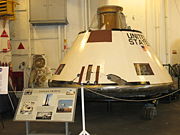 The successful use of the carriers as recovery ships continued into the Apollo program. On 26 February 1966, Boxer
recovered the command module from AS-201
, the first unmanned flight of a production Apollo Command and Service Module
. AS-202
, another sub-orbital test flight of the command module, was recovered in August by Hornet
; the command module from that flight is currently on display aboard Hornet
. Bennington
recovered the command module of Apollo 4
, the first unmanned flight of the Saturn V
launch vehicle, on 9 November 1967.
Eleven months later, Essex
recovered the astronauts of Apollo 7
, the first manned mission in the Apollo program, after eleven days in orbit. Yorktown
recovered the astronauts of Apollo 8
, after their historic flight around the Moon
in December 1968; and Princeton
recovered the second crew to orbit the Moon, aboard Apollo 10
, in May 1969.
Hornet
rejoined the program and recovered the astronauts from the first two moon landing missions, Apollo 11
in July 1969 and Apollo 12
in November. The first steps on Earth of returning astronauts Neil Armstrong
, Edwin Aldrin
, and Mike Collins
, are marked on her hangar deck, as part of her Apollo program exhibit. The three subsequent missions utilized amphibious assault ships as support vessels; however, Ticonderoga
recovered the astronauts of the last two moon missions, Apollo 16
and Apollo 17
in April and December 1972.
In the post-Apollo era, Ticonderoga
again acted as a recovery ship for the astronauts of Skylab 2
, the first manned
mission to Skylab
, the first U.S.
orbital space station
, in June 1973.
Until opened at San Diego, every preserved aircraft carrier in the U.S. was an Essex.
Oriskany was sunk in 2006 to form an artificial reef off the coast of Pensacola, Florida
.
*Long-bow units **Completed to modified design ***Never completed
Hull numbers 22-30 in the aircraft carrier sequence were assigned to the Independence-class
light carriers (CVL); hull numbers 41-44 were assigned to the large carriers (CVB) of the Midway class
.
, laid down in July 1944 at the New York Navy Yard and launched in 1945, was scrapped incomplete after tests; and was laid down at Newport News Shipbuilding
yards in January 1945 but cancelled in August 1945 and broken up on the slipway.
Six fiscal-year 1945 ships, none of which received names, were assigned to Bethlehem Steel Company (CV-50), New York Navy Yard (CVs 51 & 52), Philadelphia Navy Yard (CV-53) and Norfolk Navy Yard (CVs 54 and 55). Their construction was canceled in March 1945.
was ordered and laid down as an Essex-class vessel, was completed in 1950 to the much modified SCB-27A design, and from commissioning until her reconstruction 1957-59 was listed as the lead ship of the separate Oriskany class.
Aircraft carrier
An aircraft carrier is a warship designed with a primary mission of deploying and recovering aircraft, acting as a seagoing airbase. Aircraft carriers thus allow a naval force to project air power worldwide without having to depend on local bases for staging aircraft operations...
s of the United States Navy
United States Navy
The United States Navy is the naval warfare service branch of the United States Armed Forces and one of the seven uniformed services of the United States. The U.S. Navy is the largest in the world; its battle fleet tonnage is greater than that of the next 13 largest navies combined. The U.S...
, which constituted the 20th century's most numerous class of capital ships with 24 vessels built in both "short-hull" and "long-hull" versions. Thirty-two were originally ordered; however as World War II
World War II
World War II, or the Second World War , was a global conflict lasting from 1939 to 1945, involving most of the world's nations—including all of the great powers—eventually forming two opposing military alliances: the Allies and the Axis...
wound down, six were canceled before construction, and two were canceled after construction had begun. The Essex-class carriers were the backbone of the U.S. Navy's combat strength during World War II
World War II
World War II, or the Second World War , was a global conflict lasting from 1939 to 1945, involving most of the world's nations—including all of the great powers—eventually forming two opposing military alliances: the Allies and the Axis...
from mid-1943 on, and along with the addition of the three Midway-class
Midway class aircraft carrier
The Midway class aircraft carrier was one of the longest lived carrier designs in history. First commissioned in late 1945, the lead ship of the class, was not decommissioned until 1992, shortly after service in Operation Desert Storm in 1991.-History:...
carriers just after the war continued to be the heart of U.S. Naval strength until the supercarrier
Supercarrier
Supercarrier is an unofficial descriptive term for the largest type of aircraft carrier, usually displacing over 70,000 long tons.Supercarrier is an unofficial descriptive term for the largest type of aircraft carrier, usually displacing over 70,000 long tons.Supercarrier is an unofficial...
s began to come into the fleet in numbers during the 1960s and 1970s.
Overview
The preceding Yorktown class aircraft carrierYorktown class aircraft carrier
The Yorktown class was a class of three aircraft carriers built by the U.S. and completed shortly before World War II. They bore the brunt of early action in that war, and the sole survivor of the class was to become the most decorated ship in the history of the U.S...
s and the designers' list of trade offs and limitations forced by arms control treaty obligations formed the formative basis from which the Essex class was developed— a design formulation sparked into being when the Japanese and Italians repudiated the limitations proposed in the 1936 revision of the Washington Naval Treaty
Washington Naval Treaty
The Washington Naval Treaty, also known as the Five-Power Treaty, was an attempt to cap and limit, and "prevent 'further' costly escalation" of the naval arms race that had begun after World War I between various International powers, each of which had significant naval fleets. The treaty was...
of 1925 (as updated in October 1930 in the London Naval Treaty
London Naval Treaty
The London Naval Treaty was an agreement between the United Kingdom, the Empire of Japan, France, Italy and the United States, signed on April 22, 1930, which regulated submarine warfare and limited naval shipbuilding. Ratifications were exchanged in London on October 27, 1930, and the treaty went...
)—in effect providing a free pass for all five signatories to resume the interrupted naval arms race of the 1920s in early 1937.
At the time of the repudiations, both Italy and Japan had colonial ambitions intending or already conducting military conquests and their fascist governments, like the Nazis in Germany, were firmly controlled by military regimes. With the demise of the treaty limitations, and the growing tensions inculcated by the Nazi menace in Europe suggesting war was looming, naval planners were free to apply both the lessons they'd learned operating carriers for fifteen years and those of operating the Yorktown class carriers to the newer design.
Designed to carry a larger air group, and unencumbered by the latest in a succession of pre-war naval treaty limits
Second London Naval Treaty
The Second London Naval Disarmament Conference opened in London, the United Kingdom, on 9 December 1935. It resulted in the Second London Naval Treaty which was signed on 25 March 1936.- Description :...
, was over sixty feet longer, nearly ten feet wider in beam, and more than a third heavier. A longer, wider flight deck
Flight deck
The flight deck of an aircraft carrier is the surface from which its aircraft take off and land, essentially a miniature airfield at sea. On smaller naval ships which do not have aviation as a primary mission, the landing area for helicopters and other VTOL aircraft is also referred to as the...
and a deck-edge elevator (which had proven successful in the one-of-a-kind ) facilitated more efficient aviation operations, enhancing the ship's offensive and defensive air power.
Machinery arrangement and armor protection was greatly improved from previous designs. These features, plus the provision of more anti-aircraft guns, gave the ships much enhanced survivability. In fact during the war, none of the Essex-class carriers were lost and two, and , came home under their own power even after receiving extremely heavy damage and were successfully repaired. Some ships in the class would serve until well after the end of the Vietnam conflict
Vietnam War
The Vietnam War was a Cold War-era military conflict that occurred in Vietnam, Laos, and Cambodia from 1 November 1955 to the fall of Saigon on 30 April 1975. This war followed the First Indochina War and was fought between North Vietnam, supported by its communist allies, and the government of...
as the class was retired by newer build classes.
U.S. carriers had the same amount of deck armor as their British counterparts. While debates raged, and continue to this day, regarding the effect of strength deck location (flight deck level on British ships vs. hangar deck level on American ships
Comparison of armoured to unarmoured flight deck designs
An armoured flight deck is an aircraft carrier flight deck that incorporates substantial armour in its design.Comparison is often made between some of designs of the Royal Navy and the United States Navy...
), British designers' comments tended to disparage the use of hangar deck armor, but some historians, such as D.K. Brown in Nelson to Vanguard, see the American arrangement to have been superior. Subsequently, the larger size of the first supercarrier
Supercarrier
Supercarrier is an unofficial descriptive term for the largest type of aircraft carrier, usually displacing over 70,000 long tons.Supercarrier is an unofficial descriptive term for the largest type of aircraft carrier, usually displacing over 70,000 long tons.Supercarrier is an unofficial...
s necessitated a deeper hull, and shifted the center of gravity and center of stability lower enabling moving the strength deck to the flight deck thus free US Naval designers architects to move the armor higher and remain within compliance of US Navy stability specifications without imperiling sea worthiness. In the late 30s, locating the strength deck at hangar deck level in the proposed Essex-class ships reduced the weight located high in the ship, resulting in smaller supporting structures and more aircraft capacity for the desired displacement.
Development
After the abrogation of disarmament treaties by JapanJapan
Japan is an island nation in East Asia. Located in the Pacific Ocean, it lies to the east of the Sea of Japan, China, North Korea, South Korea and Russia, stretching from the Sea of Okhotsk in the north to the East China Sea and Taiwan in the south...
in 1936, the U.S. took a realistic look at its naval strength. With the Naval Expansion Act of Congress passed on 17 May 1938, an increase of 40,000 tons in aircraft carriers was authorized. This permitted the building of and , which became the lead ship
Lead ship
The lead ship or class leader is the first of a series or class of ships all constructed according to the same general design. The term is applicable military ships and larger civilian craft.-Overview:...
of her class.
Battlecruiser
Battlecruisers were large capital ships built in the first half of the 20th century. They were developed in the first decade of the century as the successor to the armoured cruiser, but their evolution was more closely linked to that of the dreadnought battleship...
converted to a carrier). The Navy ordered the first three of the new design, CV-9, CV-10 and CV-11, from Newport News Shipbuilding & Drydock on 3 July 1940. These were to become known as Essex-class carriers. Under the terms of the Two-Ocean Navy Act
Two-Ocean Navy Act
The Two-Ocean Navy Act, was an American Act of Congress passed on July 19, 1940, to increase the size of the United States Navy by 70%, making it the largest naval procurement bill in U.S...
, ten more of these carriers were programmed. Eight were ordered on 9 September, CV-12 through -15 from Newport News, and CV-16 through -19 from Bethlehem Steel
Bethlehem Steel
The Bethlehem Steel Corporation , based in Bethlehem, Pennsylvania, was once the second-largest steel producer in the United States, after Pittsburgh, Pennsylvania-based U.S. Steel. After a decline in the U.S...
's Fore River Shipyard
Fore River Shipyard
The Fore River Shipyard of Quincy, Massachusetts, more formally known as the Fore River Ship and Engine Building Company, was a shipyard in the United States from 1883 until 1986. Located on the Weymouth Fore River, the yard began operations in 1883 in Braintree, Massachusetts before being moved...
; the last two, CV-20 and CV-21, were ordered eight days after Pearl Harbor
Attack on Pearl Harbor
The attack on Pearl Harbor was a surprise military strike conducted by the Imperial Japanese Navy against the United States naval base at Pearl Harbor, Hawaii, on the morning of December 7, 1941...
from the Brooklyn Navy Yard
Brooklyn Navy Yard
The United States Navy Yard, New York–better known as the Brooklyn Navy Yard or the New York Naval Shipyard –was an American shipyard located in Brooklyn, northeast of the Battery on the East River in Wallabout Basin, a semicircular bend of the river across from Corlear's Hook in Manhattan...
and Newport News respectively.
After the US declaration of war Congress appropriated funds for nineteen more Essexes: six were ordered or scheduled from Brooklyn, five from the Norfolk Navy Yard, four from the Philadelphia Navy Yard, and two each from Fore River and Newport News. Ironically, only two of these were completed in time to see active WWII service.
The first eight hulls were originally assigned names from historic Navy ships (Essex, Bon Homme Richard, Intrepid, Kearsarge, Franklin, Hancock, Randolph, Cabot). was originally laid down as Cabot, but was renamed during construction after the original was lost in the Battle of the Coral Sea
Battle of the Coral Sea
The Battle of the Coral Sea, fought from 4–8 May 1942, was a major naval battle in the Pacific Theater of World War II between the Imperial Japanese Navy and Allied naval and air forces from the United States and Australia. The battle was the first fleet action in which aircraft carriers engaged...
in May 1942. , originally to be named Bon Homme Richard, was renamed after the original was lost at the Battle of Midway
Battle of Midway
The Battle of Midway is widely regarded as the most important naval battle of the Pacific Campaign of World War II. Between 4 and 7 June 1942, approximately one month after the Battle of the Coral Sea and six months after Japan's attack on Pearl Harbor, the United States Navy decisively defeated...
on 7 June 1942. 's name was changed from Oriskany after the original was sunk in September 1942 in the South Pacific near Guadalcanal
Guadalcanal
Guadalcanal is a tropical island in the South-Western Pacific. The largest island in the Solomons, it was discovered by the Spanish expedition of Alvaro de Mendaña in 1568...
, and 's name was changed from Kearsarge after the original was lost in October 1942 in the Battle of Santa Cruz Islands. The erstwhile Valley Forge was renamed after the light carrier of that name
USS Princeton (CVL-23)
The fourth USS Princeton was a United States Navy lost at the battle of Leyte Gulf in 1944.-Construction and deployment:The ship was laid down as the Tallahassee by the New York Shipbuilding Corporation, Camden, New Jersey, 2 June 1941...
was sunk in the Battle of Leyte Gulf
Battle of Leyte Gulf
The Battle of Leyte Gulf, also called the "Battles for Leyte Gulf", and formerly known as the "Second Battle of the Philippine Sea", is generally considered to be the largest naval battle of World War II and, by some criteria, possibly the largest naval battle in history.It was fought in waters...
in October 1944. The names of the and the were swapped while they were under construction. The John Hancock life insurance company
John Hancock Insurance
John Hancock Financial is a loose term for a United States insurance company which existed, in various forms, from its founding on April 21, 1862, until its acquisition in 2004 by the Canadian insurance company Manulife Financial. It was named in honor of John Hancock, a prominent patriot...
had offered to conduct a bond drive to raise money for the Hancock if that name was used for the carrier under construction in the company’s home state of Massachusetts.
At the conclusion of the war, the six ships ordered but never laid down (CV-50 through 55) were canceled. Of the nine still unfinished six were completed and two (Reprisal and Iwo Jima) scrapped; was taken in hand for modification to an improved design, completing in 1950. In summary, during World War II and until its conclusion, the US Navy ordered 32 aircraft carriers of the Essex class including the Ticonderoga subgroup, of which 26 were laid down and 24 actually commissioned.
Design
In drawing up the preliminary design for Essex, particular attention was directed at the size of both her flight and hangar decks. Aircraft design had come a long way from the comparatively light planes used in carriers during the 1930s. Flight decks now required more takeoff space for the heavier aircraft being developed. Most of the first-line carriers of the pre-war years were equipped with flush deck catapultsAircraft catapult
An aircraft catapult is a device used to launch aircraft from ships—in particular aircraft carriers—as a form of assisted take off. It consists of a track built into the flight deck, below which is a large piston or shuttle that is attached through the track to the nose gear of the aircraft, or in...
, but owing to the speed and size of these ships very little catapulting was done except for experimental purposes.
With the advent of war, airplane weights began to go up as armor and armament got heavier; aircrew complements also increased. By the war's end in 1945, catapult launches would become more common under these circumstances, with some carrier commanding officers reporting up to 40% of launches by catapult.
The hangar area design came in for many design conferences between the naval bureaus. Not only were the supporting structures to the flight deck required to carry the increased weight of landing and parked aircraft, but they were to have sufficient strength to support the storing of spare fuselages and parts (50% of each plane type aboard) under the flight deck and still provide adequate working space for the men using the area below.
One innovation in Essex was a portside deck-edge elevator in addition to two inboard elevators. The deck-edge elevator was adopted in the design after it proved successful on the . Experiments had also been made with hauling aircraft by crane up a ramp between the hangar and flight decks, but this method proved too slow. The Navy's Bureau of Ships
Bureau of Ships
The United States Navy's Bureau of Ships was established by Congress on June 20, 1940, by a law which consolidated the functions of the Bureau of Construction and Repair and the Bureau of Engineering. The new Bureau was to be headed by a Chief and Deputy-Chief, one selected from the engineering...
and the Chief Engineer of A.B.C. Elevator Co. designed the engine for the side elevator. It was a standard elevator, 60 by 34 ft (18 by 10 m) in platform surface, which traveled vertically on the port side of the ship. The design was a huge success which greatly improved flight deck operations.
Ongoing improvements to the class were made, particularly with regards to the ventilation system, lighting systems, and the trash burner design and implementation.
These carriers had better protecting armor than their predecessors, better facilities for handling ammunition, safer and greater fueling capacity, and more effective damage control equipment. Yet, these ships were also designed to limit weight and the complexity of construction, for instance incorporating extensive use of flat and straight metal pieces, and of Special Treatment Steel
Special treatment steel
Special Treatment Steel , also known as Protective Deck Plate. Originally developed by Carnegie Steel around 1910, it became the U.S. Navy Bureau of Construction and Repair standard form of high-percentage nickel steel used on all portions of a warship needing homogeneous direct impact protection...
(STS), a nickel-chrome steel alloy that provided the same protective qualities as Class B armor plate, but which was fully structural rather than deadweight.
The original design for the class assumed a complement of 215 officers and 2,171 enlisted men. However, by the end of World War II most crews were 50% larger than that.
The tactical employment of U.S. carriers changed as the war progressed. In early operations, through 1942, the doctrine was to operate singly or in pairs, joining together for the offense and separating when on the defense—the theory being that a separation of carriers under attack not only provided a protective screen for each but also dispersed the targets and divided the enemy's attack. Combat experience in those early operations did not bear out the theory, and new proposals for tactical deployment were the subject of much discussion.
As the new Essex- and Independence
Independence class aircraft carrier
The Independence class aircraft carriers were a class of light carriers built for the United States Navy that served during World War II.This class were a result of President Franklin D. Roosevelt's interest in Navy shipbuilding plans...
-class carriers became available, tactics changed. Experience taught the wisdom of combined strength. Under attack, the combined anti-aircraft fire of a task group
Task force
A task force is a unit or formation established to work on a single defined task or activity. Originally introduced by the United States Navy, the term has now caught on for general usage and is a standard part of NATO terminology...
's carriers and their screen provided a more effective umbrella of protection against marauding enemy aircraft than was possible when the carriers separated.
When two or more of these task groups supported each other, they constituted a fast carrier task force
Fast Carrier Task Force
The Fast Carrier Task Force was the main striking force of the United States Navy in the Pacific Ocean theatre of World War II.The Fast Carrier Task Force was known under two designations. The Navy made use of two sets of upper command structures for planning the upcoming operations...
. Lessons learned from operating the carriers as a single group of six, as two groups of three, and three groups of two, provided the basis for many tactics which later characterized carrier task force operations, with the evolution of the fast carrier task force and its successful employment in future operations.
"Sunday Punch"
The pride of the carrier, known as the "Sunday Punch", was the offensive power of 36 fighterFighter aircraft
A fighter aircraft is a military aircraft designed primarily for air-to-air combat with other aircraft, as opposed to a bomber, which is designed primarily to attack ground targets...
s, 36 dive bomber
Dive bomber
A dive bomber is a bomber aircraft that dives directly at its targets in order to provide greater accuracy for the bomb it drops. Diving towards the target reduces the distance the bomb has to fall, which is the primary factor in determining the accuracy of the drop...
s and 18 torpedo planes. The F6F Hellcat
F6F Hellcat
The Grumman F6F Hellcat was a carrier-based fighter aircraft developed to replace the earlier F4F Wildcat in United States Navy service. Although the F6F resembled the Wildcat, it was a completely new design powered by a 2,000 hp Pratt & Whitney R-2800. Some tagged it as the "Wildcat's big...
would be the standard fighter, the SB2C-1 Helldiver
SB2C Helldiver
The Curtiss SB2C Helldiver was a carrier-based dive bomber aircraft produced for the United States Navy during World War II. It replaced the Douglas SBD Dauntless in US Navy service. Despite its size, the SB2C was much faster than the SBD it replaced...
the standard scout aircraft and dive-bomber, and the TBF Avenger
TBF Avenger
The Grumman TBF Avenger was a torpedo bomber developed initially for the United States Navy and Marine Corps, and eventually used by several air or naval arms around the world....
was designed as a torpedo plane but often used in other attack roles. Later in the war some Essexes, such as , also included F4U Corsair
F4U Corsair
The Vought F4U Corsair was a carrier-capable fighter aircraft that saw service primarily in World War II and the Korean War. Demand for the aircraft soon overwhelmed Vought's manufacturing capability, resulting in production by Goodyear and Brewster: Goodyear-built Corsairs were designated FG and...
s in fighter-bomber squadrons (VBFs), the precursor to modern fighter-attack squadrons (VFAs).
Guns, radar and radios
The defensive plan was to use radio and radarRadar
Radar is an object-detection system which uses radio waves to determine the range, altitude, direction, or speed of objects. It can be used to detect aircraft, ships, spacecraft, guided missiles, motor vehicles, weather formations, and terrain. The radar dish or antenna transmits pulses of radio...
in a combined effort to concentrate anti-aircraft fire.
The design boasted twelve 5 in (127 mm)/38 caliber gun turret
Barbette
A barbette is a protective circular armour feature around a cannon or heavy artillery gun. The name comes from the French phrase en barbette referring to the practice of firing a field gun over a parapet rather than through an opening . The former gives better angles of fire but less protection...
s (4 twin mounts located near the island on the starboard side and 4 single open mounts located on the port side forward and port side aft), seventeen quadruple 40mm Bofors 40 mm anti-aircraft guns and 65 single 20 mm Oerlikon close-in defense gun
Oerlikon 20 mm cannon
The Oerlikon 20 mm cannon is a series of autocannons, based on an original design by Reinhold Becker of Germany, very early in World War I, and widely produced by Oerlikon Contraves and others...
s. With a range of ten miles and a rate of fire of fifteen rounds per minute, the 5-inch guns fired the deadly VT shells. The VT shells, known as proximity fuze
Proximity fuze
A proximity fuze is a fuze that is designed to detonate an explosive device automatically when the distance to target becomes smaller than a predetermined value or when the target passes through a given plane...
d-shells, would detonate when they came within 70 feet (21.3 m) of an enemy aircraft. The 5-inch guns could also aim into the water, creating waterspouts which could bring down low flying aircraft such as torpedo planes. The Bofors 40 mm guns were a significant improvement over the 1.1 in/75 caliber guns mounted in the earlier Lexington
Lexington class aircraft carrier
The Lexington class aircraft carriers were the first operational aircraft carriers in the United States Navy. There were two ships in the class: and ....
and Yorktown
Yorktown class aircraft carrier
The Yorktown class was a class of three aircraft carriers built by the U.S. and completed shortly before World War II. They bore the brunt of early action in that war, and the sole survivor of the class was to become the most decorated ship in the history of the U.S...
classes.
The Essex class also made use of advanced technological and communications equipment. All units were commissioned with SK air-search and SC and SG surface-search radars. Several of the class received SM fighter-direction radar. Two Mark 37 fire control directors fitted with FD Mark 4 tracking radar for the 5"/38 battery were installed; the Mk4 proved inadequate at distinguishing low-level intruders from surface clutter and was quickly replaced with the improved Mark 12/Mark 22 combination. 40mm AA batteries were controlled by Mark 51 gyro-stabilized optical directors with integrated lead-angle calculators. A Plan Position Indicator
Plan position indicator
The plan position indicator , is the most common type of radar display. The radar antenna is usually represented in the center of the display, so the distance from it and height above ground can be drawn as concentric circles...
(PPI) display was used to keep track of ships and enabled a multi-carrier force to maintain a high-speed formation at night or in foul weather. The new navigational tool known as the Dead Reckoning Tracer was also implemented for navigation and tracking of surface ships. Identification Friend or Foe
Identification friend or foe
In telecommunications, identification, friend or foe is an identification system designed for command and control. It is a system that enables military and national interrogation systems to identify aircraft, vehicles, or forces as friendly and to determine their bearing and range from the...
(IFF) was used to identify hostile ships and aircraft, especially at night or in adverse weather. The four-channel Very High Frequency (VHF) radio permitted channel variation in an effort to prevent enemy interception of transmissions. It also allowed for simultaneous radio contact with other ships and planes in the task force.
The "long-hull" Essexes
Modifications were made throughout the Essex building program. The number of 20mm and 40mm anti-aircraft guns was greatly increased, new and improved radars were added, the original hangar deck catapult was removed, the ventilation system was substantially revised, details of protection were altered, and hundreds of other large and small changes were executed. In the meantime, earlier ships were continually modified as they returned to the yard for repair and overhaul. For example, , one of the first to be commissioned, by the end of the war had received two H-4B flight deck catapults on place of her original single H-4A; three quad 40mm mounts below the island to starboard, three more on the port side and one additional on both the starboard quarter and the stern; 21 additional 20mm mounts; SM fighter-control radar; FD Mk 4 radar replaced with Mk 12/22; and an enlarged flag bridge. In fact, to the skilled observer, no two ships of the class looked exactly the same.
Post-war rebuilds
Midway class aircraft carrier
The Midway class aircraft carrier was one of the longest lived carrier designs in history. First commissioned in late 1945, the lead ship of the class, was not decommissioned until 1992, shortly after service in Operation Desert Storm in 1991.-History:...
contemporaries, sustained the Navy's air power through the rest of the 1940s, the Korean War
Korean War
The Korean War was a conventional war between South Korea, supported by the United Nations, and North Korea, supported by the People's Republic of China , with military material aid from the Soviet Union...
era, and beyond. While the spacious hangars accommodated the introduction of jets, various modifications significantly improved the capability of fifteen of the ships to handle the jets’ increased weight and speed. These modifications included jet-blast deflectors (JBDs); mirror and then Fresnel-lens landing light systems (a British innovation); greater aviation fuel capacity; stronger decks, elevators, and catapults; and ultimately an angled flight deck.
Five of the long-hulls were laid up in 1946–47, along with all of the short-hulls. Eight of the last nine completed stayed on active duty to form, with three Midways, the backbone of the post-war Navy's combat strength. Though the Truman administration
Harry S. Truman
Harry S. Truman was the 33rd President of the United States . As President Franklin D. Roosevelt's third vice president and the 34th Vice President of the United States , he succeeded to the presidency on April 12, 1945, when President Roosevelt died less than three months after beginning his...
's defense economies sent three of the active Essexes into "mothballs" in 1949, these soon came back into commission after the Korean War began. Ultimately, nine short-hulls and all thirteen long-hulls had active Cold War
Cold War
The Cold War was the continuing state from roughly 1946 to 1991 of political conflict, military tension, proxy wars, and economic competition between the Communist World—primarily the Soviet Union and its satellite states and allies—and the powers of the Western world, primarily the United States...
service.
, which had been left unfinished at the end of the war, was completed to an improved design between August 1948 and September 1950, with a much stronger (straight) flight deck and a reconfigured island. Eight earlier ships were thoroughly rebuilt to the Oriskany
USS Oriskany (CV-34)
USS Oriskany – nicknamed Mighty O, The O-boat, and Toasted O – was one of 24 s completed during or shortly after World War II for the United States Navy. The ship was the third US Navy ship to bear the name, and was named for the Revolutionary War Battle of Oriskany.The history of...
design under the SCB-27A
SCB-27
SCB-27, or "Two Seven-Charlie" was the United States Navy designation for a series of upgrades to the Essex class aircraft carriers , conducted between 1947 and 1955...
program in the early 1950s. Six more of the earlier ships were rebuilt to an improved 27C design as the last stage of the SBC-27 program; these ships received steam catapults instead of the less powerful hydraulic units. The otherwise unmodified received an experimental 10.5 degree angled deck in 1952. An angled flight deck and enclosed hurricane bow became the distinctive features of the SCB-125
SCB-125
SCB-125 was the United States Navy designation for a series of upgrades to the Essex class of aircraft carriers , conducted between 1954 and 1959...
program, which was undertaken concurrently with the last three 27C conversions and later applied to all 27A and 27C ships except . became the first operational United States angled deck aircraft carrier in 1955. Oriskany
USS Oriskany (CV-34)
USS Oriskany – nicknamed Mighty O, The O-boat, and Toasted O – was one of 24 s completed during or shortly after World War II for the United States Navy. The ship was the third US Navy ship to bear the name, and was named for the Revolutionary War Battle of Oriskany.The history of...
, the first of the modernized ships but the last angled-deck conversion, received a unique SCB-125A refit which upgraded her to 27C standard, and included steam catapults and an aluminum flight deck.
Korean War and subsequent Cold War needs ensured twenty-two of the twenty-four ships had extensive post–World War II service (Bunker Hill
USS Bunker Hill (CV-17)
USS Bunker Hill was one of 24 s built during World War II for the United States Navy. The ship, the second US Navy ship to bear the name, was named for the Battle of Bunker Hill. Bunker Hill was commissioned in May 1943, and served in several campaigns in the Pacific Theater of Operations, earning...
and Franklin
USS Franklin (CV-13)
The USS Franklin , nicknamed "Big Ben," was one of 24 s built during World War II for the United States Navy, and the fifth US Navy ship to bear the name. Commissioned in January 1944, she served in several campaigns in the Pacific Theater of Operations, earning four battle stars...
had suffered heavy damage and were never recommissioned). All initially carried attack air groups; however by 1955 seven unconverted Essexes were operating under the anti-submarine warfare
Anti-submarine warfare
Anti-submarine warfare is a branch of naval warfare that uses surface warships, aircraft, or other submarines to find, track and deter, damage or destroy enemy submarines....
carrier (CVS) designation established in August 1953. As the Forrestal-class
Forrestal class aircraft carrier
The Forrestal-class aircraft carriers were a four-ship class designed and built for the United States Navy in the 1950s. It was the first class of so-called supercarriers, combining high tonnage, deck-edge elevators and an angled deck...
"supercarrier
Supercarrier
Supercarrier is an unofficial descriptive term for the largest type of aircraft carrier, usually displacing over 70,000 long tons.Supercarrier is an unofficial descriptive term for the largest type of aircraft carrier, usually displacing over 70,000 long tons.Supercarrier is an unofficial...
s" entered the fleet, the eight 27A conversions were designated CVS to replace the original unconverted ships; the latter began to leave active service in the late 1950s. Two 27C conversions were designated CVS in 1962 (although Intrepid
USS Intrepid (CV-11)
USS Intrepid , also known as The Fighting "I", is one of 24 s built during World War II for the United States Navy. She is the fourth US Navy ship to bear the name. Commissioned in August 1943, Intrepid participated in several campaigns in the Pacific Theater of Operations, most notably the Battle...
would operate as an attack carrier off Vietnam) and two more in 1969. The seven angle-deck 27As and one 27C received specialized CVS modifications including bow-mounted SQS-23 sonar
Sonar
Sonar is a technique that uses sound propagation to navigate, communicate with or detect other vessels...
under the SCB-144 program in the early 1960s. The updated units remained active until age and the growing number of supercarriers made them obsolete, from the late 1960s into the middle 1970s. However, one of the very first of the type, , served until 1991 as a training ship.
Of the unmodernized Essexes, , , and were redesignated Landing Platform Helicopter (LPH) amphibious assault ship
Amphibious assault ship
An amphibious assault ship is a type of amphibious warfare ship employed to land and support ground forces on enemy territory by an amphibious assault...
s for the Marine Corps
United States Marine Corps
The United States Marine Corps is a branch of the United States Armed Forces responsible for providing power projection from the sea, using the mobility of the United States Navy to deliver combined-arms task forces rapidly. It is one of seven uniformed services of the United States...
, and remained in commission with their original straight decks until about 1970. The remainder decommissioned in the late 1950s and early 1960s and were promptly reclassified as aircraft transports (AVT), reflecting their very limited ability to operate modern aircraft safely. An unmodernised Essex was offered to the Royal Australian Navy
Royal Australian Navy
The Royal Australian Navy is the naval branch of the Australian Defence Force. Following the Federation of Australia in 1901, the ships and resources of the separate colonial navies were integrated into a national force: the Commonwealth Naval Forces...
in 1960 as a replacement for HMAS Melbourne but the offer was declined due to the expense of modifications required to make it operationally compatible with the RAN's primarily British-designed fleet. All were scrapped, most in the 1970s.
Evolution of the air wing
For a typical attack carrier configuration in 1956–57 aboard , the air wing consisted of one squadron each of the following: FJ3 FuryFJ Fury
The North American FJ-2/-3 Fury were a series of swept-wing carrier-capable fighters for the United States Navy and Marine Corps. Based on the United States Air Force's F-86 Sabre, these aircraft featured folding wings, and a longer nose landing strut designed to both increase angle of attack upon...
, F2H Banshee
F2H Banshee
The McDonnell F2H Banshee was a single-seat carrier-based jet fighter aircraft deployed by the United States Navy and United States Marine Corps from 1948 to 1961. It was one of the primary American fighters used during the Korean War and was the only jet-powered fighter ever deployed by the Royal...
s, F9F Cougars, AD-6
A-1 Skyraider
The Douglas A-1 Skyraider was an American single-seat attack aircraft that saw service between the late 1940s and early 1980s. It became a piston-powered, propeller-driven anachronism in the jet age, and was nicknamed "Spad", after a French World War I fighter...
, AD-5N
A-1 Skyraider
The Douglas A-1 Skyraider was an American single-seat attack aircraft that saw service between the late 1940s and early 1980s. It became a piston-powered, propeller-driven anachronism in the jet age, and was nicknamed "Spad", after a French World War I fighter...
, and AD-5W
A-1 Skyraider
The Douglas A-1 Skyraider was an American single-seat attack aircraft that saw service between the late 1940s and early 1980s. It became a piston-powered, propeller-driven anachronism in the jet age, and was nicknamed "Spad", after a French World War I fighter...
Skyraiders, AJ2 Savage
AJ Savage
|-See also:-References:NotesBibliography* Grossnick, Roy A. . Washington, DC:Naval Historical Center, 1995. ISBN 0-945274-29-7.* Swanborough, Gordon and Peter M. Bowers. United States Navy Aircraft since 1911. London:Putnam, Second edition, 1976. ISBN 0 370 10054 9.* Wilson, Stewart. Combat...
s, and F9F-8P photo Cougars.
By the mid to late 1960s, the attack air wing had evolved. Oriskany
USS Oriskany (CV-34)
USS Oriskany – nicknamed Mighty O, The O-boat, and Toasted O – was one of 24 s completed during or shortly after World War II for the United States Navy. The ship was the third US Navy ship to bear the name, and was named for the Revolutionary War Battle of Oriskany.The history of...
deployed with two squadrons of F-8J Crusader
F-8 Crusader
The Vought F-8 Crusader was a single-engine, supersonic, carrier-based air superiority jet aircraft built by Vought for the United States Navy and the U.S. Marine Corps, replacing the Vought F7U Cutlass...
s, three squadrons of A-4E Skyhawk
A-4 Skyhawk
The Douglas A-4 Skyhawk is a carrier-capable ground-attack aircraft designed for the United States Navy and United States Marine Corps. The delta winged, single-engined Skyhawk was designed and produced by Douglas Aircraft Company, and later McDonnell Douglas. It was originally designated the A4D...
s, E-1 Tracers, EKA-3B Skywarriors, and RF-8G photo Crusader
F-8 Crusader
The Vought F-8 Crusader was a single-engine, supersonic, carrier-based air superiority jet aircraft built by Vought for the United States Navy and the U.S. Marine Corps, replacing the Vought F7U Cutlass...
s. In 1970, the three A-4 squadrons were replaced by two squadrons of A-7A Corsair II
A-7 Corsair II
The Ling-Temco-Vought A-7 Corsair II is a carrier-based subsonic light attack aircraft introduced to replace the United States Navy's Douglas A-4 Skyhawk, initially entering service during the Vietnam War...
s. The F-4 Phantom II
F-4 Phantom II
The McDonnell Douglas F-4 Phantom II is a tandem two-seat, twin-engined, all-weather, long-range supersonic jet interceptor fighter/fighter-bomber originally developed for the United States Navy by McDonnell Aircraft. It first entered service in 1960 with the U.S. Navy. Proving highly adaptable,...
and A-6 Intruder
A-6 Intruder
The Grumman A-6 Intruder was an American, twin jet-engine, mid-wing attack aircraft built by Grumman Aerospace. In service with the U.S. Navy and U.S. Marine Corps between 1963 and 1997, the Intruder was designed as an all-weather medium attack aircraft to replace the piston-engined A-1 Skyraider...
were considered too heavy to operate from the Essex-class.
Tasked and fitted out as an ASW carrier, the air wing of an Essex such as Bennington
USS Bennington (CV-20)
USS Bennington was one of 24 s built during World War II for the United States Navy. The ship was the second US Navy ship to bear the name, and was named for the Revolutionary War Battle of Bennington...
in the 1960s consisted of two squadrons of S2F Tracker
S-2 Tracker
The Grumman S-2 Tracker was the first purpose-built, single airframe anti-submarine warfare aircraft to enter service with the US Navy. The Tracker was of conventional design with twin engines, a high wing and tricycle undercarriage. The type was exported to a number of navies around the world...
s and one squadron of Sikorsky SH-34 ASW helicopters (replaced in 1964 by SH-3A Sea Kings). Airborne early warning was first provided by modified EA-1E
A-1 Skyraider
The Douglas A-1 Skyraider was an American single-seat attack aircraft that saw service between the late 1940s and early 1980s. It became a piston-powered, propeller-driven anachronism in the jet age, and was nicknamed "Spad", after a French World War I fighter...
s; these were upgraded in 1965 to E-1Bs. A small detachment of A-4B's or A-4C's were also embarked to provide daylight fighter protection for the ASW aircraft.
Landing Platform Helicopter converted ships such as the USS Boxer
USS Boxer (CV-21)
USS Boxer was one of 24 s built during World War II for the United States Navy. She was the fifth US Navy ship to bear the name, and was named for a British ship captured by the Americans during the War of 1812...
never had an angled landing deck installed and flew only helicopters such as the UH-34 and CH-46 Sea Knight
CH-46 Sea Knight
The Boeing Vertol CH-46 Sea Knight is a medium-lift tandem rotor transport helicopter, used by the United States Marine Corps to provide all-weather, day-or-night assault transport of combat troops, supplies and equipment. Assault Support is its primary function, and the movement of supplies and...
. Four converted Essex class ships served along side the purpose built Iwo Jima class amphibious assault ships
Iwo Jima class amphibious assault ship
The Iwo Jima class amphibious assault ships of the United States Navy were the first amphibious assault ships designed and built as dedicated helicopter carriers, capable of operating up to 20 helicopters to carry up to 1,800 marines ashore. They were named for battles featuring the United States...
providing floating helicopter bases for US Marines. The LPHs were sometimes also used as aircraft ferries for all branches of the U.S. armed forces. The AV-8A arrived into Marine Corps inventory too late to see regular fixed wing operations return to these ships. It was possible to launch and recover small aircraft like the OV-10 Bronco
OV-10 Bronco
The North American Aviation Rockwell OV-10 Bronco is a turboprop light attack and observation aircraft. It was developed in the 1960s as a special aircraft for counter-insurgency combat, and one of its primary missions was as a forward air control aircraft...
without need of catapult or arresting wires, but this was very rarely permitted on these straight-deck ships for safety reasons and to avoid interruption of helicopter operations.
Military contributions
One author called the Essex class "the most significant class of warships in American naval history", citing the large number produced and "their role in making the aircraft carrier the backbone of the U.S. Navy."Essex-class ships played a central role in the Pacific Ocean theater of World War II
Pacific Ocean theater of World War II
The Pacific Ocean theatre was one of four major naval theatres of war of World War II, which pitted the forces of Japan against those of the United States, the British Commonwealth, the Netherlands and France....
from 1943 through the end of the war, beginning with raids in the central Pacific and the invasion of Tarawa
Battle of Tarawa
The Battle of Tarawa, code named Operation Galvanic, was a battle in the Pacific Theater of World War II, largely fought from November 20 to November 23, 1943. It was the first American offensive in the critical central Pacific region....
in the Gilbert Islands
Gilbert Islands
The Gilbert Islands are a chain of sixteen atolls and coral islands in the Pacific Ocean. They are the main part of Republic of Kiribati and include Tarawa, the site of the country's capital and residence of almost half of the population.-Geography:The atolls and islands of the Gilbert Islands...
. The ships successfully performed a number of missions, included air superiority, attacking the Japanese fleet, supporting landings, fleet protection, bombing the Japanese home islands, and transporting aircraft and troops. Along the way, the carriers survived bomb
Bomb
A bomb is any of a range of explosive weapons that only rely on the exothermic reaction of an explosive material to provide an extremely sudden and violent release of energy...
s, torpedo
Torpedo
The modern torpedo is a self-propelled missile weapon with an explosive warhead, launched above or below the water surface, propelled underwater towards a target, and designed to detonate either on contact with it or in proximity to it.The term torpedo was originally employed for...
es, kamikaze
Kamikaze
The were suicide attacks by military aviators from the Empire of Japan against Allied naval vessels in the closing stages of the Pacific campaign of World War II, designed to destroy as many warships as possible....
s, and typhoons
Pacific typhoon
A typhoon is a mature tropical cyclone that develops in the northwestern part of the Pacific Ocean between 180° and 100°E. This region is referred to as the northwest Pacific basin. For organizational purposes, the northern Pacific Ocean is divided into three regions: the eastern , central , and...
without one ship being sunk.
Eleven of the Essex carriers participated in the Korean War. These ships played a major role throughout the entire war. Missions included attacks on all types of ground targets, air superiority, and antisubmarine patrols.
Thirteen of the 24 carriers originally built participated in the Vietnam War
Vietnam War
The Vietnam War was a Cold War-era military conflict that occurred in Vietnam, Laos, and Cambodia from 1 November 1955 to the fall of Saigon on 30 April 1975. This war followed the First Indochina War and was fought between North Vietnam, supported by its communist allies, and the government of...
, including the prelude and follow-up. However, their inability to support the latest aircraft constrained some of those ships to specialized roles as helicopter carriers or antisubmarine platforms. The ships still performing an attack mission generally carried older aircraft types than the supercarriers. Yet, the Essex class still made significant contributions to all aspects of the U.S. war effort. In one notable event, during the Gulf of Tonkin Incident
Gulf of Tonkin Incident
The Gulf of Tonkin Incident, or the USS Maddox Incident, are the names given to two incidents, one fabricated, involving North Vietnam and the United States in the waters of the Gulf of Tonkin...
, aircraft from the Ticonderoga fired at North Vietnamese torpedo boats that had attacked a U.S. destroyer.
The carriers also contributed between the wars, projecting U.S. power around the world and performing antisubmarine patrols. When the Cold War heated up, the Essex carriers were often involved, including Quemoy and the Matsu Islands
Matsu Islands
The Matsu Islands are a minor archipelago of 19 islands and islets in the Taiwan Strait administered as Lienchiang County , Fujian Province of the Republic of China . Only a small area of what is historically Lienchiang County is under the control of the ROC...
, the Bay of Pigs Invasion
Bay of Pigs Invasion
The Bay of Pigs Invasion was an unsuccessful action by a CIA-trained force of Cuban exiles to invade southern Cuba, with support and encouragement from the US government, in an attempt to overthrow the Cuban government of Fidel Castro. The invasion was launched in April 1961, less than three months...
, and the Cuban Missile Crisis
Cuban Missile Crisis
The Cuban Missile Crisis was a confrontation among the Soviet Union, Cuba and the United States in October 1962, during the Cold War...
. Also, from 1957 through 1991 an Essex-class ship served as the Navy's training carrier—the Antietam from 1957 through 1962 and the Lexington for the remainder of the time.
The space program
Several Essex-class ships played a part in the United States' human spaceflightHuman spaceflight
Human spaceflight is spaceflight with humans on the spacecraft. When a spacecraft is manned, it can be piloted directly, as opposed to machine or robotic space probes and remotely-controlled satellites....
program, as recovery ships for unmanned and manned spaceflights, between 1960 and 1973.
USS Valley Forge
USS Valley Forge
USS Valley Forge may refer to: was an Essex-class aircraft carrier, commissioned in 1946, converted to an amphibious assault ship and decommissioned in 1970 was a guided missile cruiser commissioned in 1986 and decommissioned in 2004...
was the recovery ship for the unmanned flight of Mercury-Redstone 1A
Mercury-Redstone 1A
Mercury-Redstone 1A was launched on December 19, 1960 from LC-5 at Cape Canaveral, Florida. The mission objectives of this unmanned suborbital flight were to qualify the spacecraft for space flight and qualify the system for an upcoming primate suborbital flight. The spacecraft tested its...
on 19 December 1960. The first spaceflight by an American was on Mercury-Redstone 3
Mercury-Redstone 3
Mercury-Redstone 3 was the first manned space mission of the United States. Astronaut Alan Shepard piloted a 15-minute Project Mercury suborbital flight in the Freedom 7 spacecraft on May 5, 1961 to become the first American in space, three weeks after the Soviet cosmonaut Yuri Gagarin had carried...
, recovered by Lake Champlain
USS Lake Champlain (CV-39)
USS Lake Champlain was one of 24 s completed during or shortly after World War II for the United States Navy. She was the second US Navy ship to bear the name, and was named for the Battle of Lake Champlain in the War of 1812....
on 5 May 1961. Randolph
USS Randolph (CV-15)
USS Randolph was one of 24 s built during World War II for the United States Navy. The second US Navy ship to bear the name, she was named for Peyton Randolph, president of the First Continental Congress. Randolph was commissioned in October 1944, and served in several campaigns in the Pacific...
recovered the next flight, Mercury-Redstone 4
Mercury-Redstone 4
Mercury-Redstone 4 was the second United States manned space mission, launched on July 21, 1961. The Mercury program suborbital flight used a Redstone rocket. The spacecraft was named Liberty Bell 7 piloted by astronaut Virgil I. "Gus" Grissom. It reached an altitude of more than 118.26 mi ...
, on 21 July 1961, and she was the primary recovery ship for Mercury-Atlas 6
Mercury-Atlas 6
Mercury-Atlas 6 was a human spaceflight mission conducted by NASA, the space agency of the United States. As part of Project Mercury, MA-6 was the successful first attempt by NASA to place an astronaut into orbit. The MA-6 mission was launched February 20, 1962. It made three orbits of the Earth,...
. The next manned flight, Mercury-Atlas 7
Mercury-Atlas 7
-Backup crew:-Crew notes:The original prime crew for Mercury Atlas-7 was to have been Deke Slayton, with Schirra as his back-up. However Slayton was removed from all flight crew availability after the discovery of cardiac arrhythmia during a training run in the g-loading centrifuge...
, was picked up by Intrepid
USS Intrepid (CV-11)
USS Intrepid , also known as The Fighting "I", is one of 24 s built during World War II for the United States Navy. She is the fourth US Navy ship to bear the name. Commissioned in August 1943, Intrepid participated in several campaigns in the Pacific Theater of Operations, most notably the Battle...
on 24 May 1962, and recovered the last two Mercury spacecraft, Mercury-Atlas 8
Mercury-Atlas 8
Mercury-Atlas 8 was an early manned space mission, part of NASA's Mercury program. Astronaut Walter M. Schirra, Jr., orbited the Earth six times in the Sigma 7 spacecraft on October 3, 1962, in a nine-hour flight focused mainly on technical evaluation rather than on scientific experimentation...
, on 3 October 1962, and Mercury-Atlas 9
Mercury-Atlas 9
Mercury-Atlas 9 was the final manned space mission of the U.S. Mercury program, launched on May 15, 1963 from Launch Complex 14 at Cape Canaveral, Florida. The spacecraft, named Faith 7, completed 22 Earth orbits before splashing down in the Pacific Ocean, piloted by astronaut Gordon Cooper, then...
, on 16 May 1963.
When the Mercury program's successor, Project Gemini
Project Gemini
Project Gemini was the second human spaceflight program of NASA, the civilian space agency of the United States government. Project Gemini was conducted between projects Mercury and Apollo, with ten manned flights occurring in 1965 and 1966....
, got underway, Essexes were again closely involved. Lake Champlain
USS Lake Champlain (CV-39)
USS Lake Champlain was one of 24 s completed during or shortly after World War II for the United States Navy. She was the second US Navy ship to bear the name, and was named for the Battle of Lake Champlain in the War of 1812....
recovered the second unmanned flight, Gemini 2
Gemini 2
Gemini 2 was the second spaceflight of the American human spaceflight program Project Gemini. Gemini 2, like Gemini 1, was an unmanned mission intended as a test flight of the Gemini spacecraft. Unlike Gemini 1, which was placed into orbit, Gemini 2 made a suborbital flight, primarily intended to...
, on 19 January 1965; and Intrepid
USS Intrepid (CV-11)
USS Intrepid , also known as The Fighting "I", is one of 24 s built during World War II for the United States Navy. She is the fourth US Navy ship to bear the name. Commissioned in August 1943, Intrepid participated in several campaigns in the Pacific Theater of Operations, most notably the Battle...
recovered the first manned flight, Gemini 3
Gemini 3
Gemini 3 was the first manned mission in NASA's Gemini program, the second American manned space program. On March 23, 1965, the spacecraft, nicknamed The Molly Brown, performed the seventh manned US spaceflight, and the 17th manned spaceflight overall...
. Wasp
USS Wasp (CV-18)
USS Wasp was one of 24 s built during World War II for the United States Navy. The ship, the ninth US Navy ship to bear the name, was originally named Oriskany, but was renamed while under construction in honor of the previous , which was sunk 15 September 1942...
recovered the crew of Gemini IV on 7 June, and on 29 August, Lake Champlain
USS Lake Champlain (CV-39)
USS Lake Champlain was one of 24 s completed during or shortly after World War II for the United States Navy. She was the second US Navy ship to bear the name, and was named for the Battle of Lake Champlain in the War of 1812....
picked up Gemini 5
Gemini 5
Gemini 5 was a 1965 manned spaceflight in NASA's Gemini program. It was the third manned Gemini flight, the 11th manned American flight and the 19th spaceflight of all time...
after eight days in space. In December 1965, Wasp
USS Wasp (CV-18)
USS Wasp was one of 24 s built during World War II for the United States Navy. The ship, the ninth US Navy ship to bear the name, was originally named Oriskany, but was renamed while under construction in honor of the previous , which was sunk 15 September 1942...
made history by picking up two spacecraft in just over two days: Gemini VI-A on 16 December, and Gemini 7
Gemini 7
Gemini 7 was a 1965 manned spaceflight in NASA's Gemini program. It was the 4th manned Gemini flight, the 12th manned American flight and the 20th spaceflight of all time . The crew of Frank F. Borman, II and James A...
on 18 December, after their orbital rendezvous test flight. She also recovered Gemini 9A
Gemini 9A
- Backup crew :- Original primary crew :- Mission parameters :* Mass: * Perigee: * Apogee: * Inclination: 28.91°* Period: 88.78 min- 1st rendezvous :* June 3, 1966 - 17:45 - 18:00 UTC- Spacewalk :* Cernan...
on 6 June 1966 and the final Gemini spaceflight, Gemini 12
Gemini 12
-Backup crew:-Mission parameters:*Mass: *Perigee: *Apogee: *Inclination: 28.87°*Period: 88.87 min-Docking:*Docked: November 12, 1966 - 01:06:00 UTC*Undocked: November 13, 1966 - 20:18:00 UTC-Space walk:...
on 15 November.
USS Boxer (CV-21)
USS Boxer was one of 24 s built during World War II for the United States Navy. She was the fifth US Navy ship to bear the name, and was named for a British ship captured by the Americans during the War of 1812...
recovered the command module from AS-201
AS-201
AS-201 , flown February 26, 1966, was the first unmanned test flight of an entire production Block I Apollo Command/Service Module and the Saturn IB launch vehicle. The spacecraft consisted of the second Block I command module and the first Block I service module...
, the first unmanned flight of a production Apollo Command and Service Module
Apollo Command/Service Module
The Command/Service Module was one of two spacecraft, along with the Lunar Module, used for the United States Apollo program which landed astronauts on the Moon. It was built for NASA by North American Aviation...
. AS-202
AS-202
AS-202 was the second unmanned, suborbital test flight of a production Block I Apollo Command/Service Module launched with the Saturn IB launch vehicle. It launched August 25, 1966 and was the first flight which included the spacecraft Guidance and Navigation Control system and fuel cells...
, another sub-orbital test flight of the command module, was recovered in August by Hornet
USS Hornet (CV-12)
USS Hornet is a United States Navy aircraft carrier of the Essex class. Construction started in August 1942; she was originally named , but was renamed in honor of the , which was lost in October 1942, becoming the eighth ship to bear the name.Hornet was commissioned in November 1943, and after...
; the command module from that flight is currently on display aboard Hornet
USS Hornet (CV-12)
USS Hornet is a United States Navy aircraft carrier of the Essex class. Construction started in August 1942; she was originally named , but was renamed in honor of the , which was lost in October 1942, becoming the eighth ship to bear the name.Hornet was commissioned in November 1943, and after...
. Bennington
USS Bennington (CV-20)
USS Bennington was one of 24 s built during World War II for the United States Navy. The ship was the second US Navy ship to bear the name, and was named for the Revolutionary War Battle of Bennington...
recovered the command module of Apollo 4
Apollo 4
Apollo 4, , was the first unmanned test flight of the Saturn V launch vehicle, which was ultimately used by the Apollo program to send the first men to the Moon...
, the first unmanned flight of the Saturn V
Saturn V
The Saturn V was an American human-rated expendable rocket used by NASA's Apollo and Skylab programs from 1967 until 1973. A multistage liquid-fueled launch vehicle, NASA launched 13 Saturn Vs from the Kennedy Space Center, Florida with no loss of crew or payload...
launch vehicle, on 9 November 1967.
Eleven months later, Essex
USS Essex (CV-9)
USS Essex was an aircraft carrier, the lead ship of the 24-ship built for the United States Navy during World War II. She was the fourth US Navy ship to bear the name. Commissioned in December 1942, Essex participated in several campaigns in the Pacific Theater of Operations, earning the...
recovered the astronauts of Apollo 7
Apollo 7
Apollo 7 was the first manned mission in the American Apollo space program, and the first manned US space flight after a cabin fire killed the crew of what was to have been the first manned mission, AS-204 , during a launch pad test in 1967...
, the first manned mission in the Apollo program, after eleven days in orbit. Yorktown
USS Yorktown (CV-10)
USS Yorktown is one of 24 s built during World War II for the United States Navy. She is named after the Battle of Yorktown of the American Revolutionary War, and is the fourth U.S. Navy ship to bear the name...
recovered the astronauts of Apollo 8
Apollo 8
Apollo 8, the second manned mission in the American Apollo space program, was the first human spaceflight to leave Earth orbit; the first to be captured by and escape from the gravitational field of another celestial body; and the first crewed voyage to return to Earth from another celestial...
, after their historic flight around the Moon
Moon
The Moon is Earth's only known natural satellite,There are a number of near-Earth asteroids including 3753 Cruithne that are co-orbital with Earth: their orbits bring them close to Earth for periods of time but then alter in the long term . These are quasi-satellites and not true moons. For more...
in December 1968; and Princeton
USS Princeton (CV-37)
USS Princeton was one of 24 s built during and shortly after World War II for the United States Navy. The ship was the fifth US Navy ship to bear the name, and was named for the Revolutionary War Battle of Princeton...
recovered the second crew to orbit the Moon, aboard Apollo 10
Apollo 10
Apollo 10 was the fourth manned mission in the American Apollo space program. It was an F type mission—its purpose was to be a "dry run" for the Apollo 11 mission, testing all of the procedures and components of a Moon landing without actually landing on the Moon itself. The mission included the...
, in May 1969.
Hornet
USS Hornet (CV-12)
USS Hornet is a United States Navy aircraft carrier of the Essex class. Construction started in August 1942; she was originally named , but was renamed in honor of the , which was lost in October 1942, becoming the eighth ship to bear the name.Hornet was commissioned in November 1943, and after...
rejoined the program and recovered the astronauts from the first two moon landing missions, Apollo 11
Apollo 11
In early 1969, Bill Anders accepted a job with the National Space Council effective in August 1969 and announced his retirement as an astronaut. At that point Ken Mattingly was moved from the support crew into parallel training with Anders as backup Command Module Pilot in case Apollo 11 was...
in July 1969 and Apollo 12
Apollo 12
Apollo 12 was the sixth manned flight in the American Apollo program and the second to land on the Moon . It was launched on November 14, 1969 from the Kennedy Space Center, Florida, four months after Apollo 11. Mission commander Charles "Pete" Conrad and Lunar Module Pilot Alan L...
in November. The first steps on Earth of returning astronauts Neil Armstrong
Neil Armstrong
Neil Alden Armstrong is an American former astronaut, test pilot, aerospace engineer, university professor, United States Naval Aviator, and the first person to set foot upon the Moon....
, Edwin Aldrin
Buzz Aldrin
Buzz Aldrin is an American mechanical engineer, retired United States Air Force pilot and astronaut who was the Lunar Module pilot on Apollo 11, the first manned lunar landing in history...
, and Mike Collins
Michael Collins (astronaut)
Michael Collins is a former American astronaut and test pilot. Selected as part of the third group of fourteen astronauts in 1963, he flew in space twice. His first spaceflight was Gemini 10, in which he and command pilot John Young performed two rendezvous with different spacecraft and Collins...
, are marked on her hangar deck, as part of her Apollo program exhibit. The three subsequent missions utilized amphibious assault ships as support vessels; however, Ticonderoga
USS Ticonderoga (CV-14)
USS Ticonderoga was one of 24 s built during World War II for the United States Navy. The ship was the fourth US Navy ship to bear the name, and was named for historic Fort Ticonderoga, which played a role in the American Revolutionary War...
recovered the astronauts of the last two moon missions, Apollo 16
Apollo 16
Young and Duke served as the backup crew for Apollo 13; Mattingly was slated to be the Apollo 13 command module pilot until being pulled from the mission due to his exposure to rubella through Duke.-Backup crew:...
and Apollo 17
Apollo 17
Apollo 17 was the eleventh and final manned mission in the American Apollo space program. Launched at 12:33 a.m. EST on December 7, 1972, with a three-member crew consisting of Commander Eugene Cernan, Command Module Pilot Ronald Evans, and Lunar Module Pilot Harrison Schmitt, Apollo 17 remains the...
in April and December 1972.
In the post-Apollo era, Ticonderoga
USS Ticonderoga (CV-14)
USS Ticonderoga was one of 24 s built during World War II for the United States Navy. The ship was the fourth US Navy ship to bear the name, and was named for historic Fort Ticonderoga, which played a role in the American Revolutionary War...
again acted as a recovery ship for the astronauts of Skylab 2
Skylab 2
-Backup crew:-Support crew:*Robert L. Crippen*Richard H. Truly*Henry W. Hartsfield, Jr*William E. Thornton-Mission parameters:*Mass: 19,979 kg*Maximum Altitude: 440 km*Distance: 18,536,730.9 km...
, the first manned
Human spaceflight
Human spaceflight is spaceflight with humans on the spacecraft. When a spacecraft is manned, it can be piloted directly, as opposed to machine or robotic space probes and remotely-controlled satellites....
mission to Skylab
Skylab
Skylab was a space station launched and operated by NASA, the space agency of the United States. Skylab orbited the Earth from 1973 to 1979, and included a workshop, a solar observatory, and other systems. It was launched unmanned by a modified Saturn V rocket, with a mass of...
, the first U.S.
United States
The United States of America is a federal constitutional republic comprising fifty states and a federal district...
orbital space station
Space station
A space station is a spacecraft capable of supporting a crew which is designed to remain in space for an extended period of time, and to which other spacecraft can dock. A space station is distinguished from other spacecraft used for human spaceflight by its lack of major propulsion or landing...
, in June 1973.
The ships today
Four Essex-class ships have been preserved, and opened to the public as museums:- Yorktown, at Patriot's PointPatriot's PointPatriots Point Naval & Maritime Museum is located in Mount Pleasant, South Carolina, at the mouth of the Cooper River on the Charleston Harbor, across from Charleston.-Museum ships and exhibits:...
, Mount Pleasant, South CarolinaMount Pleasant, South CarolinaMount Pleasant is a large affluent suburban town in Charleston County, South Carolina, United States. It is a member of the Charleston–North Charleston–Summerville Metropolitan Statistical Area, for statistical purpose only, as designated by the U.S. Office of Management and Budget.... - Intrepid, in New York CityNew York CityNew York is the most populous city in the United States and the center of the New York Metropolitan Area, one of the most populous metropolitan areas in the world. New York exerts a significant impact upon global commerce, finance, media, art, fashion, research, technology, education, and...
- Hornet, in Alameda, CaliforniaAlameda, CaliforniaAlameda is a city in Alameda County, California, United States. It is located on Alameda Island and Bay Farm Island, and is adjacent to Oakland in the San Francisco Bay. The Bay Farm Island portion of the city is adjacent to the Oakland International Airport. At the 2010 census, the city had a...
- Lexington, at Corpus Christi, TexasCorpus Christi, TexasCorpus Christi is a coastal city in the South Texas region of the U.S. state of Texas. The county seat of Nueces County, it also extends into Aransas, Kleberg, and San Patricio counties. The MSA population in 2008 was 416,376. The population was 305,215 at the 2010 census making it the...
.
Until opened at San Diego, every preserved aircraft carrier in the U.S. was an Essex.
Oriskany was sunk in 2006 to form an artificial reef off the coast of Pensacola, Florida
Pensacola, Florida
Pensacola is the westernmost city in the Florida Panhandle and the county seat of Escambia County, Florida, United States of America. As of the 2000 census, the city had a total population of 56,255 and as of 2009, the estimated population was 53,752...
.
Ships in class
| Hull no. | Ship | Yard | Ordered | Keel laid !!Launched!! Commission !! Rebuild(s)!!Re-designations!!Decomm !! Fate | ||||||
|---|---|---|---|---|---|---|---|---|---|---|
| CV-09 | NNSD | Jan 1951 |
SCB-27A, 1951 SCB-125, 1956 SCB-144, 1962 |
CVA-9, 1952 CVS-9, 1960 |
Jan 1947 |
Scrapped (Jun 1975) | ||||
| CV-10 | (ex-Bon Homme Richard) |
NNSD | Jan 1953 |
SCB-27A, 1953 SCB-125, 1955 SCB-144, 1966 |
CVA-10, 1953 CVS-10, 1957 |
Jan 1947 |
Museum (Oct 1975) | |||
| CV-11 | NNSD | Feb 1952 Oct 1954 |
SCB-27C, 1954 SCB-125, 1957 SCB-144, 1965 |
CVA-11, 1952 CVS-11, 1961 |
Mar 1947 Apr 1952 |
Museum (Aug 1982) | ||||
| CV-12 | (ex-Kearsarge) |
NNSD | Mar 1951 Sep 1953 |
SCB-27A, 1953 SCB-125, 1956 SCB-144, 1965 |
CVA-12, 1953 CVS-12,1958 |
Jan 1947 May 1951 |
Museum (Jul 1989) | |||
| CV-13 | NNSD | Scrapped (Aug 1966) | ||||||||
| CV-14 | * (ex-Hancock) |
NNSD | Oct 1954 |
SCB-27C, 1954 SCB-125, 1957 |
CVA-14, 1954 CVS-14, 1969 |
Jan 1947 |
Scrapped (Sep 1975) | |||
| CV-15 | * | NNSD | Jul 1953 |
SCB-27A, 1953 SCB-125, 1956 SCB-144, 1961 |
CVA-15, 1953 CVS-15, 1959 |
Feb 1948 |
Scrapped (May 1975) | |||
| CV-16 | (ex-Cabot) |
FRSY Fore River Shipyard The Fore River Shipyard of Quincy, Massachusetts, more formally known as the Fore River Ship and Engine Building Company, was a shipyard in the United States from 1883 until 1986. Located on the Weymouth Fore River, the yard began operations in 1883 in Braintree, Massachusetts before being moved... |
Aug 1955 |
SCB-27C/125, 1955 | CVA-16,1955 CVS-16, 1962 CVT-16, 1969 AVT-16, 1978 |
Apr 1947 |
Museum (Jun 1992) | |||
| CV-17 | FRSY Fore River Shipyard The Fore River Shipyard of Quincy, Massachusetts, more formally known as the Fore River Ship and Engine Building Company, was a shipyard in the United States from 1883 until 1986. Located on the Weymouth Fore River, the yard began operations in 1883 in Braintree, Massachusetts before being moved... |
Scrapped (May 1973) | ||||||||
| CV-18 | (ex-Oriskany) |
FRSY Fore River Shipyard The Fore River Shipyard of Quincy, Massachusetts, more formally known as the Fore River Ship and Engine Building Company, was a shipyard in the United States from 1883 until 1986. Located on the Weymouth Fore River, the yard began operations in 1883 in Braintree, Massachusetts before being moved... |
Sep 1951 |
SCB-27A, 1951 SCB-125, 1955 SCB-144, 1964 |
CVA-18, 1952 CVS-18, 1956 |
Feb 1947 |
Scrapped (May 1973) | |||
| CV-19 | * (ex-Ticonderoga) |
FRSY Fore River Shipyard The Fore River Shipyard of Quincy, Massachusetts, more formally known as the Fore River Ship and Engine Building Company, was a shipyard in the United States from 1883 until 1986. Located on the Weymouth Fore River, the yard began operations in 1883 in Braintree, Massachusetts before being moved... |
Feb 1954 Nov 1956 |
SCB-27C, 1954 SCB-125, 1956 |
CVA-19, 1952 CV-19, 1975 |
May 1947 Apr 1956 |
Scrapped (Sep 1976) | |||
| CV-20 | BNY Brooklyn Navy Yard The United States Navy Yard, New York–better known as the Brooklyn Navy Yard or the New York Naval Shipyard –was an American shipyard located in Brooklyn, northeast of the Battery on the East River in Wallabout Basin, a semicircular bend of the river across from Corlear's Hook in Manhattan... |
Nov 1952 |
SCB-27A, 1952 SCB-125, 1955 SCB-144, 1963 |
CVA-20, 1952 CVS-20, 1959 |
Nov 1946 |
Scrapped (Jan 1994) | ||||
| CV-21 | * | NNSD | Amphib | CVA-21, 1952 CVS-21, 1956 LPH-4, 1959 |
Scrapped (Feb 1971) | |||||
| CV-31 | BNY Brooklyn Navy Yard The United States Navy Yard, New York–better known as the Brooklyn Navy Yard or the New York Naval Shipyard –was an American shipyard located in Brooklyn, northeast of the Battery on the East River in Wallabout Basin, a semicircular bend of the river across from Corlear's Hook in Manhattan... |
Jan 1951 Sep 1955 |
SCB-27C/125, 1955 | CVA-31, 1952 | Jan 1947 May 1953 |
Scrapped (Mar 1992) | ||||
| CV-32 | * (ex-Crown Point) |
NNSD | CVA-32, 1952 CVS-32, 1953 |
Scrapped (Mar 1970) | ||||||
| CV-33 | * | BNY Brooklyn Navy Yard The United States Navy Yard, New York–better known as the Brooklyn Navy Yard or the New York Naval Shipyard –was an American shipyard located in Brooklyn, northeast of the Battery on the East River in Wallabout Basin, a semicircular bend of the river across from Corlear's Hook in Manhattan... |
Feb 1952 |
SCB-27A, 1952 SCB-125, 1957 SCB-144, 1962 |
CVA-33, 1952 CVS-32, 1958 |
Jun 1950 |
Scrapped (Sep 1970) | |||
| CV-34 | ** | BNY Brooklyn Navy Yard The United States Navy Yard, New York–better known as the Brooklyn Navy Yard or the New York Naval Shipyard –was an American shipyard located in Brooklyn, northeast of the Battery on the East River in Wallabout Basin, a semicircular bend of the river across from Corlear's Hook in Manhattan... |
Mar 1959 |
SCB-27, 1950 SCB-125A, 1959 |
CVA-34, 1952 CV-34, 1975 |
Jan 1957 |
Scuttled as an artificial reef (May 2006) | |||
| CV-35 | *** | BNY Brooklyn Navy Yard The United States Navy Yard, New York–better known as the Brooklyn Navy Yard or the New York Naval Shipyard –was an American shipyard located in Brooklyn, northeast of the Battery on the East River in Wallabout Basin, a semicircular bend of the river across from Corlear's Hook in Manhattan... |
Scrapped (Nov 1949) | |||||||
| CV-36 | * | PNY | Jan 1951 |
Experimental angled deck, 1952 | CVA-36, 1952 CVS-36, 1953 |
1949 |
Scrapped (Feb 1974) | |||
| CV-37 | * (ex-Valley Forge) |
PNY | Aug 1950 |
Amphib | CVA-37, 1952 CVS-37, 1954 LPH-5, 1959 |
Jun 1949 |
Scrapped (May 1971) | |||
| CV-38 | * | NNY | May 1951 |
SCB-27C/125, 1955 | CVA-38, 1952 CVS-38, 1969 |
Nov 1947 |
Scrapped (Aug 1988) | |||
| CV-39 | * | NNY | Sep 1952 |
SCB-27A, 1952 | CVA-39, 1952 CVS-39, 1957 |
Feb 1947 |
Scrapped (Apr 1972) | |||
| CV-40 | * | NNY | Feb 1951 |
CVA-40, 1952 CVS-40, 1955 |
Jun 1949 |
Scrapped (Oct 1968) | ||||
| CV-45 | * | PNY | Amphib | CVA-45, 1952 CVS-45, 1953 LPH-8, 1961 |
Scrapped (Oct 1971) | |||||
| CV-46 | *** | NNSD | Broken up on the stocks | |||||||
| CV-47 | * | FRSY Fore River Shipyard The Fore River Shipyard of Quincy, Massachusetts, more formally known as the Fore River Ship and Engine Building Company, was a shipyard in the United States from 1883 until 1986. Located on the Weymouth Fore River, the yard began operations in 1883 in Braintree, Massachusetts before being moved... |
CVA-47, 1952 CVS-47, 1955 |
Scrapped (Mar 1971) |
Hull numbers 22-30 in the aircraft carrier sequence were assigned to the Independence-class
Independence class aircraft carrier
The Independence class aircraft carriers were a class of light carriers built for the United States Navy that served during World War II.This class were a result of President Franklin D. Roosevelt's interest in Navy shipbuilding plans...
light carriers (CVL); hull numbers 41-44 were assigned to the large carriers (CVB) of the Midway class
Midway class aircraft carrier
The Midway class aircraft carrier was one of the longest lived carrier designs in history. First commissioned in late 1945, the lead ship of the class, was not decommissioned until 1992, shortly after service in Operation Desert Storm in 1991.-History:...
.
, laid down in July 1944 at the New York Navy Yard and launched in 1945, was scrapped incomplete after tests; and was laid down at Newport News Shipbuilding
Northrop Grumman Newport News
Newport News Shipbuilding , originally Newport News Shipbuilding and Drydock Company , was the largest privately-owned shipyard in the United States prior to being purchased by Northrop Grumman in 2001...
yards in January 1945 but cancelled in August 1945 and broken up on the slipway.
Six fiscal-year 1945 ships, none of which received names, were assigned to Bethlehem Steel Company (CV-50), New York Navy Yard (CVs 51 & 52), Philadelphia Navy Yard (CV-53) and Norfolk Navy Yard (CVs 54 and 55). Their construction was canceled in March 1945.
was ordered and laid down as an Essex-class vessel, was completed in 1950 to the much modified SCB-27A design, and from commissioning until her reconstruction 1957-59 was listed as the lead ship of the separate Oriskany class.
Later class assignments
Successive rebuildings and changing roles meant that the original unitary Essex class became divided by the Navy into several classes, which went through many shifts and re-namings. According to the United States Naval Vessel Registry the final class assignments were- CVS-10 Yorktown class (SCB-27A): Essex, Yorktown, Hornet, Randolph, Wasp, Bennington, Kearsarge, Lake Champlain
- CVS-11 Intrepid class (SCB-27C + SCB-144): Intrepid
- CVA-19 Hancock class (SCB-27C): Ticonderoga, Hancock, Bon Homme Richard, Oriskany, Shangri-La
- AVT-8 Franklin class (unreconstructed ships): Franklin, Bunker Hill, Leyte, Antietam, Tarawa, Philippine Sea
- AVT-16 Lexington class (training carrier): Lexington
- LPH-4 Boxer class (helicopter assault conversions): Boxer, Princeton, Valley Forge